HYPERTHYROIDISM
A Practical Approach to Diagnosis
and Treatment
Hamed Rashad
Professor of Surgery Banha Faculty of Medicine
Knowledge is essential
Applied, it is Wisdom
Wisdom is Happiness
What is thyrotoxicosis ?
What is hyperthyroidism ?
What are the various causes ?
How to differentiate the causes ?
What is the appropriate treatment ?
Hyperthyroidism
HYPERTHYROIDISM
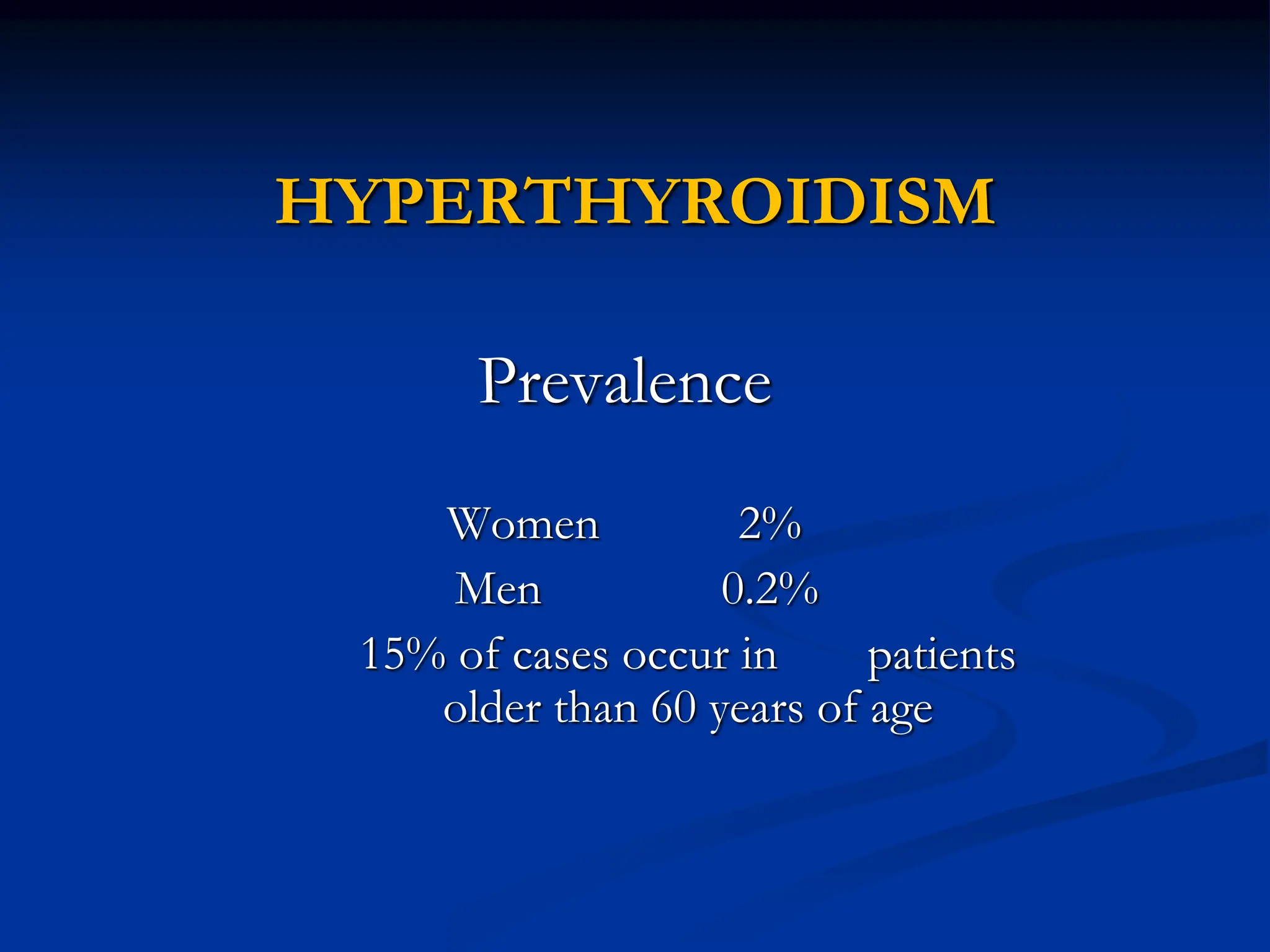
Prevalence
Women 2%
Men 0.2%
15% of cases occur in patients
older than 60 years of age
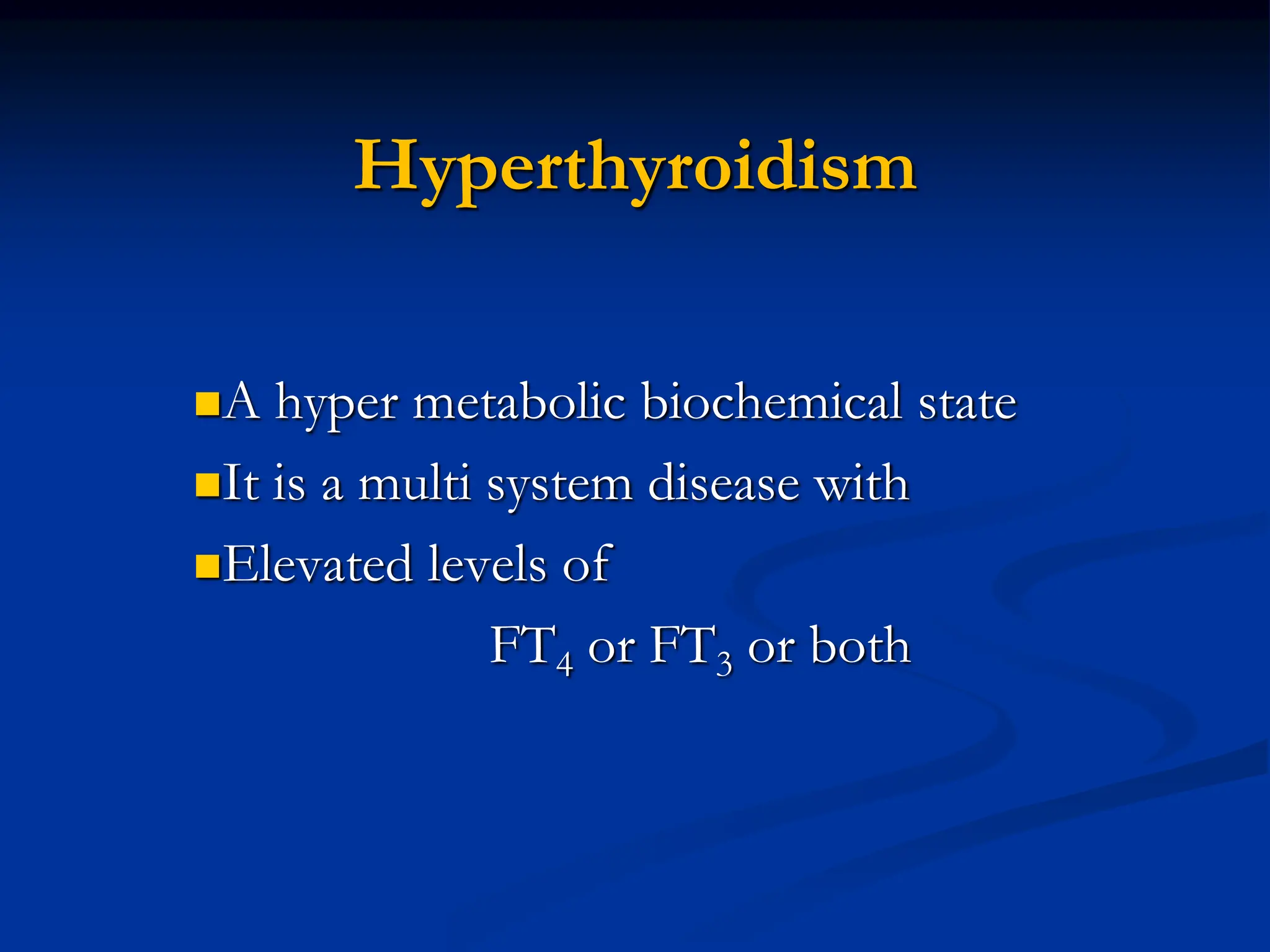
A hyper metabolic biochemical state
It is a multi system disease with
Elevated levels of
FT4 or FT3 or both
Hyperthyroidism
1. Graves Disease – Diffuse Toxic Goiter
2. Plummer’s Disease – Toxic MNG
3. Toxic phase of Sub Acute Thyroiditis - SAT
4. Toxic Single Adenoma – STA
5. Pituitary Tumours – excess TSH
6. Molar pregnancy & Choriocarcinoma (↑↑ βHCG)
7. Metastatic thyroid cancers (functioning)
8. Struma Ovarii (Dermoid and Ovarian tumors)
9. Thyrotoxicosis Factitia; INF, Amiodarone, SSRIs
Causes of Hyperthyroidism
Causes of Thyrotoxicosis
Divided by Degree of Radioiodine Uptake
High I123 Uptake
Graves’ disease
Toxic nodular goiter
TSH-mediated thyrotoxicosis
Pituitary tumor
Pituitary resistance to
thyroid hormone
HCG-mediated thyrotoxicosis
Hydatidiform mole
Choriocarcinoma
Other HCG-secreting tumors
Thyroid carcinoma (very rare)
I123
Low I123 Uptake
Subacute thyroiditis
Hashimototoxicosis
Drug-induced
Iodide
Thyroid hormone
Struma ovarii
Factitious
I123
1 - Grave’s disease
 Autoimmune disease caused by antibodies to TSH
receptors
 Can be familial and associated with other
autoimmune diseases
2 - Toxic multi-nodular goiter
 - 5% of all cases
 - 10 times more common in iodine-deficient area
Typically occurs in older than 40 with long
standing goiter
Etiology
Etiology
3 - Toxic adenoma
 More common in young patients
 Autonomically functioning nodule
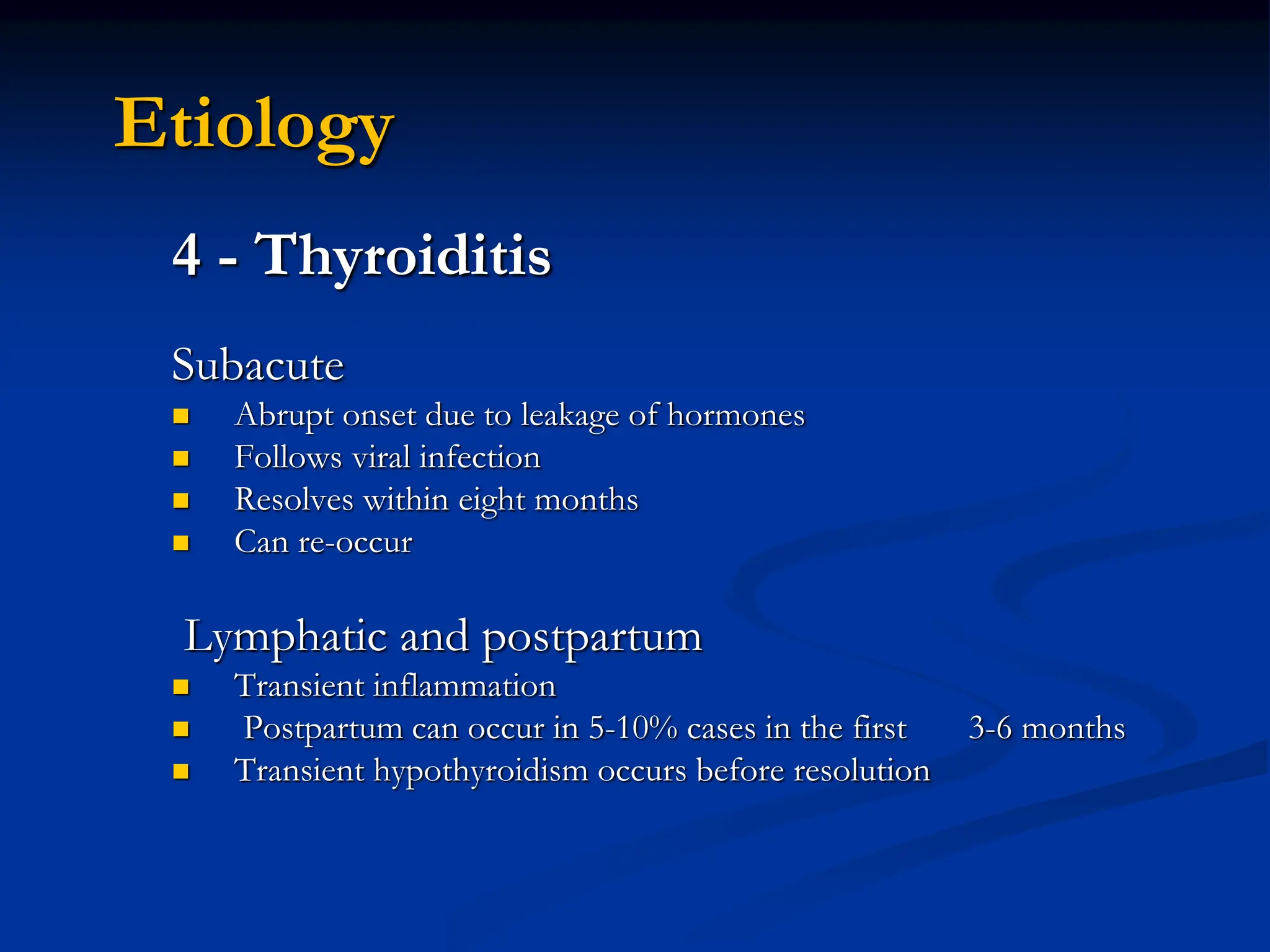
4 - Thyroiditis
Subacute
 Abrupt onset due to leakage of hormones
 Follows viral infection
 Resolves within eight months
 Can re-occur
Lymphatic and postpartum
 Transient inflammation
 Postpartum can occur in 5-10% cases in the first 3-6 months
 Transient hypothyroidism occurs before resolution
Etiology
5 - Treatment-Induced Hyperthyroidism
A- Iodine Induced
 Excess iodine indirect
 Exposure to radiographic contrast media
 Medication
Excess iodine increases synthesis and release of thyroid
hormone in iodine deficient and older patients with
pre-existing goiters
Etiology
B - Amiodarone (cordaron) Induced
Thyroiditis
 Up to 12% of patients, especially in iodine-deficient cases
 Two types:
*Type I - due to excess iodine Amiodarone contains
37% iodine.
*Type II –– occurs in normal thyroid due to thyroiditis
induced by cordaron
Etiology
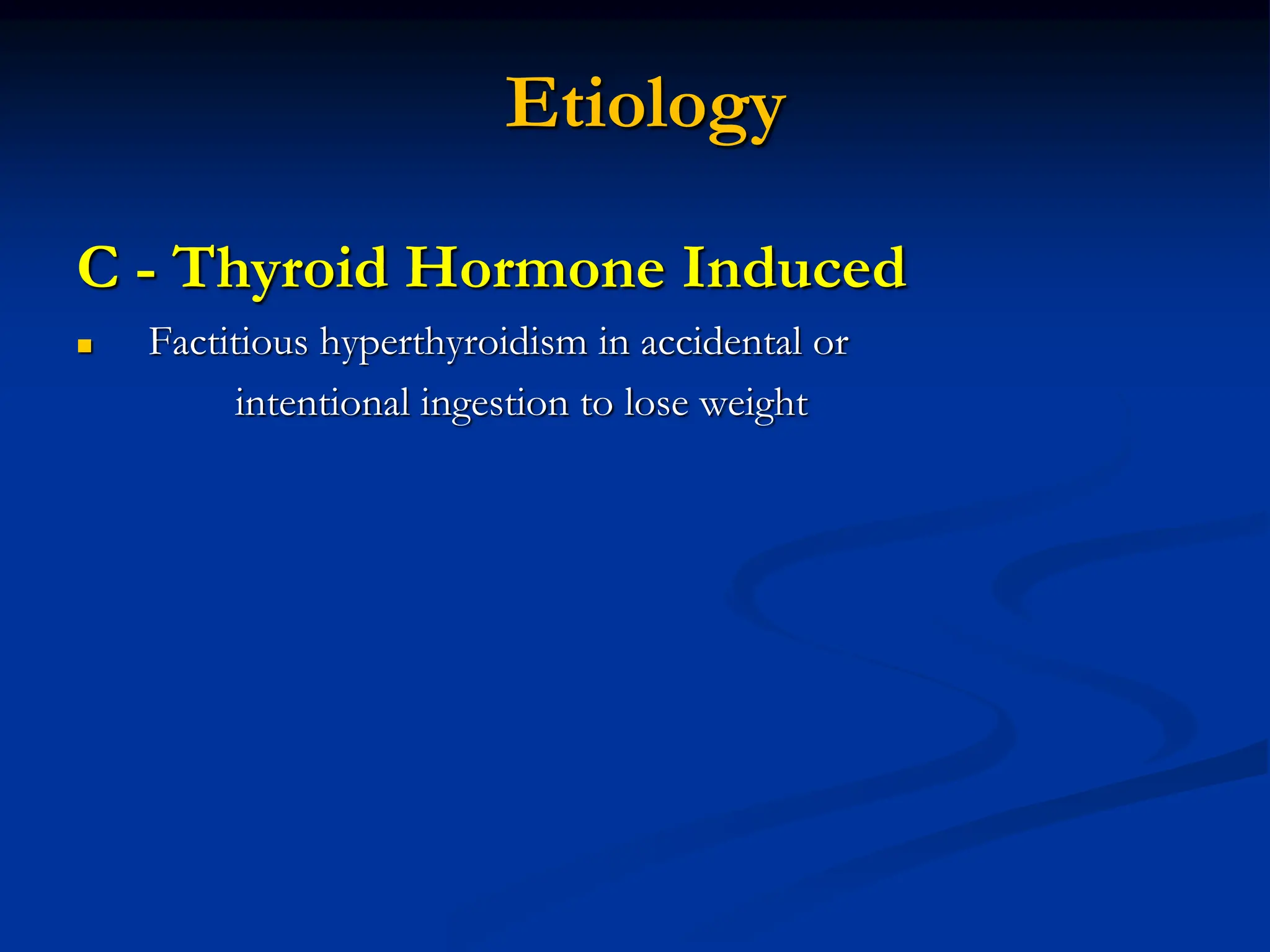
C - Thyroid Hormone Induced
 Factitious hyperthyroidism in accidental or
intentional ingestion to lose weight
Etiology
Etiology
6 - Tumors
-Metastatic thyroid cancer
-Ovarian tumor that produces thyroid
hormone (struma ovarii)
-Trophoblastic tumor
-TSH secreting tumor
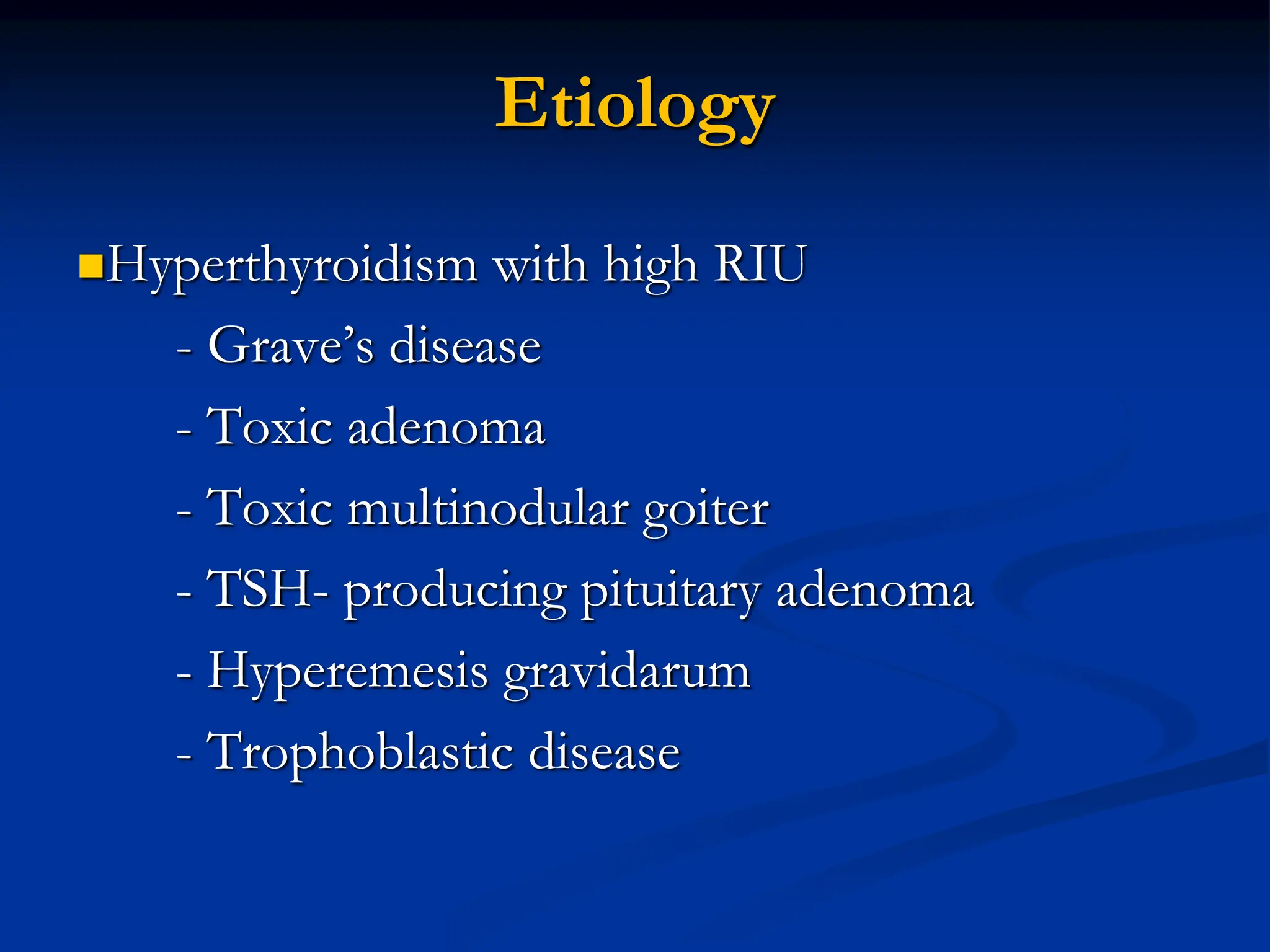
Hyperthyroidism with high RIU
- Grave’s disease
- Toxic adenoma
- Toxic multinodular goiter
- TSH- producing pituitary adenoma
- Hyperemesis gravidarum
- Trophoblastic disease
Etiology
Hyperthyroidism with low RIU
- Subacute thyroiditis
- Exogenous hormone intake
- Ectopic ovarii
- Metastatic follicular thyroid CA
- Radiation thyroiditis
- palpation thyroiditis
- Amiodarone induced
Etiology
Causes:
Persistent
1. Graves’ disease
2. Toxic multinodular goiter
3. Toxic solitary adenoma
4. Central (pituitary origin)
THYROTOXICOSIS
Causes:
Transient
1. Neonatal thyrotoxicosis
2. Infectious : Acute & subacute thyroiditis
3. Drug – induced: Amiodarone, interferon
&interleukin
4. Iatrogenic
5. Post-partum
6. Metastatic follicular carcinoma
THYROTOXICOSIS
Graves’ Disease
 Most common form of thyrotoxicosis (50-60%).
 May occur at any age but mostly from 20-40
 5 times more common in females than in males
 Syndrome consists of one or more of the following:
 Thyrotoxicosis
 Goitre
 Opthalmopathy (exopthalmos) and
 Dermopathy (pretibial myxedema)
 It is an autoimmune disease of unknown cause
 15% of pts with Graves’ have a close relative with the
same disorder
Organ specific auto-immune disease
The most important autoantibody is
 Thyroid Stimulating Immunoglobulin (TSI) or TSA
 TSI acts as proxy to TSH and stimulates T4 and T3
 Anti thyro peroxidase (anti-TPO) antibodies
 Anti thyro globulin (anti-TG)
Graves Disease
Pathogenesis
T-cell dependent autoimmune disease
Autoimmune disorder that results in production
of antibodies directed against thyroid antigens:
TSH receptors
Thyroglobulin
Thyroid peroxidase
Graves' disease (diffuse toxic goitre)
Graves’ Disease
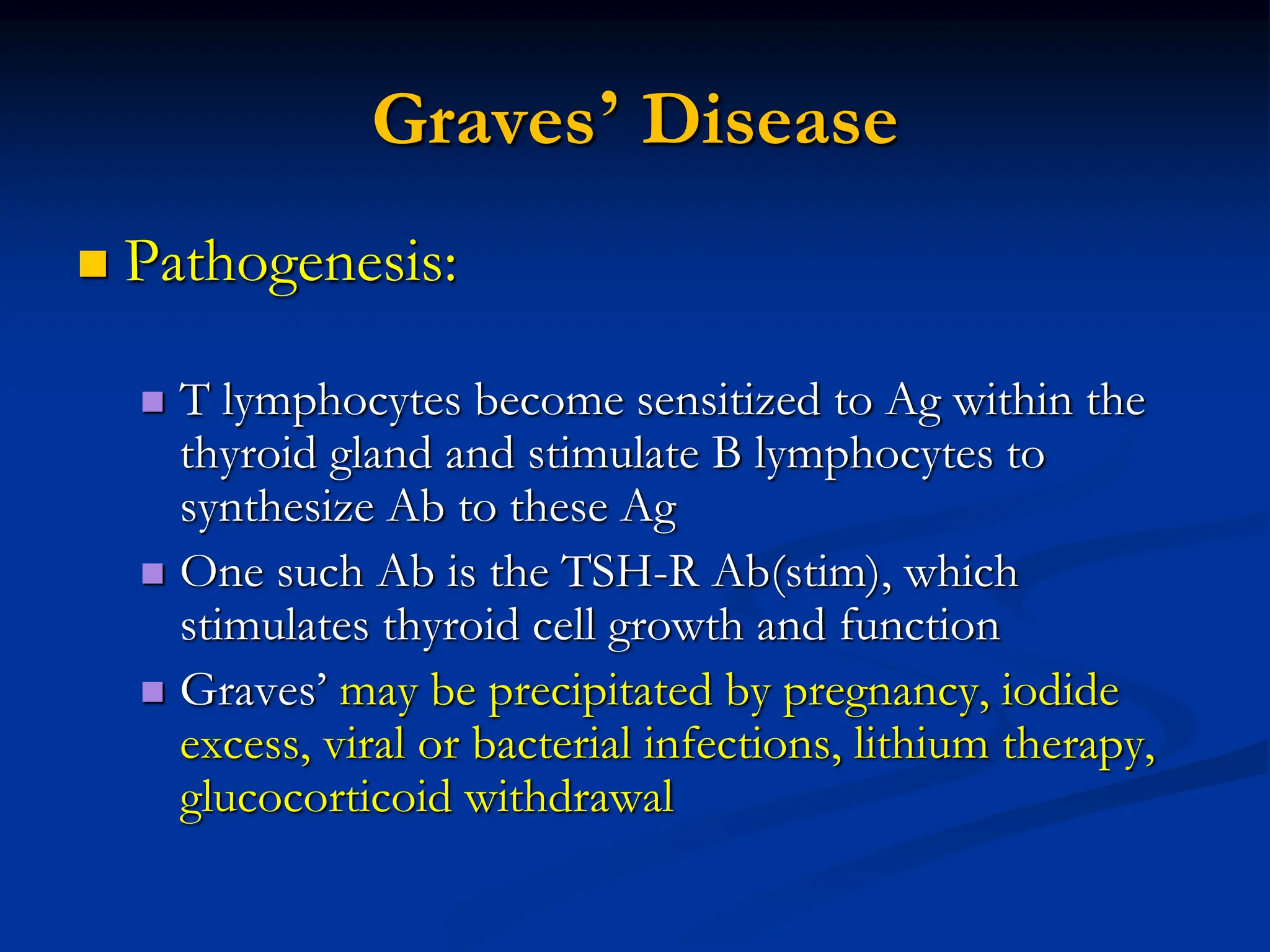
 Pathogenesis:
 T lymphocytes become sensitized to Ag within the
thyroid gland and stimulate B lymphocytes to
synthesize Ab to these Ag
 One such Ab is the TSH-R Ab(stim), which
stimulates thyroid cell growth and function
 Graves’ may be precipitated by pregnancy, iodide
excess, viral or bacterial infections, lithium therapy,
glucocorticoid withdrawal
Graves’ Disease
 Pathogenesis :
 The opthalmopathy and dermopathy associated with
Graves’ may involve lymphocyte cytokine stimulation of
fibroblasts in these locations causing an inflammatory
response that leads to edema, lymphocytic infiltration,
and glycosaminoglycans deposition
 The tachycardia, tremor, sweating, lid lag, and stare in
Graves’ is due to hyperreactivity to catecholamines and
not due to increased levels of circulating catecholamines
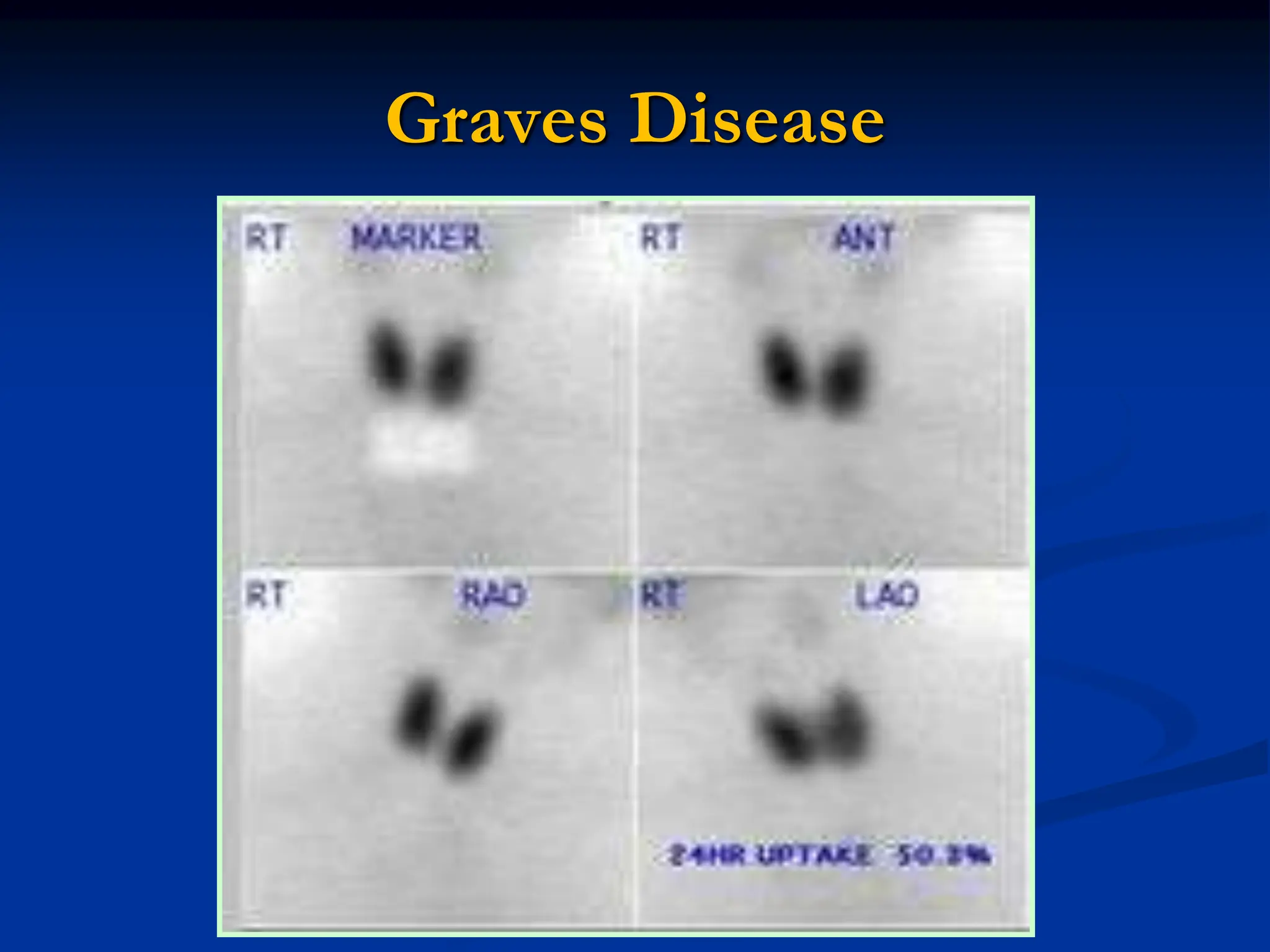
Graves Disease
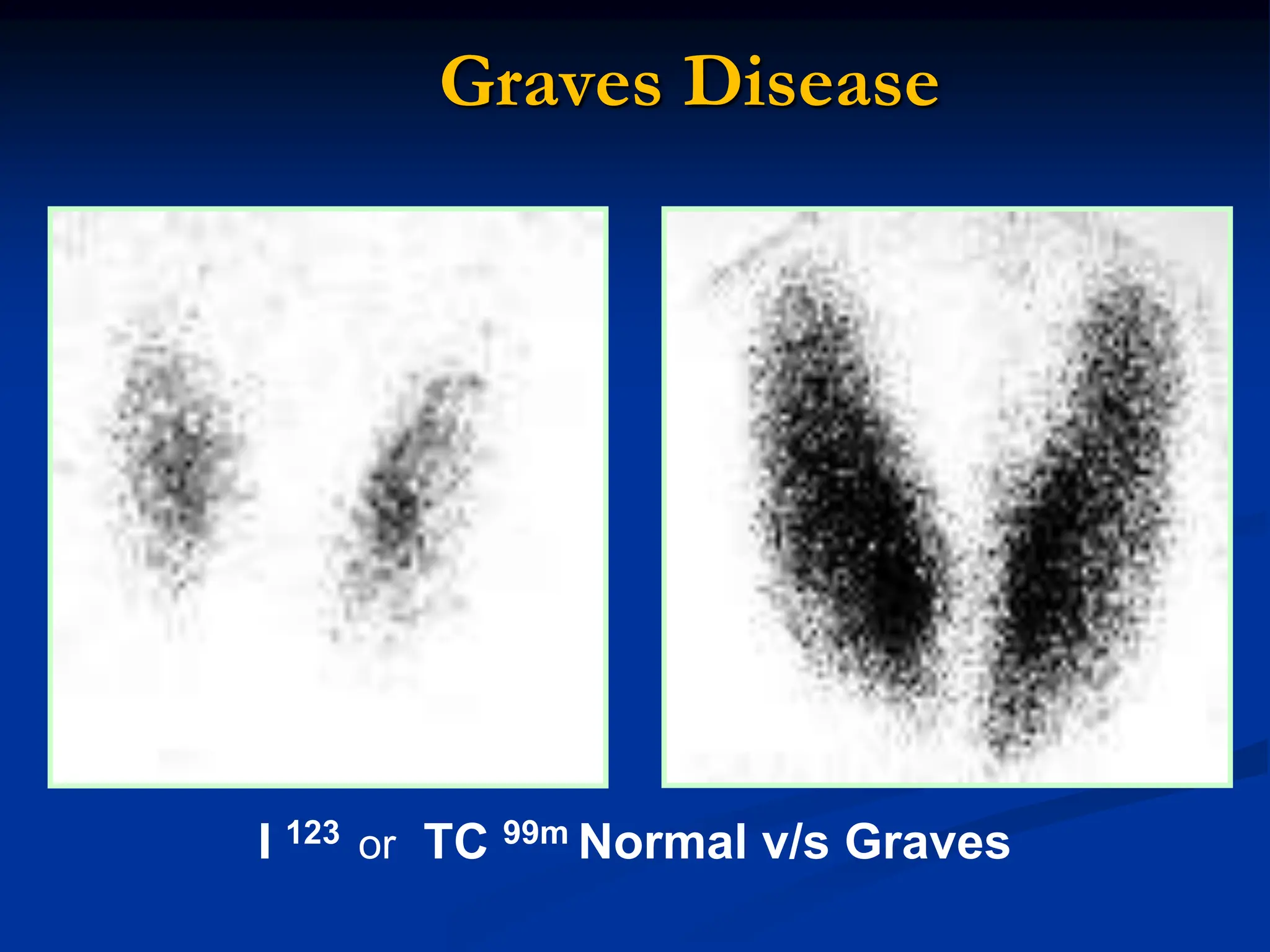
I 123 or TC 99m Normal v/s Graves
Graves Disease
Robert James Graves – in
the English-speaking world
Carl Adolph von Basedow - in
continental Europe
Diffuse Toxic Goiter
TMG is the next most common hyperthyroidism - 20%
More common in elderly individuals – long standing goiter
Lumpy bumpy thyroid gland
Milder manifestations (apathetic hyperthyroidism)
Mild elevation of FT4 and FT3
Progresses slowly over time
Clinically multiple firm nodules (called Plummer’s disease)
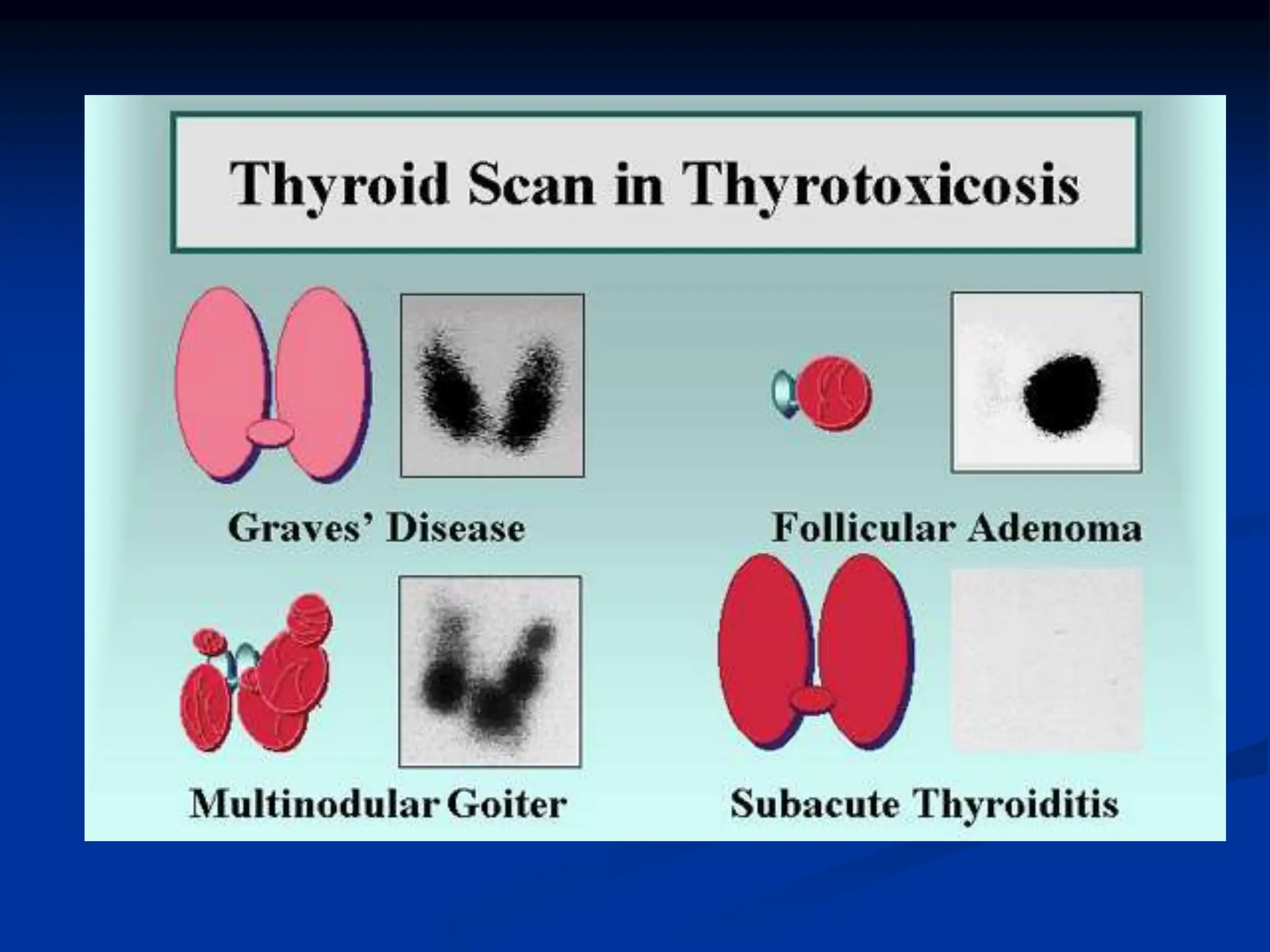
Scintigraphy shows - hot and normal areas
Toxic Multinodular Goiter
(TMG)
Toxic Multinodular Goiter
(TMG)
Toxic Multinodular Goiter
(TMG)
Goiter
SAT is the next most common hyperthyroidism – 15%
T4 and T3 are extremely elevated in this condition
Immune destruction of thyroid due to viral infection
Destructive release of preformed thyroid hormone
Thyroid gland is painful and tender on palpation
Nuclear Scintigraphy scan - no RIU in the gland
Treatment is NSAIDs and Corticosteroids
Sub Acute Thyroiditis (SAT)
TSA is a single hyper functioning follicular thyroid adenoma.
Benign monoclonal tumor that usually is larger than 2.5 cm
It is the cause in 5% of patients who are thyrotoxic
Nuclear Scintigraphy scan shows only a single hot nodule
TSH is suppressed by excess of thyroxines
So the rest of the thyroid gland is suppressed
Toxic Single Adenoma (TSA)
Nucleotide Scintigraphy
Diagnosis of Graves Disease
TSH , free T4 
Thyroid auto antibodies
Nuclear thyroid scintigraphy
(I123, Te99)
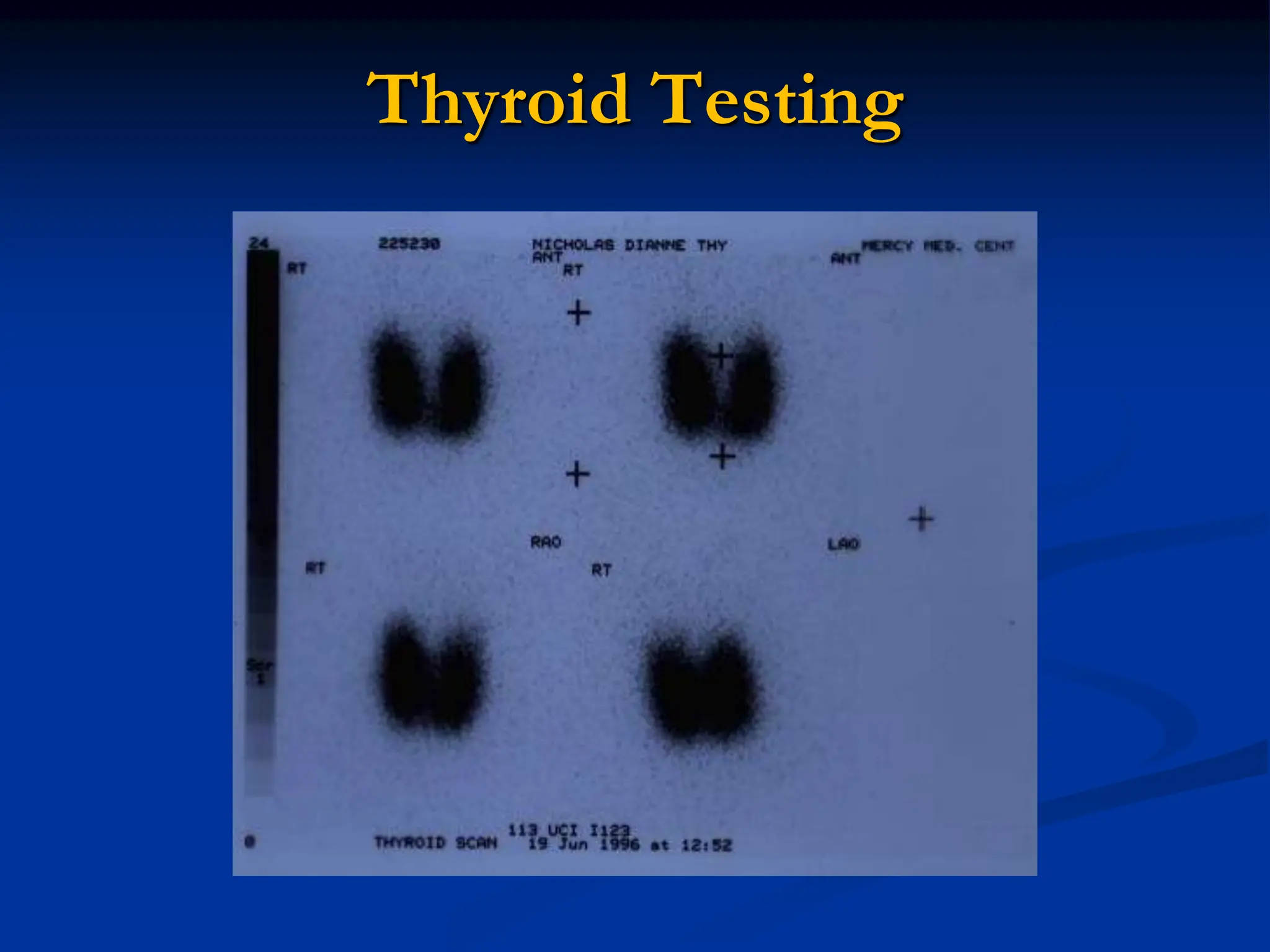
Thyroid Testing
Thyroid Testing
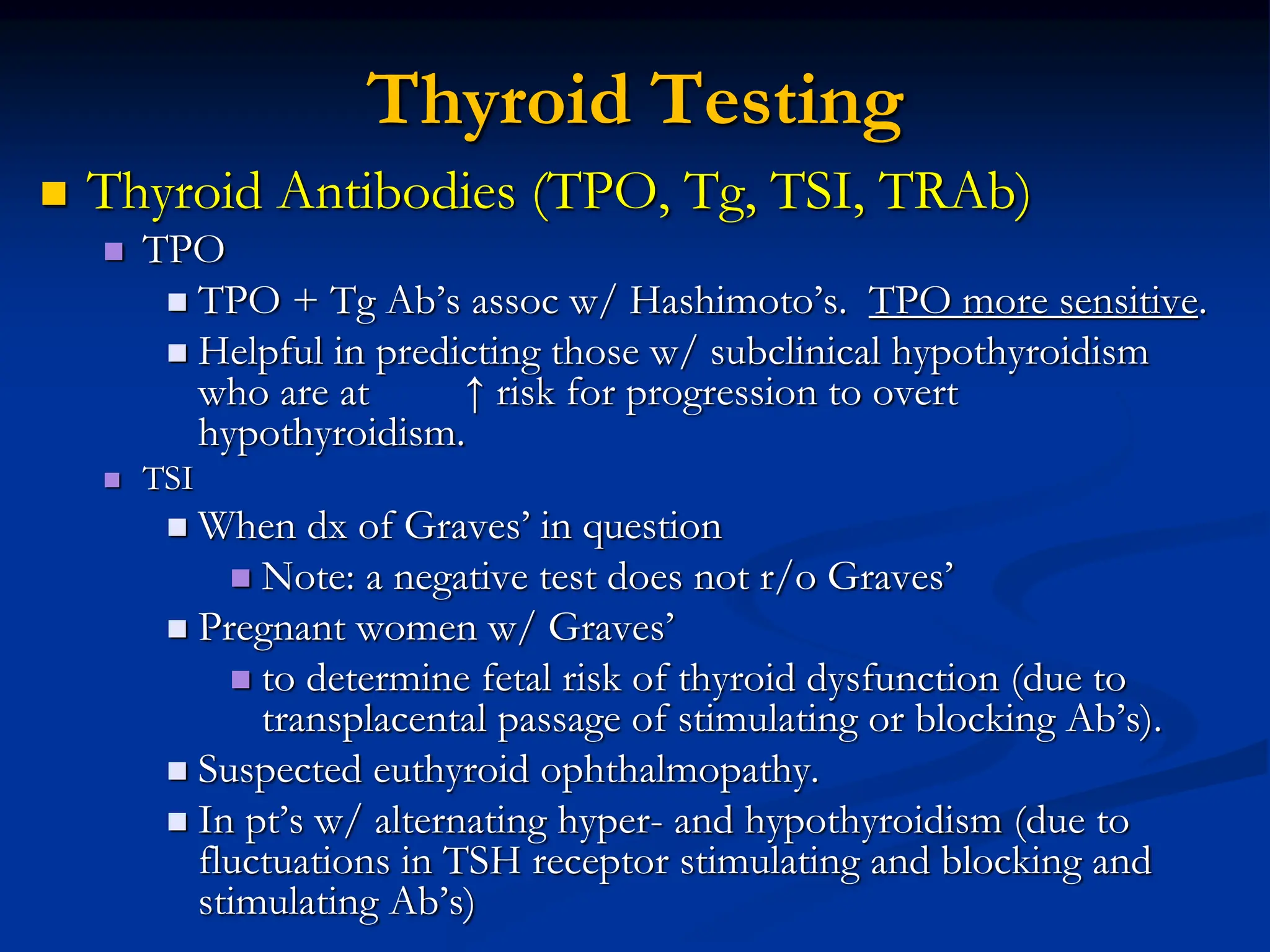
 Thyroid Antibodies (TPO, Tg, TSI, TRAb)
 TPO
 TPO + Tg Ab’s assoc w/ Hashimoto’s. TPO more sensitive.
 Helpful in predicting those w/ subclinical hypothyroidism
who are at ↑ risk for progression to overt
hypothyroidism.
 TSI
 When dx of Graves’ in question
 Note: a negative test does not r/o Graves’
 Pregnant women w/ Graves’
 to determine fetal risk of thyroid dysfunction (due to
transplacental passage of stimulating or blocking Ab’s).
 Suspected euthyroid ophthalmopathy.
 In pt’s w/ alternating hyper- and hypothyroidism (due to
fluctuations in TSH receptor stimulating and blocking and
stimulating Ab’s)
Thyroid Testing
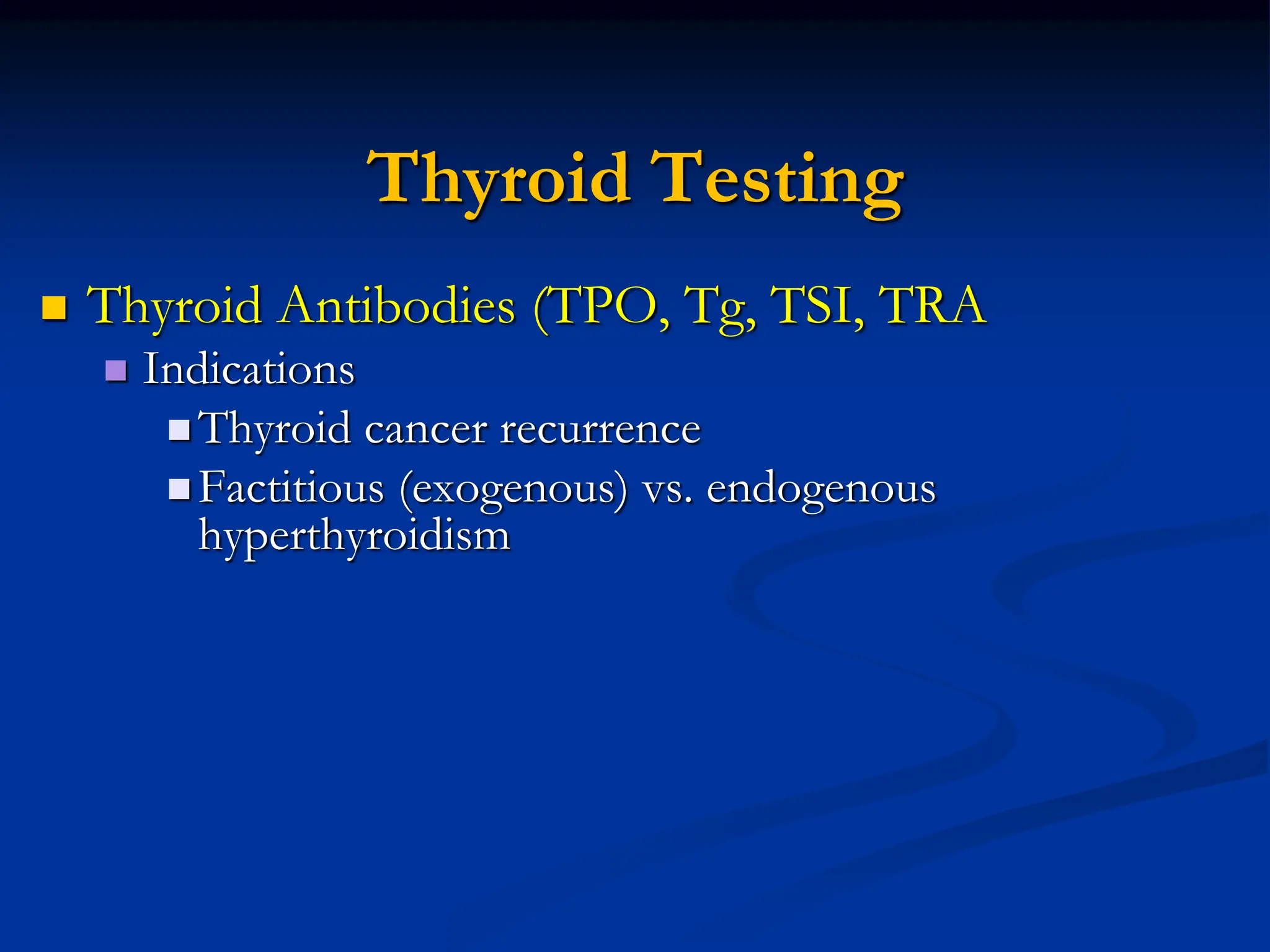
 Thyroid Antibodies (TPO, Tg, TSI, TRA
 Indications
 Thyroid cancer recurrence
 Factitious (exogenous) vs. endogenous
hyperthyroidism
Imaging Studies
40
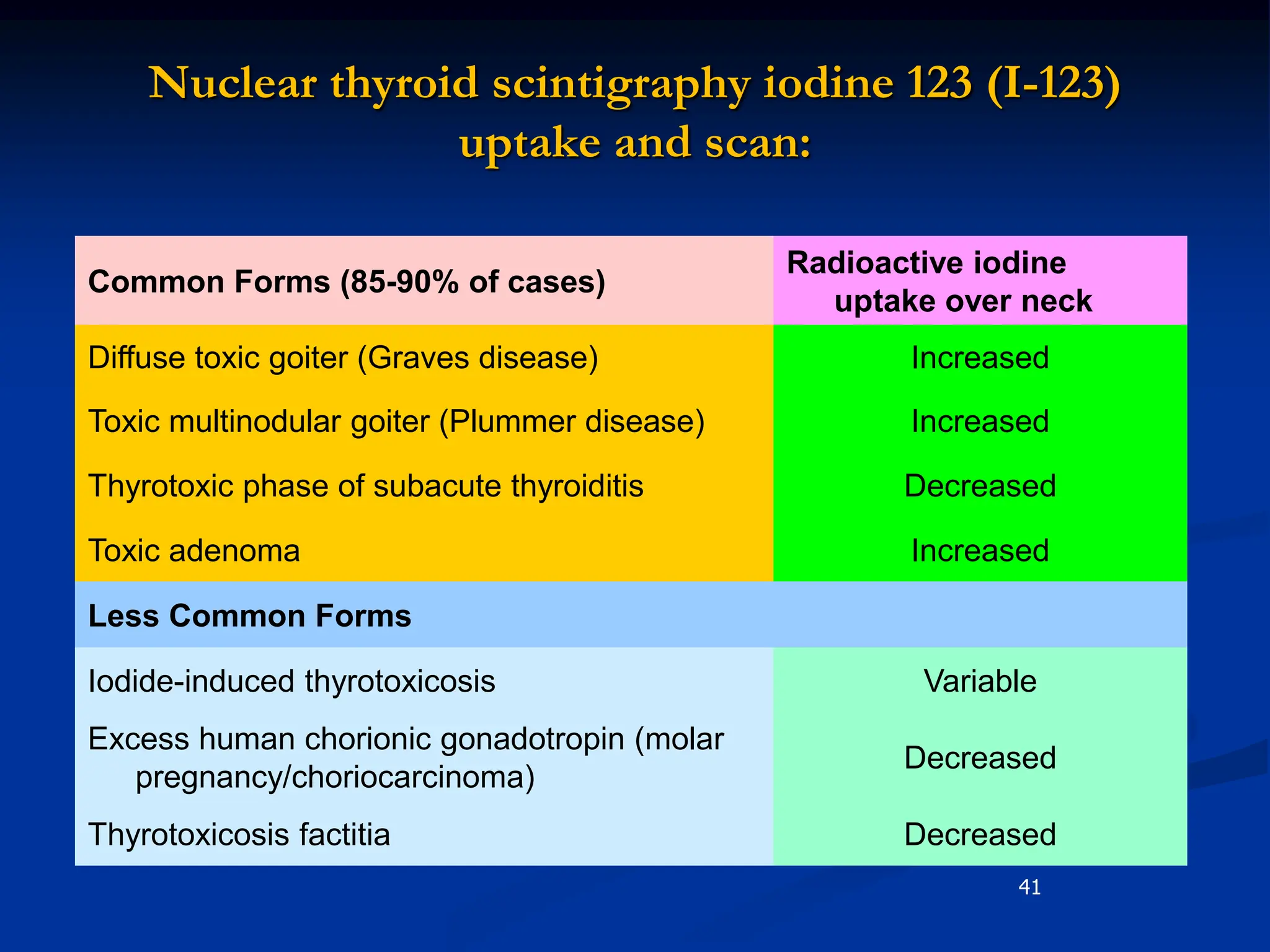
Nuclear thyroid scintigraphy iodine 123 (I-123)
uptake and scan:
Common Forms (85-90% of cases)
Radioactive iodine
uptake over neck
Diffuse toxic goiter (Graves disease) Increased
Toxic multinodular goiter (Plummer disease) Increased
Thyrotoxic phase of subacute thyroiditis Decreased
Toxic adenoma Increased
Less Common Forms
Iodide-induced thyrotoxicosis Variable
Excess human chorionic gonadotropin (molar
pregnancy/choriocarcinoma)
Decreased
Thyrotoxicosis factitia Decreased
41
Clinical Symptoms
Depends on
 Age of patient
 Magnitude of hormonal excess
 Presence of co-morbid condition
1. Catabolism
2. Enhancement of sensitivity to
catecholamines
Mechanism of Clinical Symptoms
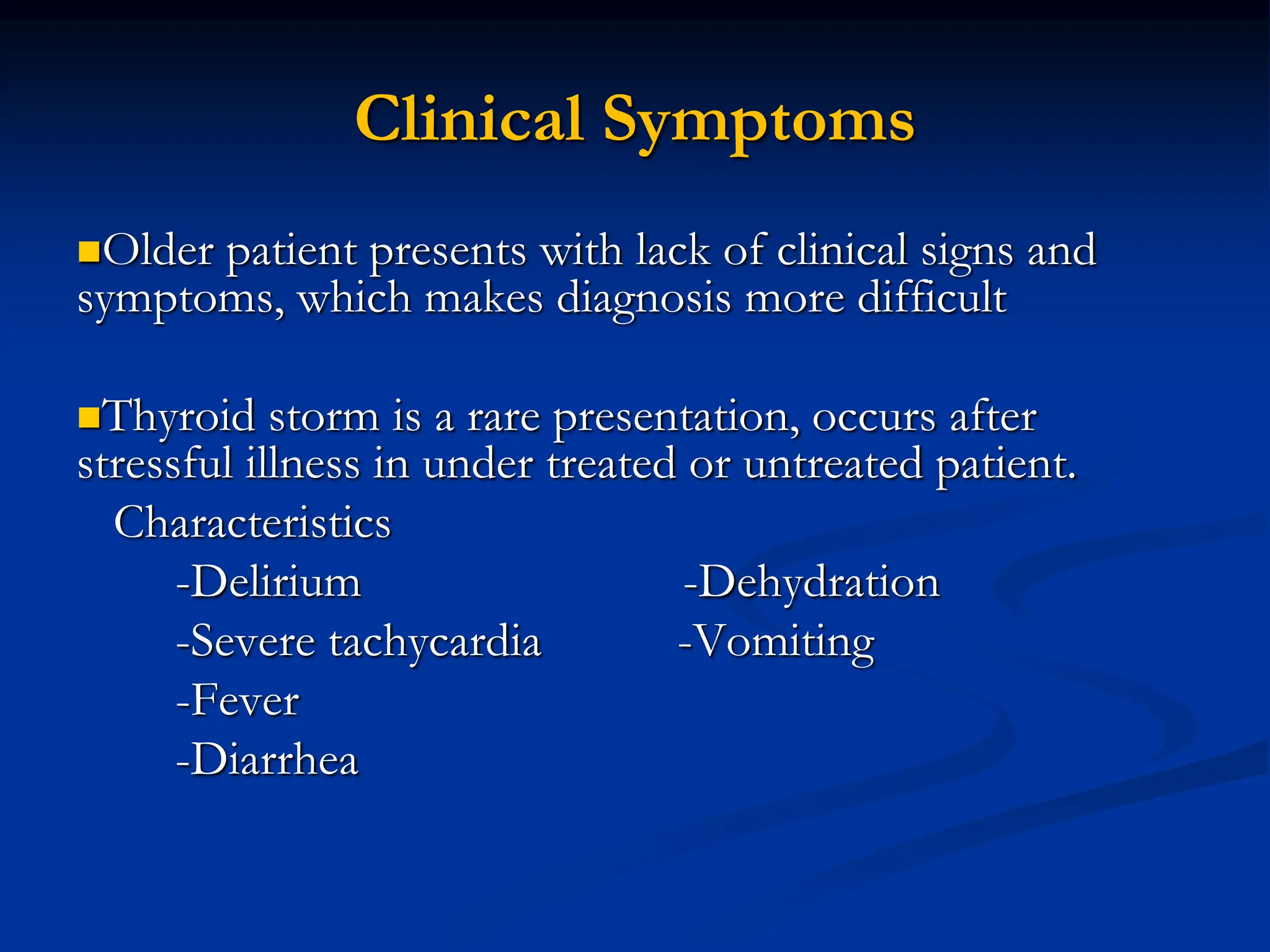
Older patient presents with lack of clinical signs and
symptoms, which makes diagnosis more difficult
Thyroid storm is a rare presentation, occurs after
stressful illness in under treated or untreated patient.
Characteristics
-Delirium -Dehydration
-Severe tachycardia -Vomiting
-Fever
-Diarrhea
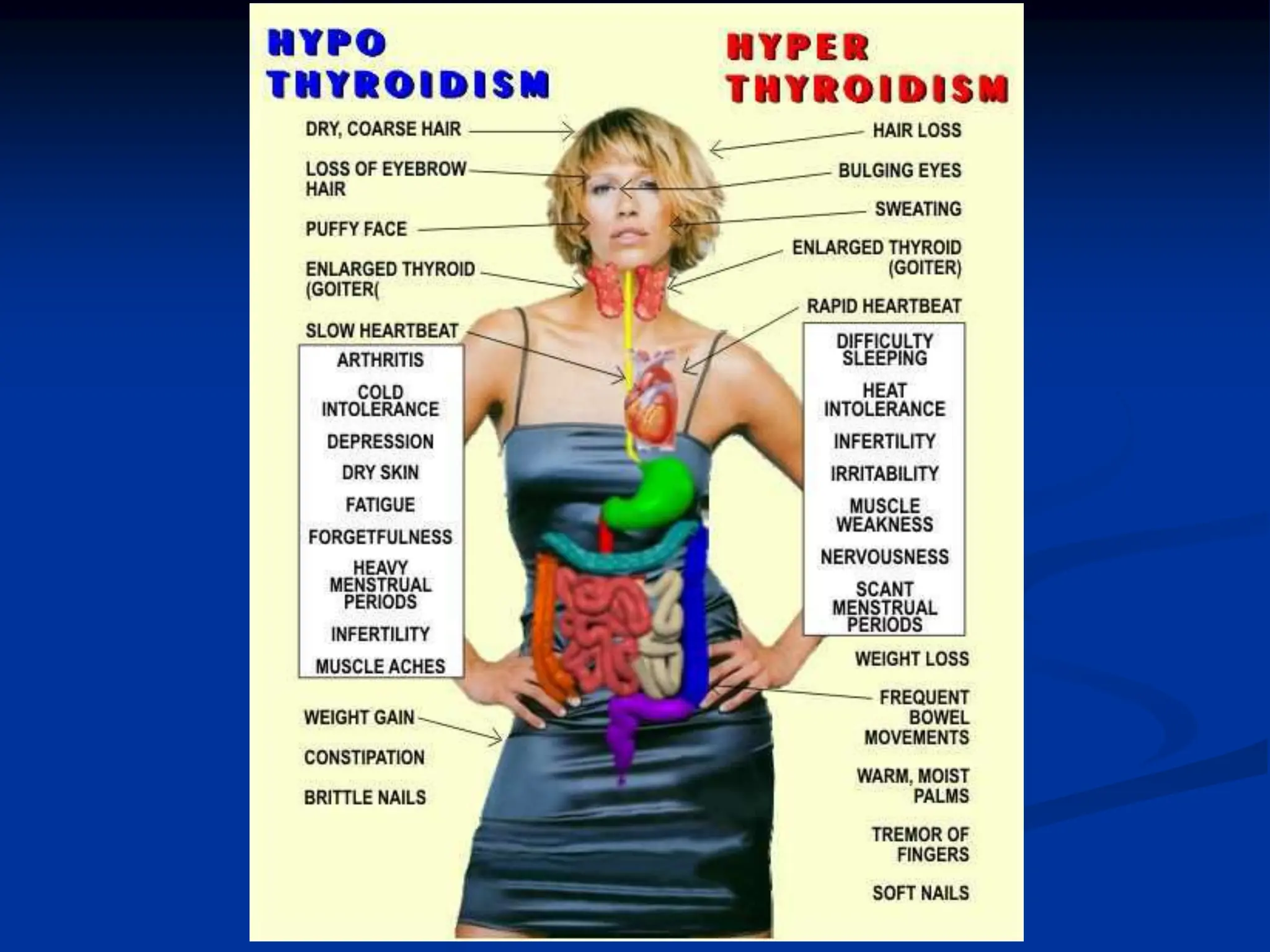
Clinical Symptoms
1. Those that occur with any type of
thyrotoxicosis
2. Those that are specific to Graves disease
3. Non specific changes of hyper metabolism
Clinical Features
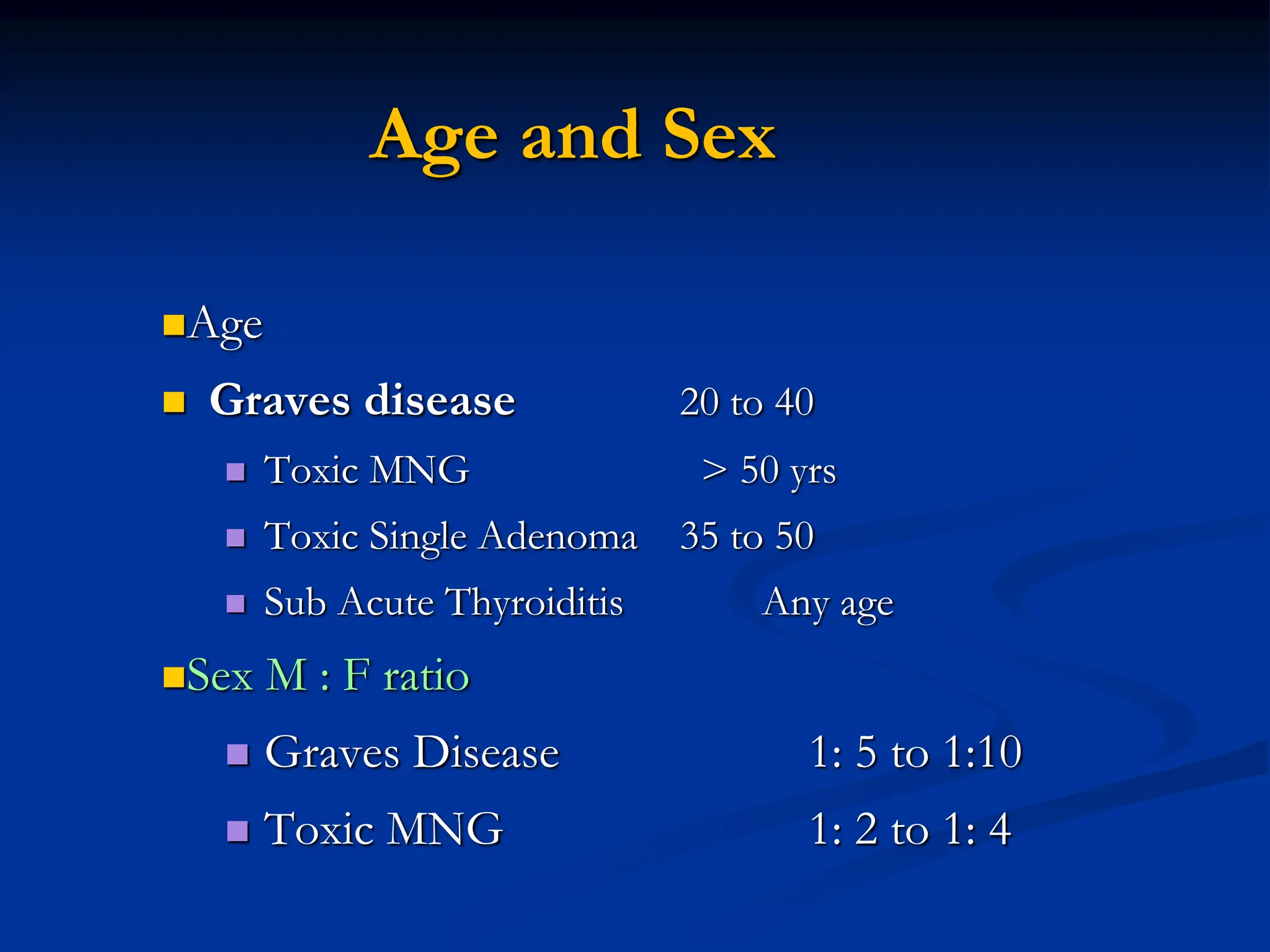
Age
 Graves disease 20 to 40
 Toxic MNG > 50 yrs
 Toxic Single Adenoma 35 to 50
 Sub Acute Thyroiditis Any age
Sex M : F ratio
 Graves Disease 1: 5 to 1:10
 Toxic MNG 1: 2 to 1: 4
Age and Sex
1. Nervousness
2. Anxiety
3. Increased perspiration
4. Heat intolerance
5. Tremor
6. Hyperactivity
7. Palpitations in basal conditions
8. Weight loss despite increased appetite
9. Reduction in menstrual flow or oligo-menorrhea
Common Symptoms
1. Hyperactivity, Hyper kinesis
2. Sinus tachycardia or atrial arrhythmia, AF, CHF
3. Systolic hypertension, wide pulse pressure
4. Warm, moist, soft and smooth skin- warm handshake
5. Excessive perspiration, palmar erythema, Onycholysis
6. Lid lag and stare (sympathetic over activity)
7. Fine tremor of out stretched hands – format's sign
8. Large muscle weakness, Diarrhea, Gynecomastia
Common Signs
1. Diffuse painless and firm enlargement of
thyroid gland
2. Thyroid bruit is audible with the bell of stethoscope
3. Ophthalmopathy – Eye manifestations – 50% of
cases
 Sand in eyes, periorbital edema, conjunctival edema (chemosis), poor lid closure,
extraocular muscle dysfunction, diplopia, pain on eye movements and proptosis.
4. Dermoacropathy – Skin/limb manifestations – 20%
of cases
 Deposition of glycosamino glycans in the dermis of the lower leg –
non pitting edema, associated with erythema and thickening of the
skin, without pain or pruritus - called (pre tibial myxedema)
Specific to Graves Disease
Huge toxic goiter in a male
Graves’ Disease
 Clinical features:
 I Eye features: Classes 0-6, mnemonic “NO SPECS”
 Class 0: No signs or symptoms
 Class 1: Only signs (lid retraction, stare, lid lag), no symptoms
 Class 2: Soft tissue involvement (periorbital edema, congestion
or redness of the conjunctiva, and chemosis)
 Class 3: Proptosis (measured with Hertel exopthalmometer)
 Class 4: Extraocular muscle involvement
 Class 5: Corneal involvement
 Class 6: Sight loss (optic nerve involvement)
Exophthalmos even under anaethesia
Huge Grave’s Disease
Graves’ Disease
 Clinical features:
 II Goitre:
 Diffuse enlargement of thyroid
 Bruit may be present
 III Thyroid dermopathy (pretibial myxedema):
 Thickening of the skin especially over the lower tibia
 The dermopathy may involve the entire leg and may extend
onto the feet
 Skin cannot be picked up between the fingers
 Rare, occurs in 2-3% of patients
 Usually associated with opthalmopathy and very hTSH-R Ab
Graves’ Disease
 Clinical features:
 IV Heat intolerance
 V Cardiovascular:
 Palpitation, Atrial fibrillation
 CHF, dyspnea, angina
 VI Gastrointestinal:
 Weight loss, happetite
 Diarrhea
 VII Reproductive:
 amenorrhea, oligo-
menorrhea, infertility
 Gynecomastia
 VIII Bone:
 Osteoporosis
 Thyroid acropachy
 IX Neuromuscular:
 Nervousness, tremor
 Emotional lability
 Proximal myopathy
 Myasthenia gravis
 Hyper-reflexia, clonus
 Periodic hypokalemic
paralysis
 X Skin:
 Pruritus
 Onycholysis
 Vitiligo, hair thinning
 Palmar erythema
 Spider nevi
Clinical Characteristics of Goiter in
Graves’ Disease
Diffuse increase in thyroid gland size
Soft to slightly firm
Non-nodular
Bruit and/or thrill
Mobile
Non-tender
Without prominent adenopathy
Toxic multinodular goiter causes 5 percent of the cases
of hyperthyroidism in the United States.
It typically occurs in patients older than 40 years with a
long-standing goiter.
Toxic adenoma
Toxic adenomas are autonomously functioning
nodules that are found most commonly in younger
patients and in iodine-deficient areas.
60
Toxic multinodular goiter
Toxic Adenoma
(Plummer’s Disease)
 This is a functioning thyroid adenoma
 Typical pt is an older person (usually > 40) who has noted recent
growth of a long-standing thyroid nodule
 Thyrotoxic symptoms are present but no infiltrative
opthalmopathy. PE reveals a nodule on one side
 Lab: low TSH, high T3, slightly high T4
 Thyroid scan reveals “hot” nodule with suppressed uptake in
contralateral lobe
 Toxic adenomas are almost always follicular adenomas and
almost never malignant
 Treatment: same as for Grave’s disease
Higher grades of Goiter
Toxic MNG (Diffuse) Graves
MNG and Graves
Huge Toxic MNG Diffuse Graves Thyroid
Grade IV Toxic MNG
Huge Toxic MNG Huge Toxic MNG
Right lobe
Subacute Thyroiditis
 Acute inflammatory disorder of the thyroid gland most likely due
to viral infection. Usually resolves over weeks or months.
 Symptoms & Signs:
 Fever, malaise, and soreness in the neck
 Initially, the patient may have symptoms of hyperthyroidism
with palpitations, agitation, and sweat
 PE: No opthalmopathy, Thyroid gland is exquisitely tender
with no signs of local redness or heat suggestive of abscess
formation
 Signs of thyrotoxicosis like tachycardia and tremor may be
present
Subacute thyroiditis
Soreness in the neck.
It often follows a viral illness.
Symptoms usually resolve within one year.
This condition can be recurrent in some patients.
ESR is markedly elevated.
67
Subacute Thyroiditis
 Acute inflammatory disorder of the thyroid gland most likely due
to viral infection. Usually resolves over weeks or months.
 Lab:
 Initially, T4 & T3 are elevated and TSH is low, but as the
disease progresses T4 & T3 will drop and TSH will rise
 RAI uptake initially is low but as the pt recovers the uptake
increases
 ESR may be as high as 100. Thyroid Ab are usually not
detectable in serum
Subacute thyroiditis
Time course of changes in thyroid function tests in
patients with Subacute thyroiditis.
69
Subacute Thyroiditis
 Management:
 In most cases only symptomatic Rx is necessary e.g.
acetaminophen 0.5g four times daily
 If pain, fever, and malaise are disabling a short
course of NSAID or a glucocorticoid such as
prednisone 20mg three times daily for 7-10 days may
be necessary to reduce the inflammation
 L-thyroxine is indicated during the hypothyroid
phase of the illness. 10% of the patients will require
L-thyroxine long term
Other Forms of Thyrotoxicosis
 Thyrotoxicosis Factitia:
 Due to ingestion of excessive amounts of
thyroxine
 RAI uptake is nil and serum thyroglobulin is low
 Struma Ovarii:
 Teratoma of the ovary with thyroid tissue that
becomes hyperactive
 No goitre or eye signs. RAI uptake in neck is nil
but body scan reveals uptake of RAI in the pelvis.
Other Forms of Thyrotoxicosis
 Hydatidiform mole:
 Chorionic gonadotropin is produced which has
intrinsic TSH-like activity.
 TSH-secreting pituitary adenoma:
 FT4 & FT3 is elevated but TSH is normal or
elevated
 Visual field examination may reveal temporal
defects, and CT or MRI of the sella usually
reveals a pituitary tumour.
Amiodarone- (Cordarone-) induced hyperthyroidism can be
found in up to 12 percent of treated patients.
Type I - Because amiodarone contains 37 percent iodine, is an
iodine induced hyperthyroidism.
Type II is a thyroiditis that occurs in patients with normal
thyroid glands.
Medications such as interferon and interleukin-2 also can cause
type II.
73
Amiodarone-induced
Factitial hyperthyroidism is caused by the
intentional or accidental ingestion of excess
amounts of thyroid hormone.
Some patients may take thyroid preparations
to achieve weight loss.
74
Thyroid hormone-induced
Skin
-Warm
-May be erythematous (due to increased blood flow)
-Smooth- due to decrease in keratin
-Sweaty and heat intolerance
-Onycholysis –softening of nails and loosening
of nail beds
Clinical symptoms
Clinical symptoms
 Hyperpigmentation
-Due the patient increase ACTH secretion
 Pruritis
-mainly in graves disease
 Thinning of hair
 Vitilago and alopecia areata
-mainly due to autoimmune disease
 Infilterative dermopathy
-Graves disease, most common on shins
Clinical symptoms
Eyes
Stare
Lid lag
*Due to sympathetic over activity
*Only Grave’s disease has ophthalmopathy
-Inflammation of extraocular muscles, orbital fat
and connective tissue.
-This results in exopthalmos
-More common in smokers
Clinical symptoms
Eyes
 Impaired eye muscle function (Diplopia)
 Periorbital and conjunctival edema
 Gritty feeling or pain in the eyes
 Corneal ulceration due to lid lag and proptosis
 Optic neuritis and even blindness
Cardiovascular System
Increased cardiac output (due to increased
oxygen demand and increased cardiac
contractibility.
Tachycardia
Widened pulse pressure
High output – heart failure
Clinical symptoms
Cardiovascular System
Atrial fibrillation, 10-20% of patients.
More common in elderly
Atrial ectopy
60% of A-fib will convert to normal sinus rhythm
with treatment (4-months of becoming euthyroid)
Mitral valve problems
LVH and cardiomyopathy
Clinical symptoms
Low total cholesterol
Low HDL
Low total cholesterol/HDL ratio
Serum Lipids
GI System
-Weight loss due to increased calorigenesis
-Hyperdefecation
-Malabsorption
-Steatorrhea
-Celiac Disease (in Grave’s Disease)
-Hyperphagia (weight gain in younger patient)
-Anorexia- weight loss in elderly
-Dysphagia
-Abnormal LFT especially phosphate
Clinical symptoms
Hematological System
Normochromic normocytic anemia
Serum ferritin may be high
Grave’s disese
 ITP
 Pernicious anemia
 Anti-neutrophiliac antibody
Clinical symptoms
GU System
Urinary frequency and nocturia
Enuresis is common in children
Clinical symptoms
GU System : Women
Increased SHBG
High serum estradiol
Low free estradiol
High LH
Reduce mid-cycle LH surge
Oligomenorrhea and amenorrhea
Anovulatory infertility
Clinical symptoms
GU System : Men
High SHBG
High total testosterone
Low free testosterone
High serum LH
High serum estradiol
Gynecomastia
Decreased libido
Erectile dysfunction
Decreased or abnormal sperm
Clinical symptoms
Skeletal System
 Bone resorption
 Increased porosity of cortical bone
 Reduced volume of trabecular bone
 Periosteal bone formation in metacarpal bone or phalanges
 Serum alkaline phosphate is increased
 Increased osteoblasts
 Inhibit PTH secretions
 Decreased calcium absorption and increased excretion
 Osteoporosis, Fractures
Clinical symptoms
Neuromuscular System
Tremors-outstretched hand and tongue
Hyperactive tendon reflexes
Clinical symptoms
The Deep Tendon Reflex in Hyperthyroidism
Normal
Hyperthyroid
TIME
The reflex amplitude is
increased in
hyperthyroidism
Reflex time is also
shortened
evokes the reflex
Hyperactive Deep Tendon Reflexes in Thyrotoxicosis
 Most common cause of hypokalemic periodic paralysis
Flaccid paralysis
 Lower extremities affected most often
 Ocular and bulbar muscles uninvolved,
respiratory muscles rarely involved
 Most often starts during sleep
 Precipitated following exercise, high
salt intake or high carbohydrate diet
 Hypokalemia during the paralysis
Thyrotoxic Periodic Paralysis
Psychiatric
Hyperactivity
Emotional lability
Anxiety
Decreased concentration
Insomnia
Clinical symptoms
Muscle Weakness
Proximal muscle weakness in 50% pts.
Decreased muscle mass and strength
May take up to six months after euthyroid state
to gain strength
Hypokelemic periodic paralysis especially in
Asian men (cause is not known)
Myesthenia Gravis, especially in Grave’s disease.
Clinical symptoms
Endocrine
Increased sensitivity of pancreatic beta cells to
glucose
Increased insulin secretion
Antagonism to peripheral action of insulin
Latter effects usually predominate leading to
intolerance.
Clinical symptoms
 Presenting manifestation (unusual)
 Occurs in 0-83% of patients*
 Onset during thyrotoxicosis
 Disappearance after euthyroidism occurs
Gynecomastia and Thyrotoxicosis
* wide range probably indicates differences in examining
technique
Proptosis
Lid lag
Thyroid Ophthalmopathy
Measurement using prisms
or special ruler
(exophthalmometer)
OR with sclera
seen above iris :
Observing position of lower
lid (sclera seen below iris =
proptosis, lid intersects iris =
lid retraction)
Clinical Differentiation of Lid
Retraction from Proptosis
Normal
position
of eyelids
Proptosis Lid retraction
Lid Lag in Thyrotoxicosis
Normal Lid Lag
Lid lag ( von Graefe’s sign )
Difficulty in convergence (Moebius sign)
Ophthalmopathy in Graves
Periorbital edema and chemosis
Severe Exophthalmia
Graves Disease Eye Signs
N - no signs or symptoms
O – only signs (lid retraction or lag)
no symptoms
S – soft tissue involvement
(peri-orbital oedema)
P – proptosis (>22 mm)(Hertl’s test)
E – extra ocular muscle involvement
(diplopia)
C – corneal involvement (keratitis)
S – sight loss (compression of the
optic nerve)
Thyroid Dermopathy
Pink and skin coloured papules, plaques on the shin
Graves’…Dermopathy
Graves’ Dermopathy
Thyroid Dermopathy
 Thickening and redness of the
dermis
 Due to lymphocytic
infiltration
 Distribution
 Pretibial (93.3%),
 Pretibial+ feet (4.3%),
 Pretibial + UE (1.1%).
Graves’ Dermopathy
Localized plaque on the outer aspect of the skin. Horny form over shin and dorsum of the foot
Clinical Characteristics of
Localized Myxedema
Raised surface
Thick, leathery
consistency
Nodularity, sometimes
Sharply demarcated
margins
Prominent hair follicles
Usually over pretibial area
Non-tender
Graves’ Disease - Localized Myxedema
Margins sharply
demarcated
Thickened skin
Nodularity
Margins sharply
demarcated
Clubbing and
Osteoarthropathy
Thyroid Acropathy
Thyroid Acropachy
Clubbing of fingers
Painless
Periosteal bone formation and
periosteal proliferation
Soft tissue swelling that is pigmented
and hyperkeratotic
Periosteal bone
formation and
periosteal
proliferation
Clubbing of fingers
Onycholysis
Onycholysis of Thyrotoxicosis
Distal separation of the
nail plate from nail bed
(Plummer’s nails)
1. Hyperglycemia, Glycosuria
2. Osteoporosis and hypercalcemia
3. ↓ LDL and Total Cholesterols
4. Atrial fibrillation, LVH, ↑ LV EF
5. Hyper dynamic circulatory state
6. High output heart failure
7. H/o excess Iodine, amiodarone, contrast dyes
Non specific changes
TSH
HIGH
LOW
FT4 Clinical Status
LOW Primary Hypothyroidism, Thyroiditis (stage 3)
NORMAL Subclinical Hypothyroidism
HIGH Pituitary Hyperthyroidism
HIGH Thyrotoxicosis, Thyroiditis (stage 1)
NORMAL Subclinical Hyperthyroidism, Autonomous nodules
LOW Pituitary Hypothyroidism
Overview of Thyroid Function Tests
Differential diagnosis:
 Panic attacks
 Psychosis
 Mania
 Pheochromocytoma
 Hypoglycemia
 Occult malignancy
HYPERTHYROIDISM
1. Typical clinical presentation
2. Markedly suppressed TSH (<0.05 µIU/mL)
3. Elevated FT4 and FT3 (Markedly in Graves)
4. Thyroid antibodies – by Elisa – anti-TPO, TSI
5. ECG to demonstrate cardiac manifestations
6. Nuclear Scintigraphy to differentiate the causes
Diagnosis
Signs and symptoms of hyperthyroid
TSH level
Low TSH High TSH (rare)
Measure T4
High
Secondary
hyperthyroidism
Image pituitary gland
Treatment depends upon
-Cause and severity of disease
-Patients age
-Goiter size
-Comorbid condition
-Treatment desired
Treatment
Anti-thyroid drugs
Radioactive iodine
Surgery
Beta-blocker and iodides are adjuncts to above
treatment
Options
Types:
 Reducing thyroid hormone synthesis:
 Antithyroid drugs (Methimazole, Propylthyouracil)
 Radioiodine (131I)
 Subtotal thyroidectomy
 Reducing Thyroid hormone effects:
 Propranolol
 Glucocorticoids
 Benzodiazepines
 Reducing peripheral conversion of T4 to T3
 Propylthyouracil
 Glucocorticoids
 Iodide (Large oral or IV dosage) (Wolf-Chaikoff effect)
Treatment
Three modalities for more than last 50 years
Radioactive iodine,antithyroid drugs&surgery
None is optimal
None interrupts the autoimmune process
Each has a drawbacks
There is no treatment for underlying cause
No other research options so far
Treatment
Clinical considerations
Age of the patient
Goiter size
Urgency of treatment
RAIU by the thyroid
Physician preference
Patient choice
Treatment choices
Treatment Advantage Disadvantage For who?
I131 Definitive,
Safe
Lifelong T4 Rx
Not suitable for
pregnant or
lactating patient
Most patients
Antithyroid
Drugs
May need
life long
medication
Side effects,
frequent visits,
lower rate of
remission,
compliance
Pre RAI Rx,
Pregnancy,
mild disease
small goiter
Surgery Definitive,
rapid
Side effects,
life long T4 Rx
Toxic nodule,
allergy to
drugs, large
goiter, ? CA
1. Symptom relief medications
2. Anti Thyroid Drugs – ATD
 Methimazole, Carbimazole
 Propylthiouracil (PTU)
3. Radio Active Iodine treatment – RAI Rx.
4. Thyroidectomy – Subtotal or Total
5. NSAIDs and Corticosteroids – for SAT
Treatment Options
1. Rehydration is the first step
2. β – blockers to decrease the sympathetic excess
 Propranalol, Atenelol, Metoprolol
3. Rate limiting CCBs if β – blockers contraindicated
4. Treatment of CHF, Arrhythmias
5. Calcium supplementation
6. Lugol solution for ↓ vascularity of the gland
Symptom Relief
Anti Thyroid Drugs (ATD)
Imp. considerations Methimazole Propylthiouracil
Efficacy Very potent Potent
Duration of action Long acting BID/OD Short acting QID/TID
In pregnancy Contraindicated Safely can be given
Mechanism of action Iodination, Coupling Iodination, Coupling
Conversion of T4 to T3 No action Inhibits conversion
Adverse reactions Rashes, Neutropenia Rashes, ↑Neutropenia
Dosage 20 to 40 mg/ OD PO 100 to 150mg qid PO
They interfere with organification of iodine—
suppress thyroid hormone levels
Two agents:
-Tapazole (methimazole)
-PTU (propylthiauracil)
Anti-thyroid Drugs
Treatment of Grave’s Disease
 A. Medical therapy:
 Antithyroid drug therapy:
 Most useful in patients with small glands and mild disease
 Treatment is usually continued for 12-18 months
 Relapse occurs in 50% of cases
 There are 2 drugs:
 Neomercazole (methimazole or carbimazole): start 30-40mg/D for 1-2m
then reduce to 5-20mg/D.
 Propylthiouracil (PTU): start 100-150mg every 6hrs for 1-2m then
reduce to 50-200 once or twice a day
 Monitor therapy with fT4 and TSH
 S.E.: 5%rash, 0.5%agranulocytosis (fever, sore throat), rare:
cholestatic jaundice, hepatocellular toxicity, angioneurotic edema, acute
arthralgia
Treatment of Grave’s disease
 B. Surgical therapy:
 Total thyroidectomy is the treatment of choice for patients with
very large glands
 The patient is prepared with antithyroid drugs until euthyroid
(about 6 weeks). In addition 2 weeks before the operation
patient is given Lugol’s iodine 5 drops BID to diminish vascularity
of thyroid gland
 Complications (1%):
 Hypoparathyroidism
 Recurrent laryngeal nerve injury
Treatment of Grave’s Disease
 C. Radioactive iodine therapy:
 Preferred treatment in most patients
 Can be administered immediately except in:
 Elderly patients
 Patients with IHD or other medical problems
 Severe thyrotoxicosis
 Large glands >100g
 In above cases it is desirable to achieve euthyroid state first
 Hypothyroidism occurs in over 80% of cases.
 Female should not get pregnant for 6-12m after RAI.
Treatment of Grave’s disease
 A. Medical therapy:
 Propranolol 10-40mg q6hrs to control tachycardia, hypertension
and atrial fibrillation during acute phase of thyrotoxicosis. It is
withdrawn gradually as thyroxine levels return to normal
 Other drugs:
 Ipodate sodium (1g OD): inhibits thyroid hormone synthesis and
release and prevents conversion of T4 to T3
 Cholestyramine 4g TID lowers serum T4 by binding it in the gut
Anti-thyroid Drugs
 Remission rate: 60% when therapy continued
for two years
 Relapse in 50% of cases.
 Relapse more common in
-smokers
-elevated TS antibodies at end of therapy
Methimazole
Drug of choice for non-pregnant patients because of :
Low cost
Long half life
Lower incidence of side effects
Can be given in conjunction with beta-blocker
Beta-blockers can be tapered off after 4-8 weeks of
therapy
Anti-thyroid Drugs
Dose 15-30 mg/day
Anti-thyroid Drugs
Methimazole
Monthly Free T4 or T3 until euthyroid
Maintenance dose 5-10 mg/day
TSH levels may remain undetectable for months
after euthyroid and not to be used to monitor the
therapy
Methimazole
At one year if patient is clinically and biochemically
euthyroid and TS antibodies are not detectable, therapy
can be discontinued
Monitor every three months for first year then annually
Relapses are more common in the first year but can
occur years later
If relapse occurs, iodide or surgery although anti-thyroid
drugs can be restarted
Anti-thyroid Drugs
Complications
Agranulocytosis up to 0.5%
High with PTU
Can occur suddenly
Mostly reversible with supportive Tx
Routine WBC monitoring controversial
Some people monitor WBC every two weeks for first
month then monthly
Advised to stop drug if they develop sudden fever or
sore throat
Anti-thyroid Drugs
Remission rate on medical therapy range from 30 – 60 %.
Relapse rate average of 29 % of medical therapy
Indicators of possible remission
Smaller size of the thyroid gland
Decreased T3/ T4 ratio
Lower radioiodine uptake
Lower (TSI) titer
Antithyroid Drugs
Reduction of thyroid hormones takes 2-8 weeks
Check TSH and FT4 every 4 to 6 weeks
In Graves, many go into remission after 12-18 months
In such pts ATD may be discontinued and followed up
40% experience recurrence in 1 yr. Re treat for 3 yrs.
Treatment is not life long. Graves seldom needs
surgery
MNG and Toxic Adenoma will not get cured by ATD.
For them ATD is not the best. Treat with RAI.
How long to give ATD ?
Prompt relief of adrenergic symptoms
Propranolol widely used
Any beta blocker can be used, but non-selectives have
more direct effect on hyper-metabolism
Start with 10-20 mg q6h
Increase progressively until symptoms are controlled
Most cases 80-320 mg qd is sufficient
Beta Blockers
Iodide blocks peripheral conversion of T4 to T3 and
inhibits hormone release. These are used as adjunct
therapy
 Before emergency non-thyroid surgery
 Beta blockers cannot curtail symptoms
 Decrease vascularity before surgery for Grave’s
disease
Iodides
In women who are not pregnant
In cases of Toxic MNG and TSA
Graves disease not remitting with ATD
RAI Rx is the best treatment of hyperthyroidism in adults
The effect is less rapid than ATD or Thyroidectomy
It is effective, safe, and does not require hospitalization.
Given orally as a single dose in a capsule or liquid form.
Very few adverse effects as no other tissue absorbs RAI
Radio Active Iodine (RAI Rx.)
Contraindication for iodine-131 therapy
 Thyrotoxicosis factitia
 Subacute thyroiditis
 Silent thyroiditis (atypical ,subacute, lymphocytic,
transient, postpartum)
 Struma ovarii
 Thyroid hormone resistance
 Secondary hyperthyroidism
 Thyrotoxicosis associated with Hashimoto’s disease
(hashitoxicosis)
 Jod-Basedow phenomenon (iodine-induced
hyperthyroidism)
Radioiodine treatment
 Goal
 Euthyroid in a reasonable length of time with a
single radioiodine dose
 Graves’diseas-80-120 uCi/g
 Standard dose:5-10mCi
 Higher for Graves’ opthalmopathy
 More than 90% patients are cured with a single dose
 Hypothyroidism-hormone replacement
Radioiodine treatment
 Plummer’s disease
 Hyperthyroidism caused by toxic nodules
 More radio-resistant
 Inhomogenity, rapidly radioiodine turnover ,low
retain dose
 Increase dose to 15-29 mCi
I123 is used for Nuclear Scintigraphy (Dx.)
I131 is given for RAI Rx. (6 to 8 milliCuries)
Goal is to make the patient hypothyroid
No effects such as Thyroid Ca or other malignancies
Never given for children and pregnant/ lactating women
Not recommended with patients of severe
Ophthalmopathy
Not advisable in chronic smokers
Radio Active Iodine (RAI Rx.)
Side effects
50% of Grave’s ophthalmology can develop or worsen
by use of radioactive iodine
Use 40-50 mg Prednisone for at least three months can
prevent or improve severe eye disease in 2/3 of patients
Use lower dose in ophthalmology because post Tx
hypothyroidism may be associated with exacerbation of
eye disease
Smoking makes ophthalmopathy worse.
Radioactive Iodine
Safety
Most radioactive iodine is eliminated in the urine, saliva
and feces in 4-8 weeks.
Have double flushing of toilet and frequent hand
washing for several weeks
No close contact with children and pregnant patients for
48-72 hours
Additional Tx may be needed after three months if
indicated
Radioactive Iodine
Some endocrinologists are hesitant to use radioactive
iodine to treat patients of childbearing age
There is no evidence to suggest that such therapy has
any adverse effects
No effect on fertility
No increased incidence of congenital malformations
No increase risk of cancer in-patients treated with
radioactive iodine or in their offspring
I131Radioactive iodine
Elderly or cardiac patients may require treatment with
antithyroid drugs prior to radioactive iodine to deplete the
gland of stored hormone and reduce the risk of I 131-
induced thyroiditis
Radioactive iodine is contraindicated during pregnancy
because it may ablate the thyroid in the fetus
 Pregnancy should be postponed after radioactive iodine
for period of six months
I131Radioactive iodine
 Subtotal Thyroidectomy, Total Thyroidectomy
 Hemi Thyroidectomy with contra-lateral subtotal
 ATD and RAI Rx are very efficacious and easy – so
 Surgical treatment is reserved for MNG with
1. Severe hyperthyroidism in children
2. Pregnant women who can’t tolerate ATD
3. Large goiters with severe Ophthalmopathy
4. Large MNGs with pressure symptoms
5. Who require quick normalization of thyroid function
Surgical Treatment
Absolute indications for surgery include the
following:
 Presence of GD and an associated suspicious
or malignant thyroid nodule
Pregnancy, not controlled with
antithyroid medication
Local compressive symptoms
Children before age 5 yo
 ATD to reduce hyper function before surgery
 βeta blockers to titrate pulse rate to 80/min
 Lugol’s iodine 10 to 20 drops bid for 14 days
 This will reduce thyroid blood flow
 And thereby reduce per operative bleeding
Preoperative Preparation
Radioactive iodine has replaced surgery for Tx of
hyperthyroidism
Subtotal thyroidectomy is most common
This limits incidence of hypothyroidism to 25%
Total thyroidectomy in large goiter or severe
disease
Surgery
Why not go straight to the surgery?
Is surgery safe?
What are side effects and complications of
the surgery?
- 1-2 % risk or permanent RLN injury
(In non-thyroid specialized surgeon – up to 10-15% reported)
~15-20% risk of temporary hoarseness
- Up to 15-20% chances of the EBSRN injury – high pitched
voice
- 1-2% risk of permanent hypoparathyroidism
- 0.5 - 1% risk of bleeding
- 0.5 - 1% risk of infection
- Scar
- Lifelong thyroid replacement
Side effects/complications of the surgery
RESULTS:
1) There are no preference in the treatment options for adults.
2) Total thyroidectomy has same complication rates as
subtotal, but higher cure rates and negligible recurrence rates
(grade A recommendation).
3) If severe GO is present, surgery or RAI combined with
glucocorticoids (grade B recommendation).
4) The extent of thyroid resection does not influence the
outcome of GO (grade B recommendation).
5) RAI or surgery advocated for children (grade C
recommendation - lack of studies).
6) Increased cancer risk with RAI in children below the age of
5 years supports surgery in this setting (grade A
recommendation).
Surgical Treatment of Graves' Disease: Evidence-Based
approach. Stålberg P, at al. World J Surg. 2008 Mar 8
CONCLUSION:
If surgery is considered - evidence-based criteria support total
thyroidectomy as the surgical technique of choice for GD.
Available evidence supports surgery in the presence of severe GO.
Children with GD should be treated with an ablative strategy.
Whether total thyroidectomy or RAI - still debatable.
Data on long-term cancer risk are missing or conflicting; and until
RAI has proven harmless in children, we continue to recommend
surgery in this group.
Surgical Treatment of Graves' Disease: Evidence-Based
Approach. Stålberg P, at al. World J Surg. 2008 Mar 8
How TO get patient ready for the
safe surgery?
Preoperative preparation of the patient with Graves' disease is crucial
to avoid intraoperative or postoperative complications associated with
anesthesia or surgery
43 patients were treated with Methimazole &/or Propylthiouracil,
preoperatively
Thyroid blood flow was measured by Doppler, microvessel density
was assessed immunohistochemically
CONCLUTION: Longer treatment duration had a 142-
fold decreased rate of intraoperative blood loss.
The effect of anti-thyroid drug treatment duration on thyroid
gland microvessel density and intraoperative blood loss in
patients with Graves' disease.
Erbil Y et al. Surgery. 2008 Feb;143(2):216-25
36 patients were randomly assigned to or not to receive
preoperative treatment with Lugol solution
Thyroid blood flow was measured by Doppler, microvessel
density was assessed immunohistochemically
Lugol solution treatment resulted in a 9.33-fold decreased rate of
intraoperative blood loss
CONCLUSION: Lugol decreased thyroid vascularity,
and intraoperative blood loss during thyroidectomy.
Effect of Lugol solution on thyroid gland blood flow and
microvessel density in the patients with Graves' disease.
Erbil Y et al J Clin Endocrinol Metab. 2007 Jun;92(6):2182-9
Total or subtotal thyroidectomy?
Equal rate of complications – RLN palsy (0.7% - 0.9%)
Equal rate of transient hypocalcemia (9.6% - 7.4%)
Equal rate of permanent hyporarathyroidism (0.9% - 1.0%)
Total thyroidectomy – no recurrence
Subtotal thyroidectomy – 7.9% recurrence
Palit. Et al 2000 J. Surg Res
Witte et al 2000 WJ Surg
Unpredictable rate of euthyroidism after subtotal (how mach to
leave?) up to 70% develops long term hypothyroidism
Michie 1975 Br J Surg
Micropapillary thyroid carcinoma found in 8% of patients with
GD
Stalberg. 2008 WJ Surg
Total or subtotal thyroidectomy?
93 pt - thyroidectomy for Graves' disease,
2 pt (2.2%) had an incidental papillary carcinoma
The prevalence of incidental thyroid cancer was 3.6% and 6.2%
in patients with nontoxic nodular goiter and toxic multinodular
goiter, respectively - no statistical difference
Incidental thyroid carcinoma in patients with Graves' disease.
Phitayakorn R, Case Western, Cleveland. Am J Surg. 2008 Mar;195(3)
Total thyroidectomy is the preferred treatment for patients
with Graves' disease and a thyroid nodule. Boostrom S.
University of Texas. Otolaryngol Head Neck Surg. 2007
Feb;136
• 49 prospective pt - thyroidectomy for Graves' disease,
• Papillary thyroid carcinoma in 10% (60% multifocal, 60%
lymph node metastases)
• CONCLUSION: Total thyroidectomy for Graves' has minimal
morbidity. Patients with Graves' and a thyroid nodule are at
an increased risk for malignancy and should be treated with
a total thyroidectomy.
Instruments and Technique
Why the thyroid surgery is safer at these days?
Chose the right tools
1) surgeon
2) instruments / technology
the effect of surgeon volume on clinical and economic
outcomes for thyroid, parathyroid, and adrenal surgery were
examined (New York and Florida state discharge data (2002))
Surgeons were grouped by annual endocrine operative volume:
Group A: 1 to 3 operations; B: 4 - 8; C: 9 - 19; D: 20 - 50; E: 51 -
99; and F: >100.
Complications, length of stay, and total charges were analyzed.
CONCLUSION: Surgeon volume correlates inversely
with complication rates, length of stay , and total charges.
The lowest complication rates are achieved by surgeons
performing >or=100 endocrine operations annually.
“Surgeon volume as a predictor of outcomes in inpatient and
outpatient endocrine surgery.” Stavrakis A, at al
Endocrine Surgical Unit and Center for Surgical Outcomes and Quality, VA
System, Los Angeles
Surgery. 2007 Dec;142(6):887
Chose the right instruments
VERY OLD INSTRUMENTS –
Ancient Roman Surgical Instruments
Pompeii, Italy, 1st Century A.D.
Old instruments & techniques
Multiple ties
bovi
Multiple clamps JP drain
New devices & technology
Harmonic FOCUS device
OBJECTIVE: To compare operative factors, postoperative
outcomes, and surgical complications of thyroidectomy when using
the harmonic scalpel (HS) vs conventional hemostasis (CH).
DESIGN: 100 patients. Single-blind, randomized controlled trial.
INTERVENTION: total thyroidectomy with either the HS or
CH.
CONCLUSIONS: Use of the HS reduce postoperative pain,
drainage volume, and transient hypocalcemia in patients undergoing
thyroidectomy. Shorter operative times and improved outcomes
might justify the cost of the HS compared with that of CH.
Randomized controlled trial of harmonic scalpel use during
thyroidectomy . Miccoli at al. Arch Otolaryngol Head Neck Surg. 2006
Oct;132(10):1069-73
NIM Nerve monitoring
for selected high-risk thyroidectomies
• For reoperative thyroidectomy
to monitor recurrent laryngeal
nerve
• For professions requiring voice
or speech (singers and
teachers) – to monitor
external branch of the
superior laryngeal nerve
Chan W, Surgery, Dec 2006
Snyder, Surgery, Dec 2005
Thyroid surgery under local anesthesia
“Thyroidectomy Using Local
Anesthesia:
a report of 1,025 cases over 16
years.”
K. Spanknebel, J. Chabot, M. DiGiorgi,
K. Cheung, S. Lee, J. Allendorf, P.
LoGerfo
JAMS, Vol 201, 3, p 375-
385
- conversion to general anesthesia -
3.3%
- outpatient procedures - 96%
What is minimally invasive
thyroid surgery?
Minimally invasive thyroid surgery
• Same day surgery – d/c 6 hr post-
op
• Small incision: 3 to 5 cm
• Incision in the natural skin crease
• Minimum stitches, no ties – only
electrical energy devices
• No drains
• No flap creation, no major
dissection - minimum scaring
• No big dressing – just skin glue
• No pain because of neck block
• Stitch is removed the day of
surgery (6 hr post-op)
in OR – immediately pos-op
1 week pos-op
Total
thyroidectomy
Left thyroid lobectomy
2 weeks post-op 3 weeks post-op
Minimally invasive thyroid surgery
1. video-endoscopic surgery: video-assisted,
totally endoscopic, axillary approach.
2. sutureless thyroid with Harmonic or other
vessel-sealing devices
3. intra – operative nerve monitoring for
r.laryngeal and external branch of the superior
laryngeal nerve
4. Intraoperative flexible laryngoscopy for vocal
cord evaluation before and after the procedure
Antithyroid medication is the preferred initial therapy in US, RAI
ablation or surgery - when drug therapy fails or in case of
recurrence.
Surgery is indicated in GD with MNG, suspiciuse for malignancy,
compressive symptoms, pregnancy and inability to control with
meds.
Graves ophthalmopathy is relative indication (Grade B evidence)
Effect of RAI on children in long term is not known, surgery is advisable.
Children younger than 5 yo – absolute.
6 weeks of preoperative anti-thyroid medication (methimazol or PTU) is
advisable.
Lugol solution 10 days preoperatively helps to decrease thyroid gland
vascularity.
Total thyroidectomy rather than subtotal (Grade A evidence)
Thyroid Surgery in GD:
conclusions
 Avoid Iodized salt, Sea foods
 Excess amounts of iodide in some
 Expectorants, x-ray contrast dyes,
 Seaweed tablets, and health food supplements
 These should be avoided because
 The iodide interferes with or complicates the
management of both ATD and RAI Rx.
Dietary Advice
Summary of Hyperthyroidism
Hyperthyroidism Age % Enlarged Pain RAIU Treatment
Graves (TSI Ab
eye, dermo, bruit)
20 - 40 60% Diffuse None ↑↑ ATD – 18 m
Toxic MNG > 50 20% Lumpy Pressure ↑ RAI, Surgery
Single Adenoma 35 - 50 5% Single None ± RAI, ATD
S Acute Thyroiditis
Any
age
15% None Yes ↓↓ NSAID, Ster.
TSH is markedly low, FT4 is elevated
Excessive intake of Thyroxine causing thyrotoxicosis
Patients usually deny – it is willful ingestion
This primarily psychiatric disorder
May lead to wrong diagnosis and wrong treatment
They are clinically thyrotoxic without eye signs of Graves
High doses of Thyroxine lead to TSH suppression
This causes shrinkage of the thyroid
Stop Thyroxine and give symptom relief drugs
Thyrotoxicosis Factitia
Endoscopic subtotal thyroidectomy
Embolization of thyroid arteries
Plasmaphoresis
Percutaneous ethanol injection into toxic nodule
L-Carnitine supplementation may improve
symptoms and may prevent bone loss
New Treatment
Prevention
Pregnant women with elevated TSI need to be
treated with PTU (150 - 300 mg / day)
High dose of PTU  fetal goiter and
hypothyroidism
Dose should be tapered gradually to the lowest
dose that maintain HR < 160/minute
MTZ associated with congenital anomaly (cutis
aplasia) and doesn’t convert T4  T3
Fetal thyrotoxicosis
Only occur with 5% of thyrotoxic mothers
Severity consistent in future pregnancies
20% mortality if untreated
Evolves rapidly, evident by D7, unless TRAB blocking antibody is
present
Associate with cranial synostosis and learning difficulties, if not
treated
Fetal thyrotoxicosis in rats leads to abnormal CNS myelination
Parents should be aware of potential learning problems (early
school years should be monitored)
Neonatal Thyrotoxicosis
Uncommon
Occurs in offspring of women with grave's
disease
The prevalence of grave's disease in pregnant
women is 0.1- 0.2 %
Neonatal hyperthyroidism will develop in 1-1.4%
of the offspring of these women
Equally affects male and female infants
Results from transplacental passage of TSI
Neonatal Grave’s disease
Increased risk when maternal TSI titers are high
Fetal hyperthyroidism usually occurs during the
second half of pregnancy
Clinical features can present at birth or delayed
up to 10 days
The duration depends on the initial TSI titers in
the mother
Clinical course lasts from 6 weeks-3 months, but
may last beyond 1 year of age
Neonatal Grave’s disease
Goiter
Exophthalmos
Tachycardia / Arrhythmia
Weight loss
Hypertension
Irritability / Tremor
Advanced BA
Hepatosplenomegaly and jaundice
Thrombocytopenia
Neonatal Grave’s disease
Treatment
PTU 5-10 mg / kg / day
MZT 0.5-1mg / kg /day
Iodine:
potassium iodide 1 drop /day
Lugol’s iodide solution 1-3 drops/day
If both not available, oral cholecystographic agents
Radioactive iodine is contraindicated
Propranolol 1-2mg/ kg/ day
Neonatal Grave’s disease
THYROID STORM
Hamed Rashad
196
Thyroid Storm
 Thyroid storm is an acute, life-threatening,
thyroid hormone–induced hypermetabolic state
in patients with thyrotoxicosis.
 In the past, thyroid storm commonly was
observed during thyroid surgery, especially in
older children and adults, but improved
preoperative management has decreased
incidence markedly.
197
Precipitating Factors
 Infection
 Surgery
 Trauma
 Radioactive iodine treatment
 Pregnancy
 Anticholinergic and adrenergic drugs
 TH ingestion
 Diabetic ketoacidosis (DKA)
198
Mortality / Morbidity
 Thyroid storm is an acute, life-threatening
emergency. Adult mortality is extremely
high (90%) if early diagnosis is not made
and the patient is left untreated.
 With better control of thyrotoxicosis and
early management of thyroid storm, adult
mortality has declined to less than 20%.
199
Clinical Features
 General symptoms
 Fever
 Profuse sweating
 Poor feeding and weight loss
 Respiratory distress
 Fatigue (more common in older adolescents)
200
Clinical Features
 Cardiovascular signs
 Hypertension with wide pulse pressure
 Hypotension in later stages with shock
 Tachycardia disproportionate to fever
 Signs of congestive heart failure (CHF)
 Cardiac arrhythmia (atrial fibrillation)
201
Clinical Features
 GI symptoms
 Vomiting
 Diarrhea
 Abdominal pain
 Jaundice
 Neurologic symptoms
 Altered behavior, confusion
 Seizures, tremors, hyperreflexia, coma
 Anxiety (more common in older adolescents)
202
203
Lab Studies
 Never forget that the diagnosis for thyroid
storm is clinically based; no laboratory
tests are diagnostic.
 If the patient's clinical picture is
consistent with thyroid storm, never delay
treatment to await laboratory confirmation
of thyrotoxicosis.
204
Lab Studies
 Thyroid studies
 Results of thyroid studies usually are
consistent with hyperthyroidism.
 Usual findings include elevated
triiodothyronine (T3) and thyroxine (T4),
elevated free T4, suppressed TSH, and an
elevated 24-hour iodine uptake. TSH is not
suppressed if the etiology is excess TSH
secretion.
205
Lab Studies
 CBC reveals mild leukocytosis, with a shift to
the left.
 LFTs commonly show nonspecific
abnormalities.
 Blood gases, electrolytes, and urinalysis
testing may be performed to assess and
monitor short-term management.
 ECG is used to reveal atrial fibrillation, the
most common cardiac arrhythmia associated
with tyroid storm.
206
Imaging Studies
 Chest radiography
 Chest radiography may show cardiac enlargement
due to CHF.
 Radiography may also reveal pulmonary edema
caused by heart failure and/or evidence of
pulmonary infection.
 Perform a head CT to exclude other neurologic
conditions if diagnosis is uncertain after initial
stabilization of a patient presenting with altered
mental status.
207
Treatment
 If needed, immediately provide supplemental
oxygen, ventilatory support, and IV fluids.
Dextrose solutions are preferred to cope with
continuous high metabolic demand.
Appropriately treat cardiac arrhythmia, if it
occurs.
 Control hyperthermia by applying ice packs
and cooling blankets and by administering
acetaminophen.
208
Treatment
 Promptly administer antiadrenergic drugs (eg,
propranolol) to minimize sympathomimetic
symptoms.
 Administer antithyroid medications to block
further synthesis of THs.
 Administer PO iodine compounds to block
release of THs after starting antithyroid drug
therapy.
 Administer glucocorticoids to decrease
peripheral conversion of T4 to T3.
209
Treatment
1° high dose PTU (300-400 mg Q4H)
2° lugol (PTU 1 hr lugol solution)
3° hydrocortisone (dexamethasone 2 g
Q6H )
4° high dose inderal (40-80mg Q6H)
210
Prognosis
 With adequate thyroid-suppressive therapy and
sympathetic blockade, clinical improvement
should occur within 24 hours.
 Adequate therapy should resolve the crisis
within a week.
 Treatment for adults has reduced mortality to
less than 20%.
 In adult patients, the precipitating factor is often
the cause of death.
211
Thanks for Ur Attention!!

Hyperthyroidism the lect .ppt

  • 1.
    HYPERTHYROIDISM A Practical Approachto Diagnosis and Treatment Hamed Rashad Professor of Surgery Banha Faculty of Medicine
  • 2.
    Knowledge is essential Applied,it is Wisdom Wisdom is Happiness
  • 3.
    What is thyrotoxicosis? What is hyperthyroidism ? What are the various causes ? How to differentiate the causes ? What is the appropriate treatment ? Hyperthyroidism
  • 4.
    HYPERTHYROIDISM Prevalence Women 2% Men 0.2% 15%of cases occur in patients older than 60 years of age
  • 5.
    A hyper metabolicbiochemical state It is a multi system disease with Elevated levels of FT4 or FT3 or both Hyperthyroidism
  • 6.
    1. Graves Disease– Diffuse Toxic Goiter 2. Plummer’s Disease – Toxic MNG 3. Toxic phase of Sub Acute Thyroiditis - SAT 4. Toxic Single Adenoma – STA 5. Pituitary Tumours – excess TSH 6. Molar pregnancy & Choriocarcinoma (↑↑ βHCG) 7. Metastatic thyroid cancers (functioning) 8. Struma Ovarii (Dermoid and Ovarian tumors) 9. Thyrotoxicosis Factitia; INF, Amiodarone, SSRIs Causes of Hyperthyroidism
  • 7.
    Causes of Thyrotoxicosis Dividedby Degree of Radioiodine Uptake High I123 Uptake Graves’ disease Toxic nodular goiter TSH-mediated thyrotoxicosis Pituitary tumor Pituitary resistance to thyroid hormone HCG-mediated thyrotoxicosis Hydatidiform mole Choriocarcinoma Other HCG-secreting tumors Thyroid carcinoma (very rare) I123 Low I123 Uptake Subacute thyroiditis Hashimototoxicosis Drug-induced Iodide Thyroid hormone Struma ovarii Factitious I123
  • 8.
    1 - Grave’sdisease  Autoimmune disease caused by antibodies to TSH receptors  Can be familial and associated with other autoimmune diseases 2 - Toxic multi-nodular goiter  - 5% of all cases  - 10 times more common in iodine-deficient area Typically occurs in older than 40 with long standing goiter Etiology
  • 9.
    Etiology 3 - Toxicadenoma  More common in young patients  Autonomically functioning nodule
  • 10.
    4 - Thyroiditis Subacute Abrupt onset due to leakage of hormones  Follows viral infection  Resolves within eight months  Can re-occur Lymphatic and postpartum  Transient inflammation  Postpartum can occur in 5-10% cases in the first 3-6 months  Transient hypothyroidism occurs before resolution Etiology
  • 11.
    5 - Treatment-InducedHyperthyroidism A- Iodine Induced  Excess iodine indirect  Exposure to radiographic contrast media  Medication Excess iodine increases synthesis and release of thyroid hormone in iodine deficient and older patients with pre-existing goiters Etiology
  • 12.
    B - Amiodarone(cordaron) Induced Thyroiditis  Up to 12% of patients, especially in iodine-deficient cases  Two types: *Type I - due to excess iodine Amiodarone contains 37% iodine. *Type II –– occurs in normal thyroid due to thyroiditis induced by cordaron Etiology
  • 13.
    C - ThyroidHormone Induced  Factitious hyperthyroidism in accidental or intentional ingestion to lose weight Etiology
  • 14.
    Etiology 6 - Tumors -Metastaticthyroid cancer -Ovarian tumor that produces thyroid hormone (struma ovarii) -Trophoblastic tumor -TSH secreting tumor
  • 15.
    Hyperthyroidism with highRIU - Grave’s disease - Toxic adenoma - Toxic multinodular goiter - TSH- producing pituitary adenoma - Hyperemesis gravidarum - Trophoblastic disease Etiology
  • 16.
    Hyperthyroidism with lowRIU - Subacute thyroiditis - Exogenous hormone intake - Ectopic ovarii - Metastatic follicular thyroid CA - Radiation thyroiditis - palpation thyroiditis - Amiodarone induced Etiology
  • 17.
    Causes: Persistent 1. Graves’ disease 2.Toxic multinodular goiter 3. Toxic solitary adenoma 4. Central (pituitary origin) THYROTOXICOSIS
  • 18.
    Causes: Transient 1. Neonatal thyrotoxicosis 2.Infectious : Acute & subacute thyroiditis 3. Drug – induced: Amiodarone, interferon &interleukin 4. Iatrogenic 5. Post-partum 6. Metastatic follicular carcinoma THYROTOXICOSIS
  • 19.
    Graves’ Disease  Mostcommon form of thyrotoxicosis (50-60%).  May occur at any age but mostly from 20-40  5 times more common in females than in males  Syndrome consists of one or more of the following:  Thyrotoxicosis  Goitre  Opthalmopathy (exopthalmos) and  Dermopathy (pretibial myxedema)  It is an autoimmune disease of unknown cause  15% of pts with Graves’ have a close relative with the same disorder
  • 20.
    Organ specific auto-immunedisease The most important autoantibody is  Thyroid Stimulating Immunoglobulin (TSI) or TSA  TSI acts as proxy to TSH and stimulates T4 and T3  Anti thyro peroxidase (anti-TPO) antibodies  Anti thyro globulin (anti-TG) Graves Disease
  • 21.
    Pathogenesis T-cell dependent autoimmunedisease Autoimmune disorder that results in production of antibodies directed against thyroid antigens: TSH receptors Thyroglobulin Thyroid peroxidase Graves' disease (diffuse toxic goitre)
  • 22.
    Graves’ Disease  Pathogenesis: T lymphocytes become sensitized to Ag within the thyroid gland and stimulate B lymphocytes to synthesize Ab to these Ag  One such Ab is the TSH-R Ab(stim), which stimulates thyroid cell growth and function  Graves’ may be precipitated by pregnancy, iodide excess, viral or bacterial infections, lithium therapy, glucocorticoid withdrawal
  • 23.
    Graves’ Disease  Pathogenesis:  The opthalmopathy and dermopathy associated with Graves’ may involve lymphocyte cytokine stimulation of fibroblasts in these locations causing an inflammatory response that leads to edema, lymphocytic infiltration, and glycosaminoglycans deposition  The tachycardia, tremor, sweating, lid lag, and stare in Graves’ is due to hyperreactivity to catecholamines and not due to increased levels of circulating catecholamines
  • 24.
    Graves Disease I 123or TC 99m Normal v/s Graves
  • 25.
  • 26.
    Robert James Graves– in the English-speaking world Carl Adolph von Basedow - in continental Europe Diffuse Toxic Goiter
  • 27.
    TMG is thenext most common hyperthyroidism - 20% More common in elderly individuals – long standing goiter Lumpy bumpy thyroid gland Milder manifestations (apathetic hyperthyroidism) Mild elevation of FT4 and FT3 Progresses slowly over time Clinically multiple firm nodules (called Plummer’s disease) Scintigraphy shows - hot and normal areas Toxic Multinodular Goiter (TMG)
  • 28.
  • 29.
  • 30.
  • 31.
    SAT is thenext most common hyperthyroidism – 15% T4 and T3 are extremely elevated in this condition Immune destruction of thyroid due to viral infection Destructive release of preformed thyroid hormone Thyroid gland is painful and tender on palpation Nuclear Scintigraphy scan - no RIU in the gland Treatment is NSAIDs and Corticosteroids Sub Acute Thyroiditis (SAT)
  • 32.
    TSA is asingle hyper functioning follicular thyroid adenoma. Benign monoclonal tumor that usually is larger than 2.5 cm It is the cause in 5% of patients who are thyrotoxic Nuclear Scintigraphy scan shows only a single hot nodule TSH is suppressed by excess of thyroxines So the rest of the thyroid gland is suppressed Toxic Single Adenoma (TSA)
  • 33.
    Toxic Single Adenoma(TSA) Nucleotide Scintigraphy
  • 34.
  • 35.
    Diagnosis of GravesDisease TSH , free T4  Thyroid auto antibodies Nuclear thyroid scintigraphy (I123, Te99)
  • 36.
  • 38.
    Thyroid Testing  ThyroidAntibodies (TPO, Tg, TSI, TRAb)  TPO  TPO + Tg Ab’s assoc w/ Hashimoto’s. TPO more sensitive.  Helpful in predicting those w/ subclinical hypothyroidism who are at ↑ risk for progression to overt hypothyroidism.  TSI  When dx of Graves’ in question  Note: a negative test does not r/o Graves’  Pregnant women w/ Graves’  to determine fetal risk of thyroid dysfunction (due to transplacental passage of stimulating or blocking Ab’s).  Suspected euthyroid ophthalmopathy.  In pt’s w/ alternating hyper- and hypothyroidism (due to fluctuations in TSH receptor stimulating and blocking and stimulating Ab’s)
  • 39.
    Thyroid Testing  ThyroidAntibodies (TPO, Tg, TSI, TRA  Indications  Thyroid cancer recurrence  Factitious (exogenous) vs. endogenous hyperthyroidism
  • 40.
  • 41.
    Nuclear thyroid scintigraphyiodine 123 (I-123) uptake and scan: Common Forms (85-90% of cases) Radioactive iodine uptake over neck Diffuse toxic goiter (Graves disease) Increased Toxic multinodular goiter (Plummer disease) Increased Thyrotoxic phase of subacute thyroiditis Decreased Toxic adenoma Increased Less Common Forms Iodide-induced thyrotoxicosis Variable Excess human chorionic gonadotropin (molar pregnancy/choriocarcinoma) Decreased Thyrotoxicosis factitia Decreased 41
  • 42.
    Clinical Symptoms Depends on Age of patient  Magnitude of hormonal excess  Presence of co-morbid condition
  • 43.
    1. Catabolism 2. Enhancementof sensitivity to catecholamines Mechanism of Clinical Symptoms
  • 44.
    Older patient presentswith lack of clinical signs and symptoms, which makes diagnosis more difficult Thyroid storm is a rare presentation, occurs after stressful illness in under treated or untreated patient. Characteristics -Delirium -Dehydration -Severe tachycardia -Vomiting -Fever -Diarrhea Clinical Symptoms
  • 45.
    1. Those thatoccur with any type of thyrotoxicosis 2. Those that are specific to Graves disease 3. Non specific changes of hyper metabolism Clinical Features
  • 47.
    Age  Graves disease20 to 40  Toxic MNG > 50 yrs  Toxic Single Adenoma 35 to 50  Sub Acute Thyroiditis Any age Sex M : F ratio  Graves Disease 1: 5 to 1:10  Toxic MNG 1: 2 to 1: 4 Age and Sex
  • 48.
    1. Nervousness 2. Anxiety 3.Increased perspiration 4. Heat intolerance 5. Tremor 6. Hyperactivity 7. Palpitations in basal conditions 8. Weight loss despite increased appetite 9. Reduction in menstrual flow or oligo-menorrhea Common Symptoms
  • 49.
    1. Hyperactivity, Hyperkinesis 2. Sinus tachycardia or atrial arrhythmia, AF, CHF 3. Systolic hypertension, wide pulse pressure 4. Warm, moist, soft and smooth skin- warm handshake 5. Excessive perspiration, palmar erythema, Onycholysis 6. Lid lag and stare (sympathetic over activity) 7. Fine tremor of out stretched hands – format's sign 8. Large muscle weakness, Diarrhea, Gynecomastia Common Signs
  • 50.
    1. Diffuse painlessand firm enlargement of thyroid gland 2. Thyroid bruit is audible with the bell of stethoscope 3. Ophthalmopathy – Eye manifestations – 50% of cases  Sand in eyes, periorbital edema, conjunctival edema (chemosis), poor lid closure, extraocular muscle dysfunction, diplopia, pain on eye movements and proptosis. 4. Dermoacropathy – Skin/limb manifestations – 20% of cases  Deposition of glycosamino glycans in the dermis of the lower leg – non pitting edema, associated with erythema and thickening of the skin, without pain or pruritus - called (pre tibial myxedema) Specific to Graves Disease
  • 52.
  • 53.
    Graves’ Disease  Clinicalfeatures:  I Eye features: Classes 0-6, mnemonic “NO SPECS”  Class 0: No signs or symptoms  Class 1: Only signs (lid retraction, stare, lid lag), no symptoms  Class 2: Soft tissue involvement (periorbital edema, congestion or redness of the conjunctiva, and chemosis)  Class 3: Proptosis (measured with Hertel exopthalmometer)  Class 4: Extraocular muscle involvement  Class 5: Corneal involvement  Class 6: Sight loss (optic nerve involvement)
  • 54.
  • 55.
  • 56.
  • 57.
    Graves’ Disease  Clinicalfeatures:  II Goitre:  Diffuse enlargement of thyroid  Bruit may be present  III Thyroid dermopathy (pretibial myxedema):  Thickening of the skin especially over the lower tibia  The dermopathy may involve the entire leg and may extend onto the feet  Skin cannot be picked up between the fingers  Rare, occurs in 2-3% of patients  Usually associated with opthalmopathy and very hTSH-R Ab
  • 58.
    Graves’ Disease  Clinicalfeatures:  IV Heat intolerance  V Cardiovascular:  Palpitation, Atrial fibrillation  CHF, dyspnea, angina  VI Gastrointestinal:  Weight loss, happetite  Diarrhea  VII Reproductive:  amenorrhea, oligo- menorrhea, infertility  Gynecomastia  VIII Bone:  Osteoporosis  Thyroid acropachy  IX Neuromuscular:  Nervousness, tremor  Emotional lability  Proximal myopathy  Myasthenia gravis  Hyper-reflexia, clonus  Periodic hypokalemic paralysis  X Skin:  Pruritus  Onycholysis  Vitiligo, hair thinning  Palmar erythema  Spider nevi
  • 59.
    Clinical Characteristics ofGoiter in Graves’ Disease Diffuse increase in thyroid gland size Soft to slightly firm Non-nodular Bruit and/or thrill Mobile Non-tender Without prominent adenopathy
  • 60.
    Toxic multinodular goitercauses 5 percent of the cases of hyperthyroidism in the United States. It typically occurs in patients older than 40 years with a long-standing goiter. Toxic adenoma Toxic adenomas are autonomously functioning nodules that are found most commonly in younger patients and in iodine-deficient areas. 60 Toxic multinodular goiter
  • 61.
    Toxic Adenoma (Plummer’s Disease) This is a functioning thyroid adenoma  Typical pt is an older person (usually > 40) who has noted recent growth of a long-standing thyroid nodule  Thyrotoxic symptoms are present but no infiltrative opthalmopathy. PE reveals a nodule on one side  Lab: low TSH, high T3, slightly high T4  Thyroid scan reveals “hot” nodule with suppressed uptake in contralateral lobe  Toxic adenomas are almost always follicular adenomas and almost never malignant  Treatment: same as for Grave’s disease
  • 62.
    Higher grades ofGoiter Toxic MNG (Diffuse) Graves
  • 63.
    MNG and Graves HugeToxic MNG Diffuse Graves Thyroid
  • 64.
    Grade IV ToxicMNG Huge Toxic MNG Huge Toxic MNG
  • 65.
  • 66.
    Subacute Thyroiditis  Acuteinflammatory disorder of the thyroid gland most likely due to viral infection. Usually resolves over weeks or months.  Symptoms & Signs:  Fever, malaise, and soreness in the neck  Initially, the patient may have symptoms of hyperthyroidism with palpitations, agitation, and sweat  PE: No opthalmopathy, Thyroid gland is exquisitely tender with no signs of local redness or heat suggestive of abscess formation  Signs of thyrotoxicosis like tachycardia and tremor may be present
  • 67.
    Subacute thyroiditis Soreness inthe neck. It often follows a viral illness. Symptoms usually resolve within one year. This condition can be recurrent in some patients. ESR is markedly elevated. 67
  • 68.
    Subacute Thyroiditis  Acuteinflammatory disorder of the thyroid gland most likely due to viral infection. Usually resolves over weeks or months.  Lab:  Initially, T4 & T3 are elevated and TSH is low, but as the disease progresses T4 & T3 will drop and TSH will rise  RAI uptake initially is low but as the pt recovers the uptake increases  ESR may be as high as 100. Thyroid Ab are usually not detectable in serum
  • 69.
    Subacute thyroiditis Time courseof changes in thyroid function tests in patients with Subacute thyroiditis. 69
  • 70.
    Subacute Thyroiditis  Management: In most cases only symptomatic Rx is necessary e.g. acetaminophen 0.5g four times daily  If pain, fever, and malaise are disabling a short course of NSAID or a glucocorticoid such as prednisone 20mg three times daily for 7-10 days may be necessary to reduce the inflammation  L-thyroxine is indicated during the hypothyroid phase of the illness. 10% of the patients will require L-thyroxine long term
  • 71.
    Other Forms ofThyrotoxicosis  Thyrotoxicosis Factitia:  Due to ingestion of excessive amounts of thyroxine  RAI uptake is nil and serum thyroglobulin is low  Struma Ovarii:  Teratoma of the ovary with thyroid tissue that becomes hyperactive  No goitre or eye signs. RAI uptake in neck is nil but body scan reveals uptake of RAI in the pelvis.
  • 72.
    Other Forms ofThyrotoxicosis  Hydatidiform mole:  Chorionic gonadotropin is produced which has intrinsic TSH-like activity.  TSH-secreting pituitary adenoma:  FT4 & FT3 is elevated but TSH is normal or elevated  Visual field examination may reveal temporal defects, and CT or MRI of the sella usually reveals a pituitary tumour.
  • 73.
    Amiodarone- (Cordarone-) inducedhyperthyroidism can be found in up to 12 percent of treated patients. Type I - Because amiodarone contains 37 percent iodine, is an iodine induced hyperthyroidism. Type II is a thyroiditis that occurs in patients with normal thyroid glands. Medications such as interferon and interleukin-2 also can cause type II. 73 Amiodarone-induced
  • 74.
    Factitial hyperthyroidism iscaused by the intentional or accidental ingestion of excess amounts of thyroid hormone. Some patients may take thyroid preparations to achieve weight loss. 74 Thyroid hormone-induced
  • 75.
    Skin -Warm -May be erythematous(due to increased blood flow) -Smooth- due to decrease in keratin -Sweaty and heat intolerance -Onycholysis –softening of nails and loosening of nail beds Clinical symptoms
  • 76.
    Clinical symptoms  Hyperpigmentation -Duethe patient increase ACTH secretion  Pruritis -mainly in graves disease  Thinning of hair  Vitilago and alopecia areata -mainly due to autoimmune disease  Infilterative dermopathy -Graves disease, most common on shins
  • 77.
    Clinical symptoms Eyes Stare Lid lag *Dueto sympathetic over activity *Only Grave’s disease has ophthalmopathy -Inflammation of extraocular muscles, orbital fat and connective tissue. -This results in exopthalmos -More common in smokers
  • 78.
    Clinical symptoms Eyes  Impairedeye muscle function (Diplopia)  Periorbital and conjunctival edema  Gritty feeling or pain in the eyes  Corneal ulceration due to lid lag and proptosis  Optic neuritis and even blindness
  • 79.
    Cardiovascular System Increased cardiacoutput (due to increased oxygen demand and increased cardiac contractibility. Tachycardia Widened pulse pressure High output – heart failure Clinical symptoms
  • 80.
    Cardiovascular System Atrial fibrillation,10-20% of patients. More common in elderly Atrial ectopy 60% of A-fib will convert to normal sinus rhythm with treatment (4-months of becoming euthyroid) Mitral valve problems LVH and cardiomyopathy Clinical symptoms
  • 81.
    Low total cholesterol LowHDL Low total cholesterol/HDL ratio Serum Lipids
  • 82.
    GI System -Weight lossdue to increased calorigenesis -Hyperdefecation -Malabsorption -Steatorrhea -Celiac Disease (in Grave’s Disease) -Hyperphagia (weight gain in younger patient) -Anorexia- weight loss in elderly -Dysphagia -Abnormal LFT especially phosphate Clinical symptoms
  • 83.
    Hematological System Normochromic normocyticanemia Serum ferritin may be high Grave’s disese  ITP  Pernicious anemia  Anti-neutrophiliac antibody Clinical symptoms
  • 84.
    GU System Urinary frequencyand nocturia Enuresis is common in children Clinical symptoms
  • 85.
    GU System :Women Increased SHBG High serum estradiol Low free estradiol High LH Reduce mid-cycle LH surge Oligomenorrhea and amenorrhea Anovulatory infertility Clinical symptoms
  • 86.
    GU System :Men High SHBG High total testosterone Low free testosterone High serum LH High serum estradiol Gynecomastia Decreased libido Erectile dysfunction Decreased or abnormal sperm Clinical symptoms
  • 87.
    Skeletal System  Boneresorption  Increased porosity of cortical bone  Reduced volume of trabecular bone  Periosteal bone formation in metacarpal bone or phalanges  Serum alkaline phosphate is increased  Increased osteoblasts  Inhibit PTH secretions  Decreased calcium absorption and increased excretion  Osteoporosis, Fractures Clinical symptoms
  • 88.
    Neuromuscular System Tremors-outstretched handand tongue Hyperactive tendon reflexes Clinical symptoms
  • 89.
    The Deep TendonReflex in Hyperthyroidism Normal Hyperthyroid TIME The reflex amplitude is increased in hyperthyroidism Reflex time is also shortened evokes the reflex
  • 90.
    Hyperactive Deep TendonReflexes in Thyrotoxicosis
  • 91.
     Most commoncause of hypokalemic periodic paralysis Flaccid paralysis  Lower extremities affected most often  Ocular and bulbar muscles uninvolved, respiratory muscles rarely involved  Most often starts during sleep  Precipitated following exercise, high salt intake or high carbohydrate diet  Hypokalemia during the paralysis Thyrotoxic Periodic Paralysis
  • 92.
  • 93.
    Muscle Weakness Proximal muscleweakness in 50% pts. Decreased muscle mass and strength May take up to six months after euthyroid state to gain strength Hypokelemic periodic paralysis especially in Asian men (cause is not known) Myesthenia Gravis, especially in Grave’s disease. Clinical symptoms
  • 94.
    Endocrine Increased sensitivity ofpancreatic beta cells to glucose Increased insulin secretion Antagonism to peripheral action of insulin Latter effects usually predominate leading to intolerance. Clinical symptoms
  • 95.
     Presenting manifestation(unusual)  Occurs in 0-83% of patients*  Onset during thyrotoxicosis  Disappearance after euthyroidism occurs Gynecomastia and Thyrotoxicosis * wide range probably indicates differences in examining technique
  • 96.
  • 97.
    Measurement using prisms orspecial ruler (exophthalmometer) OR with sclera seen above iris : Observing position of lower lid (sclera seen below iris = proptosis, lid intersects iris = lid retraction) Clinical Differentiation of Lid Retraction from Proptosis Normal position of eyelids Proptosis Lid retraction
  • 98.
    Lid Lag inThyrotoxicosis Normal Lid Lag
  • 99.
    Lid lag (von Graefe’s sign )
  • 100.
  • 101.
  • 102.
  • 105.
    Graves Disease EyeSigns N - no signs or symptoms O – only signs (lid retraction or lag) no symptoms S – soft tissue involvement (peri-orbital oedema) P – proptosis (>22 mm)(Hertl’s test) E – extra ocular muscle involvement (diplopia) C – corneal involvement (keratitis) S – sight loss (compression of the optic nerve)
  • 107.
    Thyroid Dermopathy Pink andskin coloured papules, plaques on the shin
  • 108.
  • 109.
    Graves’ Dermopathy Thyroid Dermopathy Thickening and redness of the dermis  Due to lymphocytic infiltration  Distribution  Pretibial (93.3%),  Pretibial+ feet (4.3%),  Pretibial + UE (1.1%).
  • 110.
    Graves’ Dermopathy Localized plaqueon the outer aspect of the skin. Horny form over shin and dorsum of the foot
  • 111.
    Clinical Characteristics of LocalizedMyxedema Raised surface Thick, leathery consistency Nodularity, sometimes Sharply demarcated margins Prominent hair follicles Usually over pretibial area Non-tender
  • 113.
    Graves’ Disease -Localized Myxedema Margins sharply demarcated Thickened skin Nodularity Margins sharply demarcated
  • 114.
  • 115.
    Thyroid Acropachy Clubbing offingers Painless Periosteal bone formation and periosteal proliferation Soft tissue swelling that is pigmented and hyperkeratotic Periosteal bone formation and periosteal proliferation Clubbing of fingers
  • 116.
  • 117.
    Onycholysis of Thyrotoxicosis Distalseparation of the nail plate from nail bed (Plummer’s nails)
  • 118.
    1. Hyperglycemia, Glycosuria 2.Osteoporosis and hypercalcemia 3. ↓ LDL and Total Cholesterols 4. Atrial fibrillation, LVH, ↑ LV EF 5. Hyper dynamic circulatory state 6. High output heart failure 7. H/o excess Iodine, amiodarone, contrast dyes Non specific changes
  • 119.
    TSH HIGH LOW FT4 Clinical Status LOWPrimary Hypothyroidism, Thyroiditis (stage 3) NORMAL Subclinical Hypothyroidism HIGH Pituitary Hyperthyroidism HIGH Thyrotoxicosis, Thyroiditis (stage 1) NORMAL Subclinical Hyperthyroidism, Autonomous nodules LOW Pituitary Hypothyroidism Overview of Thyroid Function Tests
  • 120.
    Differential diagnosis:  Panicattacks  Psychosis  Mania  Pheochromocytoma  Hypoglycemia  Occult malignancy HYPERTHYROIDISM
  • 121.
    1. Typical clinicalpresentation 2. Markedly suppressed TSH (<0.05 µIU/mL) 3. Elevated FT4 and FT3 (Markedly in Graves) 4. Thyroid antibodies – by Elisa – anti-TPO, TSI 5. ECG to demonstrate cardiac manifestations 6. Nuclear Scintigraphy to differentiate the causes Diagnosis
  • 122.
    Signs and symptomsof hyperthyroid TSH level Low TSH High TSH (rare) Measure T4 High Secondary hyperthyroidism Image pituitary gland
  • 123.
    Treatment depends upon -Causeand severity of disease -Patients age -Goiter size -Comorbid condition -Treatment desired Treatment
  • 124.
    Anti-thyroid drugs Radioactive iodine Surgery Beta-blockerand iodides are adjuncts to above treatment Options
  • 125.
    Types:  Reducing thyroidhormone synthesis:  Antithyroid drugs (Methimazole, Propylthyouracil)  Radioiodine (131I)  Subtotal thyroidectomy  Reducing Thyroid hormone effects:  Propranolol  Glucocorticoids  Benzodiazepines  Reducing peripheral conversion of T4 to T3  Propylthyouracil  Glucocorticoids  Iodide (Large oral or IV dosage) (Wolf-Chaikoff effect) Treatment
  • 126.
    Three modalities formore than last 50 years Radioactive iodine,antithyroid drugs&surgery None is optimal None interrupts the autoimmune process Each has a drawbacks There is no treatment for underlying cause No other research options so far Treatment
  • 127.
    Clinical considerations Age ofthe patient Goiter size Urgency of treatment RAIU by the thyroid Physician preference Patient choice Treatment choices
  • 128.
    Treatment Advantage DisadvantageFor who? I131 Definitive, Safe Lifelong T4 Rx Not suitable for pregnant or lactating patient Most patients Antithyroid Drugs May need life long medication Side effects, frequent visits, lower rate of remission, compliance Pre RAI Rx, Pregnancy, mild disease small goiter Surgery Definitive, rapid Side effects, life long T4 Rx Toxic nodule, allergy to drugs, large goiter, ? CA
  • 129.
    1. Symptom reliefmedications 2. Anti Thyroid Drugs – ATD  Methimazole, Carbimazole  Propylthiouracil (PTU) 3. Radio Active Iodine treatment – RAI Rx. 4. Thyroidectomy – Subtotal or Total 5. NSAIDs and Corticosteroids – for SAT Treatment Options
  • 130.
    1. Rehydration isthe first step 2. β – blockers to decrease the sympathetic excess  Propranalol, Atenelol, Metoprolol 3. Rate limiting CCBs if β – blockers contraindicated 4. Treatment of CHF, Arrhythmias 5. Calcium supplementation 6. Lugol solution for ↓ vascularity of the gland Symptom Relief
  • 131.
    Anti Thyroid Drugs(ATD) Imp. considerations Methimazole Propylthiouracil Efficacy Very potent Potent Duration of action Long acting BID/OD Short acting QID/TID In pregnancy Contraindicated Safely can be given Mechanism of action Iodination, Coupling Iodination, Coupling Conversion of T4 to T3 No action Inhibits conversion Adverse reactions Rashes, Neutropenia Rashes, ↑Neutropenia Dosage 20 to 40 mg/ OD PO 100 to 150mg qid PO
  • 132.
    They interfere withorganification of iodine— suppress thyroid hormone levels Two agents: -Tapazole (methimazole) -PTU (propylthiauracil) Anti-thyroid Drugs
  • 133.
    Treatment of Grave’sDisease  A. Medical therapy:  Antithyroid drug therapy:  Most useful in patients with small glands and mild disease  Treatment is usually continued for 12-18 months  Relapse occurs in 50% of cases  There are 2 drugs:  Neomercazole (methimazole or carbimazole): start 30-40mg/D for 1-2m then reduce to 5-20mg/D.  Propylthiouracil (PTU): start 100-150mg every 6hrs for 1-2m then reduce to 50-200 once or twice a day  Monitor therapy with fT4 and TSH  S.E.: 5%rash, 0.5%agranulocytosis (fever, sore throat), rare: cholestatic jaundice, hepatocellular toxicity, angioneurotic edema, acute arthralgia
  • 134.
    Treatment of Grave’sdisease  B. Surgical therapy:  Total thyroidectomy is the treatment of choice for patients with very large glands  The patient is prepared with antithyroid drugs until euthyroid (about 6 weeks). In addition 2 weeks before the operation patient is given Lugol’s iodine 5 drops BID to diminish vascularity of thyroid gland  Complications (1%):  Hypoparathyroidism  Recurrent laryngeal nerve injury
  • 135.
    Treatment of Grave’sDisease  C. Radioactive iodine therapy:  Preferred treatment in most patients  Can be administered immediately except in:  Elderly patients  Patients with IHD or other medical problems  Severe thyrotoxicosis  Large glands >100g  In above cases it is desirable to achieve euthyroid state first  Hypothyroidism occurs in over 80% of cases.  Female should not get pregnant for 6-12m after RAI.
  • 136.
    Treatment of Grave’sdisease  A. Medical therapy:  Propranolol 10-40mg q6hrs to control tachycardia, hypertension and atrial fibrillation during acute phase of thyrotoxicosis. It is withdrawn gradually as thyroxine levels return to normal  Other drugs:  Ipodate sodium (1g OD): inhibits thyroid hormone synthesis and release and prevents conversion of T4 to T3  Cholestyramine 4g TID lowers serum T4 by binding it in the gut
  • 137.
    Anti-thyroid Drugs  Remissionrate: 60% when therapy continued for two years  Relapse in 50% of cases.  Relapse more common in -smokers -elevated TS antibodies at end of therapy
  • 138.
    Methimazole Drug of choicefor non-pregnant patients because of : Low cost Long half life Lower incidence of side effects Can be given in conjunction with beta-blocker Beta-blockers can be tapered off after 4-8 weeks of therapy Anti-thyroid Drugs Dose 15-30 mg/day
  • 139.
    Anti-thyroid Drugs Methimazole Monthly FreeT4 or T3 until euthyroid Maintenance dose 5-10 mg/day TSH levels may remain undetectable for months after euthyroid and not to be used to monitor the therapy
  • 140.
    Methimazole At one yearif patient is clinically and biochemically euthyroid and TS antibodies are not detectable, therapy can be discontinued Monitor every three months for first year then annually Relapses are more common in the first year but can occur years later If relapse occurs, iodide or surgery although anti-thyroid drugs can be restarted Anti-thyroid Drugs
  • 141.
    Complications Agranulocytosis up to0.5% High with PTU Can occur suddenly Mostly reversible with supportive Tx Routine WBC monitoring controversial Some people monitor WBC every two weeks for first month then monthly Advised to stop drug if they develop sudden fever or sore throat Anti-thyroid Drugs
  • 142.
    Remission rate onmedical therapy range from 30 – 60 %. Relapse rate average of 29 % of medical therapy Indicators of possible remission Smaller size of the thyroid gland Decreased T3/ T4 ratio Lower radioiodine uptake Lower (TSI) titer Antithyroid Drugs
  • 143.
    Reduction of thyroidhormones takes 2-8 weeks Check TSH and FT4 every 4 to 6 weeks In Graves, many go into remission after 12-18 months In such pts ATD may be discontinued and followed up 40% experience recurrence in 1 yr. Re treat for 3 yrs. Treatment is not life long. Graves seldom needs surgery MNG and Toxic Adenoma will not get cured by ATD. For them ATD is not the best. Treat with RAI. How long to give ATD ?
  • 144.
    Prompt relief ofadrenergic symptoms Propranolol widely used Any beta blocker can be used, but non-selectives have more direct effect on hyper-metabolism Start with 10-20 mg q6h Increase progressively until symptoms are controlled Most cases 80-320 mg qd is sufficient Beta Blockers
  • 145.
    Iodide blocks peripheralconversion of T4 to T3 and inhibits hormone release. These are used as adjunct therapy  Before emergency non-thyroid surgery  Beta blockers cannot curtail symptoms  Decrease vascularity before surgery for Grave’s disease Iodides
  • 146.
    In women whoare not pregnant In cases of Toxic MNG and TSA Graves disease not remitting with ATD RAI Rx is the best treatment of hyperthyroidism in adults The effect is less rapid than ATD or Thyroidectomy It is effective, safe, and does not require hospitalization. Given orally as a single dose in a capsule or liquid form. Very few adverse effects as no other tissue absorbs RAI Radio Active Iodine (RAI Rx.)
  • 147.
    Contraindication for iodine-131therapy  Thyrotoxicosis factitia  Subacute thyroiditis  Silent thyroiditis (atypical ,subacute, lymphocytic, transient, postpartum)  Struma ovarii  Thyroid hormone resistance  Secondary hyperthyroidism  Thyrotoxicosis associated with Hashimoto’s disease (hashitoxicosis)  Jod-Basedow phenomenon (iodine-induced hyperthyroidism)
  • 148.
    Radioiodine treatment  Goal Euthyroid in a reasonable length of time with a single radioiodine dose  Graves’diseas-80-120 uCi/g  Standard dose:5-10mCi  Higher for Graves’ opthalmopathy  More than 90% patients are cured with a single dose  Hypothyroidism-hormone replacement
  • 149.
    Radioiodine treatment  Plummer’sdisease  Hyperthyroidism caused by toxic nodules  More radio-resistant  Inhomogenity, rapidly radioiodine turnover ,low retain dose  Increase dose to 15-29 mCi
  • 151.
    I123 is usedfor Nuclear Scintigraphy (Dx.) I131 is given for RAI Rx. (6 to 8 milliCuries) Goal is to make the patient hypothyroid No effects such as Thyroid Ca or other malignancies Never given for children and pregnant/ lactating women Not recommended with patients of severe Ophthalmopathy Not advisable in chronic smokers Radio Active Iodine (RAI Rx.)
  • 152.
    Side effects 50% ofGrave’s ophthalmology can develop or worsen by use of radioactive iodine Use 40-50 mg Prednisone for at least three months can prevent or improve severe eye disease in 2/3 of patients Use lower dose in ophthalmology because post Tx hypothyroidism may be associated with exacerbation of eye disease Smoking makes ophthalmopathy worse. Radioactive Iodine
  • 153.
    Safety Most radioactive iodineis eliminated in the urine, saliva and feces in 4-8 weeks. Have double flushing of toilet and frequent hand washing for several weeks No close contact with children and pregnant patients for 48-72 hours Additional Tx may be needed after three months if indicated Radioactive Iodine
  • 154.
    Some endocrinologists arehesitant to use radioactive iodine to treat patients of childbearing age There is no evidence to suggest that such therapy has any adverse effects No effect on fertility No increased incidence of congenital malformations No increase risk of cancer in-patients treated with radioactive iodine or in their offspring I131Radioactive iodine
  • 155.
    Elderly or cardiacpatients may require treatment with antithyroid drugs prior to radioactive iodine to deplete the gland of stored hormone and reduce the risk of I 131- induced thyroiditis Radioactive iodine is contraindicated during pregnancy because it may ablate the thyroid in the fetus  Pregnancy should be postponed after radioactive iodine for period of six months I131Radioactive iodine
  • 156.
     Subtotal Thyroidectomy,Total Thyroidectomy  Hemi Thyroidectomy with contra-lateral subtotal  ATD and RAI Rx are very efficacious and easy – so  Surgical treatment is reserved for MNG with 1. Severe hyperthyroidism in children 2. Pregnant women who can’t tolerate ATD 3. Large goiters with severe Ophthalmopathy 4. Large MNGs with pressure symptoms 5. Who require quick normalization of thyroid function Surgical Treatment
  • 157.
    Absolute indications forsurgery include the following:  Presence of GD and an associated suspicious or malignant thyroid nodule Pregnancy, not controlled with antithyroid medication Local compressive symptoms Children before age 5 yo
  • 158.
     ATD toreduce hyper function before surgery  βeta blockers to titrate pulse rate to 80/min  Lugol’s iodine 10 to 20 drops bid for 14 days  This will reduce thyroid blood flow  And thereby reduce per operative bleeding Preoperative Preparation
  • 159.
    Radioactive iodine hasreplaced surgery for Tx of hyperthyroidism Subtotal thyroidectomy is most common This limits incidence of hypothyroidism to 25% Total thyroidectomy in large goiter or severe disease Surgery
  • 160.
    Why not gostraight to the surgery? Is surgery safe? What are side effects and complications of the surgery?
  • 161.
    - 1-2 %risk or permanent RLN injury (In non-thyroid specialized surgeon – up to 10-15% reported) ~15-20% risk of temporary hoarseness - Up to 15-20% chances of the EBSRN injury – high pitched voice - 1-2% risk of permanent hypoparathyroidism - 0.5 - 1% risk of bleeding - 0.5 - 1% risk of infection - Scar - Lifelong thyroid replacement Side effects/complications of the surgery
  • 162.
    RESULTS: 1) There areno preference in the treatment options for adults. 2) Total thyroidectomy has same complication rates as subtotal, but higher cure rates and negligible recurrence rates (grade A recommendation). 3) If severe GO is present, surgery or RAI combined with glucocorticoids (grade B recommendation). 4) The extent of thyroid resection does not influence the outcome of GO (grade B recommendation). 5) RAI or surgery advocated for children (grade C recommendation - lack of studies). 6) Increased cancer risk with RAI in children below the age of 5 years supports surgery in this setting (grade A recommendation). Surgical Treatment of Graves' Disease: Evidence-Based approach. Stålberg P, at al. World J Surg. 2008 Mar 8
  • 163.
    CONCLUSION: If surgery isconsidered - evidence-based criteria support total thyroidectomy as the surgical technique of choice for GD. Available evidence supports surgery in the presence of severe GO. Children with GD should be treated with an ablative strategy. Whether total thyroidectomy or RAI - still debatable. Data on long-term cancer risk are missing or conflicting; and until RAI has proven harmless in children, we continue to recommend surgery in this group. Surgical Treatment of Graves' Disease: Evidence-Based Approach. Stålberg P, at al. World J Surg. 2008 Mar 8
  • 164.
    How TO getpatient ready for the safe surgery?
  • 165.
    Preoperative preparation ofthe patient with Graves' disease is crucial to avoid intraoperative or postoperative complications associated with anesthesia or surgery 43 patients were treated with Methimazole &/or Propylthiouracil, preoperatively Thyroid blood flow was measured by Doppler, microvessel density was assessed immunohistochemically CONCLUTION: Longer treatment duration had a 142- fold decreased rate of intraoperative blood loss. The effect of anti-thyroid drug treatment duration on thyroid gland microvessel density and intraoperative blood loss in patients with Graves' disease. Erbil Y et al. Surgery. 2008 Feb;143(2):216-25
  • 166.
    36 patients wererandomly assigned to or not to receive preoperative treatment with Lugol solution Thyroid blood flow was measured by Doppler, microvessel density was assessed immunohistochemically Lugol solution treatment resulted in a 9.33-fold decreased rate of intraoperative blood loss CONCLUSION: Lugol decreased thyroid vascularity, and intraoperative blood loss during thyroidectomy. Effect of Lugol solution on thyroid gland blood flow and microvessel density in the patients with Graves' disease. Erbil Y et al J Clin Endocrinol Metab. 2007 Jun;92(6):2182-9
  • 167.
    Total or subtotalthyroidectomy?
  • 168.
    Equal rate ofcomplications – RLN palsy (0.7% - 0.9%) Equal rate of transient hypocalcemia (9.6% - 7.4%) Equal rate of permanent hyporarathyroidism (0.9% - 1.0%) Total thyroidectomy – no recurrence Subtotal thyroidectomy – 7.9% recurrence Palit. Et al 2000 J. Surg Res Witte et al 2000 WJ Surg Unpredictable rate of euthyroidism after subtotal (how mach to leave?) up to 70% develops long term hypothyroidism Michie 1975 Br J Surg Micropapillary thyroid carcinoma found in 8% of patients with GD Stalberg. 2008 WJ Surg Total or subtotal thyroidectomy?
  • 169.
    93 pt -thyroidectomy for Graves' disease, 2 pt (2.2%) had an incidental papillary carcinoma The prevalence of incidental thyroid cancer was 3.6% and 6.2% in patients with nontoxic nodular goiter and toxic multinodular goiter, respectively - no statistical difference Incidental thyroid carcinoma in patients with Graves' disease. Phitayakorn R, Case Western, Cleveland. Am J Surg. 2008 Mar;195(3) Total thyroidectomy is the preferred treatment for patients with Graves' disease and a thyroid nodule. Boostrom S. University of Texas. Otolaryngol Head Neck Surg. 2007 Feb;136 • 49 prospective pt - thyroidectomy for Graves' disease, • Papillary thyroid carcinoma in 10% (60% multifocal, 60% lymph node metastases) • CONCLUSION: Total thyroidectomy for Graves' has minimal morbidity. Patients with Graves' and a thyroid nodule are at an increased risk for malignancy and should be treated with a total thyroidectomy.
  • 170.
    Instruments and Technique Whythe thyroid surgery is safer at these days?
  • 171.
    Chose the righttools 1) surgeon 2) instruments / technology
  • 172.
    the effect ofsurgeon volume on clinical and economic outcomes for thyroid, parathyroid, and adrenal surgery were examined (New York and Florida state discharge data (2002)) Surgeons were grouped by annual endocrine operative volume: Group A: 1 to 3 operations; B: 4 - 8; C: 9 - 19; D: 20 - 50; E: 51 - 99; and F: >100. Complications, length of stay, and total charges were analyzed. CONCLUSION: Surgeon volume correlates inversely with complication rates, length of stay , and total charges. The lowest complication rates are achieved by surgeons performing >or=100 endocrine operations annually. “Surgeon volume as a predictor of outcomes in inpatient and outpatient endocrine surgery.” Stavrakis A, at al Endocrine Surgical Unit and Center for Surgical Outcomes and Quality, VA System, Los Angeles Surgery. 2007 Dec;142(6):887
  • 173.
    Chose the rightinstruments
  • 174.
    VERY OLD INSTRUMENTS– Ancient Roman Surgical Instruments Pompeii, Italy, 1st Century A.D.
  • 175.
    Old instruments &techniques Multiple ties bovi Multiple clamps JP drain
  • 176.
    New devices &technology Harmonic FOCUS device
  • 177.
    OBJECTIVE: To compareoperative factors, postoperative outcomes, and surgical complications of thyroidectomy when using the harmonic scalpel (HS) vs conventional hemostasis (CH). DESIGN: 100 patients. Single-blind, randomized controlled trial. INTERVENTION: total thyroidectomy with either the HS or CH. CONCLUSIONS: Use of the HS reduce postoperative pain, drainage volume, and transient hypocalcemia in patients undergoing thyroidectomy. Shorter operative times and improved outcomes might justify the cost of the HS compared with that of CH. Randomized controlled trial of harmonic scalpel use during thyroidectomy . Miccoli at al. Arch Otolaryngol Head Neck Surg. 2006 Oct;132(10):1069-73
  • 178.
    NIM Nerve monitoring forselected high-risk thyroidectomies • For reoperative thyroidectomy to monitor recurrent laryngeal nerve • For professions requiring voice or speech (singers and teachers) – to monitor external branch of the superior laryngeal nerve Chan W, Surgery, Dec 2006 Snyder, Surgery, Dec 2005
  • 179.
    Thyroid surgery underlocal anesthesia “Thyroidectomy Using Local Anesthesia: a report of 1,025 cases over 16 years.” K. Spanknebel, J. Chabot, M. DiGiorgi, K. Cheung, S. Lee, J. Allendorf, P. LoGerfo JAMS, Vol 201, 3, p 375- 385 - conversion to general anesthesia - 3.3% - outpatient procedures - 96%
  • 180.
    What is minimallyinvasive thyroid surgery?
  • 181.
    Minimally invasive thyroidsurgery • Same day surgery – d/c 6 hr post- op • Small incision: 3 to 5 cm • Incision in the natural skin crease • Minimum stitches, no ties – only electrical energy devices • No drains • No flap creation, no major dissection - minimum scaring • No big dressing – just skin glue • No pain because of neck block • Stitch is removed the day of surgery (6 hr post-op) in OR – immediately pos-op 1 week pos-op
  • 182.
    Total thyroidectomy Left thyroid lobectomy 2weeks post-op 3 weeks post-op
  • 183.
    Minimally invasive thyroidsurgery 1. video-endoscopic surgery: video-assisted, totally endoscopic, axillary approach. 2. sutureless thyroid with Harmonic or other vessel-sealing devices 3. intra – operative nerve monitoring for r.laryngeal and external branch of the superior laryngeal nerve 4. Intraoperative flexible laryngoscopy for vocal cord evaluation before and after the procedure
  • 184.
    Antithyroid medication isthe preferred initial therapy in US, RAI ablation or surgery - when drug therapy fails or in case of recurrence. Surgery is indicated in GD with MNG, suspiciuse for malignancy, compressive symptoms, pregnancy and inability to control with meds. Graves ophthalmopathy is relative indication (Grade B evidence) Effect of RAI on children in long term is not known, surgery is advisable. Children younger than 5 yo – absolute. 6 weeks of preoperative anti-thyroid medication (methimazol or PTU) is advisable. Lugol solution 10 days preoperatively helps to decrease thyroid gland vascularity. Total thyroidectomy rather than subtotal (Grade A evidence) Thyroid Surgery in GD: conclusions
  • 185.
     Avoid Iodizedsalt, Sea foods  Excess amounts of iodide in some  Expectorants, x-ray contrast dyes,  Seaweed tablets, and health food supplements  These should be avoided because  The iodide interferes with or complicates the management of both ATD and RAI Rx. Dietary Advice
  • 186.
    Summary of Hyperthyroidism HyperthyroidismAge % Enlarged Pain RAIU Treatment Graves (TSI Ab eye, dermo, bruit) 20 - 40 60% Diffuse None ↑↑ ATD – 18 m Toxic MNG > 50 20% Lumpy Pressure ↑ RAI, Surgery Single Adenoma 35 - 50 5% Single None ± RAI, ATD S Acute Thyroiditis Any age 15% None Yes ↓↓ NSAID, Ster. TSH is markedly low, FT4 is elevated
  • 187.
    Excessive intake ofThyroxine causing thyrotoxicosis Patients usually deny – it is willful ingestion This primarily psychiatric disorder May lead to wrong diagnosis and wrong treatment They are clinically thyrotoxic without eye signs of Graves High doses of Thyroxine lead to TSH suppression This causes shrinkage of the thyroid Stop Thyroxine and give symptom relief drugs Thyrotoxicosis Factitia
  • 188.
    Endoscopic subtotal thyroidectomy Embolizationof thyroid arteries Plasmaphoresis Percutaneous ethanol injection into toxic nodule L-Carnitine supplementation may improve symptoms and may prevent bone loss New Treatment
  • 189.
    Prevention Pregnant women withelevated TSI need to be treated with PTU (150 - 300 mg / day) High dose of PTU  fetal goiter and hypothyroidism Dose should be tapered gradually to the lowest dose that maintain HR < 160/minute MTZ associated with congenital anomaly (cutis aplasia) and doesn’t convert T4  T3 Fetal thyrotoxicosis
  • 190.
    Only occur with5% of thyrotoxic mothers Severity consistent in future pregnancies 20% mortality if untreated Evolves rapidly, evident by D7, unless TRAB blocking antibody is present Associate with cranial synostosis and learning difficulties, if not treated Fetal thyrotoxicosis in rats leads to abnormal CNS myelination Parents should be aware of potential learning problems (early school years should be monitored) Neonatal Thyrotoxicosis
  • 191.
    Uncommon Occurs in offspringof women with grave's disease The prevalence of grave's disease in pregnant women is 0.1- 0.2 % Neonatal hyperthyroidism will develop in 1-1.4% of the offspring of these women Equally affects male and female infants Results from transplacental passage of TSI Neonatal Grave’s disease
  • 192.
    Increased risk whenmaternal TSI titers are high Fetal hyperthyroidism usually occurs during the second half of pregnancy Clinical features can present at birth or delayed up to 10 days The duration depends on the initial TSI titers in the mother Clinical course lasts from 6 weeks-3 months, but may last beyond 1 year of age Neonatal Grave’s disease
  • 193.
    Goiter Exophthalmos Tachycardia / Arrhythmia Weightloss Hypertension Irritability / Tremor Advanced BA Hepatosplenomegaly and jaundice Thrombocytopenia Neonatal Grave’s disease
  • 194.
    Treatment PTU 5-10 mg/ kg / day MZT 0.5-1mg / kg /day Iodine: potassium iodide 1 drop /day Lugol’s iodide solution 1-3 drops/day If both not available, oral cholecystographic agents Radioactive iodine is contraindicated Propranolol 1-2mg/ kg/ day Neonatal Grave’s disease
  • 195.
  • 196.
    196 Thyroid Storm  Thyroidstorm is an acute, life-threatening, thyroid hormone–induced hypermetabolic state in patients with thyrotoxicosis.  In the past, thyroid storm commonly was observed during thyroid surgery, especially in older children and adults, but improved preoperative management has decreased incidence markedly.
  • 197.
    197 Precipitating Factors  Infection Surgery  Trauma  Radioactive iodine treatment  Pregnancy  Anticholinergic and adrenergic drugs  TH ingestion  Diabetic ketoacidosis (DKA)
  • 198.
    198 Mortality / Morbidity Thyroid storm is an acute, life-threatening emergency. Adult mortality is extremely high (90%) if early diagnosis is not made and the patient is left untreated.  With better control of thyrotoxicosis and early management of thyroid storm, adult mortality has declined to less than 20%.
  • 199.
    199 Clinical Features  Generalsymptoms  Fever  Profuse sweating  Poor feeding and weight loss  Respiratory distress  Fatigue (more common in older adolescents)
  • 200.
    200 Clinical Features  Cardiovascularsigns  Hypertension with wide pulse pressure  Hypotension in later stages with shock  Tachycardia disproportionate to fever  Signs of congestive heart failure (CHF)  Cardiac arrhythmia (atrial fibrillation)
  • 201.
    201 Clinical Features  GIsymptoms  Vomiting  Diarrhea  Abdominal pain  Jaundice  Neurologic symptoms  Altered behavior, confusion  Seizures, tremors, hyperreflexia, coma  Anxiety (more common in older adolescents)
  • 202.
  • 203.
    203 Lab Studies  Neverforget that the diagnosis for thyroid storm is clinically based; no laboratory tests are diagnostic.  If the patient's clinical picture is consistent with thyroid storm, never delay treatment to await laboratory confirmation of thyrotoxicosis.
  • 204.
    204 Lab Studies  Thyroidstudies  Results of thyroid studies usually are consistent with hyperthyroidism.  Usual findings include elevated triiodothyronine (T3) and thyroxine (T4), elevated free T4, suppressed TSH, and an elevated 24-hour iodine uptake. TSH is not suppressed if the etiology is excess TSH secretion.
  • 205.
    205 Lab Studies  CBCreveals mild leukocytosis, with a shift to the left.  LFTs commonly show nonspecific abnormalities.  Blood gases, electrolytes, and urinalysis testing may be performed to assess and monitor short-term management.  ECG is used to reveal atrial fibrillation, the most common cardiac arrhythmia associated with tyroid storm.
  • 206.
    206 Imaging Studies  Chestradiography  Chest radiography may show cardiac enlargement due to CHF.  Radiography may also reveal pulmonary edema caused by heart failure and/or evidence of pulmonary infection.  Perform a head CT to exclude other neurologic conditions if diagnosis is uncertain after initial stabilization of a patient presenting with altered mental status.
  • 207.
    207 Treatment  If needed,immediately provide supplemental oxygen, ventilatory support, and IV fluids. Dextrose solutions are preferred to cope with continuous high metabolic demand. Appropriately treat cardiac arrhythmia, if it occurs.  Control hyperthermia by applying ice packs and cooling blankets and by administering acetaminophen.
  • 208.
    208 Treatment  Promptly administerantiadrenergic drugs (eg, propranolol) to minimize sympathomimetic symptoms.  Administer antithyroid medications to block further synthesis of THs.  Administer PO iodine compounds to block release of THs after starting antithyroid drug therapy.  Administer glucocorticoids to decrease peripheral conversion of T4 to T3.
  • 209.
    209 Treatment 1° high dosePTU (300-400 mg Q4H) 2° lugol (PTU 1 hr lugol solution) 3° hydrocortisone (dexamethasone 2 g Q6H ) 4° high dose inderal (40-80mg Q6H)
  • 210.
    210 Prognosis  With adequatethyroid-suppressive therapy and sympathetic blockade, clinical improvement should occur within 24 hours.  Adequate therapy should resolve the crisis within a week.  Treatment for adults has reduced mortality to less than 20%.  In adult patients, the precipitating factor is often the cause of death.
  • 211.
    211 Thanks for UrAttention!!