Spinal Muscle Atrophy SMA
Prof Dr Hussein Abdeldayem,MD
Chief and Professor of Pediatric
Neurology
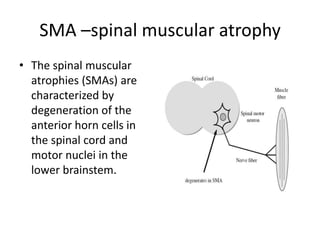
SMA –spinal muscular atrophy
• The spinal muscular
atrophies (SMAs) are
characterized by
degeneration of the
anterior horn cells in
the spinal cord and
motor nuclei in the
lower brainstem.
DEFINITION
• SMA is caused by Progressive death of AHC
• AR
• ABN OF SMN GENE (CHROMOSOME 5) so
defect in SMN protein
CLASSIFICATION
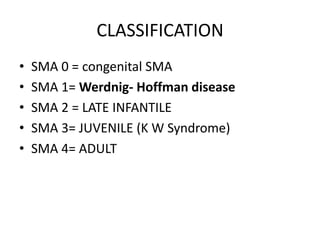
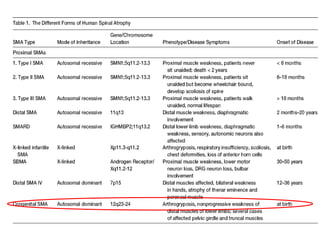
• SMA 0 = congenital SMA
• SMA 1= Werdnig- Hoffman disease
• SMA 2 = LATE INFANTILE
• SMA 3= JUVENILE (K W Syndrome)
• SMA 4= ADULT
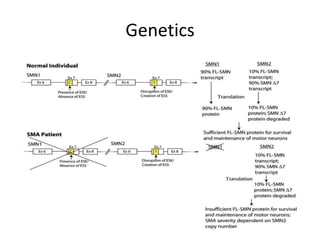
Genetics
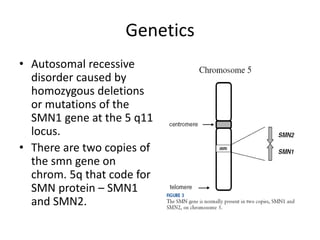
• Autosomal recessive
disorder caused by
homozygous deletions
or mutations of the
SMN1 gene at the 5 q11
locus.
• There are two copies of
the smn gene on
chrom. 5q that code for
SMN protein – SMN1
and SMN2.
• All SMA patients have reduced fl-smn protein :
– Type 1 – 9%
– Type 2 – 14%
– Type 3 – 18%
– Carriers – 45 -55%
• When levels approach 23% - motor neuron
function is normal.
Genetics
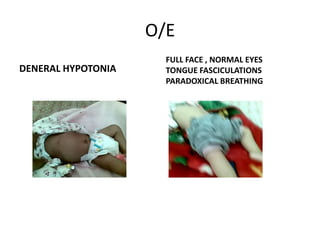
O/E
DENERAL HYPOTONIA
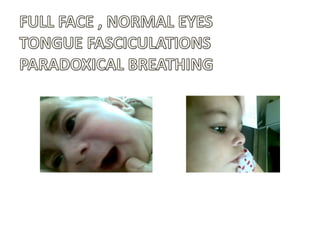
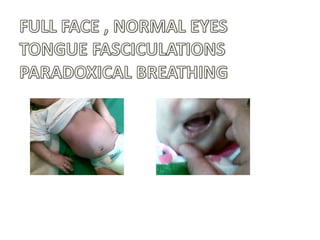
FULL FACE , NORMAL EYES
TONGUE FASCICULATIONS
PARADOXICAL BREATHING
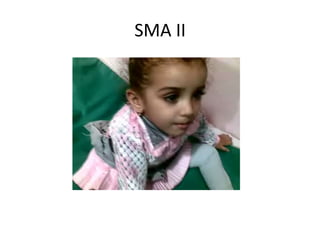
SMA II
Investigations
• EMG: fibrillation potentials, denervation, and
increased amplitude.
Nerve Conduction velocity : normal.
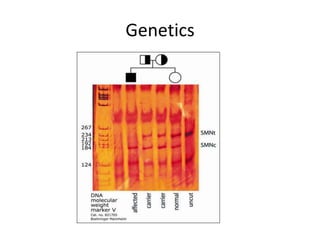
• Molecular gene testing for SMA gene : for the
baby, carrier detection and Prenatal DNA
testing: Prenatal DNA analysis of chorionic
villous biopsy (the deletion of arm 5q)
• CPK, lactic acid, LDH= N
Treatment
• Specific: ???? Gene therapy
• Non Specific
• Prevention: Family counseling, I U fetal
detection
HISTORY
• Was first described in the 1890s by Guido
Werdnig of the university of Viena and Johann
Hoffmann of Heidelberg University.
Frequency:
• The acute infantile-onset SMA (type I)
affects approximately 1 per 10,000 live
births.
• The chronic forms (types II and III), 1 per
24,000 births
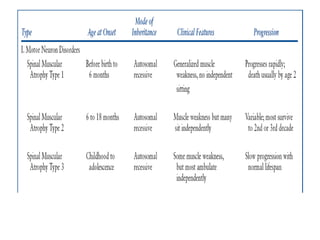
Clinical features – TYPE 1
• Werding Hoffman / infantile onset SMA
• Weakness and profound hypotonia – first few
months of life
• Normal social awareness and interaction
• Limited spontaneous movement
• Deep tendon reflexes are absent
• Sphincter tone and sensation are intact
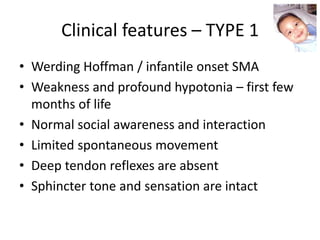
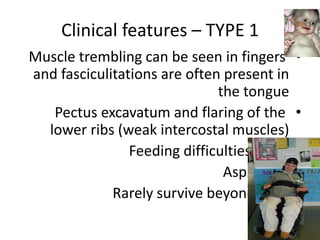
Clinical features – TYPE 1
•
Muscle trembling can be seen in fingers
and fasciculitations are often present in
the tongue
•
Pectus excavatum and flaring of the
lower ribs (weak intercostal muscles)
•
Feeding difficulties – FTT
•
Aspiration
•
Rarely survive beyond 2 yrs
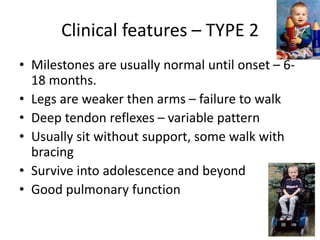
Clinical features – TYPE 2
• Milestones are usually normal until onset – 6-
18 months.
• Legs are weaker then arms – failure to walk
• Deep tendon reflexes – variable pattern
• Usually sit without support, some walk with
bracing
• Survive into adolescence and beyond
• Good pulmonary function
Clinical features – TYPE 3
• Kugelberg-Welander disease
• Independent ambulation achieved
• Normal survival
• Onset of weakness after 18 mo – often late
childhood or adolescence
• Waddling gait with lumbar lordosis
• Decrease in motor units over time has been
documented (despite clinical picture)
Diagnosis
• Clinical, physical exam, family Hx
• Lab:
– CK level is usually normal in SMA type I and
normal or slightly elevated in the other types
– Cerebrospinal fluid findings are normal
– Genetic testing, both prenatally and postnatally
Diagnosis
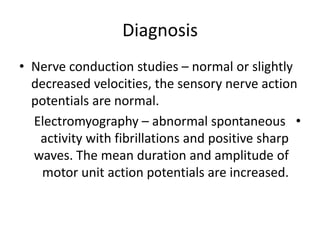
• Nerve conduction studies – normal or slightly
decreased velocities, the sensory nerve action
potentials are normal.
•
Electromyography – abnormal spontaneous
activity with fibrillations and positive sharp
waves. The mean duration and amplitude of
motor unit action potentials are increased.
Histology
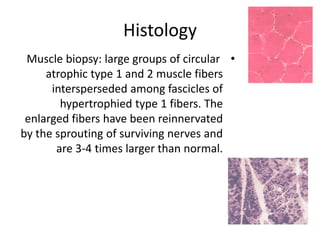
•
Muscle biopsy: large groups of circular
atrophic type 1 and 2 muscle fibers
intersperseded among fascicles of
hypertrophied type 1 fibers. The
enlarged fibers have been reinnervated
by the sprouting of surviving nerves and
are 3-4 times larger than normal.
Genetics
Genetics
•
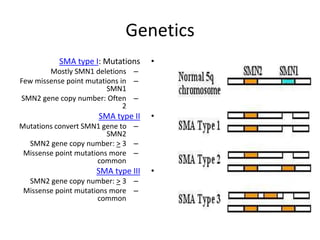
SMA type I: Mutations
–
Mostly SMN1 deletions
–
Few missense point mutations in
SMN1
–
SMN2 gene copy number: Often
2
•
SMA type II
–
Mutations convert SMN1 gene to
SMN2
–
SMN2 gene copy number: > 3
–
Missense point mutations more
common
•
SMA type III
–
SMN2 gene copy number: > 3
–
Missense point mutations more
common
Genetics
SMN protein
•
Expressed in most tissues
•
High levels are found in spinal motor neuron
•
SMN exist in the cell as a part of a large
complex that regulates the assembly of a
specific class of RNA protein complexes -
which is essential for pre-mRNA splicing.
•
The function of SMN protein is linked to the
control of protein synthesis.
Why are only motor neurons
and muscle are affected in
SMA ?
The Role of SMN in SMA -1
•
SMA is a direct consequence of a defect in
pre-RNA splicing:
•
The affected motor neurons, being large, high
energy requiring cells, have a lower tolerance for
depleted SMN levels and are uniquely sensitive.
The Role of SMN in SMA - 2
•
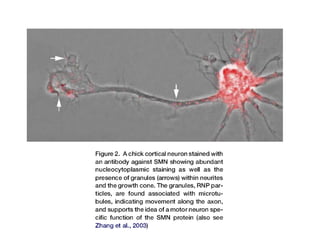
SMA is a consequence of a motor neuron
specific function of the SMN protein:
–
From observations demonstrating the
accumulation of the SMN protein in the axons
and growth cones of neuron like cells in vitro
and anterior horn cells in vivo.
Spinal muscle atrophy SMA: make it easy

Spinal muscle atrophy SMA: make it easy

  • 1.
    Spinal Muscle AtrophySMA Prof Dr Hussein Abdeldayem,MD Chief and Professor of Pediatric Neurology
  • 2.
    SMA –spinal muscularatrophy • The spinal muscular atrophies (SMAs) are characterized by degeneration of the anterior horn cells in the spinal cord and motor nuclei in the lower brainstem.
  • 3.
    DEFINITION • SMA iscaused by Progressive death of AHC • AR • ABN OF SMN GENE (CHROMOSOME 5) so defect in SMN protein
  • 4.
    CLASSIFICATION • SMA 0= congenital SMA • SMA 1= Werdnig- Hoffman disease • SMA 2 = LATE INFANTILE • SMA 3= JUVENILE (K W Syndrome) • SMA 4= ADULT
  • 7.
    Genetics • Autosomal recessive disordercaused by homozygous deletions or mutations of the SMN1 gene at the 5 q11 locus. • There are two copies of the smn gene on chrom. 5q that code for SMN protein – SMN1 and SMN2.
  • 8.
    • All SMApatients have reduced fl-smn protein : – Type 1 – 9% – Type 2 – 14% – Type 3 – 18% – Carriers – 45 -55% • When levels approach 23% - motor neuron function is normal. Genetics
  • 9.
    O/E DENERAL HYPOTONIA FULL FACE, NORMAL EYES TONGUE FASCICULATIONS PARADOXICAL BREATHING
  • 12.
  • 13.
    Investigations • EMG: fibrillationpotentials, denervation, and increased amplitude. Nerve Conduction velocity : normal. • Molecular gene testing for SMA gene : for the baby, carrier detection and Prenatal DNA testing: Prenatal DNA analysis of chorionic villous biopsy (the deletion of arm 5q) • CPK, lactic acid, LDH= N
  • 14.
    Treatment • Specific: ????Gene therapy • Non Specific • Prevention: Family counseling, I U fetal detection
  • 16.
    HISTORY • Was firstdescribed in the 1890s by Guido Werdnig of the university of Viena and Johann Hoffmann of Heidelberg University.
  • 17.
    Frequency: • The acuteinfantile-onset SMA (type I) affects approximately 1 per 10,000 live births. • The chronic forms (types II and III), 1 per 24,000 births
  • 18.
    Clinical features –TYPE 1 • Werding Hoffman / infantile onset SMA • Weakness and profound hypotonia – first few months of life • Normal social awareness and interaction • Limited spontaneous movement • Deep tendon reflexes are absent • Sphincter tone and sensation are intact
  • 19.
    Clinical features –TYPE 1 • Muscle trembling can be seen in fingers and fasciculitations are often present in the tongue • Pectus excavatum and flaring of the lower ribs (weak intercostal muscles) • Feeding difficulties – FTT • Aspiration • Rarely survive beyond 2 yrs
  • 20.
    Clinical features –TYPE 2 • Milestones are usually normal until onset – 6- 18 months. • Legs are weaker then arms – failure to walk • Deep tendon reflexes – variable pattern • Usually sit without support, some walk with bracing • Survive into adolescence and beyond • Good pulmonary function
  • 21.
    Clinical features –TYPE 3 • Kugelberg-Welander disease • Independent ambulation achieved • Normal survival • Onset of weakness after 18 mo – often late childhood or adolescence • Waddling gait with lumbar lordosis • Decrease in motor units over time has been documented (despite clinical picture)
  • 22.
    Diagnosis • Clinical, physicalexam, family Hx • Lab: – CK level is usually normal in SMA type I and normal or slightly elevated in the other types – Cerebrospinal fluid findings are normal – Genetic testing, both prenatally and postnatally
  • 23.
    Diagnosis • Nerve conductionstudies – normal or slightly decreased velocities, the sensory nerve action potentials are normal. • Electromyography – abnormal spontaneous activity with fibrillations and positive sharp waves. The mean duration and amplitude of motor unit action potentials are increased.
  • 24.
    Histology • Muscle biopsy: largegroups of circular atrophic type 1 and 2 muscle fibers intersperseded among fascicles of hypertrophied type 1 fibers. The enlarged fibers have been reinnervated by the sprouting of surviving nerves and are 3-4 times larger than normal.
  • 25.
  • 26.
    Genetics • SMA type I:Mutations – Mostly SMN1 deletions – Few missense point mutations in SMN1 – SMN2 gene copy number: Often 2 • SMA type II – Mutations convert SMN1 gene to SMN2 – SMN2 gene copy number: > 3 – Missense point mutations more common • SMA type III – SMN2 gene copy number: > 3 – Missense point mutations more common
  • 27.
  • 28.
    SMN protein • Expressed inmost tissues • High levels are found in spinal motor neuron • SMN exist in the cell as a part of a large complex that regulates the assembly of a specific class of RNA protein complexes - which is essential for pre-mRNA splicing. • The function of SMN protein is linked to the control of protein synthesis.
  • 29.
    Why are onlymotor neurons and muscle are affected in SMA ?
  • 30.
    The Role ofSMN in SMA -1 • SMA is a direct consequence of a defect in pre-RNA splicing: • The affected motor neurons, being large, high energy requiring cells, have a lower tolerance for depleted SMN levels and are uniquely sensitive.
  • 31.
    The Role ofSMN in SMA - 2 • SMA is a consequence of a motor neuron specific function of the SMN protein: – From observations demonstrating the accumulation of the SMN protein in the axons and growth cones of neuron like cells in vitro and anterior horn cells in vivo.