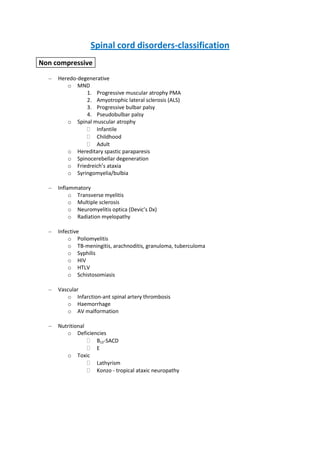
Spinal cord disorders-classification
Non compressive
Heredo-degenerative
o MND
1. Progressive muscular atrophy PMA
2. Amyotrophic lateral sclerosis (ALS)
3. Progressive bulbar palsy
4. Pseudobulbar palsy
o Spinal muscular atrophy
 Infantile
 Childhood
 Adult
o Hereditary spastic paraparesis
o Spinocerebellar degeneration
o Friedreich’s ataxia
o Syringomyelia/bulbia
Inflammatory
o Transverse myelitis
o Multiple sclerosis
o Neuromyelitis optica (Devic’s Dx)
o Radiation myelopathy
Infective
o Poliomyelitis
o TB-meningitis, arachnoditis, granuloma, tuberculoma
o Syphilis
o HIV
o HTLV
o Schistosomiasis
Vascular
o Infarction-ant spinal artery thrombosis
o Haemorrhage
o AV malformation
Nutritional
o Deficiencies
 B12-SACD
 E
o Toxic
 Lathyrism
 Konzo - tropical ataxic neuropathy
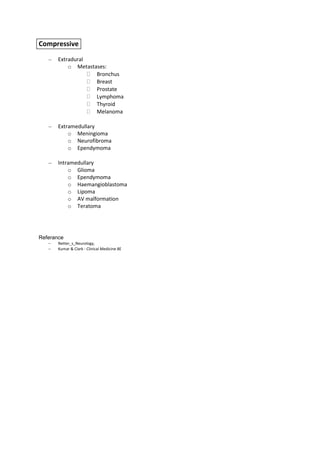
Compressive
Extradural
o Metastases:
 Bronchus
 Breast
 Prostate
 Lymphoma
 Thyroid
 Melanoma
Extramedullary
o Meningioma
o Neurofibroma
o Ependymoma
Intramedullary
o Glioma
o Ependymoma
o Haemangioblastoma
o Lipoma
o AV malformation
o Teratoma

Referance
Netter_s_Neurology,
Kumar & Clark - Clinical Medicine 8E
A 16-year-old boy suddenly began to walk with both knees in a flexed posture. Initially, his parents
thought he was just joking. However, later that evening he began to experience knife-like pain in
midback radiating around his ribs toward his epigastrium. The next morning, he awakened unable to
get out of bed. He was unable to void.
On neurologic examination he was paraplegic, his muscle stretch reflexes were absent, and his
plantar response “ambiguous.” Sensory exam suggested a T10 level for both pain and temperature
modalities.
Pertinent laboratory findings included CSF findings with a protein 175 mg/dL, and 30 WBC with 90%
lymphocytes. Nerve conductions demonstrated prolonged F waves but otherwise normal motor and
sensory nerve conductions. The spinal cord had a focal demyelinating lesion with gadolinium
enhancement involving most of its transverse diameter at T9–T11.
Unfortunately a course of intravenous (IV) methylprednisolone was ineffective; he remained
paraplegic, with a persistent dense sensory level and ongoing incontinence.

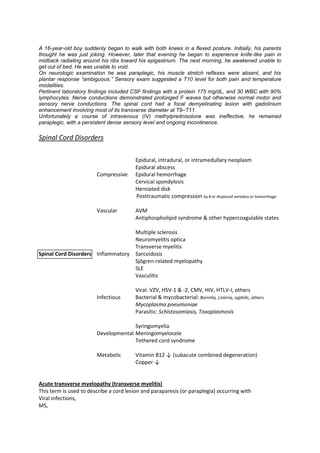
Spinal Cord Disorders

Compressive

Vascular

Spinal Cord Disorders Inflammatory

Infectious

Epidural, intradural, or intramedullary neoplasm
Epidural abscess
Epidural hemorrhage
Cervical spondylosis
Herniated disk
Posttraumatic compression by # or displaced vertebra or hemorrhage
AVM
Antiphospholipid syndrome & other hypercoagulable states
Multiple sclerosis
Neuromyelitis optica
Transverse myelitis
Sarcoidosis
Sjögren-related myelopathy
SLE
Vasculitis
Viral: VZV, HSV-1 & -2, CMV, HIV, HTLV-I, others
Bacterial & mycobacterial: Borrelia, Listeria, syphilis, others
Mycoplasma pneumoniae
Parasitic: Schistosomiasis, Toxoplasmosis

Syringomyelia
Developmental Meningomyelocele
Tethered cord syndrome
Metabolic

Vitamin B12 ↓ (subacute combined degeneration)
Copper ↓

Acute transverse myelopathy (transverse myelitis)
This term is used to describe a cord lesion and paraparesis (or paraplegia) occurring with
Viral infections,
MS,
MCTD &
Other inflammatory and vascular disorders, e.g. Hiv, sarcoid, syphilis,
Radiation myelopathy &
Anterior spinal artery occlusion.
MRI is usually required to exclude cord compression.
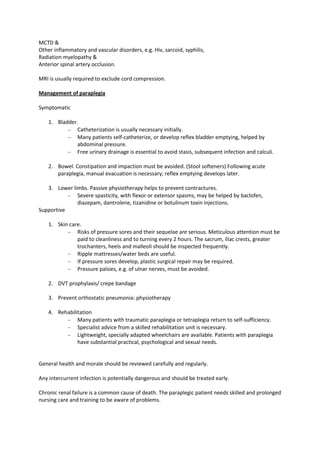
Management of paraplegia
Symptomatic
1. Bladder.
Catheterization is usually necessary initially.
Many patients self-catheterize, or develop reflex bladder emptying, helped by
abdominal pressure.
Free urinary drainage is essential to avoid stasis, subsequent infection and calculi.
2. Bowel. Constipation and impaction must be avoided. (Stool softeners) Following acute
paraplegia, manual evacuation is necessary; reflex emptying develops later.
3. Lower limbs. Passive physiotherapy helps to prevent contractures.
Severe spasticity, with flexor or extensor spasms, may be helped by baclofen,
diazepam, dantrolene, tizanidine or botulinum toxin injections.
Supportive
1. Skin care.
Risks of pressure sores and their sequelae are serious. Meticulous attention must be
paid to cleanliness and to turning every 2 hours. The sacrum, iliac crests, greater
trochanters, heels and malleoli should be inspected frequently.
Ripple mattresses/water beds are useful.
If pressure sores develop, plastic surgical repair may be required.
Pressure palsies, e.g. of ulnar nerves, must be avoided.
2. DVT prophylaxis/ crepe bandage
3. Prevent orthostatic pneumonia: physiotherapy
4. Rehabilitation
Many patients with traumatic paraplegia or tetraplegia return to self-sufficiency.
Specialist advice from a skilled rehabilitation unit is necessary.
Lightweight, specially adapted wheelchairs are available. Patients with paraplegia
have substantial practical, psychological and sexual needs.

General health and morale should be reviewed carefully and regularly.
Any intercurrent infection is potentially dangerous and should be treated early.
Chronic renal failure is a common cause of death. The paraplegic patient needs skilled and prolonged
nursing care and training to be aware of problems.

Classification of spinal cord disorders

  • 1.
    Spinal cord disorders-classification Noncompressive Heredo-degenerative o MND 1. Progressive muscular atrophy PMA 2. Amyotrophic lateral sclerosis (ALS) 3. Progressive bulbar palsy 4. Pseudobulbar palsy o Spinal muscular atrophy  Infantile  Childhood  Adult o Hereditary spastic paraparesis o Spinocerebellar degeneration o Friedreich’s ataxia o Syringomyelia/bulbia Inflammatory o Transverse myelitis o Multiple sclerosis o Neuromyelitis optica (Devic’s Dx) o Radiation myelopathy Infective o Poliomyelitis o TB-meningitis, arachnoditis, granuloma, tuberculoma o Syphilis o HIV o HTLV o Schistosomiasis Vascular o Infarction-ant spinal artery thrombosis o Haemorrhage o AV malformation Nutritional o Deficiencies  B12-SACD  E o Toxic  Lathyrism  Konzo - tropical ataxic neuropathy
  • 2.
    Compressive Extradural o Metastases:  Bronchus Breast  Prostate  Lymphoma  Thyroid  Melanoma Extramedullary o Meningioma o Neurofibroma o Ependymoma Intramedullary o Glioma o Ependymoma o Haemangioblastoma o Lipoma o AV malformation o Teratoma Referance Netter_s_Neurology, Kumar & Clark - Clinical Medicine 8E
  • 3.
    A 16-year-old boysuddenly began to walk with both knees in a flexed posture. Initially, his parents thought he was just joking. However, later that evening he began to experience knife-like pain in midback radiating around his ribs toward his epigastrium. The next morning, he awakened unable to get out of bed. He was unable to void. On neurologic examination he was paraplegic, his muscle stretch reflexes were absent, and his plantar response “ambiguous.” Sensory exam suggested a T10 level for both pain and temperature modalities. Pertinent laboratory findings included CSF findings with a protein 175 mg/dL, and 30 WBC with 90% lymphocytes. Nerve conductions demonstrated prolonged F waves but otherwise normal motor and sensory nerve conductions. The spinal cord had a focal demyelinating lesion with gadolinium enhancement involving most of its transverse diameter at T9–T11. Unfortunately a course of intravenous (IV) methylprednisolone was ineffective; he remained paraplegic, with a persistent dense sensory level and ongoing incontinence. Spinal Cord Disorders Compressive Vascular Spinal Cord Disorders Inflammatory Infectious Epidural, intradural, or intramedullary neoplasm Epidural abscess Epidural hemorrhage Cervical spondylosis Herniated disk Posttraumatic compression by # or displaced vertebra or hemorrhage AVM Antiphospholipid syndrome & other hypercoagulable states Multiple sclerosis Neuromyelitis optica Transverse myelitis Sarcoidosis Sjögren-related myelopathy SLE Vasculitis Viral: VZV, HSV-1 & -2, CMV, HIV, HTLV-I, others Bacterial & mycobacterial: Borrelia, Listeria, syphilis, others Mycoplasma pneumoniae Parasitic: Schistosomiasis, Toxoplasmosis Syringomyelia Developmental Meningomyelocele Tethered cord syndrome Metabolic Vitamin B12 ↓ (subacute combined degeneration) Copper ↓ Acute transverse myelopathy (transverse myelitis) This term is used to describe a cord lesion and paraparesis (or paraplegia) occurring with Viral infections, MS,
  • 4.
    MCTD & Other inflammatoryand vascular disorders, e.g. Hiv, sarcoid, syphilis, Radiation myelopathy & Anterior spinal artery occlusion. MRI is usually required to exclude cord compression. Management of paraplegia Symptomatic 1. Bladder. Catheterization is usually necessary initially. Many patients self-catheterize, or develop reflex bladder emptying, helped by abdominal pressure. Free urinary drainage is essential to avoid stasis, subsequent infection and calculi. 2. Bowel. Constipation and impaction must be avoided. (Stool softeners) Following acute paraplegia, manual evacuation is necessary; reflex emptying develops later. 3. Lower limbs. Passive physiotherapy helps to prevent contractures. Severe spasticity, with flexor or extensor spasms, may be helped by baclofen, diazepam, dantrolene, tizanidine or botulinum toxin injections. Supportive 1. Skin care. Risks of pressure sores and their sequelae are serious. Meticulous attention must be paid to cleanliness and to turning every 2 hours. The sacrum, iliac crests, greater trochanters, heels and malleoli should be inspected frequently. Ripple mattresses/water beds are useful. If pressure sores develop, plastic surgical repair may be required. Pressure palsies, e.g. of ulnar nerves, must be avoided. 2. DVT prophylaxis/ crepe bandage 3. Prevent orthostatic pneumonia: physiotherapy 4. Rehabilitation Many patients with traumatic paraplegia or tetraplegia return to self-sufficiency. Specialist advice from a skilled rehabilitation unit is necessary. Lightweight, specially adapted wheelchairs are available. Patients with paraplegia have substantial practical, psychological and sexual needs. General health and morale should be reviewed carefully and regularly. Any intercurrent infection is potentially dangerous and should be treated early. Chronic renal failure is a common cause of death. The paraplegic patient needs skilled and prolonged nursing care and training to be aware of problems.