SPINE INFECTION NOOR HAFIZAH BINTI HASSAN 2007287236
CONTENTS: PYOGENIC SPINE INFECTION: - OSTEOMYELITIS OF THE SPINE - DISCITIS 2) NON PYOGENIC (GRANULOMATOUS)  SPINE INFECTION: - TUBERCULOUS SPINE INFECTION
PYOGENIC  SPINE INFECTION
EPIDEMIOLOGY
AETIOLOGY Bacterial : Staph aureus (70 %)   : Streptococcus sp.   : E.coli   : Pseudomonas    IVDU Location: Lumbar spine   : Thoracic spine   : Cervical spine    ↑  vascularity
PATHOPHYSIOLOGY ROUTES OF INFECTION SPREAD:
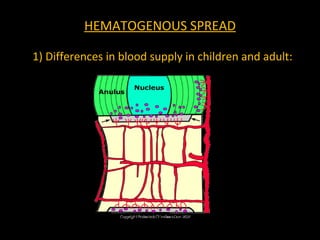
HEMATOGENOUS SPREAD 1) Differences in blood supply in children and adult:
2) Blood supply of the vertebrae: Batson’s plexus
CLINICAL PRESENTATION Back / neck pain  Constitutional symptoms Fever / malaise / anorexia Neurological deficit: according to the level of vertebra  Non specific in children o/e: tenderness, limited ROM RED FLAG OF BACK PAIN: AGE <15 OR >55 THORACIC BACK PAIN NIGHT PAIN CONSTANT & PROGRESSIVE S/SX FOCAL NEUROLOGICAL DEFICIT HX OF MALIGNANCY IVDU IMMUNOCOMPROMISED
INVESTIGATION Aim of investigation  Laboratory investigation: FBC:  ↑ WCC   : anemia of chronic disease BLOOD C&S ESR: > 50 mm/hr CRP LIVER FUNCTION TEST RENAL PROFILE
Radiological investigation: a) Plain x-ray: Narrowing of intervertebral space Destruction of vertebral body
b) CT scan: Axial view of cervical vertebra: Destruction of vertebral body
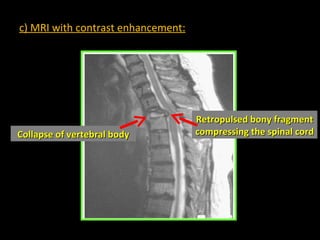
c) MRI with contrast enhancement: Collapse of vertebral body Retropulsed bony fragment compressing the spinal cord
TREATMENT MEDICAL: CRIB Analgesia Intravenous abx 4-6/52    ↓  improvement Oral abx 6-8/52 Spinal brace SURGICAL: Indications: Failed medical treatment Presence/development of neurological signs  Drainage of soft tissue abscess Methods: Decompression  Stabilization
DISCITIS Routes of infection spread: Iatrogenic: following procedure eg discectomy    adult Non iatrogenic: blood-borne    children Clinical presentation: Acute back pain / muscle spasm / systemic features Destruction of vertebral end plate    spread to v/body Raised ESR Management: Iatrogenic: prevention!!    : broad spectrum abx Non iatrogenic: usually self limiting
 
NON PYOGENIC  SPINE INFECTION: (TUBERCULOUS SPONDYLITIS)
EPIDEMIOLOGY Extrapulmonary Tb: 20-25 % of reported case Skeletal Tb: 1-3 %, with spine preference M. Dharmalingam. Tuberculosis of the spine—the Sabah experience. Epidemiology, treatment and results. Tuberculosis (Edinb). 2004;84(1-2):24-8. 33 patient (24 Males, 9 Females) Peak incidence: 20s Prior hx of pulmonary Tb: 66.6 % Vertebral involvement: thoracic ( 30.3 %)  >  lumbar (27.2 %)
PATHOPHYSIOLOGY Abscess
Preservation of intervertebral disc Collapse of vertebral body Rarefaction the anterior aspect of vertebral body
CLINICAL PRESENTATION Long h/o backache Prior h/o pulmonary Tb or exposure to Tb patient Deformity Cold abscess Paresthesia / weakness On examination:  Pulmonary signs Angular thoracic kyphos Local tenderness  Gibbus Limited ROM  Neurological exam
POTT’S PARAPLEGIA The most feared complication Early onset paresis: Weakness of LL, UMN features, sensory dysf(x) d/t pressure by the abscess/caseous material/ bony fragment Late onset:  d/t deformity/reactivation of the disease/cord ischemia
INVESTIGATION Laboratory investigation: FBC BLOOD C&S ESR & CRP LFT RP Mantoux test Radiological  investigation: Plain x-ray: Narrowing of i/vertebral space Fuzziness of end plates Collapse of adjacent vertebral body Paraspinal soft tissue shadow CT scan & MRI Cord compression
T9 Narrowing of intervertebral disc Soft tissue shadow
Soft tissue mass Destruction of vertebral body
TREATMENT Aim of treatment: To eradicate or at least arrest the disease To prevent or correct deformity To prevent or treat complication – paraplegia Medical treatment: Anti-Tb chemotherapy 9/12 Continuous bed rest Surgical treatment: To drain abscess To correct deformity
FIRST LINE TB DRUGS
 
 
THANK YOU REFERENCES: 1.  Spinal infections.  Jonathan A Clamp and Michael P Grevitt. Elsevier Ltd. 2.  Theodore Gouliouris ,  Sani H. Aliyu , and  Nicholas M. Brown .  Spondylodiscitis: update on diagnosis and management.  J. Antimicrob. Chemother. (2010) 65 (suppl 3): iii11-iii24. 3. Peter Martin.Pyogenic osteomyelitis of the spine. British Medical Journal, Nov 9 1946.
 
Extra notes: red flag of back pain
Continue..

Spine infection

  • 1.
    SPINE INFECTION NOORHAFIZAH BINTI HASSAN 2007287236
  • 2.
    CONTENTS: PYOGENIC SPINEINFECTION: - OSTEOMYELITIS OF THE SPINE - DISCITIS 2) NON PYOGENIC (GRANULOMATOUS) SPINE INFECTION: - TUBERCULOUS SPINE INFECTION
  • 3.
    PYOGENIC SPINEINFECTION
  • 4.
  • 5.
    AETIOLOGY Bacterial :Staph aureus (70 %) : Streptococcus sp. : E.coli : Pseudomonas  IVDU Location: Lumbar spine : Thoracic spine : Cervical spine ↑ vascularity
  • 6.
    PATHOPHYSIOLOGY ROUTES OFINFECTION SPREAD:
  • 7.
    HEMATOGENOUS SPREAD 1)Differences in blood supply in children and adult:
  • 8.
    2) Blood supplyof the vertebrae: Batson’s plexus
  • 9.
    CLINICAL PRESENTATION Back/ neck pain Constitutional symptoms Fever / malaise / anorexia Neurological deficit: according to the level of vertebra Non specific in children o/e: tenderness, limited ROM RED FLAG OF BACK PAIN: AGE <15 OR >55 THORACIC BACK PAIN NIGHT PAIN CONSTANT & PROGRESSIVE S/SX FOCAL NEUROLOGICAL DEFICIT HX OF MALIGNANCY IVDU IMMUNOCOMPROMISED
  • 10.
    INVESTIGATION Aim ofinvestigation Laboratory investigation: FBC: ↑ WCC : anemia of chronic disease BLOOD C&S ESR: > 50 mm/hr CRP LIVER FUNCTION TEST RENAL PROFILE
  • 11.
    Radiological investigation: a)Plain x-ray: Narrowing of intervertebral space Destruction of vertebral body
  • 12.
    b) CT scan:Axial view of cervical vertebra: Destruction of vertebral body
  • 13.
    c) MRI withcontrast enhancement: Collapse of vertebral body Retropulsed bony fragment compressing the spinal cord
  • 14.
    TREATMENT MEDICAL: CRIBAnalgesia Intravenous abx 4-6/52 ↓ improvement Oral abx 6-8/52 Spinal brace SURGICAL: Indications: Failed medical treatment Presence/development of neurological signs Drainage of soft tissue abscess Methods: Decompression Stabilization
  • 15.
    DISCITIS Routes ofinfection spread: Iatrogenic: following procedure eg discectomy  adult Non iatrogenic: blood-borne  children Clinical presentation: Acute back pain / muscle spasm / systemic features Destruction of vertebral end plate  spread to v/body Raised ESR Management: Iatrogenic: prevention!! : broad spectrum abx Non iatrogenic: usually self limiting
  • 16.
  • 17.
    NON PYOGENIC SPINE INFECTION: (TUBERCULOUS SPONDYLITIS)
  • 18.
    EPIDEMIOLOGY Extrapulmonary Tb:20-25 % of reported case Skeletal Tb: 1-3 %, with spine preference M. Dharmalingam. Tuberculosis of the spine—the Sabah experience. Epidemiology, treatment and results. Tuberculosis (Edinb). 2004;84(1-2):24-8. 33 patient (24 Males, 9 Females) Peak incidence: 20s Prior hx of pulmonary Tb: 66.6 % Vertebral involvement: thoracic ( 30.3 %) > lumbar (27.2 %)
  • 19.
  • 20.
    Preservation of intervertebraldisc Collapse of vertebral body Rarefaction the anterior aspect of vertebral body
  • 21.
    CLINICAL PRESENTATION Longh/o backache Prior h/o pulmonary Tb or exposure to Tb patient Deformity Cold abscess Paresthesia / weakness On examination: Pulmonary signs Angular thoracic kyphos Local tenderness Gibbus Limited ROM Neurological exam
  • 22.
    POTT’S PARAPLEGIA Themost feared complication Early onset paresis: Weakness of LL, UMN features, sensory dysf(x) d/t pressure by the abscess/caseous material/ bony fragment Late onset: d/t deformity/reactivation of the disease/cord ischemia
  • 23.
    INVESTIGATION Laboratory investigation:FBC BLOOD C&S ESR & CRP LFT RP Mantoux test Radiological investigation: Plain x-ray: Narrowing of i/vertebral space Fuzziness of end plates Collapse of adjacent vertebral body Paraspinal soft tissue shadow CT scan & MRI Cord compression
  • 24.
    T9 Narrowing ofintervertebral disc Soft tissue shadow
  • 25.
    Soft tissue massDestruction of vertebral body
  • 26.
    TREATMENT Aim oftreatment: To eradicate or at least arrest the disease To prevent or correct deformity To prevent or treat complication – paraplegia Medical treatment: Anti-Tb chemotherapy 9/12 Continuous bed rest Surgical treatment: To drain abscess To correct deformity
  • 27.
  • 28.
  • 29.
  • 30.
    THANK YOU REFERENCES:1. Spinal infections. Jonathan A Clamp and Michael P Grevitt. Elsevier Ltd. 2. Theodore Gouliouris , Sani H. Aliyu , and Nicholas M. Brown . Spondylodiscitis: update on diagnosis and management. J. Antimicrob. Chemother. (2010) 65 (suppl 3): iii11-iii24. 3. Peter Martin.Pyogenic osteomyelitis of the spine. British Medical Journal, Nov 9 1946.
  • 31.
  • 32.
    Extra notes: redflag of back pain
  • 33.

Editor's Notes

  • #9 Batson’s plexus: valveless venous system Venous drainage of the spine: internal plexus  external plexus  IVC  rt atrium Batson’s plexus communicate with venous drainage from the pelvic, abdominal n thoracic Y communicate? If any obstruction to IVC in abdominal level, venous blood from lower xtrmities can still travel back to the heart. That’s y gut bacteria can be one of the etiology
  • #15 Improvement: falling ESR, WCC return to normal. Important to assess pt CLINICALLY !!!
  • #21 Note the spread of the infection anteriorly to, rather than thru the vertebral body.
  • #28 Liver enzymes inducer: P C B R A S (pyrazinamide, carbamazepine, barbiturate, rifampicin, alcohol, sulphonylurea) Liver enzymes inhibitor: SICK FACES.COM (sodium valproate, isoniazid, cimetidine, ketoconazole, fluconazole, alcohol, CMC, erythromycin, sulfonamides, ciprofloxacin, omeprazole, metronidazole)