SPINAL CORD DISORDRSALI ABDULLAH ALBALUSHIOMSBEMERGENCY MEDICINE, R-4
OUTLINEANATOMYDIFFERENT SPINAL CORD DISORDERSCONCLUSIONQUISTIONS
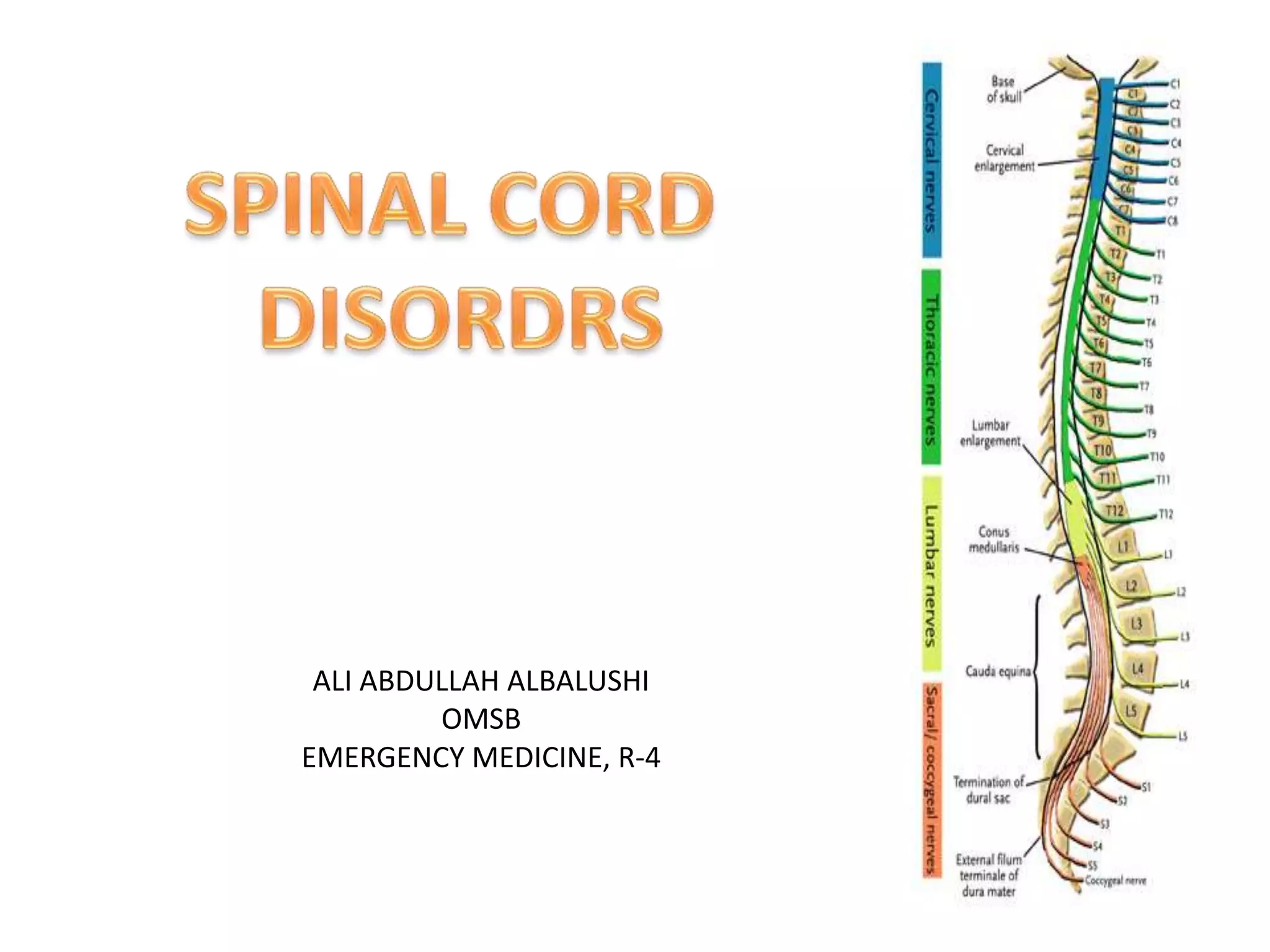
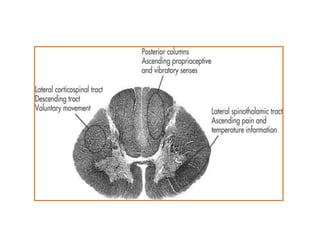
ANATOMYSpinal cord: foramen magnum  1st/2nd lumbar vertebrae. Cervical enlargement:C5-T1: gives rise to brachial plexus, innervates UE;L2-S3: gives rise to lumbosacral plexus, Gray matter – central (cell bodies)White matter – peripheral (ascending and descending tracts)
All are true about the anatomy of the spinal cord except :It is 40 cm longSupplied by a single anterior spinal artery & paired vertibral arteryThe posterior column carry the afferent ascending fibers for properiocetion & vibration & cross at  level of medullaIn the spinothalamic tract, sacral fibers are represented most mediallyIn corticospinal tract, the fibers cross at level of medulla & cervical fibers are located medially
2) All are true regarding complete spinal cord syndrom except:It is a total loss of sensory, autonomic & voluntary motor innervation distal to the level of the spinal cord injuryDeep tendon reflexes my persistThe most common cause is trauma99% of patients with persistent symptoms beyond 24 hrs do not have a functional recovery1% of patients will have some evident of cord function below the level of injury
3) All are true about spinal shock except :It is the loss of muscle tone & reflexes with complete cord syndrom during the acute phase of injuryThe intensity of the spinal shock increases with the height of the level in the spinal cordIt typically lasts less than 24 hrsBulbocavernous reflex is presentThe termination of spinal shock phase of injury is heralded by return of balbocavernous reflex
4) Central cord syndrom, all are true except :It is the post prevalent of the partial cord syndromsUpper extremities are affected more & distal muscles are affected to  a greater  degreeThe most common mechanism is  motor vehicle crushIt is caused  most often by hyperextensionElderly are affected more & prognosis is better in patients younger than 50 yrs
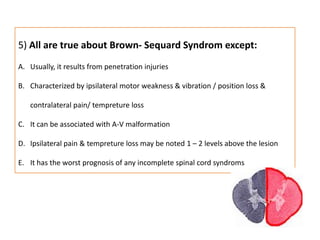
5) All are true about Brown- Sequard Syndrom except:Usually, it results from penetration injuriesCharacterized by ipsilateral motor weakness & vibration / position loss & contralateral pain/ tempreture lossIt can be associated with A-V malformationIpsilateral pain & tempreture loss may be noted 1 – 2 levels above the lesionIt has the worst prognosis of any incomplete spinal cord syndroms
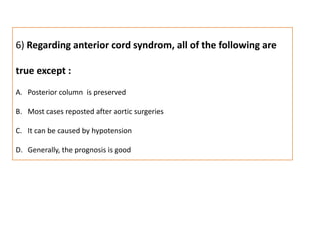
6) Regarding anterior cord syndrom, all of the following are true except :Posterior column  is preservedMost cases reposted after aortic surgeriesIt can be caused by hypotensionGenerally, the prognosis is good
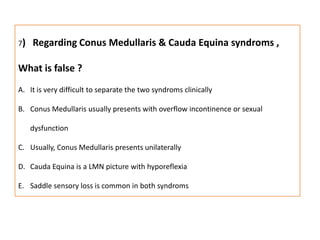
7)  Regarding Conus Medullaris & Cauda Equina syndroms , What is false ?It is very difficult to separate the two syndroms clinicallyConus Medullaris usually presents with overflow incontinence or sexual dysfunctionUsually, Conus Medullaris presents unilaterallyCauda Equina is a LMN picture with hyporeflexia Saddle sensory loss is common in both syndroms
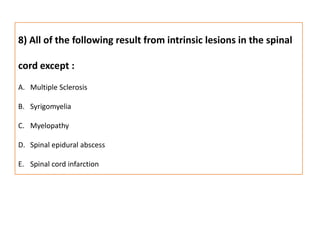
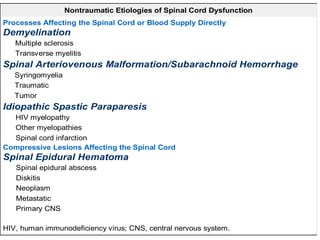
8) All of the following result from intrinsic lesions in the spinal cord except :Multiple SclerosisSyrigomyeliaMyelopathySpinal epidural abscessSpinal cord infarction
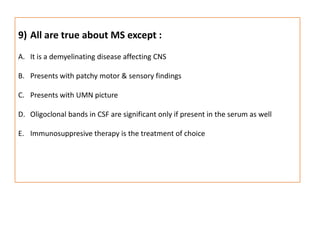
All are true about MS except :It is a demyelinating disease affecting CNSPresents with patchy motor & sensory findingsPresents with UMN pictureOligoclonal bands in CSF are significant only if present in the serum as wellImmunosuppresive therapy is the treatment of choice
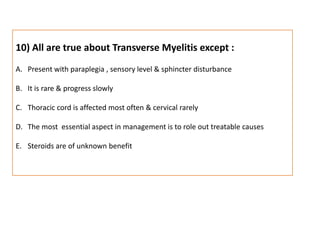
10) All are true about Transverse Myelitis except :Present with paraplegia , sensory level & sphincter disturbanceIt is rare & progress slowlyThoracic cord is affected most often & cervical rarelyThe most  essential aspect in management is to role out treatable causesSteroids are of unknown benefit
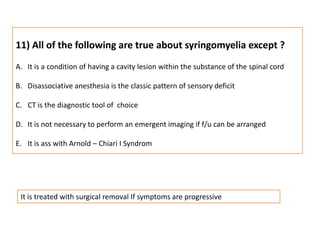
11) All of the following are true about syringomyelia except ?It is a condition of having a cavity lesion within the substance of the spinal cordDisassociative anesthesia is the classic pattern of sensory deficitCT is the diagnostic tool of  choiceIt is not necessary to perform an emergent imaging if f/u can be arrangedIt is ass with Arnold – Chiari I SyndromIt is treated with surgical removal If symptoms are progressive
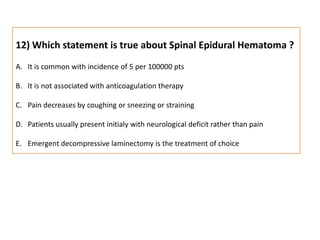
12) Which statement is true about Spinal Epidural Hematoma ?It is common with incidence of 5 per 100000 ptsIt is not associated with anticoagulation therapyPain decreases by coughing or sneezing or strainingPatients usually present initialy with neurological deficit rather than painEmergent decompressive laminectomy is the treatment of choice
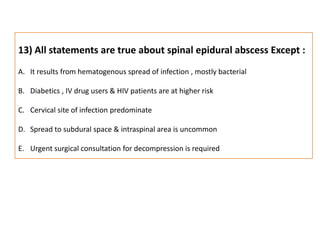
13) All statements are true about spinal epidural abscess Except :It results from hematogenous spread of infection , mostly bacterialDiabetics , IV drug users & HIV patients are at higher riskCervical site of infection predominate Spread to subdural space & intraspinal area is uncommonUrgent surgical consultation for decompression is required
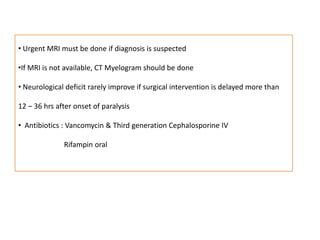
Urgent MRI must be done if diagnosis is suspected
If MRI is not available, CT Myelogram should be done
Neurological deficit rarely improve if surgical intervention is delayed more than 12 – 36 hrs after onset of paralysis
 Antibiotics : Vancomycin & Third generation Cephalosporine IVRifampin oral
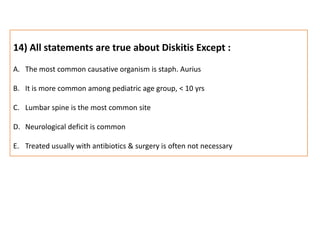
14) All statements are true about Diskitis Except :The most common causative organism is staph. AuriusIt is more common among pediatric age group, < 10 yrsLumbar spine is the most common siteNeurological deficit is commonTreated usually with antibiotics & surgery is often not necessary
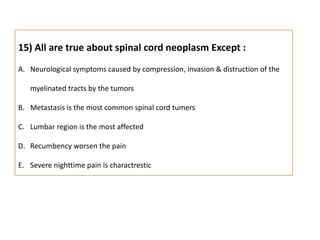
15) All are true about spinal cord neoplasm Except :Neurological symptoms caused by compression, invasion & distruction of the myelinated tracts by the tumorsMetastasis is the most common spinal cord tumersLumbar region is the most affectedRecumbency worsen the painSevere nighttime pain is charactrestic

Spinal cord disorders

  • 1.
    SPINAL CORD DISORDRSALIABDULLAH ALBALUSHIOMSBEMERGENCY MEDICINE, R-4
  • 2.
    OUTLINEANATOMYDIFFERENT SPINAL CORDDISORDERSCONCLUSIONQUISTIONS
  • 3.
    ANATOMYSpinal cord: foramenmagnum  1st/2nd lumbar vertebrae. Cervical enlargement:C5-T1: gives rise to brachial plexus, innervates UE;L2-S3: gives rise to lumbosacral plexus, Gray matter – central (cell bodies)White matter – peripheral (ascending and descending tracts)
  • 5.
    All are trueabout the anatomy of the spinal cord except :It is 40 cm longSupplied by a single anterior spinal artery & paired vertibral arteryThe posterior column carry the afferent ascending fibers for properiocetion & vibration & cross at level of medullaIn the spinothalamic tract, sacral fibers are represented most mediallyIn corticospinal tract, the fibers cross at level of medulla & cervical fibers are located medially
  • 6.
    2) All aretrue regarding complete spinal cord syndrom except:It is a total loss of sensory, autonomic & voluntary motor innervation distal to the level of the spinal cord injuryDeep tendon reflexes my persistThe most common cause is trauma99% of patients with persistent symptoms beyond 24 hrs do not have a functional recovery1% of patients will have some evident of cord function below the level of injury
  • 7.
    3) All aretrue about spinal shock except :It is the loss of muscle tone & reflexes with complete cord syndrom during the acute phase of injuryThe intensity of the spinal shock increases with the height of the level in the spinal cordIt typically lasts less than 24 hrsBulbocavernous reflex is presentThe termination of spinal shock phase of injury is heralded by return of balbocavernous reflex
  • 8.
    4) Central cordsyndrom, all are true except :It is the post prevalent of the partial cord syndromsUpper extremities are affected more & distal muscles are affected to a greater degreeThe most common mechanism is motor vehicle crushIt is caused most often by hyperextensionElderly are affected more & prognosis is better in patients younger than 50 yrs
  • 9.
    5) All aretrue about Brown- Sequard Syndrom except:Usually, it results from penetration injuriesCharacterized by ipsilateral motor weakness & vibration / position loss & contralateral pain/ tempreture lossIt can be associated with A-V malformationIpsilateral pain & tempreture loss may be noted 1 – 2 levels above the lesionIt has the worst prognosis of any incomplete spinal cord syndroms
  • 10.
    6) Regarding anteriorcord syndrom, all of the following are true except :Posterior column is preservedMost cases reposted after aortic surgeriesIt can be caused by hypotensionGenerally, the prognosis is good
  • 11.
    7) RegardingConus Medullaris & Cauda Equina syndroms , What is false ?It is very difficult to separate the two syndroms clinicallyConus Medullaris usually presents with overflow incontinence or sexual dysfunctionUsually, Conus Medullaris presents unilaterallyCauda Equina is a LMN picture with hyporeflexia Saddle sensory loss is common in both syndroms
  • 13.
    8) All ofthe following result from intrinsic lesions in the spinal cord except :Multiple SclerosisSyrigomyeliaMyelopathySpinal epidural abscessSpinal cord infarction
  • 15.
    All are trueabout MS except :It is a demyelinating disease affecting CNSPresents with patchy motor & sensory findingsPresents with UMN pictureOligoclonal bands in CSF are significant only if present in the serum as wellImmunosuppresive therapy is the treatment of choice
  • 16.
    10) All aretrue about Transverse Myelitis except :Present with paraplegia , sensory level & sphincter disturbanceIt is rare & progress slowlyThoracic cord is affected most often & cervical rarelyThe most essential aspect in management is to role out treatable causesSteroids are of unknown benefit
  • 17.
    11) All ofthe following are true about syringomyelia except ?It is a condition of having a cavity lesion within the substance of the spinal cordDisassociative anesthesia is the classic pattern of sensory deficitCT is the diagnostic tool of choiceIt is not necessary to perform an emergent imaging if f/u can be arrangedIt is ass with Arnold – Chiari I SyndromIt is treated with surgical removal If symptoms are progressive
  • 18.
    12) Which statementis true about Spinal Epidural Hematoma ?It is common with incidence of 5 per 100000 ptsIt is not associated with anticoagulation therapyPain decreases by coughing or sneezing or strainingPatients usually present initialy with neurological deficit rather than painEmergent decompressive laminectomy is the treatment of choice
  • 19.
    13) All statementsare true about spinal epidural abscess Except :It results from hematogenous spread of infection , mostly bacterialDiabetics , IV drug users & HIV patients are at higher riskCervical site of infection predominate Spread to subdural space & intraspinal area is uncommonUrgent surgical consultation for decompression is required
  • 20.
    Urgent MRI mustbe done if diagnosis is suspected
  • 21.
    If MRI isnot available, CT Myelogram should be done
  • 22.
    Neurological deficit rarelyimprove if surgical intervention is delayed more than 12 – 36 hrs after onset of paralysis
  • 23.
    Antibiotics :Vancomycin & Third generation Cephalosporine IVRifampin oral
  • 24.
    14) All statementsare true about Diskitis Except :The most common causative organism is staph. AuriusIt is more common among pediatric age group, < 10 yrsLumbar spine is the most common siteNeurological deficit is commonTreated usually with antibiotics & surgery is often not necessary
  • 25.
    15) All aretrue about spinal cord neoplasm Except :Neurological symptoms caused by compression, invasion & distruction of the myelinated tracts by the tumorsMetastasis is the most common spinal cord tumersLumbar region is the most affectedRecumbency worsen the painSevere nighttime pain is charactrestic