Seminar
On
SPEED DETECTION CAMERA
Prepared by : Kandarp Kumar Tiwari
Roll No. : 1209010085 (B. Tech 6th Semester)
Department of
Computer Science & Engineering
1
 INTRODUCTION
 HISTORY
 WHY SPEED DETECTING CAMERA ?
 ARCHITECTURE
 INTRODUCING DOPPLER’S EFFECT
 HOW WELL DOES IT WORKS?
Operating during the rain and mist
Measurement range
Reaction time
Continuous transmission
Discrimination
Objectives
 ON THE WRONG SIDE OF THE LAW
The need for public communications
 COMMUNICATIONS AND PUBLIC
AWARENESS
 ADVANTAGES
 FUTURE TECHNOLOGIES
 CONCLUSION
2
Introduction
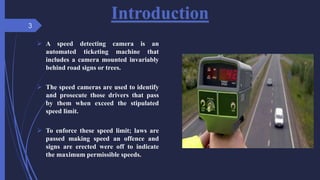
 A speed detecting camera is an
automated ticketing machine that
includes a camera mounted invariably
behind road signs or trees.
 The speed cameras are used to identify
and prosecute those drivers that pass
by them when exceed the stipulated
speed limit.
 To enforce these speed limit; laws are
passed making speed an offence and
signs are erected were off to indicate
the maximum permissible speeds.
3
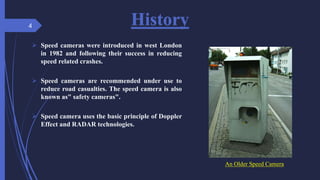
An Older Speed Camera
History
 Speed cameras were introduced in west London
in 1982 and following their success in reducing
speed related crashes.
 Speed cameras are recommended under use to
reduce road casualties. The speed camera is also
known as" safety cameras".
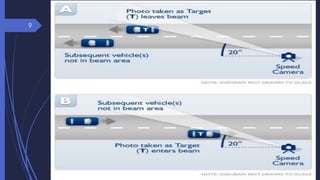
 Speed camera uses the basic principle of Doppler
Effect and RADAR technologies.
4
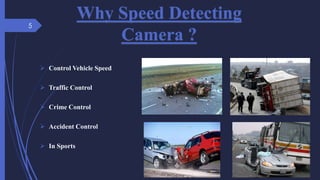
Why Speed Detecting
Camera ?
 Control Vehicle Speed
 Traffic Control
 Crime Control
 Accident Control
 In Sports
5
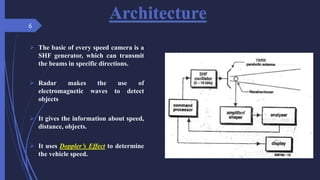
Architecture
 The basic of every speed camera is a
SHF generator, which can transmit
the beams in specific directions.
 Radar makes the use of
electromagnetic waves to detect
objects
 It gives the information about speed,
distance, objects.
 It uses Doppler’s Effect to determine
the vehicle speed.
6
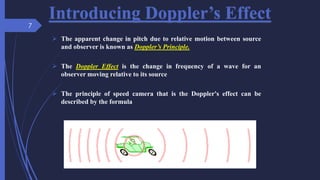
Introducing Doppler’s Effect
 The apparent change in pitch due to relative motion between source
and observer is known as Doppler’s Principle.
 The Doppler Effect is the change in frequency of a wave for an
observer moving relative to its source
 The principle of speed camera that is the Doppler's effect can be
described by the formula
7
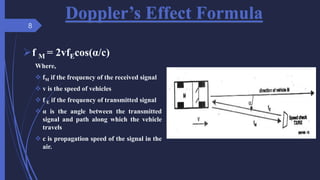
Doppler’s Effect Formula
f M = 2vfEcos(α/c)
Where,
 fM if the frequency of the received signal
 v is the speed of vehicles
 f E if the frequency of transmitted signal
 α is the angle between the transmitted
signal and path along which the vehicle
travels
 c is propagation speed of the signal in the
air.
8
9
How Well Does It Works?
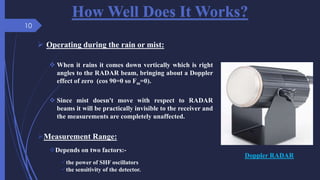
 Operating during the rain or mist:
 When it rains it comes down vertically which is right
angles to the RADAR beam, bringing about a Doppler
effect of zero (cos 90=0 so Fm=0).
 Since mist doesn't move with respect to RADAR
beams it will be practically invisible to the receiver and
the measurements are completely unaffected.
Doppler RADAR
Measurement Range:
Depends on two factors:-
the power of SHF oscillators
the sensitivity of the detector.
10
 Reaction time:
 Older models required by about half a second to take a reliable
measurement.
 Current models uses special DSP algorithms with the very short time, making
extremely fast readings possible.
 Continuous transmission:
 RADAR does not need to have its oscillators functioning continuously. It only
needs to be active long enough to stabilize and take a measurement. Actual
RADAR equipment works on the random basis or is activated only when a
vehicle comes nearby.
11
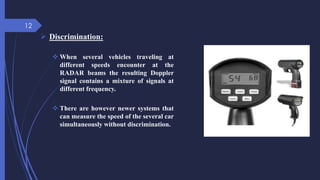
 Discrimination:
 When several vehicles traveling at
different speeds encounter at the
RADAR beams the resulting Doppler
signal contains a mixture of signals at
different frequency.
 There are however newer systems that
can measure the speed of the several car
simultaneously without discrimination.
12
On The Wrong Side Of Law
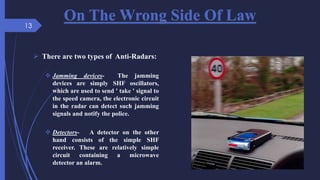
 There are two types of Anti-Radars:
 Jamming devices- The jamming
devices are simply SHF oscillators,
which are used to send ' take ' signal to
the speed camera, the electronic circuit
in the radar can detect such jamming
signals and notify the police.
 Detectors- A detector on the other
hand consists of the simple SHF
receiver. These are relatively simple
circuit containing a microwave
detector an alarm.
13
Communications and Public Awareness
 The need for public communications:
 We should make people aware of the speeding and benefits of speed cameras. We should make
awareness in the local level, national level and also in government level.
 There are many publicity campaigns, for example called ‘THINK!’ which includes messages
about the risks and other consequences of speeding.
14
Advantages
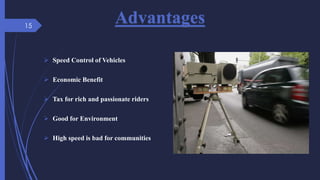
 Speed Control of Vehicles
 Economic Benefit
 Tax for rich and passionate riders
 Good for Environment
 High speed is bad for communities
15
Future Technologies
 A speed camera designed to catch speeding motorist.
 The asset camera should be able to pick out the drivers who are not wearing helmet.
 Identify tailgating.
 Can also note number plate and recognise cars with out-of-date tax and licence.
16
Conclusion
 A new approach to vehicle extraction and speed detection was proposed.
 These camera reduces accidents and protects the innocent road users.
 The system also provides location and velocity information of each vehicle.
 In general speed camera are perceived to be good idea because they protect
innocent road users and pedestrians.
 So on utilizing the strategies in the right way, we can reduce 40 percent it of
accidents
17
18

Speed Detecting Camera by Kandarp Tiwari

  • 1.
    Seminar On SPEED DETECTION CAMERA Preparedby : Kandarp Kumar Tiwari Roll No. : 1209010085 (B. Tech 6th Semester) Department of Computer Science & Engineering 1
  • 2.
     INTRODUCTION  HISTORY WHY SPEED DETECTING CAMERA ?  ARCHITECTURE  INTRODUCING DOPPLER’S EFFECT  HOW WELL DOES IT WORKS? Operating during the rain and mist Measurement range Reaction time Continuous transmission Discrimination Objectives  ON THE WRONG SIDE OF THE LAW The need for public communications  COMMUNICATIONS AND PUBLIC AWARENESS  ADVANTAGES  FUTURE TECHNOLOGIES  CONCLUSION 2
  • 3.
    Introduction  A speeddetecting camera is an automated ticketing machine that includes a camera mounted invariably behind road signs or trees.  The speed cameras are used to identify and prosecute those drivers that pass by them when exceed the stipulated speed limit.  To enforce these speed limit; laws are passed making speed an offence and signs are erected were off to indicate the maximum permissible speeds. 3
  • 4.
    An Older SpeedCamera History  Speed cameras were introduced in west London in 1982 and following their success in reducing speed related crashes.  Speed cameras are recommended under use to reduce road casualties. The speed camera is also known as" safety cameras".  Speed camera uses the basic principle of Doppler Effect and RADAR technologies. 4
  • 5.
    Why Speed Detecting Camera?  Control Vehicle Speed  Traffic Control  Crime Control  Accident Control  In Sports 5
  • 6.
    Architecture  The basicof every speed camera is a SHF generator, which can transmit the beams in specific directions.  Radar makes the use of electromagnetic waves to detect objects  It gives the information about speed, distance, objects.  It uses Doppler’s Effect to determine the vehicle speed. 6
  • 7.
    Introducing Doppler’s Effect The apparent change in pitch due to relative motion between source and observer is known as Doppler’s Principle.  The Doppler Effect is the change in frequency of a wave for an observer moving relative to its source  The principle of speed camera that is the Doppler's effect can be described by the formula 7
  • 8.
    Doppler’s Effect Formula fM = 2vfEcos(α/c) Where,  fM if the frequency of the received signal  v is the speed of vehicles  f E if the frequency of transmitted signal  α is the angle between the transmitted signal and path along which the vehicle travels  c is propagation speed of the signal in the air. 8
  • 9.
  • 10.
    How Well DoesIt Works?  Operating during the rain or mist:  When it rains it comes down vertically which is right angles to the RADAR beam, bringing about a Doppler effect of zero (cos 90=0 so Fm=0).  Since mist doesn't move with respect to RADAR beams it will be practically invisible to the receiver and the measurements are completely unaffected. Doppler RADAR Measurement Range: Depends on two factors:- the power of SHF oscillators the sensitivity of the detector. 10
  • 11.
     Reaction time: Older models required by about half a second to take a reliable measurement.  Current models uses special DSP algorithms with the very short time, making extremely fast readings possible.  Continuous transmission:  RADAR does not need to have its oscillators functioning continuously. It only needs to be active long enough to stabilize and take a measurement. Actual RADAR equipment works on the random basis or is activated only when a vehicle comes nearby. 11
  • 12.
     Discrimination:  Whenseveral vehicles traveling at different speeds encounter at the RADAR beams the resulting Doppler signal contains a mixture of signals at different frequency.  There are however newer systems that can measure the speed of the several car simultaneously without discrimination. 12
  • 13.
    On The WrongSide Of Law  There are two types of Anti-Radars:  Jamming devices- The jamming devices are simply SHF oscillators, which are used to send ' take ' signal to the speed camera, the electronic circuit in the radar can detect such jamming signals and notify the police.  Detectors- A detector on the other hand consists of the simple SHF receiver. These are relatively simple circuit containing a microwave detector an alarm. 13
  • 14.
    Communications and PublicAwareness  The need for public communications:  We should make people aware of the speeding and benefits of speed cameras. We should make awareness in the local level, national level and also in government level.  There are many publicity campaigns, for example called ‘THINK!’ which includes messages about the risks and other consequences of speeding. 14
  • 15.
    Advantages  Speed Controlof Vehicles  Economic Benefit  Tax for rich and passionate riders  Good for Environment  High speed is bad for communities 15
  • 16.
    Future Technologies  Aspeed camera designed to catch speeding motorist.  The asset camera should be able to pick out the drivers who are not wearing helmet.  Identify tailgating.  Can also note number plate and recognise cars with out-of-date tax and licence. 16
  • 17.
    Conclusion  A newapproach to vehicle extraction and speed detection was proposed.  These camera reduces accidents and protects the innocent road users.  The system also provides location and velocity information of each vehicle.  In general speed camera are perceived to be good idea because they protect innocent road users and pedestrians.  So on utilizing the strategies in the right way, we can reduce 40 percent it of accidents 17
  • 18.