By:
ANAND THAKKAR
WHAT IS CRUISE CONTROL ?
 Cruise control is a system to accurately maintain the
driver's desired set speed, with out intervention from
the driver, by actuating the throttle-accelerator pedal
linkage.
 Also sometimes known as speed control or
autocruise.
 The system takes over the throttle of the car to
maintain a steady speed as set by the driver.
HISTORY
 Speed control with a centrifugal governor was used in
automobiles as early as the 1910s.
 That technology was invented by James
Watt and Matthew Boulton in 1788 to control steam
engines. The governor adjusts the throttle position as
the speed of the engine changes with different loads.
HISTORY
 Modern cruise control was invented in 1945 by
mechanical engineer Ralph Teetor. His idea was born
out of the frustration of riding in a car driven by his
lawyer, who kept speeding up and slowing down.
 This system calculated ground speed based
on driveshaft rotations and used a solenoid to vary
throttle position as needed.
 But a 1955 U.S. Patent for a "Constant Speed Regulator"
was filed in by Frank J. Riley.
THEORY OF OPERATION
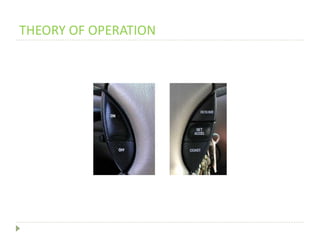
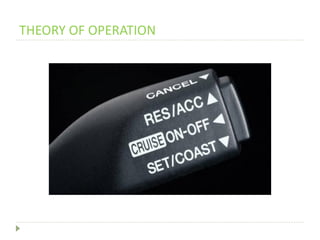
 The driver can set the cruise control with the cruise switches,
usually ON, OFF, RESUME, SET/ACCEL and COAST, that are located in
the steering wheel spokes or on the edge of the hub ( HONDA vehicles )
or on turn signal stalk ( GENERAL MOTORS ).
 The ON and OFF buttons don't actually do much. Hitting the ON button
does not do anything except tell the car that you might be hitting
another button soon. The OFF button turns the cruise control off even if
it is engaged. Some cruise controls don't have these buttons; instead,
they turn off when the driver hits the brakes, and turn on when the
driver hits the set button.
 The SET/ACCEL button tells the car to maintain the speed you are
currently driving. If you hit the set button at 45 mph, the car will
maintain your speed at 45 mph. Holding down the SET / ACCEL button
will make the car accelerate; and on this car, tapping it once will make
the car go 1 mph faster. Hit the button five times to go 5 mph faster.
THEORY OF OPERATION
 If you recently disengaged the cruise control by hitting the
brake pedal, hitting the RESUME button will command the
car to accelerate back to the most recent speed setting.
 Holding down the COAST button will cause the car to
decelerate, just as if you took your foot completely off the
gas. On this car, tapping the coast button once will cause the
car to slow down by 1 mph.
 The brake pedal and clutch pedal each have a switch that
disengages the cruise control as soon as the pedal is
pressed, So you can disengage the cruise control with a
light tap on the brake or clutch.
THEORY OF OPERATION
THEORY OF OPERATION
THEORY OF OPERATION
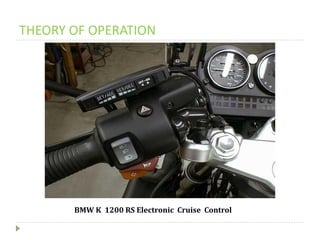
BMW K 1200 RS Electronic Cruise Control
HOW IT WORKS ?
 The cruise control system controls the speed of car the
same way , by adjusting the throttle position. But
cruise control actuates the throttle valve by a cable
connected to an actuator, instead of by pressing a
pedal.
 Most systems do not allow the use of the cruise control
below 25 mph speed (40 kmph)
HOW IT WORKS ?
 The vehicle will maintain the desired speed by pulling
the throttle cable with a solenoid, a vacuum driven
servomechanism, or by using the electronic systems
built into the vehicle (fully electronic) if it uses a 'drive-
by-wire' system.
 The cruise control takes its speed signal from a
rotating driveshaft, speedometer cable,wheel speed
sensor from the engine's RPM or from internal speed
pulses produced electronically by the vehicle.
HOW IT WORKS ?
 On the latest vehicles fitted with electronic throttle
control, cruise control can be easily integrated into the
vehicle's engine management system.
 Modern "adaptive" systems include the ability to
automatically reduce speed when the distance to a car
in front, or the speed limit, decreases. This is an
advantage for those driving in unfamiliar areas.
HOW IT WORKS ?
 Cruise control is not lane control and again it is the
drivers responsibility to maintain lane.
Cruise control cannot see obstacles, therefore it is the
drivers responsibility to break for objects, other
vehicles, stop signs, lights.
SYSTEM COMPONENTS
 Vehicle's Speed Sensor :
 The Vehicle Speed Sensor (VSS) is mounted to the
transmission and provides a low voltage Alternating
Current (AC) signal to the Cruise Control Module
(CCM).
 The CCM converts the AC signal to a pulse width
modulated Direct Current (DC) signal, which is sent to
the cruise control module at a rate of 4000 pulses per
mile.
SYSTEM COMPONENTS
 Cruise Control Module:
The cruise control module has to do three things:
 First it remembers the speed you set. It stores this set
speed until you change it or turn off the ignition.
 Next it takes the speed signal from the vehicle speed sensor
and compares it to the set speed.
 Lastly it sends pulse signals to the actuator. The actuator
will move the throttle linkage to bring the vehicle up to the
set speed and then modulate vacuum to maintain that
speed.
SYSTEM COMPONENTS
 Actuator :
The actuator is what actually moves the throttle linkage.
It is most often vacuum operated although some
actuators are electrically controlled with small, stepper
type motors.
The actuator moves the linkage as directed by the cruise
control module until the set speed has been achieved. It
then maintains this speed by controlling the amount of
vacuum. It actually modulates the vacuum as the pulses
from the control module direct.
SYSTEM COMPONENTS
 Brake Switch :
 A cruise control release switch and a stop lamp switch,
mounted on the brake pedal bracket disengage the
system electrically when the brake pedal is pressed.
 This is accomplished by interrupting the flow of
current to the cruise control module. The cruise speed
of the vehicle at brake actuation will be stored in the
cruise control module memory.
SYSTEM COMPONENTS
 Clutch Switch :
In addition to the brake switch, a vehicle with a manual
transmission has a switch very similar to the brake
switch and disengages the cruise control system when
the clutch pedal is depressed.
 Throttle Linkage :
The actual mechanical connection between the cruise
control actuator and the engine throttle .
CONTROLLING CRUISE CONTROL
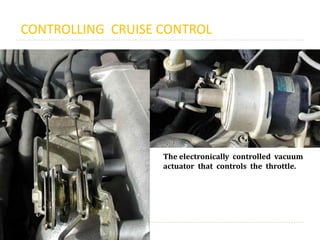
The electronically controlled vacuum
actuator that controls the throttle.
CONTROLLING CRUISE CONTROL
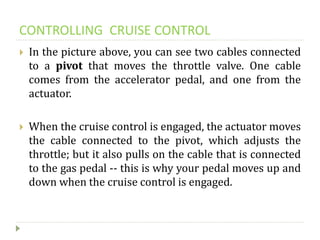
 In the picture above, you can see two cables connected
to a pivot that moves the throttle valve. One cable
comes from the accelerator pedal, and one from the
actuator.
 When the cruise control is engaged, the actuator moves
the cable connected to the pivot, which adjusts the
throttle; but it also pulls on the cable that is connected
to the gas pedal -- this is why your pedal moves up and
down when the cruise control is engaged.
CONTROLLING CRUISE CONTROL
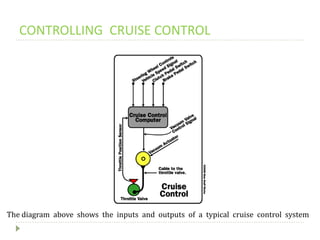
The diagram above shows the inputs and outputs of a typical cruise control system
CONTROLLING CRUISE CONTROL
 The brain of a cruise control system is a small computer
that is normally found behind the dashboard which
connects the sensors.
 A good cruise control system accelerates aggressively to
the desired speed without overshooting, and then
maintains that speed with little deviation no matter how
much weight is in the car, or how steep the hill you drive up.
 When the cruise control is engaged, the throttle can
still be used to accelerate the car, but once the pedal is
released the car will then slow down until it reaches
the previously set speed.
CONTROLLING CRUISE CONTROL
 Controlling the speed of a car is a classic application
of control system theory.
 The most important input is the speed signal; the
cruise control system does a lot with this signal by
a proportional control.
 In a proportional control system, the cruise control
adjusts the throttle proportional to the error, the
error being the difference between the desired speed
and the actual speed.
CONTROLLING CRUISE CONTROL
 Example:
 If the cruise control is set at 60 mph and the car is going 50
mph, the throttle position will be open quite far.
 When the car is going 55 mph, the throttle position
opening will be only half of what it was before. The result is
that the closer the car gets to the desired speed, the slower
it accelerates. Also, if you were on a steep enough hill,
the car might not accelerate at all.
Calculation behind throttle valve
 Most cruise control systems use a control scheme
called proportional-integral-derivative control ( PID control )
 The integral of speed is distance.
 The derivative of speed is acceleration.
 A PID control system uses three factors - proportional, integral
and derivative, calculating each individually and adding them
to get the throttle position.
 This proportional factor helps the car deal with hills, and also
helps it settle into the correct speed and stay there. Taking an
Example : Car when it starts to go up a hill and slows down.
Calculation behind throttle valve
 The proportional control increases the throttle a little,
but you may still slow down. After a little while, the
integral control will start to increase the throttle,
opening it more and more, because the longer the car
maintains a speed slower than the desired speed, the
larger the distance error gets.
 Derivative factor helps the cruise control respond
quickly to changes, such as hills. If the car starts to
slow down, the cruise control respond by increasing
the throttle position.
WHAT CAN GO WRONG
 Since each manufacturer has slightly different cruise
control systems, specific troubleshooting procedures
will vary.
 Below factors can stop working of Cruise Control :
1. Broken Wire
2. Blown Fuse
3. Leaking Vacuum Line
4. Failure of Speed sensor
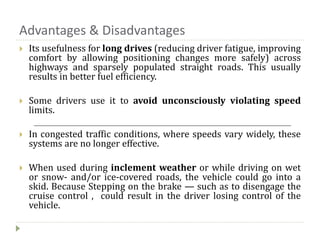
Advantages & Disadvantages
 Its usefulness for long drives (reducing driver fatigue, improving
comfort by allowing positioning changes more safely) across
highways and sparsely populated straight roads. This usually
results in better fuel efficiency.
 Some drivers use it to avoid unconsciously violating speed
limits.
 In congested traffic conditions, where speeds vary widely, these
systems are no longer effective.
 When used during inclement weather or while driving on wet
or snow- and/or ice-covered roads, the vehicle could go into a
skid. Because Stepping on the brake — such as to disengage the
cruise control , could result in the driver losing control of the
vehicle.
 Driving over "rolling" terrain, with gentle up and down
portions, can usually be done more economically by a
skilled driver than cruise system, by maintaining a
relatively constant throttle position.
 Cruise control will tend to over throttle on the upgrades
and retard on the downgrades, wasting the energy
storage capabilities available from the inertia of the
vehicle.
 The lack of need to maintain constant pedal pressure,
which can help lead to accidents caused by highway
hypnosis .
YOU !!!THANK

Cruise control & Adaptive Cruise Control

  • 1.
  • 2.
    WHAT IS CRUISECONTROL ?  Cruise control is a system to accurately maintain the driver's desired set speed, with out intervention from the driver, by actuating the throttle-accelerator pedal linkage.  Also sometimes known as speed control or autocruise.  The system takes over the throttle of the car to maintain a steady speed as set by the driver.
  • 3.
    HISTORY  Speed controlwith a centrifugal governor was used in automobiles as early as the 1910s.  That technology was invented by James Watt and Matthew Boulton in 1788 to control steam engines. The governor adjusts the throttle position as the speed of the engine changes with different loads.
  • 4.
    HISTORY  Modern cruisecontrol was invented in 1945 by mechanical engineer Ralph Teetor. His idea was born out of the frustration of riding in a car driven by his lawyer, who kept speeding up and slowing down.  This system calculated ground speed based on driveshaft rotations and used a solenoid to vary throttle position as needed.  But a 1955 U.S. Patent for a "Constant Speed Regulator" was filed in by Frank J. Riley.
  • 5.
    THEORY OF OPERATION The driver can set the cruise control with the cruise switches, usually ON, OFF, RESUME, SET/ACCEL and COAST, that are located in the steering wheel spokes or on the edge of the hub ( HONDA vehicles ) or on turn signal stalk ( GENERAL MOTORS ).  The ON and OFF buttons don't actually do much. Hitting the ON button does not do anything except tell the car that you might be hitting another button soon. The OFF button turns the cruise control off even if it is engaged. Some cruise controls don't have these buttons; instead, they turn off when the driver hits the brakes, and turn on when the driver hits the set button.  The SET/ACCEL button tells the car to maintain the speed you are currently driving. If you hit the set button at 45 mph, the car will maintain your speed at 45 mph. Holding down the SET / ACCEL button will make the car accelerate; and on this car, tapping it once will make the car go 1 mph faster. Hit the button five times to go 5 mph faster.
  • 6.
    THEORY OF OPERATION If you recently disengaged the cruise control by hitting the brake pedal, hitting the RESUME button will command the car to accelerate back to the most recent speed setting.  Holding down the COAST button will cause the car to decelerate, just as if you took your foot completely off the gas. On this car, tapping the coast button once will cause the car to slow down by 1 mph.  The brake pedal and clutch pedal each have a switch that disengages the cruise control as soon as the pedal is pressed, So you can disengage the cruise control with a light tap on the brake or clutch.
  • 7.
  • 8.
  • 9.
    THEORY OF OPERATION BMWK 1200 RS Electronic Cruise Control
  • 10.
    HOW IT WORKS?  The cruise control system controls the speed of car the same way , by adjusting the throttle position. But cruise control actuates the throttle valve by a cable connected to an actuator, instead of by pressing a pedal.  Most systems do not allow the use of the cruise control below 25 mph speed (40 kmph)
  • 11.
    HOW IT WORKS?  The vehicle will maintain the desired speed by pulling the throttle cable with a solenoid, a vacuum driven servomechanism, or by using the electronic systems built into the vehicle (fully electronic) if it uses a 'drive- by-wire' system.  The cruise control takes its speed signal from a rotating driveshaft, speedometer cable,wheel speed sensor from the engine's RPM or from internal speed pulses produced electronically by the vehicle.
  • 12.
    HOW IT WORKS?  On the latest vehicles fitted with electronic throttle control, cruise control can be easily integrated into the vehicle's engine management system.  Modern "adaptive" systems include the ability to automatically reduce speed when the distance to a car in front, or the speed limit, decreases. This is an advantage for those driving in unfamiliar areas.
  • 13.
    HOW IT WORKS?  Cruise control is not lane control and again it is the drivers responsibility to maintain lane. Cruise control cannot see obstacles, therefore it is the drivers responsibility to break for objects, other vehicles, stop signs, lights.
  • 14.
    SYSTEM COMPONENTS  Vehicle'sSpeed Sensor :  The Vehicle Speed Sensor (VSS) is mounted to the transmission and provides a low voltage Alternating Current (AC) signal to the Cruise Control Module (CCM).  The CCM converts the AC signal to a pulse width modulated Direct Current (DC) signal, which is sent to the cruise control module at a rate of 4000 pulses per mile.
  • 15.
    SYSTEM COMPONENTS  CruiseControl Module: The cruise control module has to do three things:  First it remembers the speed you set. It stores this set speed until you change it or turn off the ignition.  Next it takes the speed signal from the vehicle speed sensor and compares it to the set speed.  Lastly it sends pulse signals to the actuator. The actuator will move the throttle linkage to bring the vehicle up to the set speed and then modulate vacuum to maintain that speed.
  • 16.
    SYSTEM COMPONENTS  Actuator: The actuator is what actually moves the throttle linkage. It is most often vacuum operated although some actuators are electrically controlled with small, stepper type motors. The actuator moves the linkage as directed by the cruise control module until the set speed has been achieved. It then maintains this speed by controlling the amount of vacuum. It actually modulates the vacuum as the pulses from the control module direct.
  • 17.
    SYSTEM COMPONENTS  BrakeSwitch :  A cruise control release switch and a stop lamp switch, mounted on the brake pedal bracket disengage the system electrically when the brake pedal is pressed.  This is accomplished by interrupting the flow of current to the cruise control module. The cruise speed of the vehicle at brake actuation will be stored in the cruise control module memory.
  • 18.
    SYSTEM COMPONENTS  ClutchSwitch : In addition to the brake switch, a vehicle with a manual transmission has a switch very similar to the brake switch and disengages the cruise control system when the clutch pedal is depressed.  Throttle Linkage : The actual mechanical connection between the cruise control actuator and the engine throttle .
  • 19.
    CONTROLLING CRUISE CONTROL Theelectronically controlled vacuum actuator that controls the throttle.
  • 20.
    CONTROLLING CRUISE CONTROL In the picture above, you can see two cables connected to a pivot that moves the throttle valve. One cable comes from the accelerator pedal, and one from the actuator.  When the cruise control is engaged, the actuator moves the cable connected to the pivot, which adjusts the throttle; but it also pulls on the cable that is connected to the gas pedal -- this is why your pedal moves up and down when the cruise control is engaged.
  • 21.
    CONTROLLING CRUISE CONTROL Thediagram above shows the inputs and outputs of a typical cruise control system
  • 22.
    CONTROLLING CRUISE CONTROL The brain of a cruise control system is a small computer that is normally found behind the dashboard which connects the sensors.  A good cruise control system accelerates aggressively to the desired speed without overshooting, and then maintains that speed with little deviation no matter how much weight is in the car, or how steep the hill you drive up.  When the cruise control is engaged, the throttle can still be used to accelerate the car, but once the pedal is released the car will then slow down until it reaches the previously set speed.
  • 23.
    CONTROLLING CRUISE CONTROL Controlling the speed of a car is a classic application of control system theory.  The most important input is the speed signal; the cruise control system does a lot with this signal by a proportional control.  In a proportional control system, the cruise control adjusts the throttle proportional to the error, the error being the difference between the desired speed and the actual speed.
  • 24.
    CONTROLLING CRUISE CONTROL Example:  If the cruise control is set at 60 mph and the car is going 50 mph, the throttle position will be open quite far.  When the car is going 55 mph, the throttle position opening will be only half of what it was before. The result is that the closer the car gets to the desired speed, the slower it accelerates. Also, if you were on a steep enough hill, the car might not accelerate at all.
  • 25.
    Calculation behind throttlevalve  Most cruise control systems use a control scheme called proportional-integral-derivative control ( PID control )  The integral of speed is distance.  The derivative of speed is acceleration.  A PID control system uses three factors - proportional, integral and derivative, calculating each individually and adding them to get the throttle position.  This proportional factor helps the car deal with hills, and also helps it settle into the correct speed and stay there. Taking an Example : Car when it starts to go up a hill and slows down.
  • 26.
    Calculation behind throttlevalve  The proportional control increases the throttle a little, but you may still slow down. After a little while, the integral control will start to increase the throttle, opening it more and more, because the longer the car maintains a speed slower than the desired speed, the larger the distance error gets.  Derivative factor helps the cruise control respond quickly to changes, such as hills. If the car starts to slow down, the cruise control respond by increasing the throttle position.
  • 27.
    WHAT CAN GOWRONG  Since each manufacturer has slightly different cruise control systems, specific troubleshooting procedures will vary.  Below factors can stop working of Cruise Control : 1. Broken Wire 2. Blown Fuse 3. Leaking Vacuum Line 4. Failure of Speed sensor
  • 28.
    Advantages & Disadvantages Its usefulness for long drives (reducing driver fatigue, improving comfort by allowing positioning changes more safely) across highways and sparsely populated straight roads. This usually results in better fuel efficiency.  Some drivers use it to avoid unconsciously violating speed limits.  In congested traffic conditions, where speeds vary widely, these systems are no longer effective.  When used during inclement weather or while driving on wet or snow- and/or ice-covered roads, the vehicle could go into a skid. Because Stepping on the brake — such as to disengage the cruise control , could result in the driver losing control of the vehicle.
  • 29.
     Driving over"rolling" terrain, with gentle up and down portions, can usually be done more economically by a skilled driver than cruise system, by maintaining a relatively constant throttle position.  Cruise control will tend to over throttle on the upgrades and retard on the downgrades, wasting the energy storage capabilities available from the inertia of the vehicle.  The lack of need to maintain constant pedal pressure, which can help lead to accidents caused by highway hypnosis .
  • 30.