International Research Journal of Engineering and Technology (IRJET) e-ISSN: 2395 -0056
Volume: 04 Issue: 03 | Mar -2017 www.irjet.net p-ISSN: 2395-0072
© 2017, IRJET | Impact Factor value: 5.181 | ISO 9001:2008 Certified Journal | Page 1367
TRAFFIC CLEARANCE FOR EMERGENCY VEHICLES USING PRIORITY
MODE
MR. M. NITHYAKUMAR1, P.ASWIN2, D. BHARATHI SHREE3, M.P.DHARMEESH4,M. KALAIVANI5
1-Assistant Professor, Department of Electronics and Communication Engineering, Jansons Institute of Technology,
Karumathampatti, Coimbatore.
2, 3, 4, 5-Students, Department of Electronics and Communication Engineering, Jansons Institute of Technology,
Karumathampatti, Coimbatore.
---------------------------------------------------------------------***---------------------------------------------------------------------
Abstract: The main motto behind our project is to provide a smart way of controlling traffic light timing during a peak hours and
also to provide smooth flow for the ambulance to reach the hospital in time .We are going to implement a new mode called
“ambulance mode” which would control the traffic lights in the path of the ambulance. This scheme is fully automated thus it
controls the traffic lights, helping to reach the hospital in time. This is not preferred only for ambulance. It is preferrable for other
emergency vehicles such as fire engine.
KEYWORDS: Other names for blue mode: Ambulance mode, Emergency mode, Priority mode.
1.INTRODUCTION:
Traffic congestion and tidal flow management were recognized as major problems. In India as the population is being
increasing day by day the traffic is also increasing with proportionality. So the traffic signals need good coordination
for the smooth flow of traffic during the peak hours .. Moreover road accidents in the city have been incessant and to bar
the loss of life due to the accidents is even more crucial. In this fast moving world we are in a compulsion torushour selfwhich
makes the traffic congestion and accident an inevitable one. In foreign countries, they successfully save human life, because
whenever an ambulance comes they move aside to clear out the route till the ambulance passes through. On the other hand in
INDIA, whenever an ambulance comes it is controlled manually at the traffic junction by a traffic officer.Nowadays all systems
are working automatically. So, we proposed system called “traffic clearance for emergency vehicles using blue mode”.
1.1.MOTIVATION AND RELATED WORK:
In early days, the traffic is controlled manually by police officer. They decide when the vehicle has to cross the road and also
provide importance to the emergency vehicle. Then in Intelligent Traffic Management System, the traffic is controlled
automatically by each lane 120 seconds of green light is set on. Before green light, yellow light flashes for 20 second,signifying
to start your vehicle and be ready to go. The disadvantages of this system is it does not provide timing based on priority
because of that people has to wait for long time even though there is no traffic and also does not recognize and prioritize the
emergency vehicle.[1] They consists of two parts :wireless sensors network(traffic sensor nodes(TSN) groups) and a control
box. In this they collected traffic data with help of sensors and control the traffic.
[2] Describes the concept of traffic clearance in which the time delay (6s) between the switching of signals is based on the
congestion of vehicle. In our project we use 10s for green light to be left ON. If the congestion increases this duration will be
International Research Journal of Engineering and Technology (IRJET) e-ISSN: 2395 -0056
Volume: 04 Issue: 03 | Mar -2017 www.irjet.net p-ISSN: 2395-0072
© 2017, IRJET | Impact Factor value: 5.181 | ISO 9001:2008 Certified Journal | Page 1368
extended to 20s.[3]Describes about density based traffic clearance. Initially we started this project only for ambulance mode
but we thought of using this concept for normal mode also by using the knowledge of this paper.[4] Portrays area occupied by
the edges of vehicle will be considered to estimate vehicles density using image processing. We makeuseofthisconceptinour
project to clear the traffic congestion in normal mode. Due to insufficient time we have used IR sensor instead. Keeping this
paper as reference we can extend our project by placing camera at junction in four ways. [5]Trafficisclearedusing green wave
system. The green wave is the synchronization of the green phase of traffic signals. The disadvantage of this system is that if
green wave is disturbed the traffic will collapse. [6]Way for ambulance in lane is provided through RFID technology. The
system may not work, if the ambulance needs to take another route for some reasons or if the starting point is not known in
advance. [7] Uses two RFID readers which will identify traffic density on two roads. When emergency vehicle is on lane it turn
traffic signal to green.[8]The images sequences from a camera are analysed using various edge detection and object counting
methods to obtain the most efficient technique to provide smooth flow for the vehicle using” LabVIEW stimulation”.
1.2.CONTRIBUTIONS AND OUTLINE:
Our objective in this paper is to design a system of traffic clearance for emergency vehicle using image processing in matlab
especially by using a new mode called blue mode. In this system, we first control the normal traffic using sensor based density
management [3]. If any emergency situation occur, then the swift movement is important tocontrol thetrafficcongestion.And
by here we introduce a special mode called AMBULANCEMODE, in which there will be an additional indicatorwhichisinblue.
By this the people could know that the ambulance is in its path and try to pave a way for life saver. All these process are
combined and makes the life saver to reach the hospital in time.
2.SYSTEM MODEL:
Our project consists of three main modules which co-ordinates the entire process.
 Ambulance module
 Control module
 Traffic control module
2.1.ALGORITHM FOR ENTIRE PROCESS
1. START
2. Ambulance is on the way to hospital.
3. On reaching the 1 km marking, a camera which is fitted there will take the snap shot of ambulance.
4. Compares the captured image with the reference ambulance image.
5. Case 1: i. If the image matches, a signal will be sent to the traffic light to switch from normal mode to BLUE mode.
ii. This mode continues for 30 seconds and goes to step 6.
Case 2: If the image doesnt matches the traffic light continues to be in normal mode.
International Research Journal of Engineering and Technology (IRJET) e-ISSN: 2395 -0056
Volume: 04 Issue: 03 | Mar -2017 www.irjet.net p-ISSN: 2395-0072
© 2017, IRJET | Impact Factor value: 5.181 | ISO 9001:2008 Certified Journal | Page 1369
6. In normal mode, the signals red, yellow, green will be switched at an interval of 10 seconds.
7. IR sensor will continuosly sense the traffic density.
8. Case 1: If the density is detected, green light will be ON for additional 10 seconds.Case 2: If the normal density is
detected step 6 will be continued.
9. STOP.
2.2.AMBULANCE MODULE
This unit initiates the entire process of our project. Switching of our controls mainly depend on its arrival. Ambulance unit is
designed in a way its movements are entirely controlled by Bluetooth. This unit is just made to give an outward appearanceof
the original ambulance in our demo. So we planned to design this unit by a Bluetooth controlled vehicle.
2.3. CONTROL MODULE
This unit plays a vital role in recognizing the arrival of ambulance. Furtheritsendsa signal tothetrafficcontrol unit toprogress
for the next stage.
2.3.1.WORKING
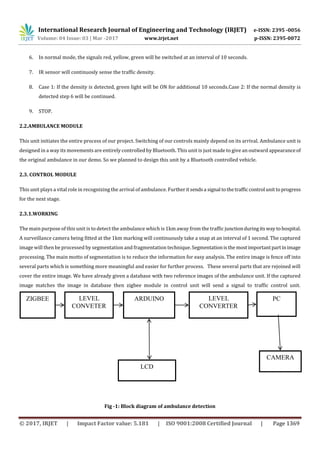
The main purpose of this unit is to detect the ambulance which is 1km away from the traffic junctionduringitsway tohospital.
A surveillance camera being fitted at the 1km marking will continuously take a snap at an interval of 1 second. The captured
image will then be processed by segmentation and fragmentation technique.Segmentationisthe mostimportantpartinimage
processing. The main motto of segmentation is to reduce the information for easy analysis. The entire image is fence off into
several parts which is something more meaningful and easier for further process. These several parts that are rejoined will
cover the entire image. We have already given a database with two reference images of the ambulance unit. If the captured
image matches the image in database then zigbee module in control unit will send a signal to traffic control unit.
Fig -1: Block diagram of ambulance detection
ARDUINOZIGBEE
CAMERA
LEVEL
CONVERTER
LEVEL
CONVETER
PC
LCD
International Research Journal of Engineering and Technology (IRJET) e-ISSN: 2395 -0056
Volume: 04 Issue: 03 | Mar -2017 www.irjet.net p-ISSN: 2395-0072
© 2017, IRJET | Impact Factor value: 5.181 | ISO 9001:2008 Certified Journal | Page 1370
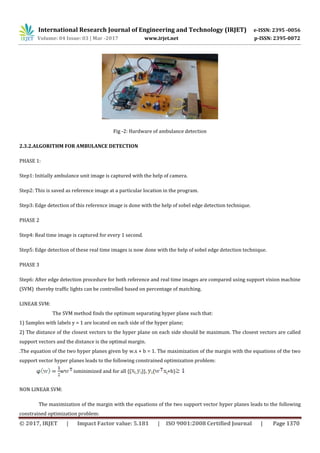
Fig -2: Hardware of ambulance detection
2.3.2.ALGORITHM FOR AMBULANCE DETECTION
PHASE 1:
Step1: Initially ambulance unit image is captured with the help of camera.
Step2: This is saved as reference image at a particular location in the program.
Step3: Edge detection of this reference image is done with the help of sobel edge detection technique.
PHASE 2
Step4: Real time image is captured for every 1 second.
Step5: Edge detection of these real time images is now done with the help of sobel edge detection technique.
PHASE 3
Step6: After edge detection procedure for both reference and real time images are compared using support vision machine
(SVM) thereby traffic lights can be controlled based on percentage of matching.
LINEAR SVM:
The SVM method finds the optimum separating hyper plane such that:
1) Samples with labels y = 1 are located on each side of the hyper plane;
2) The distance of the closest vectors to the hyper plane on each side should be maximum. The closest vectors are called
support vectors and the distance is the optimal margin.
.The equation of the two hyper planes given by w.x + b = 1. The maximization of the margin with the equations of the two
support vector hyper planes leads to the following constrained optimization problem:
w isminimized and for all {( )}, ( +b)
NON LINEAR SVM:
The maximization of the margin with the equations of the two support vector hyper planes leads to the following
constrained optimization problem:
International Research Journal of Engineering and Technology (IRJET) e-ISSN: 2395 -0056
Volume: 04 Issue: 03 | Mar -2017 www.irjet.net p-ISSN: 2395-0072
© 2017, IRJET | Impact Factor value: 5.181 | ISO 9001:2008 Certified Journal | Page 1371
w is minimized and for all {( )}, ( +b) - and ξ≥
Kernel functions processes dual maximum margin problem in feature space using linear classification. The resulting
model is then a linear model in feature space and a non-linear model in input space.
Linear kernel: k(
Polynomial kernel :
k( ,γ>0
RBF kernel:
k( =exp(-γ││ ,γ>0
SIGMOID KERNEL:
k( =tanh ,γ>0
%match = number of pixels matched successfully / total number of pixels.
On the detection of ambulance arrival a signal *1 is programmed to send via Zigbee module which is fittedat1Kmmarking.On
receiving this signal by another Zigbee module which is at traffic light will switch the signal from normal mode to ambulance
mode. After a time delay a signal *2 will be send to return normal mode[3].
2.4TRAFFIC CONTROL MODULE
This unit will control the traffic congestion in normal mode as well as in blue mode.
Fig -4: Block diagram of traffic signal
ZIGBEE LEVEL
CONVERTER
PIC 16F877A
TRAFFIC
LIGHT
TRAFFIC
DENSITY
SENSOR
AMPLIFIER
International Research Journal of Engineering and Technology (IRJET) e-ISSN: 2395 -0056
Volume: 04 Issue: 03 | Mar -2017 www.irjet.net p-ISSN: 2395-0072
© 2017, IRJET | Impact Factor value: 5.181 | ISO 9001:2008 Certified Journal | Page 1372
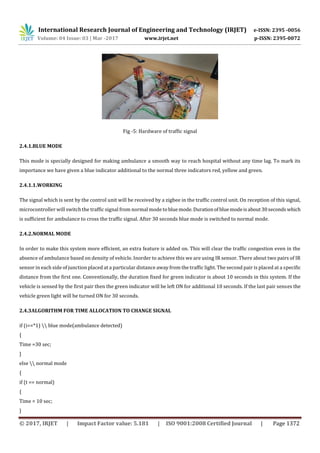
Fig -5: Hardware of traffic signal
2.4.1.BLUE MODE
This mode is specially designed for making ambulance a smooth way to reach hospital without any time lag. To mark its
importance we have given a blue indicator additional to the normal three indicators red, yellow and green.
2.4.1.1.WORKING
The signal which is sent by the control unit will be received by a zigbee in the traffic control unit. On reception of this signal,
microcontroller will switch the traffic signal from normal mode tobluemode.Duration ofbluemodeisabout30secondswhich
is sufficient for ambulance to cross the traffic signal. After 30 seconds blue mode is switched to normal mode.
2.4.2.NORMAL MODE
In order to make this system more efficient, an extra feature is added on. This will clear the traffic congestion even in the
absence of ambulance based on density of vehicle. Inorder to achieve this we are using IR sensor. There about two pairs of IR
sensor in each side of junction placed at a particular distance away from the traffic light. The second pair is placed at a specific
distance from the first one. Conventionally, the duration fixed for green indicator is about 10 seconds in this system. If the
vehicle is sensed by the first pair then the green indicator will be left ON for additional 10 seconds. If the last pair senses the
vehicle green light will be turned ON for 30 seconds.
2.4.3ALGORITHM FOR TIME ALLOCATION TO CHANGE SIGNAL
if (i==*1)  blue mode(ambulance detected)
{
Time =30 sec;
}
else  normal mode
{
if (t == normal)
{
Time = 10 sec;
}
International Research Journal of Engineering and Technology (IRJET) e-ISSN: 2395 -0056
Volume: 04 Issue: 03 | Mar -2017 www.irjet.net p-ISSN: 2395-0072
© 2017, IRJET | Impact Factor value: 5.181 | ISO 9001:2008 Certified Journal | Page 1373
elseif (t==medium)
{
Time = 20 sec;
}
elseif (t==high)
{
Time=30 sec;
}}
i = checking whether referred images matched with captured images
t = number of vehicle.
3. FUTURE IMPLEMENTATION
In our project we have used only one camera at 1km marking. We have implemented this in only one side of the junction. This
project can be extended further using camera fitted at 1km marking of eachside.Wecanalsofixanothercamera atthejunction
to detect the departure of ambulance instead of using 30 seconds delay.IR sensor can be replaced by this camera in normal
mode.
4.REAL TIME IMPLEMENTATION:
We have used zigbee module cc250 which cover area of 50metres in real time implementation we can use the following:
1) Xbee pro which cover area of 5km.
2) Using global system for mobile communication (GSM).
3) Using internet of things (IOT).
In our system we have used sobel operator for edge detectionbecauseofitssimplicity, detectionofedgesandtheirorientations
but this is sensitive to noise so in real time implementation we can use canny edge detection algorithm.
5. REFERENCE:
[1] KHALIL M. YOUSEF, JAMAL N. AL-KARAKI, “Intelligent Traffic Light Flow Control System Using Wireless Sensors
Networks”, JOURNAL OF INFORMATION SCIENCE AND ENGINEERING 26, 753-768 (2010).
[2] WM El-Medany 1, MR Hussain,” FPGA-Based Advanced Real Traffic Light Controller System Design” IEEE International
Workshop on Intelligent Data Acquisition and Advanced Computing Systems: Technology and Applications 6-8 September
2007, Dortmund, Germany1-4244-1348-6/07/$25.00 ©2007 IEEE 100.
[3]Minal K. Avzekar1, Amruta Moon,” Adaptive Traffic Signal Control with VANET” International Journal of Scientific
Engineering and Research (IJSER) Volume 2 Issue 3, March 2014.
[4] Mohammad ShahabUddin, Ayon Kumar Das, Md. Abu Taleb,” real-time area based traffic density estimation by image
processing for traffic signal control system:bangladeshperspective”2ndInt'l Conf.onElectrical EngineeringandInformation&
Communication Technology (ICEEICT) 2015
Jahangirnagar University, Dhaka-1342, Bangladesh, 21-23 May 2015.
International Research Journal of Engineering and Technology (IRJET) e-ISSN: 2395 -0056
Volume: 04 Issue: 03 | Mar -2017 www.irjet.net p-ISSN: 2395-0072
© 2017, IRJET | Impact Factor value: 5.181 | ISO 9001:2008 Certified Journal | Page 1374
[5]A. K. Mittal and D. Bhandari, “A novel approach to implement green wave system and detection of stolen vehicles,” in Proc.
IEEE 3rd Int.Adv.Comput., Feb. 2013, pp. 1055–1059.
[6]R. Hegde, R. R. Sali, and M. S. Indira, “RFID and GPS based automatic lane clearance system for ambulance,” Int. J. Adv. Elect.
Electron.Eng., vol. 2, no. 3, pp. 102–107, 2013.
[7]Sarika B. Kale, and Gajanan P. Dhok” Design of Intelligent Ambulance and Traffic Control”, International Journal of
Innovative Technology and Exploring Engineering (IJITEE) ISSN: 2278-3075, Volume-2, Issue-5, April 2013.
[8]Veeravenkatesh, Nazneensyed ,” smart traffic control system for emergency vehicle clearance” International Journal of
Innovative Research in Computer and Communication Engineering –Vol.3, Issue 8, August 2015.

Traffic Clearance for Emergency Vehicles Using Priority Mode

  • 1.
    International Research Journalof Engineering and Technology (IRJET) e-ISSN: 2395 -0056 Volume: 04 Issue: 03 | Mar -2017 www.irjet.net p-ISSN: 2395-0072 © 2017, IRJET | Impact Factor value: 5.181 | ISO 9001:2008 Certified Journal | Page 1367 TRAFFIC CLEARANCE FOR EMERGENCY VEHICLES USING PRIORITY MODE MR. M. NITHYAKUMAR1, P.ASWIN2, D. BHARATHI SHREE3, M.P.DHARMEESH4,M. KALAIVANI5 1-Assistant Professor, Department of Electronics and Communication Engineering, Jansons Institute of Technology, Karumathampatti, Coimbatore. 2, 3, 4, 5-Students, Department of Electronics and Communication Engineering, Jansons Institute of Technology, Karumathampatti, Coimbatore. ---------------------------------------------------------------------***--------------------------------------------------------------------- Abstract: The main motto behind our project is to provide a smart way of controlling traffic light timing during a peak hours and also to provide smooth flow for the ambulance to reach the hospital in time .We are going to implement a new mode called “ambulance mode” which would control the traffic lights in the path of the ambulance. This scheme is fully automated thus it controls the traffic lights, helping to reach the hospital in time. This is not preferred only for ambulance. It is preferrable for other emergency vehicles such as fire engine. KEYWORDS: Other names for blue mode: Ambulance mode, Emergency mode, Priority mode. 1.INTRODUCTION: Traffic congestion and tidal flow management were recognized as major problems. In India as the population is being increasing day by day the traffic is also increasing with proportionality. So the traffic signals need good coordination for the smooth flow of traffic during the peak hours .. Moreover road accidents in the city have been incessant and to bar the loss of life due to the accidents is even more crucial. In this fast moving world we are in a compulsion torushour selfwhich makes the traffic congestion and accident an inevitable one. In foreign countries, they successfully save human life, because whenever an ambulance comes they move aside to clear out the route till the ambulance passes through. On the other hand in INDIA, whenever an ambulance comes it is controlled manually at the traffic junction by a traffic officer.Nowadays all systems are working automatically. So, we proposed system called “traffic clearance for emergency vehicles using blue mode”. 1.1.MOTIVATION AND RELATED WORK: In early days, the traffic is controlled manually by police officer. They decide when the vehicle has to cross the road and also provide importance to the emergency vehicle. Then in Intelligent Traffic Management System, the traffic is controlled automatically by each lane 120 seconds of green light is set on. Before green light, yellow light flashes for 20 second,signifying to start your vehicle and be ready to go. The disadvantages of this system is it does not provide timing based on priority because of that people has to wait for long time even though there is no traffic and also does not recognize and prioritize the emergency vehicle.[1] They consists of two parts :wireless sensors network(traffic sensor nodes(TSN) groups) and a control box. In this they collected traffic data with help of sensors and control the traffic. [2] Describes the concept of traffic clearance in which the time delay (6s) between the switching of signals is based on the congestion of vehicle. In our project we use 10s for green light to be left ON. If the congestion increases this duration will be
  • 2.
    International Research Journalof Engineering and Technology (IRJET) e-ISSN: 2395 -0056 Volume: 04 Issue: 03 | Mar -2017 www.irjet.net p-ISSN: 2395-0072 © 2017, IRJET | Impact Factor value: 5.181 | ISO 9001:2008 Certified Journal | Page 1368 extended to 20s.[3]Describes about density based traffic clearance. Initially we started this project only for ambulance mode but we thought of using this concept for normal mode also by using the knowledge of this paper.[4] Portrays area occupied by the edges of vehicle will be considered to estimate vehicles density using image processing. We makeuseofthisconceptinour project to clear the traffic congestion in normal mode. Due to insufficient time we have used IR sensor instead. Keeping this paper as reference we can extend our project by placing camera at junction in four ways. [5]Trafficisclearedusing green wave system. The green wave is the synchronization of the green phase of traffic signals. The disadvantage of this system is that if green wave is disturbed the traffic will collapse. [6]Way for ambulance in lane is provided through RFID technology. The system may not work, if the ambulance needs to take another route for some reasons or if the starting point is not known in advance. [7] Uses two RFID readers which will identify traffic density on two roads. When emergency vehicle is on lane it turn traffic signal to green.[8]The images sequences from a camera are analysed using various edge detection and object counting methods to obtain the most efficient technique to provide smooth flow for the vehicle using” LabVIEW stimulation”. 1.2.CONTRIBUTIONS AND OUTLINE: Our objective in this paper is to design a system of traffic clearance for emergency vehicle using image processing in matlab especially by using a new mode called blue mode. In this system, we first control the normal traffic using sensor based density management [3]. If any emergency situation occur, then the swift movement is important tocontrol thetrafficcongestion.And by here we introduce a special mode called AMBULANCEMODE, in which there will be an additional indicatorwhichisinblue. By this the people could know that the ambulance is in its path and try to pave a way for life saver. All these process are combined and makes the life saver to reach the hospital in time. 2.SYSTEM MODEL: Our project consists of three main modules which co-ordinates the entire process.  Ambulance module  Control module  Traffic control module 2.1.ALGORITHM FOR ENTIRE PROCESS 1. START 2. Ambulance is on the way to hospital. 3. On reaching the 1 km marking, a camera which is fitted there will take the snap shot of ambulance. 4. Compares the captured image with the reference ambulance image. 5. Case 1: i. If the image matches, a signal will be sent to the traffic light to switch from normal mode to BLUE mode. ii. This mode continues for 30 seconds and goes to step 6. Case 2: If the image doesnt matches the traffic light continues to be in normal mode.
  • 3.
    International Research Journalof Engineering and Technology (IRJET) e-ISSN: 2395 -0056 Volume: 04 Issue: 03 | Mar -2017 www.irjet.net p-ISSN: 2395-0072 © 2017, IRJET | Impact Factor value: 5.181 | ISO 9001:2008 Certified Journal | Page 1369 6. In normal mode, the signals red, yellow, green will be switched at an interval of 10 seconds. 7. IR sensor will continuosly sense the traffic density. 8. Case 1: If the density is detected, green light will be ON for additional 10 seconds.Case 2: If the normal density is detected step 6 will be continued. 9. STOP. 2.2.AMBULANCE MODULE This unit initiates the entire process of our project. Switching of our controls mainly depend on its arrival. Ambulance unit is designed in a way its movements are entirely controlled by Bluetooth. This unit is just made to give an outward appearanceof the original ambulance in our demo. So we planned to design this unit by a Bluetooth controlled vehicle. 2.3. CONTROL MODULE This unit plays a vital role in recognizing the arrival of ambulance. Furtheritsendsa signal tothetrafficcontrol unit toprogress for the next stage. 2.3.1.WORKING The main purpose of this unit is to detect the ambulance which is 1km away from the traffic junctionduringitsway tohospital. A surveillance camera being fitted at the 1km marking will continuously take a snap at an interval of 1 second. The captured image will then be processed by segmentation and fragmentation technique.Segmentationisthe mostimportantpartinimage processing. The main motto of segmentation is to reduce the information for easy analysis. The entire image is fence off into several parts which is something more meaningful and easier for further process. These several parts that are rejoined will cover the entire image. We have already given a database with two reference images of the ambulance unit. If the captured image matches the image in database then zigbee module in control unit will send a signal to traffic control unit. Fig -1: Block diagram of ambulance detection ARDUINOZIGBEE CAMERA LEVEL CONVERTER LEVEL CONVETER PC LCD
  • 4.
    International Research Journalof Engineering and Technology (IRJET) e-ISSN: 2395 -0056 Volume: 04 Issue: 03 | Mar -2017 www.irjet.net p-ISSN: 2395-0072 © 2017, IRJET | Impact Factor value: 5.181 | ISO 9001:2008 Certified Journal | Page 1370 Fig -2: Hardware of ambulance detection 2.3.2.ALGORITHM FOR AMBULANCE DETECTION PHASE 1: Step1: Initially ambulance unit image is captured with the help of camera. Step2: This is saved as reference image at a particular location in the program. Step3: Edge detection of this reference image is done with the help of sobel edge detection technique. PHASE 2 Step4: Real time image is captured for every 1 second. Step5: Edge detection of these real time images is now done with the help of sobel edge detection technique. PHASE 3 Step6: After edge detection procedure for both reference and real time images are compared using support vision machine (SVM) thereby traffic lights can be controlled based on percentage of matching. LINEAR SVM: The SVM method finds the optimum separating hyper plane such that: 1) Samples with labels y = 1 are located on each side of the hyper plane; 2) The distance of the closest vectors to the hyper plane on each side should be maximum. The closest vectors are called support vectors and the distance is the optimal margin. .The equation of the two hyper planes given by w.x + b = 1. The maximization of the margin with the equations of the two support vector hyper planes leads to the following constrained optimization problem: w isminimized and for all {( )}, ( +b) NON LINEAR SVM: The maximization of the margin with the equations of the two support vector hyper planes leads to the following constrained optimization problem:
  • 5.
    International Research Journalof Engineering and Technology (IRJET) e-ISSN: 2395 -0056 Volume: 04 Issue: 03 | Mar -2017 www.irjet.net p-ISSN: 2395-0072 © 2017, IRJET | Impact Factor value: 5.181 | ISO 9001:2008 Certified Journal | Page 1371 w is minimized and for all {( )}, ( +b) - and ξ≥ Kernel functions processes dual maximum margin problem in feature space using linear classification. The resulting model is then a linear model in feature space and a non-linear model in input space. Linear kernel: k( Polynomial kernel : k( ,γ>0 RBF kernel: k( =exp(-γ││ ,γ>0 SIGMOID KERNEL: k( =tanh ,γ>0 %match = number of pixels matched successfully / total number of pixels. On the detection of ambulance arrival a signal *1 is programmed to send via Zigbee module which is fittedat1Kmmarking.On receiving this signal by another Zigbee module which is at traffic light will switch the signal from normal mode to ambulance mode. After a time delay a signal *2 will be send to return normal mode[3]. 2.4TRAFFIC CONTROL MODULE This unit will control the traffic congestion in normal mode as well as in blue mode. Fig -4: Block diagram of traffic signal ZIGBEE LEVEL CONVERTER PIC 16F877A TRAFFIC LIGHT TRAFFIC DENSITY SENSOR AMPLIFIER
  • 6.
    International Research Journalof Engineering and Technology (IRJET) e-ISSN: 2395 -0056 Volume: 04 Issue: 03 | Mar -2017 www.irjet.net p-ISSN: 2395-0072 © 2017, IRJET | Impact Factor value: 5.181 | ISO 9001:2008 Certified Journal | Page 1372 Fig -5: Hardware of traffic signal 2.4.1.BLUE MODE This mode is specially designed for making ambulance a smooth way to reach hospital without any time lag. To mark its importance we have given a blue indicator additional to the normal three indicators red, yellow and green. 2.4.1.1.WORKING The signal which is sent by the control unit will be received by a zigbee in the traffic control unit. On reception of this signal, microcontroller will switch the traffic signal from normal mode tobluemode.Duration ofbluemodeisabout30secondswhich is sufficient for ambulance to cross the traffic signal. After 30 seconds blue mode is switched to normal mode. 2.4.2.NORMAL MODE In order to make this system more efficient, an extra feature is added on. This will clear the traffic congestion even in the absence of ambulance based on density of vehicle. Inorder to achieve this we are using IR sensor. There about two pairs of IR sensor in each side of junction placed at a particular distance away from the traffic light. The second pair is placed at a specific distance from the first one. Conventionally, the duration fixed for green indicator is about 10 seconds in this system. If the vehicle is sensed by the first pair then the green indicator will be left ON for additional 10 seconds. If the last pair senses the vehicle green light will be turned ON for 30 seconds. 2.4.3ALGORITHM FOR TIME ALLOCATION TO CHANGE SIGNAL if (i==*1) blue mode(ambulance detected) { Time =30 sec; } else normal mode { if (t == normal) { Time = 10 sec; }
  • 7.
    International Research Journalof Engineering and Technology (IRJET) e-ISSN: 2395 -0056 Volume: 04 Issue: 03 | Mar -2017 www.irjet.net p-ISSN: 2395-0072 © 2017, IRJET | Impact Factor value: 5.181 | ISO 9001:2008 Certified Journal | Page 1373 elseif (t==medium) { Time = 20 sec; } elseif (t==high) { Time=30 sec; }} i = checking whether referred images matched with captured images t = number of vehicle. 3. FUTURE IMPLEMENTATION In our project we have used only one camera at 1km marking. We have implemented this in only one side of the junction. This project can be extended further using camera fitted at 1km marking of eachside.Wecanalsofixanothercamera atthejunction to detect the departure of ambulance instead of using 30 seconds delay.IR sensor can be replaced by this camera in normal mode. 4.REAL TIME IMPLEMENTATION: We have used zigbee module cc250 which cover area of 50metres in real time implementation we can use the following: 1) Xbee pro which cover area of 5km. 2) Using global system for mobile communication (GSM). 3) Using internet of things (IOT). In our system we have used sobel operator for edge detectionbecauseofitssimplicity, detectionofedgesandtheirorientations but this is sensitive to noise so in real time implementation we can use canny edge detection algorithm. 5. REFERENCE: [1] KHALIL M. YOUSEF, JAMAL N. AL-KARAKI, “Intelligent Traffic Light Flow Control System Using Wireless Sensors Networks”, JOURNAL OF INFORMATION SCIENCE AND ENGINEERING 26, 753-768 (2010). [2] WM El-Medany 1, MR Hussain,” FPGA-Based Advanced Real Traffic Light Controller System Design” IEEE International Workshop on Intelligent Data Acquisition and Advanced Computing Systems: Technology and Applications 6-8 September 2007, Dortmund, Germany1-4244-1348-6/07/$25.00 ©2007 IEEE 100. [3]Minal K. Avzekar1, Amruta Moon,” Adaptive Traffic Signal Control with VANET” International Journal of Scientific Engineering and Research (IJSER) Volume 2 Issue 3, March 2014. [4] Mohammad ShahabUddin, Ayon Kumar Das, Md. Abu Taleb,” real-time area based traffic density estimation by image processing for traffic signal control system:bangladeshperspective”2ndInt'l Conf.onElectrical EngineeringandInformation& Communication Technology (ICEEICT) 2015 Jahangirnagar University, Dhaka-1342, Bangladesh, 21-23 May 2015.
  • 8.
    International Research Journalof Engineering and Technology (IRJET) e-ISSN: 2395 -0056 Volume: 04 Issue: 03 | Mar -2017 www.irjet.net p-ISSN: 2395-0072 © 2017, IRJET | Impact Factor value: 5.181 | ISO 9001:2008 Certified Journal | Page 1374 [5]A. K. Mittal and D. Bhandari, “A novel approach to implement green wave system and detection of stolen vehicles,” in Proc. IEEE 3rd Int.Adv.Comput., Feb. 2013, pp. 1055–1059. [6]R. Hegde, R. R. Sali, and M. S. Indira, “RFID and GPS based automatic lane clearance system for ambulance,” Int. J. Adv. Elect. Electron.Eng., vol. 2, no. 3, pp. 102–107, 2013. [7]Sarika B. Kale, and Gajanan P. Dhok” Design of Intelligent Ambulance and Traffic Control”, International Journal of Innovative Technology and Exploring Engineering (IJITEE) ISSN: 2278-3075, Volume-2, Issue-5, April 2013. [8]Veeravenkatesh, Nazneensyed ,” smart traffic control system for emergency vehicle clearance” International Journal of Innovative Research in Computer and Communication Engineering –Vol.3, Issue 8, August 2015.