The document contains 10 programs related to sorting and graph algorithms. Program 1-7 implement different sorting algorithms - insertion sort, selection sort, heap sort, quick sort, counting sort, merge sort and radix sort. Program 8 implements the greedy knapsack problem. Program 9 implements the travelling salesman problem. Program 10 implements Kruskal's algorithm to find the minimum spanning tree of a graph.
These slides present various sorting algorithms: Insertion, Selection, Heap, Quick, Counting, Merge, and Radix Sort, detailing their implementation in C with functions and array manipulations.
These slides present various sorting algorithms: Insertion, Selection, Heap, Quick, Counting, Merge, and Radix Sort, detailing their implementation in C with functions and array manipulations.
These slides present various sorting algorithms: Insertion, Selection, Heap, Quick, Counting, Merge, and Radix Sort, detailing their implementation in C with functions and array manipulations.
These slides present various sorting algorithms: Insertion, Selection, Heap, Quick, Counting, Merge, and Radix Sort, detailing their implementation in C with functions and array manipulations.
These slides present various sorting algorithms: Insertion, Selection, Heap, Quick, Counting, Merge, and Radix Sort, detailing their implementation in C with functions and array manipulations.
These slides present various sorting algorithms: Insertion, Selection, Heap, Quick, Counting, Merge, and Radix Sort, detailing their implementation in C with functions and array manipulations.
These slides present various sorting algorithms: Insertion, Selection, Heap, Quick, Counting, Merge, and Radix Sort, detailing their implementation in C with functions and array manipulations.
This group covers optimization problems using greedy methods, including the Knapsack Problem, Traveling Salesman Problem, Minimum Spanning Tree via Kruskal’s Algorithm, and the N Queen Problem, all implemented in C.
This group covers optimization problems using greedy methods, including the Knapsack Problem, Traveling Salesman Problem, Minimum Spanning Tree via Kruskal’s Algorithm, and the N Queen Problem, all implemented in C.
This group covers optimization problems using greedy methods, including the Knapsack Problem, Traveling Salesman Problem, Minimum Spanning Tree via Kruskal’s Algorithm, and the N Queen Problem, all implemented in C.
This group covers optimization problems using greedy methods, including the Knapsack Problem, Traveling Salesman Problem, Minimum Spanning Tree via Kruskal’s Algorithm, and the N Queen Problem, all implemented in C.
Program 7
Writea program to perform radix sort.
#include<stdio.h>
#include<conio.h>
radix_sort(int array[], int n);
void main()
{
int array[100],n,i;
clrscr();
printf("tttRadix Sortnnnn");
printf("Enter the number of elements to be sorted: ");
scanf("%d",&n);
printf("nEnter the elements to be sorted: n");
for(i = 0 ; i < n ; i++ )
{
printf("tArray[%d] = ",i);
scanf("%d",&array[i]);
}
printf("nArray Before Radix Sort:"); //Array Before Radix Sort
for(i = 0; i < n; i++)
{
printf("%8d", array[i]);
}
printf("n");
radix_sort(array,n);
printf("nArray After Radix Sort: "); //Array After Radix Sort
for(i = 0; i < n; i++)
{
printf("%8d", array[i]);
}
printf("n");
getch();
}
radix_sort(int arr[], int n)
{
int bucket[10][5],buck[10],b[10];
int i,j,k,l,num,div,large,passes;
div=1;
num=0;
large=arr[0];
for(i=0 ; i<n ; i++)
{
if(arr[i] > large)
{
large = arr[i];
}
while(large > 0)
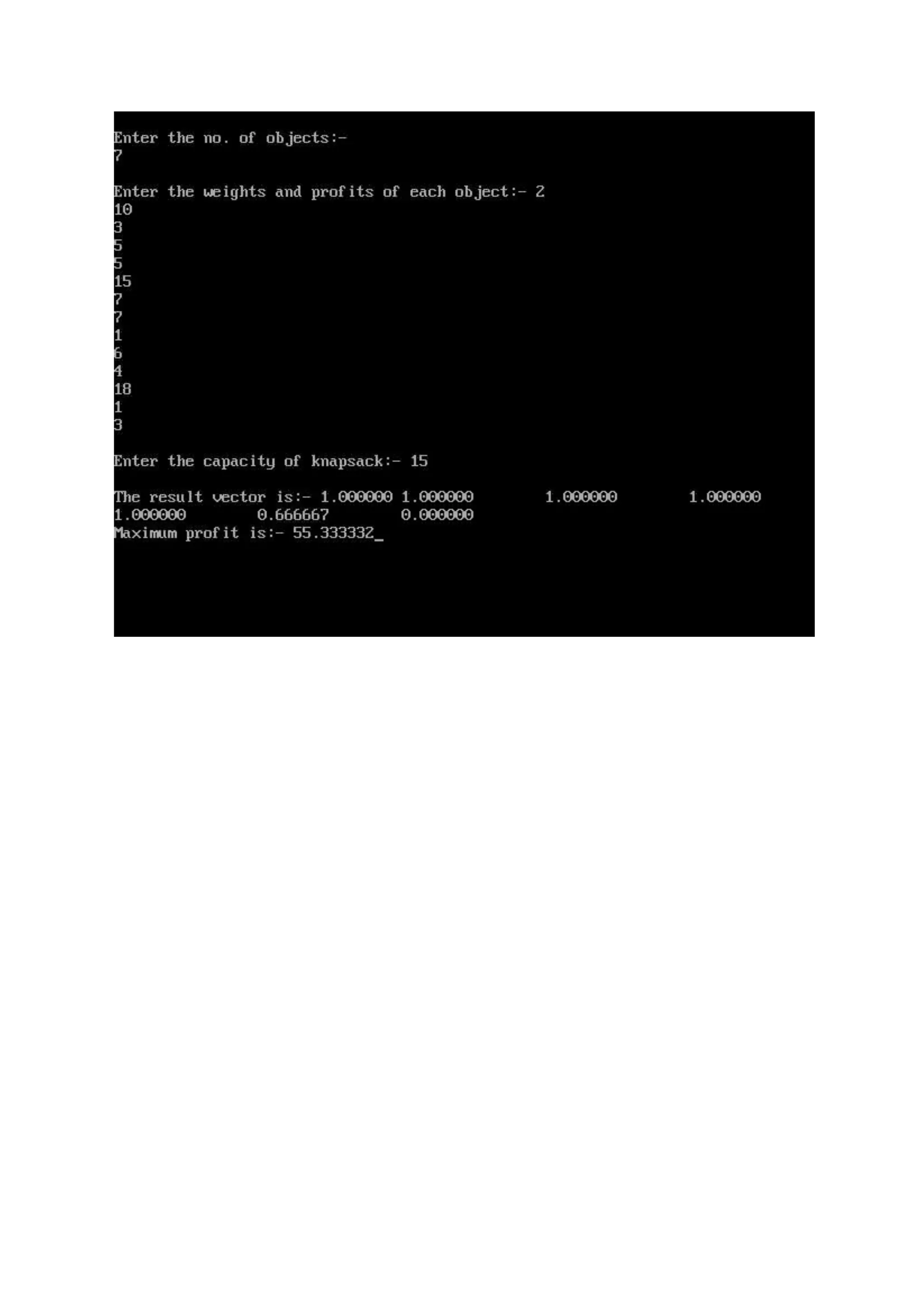
Program 8
Writea program to perform Knapsack Problem using Greedy Solution
#include<stdio.h>
#include<conio.h>
void knapsack(int n, float weight[], float profit[], float capacity)
{
float x[20], tp = 0;
int i, j, u;
u = capacity;
for (i = 0; i < n; i++)
x[i] = 0.0;
for (i = 0; i < n; i++)
{
if (weight[i] > u)
break;
else
{
x[i] = 1.0;
tp = tp + profit[i];
u = u - weight[i];
}
}
if (i < n)
x[i] = u / weight[i];
tp = tp + (x[i] * profit[i]);
printf("nThe result vector is:- ");
for (i = 0; i < n; i++)
printf("%ft", x[i]);
printf("nMaximum profit is:- %f", tp);
}
void main()
{
clrscr();
float weight[20], profit[20], capacity;
int num, i, j;
float ratio[20], temp;
printf("nEnter the no. of objects:- ");
scanf("%d", &num);
printf("nEnter the weights and profits of each object:- ");
for (i = 0; i < num; i++)
{
scanf("%f %f", &weight[i], &profit[i]);
}
printf("nEnter the capacity of knapsack:- ");
scanf("%f", &capacity);
for (i = 0; i < num; i++)
{
Program 11
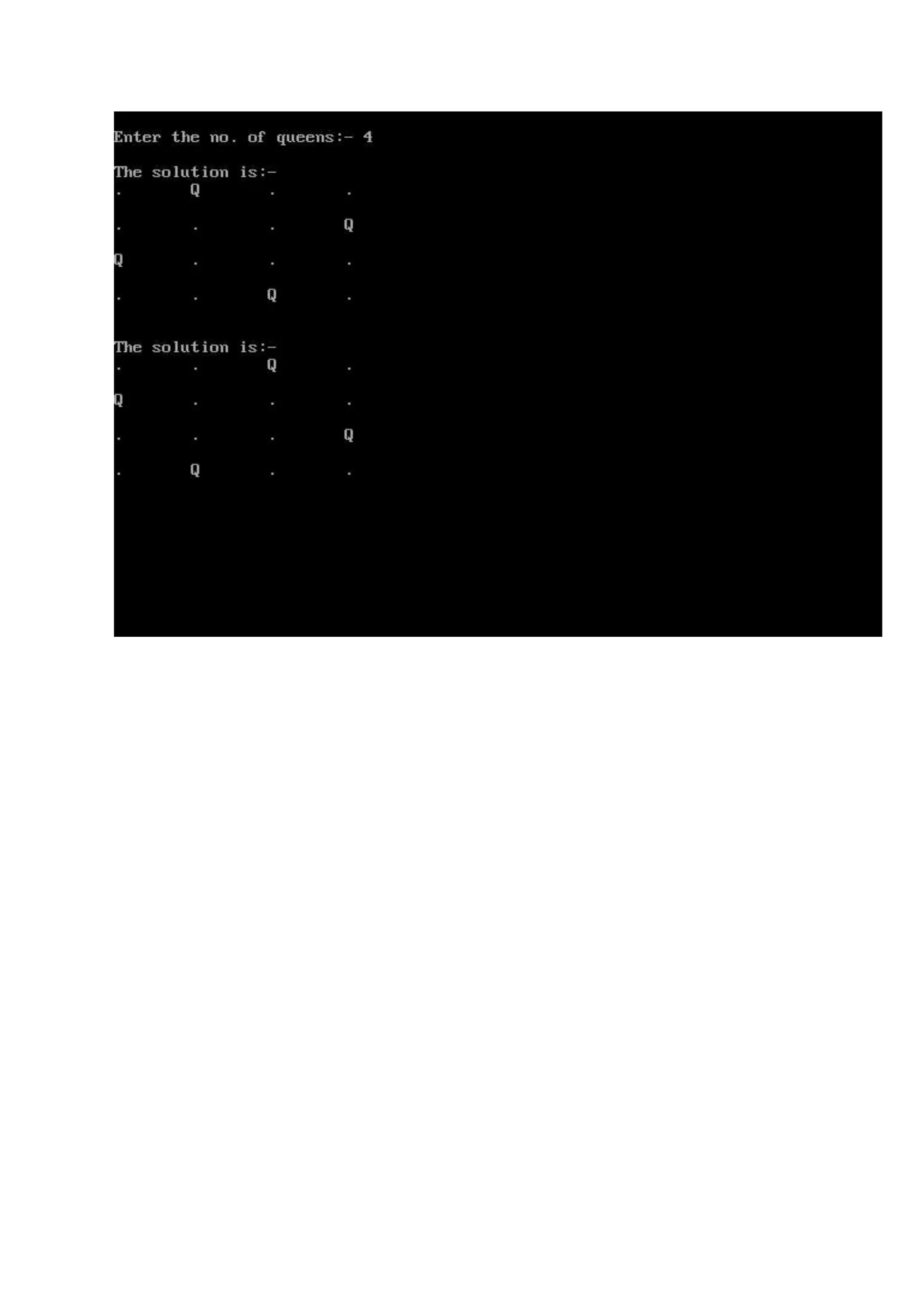
Writea program to implement N Queen Problem using Backtracking
#include<stdio.h>
#include<conio.h>
#include<math.h>
char a[10][10];
int n;
void printmatrix()
{
int i, j;
printf("n");
for (i = 0; i < n; i++)
{
for (j = 0; j < n; j++)
printf("%ct", a[i][j]);
printf("nn");
}
}
int getmarkedcol(int row)
{
int i;
for (i = 0; i < n; i++)
if (a[row][i] == 'Q')
{
return (i);
break;
}
}
int feasible(int row, int col)
{
int i, tcol;
for (i = 0; i < n; i++)
{
tcol = getmarkedcol(i);
if (col == tcol || abs(row - i) == abs(col - tcol))
return 0;
}
return 1;
}
void nqueen(int row)
{
int i, j;
if (row < n)
{
for (i = 0; i < n; i++)
{
if (feasible(row, i))
29.
{
a[row][i] ='Q';
nqueen(row + 1);
a[row][i] = '.';
}
}
}
else
{
printf("nThe solution is:- ");
printmatrix();
}
}
void main()
{
clrscr();
int i, j;
printf("nEnter the no. of queens:- ");
scanf("%d", &n);
for (i = 0; i < n; i++)
for (j = 0; j < n; j++)
a[i][j] = '.';
nqueen(0);
getch();
}
![Program 1
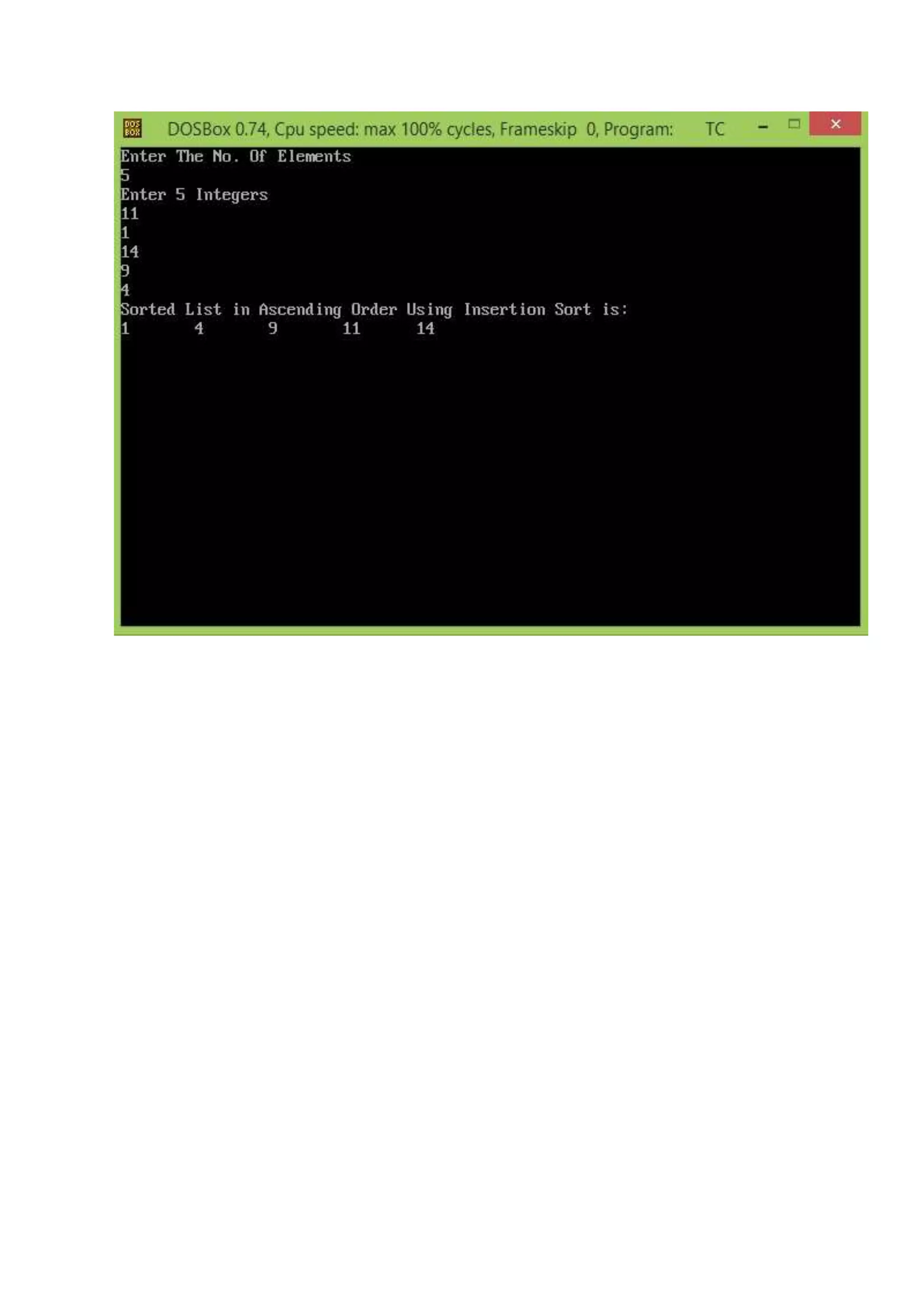
Write a program to perform insertion sort.
#include<stdio.h>
#include<conio.h>
void main()
{
clrscr();
int i,t,a[100],d,n;
printf("Enter The No. Of Elementsn");
scanf("%d",&n);
printf("Enter %d Integersn",n);
for(i=0;i<n;i++)
{
scanf("%d",&a[i]);
}
for(i=1;i<=n-1;i++)
{
d=i;
while(d>0&&a[d]<a[d-1])
{
t=a[d];
a[d]=a[d-1];
a[d-1]=t;
d--;
}
}
printf("Sorted List in Ascending Order is:n");
for(i=0;i<=n-1;i++)
{
printf("%dt",a[i]);
}
getch();
}](https://image.slidesharecdn.com/daalabfilecprograms-141126103635-conversion-gate02/75/DAA-Lab-File-C-Programs-1-2048.jpg)
![Program 2
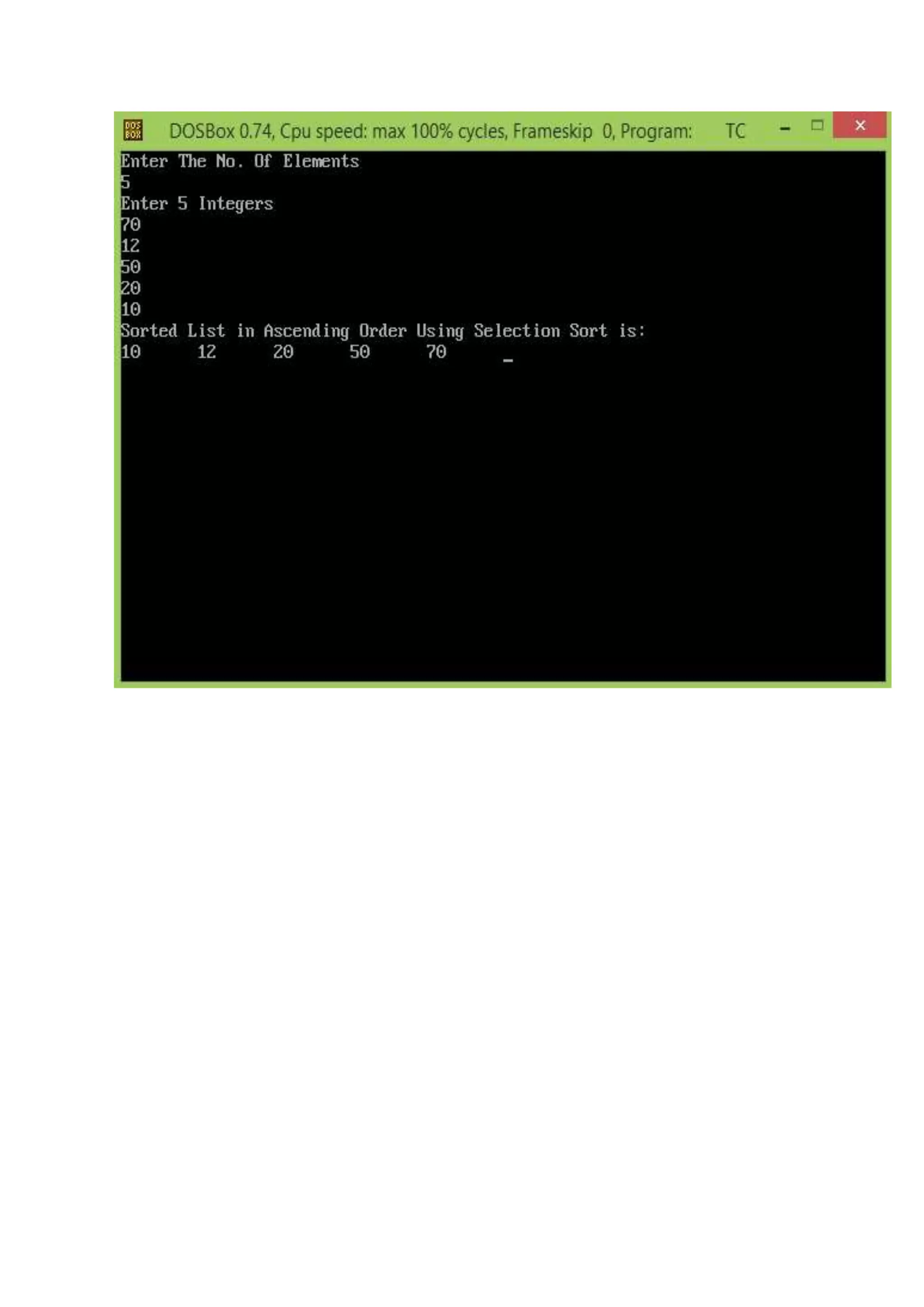
Write a program to perform selection sort.
#include<stdio.h>
#include<conio.h>
void main()
{
clrscr();
int i,position,swap,a[100],d,n;
printf("Enter The No. Of Elementsn");
scanf("%d",&n);
printf("Enter %d Integersn",n);
for(i=0;i<n;i++)
{
scanf("%d",&a[i]);
}
for(i=0;i<(n-1);i++)
{
position=i;
for(d=c+1;d<n;d++)
{
if(array[position]>array[d])
position=d;
}
if(position!=i)
{
swap=a[i];
a[i]=a[position];
a[position]=swap;
}
}
printf("Sorted List in Ascending Order is:n");
for(i=0;i<=n;i++)
{
printf("%dt",a[i]);
}
getch();
}](https://image.slidesharecdn.com/daalabfilecprograms-141126103635-conversion-gate02/75/DAA-Lab-File-C-Programs-3-2048.jpg)
![Program 3
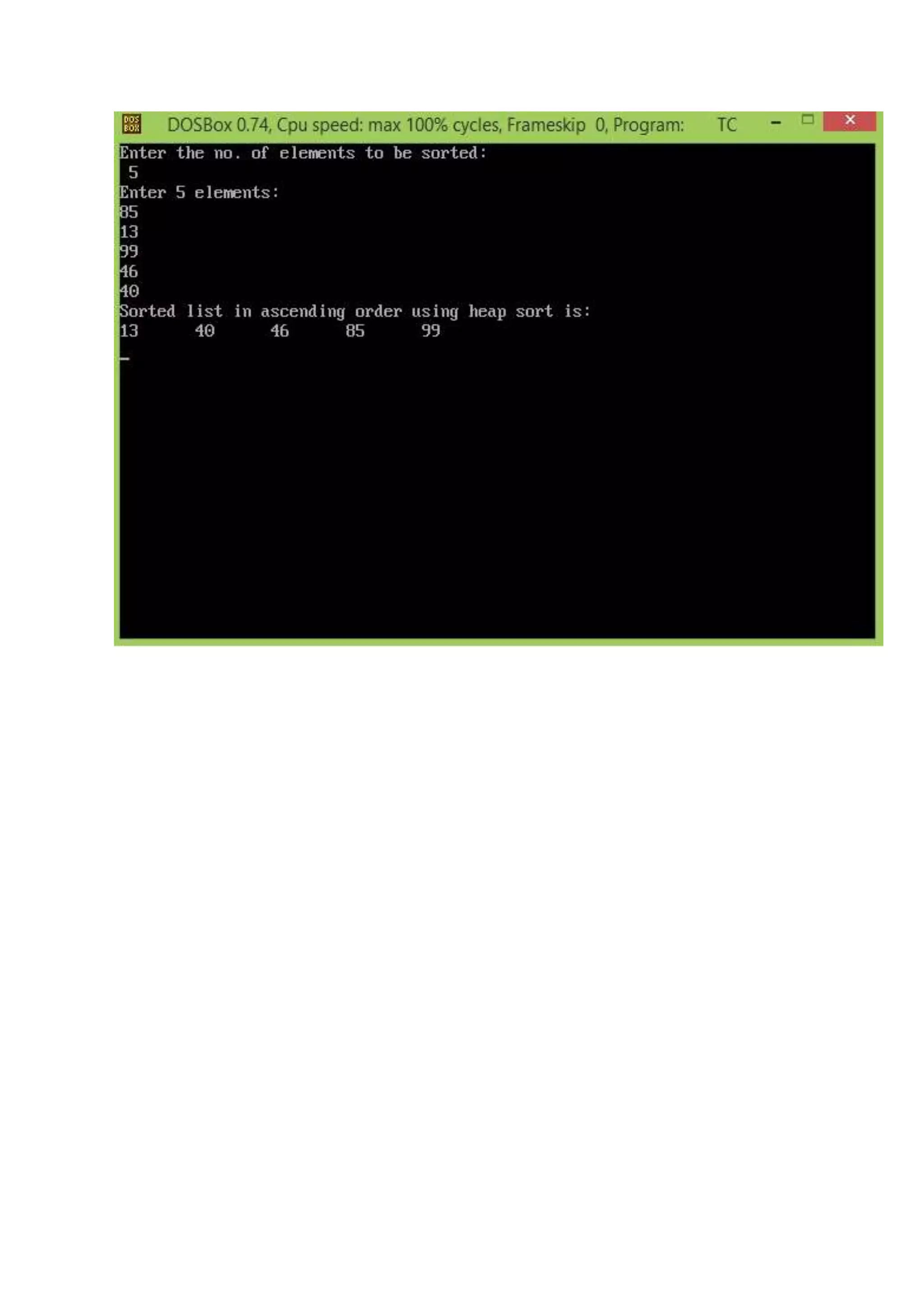
Write a program to perform heap sort.
#include<stdio.h>
#include<conio.h>
void heapsort(int[], int);
void heapify(int[], int);
void adjust(int[], int);
int main()
{
int array[50],n,i;
clrscr();
printf("Enter the no. of elements to be sorted:n ");
scanf("%d",&n);
printf("Enter %d elements: n",n);
for(i=0 ; i<n ; i++)
{
scanf("%d",&array[i]);
}
heapsort(array,n);
printf("Sorted list in ascending order using heap sort is:n");
for(i = 0; i < n; i++)
{
printf("%dt", array[i]);
}
printf("n");
getch();
return 0;
}
void heapsort(int array[], int n)
{
int i,t;
heapify(array,n);
for(i=n-1 ; i>0 ; i--)
{
t = array[0];
array[0] = array[i];
array[i] = t;
adjust(array,i);
}
}
void heapify(int array[], int n)
{
int item,i,j,k;
for(k=1 ; k<n ; k++)
{
item = array[k];
i = k;](https://image.slidesharecdn.com/daalabfilecprograms-141126103635-conversion-gate02/75/DAA-Lab-File-C-Programs-5-2048.jpg)
![j = (i-1)/2;
while( (i>0) && (item>array[j]) )
{
array[i] = array[j];
i = j;
j = (i-1)/2;
}
array[i] = item;
}
}
void adjust(int array[], int n)
{
int item,i,j;
j = 0;
item = array[j];
i = 2*j+1;
while(i<=n-1)
{
if(i+1 <= n-1)
if(array[i] < array[i+1])
i++;
if(item < array[i])
{
array[j] = array[i];
j = i;
i = 2*j+1;
}
else
break;
}
array[j] = item;
}](https://image.slidesharecdn.com/daalabfilecprograms-141126103635-conversion-gate02/75/DAA-Lab-File-C-Programs-6-2048.jpg)
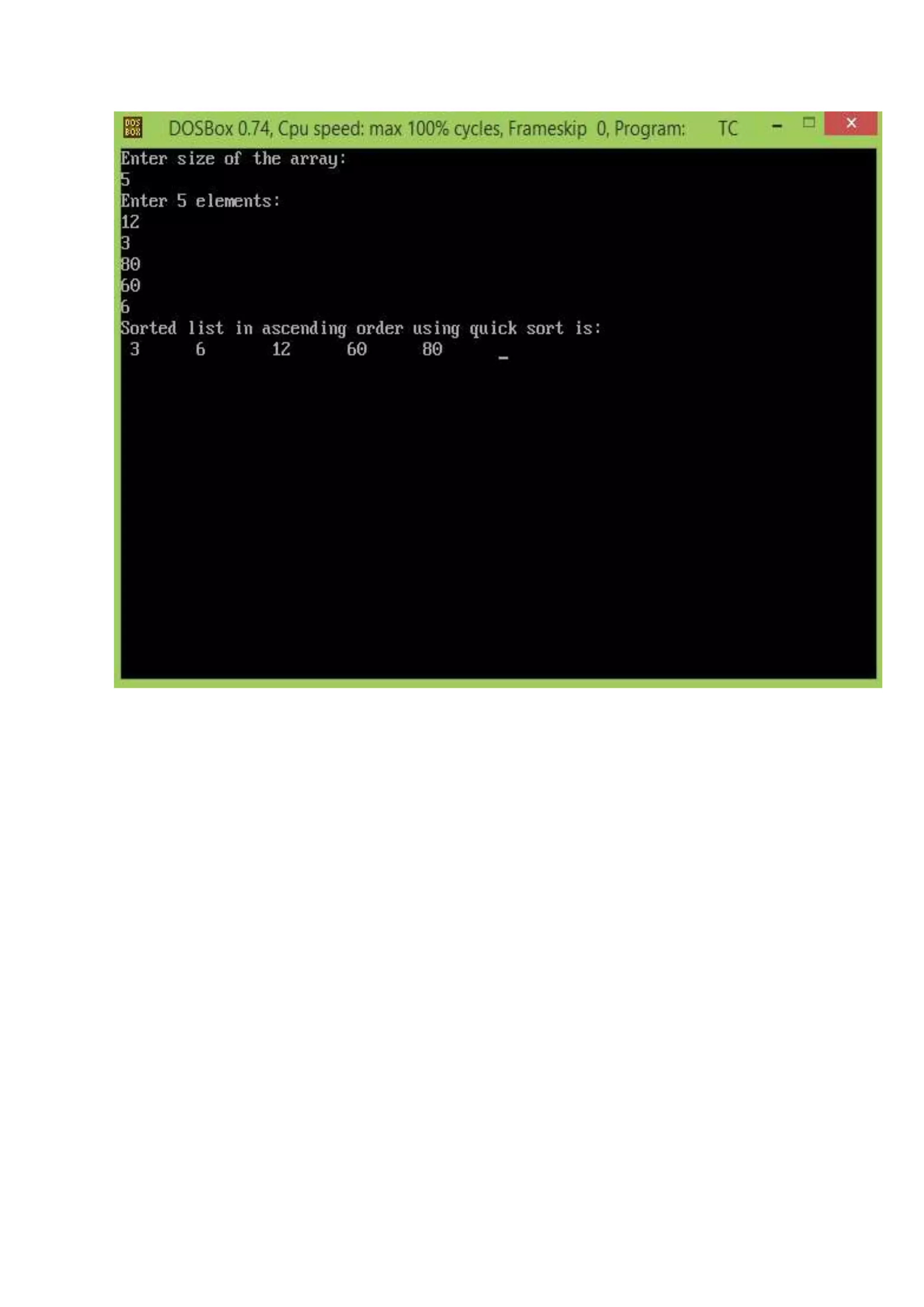
![Program 4
Write a program to perform quick sort.
#include<stdio.h>
#include<conio.h>
void quicksort(int [10],int,int);
void main()
{
clrscr();
int a[20],n,i;
printf("Enter size of the array:n");
scanf("%d",&n);
printf("Enter %d elements:n",n);
for(i=0;i<n;i++)
{
scanf("%d",&a[i]);
}
quicksort(a,0,n-1);
printf("Sorted elements:n ");
for(i=0;i<n;i++)
{
printf("t%d",a[i]);
}
getch();
}
void quicksort(int a[10],int first,int last)
{
int pivot,j,temp,i;
if(first<last)
{
pivot=first;
i=first;
j=last;
while(i<j)
{
while(a[i]<=a[pivot]&&i<last)
i++;
while(a[j]>a[pivot])
j--;
if(i<j)
{
temp=a[i];
a[i]=a[j];
a[j]=temp;
}
}
temp=a[pivot];
a[pivot]=a[j];
a[j]=temp;
quicksort(a,first,j-1);
quicksort(a,j+1,last);
}
}](https://image.slidesharecdn.com/daalabfilecprograms-141126103635-conversion-gate02/75/DAA-Lab-File-C-Programs-8-2048.jpg)
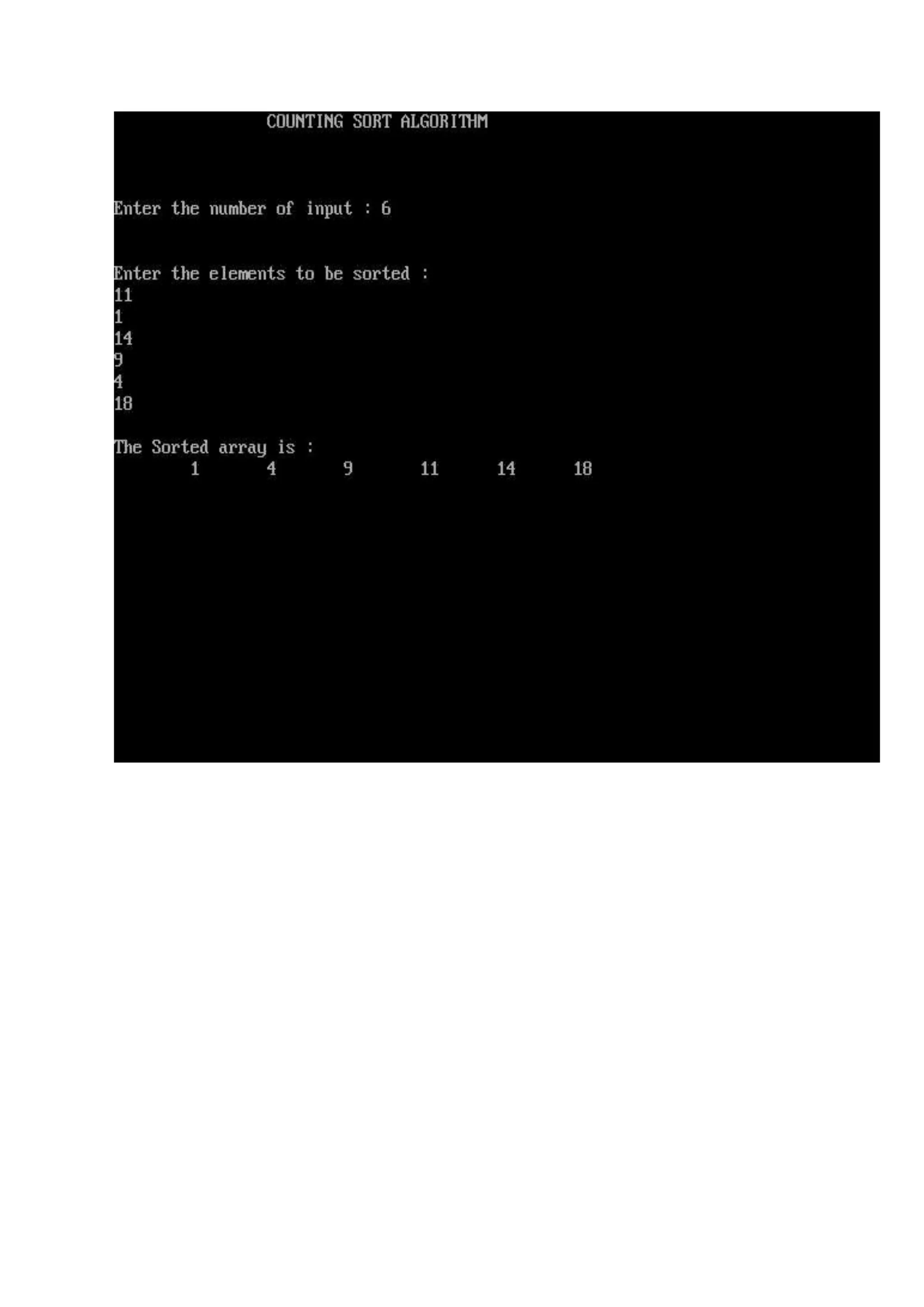
![Program 5
Write a program to perform counting sort.
#include<stdio.h>
#include<conio.h>
void Counting_sort(int A[], int k, int n)
{
int i, j;
int B[15], C[100];
for(i = 0; i <= k; i++)
C[i] = 0;
for(j =1; j <= n; j++)
C[A[j]] = C[A[j]] + 1;
for(i = 1; i <= k; i++)
C[i] = C[i] + C[i-1];
for(j = n; j >= 1; j--)
{
B[C[A[j]]] = A[j];
C[A[j]] = C[A[j]] - 1;
}
printf("nThe Sorted array is :n");
for(i = 1; i <= n; i++)
printf("t%d",B[i]);
}
void main()
{
clrscr();
int n,i,k = 0, A[15];
printf("ttCOUNTING SORT ALGORITHMnnnn");
printf("Enter the number of input : ");
scanf("%d",&n);
printf("nnEnter the elements to be sorted :n");
for ( i = 1; i <= n; i++)
{
scanf("%d",&A[i]);
if(A[i] > k)
{
k = A[i];
}
}
Counting_sort(A, k, n);
getch();
}](https://image.slidesharecdn.com/daalabfilecprograms-141126103635-conversion-gate02/75/DAA-Lab-File-C-Programs-10-2048.jpg)
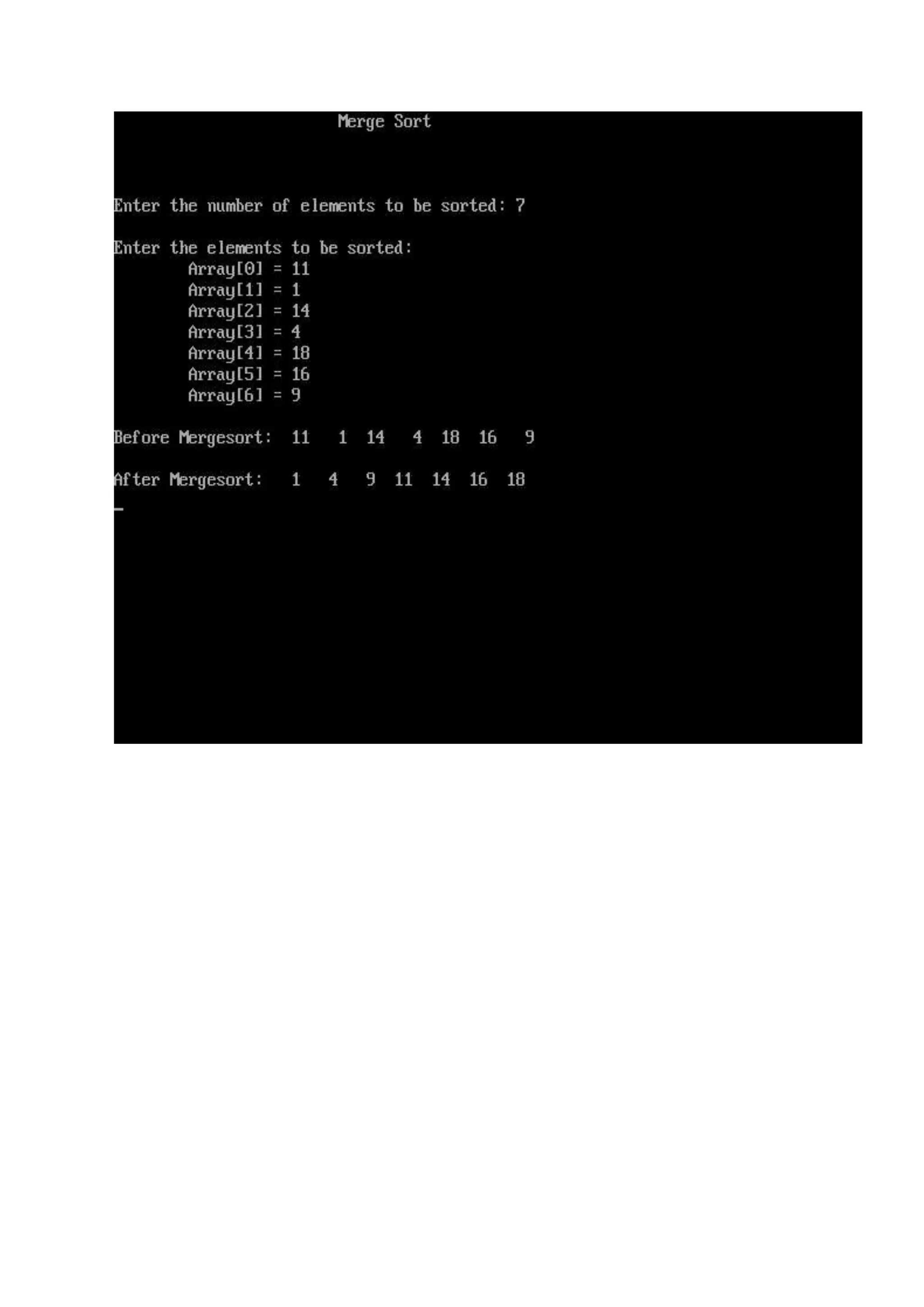
![Program 6
Write a program to perform merge sort.
#include <stdio.h>
#include<conio.h>
void mergesort(int arr[], int l, int h);
void main(void)
{
int array[100],n,i = 0;
clrscr();
printf("tttMerge Sortnnnn");
printf("Enter the number of elements to be sorted: ");
scanf("%d",&n);
printf("nEnter the elements to be sorted: n");
for(i = 0 ; i < n ; i++ )
{
printf("tArray[%d] = ",i);
scanf("%d",&array[i]);
}
printf("nBefore Mergesort:");
for(i = 0; i < n; i++)
{
printf("%4d", array[i]);
}
printf("n");
mergesort(array, 0, n - 1);
printf("nAfter Mergesort:");
for(i = 0; i < n; i++)
{
printf("%4d", array[i]);
}
printf("n");
getch();
}
void mergesort(int arr[], int l, int h)
{
int i = 0;
int length = h - l + 1;
int pivot = 0;
int merge1 = 0;
int merge2 = 0;
int temp[100];
if(l == h)
return;
pivot = (l + h) / 2;
mergesort(arr, l, pivot);
mergesort(arr, pivot + 1, h);
for(i = 0; i < length; i++)
{
temp[i] = arr[l + i];
}
merge1 = 0;
merge2 = pivot - l + 1;](https://image.slidesharecdn.com/daalabfilecprograms-141126103635-conversion-gate02/75/DAA-Lab-File-C-Programs-12-2048.jpg)
![for(i = 0; i < length; i++)
{
if(merge2 <= h - l)
{
if(merge1 <= pivot - l)
{
if(temp[merge1] > temp[merge2])
{
arr[i + l] = temp[merge2++];
}
else
{
arr[i + l] = temp[merge1++];
}
}
else
{
arr[i + l] = temp[merge2++];
}
}
else
{
arr[i + l] = temp[merge1++];
}
}
}](https://image.slidesharecdn.com/daalabfilecprograms-141126103635-conversion-gate02/75/DAA-Lab-File-C-Programs-13-2048.jpg)
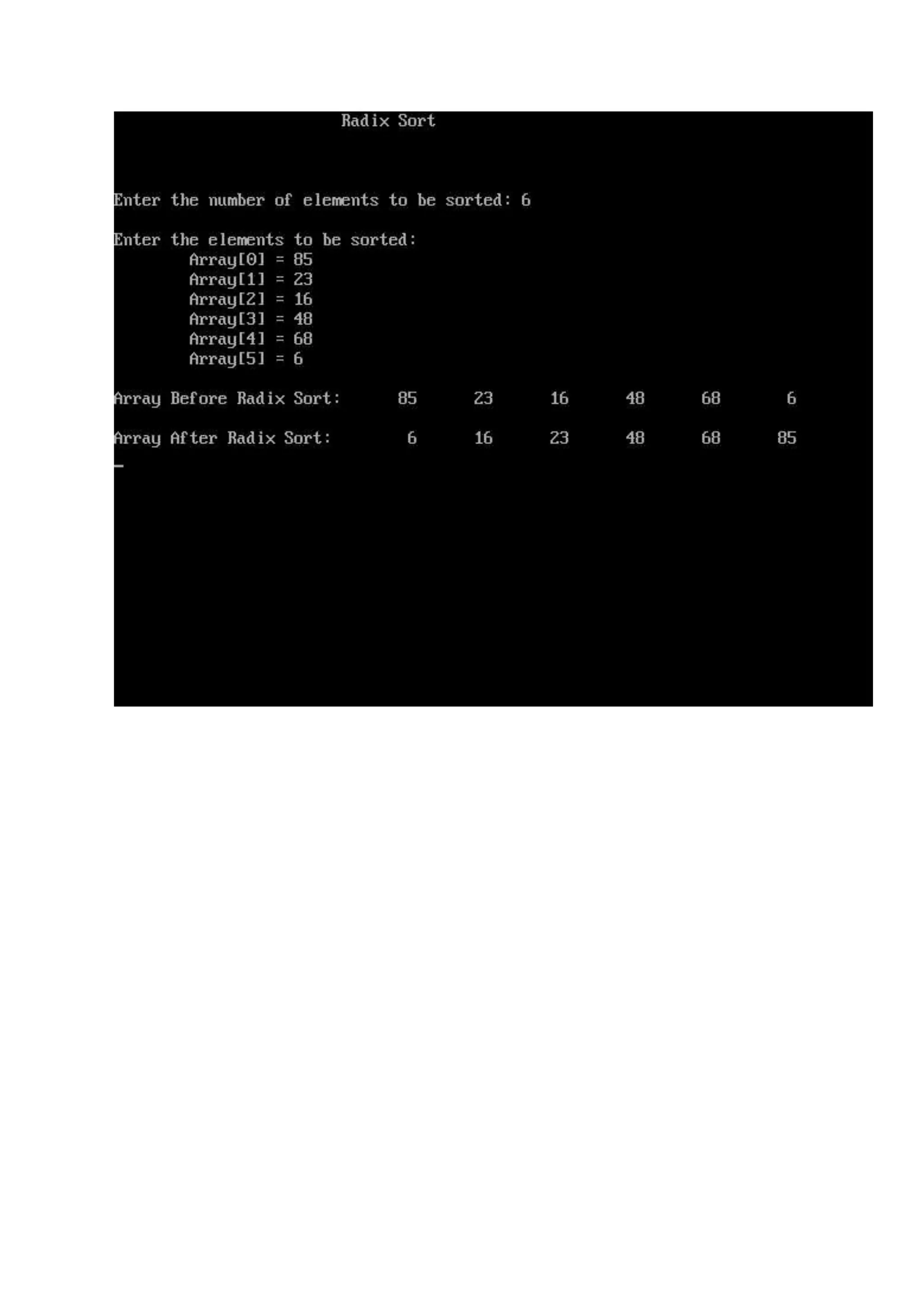
![Program 7
Write a program to perform radix sort.
#include<stdio.h>
#include<conio.h>
radix_sort(int array[], int n);
void main()
{
int array[100],n,i;
clrscr();
printf("tttRadix Sortnnnn");
printf("Enter the number of elements to be sorted: ");
scanf("%d",&n);
printf("nEnter the elements to be sorted: n");
for(i = 0 ; i < n ; i++ )
{
printf("tArray[%d] = ",i);
scanf("%d",&array[i]);
}
printf("nArray Before Radix Sort:"); //Array Before Radix Sort
for(i = 0; i < n; i++)
{
printf("%8d", array[i]);
}
printf("n");
radix_sort(array,n);
printf("nArray After Radix Sort: "); //Array After Radix Sort
for(i = 0; i < n; i++)
{
printf("%8d", array[i]);
}
printf("n");
getch();
}
radix_sort(int arr[], int n)
{
int bucket[10][5],buck[10],b[10];
int i,j,k,l,num,div,large,passes;
div=1;
num=0;
large=arr[0];
for(i=0 ; i<n ; i++)
{
if(arr[i] > large)
{
large = arr[i];
}
while(large > 0)](https://image.slidesharecdn.com/daalabfilecprograms-141126103635-conversion-gate02/75/DAA-Lab-File-C-Programs-15-2048.jpg)
![{
num++;
large = large/10;
}
for(passes=0 ; passes<num ; passes++)
{
for(k=0 ; k<10 ; k++)
{
buck[k] = 0;
}
for(i=0 ; i<n ;i++)
{
l = ((arr[i]/div)%10);
bucket[l][buck[l]++] = arr[i];
}
i=0;
for(k=0 ; k<10 ; k++)
{
for(j=0 ; j<buck[k] ; j++)
{
arr[i++] = bucket[k][j];
}
}
div*=10;
}
}
return 0;
}](https://image.slidesharecdn.com/daalabfilecprograms-141126103635-conversion-gate02/75/DAA-Lab-File-C-Programs-16-2048.jpg)
![Program 8
Write a program to perform Knapsack Problem using Greedy Solution
#include<stdio.h>
#include<conio.h>
void knapsack(int n, float weight[], float profit[], float capacity)
{
float x[20], tp = 0;
int i, j, u;
u = capacity;
for (i = 0; i < n; i++)
x[i] = 0.0;
for (i = 0; i < n; i++)
{
if (weight[i] > u)
break;
else
{
x[i] = 1.0;
tp = tp + profit[i];
u = u - weight[i];
}
}
if (i < n)
x[i] = u / weight[i];
tp = tp + (x[i] * profit[i]);
printf("nThe result vector is:- ");
for (i = 0; i < n; i++)
printf("%ft", x[i]);
printf("nMaximum profit is:- %f", tp);
}
void main()
{
clrscr();
float weight[20], profit[20], capacity;
int num, i, j;
float ratio[20], temp;
printf("nEnter the no. of objects:- ");
scanf("%d", &num);
printf("nEnter the weights and profits of each object:- ");
for (i = 0; i < num; i++)
{
scanf("%f %f", &weight[i], &profit[i]);
}
printf("nEnter the capacity of knapsack:- ");
scanf("%f", &capacity);
for (i = 0; i < num; i++)
{](https://image.slidesharecdn.com/daalabfilecprograms-141126103635-conversion-gate02/75/DAA-Lab-File-C-Programs-18-2048.jpg)
![ratio[i] = profit[i] / weight[i];
}
for (i = 0; i < num; i++)
{
for (j = i + 1; j < num; j++)
{
if (ratio[i] < ratio[j])
{
temp = ratio[j];
ratio[j] = ratio[i];
ratio[i] = temp;
temp=weight[j];
weight[j] = weight[i];
weight[i] = temp;
temp = profit[j];
profit[j] = profit[i];
profit[i] = temp;
}
}
}
knapsack(num, weight, profit, capacity);
getch();
}](https://image.slidesharecdn.com/daalabfilecprograms-141126103635-conversion-gate02/75/DAA-Lab-File-C-Programs-19-2048.jpg)
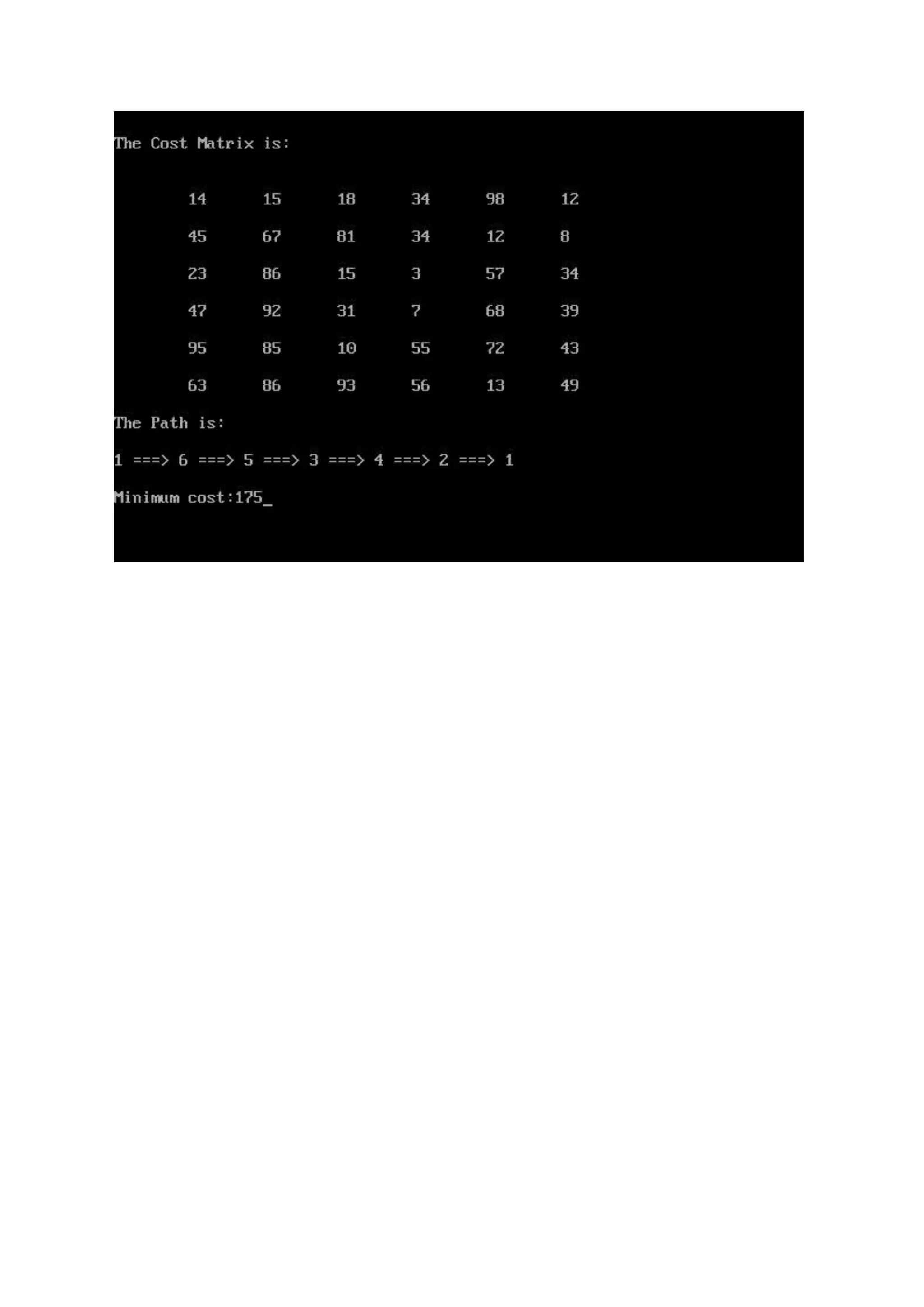
![Program 9
Write a program to perform Travelling Salesman Problem
#include<stdio.h>
#include<conio.h>
#include<stdlib.h>
int a[10][10],visited[10],n,cost=0;
void get()
{
int i,j;
printf("nnEnter Number of Cities: ");
scanf("%d",&n);
printf("nEnter Cost Matrix: n");
for( i=0;i<n;i++)
{
printf("n Enter Elements of Row # : %dn",i+1);
for( j=0;j<n;j++)
scanf("%d",&a[i][j]);
visited[i]=0;
}
printf("nnThe Cost Matrix is:n");
for( i=0;i<n;i++)
{
printf("nn");
for(j=0;j<n;j++)
printf("t%d",a[i][j]);
}
}
void mincost(int city)
{
int i,ncity,least(int city);
visited[city]=1;
printf("%d ===> ",city+1);
ncity=least(city);
if(ncity==999)
{
ncity=0;
printf("%d",ncity+1);
cost+=a[city][ncity];
return;
}
mincost(ncity);
}
int least(int c)
{
int i,nc=999;
int min=999,kmin;
for(i=0;i<n;i++)](https://image.slidesharecdn.com/daalabfilecprograms-141126103635-conversion-gate02/75/DAA-Lab-File-C-Programs-21-2048.jpg)
![{
if((a[c][i]!=0)&&(visited[i]==0))
if(a[c][i]<min)
{
min=a[i][0]+a[c][i];
kmin=a[c][i];
nc=i;
}
}
if(min!=999)
cost+=kmin;
return nc;
}
void put()
{
printf("nnMinimum cost:");
printf("%d",cost);
}
void main()
{
clrscr();
get();
printf("nnThe Path is:nn");
mincost(0);
put();
getch();
}](https://image.slidesharecdn.com/daalabfilecprograms-141126103635-conversion-gate02/75/DAA-Lab-File-C-Programs-22-2048.jpg)
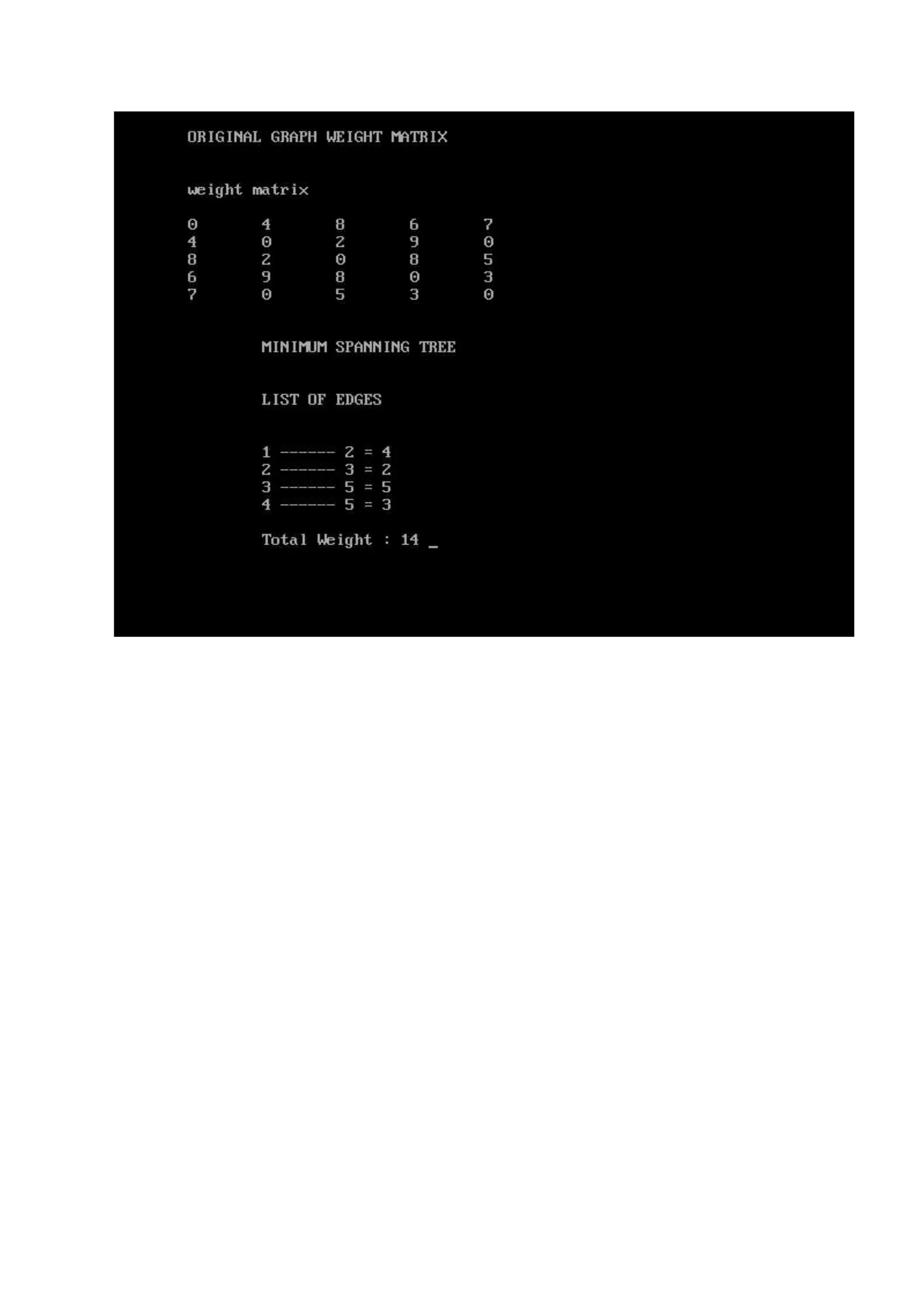
![Program 10
Write a program to find Minimum Spanning Tree using Kruskal’s Algorithm
#include<stdio.h>
#include<conio.h>
#define INF 0
char vertex[10];
int wght[10][10];
int span_wght[10][10];
int source;
struct Sort
{
int v1,v2;
int weight;
}que[20];
int n,ed,f,r;
int cycle(int s,int d)
{
int j,k;
if(source==d)
return 1;
for(j=0;j<n;j++)
if(span_wght[d][j]!=INF && s!=j)
{
if(cycle(d,j))
return 1;
}
return 0;
}
void build_tree()
{
int i,j,w,k,count=0;
for(count=0;count<n;f++)
{
i=que[f].v1;
j=que[f].v2;
w=que[f].weight;
span_wght[i][j]=span_wght[j][i]=w;
source=i;
k=cycle(i,j);
if(k)
span_wght[i][j]=span_wght[j][i]=INF;
else
count++;
}
}
void swap(int *i,int *j)
{](https://image.slidesharecdn.com/daalabfilecprograms-141126103635-conversion-gate02/75/DAA-Lab-File-C-Programs-24-2048.jpg)
![int t;
t=*i;
*i=*j;
*j=t;
}
void main()
{
int i,j,k=0,temp;
int sum=0;
clrscr();
printf("ntEnter the No. of Nodes : ");
scanf("%d",&n);
for(i=0;i<n;i++)
{
printf("ntEnter %d value : ",i+1);
fflush(stdin);
scanf("%c",&vertex[i]);
for(j=0;j<n;j++)
{
wght[i][j]=INF;
span_wght[i][j]=INF;
}
}
printf("nnGetting Weightn");
for(i=0;i<n;i++)
for(j=i+1;j<n;j++)
{
printf("nEnter 0 if path Doesn't exist between %c to %c : ",vertex[i],vertex[j]);
scanf("%d",&ed);
if(ed>=1)
{
wght[i][j]=wght[j][i]=ed;
que[r].v1=i;
que[r].v2=j;
que[r].weight=wght[i][j];
if(r)
{
for(k=0;k<r;k++)
if(que[k].weight>que[r].weight)
{
swap(&que[k].weight,&que[r].weight);
swap(&que[k].v1,&que[r].v1);
swap(&que[k].v2,&que[r].v2);
}
}
r++;
}
}
clrscr();
printf("ntORIGINAL GRAPH WEIGHT MATRIXnn");](https://image.slidesharecdn.com/daalabfilecprograms-141126103635-conversion-gate02/75/DAA-Lab-File-C-Programs-25-2048.jpg)
![printf("ntweight matrixnnt");
for(i=0;i<n;i++,printf("nt"))
for(j=0;j<n;j++,printf("t"))
printf("%d",wght[i][j]);
build_tree();
printf("nnttMINIMUM SPANNING TREEnn");
printf("nttLIST OF EDGESnn");
for(i=0;i<n;i++)
for(j=i+1;j<n;j++)
if(span_wght[i][j]!=INF)
{
printf("ntt%c ------ %c = %d ",vertex[i],vertex[j],span_wght[i][j]);
sum+=span_wght[i][j];
}
printf("nnttTotal Weight : %d ",sum);
getch();
}](https://image.slidesharecdn.com/daalabfilecprograms-141126103635-conversion-gate02/75/DAA-Lab-File-C-Programs-26-2048.jpg)
![Program 11
Write a program to implement N Queen Problem using Backtracking
#include<stdio.h>
#include<conio.h>
#include<math.h>
char a[10][10];
int n;
void printmatrix()
{
int i, j;
printf("n");
for (i = 0; i < n; i++)
{
for (j = 0; j < n; j++)
printf("%ct", a[i][j]);
printf("nn");
}
}
int getmarkedcol(int row)
{
int i;
for (i = 0; i < n; i++)
if (a[row][i] == 'Q')
{
return (i);
break;
}
}
int feasible(int row, int col)
{
int i, tcol;
for (i = 0; i < n; i++)
{
tcol = getmarkedcol(i);
if (col == tcol || abs(row - i) == abs(col - tcol))
return 0;
}
return 1;
}
void nqueen(int row)
{
int i, j;
if (row < n)
{
for (i = 0; i < n; i++)
{
if (feasible(row, i))](https://image.slidesharecdn.com/daalabfilecprograms-141126103635-conversion-gate02/75/DAA-Lab-File-C-Programs-28-2048.jpg)
![{
a[row][i] = 'Q';
nqueen(row + 1);
a[row][i] = '.';
}
}
}
else
{
printf("nThe solution is:- ");
printmatrix();
}
}
void main()
{
clrscr();
int i, j;
printf("nEnter the no. of queens:- ");
scanf("%d", &n);
for (i = 0; i < n; i++)
for (j = 0; j < n; j++)
a[i][j] = '.';
nqueen(0);
getch();
}](https://image.slidesharecdn.com/daalabfilecprograms-141126103635-conversion-gate02/75/DAA-Lab-File-C-Programs-29-2048.jpg)