An Introduction
to Radar Speed
Guns
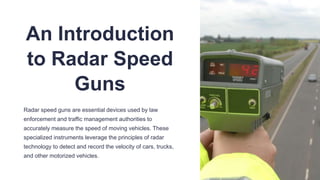
Radar speed guns are essential devices used by law
enforcement and traffic management authorities to
accurately measure the speed of moving vehicles. These
specialized instruments leverage the principles of radar
technology to detect and record the velocity of cars, trucks,
and other motorized vehicles.
Historical Background
1 Early Radar Technology
Radar technology was first developed in the early 20th century, with pioneering work by
scientists like Heinrich Hertz and Christian Hülsmeyer. These early systems were used for
military applications like aircraft and ship detection.
2 World War II Advancements
During World War II, radar technology saw rapid advancements as it was critical for air
defense and naval operations. This period saw the development of more sophisticated
radar systems with improved range and accuracy.
3 Postwar Speed Measurement
Principles of Operation
1. The Doppler Effect is the basis for radar speed measurement. When a vehicle approaches or
recedes from the radar gun, the reflected waves exhibit a frequency shift proportional to the vehicle's
speed.
2. A radar speed gun consists of a Transmitter that generates and emits high-frequency radio waves,
a Receiver that detects the reflected signals, and an Antenna that focuses and directs the
transmitted and received waves.
3. The radar waves are transmitted towards the target vehicle, bounce off its surface, and are then
received back by the radar gun. The time delay and frequency shift of the reflected waves are used
to calculate the vehicle's speed.
Governing Equations
The Radar Equation
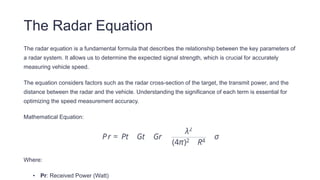
The radar equation is a fundamental formula that describes the relationship between the key parameters of
a radar system. It allows us to determine the expected signal strength, which is crucial for accurately
measuring vehicle speed.
The equation considers factors such as the radar cross-section of the target, the transmit power, and the
distance between the radar and the vehicle. Understanding the significance of each term is essential for
optimizing the speed measurement accuracy.
Mathematical Equation:
Where:
• Pr: Received Power (Watt)
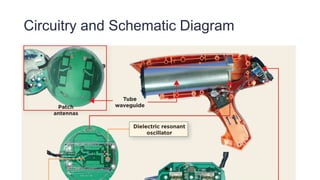
Circuitry and Schematic Diagram
Types of Radar Speed Guns
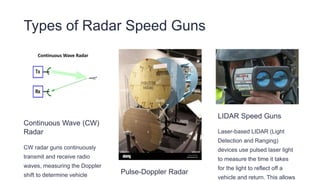
Continuous Wave (CW)
Radar
CW radar guns continuously
transmit and receive radio
waves, measuring the Doppler
shift to determine vehicle Pulse-Doppler Radar
LIDAR Speed Guns
Laser-based LIDAR (Light
Detection and Ranging)
devices use pulsed laser light
to measure the time it takes
for the light to reflect off a
vehicle and return. This allows
Signal Processing and Data Analysis
Filtering Techniques
Radar speed guns employ advanced filtering algorithms to eliminate unwanted noise and
interference, ensuring accurate Doppler frequency measurements.
Doppler Signal Processing
Sophisticated signal processing algorithms analyze the Doppler frequency shift to determine
the velocity of the target vehicle with high precision.
Velocity Calculation
The Doppler frequency shift is directly proportional to the target's velocity, allowing the radar
gun to convert the frequency data into an accurate speed readout.
Accuracy and Limitations
1 Environmental Factors
The accuracy of radar speed guns can be
influenced by weather conditions, such as
rain, fog, or high winds, which can affect the
propagation of the radar waves.
2 Target Characteristics
The size, shape, and material of the target
vehicle can impact the radar cross-section,
leading to potential errors in speed
measurement.
3 Interference and Noise
Electromagnetic interference from nearby
electronic devices or atmospheric noise can
introduce errors in the Doppler frequency
shift detection.
4 Legal Considerations
Radar speed guns must be properly
calibrated and operated within legal
guidelines to ensure the admissibility of
speed data in court.
Applications Beyond Traffic Enforcement
Industrial
Applications
Radar technology is
widely used in
industrial settings for
processes like level
monitoring, object
detection, and quality
control.
Military
Applications
Radar is a crucial tool
for national defense,
enabling applications
such as target
tracking, air traffic
control, and missile
guidance systems.
Autonomous
Vehicles
Advancements in
radar-based sensing
are enabling the
development of
sophisticated collision
avoidance systems for
autonomous and semi-
autonomous vehicles.
Collision Avoidance
Radar-based detection
and ranging systems
are improving safety
by providing early
warning of potential
collisions, allowing for
timely evasive
maneuvers.

An-Introduction-to-Radar-Speed-Guns.pptx

  • 1.
    An Introduction to RadarSpeed Guns Radar speed guns are essential devices used by law enforcement and traffic management authorities to accurately measure the speed of moving vehicles. These specialized instruments leverage the principles of radar technology to detect and record the velocity of cars, trucks, and other motorized vehicles.
  • 2.
    Historical Background 1 EarlyRadar Technology Radar technology was first developed in the early 20th century, with pioneering work by scientists like Heinrich Hertz and Christian Hülsmeyer. These early systems were used for military applications like aircraft and ship detection. 2 World War II Advancements During World War II, radar technology saw rapid advancements as it was critical for air defense and naval operations. This period saw the development of more sophisticated radar systems with improved range and accuracy. 3 Postwar Speed Measurement
  • 3.
    Principles of Operation 1.The Doppler Effect is the basis for radar speed measurement. When a vehicle approaches or recedes from the radar gun, the reflected waves exhibit a frequency shift proportional to the vehicle's speed. 2. A radar speed gun consists of a Transmitter that generates and emits high-frequency radio waves, a Receiver that detects the reflected signals, and an Antenna that focuses and directs the transmitted and received waves. 3. The radar waves are transmitted towards the target vehicle, bounce off its surface, and are then received back by the radar gun. The time delay and frequency shift of the reflected waves are used to calculate the vehicle's speed.
  • 4.
  • 6.
    The Radar Equation Theradar equation is a fundamental formula that describes the relationship between the key parameters of a radar system. It allows us to determine the expected signal strength, which is crucial for accurately measuring vehicle speed. The equation considers factors such as the radar cross-section of the target, the transmit power, and the distance between the radar and the vehicle. Understanding the significance of each term is essential for optimizing the speed measurement accuracy. Mathematical Equation: Where: • Pr: Received Power (Watt)
  • 7.
  • 8.
    Types of RadarSpeed Guns Continuous Wave (CW) Radar CW radar guns continuously transmit and receive radio waves, measuring the Doppler shift to determine vehicle Pulse-Doppler Radar LIDAR Speed Guns Laser-based LIDAR (Light Detection and Ranging) devices use pulsed laser light to measure the time it takes for the light to reflect off a vehicle and return. This allows
  • 9.
    Signal Processing andData Analysis Filtering Techniques Radar speed guns employ advanced filtering algorithms to eliminate unwanted noise and interference, ensuring accurate Doppler frequency measurements. Doppler Signal Processing Sophisticated signal processing algorithms analyze the Doppler frequency shift to determine the velocity of the target vehicle with high precision. Velocity Calculation The Doppler frequency shift is directly proportional to the target's velocity, allowing the radar gun to convert the frequency data into an accurate speed readout.
  • 11.
    Accuracy and Limitations 1Environmental Factors The accuracy of radar speed guns can be influenced by weather conditions, such as rain, fog, or high winds, which can affect the propagation of the radar waves. 2 Target Characteristics The size, shape, and material of the target vehicle can impact the radar cross-section, leading to potential errors in speed measurement. 3 Interference and Noise Electromagnetic interference from nearby electronic devices or atmospheric noise can introduce errors in the Doppler frequency shift detection. 4 Legal Considerations Radar speed guns must be properly calibrated and operated within legal guidelines to ensure the admissibility of speed data in court.
  • 12.
    Applications Beyond TrafficEnforcement Industrial Applications Radar technology is widely used in industrial settings for processes like level monitoring, object detection, and quality control. Military Applications Radar is a crucial tool for national defense, enabling applications such as target tracking, air traffic control, and missile guidance systems. Autonomous Vehicles Advancements in radar-based sensing are enabling the development of sophisticated collision avoidance systems for autonomous and semi- autonomous vehicles. Collision Avoidance Radar-based detection and ranging systems are improving safety by providing early warning of potential collisions, allowing for timely evasive maneuvers.