Unit 3: Communication
Disorders
COURSE CODE: 3604
PRESENTER: SHAMAILA HAMID
Communication Disorder and Delays
 Communication Disorders:
 Is a broad term that encompasses any impairment in the
ability to receive, send , process and comprehend concepts,
verbal or non-verbal. These may range in severity from mild
to profound.
 Communication Delays:
 Refers to quantitative delay in meeting certain age-specific
developmental milestones for communication.
Abilities needed for Speech
• (1) Motor Ability:
This included all vocal mechanism, nerves and
muscles.
• (2) Mental Maturity:
Words selection use if not due to lack of
knowledge and understanding.
Types of Language Skills
(a) Receptive Language:
• It includes understanding.
• It includes reading.
(b) Expressive Language:
• It includes speaking.
• It includes writing.
Types of Communication Disorders
 Hearing Disorders
 Impairment of the auditory system (mechanical and neurological
element of the ear and brain involved in hearing).
 Language Disorders
 Involve impaired comprehension and/or use of spoken, written, and /or
symbol sounds. The disorder may involve in three forms.
1. The form of language
2. Content (semantics)
3. Function of language (pragmatics)
1. Form of Language
• Phonology : is the sound system of spoken language
• Morphology : is the system that governs the
structure of words and construction of word forms
• Syntax: is the system governing the order &
combination of words to make phrases and
sentences
2. Content of Language
•Semantics: is the system that governs the
meaning of words and sentences
3. Pragmatics
 Pragmatics is the system that combines all other
language components in functional use of language
 Speech Disorders
 Are the most common reasons for receiving speech/ language
therapy.
 Types
Articulation Disorders (Atypical production of speech sounds).
Fluency Disorders (interruption in the flow of speech,
including abnormal rate, rhythm, unintentional repeating)
Voice Disorders (abnormal production of vocal quality, pitch
loudness)
Fluency Disorders
 Stuttering, the most common fluency disorder, is an interruption in the
flow of speaking characterized by specific types of disfluencies, including
 repetitions of sounds, syllables, and monosyllabic words (e.g., “Look
at the b-b-baby,” “Let’s go out-out-out”); prolongations of consonants
when it isn’t for emphasis (e.g., “Ssssssssometimes we stay home”)
 Cluttering, another fluency disorder, is characterized by a perceived rapid
and/or irregular speech rate, atypical pauses.
 deletion and/or collapsing of syllables (e.g., “I wanwatevision”),
Voice Disorders
 Sound rough or harsh (hoarseness)
 Sound strained or choppy.
 Be weak, whispery, or breathy.
 Cause: problem in vocal cords
Articulation Disorders
 SUBSTITUTION
 occurs when a sound is substituted for one they can not make yet. i.e. wed-red, or
fumb-thumb.
 OMISSION
 occurs when a sound is left out that is too hard. i.e. ed-red.
 DISTORTION
 occurs when the sound is not left out or substituted but does not sound right.
There is an attempt to make the sound but it is misarticulated.
 ADDITION
 occurs when an extra sound is added. i.e. galue-glue.
Causes of Articulation Disorders
 Functional / Organic
 Hearing loss
 History of otitis media during first years of life
 Speech sound perception and discrimination problem
 Tooth alignment
 Impaired oral/motor skills
 Eating problems
 Tongue thrust swallow after 6 years of age
 Mental retardation
 Language problems
 Reading problems
 Family history
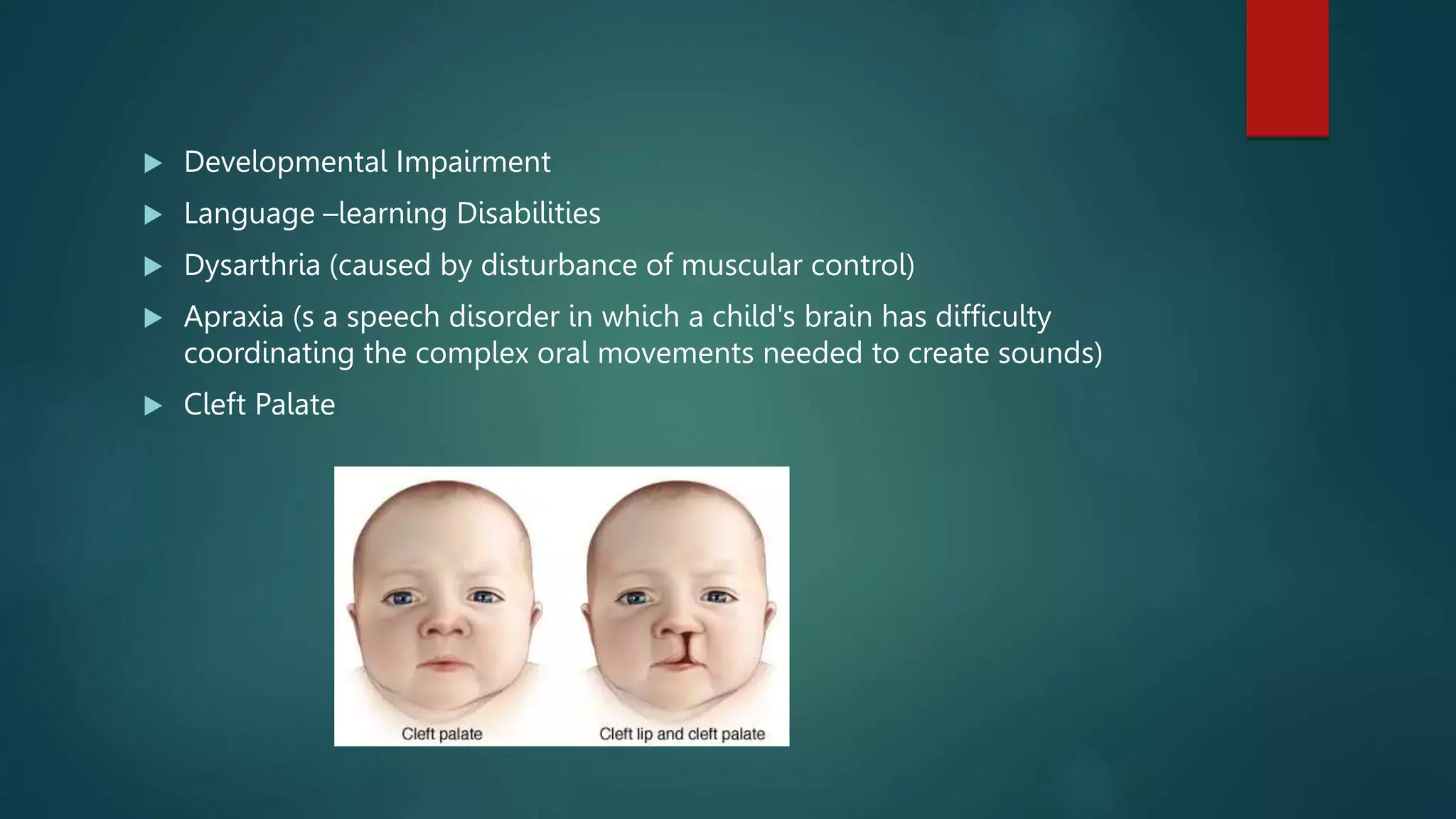
 Developmental Impairment
 Language –learning Disabilities
 Dysarthria (caused by disturbance of muscular control)
 Apraxia (s a speech disorder in which a child's brain has difficulty
coordinating the complex oral movements needed to create sounds)
 Cleft Palate
Assessment of Articulation Disorders
 First step is to gather medical, developmental and educational history.
 Testing Speech sound inventory (list of sounds client can produce, syllable
position, word position)
 Syllable and Word shape inventory (C,V,VC, CV, VCC,VCC
 Formal Screening
 Single word articulation
 Often part of a more detailed test
 Informal Screening
 Name , count 10 10
 Talk about TV or mobile game
 Identification of errors
 Substitution (Replace one sound with another sound. Examples:
“wed” for “red,”)
 Omission (Omit a sound in a word. “p ay the piano” for “play the
piano”)
 Distortion (“sun” (lisped—sounds “slushy”) for “sun”)
 Addition (“doguh,” for “dog” )
THANK YOU

Communication Disorders.pptx

  • 1.
    Unit 3: Communication Disorders COURSECODE: 3604 PRESENTER: SHAMAILA HAMID
  • 2.
    Communication Disorder andDelays  Communication Disorders:  Is a broad term that encompasses any impairment in the ability to receive, send , process and comprehend concepts, verbal or non-verbal. These may range in severity from mild to profound.  Communication Delays:  Refers to quantitative delay in meeting certain age-specific developmental milestones for communication.
  • 3.
    Abilities needed forSpeech • (1) Motor Ability: This included all vocal mechanism, nerves and muscles. • (2) Mental Maturity: Words selection use if not due to lack of knowledge and understanding.
  • 4.
    Types of LanguageSkills (a) Receptive Language: • It includes understanding. • It includes reading. (b) Expressive Language: • It includes speaking. • It includes writing.
  • 5.
    Types of CommunicationDisorders  Hearing Disorders  Impairment of the auditory system (mechanical and neurological element of the ear and brain involved in hearing).  Language Disorders  Involve impaired comprehension and/or use of spoken, written, and /or symbol sounds. The disorder may involve in three forms. 1. The form of language 2. Content (semantics) 3. Function of language (pragmatics)
  • 6.
    1. Form ofLanguage • Phonology : is the sound system of spoken language • Morphology : is the system that governs the structure of words and construction of word forms • Syntax: is the system governing the order & combination of words to make phrases and sentences
  • 7.
    2. Content ofLanguage •Semantics: is the system that governs the meaning of words and sentences
  • 8.
    3. Pragmatics  Pragmaticsis the system that combines all other language components in functional use of language
  • 9.
     Speech Disorders Are the most common reasons for receiving speech/ language therapy.  Types Articulation Disorders (Atypical production of speech sounds). Fluency Disorders (interruption in the flow of speech, including abnormal rate, rhythm, unintentional repeating) Voice Disorders (abnormal production of vocal quality, pitch loudness)
  • 10.
    Fluency Disorders  Stuttering,the most common fluency disorder, is an interruption in the flow of speaking characterized by specific types of disfluencies, including  repetitions of sounds, syllables, and monosyllabic words (e.g., “Look at the b-b-baby,” “Let’s go out-out-out”); prolongations of consonants when it isn’t for emphasis (e.g., “Ssssssssometimes we stay home”)  Cluttering, another fluency disorder, is characterized by a perceived rapid and/or irregular speech rate, atypical pauses.  deletion and/or collapsing of syllables (e.g., “I wanwatevision”),
  • 11.
    Voice Disorders  Soundrough or harsh (hoarseness)  Sound strained or choppy.  Be weak, whispery, or breathy.  Cause: problem in vocal cords
  • 12.
    Articulation Disorders  SUBSTITUTION occurs when a sound is substituted for one they can not make yet. i.e. wed-red, or fumb-thumb.  OMISSION  occurs when a sound is left out that is too hard. i.e. ed-red.  DISTORTION  occurs when the sound is not left out or substituted but does not sound right. There is an attempt to make the sound but it is misarticulated.  ADDITION  occurs when an extra sound is added. i.e. galue-glue.
  • 13.
    Causes of ArticulationDisorders  Functional / Organic  Hearing loss  History of otitis media during first years of life  Speech sound perception and discrimination problem  Tooth alignment  Impaired oral/motor skills  Eating problems  Tongue thrust swallow after 6 years of age  Mental retardation  Language problems  Reading problems  Family history
  • 14.
     Developmental Impairment Language –learning Disabilities  Dysarthria (caused by disturbance of muscular control)  Apraxia (s a speech disorder in which a child's brain has difficulty coordinating the complex oral movements needed to create sounds)  Cleft Palate
  • 15.
    Assessment of ArticulationDisorders  First step is to gather medical, developmental and educational history.  Testing Speech sound inventory (list of sounds client can produce, syllable position, word position)  Syllable and Word shape inventory (C,V,VC, CV, VCC,VCC  Formal Screening  Single word articulation  Often part of a more detailed test  Informal Screening  Name , count 10 10  Talk about TV or mobile game
  • 16.
     Identification oferrors  Substitution (Replace one sound with another sound. Examples: “wed” for “red,”)  Omission (Omit a sound in a word. “p ay the piano” for “play the piano”)  Distortion (“sun” (lisped—sounds “slushy”) for “sun”)  Addition (“doguh,” for “dog” )
  • 17.