

Recap
 What is a model?
 Types of Models of disability
 Why is disability assessment
important?
 Disability assessment
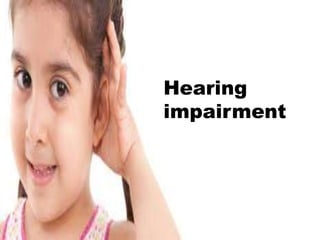
Hearing
impairment
Over 5% of the world’s
population – 360 million people –
has disabling hearing loss.
Living with hearing loss is not a
big deal.
If someone has a hearing
impairment, he’d certainly
know about it
Hearing aids can restore
hearing.
The deaf sometimes seem to
hear me only when they feel like
it.
Noise is a major avoidable cause
of hearing loss
All people who are deaf use sign
language to communicate
Gradual hearing loss can affect
people of all ages .
http://www.slideshare.net/denosmena/understand
ing-hearing-impairment
Definition
• .
• A hearing impairment is a hearing loss that
prevents a person from totally receiving sounds through the
ear. or Losing some hearing in one or both ears..
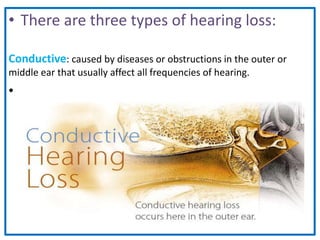
• There are three types of hearing loss:
Conductive: caused by diseases or obstructions in the outer or
middle ear that usually affect all frequencies of hearing.
• .
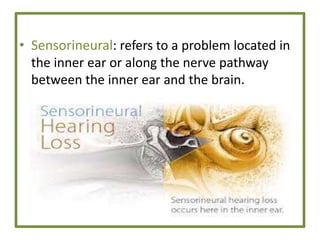
• Sensorineural: refers to a problem located in
the inner ear or along the nerve pathway
between the inner ear and the brain.
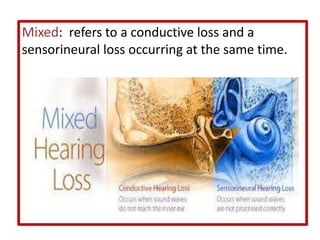
Mixed: refers to a conductive loss and a
sensorineural loss occurring at the same time.
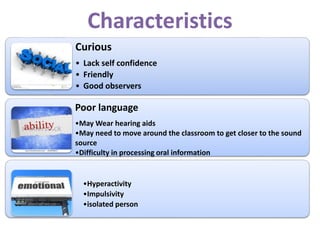
Characteristics
Curious
• Lack self confidence
• Friendly
• Good observers
Poor language
•May Wear hearing aids
•May need to move around the classroom to get closer to the sound
source
•Difficulty in processing oral information
•Hyperactivity
•Impulsivity
•isolated person
Methods of Communication
• American Sign Language (ASL): This is the primary
language of people who are deaf. It consists of a
combination of hand movements and positions to
express thoughts and phrases.
• Finger spelling: This is a manual form of communication
in which the hand and fingers spell out letters of the
alphabet to form words.
• Lipreading: This is a difficult skill used only by about 10% of
people with hearing impairments. Therefore, don't assume
that a deaf person to whom you are speaking can lip read.
Even if a person cannot lip read, however, being allowed to
see the speaker's mouth provides helpful visual cues.
• Written communication ("Pad and Pencil"): This is a fairly
simple way to communicate with a person who is deaf.
Remember, however, that sign language is the primary
language for most persons who are deaf; English is a second
language, so keep your words simple.
From: "Those of Us DisLabeled: A Guide to Awareness and Understanding", University of Kentucky Human Development Institute,
Cooperative Extension Service)
Methods of Communication
Things we have to think about before dealing
with students with hearing disabilities
• ●The type and degree of hearing loss.
• ●Their age .
• ●The attitudes of the child’s parents and siblings.
• ●The presence or absence of other disabilities.
Why ?
Instruction and teaching strategies
• Seat the hearing impaired student close to the
teacher for the best sound reception and visual
information. However, don't restrict them to
only one location. Allow the student to move to
a better listening position if they wish.
• Check the student has a clear view of the whole
class for participation in group activities if
possible.
• If one ear is better than the other, ensure the
better ear is directed to class and teacher.
Instruction and teaching strategies
• When appropriate, ask for a hearing volunteer to team up with
a student who is deaf or hard of hearing for in-class
assignments.
• In small group discussions, allow for participation by students
with hearing impairments.
• If there is a break in the class, get the attention of the student
who is deaf or hard of hearing before resuming class.
• Sit the student away from noisy areas.
• It may be necessary to change the seating arrangements for
particular activities.
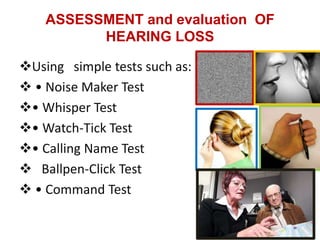
ASSESSMENT and evaluation OF
HEARING LOSS
Using simple tests such as:
 • Noise Maker Test
• Whisper Test
• Watch-Tick Test
• Calling Name Test
 Ballpen-Click Test
 • Command Test
Don’t forget
• Teacher has to write her-his lesson plan
according to IEP
• Avoid speaking exams at least at the beginning.
• that they can not listen but that is not mean they
are not able to speak.
Materials and resources
• Promote more learning through a variety of
materials incorporated into many different
curriculum areas.
• Number Puzzle
• Alphabet Peg Puzzle
• Flash Cards
• Floor Puzzle
• Sign Language
• Vocabulary Cards
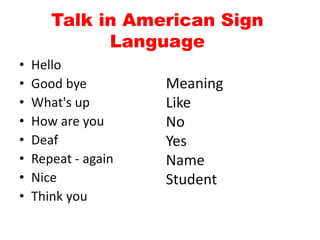
Talk in American Sign
Language
• Hello
• Good bye
• What's up
• How are you
• Deaf
• Repeat - again
• Nice
• Think you
Meaning
Like
No
Yes
Name
Student
Hearing impairment

Hearing impairment

  • 1.
    Recap  What isa model?  Types of Models of disability  Why is disability assessment important?  Disability assessment
  • 3.
  • 5.
    Over 5% ofthe world’s population – 360 million people – has disabling hearing loss.
  • 6.
    Living with hearingloss is not a big deal.
  • 7.
    If someone hasa hearing impairment, he’d certainly know about it
  • 8.
    Hearing aids canrestore hearing.
  • 9.
    The deaf sometimesseem to hear me only when they feel like it.
  • 10.
    Noise is amajor avoidable cause of hearing loss
  • 11.
    All people whoare deaf use sign language to communicate
  • 12.
    Gradual hearing losscan affect people of all ages . http://www.slideshare.net/denosmena/understand ing-hearing-impairment
  • 13.
    Definition • . • Ahearing impairment is a hearing loss that prevents a person from totally receiving sounds through the ear. or Losing some hearing in one or both ears..
  • 14.
    • There arethree types of hearing loss: Conductive: caused by diseases or obstructions in the outer or middle ear that usually affect all frequencies of hearing. • .
  • 15.
    • Sensorineural: refersto a problem located in the inner ear or along the nerve pathway between the inner ear and the brain.
  • 16.
    Mixed: refers toa conductive loss and a sensorineural loss occurring at the same time.
  • 17.
    Characteristics Curious • Lack selfconfidence • Friendly • Good observers Poor language •May Wear hearing aids •May need to move around the classroom to get closer to the sound source •Difficulty in processing oral information •Hyperactivity •Impulsivity •isolated person
  • 18.
    Methods of Communication •American Sign Language (ASL): This is the primary language of people who are deaf. It consists of a combination of hand movements and positions to express thoughts and phrases. • Finger spelling: This is a manual form of communication in which the hand and fingers spell out letters of the alphabet to form words.
  • 19.
    • Lipreading: Thisis a difficult skill used only by about 10% of people with hearing impairments. Therefore, don't assume that a deaf person to whom you are speaking can lip read. Even if a person cannot lip read, however, being allowed to see the speaker's mouth provides helpful visual cues. • Written communication ("Pad and Pencil"): This is a fairly simple way to communicate with a person who is deaf. Remember, however, that sign language is the primary language for most persons who are deaf; English is a second language, so keep your words simple. From: "Those of Us DisLabeled: A Guide to Awareness and Understanding", University of Kentucky Human Development Institute, Cooperative Extension Service) Methods of Communication
  • 20.
    Things we haveto think about before dealing with students with hearing disabilities • ●The type and degree of hearing loss. • ●Their age . • ●The attitudes of the child’s parents and siblings. • ●The presence or absence of other disabilities. Why ?
  • 21.
    Instruction and teachingstrategies • Seat the hearing impaired student close to the teacher for the best sound reception and visual information. However, don't restrict them to only one location. Allow the student to move to a better listening position if they wish. • Check the student has a clear view of the whole class for participation in group activities if possible. • If one ear is better than the other, ensure the better ear is directed to class and teacher.
  • 22.
    Instruction and teachingstrategies • When appropriate, ask for a hearing volunteer to team up with a student who is deaf or hard of hearing for in-class assignments. • In small group discussions, allow for participation by students with hearing impairments. • If there is a break in the class, get the attention of the student who is deaf or hard of hearing before resuming class. • Sit the student away from noisy areas. • It may be necessary to change the seating arrangements for particular activities.
  • 23.
    ASSESSMENT and evaluationOF HEARING LOSS Using simple tests such as:  • Noise Maker Test • Whisper Test • Watch-Tick Test • Calling Name Test  Ballpen-Click Test  • Command Test
  • 24.
    Don’t forget • Teacherhas to write her-his lesson plan according to IEP • Avoid speaking exams at least at the beginning. • that they can not listen but that is not mean they are not able to speak.
  • 25.
    Materials and resources •Promote more learning through a variety of materials incorporated into many different curriculum areas. • Number Puzzle • Alphabet Peg Puzzle • Flash Cards • Floor Puzzle • Sign Language • Vocabulary Cards
  • 26.
    Talk in AmericanSign Language • Hello • Good bye • What's up • How are you • Deaf • Repeat - again • Nice • Think you Meaning Like No Yes Name Student

Editor's Notes

  • #6 There are 360 million persons in the world with disabling hearing loss This is 5.3% of the world’s population - 32 million of these are children. Disabling hearing loss is defined as: adults (15 years and older): hearing loss greater than 40 dB in the better hearing ear; children (0 – 14 years of age): hearing loss greater than 30 dB in the better hearing ear.
  • #7 There are many psychological effects to hearing loss, including frustration, withdrawal, and depression. Trouble communicating with others creates a strain on relationships and a loss of esteem. It’s far better to deal with hearing loss than to pretend it isn’t happening—or to ignore the effect it is having on those around you.
  • #8 The truth is, hearing loss happens gradually and the signs are subtle at first. Our own built-in defenses and ability to adapt make it difficult to self-diagnose. A simple hearing test can help you gain insight, while professional screening can provide a more definitive answer.
  • #9 Hearing aids can be a great help to many people who are deaf or hard of hearing, but they cannot restore hearing that has been lost. About two million people in the UK use hearing aids, but it is estimated that a further four million could benefit from them. While analogue hearing aids merely amplify sound, digital hearing aids are also able to convert it into information that can be 'processed' by a tiny computer. This means that they can be tailored to suit an individual's hearing loss. Background noise can be a problem, as hearing aids tend to amplify everything. Although digital hearing aids are better equipped to deal with background noise, they cannot cut it out entirely. All aids work best when their wearers are having one-to-one conversations in quiet environments.
  • #10 People who are deaf and hard of hearing may be able to understand what you are saying some of the time, but not always. This can be confusing, but there are various reasons why it happens. Depending on their degree and type of hearing loss, people may be able to hear some sounds at certain pitches, but little else. Lipreading requires intense concentration. This means that someone who relies on lipreading has to concentrate hard all day and may not be able to continue when they are tired. Other people with hearing loss use hearing aids. These work best in quiet environments across a distance of no more than 1.5 metres and in one-to-one conversations. If there is noise or several people talking, or even a windy day, the hearing aid user might need the help of assistive devices like induction loops to eliminate background sounds.
  • #11 Noise is a cause for concern in both, developed and developing countries. In many countries, excessive noise has become the most compensated occupational hazard. The risk of social noise, such as, music and entertainment devices, is increasing globally among young persons.
  • #12 American Sign Language (ASL) is the language of many people who are deaf. Some people who are deaf use one or more of a variety of communication systems based on the English language. Sign language facilitates communication with deaf people Deaf and deaf-blind persons often use sign language. Sign languages differ across cultures, but they are legitimate languages, with their own vocabulary and grammar. Family members, medical professionals, teachers and employers should be encouraged to learn signs/sign language in order to facilitate communication with deaf people.
  • #13 Hearing loss is a sudden or gradual decrease in how well you can hear. Depending on the cause, it can be mild or severe, temporary or permanent.