HEARING
IMPAIRMENT OR
DISABILITY, DEAF
AND HARD OF
HEARING
GROUP #6
MENDEZ, JAYMART
PAEZ, RUFFA MAE
PALOMO, RAY ANNE
Hearing impairment or disability refers to
the reduced function or loss of the normal
function of the hearing mechanism.
The impairment or disability limits the
person's sensitivity to tasks like listening,
understanding speech, and speaking in the
same way those persons with normal
hearing do.
HEARING IMPAIRMENT OR DISABILITY,
DEAF AND HARD OF HEARING
When the condition occurs before the child
learns to talk, deafness is prelingual.
Deafness is postlingual when it is acquired
after the child has learned speech usually at
the age of two.
A person who is deaf cannot use hearing to
listen, understand speech and communicate
orally without special adaptations mainly
in the visual mode.
HEARING IMPAIRMENT OR DISABILITY,
DEAF AND HARD OF HEARING
 A person who is hard of hearing has a significant loss of
hearing sensitivity but he or she can hear sounds,
respond to speech and other auditory stimuli with or
without the use of a hearing aid. He or she is more like
a hearing person than one who is deaf because both of
them use audition or listening to auditory stimuli in the
environment, unlike a deaf person who relies more on
visual stimuli.
HEARING IMPAIRMENT OR DISABILITY,
DEAF AND HARD OF HEARING
The affected part of the ear is one basis for
classifying hearing impairment. A conductive
hearing loss occurs in the outer and middle ear
thereby blocking the passage of the acoustic
energy. The blockage may be caused by
abnormal growths or complications of the outer
or middle ear.
Another basis for classifying hearing impairment
is its being unilateral or present in one ear only,
or bilateral or present in both ears.
CLASSIFICATION OF HEARING
IMPAIRMENT
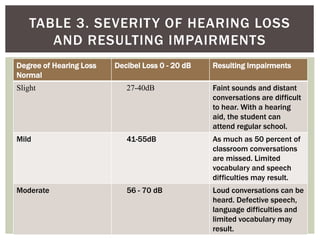
Degree of Hearing Loss
Normal
Decibel Loss 0 - 20 dB Resulting Impairments
Slight 27-40dB Faint sounds and distant
conversations are difficult
to hear. With a hearing
aid, the student can
attend regular school.
Mild 41-55dB As much as 50 percent of
classroom conversations
are missed. Limited
vocabulary and speech
difficulties may result.
Moderate 56 - 70 dB Loud conversations can be
heard. Defective speech,
language difficulties and
limited vocabulary may
result.
TABLE 3. SEVERITY OF HEARING LOSS
AND RESULTING IMPAIRMENTS
Severe 71-90dB Hearing is limited to a
radius of one foot, enough
to discriminate loud
sounds. Defective speech
and language and severe
difficulty in hearing
consonant sounds may
result.
Profound 91 -and above Sounds and tones cannot
be perceived. Vision
becomes the primary
sense of communication.
Speech and language are
likely to deteriorate.
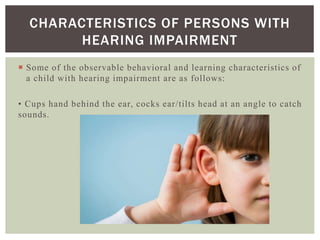
 Some of the observable behavioral and learning characteristics of
a child with hearing impairment are as follows:
• Cups hand behind the ear, cocks ear/tilts head at an angle to catch
sounds.
CHARACTERISTICS OF PERSONS WITH
HEARING IMPAIRMENT
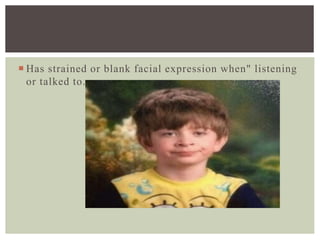
 Has strained or blank facial expression when" listening
or talked to.
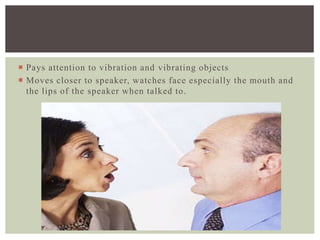
 Pays attention to vibration and vibrating objects
 Moves closer to speaker, watches face especially the mouth and
the lips of the speaker when talked to.
Less responsive to noise, voice, music and other
sources of sounds.
Uses more natural gestures, signs and
movements to express self.
Shows marked imitativeness at work and play.
Often fails to respond to oral questions.
Furthermore, a person with with hearing impairment has the
characteristics of:
- Less responsive to noise, voice, music and other sources of
sounds
- Uses more natural gestures, signs and movements to expres
self.
- Shows marked imitativeness at work and play.
- Often fails to respond to oral questions.
- Often asks for repetition of questions and statements
- Often unable to follow oral directions and instructions
- Has difficulty in associating concrete with abstract ideas.
- Has poor general learning performance.
CHARACTERISTICS OF PERSONS WITH
HEARING IMPAIRMENT
 1. Educational Replacement
-A special education teacher assists the regular teacher in seeing to
it that the students receive as much instruction as their hearing
classmates. Some special education programs employ an interpreter
in the regular class who translates the verbal activities into signs
and gestures to enable the student to follow the lesson.
2.Support Services
-Communication accessibility is provided by sign language and oral
interpreters inside and outside of the classrooms. Computer-aided
instruction (CAI) reinforces the knowledge and skills learned in the
different subject areas.
1. Promote the acceptance of the student with hearing
impairment in the regular class. Welcome the student
to your class.
2. Be sure that prescribed hearing aids and other
amplification devices are used.
3. Provide preferential seating.
4. Increase visual information.
5. Minimize classroom noise.
6. Modify teaching procedures.
7. Have realistic expectations.
SUGGESTIONS FOR TEACHING STUDENTS
WITH HEARING IMPAIRMENT IN A
REGULAR CLASS
THANK YOU FOR LISTENING!
,
PALOMO
MENDEZ, JAYMART
PAEZ, RUFFA MAE
PALOMO, RAY ANNE GROUP #6

HEARING IMPAIRMENT-PPT.pptx

  • 1.
    HEARING IMPAIRMENT OR DISABILITY, DEAF ANDHARD OF HEARING GROUP #6 MENDEZ, JAYMART PAEZ, RUFFA MAE PALOMO, RAY ANNE
  • 2.
    Hearing impairment ordisability refers to the reduced function or loss of the normal function of the hearing mechanism. The impairment or disability limits the person's sensitivity to tasks like listening, understanding speech, and speaking in the same way those persons with normal hearing do. HEARING IMPAIRMENT OR DISABILITY, DEAF AND HARD OF HEARING
  • 3.
    When the conditionoccurs before the child learns to talk, deafness is prelingual. Deafness is postlingual when it is acquired after the child has learned speech usually at the age of two. A person who is deaf cannot use hearing to listen, understand speech and communicate orally without special adaptations mainly in the visual mode. HEARING IMPAIRMENT OR DISABILITY, DEAF AND HARD OF HEARING
  • 4.
     A personwho is hard of hearing has a significant loss of hearing sensitivity but he or she can hear sounds, respond to speech and other auditory stimuli with or without the use of a hearing aid. He or she is more like a hearing person than one who is deaf because both of them use audition or listening to auditory stimuli in the environment, unlike a deaf person who relies more on visual stimuli. HEARING IMPAIRMENT OR DISABILITY, DEAF AND HARD OF HEARING
  • 5.
    The affected partof the ear is one basis for classifying hearing impairment. A conductive hearing loss occurs in the outer and middle ear thereby blocking the passage of the acoustic energy. The blockage may be caused by abnormal growths or complications of the outer or middle ear. Another basis for classifying hearing impairment is its being unilateral or present in one ear only, or bilateral or present in both ears. CLASSIFICATION OF HEARING IMPAIRMENT
  • 6.
    Degree of HearingLoss Normal Decibel Loss 0 - 20 dB Resulting Impairments Slight 27-40dB Faint sounds and distant conversations are difficult to hear. With a hearing aid, the student can attend regular school. Mild 41-55dB As much as 50 percent of classroom conversations are missed. Limited vocabulary and speech difficulties may result. Moderate 56 - 70 dB Loud conversations can be heard. Defective speech, language difficulties and limited vocabulary may result. TABLE 3. SEVERITY OF HEARING LOSS AND RESULTING IMPAIRMENTS
  • 7.
    Severe 71-90dB Hearingis limited to a radius of one foot, enough to discriminate loud sounds. Defective speech and language and severe difficulty in hearing consonant sounds may result. Profound 91 -and above Sounds and tones cannot be perceived. Vision becomes the primary sense of communication. Speech and language are likely to deteriorate.
  • 8.
     Some ofthe observable behavioral and learning characteristics of a child with hearing impairment are as follows: • Cups hand behind the ear, cocks ear/tilts head at an angle to catch sounds. CHARACTERISTICS OF PERSONS WITH HEARING IMPAIRMENT
  • 9.
     Has strainedor blank facial expression when" listening or talked to.
  • 10.
     Pays attentionto vibration and vibrating objects  Moves closer to speaker, watches face especially the mouth and the lips of the speaker when talked to.
  • 11.
    Less responsive tonoise, voice, music and other sources of sounds. Uses more natural gestures, signs and movements to express self. Shows marked imitativeness at work and play. Often fails to respond to oral questions.
  • 12.
    Furthermore, a personwith with hearing impairment has the characteristics of: - Less responsive to noise, voice, music and other sources of sounds - Uses more natural gestures, signs and movements to expres self. - Shows marked imitativeness at work and play. - Often fails to respond to oral questions. - Often asks for repetition of questions and statements - Often unable to follow oral directions and instructions - Has difficulty in associating concrete with abstract ideas. - Has poor general learning performance. CHARACTERISTICS OF PERSONS WITH HEARING IMPAIRMENT
  • 13.
     1. EducationalReplacement -A special education teacher assists the regular teacher in seeing to it that the students receive as much instruction as their hearing classmates. Some special education programs employ an interpreter in the regular class who translates the verbal activities into signs and gestures to enable the student to follow the lesson. 2.Support Services -Communication accessibility is provided by sign language and oral interpreters inside and outside of the classrooms. Computer-aided instruction (CAI) reinforces the knowledge and skills learned in the different subject areas.
  • 14.
    1. Promote theacceptance of the student with hearing impairment in the regular class. Welcome the student to your class. 2. Be sure that prescribed hearing aids and other amplification devices are used. 3. Provide preferential seating. 4. Increase visual information. 5. Minimize classroom noise. 6. Modify teaching procedures. 7. Have realistic expectations. SUGGESTIONS FOR TEACHING STUDENTS WITH HEARING IMPAIRMENT IN A REGULAR CLASS
  • 15.
    THANK YOU FORLISTENING! , PALOMO MENDEZ, JAYMART PAEZ, RUFFA MAE PALOMO, RAY ANNE GROUP #6