Metal-Cyclopentadiene complexes
1
• η5- Cyclopentadienyl or “Cp” is one of the most common ligands
encountered in organotransition-metal chemistry
• Complexes of this ligand are known for all transition and most f-
block metals
• The group is a principal member of the class of planar aromatic
ligands such as benzene
2
• It played major role in the development of organometallic chemistry
• Although the pot. derivative of cyclopentadienide anion was described as
early as 1901by Thiele, yet an exciting phase in metal cyclopentadienyl
chemistry began in early 1950’s with the discovery of ‘ferrocene’
• Ferrocene have a novel ‘sandwich’structure with all the carbons of both
the Cp rings within bonding distance of the metal atom
3
• large number of TM-Cp complexes known
• Fact: Cp ligand bound firmly to the metal atom and most inert to
nucleophilic and electrophilic attack
(η5-C5H5)2M complexes formed by the reaction between the Cp anion and
suitable derivatives of the TMs are ---> metallocenes
4
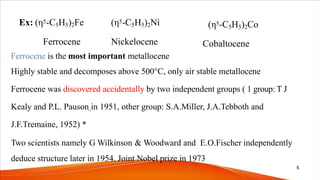
Ex: (η5-C5H5)2Fe
Ferrocene
(η5-C5H5)2Ni
Nickelocene
(η5-C5H5)2Co
Cobaltocene
Ferrocene is the most important metallocene
Highly stable and decomposes above 500°C, only air stable metallocene
Ferrocene was discovered accidentally by two independent groups ( 1 group: T J
Kealy and P.L. Pauson in 1951, other group: S.A.Miller, J.A.Tebboth and
J.F.Tremaine, 1952) *
Two scientists namely G Wilkinson & Woodward and E.O.Fischer independently
deduce structure later in 1954. Joint Nobel prize in 1973
5
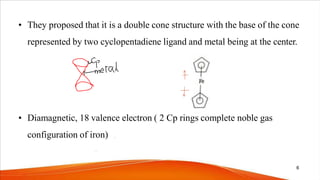
• They proposed that it is a double cone structure with the base of the cone
represented by two cyclopentadiene ligand and metal being at the center.
• Diamagnetic, 18 valence electron ( 2 Cp rings complete noble gas
configuration of iron)
6
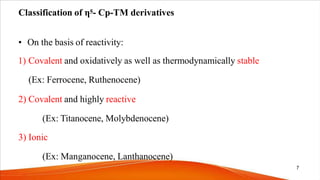
Classification of η5- Cp-TM derivatives
• On the basis of reactivity:
1) Covalent and oxidatively as well as thermodynamically stable
(Ex: Ferrocene, Ruthenocene)
2) Covalent and highly reactive
(Ex: Titanocene, Molybdenocene)
3) Ionic
(Ex: Manganocene, Lanthanocene)
7
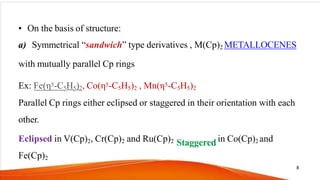
• On the basis of structure:
a) Symmetrical “sandwich” type derivatives , M(Cp)2 METALLOCENES
with mutually parallel Cp rings
Ex: Fe(η5-C5H5)2, Co(η5-C5H5)2 , Mn(η5-C5H5)2
Parallel Cp rings either eclipsed or staggered in their orientation with each
other.
Eclipsed in V(Cp)2, Cr(Cp)2 and Ru(Cp)2 in Co(Cp)2 and
Fe(Cp)2
8
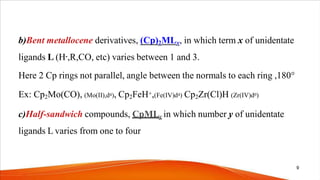
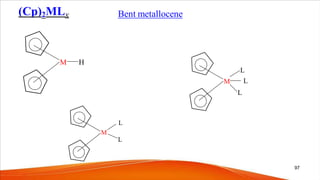
b)Bent metallocene derivatives, (Cp)2MLx, in which term x of unidentate
ligands L (H-,R,CO, etc) varies between 1 and 3.
Here 2 Cp rings not parallel, angle between the normals to each ring ,180°
Ex: Cp2Mo(CO), (Mo(II),d4), Cp2FeH+,(Fe(IV)d4) Cp2Zr(Cl)H (Zr(IV)d0)
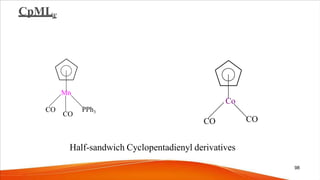
c)Half-sandwich compounds, CpMLy in which number y of unidentate
ligands L varies from one to four
9
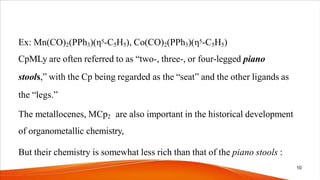
Ex: Mn(CO)2(PPh3)(η5-C5H5), Co(CO)2(PPh3)(η5-C5H5)
CpMLy are often referred to as “two-, three-, or four-legged piano
stools,” with the Cp being regarded as the “seat” and the other ligands as
the “legs.”
The metallocenes, MCp2 are also important in the historical development
of organometallic chemistry,
But their chemistry is somewhat less rich than that of the piano stools :
10
• fewer ligands can bind to the metallocenes without overstepping the
18e- limit.
• Their most important application is alkene polymerization.
• The sandwich structure of the orange crystalline Cp2Fe was deduced by
Wilkinson and Woodward and by Fischer in 1954.
• One of the most significant discoveries during the early development of
organotransition metal chemistry and helped to launch it as an
independent field in its own right.
11
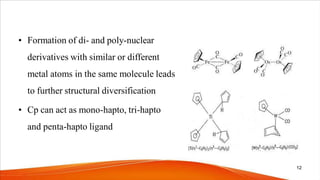
• Formation of di- and poly-nuclear
derivatives with similar or different
metal atoms in the same molecule leads
to further structural diversification
• Cp can act as mono-hapto, tri-hapto
and penta-hapto ligand
12
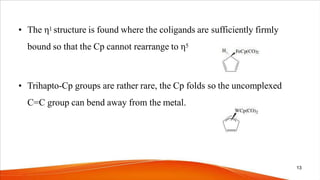
• The η1 structure is found where the coligands are sufficiently firmly
bound so that the Cp cannot rearrange to η5
• Trihapto-Cp groups are rather rare, the Cp folds so the uncomplexed
C=C group can bend away from the metal.
13
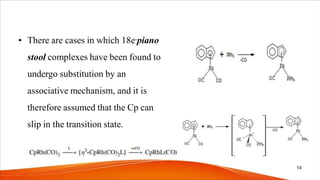
• There are cases in which 18e-piano
stool complexes have been found to
undergo substitution by an
associative mechanism, and it is
therefore assumed that the Cp can
slip in the transition state.
14
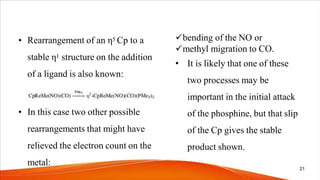
• Rearrangement of an η5 Cp to a
stable η1 structure on the addition
of a ligand is also known:
• In this case two other possible
rearrangements that might have
relieved the electron count on the
metal:
bending of the NO or
methyl migration to CO.
• It is likely that one of these
two processes may be
important in the initial attack
of the phosphine, but that slip
of the Cp gives the stable
product shown.
21
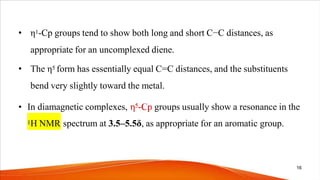
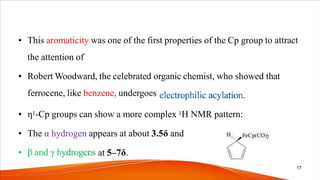
• η1-Cp groups tend to show both long and short C−C distances, as
appropriate for an uncomplexed diene.
• The η5 form has essentially equal C=C distances, and the substituents
bend very slightly toward the metal.
• In diamagnetic complexes, groups usually show a resonance in the
1H NMR spectrum at 3.5–5.5δ, as appropriate for an aromatic group.
16
• This aromaticity was one of the first properties of the Cp group to attract
the attention of
• Robert Woodward, the celebrated organic chemist, who showed that
ferrocene, like benzene, undergoes
• η1-Cp groups can show a more complex 1H NMR pattern:
• The α hydrogen appears at about 3.5δ and
at 5–7δ.
17
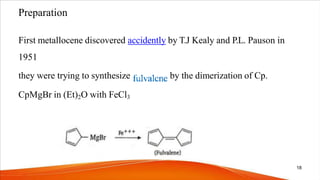
Preparation
First metallocene discovered accidently by T.J Kealy and P.L. Pauson in
1951
they were trying to synthesize by the dimerization of Cp.
CpMgBr in (Et)2O with FeCl3
18
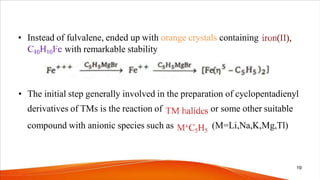
• Instead of fulvalene, ended up with orange crystals containing
with remarkable stability
• The initial step generally involved in the preparation of cyclopentadienyl
derivatives of TMs is the reaction of
compound with anionic species such as
or some other suitable
(M=Li,Na,K,Mg,Tl)
19
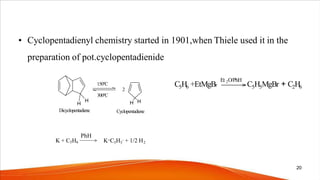
• Cyclopentadienyl chemistry started in 1901,when Thiele used it in the
preparation of pot.cyclopentadienide
H
H H H
2
150o
C
300o
C
Dicyclopentadiene Cyclopentadiene
K + C5H6 5 5
K+C H - + 1/2 H2
PhH
C5H6 +EtMgBr
Et 2O/PhH
C5H5MgBr + C2H6
20
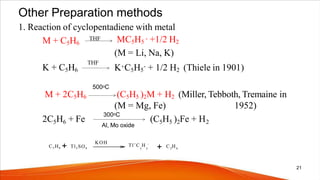
Other Preparation methods
1. Reaction of cyclopentadiene with metal
M + C5H6
K + C5H6
-
MC5H5
- +1/2 H2
(M = Li, Na, K)
K+C5H5 + 1/2 H2 (Thiele in 1901)
M + 2C5H6 (C5H5 )2M + H2 (Miller, Tebboth, Tremaine in
(M = Mg, Fe) 1952)
5 6
2C H + Fe (C H ) Fe + H
5 5 2 2
500oC
300oC
Al, Mo oxide
THF
THF
C5H6 + Tl2SO4
KOH
Tl+
C H -
5 5 + C H
2 6
21
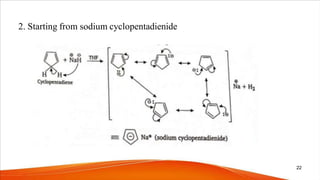
2. Starting from sodium cyclopentadienide
22
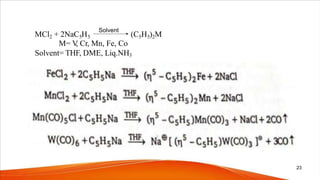
MCl + 2NaC H
2 5 5 5 5 2
(C H ) M
M= V
, Cr, Mn, Fe, Co
Solvent= THF, DME, Liq.NH3
Solvent
23
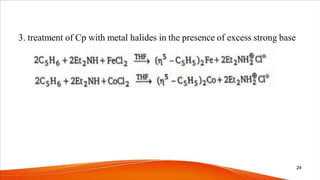
3. treatment of Cp with metal halides in the presence of excess strong base
24
• For understanding nature of bonding in metallocenes by taking example
of ferrocene,
picture for cyclopentadienide
• first have to
ligand(s)
• Then which have the correct symmetry and
energies to overlap with the ligand group orbitals for effective bonding
25
• Cyclopentadienide anion - delocalized structure (i.e., non-localized
multiple bonds)
• All the ten (5C and 5H) atoms are coplanar, with the same carbon-carbon
bond length (1.39 A) , intermediate between those of ethene (1.34 A) and
ethane (1.54A) and is similar to that in benzene
26
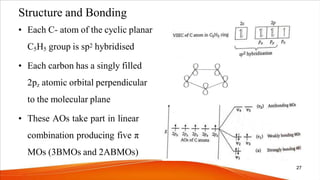
Structure and Bonding
• Each C- atom of the cyclic planar
C5H5 group is sp2 hybridised
• Each carbon has a singly filled
2pz atomic orbital perpendicular
to the molecular plane
• These AOs take part in linear
combination producing five π
MOs (3BMOs and 2ABMOs)
27
28
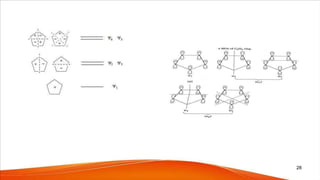
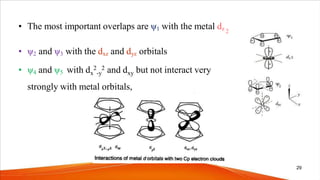
• The most important overlaps are ψ1 with the metal dz 2
• ψ2 and ψ3 with the dxz and dyz orbitals
• ψ4 and ψ5 with dx
2
-y
2 and dxy but not interact very
strongly with metal orbitals,
29
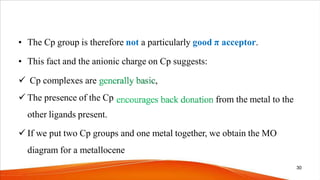
• The Cp group is therefore not a particularly good π acceptor.
from the metal to the
• This fact and the anionic charge on Cp suggests:
 Cp complexes are ,
 The presence of the Cp
other ligands present.
 If we put two Cp groups and one metal together, we obtain the MO
diagram for a metallocene
30
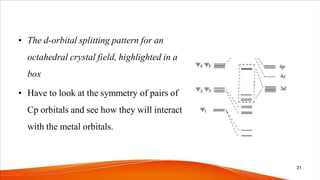
• The d-orbital splitting pattern for an
octahedral crystal field, highlighted in a
box
• Have to look at the symmetry of pairs of
Cp orbitals and see how they will interact
with the metal orbitals.
31
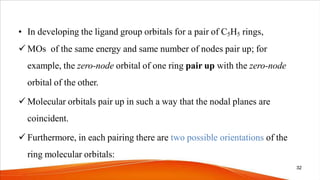
• In developing the ligand group orbitals for a pair of C5H5 rings,
 MOs of the same energy and same number of nodes pair up; for
example, the zero-node orbital of one ring pair up with the zero-node
orbital of the other.
 Molecular orbitals pair up in such a way that the nodal planes are
coincident.
 Furthermore, in each pairing there are two possible orientations of the
ring molecular orbitals:
32
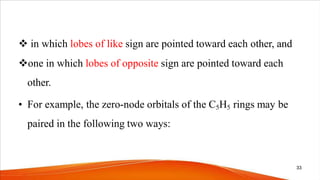
 in which lobes of like sign are pointed toward each other, and
one in which lobes of opposite sign are pointed toward each
other.
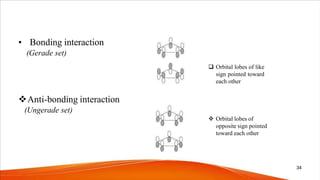
• For example, the zero-node orbitals of the C5H5 rings may be
paired in the following two ways:
33
• Bonding interaction
(Gerade set)
Anti-bonding interaction
(Ungerade set)
 Orbital lobes of
opposite sign pointed
toward each other
 Orbital lobes of like
sign pointed toward
each other
34
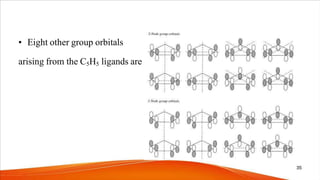
• Eight other group orbitals
arising from the C5H5 ligands are
35
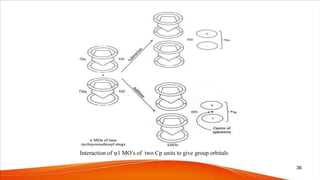
• II
Interaction of ψ1 MO’s of two Cp units to give group orbitals
36
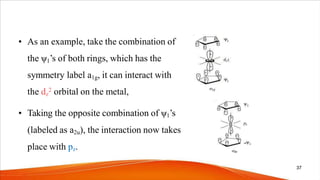
• As an example, take the combination of
the ψ1’s of both rings, which has the
symmetry label a1g, it can interact with
the dz
2 orbital on the metal,
• Taking the opposite combination of ψ1’s
(labeled as a2u), the interaction now takes
place with pz.
37
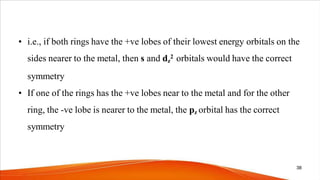
• i.e., if both rings have the +ve lobes of their lowest energy orbitals on the
sides nearer to the metal, then s and dz
2 orbitals would have the correct
symmetry
• If one of the rings has the +ve lobes near to the metal and for the other
ring, the -ve lobe is nearer to the metal, the pz orbital has the correct
symmetry
38
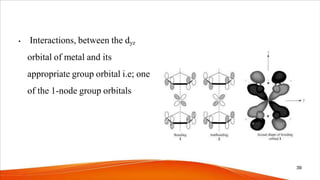
• Interactions, between the dyz
orbital of metal and its
appropriate group orbital i.e; one
of the 1-node group orbitals
39
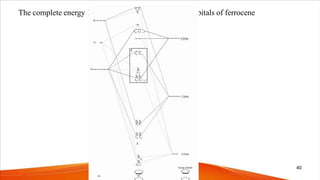
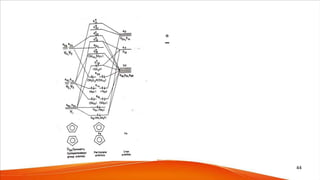
The complete energy level diagram for the molecular orbitals of ferrocene
40
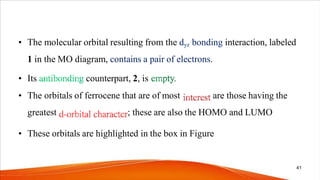
• The molecular orbital resulting from the dyz bonding interaction, labeled
1 in the MO diagram, contains a pair of electrons.
• Its counterpart, 2, is
• The orbitals of ferrocene that are of most are those having the
greatest ; these are also the HOMO and LUMO
• These orbitals are highlighted in the box in Figure
41
character, are
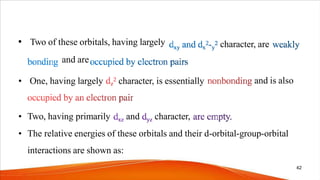
• Two of these orbitals, having largely
and are
• One, having largely character, is essentially and is also
• Two, having primarily and character,
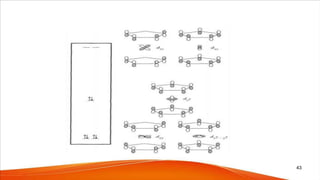
• The relative energies of these orbitals and their d-orbital-group-orbital
interactions are shown as:
42
43
*
44
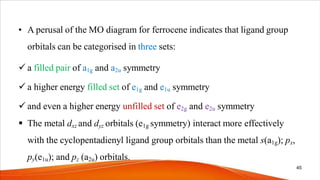
• A perusal of the MO diagram for ferrocene indicates that ligand group
orbitals can be categorised in three sets:
 a filled pair of a1g and a2u symmetry
 a higher energy filled set of e1g and e1u symmetry
 and even a higher energy unfilled set of e2g and e2u symmetry
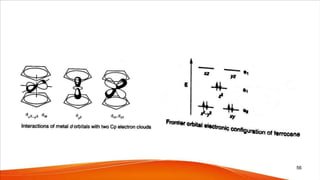
 The metal dxz and dyz orbitals (e1g symmetry) interact more effectively
with the cyclopentadienyl ligand group orbitals than the metal s(a1g); px,
py(e1u); and pz (a2u) orbitals.
45
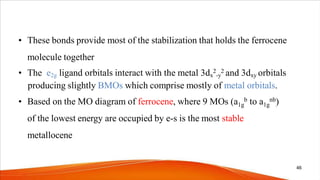
• These bonds provide most of the stabilization that holds the ferrocene
molecule together
• The e2g ligand orbitals interact with the metal 3dx
2
-y
2 and 3dxy orbitals
producing slightly BMOs which comprise mostly of metal orbitals.
• Based on the MO diagram of ferrocene, where 9 MOs (a1g
b to a1g
nb)
of the lowest energy are occupied by e-s is the most stable
metallocene
46
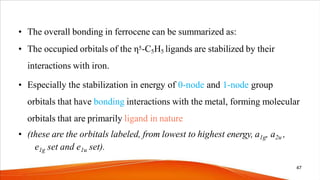
• The overall bonding in ferrocene can be summarized as:
• The occupied orbitals of the η5-C5H5 ligands are stabilized by their
interactions with iron.
• Especially the stabilization in energy of 0-node and 1-node group
orbitals that have bonding interactions with the metal, forming molecular
orbitals that are primarily ligand in nature
• (these are the orbitals labeled, from lowest to highest energy, a1g, a2u ,
e1g set and e1u set).
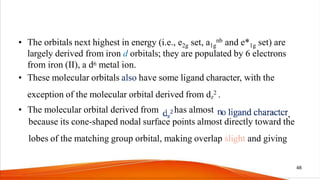
47
• The orbitals next highest in energy (i.e., e2g set, a1g
nb and e*1g set) are
largely derived from iron d orbitals; they are populated by 6 electrons
from iron (II), a d6 metal ion.
• These molecular orbitals also have some ligand character, with the
exception of the molecular orbital derived from dz
2 .
• The molecular orbital derived from has almost ,
because its cone-shaped nodal surface points almost directly toward the
lobes of the matching group orbital, making overlap slight and giving
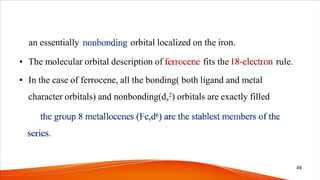
48
an essentially orbital localized on the iron.
• The molecular orbital description of fits the rule.
• In the case of ferrocene, all the bonding( both ligand and metal
character orbitals) and nonbonding(dz
2) orbitals are exactly filled
49
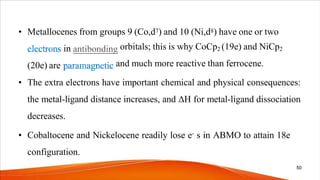
• Metallocenes from groups 9 (Co,d7) and 10 (Ni,d8) have one or two
in
(20e) are
orbitals; this is why CoCp2 (19e) and NiCp2
and much more reactive than ferrocene.
• The extra electrons have important chemical and physical consequences:
the metal-ligand distance increases, and ΔH for metal-ligand dissociation
decreases.
• Cobaltocene and Nickelocene readily lose e- s in ABMO to attain 18e
configuration.
50
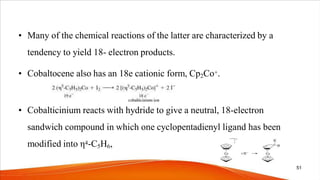
• Many of the chemical reactions of the latter are characterized by a
tendency to yield 18- electron products.
• Cobaltocene also has an 18e cationic form, Cp2Co+.
• Cobalticinium reacts with hydride to give a neutral, 18-electron
sandwich compound in which one cyclopentadienyl ligand has been
modified into η4-C5H6,
51
Although isoelectronic with [Fe(Cp)2], [Co(Cp)2]+ (18e-)
shows more oxidative stability
=> In [Co(Cp)2]+ , Co is in Co(III), while in ferrocene Fe is
in Fe(II)
52
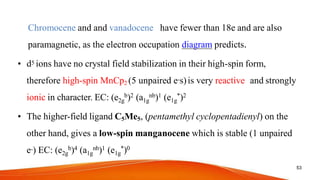
Chromocene and and vanadocene have fewer than 18e and are also
paramagnetic, as the electron occupation diagram predicts.
• d5 ions have no crystal field stabilization in their high-spin form,
therefore high-spin MnCp2 (5 unpaired e-s)is very reactive and strongly
ionic in character. EC: (e2g
b)2 (a1g
nb)1 (e1g
*)2
• The higher-field ligand C5Me5, (pentamethyl cyclopentadienyl) on the
other hand, gives a low-spin manganocene which is stable (1 unpaired
e-) EC: (e2g
b)4 (a1g
nb)1 (e1g
*)0
53
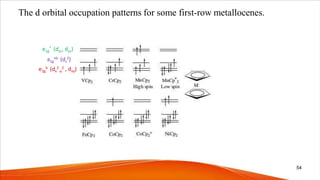
The d orbital occupation patterns for some first-row metallocenes.
54
e2g
b (dx
2
-y
2 , dxy)
a1g
nb (dz
2)
e1g
* (dxz, dyz)
[Mn(Cp)2] is high spin while [Re(Cp)2] is a low spin
complex
Re heavier congener of Mn
Hence higher crystal field splitting power
55
56
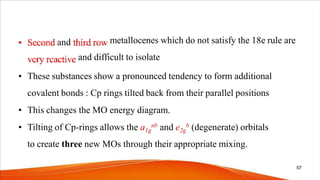
and metallocenes which do not satisfy the 18e rule are
and difficult to isolate
• These substances show a pronounced tendency to form additional
covalent bonds : Cp rings tilted back from their parallel positions
• This changes the MO energy diagram.
• Tilting of Cp-rings allows the a1g
nb and e2g
b (degenerate) orbitals
to create three new MOs through their appropriate mixing.
57
• These three MOs can accommodate 6 electrons.
• In this event, the lower 6 MOs (i.e. upto e1u
b) remain more or less
unpurturbed.
• These 6 MOs accommodate 12 electrons and 3 new MOs can
accommodate 6 electrons to give the 18e configuration
• Ex: [(η5-Cp)2Re-H], [(η5-Cp)2Mo(H)2], [(η5-Cp)2Ti(CO)2], [(η5-
Cp)2Ta(H)3]
• For ex, Cp2Re(17e) and Cp2Re+ (16e) are unstable, Cp2ReH is very
stable
58
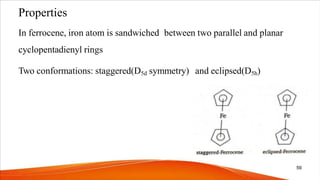
In ferrocene, iron atom is sandwiched between two parallel and planar
cyclopentadienyl rings
Two conformations: staggered(D5d symmetry) and eclipsed(D5h)
Properties
59
Both the forms are in transition
Energy barrier to rotation is very low (≤ 5kJ/mol)
Structural features of ferrocene below 169K are:
C-C distance 139+/-6pm
Fe-C distance 203+/-2pm
All the C’s are at equidistant from Fe
60
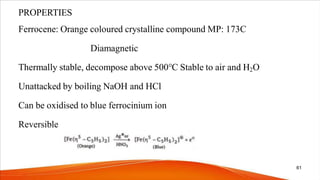
PROPERTIES
Ferrocene: Orange coloured crystalline compound MP: 173C
Diamagnetic
Thermally stable, decompose above 500℃ Stable to air and H2O
Unattacked by boiling NaOH and HCl
Can be oxidised to blue ferrocinium ion
Reversible
61
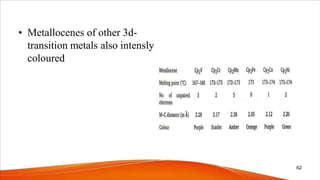
• Metallocenes of other 3d-
transition metals also intensly
coloured
62
• Cyclopentadienyl derivatives of
TMs available in various
ox.states
Ex: [CpMo(CO)3]- , CpMn(CO)3 ,
Fe(Cp)2 , [Co(Cp)2]+ , TiCl2(Cp)2 ,
NbBr3(Cp)2
• with central metals in
0,1,2,3,4 & 5 ox.states
respectively
• Metallocenes from the 3d
transition series - generally
paramagnetic
• Exception: Fe(η5-C5H5)2 ,
[Co(η5-C5H5)2]+ and Ti(η2-
Cp)2
63
Cp rings are aromatic in nature
No typical reactions of Diene, i.e., Diels-Alder reaction
Cp rings of ferrocene readily undergo electrophilic substitution reaction
characteristic of aromatic compound
Ferrocenes behaviour as an electron rich aromatic compound, its facile
metallation and unusual ability to stabilise carbocations at its benzylic like
position are properties which pave the way to prepare functionalised
substituted ferrocene
64
The ease of electrophilic substitution, scope of having planar chirality and
redox active iron atom facilitated the development of ferrocene chemistry
in diverse directions
Major interest in ferrocene chemistry is centered around developing chiral
chelating ligands with planar and lateral chirality and their use as prochiral
ligand in asymmetric catalysis
Use of Ferrocenophanes as precursors for ferrocene based polymer- another
application
65
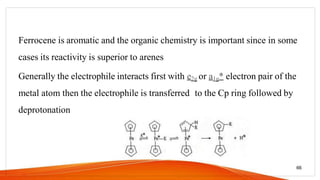
Ferrocene is aromatic and the organic chemistry is important since in some
cases its reactivity is superior to arenes
Generally the electrophile interacts first with e2g or a1g* electron pair of the
metal atom then the electrophile is transferred to the Cp ring followed by
deprotonation
66
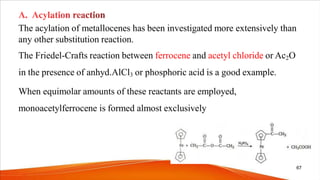
The acylation of metallocenes has been investigated more extensively than
any other substitution reaction.
The Friedel-Crafts reaction between ferrocene and acetyl chloride or Ac2O
in the presence of anhyd.AlCl3 or phosphoric acid is a good example.
When equimolar amounts of these reactants are employed,
monoacetylferrocene is formed almost exclusively
67
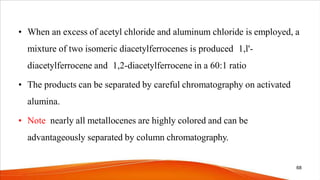
• When an excess of acetyl chloride and aluminum chloride is employed, a
mixture of two isomeric diacetylferrocenes is produced 1,l'-
diacetylferrocene and 1,2-diacetylferrocene in a 60:1 ratio
• The products can be separated by careful chromatography on activated
alumina.
• Note nearly all metallocenes are highly colored and can be
advantageously separated by column chromatography.
68
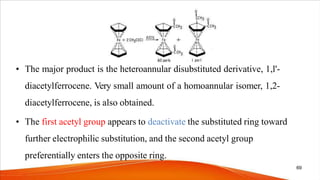
• The major product is the heteroannular disubstituted derivative, 1,l'-
diacetylferrocene. Very small amount of a homoannular isomer, 1,2-
diacetylferrocene, is also obtained.
• The first acetyl group appears to deactivate the substituted ring toward
further electrophilic substitution, and the second acetyl group
preferentially enters the opposite ring.
69
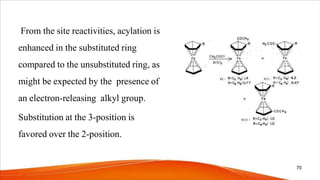
From the site reactivities, acylation is
enhanced in the substituted ring
compared to the unsubstituted ring, as
might be expected by the presence of
an electron-releasing alkyl group.
Substitution at the 3-position is
favored over the 2-position.
70
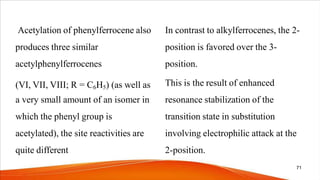
In contrast to alkylferrocenes, the 2-
position is favored over the 3-
position.
This is the result of enhanced
resonance stabilization of the
transition state in substitution
involving electrophilic attack at the
2-position.
Acetylation of phenylferrocene also
produces three similar
acetylphenylferrocenes
(VI, VII, VIII; R = C6H5) (as well as
a very small amount of an isomer in
which the phenyl group is
acetylated), the site reactivities are
quite different
71
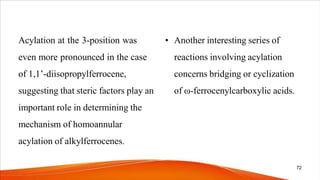
Acylation at the 3-position was
even more pronounced in the case
of 1,1’-diisopropylferrocene,
suggesting that steric factors play an
important role in determining the
mechanism of homoannular
acylation of alkylferrocenes.
• Another interesting series of
reactions involving acylation
concerns bridging or cyclization
of ω-ferrocenylcarboxylic acids.
72
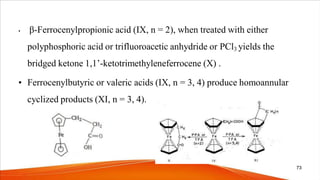
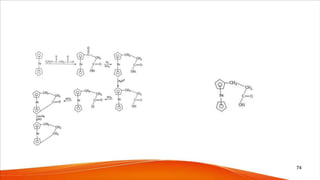
• β-Ferrocenylpropionic acid (IX, n = 2), when treated with either
polyphosphoric acid or trifluoroacetic anhydride or PCl3 yields the
bridged ketone 1,1’-ketotrimethyleneferrocene (X) .
• Ferrocenylbutyric or valeric acids (IX, n = 3, 4) produce homoannular
cyclized products (XI, n = 3, 4).
73
74
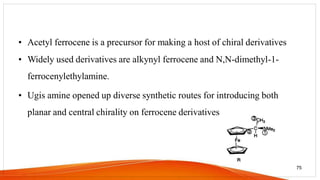
• Acetyl ferrocene is a precursor for making a host of chiral derivatives
• Widely used derivatives are alkynyl ferrocene and N,N-dimethyl-1-
ferrocenylethylamine.
• Ugis amine opened up diverse synthetic routes for introducing both
planar and central chirality on ferrocene derivatives
75
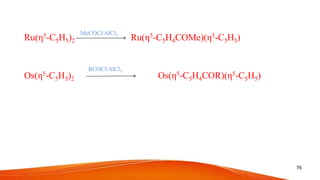
Ru(η5-C5H5)2 Ru(η5-C5H4COMe)(η5-C5H5)
Os(η5-C5H5)2 Os(η5-C5H4COR)(η5-C5H5)
76
MeCOCl/AlCl3
RCOCl/AlCl3
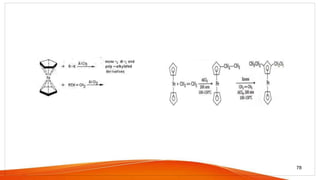
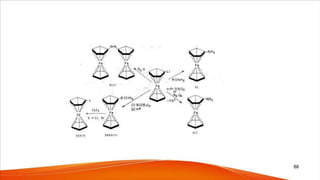
Ferrocene is readily alkylated by alkyl halides, alcohols, or olefins to
produce alkylated derivatives.
The exceedingly great reactivity of ferrocene under these conditions results
in the formation of mixtures of mono-, di-, tri-, and poly-alkylated products,
and the yield of any one alkylation product is usually low.
The introduction of an alkyl group into the ferrocene nucleus facilitates
subsequent alkylation in the same ring.
77
78
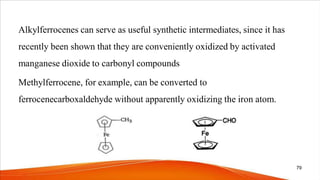
Alkylferrocenes can serve as useful synthetic intermediates, since it has
recently been shown that they are conveniently oxidized by activated
manganese dioxide to carbonyl compounds
Methylferrocene, for example, can be converted to
ferrocenecarboxaldehyde without apparently oxidizing the iron atom.
79
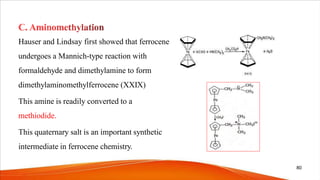
Hauser and Lindsay first showed that ferrocene
undergoes a Mannich-type reaction with
formaldehyde and dimethylamine to form
dimethylaminomethylferrocene (XXIX)
This amine is readily converted to a
methiodide.
This quaternary salt is an important synthetic
intermediate in ferrocene chemistry.
80
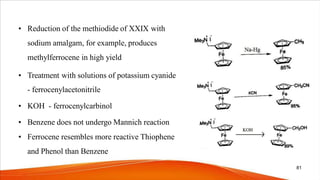
• Reduction of the methiodide of XXIX with
sodium amalgam, for example, produces
methylferrocene in high yield
• Treatment with solutions of potassium cyanide
- ferrocenylacetonitrile
• KOH - ferrocenylcarbinol
• Benzene does not undergo Mannich reaction
• Ferrocene resembles more reactive Thiophene
and Phenol than Benzene
81
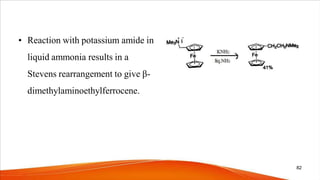
• Reaction with potassium amide in
liquid ammonia results in a
Stevens rearrangement to give β-
dimethylaminoethylferrocene.
82
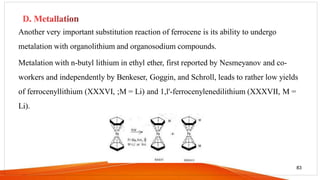
Another very important substitution reaction of ferrocene is its ability to undergo
metalation with organolithium and organosodium compounds.
Metalation with n-butyl lithium in ethyl ether, first reported by Nesmeyanov and co-
workers and independently by Benkeser, Goggin, and Schroll, leads to rather low yields
of ferrocenyllithium (XXXVI, ;M = Li) and 1,l'-ferrocenylenedilithium (XXXVII, M =
Li).
83
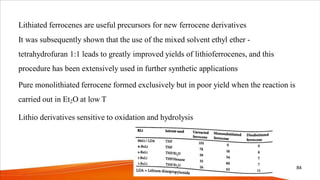
Lithiated ferrocenes are useful precursors for new ferrocene derivatives
It was subsequently shown that the use of the mixed solvent ethyl ether -
tetrahydrofuran 1:1 leads to greatly improved yields of lithioferrocenes, and this
procedure has been extensively used in further synthetic applications
Pure monolithiated ferrocene formed exclusively but in poor yield when the reaction is
carried out in Et2O at low T
Lithio derivatives sensitive to oxidation and hydrolysis
84
Similar reactions of ferrocene with phenylsodium or n-amylsodium lead to
the corresponding sodiated products (XXXVI, XXXVII, M = Na)
The steric course of both metalation reactions has been studied, and it has
been proved that dimetalation occurs in opposite cyclopentadienyl rings .
Both ruthenocene and osmocene have been metalated with n- butyllithium.
It has been shown that under comparable conditions ruthenocene is
metalated to a greater extent than is ferrocene.
85
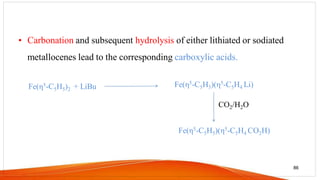
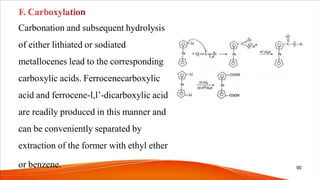
• Carbonation and subsequent hydrolysis of either lithiated or sodiated
metallocenes lead to the corresponding carboxylic acids.
86
Fe(η5-C5H5)(η5-C5H4 CO2H)
Fe(η5-C5H5)2 + LiBu Fe(η5-C5H5)(η5-C5H4 Li)
CO2/H2O
• Ferrocenecarboxylic acid and ferrocene-l,l’-dicarboxylic acid are readily
produced in this manner and can be conveniently separated by extraction
of the former with ethyl ether or benzene.
• Metalated ferrocenes have served as very valuable intermediates for the
synthesis of a number of other derivatives.
87
88
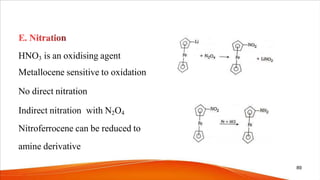
HNO3 is an oxidising agent
Metallocene sensitive to oxidation
No direct nitration
Indirect nitration with N2O4
Nitroferrocene can be reduced to
amine derivative
89
Carbonation and subsequent hydrolysis
of either lithiated or sodiated
metallocenes lead to the corresponding
carboxylic acids. Ferrocenecarboxylic
acid and ferrocene-l,l’-dicarboxylic acid
are readily produced in this manner and
can be conveniently separated by
extraction of the former with ethyl ether
or benzene. 90
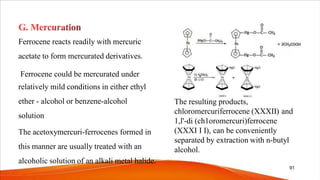
Ferrocene reacts readily with mercuric
acetate to form mercurated derivatives.
Ferrocene could be mercurated under
relatively mild conditions in either ethyl
ether - alcohol or benzene-alcohol
solution
The acetoxymercuri-ferrocenes formed in
this manner are usually treated with an
alcoholic solution of an alkali metal halide.
The resulting products,
chloromercuriferrocene (XXXII) and
1,l'-di (ch1oromercuri)ferrocene
(XXXI I I), can be conveniently
separated by extraction with n-butyl
alcohol.
91
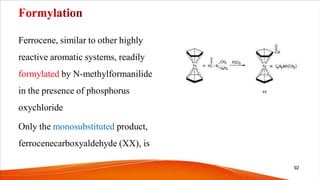
Ferrocene, similar to other highly
reactive aromatic systems, readily
formylated by N-methylformanilide
in the presence of phosphorus
oxychloride
Only the monosubstituted product,
ferrocenecarboxyaldehyde (XX), is
92
produced even when a large excess
of formylating agent is used.
Ferrocenecarboxaldehyde, like
benzaldehyde, is readily reduced to
the corresponding carbinol and
undergoes the Cannizzaro reaction
with alcoholic potassium hydroxide
solution.
• While ferrocenecarboxaldehyde
apparently does not undergo a
self-benzoin condensation it will
condense with benzaldehyde to
form a mixed benzoin.
93
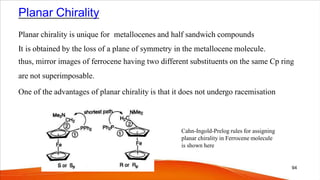
Planar Chirality
Planar chirality is unique for metallocenes and half sandwich compounds
It is obtained by the loss of a plane of symmetry in the metallocene molecule.
thus, mirror images of ferrocene having two different substituents on the same Cp ring
are not superimposable.
One of the advantages of planar chirality is that it does not undergo racemisation
94
Cahn-Ingold-Prelog rules for assigning
planar chirality in Ferrocene molecule
is shown here
Central chirality
Central chirality also known as lateral
chirality is the second type of chirality
found in ferrocene and similar
compounds.
It is basically due to a chiral carbon
centre directly attached to the Cp ring.
Ex:Ugi’s amine, [(R)-N,N-dimethyl-1-
ferrocenylethylamine]
95
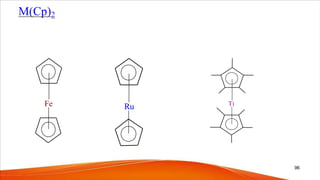
M(Cp)2
Fe Ru Ti
96
(Cp)2MLx
M H
L
M
L
M
L
L
L
Bent metallocene
97
CpMLy
Mn
CO
CO
PPh3
Co
CO CO
Half-sandwich Cyclopentadienyl derivatives
98

Cyclopentadiene-TM, Ferrocene complex .pdf

  • 1.
  • 2.
    • η5- Cyclopentadienylor “Cp” is one of the most common ligands encountered in organotransition-metal chemistry • Complexes of this ligand are known for all transition and most f- block metals • The group is a principal member of the class of planar aromatic ligands such as benzene 2
  • 3.
    • It playedmajor role in the development of organometallic chemistry • Although the pot. derivative of cyclopentadienide anion was described as early as 1901by Thiele, yet an exciting phase in metal cyclopentadienyl chemistry began in early 1950’s with the discovery of ‘ferrocene’ • Ferrocene have a novel ‘sandwich’structure with all the carbons of both the Cp rings within bonding distance of the metal atom 3
  • 4.
    • large numberof TM-Cp complexes known • Fact: Cp ligand bound firmly to the metal atom and most inert to nucleophilic and electrophilic attack (η5-C5H5)2M complexes formed by the reaction between the Cp anion and suitable derivatives of the TMs are ---> metallocenes 4
  • 5.
    Ex: (η5-C5H5)2Fe Ferrocene (η5-C5H5)2Ni Nickelocene (η5-C5H5)2Co Cobaltocene Ferrocene isthe most important metallocene Highly stable and decomposes above 500°C, only air stable metallocene Ferrocene was discovered accidentally by two independent groups ( 1 group: T J Kealy and P.L. Pauson in 1951, other group: S.A.Miller, J.A.Tebboth and J.F.Tremaine, 1952) * Two scientists namely G Wilkinson & Woodward and E.O.Fischer independently deduce structure later in 1954. Joint Nobel prize in 1973 5
  • 6.
    • They proposedthat it is a double cone structure with the base of the cone represented by two cyclopentadiene ligand and metal being at the center. • Diamagnetic, 18 valence electron ( 2 Cp rings complete noble gas configuration of iron) 6
  • 7.
    Classification of η5-Cp-TM derivatives • On the basis of reactivity: 1) Covalent and oxidatively as well as thermodynamically stable (Ex: Ferrocene, Ruthenocene) 2) Covalent and highly reactive (Ex: Titanocene, Molybdenocene) 3) Ionic (Ex: Manganocene, Lanthanocene) 7
  • 8.
    • On thebasis of structure: a) Symmetrical “sandwich” type derivatives , M(Cp)2 METALLOCENES with mutually parallel Cp rings Ex: Fe(η5-C5H5)2, Co(η5-C5H5)2 , Mn(η5-C5H5)2 Parallel Cp rings either eclipsed or staggered in their orientation with each other. Eclipsed in V(Cp)2, Cr(Cp)2 and Ru(Cp)2 in Co(Cp)2 and Fe(Cp)2 8
  • 9.
    b)Bent metallocene derivatives,(Cp)2MLx, in which term x of unidentate ligands L (H-,R,CO, etc) varies between 1 and 3. Here 2 Cp rings not parallel, angle between the normals to each ring ,180° Ex: Cp2Mo(CO), (Mo(II),d4), Cp2FeH+,(Fe(IV)d4) Cp2Zr(Cl)H (Zr(IV)d0) c)Half-sandwich compounds, CpMLy in which number y of unidentate ligands L varies from one to four 9
  • 10.
    Ex: Mn(CO)2(PPh3)(η5-C5H5), Co(CO)2(PPh3)(η5-C5H5) CpMLyare often referred to as “two-, three-, or four-legged piano stools,” with the Cp being regarded as the “seat” and the other ligands as the “legs.” The metallocenes, MCp2 are also important in the historical development of organometallic chemistry, But their chemistry is somewhat less rich than that of the piano stools : 10
  • 11.
    • fewer ligandscan bind to the metallocenes without overstepping the 18e- limit. • Their most important application is alkene polymerization. • The sandwich structure of the orange crystalline Cp2Fe was deduced by Wilkinson and Woodward and by Fischer in 1954. • One of the most significant discoveries during the early development of organotransition metal chemistry and helped to launch it as an independent field in its own right. 11
  • 12.
    • Formation ofdi- and poly-nuclear derivatives with similar or different metal atoms in the same molecule leads to further structural diversification • Cp can act as mono-hapto, tri-hapto and penta-hapto ligand 12
  • 13.
    • The η1structure is found where the coligands are sufficiently firmly bound so that the Cp cannot rearrange to η5 • Trihapto-Cp groups are rather rare, the Cp folds so the uncomplexed C=C group can bend away from the metal. 13
  • 14.
    • There arecases in which 18e-piano stool complexes have been found to undergo substitution by an associative mechanism, and it is therefore assumed that the Cp can slip in the transition state. 14
  • 15.
    • Rearrangement ofan η5 Cp to a stable η1 structure on the addition of a ligand is also known: • In this case two other possible rearrangements that might have relieved the electron count on the metal: bending of the NO or methyl migration to CO. • It is likely that one of these two processes may be important in the initial attack of the phosphine, but that slip of the Cp gives the stable product shown. 21
  • 16.
    • η1-Cp groupstend to show both long and short C−C distances, as appropriate for an uncomplexed diene. • The η5 form has essentially equal C=C distances, and the substituents bend very slightly toward the metal. • In diamagnetic complexes, groups usually show a resonance in the 1H NMR spectrum at 3.5–5.5δ, as appropriate for an aromatic group. 16
  • 17.
    • This aromaticitywas one of the first properties of the Cp group to attract the attention of • Robert Woodward, the celebrated organic chemist, who showed that ferrocene, like benzene, undergoes • η1-Cp groups can show a more complex 1H NMR pattern: • The α hydrogen appears at about 3.5δ and at 5–7δ. 17
  • 18.
    Preparation First metallocene discoveredaccidently by T.J Kealy and P.L. Pauson in 1951 they were trying to synthesize by the dimerization of Cp. CpMgBr in (Et)2O with FeCl3 18
  • 19.
    • Instead offulvalene, ended up with orange crystals containing with remarkable stability • The initial step generally involved in the preparation of cyclopentadienyl derivatives of TMs is the reaction of compound with anionic species such as or some other suitable (M=Li,Na,K,Mg,Tl) 19
  • 20.
    • Cyclopentadienyl chemistrystarted in 1901,when Thiele used it in the preparation of pot.cyclopentadienide H H H H 2 150o C 300o C Dicyclopentadiene Cyclopentadiene K + C5H6 5 5 K+C H - + 1/2 H2 PhH C5H6 +EtMgBr Et 2O/PhH C5H5MgBr + C2H6 20
  • 21.
    Other Preparation methods 1.Reaction of cyclopentadiene with metal M + C5H6 K + C5H6 - MC5H5 - +1/2 H2 (M = Li, Na, K) K+C5H5 + 1/2 H2 (Thiele in 1901) M + 2C5H6 (C5H5 )2M + H2 (Miller, Tebboth, Tremaine in (M = Mg, Fe) 1952) 5 6 2C H + Fe (C H ) Fe + H 5 5 2 2 500oC 300oC Al, Mo oxide THF THF C5H6 + Tl2SO4 KOH Tl+ C H - 5 5 + C H 2 6 21
  • 22.
    2. Starting fromsodium cyclopentadienide 22
  • 23.
    MCl + 2NaCH 2 5 5 5 5 2 (C H ) M M= V , Cr, Mn, Fe, Co Solvent= THF, DME, Liq.NH3 Solvent 23
  • 24.
    3. treatment ofCp with metal halides in the presence of excess strong base 24
  • 25.
    • For understandingnature of bonding in metallocenes by taking example of ferrocene, picture for cyclopentadienide • first have to ligand(s) • Then which have the correct symmetry and energies to overlap with the ligand group orbitals for effective bonding 25
  • 26.
    • Cyclopentadienide anion- delocalized structure (i.e., non-localized multiple bonds) • All the ten (5C and 5H) atoms are coplanar, with the same carbon-carbon bond length (1.39 A) , intermediate between those of ethene (1.34 A) and ethane (1.54A) and is similar to that in benzene 26
  • 27.
    Structure and Bonding •Each C- atom of the cyclic planar C5H5 group is sp2 hybridised • Each carbon has a singly filled 2pz atomic orbital perpendicular to the molecular plane • These AOs take part in linear combination producing five π MOs (3BMOs and 2ABMOs) 27
  • 28.
  • 29.
    • The mostimportant overlaps are ψ1 with the metal dz 2 • ψ2 and ψ3 with the dxz and dyz orbitals • ψ4 and ψ5 with dx 2 -y 2 and dxy but not interact very strongly with metal orbitals, 29
  • 30.
    • The Cpgroup is therefore not a particularly good π acceptor. from the metal to the • This fact and the anionic charge on Cp suggests:  Cp complexes are ,  The presence of the Cp other ligands present.  If we put two Cp groups and one metal together, we obtain the MO diagram for a metallocene 30
  • 31.
    • The d-orbitalsplitting pattern for an octahedral crystal field, highlighted in a box • Have to look at the symmetry of pairs of Cp orbitals and see how they will interact with the metal orbitals. 31
  • 32.
    • In developingthe ligand group orbitals for a pair of C5H5 rings,  MOs of the same energy and same number of nodes pair up; for example, the zero-node orbital of one ring pair up with the zero-node orbital of the other.  Molecular orbitals pair up in such a way that the nodal planes are coincident.  Furthermore, in each pairing there are two possible orientations of the ring molecular orbitals: 32
  • 33.
     in whichlobes of like sign are pointed toward each other, and one in which lobes of opposite sign are pointed toward each other. • For example, the zero-node orbitals of the C5H5 rings may be paired in the following two ways: 33
  • 34.
    • Bonding interaction (Geradeset) Anti-bonding interaction (Ungerade set)  Orbital lobes of opposite sign pointed toward each other  Orbital lobes of like sign pointed toward each other 34
  • 35.
    • Eight othergroup orbitals arising from the C5H5 ligands are 35
  • 36.
    • II Interaction ofψ1 MO’s of two Cp units to give group orbitals 36
  • 37.
    • As anexample, take the combination of the ψ1’s of both rings, which has the symmetry label a1g, it can interact with the dz 2 orbital on the metal, • Taking the opposite combination of ψ1’s (labeled as a2u), the interaction now takes place with pz. 37
  • 38.
    • i.e., ifboth rings have the +ve lobes of their lowest energy orbitals on the sides nearer to the metal, then s and dz 2 orbitals would have the correct symmetry • If one of the rings has the +ve lobes near to the metal and for the other ring, the -ve lobe is nearer to the metal, the pz orbital has the correct symmetry 38
  • 39.
    • Interactions, betweenthe dyz orbital of metal and its appropriate group orbital i.e; one of the 1-node group orbitals 39
  • 40.
    The complete energylevel diagram for the molecular orbitals of ferrocene 40
  • 41.
    • The molecularorbital resulting from the dyz bonding interaction, labeled 1 in the MO diagram, contains a pair of electrons. • Its counterpart, 2, is • The orbitals of ferrocene that are of most are those having the greatest ; these are also the HOMO and LUMO • These orbitals are highlighted in the box in Figure 41
  • 42.
    character, are • Twoof these orbitals, having largely and are • One, having largely character, is essentially and is also • Two, having primarily and character, • The relative energies of these orbitals and their d-orbital-group-orbital interactions are shown as: 42
  • 43.
  • 44.
  • 45.
    • A perusalof the MO diagram for ferrocene indicates that ligand group orbitals can be categorised in three sets:  a filled pair of a1g and a2u symmetry  a higher energy filled set of e1g and e1u symmetry  and even a higher energy unfilled set of e2g and e2u symmetry  The metal dxz and dyz orbitals (e1g symmetry) interact more effectively with the cyclopentadienyl ligand group orbitals than the metal s(a1g); px, py(e1u); and pz (a2u) orbitals. 45
  • 46.
    • These bondsprovide most of the stabilization that holds the ferrocene molecule together • The e2g ligand orbitals interact with the metal 3dx 2 -y 2 and 3dxy orbitals producing slightly BMOs which comprise mostly of metal orbitals. • Based on the MO diagram of ferrocene, where 9 MOs (a1g b to a1g nb) of the lowest energy are occupied by e-s is the most stable metallocene 46
  • 47.
    • The overallbonding in ferrocene can be summarized as: • The occupied orbitals of the η5-C5H5 ligands are stabilized by their interactions with iron. • Especially the stabilization in energy of 0-node and 1-node group orbitals that have bonding interactions with the metal, forming molecular orbitals that are primarily ligand in nature • (these are the orbitals labeled, from lowest to highest energy, a1g, a2u , e1g set and e1u set). 47
  • 48.
    • The orbitalsnext highest in energy (i.e., e2g set, a1g nb and e*1g set) are largely derived from iron d orbitals; they are populated by 6 electrons from iron (II), a d6 metal ion. • These molecular orbitals also have some ligand character, with the exception of the molecular orbital derived from dz 2 . • The molecular orbital derived from has almost , because its cone-shaped nodal surface points almost directly toward the lobes of the matching group orbital, making overlap slight and giving 48
  • 49.
    an essentially orbitallocalized on the iron. • The molecular orbital description of fits the rule. • In the case of ferrocene, all the bonding( both ligand and metal character orbitals) and nonbonding(dz 2) orbitals are exactly filled 49
  • 50.
    • Metallocenes fromgroups 9 (Co,d7) and 10 (Ni,d8) have one or two in (20e) are orbitals; this is why CoCp2 (19e) and NiCp2 and much more reactive than ferrocene. • The extra electrons have important chemical and physical consequences: the metal-ligand distance increases, and ΔH for metal-ligand dissociation decreases. • Cobaltocene and Nickelocene readily lose e- s in ABMO to attain 18e configuration. 50
  • 51.
    • Many ofthe chemical reactions of the latter are characterized by a tendency to yield 18- electron products. • Cobaltocene also has an 18e cationic form, Cp2Co+. • Cobalticinium reacts with hydride to give a neutral, 18-electron sandwich compound in which one cyclopentadienyl ligand has been modified into η4-C5H6, 51
  • 52.
    Although isoelectronic with[Fe(Cp)2], [Co(Cp)2]+ (18e-) shows more oxidative stability => In [Co(Cp)2]+ , Co is in Co(III), while in ferrocene Fe is in Fe(II) 52
  • 53.
    Chromocene and andvanadocene have fewer than 18e and are also paramagnetic, as the electron occupation diagram predicts. • d5 ions have no crystal field stabilization in their high-spin form, therefore high-spin MnCp2 (5 unpaired e-s)is very reactive and strongly ionic in character. EC: (e2g b)2 (a1g nb)1 (e1g *)2 • The higher-field ligand C5Me5, (pentamethyl cyclopentadienyl) on the other hand, gives a low-spin manganocene which is stable (1 unpaired e-) EC: (e2g b)4 (a1g nb)1 (e1g *)0 53
  • 54.
    The d orbitaloccupation patterns for some first-row metallocenes. 54 e2g b (dx 2 -y 2 , dxy) a1g nb (dz 2) e1g * (dxz, dyz)
  • 55.
    [Mn(Cp)2] is highspin while [Re(Cp)2] is a low spin complex Re heavier congener of Mn Hence higher crystal field splitting power 55
  • 56.
  • 57.
    and metallocenes whichdo not satisfy the 18e rule are and difficult to isolate • These substances show a pronounced tendency to form additional covalent bonds : Cp rings tilted back from their parallel positions • This changes the MO energy diagram. • Tilting of Cp-rings allows the a1g nb and e2g b (degenerate) orbitals to create three new MOs through their appropriate mixing. 57
  • 58.
    • These threeMOs can accommodate 6 electrons. • In this event, the lower 6 MOs (i.e. upto e1u b) remain more or less unpurturbed. • These 6 MOs accommodate 12 electrons and 3 new MOs can accommodate 6 electrons to give the 18e configuration • Ex: [(η5-Cp)2Re-H], [(η5-Cp)2Mo(H)2], [(η5-Cp)2Ti(CO)2], [(η5- Cp)2Ta(H)3] • For ex, Cp2Re(17e) and Cp2Re+ (16e) are unstable, Cp2ReH is very stable 58
  • 59.
    In ferrocene, ironatom is sandwiched between two parallel and planar cyclopentadienyl rings Two conformations: staggered(D5d symmetry) and eclipsed(D5h) Properties 59
  • 60.
    Both the formsare in transition Energy barrier to rotation is very low (≤ 5kJ/mol) Structural features of ferrocene below 169K are: C-C distance 139+/-6pm Fe-C distance 203+/-2pm All the C’s are at equidistant from Fe 60
  • 61.
    PROPERTIES Ferrocene: Orange colouredcrystalline compound MP: 173C Diamagnetic Thermally stable, decompose above 500℃ Stable to air and H2O Unattacked by boiling NaOH and HCl Can be oxidised to blue ferrocinium ion Reversible 61
  • 62.
    • Metallocenes ofother 3d- transition metals also intensly coloured 62
  • 63.
    • Cyclopentadienyl derivativesof TMs available in various ox.states Ex: [CpMo(CO)3]- , CpMn(CO)3 , Fe(Cp)2 , [Co(Cp)2]+ , TiCl2(Cp)2 , NbBr3(Cp)2 • with central metals in 0,1,2,3,4 & 5 ox.states respectively • Metallocenes from the 3d transition series - generally paramagnetic • Exception: Fe(η5-C5H5)2 , [Co(η5-C5H5)2]+ and Ti(η2- Cp)2 63
  • 64.
    Cp rings arearomatic in nature No typical reactions of Diene, i.e., Diels-Alder reaction Cp rings of ferrocene readily undergo electrophilic substitution reaction characteristic of aromatic compound Ferrocenes behaviour as an electron rich aromatic compound, its facile metallation and unusual ability to stabilise carbocations at its benzylic like position are properties which pave the way to prepare functionalised substituted ferrocene 64
  • 65.
    The ease ofelectrophilic substitution, scope of having planar chirality and redox active iron atom facilitated the development of ferrocene chemistry in diverse directions Major interest in ferrocene chemistry is centered around developing chiral chelating ligands with planar and lateral chirality and their use as prochiral ligand in asymmetric catalysis Use of Ferrocenophanes as precursors for ferrocene based polymer- another application 65
  • 66.
    Ferrocene is aromaticand the organic chemistry is important since in some cases its reactivity is superior to arenes Generally the electrophile interacts first with e2g or a1g* electron pair of the metal atom then the electrophile is transferred to the Cp ring followed by deprotonation 66
  • 67.
    The acylation ofmetallocenes has been investigated more extensively than any other substitution reaction. The Friedel-Crafts reaction between ferrocene and acetyl chloride or Ac2O in the presence of anhyd.AlCl3 or phosphoric acid is a good example. When equimolar amounts of these reactants are employed, monoacetylferrocene is formed almost exclusively 67
  • 68.
    • When anexcess of acetyl chloride and aluminum chloride is employed, a mixture of two isomeric diacetylferrocenes is produced 1,l'- diacetylferrocene and 1,2-diacetylferrocene in a 60:1 ratio • The products can be separated by careful chromatography on activated alumina. • Note nearly all metallocenes are highly colored and can be advantageously separated by column chromatography. 68
  • 69.
    • The majorproduct is the heteroannular disubstituted derivative, 1,l'- diacetylferrocene. Very small amount of a homoannular isomer, 1,2- diacetylferrocene, is also obtained. • The first acetyl group appears to deactivate the substituted ring toward further electrophilic substitution, and the second acetyl group preferentially enters the opposite ring. 69
  • 70.
    From the sitereactivities, acylation is enhanced in the substituted ring compared to the unsubstituted ring, as might be expected by the presence of an electron-releasing alkyl group. Substitution at the 3-position is favored over the 2-position. 70
  • 71.
    In contrast toalkylferrocenes, the 2- position is favored over the 3- position. This is the result of enhanced resonance stabilization of the transition state in substitution involving electrophilic attack at the 2-position. Acetylation of phenylferrocene also produces three similar acetylphenylferrocenes (VI, VII, VIII; R = C6H5) (as well as a very small amount of an isomer in which the phenyl group is acetylated), the site reactivities are quite different 71
  • 72.
    Acylation at the3-position was even more pronounced in the case of 1,1’-diisopropylferrocene, suggesting that steric factors play an important role in determining the mechanism of homoannular acylation of alkylferrocenes. • Another interesting series of reactions involving acylation concerns bridging or cyclization of ω-ferrocenylcarboxylic acids. 72
  • 73.
    • β-Ferrocenylpropionic acid(IX, n = 2), when treated with either polyphosphoric acid or trifluoroacetic anhydride or PCl3 yields the bridged ketone 1,1’-ketotrimethyleneferrocene (X) . • Ferrocenylbutyric or valeric acids (IX, n = 3, 4) produce homoannular cyclized products (XI, n = 3, 4). 73
  • 74.
  • 75.
    • Acetyl ferroceneis a precursor for making a host of chiral derivatives • Widely used derivatives are alkynyl ferrocene and N,N-dimethyl-1- ferrocenylethylamine. • Ugis amine opened up diverse synthetic routes for introducing both planar and central chirality on ferrocene derivatives 75
  • 76.
  • 77.
    Ferrocene is readilyalkylated by alkyl halides, alcohols, or olefins to produce alkylated derivatives. The exceedingly great reactivity of ferrocene under these conditions results in the formation of mixtures of mono-, di-, tri-, and poly-alkylated products, and the yield of any one alkylation product is usually low. The introduction of an alkyl group into the ferrocene nucleus facilitates subsequent alkylation in the same ring. 77
  • 78.
  • 79.
    Alkylferrocenes can serveas useful synthetic intermediates, since it has recently been shown that they are conveniently oxidized by activated manganese dioxide to carbonyl compounds Methylferrocene, for example, can be converted to ferrocenecarboxaldehyde without apparently oxidizing the iron atom. 79
  • 80.
    Hauser and Lindsayfirst showed that ferrocene undergoes a Mannich-type reaction with formaldehyde and dimethylamine to form dimethylaminomethylferrocene (XXIX) This amine is readily converted to a methiodide. This quaternary salt is an important synthetic intermediate in ferrocene chemistry. 80
  • 81.
    • Reduction ofthe methiodide of XXIX with sodium amalgam, for example, produces methylferrocene in high yield • Treatment with solutions of potassium cyanide - ferrocenylacetonitrile • KOH - ferrocenylcarbinol • Benzene does not undergo Mannich reaction • Ferrocene resembles more reactive Thiophene and Phenol than Benzene 81
  • 82.
    • Reaction withpotassium amide in liquid ammonia results in a Stevens rearrangement to give β- dimethylaminoethylferrocene. 82
  • 83.
    Another very importantsubstitution reaction of ferrocene is its ability to undergo metalation with organolithium and organosodium compounds. Metalation with n-butyl lithium in ethyl ether, first reported by Nesmeyanov and co- workers and independently by Benkeser, Goggin, and Schroll, leads to rather low yields of ferrocenyllithium (XXXVI, ;M = Li) and 1,l'-ferrocenylenedilithium (XXXVII, M = Li). 83
  • 84.
    Lithiated ferrocenes areuseful precursors for new ferrocene derivatives It was subsequently shown that the use of the mixed solvent ethyl ether - tetrahydrofuran 1:1 leads to greatly improved yields of lithioferrocenes, and this procedure has been extensively used in further synthetic applications Pure monolithiated ferrocene formed exclusively but in poor yield when the reaction is carried out in Et2O at low T Lithio derivatives sensitive to oxidation and hydrolysis 84
  • 85.
    Similar reactions offerrocene with phenylsodium or n-amylsodium lead to the corresponding sodiated products (XXXVI, XXXVII, M = Na) The steric course of both metalation reactions has been studied, and it has been proved that dimetalation occurs in opposite cyclopentadienyl rings . Both ruthenocene and osmocene have been metalated with n- butyllithium. It has been shown that under comparable conditions ruthenocene is metalated to a greater extent than is ferrocene. 85
  • 86.
    • Carbonation andsubsequent hydrolysis of either lithiated or sodiated metallocenes lead to the corresponding carboxylic acids. 86 Fe(η5-C5H5)(η5-C5H4 CO2H) Fe(η5-C5H5)2 + LiBu Fe(η5-C5H5)(η5-C5H4 Li) CO2/H2O
  • 87.
    • Ferrocenecarboxylic acidand ferrocene-l,l’-dicarboxylic acid are readily produced in this manner and can be conveniently separated by extraction of the former with ethyl ether or benzene. • Metalated ferrocenes have served as very valuable intermediates for the synthesis of a number of other derivatives. 87
  • 88.
  • 89.
    HNO3 is anoxidising agent Metallocene sensitive to oxidation No direct nitration Indirect nitration with N2O4 Nitroferrocene can be reduced to amine derivative 89
  • 90.
    Carbonation and subsequenthydrolysis of either lithiated or sodiated metallocenes lead to the corresponding carboxylic acids. Ferrocenecarboxylic acid and ferrocene-l,l’-dicarboxylic acid are readily produced in this manner and can be conveniently separated by extraction of the former with ethyl ether or benzene. 90
  • 91.
    Ferrocene reacts readilywith mercuric acetate to form mercurated derivatives. Ferrocene could be mercurated under relatively mild conditions in either ethyl ether - alcohol or benzene-alcohol solution The acetoxymercuri-ferrocenes formed in this manner are usually treated with an alcoholic solution of an alkali metal halide. The resulting products, chloromercuriferrocene (XXXII) and 1,l'-di (ch1oromercuri)ferrocene (XXXI I I), can be conveniently separated by extraction with n-butyl alcohol. 91
  • 92.
    Ferrocene, similar toother highly reactive aromatic systems, readily formylated by N-methylformanilide in the presence of phosphorus oxychloride Only the monosubstituted product, ferrocenecarboxyaldehyde (XX), is 92
  • 93.
    produced even whena large excess of formylating agent is used. Ferrocenecarboxaldehyde, like benzaldehyde, is readily reduced to the corresponding carbinol and undergoes the Cannizzaro reaction with alcoholic potassium hydroxide solution. • While ferrocenecarboxaldehyde apparently does not undergo a self-benzoin condensation it will condense with benzaldehyde to form a mixed benzoin. 93
  • 94.
    Planar Chirality Planar chiralityis unique for metallocenes and half sandwich compounds It is obtained by the loss of a plane of symmetry in the metallocene molecule. thus, mirror images of ferrocene having two different substituents on the same Cp ring are not superimposable. One of the advantages of planar chirality is that it does not undergo racemisation 94 Cahn-Ingold-Prelog rules for assigning planar chirality in Ferrocene molecule is shown here
  • 95.
    Central chirality Central chiralityalso known as lateral chirality is the second type of chirality found in ferrocene and similar compounds. It is basically due to a chiral carbon centre directly attached to the Cp ring. Ex:Ugi’s amine, [(R)-N,N-dimethyl-1- ferrocenylethylamine] 95
  • 96.
  • 97.
  • 98.