AQA Trilogy Science
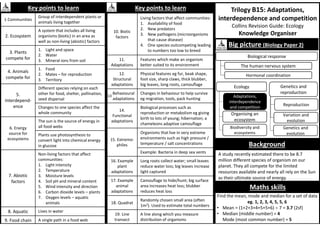
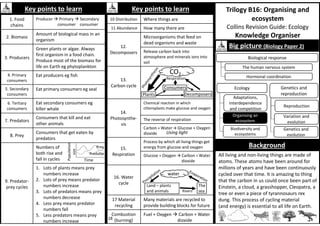
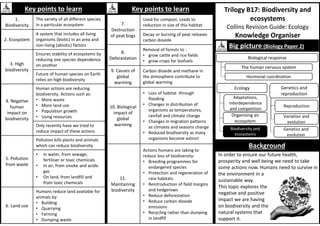
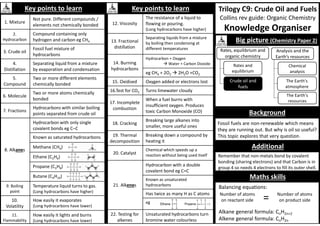
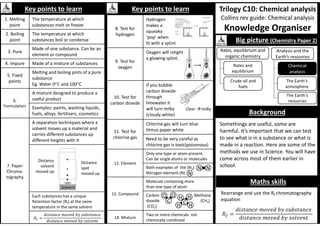
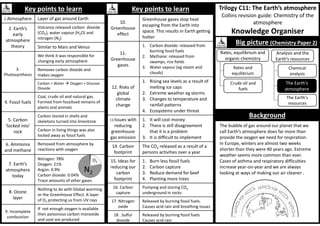
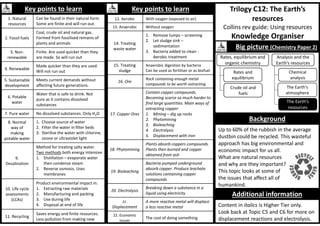
Knowledge Organisers for All Topics
The information on each page is a summary of key
information needed for each topic.
It does not cover all content and is not intended as a
replacement to other study resources.
Please email Mr Allen (callen@swatrust.co.uk) if you spot
any mistakes or potential improvements.
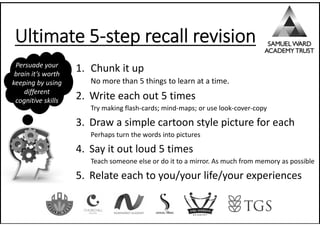
Ultimate 5-step recall revision
1. Chunk it up
No more than 5 things to learn at a time.
2. Write each out 5 times
Try making flash-cards; mind-maps; or use look-cover-copy
3. Draw a simple cartoon style picture for each
Perhaps turn the words into pictures
4. Say it out loud 5 times
Teach someone else or do it to a mirror. As much from memory as possible
5. Relate each to you/your life/your experiences
Persuade your
brain it’s worth
keeping by using
different
cognitive skills
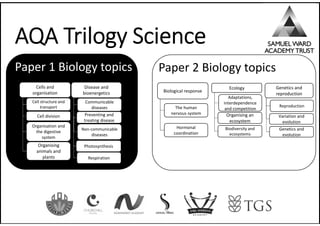
AQA Trilogy Science
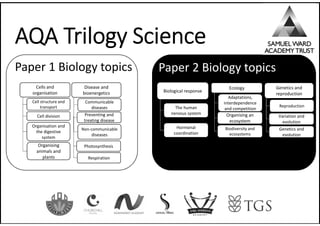
Paper 1 Biology topics
Cell structure and
transport
Cell division
Organising
animals and
plants
Organisation and
the digestive
system
Cells and
organisation
Communicable
diseases
Preventing and
treating disease
Non-communicable
diseases
Disease and
bioenergetics
Photosynthesis
Respiration
The human
nervous system
Hormonal
coordination
Organising an
ecosystem
Biological response
Reproduction
Variation and
evolution
Biodiversity and
ecosystems
Genetics and
reproduction
Adaptations,
interdependence
and competition
Ecology
Genetics and
evolution
Paper 2 Biology topics
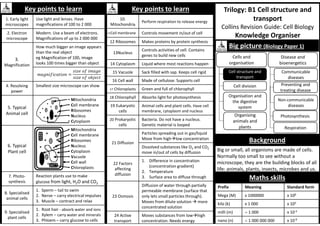
Trilogy: B1 Cell structure and
transport
Collins Revision Guide: Cell Biology
Knowledge Organiser
Maths skills
Key points to learn
1. Early light
microscopes
Use light and lenses. Have
magnifications of 100 to 2 000
2. Electron
microscope
Modern. Use a beam of electrons.
Magnifications of up to 2 000 000
3.
Magnification
How much bigger an image appears
than the real object
eg Magnification of 100, image
looks 100 times bigger than object
=
4. Resolving
power
Smallest size microscope can show
5. Typical
Animal cell
• Mitochondria
• Cell membrane
• Ribosomes
• Nucleus
• Cytoplasm
6. Typical
Plant cell
• Mitochondria
• Cell membrane
• Ribosomes
• Nucleus
• Cytoplasm
• Vacuole
• Cell wall
• Chloroplasts
7. Photo-
synthesis
Reaction plants use to make
glucose from light, H2O and CO2
8. Specialised
animal cells
1. Sperm – tail to swim
2. Nerve – carry electrical impulses
3. Muscle – contract and relax
9. Specialised
plant cells
1. Root hair - absorb water and ions
2. Xylem – carry water and minerals
3. Phloem – carry glucose to cells
Key points to learn
10.
Mitochondria
Perform respiration to release energy
Cell membrane Controls movement in/out of cell
12 Ribosomes Makes proteins by protein synthesis
13Nucleus
Controls activities of cell. Contains
genes to build new cells
14 Cytoplasm Liquid where most reactions happen
15 Vacuole Sack filled with sap. Keeps cell rigid
16 Cell wall Made of cellulose. Supports cell
17 Chloroplasts Green and full of chlorophyll
18 Chlorophyll Absorbs light for photosynthesis
19 Eukaryotic
cells
Animal cells and plant cells. Have cell
membrane, cytoplasm and nucleus
20 Prokaryotic
cells
Bacteria. Do not have a nucleus.
Genetic material is looped
21 Diffusion
Particles spreading out in gas/liquid
Move from highlow concentration
Dissolved substances like O2 and CO2
move in/out of cells by diffusion
22 Factors
affecting
diffusion
1. Difference in concentration
(concentration gradient)
2. Temperature
3. Surface area to diffuse through
23 Osmosis
Diffusion of water through partially
permeable membrane (surface that
only lets small particles through).
Moves from dilute solution  more
concentrated solution
24 Active
transport
Moves substances from lowhigh
concentration. Needs energy
Background
Big picture (Biology Paper 1)
Cell structure and
transport
Cell division
Organising
animals and
plants
Organisation and
the digestive
system
Cells and
organisation
Communicable
diseases
Preventing and
treating disease
Non-communicable
diseases
Disease and
bioenergetics
Photosynthesis
Respiration
Prefix Meaning Standard form
Mega (M) x 1000000 x 106
kilo (k) x 1 000 x 103
milli (m)  1 000 x 10-3
nano (n)  1 000 000 000 x 10-9
Big or small, all organisms are made of cells.
Normally too small to see without a
microscope, they are the building blocks of all
life: animals, plants, insects, microbes and us.
11
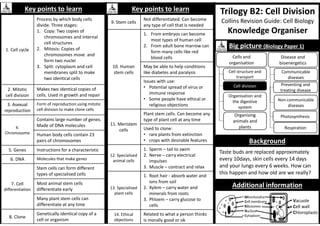
Trilogy B2: Cell Division
Collins Revision Guide: Cell Biology
Knowledge Organiser
Additional information
Key points to learn
1. Cell cycle
Process by which body cells
divide. Three stages:
1. Copy: Two copies of
chromosomes and internal
cell structures
2. Mitosis: Copies of
chromosomes move and
form two nuclei
3. Split: cytoplasm and cell
membranes split to make
two identical cells
2. Mitotic
cell division
Makes two identical copies of
cells. Used in growth and repair
3. Asexual
reproduction
Form of reproduction using mitotic
cell division to make clone cells
4.
Chromosome
Contains large number of genes.
Made of DNA molecules
Human body cells contain 23
pairs of chromosomes
5. Genes Instructions for a characteristic
6. DNA Molecules that make genes
7. Cell
differentiation
Stem cells can form different
types of specialised cells
Most animal stem cells
differentiate early
Many plant stem cells can
differentiate at any time
8. Clone
Genetically identical copy of a
cell or organism
Key points to learn
9. Stem cells
Not differentiated. Can become
any type of cell that is needed
10. Human
stem cells
1. From embryos can become
most types of human cell
2. From adult bone marrow can
form many cells like red
blood cells
May be able to help conditions
like diabetes and paralysis
Issues with use:
• Potential spread of virus or
immune response
• Some people have ethical or
religious objections
11. Meristem
cells
Plant stem cells. Can become any
type of plant cell at any time
Used to clone:
• rare plants from extinction
• crops with desirable features
12. Specialised
animal cells
1. Sperm – tail to swim
2. Nerve – carry electrical
impulses
3. Muscle – contract and relax
13. Specialised
plant cells
1. Root hair - absorb water and
ions from soil
2. Xylem – carry water and
minerals from roots
3. Phloem – carry glucose to
cells
14. Ethical
objections
Related to what a person thinks
is morally good or ok
Background
Big picture (Biology Paper 1)
Cell structure and
transport
Cell division
Organising
animals and
plants
Organisation and
the digestive
system
Cells and
organisation
Communicable
diseases
Preventing and
treating disease
Non-communicable
diseases
Disease and
bioenergetics
Photosynthesis
Respiration
• Vacuole
• Cell wall
• Chloroplasts
Taste buds are replaced approximately
every 10days, skin cells every 14 days
and your lungs every 6 weeks. How can
this happen and how old are we really?
Trilogy B3: Organisation and the
digestive system
Collins Revision Guide: Organisation
Knowledge Organiser
Key points to learn
Key points to learn
1. Specialised
animal cells
1. Sperm – tail to swim
2. Nerve – carry electrical impulses
3. Muscle – contract and relax
2. Tissue Group of similar cells
3. Organ
Group of tissues
working together
4. Organ
systems
Group of organs which
work together in organism
5. Digestive
system
A group of organs that digest
and absorb food
6. Digestion
Breaking large food molecules
into small soluble ones
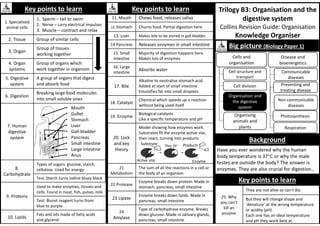
7. Human
digestive
system
• Mouth
• Gullet
• Stomach
• Liver
• Gall-bladder
• Pancreas
• Small intestine
• Large intestine
• Anus
8.
Carbohydrate
Types of sugars: glucose, starch,
cellulose. Used for energy
Test: Starch turns iodine bluey black
9. Proteins
Used to make enzymes, tissues and
cells. Found in meat, fish, pulses, milk
Test: Biuret reagent turns from
blue to purple
10. Lipids
Fats and oils made of fatty acids
and glycerol
Key points to learn
11. Mouth Chews food, releases saliva
12. Stomach Churns food. Partial digestion here
13. Liver Makes bile to be stored in gall bladder
14 Pancreas Releases enzymes in small intestine
15. Small
intestine
Majority of digestion happens here.
Makes lots of enzymes
16. Large
intestine
Absorbs water
17. Bile
Alkaline to neutralise stomach acid.
Added at start of small intestine.
Emulsifies fat into small droplets
18. Catalyst
Chemical which speeds up a reaction
without being used itself
19. Enzyme
Biological catalysts
Like a specific temperature and pH
20. Lock
and key
theory
Model showing how enzymes work.
Substrates fit the enzyme active site,
then react, turning into products
21
Metabolism
The sum of all the reactions in a cell or
the body of an organism
22 Protease
Enzyme breaks down protein. Made in
stomach, pancreas, small intestine
23 Lipase
Enzyme breaks down lipids. Made in
pancreas, small intestine
24
Amylase
Type of carbohydrase enzyme. Breaks
down glucose. Made in salivary glands,
pancreas, small intestine
Big picture (Biology Paper 1)
Cell structure and
transport
Cell division
Organising
animals and
plants
Organisation and
the digestive
system
Cells and
organisation
Communicable
diseases
Preventing and
treating disease
Non-communicable
diseases
Disease and
bioenergetics
Photosynthesis
Respiration
Background
Substrate
Active site
They ‘fit’ Products
Enzyme
25. Why
you can’t
kill an
enzyme
They are not alive so can’t die.
But they will change shape and
‘denature’ at the wrong temperature
or acidity (pH)
Each one has an ideal temperature
and pH they work best at.
Have you ever wondered why the human
body temperature is 37C or why the male
testes are outside the body? The answer is
enzymes. They are also crucial for digestion…
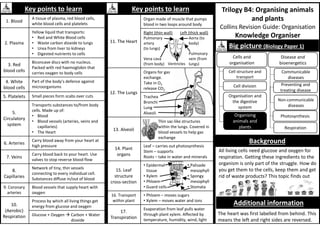
11. The Heart
Organ made of muscle that pumps
blood in two loops around body
Right (thin wall)
Pulmonary
artery
(to lungs)
Vena cava
(from body)
Left (thick wall)
Aorta (to
body)
Pulmonary
vein (from
lungs)
12. The Lungs
Organs for gas
exchange.
Take in O2
release CO2
Trachea
Bronchi
Lung
Alveoli
13. Alveoli
Thin sac-like structures
within the lungs. Covered in
blood vessels to help gas
exchange
14. Plant
organs
Leaf – carries out photosynthesis
Stem – supports
Roots – take in water and minerals
15. Leaf
structure
cross-section
• Epidermal
tissue
• Xylem
• Phloem
• Guard cells
• Palisade
mesophyll
• Spongy
mesophyll
• Stomata
16. Transport
within plant
• Phloem – moves sugars
• Xylem – moves water and ions
17.
Transpiration
Evaporation from leaf pulls water
through plant xylem. Affected by
temperature, humidity, wind, light
Trilogy B4: Organising animals
and plants
Collins Revision Guide: Organisation
Knowledge Organiser
Key points to learn
1. Blood
A tissue of plasma, red blood cells,
white blood cells and platelets
2. Plasma
Yellow liquid that transports:
• Red and White Blood cells
• Waste carbon dioxide to lungs
• Urea from liver to kidneys
• Digested nutrients to cells
3. Red
blood cells
Biconcave discs with no nucleus.
Packed with red haemoglobin that
carries oxygen to body cells
4. White
blood cells
Part of the body’s defence against
microorganisms
5. Platelets Small pieces form scabs over cuts
5.
Circulatory
system
Transports substances to/from body
cells. Made up of:
• Blood
• Blood vessels (arteries, veins and
capillaries)
• The Heart
6. Arteries
Carry blood away from your heart at
high pressure
7. Veins
Carry blood back to your heart. Use
valves to stop reverse blood flow
8.
Capillaries
Network of tiny, thin vessels
connecting to every individual cell.
Substances diffuse in/out of blood
9. Coronary
arteries
Blood vessels that supply heart with
oxygen
10.
(Aerobic)
Respiration
Process by which all living things get
energy from glucose and oxygen
Glucose + Oxygen  Carbon + Water
dioxide
Key points to learn
Background
Big picture (Biology Paper 1)
Cell structure and
transport
Cell division
Organising
animals and
plants
Organisation and
the digestive
system
Cells and
organisation
Communicable
diseases
Preventing and
treating disease
Non-communicable
diseases
Disease and
bioenergetics
Photosynthesis
Respiration
Ventricles
All living cells need glucose and oxygen for
respiration. Getting these ingredients to the
organism is only part of the struggle. How do
you get them to the cells, keep them and get
rid of waste products? This topic finds out
Additional information
The heart was first labelled from behind. This
means the left and right sides are reversed.
Trilogy B5: Communicable
diseases
Collins Revision Guide: Infection and response
Knowledge Organiser
Key points to learn
1. Bacteria
Large microbe
Living
Divide by splitting in two
May produce toxins to make us ill
Cause:
• Salmonella – food poisoning
• Gonorrhoea – sexually
transmitted disease (STD)
2. Viruses
Smallest microbe
Not alive
Live and reproduce inside cells
Cause:
• Measles – can be fatal
• HIV – can turn into AIDS
• Tobacco mosaic virus (TMV)
affects photosynthesis in plants
3. Fungi
The other type of microbe. Living
Cause:
• Rose black spot – affects
photosynthesis in plants
4. Pathogens
Microbes/microorganisms that
cause diseases
Spread by air, contact and water
5.
Communicable
diseases
Infectious diseases that can be
passed from one person to
another
Caused by pathogens
6. Malaria
Is a protist disease. Spread by
mosquito bites
Key points to learn
7. Causes of ill
health
Pathogens, diet, stress, life
situations/conditions
8. Non-
communicable
diseases
Cannot be transmitted from one
person to another
Eg heart disease, arthritis
9. Ignaz
Semmelweis
Doctor in mid-1850s who persuaded
doctors to wash their hands
10. Louis
Pasteur
Showed that microbes caused
disease. Developed vaccines
11. Vaccines
An inactive form of a pathogen used
to prepare your immune system
12. Human
defences
against
pathogens
1. Skin barrier - covers your body
2. Nose - hair and mucus act as trap
3. Trachea and bronchi – covered
in cilia and mucus
4. Stomach - makes acid to destroy
5. Immune system – white blood
cells defend us in three ways
13. Trachea Pipe from mouth to bronchi
14. Bronchi Pipe into each lung
15. Cilia Tiny hair-like cells
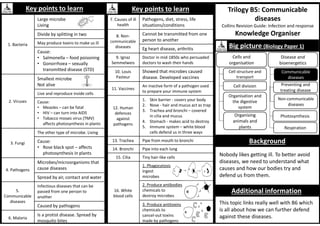
16. White
blood cells
1. Phagocytosis
ingest
microbes
2. Produce antibodies
chemicals to
destroy microbes
3. Produce antitoxins
chemicals to
cancel-out toxins
made by pathogens
Background
Additional information
Big picture (Biology Paper 1)
Cell structure and
transport
Cell division
Organising
animals and
plants
Organisation and
the digestive
system
Cells and
organisation
Communicable
diseases
Preventing and
treating disease
Non-communicable
diseases
Disease and
bioenergetics
Photosynthesis
Respiration
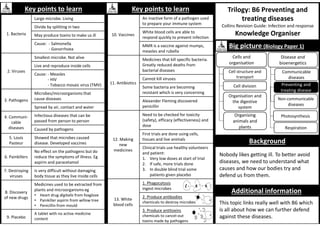
Nobody likes getting ill. To better avoid
diseases, we need to understand what
causes and how our bodies try and
defend us from them.
This topic links really well with B6 which
is all about how we can further defend
against these diseases.
Trilogy: B6 Preventing and
treating diseases
Collins Revision Guide: Infection and response
Knowledge Organiser
Key points to learn
1. Bacteria
Large microbe. Living
Divide by splitting in two
May produce toxins to make us ill
Cause: - Salmonella
- Gonorrhoea
2. Viruses
Smallest microbe. Not alive
Live and reproduce inside cells
Cause: - Measles
- HIV
- Tobacco mosaic virus (TMV)
3. Pathogens
Microbes/microorganisms that
cause diseases
Spread by air, contact and water
4. Communi-
cable
diseases
Infectious diseases that can be
passed from person to person
Caused by pathogens
5. Louis
Pasteur
Showed that microbes caused
disease. Developed vaccines
6. Painkillers
No effect on the pathogens but do
reduce the symptoms of illness. Eg
aspirin and paracetamol
7. Destroying
viruses
Is very difficult without damaging
body tissue as they live inside cells
8. Discovery
of new drugs
Medicines used to be extracted from
plants and microorganisms eg
• Heart drug digitalis from foxglove
• Painkiller aspirin from willow tree
• Penicillin from mould
9. Placebo
A tablet with no active medicine
content
Key points to learn
10. Vaccines
An inactive form of a pathogen used
to prepare your immune system
White blood cells are able to
respond quickly to prevent infection
MMR is a vaccine against mumps,
measles and rubella
11. Antibiotics
Medicines that kill specific bacteria.
Greatly reduced deaths from
bacterial diseases
Cannot kill viruses
Some bacteria are becoming
resistant which is very concerning
Alexander Fleming discovered
penicillin
12. Making
new
medicines
Need to be checked for toxicity
(safety), efficacy (effectiveness) and
dose
First trials are done using cells,
tissues and live animals
Clinical trials use healthy volunteers
and patient:
1. Very low doses at start of trial
2. If safe, more trials done
3. In double blind trial some
patients given placebo
13. White
blood cells
1. Phagocytosis
ingest microbes
2. Produce antibodies
chemicals to destroy microbes
3. Produce antitoxins
chemicals to cancel-out
toxins made by pathogens
Background
Additional information
Big picture (Biology Paper 1)
Cell structure and
transport
Cell division
Organising
animals and
plants
Organisation and
the digestive
system
Cells and
organisation
Communicable
diseases
Preventing and
treating disease
Non-communicable
diseases
Disease and
bioenergetics
Photosynthesis
Respiration
Nobody likes getting ill. To better avoid
diseases, we need to understand what
causes and how our bodies try and
defend us from them.
This topic links really well with B6 which
is all about how we can further defend
against these diseases.
Trilogy B7: Non-communicable
diseases
Collins Revision Guide: Organisation
Knowledge Organiser
Maths skills
Key points to learn
1. Non-
communicable
diseases
Cannot be transmitted from one
person to another
Eg heart disease, arthritis
2. Causes of ill
health
Pathogens, diet, stress, life
situations/conditions
3.
Communicable
diseases
Infectious diseases that can be
passed from one person to another
Caused by pathogens (microbes)
4. Coronary
heart disease
Layers of fat build up inside
coronary arteries, reducing blood
flow and oxygen for the heart
Stents used to keep arteries open
Statin medicines used to reduce
blood cholesterol levels which
reduces rate of fatty build up
5. Heart
failure
A failed heart can be replaced by
a donor heart
6. Faulty heart
valves
Can be replaced by
biological/mechanical valves
7. Coronary
arteries
Blood vessels that supply the
heart
8. Cancer
Uncontrolled growth and division
of cells
Lifestyle and genetic factors can
increase risks of some cancers
9. Tumour
Lump or growth in a part of the
body
10. Health
State of physical and mental well-
being
Key points to learn
11.
Malignant
tumour
Are cancers
Invade neighbouring tissues and
spread throughout body forming
secondary tumours
12. Benign
tumour
Not cancers
Growths of abnormal cells in one area
that do not invade other parts of the
body
13.
Different
diseases can
interact
• A defective immune system can
lead to more infections
• Viruses can trigger cancer
• Pathogens can trigger allergies
• Physical ill health can lead to
depression and mental illness
14. Smoking
and risk of
disease
Carbon monoxide harms unborn babies
Carcinogens increase risk of cancers
Increases risk of coronary heart
disease
Increases risk of lung disease and lung
cancer
15. Risks of
diet, exercise
and obesity
Increases risk of coronary heart
disease and high blood pressure
Obesity can lead to Type 2 diabetes
16. Alcohol
and risk of
disease
Damages the liver and carcinogens
increase risk of liver cancer
Affects brain function
Passes to and harms unborn babies
17. Exposure
to ionising
radiation
EM Waves (UV rays, X-rays Gamma
rays) and radioactive material
Can increase risk of cancers
Background
Big picture (Biology Paper 1)
Cell structure and
transport
Cell division
Organising
animals and
plants
Organisation and
the digestive
system
Cells and
organisation
Communicable
diseases
Preventing and
treating disease
Non-communicable
diseases
Disease and
bioenergetics
Photosynthesis
Respiration
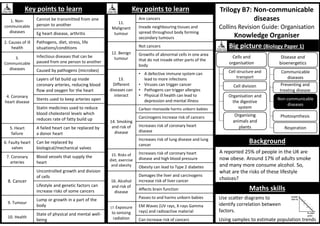
Use scatter diagrams to
identify correlation between
factors.
Using samples to estimate population trends
A reported 25% of people in the UK are
now obese. Around 17% of adults smoke
and many more consume alcohol. So,
what are the risks of these lifestyle
choices?
Trilogy B8: Photosynthesis
Collins Revision Guide: Bioenergetics
Knowledge Organiser
Maths skills
Key points to learn
1. Plant leaf
cell
• Mitochondria
• Cell membrane
• Ribosomes
• Nucleus
• Cytoplasm
• Vacuole
• Cell wall
• Chloroplasts
2.
Mitochondria
Perform respiration to release energy
3. Cell
membrane
Controls movement in/out of cell
4. Ribosomes Makes proteins by protein synthesis
5. Nucleus
Controls activities of cell. Contains
genes to build new cells
6. Cytoplasm Liquid where most reactions happen
7. Vacuole Sack filled with sap. Keeps cell rigid
8. Cell wall Made of cellulose. Supports cell
9.
Chloroplasts
Green and full of chlorophyll
10 Chlorophyll Absorbs light for photosynthesis
11.
Photosynth-
esis
The process of chloroplasts making
their food (glucose) using light
The reverse of respiration
Carbon + Water  Glucose + Oxygen
dioxide
Endothermic reaction – light energy
is absorbed
Key points to learn
12. Leaf
adaptations
for
photosynth-
esis
• Big surface area – to catch light
• Thin - helps diffusion of gases
• Chloroplasts – contain chlorophyll
• Veins – bring water through xylem
and move glucose through phloem
• Air spaces – help diffusion of gases
• Guard cells – open and close
stomata to control gas movement
13. Rate of
Photosynth-
esis
Can be measured by
using pond weed and
counting number of
oxygen bubbles
released
Affected by
light intensity
Affected by
CO2
concentration
Affected by
temperature
14. How
plants use
glucose
In respiration – provides energy
Glucose + Oxygen  Carbon + Water
dioxide
Store it as insoluble starch
Make fat or oil for storage
Make cellulose to strengthen cell wall
To produce amino acids for protein
synthesis and making DNA
15 Nitrate ions Also needed to make amino acids
Background
Big picture (Biology Paper 1)
Cell structure and
transport
Cell division
Organising
animals and
plants
Organisation and
the digestive
system
Cells and
organisation
Communicable
diseases
Preventing and
treating disease
Non-communicable
diseases
Disease and
bioenergetics
Photosynthesis
Respiration
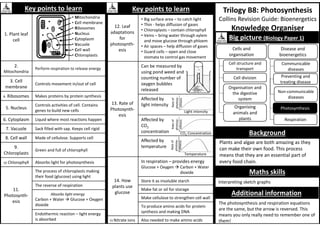
Plants and algae are both amazing as they
can make their own food. This process
means that they are an essential part of
every food chain.
Interpreting sketch graphs
Absorbs light energy
Rate
of
photosy-
nthesis
Light intensity
Rate
of
photosy-
nthesis
CO2 Concentration
Rate
of
photosy-
nthesis
Temperature
Additional information
The photosynthesis and respiration equations
are the same, but the arrow is reversed. This
means you only really need to remember one of
them!
Trilogy B9: Respiration
Collins Revision Guide: Bioenergetics
Knowledge Organiser
Additional information
Key points to learn
1.Breathing
Not the same as respiration. Method
of obtaining oxygen from the air
2. Aerobic
respiration
Process by which all living things get
energy from glucose and oxygen
Happens continuously in plants an
animals. Provides lots of energy
Glucose + Oxygen  Carbon + Water
dioxide
C6H12O6 + 6O2  6CO2 + 6H2O
Exothermic reaction - gives off heat
Occurs within mitochondria in cells
3.
Response
to exercise
During exercise body needs more
energy so rate of aerobic respiration
increases. This needs:
1. Heart rate increases - blood
carries glucose and oxygen faster
2. Breathing rate and volume
increases – lungs obtain more
oxygen
3. Glycogen stores turned into
glucose – more glucose available
More respiration means you get
hotter and may need to cool down
4 Anaerobic
respiration
Provides energy from glucose if there
is not enough oxygen available
5. Anaerobic
respiration
in plants and
yeast
Called fermentation. Used to make
bread and alcohol
Glucose  Ethanol + Carbon
dioxide
6. Enzymes
Biological catalyst. Helps reactions to
happen in living things
Key points to learn
7. Anaerobic
respiration in
animal cells
Glucose  Lactic acid
Much less energy provided than
aerobic respiration
8. Lactic acid
Leads to an oxygen debt which
requires more oxygen after
exercise is complete to break
down the lactic acid
Causes muscles to tire and cramp
9.
Metabolism
The sum of all the reactions in a
cell or the body of an organism
Energy provided by respiration is
used in these metabolic reactions
to make new molecules
10. Metabolic
reactions
Includes these 5 reactions:
1. Turning glucose into starch,
glycogen and cellulose
2. Making lipids from glycerol and
fatty acids
3. Using glucose and nitrate ions
to make amino acids
4. Respiration
5. Turning excess proteins into
urea
11. Metabolic
rate
The rate at which reactions
happen in an organism
12. Lipids Fats and oils
13. Starch Carbohydrate store in plants
14. Glycogen Carbohydrate store in animals
15. Cellulose Makes cell walls in plants
16. Urea Waste product from liver
Background
Big picture (Biology Paper 1)
Cell structure and
transport
Cell division
Organising
animals and
plants
Organisation and
the digestive
system
Cells and
organisation
Communicable
diseases
Preventing and
treating disease
Non-communicable
diseases
Disease and
bioenergetics
Photosynthesis
Respiration
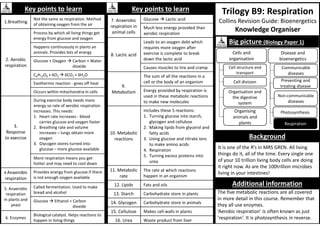
The five metabolic reactions are all covered
in more detail in this course. Remember that
they all use enzymes.
‘Aerobic respiration’ is often known as just
‘respiration’. It is photosynthesis in reverse.
It is one of the R’s in MRS GREN. All living
things do it, all of the time. Every single one
of your 10 trillion living body cells are doing
it right now. As are the 100trillion microbes
living in your intestines!
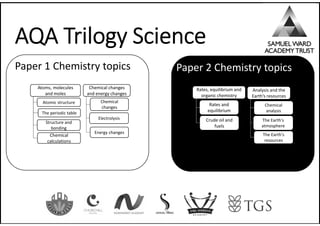
AQA Trilogy Science
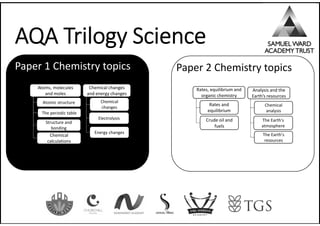
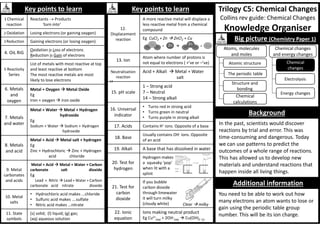
Paper 1 Chemistry topics Paper 2 Chemistry topics
Atomic structure
The periodic table
Chemical
calculations
Structure and
bonding
Atoms, molecules
and moles
Chemical
changes
Electrolysis
Energy changes
Chemical changes
and energy changes
Rates, equilibrium and
organic chemistry
Rates and
equilibrium
Crude oil and
fuels
Chemical
analysis
The Earth's
atmosphere
The Earth’s
resources
Analysis and the
Earth’s resources
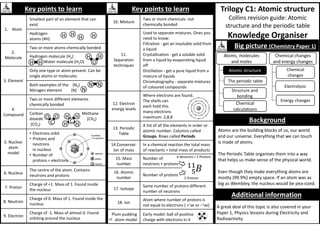
Trilogy C1: Atomic structure
Collins revision guide: Atomic
structure and the periodic table
Knowledge Organiser
Key points to learn
1. Atom
Smallest part of an element that can
exist
Hydrogen
atoms (4H)
2.
Molecule
Two or more atoms chemically bonded
Hydrogen molecule (H2)
Water molecule (H2O)
3. Element
Only one type or atom present. Can be
single atoms or molecules
Both examples of the (N2)
Nitrogen element (N)
4.
Compound
Two or more different elements
chemically bonded
Carbon Methane
dioxide (CH4)
(CO2)
5. Nuclear
atom
model
• Electrons orbit
• Protons and
neutrons
in nucleus
• Number of
protons = electrons
6. Nucleus
The centre of the atom. Contains
neutrons and protons
7. Proton
Charge of +1. Mass of 1. Found inside
the nucleus
8. Neutron
Charge of 0. Mass of 1. Found inside the
nucleus
9. Electron
Charge of -1. Mass of almost 0. Found
orbiting around the nucleus
Key points to learn
10. Mixture
Two or more chemicals not
chemically bonded
11.
Separation
techniques
Used to separate mixtures. Ones you
need to know:
Filtration - get an insoluble solid from
a liquid
Crystallisation - get a soluble solid
from a liquid by evaporating liquid
off
Distillation - get a pure liquid from a
mixture of liquids
Chromatography - separate mixtures
of coloured compounds
12. Electron
energy levels
Where electrons are found.
The shells can
each hold this
many electrons
maximum: 2,8,8
13. Periodic
Table
A list of all the elements in order or
atomic number. Columns called
Groups. Rows called Periods
14.Conservat-
ion of mass
In a chemical reaction the total mass
of reactants = total mass of products
15. Mass
number
Number of
neutrons + protons
16. Atomic
number
Number of protons
17. Isotope
Same number of protons different
number of neutrons
18. Ion
Atom where number of protons is
not equal to electrons ( +’ve or –’ve)
Plum pudding
atom model
Early model: ball of positive
charge with electrons in it
Background
Additional information
Big picture (Chemistry Paper 1)
Atomic structure
The periodic table
Chemical
calculations
Structure and
bonding
Atoms, molecules
and moles
Chemical
changes
Electrolysis
Energy changes
Chemical changes
and energy changes
Atoms are the building blocks of us, our world
and our universe. Everything that we can touch
is made of atoms.
The Periodic Table organises them into a way
that helps us make sense of the physical world.
Even though they make everything atoms are
mostly (99.9%) empty space. If an atom was as
big as Wembley, the nucleus would be pea-sized.
H H
H H
H
O
H
H
N N
O
C
O
N
C
H
H
H
H
A great deal of this topic is also covered in your
Paper 1, Physics lessons during Electricity and
Radioactivity.
6 Neutrons + 5 Protons
5 Protons
H
19
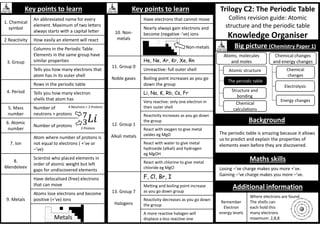
Trilogy C2: The Periodic Table
Collins revision guide: Atomic
structure and the periodic table
Knowledge Organiser
Maths skills
Key points to learn
1. Chemical
symbol
An abbreviated name for every
element. Maximum of two letters
always starts with a capital letter
2 Reactivity How easily an element will react
3. Group
Columns in the Periodic Table.
Elements in the same group have
similar properties
Tells you how many electrons that
atom has in its outer shell
4. Period
Rows in the periodic table
Tells you how many electron
shells that atom has
5. Mass
number
Number of
neutrons + protons
6. Atomic
number
Number of protons
7. Ion
Atom where number of protons is
not equal to electrons ( +’ve or
–’ve)
8.
Mendeleev
Scientist who placed elements in
order of atomic weight but left
gaps for undiscovered elements
9. Metals
Have delocalised (free) electrons
that can move
Atoms lose electrons and become
positive (+’ve) ions
Key points to learn
10. Non-
metals
Have electrons that cannot move
Nearly always gain electrons and
become (negative -’ve) ions
11. Group 0
Noble gases
He, Ne, Ar, Kr, Xe, Rn
Unreactive: full outer shell
Boiling point increases as you go
down the group
12. Group 1
Alkali metals
Li, Na, K, Rb, Cs, Fr
Very reactive: only one electron in
their outer shell
Reactivity increases as you go down
the group
React with oxygen to give metal
oxides eg MgO
React with water to give metal
hydroxide (alkali) and hydrogen
eg MgOH
React with chlorine to give metal
chloride eg MgCl
13. Group 7
Halogens
F, Cl, Br, I
Melting and boiling point increase
as you go down group
Reactivity decreases as you go down
the group
A more reactive halogen will
displace a less reactive one
Background
Additional information
Big picture (Chemistry Paper 1)
Atomic structure
The periodic table
Chemical
calculations
Structure and
bonding
Atoms, molecules
and moles
Chemical
changes
Electrolysis
Energy changes
Chemical changes
and energy changes
4 Neutrons + 3 Protons
3 Protons
Metals
Non-metals
Losing –’ve charge makes you more +’ve.
Gaining –‘ve charge makes you more –’ve.
The periodic table is amazing because it allows
us to predict and explain the properties of
elements even before they are discovered.
Remember
Electron
energy levels
Where electrons are found.
The shells can
each hold this
many electrons
maximum: 2,8,8
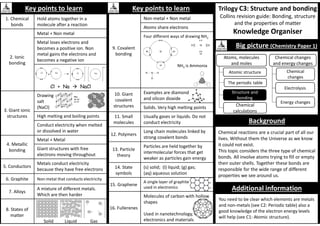
Trilogy C3: Structure and bonding
Collins revision guide: Bonding, structure
and the properties of matter
Knowledge Organiser
Key points to learn
1. Chemical
bonds
Hold atoms together in a
molecule after a reaction
2. Ionic
bonding
Metal + Non metal
Metal loses electrons and
becomes a positive ion. Non
metal gains the electrons and
becomes a negative ion
Cl + Na  NaCl
3. Giant ionic
structures
Drawing
salt
(NaCl)
High melting and boiling points
Conduct electricity when melted
or dissolved in water
4. Metallic
bonding
Metal + Metal
Giant structures with free
electrons moving throughout
5. Conductors
Metals conduct electricity
because they have free electrons
6. Graphite Non-metal that conducts electricity
7. Alloys
A mixture of different metals.
Which are then harder
8. States of
matter
Solid Liquid Gas
Key points to learn
9. Covalent
bonding
Non-metal + Non metal
Atoms share electrons
Four different ways of drawing NH3
10. Giant
covalent
structures
Examples are diamond
and silicon dioxide
Solids. Very high melting points
11. Small
molecules
Usually gases or liquids. Do not
conduct electricity
12. Polymers
Long chain molecules linked by
strong covalent bonds
13. Particle
theory
Particles are held together by
intermolecular forces that get
weaker as particles gain energy
14. State
symbols
(s) solid; (l) liquid; (g) gas;
(aq) aqueous solution
15. Graphene
A single layer of graphite
used in electronics
16. Fullerenes
Molecules of carbon with hollow
shapes
Used in nanotechnology,
electronics and materials
Background
Additional information
Big picture (Chemistry Paper 1)
Atomic structure
The periodic table
Chemical
calculations
Structure and
bonding
Atoms, molecules
and moles
Chemical
changes
Electrolysis
Energy changes
Chemical changes
and energy changes
Chemical reactions are a crucial part of all our
lives. Without them the Universe as we know
it could not exist.
This topic considers the three type of chemical
bonds. All involve atoms trying to fill or empty
their outer shells. Together these bonds are
responsible for the wide range of different
properties we see around us.
You need to be clear which elements are metals
and non-metals (see C2: Periodic table) also a
good knowledge of the electron energy levels
will help (see C1: Atomic structure).
NH3 is Ammonia
Trilogy C4: Chemical
calculations
Collins rev. guide: Quantitative chemistry
Knowledge Organiser
Maths skills
Key points to learn
1. Atom
Smallest part of an element that can
exist
Hydrogen
atoms (4H)
2. Molecule
Two or more atoms chemically
bonded
Hydrogen molecule (H2)
Water molecule (H2O)
3. Element
Only one type or atom present. Can
be single atoms or molecules
Both examples of the (N2)
Nitrogen element (N)
4.
Compound
Two or more different elements
chemically bonded
Carbon
Methane
dioxide (CH4)
(CO2)
5. Mass
number
Number of
neutrons + protons
B
6. Atomic
number
Number of protons
7. Relative
Atomic Mass
Ar The mass number of an atom.
Eg Ar of O is 16 and H is 1
8. Relative
Formula
Mass
Mr The mass of all the atoms of a
molecule added together.
Eg Mr of H2O is (2 x 1) + 16 = 18
9. Mole
An amount where either the Ar or Mr
is written in grams. Eg one mole of
water has a mass of 18g
10. Solute Solid that has been dissolved
Key points to learn
11. Isotope
Same number of protons different
number of neutrons
12. Numbers
in reaction
equations
Big numbers in front of a chemical
tell us how many molecules/atoms of
that chemical there are
13.
Balancing
equations
The number of atoms in the
reactants must equal the number
of atoms in the products
Steps to balance an equation
1) Mg + O2  MgO
Needs another O on product side
2) Mg + O2  2MgO
Only add big numbers in front
Now needs more Mg on reactants
3) 2Mg +O2  2MgO
Only add big numbers in front
The table you will have drawn to help
Mg: 1 2  1 2
O: 2  1 2
14. Chemical
reaction
Reactants  Products
‘turn into’
Conservation
of mass
In a chemical reaction the total mass
of reactants = total mass of products
16 If mass
seems to be
lost/gained
Conservation of mass always applies
but sometimes the mass of a gas
being used/made is missed
17.
Concentration
The mass of solute in a given
volume of solution
Concentration = mass of solute [g]
[g/dm3] volume of solution [dm3]
18. Solution Liquid containing dissolved solute
Background
Big picture (Chemistry Paper 1)
Atomic structure
The periodic table
Chemical
calculations
Structure and
bonding
Atoms, molecules
and moles
Chemical
changes
Electrolysis
Energy changes
Chemical changes
and energy changes
H H
H H
H
O
H
H
N N
O
C
O
N
C
H
H
H
H
H
6 Neutrons + 5 Protons
5 Protons
Steps to balance an equation:
1. Write down the symbols of each element then
count how many are on each side of the
equation
2. Leave Hydrogen and Oxygen till last if it’s
complicated
3. Start with an element that appears in the least
molecules first (usually a metal)
4. Only add big numbers to the left of each
chemical. You can’t change molecules
Want to make enough pancakes for everyone?
Then you need to know quantities. Chemical
reactions are the same (cooking is a chemical
reaction!). This topic explores in more detail.
15
Trilogy C5: Chemical Changes
Collins rev guide: Chemical Changes
Knowledge Organiser
Key points to learn
1 Chemical
reaction
Reactants  Products
‘turn into’
2 Oxidation Losing electrons (or gaining oxygen)
3 Reduction Gaining electrons (or losing oxygen)
4. OiL RiG
Oxidation is Loss of electrons
Reduction is Gain of electrons
5 Reactivity
Series
List of metals with most reactive at top
and least reactive at bottom
The most reactive metals are most
likely to lose electrons
6. Metals
and
oxygen
Metal + Oxygen  Metal Oxide
Eg
Iron + oxygen  iron oxide
7. Metals
and water
Metal + Water  Metal + Hydrogen
hydroxide
Eg
Sodium + Water  Sodium + Hydrogen
hydroxide
8. Metals
and acid
Metal + Acid  Metal salt + hydrogen
Eg
Zinc + Hydrochloric  Zinc + Hydrogen
acid chloride
9. Metal
carbonates
and acids
Metal + Acid  Metal + Water + Carbon
carbonate salt dioxide
Eg
Lead + Nitric  Lead + Water + Carbon
carbonate acid nitrate dioxide
10. Metal
salts
• Hydrochloric acid makes ...chloride
• Sulfuric acid makes ….sulfate
• Nitric acid makes …nitrate
11. State
symbols
(s) solid; (l) liquid; (g) gas;
(aq) aqueous solution
Key points to learn
12.
Displacement
reaction
A more reactive metal will displace a
less reactive metal from a chemical
compound
Eg CuCl2 + Zn  ZnCl2 + Cu
13. Ion
Atom where number of protons is
not equal to electrons ( +’ve or –’ve)
Neutralisation
reaction
Acid + Alkali  Metal + Water
salt
15. pH scale
1 – Strong acid
7 – Neutral
14 – Strong alkali
16. Universal
indicator
• Turns red in strong acid
• Turns green in neutral
• Turns purple in strong alkali
17. Acids Contains H+ ions. Opposite of a base
18. Base
Usually contains OH- ions. Opposite
of an acid
19. Alkali A base that has dissolved in water
20. Test for
hydrogen
Hydrogen makes
a squeaky ‘pop’
when lit with a
splint
21. Test for
carbon
dioxide
If you bubble
carbon dioxide
through limewater
it will turn milky
(cloudy white)
22. Ionic
equation
Ions making neutral product
Eg Cu2+
(aq) + 2OH-
(aq)  Cu(OH)2 (s)
Background
Additional information
Big picture (Chemistry Paper 1)
Atomic structure
The periodic table
Chemical
calculations
Structure and
bonding
Atoms, molecules
and moles
Chemical
changes
Electrolysis
Energy changes
Chemical changes
and energy changes
Clear  milky
You need to be able to work out how
many electrons an atom wants to lose or
gain using the periodic table group
number. This will be its ion charge.
In the past, scientists would discover
reactions by trial and error. This was
time-consuming and dangerous. Today
we can use patterns to predict the
outcomes of a whole range of reactions.
This has allowed us to develop new
materials and understand reactions that
happen inside all living things.
14
Zn Zn
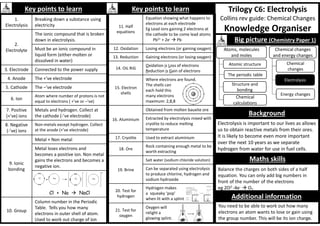
Trilogy C6: Electrolysis
Collins rev guide: Chemical Changes
Knowledge Organiser
Maths skills
Key points to learn
1.
Electrolysis
Breaking down a substance using
electricity
2.
Electrolyte
The ionic compound that is broken
down in electrolysis.
Must be an ionic compound in
liquid form (either molten or
dissolved in water)
3. Electrode Connected to the power supply
4. Anode The +’ve electrode
5. Cathode The –’ve electrode
6. Ion
Atom where number of protons is not
equal to electrons ( +’ve or –’ve)
7. Positive
(+’ve) ions
Metals and hydrogen. Collect at
the cathode (-’ve electrode)
8. Negative
(-’ve) ions
Non-metals except hydrogen. Collect
at the anode (+’ve electrode)
9. Ionic
bonding
Metal + Non metal
Metal loses electrons and
becomes a positive ion. Non metal
gains the electrons and becomes a
negative ion.
Cl + Na  NaCl
10. Group
Column number in the Periodic
Table. Tells you how many
electrons in outer shell of atom.
Used to work out charge of ion
Key points to learn
11. Half
equations
Equation showing what happens to
electrons at each electrode
Eg Lead ions gaining 2 electrons at
the cathode to be come lead atoms
Pb2+ + 2e-  Pb
12. Oxidation Losing electrons (or gaining oxygen)
13. Reduction Gaining electrons (or losing oxygen)
14. OiL RiG
Oxidation is Loss of electrons
Reduction is Gain of electrons
15. Electron
shells
Where electrons are found.
The shells can
each hold this
many electrons
maximum: 2,8,8
16. Aluminium
Obtained from molten bauxite ore
Extracted by electrolysis mixed with
cryolite to reduce melting
temperature
17. Cryolite Used to extract aluminium
18. Ore
Rock containing enough metal to be
worth extracting
19. Brine
Salt water (sodium chloride solution)
Can be separated using electrolysis
to produce chlorine, hydrogen and
sodium hydroxide
20. Test for
hydrogen
Hydrogen makes
a squeaky ‘pop’
when lit with a splint
21. Test for
oxygen
Oxygen will
relight a
glowing splint.
Background
Additional information
Big picture (Chemistry Paper 1)
Atomic structure
The periodic table
Chemical
calculations
Structure and
bonding
Atoms, molecules
and moles
Chemical
changes
Electrolysis
Energy changes
Chemical changes
and energy changes
Electrolysis is important to our lives as allows
us to obtain reactive metals from their ores.
It is likely to become even more important
over the next 10 years as we separate
hydrogen from water for use in fuel cells.
You need to be able to work out how many
electrons an atom wants to lose or gain using
the group number. This will be its ion charge.
Balance the charges on both sides of a half
equation. You can only add big numbers in
front of the number of the electrons
eg 2O2--4e-  O2
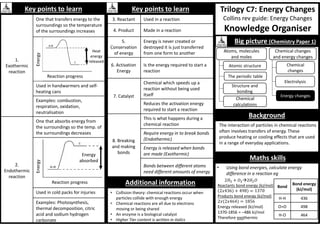
Trilogy C7: Energy Changes
Collins rev guide: Energy Changes
Knowledge Organiser
Maths skills
Key points to learn
1.
Exothermic
reaction
One that transfers energy to the
surroundings so the temperature
of the surroundings increases
Used in handwarmers and self-
heating cans
Examples: combustion,
respiration, oxidation,
neutralisation
2.
Endothermic
reaction
One that absorbs energy from
the surroundings so the temp. of
the surroundings decreases
Used in cold packs for injuries
Examples: Photosynthesis,
thermal decomposition, citric
acid and sodium hydrogen
carbonate
Key points to learn
3. Reactant Used in a reaction
4. Product Made in a reaction
5.
Conservation
of energy
Energy is never created or
destroyed it is just transferred
from one form to another
6. Activation
Energy
Is the energy required to start a
reaction
7. Catalyst
Chemical which speeds up a
reaction without being used
itself
Reduces the activation energy
required to start a reaction
8. Breaking
and making
bonds
This is what happens during a
chemical reaction
Require energy in to break bonds
(Endothermic)
Energy is released when bonds
are made (Exothermic)
Bonds between different atoms
need different amounts of energy
• Using bond energies, calculate energy
difference in a reaction eg
2 + 2
Reactants bond energy (kJ/mol)
2 436 + 498) = 1370
Products bond energy (kJ/mol)
2 (2 464) = 1856
Energy released (kJ/mol)
1370-1856 = –486 kJ/mol
Therefore exothermic
Bond
Bond energy
(kJ/mol)
H-H 436
O=O 498
H-O 464
Background
Energy
absorbed
Reaction progress
Energy
Reaction progress
Energy
• Collision theory: chemical reactions occur when
particles collide with enough energy
• Chemical reactions are all due to electrons
moving or being shared
• An enzyme is a biological catalyst
• Higher Tier content is written in italics
Additional information
The interaction of particles in chemical reactions
often involves transfers of energy. These
produce heating or cooling effects that are used
in a range of everyday applications.
Big picture (Chemistry Paper 1)
Atomic structure
The periodic table
Chemical
calculations
Structure and
bonding
Atoms, molecules
and moles
Chemical
changes
Electrolysis
Energy changes
Chemical changes
and energy changes
Heat
energy
released
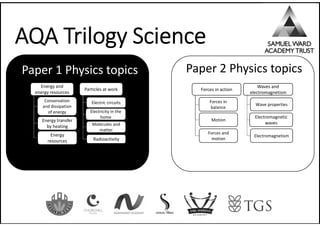
AQA Trilogy Science
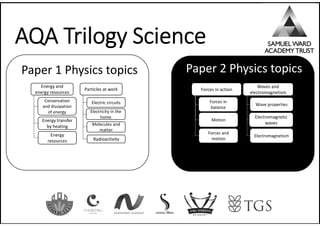
Paper 1 Physics topics Paper 2 Physics topics
Energy and
energy resources
Conservation
and dissipation
of energy
Energy transfer
by heating
Energy
resources
Electric circuits
Electricity in the
home
Radioactivity
Molecules and
matter
Particles at work
Forces in
balance
Motion
Wave properties
Electromagnetic
waves
Electromagnetism
Waves and
electromagnetism
Forces and
motion
Forces in action
Trilogy P1: Conservation and
dissipation of energy
Collins revision guide: Energy
Knowledge Organiser
Maths skills
Key points to learn
1. Energy
stores
[J]
Chemical energy
Kinetic energy
Gravitational potential energy
Elastic potential energy
2. Chemical
energy
[J]
Transferred during chemical
reactions eg fuels, foods, or in
batteries
3. Kinetic
energy
[J]
All moving objects have it.
k.e = 0.5 x mass x (speed)2
Ek = ½ x m x v2
[J] [kg] [m/s]
4 Gravitational
potential
energy
[J]
Stored in an object lifted up.
g.p.e = mass x g x height
Ep = m x g x h
[J] [kg] [N/kg] [m]
5. Elastic
potential
energy
[J]
Energy stored in a springy object
e.p.e = 0.5 x spring x (extension)2
constant
Ee = ½ x k x e2
[J] [N/m] [m]
6. Energy can
be
transferred
by…
Heating (thermal energy always
flows from hot to cold objects)
An electrical current flowing
A force moving an object
7. Useful
energy [J]
Energy transferred to the place
and in the form we need it.
8. Wasted
energy [J]
Not useful. Eventually transferred
to surroundings
Key points to learn
9. Work
done [J]
Equal to the energy transferred.
When a force moves an object.
Work done = Force x distance moved
W = F x s
[J] [N] [m]
10. Energy
flow diagram
Show energy transfers eg for a
torch lamp:
Chemical  Light + Heat
11.
Conservation
of energy
Energy cannot be created or
destroyed.
It can only be transferred usefully,
stored or dissipated.
12. Dissipated
energy [J]
Wasted energy, usually spread to the
surroundings as heat.
13. Hooke’s
Law and k the
spring
constant
The extension of a spring is
proportional to the force on it.
The gradient
of this graph
is known as
k, the spring
constant.
14. Efficiency
Proportion of input energy
transferred to useful energy. 100%
means no wasted energy.
Efficiency = useful  total input
energy energy
15. Power
[W]
Energy [J] transferred in 1 second.
Power [W] = Energy [J]  time [s]
16. Wasted
power [W]
Total power in – useful power out
Background
Big picture (Physics Paper 1)
Energy and
energy resources
Conservation
and dissipation
of energy
Energy transfer
by heating
Energy
resources
Electric circuits
Electricity in the
home
Radioactivity
Molecules and
matter
Particles at work
You should be able to recall, use and rearrange
all the equations on this page except number 5.
g is Earth’s acceleration due to gravity. It has a
constant value of approximately 9.8m/s2
You need to remember the units for each
quantity. They are in [ ] next to equations.
You should be able to calculate the gradient of a
Force – extension graph.
Energy is the capacity of something to make
something happen.
The Universe and everything in it is constantly
changing energy from one form into another.
(You are
given this
equation)
Trilogy P2: Energy transfer by
heating
Collins revision guide: Energy
Knowledge Organiser
Maths skills
Key points to learn
1. States of
matter
Solid Liquid Gas
2. Solid
Particles held together in fixed
positions by strong forces. Least
energetic state of matter.
3. Liquid
Particles move at random and are
in contact with each other. More
energy than solids, less than gas
4. Gas
Particles move randomly and are
far apart. Weak forces of
attraction. Most energetic.
5. Vacuum No particles at all. Space is a vacuum
6. Metals
Have free electrons which makes
them good conductors
7.
Non-metals
Have fixed electrons which makes
them good insulators
8.
Conductor
Is good at carrying heat energy or
electrical energy
9. Thermal
conductivity
A measure of how good
something is at conducting
10. Insulator A poor conductor
11. Friction
Two surfaces rubbing together
Causes energy to be transferred
as heat
Can be reduced by using a lubricant
12.
Lubricant
Fluid (eg oil) that smooths contact
points between surfaces
Key points to learn
13. More
energy loss
from a
building
If walls are thin
If walls have high thermal
conductivity
Big temperature difference
between inside and outside
14. Reduce
heat loss by
Using material with low thermal
conductivity ie an insulator
Make insulator thicker
15.
Specific heat
capacity,
c
[J/kgC]
Amount of energy needed to
change temperature of 1kg by 1C
=
• : Change in
energy [J]
• : mass of object
• : specific heat
capacity
• : change in
temperature [C]
Objects with high specific heat
capacity take a long time to heat
up and cool down. They are good
at storing heat energy.
16. Loft
insulation
Fibreglass which traps air which is
a good insulator.
17. Cavity wall
insulation
Traps air pockets in gaps which is a
good insulator
18. Double
glazing
Traps air in gaps between glass
which is a good insulator
19. Foil behind
radiator
Reflects heat away from wall back
into room
You should be able to use the specific heat
capacity equation to find energy change and the
specific heat capacity when given all other
variables. Rearranging to make c the subject:
=
Background
Big picture (Physics Paper 1)
Energy and
energy resources
Conservation
and dissipation
of energy
Energy transfer
by heating
Energy
resources
Electric circuits
Electricity in the
home
Radioactivity
Molecules and
matter
Particles at work
Not wasting heat energy in your home is
important for the environment and for
your finances. This topic will help you
make more informed decisions so that
you can save even more.
(You are given
this equation)
Trilogy P3: Energy Resources
Collins revision guide: Energy
Knowledge Organiser
Additional
Key points to learn
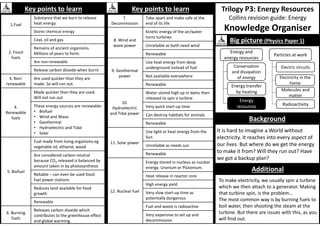
1.Fuel
Substance that we burn to release
heat energy
Stores chemical energy
2. Fossil
fuels
Coal, oil and gas
Remains of ancient organisms.
Millions of years to form.
Are non-renewable
Release carbon dioxide when burnt
3. Non-
renewable
Are used quicker than they are
made. So will run out.
4.
Renewable
fuels
Made quicker than they are used.
Will not run out
These energy sources are renewable:
• Biofuel
• Wind and Wave
• Geothermal
• Hydroelectric and Tidal
• Solar
5. Biofuel
Fuel made from living organisms eg
vegetable oil, ethanol, wood
Are considered carbon-neutral
because CO2 released is balanced by
amount taken in by photosynthesis
Reliable – can even be used fossil
fuel power stations
Reduces land available for food
growth
Renewable
6. Burning
fuels
Releases carbon dioxide which
contributes to the greenhouse effect
and global warming.
Key points to learn
7.
Decommission
Take apart and make safe at the
end of its life
8. Wind and
wave power
Kinetic energy of the air/water
turns turbines
Unreliable as both need wind
Renewable
9. Geothermal
power
Use heat energy from deep
underground instead of fuel
Not available everywhere
Renewable
10.
Hydroelectric
and Tidal power
Water stored high up in dams then
released to spin a turbine
Very quick start-up time
Can destroy habitats for animals
Renewable
11. Solar power
Use light or heat energy from the
Sun
Unreliable as needs sun
Renewable
12. Nuclear fuel
Energy stored in nucleus as nuclear
energy. Uranium or Plutonium.
Heat release in reactor core
High energy yield
Very slow start-up time as
potentially dangerous
Fuel and waste is radioactive
Very expensive to set up and
decommission
Background
Big picture (Physics Paper 1)
Energy and
energy resources
Conservation
and dissipation
of energy
Energy transfer
by heating
Energy
resources
Electric circuits
Electricity in the
home
Radioactivity
Molecules and
matter
Particles at work
To make electricity, we usually spin a turbine
which we then attach to a generator. Making
that turbine spin, is the problem…
The most common way is by burning fuels to
boil water, then shooting the steam at the
turbine. But there are issues with this, as you
will find out.
It is hard to imagine a World without
electricity. It reaches into every aspect of
our lives. But where do we get the energy
to make it from? Will they run out? Have
we got a backup plan?
Trilogy P4: Electric circuits
Collins revision guide: Electricity
Knowledge Organiser
Maths skills
Key points to learn
1. Diode
Current only flows one way. Very
high resistance in other direction.
2. Resistor
(Ohmic
conductor) Resistance stays constant. Current
proportional to pd.
3. Variable
resistor
Resistance can be
set by a human.
Used in dimmer switches.
4. LED
A diode that gives
off light.
5. Lamp
Resistance increases as the
temperature increases.
6.
Thermistor Resistance decreases as the
temperature increases.
Used in thermostats.
7. LDR Resistance decreases as the light
intensity increases (gets brighter).
Used in automatic lights.
Key points to learn
8. Cell and
battery
Provides the potential difference
(pd) and energy
for a circuit.
9. Current,
I
Rate of flow of electrical charge.
Measured in Amps (A)
10. Charge, Q Measured in Coulombs (C)
11. Potential
difference, V
pd. Energy transferred per unit
charge. Measured in Volts (V)
12.Resistance
R
Ability to slow current. Measured
in Ohms ()
13. Series
circuit
Current has only one route.
Current is the same all the way
around. Potential difference is
shared across components.
Resistances are added together.
14. Parallel
circuit
Current has different
paths it could take.
Current is shared through each
branch. Potential difference is the
same across each branch.
Total resistance is lower than the
smallest single resistor.
15.
Voltmeter
Measures pd across
a component
16.
Ammeter
Measures current
through a component
17. Fuse
Resistor that melts
if current is too high.
• Q = I x t
Charge= Current x time
[C] [A] [s]
• V = I x R
Potential difference = Current x Resistance
[V] [A] []
(You need to be able to remember and use these )
Background
Big picture (Physics Paper 1)
I
V
I
V
I
V
R
Temperature
R
Light intensity
Electrical power fills the modern world with light
and sound, information and entertainment,
remote sensing and control. Its use was identified
and explored by scientists of the 19th century but
it becomes more important every day.
Energy and
energy resources
Conservation
and dissipation
of energy
Energy transfer
by heating
Energy
resources
Electric circuits
Electricity in the
home
Radioactivity
Molecules and
matter
Particles at work
Cell Battery
12. Current, I Measured in Amps (A)
13.
Resistance, R
Measured in ohms ()
14. Live wire
Brown. Connects to fuse.
Carries the alternating potential
difference from the supply.
About 230V.
15. Neutral
wire
Blue wire
Completes the circuit.
Around 0V
16. Earth
wire
Green and yellow striped wire.
Carries current safely to Earth if
there is a fault.
Normally 0V.
17.Electrical
plug
Made of plastic as it is a good
insulator.
Earth wire
Neutral wire
Bottom left
(Blue)
Live wire
Bottom right
(Brown)
Through fuse
Trilogy P5: Electricity in
the home
Collins revision guide: Electricity
Knowledge Organiser
Maths skills
Key points to learn
1. ac
Alternating current
Found in mains
Has an alternating potential
difference (voltage)
negative to positive.
2. dc
Direct current
Found in batteries
Has a constant potential
difference (voltage)
3. UK mains
AC supply of 230Volts and
frequency of 50Hz
4. Power, P
Energy [J] transferred in one
second. Measured in Watts (W)
5. Potential
difference, V
Also known as voltage. Measured
in volts (V)
6. Energy
transferred,
E
Depends on the power of the
appliance and the time it is on for.
Also called work done.
7. Energy
transfer
diagram
Energy  Useful + Wasted
input energy energy
8. Work
done, E
Energy transferred when current
flows in a circuit.
9. National
grid
System of cables and
transformers.
10. Step-up
transformer
Increase potential difference so
that less heat energy is wasted.
11. Step-down
transformer
Decrease potential difference to
make electric more easily used.
Key points to learn
Background
• P = V x I
power = potential difference × current
[W] [V] [A]
• P = I2 × R
power = current2 × resistance
[W] [A] []
Big picture (Physics Paper 1)
• E = P x t
Work done = Power x time
[J] [W] [s]
[kWh] [kW] [hr]
• E = Q x V
Work done = Charge flow x potential difference
[J] [C] [V]
pd
time
pd
time
We use electricity in all aspects of modern life. But
how is it moved from power stations to our homes
and then to our devices? This topic answers that
question as well as investigating how power
companies measure our electricity usage.
Energy and
energy resources
Conservation
and dissipation
of energy
Energy transfer
by heating
Energy
resources
Electric circuits
Electricity in the
home
Radioactivity
Molecules and
matter
Particles at work
(You need to
remember and be
able to use all of
the equations on
this sheet.)
Trilogy: Molecules and matter
Collins rev guide: Particle model of matter
Knowledge Organiser
Maths skills
Key points to learn
1. Mass, m
Amount of matter in something.
Measured in kg
2. Volume,
V
Amount of space something takes
up. Measured in m3
Volume of
a cuboid = w x d x h
Volume of an irregular
object can be found
by dropping in a
liquid and measuring
displacement.
3. Density,

Mass per unit volume. Measured
in kg/m3
=
4. Floating
An object that has a lower density
than the fluid will float
5. Sinking
An object that has a higher density
than the fluid will sink
Evaporation Happens at any temperature
Sublimation Solid turns straight into gas
8. Solid
Particles held together in fixed
positions by strong forces. Least
energetic state of matter.
9. Liquid
Particles move at random and are in
contact with each other. More
energy than solids, less than gas
10. Gas
Particles move randomly and are far
apart. Weak forces of attraction.
Most energetic.
Key points to learn
nsity =
[kg/m3] =
[ ]
[ ]
Latent heat: y = mass x specific latent heat
E = m x L
[J] [kg] [J/kg]
Background
Big picture (Physics Paper 1)
Energy and
energy resources
Conservation
and dissipation
of energy
Energy transfer
by heating
Energy
resources
Electric circuits
Electricity in the
home
Radioactivity
Molecules and
matter
Particles at work
w
h
d
time time
temperature
temperature
All gas
All liquid
All gas
All solid
All liquid
All solid
The particle model is widely used to predict the
behaviour of solids, liquids and gases. It helps us
to design vehicles from submarines to
spacecraft. It even explains why it is difficult to
make a good cup of tea high up a mountain!
(You need to
remember
this.)
(You are
given this)
11. Melting
point
Temperature when solid turns into
liquid. Same as freezing point.
12. Boiling
point
Temperature when liquid turns into
gas. Same as condensation point.
Condensation
point
Temperature when gas turns into
liquid. Same as boiling point.
14. Freezing
point
Temperature when liquid turns into
solid. Same as melting point.
15. Latent heat
Energy transferred when a
substance changes state but
temperature doesn’t change
16. Specific
latent heat of
fusion
Energy needed to melt 1kg of solid
into liquid
17. Specific
latent heat of
vaporisation
Energy needed to boil 1kg of liquid
into gas
18. At state
changes…
Temperature and kinetic energy of
particles stays constant.
Internal energy increases due to an
increase in potential energy as
particles move further apart
19. Heating
and cooling
curves
20. Gas
pressure
Caused by particles hitting surfaces.
Increases when temperature
increases
6
7
13.
Trilogy P6: Radioactivity
Collins rev guide: Atomic Structure
Knowledge Organiser
Maths skills
Key points to learn
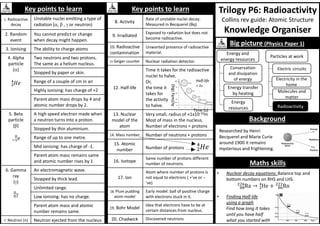
1. Radioactive
decay
Unstable nuclei emitting a type of
radiation (,  , g or neutron)
2. Random
event
You cannot predict or change
when decay might happen.
3. Ionising The ability to charge atoms
4. Alpha
particle
()
Two neutrons and two protons.
The same as a helium nucleus.
Stopped by paper or skin.
Range of a couple of cm in air
Highly ionising: has charge of +2
Parent atom mass drops by 4 and
atomic number drops by 2.
5. Beta
particle
()
A high speed electron made when
a neutron turns into a proton.
Stopped by thin aluminium.
Range of up to one metre.
Mid ionising: has charge of -1.
Parent atom mass remains same
and atomic number rises by 1
6. Gamma
ray
(g)
g
An electromagnetic wave.
Stopped by thick lead.
Unlimited range.
Low ionising: has no charge.
Parent atom mass and atomic
number remains same.
7. Neutron (n) Neutron ejected from the nucleus
Key points to learn
8. Activity
Rate of unstable nuclei decay.
Measured in Becquerel (Bq)
9. Irradiated
Exposed to radiation but does not
become radioactive.
10. Radioactive
contamination
Unwanted presence of radioactive
material.
11 Geiger counter Nuclear radiation detector.
12. Half-life
Time it takes for the radioactive
nuclei to halve.
Or,
the time it
takes for
the activity
to halve.
13. Nuclear
model of the
atom
Very small, radius of 1x10⁻¹⁰m
Most of mass in the nucleus.
Number of electrons = protons
14. Mass number Number of neutrons + protons
15. Atomic
number Number of protons
16. Isotope
Same number of protons different
number of neutrons.
17. Ion
Atom where number of protons is
not equal to electrons ( +’ve or –
’ve)
18. Plum pudding
atom model
Early model: ball of positive charge
with electrons stuck in it.
19. Bohr Model
Idea that electrons have to be at
certain distances from nucleus.
20. Chadwick Discovered neutrons
• Nuclear decay equations: Balance top and
bottom numbers on RHS and LHS.
Ra → He + Rn
• Finding Half-life
using a graph
Find how long It takes
until you have half
what you started with
Background
Researched by Henri
Becquerel and Marie Curie
around 1900 it remains
mysterious and frightening.
Big picture (Physics Paper 1)
Activity
(Bq)
Time (s)
Energy and
energy resources
Conservation
and dissipation
of energy
Energy transfer
by heating
Energy
resources
Electric circuits
Electricity in the
home
Radioactivity
Molecules and
matter
Particles at work
Half-life
= 1s
AQA Trilogy Science
Paper 1 Biology topics
Cell structure and
transport
Cell division
Organising
animals and
plants
Organisation and
the digestive
system
Cells and
organisation
Communicable
diseases
Preventing and
treating disease
Non-communicable
diseases
Disease and
bioenergetics
Photosynthesis
Respiration
The human
nervous system
Hormonal
coordination
Organising an
ecosystem
Biological response
Reproduction
Variation and
evolution
Biodiversity and
ecosystems
Genetics and
reproduction
Adaptations,
interdependence
and competition
Ecology
Genetics and
evolution
Paper 2 Biology topics
Trilogy B10: The human nervous
system
Collins Revision Guide: Homeostasis and
response
Knowledge Organiser
Additional information
Key points to learn
1. Catalyst
Increase rate of reaction without
being used up themselves
2. Enzyme
Biological catalysts.
Work at a specific temperature and
Ph
3.
Homeostasis
Automatic control of conditions
inside a cell or organism so that
enzymes and cells work effectively
In the human body it controls:
1. Blood glucose concentration
2. Body temperature
3. Water levels
Uses receptors, coordination
centres and effectors
4. Receptors Cells that detect changes (stimuli)
Coordination
centres
Use information from receptors
Brain, spinal cord and pancreas
6. Effectors
Bring about response to changes
Muscles or glands
7. Pancreas
Monitors and controls blood
glucose levels
8. Glands
Make hormones which act as
chemical messages in the body
9. Stimuli
A change noticed by a sensory
receptor. Can be changes in:
1. Temperature
2. Taste
3. Touch
4. Sound
5. Light
6. Smell
10. Neuron
Specialised cell that carries
electrical impulse in nervous system
Key points to learn
11. CNS
Central Nervous System. Brain and
spinal cord
12. Reflex
actions
Automatic, rapid actions that do
not use conscious part of brain
Safety mechanism for our body
Eg. Blinking, jumping at loud
sounds
13. Reflex arc
The sequence in a reflex action
eg tasting something sour
1. Stimulus – sour taste
2. Receptor – taste bud cell
3. Sensory neuron – carries
impulse to coordinator
4. Relay neuron in
Coordinator – spinal cord
5. Motor neuron – carries
impulse to effector
6. Effector – muscle in face
7. Response – muscle
contracts
Sensory neuron
Relay neuron
Motor neuron
14. Synapse
Gap between two neurons.
Chemicals diffuse across gap
instead of electrical impulse
15. Muscle
Tissue that can contract or relax
to cause movement
Background
Big picture (Biology Paper 2)
The human nervous system
Hormonal coordination
Organising an
ecosystem
Biological response
Reproduction
Variation and
evolution
Biodiversity and
ecosystems
Genetics and
reproduction
Adaptations,
interdependence
and competition
Ecology
Genetics and
evolution
Cells in the body need very specific
conditions to survive and operate. How
does our nervous system ensure that
these conditions are monitored and
controlled?
Remember that our bodies operate at 37C. It’s
so that our enzymes work best and do not
denature.
5.
Trilogy B11: Hormonal
coordination
Collins Rev. Guide: Homeostasis and response
Knowledge Organiser
Key points to learn
1. Endocrine
system
Contains glands that secrete
hormones into the bloodstream
Pituitary gland
Thyroid
Adrenal gland
Testes (male)
Pancreas
Ovary
(female)
2. Hormones Chemical messages in the body.
3. Pituitary
gland
‘Master gland’ that secretes
hormones that act on other glands
4. Pancreas
Monitors and controls blood glucose
levels
Releases insulin hormone if blood
glucose concentration too high
Releases glucagon if blood glucose
concentration too low
5. Insulin
(hormone)
Causes cells to take glucose from
blood. Liver and muscle cells store
as glycogen
6. Glucagon
(hormone)
Converts glycogen into glucose.
Interacts with insulin in negative
feedback cycle to control glucose
7. Adrenaline
(hormone)
From adrenal gland. Increases heart
rate in fight or flight response
8.
Contraception
(to stop
pregnancy)
• Oral (pill) - FSH stops eggs maturing
• Injection/implant – progesterone to
stop maturation and release of eggs
• Spermicides – chemicals kill sperm
• Barrier – stop sperm reaching egg
• Abstinence – No sexual intercourse
• Surgical – remove/cut reproductive
organs
Key points to learn
9. Type 1
diabetes
Pancreas does not produce enough
insulin when glucose concentration
too high. Needs insulin injections
10. Type 2
diabetes
Body no longer responds to insulin.
Controlled by diet and exercise
Obesity a risk factor for this diabetes
11. Thyroxin
(hormone)
From the thyroid gland. Controls they
body’s metabolic rate. Important in
growth and development
Controlled by negative feedback
12 Oestrogen
(hormone)
Main female reproductive hormone.
From ovaries
13.
Ovulation
Once a girls has gone through puberty
she releases an egg every 28days
during the menstrual cycle
14.
Hormones
during
menstrual
cycle
FSH (Follicle Stimulating Hormone )
causes and egg to mature in ovary.
Stimulates ovary to make oestrogen
LH (Luteinising Hormone) triggers
release of egg (ovulation)
Oestrogen: causes uterus lining to
grow; stops release of FSH; starts
release of LH
Progesterone: maintains uterus lining;
stops production of both FSH and LH
Testosterone
(hormone)
Main male reproductive hormone.
From testes. Starts sperm production
16. Infertility
treatment
(to help
pregnancy)
• FSH and LH can be taken to stimulate
egg development and release.
• IVF (In Vitro Fertilisation) uses eggs
that are removed, fertilized and re-
implanted into uterus
Background
Big picture (Biology Paper 2)
The human nervous system
Hormonal coordination
Organising an
ecosystem
Biological response
Reproduction
Variation and
evolution
Biodiversity and
ecosystems
Genetics and
reproduction
Adaptations,
interdependence
and competition
Ecology
Genetics and
evolution
The journey from a child into an adult is
(adolescence) is a difficult time for all living
things. It’s all because of our hormones.
Here are the
hormones
that change
and control
the female
menstrual
cycle.
15
LH
FSH
Oestrogen Progesterone
0 days 28 days
14 days
Ovulation
Thickness
of womb
lining
Hormone
levels
Trilogy B12: Reproduction
Collins Revision Guide: inheritance,
variation and evolution
Knowledge Organiser
Punnet squares
Key points to learn
1. Asexual
reproduction
1. Only one parent
2. Cells divide by mitosis
3. Offspring are clones of parent
2. Sexual
reproduction
1. Two parents
2. Fusing of male and female
gametes which mixes genetic
information from parents.
3. Variation between offspring
3. Gametes
Male and female sex cells:
• Male: Sperm (animals) and
pollen (plants)
• Female: Egg (animals and plants)
Half chromosomes of normal cell
4. Mitosis
One parent cell divides into two
identical versions . Making identical
two. Used in growth/repair
5. Meiosis
Cell divides to make
gametes (sex cells)
1. Copies genetic
information
2. Cell divides into two
each with full set of
chromosomes
3. Two cells divide into
four gametes - each
with a half set of chromosomes
4. Gametes are genetically unique
6.
Fertilisation
Male and female gametes fuse
together – now have full set of
chromosomes for offspring
Fusing half mothers chromosomes
with half of fathers
7. Clone Genetically identical
Characteristics Features of an individual
Key points to learn
9. DNA
Chemical that makes chromosomes
Polymer made of two
strands. Double helix shape
10. Gene
Small section of DNA in a
chromosome. Codes for a certain
amino acid to make certain protein
11.
Chromosome
Made of genes. Carry all genetic
information on how to make
organisms what they are. Humans
have 23 pairs of chromosomes
12. Genome
All the genetic material of an
organism.
The whole human genome has been
studied and will have great
importance for future medicine
13. Using the
human
genome
1. Search for genes related to
certain diseases
2. Treating inherited disorders
3. Study human migration patterns
14. Allele
Single gene that controls one
inherited characteristic eg fur colour
15. Genotype Allele version present eg BB, Bb or bb
16. Phenotype Characteristic displayed eg green eye
17. Dominant Allele that wins if present eg B
18. Recessive Allele that submits to dominant eg b
Heterozygous Both alleles are identical eg BB or bb
Homozygous Both alleles are different eg Bb
21 Inherited
disorders
1. Polydactyl – extra fingers or
toes. Caused by dominant allele
2. Cystic fibrosis - recessive allele
22. Gender Females – XX. Males - XY
Background
Big picture (Biology Paper 2)
The human nervous system
Hormonal coordination
Organising an
ecosystem
Biological response
Reproduction
Variation and
evolution
Biodiversity and
ecosystems
Genetics and
reproduction
Adaptations,
interdependence
and competition
Ecology
Genetics and
evolution
Predict outcomes of genetic crosses. Parents genotype
outside. Possible offspring genotypes in middle.
B B
b Bb Bb
b Bb Bb
B b
b Bb bb
b Bb bb
B b
B BB Bb
b Bb bb
Brown: 100% Brown: 50% Brown: 75%
blonde: 0% blonde: 50% blonde: 25%
Hair
colour
Why is there such variation between humans? How
are some characteristics inherited from mothers and
some from fathers? This topic explores.
Phenotypes
8
19
20
Trilogy B13: Variation and evolution
Collins Revision Guide: inheritance,
variation and evolution
Knowledge Organiser
Key points to learn
1.Variation
Differences between individuals in
a species. Caused by combination
of genes and environment
2. Inherited
characteristics
Features from genes you inherit eg
hair colour, tongue rolling
3 Environmental
characteristics
Features caused from conditions
you have grown up in eg accent
4. Mutations
Changes in DNA code. Occur
continuously
Responsible for all different
phenotypes
5. Phenotype
Characteristic displayed due to a
genetic allele eg green eye
6. Evolution
Change in inherited characteristics
over time due to natural selection
7. Darwin’s
Theory of
evolution
through
natural
selection
All living things evolved from
simple life forms over 3 billion
years ago
1. Different
phenotypes in
species
2. Some phenotypes
are better suited to
environment
3. Individuals with
better suited
phenotypes survive
and breed
4. Successful
phenotypes are
passed on to next
generation
Mutation
of gene
Better at
surviving
Breed
Pass on
genes
8. Genome All genetic information in organism
Key points to learn
9. New
species
Evolve such different phenotypes
that they can no longer breed
10.
Selective
breeding
(artificial
selection)
Choosing parents with desired
characteristics so that their offspring
show those characteristics
Takes many generations to obtain
desired characteristic reliably
Desirable characteristics include:
Disease resistant crops; more milk
or meat; dogs with gentle nature;
large or unusual flowers
11.
Inbreeding
Selective breeding can lead to this.
Where breeds are prone to disease
or inherited defects
12. Genetic
engineering
Modifying the genome of an
organism by adding a gene from
another organism. Examples:
1. Bacteria to produce insulin
2. Possibly curing human inherited
disorders
13. GM Crops
Genetically Modified crops can be
resistant to disease or have higher
yield
Concerns over effect on wild plants
and insects. Also long term effects
on human health
14. Processes
of genetic
engineering
1. Enzyme isolates gene
2. Gene loaded into vector eg virus
3. Vector inserts gene into cell
4. Genes transferred at early stage
of development so organism
develops with desired
characteristics
Background
Big picture (Biology Paper 2)
The human nervous system
Hormonal coordination
Organising an
ecosystem
Biological response
Reproduction
Variation and
evolution
Biodiversity and
ecosystems
Genetics and
reproduction
Adaptations,
interdependence
and competition
Ecology
Genetics and
evolution
It is hard to imagine that all life on Earth
shares the same ancestors. The process of
evolution through natural (and artificial)
selection have both been in action for a very,
very long time.
This topic considers
how living things
have and continue
to evolve.
(Italicised statements
are Higher Tier Only)
Trilogy B14: Genetics and evolution
Collins Revision Guide: inheritance,
variation and evolution
Knowledge Organiser
Key points to learn
1. Darwin’s
Theory of
evolution
through
natural
selection
All living things evolved from simple
life forms over 3 billion years ago
1. Different phenotypes
in species
2. Some phenotypes are
better suited to
environment
3. Individuals with
better suited
phenotypes survive
and breed
4. Successful
phenotypes are
passed on to next
generation
Mutation
of gene
Better at
surviving
Breed
Pass on
genes
Theory is now widely accepted
2. Evidence
for evolution
1. From looking at fossils
2. Antibiotic resistance in bacteria
3. Understanding of genetics
3. Fossils
Remains of organisms from millions
of years ago found in rocks.
Formed by:
1. Conditions needed for decay
were not present
2. Parts of organism replaced by
minerals as they decayed
3. Preserved traces eg footprints,
4. Why so
few fossils?
Many life forms had soft bodies.
Geological activity destroyed some
5. Extinct
No more surviving individuals of a
species
6.
Evolutionary
trees
Used to show how
we think organisms
are related
Key points to learn
7. Extinction
Permanent loss of all members of a
species.
Can be caused by:
1. Changes in environment eg climate
2. New predators
3. New diseases
4. New competition eg for food
8. Bacterial
evolution
Can evolve quickly as the reproduce at
such a fast rate
9. Resistant
bacteria
Some bacteria have a mutation that
makes them resistant to anti-biotics.
This means we cannot kill them
MRSA is resistant to antibiotics
10. Reducing
development
of resistant
bacteria
1. Humans to not use antibiotics as
often
2. Patients should always complete
their courses of antibiotics so all
bacteria are killed
3. Reduce use of antibiotics in
agriculture
Developing
new
antibiotics
Is expensive and slow.
It is unlikely to be done quick enough
to cope with resistant bacteria
Classification Putting living things into similar groups
13. Linnaean
system
Carl Linnaeus’s classification system
Kingdom; Phylum; Class; Order;
Family; Genus; Species
Keeping Precious Creatures Organised
For Grumpy Scientists
14. Three
Domain
system
Classification developed by Carl Woese.
• Archaea – primitive bacteria
• Bacteria – true bacteria
• Eukaryota – everything else living
Background
Big picture (Biology Paper 2)
The human nervous system
Hormonal coordination
Organising an
ecosystem
Biological response
Reproduction
Variation and
evolution
Biodiversity and
ecosystems
Genetics and
reproduction
Adaptations,
interdependence
and competition
Ecology
Genetics and
evolution
Understanding where we come from may be
far more useful than satisfying our curiosity.
It might help us fight the emergence of anti-
biotic resistant bacteria - described as one of
the greatest current threats to humanity.
So what is evolution all about?
11
12
Trilogy B15: Adaptations,
interdependence and competition
Collins Revision Guide: Ecology
Knowledge Organiser
Key points to learn
1 Communities
Group of interdependent plants or
animals living together
2. Ecosystem
A system that includes all living
organisms (biotic) in an area as
well as non-living (abiotic) factors
3. Plants
compete for
1. Light and space
2. Water
3. Mineral ions from soil
4. Animals
compete for
1. Food
2. Mates – for reproduction
3. Territory
5.
Interdepend-
ence
Different species relying on each
other for food, shelter, pollination,
seed dispersal
Changes to one species affect the
whole community
6. Energy
source for
ecosystems
The sun is the source of energy in
all food webs
Plants use photosynthesis to
convert light into chemical energy
in glucose
7. Abiotic
factors
Non-living factors that affect
communities:
1. Light intensity
2. Temperature
3. Moisture levels
4. Soil pH and mineral content
5. Wind intensity and direction
6. Carbon dioxide levels – plants
7. Oxygen levels – aquatic
animals
8. Aquatic Lives in water
9. Food chain A single path in a food web
Key points to learn
10. Biotic
factors
Living factors that affect communities:
1. Availability of food
2. New predators
3. New pathogens (microorganisms
that cause disease)
4. One species outcompeting leading
to numbers too low to breed
11.
Adaptations
Features which make an organism
better suited to its environment
12.
Structural
adaptations
Physical features eg fur, beak shape,
foot size, sharp claws, thick blubber,
big leaves, long roots, camouflage
Behavioural
adaptations
Changes in behaviour to help survive
eg migration, tools, pack hunting
14.
Functional
adaptations
Biological processes such as
reproduction or metabolism eg giving
birth to lots of young; hibernation; a
chameleons adaptive camouflage
15. Extremo-
philes
Organisms that live in very extreme
environments such as high pressure /
temperature / salt concentrations
Example: Bacteria in deep sea vents
16. Example
plant
adaptations
Long roots collect water; small leaves
reduce water loss; big leaves increase
light captured
17. Example
animal
adaptations
Camouflage to hide/hunt; big surface
area increases heat loss; blubber
reduces heat loss
18. Quadrat
Randomly chosen small area (often
1m2). Used to estimate total numbers
19. Line
transect
A line along which you measure
distribution of organisms
Background
Big picture (Biology Paper 2)
The human nervous system
Hormonal coordination
Organising an
ecosystem
Biological response
Reproduction
Variation and
evolution
Biodiversity and
ecosystems
Genetics and
reproduction
Adaptations,
interdependence
and competition
Ecology
Genetics and
evolution
A study recently estimated there to be 8.7
million different species of organism on our
planet. They all compete for the limited
resources available and nearly all rely on the Sun
as their ultimate source of energy.
Maths skills
Find the mean, mode and median for a set of data
eg. 1, 2, 3, 4, 5, 5, 6
• Mean = (1+2+3+4+5+5+6)  7 = 3.7 (2sf)
• Median (middle number) = 4
Mode (most common number) = 5
13
Trilogy B16: Organising and
ecosystem
Collins Revision Guide: Ecology
Knowledge Organiser
Key points to learn
1. Food
chains
Producer  Primary  Secondary
consumer consumer
2. Biomass
Amount of biological mass in an
organism
3. Producers
Green plants or algae. Always
first organism in a food chain.
Produce most of the biomass for
life on Earth eg phytoplankton
4. Primary
consumers
Eat producers eg fish
5. Secondary
consumers
Eat primary consumers eg seal
6. Tertiary
consumers
Eat secondary consumers eg
killer whale
7. Predators
Consumers that kill and eat
other animals
8. Prey
Consumers that get eaten by
predators
9. Predator-
prey cycles
Numbers of
both rise and
fall in cycles
1. Lots of plants means prey
numbers increase
2. Lots of prey means predator
numbers increase
3. Lots of predators means prey
numbers decrease
4. Less prey means predator
numbers fall
5. Less predators means prey
numbers increase
Key points to learn
10 Distribution Where things are
11 Abundance How many there are
12.
Decomposers
Microorganisms that feed on
dead organisms and waste
Release carbon back into
atmosphere and minerals ions into
soil
13.
Carbon cycle
14.
Photosynthe-
sis
Chemical reaction in which
chloroplasts make glucose and oxygen
The reverse of respiration
Carbon + Water  Glucose + Oxygen
dioxide
15.
Respiration
Process by which all living things get
energy from glucose and oxygen
Glucose + Oxygen  Carbon + Water
dioxide
16. Water
cycle Land – plants The
and animals sea
17 Material
recycling
Many materials are recycled to
provide building blocks for future
Combustion
(burning)
Fuel + Oxygen  Carbon + Water
dioxide
Background
Big picture (Biology Paper 2)
The human nervous system
Hormonal coordination
Organising an
ecosystem
Biological response
Reproduction
Variation and
evolution
Biodiversity and
ecosystems
Genetics and
reproduction
Adaptations,
interdependence
and competition
Ecology
Genetics and
evolution
Time
Population
size
Prey
Predator
Plants
CO2
Consumers
Decomposers
Respiration
water
Rivers
All living and non-living things are made of
atoms. These atoms have been around for
millions of years and have been continuously
cycled over that time. It is amazing to thing
that the carbon in us could once been part of
Einstein, a cloud, a grasshopper, Cleopatra, a
tree or even a piece of tyrannosaurs rex
dung. This process of cycling material
(and energy) is essential to all life on Earth.
18
Using light
Trilogy B17: Biodiversity and
ecosystems
Collins Revision Guide: Ecology
Knowledge Organiser
Key points to learn
1.
Biodiversity
The variety of all different species
in a particular ecosystem
2. Ecosystem
A system that includes all living
organisms (biotic) in an area and
non-living (abiotic) factors
3. High
biodiversity
Ensures stability of ecosystems by
reducing one species dependence
on another
Future of human species on Earth
relies on high biodiversity
4. Negative
human
impact on
biodiversity
Human actions are reducing
biodiversity. Actions such as:
• More waste
• More land use
• Population growth
• Using resources
Only recently have we tried to
reduce impact of these actions
5. Pollution
from waste
Pollution kills plants and animals
which can reduce biodiversity
• In water, from sewage,
fertiliser or toxic chemicals
• In air, from smoke and acidic
gas
• On land, from landfill and
from toxic chemicals
6. Land use
Humans reduce land available for
animals by:
• Building
• Quarrying
• Farming
• Dumping waste
Key points to learn
7.
Destruction
of peat bogs
Used for compost. Leads to
reduction in size of this habitat.
Decay or burning of peat releases
carbon dioxide
8.
Deforestation
Removal of forests to :
• grow cattle and rice fields
• grow crops for biofuels
9. Causes of
global
warming
Carbon dioxide and methane in
the atmosphere contribute to
global warming
10. Biological
impact of
global
warming
• Loss of habitat through
flooding
• Changes in distribution of
organisms as temperatures,
rainfall and climate change
• Changes in migration patterns
as climates and seasons change
• Reduced biodiversity as many
organisms become extinct
11.
Maintaining
biodiversity
Actions humans are taking to
reduce loss of biodiversity:
• Breeding programmes for
endangered species
• Protection and regeneration of
rare habitats
• Reintroduction of field margins
and hedgerows
• Reduce deforestation
• Reduce carbon dioxide
emissions
• Recycling rather than dumping
in landfill
Background
Big picture (Biology Paper 2)
The human nervous system
Hormonal coordination
Organising an
ecosystem
Biological response
Reproduction
Variation and
evolution
Biodiversity and
ecosystems
Genetics and
reproduction
Adaptations,
interdependence
and competition
Ecology
Genetics and
evolution
In order to ensure our future health,
prosperity and well being we need to take
some actions now. Humans need to survive in
the environment in a
sustainable way.
This topic explores the
negative and positive
impact we are having
on biodiversity and the
natural systems that
support it.
Blank page
AQA Trilogy Science
Paper 1 Chemistry topics Paper 2 Chemistry topics
Atomic structure
The periodic table
Chemical
calculations
Structure and
bonding
Atoms, molecules
and moles
Chemical
changes
Electrolysis
Energy changes
Chemical changes
and energy changes
Rates, equilibrium and
organic chemistry
Rates and
equilibrium
Crude oil and
fuels
Chemical
analysis
The Earth's
atmosphere
The Earth’s
resources
Analysis and the
Earth’s resources
Trilogy C8: Rates and equilibrium
Collins revision guide: The rate and
extent of chemical change
Knowledge Organiser
Maths skills
Key points to learn
1. Chemical
reaction
Reactants  Products
‘turn into’
2. Reactants Ingredients in a chemical reaction
3. Products The chemicals that are produced
Conservation
of mass
In a chemical reaction the total
mass of reactants = total mass of
products
5. Rate
How quickly something happens.
Usually measured per second
6. Rate of
reaction
How fast reactants turn into
products
7. Measuring
rate of
reaction
1. Measure decrease in mass of a
reaction if a gas is given off
2. Increase in volume of gas given
off. Catch gas given off
3. Decrease in light passing through
a solution
8. Calculating
rate of
reaction
The steepness of the line at any
point on a reaction vs time graph.
The steeper the line on the reaction
vs time graph, the faster the reaction
9. Increasing
temperature
Increases speed and energy of
particles
10.
Concentration
Amount of a substance per defined
volume units of mol/dm3
11. Pressure Force applied per unit area [N/m2]
Endothermic Reaction that absorbs in energy
Exothermic Reaction that releases heat energy
Equilibrium Concentrations remain constant
Key points to learn
15. Collision
theory
Reactions occur when particles
collide with enough energy
16. Activation
energy
Minimum energy needed in a
collision for a reaction to occur
17. Increasing
rate of
reaction
1. Either need more particle
collisions or more energetic
collisions
2. Increase surface area to volume
ratio: greater rate of collisions
3. Increase concentration: more
particles, greater rate of collisions
4. Increase pressure: particles
closer, greater rate of collisions
5. Increase temperature: greater
rate of collisions each with more
energy
6. Use of a catalyst: reduce
activation energy required for a
reaction to happen
18. Catalyst
A substance that helps a reaction
take place but is not used up itself
In industry the increase rates of
reaction and reduce energy cost
19. Reversible
reactions
A reaction where the products
will turn back into the products
Reactants Products
eg
hydrated
copper
sulfate
Anhydrous
copper
sulfate
water
Finding the steepness
(gradient) of a curved line
at a point using a tangent.
Gradient = rise  run
Rate of reaction = (Product)  (time)
Background
Big picture (Chemistry Paper 2)
Rates, equilibrium and
organic chemistry
Rates and
equilibrium
Crude oil and
fuels
Chemical
analysis
The Earth's
atmosphere
The Earth’s
resources
Analysis and the
Earth’s resources
+
Additional
Look back at Trilogy C7: Energy Changes for more on
endothermic, exothermic and activation energy.
In your body there are lots of reactions taking place all
the time. Reactions are also important in industry to
make products to sell for money. How do we measure
or accelerate these reactions up? This topic finds out.
4
12
13
14
Trilogy C9: Crude Oil and Fuels
Collins rev guide: Organic Chemistry
Knowledge Organiser
Maths skills
Key points to learn
1. Mixture
Not pure. Different compounds /
elements not chemically bonded
2.
Hydrocarbon
Compound containing only
hydrogen and carbon eg CH4
3. Crude oil
Fossil fuel mixture of
hydrocarbons
4.
Distillation
Separating liquid from a mixture
by evaporation and condensation
5.
Compound
Two or more different elements
chemically bonded
6. Molecule
Two or more atoms chemically
bonded
7. Fractions
Hydrocarbons with similar boiling
points separated from crude oil
8. Alkanes
Hydrocarbon with only single
covalent bonds eg C–C
Known as saturated hydrocarbons
Methane (CH4)
Ethane (C2H6)
Propane (C3H8)
Butane (C4H10)
9. Boiling
point
Temperature liquid turns to gas.
(Long hydrocarbons have higher)
10.
Volatility
How easily it evaporates
(Long hydrocarbons have lower)
11.
Flammability
How easily it lights and burns
(Long hydrocarbons have lower)
Key points to learn
12. Viscosity
The resistance of a liquid to
flowing or pouring.
(Long hydrocarbons have higher)
13. Fractional
distillation
Separating liquids from a mixture
by boiling then condensing at
different temperatures
14. Burning
hydrocarbons
Hydrocarbon + Oxygen
 Water + Carbon Dioxide
eg CH4 + 2O2  2H2O +CO2
15. Oxidised Oxygen added or electrons lost
16.Test for CO2 Turns limewater cloudy
17. Incomplete
combustion
When a fuel burns with
insufficient oxygen. Produces
toxic Carbon Monoxide (CO)
18. Cracking
Breaking large alkanes into
smaller, more useful ones
19. Thermal
decomposition
Breaking down a compound by
heating it
20. Catalyst
Chemical which speeds up a
reaction without being used itself
21. Alkenes
Hydrocarbon with a double
covalent bond eg C=C
Known as unsaturated
hydrocarbons
Has twice as many H as C atoms
eg
22. Testing for
alkenes
Unsaturated hydrocarbons turn
bromine water colourless
Background
Big picture (Chemistry Paper 2)
Rates, equilibrium and
organic chemistry
Rates and
equilibrium
Crude oil and
fuels
Chemical
analysis
The Earth's
atmosphere
The Earth’s
resources
Analysis and the
Earth’s resources
Balancing equations:
Alkane general formula: CnH2n+2
Alkene general formula: CnH2n
Number of atoms
on reactant side = Number of atoms
on product side
Fossil fuels are non-renewable which means
they are running out. But why is oil so useful?
This topic explores that very question.
Additional
Remember that non-metals bond by covalent
bonding (sharing electrons) and that Carbon is in
group 4 so needs 4 electrons to fill its outer shell.
Trilogy C10: Chemical analysis
Collins rev guide: Chemical analysis
Knowledge Organiser
Maths skills
Key points to learn
1. Melting
point
The temperature at which
substances melt or freeze
2. Boiling
point
The temperature at which
substances boil or condense
3. Pure
Made of one substance. Can be an
element or compound
4. Impure Made of a mixture of substances
5. Fixed
points
Melting and boiling pints of a pure
substance
Eg. Water 0C and 100C
6.
Formulation
A mixture designed to produce a
useful product
Examples: paints, washing liquids,
fuels, alloys, fertilisers, cosmetics
7. Paper
Chroma-
tography
A separation techniques where a
solvent moves up a material and
carries different substances up
different heights with it
Each substances has a unique
Retention factor (Rf) at the same
temperature in the same solvent
=
Key points to learn
8. Test for
hydrogen
Hydrogen
makes a
squeaky
‘pop’ when
lit with a splint
9. Test for
oxygen
Oxygen will relight
a glowing splint.
10. Test for
carbon dioxide
If you bubble
carbon dioxide
through
limewater it
will turn milky
(cloudy white)
11. Test for
chlorine gas
Chlorine gas will turn blue
litmus paper white
Need to be very careful as
chlorine gas is toxic(poisonous)
12. Element
Only one type or atom present.
Can be single atoms or molecules
Both examples of the (N2)
Nitrogen element (N)
13. Compound
Molecule containing more
than one type of atom
Carbon Methane
dioxide (CH4)
(CO2)
14. Mixture
Two or more chemicals not
chemically combined
Somethings are useful, some are
harmful. It’s important that we can test
to see what is in a substance or what is
made in a reaction. Here are some of the
methods we use in Science. You will have
come across most of them earlier in
school.
Background
Big picture (Chemistry Paper 2)
Rates, equilibrium and
organic chemistry
Rates and
equilibrium
Crude oil and
fuels
Chemical
analysis
The Earth's
atmosphere
The Earth’s
resources
Analysis and the
Earth’s resources
Solvent
Distance
spot
moved up
Distance
solvent
moved up
N N
O
C
O
N
C
H
H
H
H
Clear  milky
=
Rearrange and use the Rf chromatography
equation
Trilogy C11: The Earth’s atmosphere
Collins revision guide: Chemistry of the
atmosphere
Knowledge Organiser
Key points to learn
1 Atmosphere Layer of gas around Earth
2. Earth’s
early
atmosphere
theory
Volcanos released carbon dioxide
(CO2), water vapour (H2O) and
nitrogen (N2)
Similar to Mars and Venus
3.
Photosynthesis
We think it was responsible for
changing early atmosphere
Removes carbon dioxide and
makes oxygen
Carbon + Water  Oxygen + Glucose
Dioxide
4. Fossil fuels
Coal, crude oil and natural gas.
Formed from fossilised remains of
plants and animals
5. Carbon
‘locked into’
rock
Carbon stored in shells and
skeletons turned into limestone
Carbon in living things was also
locked away as fossil fuels
6. Ammonia
and methane
Removed from atmosphere by
reactions with oxygen
7. Earth’s
atmosphere
today
Nitrogen: 78%
Oxygen: 21%
Argon: 0.9%
Carbon dioxide: 0.04%
Trace amounts of other gases
8. Ozone
layer
Nothing to do with Global warming
or the Greenhouse Effect. A layer
of O3 protecting us from UV rays
9. Incomplete
combustion
If not enough oxygen is available
then poisonous carbon monoxide
and soot are produced
Key points to learn
10.
Greenhouse
effect
Greenhouse gases stop heat
escaping from the Earth into
space. This results in Earth getting
hotter
11.
Greenhouse
gases
1. Carbon dioxide: released from
burning fossil fuels
2. Methane: released from
swamps, rice fields
3. Water vapour (eg steam and
clouds)
12. Risks of
global
climate
change
1. Rising sea levels as a result of
melting ice caps
2. Extreme weather eg storms
3. Changes to temperature and
rainfall patterns
4. Ecosystems under threat
13 Issues with
reducing
greenhouse
gas emission
1. It will cost money
2. There is still disagreement
that it is a problem
3. It is difficult to implement
14. Carbon
footprint
The CO2 released as a result of a
persons activities over a year
15. Ideas for
reducing our
carbon
footprint
1. Burn less fossil fuels
2. Carbon capture
3. Reduce demand for beef
4. Planting more trees
16. Carbon
capture
Pumping and storing CO2
underground in rocks
17. Nitrogen
oxide
Released by burning fossil fuels.
Causes acid rain and breathing issues
18 . Sulfur
dioxide
Released by burning fossil fuels.
Causes acid rain
Background
Big picture (Chemistry Paper 2)
Rates, equilibrium and
organic chemistry
Rates and
equilibrium
Crude oil and
fuels
Chemical
analysis
The Earth's
atmosphere
The Earth’s
resources
Analysis and the
Earth’s resources
The bubble of gas around our planet that we
call Earth’s atmosphere does far more than
provide the oxygen we need for respiration.
In Europe, winters are almost two weeks
shorter than they were 40 years ago. Extreme
weather seems more common than ever.
Cases of asthma and respiratory difficulties
increase year-on-year and we are always
looking at ways of making our air cleaner .
Trilogy C12: The Earth’s
resources
Collins rev guide: Using resources
Knowledge Organiser
Additional information
Key points to learn
1. Natural
resources
Can be found in their natural form.
Some are finite and will run out.
2. Fossil fuels
Coal, crude oil and natural gas.
Formed from fossilised remains of
plants and animals
3. Non-
renewable
Finite. Are used quicker than they
are made. So will run out
4. Renewable
Made quicker than they are used.
Will not run out
5. Sustainable
development
Meets current demands without
affecting future generations.
6. Potable
water
Water that is safe to drink. Not
pure as it contains dissolved
substances
7. Pure water No dissolved substances. Only H2O
8. Normal
way of
making
potable water
1. Choose source of water
2. Filter the water in filter beds
3. Sterilise the water with chlorine,
ozone or ultraviolet light
9.
Desalination
Method for treating salty water.
Two methods both energy intensive
1. Distillation – evaporate water
then condense steam
2. Reverse osmosis. Uses
membranes
10. Life cycle
assessments
(LCAs)
Product environmental impact in:
1. Extracting raw materials
2. Manufacturing and packing
3. Use during life
4. Disposal at end of life
11. Recycling
Saves energy and finite resources.
Less pollution from making new
Key points to learn
12. Aerobic With oxygen (exposed to air)
13. Anaerobic Without oxygen
14. Treating
waste water
1. Remove lumps – screening
2. Let sludge sink –
sedimentation
3. Bacteria added to clean -
Aerobic treatment
15. Treating
sludge
Anaerobic digestion by bacteria
Can be used as fertiliser or as biofuel
16. Ore
Rock containing enough metal
compounds to be worth extracting
17. Copper Ores
Contain copper compounds.
Becoming scarce so much harder to
find large quantities. Main ways of
extracting copper:
1. Mining – dig up rocks
2. Phytomining
3. Bioleaching
4. Electrolysis
5. Displacement with iron
18. Phytomining
Plants absorb coppers compounds.
Plants then burned and copper
obtained from ash
19. Bioleaching
Bacteria pumped underground
absorb copper. Produce leachate
solutions containing copper
compounds
20. Electrolysis
Breaking down a substance in a
liquid using electricity
21.
Displacement
A more reactive metal will displace
a less reactive metal
22. Economic
issues
The cost of doing something
Background
Big picture (Chemistry Paper 2)
Rates, equilibrium and
organic chemistry
Rates and
equilibrium
Crude oil and
fuels
Chemical
analysis
The Earth's
atmosphere
The Earth’s
resources
Analysis and the
Earth’s resources
Up to 60% of the rubbish in the average
dustbin could be recycled. This wasteful
approach has big environmental and
economic impact for us all.
What are natural resources
and why are they important?
This topic looks at some of
the issues that affect all of
humankind.
Content in italics is Higher Tier only.
Look back at Topic C5 and C6 for more on
displacement reactions and electrolysis.
AQA Trilogy Science
Paper 1 Physics topics Paper 2 Physics topics
Energy and
energy resources
Conservation
and dissipation
of energy
Energy transfer
by heating
Energy
resources
Electric circuits
Electricity in the
home
Radioactivity
Molecules and
matter
Particles at work
Forces in
balance
Motion
Wave properties
Electromagnetic
waves
Electromagnetism
Waves and
electromagnetism
Forces and
motion
Forces in action
3N
Trilogy P7: Forces in balance
Collins rev guide: Forces
Knowledge Organiser
Maths skills
Key points to learn
1. Scalar Magnitude only eg speed
2. Vector
Magnitude and direction eg
velocity, force
Can be drawn as an arrow 
3.
Displacement
Distance away from start point in
a straight line
4 Magnitude Size of a quantity
5 Force, F [N] Push or a pull acting on an object
6. Contact
force
Forces that act though touch eg
friction, air resistance, tension
7. Non-
contact
force
Forces that act without need for
touch eg magnetic force, gravity,
electrostatic force
8. Newton’s
Third Law
When two objects interact they
exert an equal and opposite force
on each other
9. Driving
force
A force that makes a vehicle
move
10. Friction
A force that tries to stop an
object moving. Generates heat
11.
Resultant
force
The force you have if you
replaced all the forces on an
object with one single force
If it is zero, forces are balanced
12.
Newton’s
First Law
If the forces on an object are
balanced the object will either:
1. Remain still
2. Keep moving same velocity
Key points to learn
13. Free body
force diagram
Shows the forces as arrows
acting on an object. Object
represented as a dot on centre
of mass
Eg
14. Centre of
mass
Point at which mass of an object
appears to be concentrated
All objects will hang with their
centre of mass below the pivot
The centre of mass of a regular
shape is at the centre
15. The
parallelogram
of forces
Used to find the resultant of two
forces that are not parallel.
Eg
gives…
16. Resolving
forces
Drawing two forces at right angles
to represent a single resultant force
Eg
gives
17. Weight, W
[N]
Force acting on a mass due to
gravity (Weight = mass x gravity)
18 Mass, m [kg] The amount of matter in an object
19. Normal
contact force
Push between solids. Acts at right
angle to the surface at the point of
contact
Drawing scale diagrams to find the diagonal
of a parallelogram (see Fact 15) or drawing a
scale parallelograms around a diagonal (see
Fact 16)
Vectors and scalars are used in maths as well.
Background
Big picture (Physics Paper 2)
Forces in
balance
Motion
Wave properties
Electromagnetic
waves
Electromagnetism
Waves and
electromagnetism
Forces and
motion
Forces in action
5N
2N
Resultant
Force
y
Force x
Additional infornation
Content in italics is Higher Tier only.
Anything that changes direction, speed
or shape does so because of unbalanced
forces. They are the reason we go to bed
up to 2cm shorter than we are when we
wake up. Weird? That’s forces.
Trilogy P8: Motion
Collins rev guide: Forces
Knowledge Organiser
Maths skills
Key points to learn
1. Distance-
time (d-t)
graph
A graph showing how
distance changes with time
Gradient represents speed
2. Speed, v
[m/s]
Scalar. Distance travelled in one
second
Speed = distance travelled, s [m]
time taken, t [s]
3. Average
speed [m/s]
Considers the total distance travelled
and the total time taken
4. Velocity, v
[m/s]
Vector. Speed in a given direction.
Uses the same formula as speed
5.
Displacement
Vector. Distance travelled in a
certain direction
6.
Acceleration,
a
[m/s2]
Any change in velocity. Can be either
speed or direction
Change in velocity per second. eg
10m/s2 means velocity changes by
10m/s every second
Acceleration = change in velocity
time taken for change
a = v [m/s]
[m/s2] t [s]
7 Deceleration
a [m/s2]
When acceleration is negative.
Object slows down
10. Scalar Magnitude only eg speed
11. Vector Magnitude and direction eg velocity
12. Velocity-
time (v-t)
graph
A graph showing how velocity changes
with time
Gradient represents acceleration
Area under a v-t graph line represents
distance travelled
Key points to learn
13. Typical
speeds
Walking 1.5m/s Running 1.5m/s
Cycling 6m/s Sound 330m/s
14. Slopes of
d-t graphs
15. Slopes of
v-t graphs
16 Gravitational
acceleration
Acceleration due to gravity on
Earth is 9.8m/s2
17. Equation of
motion
You need to be able to use this
equation. It is given in the exam.
= 2
v = final velocity in m/s
u = start velocity in m/s
a = acceleration in m/s2
s = distance travelled in m
Graph skills:
• Finding the steepness
(gradient) of a curved line
at a point using a tangent.
Gradient = rise  run
• Find the area under a straight line graph. Using
areas of triangles and rectangle
Rearrange the speed equation v = s  t
Background
Big picture (Physics Paper 2)
Forces in
balance
Motion
Wave properties
Electromagnetic
waves
Electromagnetism
Waves and
electromagnetism
Forces and
motion
Forces in action
d
t
d
t
d
t
d
t
v
t
v
t
v
t
v
t
Stationary
Accelerating
Constant
low speed
Constant
high speed
Low constant
velocity
High
constant
acceleration
High constant
velocity
Low constant
acceleration
v
t
Low constant
deceleration
v
t
Low constant
acceleration.
Big distance
We all know about acceleration and speed,
but how are they really related. The ideas on
this page are essential in the use of vehicle
design and tectonic movement. They can be
used to describe any journey by any object.
Trilogy P9: Force and motion
Collins rev guide: Forces
Knowledge Organiser
Key points to learn
1. Newton’s
Second Law
Acceleration is directly proportional
to force and indirectly proportional
to mass
Resultant = mass x acceleration
Force
F = m x a
[N] [kg] [m/s2]
Greater resultant force leads to
greater acceleration
2. Inertial
mass
How difficult it is to change the
velocity of an object.
Ratio of Force  acceleration
3. Inertia
Tendency of objects to maintain
same motion
4 Force, F [N] Push or a pull acting on an object
5.
Acceleration,
a
[m/s2]
Any change in velocity. Can be either
speed or direction
Change in velocity per second. eg
10m/s2 means velocity changes by
10m/s every second
Acceleration = change in velocity
time taken for change
a = v [m/s]
[m/s2] t [s]
6. Resultant
force, F [N]
The force you have if you replaced
all the forces on an object with one
single force
If it is zero forces are balanced
7 Mass, m [kg] Amount of matter in something
8 Gravitational
field strength
Constant on each planet. Symbol of
g. On Earth it is 9.8 N/kg
Key points to learn
9. Weight,
W
[N]
The force on a mass due to gravity
Weight = mass x gravitational field
strength
W = m x g
[N] [kg] [N/kg]
10. Terminal
velocity [m/s]
Maximum velocity of a falling
object. When fluid drag increases
until it balances weight
11. Stopping
distance [m]
Shortest distance a vehicle can
safely stop
Split into two parts:
1. Thinking distance – travelled
during reaction time
2. Braking distance – travelled
once brakes applied
Stopping = Thinking + Braking
distance distance distance
12. Reaction
time [s]
Time it takes a person to react.
Differs for everyone from 0.2 - 0.9s
Affected by: tiredness, drugs,
alcohol and distractions
13. Factors
affecting
braking distance
1. Road and weather conditions
2. Condition of vehicle brakes or
tyres
14. Momentum,
p [kg m/s]
Momentum = mass x velocity
p = m x v
[kg m/s] [kg] [m/s]
15 Conservation
of momentum
In a closed system, total momentum
before an event is the same as the
total momentum after
16. Elastic Will return to original shape
17. Inelastic Will not return to original shape
Background
Big picture (Physics Paper 2)
Forces in
balance
Motion
Wave properties
Electromagnetic
waves
Electromagnetism
Waves and
electromagnetism
Forces and
motion
Forces in action
18. Hooke’s
Law
A springs extension/compression is
proportional to the force on it
The gradient
of this graph
is known as
k, the spring
constant.
Force = spring constant x extension
F = k x e
[N] [N/m] [m]
Key points to learn
Forces can make things change how they move
or make them change shape. Every time one of
these things happens it is down to a resultant
force.
Trilogy P10: Wave properties
Collins rev guide: Waves
Knowledge Organiser
Maths skills
Key points to learn
1 Oscillations Vibrations of a wave
2. Waves
Carry energy using oscillations
Can reflect - bounce off a boundary
Can refract - change direction at a
boundary as they change speed
Two types: transverse and
longitudinal
3.
Transverse
waves
Oscillate at right angles to direction
that the wave transfers energy
Eg Electromagnetic waves, such as
light, radio, ripples on water
4.
Longitudinal
waves
Oscillate in same direction as the
wave transfers energy eg sound
Compression Rarefaction
5. Drawing
waves
Wavelength, 
Amplitude, A
Both
measured
in metres (m)
6 Mechanical
waves
Need particles to move eg sound,
water, Mexican
7. Vacuum No particles. Space is a vacuum
Key points to learn
8.
Electromagnetic
waves
Family of transverse waves.
Travel through vacuum at speed of
light (300 000 km/s)
The waves in the EM family are:
Radio, Infra Red, Visible light, Ultra
Violet, X-ray and Gamma
Rich Men In Vegas Use X-ray Glasses
9. Amplitude, A
[cm]
Height/depth of the wave
above/below the rest point
10.
Wavelength, 
[m]
Length of one wave. Distance on a
wave from one point to the next
identical point
11. Frequency,
f [Hz]
Number of waves in one second.
Measure in Hertz
Frequency = 1  Period
[Hz] f = 1
T [s]
12. Period, T [s] Time for one wave to pass
13. Wave
equation
Speed of
a wave = frequency x wavelength
v = f x 
[m/s] [Hz] [m]
15. Sound
waves
Longitudinal. Cannot travel
through a vacuum.
Reflections are called echoes
16. Observing
waves
We can use these devices:
1. A ripple tank
2. A slinky spring
3. A signal generator
17. Law of
reflection
Angle of reflection is same
as angle of incidence.
Speed and wavelength not changed
Background
Big picture (Physics Paper 2)
Forces in
balance
Motion
Wave properties
Electromagnetic
waves
Electromagnetism
Waves and
electromagnetism
Forces and
motion
Forces in action

A

A
r
i
(You are
given this in
the exam)
(You need to
learn this)
We are continuously hit with waves in
many forms from sound to radio. They
are so much more than just ripples on
water we can surf on.
You need to be able to use the equation relating f
and T (statement number 11). In it you have to
divide 1 by a number.
Units of quantities are shown in square brackets [ ].
The wavelength and frequencies of waves varies
hugely. You will be expected to use standard form.
Prefix Meaning Standard form
Mega (M) x 1000000 x 106
kilo (k) x 1 000 x 103
Trilogy P11: Electromagnetic
waves
Collins rev guide: Waves
Knowledge Organiser
Maths skills
Key points to learn
1. Electro-
magnetic
waves
Family of transverse waves. Travel
through vacuum at speed of light.
Radio
Microwave
Infrared (IR)
Visible
Ultraviolet (UV)
X-ray
Gamma ray
Rich Men In Vegas Use X-ray Glasses
2. Drawing
waves
Wavelength, 
Amplitude, A
Both measured
in metres (m)
3 Transverse
wave
Oscillate at right angles to direction
that the wave transfers energy
4. Wave
equation
Speed of
a wave = frequency x wavelength
v = f x 
[m/s] [Hz] [m]
5. Energy of
waves
Increases as frequency increases.
Gamma have most, radio least
6.
Refraction
Light changing direction as it changes
speed at a boundary
7. Ionising Knocking electrons off atoms
Absorbing
waves
Waves carry energy so absorbing
any wave generates some heat
Key points to learn
9. Radio
waves
No known dangers
Can be made and absorbed by
electrical circuits
Used for television and radio
10.
Microwaves
Some can cause burning
Used for satellite communications,
and cooking food
11. Infrared
radiation
Can cause burning
Emitted by hot objects.
Matt black surfaces are best
absorbers and emitters
Smooth shiny surfaces reflect IR
waves so are worst absorbers and
emitters
Used for electric heaters, cooking,
infrared cameras
12. Visible
light
Very bright light can cause blindness
We see. Used in fibre optics
13.
Ultraviolet
Ionising: can cause skin cancer
Used in energy efficient lamps, sun
tanning and sterilising
14. X-rays
and gamma
rays
Ionising: can cause cancer
Used in medical imaging and in
radiotherapy treatment and
sterilising
15. Carrier
waves
Used in communication. Different
amplitudes mean different things
16 Frequency,
f [Hz]
Number of waves in one second.
Measure in Hertz
Background
Big picture (Physics Paper 2)
Forces in
balance
Motion
Wave properties
Electromagnetic
waves
Electromagnetism
Waves and
electromagnetism
Forces and
motion
Forces in action
Wavelength,

Frequency
(Hz)
Long
(1000 m)
Very short
( ⁄ )m
High
Low

A

A
i
Glass
Air
incident
refracted
r
This family of waves is all around us, all the
time. They travels at 300million metres a
second through space and are some of the
building blocks of the Universe. So what are
they and how do we use them?
(You need to
learn this)
You need to remember and be able to rearrange
the Wave Equation. A nice way to check is by
finding the frequency of your microwave oven
2450MHz (usually written on back of oven).
Speed of light is 3x10⁸m/s. You should be able to
calculate that a microwave in your oven is 0.12m
long exactly.
8
Trilogy P12: Electromagnetism
Collins rev guide: Magnetism and
electromagnetism
Knowledge Organiser
Maths skills
Key points to learn
1. Magnetic
poles
North and South
Like poles attract
Unlike poles repel
Permanent
magnet
Has its own magnetic field
3. Induced
magnet
Becomes a magnet when put in a
magnetic field. Loses it when
removed
4. Magnetic
field, B
Region around a magnet which
attracts magnetic material.
Caused by magnetic field lines
Strongest at poles of a magnet
Known as magnetic flux density, B
measured in Tesla, T
5. Magnetic
field lines
Closer the lines,
the stronger the
magnetic field
6. Earth’s
magnetic
field
Acts like a
giant bar
magnet
7. Magnetic
material
Are attracted by magnetic fields:
iron, steel, cobalt and nickel
8. Solenoid A coil of wire, looks like a spring
9. Magnetic
field
around a
wire
If a wire carries
a current it
becomes an
electromagnet
Key points to learn
10. Magnetic
field around a
solenoid
If a wire is coiled
and carries a
current it becomes
an electromagnet
Magnetic field inside is strong and
uniform
Outside looks similar to a bar
magnet
11.Increasing
strength of
electromagnet
1. Add an iron core
2. Increase current
3. More coils
12. Motor
effect
A wire carrying a current at a right
angle through a magnetic field
feels a force
13. Size of
motor effect
force
Force = magnetic x current x length
flux density
=
[N] [T] [A] [m]
14. Direction
of motor force
Is given by
Flemings Left
Hand rule
15. Increasing
force of a
motor
1. More current
2. Stronger magnetic field
3. More coils
16. Electric
motor
Coil of wire carrying a current
inside a magnetic field.
Each side moves
in different
direction causing
it to rotate.
Commutator Stops motor wires twisting
Background
Big picture (Physics Paper 2)
Forces in
balance
Motion
Wave properties
Electromagnetic
waves
Electromagnetism
Waves and
electromagnetism
Forces and
motion
Forces in action
(You are
given this)
Electromagnetic effects are used in motors to
make things move, generators to provide
electricity and automatic locks on security
doors. Magnetism is far more useful to us
than just helping pigeons to navigate.
There is only one formula in this topic and it
is only for Higher Tier. It is given to you in the
equation sheet but you need to be able to
use it.
Additional information
Higher Tier only content is shown in
italics.
17
2.
Blank page
Concept behind…. Knowledge
Organisers
• AQA GCSE 9-1
• Single side summary of key recall facts taken from
specification
• Will form basis of frequent key knowledge tests in class
and at end of term/topic
• Foldable to allow them to be stuck in exercise books
• Black and white for cheaper photocopying
• Based on OUP/AQA Topics (44 Topics in all across 3 years
and 2 GCSEs)
Home
learning
Starter Main Plenary
Earlier
lessons
•Key Knowledge
recall
•Highlight
knowledge
covered
Knowledge
organizer for topic
•5 recall Qs on
knowledge
covered
•Reward 100%
Low stakes ‘Do
Now’ Q •Simple/quicker
•Same for every
lesson…
•Differentiated
(copy correct
statement,
explain why..)
DIRT on ‘Do Now’
•LO – link to KO?
•Lesson
New learning
•Students know
what will be
tested next
lesson.
•Knowledge
Organisers
online per class.
Update Knowledge
Organiser
•Students revise
/ prepare for
next lesson
•Generate
differentiated
revision
materials
Revise key
knowledge
Additional opps:
• Tutor Groups by year – giving low stakes tests. From previous topics covered. Same Qs.
• Maths/Eng – key ideas we are looking at this term.
• End of term knowledge tests
• Spiral learning, interweaving
• Low stakes, confidence builder
• Building a bank of revision material
Issues:
• Do students know how to revise?
• Other homeworks… Still room for others eg formative tasks
Reference source:
• Knowledge based curriculum Michaela School (Battle Cry of Tiger Teacher)
NAS: Using Knowledge Organisers to build core knowledge
Write a poem or song which
summarises the topic.
Make it informative but catchy and
remember to include key terms…
Make a revision board game for
the topic.
To be played by at least two people.
Include questions, answers and
rules.
Summarise the entire topic in
five words and one picture.
Explain each key term or idea in a
drawing. Then combine each into one
large picture that you can interpret.
Create a leaflet which
summarises the topic we have
studied recently.
Use key terms, make it informative
and eye catching…
Create a factsheet summarising
the topic, but also add
additional research and facts.
Use correct terminology and find
extra relevant facts (no copy/paste)
Create a comic strip to explain
to summarise the topic.
Use pictures and key words to
explain the topic in a clear way…
Create a poster summarising
the topic.
Use key terms, make it informative
and eye catching…
Create revision flashcards for
the topic.
Make at least 15. Key term on one
side and information on the back.
Create 10-15 quiz questions
about the topic.
Write the questions with correct
answers separate to test a peer…
Create a mind map summarising
the topic.
Use key terms, make it informative
and eye catching…
Identify and list the key terms
we’ve used in the topic.
Write a glossary to help you to learn
spellings…
Make a FaceBook profile page
on paper summarising the topic.
No more than two A4 pages; use #’s
for key words.
Choose your task from the menu below:
The Peri-ometer suggests the difficulty or challenge the task may offer.
Every term you should attempt at least one ‘EXTRA HOT’ task!
Take Away Task Selector!
Write a poem or song which
summarises the topic.
Make it informative but catchy and
remember to include key terms…
Make a revision board game for
the topic.
To be played by at least two people.
Include questions, answers and
rules.
Summarise the entire topic in
five words and one picture.
Explain each key term or idea in a
drawing. Then combine each into one
large picture that you can interpret.
Create a leaflet which
summarises the topic we have
studied recently.
Use key terms, make it informative
and eye catching…
Create a factsheet summarising
the topic, but also add
additional research and facts.
Use correct terminology and find
extra relevant facts (no copy/paste)
Create a comic strip to explain
to summarise the topic.
Use pictures and key words to
explain the topic in a clear way…
Create a poster summarising
the topic.
Use key terms, make it informative
and eye catching…
Create revision flashcards for
the topic.
Make at least 15. Key term on one
side and information on the back.
Create 10-15 quiz questions
about the topic.
Write the questions with correct
answers separate to test a peer…
Create a mind map summarising
the topic.
Use key terms, make it informative
and eye catching…
Identify and list the key terms
we’ve used in the topic.
Write a glossary to help you to learn
spellings…
Make a FaceBook profile page
on paper summarising the topic.
No more than two A4 pages; use #’s
for key words.
Choose your task from the menu below:
The Peri-ometer suggests the difficulty or challenge the task may offer.
Every term you should attempt at least one ‘EXTRA HOT’ task!
Take Away Task Selector!

Science knowledge organisers for AQA Science

  • 1.
    AQA Trilogy Science KnowledgeOrganisers for All Topics The information on each page is a summary of key information needed for each topic. It does not cover all content and is not intended as a replacement to other study resources. Please email Mr Allen (callen@swatrust.co.uk) if you spot any mistakes or potential improvements.
  • 2.
    Ultimate 5-step recallrevision 1. Chunk it up No more than 5 things to learn at a time. 2. Write each out 5 times Try making flash-cards; mind-maps; or use look-cover-copy 3. Draw a simple cartoon style picture for each Perhaps turn the words into pictures 4. Say it out loud 5 times Teach someone else or do it to a mirror. As much from memory as possible 5. Relate each to you/your life/your experiences Persuade your brain it’s worth keeping by using different cognitive skills
  • 3.
    AQA Trilogy Science Paper1 Biology topics Cell structure and transport Cell division Organising animals and plants Organisation and the digestive system Cells and organisation Communicable diseases Preventing and treating disease Non-communicable diseases Disease and bioenergetics Photosynthesis Respiration The human nervous system Hormonal coordination Organising an ecosystem Biological response Reproduction Variation and evolution Biodiversity and ecosystems Genetics and reproduction Adaptations, interdependence and competition Ecology Genetics and evolution Paper 2 Biology topics
  • 4.
    Trilogy: B1 Cellstructure and transport Collins Revision Guide: Cell Biology Knowledge Organiser Maths skills Key points to learn 1. Early light microscopes Use light and lenses. Have magnifications of 100 to 2 000 2. Electron microscope Modern. Use a beam of electrons. Magnifications of up to 2 000 000 3. Magnification How much bigger an image appears than the real object eg Magnification of 100, image looks 100 times bigger than object = 4. Resolving power Smallest size microscope can show 5. Typical Animal cell • Mitochondria • Cell membrane • Ribosomes • Nucleus • Cytoplasm 6. Typical Plant cell • Mitochondria • Cell membrane • Ribosomes • Nucleus • Cytoplasm • Vacuole • Cell wall • Chloroplasts 7. Photo- synthesis Reaction plants use to make glucose from light, H2O and CO2 8. Specialised animal cells 1. Sperm – tail to swim 2. Nerve – carry electrical impulses 3. Muscle – contract and relax 9. Specialised plant cells 1. Root hair - absorb water and ions 2. Xylem – carry water and minerals 3. Phloem – carry glucose to cells Key points to learn 10. Mitochondria Perform respiration to release energy Cell membrane Controls movement in/out of cell 12 Ribosomes Makes proteins by protein synthesis 13Nucleus Controls activities of cell. Contains genes to build new cells 14 Cytoplasm Liquid where most reactions happen 15 Vacuole Sack filled with sap. Keeps cell rigid 16 Cell wall Made of cellulose. Supports cell 17 Chloroplasts Green and full of chlorophyll 18 Chlorophyll Absorbs light for photosynthesis 19 Eukaryotic cells Animal cells and plant cells. Have cell membrane, cytoplasm and nucleus 20 Prokaryotic cells Bacteria. Do not have a nucleus. Genetic material is looped 21 Diffusion Particles spreading out in gas/liquid Move from highlow concentration Dissolved substances like O2 and CO2 move in/out of cells by diffusion 22 Factors affecting diffusion 1. Difference in concentration (concentration gradient) 2. Temperature 3. Surface area to diffuse through 23 Osmosis Diffusion of water through partially permeable membrane (surface that only lets small particles through). Moves from dilute solution  more concentrated solution 24 Active transport Moves substances from lowhigh concentration. Needs energy Background Big picture (Biology Paper 1) Cell structure and transport Cell division Organising animals and plants Organisation and the digestive system Cells and organisation Communicable diseases Preventing and treating disease Non-communicable diseases Disease and bioenergetics Photosynthesis Respiration Prefix Meaning Standard form Mega (M) x 1000000 x 106 kilo (k) x 1 000 x 103 milli (m)  1 000 x 10-3 nano (n)  1 000 000 000 x 10-9 Big or small, all organisms are made of cells. Normally too small to see without a microscope, they are the building blocks of all life: animals, plants, insects, microbes and us. 11
  • 5.
    Trilogy B2: CellDivision Collins Revision Guide: Cell Biology Knowledge Organiser Additional information Key points to learn 1. Cell cycle Process by which body cells divide. Three stages: 1. Copy: Two copies of chromosomes and internal cell structures 2. Mitosis: Copies of chromosomes move and form two nuclei 3. Split: cytoplasm and cell membranes split to make two identical cells 2. Mitotic cell division Makes two identical copies of cells. Used in growth and repair 3. Asexual reproduction Form of reproduction using mitotic cell division to make clone cells 4. Chromosome Contains large number of genes. Made of DNA molecules Human body cells contain 23 pairs of chromosomes 5. Genes Instructions for a characteristic 6. DNA Molecules that make genes 7. Cell differentiation Stem cells can form different types of specialised cells Most animal stem cells differentiate early Many plant stem cells can differentiate at any time 8. Clone Genetically identical copy of a cell or organism Key points to learn 9. Stem cells Not differentiated. Can become any type of cell that is needed 10. Human stem cells 1. From embryos can become most types of human cell 2. From adult bone marrow can form many cells like red blood cells May be able to help conditions like diabetes and paralysis Issues with use: • Potential spread of virus or immune response • Some people have ethical or religious objections 11. Meristem cells Plant stem cells. Can become any type of plant cell at any time Used to clone: • rare plants from extinction • crops with desirable features 12. Specialised animal cells 1. Sperm – tail to swim 2. Nerve – carry electrical impulses 3. Muscle – contract and relax 13. Specialised plant cells 1. Root hair - absorb water and ions from soil 2. Xylem – carry water and minerals from roots 3. Phloem – carry glucose to cells 14. Ethical objections Related to what a person thinks is morally good or ok Background Big picture (Biology Paper 1) Cell structure and transport Cell division Organising animals and plants Organisation and the digestive system Cells and organisation Communicable diseases Preventing and treating disease Non-communicable diseases Disease and bioenergetics Photosynthesis Respiration • Vacuole • Cell wall • Chloroplasts Taste buds are replaced approximately every 10days, skin cells every 14 days and your lungs every 6 weeks. How can this happen and how old are we really?
  • 6.
    Trilogy B3: Organisationand the digestive system Collins Revision Guide: Organisation Knowledge Organiser Key points to learn Key points to learn 1. Specialised animal cells 1. Sperm – tail to swim 2. Nerve – carry electrical impulses 3. Muscle – contract and relax 2. Tissue Group of similar cells 3. Organ Group of tissues working together 4. Organ systems Group of organs which work together in organism 5. Digestive system A group of organs that digest and absorb food 6. Digestion Breaking large food molecules into small soluble ones 7. Human digestive system • Mouth • Gullet • Stomach • Liver • Gall-bladder • Pancreas • Small intestine • Large intestine • Anus 8. Carbohydrate Types of sugars: glucose, starch, cellulose. Used for energy Test: Starch turns iodine bluey black 9. Proteins Used to make enzymes, tissues and cells. Found in meat, fish, pulses, milk Test: Biuret reagent turns from blue to purple 10. Lipids Fats and oils made of fatty acids and glycerol Key points to learn 11. Mouth Chews food, releases saliva 12. Stomach Churns food. Partial digestion here 13. Liver Makes bile to be stored in gall bladder 14 Pancreas Releases enzymes in small intestine 15. Small intestine Majority of digestion happens here. Makes lots of enzymes 16. Large intestine Absorbs water 17. Bile Alkaline to neutralise stomach acid. Added at start of small intestine. Emulsifies fat into small droplets 18. Catalyst Chemical which speeds up a reaction without being used itself 19. Enzyme Biological catalysts Like a specific temperature and pH 20. Lock and key theory Model showing how enzymes work. Substrates fit the enzyme active site, then react, turning into products 21 Metabolism The sum of all the reactions in a cell or the body of an organism 22 Protease Enzyme breaks down protein. Made in stomach, pancreas, small intestine 23 Lipase Enzyme breaks down lipids. Made in pancreas, small intestine 24 Amylase Type of carbohydrase enzyme. Breaks down glucose. Made in salivary glands, pancreas, small intestine Big picture (Biology Paper 1) Cell structure and transport Cell division Organising animals and plants Organisation and the digestive system Cells and organisation Communicable diseases Preventing and treating disease Non-communicable diseases Disease and bioenergetics Photosynthesis Respiration Background Substrate Active site They ‘fit’ Products Enzyme 25. Why you can’t kill an enzyme They are not alive so can’t die. But they will change shape and ‘denature’ at the wrong temperature or acidity (pH) Each one has an ideal temperature and pH they work best at. Have you ever wondered why the human body temperature is 37C or why the male testes are outside the body? The answer is enzymes. They are also crucial for digestion…
  • 7.
    11. The Heart Organmade of muscle that pumps blood in two loops around body Right (thin wall) Pulmonary artery (to lungs) Vena cava (from body) Left (thick wall) Aorta (to body) Pulmonary vein (from lungs) 12. The Lungs Organs for gas exchange. Take in O2 release CO2 Trachea Bronchi Lung Alveoli 13. Alveoli Thin sac-like structures within the lungs. Covered in blood vessels to help gas exchange 14. Plant organs Leaf – carries out photosynthesis Stem – supports Roots – take in water and minerals 15. Leaf structure cross-section • Epidermal tissue • Xylem • Phloem • Guard cells • Palisade mesophyll • Spongy mesophyll • Stomata 16. Transport within plant • Phloem – moves sugars • Xylem – moves water and ions 17. Transpiration Evaporation from leaf pulls water through plant xylem. Affected by temperature, humidity, wind, light Trilogy B4: Organising animals and plants Collins Revision Guide: Organisation Knowledge Organiser Key points to learn 1. Blood A tissue of plasma, red blood cells, white blood cells and platelets 2. Plasma Yellow liquid that transports: • Red and White Blood cells • Waste carbon dioxide to lungs • Urea from liver to kidneys • Digested nutrients to cells 3. Red blood cells Biconcave discs with no nucleus. Packed with red haemoglobin that carries oxygen to body cells 4. White blood cells Part of the body’s defence against microorganisms 5. Platelets Small pieces form scabs over cuts 5. Circulatory system Transports substances to/from body cells. Made up of: • Blood • Blood vessels (arteries, veins and capillaries) • The Heart 6. Arteries Carry blood away from your heart at high pressure 7. Veins Carry blood back to your heart. Use valves to stop reverse blood flow 8. Capillaries Network of tiny, thin vessels connecting to every individual cell. Substances diffuse in/out of blood 9. Coronary arteries Blood vessels that supply heart with oxygen 10. (Aerobic) Respiration Process by which all living things get energy from glucose and oxygen Glucose + Oxygen  Carbon + Water dioxide Key points to learn Background Big picture (Biology Paper 1) Cell structure and transport Cell division Organising animals and plants Organisation and the digestive system Cells and organisation Communicable diseases Preventing and treating disease Non-communicable diseases Disease and bioenergetics Photosynthesis Respiration Ventricles All living cells need glucose and oxygen for respiration. Getting these ingredients to the organism is only part of the struggle. How do you get them to the cells, keep them and get rid of waste products? This topic finds out Additional information The heart was first labelled from behind. This means the left and right sides are reversed.
  • 8.
    Trilogy B5: Communicable diseases CollinsRevision Guide: Infection and response Knowledge Organiser Key points to learn 1. Bacteria Large microbe Living Divide by splitting in two May produce toxins to make us ill Cause: • Salmonella – food poisoning • Gonorrhoea – sexually transmitted disease (STD) 2. Viruses Smallest microbe Not alive Live and reproduce inside cells Cause: • Measles – can be fatal • HIV – can turn into AIDS • Tobacco mosaic virus (TMV) affects photosynthesis in plants 3. Fungi The other type of microbe. Living Cause: • Rose black spot – affects photosynthesis in plants 4. Pathogens Microbes/microorganisms that cause diseases Spread by air, contact and water 5. Communicable diseases Infectious diseases that can be passed from one person to another Caused by pathogens 6. Malaria Is a protist disease. Spread by mosquito bites Key points to learn 7. Causes of ill health Pathogens, diet, stress, life situations/conditions 8. Non- communicable diseases Cannot be transmitted from one person to another Eg heart disease, arthritis 9. Ignaz Semmelweis Doctor in mid-1850s who persuaded doctors to wash their hands 10. Louis Pasteur Showed that microbes caused disease. Developed vaccines 11. Vaccines An inactive form of a pathogen used to prepare your immune system 12. Human defences against pathogens 1. Skin barrier - covers your body 2. Nose - hair and mucus act as trap 3. Trachea and bronchi – covered in cilia and mucus 4. Stomach - makes acid to destroy 5. Immune system – white blood cells defend us in three ways 13. Trachea Pipe from mouth to bronchi 14. Bronchi Pipe into each lung 15. Cilia Tiny hair-like cells 16. White blood cells 1. Phagocytosis ingest microbes 2. Produce antibodies chemicals to destroy microbes 3. Produce antitoxins chemicals to cancel-out toxins made by pathogens Background Additional information Big picture (Biology Paper 1) Cell structure and transport Cell division Organising animals and plants Organisation and the digestive system Cells and organisation Communicable diseases Preventing and treating disease Non-communicable diseases Disease and bioenergetics Photosynthesis Respiration Nobody likes getting ill. To better avoid diseases, we need to understand what causes and how our bodies try and defend us from them. This topic links really well with B6 which is all about how we can further defend against these diseases.
  • 9.
    Trilogy: B6 Preventingand treating diseases Collins Revision Guide: Infection and response Knowledge Organiser Key points to learn 1. Bacteria Large microbe. Living Divide by splitting in two May produce toxins to make us ill Cause: - Salmonella - Gonorrhoea 2. Viruses Smallest microbe. Not alive Live and reproduce inside cells Cause: - Measles - HIV - Tobacco mosaic virus (TMV) 3. Pathogens Microbes/microorganisms that cause diseases Spread by air, contact and water 4. Communi- cable diseases Infectious diseases that can be passed from person to person Caused by pathogens 5. Louis Pasteur Showed that microbes caused disease. Developed vaccines 6. Painkillers No effect on the pathogens but do reduce the symptoms of illness. Eg aspirin and paracetamol 7. Destroying viruses Is very difficult without damaging body tissue as they live inside cells 8. Discovery of new drugs Medicines used to be extracted from plants and microorganisms eg • Heart drug digitalis from foxglove • Painkiller aspirin from willow tree • Penicillin from mould 9. Placebo A tablet with no active medicine content Key points to learn 10. Vaccines An inactive form of a pathogen used to prepare your immune system White blood cells are able to respond quickly to prevent infection MMR is a vaccine against mumps, measles and rubella 11. Antibiotics Medicines that kill specific bacteria. Greatly reduced deaths from bacterial diseases Cannot kill viruses Some bacteria are becoming resistant which is very concerning Alexander Fleming discovered penicillin 12. Making new medicines Need to be checked for toxicity (safety), efficacy (effectiveness) and dose First trials are done using cells, tissues and live animals Clinical trials use healthy volunteers and patient: 1. Very low doses at start of trial 2. If safe, more trials done 3. In double blind trial some patients given placebo 13. White blood cells 1. Phagocytosis ingest microbes 2. Produce antibodies chemicals to destroy microbes 3. Produce antitoxins chemicals to cancel-out toxins made by pathogens Background Additional information Big picture (Biology Paper 1) Cell structure and transport Cell division Organising animals and plants Organisation and the digestive system Cells and organisation Communicable diseases Preventing and treating disease Non-communicable diseases Disease and bioenergetics Photosynthesis Respiration Nobody likes getting ill. To better avoid diseases, we need to understand what causes and how our bodies try and defend us from them. This topic links really well with B6 which is all about how we can further defend against these diseases.
  • 10.
    Trilogy B7: Non-communicable diseases CollinsRevision Guide: Organisation Knowledge Organiser Maths skills Key points to learn 1. Non- communicable diseases Cannot be transmitted from one person to another Eg heart disease, arthritis 2. Causes of ill health Pathogens, diet, stress, life situations/conditions 3. Communicable diseases Infectious diseases that can be passed from one person to another Caused by pathogens (microbes) 4. Coronary heart disease Layers of fat build up inside coronary arteries, reducing blood flow and oxygen for the heart Stents used to keep arteries open Statin medicines used to reduce blood cholesterol levels which reduces rate of fatty build up 5. Heart failure A failed heart can be replaced by a donor heart 6. Faulty heart valves Can be replaced by biological/mechanical valves 7. Coronary arteries Blood vessels that supply the heart 8. Cancer Uncontrolled growth and division of cells Lifestyle and genetic factors can increase risks of some cancers 9. Tumour Lump or growth in a part of the body 10. Health State of physical and mental well- being Key points to learn 11. Malignant tumour Are cancers Invade neighbouring tissues and spread throughout body forming secondary tumours 12. Benign tumour Not cancers Growths of abnormal cells in one area that do not invade other parts of the body 13. Different diseases can interact • A defective immune system can lead to more infections • Viruses can trigger cancer • Pathogens can trigger allergies • Physical ill health can lead to depression and mental illness 14. Smoking and risk of disease Carbon monoxide harms unborn babies Carcinogens increase risk of cancers Increases risk of coronary heart disease Increases risk of lung disease and lung cancer 15. Risks of diet, exercise and obesity Increases risk of coronary heart disease and high blood pressure Obesity can lead to Type 2 diabetes 16. Alcohol and risk of disease Damages the liver and carcinogens increase risk of liver cancer Affects brain function Passes to and harms unborn babies 17. Exposure to ionising radiation EM Waves (UV rays, X-rays Gamma rays) and radioactive material Can increase risk of cancers Background Big picture (Biology Paper 1) Cell structure and transport Cell division Organising animals and plants Organisation and the digestive system Cells and organisation Communicable diseases Preventing and treating disease Non-communicable diseases Disease and bioenergetics Photosynthesis Respiration Use scatter diagrams to identify correlation between factors. Using samples to estimate population trends A reported 25% of people in the UK are now obese. Around 17% of adults smoke and many more consume alcohol. So, what are the risks of these lifestyle choices?
  • 11.
    Trilogy B8: Photosynthesis CollinsRevision Guide: Bioenergetics Knowledge Organiser Maths skills Key points to learn 1. Plant leaf cell • Mitochondria • Cell membrane • Ribosomes • Nucleus • Cytoplasm • Vacuole • Cell wall • Chloroplasts 2. Mitochondria Perform respiration to release energy 3. Cell membrane Controls movement in/out of cell 4. Ribosomes Makes proteins by protein synthesis 5. Nucleus Controls activities of cell. Contains genes to build new cells 6. Cytoplasm Liquid where most reactions happen 7. Vacuole Sack filled with sap. Keeps cell rigid 8. Cell wall Made of cellulose. Supports cell 9. Chloroplasts Green and full of chlorophyll 10 Chlorophyll Absorbs light for photosynthesis 11. Photosynth- esis The process of chloroplasts making their food (glucose) using light The reverse of respiration Carbon + Water  Glucose + Oxygen dioxide Endothermic reaction – light energy is absorbed Key points to learn 12. Leaf adaptations for photosynth- esis • Big surface area – to catch light • Thin - helps diffusion of gases • Chloroplasts – contain chlorophyll • Veins – bring water through xylem and move glucose through phloem • Air spaces – help diffusion of gases • Guard cells – open and close stomata to control gas movement 13. Rate of Photosynth- esis Can be measured by using pond weed and counting number of oxygen bubbles released Affected by light intensity Affected by CO2 concentration Affected by temperature 14. How plants use glucose In respiration – provides energy Glucose + Oxygen  Carbon + Water dioxide Store it as insoluble starch Make fat or oil for storage Make cellulose to strengthen cell wall To produce amino acids for protein synthesis and making DNA 15 Nitrate ions Also needed to make amino acids Background Big picture (Biology Paper 1) Cell structure and transport Cell division Organising animals and plants Organisation and the digestive system Cells and organisation Communicable diseases Preventing and treating disease Non-communicable diseases Disease and bioenergetics Photosynthesis Respiration Plants and algae are both amazing as they can make their own food. This process means that they are an essential part of every food chain. Interpreting sketch graphs Absorbs light energy Rate of photosy- nthesis Light intensity Rate of photosy- nthesis CO2 Concentration Rate of photosy- nthesis Temperature Additional information The photosynthesis and respiration equations are the same, but the arrow is reversed. This means you only really need to remember one of them!
  • 12.
    Trilogy B9: Respiration CollinsRevision Guide: Bioenergetics Knowledge Organiser Additional information Key points to learn 1.Breathing Not the same as respiration. Method of obtaining oxygen from the air 2. Aerobic respiration Process by which all living things get energy from glucose and oxygen Happens continuously in plants an animals. Provides lots of energy Glucose + Oxygen  Carbon + Water dioxide C6H12O6 + 6O2  6CO2 + 6H2O Exothermic reaction - gives off heat Occurs within mitochondria in cells 3. Response to exercise During exercise body needs more energy so rate of aerobic respiration increases. This needs: 1. Heart rate increases - blood carries glucose and oxygen faster 2. Breathing rate and volume increases – lungs obtain more oxygen 3. Glycogen stores turned into glucose – more glucose available More respiration means you get hotter and may need to cool down 4 Anaerobic respiration Provides energy from glucose if there is not enough oxygen available 5. Anaerobic respiration in plants and yeast Called fermentation. Used to make bread and alcohol Glucose  Ethanol + Carbon dioxide 6. Enzymes Biological catalyst. Helps reactions to happen in living things Key points to learn 7. Anaerobic respiration in animal cells Glucose  Lactic acid Much less energy provided than aerobic respiration 8. Lactic acid Leads to an oxygen debt which requires more oxygen after exercise is complete to break down the lactic acid Causes muscles to tire and cramp 9. Metabolism The sum of all the reactions in a cell or the body of an organism Energy provided by respiration is used in these metabolic reactions to make new molecules 10. Metabolic reactions Includes these 5 reactions: 1. Turning glucose into starch, glycogen and cellulose 2. Making lipids from glycerol and fatty acids 3. Using glucose and nitrate ions to make amino acids 4. Respiration 5. Turning excess proteins into urea 11. Metabolic rate The rate at which reactions happen in an organism 12. Lipids Fats and oils 13. Starch Carbohydrate store in plants 14. Glycogen Carbohydrate store in animals 15. Cellulose Makes cell walls in plants 16. Urea Waste product from liver Background Big picture (Biology Paper 1) Cell structure and transport Cell division Organising animals and plants Organisation and the digestive system Cells and organisation Communicable diseases Preventing and treating disease Non-communicable diseases Disease and bioenergetics Photosynthesis Respiration The five metabolic reactions are all covered in more detail in this course. Remember that they all use enzymes. ‘Aerobic respiration’ is often known as just ‘respiration’. It is photosynthesis in reverse. It is one of the R’s in MRS GREN. All living things do it, all of the time. Every single one of your 10 trillion living body cells are doing it right now. As are the 100trillion microbes living in your intestines!
  • 13.
    AQA Trilogy Science Paper1 Chemistry topics Paper 2 Chemistry topics Atomic structure The periodic table Chemical calculations Structure and bonding Atoms, molecules and moles Chemical changes Electrolysis Energy changes Chemical changes and energy changes Rates, equilibrium and organic chemistry Rates and equilibrium Crude oil and fuels Chemical analysis The Earth's atmosphere The Earth’s resources Analysis and the Earth’s resources
  • 14.
    Trilogy C1: Atomicstructure Collins revision guide: Atomic structure and the periodic table Knowledge Organiser Key points to learn 1. Atom Smallest part of an element that can exist Hydrogen atoms (4H) 2. Molecule Two or more atoms chemically bonded Hydrogen molecule (H2) Water molecule (H2O) 3. Element Only one type or atom present. Can be single atoms or molecules Both examples of the (N2) Nitrogen element (N) 4. Compound Two or more different elements chemically bonded Carbon Methane dioxide (CH4) (CO2) 5. Nuclear atom model • Electrons orbit • Protons and neutrons in nucleus • Number of protons = electrons 6. Nucleus The centre of the atom. Contains neutrons and protons 7. Proton Charge of +1. Mass of 1. Found inside the nucleus 8. Neutron Charge of 0. Mass of 1. Found inside the nucleus 9. Electron Charge of -1. Mass of almost 0. Found orbiting around the nucleus Key points to learn 10. Mixture Two or more chemicals not chemically bonded 11. Separation techniques Used to separate mixtures. Ones you need to know: Filtration - get an insoluble solid from a liquid Crystallisation - get a soluble solid from a liquid by evaporating liquid off Distillation - get a pure liquid from a mixture of liquids Chromatography - separate mixtures of coloured compounds 12. Electron energy levels Where electrons are found. The shells can each hold this many electrons maximum: 2,8,8 13. Periodic Table A list of all the elements in order or atomic number. Columns called Groups. Rows called Periods 14.Conservat- ion of mass In a chemical reaction the total mass of reactants = total mass of products 15. Mass number Number of neutrons + protons 16. Atomic number Number of protons 17. Isotope Same number of protons different number of neutrons 18. Ion Atom where number of protons is not equal to electrons ( +’ve or –’ve) Plum pudding atom model Early model: ball of positive charge with electrons in it Background Additional information Big picture (Chemistry Paper 1) Atomic structure The periodic table Chemical calculations Structure and bonding Atoms, molecules and moles Chemical changes Electrolysis Energy changes Chemical changes and energy changes Atoms are the building blocks of us, our world and our universe. Everything that we can touch is made of atoms. The Periodic Table organises them into a way that helps us make sense of the physical world. Even though they make everything atoms are mostly (99.9%) empty space. If an atom was as big as Wembley, the nucleus would be pea-sized. H H H H H O H H N N O C O N C H H H H A great deal of this topic is also covered in your Paper 1, Physics lessons during Electricity and Radioactivity. 6 Neutrons + 5 Protons 5 Protons H 19
  • 15.
    Trilogy C2: ThePeriodic Table Collins revision guide: Atomic structure and the periodic table Knowledge Organiser Maths skills Key points to learn 1. Chemical symbol An abbreviated name for every element. Maximum of two letters always starts with a capital letter 2 Reactivity How easily an element will react 3. Group Columns in the Periodic Table. Elements in the same group have similar properties Tells you how many electrons that atom has in its outer shell 4. Period Rows in the periodic table Tells you how many electron shells that atom has 5. Mass number Number of neutrons + protons 6. Atomic number Number of protons 7. Ion Atom where number of protons is not equal to electrons ( +’ve or –’ve) 8. Mendeleev Scientist who placed elements in order of atomic weight but left gaps for undiscovered elements 9. Metals Have delocalised (free) electrons that can move Atoms lose electrons and become positive (+’ve) ions Key points to learn 10. Non- metals Have electrons that cannot move Nearly always gain electrons and become (negative -’ve) ions 11. Group 0 Noble gases He, Ne, Ar, Kr, Xe, Rn Unreactive: full outer shell Boiling point increases as you go down the group 12. Group 1 Alkali metals Li, Na, K, Rb, Cs, Fr Very reactive: only one electron in their outer shell Reactivity increases as you go down the group React with oxygen to give metal oxides eg MgO React with water to give metal hydroxide (alkali) and hydrogen eg MgOH React with chlorine to give metal chloride eg MgCl 13. Group 7 Halogens F, Cl, Br, I Melting and boiling point increase as you go down group Reactivity decreases as you go down the group A more reactive halogen will displace a less reactive one Background Additional information Big picture (Chemistry Paper 1) Atomic structure The periodic table Chemical calculations Structure and bonding Atoms, molecules and moles Chemical changes Electrolysis Energy changes Chemical changes and energy changes 4 Neutrons + 3 Protons 3 Protons Metals Non-metals Losing –’ve charge makes you more +’ve. Gaining –‘ve charge makes you more –’ve. The periodic table is amazing because it allows us to predict and explain the properties of elements even before they are discovered. Remember Electron energy levels Where electrons are found. The shells can each hold this many electrons maximum: 2,8,8
  • 16.
    Trilogy C3: Structureand bonding Collins revision guide: Bonding, structure and the properties of matter Knowledge Organiser Key points to learn 1. Chemical bonds Hold atoms together in a molecule after a reaction 2. Ionic bonding Metal + Non metal Metal loses electrons and becomes a positive ion. Non metal gains the electrons and becomes a negative ion Cl + Na  NaCl 3. Giant ionic structures Drawing salt (NaCl) High melting and boiling points Conduct electricity when melted or dissolved in water 4. Metallic bonding Metal + Metal Giant structures with free electrons moving throughout 5. Conductors Metals conduct electricity because they have free electrons 6. Graphite Non-metal that conducts electricity 7. Alloys A mixture of different metals. Which are then harder 8. States of matter Solid Liquid Gas Key points to learn 9. Covalent bonding Non-metal + Non metal Atoms share electrons Four different ways of drawing NH3 10. Giant covalent structures Examples are diamond and silicon dioxide Solids. Very high melting points 11. Small molecules Usually gases or liquids. Do not conduct electricity 12. Polymers Long chain molecules linked by strong covalent bonds 13. Particle theory Particles are held together by intermolecular forces that get weaker as particles gain energy 14. State symbols (s) solid; (l) liquid; (g) gas; (aq) aqueous solution 15. Graphene A single layer of graphite used in electronics 16. Fullerenes Molecules of carbon with hollow shapes Used in nanotechnology, electronics and materials Background Additional information Big picture (Chemistry Paper 1) Atomic structure The periodic table Chemical calculations Structure and bonding Atoms, molecules and moles Chemical changes Electrolysis Energy changes Chemical changes and energy changes Chemical reactions are a crucial part of all our lives. Without them the Universe as we know it could not exist. This topic considers the three type of chemical bonds. All involve atoms trying to fill or empty their outer shells. Together these bonds are responsible for the wide range of different properties we see around us. You need to be clear which elements are metals and non-metals (see C2: Periodic table) also a good knowledge of the electron energy levels will help (see C1: Atomic structure). NH3 is Ammonia
  • 17.
    Trilogy C4: Chemical calculations Collinsrev. guide: Quantitative chemistry Knowledge Organiser Maths skills Key points to learn 1. Atom Smallest part of an element that can exist Hydrogen atoms (4H) 2. Molecule Two or more atoms chemically bonded Hydrogen molecule (H2) Water molecule (H2O) 3. Element Only one type or atom present. Can be single atoms or molecules Both examples of the (N2) Nitrogen element (N) 4. Compound Two or more different elements chemically bonded Carbon Methane dioxide (CH4) (CO2) 5. Mass number Number of neutrons + protons B 6. Atomic number Number of protons 7. Relative Atomic Mass Ar The mass number of an atom. Eg Ar of O is 16 and H is 1 8. Relative Formula Mass Mr The mass of all the atoms of a molecule added together. Eg Mr of H2O is (2 x 1) + 16 = 18 9. Mole An amount where either the Ar or Mr is written in grams. Eg one mole of water has a mass of 18g 10. Solute Solid that has been dissolved Key points to learn 11. Isotope Same number of protons different number of neutrons 12. Numbers in reaction equations Big numbers in front of a chemical tell us how many molecules/atoms of that chemical there are 13. Balancing equations The number of atoms in the reactants must equal the number of atoms in the products Steps to balance an equation 1) Mg + O2  MgO Needs another O on product side 2) Mg + O2  2MgO Only add big numbers in front Now needs more Mg on reactants 3) 2Mg +O2  2MgO Only add big numbers in front The table you will have drawn to help Mg: 1 2  1 2 O: 2  1 2 14. Chemical reaction Reactants  Products ‘turn into’ Conservation of mass In a chemical reaction the total mass of reactants = total mass of products 16 If mass seems to be lost/gained Conservation of mass always applies but sometimes the mass of a gas being used/made is missed 17. Concentration The mass of solute in a given volume of solution Concentration = mass of solute [g] [g/dm3] volume of solution [dm3] 18. Solution Liquid containing dissolved solute Background Big picture (Chemistry Paper 1) Atomic structure The periodic table Chemical calculations Structure and bonding Atoms, molecules and moles Chemical changes Electrolysis Energy changes Chemical changes and energy changes H H H H H O H H N N O C O N C H H H H H 6 Neutrons + 5 Protons 5 Protons Steps to balance an equation: 1. Write down the symbols of each element then count how many are on each side of the equation 2. Leave Hydrogen and Oxygen till last if it’s complicated 3. Start with an element that appears in the least molecules first (usually a metal) 4. Only add big numbers to the left of each chemical. You can’t change molecules Want to make enough pancakes for everyone? Then you need to know quantities. Chemical reactions are the same (cooking is a chemical reaction!). This topic explores in more detail. 15
  • 18.
    Trilogy C5: ChemicalChanges Collins rev guide: Chemical Changes Knowledge Organiser Key points to learn 1 Chemical reaction Reactants  Products ‘turn into’ 2 Oxidation Losing electrons (or gaining oxygen) 3 Reduction Gaining electrons (or losing oxygen) 4. OiL RiG Oxidation is Loss of electrons Reduction is Gain of electrons 5 Reactivity Series List of metals with most reactive at top and least reactive at bottom The most reactive metals are most likely to lose electrons 6. Metals and oxygen Metal + Oxygen  Metal Oxide Eg Iron + oxygen  iron oxide 7. Metals and water Metal + Water  Metal + Hydrogen hydroxide Eg Sodium + Water  Sodium + Hydrogen hydroxide 8. Metals and acid Metal + Acid  Metal salt + hydrogen Eg Zinc + Hydrochloric  Zinc + Hydrogen acid chloride 9. Metal carbonates and acids Metal + Acid  Metal + Water + Carbon carbonate salt dioxide Eg Lead + Nitric  Lead + Water + Carbon carbonate acid nitrate dioxide 10. Metal salts • Hydrochloric acid makes ...chloride • Sulfuric acid makes ….sulfate • Nitric acid makes …nitrate 11. State symbols (s) solid; (l) liquid; (g) gas; (aq) aqueous solution Key points to learn 12. Displacement reaction A more reactive metal will displace a less reactive metal from a chemical compound Eg CuCl2 + Zn  ZnCl2 + Cu 13. Ion Atom where number of protons is not equal to electrons ( +’ve or –’ve) Neutralisation reaction Acid + Alkali  Metal + Water salt 15. pH scale 1 – Strong acid 7 – Neutral 14 – Strong alkali 16. Universal indicator • Turns red in strong acid • Turns green in neutral • Turns purple in strong alkali 17. Acids Contains H+ ions. Opposite of a base 18. Base Usually contains OH- ions. Opposite of an acid 19. Alkali A base that has dissolved in water 20. Test for hydrogen Hydrogen makes a squeaky ‘pop’ when lit with a splint 21. Test for carbon dioxide If you bubble carbon dioxide through limewater it will turn milky (cloudy white) 22. Ionic equation Ions making neutral product Eg Cu2+ (aq) + 2OH- (aq)  Cu(OH)2 (s) Background Additional information Big picture (Chemistry Paper 1) Atomic structure The periodic table Chemical calculations Structure and bonding Atoms, molecules and moles Chemical changes Electrolysis Energy changes Chemical changes and energy changes Clear  milky You need to be able to work out how many electrons an atom wants to lose or gain using the periodic table group number. This will be its ion charge. In the past, scientists would discover reactions by trial and error. This was time-consuming and dangerous. Today we can use patterns to predict the outcomes of a whole range of reactions. This has allowed us to develop new materials and understand reactions that happen inside all living things. 14 Zn Zn
  • 19.
    Trilogy C6: Electrolysis Collinsrev guide: Chemical Changes Knowledge Organiser Maths skills Key points to learn 1. Electrolysis Breaking down a substance using electricity 2. Electrolyte The ionic compound that is broken down in electrolysis. Must be an ionic compound in liquid form (either molten or dissolved in water) 3. Electrode Connected to the power supply 4. Anode The +’ve electrode 5. Cathode The –’ve electrode 6. Ion Atom where number of protons is not equal to electrons ( +’ve or –’ve) 7. Positive (+’ve) ions Metals and hydrogen. Collect at the cathode (-’ve electrode) 8. Negative (-’ve) ions Non-metals except hydrogen. Collect at the anode (+’ve electrode) 9. Ionic bonding Metal + Non metal Metal loses electrons and becomes a positive ion. Non metal gains the electrons and becomes a negative ion. Cl + Na  NaCl 10. Group Column number in the Periodic Table. Tells you how many electrons in outer shell of atom. Used to work out charge of ion Key points to learn 11. Half equations Equation showing what happens to electrons at each electrode Eg Lead ions gaining 2 electrons at the cathode to be come lead atoms Pb2+ + 2e-  Pb 12. Oxidation Losing electrons (or gaining oxygen) 13. Reduction Gaining electrons (or losing oxygen) 14. OiL RiG Oxidation is Loss of electrons Reduction is Gain of electrons 15. Electron shells Where electrons are found. The shells can each hold this many electrons maximum: 2,8,8 16. Aluminium Obtained from molten bauxite ore Extracted by electrolysis mixed with cryolite to reduce melting temperature 17. Cryolite Used to extract aluminium 18. Ore Rock containing enough metal to be worth extracting 19. Brine Salt water (sodium chloride solution) Can be separated using electrolysis to produce chlorine, hydrogen and sodium hydroxide 20. Test for hydrogen Hydrogen makes a squeaky ‘pop’ when lit with a splint 21. Test for oxygen Oxygen will relight a glowing splint. Background Additional information Big picture (Chemistry Paper 1) Atomic structure The periodic table Chemical calculations Structure and bonding Atoms, molecules and moles Chemical changes Electrolysis Energy changes Chemical changes and energy changes Electrolysis is important to our lives as allows us to obtain reactive metals from their ores. It is likely to become even more important over the next 10 years as we separate hydrogen from water for use in fuel cells. You need to be able to work out how many electrons an atom wants to lose or gain using the group number. This will be its ion charge. Balance the charges on both sides of a half equation. You can only add big numbers in front of the number of the electrons eg 2O2--4e-  O2
  • 20.
    Trilogy C7: EnergyChanges Collins rev guide: Energy Changes Knowledge Organiser Maths skills Key points to learn 1. Exothermic reaction One that transfers energy to the surroundings so the temperature of the surroundings increases Used in handwarmers and self- heating cans Examples: combustion, respiration, oxidation, neutralisation 2. Endothermic reaction One that absorbs energy from the surroundings so the temp. of the surroundings decreases Used in cold packs for injuries Examples: Photosynthesis, thermal decomposition, citric acid and sodium hydrogen carbonate Key points to learn 3. Reactant Used in a reaction 4. Product Made in a reaction 5. Conservation of energy Energy is never created or destroyed it is just transferred from one form to another 6. Activation Energy Is the energy required to start a reaction 7. Catalyst Chemical which speeds up a reaction without being used itself Reduces the activation energy required to start a reaction 8. Breaking and making bonds This is what happens during a chemical reaction Require energy in to break bonds (Endothermic) Energy is released when bonds are made (Exothermic) Bonds between different atoms need different amounts of energy • Using bond energies, calculate energy difference in a reaction eg 2 + 2 Reactants bond energy (kJ/mol) 2 436 + 498) = 1370 Products bond energy (kJ/mol) 2 (2 464) = 1856 Energy released (kJ/mol) 1370-1856 = –486 kJ/mol Therefore exothermic Bond Bond energy (kJ/mol) H-H 436 O=O 498 H-O 464 Background Energy absorbed Reaction progress Energy Reaction progress Energy • Collision theory: chemical reactions occur when particles collide with enough energy • Chemical reactions are all due to electrons moving or being shared • An enzyme is a biological catalyst • Higher Tier content is written in italics Additional information The interaction of particles in chemical reactions often involves transfers of energy. These produce heating or cooling effects that are used in a range of everyday applications. Big picture (Chemistry Paper 1) Atomic structure The periodic table Chemical calculations Structure and bonding Atoms, molecules and moles Chemical changes Electrolysis Energy changes Chemical changes and energy changes Heat energy released
  • 21.
    AQA Trilogy Science Paper1 Physics topics Paper 2 Physics topics Energy and energy resources Conservation and dissipation of energy Energy transfer by heating Energy resources Electric circuits Electricity in the home Radioactivity Molecules and matter Particles at work Forces in balance Motion Wave properties Electromagnetic waves Electromagnetism Waves and electromagnetism Forces and motion Forces in action
  • 22.
    Trilogy P1: Conservationand dissipation of energy Collins revision guide: Energy Knowledge Organiser Maths skills Key points to learn 1. Energy stores [J] Chemical energy Kinetic energy Gravitational potential energy Elastic potential energy 2. Chemical energy [J] Transferred during chemical reactions eg fuels, foods, or in batteries 3. Kinetic energy [J] All moving objects have it. k.e = 0.5 x mass x (speed)2 Ek = ½ x m x v2 [J] [kg] [m/s] 4 Gravitational potential energy [J] Stored in an object lifted up. g.p.e = mass x g x height Ep = m x g x h [J] [kg] [N/kg] [m] 5. Elastic potential energy [J] Energy stored in a springy object e.p.e = 0.5 x spring x (extension)2 constant Ee = ½ x k x e2 [J] [N/m] [m] 6. Energy can be transferred by… Heating (thermal energy always flows from hot to cold objects) An electrical current flowing A force moving an object 7. Useful energy [J] Energy transferred to the place and in the form we need it. 8. Wasted energy [J] Not useful. Eventually transferred to surroundings Key points to learn 9. Work done [J] Equal to the energy transferred. When a force moves an object. Work done = Force x distance moved W = F x s [J] [N] [m] 10. Energy flow diagram Show energy transfers eg for a torch lamp: Chemical  Light + Heat 11. Conservation of energy Energy cannot be created or destroyed. It can only be transferred usefully, stored or dissipated. 12. Dissipated energy [J] Wasted energy, usually spread to the surroundings as heat. 13. Hooke’s Law and k the spring constant The extension of a spring is proportional to the force on it. The gradient of this graph is known as k, the spring constant. 14. Efficiency Proportion of input energy transferred to useful energy. 100% means no wasted energy. Efficiency = useful  total input energy energy 15. Power [W] Energy [J] transferred in 1 second. Power [W] = Energy [J]  time [s] 16. Wasted power [W] Total power in – useful power out Background Big picture (Physics Paper 1) Energy and energy resources Conservation and dissipation of energy Energy transfer by heating Energy resources Electric circuits Electricity in the home Radioactivity Molecules and matter Particles at work You should be able to recall, use and rearrange all the equations on this page except number 5. g is Earth’s acceleration due to gravity. It has a constant value of approximately 9.8m/s2 You need to remember the units for each quantity. They are in [ ] next to equations. You should be able to calculate the gradient of a Force – extension graph. Energy is the capacity of something to make something happen. The Universe and everything in it is constantly changing energy from one form into another. (You are given this equation)
  • 23.
    Trilogy P2: Energytransfer by heating Collins revision guide: Energy Knowledge Organiser Maths skills Key points to learn 1. States of matter Solid Liquid Gas 2. Solid Particles held together in fixed positions by strong forces. Least energetic state of matter. 3. Liquid Particles move at random and are in contact with each other. More energy than solids, less than gas 4. Gas Particles move randomly and are far apart. Weak forces of attraction. Most energetic. 5. Vacuum No particles at all. Space is a vacuum 6. Metals Have free electrons which makes them good conductors 7. Non-metals Have fixed electrons which makes them good insulators 8. Conductor Is good at carrying heat energy or electrical energy 9. Thermal conductivity A measure of how good something is at conducting 10. Insulator A poor conductor 11. Friction Two surfaces rubbing together Causes energy to be transferred as heat Can be reduced by using a lubricant 12. Lubricant Fluid (eg oil) that smooths contact points between surfaces Key points to learn 13. More energy loss from a building If walls are thin If walls have high thermal conductivity Big temperature difference between inside and outside 14. Reduce heat loss by Using material with low thermal conductivity ie an insulator Make insulator thicker 15. Specific heat capacity, c [J/kgC] Amount of energy needed to change temperature of 1kg by 1C = • : Change in energy [J] • : mass of object • : specific heat capacity • : change in temperature [C] Objects with high specific heat capacity take a long time to heat up and cool down. They are good at storing heat energy. 16. Loft insulation Fibreglass which traps air which is a good insulator. 17. Cavity wall insulation Traps air pockets in gaps which is a good insulator 18. Double glazing Traps air in gaps between glass which is a good insulator 19. Foil behind radiator Reflects heat away from wall back into room You should be able to use the specific heat capacity equation to find energy change and the specific heat capacity when given all other variables. Rearranging to make c the subject: = Background Big picture (Physics Paper 1) Energy and energy resources Conservation and dissipation of energy Energy transfer by heating Energy resources Electric circuits Electricity in the home Radioactivity Molecules and matter Particles at work Not wasting heat energy in your home is important for the environment and for your finances. This topic will help you make more informed decisions so that you can save even more. (You are given this equation)
  • 24.
    Trilogy P3: EnergyResources Collins revision guide: Energy Knowledge Organiser Additional Key points to learn 1.Fuel Substance that we burn to release heat energy Stores chemical energy 2. Fossil fuels Coal, oil and gas Remains of ancient organisms. Millions of years to form. Are non-renewable Release carbon dioxide when burnt 3. Non- renewable Are used quicker than they are made. So will run out. 4. Renewable fuels Made quicker than they are used. Will not run out These energy sources are renewable: • Biofuel • Wind and Wave • Geothermal • Hydroelectric and Tidal • Solar 5. Biofuel Fuel made from living organisms eg vegetable oil, ethanol, wood Are considered carbon-neutral because CO2 released is balanced by amount taken in by photosynthesis Reliable – can even be used fossil fuel power stations Reduces land available for food growth Renewable 6. Burning fuels Releases carbon dioxide which contributes to the greenhouse effect and global warming. Key points to learn 7. Decommission Take apart and make safe at the end of its life 8. Wind and wave power Kinetic energy of the air/water turns turbines Unreliable as both need wind Renewable 9. Geothermal power Use heat energy from deep underground instead of fuel Not available everywhere Renewable 10. Hydroelectric and Tidal power Water stored high up in dams then released to spin a turbine Very quick start-up time Can destroy habitats for animals Renewable 11. Solar power Use light or heat energy from the Sun Unreliable as needs sun Renewable 12. Nuclear fuel Energy stored in nucleus as nuclear energy. Uranium or Plutonium. Heat release in reactor core High energy yield Very slow start-up time as potentially dangerous Fuel and waste is radioactive Very expensive to set up and decommission Background Big picture (Physics Paper 1) Energy and energy resources Conservation and dissipation of energy Energy transfer by heating Energy resources Electric circuits Electricity in the home Radioactivity Molecules and matter Particles at work To make electricity, we usually spin a turbine which we then attach to a generator. Making that turbine spin, is the problem… The most common way is by burning fuels to boil water, then shooting the steam at the turbine. But there are issues with this, as you will find out. It is hard to imagine a World without electricity. It reaches into every aspect of our lives. But where do we get the energy to make it from? Will they run out? Have we got a backup plan?
  • 25.
    Trilogy P4: Electriccircuits Collins revision guide: Electricity Knowledge Organiser Maths skills Key points to learn 1. Diode Current only flows one way. Very high resistance in other direction. 2. Resistor (Ohmic conductor) Resistance stays constant. Current proportional to pd. 3. Variable resistor Resistance can be set by a human. Used in dimmer switches. 4. LED A diode that gives off light. 5. Lamp Resistance increases as the temperature increases. 6. Thermistor Resistance decreases as the temperature increases. Used in thermostats. 7. LDR Resistance decreases as the light intensity increases (gets brighter). Used in automatic lights. Key points to learn 8. Cell and battery Provides the potential difference (pd) and energy for a circuit. 9. Current, I Rate of flow of electrical charge. Measured in Amps (A) 10. Charge, Q Measured in Coulombs (C) 11. Potential difference, V pd. Energy transferred per unit charge. Measured in Volts (V) 12.Resistance R Ability to slow current. Measured in Ohms () 13. Series circuit Current has only one route. Current is the same all the way around. Potential difference is shared across components. Resistances are added together. 14. Parallel circuit Current has different paths it could take. Current is shared through each branch. Potential difference is the same across each branch. Total resistance is lower than the smallest single resistor. 15. Voltmeter Measures pd across a component 16. Ammeter Measures current through a component 17. Fuse Resistor that melts if current is too high. • Q = I x t Charge= Current x time [C] [A] [s] • V = I x R Potential difference = Current x Resistance [V] [A] [] (You need to be able to remember and use these ) Background Big picture (Physics Paper 1) I V I V I V R Temperature R Light intensity Electrical power fills the modern world with light and sound, information and entertainment, remote sensing and control. Its use was identified and explored by scientists of the 19th century but it becomes more important every day. Energy and energy resources Conservation and dissipation of energy Energy transfer by heating Energy resources Electric circuits Electricity in the home Radioactivity Molecules and matter Particles at work Cell Battery
  • 26.
    12. Current, IMeasured in Amps (A) 13. Resistance, R Measured in ohms () 14. Live wire Brown. Connects to fuse. Carries the alternating potential difference from the supply. About 230V. 15. Neutral wire Blue wire Completes the circuit. Around 0V 16. Earth wire Green and yellow striped wire. Carries current safely to Earth if there is a fault. Normally 0V. 17.Electrical plug Made of plastic as it is a good insulator. Earth wire Neutral wire Bottom left (Blue) Live wire Bottom right (Brown) Through fuse Trilogy P5: Electricity in the home Collins revision guide: Electricity Knowledge Organiser Maths skills Key points to learn 1. ac Alternating current Found in mains Has an alternating potential difference (voltage) negative to positive. 2. dc Direct current Found in batteries Has a constant potential difference (voltage) 3. UK mains AC supply of 230Volts and frequency of 50Hz 4. Power, P Energy [J] transferred in one second. Measured in Watts (W) 5. Potential difference, V Also known as voltage. Measured in volts (V) 6. Energy transferred, E Depends on the power of the appliance and the time it is on for. Also called work done. 7. Energy transfer diagram Energy  Useful + Wasted input energy energy 8. Work done, E Energy transferred when current flows in a circuit. 9. National grid System of cables and transformers. 10. Step-up transformer Increase potential difference so that less heat energy is wasted. 11. Step-down transformer Decrease potential difference to make electric more easily used. Key points to learn Background • P = V x I power = potential difference × current [W] [V] [A] • P = I2 × R power = current2 × resistance [W] [A] [] Big picture (Physics Paper 1) • E = P x t Work done = Power x time [J] [W] [s] [kWh] [kW] [hr] • E = Q x V Work done = Charge flow x potential difference [J] [C] [V] pd time pd time We use electricity in all aspects of modern life. But how is it moved from power stations to our homes and then to our devices? This topic answers that question as well as investigating how power companies measure our electricity usage. Energy and energy resources Conservation and dissipation of energy Energy transfer by heating Energy resources Electric circuits Electricity in the home Radioactivity Molecules and matter Particles at work (You need to remember and be able to use all of the equations on this sheet.)
  • 27.
    Trilogy: Molecules andmatter Collins rev guide: Particle model of matter Knowledge Organiser Maths skills Key points to learn 1. Mass, m Amount of matter in something. Measured in kg 2. Volume, V Amount of space something takes up. Measured in m3 Volume of a cuboid = w x d x h Volume of an irregular object can be found by dropping in a liquid and measuring displacement. 3. Density,  Mass per unit volume. Measured in kg/m3 = 4. Floating An object that has a lower density than the fluid will float 5. Sinking An object that has a higher density than the fluid will sink Evaporation Happens at any temperature Sublimation Solid turns straight into gas 8. Solid Particles held together in fixed positions by strong forces. Least energetic state of matter. 9. Liquid Particles move at random and are in contact with each other. More energy than solids, less than gas 10. Gas Particles move randomly and are far apart. Weak forces of attraction. Most energetic. Key points to learn nsity = [kg/m3] = [ ] [ ] Latent heat: y = mass x specific latent heat E = m x L [J] [kg] [J/kg] Background Big picture (Physics Paper 1) Energy and energy resources Conservation and dissipation of energy Energy transfer by heating Energy resources Electric circuits Electricity in the home Radioactivity Molecules and matter Particles at work w h d time time temperature temperature All gas All liquid All gas All solid All liquid All solid The particle model is widely used to predict the behaviour of solids, liquids and gases. It helps us to design vehicles from submarines to spacecraft. It even explains why it is difficult to make a good cup of tea high up a mountain! (You need to remember this.) (You are given this) 11. Melting point Temperature when solid turns into liquid. Same as freezing point. 12. Boiling point Temperature when liquid turns into gas. Same as condensation point. Condensation point Temperature when gas turns into liquid. Same as boiling point. 14. Freezing point Temperature when liquid turns into solid. Same as melting point. 15. Latent heat Energy transferred when a substance changes state but temperature doesn’t change 16. Specific latent heat of fusion Energy needed to melt 1kg of solid into liquid 17. Specific latent heat of vaporisation Energy needed to boil 1kg of liquid into gas 18. At state changes… Temperature and kinetic energy of particles stays constant. Internal energy increases due to an increase in potential energy as particles move further apart 19. Heating and cooling curves 20. Gas pressure Caused by particles hitting surfaces. Increases when temperature increases 6 7 13.
  • 28.
    Trilogy P6: Radioactivity Collinsrev guide: Atomic Structure Knowledge Organiser Maths skills Key points to learn 1. Radioactive decay Unstable nuclei emitting a type of radiation (,  , g or neutron) 2. Random event You cannot predict or change when decay might happen. 3. Ionising The ability to charge atoms 4. Alpha particle () Two neutrons and two protons. The same as a helium nucleus. Stopped by paper or skin. Range of a couple of cm in air Highly ionising: has charge of +2 Parent atom mass drops by 4 and atomic number drops by 2. 5. Beta particle () A high speed electron made when a neutron turns into a proton. Stopped by thin aluminium. Range of up to one metre. Mid ionising: has charge of -1. Parent atom mass remains same and atomic number rises by 1 6. Gamma ray (g) g An electromagnetic wave. Stopped by thick lead. Unlimited range. Low ionising: has no charge. Parent atom mass and atomic number remains same. 7. Neutron (n) Neutron ejected from the nucleus Key points to learn 8. Activity Rate of unstable nuclei decay. Measured in Becquerel (Bq) 9. Irradiated Exposed to radiation but does not become radioactive. 10. Radioactive contamination Unwanted presence of radioactive material. 11 Geiger counter Nuclear radiation detector. 12. Half-life Time it takes for the radioactive nuclei to halve. Or, the time it takes for the activity to halve. 13. Nuclear model of the atom Very small, radius of 1x10⁻¹⁰m Most of mass in the nucleus. Number of electrons = protons 14. Mass number Number of neutrons + protons 15. Atomic number Number of protons 16. Isotope Same number of protons different number of neutrons. 17. Ion Atom where number of protons is not equal to electrons ( +’ve or – ’ve) 18. Plum pudding atom model Early model: ball of positive charge with electrons stuck in it. 19. Bohr Model Idea that electrons have to be at certain distances from nucleus. 20. Chadwick Discovered neutrons • Nuclear decay equations: Balance top and bottom numbers on RHS and LHS. Ra → He + Rn • Finding Half-life using a graph Find how long It takes until you have half what you started with Background Researched by Henri Becquerel and Marie Curie around 1900 it remains mysterious and frightening. Big picture (Physics Paper 1) Activity (Bq) Time (s) Energy and energy resources Conservation and dissipation of energy Energy transfer by heating Energy resources Electric circuits Electricity in the home Radioactivity Molecules and matter Particles at work Half-life = 1s
  • 29.
    AQA Trilogy Science Paper1 Biology topics Cell structure and transport Cell division Organising animals and plants Organisation and the digestive system Cells and organisation Communicable diseases Preventing and treating disease Non-communicable diseases Disease and bioenergetics Photosynthesis Respiration The human nervous system Hormonal coordination Organising an ecosystem Biological response Reproduction Variation and evolution Biodiversity and ecosystems Genetics and reproduction Adaptations, interdependence and competition Ecology Genetics and evolution Paper 2 Biology topics
  • 30.
    Trilogy B10: Thehuman nervous system Collins Revision Guide: Homeostasis and response Knowledge Organiser Additional information Key points to learn 1. Catalyst Increase rate of reaction without being used up themselves 2. Enzyme Biological catalysts. Work at a specific temperature and Ph 3. Homeostasis Automatic control of conditions inside a cell or organism so that enzymes and cells work effectively In the human body it controls: 1. Blood glucose concentration 2. Body temperature 3. Water levels Uses receptors, coordination centres and effectors 4. Receptors Cells that detect changes (stimuli) Coordination centres Use information from receptors Brain, spinal cord and pancreas 6. Effectors Bring about response to changes Muscles or glands 7. Pancreas Monitors and controls blood glucose levels 8. Glands Make hormones which act as chemical messages in the body 9. Stimuli A change noticed by a sensory receptor. Can be changes in: 1. Temperature 2. Taste 3. Touch 4. Sound 5. Light 6. Smell 10. Neuron Specialised cell that carries electrical impulse in nervous system Key points to learn 11. CNS Central Nervous System. Brain and spinal cord 12. Reflex actions Automatic, rapid actions that do not use conscious part of brain Safety mechanism for our body Eg. Blinking, jumping at loud sounds 13. Reflex arc The sequence in a reflex action eg tasting something sour 1. Stimulus – sour taste 2. Receptor – taste bud cell 3. Sensory neuron – carries impulse to coordinator 4. Relay neuron in Coordinator – spinal cord 5. Motor neuron – carries impulse to effector 6. Effector – muscle in face 7. Response – muscle contracts Sensory neuron Relay neuron Motor neuron 14. Synapse Gap between two neurons. Chemicals diffuse across gap instead of electrical impulse 15. Muscle Tissue that can contract or relax to cause movement Background Big picture (Biology Paper 2) The human nervous system Hormonal coordination Organising an ecosystem Biological response Reproduction Variation and evolution Biodiversity and ecosystems Genetics and reproduction Adaptations, interdependence and competition Ecology Genetics and evolution Cells in the body need very specific conditions to survive and operate. How does our nervous system ensure that these conditions are monitored and controlled? Remember that our bodies operate at 37C. It’s so that our enzymes work best and do not denature. 5.
  • 31.
    Trilogy B11: Hormonal coordination CollinsRev. Guide: Homeostasis and response Knowledge Organiser Key points to learn 1. Endocrine system Contains glands that secrete hormones into the bloodstream Pituitary gland Thyroid Adrenal gland Testes (male) Pancreas Ovary (female) 2. Hormones Chemical messages in the body. 3. Pituitary gland ‘Master gland’ that secretes hormones that act on other glands 4. Pancreas Monitors and controls blood glucose levels Releases insulin hormone if blood glucose concentration too high Releases glucagon if blood glucose concentration too low 5. Insulin (hormone) Causes cells to take glucose from blood. Liver and muscle cells store as glycogen 6. Glucagon (hormone) Converts glycogen into glucose. Interacts with insulin in negative feedback cycle to control glucose 7. Adrenaline (hormone) From adrenal gland. Increases heart rate in fight or flight response 8. Contraception (to stop pregnancy) • Oral (pill) - FSH stops eggs maturing • Injection/implant – progesterone to stop maturation and release of eggs • Spermicides – chemicals kill sperm • Barrier – stop sperm reaching egg • Abstinence – No sexual intercourse • Surgical – remove/cut reproductive organs Key points to learn 9. Type 1 diabetes Pancreas does not produce enough insulin when glucose concentration too high. Needs insulin injections 10. Type 2 diabetes Body no longer responds to insulin. Controlled by diet and exercise Obesity a risk factor for this diabetes 11. Thyroxin (hormone) From the thyroid gland. Controls they body’s metabolic rate. Important in growth and development Controlled by negative feedback 12 Oestrogen (hormone) Main female reproductive hormone. From ovaries 13. Ovulation Once a girls has gone through puberty she releases an egg every 28days during the menstrual cycle 14. Hormones during menstrual cycle FSH (Follicle Stimulating Hormone ) causes and egg to mature in ovary. Stimulates ovary to make oestrogen LH (Luteinising Hormone) triggers release of egg (ovulation) Oestrogen: causes uterus lining to grow; stops release of FSH; starts release of LH Progesterone: maintains uterus lining; stops production of both FSH and LH Testosterone (hormone) Main male reproductive hormone. From testes. Starts sperm production 16. Infertility treatment (to help pregnancy) • FSH and LH can be taken to stimulate egg development and release. • IVF (In Vitro Fertilisation) uses eggs that are removed, fertilized and re- implanted into uterus Background Big picture (Biology Paper 2) The human nervous system Hormonal coordination Organising an ecosystem Biological response Reproduction Variation and evolution Biodiversity and ecosystems Genetics and reproduction Adaptations, interdependence and competition Ecology Genetics and evolution The journey from a child into an adult is (adolescence) is a difficult time for all living things. It’s all because of our hormones. Here are the hormones that change and control the female menstrual cycle. 15 LH FSH Oestrogen Progesterone 0 days 28 days 14 days Ovulation Thickness of womb lining Hormone levels
  • 32.
    Trilogy B12: Reproduction CollinsRevision Guide: inheritance, variation and evolution Knowledge Organiser Punnet squares Key points to learn 1. Asexual reproduction 1. Only one parent 2. Cells divide by mitosis 3. Offspring are clones of parent 2. Sexual reproduction 1. Two parents 2. Fusing of male and female gametes which mixes genetic information from parents. 3. Variation between offspring 3. Gametes Male and female sex cells: • Male: Sperm (animals) and pollen (plants) • Female: Egg (animals and plants) Half chromosomes of normal cell 4. Mitosis One parent cell divides into two identical versions . Making identical two. Used in growth/repair 5. Meiosis Cell divides to make gametes (sex cells) 1. Copies genetic information 2. Cell divides into two each with full set of chromosomes 3. Two cells divide into four gametes - each with a half set of chromosomes 4. Gametes are genetically unique 6. Fertilisation Male and female gametes fuse together – now have full set of chromosomes for offspring Fusing half mothers chromosomes with half of fathers 7. Clone Genetically identical Characteristics Features of an individual Key points to learn 9. DNA Chemical that makes chromosomes Polymer made of two strands. Double helix shape 10. Gene Small section of DNA in a chromosome. Codes for a certain amino acid to make certain protein 11. Chromosome Made of genes. Carry all genetic information on how to make organisms what they are. Humans have 23 pairs of chromosomes 12. Genome All the genetic material of an organism. The whole human genome has been studied and will have great importance for future medicine 13. Using the human genome 1. Search for genes related to certain diseases 2. Treating inherited disorders 3. Study human migration patterns 14. Allele Single gene that controls one inherited characteristic eg fur colour 15. Genotype Allele version present eg BB, Bb or bb 16. Phenotype Characteristic displayed eg green eye 17. Dominant Allele that wins if present eg B 18. Recessive Allele that submits to dominant eg b Heterozygous Both alleles are identical eg BB or bb Homozygous Both alleles are different eg Bb 21 Inherited disorders 1. Polydactyl – extra fingers or toes. Caused by dominant allele 2. Cystic fibrosis - recessive allele 22. Gender Females – XX. Males - XY Background Big picture (Biology Paper 2) The human nervous system Hormonal coordination Organising an ecosystem Biological response Reproduction Variation and evolution Biodiversity and ecosystems Genetics and reproduction Adaptations, interdependence and competition Ecology Genetics and evolution Predict outcomes of genetic crosses. Parents genotype outside. Possible offspring genotypes in middle. B B b Bb Bb b Bb Bb B b b Bb bb b Bb bb B b B BB Bb b Bb bb Brown: 100% Brown: 50% Brown: 75% blonde: 0% blonde: 50% blonde: 25% Hair colour Why is there such variation between humans? How are some characteristics inherited from mothers and some from fathers? This topic explores. Phenotypes 8 19 20
  • 33.
    Trilogy B13: Variationand evolution Collins Revision Guide: inheritance, variation and evolution Knowledge Organiser Key points to learn 1.Variation Differences between individuals in a species. Caused by combination of genes and environment 2. Inherited characteristics Features from genes you inherit eg hair colour, tongue rolling 3 Environmental characteristics Features caused from conditions you have grown up in eg accent 4. Mutations Changes in DNA code. Occur continuously Responsible for all different phenotypes 5. Phenotype Characteristic displayed due to a genetic allele eg green eye 6. Evolution Change in inherited characteristics over time due to natural selection 7. Darwin’s Theory of evolution through natural selection All living things evolved from simple life forms over 3 billion years ago 1. Different phenotypes in species 2. Some phenotypes are better suited to environment 3. Individuals with better suited phenotypes survive and breed 4. Successful phenotypes are passed on to next generation Mutation of gene Better at surviving Breed Pass on genes 8. Genome All genetic information in organism Key points to learn 9. New species Evolve such different phenotypes that they can no longer breed 10. Selective breeding (artificial selection) Choosing parents with desired characteristics so that their offspring show those characteristics Takes many generations to obtain desired characteristic reliably Desirable characteristics include: Disease resistant crops; more milk or meat; dogs with gentle nature; large or unusual flowers 11. Inbreeding Selective breeding can lead to this. Where breeds are prone to disease or inherited defects 12. Genetic engineering Modifying the genome of an organism by adding a gene from another organism. Examples: 1. Bacteria to produce insulin 2. Possibly curing human inherited disorders 13. GM Crops Genetically Modified crops can be resistant to disease or have higher yield Concerns over effect on wild plants and insects. Also long term effects on human health 14. Processes of genetic engineering 1. Enzyme isolates gene 2. Gene loaded into vector eg virus 3. Vector inserts gene into cell 4. Genes transferred at early stage of development so organism develops with desired characteristics Background Big picture (Biology Paper 2) The human nervous system Hormonal coordination Organising an ecosystem Biological response Reproduction Variation and evolution Biodiversity and ecosystems Genetics and reproduction Adaptations, interdependence and competition Ecology Genetics and evolution It is hard to imagine that all life on Earth shares the same ancestors. The process of evolution through natural (and artificial) selection have both been in action for a very, very long time. This topic considers how living things have and continue to evolve. (Italicised statements are Higher Tier Only)
  • 34.
    Trilogy B14: Geneticsand evolution Collins Revision Guide: inheritance, variation and evolution Knowledge Organiser Key points to learn 1. Darwin’s Theory of evolution through natural selection All living things evolved from simple life forms over 3 billion years ago 1. Different phenotypes in species 2. Some phenotypes are better suited to environment 3. Individuals with better suited phenotypes survive and breed 4. Successful phenotypes are passed on to next generation Mutation of gene Better at surviving Breed Pass on genes Theory is now widely accepted 2. Evidence for evolution 1. From looking at fossils 2. Antibiotic resistance in bacteria 3. Understanding of genetics 3. Fossils Remains of organisms from millions of years ago found in rocks. Formed by: 1. Conditions needed for decay were not present 2. Parts of organism replaced by minerals as they decayed 3. Preserved traces eg footprints, 4. Why so few fossils? Many life forms had soft bodies. Geological activity destroyed some 5. Extinct No more surviving individuals of a species 6. Evolutionary trees Used to show how we think organisms are related Key points to learn 7. Extinction Permanent loss of all members of a species. Can be caused by: 1. Changes in environment eg climate 2. New predators 3. New diseases 4. New competition eg for food 8. Bacterial evolution Can evolve quickly as the reproduce at such a fast rate 9. Resistant bacteria Some bacteria have a mutation that makes them resistant to anti-biotics. This means we cannot kill them MRSA is resistant to antibiotics 10. Reducing development of resistant bacteria 1. Humans to not use antibiotics as often 2. Patients should always complete their courses of antibiotics so all bacteria are killed 3. Reduce use of antibiotics in agriculture Developing new antibiotics Is expensive and slow. It is unlikely to be done quick enough to cope with resistant bacteria Classification Putting living things into similar groups 13. Linnaean system Carl Linnaeus’s classification system Kingdom; Phylum; Class; Order; Family; Genus; Species Keeping Precious Creatures Organised For Grumpy Scientists 14. Three Domain system Classification developed by Carl Woese. • Archaea – primitive bacteria • Bacteria – true bacteria • Eukaryota – everything else living Background Big picture (Biology Paper 2) The human nervous system Hormonal coordination Organising an ecosystem Biological response Reproduction Variation and evolution Biodiversity and ecosystems Genetics and reproduction Adaptations, interdependence and competition Ecology Genetics and evolution Understanding where we come from may be far more useful than satisfying our curiosity. It might help us fight the emergence of anti- biotic resistant bacteria - described as one of the greatest current threats to humanity. So what is evolution all about? 11 12
  • 35.
    Trilogy B15: Adaptations, interdependenceand competition Collins Revision Guide: Ecology Knowledge Organiser Key points to learn 1 Communities Group of interdependent plants or animals living together 2. Ecosystem A system that includes all living organisms (biotic) in an area as well as non-living (abiotic) factors 3. Plants compete for 1. Light and space 2. Water 3. Mineral ions from soil 4. Animals compete for 1. Food 2. Mates – for reproduction 3. Territory 5. Interdepend- ence Different species relying on each other for food, shelter, pollination, seed dispersal Changes to one species affect the whole community 6. Energy source for ecosystems The sun is the source of energy in all food webs Plants use photosynthesis to convert light into chemical energy in glucose 7. Abiotic factors Non-living factors that affect communities: 1. Light intensity 2. Temperature 3. Moisture levels 4. Soil pH and mineral content 5. Wind intensity and direction 6. Carbon dioxide levels – plants 7. Oxygen levels – aquatic animals 8. Aquatic Lives in water 9. Food chain A single path in a food web Key points to learn 10. Biotic factors Living factors that affect communities: 1. Availability of food 2. New predators 3. New pathogens (microorganisms that cause disease) 4. One species outcompeting leading to numbers too low to breed 11. Adaptations Features which make an organism better suited to its environment 12. Structural adaptations Physical features eg fur, beak shape, foot size, sharp claws, thick blubber, big leaves, long roots, camouflage Behavioural adaptations Changes in behaviour to help survive eg migration, tools, pack hunting 14. Functional adaptations Biological processes such as reproduction or metabolism eg giving birth to lots of young; hibernation; a chameleons adaptive camouflage 15. Extremo- philes Organisms that live in very extreme environments such as high pressure / temperature / salt concentrations Example: Bacteria in deep sea vents 16. Example plant adaptations Long roots collect water; small leaves reduce water loss; big leaves increase light captured 17. Example animal adaptations Camouflage to hide/hunt; big surface area increases heat loss; blubber reduces heat loss 18. Quadrat Randomly chosen small area (often 1m2). Used to estimate total numbers 19. Line transect A line along which you measure distribution of organisms Background Big picture (Biology Paper 2) The human nervous system Hormonal coordination Organising an ecosystem Biological response Reproduction Variation and evolution Biodiversity and ecosystems Genetics and reproduction Adaptations, interdependence and competition Ecology Genetics and evolution A study recently estimated there to be 8.7 million different species of organism on our planet. They all compete for the limited resources available and nearly all rely on the Sun as their ultimate source of energy. Maths skills Find the mean, mode and median for a set of data eg. 1, 2, 3, 4, 5, 5, 6 • Mean = (1+2+3+4+5+5+6)  7 = 3.7 (2sf) • Median (middle number) = 4 Mode (most common number) = 5 13
  • 36.
    Trilogy B16: Organisingand ecosystem Collins Revision Guide: Ecology Knowledge Organiser Key points to learn 1. Food chains Producer  Primary  Secondary consumer consumer 2. Biomass Amount of biological mass in an organism 3. Producers Green plants or algae. Always first organism in a food chain. Produce most of the biomass for life on Earth eg phytoplankton 4. Primary consumers Eat producers eg fish 5. Secondary consumers Eat primary consumers eg seal 6. Tertiary consumers Eat secondary consumers eg killer whale 7. Predators Consumers that kill and eat other animals 8. Prey Consumers that get eaten by predators 9. Predator- prey cycles Numbers of both rise and fall in cycles 1. Lots of plants means prey numbers increase 2. Lots of prey means predator numbers increase 3. Lots of predators means prey numbers decrease 4. Less prey means predator numbers fall 5. Less predators means prey numbers increase Key points to learn 10 Distribution Where things are 11 Abundance How many there are 12. Decomposers Microorganisms that feed on dead organisms and waste Release carbon back into atmosphere and minerals ions into soil 13. Carbon cycle 14. Photosynthe- sis Chemical reaction in which chloroplasts make glucose and oxygen The reverse of respiration Carbon + Water  Glucose + Oxygen dioxide 15. Respiration Process by which all living things get energy from glucose and oxygen Glucose + Oxygen  Carbon + Water dioxide 16. Water cycle Land – plants The and animals sea 17 Material recycling Many materials are recycled to provide building blocks for future Combustion (burning) Fuel + Oxygen  Carbon + Water dioxide Background Big picture (Biology Paper 2) The human nervous system Hormonal coordination Organising an ecosystem Biological response Reproduction Variation and evolution Biodiversity and ecosystems Genetics and reproduction Adaptations, interdependence and competition Ecology Genetics and evolution Time Population size Prey Predator Plants CO2 Consumers Decomposers Respiration water Rivers All living and non-living things are made of atoms. These atoms have been around for millions of years and have been continuously cycled over that time. It is amazing to thing that the carbon in us could once been part of Einstein, a cloud, a grasshopper, Cleopatra, a tree or even a piece of tyrannosaurs rex dung. This process of cycling material (and energy) is essential to all life on Earth. 18 Using light
  • 37.
    Trilogy B17: Biodiversityand ecosystems Collins Revision Guide: Ecology Knowledge Organiser Key points to learn 1. Biodiversity The variety of all different species in a particular ecosystem 2. Ecosystem A system that includes all living organisms (biotic) in an area and non-living (abiotic) factors 3. High biodiversity Ensures stability of ecosystems by reducing one species dependence on another Future of human species on Earth relies on high biodiversity 4. Negative human impact on biodiversity Human actions are reducing biodiversity. Actions such as: • More waste • More land use • Population growth • Using resources Only recently have we tried to reduce impact of these actions 5. Pollution from waste Pollution kills plants and animals which can reduce biodiversity • In water, from sewage, fertiliser or toxic chemicals • In air, from smoke and acidic gas • On land, from landfill and from toxic chemicals 6. Land use Humans reduce land available for animals by: • Building • Quarrying • Farming • Dumping waste Key points to learn 7. Destruction of peat bogs Used for compost. Leads to reduction in size of this habitat. Decay or burning of peat releases carbon dioxide 8. Deforestation Removal of forests to : • grow cattle and rice fields • grow crops for biofuels 9. Causes of global warming Carbon dioxide and methane in the atmosphere contribute to global warming 10. Biological impact of global warming • Loss of habitat through flooding • Changes in distribution of organisms as temperatures, rainfall and climate change • Changes in migration patterns as climates and seasons change • Reduced biodiversity as many organisms become extinct 11. Maintaining biodiversity Actions humans are taking to reduce loss of biodiversity: • Breeding programmes for endangered species • Protection and regeneration of rare habitats • Reintroduction of field margins and hedgerows • Reduce deforestation • Reduce carbon dioxide emissions • Recycling rather than dumping in landfill Background Big picture (Biology Paper 2) The human nervous system Hormonal coordination Organising an ecosystem Biological response Reproduction Variation and evolution Biodiversity and ecosystems Genetics and reproduction Adaptations, interdependence and competition Ecology Genetics and evolution In order to ensure our future health, prosperity and well being we need to take some actions now. Humans need to survive in the environment in a sustainable way. This topic explores the negative and positive impact we are having on biodiversity and the natural systems that support it.
  • 38.
  • 39.
    AQA Trilogy Science Paper1 Chemistry topics Paper 2 Chemistry topics Atomic structure The periodic table Chemical calculations Structure and bonding Atoms, molecules and moles Chemical changes Electrolysis Energy changes Chemical changes and energy changes Rates, equilibrium and organic chemistry Rates and equilibrium Crude oil and fuels Chemical analysis The Earth's atmosphere The Earth’s resources Analysis and the Earth’s resources
  • 40.
    Trilogy C8: Ratesand equilibrium Collins revision guide: The rate and extent of chemical change Knowledge Organiser Maths skills Key points to learn 1. Chemical reaction Reactants  Products ‘turn into’ 2. Reactants Ingredients in a chemical reaction 3. Products The chemicals that are produced Conservation of mass In a chemical reaction the total mass of reactants = total mass of products 5. Rate How quickly something happens. Usually measured per second 6. Rate of reaction How fast reactants turn into products 7. Measuring rate of reaction 1. Measure decrease in mass of a reaction if a gas is given off 2. Increase in volume of gas given off. Catch gas given off 3. Decrease in light passing through a solution 8. Calculating rate of reaction The steepness of the line at any point on a reaction vs time graph. The steeper the line on the reaction vs time graph, the faster the reaction 9. Increasing temperature Increases speed and energy of particles 10. Concentration Amount of a substance per defined volume units of mol/dm3 11. Pressure Force applied per unit area [N/m2] Endothermic Reaction that absorbs in energy Exothermic Reaction that releases heat energy Equilibrium Concentrations remain constant Key points to learn 15. Collision theory Reactions occur when particles collide with enough energy 16. Activation energy Minimum energy needed in a collision for a reaction to occur 17. Increasing rate of reaction 1. Either need more particle collisions or more energetic collisions 2. Increase surface area to volume ratio: greater rate of collisions 3. Increase concentration: more particles, greater rate of collisions 4. Increase pressure: particles closer, greater rate of collisions 5. Increase temperature: greater rate of collisions each with more energy 6. Use of a catalyst: reduce activation energy required for a reaction to happen 18. Catalyst A substance that helps a reaction take place but is not used up itself In industry the increase rates of reaction and reduce energy cost 19. Reversible reactions A reaction where the products will turn back into the products Reactants Products eg hydrated copper sulfate Anhydrous copper sulfate water Finding the steepness (gradient) of a curved line at a point using a tangent. Gradient = rise  run Rate of reaction = (Product)  (time) Background Big picture (Chemistry Paper 2) Rates, equilibrium and organic chemistry Rates and equilibrium Crude oil and fuels Chemical analysis The Earth's atmosphere The Earth’s resources Analysis and the Earth’s resources + Additional Look back at Trilogy C7: Energy Changes for more on endothermic, exothermic and activation energy. In your body there are lots of reactions taking place all the time. Reactions are also important in industry to make products to sell for money. How do we measure or accelerate these reactions up? This topic finds out. 4 12 13 14
  • 41.
    Trilogy C9: CrudeOil and Fuels Collins rev guide: Organic Chemistry Knowledge Organiser Maths skills Key points to learn 1. Mixture Not pure. Different compounds / elements not chemically bonded 2. Hydrocarbon Compound containing only hydrogen and carbon eg CH4 3. Crude oil Fossil fuel mixture of hydrocarbons 4. Distillation Separating liquid from a mixture by evaporation and condensation 5. Compound Two or more different elements chemically bonded 6. Molecule Two or more atoms chemically bonded 7. Fractions Hydrocarbons with similar boiling points separated from crude oil 8. Alkanes Hydrocarbon with only single covalent bonds eg C–C Known as saturated hydrocarbons Methane (CH4) Ethane (C2H6) Propane (C3H8) Butane (C4H10) 9. Boiling point Temperature liquid turns to gas. (Long hydrocarbons have higher) 10. Volatility How easily it evaporates (Long hydrocarbons have lower) 11. Flammability How easily it lights and burns (Long hydrocarbons have lower) Key points to learn 12. Viscosity The resistance of a liquid to flowing or pouring. (Long hydrocarbons have higher) 13. Fractional distillation Separating liquids from a mixture by boiling then condensing at different temperatures 14. Burning hydrocarbons Hydrocarbon + Oxygen  Water + Carbon Dioxide eg CH4 + 2O2  2H2O +CO2 15. Oxidised Oxygen added or electrons lost 16.Test for CO2 Turns limewater cloudy 17. Incomplete combustion When a fuel burns with insufficient oxygen. Produces toxic Carbon Monoxide (CO) 18. Cracking Breaking large alkanes into smaller, more useful ones 19. Thermal decomposition Breaking down a compound by heating it 20. Catalyst Chemical which speeds up a reaction without being used itself 21. Alkenes Hydrocarbon with a double covalent bond eg C=C Known as unsaturated hydrocarbons Has twice as many H as C atoms eg 22. Testing for alkenes Unsaturated hydrocarbons turn bromine water colourless Background Big picture (Chemistry Paper 2) Rates, equilibrium and organic chemistry Rates and equilibrium Crude oil and fuels Chemical analysis The Earth's atmosphere The Earth’s resources Analysis and the Earth’s resources Balancing equations: Alkane general formula: CnH2n+2 Alkene general formula: CnH2n Number of atoms on reactant side = Number of atoms on product side Fossil fuels are non-renewable which means they are running out. But why is oil so useful? This topic explores that very question. Additional Remember that non-metals bond by covalent bonding (sharing electrons) and that Carbon is in group 4 so needs 4 electrons to fill its outer shell.
  • 42.
    Trilogy C10: Chemicalanalysis Collins rev guide: Chemical analysis Knowledge Organiser Maths skills Key points to learn 1. Melting point The temperature at which substances melt or freeze 2. Boiling point The temperature at which substances boil or condense 3. Pure Made of one substance. Can be an element or compound 4. Impure Made of a mixture of substances 5. Fixed points Melting and boiling pints of a pure substance Eg. Water 0C and 100C 6. Formulation A mixture designed to produce a useful product Examples: paints, washing liquids, fuels, alloys, fertilisers, cosmetics 7. Paper Chroma- tography A separation techniques where a solvent moves up a material and carries different substances up different heights with it Each substances has a unique Retention factor (Rf) at the same temperature in the same solvent = Key points to learn 8. Test for hydrogen Hydrogen makes a squeaky ‘pop’ when lit with a splint 9. Test for oxygen Oxygen will relight a glowing splint. 10. Test for carbon dioxide If you bubble carbon dioxide through limewater it will turn milky (cloudy white) 11. Test for chlorine gas Chlorine gas will turn blue litmus paper white Need to be very careful as chlorine gas is toxic(poisonous) 12. Element Only one type or atom present. Can be single atoms or molecules Both examples of the (N2) Nitrogen element (N) 13. Compound Molecule containing more than one type of atom Carbon Methane dioxide (CH4) (CO2) 14. Mixture Two or more chemicals not chemically combined Somethings are useful, some are harmful. It’s important that we can test to see what is in a substance or what is made in a reaction. Here are some of the methods we use in Science. You will have come across most of them earlier in school. Background Big picture (Chemistry Paper 2) Rates, equilibrium and organic chemistry Rates and equilibrium Crude oil and fuels Chemical analysis The Earth's atmosphere The Earth’s resources Analysis and the Earth’s resources Solvent Distance spot moved up Distance solvent moved up N N O C O N C H H H H Clear  milky = Rearrange and use the Rf chromatography equation
  • 43.
    Trilogy C11: TheEarth’s atmosphere Collins revision guide: Chemistry of the atmosphere Knowledge Organiser Key points to learn 1 Atmosphere Layer of gas around Earth 2. Earth’s early atmosphere theory Volcanos released carbon dioxide (CO2), water vapour (H2O) and nitrogen (N2) Similar to Mars and Venus 3. Photosynthesis We think it was responsible for changing early atmosphere Removes carbon dioxide and makes oxygen Carbon + Water  Oxygen + Glucose Dioxide 4. Fossil fuels Coal, crude oil and natural gas. Formed from fossilised remains of plants and animals 5. Carbon ‘locked into’ rock Carbon stored in shells and skeletons turned into limestone Carbon in living things was also locked away as fossil fuels 6. Ammonia and methane Removed from atmosphere by reactions with oxygen 7. Earth’s atmosphere today Nitrogen: 78% Oxygen: 21% Argon: 0.9% Carbon dioxide: 0.04% Trace amounts of other gases 8. Ozone layer Nothing to do with Global warming or the Greenhouse Effect. A layer of O3 protecting us from UV rays 9. Incomplete combustion If not enough oxygen is available then poisonous carbon monoxide and soot are produced Key points to learn 10. Greenhouse effect Greenhouse gases stop heat escaping from the Earth into space. This results in Earth getting hotter 11. Greenhouse gases 1. Carbon dioxide: released from burning fossil fuels 2. Methane: released from swamps, rice fields 3. Water vapour (eg steam and clouds) 12. Risks of global climate change 1. Rising sea levels as a result of melting ice caps 2. Extreme weather eg storms 3. Changes to temperature and rainfall patterns 4. Ecosystems under threat 13 Issues with reducing greenhouse gas emission 1. It will cost money 2. There is still disagreement that it is a problem 3. It is difficult to implement 14. Carbon footprint The CO2 released as a result of a persons activities over a year 15. Ideas for reducing our carbon footprint 1. Burn less fossil fuels 2. Carbon capture 3. Reduce demand for beef 4. Planting more trees 16. Carbon capture Pumping and storing CO2 underground in rocks 17. Nitrogen oxide Released by burning fossil fuels. Causes acid rain and breathing issues 18 . Sulfur dioxide Released by burning fossil fuels. Causes acid rain Background Big picture (Chemistry Paper 2) Rates, equilibrium and organic chemistry Rates and equilibrium Crude oil and fuels Chemical analysis The Earth's atmosphere The Earth’s resources Analysis and the Earth’s resources The bubble of gas around our planet that we call Earth’s atmosphere does far more than provide the oxygen we need for respiration. In Europe, winters are almost two weeks shorter than they were 40 years ago. Extreme weather seems more common than ever. Cases of asthma and respiratory difficulties increase year-on-year and we are always looking at ways of making our air cleaner .
  • 44.
    Trilogy C12: TheEarth’s resources Collins rev guide: Using resources Knowledge Organiser Additional information Key points to learn 1. Natural resources Can be found in their natural form. Some are finite and will run out. 2. Fossil fuels Coal, crude oil and natural gas. Formed from fossilised remains of plants and animals 3. Non- renewable Finite. Are used quicker than they are made. So will run out 4. Renewable Made quicker than they are used. Will not run out 5. Sustainable development Meets current demands without affecting future generations. 6. Potable water Water that is safe to drink. Not pure as it contains dissolved substances 7. Pure water No dissolved substances. Only H2O 8. Normal way of making potable water 1. Choose source of water 2. Filter the water in filter beds 3. Sterilise the water with chlorine, ozone or ultraviolet light 9. Desalination Method for treating salty water. Two methods both energy intensive 1. Distillation – evaporate water then condense steam 2. Reverse osmosis. Uses membranes 10. Life cycle assessments (LCAs) Product environmental impact in: 1. Extracting raw materials 2. Manufacturing and packing 3. Use during life 4. Disposal at end of life 11. Recycling Saves energy and finite resources. Less pollution from making new Key points to learn 12. Aerobic With oxygen (exposed to air) 13. Anaerobic Without oxygen 14. Treating waste water 1. Remove lumps – screening 2. Let sludge sink – sedimentation 3. Bacteria added to clean - Aerobic treatment 15. Treating sludge Anaerobic digestion by bacteria Can be used as fertiliser or as biofuel 16. Ore Rock containing enough metal compounds to be worth extracting 17. Copper Ores Contain copper compounds. Becoming scarce so much harder to find large quantities. Main ways of extracting copper: 1. Mining – dig up rocks 2. Phytomining 3. Bioleaching 4. Electrolysis 5. Displacement with iron 18. Phytomining Plants absorb coppers compounds. Plants then burned and copper obtained from ash 19. Bioleaching Bacteria pumped underground absorb copper. Produce leachate solutions containing copper compounds 20. Electrolysis Breaking down a substance in a liquid using electricity 21. Displacement A more reactive metal will displace a less reactive metal 22. Economic issues The cost of doing something Background Big picture (Chemistry Paper 2) Rates, equilibrium and organic chemistry Rates and equilibrium Crude oil and fuels Chemical analysis The Earth's atmosphere The Earth’s resources Analysis and the Earth’s resources Up to 60% of the rubbish in the average dustbin could be recycled. This wasteful approach has big environmental and economic impact for us all. What are natural resources and why are they important? This topic looks at some of the issues that affect all of humankind. Content in italics is Higher Tier only. Look back at Topic C5 and C6 for more on displacement reactions and electrolysis.
  • 45.
    AQA Trilogy Science Paper1 Physics topics Paper 2 Physics topics Energy and energy resources Conservation and dissipation of energy Energy transfer by heating Energy resources Electric circuits Electricity in the home Radioactivity Molecules and matter Particles at work Forces in balance Motion Wave properties Electromagnetic waves Electromagnetism Waves and electromagnetism Forces and motion Forces in action
  • 46.
    3N Trilogy P7: Forcesin balance Collins rev guide: Forces Knowledge Organiser Maths skills Key points to learn 1. Scalar Magnitude only eg speed 2. Vector Magnitude and direction eg velocity, force Can be drawn as an arrow  3. Displacement Distance away from start point in a straight line 4 Magnitude Size of a quantity 5 Force, F [N] Push or a pull acting on an object 6. Contact force Forces that act though touch eg friction, air resistance, tension 7. Non- contact force Forces that act without need for touch eg magnetic force, gravity, electrostatic force 8. Newton’s Third Law When two objects interact they exert an equal and opposite force on each other 9. Driving force A force that makes a vehicle move 10. Friction A force that tries to stop an object moving. Generates heat 11. Resultant force The force you have if you replaced all the forces on an object with one single force If it is zero, forces are balanced 12. Newton’s First Law If the forces on an object are balanced the object will either: 1. Remain still 2. Keep moving same velocity Key points to learn 13. Free body force diagram Shows the forces as arrows acting on an object. Object represented as a dot on centre of mass Eg 14. Centre of mass Point at which mass of an object appears to be concentrated All objects will hang with their centre of mass below the pivot The centre of mass of a regular shape is at the centre 15. The parallelogram of forces Used to find the resultant of two forces that are not parallel. Eg gives… 16. Resolving forces Drawing two forces at right angles to represent a single resultant force Eg gives 17. Weight, W [N] Force acting on a mass due to gravity (Weight = mass x gravity) 18 Mass, m [kg] The amount of matter in an object 19. Normal contact force Push between solids. Acts at right angle to the surface at the point of contact Drawing scale diagrams to find the diagonal of a parallelogram (see Fact 15) or drawing a scale parallelograms around a diagonal (see Fact 16) Vectors and scalars are used in maths as well. Background Big picture (Physics Paper 2) Forces in balance Motion Wave properties Electromagnetic waves Electromagnetism Waves and electromagnetism Forces and motion Forces in action 5N 2N Resultant Force y Force x Additional infornation Content in italics is Higher Tier only. Anything that changes direction, speed or shape does so because of unbalanced forces. They are the reason we go to bed up to 2cm shorter than we are when we wake up. Weird? That’s forces.
  • 47.
    Trilogy P8: Motion Collinsrev guide: Forces Knowledge Organiser Maths skills Key points to learn 1. Distance- time (d-t) graph A graph showing how distance changes with time Gradient represents speed 2. Speed, v [m/s] Scalar. Distance travelled in one second Speed = distance travelled, s [m] time taken, t [s] 3. Average speed [m/s] Considers the total distance travelled and the total time taken 4. Velocity, v [m/s] Vector. Speed in a given direction. Uses the same formula as speed 5. Displacement Vector. Distance travelled in a certain direction 6. Acceleration, a [m/s2] Any change in velocity. Can be either speed or direction Change in velocity per second. eg 10m/s2 means velocity changes by 10m/s every second Acceleration = change in velocity time taken for change a = v [m/s] [m/s2] t [s] 7 Deceleration a [m/s2] When acceleration is negative. Object slows down 10. Scalar Magnitude only eg speed 11. Vector Magnitude and direction eg velocity 12. Velocity- time (v-t) graph A graph showing how velocity changes with time Gradient represents acceleration Area under a v-t graph line represents distance travelled Key points to learn 13. Typical speeds Walking 1.5m/s Running 1.5m/s Cycling 6m/s Sound 330m/s 14. Slopes of d-t graphs 15. Slopes of v-t graphs 16 Gravitational acceleration Acceleration due to gravity on Earth is 9.8m/s2 17. Equation of motion You need to be able to use this equation. It is given in the exam. = 2 v = final velocity in m/s u = start velocity in m/s a = acceleration in m/s2 s = distance travelled in m Graph skills: • Finding the steepness (gradient) of a curved line at a point using a tangent. Gradient = rise  run • Find the area under a straight line graph. Using areas of triangles and rectangle Rearrange the speed equation v = s  t Background Big picture (Physics Paper 2) Forces in balance Motion Wave properties Electromagnetic waves Electromagnetism Waves and electromagnetism Forces and motion Forces in action d t d t d t d t v t v t v t v t Stationary Accelerating Constant low speed Constant high speed Low constant velocity High constant acceleration High constant velocity Low constant acceleration v t Low constant deceleration v t Low constant acceleration. Big distance We all know about acceleration and speed, but how are they really related. The ideas on this page are essential in the use of vehicle design and tectonic movement. They can be used to describe any journey by any object.
  • 48.
    Trilogy P9: Forceand motion Collins rev guide: Forces Knowledge Organiser Key points to learn 1. Newton’s Second Law Acceleration is directly proportional to force and indirectly proportional to mass Resultant = mass x acceleration Force F = m x a [N] [kg] [m/s2] Greater resultant force leads to greater acceleration 2. Inertial mass How difficult it is to change the velocity of an object. Ratio of Force  acceleration 3. Inertia Tendency of objects to maintain same motion 4 Force, F [N] Push or a pull acting on an object 5. Acceleration, a [m/s2] Any change in velocity. Can be either speed or direction Change in velocity per second. eg 10m/s2 means velocity changes by 10m/s every second Acceleration = change in velocity time taken for change a = v [m/s] [m/s2] t [s] 6. Resultant force, F [N] The force you have if you replaced all the forces on an object with one single force If it is zero forces are balanced 7 Mass, m [kg] Amount of matter in something 8 Gravitational field strength Constant on each planet. Symbol of g. On Earth it is 9.8 N/kg Key points to learn 9. Weight, W [N] The force on a mass due to gravity Weight = mass x gravitational field strength W = m x g [N] [kg] [N/kg] 10. Terminal velocity [m/s] Maximum velocity of a falling object. When fluid drag increases until it balances weight 11. Stopping distance [m] Shortest distance a vehicle can safely stop Split into two parts: 1. Thinking distance – travelled during reaction time 2. Braking distance – travelled once brakes applied Stopping = Thinking + Braking distance distance distance 12. Reaction time [s] Time it takes a person to react. Differs for everyone from 0.2 - 0.9s Affected by: tiredness, drugs, alcohol and distractions 13. Factors affecting braking distance 1. Road and weather conditions 2. Condition of vehicle brakes or tyres 14. Momentum, p [kg m/s] Momentum = mass x velocity p = m x v [kg m/s] [kg] [m/s] 15 Conservation of momentum In a closed system, total momentum before an event is the same as the total momentum after 16. Elastic Will return to original shape 17. Inelastic Will not return to original shape Background Big picture (Physics Paper 2) Forces in balance Motion Wave properties Electromagnetic waves Electromagnetism Waves and electromagnetism Forces and motion Forces in action 18. Hooke’s Law A springs extension/compression is proportional to the force on it The gradient of this graph is known as k, the spring constant. Force = spring constant x extension F = k x e [N] [N/m] [m] Key points to learn Forces can make things change how they move or make them change shape. Every time one of these things happens it is down to a resultant force.
  • 49.
    Trilogy P10: Waveproperties Collins rev guide: Waves Knowledge Organiser Maths skills Key points to learn 1 Oscillations Vibrations of a wave 2. Waves Carry energy using oscillations Can reflect - bounce off a boundary Can refract - change direction at a boundary as they change speed Two types: transverse and longitudinal 3. Transverse waves Oscillate at right angles to direction that the wave transfers energy Eg Electromagnetic waves, such as light, radio, ripples on water 4. Longitudinal waves Oscillate in same direction as the wave transfers energy eg sound Compression Rarefaction 5. Drawing waves Wavelength,  Amplitude, A Both measured in metres (m) 6 Mechanical waves Need particles to move eg sound, water, Mexican 7. Vacuum No particles. Space is a vacuum Key points to learn 8. Electromagnetic waves Family of transverse waves. Travel through vacuum at speed of light (300 000 km/s) The waves in the EM family are: Radio, Infra Red, Visible light, Ultra Violet, X-ray and Gamma Rich Men In Vegas Use X-ray Glasses 9. Amplitude, A [cm] Height/depth of the wave above/below the rest point 10. Wavelength,  [m] Length of one wave. Distance on a wave from one point to the next identical point 11. Frequency, f [Hz] Number of waves in one second. Measure in Hertz Frequency = 1  Period [Hz] f = 1 T [s] 12. Period, T [s] Time for one wave to pass 13. Wave equation Speed of a wave = frequency x wavelength v = f x  [m/s] [Hz] [m] 15. Sound waves Longitudinal. Cannot travel through a vacuum. Reflections are called echoes 16. Observing waves We can use these devices: 1. A ripple tank 2. A slinky spring 3. A signal generator 17. Law of reflection Angle of reflection is same as angle of incidence. Speed and wavelength not changed Background Big picture (Physics Paper 2) Forces in balance Motion Wave properties Electromagnetic waves Electromagnetism Waves and electromagnetism Forces and motion Forces in action  A  A r i (You are given this in the exam) (You need to learn this) We are continuously hit with waves in many forms from sound to radio. They are so much more than just ripples on water we can surf on. You need to be able to use the equation relating f and T (statement number 11). In it you have to divide 1 by a number. Units of quantities are shown in square brackets [ ]. The wavelength and frequencies of waves varies hugely. You will be expected to use standard form. Prefix Meaning Standard form Mega (M) x 1000000 x 106 kilo (k) x 1 000 x 103
  • 50.
    Trilogy P11: Electromagnetic waves Collinsrev guide: Waves Knowledge Organiser Maths skills Key points to learn 1. Electro- magnetic waves Family of transverse waves. Travel through vacuum at speed of light. Radio Microwave Infrared (IR) Visible Ultraviolet (UV) X-ray Gamma ray Rich Men In Vegas Use X-ray Glasses 2. Drawing waves Wavelength,  Amplitude, A Both measured in metres (m) 3 Transverse wave Oscillate at right angles to direction that the wave transfers energy 4. Wave equation Speed of a wave = frequency x wavelength v = f x  [m/s] [Hz] [m] 5. Energy of waves Increases as frequency increases. Gamma have most, radio least 6. Refraction Light changing direction as it changes speed at a boundary 7. Ionising Knocking electrons off atoms Absorbing waves Waves carry energy so absorbing any wave generates some heat Key points to learn 9. Radio waves No known dangers Can be made and absorbed by electrical circuits Used for television and radio 10. Microwaves Some can cause burning Used for satellite communications, and cooking food 11. Infrared radiation Can cause burning Emitted by hot objects. Matt black surfaces are best absorbers and emitters Smooth shiny surfaces reflect IR waves so are worst absorbers and emitters Used for electric heaters, cooking, infrared cameras 12. Visible light Very bright light can cause blindness We see. Used in fibre optics 13. Ultraviolet Ionising: can cause skin cancer Used in energy efficient lamps, sun tanning and sterilising 14. X-rays and gamma rays Ionising: can cause cancer Used in medical imaging and in radiotherapy treatment and sterilising 15. Carrier waves Used in communication. Different amplitudes mean different things 16 Frequency, f [Hz] Number of waves in one second. Measure in Hertz Background Big picture (Physics Paper 2) Forces in balance Motion Wave properties Electromagnetic waves Electromagnetism Waves and electromagnetism Forces and motion Forces in action Wavelength,  Frequency (Hz) Long (1000 m) Very short ( ⁄ )m High Low  A  A i Glass Air incident refracted r This family of waves is all around us, all the time. They travels at 300million metres a second through space and are some of the building blocks of the Universe. So what are they and how do we use them? (You need to learn this) You need to remember and be able to rearrange the Wave Equation. A nice way to check is by finding the frequency of your microwave oven 2450MHz (usually written on back of oven). Speed of light is 3x10⁸m/s. You should be able to calculate that a microwave in your oven is 0.12m long exactly. 8
  • 51.
    Trilogy P12: Electromagnetism Collinsrev guide: Magnetism and electromagnetism Knowledge Organiser Maths skills Key points to learn 1. Magnetic poles North and South Like poles attract Unlike poles repel Permanent magnet Has its own magnetic field 3. Induced magnet Becomes a magnet when put in a magnetic field. Loses it when removed 4. Magnetic field, B Region around a magnet which attracts magnetic material. Caused by magnetic field lines Strongest at poles of a magnet Known as magnetic flux density, B measured in Tesla, T 5. Magnetic field lines Closer the lines, the stronger the magnetic field 6. Earth’s magnetic field Acts like a giant bar magnet 7. Magnetic material Are attracted by magnetic fields: iron, steel, cobalt and nickel 8. Solenoid A coil of wire, looks like a spring 9. Magnetic field around a wire If a wire carries a current it becomes an electromagnet Key points to learn 10. Magnetic field around a solenoid If a wire is coiled and carries a current it becomes an electromagnet Magnetic field inside is strong and uniform Outside looks similar to a bar magnet 11.Increasing strength of electromagnet 1. Add an iron core 2. Increase current 3. More coils 12. Motor effect A wire carrying a current at a right angle through a magnetic field feels a force 13. Size of motor effect force Force = magnetic x current x length flux density = [N] [T] [A] [m] 14. Direction of motor force Is given by Flemings Left Hand rule 15. Increasing force of a motor 1. More current 2. Stronger magnetic field 3. More coils 16. Electric motor Coil of wire carrying a current inside a magnetic field. Each side moves in different direction causing it to rotate. Commutator Stops motor wires twisting Background Big picture (Physics Paper 2) Forces in balance Motion Wave properties Electromagnetic waves Electromagnetism Waves and electromagnetism Forces and motion Forces in action (You are given this) Electromagnetic effects are used in motors to make things move, generators to provide electricity and automatic locks on security doors. Magnetism is far more useful to us than just helping pigeons to navigate. There is only one formula in this topic and it is only for Higher Tier. It is given to you in the equation sheet but you need to be able to use it. Additional information Higher Tier only content is shown in italics. 17 2.
  • 52.
  • 53.
    Concept behind…. Knowledge Organisers •AQA GCSE 9-1 • Single side summary of key recall facts taken from specification • Will form basis of frequent key knowledge tests in class and at end of term/topic • Foldable to allow them to be stuck in exercise books • Black and white for cheaper photocopying • Based on OUP/AQA Topics (44 Topics in all across 3 years and 2 GCSEs)
  • 54.
    Home learning Starter Main Plenary Earlier lessons •KeyKnowledge recall •Highlight knowledge covered Knowledge organizer for topic •5 recall Qs on knowledge covered •Reward 100% Low stakes ‘Do Now’ Q •Simple/quicker •Same for every lesson… •Differentiated (copy correct statement, explain why..) DIRT on ‘Do Now’ •LO – link to KO? •Lesson New learning •Students know what will be tested next lesson. •Knowledge Organisers online per class. Update Knowledge Organiser •Students revise / prepare for next lesson •Generate differentiated revision materials Revise key knowledge Additional opps: • Tutor Groups by year – giving low stakes tests. From previous topics covered. Same Qs. • Maths/Eng – key ideas we are looking at this term. • End of term knowledge tests • Spiral learning, interweaving • Low stakes, confidence builder • Building a bank of revision material Issues: • Do students know how to revise? • Other homeworks… Still room for others eg formative tasks Reference source: • Knowledge based curriculum Michaela School (Battle Cry of Tiger Teacher) NAS: Using Knowledge Organisers to build core knowledge
  • 56.
    Write a poemor song which summarises the topic. Make it informative but catchy and remember to include key terms… Make a revision board game for the topic. To be played by at least two people. Include questions, answers and rules. Summarise the entire topic in five words and one picture. Explain each key term or idea in a drawing. Then combine each into one large picture that you can interpret. Create a leaflet which summarises the topic we have studied recently. Use key terms, make it informative and eye catching… Create a factsheet summarising the topic, but also add additional research and facts. Use correct terminology and find extra relevant facts (no copy/paste) Create a comic strip to explain to summarise the topic. Use pictures and key words to explain the topic in a clear way… Create a poster summarising the topic. Use key terms, make it informative and eye catching… Create revision flashcards for the topic. Make at least 15. Key term on one side and information on the back. Create 10-15 quiz questions about the topic. Write the questions with correct answers separate to test a peer… Create a mind map summarising the topic. Use key terms, make it informative and eye catching… Identify and list the key terms we’ve used in the topic. Write a glossary to help you to learn spellings… Make a FaceBook profile page on paper summarising the topic. No more than two A4 pages; use #’s for key words. Choose your task from the menu below: The Peri-ometer suggests the difficulty or challenge the task may offer. Every term you should attempt at least one ‘EXTRA HOT’ task! Take Away Task Selector!
  • 57.
    Write a poemor song which summarises the topic. Make it informative but catchy and remember to include key terms… Make a revision board game for the topic. To be played by at least two people. Include questions, answers and rules. Summarise the entire topic in five words and one picture. Explain each key term or idea in a drawing. Then combine each into one large picture that you can interpret. Create a leaflet which summarises the topic we have studied recently. Use key terms, make it informative and eye catching… Create a factsheet summarising the topic, but also add additional research and facts. Use correct terminology and find extra relevant facts (no copy/paste) Create a comic strip to explain to summarise the topic. Use pictures and key words to explain the topic in a clear way… Create a poster summarising the topic. Use key terms, make it informative and eye catching… Create revision flashcards for the topic. Make at least 15. Key term on one side and information on the back. Create 10-15 quiz questions about the topic. Write the questions with correct answers separate to test a peer… Create a mind map summarising the topic. Use key terms, make it informative and eye catching… Identify and list the key terms we’ve used in the topic. Write a glossary to help you to learn spellings… Make a FaceBook profile page on paper summarising the topic. No more than two A4 pages; use #’s for key words. Choose your task from the menu below: The Peri-ometer suggests the difficulty or challenge the task may offer. Every term you should attempt at least one ‘EXTRA HOT’ task! Take Away Task Selector!