December
2014
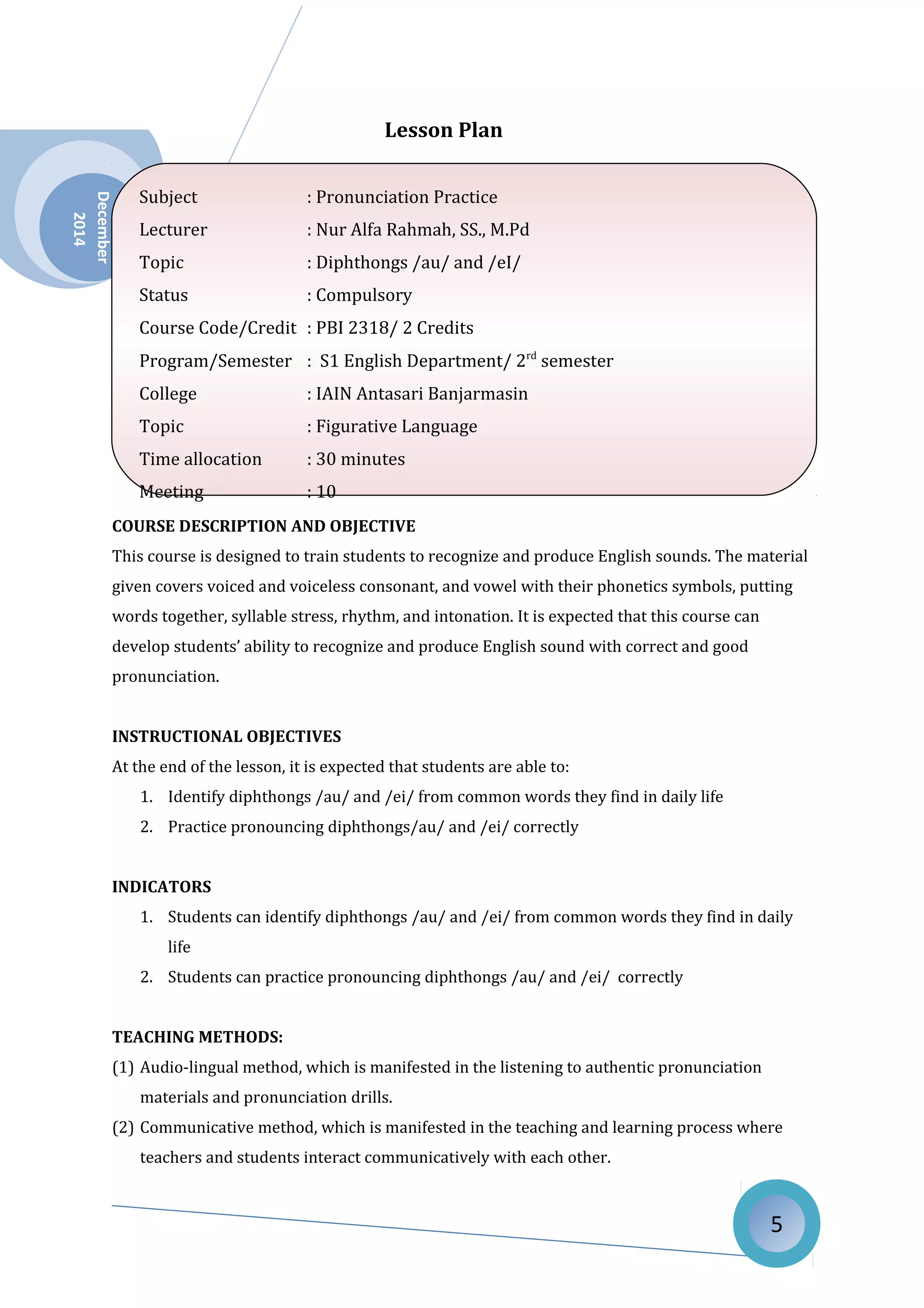
Lesson Plan
COURSE DESCRIPTION AND OBJECTIVE
This course is designed to train students to recognize and produce English sounds. The material
given covers voiced and voiceless consonant, and vowel with their phonetics symbols, putting
words together, syllable stress, rhythm, and intonation. It is expected that this course can
develop students’ ability to recognize and produce English sound with correct and good
pronunciation.
INSTRUCTIONAL OBJECTIVES
At the end of the lesson, it is expected that students are able to:
1. Identify diphthongs /au/ and /ei/ from common words they find in daily life
2. Practice pronouncing diphthongs/au/ and /ei/ correctly
INDICATORS
1. Students can identify diphthongs /au/ and /ei/ from common words they find in daily
life
2. Students can practice pronouncing diphthongs /au/ and /ei/ correctly
TEACHING METHODS:
(1) Audio-lingual method, which is manifested in the listening to authentic pronunciation
materials and pronunciation drills.
(2) Communicative method, which is manifested in the teaching and learning process where
teachers and students interact communicatively with each other.
5
Subject : Pronunciation Practice
Lecturer : Nur Alfa Rahmah, SS., M.Pd
Topic : Diphthongs /au/ and /eI/
Status : Compulsory
Course Code/Credit : PBI 2318/ 2 Credits
Program/Semester : S1 English Department/ 2rd
semester
College : IAIN Antasari Banjarmasin
Topic : Figurative Language
Time allocation : 30 minutes
Meeting : 10
December
2014
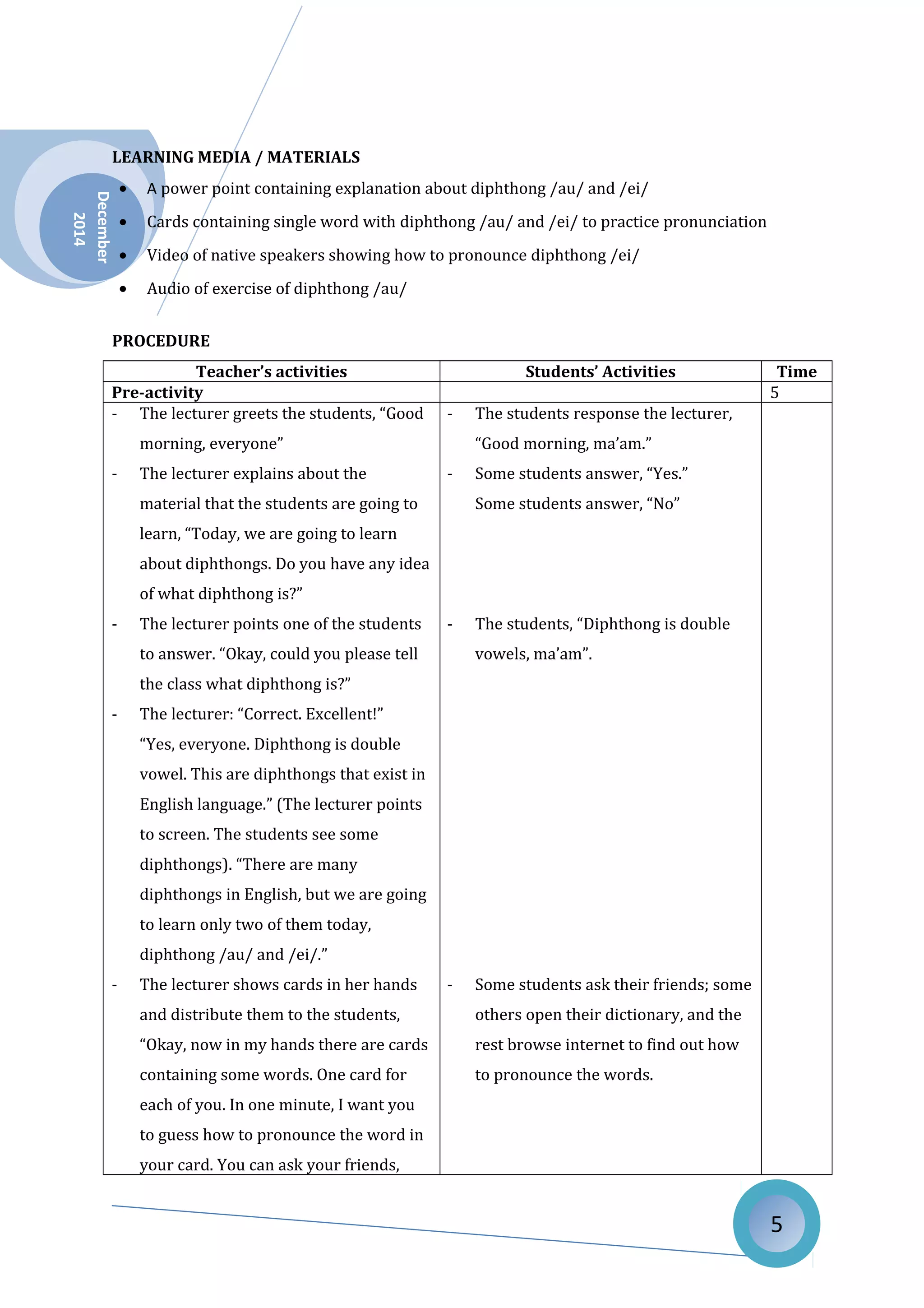
LEARNING MEDIA / MATERIALS
• A power point containing explanation about diphthong /au/ and /ei/
• Cards containing single word with diphthong /au/ and /ei/ to practice pronunciation
• Video of native speakers showing how to pronounce diphthong /ei/
• Audio of exercise of diphthong /au/
PROCEDURE
Teacher’s activities Students’ Activities Time
Pre-activity 5
- The lecturer greets the students, “Good
morning, everyone”
- The lecturer explains about the
material that the students are going to
learn, “Today, we are going to learn
about diphthongs. Do you have any idea
of what diphthong is?”
- The lecturer points one of the students
to answer. “Okay, could you please tell
the class what diphthong is?”
- The lecturer: “Correct. Excellent!”
“Yes, everyone. Diphthong is double
vowel. This are diphthongs that exist in
English language.” (The lecturer points
to screen. The students see some
diphthongs). “There are many
diphthongs in English, but we are going
to learn only two of them today,
diphthong /au/ and /ei/.”
- The lecturer shows cards in her hands
and distribute them to the students,
“Okay, now in my hands there are cards
containing some words. One card for
each of you. In one minute, I want you
to guess how to pronounce the word in
your card. You can ask your friends,
- The students response the lecturer,
“Good morning, ma’am.”
- Some students answer, “Yes.”
Some students answer, “No”
- The students, “Diphthong is double
vowels, ma’am”.
- Some students ask their friends; some
others open their dictionary, and the
rest browse internet to find out how
to pronounce the words.
5
December
2014
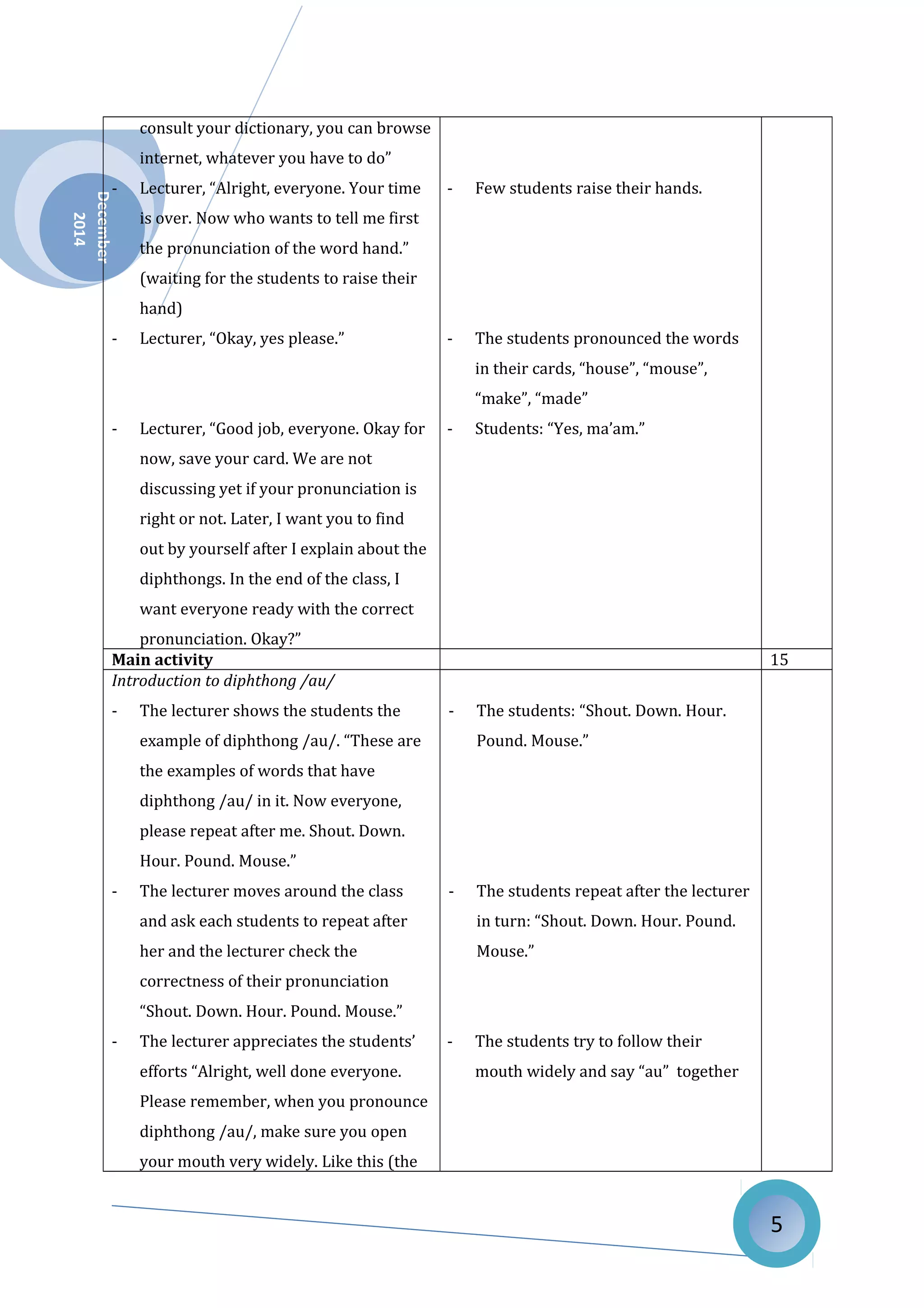
consult your dictionary, you can browse
internet, whatever you have to do”
- Lecturer, “Alright, everyone. Your time
is over. Now who wants to tell me first
the pronunciation of the word hand.”
(waiting for the students to raise their
hand)
- Lecturer, “Okay, yes please.”
- Lecturer, “Good job, everyone. Okay for
now, save your card. We are not
discussing yet if your pronunciation is
right or not. Later, I want you to find
out by yourself after I explain about the
diphthongs. In the end of the class, I
want everyone ready with the correct
pronunciation. Okay?”
- Few students raise their hands.
- The students pronounced the words
in their cards, “house”, “mouse”,
“make”, “made”
- Students: “Yes, ma’am.”
Main activity 15
Introduction to diphthong /au/
- The lecturer shows the students the
example of diphthong /au/. “These are
the examples of words that have
diphthong /au/ in it. Now everyone,
please repeat after me. Shout. Down.
Hour. Pound. Mouse.”
- The lecturer moves around the class
and ask each students to repeat after
her and the lecturer check the
correctness of their pronunciation
“Shout. Down. Hour. Pound. Mouse.”
- The lecturer appreciates the students’
efforts “Alright, well done everyone.
Please remember, when you pronounce
diphthong /au/, make sure you open
your mouth very widely. Like this (the
- The students: “Shout. Down. Hour.
Pound. Mouse.”
- The students repeat after the lecturer
in turn: “Shout. Down. Hour. Pound.
Mouse.”
- The students try to follow their
mouth widely and say “au” together
5
December
2014
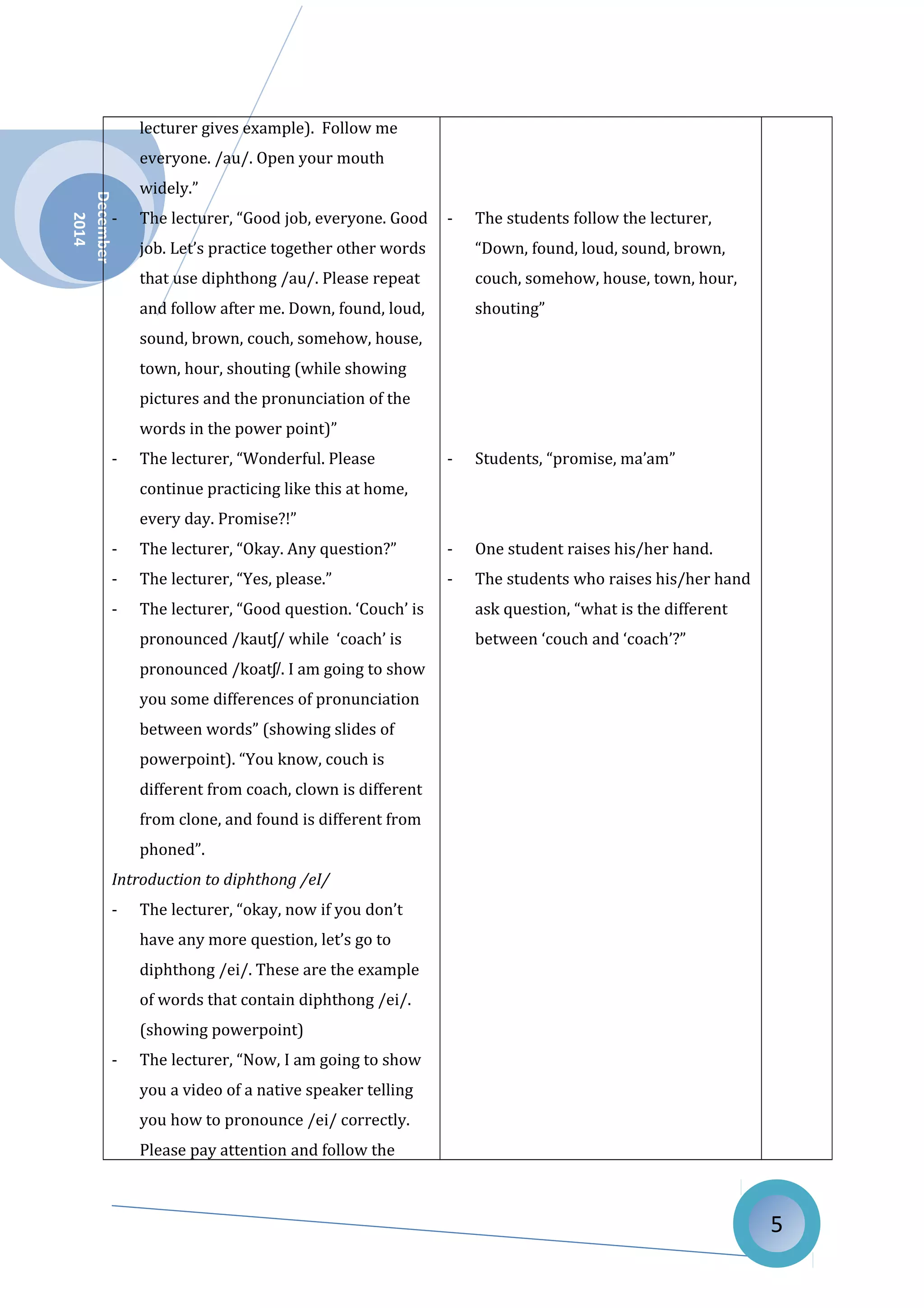
lecturer gives example). Follow me
everyone. /au/. Open your mouth
widely.”
- The lecturer, “Good job, everyone. Good
job. Let’s practice together other words
that use diphthong /au/. Please repeat
and follow after me. Down, found, loud,
sound, brown, couch, somehow, house,
town, hour, shouting (while showing
pictures and the pronunciation of the
words in the power point)”
- The lecturer, “Wonderful. Please
continue practicing like this at home,
every day. Promise?!”
- The lecturer, “Okay. Any question?”
- The lecturer, “Yes, please.”
- The lecturer, “Good question. ‘Couch’ is
pronounced /kautʃ/ while ‘coach’ is
pronounced /koat /ʃ . I am going to show
you some differences of pronunciation
between words” (showing slides of
powerpoint). “You know, couch is
different from coach, clown is different
from clone, and found is different from
phoned”.
Introduction to diphthong /eI/
- The lecturer, “okay, now if you don’t
have any more question, let’s go to
diphthong /ei/. These are the example
of words that contain diphthong /ei/.
(showing powerpoint)
- The lecturer, “Now, I am going to show
you a video of a native speaker telling
you how to pronounce /ei/ correctly.
Please pay attention and follow the
- The students follow the lecturer,
“Down, found, loud, sound, brown,
couch, somehow, house, town, hour,
shouting”
- Students, “promise, ma’am”
- One student raises his/her hand.
- The students who raises his/her hand
ask question, “what is the different
between ‘couch and ‘coach’?”
5
December
2014
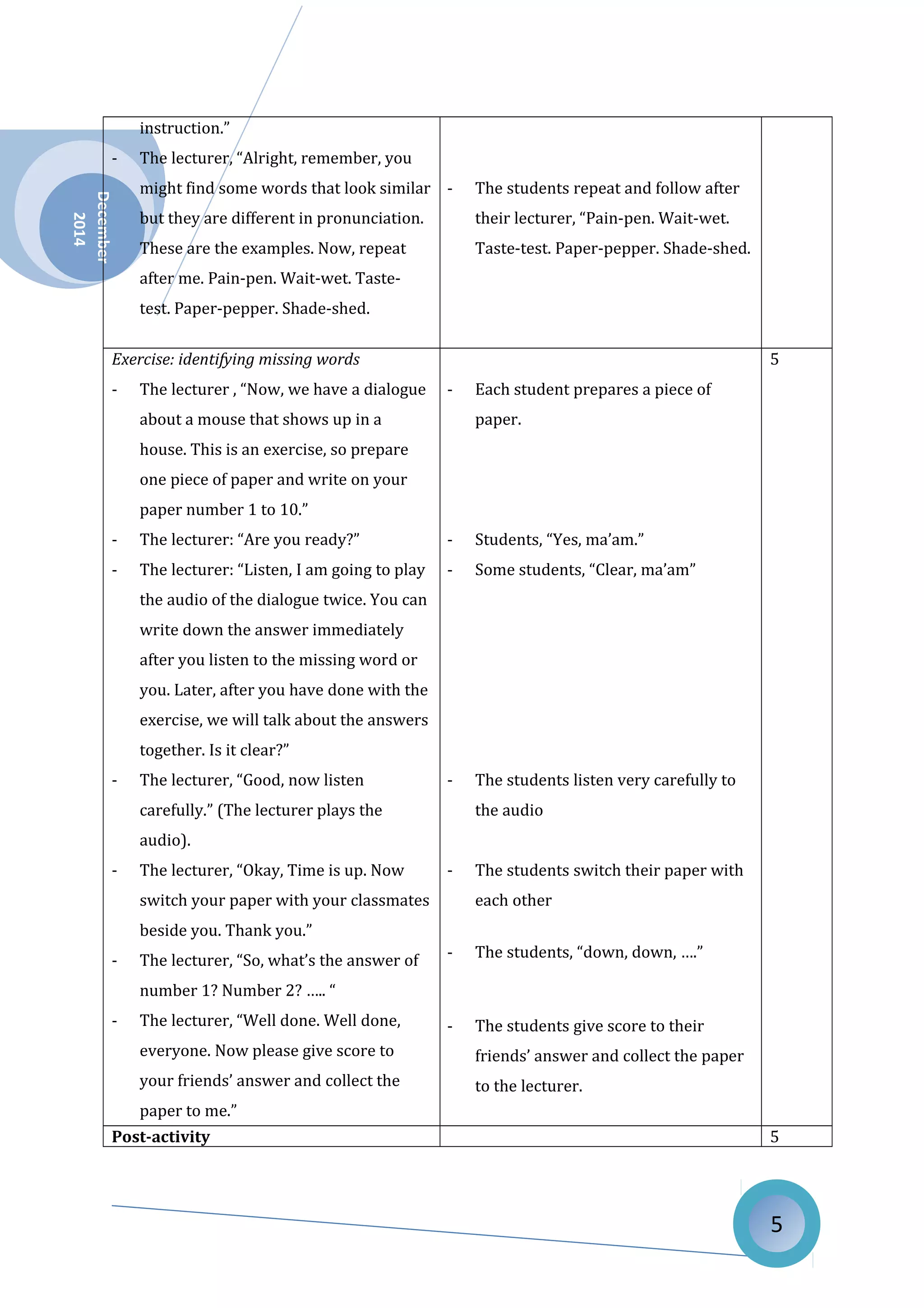
instruction.”
- The lecturer, “Alright, remember, you
might find some words that look similar
but they are different in pronunciation.
These are the examples. Now, repeat
after me. Pain-pen. Wait-wet. Taste-
test. Paper-pepper. Shade-shed.
- The students repeat and follow after
their lecturer, “Pain-pen. Wait-wet.
Taste-test. Paper-pepper. Shade-shed.
Exercise: identifying missing words
- The lecturer , “Now, we have a dialogue
about a mouse that shows up in a
house. This is an exercise, so prepare
one piece of paper and write on your
paper number 1 to 10.”
- The lecturer: “Are you ready?”
- The lecturer: “Listen, I am going to play
the audio of the dialogue twice. You can
write down the answer immediately
after you listen to the missing word or
you. Later, after you have done with the
exercise, we will talk about the answers
together. Is it clear?”
- The lecturer, “Good, now listen
carefully.” (The lecturer plays the
audio).
- The lecturer, “Okay, Time is up. Now
switch your paper with your classmates
beside you. Thank you.”
- The lecturer, “So, what’s the answer of
number 1? Number 2? ….. “
- The lecturer, “Well done. Well done,
everyone. Now please give score to
your friends’ answer and collect the
paper to me.”
- Each student prepares a piece of
paper.
- Students, “Yes, ma’am.”
- Some students, “Clear, ma’am”
- The students listen very carefully to
the audio
- The students switch their paper with
each other
- The students, “down, down, ….”
- The students give score to their
friends’ answer and collect the paper
to the lecturer.
5
Post-activity 5
5
December
2014
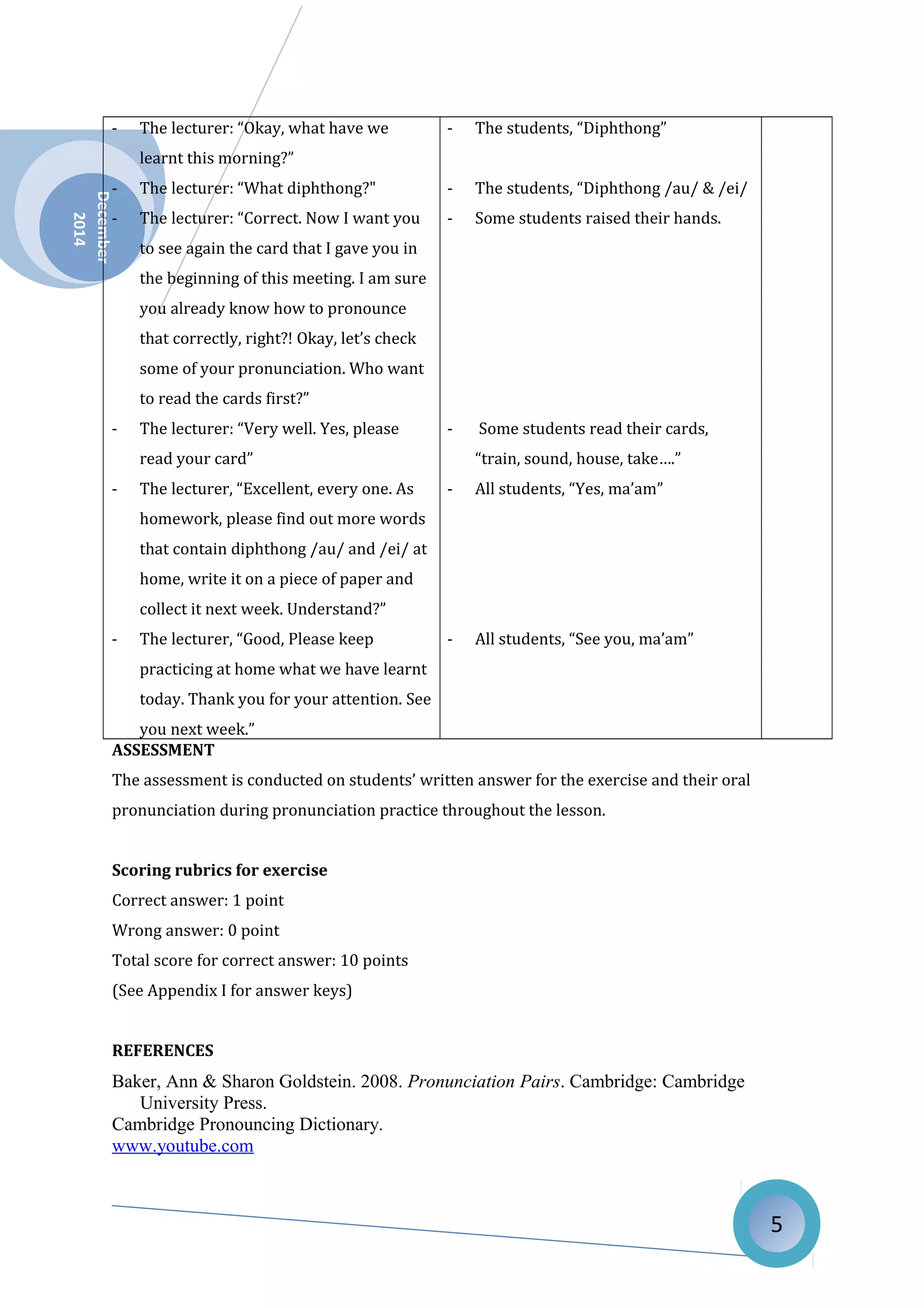
- The lecturer: “Okay, what have we
learnt this morning?”
- The lecturer: “What diphthong?"
- The lecturer: “Correct. Now I want you
to see again the card that I gave you in
the beginning of this meeting. I am sure
you already know how to pronounce
that correctly, right?! Okay, let’s check
some of your pronunciation. Who want
to read the cards first?”
- The lecturer: “Very well. Yes, please
read your card”
- The lecturer, “Excellent, every one. As
homework, please find out more words
that contain diphthong /au/ and /ei/ at
home, write it on a piece of paper and
collect it next week. Understand?”
- The lecturer, “Good, Please keep
practicing at home what we have learnt
today. Thank you for your attention. See
you next week.”
- The students, “Diphthong”
- The students, “Diphthong /au/ & /ei/
- Some students raised their hands.
- Some students read their cards,
“train, sound, house, take….”
- All students, “Yes, ma’am”
- All students, “See you, ma’am”
ASSESSMENT
The assessment is conducted on students’ written answer for the exercise and their oral
pronunciation during pronunciation practice throughout the lesson.
Scoring rubrics for exercise
Correct answer: 1 point
Wrong answer: 0 point
Total score for correct answer: 10 points
(See Appendix I for answer keys)
REFERENCES
Baker, Ann & Sharon Goldstein. 2008. Pronunciation Pairs. Cambridge: Cambridge
University Press.
Cambridge Pronouncing Dictionary.
www.youtube.com
5
December
2014
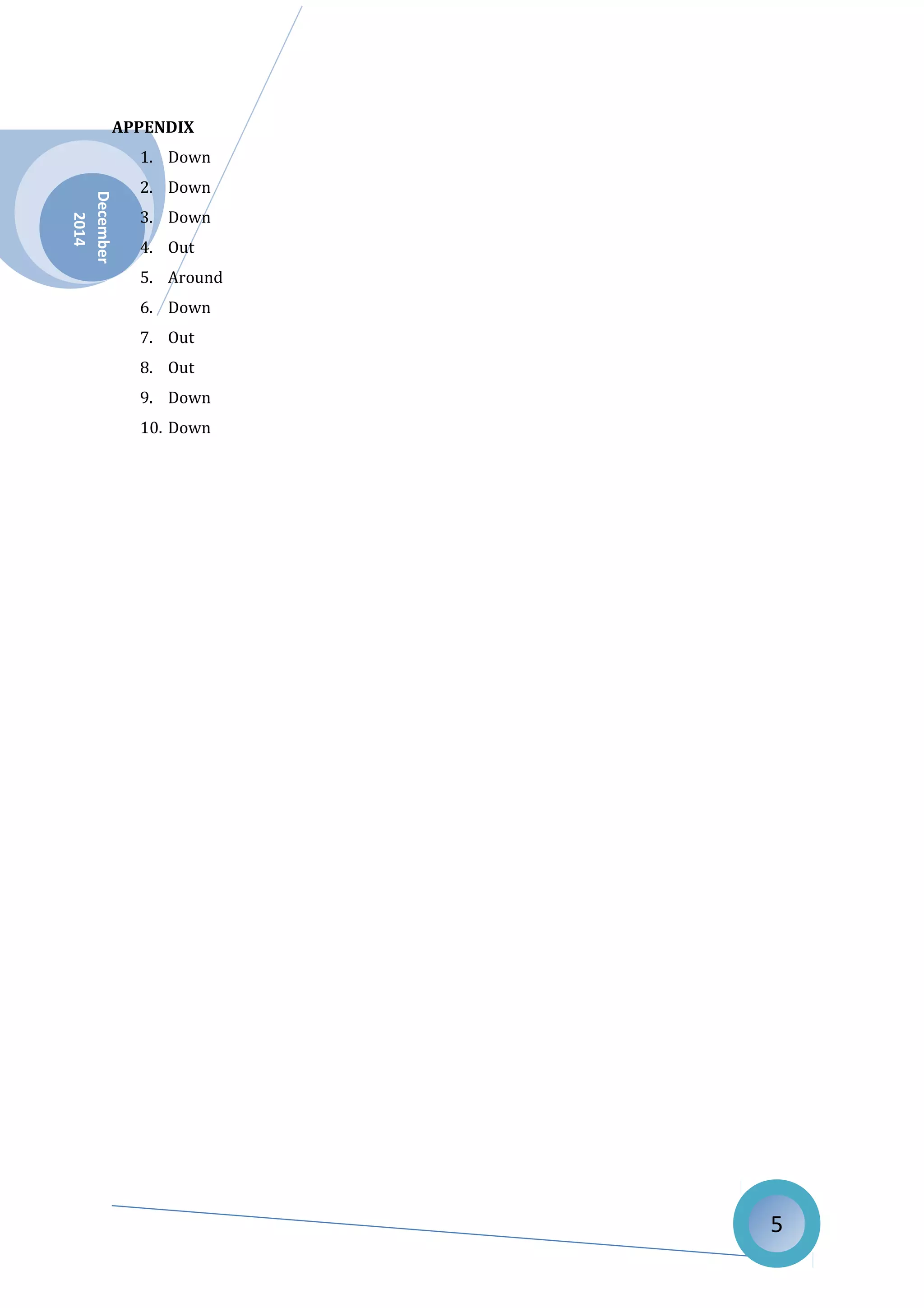
APPENDIX
1. Down
2. Down
3. Down
4. Out
5. Around
6. Down
7. Out
8. Out
9. Down
10. Down
5

Lesson plan pronunciation-

  • 1.
    December 2014 Lesson Plan COURSE DESCRIPTIONAND OBJECTIVE This course is designed to train students to recognize and produce English sounds. The material given covers voiced and voiceless consonant, and vowel with their phonetics symbols, putting words together, syllable stress, rhythm, and intonation. It is expected that this course can develop students’ ability to recognize and produce English sound with correct and good pronunciation. INSTRUCTIONAL OBJECTIVES At the end of the lesson, it is expected that students are able to: 1. Identify diphthongs /au/ and /ei/ from common words they find in daily life 2. Practice pronouncing diphthongs/au/ and /ei/ correctly INDICATORS 1. Students can identify diphthongs /au/ and /ei/ from common words they find in daily life 2. Students can practice pronouncing diphthongs /au/ and /ei/ correctly TEACHING METHODS: (1) Audio-lingual method, which is manifested in the listening to authentic pronunciation materials and pronunciation drills. (2) Communicative method, which is manifested in the teaching and learning process where teachers and students interact communicatively with each other. 5 Subject : Pronunciation Practice Lecturer : Nur Alfa Rahmah, SS., M.Pd Topic : Diphthongs /au/ and /eI/ Status : Compulsory Course Code/Credit : PBI 2318/ 2 Credits Program/Semester : S1 English Department/ 2rd semester College : IAIN Antasari Banjarmasin Topic : Figurative Language Time allocation : 30 minutes Meeting : 10
  • 2.
    December 2014 LEARNING MEDIA /MATERIALS • A power point containing explanation about diphthong /au/ and /ei/ • Cards containing single word with diphthong /au/ and /ei/ to practice pronunciation • Video of native speakers showing how to pronounce diphthong /ei/ • Audio of exercise of diphthong /au/ PROCEDURE Teacher’s activities Students’ Activities Time Pre-activity 5 - The lecturer greets the students, “Good morning, everyone” - The lecturer explains about the material that the students are going to learn, “Today, we are going to learn about diphthongs. Do you have any idea of what diphthong is?” - The lecturer points one of the students to answer. “Okay, could you please tell the class what diphthong is?” - The lecturer: “Correct. Excellent!” “Yes, everyone. Diphthong is double vowel. This are diphthongs that exist in English language.” (The lecturer points to screen. The students see some diphthongs). “There are many diphthongs in English, but we are going to learn only two of them today, diphthong /au/ and /ei/.” - The lecturer shows cards in her hands and distribute them to the students, “Okay, now in my hands there are cards containing some words. One card for each of you. In one minute, I want you to guess how to pronounce the word in your card. You can ask your friends, - The students response the lecturer, “Good morning, ma’am.” - Some students answer, “Yes.” Some students answer, “No” - The students, “Diphthong is double vowels, ma’am”. - Some students ask their friends; some others open their dictionary, and the rest browse internet to find out how to pronounce the words. 5
  • 3.
    December 2014 consult your dictionary,you can browse internet, whatever you have to do” - Lecturer, “Alright, everyone. Your time is over. Now who wants to tell me first the pronunciation of the word hand.” (waiting for the students to raise their hand) - Lecturer, “Okay, yes please.” - Lecturer, “Good job, everyone. Okay for now, save your card. We are not discussing yet if your pronunciation is right or not. Later, I want you to find out by yourself after I explain about the diphthongs. In the end of the class, I want everyone ready with the correct pronunciation. Okay?” - Few students raise their hands. - The students pronounced the words in their cards, “house”, “mouse”, “make”, “made” - Students: “Yes, ma’am.” Main activity 15 Introduction to diphthong /au/ - The lecturer shows the students the example of diphthong /au/. “These are the examples of words that have diphthong /au/ in it. Now everyone, please repeat after me. Shout. Down. Hour. Pound. Mouse.” - The lecturer moves around the class and ask each students to repeat after her and the lecturer check the correctness of their pronunciation “Shout. Down. Hour. Pound. Mouse.” - The lecturer appreciates the students’ efforts “Alright, well done everyone. Please remember, when you pronounce diphthong /au/, make sure you open your mouth very widely. Like this (the - The students: “Shout. Down. Hour. Pound. Mouse.” - The students repeat after the lecturer in turn: “Shout. Down. Hour. Pound. Mouse.” - The students try to follow their mouth widely and say “au” together 5
  • 4.
    December 2014 lecturer gives example).Follow me everyone. /au/. Open your mouth widely.” - The lecturer, “Good job, everyone. Good job. Let’s practice together other words that use diphthong /au/. Please repeat and follow after me. Down, found, loud, sound, brown, couch, somehow, house, town, hour, shouting (while showing pictures and the pronunciation of the words in the power point)” - The lecturer, “Wonderful. Please continue practicing like this at home, every day. Promise?!” - The lecturer, “Okay. Any question?” - The lecturer, “Yes, please.” - The lecturer, “Good question. ‘Couch’ is pronounced /kautʃ/ while ‘coach’ is pronounced /koat /ʃ . I am going to show you some differences of pronunciation between words” (showing slides of powerpoint). “You know, couch is different from coach, clown is different from clone, and found is different from phoned”. Introduction to diphthong /eI/ - The lecturer, “okay, now if you don’t have any more question, let’s go to diphthong /ei/. These are the example of words that contain diphthong /ei/. (showing powerpoint) - The lecturer, “Now, I am going to show you a video of a native speaker telling you how to pronounce /ei/ correctly. Please pay attention and follow the - The students follow the lecturer, “Down, found, loud, sound, brown, couch, somehow, house, town, hour, shouting” - Students, “promise, ma’am” - One student raises his/her hand. - The students who raises his/her hand ask question, “what is the different between ‘couch and ‘coach’?” 5
  • 5.
    December 2014 instruction.” - The lecturer,“Alright, remember, you might find some words that look similar but they are different in pronunciation. These are the examples. Now, repeat after me. Pain-pen. Wait-wet. Taste- test. Paper-pepper. Shade-shed. - The students repeat and follow after their lecturer, “Pain-pen. Wait-wet. Taste-test. Paper-pepper. Shade-shed. Exercise: identifying missing words - The lecturer , “Now, we have a dialogue about a mouse that shows up in a house. This is an exercise, so prepare one piece of paper and write on your paper number 1 to 10.” - The lecturer: “Are you ready?” - The lecturer: “Listen, I am going to play the audio of the dialogue twice. You can write down the answer immediately after you listen to the missing word or you. Later, after you have done with the exercise, we will talk about the answers together. Is it clear?” - The lecturer, “Good, now listen carefully.” (The lecturer plays the audio). - The lecturer, “Okay, Time is up. Now switch your paper with your classmates beside you. Thank you.” - The lecturer, “So, what’s the answer of number 1? Number 2? ….. “ - The lecturer, “Well done. Well done, everyone. Now please give score to your friends’ answer and collect the paper to me.” - Each student prepares a piece of paper. - Students, “Yes, ma’am.” - Some students, “Clear, ma’am” - The students listen very carefully to the audio - The students switch their paper with each other - The students, “down, down, ….” - The students give score to their friends’ answer and collect the paper to the lecturer. 5 Post-activity 5 5
  • 6.
    December 2014 - The lecturer:“Okay, what have we learnt this morning?” - The lecturer: “What diphthong?" - The lecturer: “Correct. Now I want you to see again the card that I gave you in the beginning of this meeting. I am sure you already know how to pronounce that correctly, right?! Okay, let’s check some of your pronunciation. Who want to read the cards first?” - The lecturer: “Very well. Yes, please read your card” - The lecturer, “Excellent, every one. As homework, please find out more words that contain diphthong /au/ and /ei/ at home, write it on a piece of paper and collect it next week. Understand?” - The lecturer, “Good, Please keep practicing at home what we have learnt today. Thank you for your attention. See you next week.” - The students, “Diphthong” - The students, “Diphthong /au/ & /ei/ - Some students raised their hands. - Some students read their cards, “train, sound, house, take….” - All students, “Yes, ma’am” - All students, “See you, ma’am” ASSESSMENT The assessment is conducted on students’ written answer for the exercise and their oral pronunciation during pronunciation practice throughout the lesson. Scoring rubrics for exercise Correct answer: 1 point Wrong answer: 0 point Total score for correct answer: 10 points (See Appendix I for answer keys) REFERENCES Baker, Ann & Sharon Goldstein. 2008. Pronunciation Pairs. Cambridge: Cambridge University Press. Cambridge Pronouncing Dictionary. www.youtube.com 5
  • 7.
    December 2014 APPENDIX 1. Down 2. Down 3.Down 4. Out 5. Around 6. Down 7. Out 8. Out 9. Down 10. Down 5