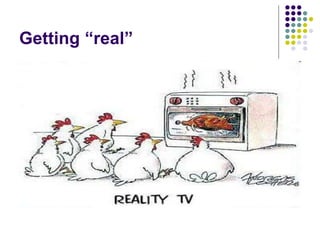
Getting “real”
An authentic material is ……
“any material which has not been specifically
produced for the purpose of language
teaching.”
(Nunan, 1998)
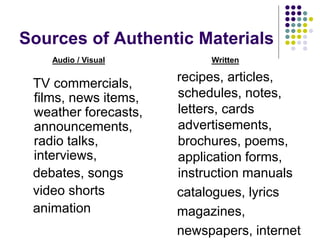
Sources of Authentic Materials
TV commercials,
films, news items,
weather forecasts,
announcements,
radio talks,
interviews,
debates, songs
video shorts
animation
recipes, articles,
schedules, notes,
letters, cards
advertisements,
brochures, poems,
application forms,
instruction manuals
catalogues, lyrics
magazines,
newspapers, internet
Audio / Visual Written
Why use Authentic Materials?
Using authentic materials is a very contentious
point in language instruction.
Many people recommend using them – others
say never. However, the truth lies
somewhere in between.
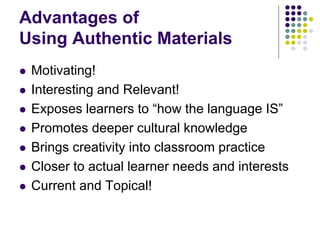
Advantages of
Using Authentic Materials
 Motivating!
 Interesting and Relevant!
 Exposes learners to “how the language IS”
 Promotes deeper cultural knowledge
 Brings creativity into classroom practice
 Closer to actual learner needs and interests
 Current and Topical!
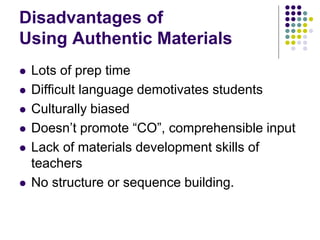
Disadvantages of
Using Authentic Materials
 Lots of prep time
 Difficult language demotivates students
 Culturally biased
 Doesn’t promote “CO”, comprehensible input
 Lack of materials development skills of
teachers
 No structure or sequence building.
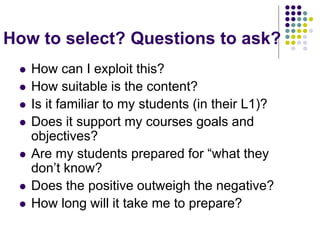
How to select? Questions to ask?
 How can I exploit this?
 How suitable is the content?
 Is it familiar to my students (in their L1)?
 Does it support my courses goals and
objectives?
 Are my students prepared for “what they
don’t know?
 Does the positive outweigh the negative?
 How long will it take me to prepare?
Authentic Materials are powerful
They offer the student a chance to practice
“real” language use.
They promote “real” learning – students try to
understand the meaning without knowing
everything.
They bridge the “test tube” of the classroom
with the eventual “real” world.
Further Reading / Resources
 Glossary Terms
 Teaching with Authentic Materials.
 Effective Ways to use Authentic Materials
 Authentic Materials and Cultural Content
 Authentic Materials: an overview
 Authentic Materials – interactive Webquest
 Using Authentic Materials in the EFL Classroom
Using authentic materials

Using authentic materials

  • 2.
  • 3.
    An authentic materialis …… “any material which has not been specifically produced for the purpose of language teaching.” (Nunan, 1998)
  • 4.
    Sources of AuthenticMaterials TV commercials, films, news items, weather forecasts, announcements, radio talks, interviews, debates, songs video shorts animation recipes, articles, schedules, notes, letters, cards advertisements, brochures, poems, application forms, instruction manuals catalogues, lyrics magazines, newspapers, internet Audio / Visual Written
  • 5.
    Why use AuthenticMaterials? Using authentic materials is a very contentious point in language instruction. Many people recommend using them – others say never. However, the truth lies somewhere in between.
  • 6.
    Advantages of Using AuthenticMaterials  Motivating!  Interesting and Relevant!  Exposes learners to “how the language IS”  Promotes deeper cultural knowledge  Brings creativity into classroom practice  Closer to actual learner needs and interests  Current and Topical!
  • 7.
    Disadvantages of Using AuthenticMaterials  Lots of prep time  Difficult language demotivates students  Culturally biased  Doesn’t promote “CO”, comprehensible input  Lack of materials development skills of teachers  No structure or sequence building.
  • 8.
    How to select?Questions to ask?  How can I exploit this?  How suitable is the content?  Is it familiar to my students (in their L1)?  Does it support my courses goals and objectives?  Are my students prepared for “what they don’t know?  Does the positive outweigh the negative?  How long will it take me to prepare?
  • 9.
    Authentic Materials arepowerful They offer the student a chance to practice “real” language use. They promote “real” learning – students try to understand the meaning without knowing everything. They bridge the “test tube” of the classroom with the eventual “real” world.
  • 11.
    Further Reading /Resources  Glossary Terms  Teaching with Authentic Materials.  Effective Ways to use Authentic Materials  Authentic Materials and Cultural Content  Authentic Materials: an overview  Authentic Materials – interactive Webquest  Using Authentic Materials in the EFL Classroom