LOGO
Assessing task-based language
teaching
D. Nunan (2004: ch.7)
by
Parisa Mehran
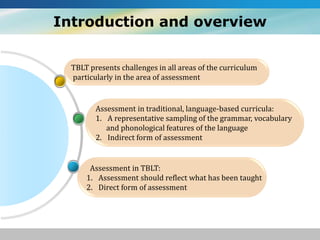
Introduction and overview
Assessment in TBLT:
1. Assessment should reflect what has been taught
2. Direct form of assessment
Assessment in traditional, language-based curricula:
1. A representative sampling of the grammar, vocabulary
and phonological features of the language
2. Indirect form of assessment
TBLT presents challenges in all areas of the curriculum
particularly in the area of assessment
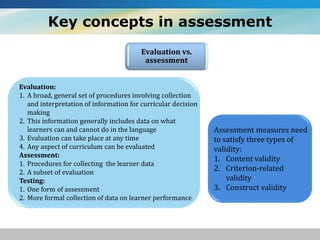
Key concepts in assessment
Evaluation vs.
assessment
Evaluation:
1. A broad, general set of procedures involving collection
and interpretation of information for curricular decision
making
2. This information generally includes data on what
learners can and cannot do in the language
3. Evaluation can take place at any time
4. Any aspect of curriculum can be evaluated
Assessment:
1. Procedures for collecting the learner data
2. A subset of evaluation
Testing:
1. One form of assessment
2. More formal collection of data on learner performance
Assessment measures need
to satisfy three types of
validity:
1. Content validity
2. Criterion-related
validity
3. Construct validity
Indirect vs. direct
assessment
Direct assessment: learners are required to
reproduce the kinds of communicative behaviors
they will need to carry out in the real world
Indirect assessment: the test does not resemble
outside-class performance
System-referenced vs.
performance-referenced
tasks
A system-referenced test item: requires
the learner to demonstrate knowledge of
the phonological, lexical or grammatical
systems of the language
A performance-referenced test item:
requires the learner to demonstrate an
ability to use the language
Why to use indirect assessment?
1. Performance-based assessment can be
difficult to set up and control
2. Grading learner performance can be
highly problematic
3. They can be quickly and conveniently
administered to many learners at the
same time
4. They are easy to score
Why to use direct performance-based
assessment?
1. It measures Ss’ abilities to respond to
real-life language tasks
2. Their scores can be used to predict Ss’
abilities in future real-world situations
Assessing proficiency
vs. achievement
Assessment of proficiency:
proficiency is meant to be independent
of any particular course of study and of
a given syllabus
Assessment of achievement:
achievement refers to the mastery by
the learner of specific curricular
objectives
According to Ingram
(1984), general
proficiency refers to
the ability to use the
language in everyday,
non-specific
situations
Teaching vs. testing
Almost any teaching task can be used for
assessment purposes and vice versa
The difference is:
1. How the task fits into an instructional
cycle
2. What is done with the learner output
from the task
Task-based
assessment
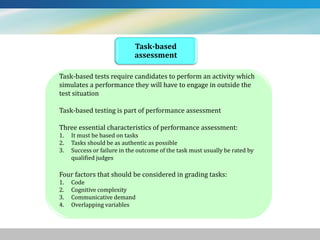
Task-based tests require candidates to perform an activity which
simulates a performance they will have to engage in outside the
test situation
Task-based testing is part of performance assessment
Three essential characteristics of performance assessment:
1. It must be based on tasks
2. Tasks should be as authentic as possible
3. Success or failure in the outcome of the task must usually be rated by
qualified judges
Four factors that should be considered in grading tasks:
1. Code
2. Cognitive complexity
3. Communicative demand
4. Overlapping variables
Norm-referenced vs.
criterion-referenced assessment
Both have to do with how student test scores are interpreted
Norm-referenced testing:
1. Ss are compared to each other
2. Ss’ scores are dispersed along a normal distribution
3. It is appropriate for ‘assessing abstracted language ability
traits’
Criterion-referenced testing:
1. It compares Ss not against each other but on how well they
do on a given assessment task
2. It is more appropriate than norm-referenced testing in TBLT
3. They are designed to assess Ss’ mastery of course objectives
The purposes of assessment
Reasons for carrying out assessment in the first
place should have an important bearing on:
1. How the assessment is carried out
2. When it is carried out
3. By whom
4. How the results will be reported
There are different functions of assessment such as
placement of learners in classes as the most important
function
Self-assessment
1
To encourage
learner autonomy
and a focus on
learning processes
as well as learning
outcomes
2
To involve learners
in their own
learning processes
3
To develop an
understanding of
learners’ own level
of skill, knowledge
or personal
readiness for a
task in relation to
their goals
Criticism to self-assessment: not all learners are
accurate judges of their own ability
Techniques for collecting assessment data
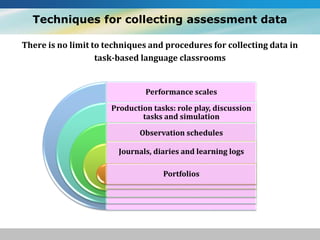
There is no limit to techniques and procedures for collecting data in
task-based language classrooms
Performance scales
Production tasks: role play, discussion
tasks and simulation
Observation schedules
Journals, diaries and learning logs
Portfolios
Criteria for assessing learner performance
1. Accuracy, fluency and complexity
Systematically manipulating the characteristics of tasks resulted in
different levels of accuracy, complexity and fluency
Five task characteristics:
1.Familiarity of the information in the task
2.Dialogic versus monologic task
3.Degree of structure to the task
4.Complexity of the task outcome
5.Transformation of language and content as speakers speak
2. Objectives-based criteria: the criteria are taken directly from the
course objectives
Conclusion
Assessment of
learning outcomes
should always:
Be
formative
in nature
Involve the direct
assessment of
student
performance
Be criterion-
referenced
Focus on the attainment
of specific objectives
rather than trying to
assess general
proficiency

Assessing Task-based Language Teaching

  • 1.
    LOGO Assessing task-based language teaching D.Nunan (2004: ch.7) by Parisa Mehran
  • 2.
    Introduction and overview Assessmentin TBLT: 1. Assessment should reflect what has been taught 2. Direct form of assessment Assessment in traditional, language-based curricula: 1. A representative sampling of the grammar, vocabulary and phonological features of the language 2. Indirect form of assessment TBLT presents challenges in all areas of the curriculum particularly in the area of assessment
  • 3.
    Key concepts inassessment Evaluation vs. assessment Evaluation: 1. A broad, general set of procedures involving collection and interpretation of information for curricular decision making 2. This information generally includes data on what learners can and cannot do in the language 3. Evaluation can take place at any time 4. Any aspect of curriculum can be evaluated Assessment: 1. Procedures for collecting the learner data 2. A subset of evaluation Testing: 1. One form of assessment 2. More formal collection of data on learner performance Assessment measures need to satisfy three types of validity: 1. Content validity 2. Criterion-related validity 3. Construct validity
  • 4.
    Indirect vs. direct assessment Directassessment: learners are required to reproduce the kinds of communicative behaviors they will need to carry out in the real world Indirect assessment: the test does not resemble outside-class performance
  • 5.
    System-referenced vs. performance-referenced tasks A system-referencedtest item: requires the learner to demonstrate knowledge of the phonological, lexical or grammatical systems of the language A performance-referenced test item: requires the learner to demonstrate an ability to use the language Why to use indirect assessment? 1. Performance-based assessment can be difficult to set up and control 2. Grading learner performance can be highly problematic 3. They can be quickly and conveniently administered to many learners at the same time 4. They are easy to score Why to use direct performance-based assessment? 1. It measures Ss’ abilities to respond to real-life language tasks 2. Their scores can be used to predict Ss’ abilities in future real-world situations
  • 6.
    Assessing proficiency vs. achievement Assessmentof proficiency: proficiency is meant to be independent of any particular course of study and of a given syllabus Assessment of achievement: achievement refers to the mastery by the learner of specific curricular objectives According to Ingram (1984), general proficiency refers to the ability to use the language in everyday, non-specific situations
  • 7.
    Teaching vs. testing Almostany teaching task can be used for assessment purposes and vice versa The difference is: 1. How the task fits into an instructional cycle 2. What is done with the learner output from the task
  • 8.
    Task-based assessment Task-based tests requirecandidates to perform an activity which simulates a performance they will have to engage in outside the test situation Task-based testing is part of performance assessment Three essential characteristics of performance assessment: 1. It must be based on tasks 2. Tasks should be as authentic as possible 3. Success or failure in the outcome of the task must usually be rated by qualified judges Four factors that should be considered in grading tasks: 1. Code 2. Cognitive complexity 3. Communicative demand 4. Overlapping variables
  • 9.
    Norm-referenced vs. criterion-referenced assessment Bothhave to do with how student test scores are interpreted Norm-referenced testing: 1. Ss are compared to each other 2. Ss’ scores are dispersed along a normal distribution 3. It is appropriate for ‘assessing abstracted language ability traits’ Criterion-referenced testing: 1. It compares Ss not against each other but on how well they do on a given assessment task 2. It is more appropriate than norm-referenced testing in TBLT 3. They are designed to assess Ss’ mastery of course objectives
  • 10.
    The purposes ofassessment Reasons for carrying out assessment in the first place should have an important bearing on: 1. How the assessment is carried out 2. When it is carried out 3. By whom 4. How the results will be reported There are different functions of assessment such as placement of learners in classes as the most important function
  • 11.
    Self-assessment 1 To encourage learner autonomy anda focus on learning processes as well as learning outcomes 2 To involve learners in their own learning processes 3 To develop an understanding of learners’ own level of skill, knowledge or personal readiness for a task in relation to their goals Criticism to self-assessment: not all learners are accurate judges of their own ability
  • 12.
    Techniques for collectingassessment data There is no limit to techniques and procedures for collecting data in task-based language classrooms Performance scales Production tasks: role play, discussion tasks and simulation Observation schedules Journals, diaries and learning logs Portfolios
  • 13.
    Criteria for assessinglearner performance 1. Accuracy, fluency and complexity Systematically manipulating the characteristics of tasks resulted in different levels of accuracy, complexity and fluency Five task characteristics: 1.Familiarity of the information in the task 2.Dialogic versus monologic task 3.Degree of structure to the task 4.Complexity of the task outcome 5.Transformation of language and content as speakers speak 2. Objectives-based criteria: the criteria are taken directly from the course objectives
  • 14.
    Conclusion Assessment of learning outcomes shouldalways: Be formative in nature Involve the direct assessment of student performance Be criterion- referenced Focus on the attainment of specific objectives rather than trying to assess general proficiency