METHODOLOGY APPLIED TO AN EFL SITUATION Universidad de Caldas Master’s Program in English Didactics 2009 Margarita Maria Lopez P.
METHODOLOGY IN ENGLISH LANGUAGE TEACHING Analysis of Methods in English Teaching Criticism to ELT methods New Trends in ELT The Communicative Methodology
LEARNING Inside and Outside the classroom Informal of formal process Consciously or unconsciously Active or Passive Learners
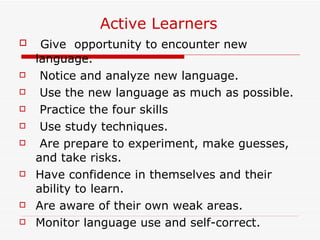
Active Learners Give  opportunity to encounter new  language. Notice and analyze new language. Use the new language as much as possible. Practice the four skills Use study techniques. Are prepare to experiment, make guesses,  and take risks. Have confidence in themselves and their ability to learn. Are aware of their own weak areas. Monitor language use and self-correct.
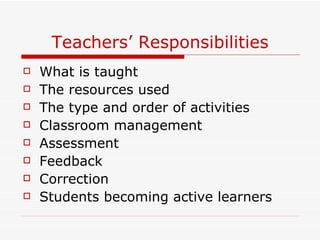
Teachers’ Responsibilities What is taught The resources used The type and order of activities Classroom management Assessment Feedback Correction Students becoming active learners
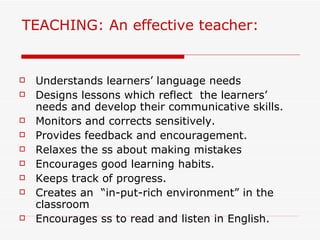
TEACHING: An effective teacher: Understands learners’ language needs Designs lessons which reflect  the learners’ needs and develop their communicative skills. Monitors and corrects sensitively. Provides feedback and encouragement. Relaxes the ss about making mistakes Encourages good learning habits. Keeps track of progress. Creates an  “in-put-rich environment” in the classroom Encourages ss to read and listen in English.
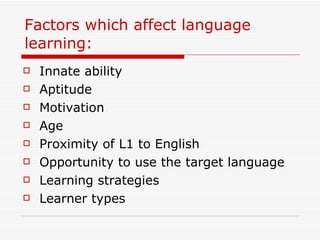
Factors which affect language learning: Innate ability Aptitude Motivation Age Proximity of L1 to English Opportunity to use the target language Learning strategies Learner types
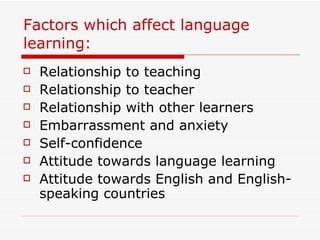
Factors which affect language learning: Relationship to teaching Relationship to teacher Relationship with other learners Embarrassment and anxiety Self-confidence Attitude towards language learning Attitude towards English and English-speaking countries
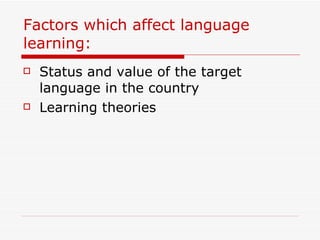
Factors which affect language learning: Status and value of the target language in the country Learning theories
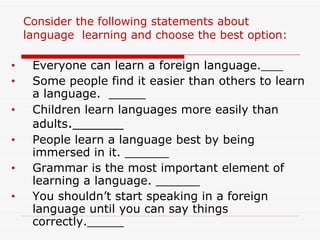
Consider the following statements about language  learning and choose the best option: Everyone can learn a foreign language.___ Some people find it easier than others to learn a language.  _____ Children learn languages more easily than adults .______ People learn a language best by being immersed in it. ______ Grammar is the most important element of learning a language. ______ You shouldn’t start speaking in a foreign language until you can say things correctly._____
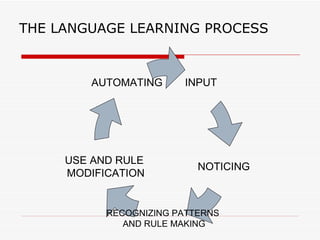
THE LANGUAGE LEARNING PROCESS INPUT NOTICING AUTOMATING RECOGNIZING PATTERNS  AND RULE MAKING USE AND RULE MODIFICATION
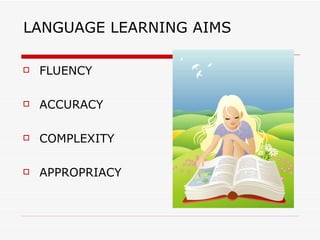
LANGUAGE LEARNING AIMS FLUENCY ACCURACY COMPLEXITY APPROPRIACY
Summary “Effective learning is the result of the partnership between learner and teacher with both taking the responsibilities appropriate to the language system and the four skills” Lindsay & Knight 2006
TEACHING METHODS AND IDEAS Edward Anthony (1963) Approach:  “A set of assumptions dealing with the nature of language learning and teaching.” Method:  “Overall plan for systematic presentation of language based upon a selected approach.” Techniques:  “Specific activities manifested in the classroom that are consistent with a method and therefore are in harmony with an approach, as well”
Language teaching over the years

Methodology Applied To An Efl Situation

  • 1.
    METHODOLOGY APPLIED TOAN EFL SITUATION Universidad de Caldas Master’s Program in English Didactics 2009 Margarita Maria Lopez P.
  • 2.
    METHODOLOGY IN ENGLISHLANGUAGE TEACHING Analysis of Methods in English Teaching Criticism to ELT methods New Trends in ELT The Communicative Methodology
  • 3.
    LEARNING Inside andOutside the classroom Informal of formal process Consciously or unconsciously Active or Passive Learners
  • 4.
    Active Learners Give opportunity to encounter new language. Notice and analyze new language. Use the new language as much as possible. Practice the four skills Use study techniques. Are prepare to experiment, make guesses, and take risks. Have confidence in themselves and their ability to learn. Are aware of their own weak areas. Monitor language use and self-correct.
  • 5.
    Teachers’ Responsibilities Whatis taught The resources used The type and order of activities Classroom management Assessment Feedback Correction Students becoming active learners
  • 6.
    TEACHING: An effectiveteacher: Understands learners’ language needs Designs lessons which reflect the learners’ needs and develop their communicative skills. Monitors and corrects sensitively. Provides feedback and encouragement. Relaxes the ss about making mistakes Encourages good learning habits. Keeps track of progress. Creates an “in-put-rich environment” in the classroom Encourages ss to read and listen in English.
  • 7.
    Factors which affectlanguage learning: Innate ability Aptitude Motivation Age Proximity of L1 to English Opportunity to use the target language Learning strategies Learner types
  • 8.
    Factors which affectlanguage learning: Relationship to teaching Relationship to teacher Relationship with other learners Embarrassment and anxiety Self-confidence Attitude towards language learning Attitude towards English and English-speaking countries
  • 9.
    Factors which affectlanguage learning: Status and value of the target language in the country Learning theories
  • 10.
    Consider the followingstatements about language learning and choose the best option: Everyone can learn a foreign language.___ Some people find it easier than others to learn a language. _____ Children learn languages more easily than adults .______ People learn a language best by being immersed in it. ______ Grammar is the most important element of learning a language. ______ You shouldn’t start speaking in a foreign language until you can say things correctly._____
  • 11.
    THE LANGUAGE LEARNINGPROCESS INPUT NOTICING AUTOMATING RECOGNIZING PATTERNS AND RULE MAKING USE AND RULE MODIFICATION
  • 12.
    LANGUAGE LEARNING AIMSFLUENCY ACCURACY COMPLEXITY APPROPRIACY
  • 13.
    Summary “Effective learningis the result of the partnership between learner and teacher with both taking the responsibilities appropriate to the language system and the four skills” Lindsay & Knight 2006
  • 14.
    TEACHING METHODS ANDIDEAS Edward Anthony (1963) Approach: “A set of assumptions dealing with the nature of language learning and teaching.” Method: “Overall plan for systematic presentation of language based upon a selected approach.” Techniques: “Specific activities manifested in the classroom that are consistent with a method and therefore are in harmony with an approach, as well”
  • 15.