®
© 2014 MapR Technologies 1
®
© 2014 MapR Technologies
Apache Spark
Keys Botzum
Senior Principal Technologist, MapR Technologies
June 2014
®
© 2014 MapR Technologies 2
Agenda
•  MapReduce
•  Apache Spark
•  How Spark Works
•  Fault Tolerance and Performance
•  Examples
•  Spark and More
®
© 2014 MapR Technologies 3
MapR: Best Product, Best Business & Best
Customers
Top Ranked
Exponential
Growth
500+
Customers Cloud Leaders
3X bookings Q1 ‘13 – Q1 ‘14
80% of accounts expand 3X
90% software licenses
<1% lifetime churn
>$1B
in incremental revenue
generated by 1 customer
®
© 2014 MapR Technologies 4© 2014 MapR Technologies
®
Review: MapReduce
®
© 2014 MapR Technologies 5
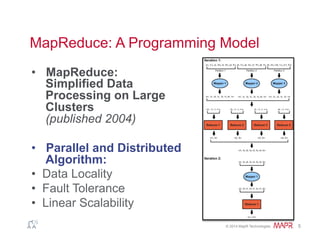
MapReduce: A Programming Model
•  MapReduce:
Simplified Data
Processing on Large
Clusters
(published 2004)
•  Parallel and Distributed
Algorithm:
•  Data Locality
•  Fault Tolerance
•  Linear Scalability
®
© 2014 MapR Technologies 6
MapReduce Basics
•  Assumes scalable distributed file system that
shards data
•  Map
–  Loading of the data and defining a set of keys
•  Reduce
–  Collects the organized key-based data to process
and output
•  Performance can be tweaked based on known
details of your source files and cluster shape
(size, total number)
®
© 2014 MapR Technologies 7
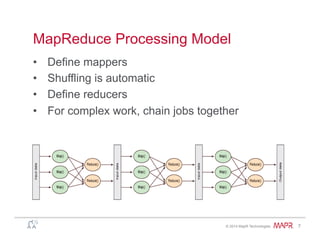
MapReduce Processing Model
•  Define mappers
•  Shuffling is automatic
•  Define reducers
•  For complex work, chain jobs together
®
© 2014 MapR Technologies 8
MapReduce: The Good
•  Built in fault tolerance
•  Optimized IO path
•  Scalable
•  Developer focuses on Map/Reduce, not
infrastructure
•  simple? API
®
© 2014 MapR Technologies 9
MapReduce: The Bad
•  Optimized for disk IO
–  Doesn’t leverage memory well
–  Iterative algorithms go through disk IO path again
and again
•  Primitive API
–  Developer’s have to build on very simple abstraction
–  Key/Value in/out
–  Even basic things like join require extensive code
•  Result often many files that need to be
combined appropriately
®
© 2014 MapR Technologies 10© 2014 MapR Technologies
®
Apache Spark
®
© 2014 MapR Technologies 11
Apache Spark
•  spark.apache.org
•  github.com/apache/spark
•  user@spark.apache.org
•  Originally developed in
2009 in UC Berkeley’s
AMP Lab
•  Fully open sourced in
2010 – now at Apache
Software Foundation
- Commercial Vendor Developing/Supporting
®
© 2014 MapR Technologies 12
Spark: Easy and Fast Big Data
•  Easy to Develop
–  Rich APIs in
Java, Scala,
Python
–  Interactive shell
•  Fast to Run
–  General execution
graphs
–  In-memory storage
2-5× less code
®
© 2014 MapR Technologies 13
Resilient Distributed Datasets (RDD)
•  Spark revolves around RDDs
•  Fault-tolerant read only collection of elements
that can be operated on in parallel
•  Cached in memory or on disk
http://www.cs.berkeley.edu/~matei/papers/2012/nsdi_spark.pdf
®
© 2014 MapR Technologies 14
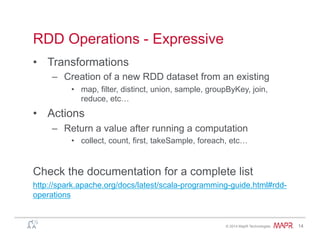
RDD Operations - Expressive
•  Transformations
–  Creation of a new RDD dataset from an existing
•  map, filter, distinct, union, sample, groupByKey, join,
reduce, etc…
•  Actions
–  Return a value after running a computation
•  collect, count, first, takeSample, foreach, etc…
Check the documentation for a complete list
http://spark.apache.org/docs/latest/scala-programming-guide.html#rdd-
operations
®
© 2014 MapR Technologies 15
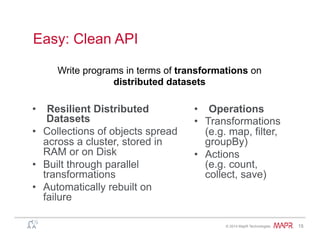
Easy: Clean API
•  Resilient Distributed
Datasets
•  Collections of objects spread
across a cluster, stored in
RAM or on Disk
•  Built through parallel
transformations
•  Automatically rebuilt on
failure
•  Operations
•  Transformations
(e.g. map, filter,
groupBy)
•  Actions
(e.g. count,
collect, save)
Write programs in terms of transformations on
distributed datasets
®
© 2014 MapR Technologies 16
Easy: Expressive API
•  map •  reduce
®
© 2014 MapR Technologies 17
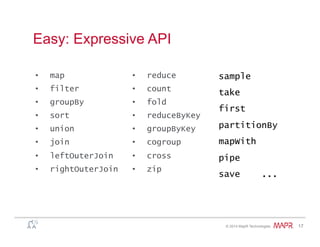
Easy: Expressive API
•  map
•  filter
•  groupBy
•  sort
•  union
•  join
•  leftOuterJoin
•  rightOuterJoin
•  reduce
•  count
•  fold
•  reduceByKey
•  groupByKey
•  cogroup
•  cross
•  zip
sample
take
first
partitionBy
mapWith
pipe
save ...
®
© 2014 MapR Technologies 18
Easy: Example – Word Count
•  Spark•  Hadoop MapReduce
public static class WordCountMapClass extends MapReduceBase
implements Mapper<LongWritable, Text, Text, IntWritable> {
private final static IntWritable one = new IntWritable(1);
private Text word = new Text();
public void map(LongWritable key, Text value,
OutputCollector<Text, IntWritable> output,
Reporter reporter) throws IOException {
String line = value.toString();
StringTokenizer itr = new StringTokenizer(line);
while (itr.hasMoreTokens()) {
word.set(itr.nextToken());
output.collect(word, one);
}
}
}
public static class WorkdCountReduce extends MapReduceBase
implements Reducer<Text, IntWritable, Text, IntWritable> {
public void reduce(Text key, Iterator<IntWritable> values,
OutputCollector<Text, IntWritable> output,
Reporter reporter) throws IOException {
int sum = 0;
while (values.hasNext()) {
sum += values.next().get();
}
output.collect(key, new IntWritable(sum));
}
}
val spark = new SparkContext(master, appName, [sparkHome], [jars])
val file = spark.textFile("hdfs://...")
val counts = file.flatMap(line => line.split(" "))
.map(word => (word, 1))
.reduceByKey(_ + _)
counts.saveAsTextFile("hdfs://...")
®
© 2014 MapR Technologies 19
Easy: Example – Word Count
•  Spark•  Hadoop MapReduce
public static class WordCountMapClass extends MapReduceBase
implements Mapper<LongWritable, Text, Text, IntWritable> {
private final static IntWritable one = new IntWritable(1);
private Text word = new Text();
public void map(LongWritable key, Text value,
OutputCollector<Text, IntWritable> output,
Reporter reporter) throws IOException {
String line = value.toString();
StringTokenizer itr = new StringTokenizer(line);
while (itr.hasMoreTokens()) {
word.set(itr.nextToken());
output.collect(word, one);
}
}
}
public static class WorkdCountReduce extends MapReduceBase
implements Reducer<Text, IntWritable, Text, IntWritable> {
public void reduce(Text key, Iterator<IntWritable> values,
OutputCollector<Text, IntWritable> output,
Reporter reporter) throws IOException {
int sum = 0;
while (values.hasNext()) {
sum += values.next().get();
}
output.collect(key, new IntWritable(sum));
}
}
val spark = new SparkContext(master, appName, [sparkHome], [jars])
val file = spark.textFile("hdfs://...")
val counts = file.flatMap(line => line.split(" "))
.map(word => (word, 1))
.reduceByKey(_ + _)
counts.saveAsTextFile("hdfs://...")
®
© 2014 MapR Technologies 20
Easy: Works Well With Hadoop
•  Data Compatibility
•  Access your existing
Hadoop Data
•  Use the same data
formats
•  Adheres to data
locality for efficient
processing
•  Deployment
Models
•  “Standalone”
deployment
•  YARN-based
deployment
•  Mesos-based
deployment
•  Deploy on existing
Hadoop cluster or
side-by-side
®
© 2014 MapR Technologies 21
Easy: User-Driven Roadmap
•  Language support
–  Improved Python
support
–  SparkR
–  Java 8
–  Integrated Schema
and SQL support in
Spark’s APIs
•  Better ML
–  Sparse Data
Support
–  Model Evaluation
Framework
–  Performance Testing
®
© 2014 MapR Technologies 22
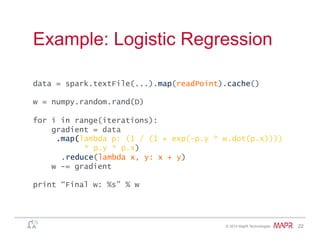
Example: Logistic Regression
data = spark.textFile(...).map(readPoint).cache()
w = numpy.random.rand(D)
for i in range(iterations):
gradient = data
.map(lambda p: (1 / (1 + exp(-p.y * w.dot(p.x))))
* p.y * p.x)
.reduce(lambda x, y: x + y)
w -= gradient
print “Final w: %s” % w
®
© 2014 MapR Technologies 23
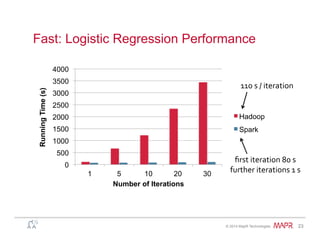
Fast: Logistic Regression Performance
0
500
1000
1500
2000
2500
3000
3500
4000
1 5 10 20 30
RunningTime(s)
Number of Iterations
Hadoop
Spark
110	
  s	
  /	
  iteration	
  
first	
  iteration	
  80	
  s	
  
further	
  iterations	
  1	
  s	
  
®
© 2014 MapR Technologies 24
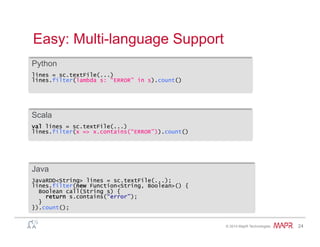
Easy: Multi-language Support
Python
lines = sc.textFile(...)
lines.filter(lambda s: “ERROR” in s).count()
Scala
val lines = sc.textFile(...)
lines.filter(x => x.contains(“ERROR”)).count()
Java
JavaRDD<String> lines = sc.textFile(...);
lines.filter(new Function<String, Boolean>() {
Boolean call(String s) {
return s.contains(“error”);
}
}).count();
®
© 2014 MapR Technologies 25
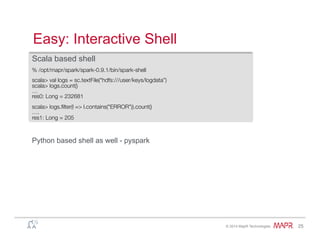
Easy: Interactive Shell
Scala based shell
% /opt/mapr/spark/spark-0.9.1/bin/spark-shell
scala> val logs = sc.textFile("hdfs:///user/keys/logdata”)"
scala> logs.count()"
…"
res0: Long = 232681
scala> logs.filter(l => l.contains("ERROR")).count()"
…."
res1: Long = 205

Python based shell as well - pyspark
®
© 2014 MapR Technologies 26© 2014 MapR Technologies
®
Fault Tolerance and Performance
®
© 2014 MapR Technologies 27
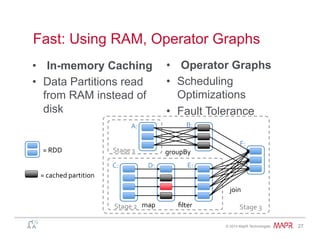
Fast: Using RAM, Operator Graphs
•  In-memory Caching
•  Data Partitions read
from RAM instead of
disk
•  Operator Graphs
•  Scheduling
Optimizations
•  Fault Tolerance
=	
  cached	
  partition	
  
=	
  RDD	
  
join	
  
filter	
  
groupBy	
  
Stage	
  3	
  
Stage	
  1	
  
Stage	
  2	
  
A:	
   B:	
  
C:	
   D:	
   E:	
  
F:	
  
map	
  
®
© 2014 MapR Technologies 28
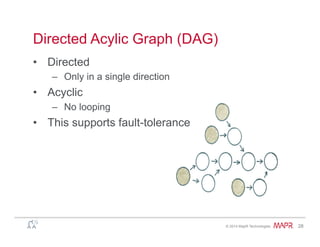
Directed Acylic Graph (DAG)
•  Directed
–  Only in a single direction
•  Acyclic
–  No looping
•  This supports fault-tolerance
®
© 2014 MapR Technologies 29
Easy: Fault Recovery
RDDs track lineage information that can be used to
efficiently recompute lost data
msgs = textFile.filter(lambda s: s.startsWith(“ERROR”))
.map(lambda s: s.split(“t”)[2])
HDFS File Filtered RDD Mapped RDD
filter	
  
(func	
  =	
  startsWith(…))	
  
map	
  
(func	
  =	
  split(...))	
  
®
© 2014 MapR Technologies 30
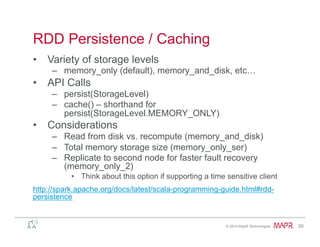
RDD Persistence / Caching
•  Variety of storage levels
–  memory_only (default), memory_and_disk, etc…
•  API Calls
–  persist(StorageLevel)
–  cache() – shorthand for
persist(StorageLevel.MEMORY_ONLY)
•  Considerations
–  Read from disk vs. recompute (memory_and_disk)
–  Total memory storage size (memory_only_ser)
–  Replicate to second node for faster fault recovery
(memory_only_2)
•  Think about this option if supporting a time sensitive client
http://spark.apache.org/docs/latest/scala-programming-guide.html#rdd-
persistence
®
© 2014 MapR Technologies 31
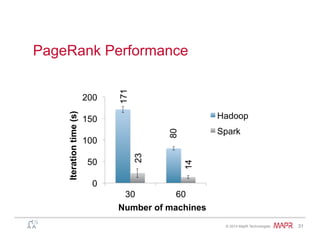
PageRank Performance
171
80
23
14
0
50
100
150
200
30 60
Iterationtime(s)
Number of machines
Hadoop
Spark
®
© 2014 MapR Technologies 32
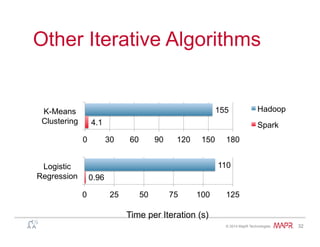
Other Iterative Algorithms
0.96
110
0 25 50 75 100 125
Logistic
Regression
4.1
155
0 30 60 90 120 150 180
K-Means
Clustering
Hadoop
Spark
Time per Iteration (s)
®
© 2014 MapR Technologies 33
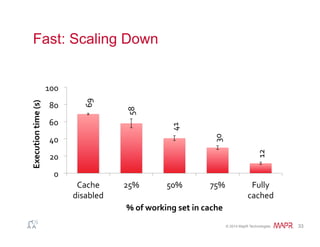
Fast: Scaling Down
69	
  
58	
  
41	
  
30	
  
12	
  
0	
  
20	
  
40	
  
60	
  
80	
  
100	
  
Cache	
  
disabled	
  
25%	
   50%	
   75%	
   Fully	
  
cached	
  
Execution	
  time	
  (s)	
  
%	
  of	
  working	
  set	
  in	
  cache	
  
®
© 2014 MapR Technologies 34
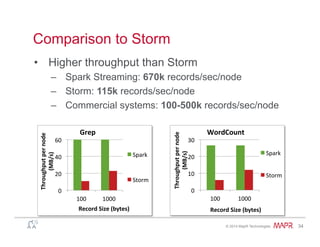
Comparison to Storm
•  Higher throughput than Storm
–  Spark Streaming: 670k records/sec/node
–  Storm: 115k records/sec/node
–  Commercial systems: 100-500k records/sec/node
0	
  
10	
  
20	
  
30	
  
100	
   1000	
  
Throughput	
  per	
  node	
  
(MB/s)	
  
Record	
  Size	
  (bytes)	
  
WordCount	
  
Spark	
  
Storm	
  
0	
  
20	
  
40	
  
60	
  
100	
   1000	
  
Throughput	
  per	
  node	
  
(MB/s)	
  
Record	
  Size	
  (bytes)	
  
Grep	
  
Spark	
  
Storm	
  
®
© 2014 MapR Technologies 35© 2014 MapR Technologies
®
How Spark Works
®
© 2014 MapR Technologies 36
Working With RDDs
®
© 2014 MapR Technologies 37
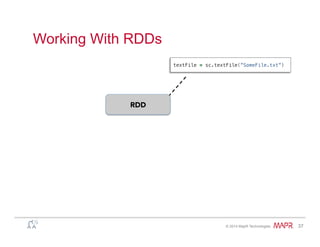
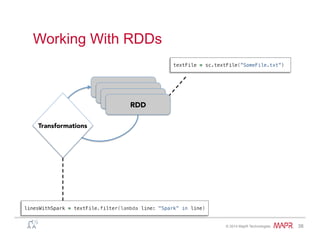
Working With RDDs
RDD
textFile = sc.textFile(”SomeFile.txt”)!
®
© 2014 MapR Technologies 38
Working With RDDs
RDD
RDD
RDD
RDD
Transformations
linesWithSpark = textFile.filter(lambda line: "Spark” in line)!
textFile = sc.textFile(”SomeFile.txt”)!
®
© 2014 MapR Technologies 39
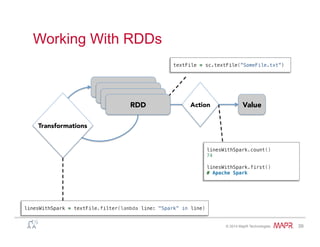
Working With RDDs
RDD
RDD
RDD
RDD
Transformations
Action
 Value
linesWithSpark = textFile.filter(lambda line: "Spark” in line)!
linesWithSpark.count()!
74!
!
linesWithSpark.first()!
# Apache Spark!
textFile = sc.textFile(”SomeFile.txt”)!
®
© 2014 MapR Technologies 40© 2014 MapR Technologies
®
Example: Log Mining
®
© 2014 MapR Technologies 41
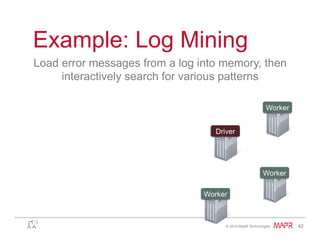
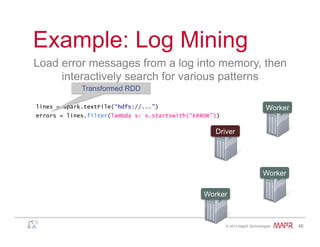
Example: Log Mining
Load error messages from a log into memory, then
interactively search for various patterns
®
© 2014 MapR Technologies 42
Example: Log Mining
Load error messages from a log into memory, then
interactively search for various patterns
Worker
Worker
Worker
Driver
®
© 2014 MapR Technologies 43
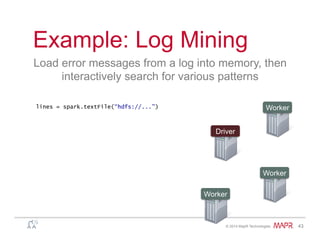
Example: Log Mining
Load error messages from a log into memory, then
interactively search for various patterns
Worker
Worker
Worker
Driver
lines = spark.textFile(“hdfs://...”)
®
© 2014 MapR Technologies 44
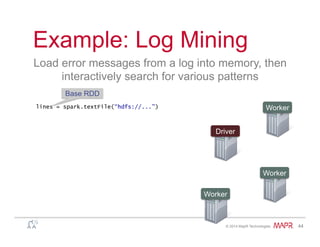
Example: Log Mining
Load error messages from a log into memory, then
interactively search for various patterns
Worker
Worker
Worker
Driver
lines = spark.textFile(“hdfs://...”)
Base RDD
®
© 2014 MapR Technologies 45
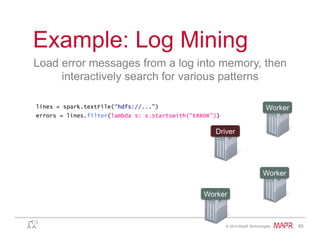
Example: Log Mining
Load error messages from a log into memory, then
interactively search for various patterns
lines = spark.textFile(“hdfs://...”)
errors = lines.filter(lambda s: s.startswith(“ERROR”))
Worker
Worker
Worker
Driver
®
© 2014 MapR Technologies 46
Example: Log Mining
Load error messages from a log into memory, then
interactively search for various patterns
lines = spark.textFile(“hdfs://...”)
errors = lines.filter(lambda s: s.startswith(“ERROR”))
Worker
Worker
Worker
Driver
Transformed RDD
®
© 2014 MapR Technologies 47
Example: Log Mining
Load error messages from a log into memory, then
interactively search for various patterns
lines = spark.textFile(“hdfs://...”)
errors = lines.filter(lambda s: s.startswith(“ERROR”))
messages = errors.map(lambda s: s.split(“t”)[2])
messages.cache()
Worker
Worker
Worker
Driver
messages.filter(lambda s: “mysql” in s).count()
®
© 2014 MapR Technologies 48
Example: Log Mining
Load error messages from a log into memory, then
interactively search for various patterns
lines = spark.textFile(“hdfs://...”)
errors = lines.filter(lambda s: s.startswith(“ERROR”))
messages = errors.map(lambda s: s.split(“t”)[2])
messages.cache()
Worker
Worker
Worker
Driver
messages.filter(lambda s: “mysql” in s).count()
Action
®
© 2014 MapR Technologies 49
Example: Log Mining
Load error messages from a log into memory, then
interactively search for various patterns
lines = spark.textFile(“hdfs://...”)
errors = lines.filter(lambda s: s.startswith(“ERROR”))
messages = errors.map(lambda s: s.split(“t”)[2])
messages.cache()
Worker
Worker
Worker
Driver
messages.filter(lambda s: “mysql” in s).count()
Block 1
Block 2
Block 3
®
© 2014 MapR Technologies 50
Example: Log Mining
Load error messages from a log into memory, then
interactively search for various patterns
lines = spark.textFile(“hdfs://...”)
errors = lines.filter(lambda s: s.startswith(“ERROR”))
messages = errors.map(lambda s: s.split(“t”)[2])
messages.cache()
Worker
Worker
Worker
messages.filter(lambda s: “mysql” in s).count()
Block 1
Block 2
Block 3
Driver
tasks
tasks
tasks
®
© 2014 MapR Technologies 51
Example: Log Mining
Load error messages from a log into memory, then
interactively search for various patterns
lines = spark.textFile(“hdfs://...”)
errors = lines.filter(lambda s: s.startswith(“ERROR”))
messages = errors.map(lambda s: s.split(“t”)[2])
messages.cache()
Worker
Worker
Worker
messages.filter(lambda s: “mysql” in s).count()
Block 1
Block 2
Block 3
Driver
Read
HDFS
Block
Read
HDFS
Block
Read
HDFS
Block
®
© 2014 MapR Technologies 52
Example: Log Mining
Load error messages from a log into memory, then
interactively search for various patterns
lines = spark.textFile(“hdfs://...”)
errors = lines.filter(lambda s: s.startswith(“ERROR”))
messages = errors.map(lambda s: s.split(“t”)[2])
messages.cache()
Worker
Worker
Worker
messages.filter(lambda s: “mysql” in s).count()
Block 1
Block 2
Block 3
Driver
Cache 1
Cache 2
Cache 3
Process
& Cache
Data
Process
& Cache
Data
Process
& Cache
Data
®
© 2014 MapR Technologies 53
Example: Log Mining
Load error messages from a log into memory, then
interactively search for various patterns
lines = spark.textFile(“hdfs://...”)
errors = lines.filter(lambda s: s.startswith(“ERROR”))
messages = errors.map(lambda s: s.split(“t”)[2])
messages.cache()
Worker
Worker
Worker
messages.filter(lambda s: “mysql” in s).count()
Block 1
Block 2
Block 3
Driver
Cache 1
Cache 2
Cache 3
results
results
results
®
© 2014 MapR Technologies 54
Example: Log Mining
Load error messages from a log into memory, then
interactively search for various patterns
lines = spark.textFile(“hdfs://...”)
errors = lines.filter(lambda s: s.startswith(“ERROR”))
messages = errors.map(lambda s: s.split(“t”)[2])
messages.cache()
Worker
Worker
Worker
messages.filter(lambda s: “mysql” in s).count()
Block 1
Block 2
Block 3
Driver
Cache 1
Cache 2
Cache 3
messages.filter(lambda s: “php” in s).count()
®
© 2014 MapR Technologies 55
Example: Log Mining
Load error messages from a log into memory, then
interactively search for various patterns
lines = spark.textFile(“hdfs://...”)
errors = lines.filter(lambda s: s.startswith(“ERROR”))
messages = errors.map(lambda s: s.split(“t”)[2])
messages.cache()
Worker
Worker
Worker
messages.filter(lambda s: “mysql” in s).count()
Block 1
Block 2
Block 3
Cache 1
Cache 2
Cache 3
messages.filter(lambda s: “php” in s).count()
tasks
tasks
tasks
Driver
®
© 2014 MapR Technologies 56
Example: Log Mining
Load error messages from a log into memory, then
interactively search for various patterns
lines = spark.textFile(“hdfs://...”)
errors = lines.filter(lambda s: s.startswith(“ERROR”))
messages = errors.map(lambda s: s.split(“t”)[2])
messages.cache()
Worker
Worker
Worker
messages.filter(lambda s: “mysql” in s).count()
Block 1
Block 2
Block 3
Cache 1
Cache 2
Cache 3
messages.filter(lambda s: “php” in s).count()
Driver
Process
from
Cache
Process
from
Cache
Process
from
Cache
®
© 2014 MapR Technologies 57
Example: Log Mining
Load error messages from a log into memory, then
interactively search for various patterns
lines = spark.textFile(“hdfs://...”)
errors = lines.filter(lambda s: s.startswith(“ERROR”))
messages = errors.map(lambda s: s.split(“t”)[2])
messages.cache()
Worker
Worker
Worker
messages.filter(lambda s: “mysql” in s).count()
Block 1
Block 2
Block 3
Cache 1
Cache 2
Cache 3
messages.filter(lambda s: “php” in s).count()
Driver
results
results
results
®
© 2014 MapR Technologies 58
Example: Log Mining
Load error messages from a log into memory, then
interactively search for various patterns
lines = spark.textFile(“hdfs://...”)
errors = lines.filter(lambda s: s.startswith(“ERROR”))
messages = errors.map(lambda s: s.split(“t”)[2])
messages.cache()
Worker
Worker
Worker
messages.filter(lambda s: “mysql” in s).count()
Block 1
Block 2
Block 3
Cache 1
Cache 2
Cache 3
messages.filter(lambda s: “php” in s).count()
Driver
Cache your data è Faster Results
Full-text search of Wikipedia
•  60GB on 20 EC2 machines
•  0.5 sec from cache vs. 20s for on-disk
®
© 2014 MapR Technologies 59© 2014 MapR Technologies
®
Example: Page Rank
®
© 2014 MapR Technologies 60
Example: PageRank
•  Good example of a more complex algorithm
–  Multiple stages of map & reduce
•  Benefits from Spark’s in-memory caching
–  Multiple iterations over the same data
®
© 2014 MapR Technologies 61
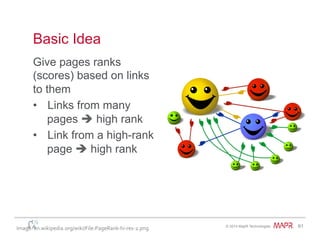
Basic Idea
Give pages ranks
(scores) based on links
to them
•  Links from many
pages è high rank
•  Link from a high-rank
page è high rank
Image:	
  en.wikipedia.org/wiki/File:PageRank-­‐hi-­‐res-­‐2.png	
  	
  
®
© 2014 MapR Technologies 62
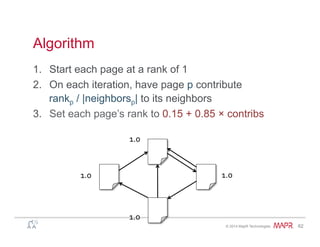
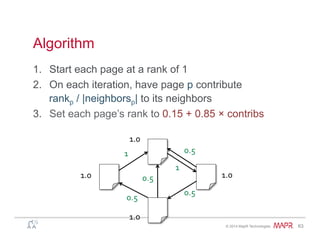
Algorithm
1.  Start each page at a rank of 1
2.  On each iteration, have page p contribute
rankp / |neighborsp| to its neighbors
3.  Set each page’s rank to 0.15 + 0.85 × contribs
1.0	
   1.0	
  
1.0	
  
1.0	
  
®
© 2014 MapR Technologies 63
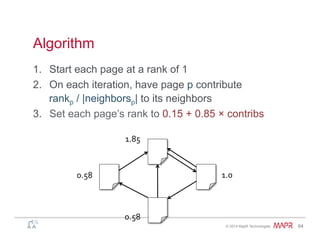
Algorithm
1.  Start each page at a rank of 1
2.  On each iteration, have page p contribute
rankp / |neighborsp| to its neighbors
3.  Set each page’s rank to 0.15 + 0.85 × contribs
1.0	
   1.0	
  
1.0	
  
1.0	
  
1	
  
0.5	
  
0.5	
  
0.5	
  
1	
  
0.5	
  
®
© 2014 MapR Technologies 64
Algorithm
1.  Start each page at a rank of 1
2.  On each iteration, have page p contribute
rankp / |neighborsp| to its neighbors
3.  Set each page’s rank to 0.15 + 0.85 × contribs
0.58	
   1.0	
  
1.85	
  
0.58	
  
®
© 2014 MapR Technologies 65
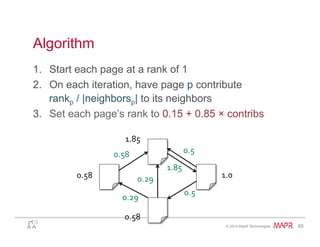
Algorithm
1.  Start each page at a rank of 1
2.  On each iteration, have page p contribute
rankp / |neighborsp| to its neighbors
3.  Set each page’s rank to 0.15 + 0.85 × contribs
0.58	
  
0.29	
  
0.29	
  
0.5	
  
1.85	
  
0.58	
   1.0	
  
1.85	
  
0.58	
  
0.5	
  
®
© 2014 MapR Technologies 66
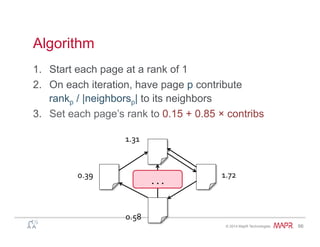
Algorithm
1.  Start each page at a rank of 1
2.  On each iteration, have page p contribute
rankp / |neighborsp| to its neighbors
3.  Set each page’s rank to 0.15 + 0.85 × contribs
0.39	
   1.72	
  
1.31	
  
0.58	
  
. . .
®
© 2014 MapR Technologies 67
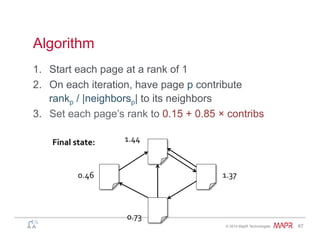
Algorithm
1.  Start each page at a rank of 1
2.  On each iteration, have page p contribute
rankp / |neighborsp| to its neighbors
3.  Set each page’s rank to 0.15 + 0.85 × contribs
0.46	
   1.37	
  
1.44	
  
0.73	
  
Final	
  state:	
  
®
© 2014 MapR Technologies 68
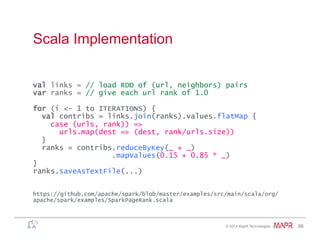
Scala Implementation
val links = // load RDD of (url, neighbors) pairs
var ranks = // give each url rank of 1.0
for (i <- 1 to ITERATIONS) {
val contribs = links.join(ranks).values.flatMap {
case (urls, rank)) =>
urls.map(dest => (dest, rank/urls.size))
}
ranks = contribs.reduceByKey(_ + _)
.mapValues(0.15 + 0.85 * _)
}
ranks.saveAsTextFile(...)
https://github.com/apache/spark/blob/master/examples/src/main/scala/org/
apache/spark/examples/SparkPageRank.scala
®
© 2014 MapR Technologies 69© 2014 MapR Technologies
®
Spark and More
®
© 2014 MapR Technologies 70
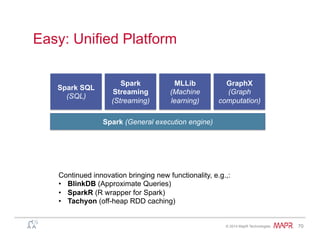
Easy: Unified Platform
Spark SQL
(SQL)
Spark
Streaming
(Streaming)
MLLib
(Machine
learning)
Spark (General execution engine)
GraphX
(Graph
computation)
Continued innovation bringing new functionality, e.g.,:
•  BlinkDB (Approximate Queries)
•  SparkR (R wrapper for Spark)
•  Tachyon (off-heap RDD caching)
®
© 2014 MapR Technologies 71
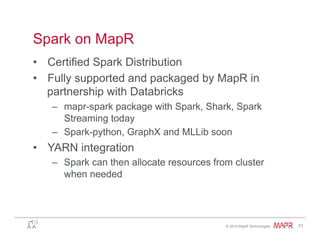
Spark on MapR
•  Certified Spark Distribution
•  Fully supported and packaged by MapR in
partnership with Databricks
–  mapr-spark package with Spark, Shark, Spark
Streaming today
–  Spark-python, GraphX and MLLib soon
•  YARN integration
–  Spark can then allocate resources from cluster
when needed
®
© 2014 MapR Technologies 72
References
•  Based on slides from Pat McDonough at
•  Spark web site: http://spark.apache.org/
•  Spark on MapR:
–  http://www.mapr.com/products/apache-spark
–  http://doc.mapr.com/display/MapR/Installing+Spark
+and+Shark
®
© 2014 MapR Technologies 73
Q&A
@mapr maprtech
kbotzum@mapr.com
Engage with us!
MapR
maprtech
mapr-technologies

Apache Spark & Hadoop

  • 1.
    ® © 2014 MapRTechnologies 1 ® © 2014 MapR Technologies Apache Spark Keys Botzum Senior Principal Technologist, MapR Technologies June 2014
  • 2.
    ® © 2014 MapRTechnologies 2 Agenda •  MapReduce •  Apache Spark •  How Spark Works •  Fault Tolerance and Performance •  Examples •  Spark and More
  • 3.
    ® © 2014 MapRTechnologies 3 MapR: Best Product, Best Business & Best Customers Top Ranked Exponential Growth 500+ Customers Cloud Leaders 3X bookings Q1 ‘13 – Q1 ‘14 80% of accounts expand 3X 90% software licenses <1% lifetime churn >$1B in incremental revenue generated by 1 customer
  • 4.
    ® © 2014 MapRTechnologies 4© 2014 MapR Technologies ® Review: MapReduce
  • 5.
    ® © 2014 MapRTechnologies 5 MapReduce: A Programming Model •  MapReduce: Simplified Data Processing on Large Clusters (published 2004) •  Parallel and Distributed Algorithm: •  Data Locality •  Fault Tolerance •  Linear Scalability
  • 6.
    ® © 2014 MapRTechnologies 6 MapReduce Basics •  Assumes scalable distributed file system that shards data •  Map –  Loading of the data and defining a set of keys •  Reduce –  Collects the organized key-based data to process and output •  Performance can be tweaked based on known details of your source files and cluster shape (size, total number)
  • 7.
    ® © 2014 MapRTechnologies 7 MapReduce Processing Model •  Define mappers •  Shuffling is automatic •  Define reducers •  For complex work, chain jobs together
  • 8.
    ® © 2014 MapRTechnologies 8 MapReduce: The Good •  Built in fault tolerance •  Optimized IO path •  Scalable •  Developer focuses on Map/Reduce, not infrastructure •  simple? API
  • 9.
    ® © 2014 MapRTechnologies 9 MapReduce: The Bad •  Optimized for disk IO –  Doesn’t leverage memory well –  Iterative algorithms go through disk IO path again and again •  Primitive API –  Developer’s have to build on very simple abstraction –  Key/Value in/out –  Even basic things like join require extensive code •  Result often many files that need to be combined appropriately
  • 10.
    ® © 2014 MapRTechnologies 10© 2014 MapR Technologies ® Apache Spark
  • 11.
    ® © 2014 MapRTechnologies 11 Apache Spark •  spark.apache.org •  github.com/apache/spark •  user@spark.apache.org •  Originally developed in 2009 in UC Berkeley’s AMP Lab •  Fully open sourced in 2010 – now at Apache Software Foundation - Commercial Vendor Developing/Supporting
  • 12.
    ® © 2014 MapRTechnologies 12 Spark: Easy and Fast Big Data •  Easy to Develop –  Rich APIs in Java, Scala, Python –  Interactive shell •  Fast to Run –  General execution graphs –  In-memory storage 2-5× less code
  • 13.
    ® © 2014 MapRTechnologies 13 Resilient Distributed Datasets (RDD) •  Spark revolves around RDDs •  Fault-tolerant read only collection of elements that can be operated on in parallel •  Cached in memory or on disk http://www.cs.berkeley.edu/~matei/papers/2012/nsdi_spark.pdf
  • 14.
    ® © 2014 MapRTechnologies 14 RDD Operations - Expressive •  Transformations –  Creation of a new RDD dataset from an existing •  map, filter, distinct, union, sample, groupByKey, join, reduce, etc… •  Actions –  Return a value after running a computation •  collect, count, first, takeSample, foreach, etc… Check the documentation for a complete list http://spark.apache.org/docs/latest/scala-programming-guide.html#rdd- operations
  • 15.
    ® © 2014 MapRTechnologies 15 Easy: Clean API •  Resilient Distributed Datasets •  Collections of objects spread across a cluster, stored in RAM or on Disk •  Built through parallel transformations •  Automatically rebuilt on failure •  Operations •  Transformations (e.g. map, filter, groupBy) •  Actions (e.g. count, collect, save) Write programs in terms of transformations on distributed datasets
  • 16.
    ® © 2014 MapRTechnologies 16 Easy: Expressive API •  map •  reduce
  • 17.
    ® © 2014 MapRTechnologies 17 Easy: Expressive API •  map •  filter •  groupBy •  sort •  union •  join •  leftOuterJoin •  rightOuterJoin •  reduce •  count •  fold •  reduceByKey •  groupByKey •  cogroup •  cross •  zip sample take first partitionBy mapWith pipe save ...
  • 18.
    ® © 2014 MapRTechnologies 18 Easy: Example – Word Count •  Spark•  Hadoop MapReduce public static class WordCountMapClass extends MapReduceBase implements Mapper<LongWritable, Text, Text, IntWritable> { private final static IntWritable one = new IntWritable(1); private Text word = new Text(); public void map(LongWritable key, Text value, OutputCollector<Text, IntWritable> output, Reporter reporter) throws IOException { String line = value.toString(); StringTokenizer itr = new StringTokenizer(line); while (itr.hasMoreTokens()) { word.set(itr.nextToken()); output.collect(word, one); } } } public static class WorkdCountReduce extends MapReduceBase implements Reducer<Text, IntWritable, Text, IntWritable> { public void reduce(Text key, Iterator<IntWritable> values, OutputCollector<Text, IntWritable> output, Reporter reporter) throws IOException { int sum = 0; while (values.hasNext()) { sum += values.next().get(); } output.collect(key, new IntWritable(sum)); } } val spark = new SparkContext(master, appName, [sparkHome], [jars]) val file = spark.textFile("hdfs://...") val counts = file.flatMap(line => line.split(" ")) .map(word => (word, 1)) .reduceByKey(_ + _) counts.saveAsTextFile("hdfs://...")
  • 19.
    ® © 2014 MapRTechnologies 19 Easy: Example – Word Count •  Spark•  Hadoop MapReduce public static class WordCountMapClass extends MapReduceBase implements Mapper<LongWritable, Text, Text, IntWritable> { private final static IntWritable one = new IntWritable(1); private Text word = new Text(); public void map(LongWritable key, Text value, OutputCollector<Text, IntWritable> output, Reporter reporter) throws IOException { String line = value.toString(); StringTokenizer itr = new StringTokenizer(line); while (itr.hasMoreTokens()) { word.set(itr.nextToken()); output.collect(word, one); } } } public static class WorkdCountReduce extends MapReduceBase implements Reducer<Text, IntWritable, Text, IntWritable> { public void reduce(Text key, Iterator<IntWritable> values, OutputCollector<Text, IntWritable> output, Reporter reporter) throws IOException { int sum = 0; while (values.hasNext()) { sum += values.next().get(); } output.collect(key, new IntWritable(sum)); } } val spark = new SparkContext(master, appName, [sparkHome], [jars]) val file = spark.textFile("hdfs://...") val counts = file.flatMap(line => line.split(" ")) .map(word => (word, 1)) .reduceByKey(_ + _) counts.saveAsTextFile("hdfs://...")
  • 20.
    ® © 2014 MapRTechnologies 20 Easy: Works Well With Hadoop •  Data Compatibility •  Access your existing Hadoop Data •  Use the same data formats •  Adheres to data locality for efficient processing •  Deployment Models •  “Standalone” deployment •  YARN-based deployment •  Mesos-based deployment •  Deploy on existing Hadoop cluster or side-by-side
  • 21.
    ® © 2014 MapRTechnologies 21 Easy: User-Driven Roadmap •  Language support –  Improved Python support –  SparkR –  Java 8 –  Integrated Schema and SQL support in Spark’s APIs •  Better ML –  Sparse Data Support –  Model Evaluation Framework –  Performance Testing
  • 22.
    ® © 2014 MapRTechnologies 22 Example: Logistic Regression data = spark.textFile(...).map(readPoint).cache() w = numpy.random.rand(D) for i in range(iterations): gradient = data .map(lambda p: (1 / (1 + exp(-p.y * w.dot(p.x)))) * p.y * p.x) .reduce(lambda x, y: x + y) w -= gradient print “Final w: %s” % w
  • 23.
    ® © 2014 MapRTechnologies 23 Fast: Logistic Regression Performance 0 500 1000 1500 2000 2500 3000 3500 4000 1 5 10 20 30 RunningTime(s) Number of Iterations Hadoop Spark 110  s  /  iteration   first  iteration  80  s   further  iterations  1  s  
  • 24.
    ® © 2014 MapRTechnologies 24 Easy: Multi-language Support Python lines = sc.textFile(...) lines.filter(lambda s: “ERROR” in s).count() Scala val lines = sc.textFile(...) lines.filter(x => x.contains(“ERROR”)).count() Java JavaRDD<String> lines = sc.textFile(...); lines.filter(new Function<String, Boolean>() { Boolean call(String s) { return s.contains(“error”); } }).count();
  • 25.
    ® © 2014 MapRTechnologies 25 Easy: Interactive Shell Scala based shell % /opt/mapr/spark/spark-0.9.1/bin/spark-shell scala> val logs = sc.textFile("hdfs:///user/keys/logdata”)" scala> logs.count()" …" res0: Long = 232681 scala> logs.filter(l => l.contains("ERROR")).count()" …." res1: Long = 205 Python based shell as well - pyspark
  • 26.
    ® © 2014 MapRTechnologies 26© 2014 MapR Technologies ® Fault Tolerance and Performance
  • 27.
    ® © 2014 MapRTechnologies 27 Fast: Using RAM, Operator Graphs •  In-memory Caching •  Data Partitions read from RAM instead of disk •  Operator Graphs •  Scheduling Optimizations •  Fault Tolerance =  cached  partition   =  RDD   join   filter   groupBy   Stage  3   Stage  1   Stage  2   A:   B:   C:   D:   E:   F:   map  
  • 28.
    ® © 2014 MapRTechnologies 28 Directed Acylic Graph (DAG) •  Directed –  Only in a single direction •  Acyclic –  No looping •  This supports fault-tolerance
  • 29.
    ® © 2014 MapRTechnologies 29 Easy: Fault Recovery RDDs track lineage information that can be used to efficiently recompute lost data msgs = textFile.filter(lambda s: s.startsWith(“ERROR”)) .map(lambda s: s.split(“t”)[2]) HDFS File Filtered RDD Mapped RDD filter   (func  =  startsWith(…))   map   (func  =  split(...))  
  • 30.
    ® © 2014 MapRTechnologies 30 RDD Persistence / Caching •  Variety of storage levels –  memory_only (default), memory_and_disk, etc… •  API Calls –  persist(StorageLevel) –  cache() – shorthand for persist(StorageLevel.MEMORY_ONLY) •  Considerations –  Read from disk vs. recompute (memory_and_disk) –  Total memory storage size (memory_only_ser) –  Replicate to second node for faster fault recovery (memory_only_2) •  Think about this option if supporting a time sensitive client http://spark.apache.org/docs/latest/scala-programming-guide.html#rdd- persistence
  • 31.
    ® © 2014 MapRTechnologies 31 PageRank Performance 171 80 23 14 0 50 100 150 200 30 60 Iterationtime(s) Number of machines Hadoop Spark
  • 32.
    ® © 2014 MapRTechnologies 32 Other Iterative Algorithms 0.96 110 0 25 50 75 100 125 Logistic Regression 4.1 155 0 30 60 90 120 150 180 K-Means Clustering Hadoop Spark Time per Iteration (s)
  • 33.
    ® © 2014 MapRTechnologies 33 Fast: Scaling Down 69   58   41   30   12   0   20   40   60   80   100   Cache   disabled   25%   50%   75%   Fully   cached   Execution  time  (s)   %  of  working  set  in  cache  
  • 34.
    ® © 2014 MapRTechnologies 34 Comparison to Storm •  Higher throughput than Storm –  Spark Streaming: 670k records/sec/node –  Storm: 115k records/sec/node –  Commercial systems: 100-500k records/sec/node 0   10   20   30   100   1000   Throughput  per  node   (MB/s)   Record  Size  (bytes)   WordCount   Spark   Storm   0   20   40   60   100   1000   Throughput  per  node   (MB/s)   Record  Size  (bytes)   Grep   Spark   Storm  
  • 35.
    ® © 2014 MapRTechnologies 35© 2014 MapR Technologies ® How Spark Works
  • 36.
    ® © 2014 MapRTechnologies 36 Working With RDDs
  • 37.
    ® © 2014 MapRTechnologies 37 Working With RDDs RDD textFile = sc.textFile(”SomeFile.txt”)!
  • 38.
    ® © 2014 MapRTechnologies 38 Working With RDDs RDD RDD RDD RDD Transformations linesWithSpark = textFile.filter(lambda line: "Spark” in line)! textFile = sc.textFile(”SomeFile.txt”)!
  • 39.
    ® © 2014 MapRTechnologies 39 Working With RDDs RDD RDD RDD RDD Transformations Action Value linesWithSpark = textFile.filter(lambda line: "Spark” in line)! linesWithSpark.count()! 74! ! linesWithSpark.first()! # Apache Spark! textFile = sc.textFile(”SomeFile.txt”)!
  • 40.
    ® © 2014 MapRTechnologies 40© 2014 MapR Technologies ® Example: Log Mining
  • 41.
    ® © 2014 MapRTechnologies 41 Example: Log Mining Load error messages from a log into memory, then interactively search for various patterns
  • 42.
    ® © 2014 MapRTechnologies 42 Example: Log Mining Load error messages from a log into memory, then interactively search for various patterns Worker Worker Worker Driver
  • 43.
    ® © 2014 MapRTechnologies 43 Example: Log Mining Load error messages from a log into memory, then interactively search for various patterns Worker Worker Worker Driver lines = spark.textFile(“hdfs://...”)
  • 44.
    ® © 2014 MapRTechnologies 44 Example: Log Mining Load error messages from a log into memory, then interactively search for various patterns Worker Worker Worker Driver lines = spark.textFile(“hdfs://...”) Base RDD
  • 45.
    ® © 2014 MapRTechnologies 45 Example: Log Mining Load error messages from a log into memory, then interactively search for various patterns lines = spark.textFile(“hdfs://...”) errors = lines.filter(lambda s: s.startswith(“ERROR”)) Worker Worker Worker Driver
  • 46.
    ® © 2014 MapRTechnologies 46 Example: Log Mining Load error messages from a log into memory, then interactively search for various patterns lines = spark.textFile(“hdfs://...”) errors = lines.filter(lambda s: s.startswith(“ERROR”)) Worker Worker Worker Driver Transformed RDD
  • 47.
    ® © 2014 MapRTechnologies 47 Example: Log Mining Load error messages from a log into memory, then interactively search for various patterns lines = spark.textFile(“hdfs://...”) errors = lines.filter(lambda s: s.startswith(“ERROR”)) messages = errors.map(lambda s: s.split(“t”)[2]) messages.cache() Worker Worker Worker Driver messages.filter(lambda s: “mysql” in s).count()
  • 48.
    ® © 2014 MapRTechnologies 48 Example: Log Mining Load error messages from a log into memory, then interactively search for various patterns lines = spark.textFile(“hdfs://...”) errors = lines.filter(lambda s: s.startswith(“ERROR”)) messages = errors.map(lambda s: s.split(“t”)[2]) messages.cache() Worker Worker Worker Driver messages.filter(lambda s: “mysql” in s).count() Action
  • 49.
    ® © 2014 MapRTechnologies 49 Example: Log Mining Load error messages from a log into memory, then interactively search for various patterns lines = spark.textFile(“hdfs://...”) errors = lines.filter(lambda s: s.startswith(“ERROR”)) messages = errors.map(lambda s: s.split(“t”)[2]) messages.cache() Worker Worker Worker Driver messages.filter(lambda s: “mysql” in s).count() Block 1 Block 2 Block 3
  • 50.
    ® © 2014 MapRTechnologies 50 Example: Log Mining Load error messages from a log into memory, then interactively search for various patterns lines = spark.textFile(“hdfs://...”) errors = lines.filter(lambda s: s.startswith(“ERROR”)) messages = errors.map(lambda s: s.split(“t”)[2]) messages.cache() Worker Worker Worker messages.filter(lambda s: “mysql” in s).count() Block 1 Block 2 Block 3 Driver tasks tasks tasks
  • 51.
    ® © 2014 MapRTechnologies 51 Example: Log Mining Load error messages from a log into memory, then interactively search for various patterns lines = spark.textFile(“hdfs://...”) errors = lines.filter(lambda s: s.startswith(“ERROR”)) messages = errors.map(lambda s: s.split(“t”)[2]) messages.cache() Worker Worker Worker messages.filter(lambda s: “mysql” in s).count() Block 1 Block 2 Block 3 Driver Read HDFS Block Read HDFS Block Read HDFS Block
  • 52.
    ® © 2014 MapRTechnologies 52 Example: Log Mining Load error messages from a log into memory, then interactively search for various patterns lines = spark.textFile(“hdfs://...”) errors = lines.filter(lambda s: s.startswith(“ERROR”)) messages = errors.map(lambda s: s.split(“t”)[2]) messages.cache() Worker Worker Worker messages.filter(lambda s: “mysql” in s).count() Block 1 Block 2 Block 3 Driver Cache 1 Cache 2 Cache 3 Process & Cache Data Process & Cache Data Process & Cache Data
  • 53.
    ® © 2014 MapRTechnologies 53 Example: Log Mining Load error messages from a log into memory, then interactively search for various patterns lines = spark.textFile(“hdfs://...”) errors = lines.filter(lambda s: s.startswith(“ERROR”)) messages = errors.map(lambda s: s.split(“t”)[2]) messages.cache() Worker Worker Worker messages.filter(lambda s: “mysql” in s).count() Block 1 Block 2 Block 3 Driver Cache 1 Cache 2 Cache 3 results results results
  • 54.
    ® © 2014 MapRTechnologies 54 Example: Log Mining Load error messages from a log into memory, then interactively search for various patterns lines = spark.textFile(“hdfs://...”) errors = lines.filter(lambda s: s.startswith(“ERROR”)) messages = errors.map(lambda s: s.split(“t”)[2]) messages.cache() Worker Worker Worker messages.filter(lambda s: “mysql” in s).count() Block 1 Block 2 Block 3 Driver Cache 1 Cache 2 Cache 3 messages.filter(lambda s: “php” in s).count()
  • 55.
    ® © 2014 MapRTechnologies 55 Example: Log Mining Load error messages from a log into memory, then interactively search for various patterns lines = spark.textFile(“hdfs://...”) errors = lines.filter(lambda s: s.startswith(“ERROR”)) messages = errors.map(lambda s: s.split(“t”)[2]) messages.cache() Worker Worker Worker messages.filter(lambda s: “mysql” in s).count() Block 1 Block 2 Block 3 Cache 1 Cache 2 Cache 3 messages.filter(lambda s: “php” in s).count() tasks tasks tasks Driver
  • 56.
    ® © 2014 MapRTechnologies 56 Example: Log Mining Load error messages from a log into memory, then interactively search for various patterns lines = spark.textFile(“hdfs://...”) errors = lines.filter(lambda s: s.startswith(“ERROR”)) messages = errors.map(lambda s: s.split(“t”)[2]) messages.cache() Worker Worker Worker messages.filter(lambda s: “mysql” in s).count() Block 1 Block 2 Block 3 Cache 1 Cache 2 Cache 3 messages.filter(lambda s: “php” in s).count() Driver Process from Cache Process from Cache Process from Cache
  • 57.
    ® © 2014 MapRTechnologies 57 Example: Log Mining Load error messages from a log into memory, then interactively search for various patterns lines = spark.textFile(“hdfs://...”) errors = lines.filter(lambda s: s.startswith(“ERROR”)) messages = errors.map(lambda s: s.split(“t”)[2]) messages.cache() Worker Worker Worker messages.filter(lambda s: “mysql” in s).count() Block 1 Block 2 Block 3 Cache 1 Cache 2 Cache 3 messages.filter(lambda s: “php” in s).count() Driver results results results
  • 58.
    ® © 2014 MapRTechnologies 58 Example: Log Mining Load error messages from a log into memory, then interactively search for various patterns lines = spark.textFile(“hdfs://...”) errors = lines.filter(lambda s: s.startswith(“ERROR”)) messages = errors.map(lambda s: s.split(“t”)[2]) messages.cache() Worker Worker Worker messages.filter(lambda s: “mysql” in s).count() Block 1 Block 2 Block 3 Cache 1 Cache 2 Cache 3 messages.filter(lambda s: “php” in s).count() Driver Cache your data è Faster Results Full-text search of Wikipedia •  60GB on 20 EC2 machines •  0.5 sec from cache vs. 20s for on-disk
  • 59.
    ® © 2014 MapRTechnologies 59© 2014 MapR Technologies ® Example: Page Rank
  • 60.
    ® © 2014 MapRTechnologies 60 Example: PageRank •  Good example of a more complex algorithm –  Multiple stages of map & reduce •  Benefits from Spark’s in-memory caching –  Multiple iterations over the same data
  • 61.
    ® © 2014 MapRTechnologies 61 Basic Idea Give pages ranks (scores) based on links to them •  Links from many pages è high rank •  Link from a high-rank page è high rank Image:  en.wikipedia.org/wiki/File:PageRank-­‐hi-­‐res-­‐2.png    
  • 62.
    ® © 2014 MapRTechnologies 62 Algorithm 1.  Start each page at a rank of 1 2.  On each iteration, have page p contribute rankp / |neighborsp| to its neighbors 3.  Set each page’s rank to 0.15 + 0.85 × contribs 1.0   1.0   1.0   1.0  
  • 63.
    ® © 2014 MapRTechnologies 63 Algorithm 1.  Start each page at a rank of 1 2.  On each iteration, have page p contribute rankp / |neighborsp| to its neighbors 3.  Set each page’s rank to 0.15 + 0.85 × contribs 1.0   1.0   1.0   1.0   1   0.5   0.5   0.5   1   0.5  
  • 64.
    ® © 2014 MapRTechnologies 64 Algorithm 1.  Start each page at a rank of 1 2.  On each iteration, have page p contribute rankp / |neighborsp| to its neighbors 3.  Set each page’s rank to 0.15 + 0.85 × contribs 0.58   1.0   1.85   0.58  
  • 65.
    ® © 2014 MapRTechnologies 65 Algorithm 1.  Start each page at a rank of 1 2.  On each iteration, have page p contribute rankp / |neighborsp| to its neighbors 3.  Set each page’s rank to 0.15 + 0.85 × contribs 0.58   0.29   0.29   0.5   1.85   0.58   1.0   1.85   0.58   0.5  
  • 66.
    ® © 2014 MapRTechnologies 66 Algorithm 1.  Start each page at a rank of 1 2.  On each iteration, have page p contribute rankp / |neighborsp| to its neighbors 3.  Set each page’s rank to 0.15 + 0.85 × contribs 0.39   1.72   1.31   0.58   . . .
  • 67.
    ® © 2014 MapRTechnologies 67 Algorithm 1.  Start each page at a rank of 1 2.  On each iteration, have page p contribute rankp / |neighborsp| to its neighbors 3.  Set each page’s rank to 0.15 + 0.85 × contribs 0.46   1.37   1.44   0.73   Final  state:  
  • 68.
    ® © 2014 MapRTechnologies 68 Scala Implementation val links = // load RDD of (url, neighbors) pairs var ranks = // give each url rank of 1.0 for (i <- 1 to ITERATIONS) { val contribs = links.join(ranks).values.flatMap { case (urls, rank)) => urls.map(dest => (dest, rank/urls.size)) } ranks = contribs.reduceByKey(_ + _) .mapValues(0.15 + 0.85 * _) } ranks.saveAsTextFile(...) https://github.com/apache/spark/blob/master/examples/src/main/scala/org/ apache/spark/examples/SparkPageRank.scala
  • 69.
    ® © 2014 MapRTechnologies 69© 2014 MapR Technologies ® Spark and More
  • 70.
    ® © 2014 MapRTechnologies 70 Easy: Unified Platform Spark SQL (SQL) Spark Streaming (Streaming) MLLib (Machine learning) Spark (General execution engine) GraphX (Graph computation) Continued innovation bringing new functionality, e.g.,: •  BlinkDB (Approximate Queries) •  SparkR (R wrapper for Spark) •  Tachyon (off-heap RDD caching)
  • 71.
    ® © 2014 MapRTechnologies 71 Spark on MapR •  Certified Spark Distribution •  Fully supported and packaged by MapR in partnership with Databricks –  mapr-spark package with Spark, Shark, Spark Streaming today –  Spark-python, GraphX and MLLib soon •  YARN integration –  Spark can then allocate resources from cluster when needed
  • 72.
    ® © 2014 MapRTechnologies 72 References •  Based on slides from Pat McDonough at •  Spark web site: http://spark.apache.org/ •  Spark on MapR: –  http://www.mapr.com/products/apache-spark –  http://doc.mapr.com/display/MapR/Installing+Spark +and+Shark
  • 73.
    ® © 2014 MapRTechnologies 73 Q&A @mapr maprtech kbotzum@mapr.com Engage with us! MapR maprtech mapr-technologies