APACHE SPARK OVERVIEW 
tech talk @ ferret 
Andrii Gakhov
• Apache Spark™ is a fast and general engine for 
large-scale data processing. 
• Lastest release: Spark 1.1.1 (Nov 26, 2014) 
• spark.apache.org 
• Originally developed in 2009 in UC Berkeley’s 
AMPLab, and open sourced in 2010. Now Spark is 
supported by Databricks.
APACHE SPARK 
Spark SQL MLlib GraphX Streaming 
standalone 
with local 
storage 
Apache Spark 
MESOS YARN 
EC2 
S3 HDFS 
node node node node
RDD 
• Spark’s primary conception is a Resilient 
Distributed Dataset (RDD) - abstraction of an 
immutable, distributed dataset. 
textFile = sc.textFile(“api.log") 
anotherFile = sc.textFile(“hdfs://var/log/api.log”) 
• Collections of objects that can be stored in memory 
or disk across the cluster 
• Parallel functional transformations (map, filter, …) 
• Automatically rebuild of failure
RDD 
• RDDs have actions, which retur n values, and 
transformations, which return pointers to new RDDs. 
• Actions: 
• reduce collect count countByKey take saveAsTextFile 
takeSample … 
• Transformations: 
• map filter flatMap distinct sample join union intersection 
reduceByKey groupByKey sortByKey … 
errors = logFile.filter(lambda line: line.startswith(“ERROR”)) 
print errors.count()
PERSISTANCE 
• You can control persistence of RDD across operations 
(MEMORY_ONLY, MEMORY_AND_DISK …) 
• When you persist an RDD in memory, each node stores 
any partitions of it that it computes in memory and 
reuses them in other actions on that dataset (or datasets 
derived from it) 
• This allows future actions to be much faster (often by 
more than 10x). 
errors.cache() 
endpoint_errors = errors.filter( 
lambda line: “/test/endpoint” in line) 
endpoint_errors.count()
HDFS 
iteration iteration iteration 
Hadoop MapReduce 
iteration iteration iteration 
MEMORY HDFS 
Apache Spark
INTERACTIVE DEMO 
STRATA+HADOOP WORD EXAMPLE 
http://www.datacrucis.com/research/twitter-analysis-for-strata-barcelona-2014-with-apache-spark-and-d3.html
SPARK SQL 
TRANSFORM RDD WITH SQL
SCHEMA RDD 
• Spark SQL allows relational queries expressed in SQL, 
HiveQL, or Scala to be executed using Spark. 
• At the core of this component is a new type of RDD - 
SchemaRDD. 
• SchemaRDDs are composed of Row objects, along with a 
schema that describes the data types of each column in the row. 
• A SchemaRDD is similar to a table in a traditional relational 
database. 
• A SchemaRDD can be created from an existing RDD, a Parquet 
file, a JSON dataset, or by running HiveQL against data stored in 
Apache Hive.
SCHEMA RDD 
• To work with SparkSQL you need SQLContext 
(or HiveContext) 
from spark.sql import SQLContext 
sqlCtx = SQLContext(sc) 
records = sc.textFile(“customers.csv”) 
customers = records.map(lambda line: line.split(“,”)) 
.map(lambda r: Row(name=r[0], age=int(r[1]))) 
customersTable = sqlCtx.inferSchema(customers) 
customersTable.registerAsTable(“customers”)
SCHEMA RDD 
User 
User 
User 
Name Age Phone 
Name Age Phone 
Name Age Phone 
RDD SchemaRDD 
• Transformations over RDD are just functional 
transformation on partitioned collections of objects 
• Transformation over the SchemaRDD are 
declarative transformations on par titioned 
collections of tuples
SPARK SQL 
• Schema RDD could be used as regular RDD at 
the same time. 
seniors = sqlCtx.sql(“”” 
SELECT from customers WHERE age >= 70”””) 
print seniors.count() 
print seniors.map(lambda r: “Name: “ + r.name).take(10)
MLLIB 
Distributed Machine Learning
MACHINE LEARNING LIBRARY 
• MLlib uses the linear algebra package Breeze, 
which depends on netlib-java, and jblas 
• MLlib in Python requires NumPy version 1.4+ 
• MLlib is under active development 
• Many API changes every release 
• Not all algorithms are fully functional
MACHINE LEARNING LIBRARY 
• Basic statistics 
• Classification and regression 
• linear models (SVMs, logistic regression, linear 
regression) 
• decision trees 
• naive Bayes 
• Collaborative filtering 
• alternating least squares (ALS) 
• Clustering 
• k-means
MACHINE LEARNING LIBRARY 
• Dimensionality reduction 
• singular value decomposition (SVD) 
• principal component analysis (PCA) 
• Feature extraction and transformation 
• Optimization 
• stochastic gradient descent 
• limited-memory BFGS (L-BFGS)
MACHINE LEARNING LIBRARY 
• LinearRegression with stochastic gradient descent (SGD) 
example on Spark: 
def parsePoint(line): 
values = [float(x) for x in line.replace(',', ' ').split(' ')] 
return LabeledPoint(values[0], values[1:]) 
parsedData = data.map(parsePoint) 
model = LinearRegressionWithSGD.train(parsedData) 
valuesAndPreds = parsedData.map( 
lambda p: (p.label, model.predict(p.features))) 
MSE = valuesAndPreds.map(lambda (v, p): (v - p)**2) 
.reduce(lambda x, y: x + y) / valuesAndPreds.count()
SPARK STREAMING 
Fault-tolerant stream processing
SPARK STREAMING 
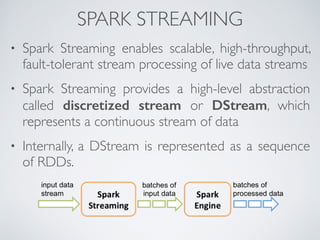
• Spark Streaming enables scalable, high-throughput, 
fault-tolerant stream processing of live data streams 
• Spark Streaming provides a high-level abstraction 
called discretized stream or DStream, which 
represents a continuous stream of data 
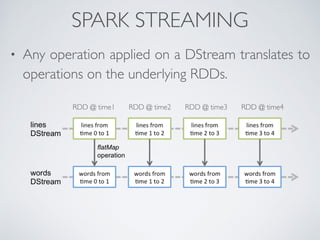
• Internally, a DStream is represented as a sequence 
of RDDs.
SPARK STREAMING 
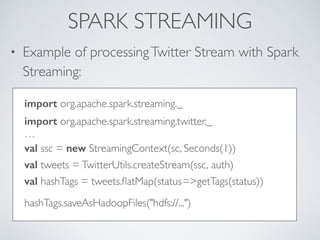
• Example of processing Twitter Stream with Spark 
Streaming: 
import org.apache.spark.streaming._ 
import org.apache.spark.streaming.twitter._ 
… 
val ssc = new StreamingContext(sc, Seconds(1)) 
val tweets = TwitterUtils.createStream(ssc, auth) 
val hashTags = tweets.flatMap(status=>getTags(status)) 
hashTags.saveAsHadoopFiles("hdfs://...")
SPARK STREAMING 
• Any operation applied on a DStream translates to 
operations on the underlying RDDs. 
RDD @ time1 RDD @ time2 RDD @ time3 RDD @ time4
SPARK STREAMING 
• Spark Streaming also provides windowed 
computations, which allow you to apply 
transformations over a sliding window of data
CONCLUSIONS
SPEED 
• Run programs up to 100x faster than Hadoop 
MapReduce in memory, or 10x faster on disk. 
Logistic regression 
in Hadoop and Spark 
• Spark has won the Daytona GraySort contest for 
2014 (sortbenchmark.org) with 4.27 TB/min 
(in 2013 Hadoop was the winner with 1.42 TB/min)
EASE OF USE 
• Supports out of the box: 
• Java 
• Scala 
• Python 
• You can use it interactively from the Scala and 
Python shells
GENERALITY 
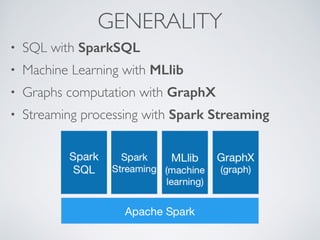
• SQL with SparkSQL 
• Machine Learning with MLlib 
• Graphs computation with GraphX 
• Streaming processing with Spark Streaming
RUNS EVERYWHERE 
• Spark could be run on 
• Hadoop (YARN) 
• Mesos 
• standalone 
• in the cloud 
• Spark can read from 
• S3 
• HDFS 
• HBase 
• Cassandra 
• any Hadoop data source.
Thank you. 
• Credentials: 
• http://www.slideshare.net/jeykottalam/spark-sqlamp-camp2014 
• http://spark.apache.org 
• http://www.databricks.com 
• http://www.datacrucis.com/research/twitter-analysis-for-strata-barcelona- 
2014-with-apache-spark-and-d3.html

Apache Spark Overview @ ferret

  • 1.
    APACHE SPARK OVERVIEW tech talk @ ferret Andrii Gakhov
  • 2.
    • Apache Spark™is a fast and general engine for large-scale data processing. • Lastest release: Spark 1.1.1 (Nov 26, 2014) • spark.apache.org • Originally developed in 2009 in UC Berkeley’s AMPLab, and open sourced in 2010. Now Spark is supported by Databricks.
  • 3.
    APACHE SPARK SparkSQL MLlib GraphX Streaming standalone with local storage Apache Spark MESOS YARN EC2 S3 HDFS node node node node
  • 4.
    RDD • Spark’sprimary conception is a Resilient Distributed Dataset (RDD) - abstraction of an immutable, distributed dataset. textFile = sc.textFile(“api.log") anotherFile = sc.textFile(“hdfs://var/log/api.log”) • Collections of objects that can be stored in memory or disk across the cluster • Parallel functional transformations (map, filter, …) • Automatically rebuild of failure
  • 5.
    RDD • RDDshave actions, which retur n values, and transformations, which return pointers to new RDDs. • Actions: • reduce collect count countByKey take saveAsTextFile takeSample … • Transformations: • map filter flatMap distinct sample join union intersection reduceByKey groupByKey sortByKey … errors = logFile.filter(lambda line: line.startswith(“ERROR”)) print errors.count()
  • 6.
    PERSISTANCE • Youcan control persistence of RDD across operations (MEMORY_ONLY, MEMORY_AND_DISK …) • When you persist an RDD in memory, each node stores any partitions of it that it computes in memory and reuses them in other actions on that dataset (or datasets derived from it) • This allows future actions to be much faster (often by more than 10x). errors.cache() endpoint_errors = errors.filter( lambda line: “/test/endpoint” in line) endpoint_errors.count()
  • 7.
    HDFS iteration iterationiteration Hadoop MapReduce iteration iteration iteration MEMORY HDFS Apache Spark
  • 8.
    INTERACTIVE DEMO STRATA+HADOOPWORD EXAMPLE http://www.datacrucis.com/research/twitter-analysis-for-strata-barcelona-2014-with-apache-spark-and-d3.html
  • 9.
    SPARK SQL TRANSFORMRDD WITH SQL
  • 10.
    SCHEMA RDD •Spark SQL allows relational queries expressed in SQL, HiveQL, or Scala to be executed using Spark. • At the core of this component is a new type of RDD - SchemaRDD. • SchemaRDDs are composed of Row objects, along with a schema that describes the data types of each column in the row. • A SchemaRDD is similar to a table in a traditional relational database. • A SchemaRDD can be created from an existing RDD, a Parquet file, a JSON dataset, or by running HiveQL against data stored in Apache Hive.
  • 11.
    SCHEMA RDD •To work with SparkSQL you need SQLContext (or HiveContext) from spark.sql import SQLContext sqlCtx = SQLContext(sc) records = sc.textFile(“customers.csv”) customers = records.map(lambda line: line.split(“,”)) .map(lambda r: Row(name=r[0], age=int(r[1]))) customersTable = sqlCtx.inferSchema(customers) customersTable.registerAsTable(“customers”)
  • 12.
    SCHEMA RDD User User User Name Age Phone Name Age Phone Name Age Phone RDD SchemaRDD • Transformations over RDD are just functional transformation on partitioned collections of objects • Transformation over the SchemaRDD are declarative transformations on par titioned collections of tuples
  • 13.
    SPARK SQL •Schema RDD could be used as regular RDD at the same time. seniors = sqlCtx.sql(“”” SELECT from customers WHERE age >= 70”””) print seniors.count() print seniors.map(lambda r: “Name: “ + r.name).take(10)
  • 14.
  • 15.
    MACHINE LEARNING LIBRARY • MLlib uses the linear algebra package Breeze, which depends on netlib-java, and jblas • MLlib in Python requires NumPy version 1.4+ • MLlib is under active development • Many API changes every release • Not all algorithms are fully functional
  • 16.
    MACHINE LEARNING LIBRARY • Basic statistics • Classification and regression • linear models (SVMs, logistic regression, linear regression) • decision trees • naive Bayes • Collaborative filtering • alternating least squares (ALS) • Clustering • k-means
  • 17.
    MACHINE LEARNING LIBRARY • Dimensionality reduction • singular value decomposition (SVD) • principal component analysis (PCA) • Feature extraction and transformation • Optimization • stochastic gradient descent • limited-memory BFGS (L-BFGS)
  • 18.
    MACHINE LEARNING LIBRARY • LinearRegression with stochastic gradient descent (SGD) example on Spark: def parsePoint(line): values = [float(x) for x in line.replace(',', ' ').split(' ')] return LabeledPoint(values[0], values[1:]) parsedData = data.map(parsePoint) model = LinearRegressionWithSGD.train(parsedData) valuesAndPreds = parsedData.map( lambda p: (p.label, model.predict(p.features))) MSE = valuesAndPreds.map(lambda (v, p): (v - p)**2) .reduce(lambda x, y: x + y) / valuesAndPreds.count()
  • 19.
  • 20.
    SPARK STREAMING •Spark Streaming enables scalable, high-throughput, fault-tolerant stream processing of live data streams • Spark Streaming provides a high-level abstraction called discretized stream or DStream, which represents a continuous stream of data • Internally, a DStream is represented as a sequence of RDDs.
  • 21.
    SPARK STREAMING •Example of processing Twitter Stream with Spark Streaming: import org.apache.spark.streaming._ import org.apache.spark.streaming.twitter._ … val ssc = new StreamingContext(sc, Seconds(1)) val tweets = TwitterUtils.createStream(ssc, auth) val hashTags = tweets.flatMap(status=>getTags(status)) hashTags.saveAsHadoopFiles("hdfs://...")
  • 22.
    SPARK STREAMING •Any operation applied on a DStream translates to operations on the underlying RDDs. RDD @ time1 RDD @ time2 RDD @ time3 RDD @ time4
  • 23.
    SPARK STREAMING •Spark Streaming also provides windowed computations, which allow you to apply transformations over a sliding window of data
  • 24.
  • 25.
    SPEED • Runprograms up to 100x faster than Hadoop MapReduce in memory, or 10x faster on disk. Logistic regression in Hadoop and Spark • Spark has won the Daytona GraySort contest for 2014 (sortbenchmark.org) with 4.27 TB/min (in 2013 Hadoop was the winner with 1.42 TB/min)
  • 26.
    EASE OF USE • Supports out of the box: • Java • Scala • Python • You can use it interactively from the Scala and Python shells
  • 27.
    GENERALITY • SQLwith SparkSQL • Machine Learning with MLlib • Graphs computation with GraphX • Streaming processing with Spark Streaming
  • 28.
    RUNS EVERYWHERE •Spark could be run on • Hadoop (YARN) • Mesos • standalone • in the cloud • Spark can read from • S3 • HDFS • HBase • Cassandra • any Hadoop data source.
  • 30.
    Thank you. •Credentials: • http://www.slideshare.net/jeykottalam/spark-sqlamp-camp2014 • http://spark.apache.org • http://www.databricks.com • http://www.datacrucis.com/research/twitter-analysis-for-strata-barcelona- 2014-with-apache-spark-and-d3.html