SPANISH
ARCHITECTURE
OVERVIEW
Spain is renowned worldwide for both its architecture and its architects.
In terms of UNESCO World Heritage Sites, Spain is the country with the
second highest amount of buildings on the list, beaten only by Italy.
Prehistoric Spanish Architecture
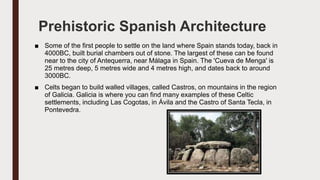
■ Some of the first people to settle on the land where Spain stands today, back in
4000BC, built burial chambers out of stone. The largest of these can be found
near to the city of Antequerra, near Málaga in Spain. The 'Cueva de Menga' is
25 metres deep, 5 metres wide and 4 metres high, and dates back to around
3000BC.
■ Celts began to build walled villages, called Castros, on mountains in the region
of Galicia. Galicia is where you can find many examples of these Celtic
settlements, including Las Cogotas, in Ávila and the Castro of Santa Tecla, in
Pontevedra.
Roman Spanish Architecture
■ The Romans conquered the Spanish peninsular and with them they brought
their fantastic expertise in civil engineering. The Romans built a network of
roads that linked many of the major Spanish cities, such as Córdoba and
Tarragona (or Taraco as it was called in Roman times).
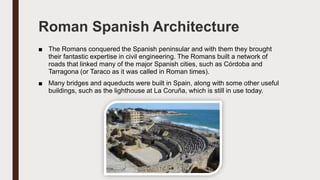
■ Many bridges and aqueducts were built in Spain, along with some other useful
buildings, such as the lighthouse at La Coruña, which is still in use today.
Pre-Romanesque Architecture
■ The Pre-Romanesque period of Spanish architecture refers to the Christian art
produced after the Classical Age, yet before the Romanesque art period. The
most well known of which in Spain is Asturian art.
■ This period was a time of innovation in structural and design elements. Arches
and lattices became much more common in buildings in Spain. Later, there was
a heavy Mozarabic influence in architecture in Asturias, in which the horseshoe
shaped arch increased in usage.
Mudejar Style
■ Mudejar architecture is a style of architecture developed by the Moors left in
Christian Spain, yet who did not convert to the Christian religion. This style
developed from the 12th Century, right up until the 16th Century, and even
experienced a revival in the 20th Century by Spanish architect, Lluís
Domènech i Montaner.
■ Mudejar is best known for its extensive use of brick as the principal building
material. Good examples of Mudejar architecture are the synagogues of Santa
María la Blanca and El Tránsito in Toledo, Spain.
Romanesque Spanish Architecture
■ The 10th and 11th Centuries were the time when Romanesque Spanish
architecture began to develop in Spain. However at this time, the architecture
was quite basic; the walls were thick and the use of sculptures was limited. This
period is therefore named the 'First Romanesque' period. The iconic building of
Spanish Romanesque architecture is the Cathedral of Jaca in Aragon, which
contains the typical chessboard style decoration called 'taqueado jaqués'.
Gothic Spanish Architecture
■ The 12th Century saw the arrival of Gothic architecture from Europe in the
Spanish peninsular, yet it was still alternating with the earlier Romanesque
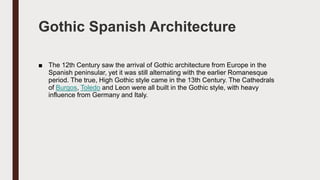
period. The true, High Gothic style came in the 13th Century. The Cathedrals
of Burgos, Toledo and Leon were all built in the Gothic style, with heavy
influence from Germany and Italy.
Renaissance Spanish Architecture
■ In Spain, at the beginnings of the Renaissance architecture period (the end of
the 15th Century), many former Gothic buildings were adapted to meet the new
Renaissance style. The Palace of Charles V, in Granada, was designed by
Pedro Machuca and was very innovative for the time. It incorporated many
elements of Mannerism before the movement had developed properly, and was
completed way before the likes of the Italian painter Michelangelo.
■ However it was later on during this era, when the Gothic influences were finally
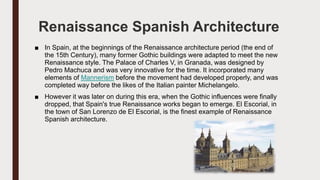
dropped, that Spain's true Renaissance works began to emerge. El Escorial, in
the town of San Lorenzo de El Escorial, is the finest example of Renaissance
Spanish architecture.
Baroque Spanish Architecture
■ Baroque is a style of architecture that came to Spain from nearby Italy in the
16th Century. A vernacular form of the style was then developed and is the style
of architecture that one can see at the Plaza Mayor in Madrid.
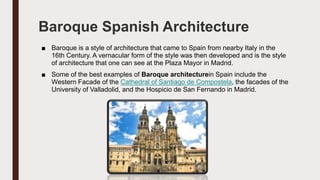
■ Some of the best examples of Baroque architecturein Spain include the
Western Facade of the Cathedral of Santiago de Compostela, the facades of the
University of Valladolid, and the Hospicio de San Fernando in Madrid.
Colonial Spanish Architecture
■ The former Spanish colonies in the Americas contain some of the finest
examples of Hispanic architecture. The mix of Moorish, Native American and
Spanish elements meant buildings were fantastically blended together.
■ The Americas also developed their own Baroque style, which came into its own
in 1664. Peru exhibited the most extravagant of the American Baroque styles.
The monastery of San Francisco in the capital of Peru, Lima, is particularly
eccentric with two yellow stone towers with a dark, detailed facade in the middle.
Neoclassical Spanish Architecture
■ Neoclassical architecture in Spain was promoted by the Madrid school of
architecture, Royal Academy of Fine Arts of San Fernando. Neoclassicalist
architecture was very technical and intellectual.
■ Spain's most famous Neoclassical architect was Juan de Villanueva. His most
famous building in Spain is the Museo del Prado, the art gallery in central
Madrid, where you can study Spanish art at its finest.
19th Century Spanish Architecture
■ The 19th Century was a period for revival of old architectural styles. Hence,
there were examples of Neo-Gothic architecture, Neo-Egyptian architecture and
Neo-Romanesque, among others. Spanish architects would pick and choose
their style depending on its purpose. This led to a new movement called
Eclecticism. Antonio Palacios is an example of this Eclecticism style, with the
Communications Palace of Madrid (Palacio de Comunicaciones de Madrid).
■ The 19th Century was also the period of the Industrial Revolution. Buildings
began to incorporate some of the new materials that this Revolution brought,
including glass and ironwork.
20th and 21st Century Spanish
Architecture
■ The 20th Century saw the rise of Catalan Modernism, a style that incorporated
more natural and organic elements. Gaudí was the leading Spanish architect of
this style. He adorned the city of Barcelona with many fantastic buildings,
including his most famous work, La Sagrada Familia. Lluís Domènech i
Montaner is also another Spanish architect who developed the Catalan
Modernism movement.
■ Today, there are many budding Spanish architects who have passed more into
the realms of Modern architecture. Both Santiago Calatrava and Rafael Moneo
have pushed the boundaries of Spanish architecture both in Spain and
abroad.

Spanish architecture overview

  • 1.
    SPANISH ARCHITECTURE OVERVIEW Spain is renownedworldwide for both its architecture and its architects. In terms of UNESCO World Heritage Sites, Spain is the country with the second highest amount of buildings on the list, beaten only by Italy.
  • 2.
    Prehistoric Spanish Architecture ■Some of the first people to settle on the land where Spain stands today, back in 4000BC, built burial chambers out of stone. The largest of these can be found near to the city of Antequerra, near Málaga in Spain. The 'Cueva de Menga' is 25 metres deep, 5 metres wide and 4 metres high, and dates back to around 3000BC. ■ Celts began to build walled villages, called Castros, on mountains in the region of Galicia. Galicia is where you can find many examples of these Celtic settlements, including Las Cogotas, in Ávila and the Castro of Santa Tecla, in Pontevedra.
  • 3.
    Roman Spanish Architecture ■The Romans conquered the Spanish peninsular and with them they brought their fantastic expertise in civil engineering. The Romans built a network of roads that linked many of the major Spanish cities, such as Córdoba and Tarragona (or Taraco as it was called in Roman times). ■ Many bridges and aqueducts were built in Spain, along with some other useful buildings, such as the lighthouse at La Coruña, which is still in use today.
  • 4.
    Pre-Romanesque Architecture ■ ThePre-Romanesque period of Spanish architecture refers to the Christian art produced after the Classical Age, yet before the Romanesque art period. The most well known of which in Spain is Asturian art. ■ This period was a time of innovation in structural and design elements. Arches and lattices became much more common in buildings in Spain. Later, there was a heavy Mozarabic influence in architecture in Asturias, in which the horseshoe shaped arch increased in usage.
  • 5.
    Mudejar Style ■ Mudejararchitecture is a style of architecture developed by the Moors left in Christian Spain, yet who did not convert to the Christian religion. This style developed from the 12th Century, right up until the 16th Century, and even experienced a revival in the 20th Century by Spanish architect, Lluís Domènech i Montaner. ■ Mudejar is best known for its extensive use of brick as the principal building material. Good examples of Mudejar architecture are the synagogues of Santa María la Blanca and El Tránsito in Toledo, Spain.
  • 6.
    Romanesque Spanish Architecture ■The 10th and 11th Centuries were the time when Romanesque Spanish architecture began to develop in Spain. However at this time, the architecture was quite basic; the walls were thick and the use of sculptures was limited. This period is therefore named the 'First Romanesque' period. The iconic building of Spanish Romanesque architecture is the Cathedral of Jaca in Aragon, which contains the typical chessboard style decoration called 'taqueado jaqués'.
  • 7.
    Gothic Spanish Architecture ■The 12th Century saw the arrival of Gothic architecture from Europe in the Spanish peninsular, yet it was still alternating with the earlier Romanesque period. The true, High Gothic style came in the 13th Century. The Cathedrals of Burgos, Toledo and Leon were all built in the Gothic style, with heavy influence from Germany and Italy.
  • 8.
    Renaissance Spanish Architecture ■In Spain, at the beginnings of the Renaissance architecture period (the end of the 15th Century), many former Gothic buildings were adapted to meet the new Renaissance style. The Palace of Charles V, in Granada, was designed by Pedro Machuca and was very innovative for the time. It incorporated many elements of Mannerism before the movement had developed properly, and was completed way before the likes of the Italian painter Michelangelo. ■ However it was later on during this era, when the Gothic influences were finally dropped, that Spain's true Renaissance works began to emerge. El Escorial, in the town of San Lorenzo de El Escorial, is the finest example of Renaissance Spanish architecture.
  • 9.
    Baroque Spanish Architecture ■Baroque is a style of architecture that came to Spain from nearby Italy in the 16th Century. A vernacular form of the style was then developed and is the style of architecture that one can see at the Plaza Mayor in Madrid. ■ Some of the best examples of Baroque architecturein Spain include the Western Facade of the Cathedral of Santiago de Compostela, the facades of the University of Valladolid, and the Hospicio de San Fernando in Madrid.
  • 10.
    Colonial Spanish Architecture ■The former Spanish colonies in the Americas contain some of the finest examples of Hispanic architecture. The mix of Moorish, Native American and Spanish elements meant buildings were fantastically blended together. ■ The Americas also developed their own Baroque style, which came into its own in 1664. Peru exhibited the most extravagant of the American Baroque styles. The monastery of San Francisco in the capital of Peru, Lima, is particularly eccentric with two yellow stone towers with a dark, detailed facade in the middle.
  • 11.
    Neoclassical Spanish Architecture ■Neoclassical architecture in Spain was promoted by the Madrid school of architecture, Royal Academy of Fine Arts of San Fernando. Neoclassicalist architecture was very technical and intellectual. ■ Spain's most famous Neoclassical architect was Juan de Villanueva. His most famous building in Spain is the Museo del Prado, the art gallery in central Madrid, where you can study Spanish art at its finest.
  • 12.
    19th Century SpanishArchitecture ■ The 19th Century was a period for revival of old architectural styles. Hence, there were examples of Neo-Gothic architecture, Neo-Egyptian architecture and Neo-Romanesque, among others. Spanish architects would pick and choose their style depending on its purpose. This led to a new movement called Eclecticism. Antonio Palacios is an example of this Eclecticism style, with the Communications Palace of Madrid (Palacio de Comunicaciones de Madrid). ■ The 19th Century was also the period of the Industrial Revolution. Buildings began to incorporate some of the new materials that this Revolution brought, including glass and ironwork.
  • 13.
    20th and 21stCentury Spanish Architecture ■ The 20th Century saw the rise of Catalan Modernism, a style that incorporated more natural and organic elements. Gaudí was the leading Spanish architect of this style. He adorned the city of Barcelona with many fantastic buildings, including his most famous work, La Sagrada Familia. Lluís Domènech i Montaner is also another Spanish architect who developed the Catalan Modernism movement. ■ Today, there are many budding Spanish architects who have passed more into the realms of Modern architecture. Both Santiago Calatrava and Rafael Moneo have pushed the boundaries of Spanish architecture both in Spain and abroad.