MODERN ARCHITECTURE 
(started during 19th century) 
• Inventions & discoveries 
• Less is more 
• Form follows function 
• Minimalism 
• Truthfulness of form, material & expression
CONTENT 
Introduction 
Technologies 
Material used 
Characteristics 
Architects
INTRODUCTION 
•Modern Architecture is Architecture that emerged in the 1920s in 
Europe and the United States. 
•It began as a response by Architects to rapid technological advances 
and greater urbanization of society at the turn of the century. 
•It is the very dominant style which came during the 19th century. 
•It symbolized the Ideal Public Virtues of democracy, liberty and 
reason. 
•It is the Architecture of simple forms(rectangles) enclosed with flat 
opaque (solid) or transparent (glass) walls.
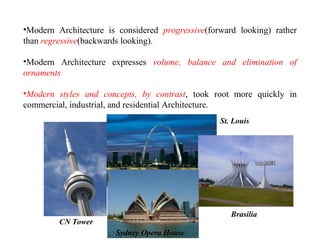
•Modern Architecture is considered progressive(forward looking) rather 
than regressive(backwards looking). 
•Modern Architecture expresses volume, balance and elimination of 
ornaments 
•Modern styles and concepts, by contrast, took root more quickly in 
commercial, industrial, and residential Architecture. 
Sydney Opera House 
St. Louis 
Brasilia 
CN Tower
TECHNOLOGIES 
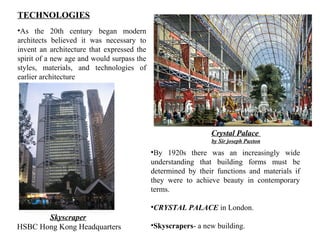
•As the 20th century began modern 
architects believed it was necessary to 
invent an architecture that expressed the 
spirit of a new age and would surpass the 
styles, materials, and technologies of 
earlier architecture 
Crystal Palace 
by Sir joseph Paxton 
Skyscraper 
HSBC Hong Kong Headquarters 
•By 1920s there was an increasingly wide 
understanding that building forms must be 
determined by their functions and materials if 
they were to achieve beauty in contemporary 
terms. 
•CRYSTAL PALACE in London. 
•Skyscrapers- a new building.
MATERIAL USED 
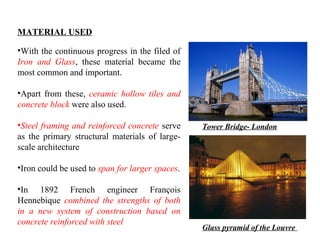
•With the continuous progress in the filed of 
Iron and Glass, these material became the 
most common and important. 
•Apart from these, ceramic hollow tiles and 
concrete block were also used. 
•Steel framing and reinforced concrete serve 
as the primary structural materials of large-scale 
architecture 
•Iron could be used to span for larger spaces. 
•In 1892 French engineer François 
Hennebique combined the strengths of both 
in a new system of construction based on 
concrete reinforced with steel 
Tower Bridge- London 
Glass pyramid of the Louvre
CHARACTERISTICS 
Common themes of modern architecture include: 
•The notion that "Form follows function", a dictum originally expressed 
by Frank Lloyd Wright's 
•Simplicity and clarity of forms and elimination of "unnecessary detail“ 
•Visual expression of structure (as opposed to the hiding of structural 
elements) 
•The related concept of "Truth to materials“ 
•Use of industrially-produced materials; adoption of the machine aesthetic 
•Particularly in International Style modernism, a visual emphasis on horizontal 
and vertical lines.
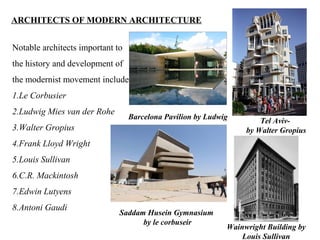
ARCHITECTS OF MODERN ARCHITECTURE 
Notable architects important to 
the history and development of 
the modernist movement include 
1.Le Corbusier 
2.Ludwig Mies van der Rohe 
3.Walter Gropius 
4.Frank Lloyd Wright 
5.Louis Sullivan 
6.C.R. Mackintosh 
7.Edwin Lutyens 
8.Antoni Gaudi 
Barcelona Pavilion by Ludwig 
Saddam Husein Gymnasium 
by le corbuseir 
Tel Aviv-by 
Walter Gropius 
Wainwright Building by 
Louis Sullivan

Modern Architecture History

  • 1.
    MODERN ARCHITECTURE (startedduring 19th century) • Inventions & discoveries • Less is more • Form follows function • Minimalism • Truthfulness of form, material & expression
  • 2.
    CONTENT Introduction Technologies Material used Characteristics Architects
  • 3.
    INTRODUCTION •Modern Architectureis Architecture that emerged in the 1920s in Europe and the United States. •It began as a response by Architects to rapid technological advances and greater urbanization of society at the turn of the century. •It is the very dominant style which came during the 19th century. •It symbolized the Ideal Public Virtues of democracy, liberty and reason. •It is the Architecture of simple forms(rectangles) enclosed with flat opaque (solid) or transparent (glass) walls.
  • 4.
    •Modern Architecture isconsidered progressive(forward looking) rather than regressive(backwards looking). •Modern Architecture expresses volume, balance and elimination of ornaments •Modern styles and concepts, by contrast, took root more quickly in commercial, industrial, and residential Architecture. Sydney Opera House St. Louis Brasilia CN Tower
  • 5.
    TECHNOLOGIES •As the20th century began modern architects believed it was necessary to invent an architecture that expressed the spirit of a new age and would surpass the styles, materials, and technologies of earlier architecture Crystal Palace by Sir joseph Paxton Skyscraper HSBC Hong Kong Headquarters •By 1920s there was an increasingly wide understanding that building forms must be determined by their functions and materials if they were to achieve beauty in contemporary terms. •CRYSTAL PALACE in London. •Skyscrapers- a new building.
  • 6.
    MATERIAL USED •Withthe continuous progress in the filed of Iron and Glass, these material became the most common and important. •Apart from these, ceramic hollow tiles and concrete block were also used. •Steel framing and reinforced concrete serve as the primary structural materials of large-scale architecture •Iron could be used to span for larger spaces. •In 1892 French engineer François Hennebique combined the strengths of both in a new system of construction based on concrete reinforced with steel Tower Bridge- London Glass pyramid of the Louvre
  • 7.
    CHARACTERISTICS Common themesof modern architecture include: •The notion that "Form follows function", a dictum originally expressed by Frank Lloyd Wright's •Simplicity and clarity of forms and elimination of "unnecessary detail“ •Visual expression of structure (as opposed to the hiding of structural elements) •The related concept of "Truth to materials“ •Use of industrially-produced materials; adoption of the machine aesthetic •Particularly in International Style modernism, a visual emphasis on horizontal and vertical lines.
  • 8.
    ARCHITECTS OF MODERNARCHITECTURE Notable architects important to the history and development of the modernist movement include 1.Le Corbusier 2.Ludwig Mies van der Rohe 3.Walter Gropius 4.Frank Lloyd Wright 5.Louis Sullivan 6.C.R. Mackintosh 7.Edwin Lutyens 8.Antoni Gaudi Barcelona Pavilion by Ludwig Saddam Husein Gymnasium by le corbuseir Tel Aviv-by Walter Gropius Wainwright Building by Louis Sullivan