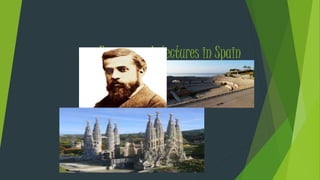

Famous architectures in Spain
Sagrada familia
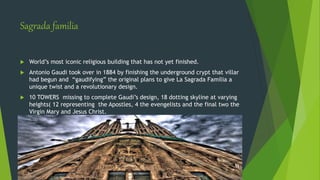
 World’s most iconic religious building that has not yet finished.
 Antonio Gaudi took over in 1884 by finishing the underground crypt that villar
had begun and “gaudifying” the original plans to give La Sagrada Familia a
unique twist and a revolutionary design.
 10 TOWERS missing to complete Gaudi’s design, 18 dotting skyline at varying
heights( 12 representing the Apostles, 4 the evengelists and the final two the
Virgin Mary and Jesus Christ.
Plaza de Espana
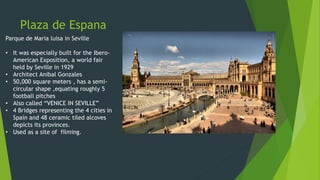
Parque de Maria luisa in Seville
• It was especially built for the Ibero-
American Exposition, a world fair
held by Seville in 1929
• Architect Anibal Gonzales
• 50,000 square meters , has a semi-
circular shape ,equating roughly 5
football pitches
• Also called “VENICE IN SEVILLE”
• 4 Bridges representing the 4 cities in
Spain and 48 ceramic tiled alcoves
depicts its provinces.
• Used as a site of filming.
PARK GUELL
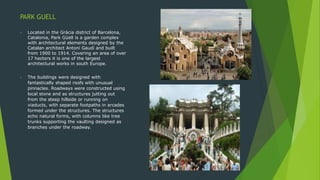
• Located in the Gràcia district of Barcelona,
Catalonia, Park Güell is a garden complex
with architectural elements designed by the
Catalan architect Antoni Gaudí and built
from 1900 to 1914. Covering an area of over
17 hectors it is one of the largest
architectural works in south Europe.
• The buildings were designed with
fantastically shaped roofs with unusual
pinnacles. Roadways were constructed using
local stone and as structures jutting out
from the steep hillside or running on
viaducts, with separate footpaths in arcades
formed under the structures. The structures
echo natural forms, with columns like tree
trunks supporting the vaulting designed as
branches under the roadway.
Tarragona
 Located in the region of Catalonia on the East coast of Spain,
Tarragona is approximately 60 miles (98 km) from Barcelona.
The city dates back to the Phoenicians when it was called
Tarchon.
 This period saw the enlargement of the forum and public baths
and the construction of many of the buildings, the ruins of
which remain today.
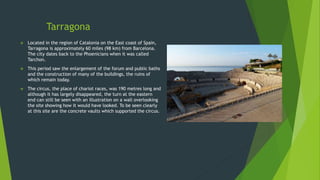
 The circus, the place of chariot races, was 190 metres long and
although it has largely disappeared, the turn at the eastern
end can still be seen with an illustration on a wall overlooking
the site showing how it would have looked. To be seen clearly
at this site are the concrete vaults which supported the circus.
Carthagena
(The Roman Theatre)
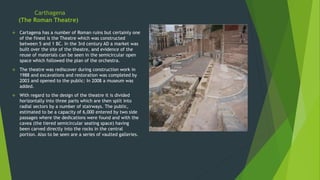
 Cartagena has a number of Roman ruins but certainly one
of the finest is the Theatre which was constructed
between 5 and 1 BC. In the 3rd century AD a market was
built over the site of the theatre, and evidence of the
reuse of materials can be seen in the semicircular open
space which followed the plan of the orchestra.
 The theatre was rediscover during construction work in
1988 and excavations and restoration was completed by
2003 and opened to the public: In 2008 a museum was
added.
 With regard to the design of the theatre it is divided
horizontally into three parts which are then split into
radial sectors by a number of stairways. The public,
estimated to be a capacity of 6,000 entered by two side
passages where the dedications were found and with the
cavea (the tiered semicircular seating space) having
been carved directly into the rocks in the central
portion. Also to be seen are a series of vaulted galleries.
Visual artist in spain
-716th Century: El Greco (1541-1614)
 His highly emotional style gave powerful expression to the
religious fervour of his adopted country but it was not to
Philip’s taste. El Greco consequently enjoyed little royal
patronage but he produced a succession of magnificent
altarpieces for churches in Toledo.
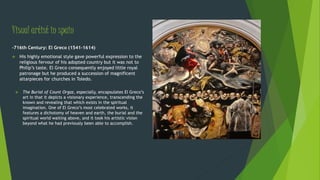
 The Burial of Count Orgaz, especially, encapsulates El Greco’s
art in that it depicts a visionary experience, transcending the
known and revealing that which exists in the spiritual
imagination. One of El Greco’s most celebrated works, it
features a dichotomy of heaven and earth, the burial and the
spiritual world waiting above, and it took his artistic vision
beyond what he had previously been able to accomplish.
17th Century: Diego Velázquez (1599-1660)
 The artist probably most loved by the Spanish people
is Velázquez who painted religious pictures and also occasional
mythological scenes and tavern scenes with a prominent still-life
element.
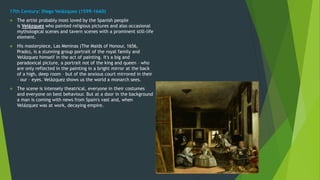
 His masterpiece, Las Meninas (The Maids of Honour, 1656,
Prado), is a stunning group portrait of the royal family and
Velázquez himself in the act of painting. It's a big and
paradoxical picture, a portrait not of the king and queen – who
are only reflected in the painting in a bright mirror at the back
of a high, deep room – but of the anxious court mirrored in their
– our – eyes. Velázquez shows us the world a monarch sees.
 The scene is intensely theatrical, everyone in their costumes
and everyone on best behaviour. But at a door in the background
a man is coming with news from Spain's vast and, when
Velázquez was at work, decaying empire.
18th Century: Francisco Goya (1746-1828)
 The greatest painter of his time in Spain and also probably the most
powerful and original figure in the visual arts in the whole of Europe
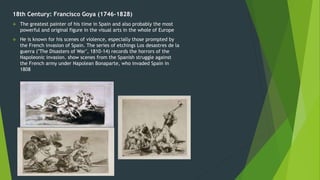
 He is known for his scenes of violence, especially those prompted by
the French invasion of Spain. The series of etchings Los desastres de la
guerra ("The Disasters of War", 1810-14) records the horrors of the
Napoleonic invasion. show scenes from the Spanish struggle against
the French army under Napolean Bonaparte, who invaded Spain in
1808
19th Century: Joaquin Sorolla (1863-1923)
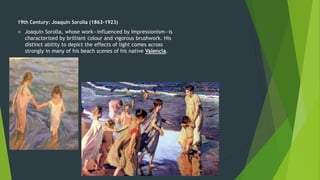
 Joaquin Sorolla, whose work—influenced by Impressionism—is
characterized by brilliant colour and vigorous brushwork. His
distinct ability to depict the effects of light comes across
strongly in many of his beach scenes of his native Valencia.
20th Century: Pablo Picasso (1881-1973)
 One of the most prolific artists in history was Pablo
Picasso who spent most of his life in France but his work often
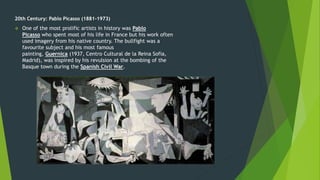
used imagery from his native country. The bullfight was a
favourite subject and his most famous
painting, Guernica (1937, Centro Cultural de la Reina Sofia,
Madrid), was inspired by his revulsion at the bombing of the
Basque town during the Spanish Civil War.
Salvador Dalí (1904-1989)
 Salvador Dali was probably the greatest Surrealist artist
using bizarre dream imagery to create unforgettable and
unmistakable landscapes of his inner world. His most
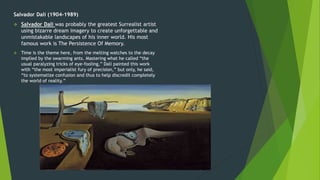
famous work is The Persistence Of Memory.
 Time is the theme here, from the melting watches to the decay
implied by the swarming ants. Mastering what he called “the
usual paralyzing tricks of eye-fooling,” Dalí painted this work
with “the most imperialist fury of precision,” but only, he said,
“to systematize confusion and thus to help discredit completely
the world of reality.”
Thank you so much

Famous Architectures in spain

  • 1.
  • 2.
    Sagrada familia  World’smost iconic religious building that has not yet finished.  Antonio Gaudi took over in 1884 by finishing the underground crypt that villar had begun and “gaudifying” the original plans to give La Sagrada Familia a unique twist and a revolutionary design.  10 TOWERS missing to complete Gaudi’s design, 18 dotting skyline at varying heights( 12 representing the Apostles, 4 the evengelists and the final two the Virgin Mary and Jesus Christ.
  • 3.
    Plaza de Espana Parquede Maria luisa in Seville • It was especially built for the Ibero- American Exposition, a world fair held by Seville in 1929 • Architect Anibal Gonzales • 50,000 square meters , has a semi- circular shape ,equating roughly 5 football pitches • Also called “VENICE IN SEVILLE” • 4 Bridges representing the 4 cities in Spain and 48 ceramic tiled alcoves depicts its provinces. • Used as a site of filming.
  • 4.
    PARK GUELL • Locatedin the Gràcia district of Barcelona, Catalonia, Park Güell is a garden complex with architectural elements designed by the Catalan architect Antoni Gaudí and built from 1900 to 1914. Covering an area of over 17 hectors it is one of the largest architectural works in south Europe. • The buildings were designed with fantastically shaped roofs with unusual pinnacles. Roadways were constructed using local stone and as structures jutting out from the steep hillside or running on viaducts, with separate footpaths in arcades formed under the structures. The structures echo natural forms, with columns like tree trunks supporting the vaulting designed as branches under the roadway.
  • 5.
    Tarragona  Located inthe region of Catalonia on the East coast of Spain, Tarragona is approximately 60 miles (98 km) from Barcelona. The city dates back to the Phoenicians when it was called Tarchon.  This period saw the enlargement of the forum and public baths and the construction of many of the buildings, the ruins of which remain today.  The circus, the place of chariot races, was 190 metres long and although it has largely disappeared, the turn at the eastern end can still be seen with an illustration on a wall overlooking the site showing how it would have looked. To be seen clearly at this site are the concrete vaults which supported the circus.
  • 6.
    Carthagena (The Roman Theatre) Cartagena has a number of Roman ruins but certainly one of the finest is the Theatre which was constructed between 5 and 1 BC. In the 3rd century AD a market was built over the site of the theatre, and evidence of the reuse of materials can be seen in the semicircular open space which followed the plan of the orchestra.  The theatre was rediscover during construction work in 1988 and excavations and restoration was completed by 2003 and opened to the public: In 2008 a museum was added.  With regard to the design of the theatre it is divided horizontally into three parts which are then split into radial sectors by a number of stairways. The public, estimated to be a capacity of 6,000 entered by two side passages where the dedications were found and with the cavea (the tiered semicircular seating space) having been carved directly into the rocks in the central portion. Also to be seen are a series of vaulted galleries.
  • 7.
  • 8.
    Visual artist inspain -716th Century: El Greco (1541-1614)  His highly emotional style gave powerful expression to the religious fervour of his adopted country but it was not to Philip’s taste. El Greco consequently enjoyed little royal patronage but he produced a succession of magnificent altarpieces for churches in Toledo.  The Burial of Count Orgaz, especially, encapsulates El Greco’s art in that it depicts a visionary experience, transcending the known and revealing that which exists in the spiritual imagination. One of El Greco’s most celebrated works, it features a dichotomy of heaven and earth, the burial and the spiritual world waiting above, and it took his artistic vision beyond what he had previously been able to accomplish.
  • 9.
    17th Century: DiegoVelázquez (1599-1660)  The artist probably most loved by the Spanish people is Velázquez who painted religious pictures and also occasional mythological scenes and tavern scenes with a prominent still-life element.  His masterpiece, Las Meninas (The Maids of Honour, 1656, Prado), is a stunning group portrait of the royal family and Velázquez himself in the act of painting. It's a big and paradoxical picture, a portrait not of the king and queen – who are only reflected in the painting in a bright mirror at the back of a high, deep room – but of the anxious court mirrored in their – our – eyes. Velázquez shows us the world a monarch sees.  The scene is intensely theatrical, everyone in their costumes and everyone on best behaviour. But at a door in the background a man is coming with news from Spain's vast and, when Velázquez was at work, decaying empire.
  • 10.
    18th Century: FranciscoGoya (1746-1828)  The greatest painter of his time in Spain and also probably the most powerful and original figure in the visual arts in the whole of Europe  He is known for his scenes of violence, especially those prompted by the French invasion of Spain. The series of etchings Los desastres de la guerra ("The Disasters of War", 1810-14) records the horrors of the Napoleonic invasion. show scenes from the Spanish struggle against the French army under Napolean Bonaparte, who invaded Spain in 1808
  • 11.
    19th Century: JoaquinSorolla (1863-1923)  Joaquin Sorolla, whose work—influenced by Impressionism—is characterized by brilliant colour and vigorous brushwork. His distinct ability to depict the effects of light comes across strongly in many of his beach scenes of his native Valencia.
  • 12.
    20th Century: PabloPicasso (1881-1973)  One of the most prolific artists in history was Pablo Picasso who spent most of his life in France but his work often used imagery from his native country. The bullfight was a favourite subject and his most famous painting, Guernica (1937, Centro Cultural de la Reina Sofia, Madrid), was inspired by his revulsion at the bombing of the Basque town during the Spanish Civil War.
  • 13.
    Salvador Dalí (1904-1989) Salvador Dali was probably the greatest Surrealist artist using bizarre dream imagery to create unforgettable and unmistakable landscapes of his inner world. His most famous work is The Persistence Of Memory.  Time is the theme here, from the melting watches to the decay implied by the swarming ants. Mastering what he called “the usual paralyzing tricks of eye-fooling,” Dalí painted this work with “the most imperialist fury of precision,” but only, he said, “to systematize confusion and thus to help discredit completely the world of reality.”
  • 14.