Evolution of
Architectural Styles
(CLASSICAL STYLES TO REVIVALISM)
Classical Architecture: Ancient
Greece and Rome
A Journey Through Timeless Design
Classical Architecture
 Classical architecture derives from Greek and Roman architectural
principles, often influenced by the works of Vitruvius.
 Its roots can be traced back to the Carolingian Renaissance and gained
prominence during the Italian Renaissance.
 Classical styles encompass a range of variations but share a common
vocabulary of decorative and constructive elements.
 These styles have dominated Western architecture from the Renaissance
until World War II.
 Classical architecture continues to inspire architects and inform
architectural practices today.
 Key characteristics: balance, symmetry, proportion, and harmony
Ancient Greek Architecture
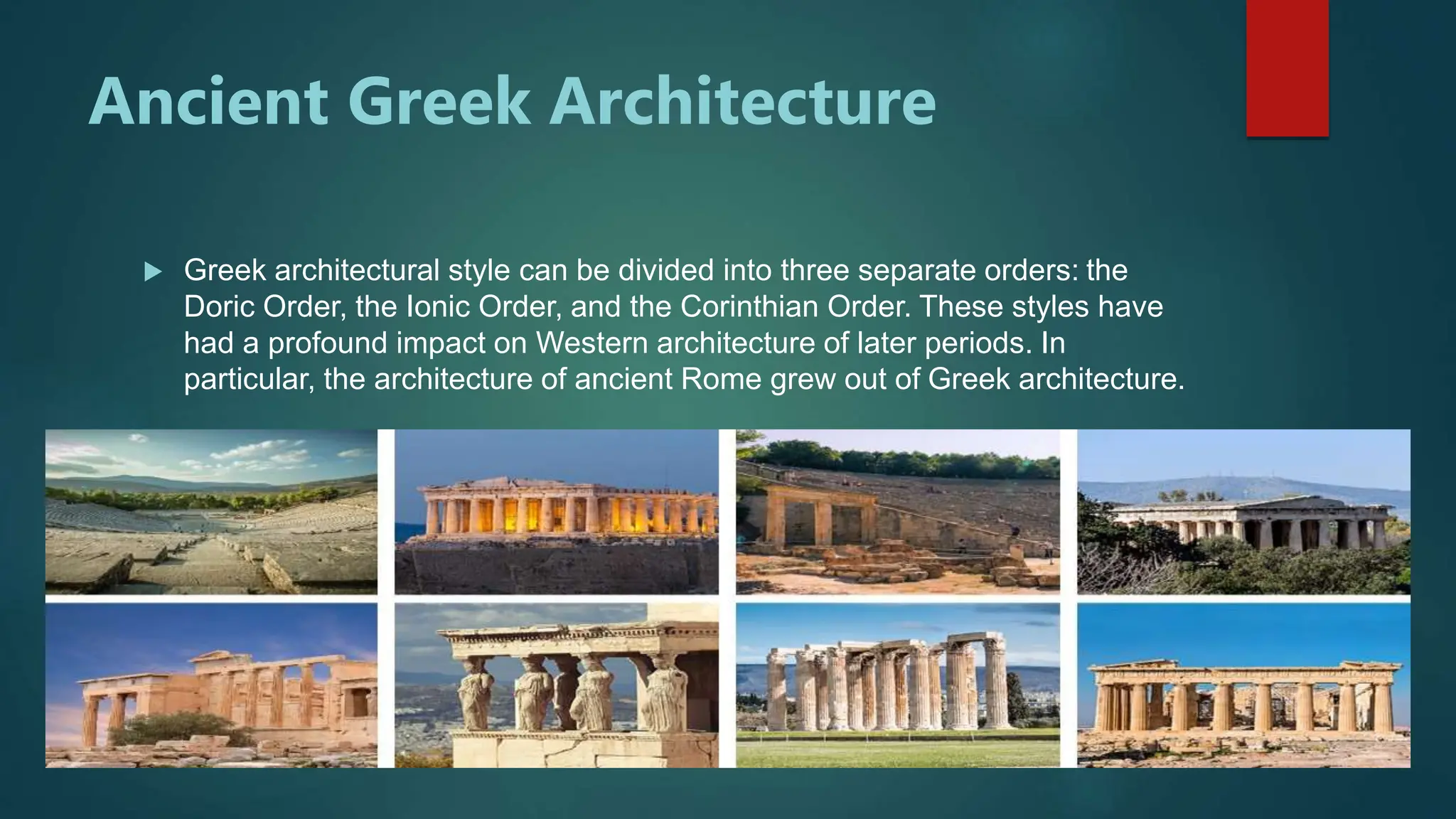
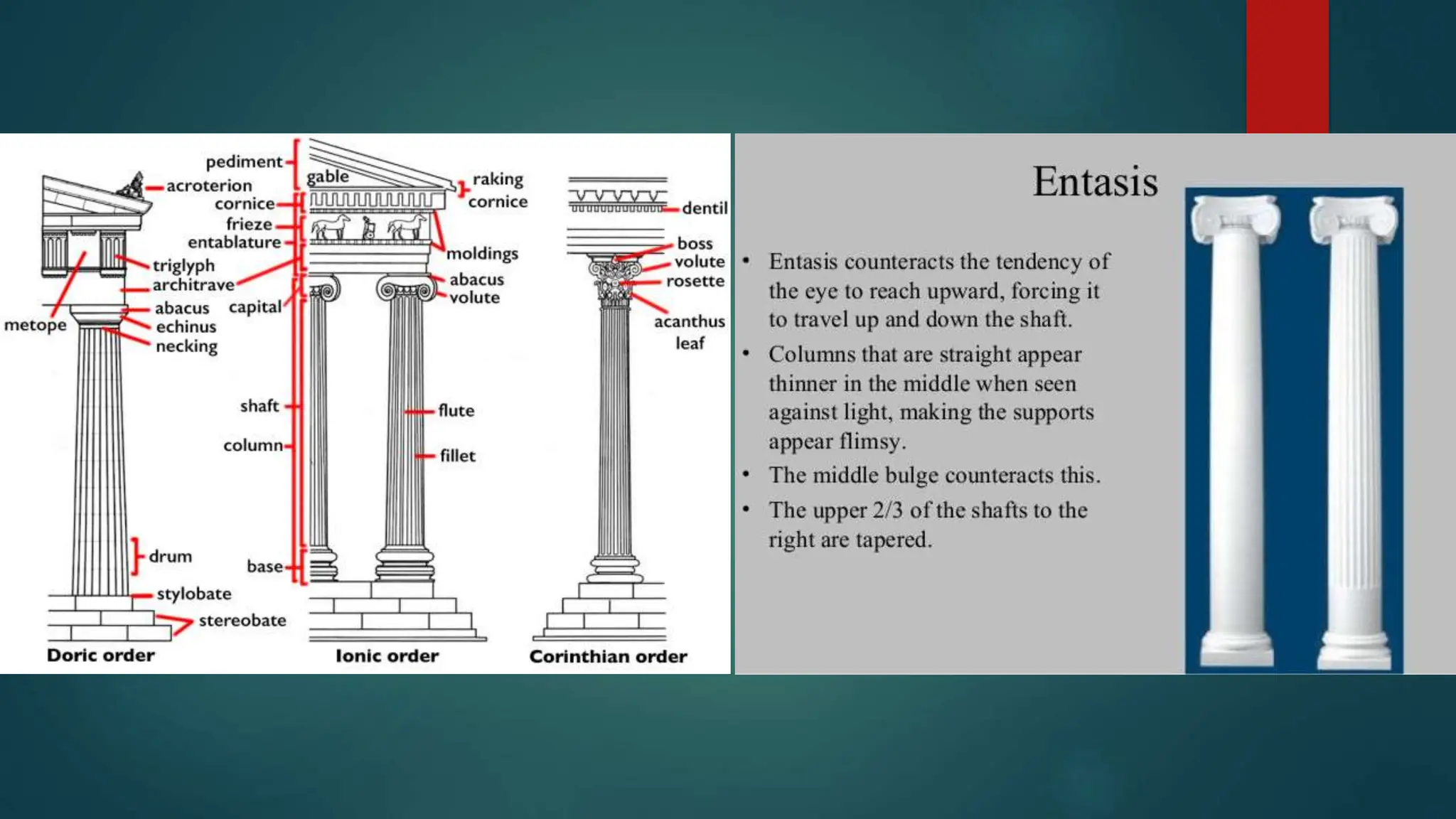
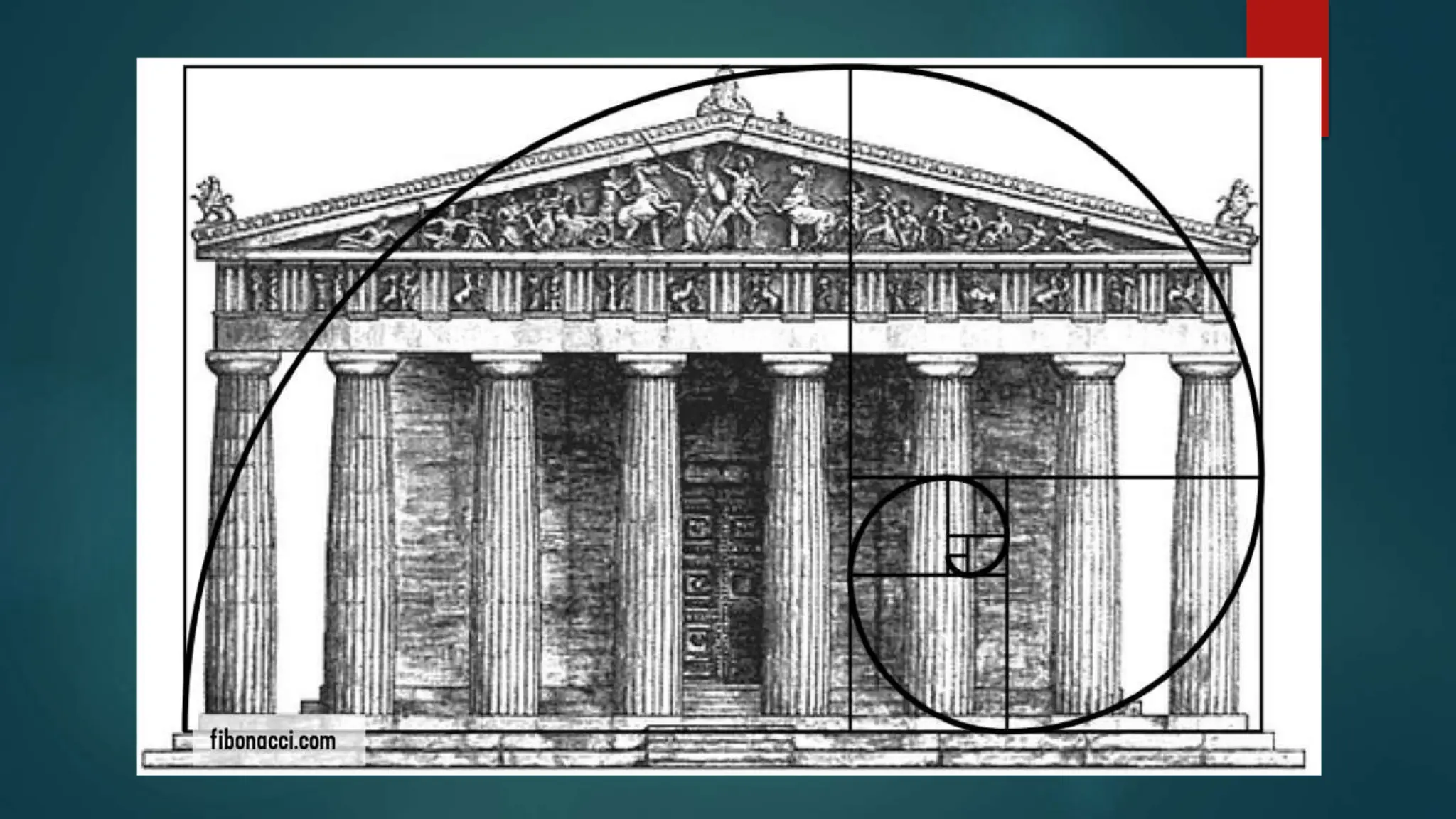
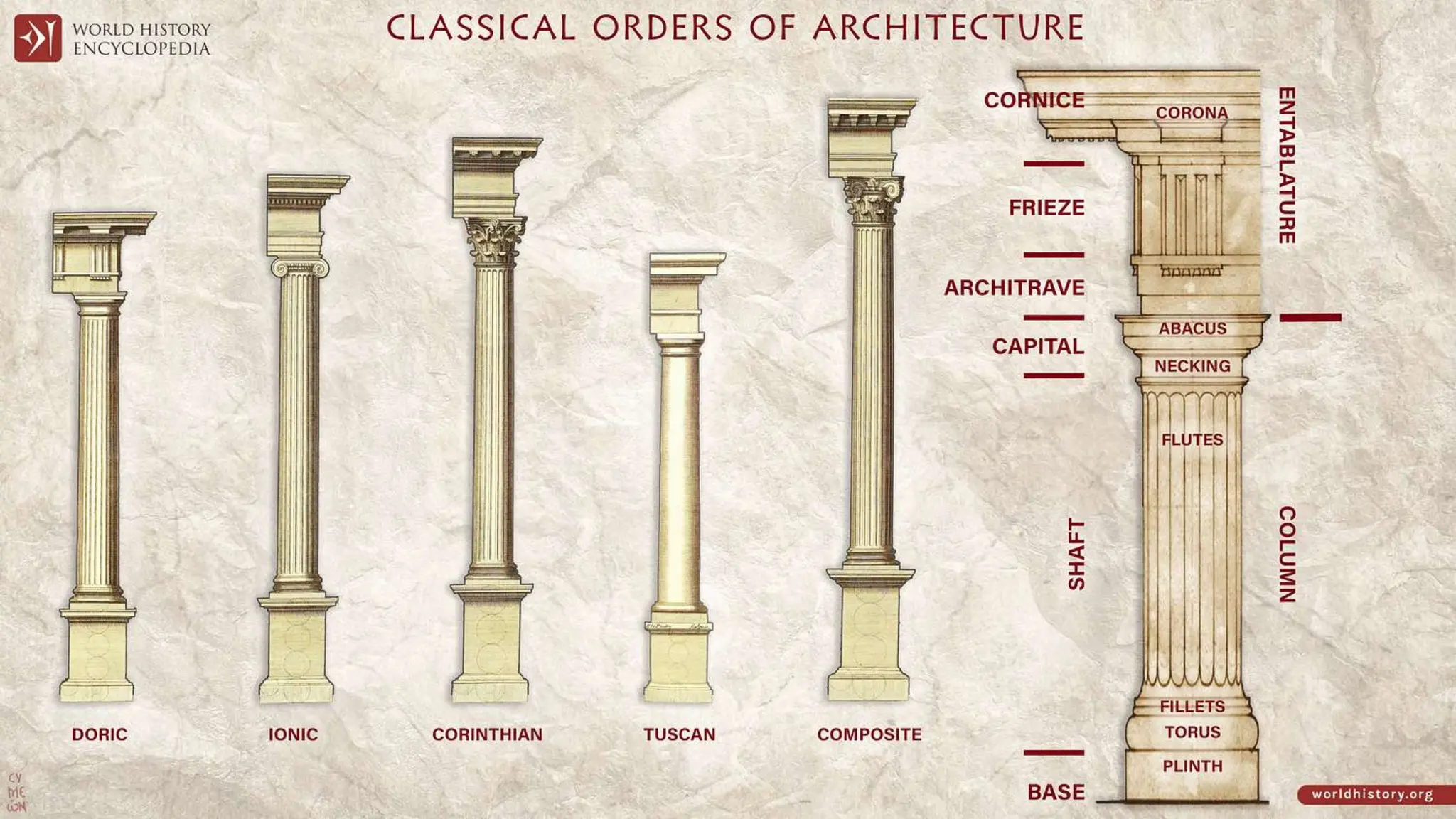
 Greek architectural style can be divided into three separate orders: the
Doric Order, the Ionic Order, and the Corinthian Order. These styles have
had a profound impact on Western architecture of later periods. In
particular, the architecture of ancient Rome grew out of Greek architecture.
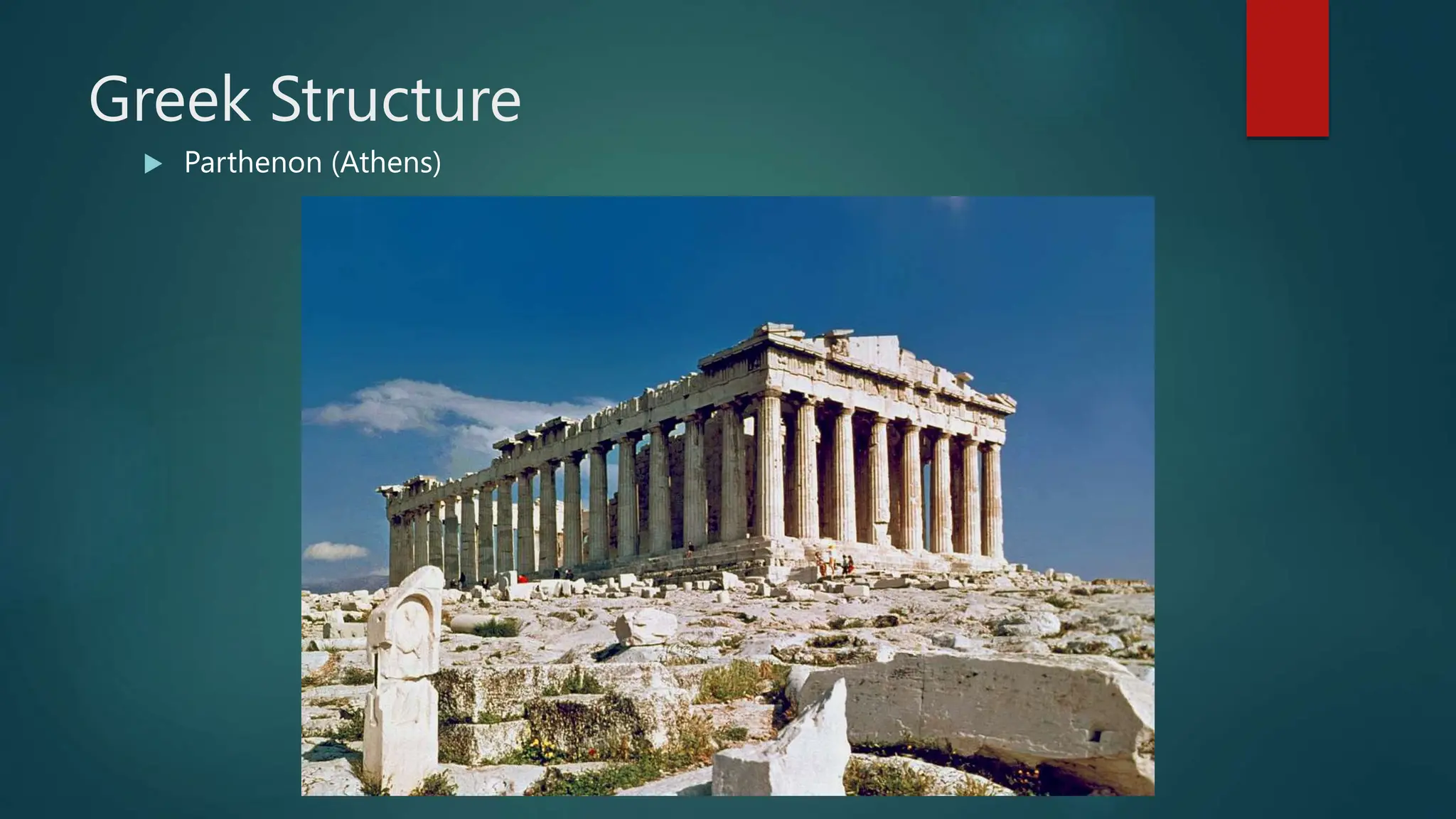
Greek Structure
 Parthenon (Athens)
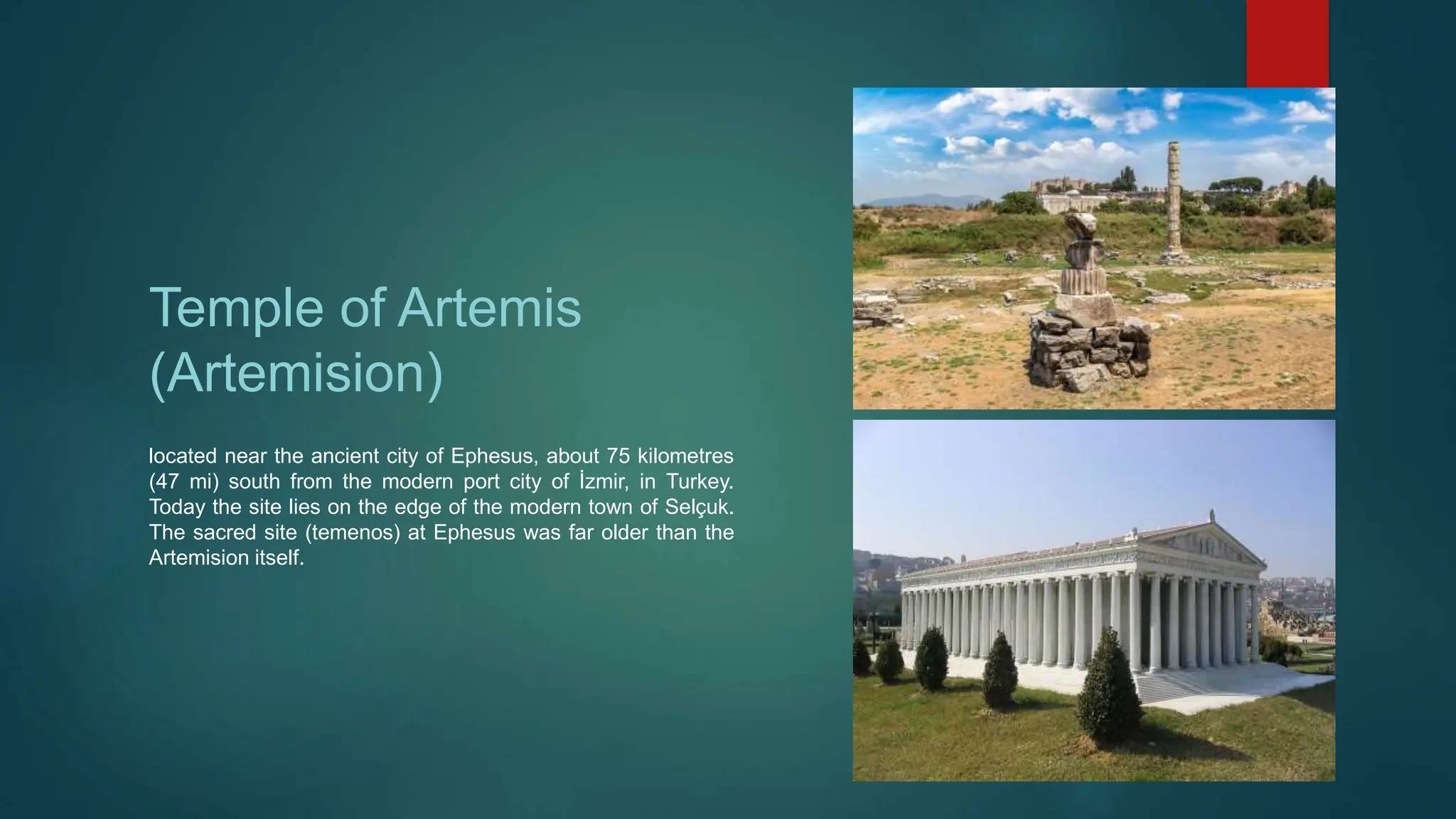
Temple of Artemis
(Artemision)
located near the ancient city of Ephesus, about 75 kilometres
(47 mi) south from the modern port city of İzmir, in Turkey.
Today the site lies on the edge of the modern town of Selçuk.
The sacred site (temenos) at Ephesus was far older than the
Artemision itself.
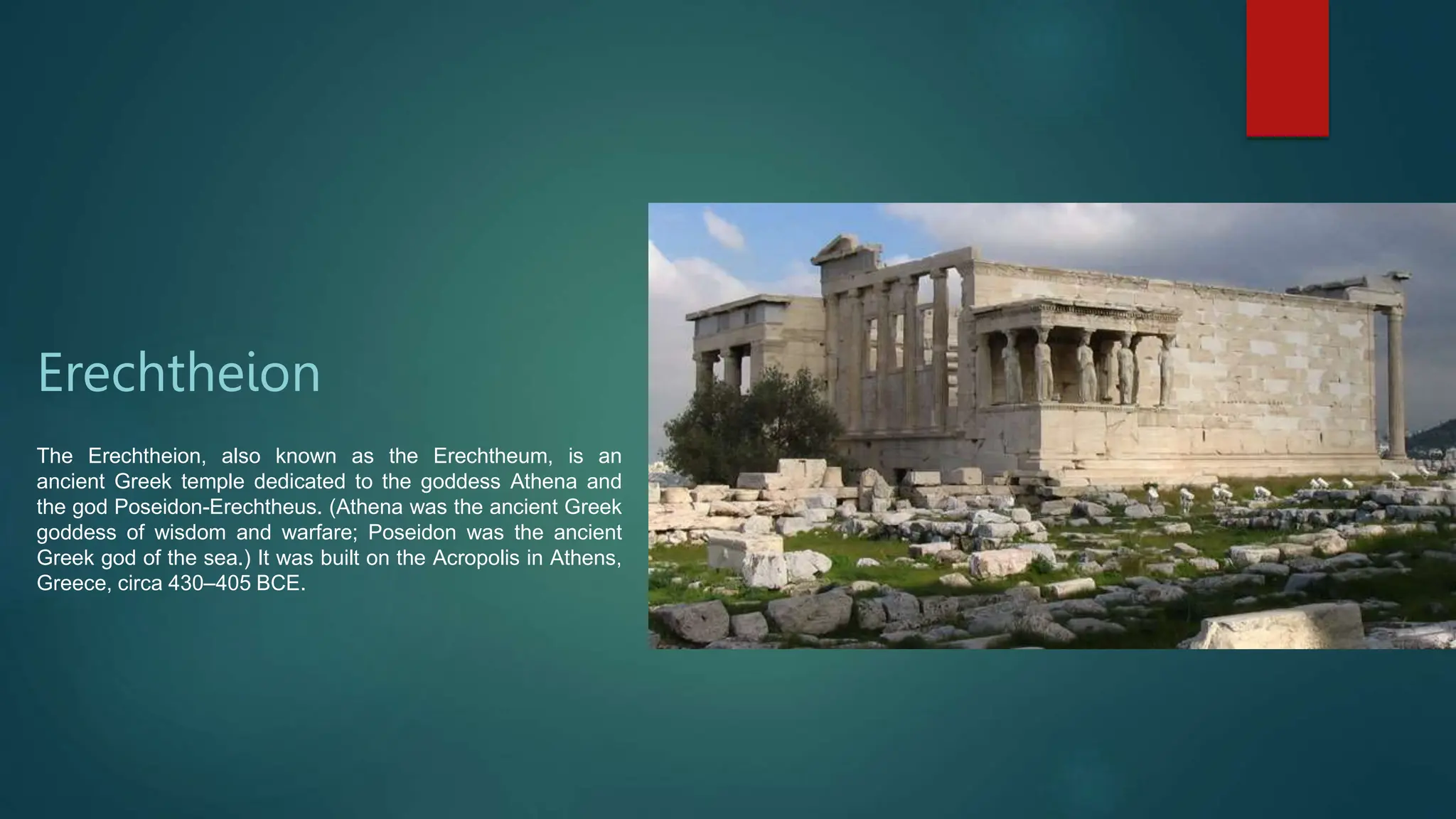
Erechtheion
The Erechtheion, also known as the Erechtheum, is an
ancient Greek temple dedicated to the goddess Athena and
the god Poseidon-Erechtheus. (Athena was the ancient Greek
goddess of wisdom and warfare; Poseidon was the ancient
Greek god of the sea.) It was built on the Acropolis in Athens,
Greece, circa 430–405 BCE.
Roman Architecture
 Influences of Greek architecture on Roman design
 Development of new architectural elements: arches, domes, and vaults
 Roman architectural styles: Tuscan, Doric, Ionic, Corinthian, and Composite orders
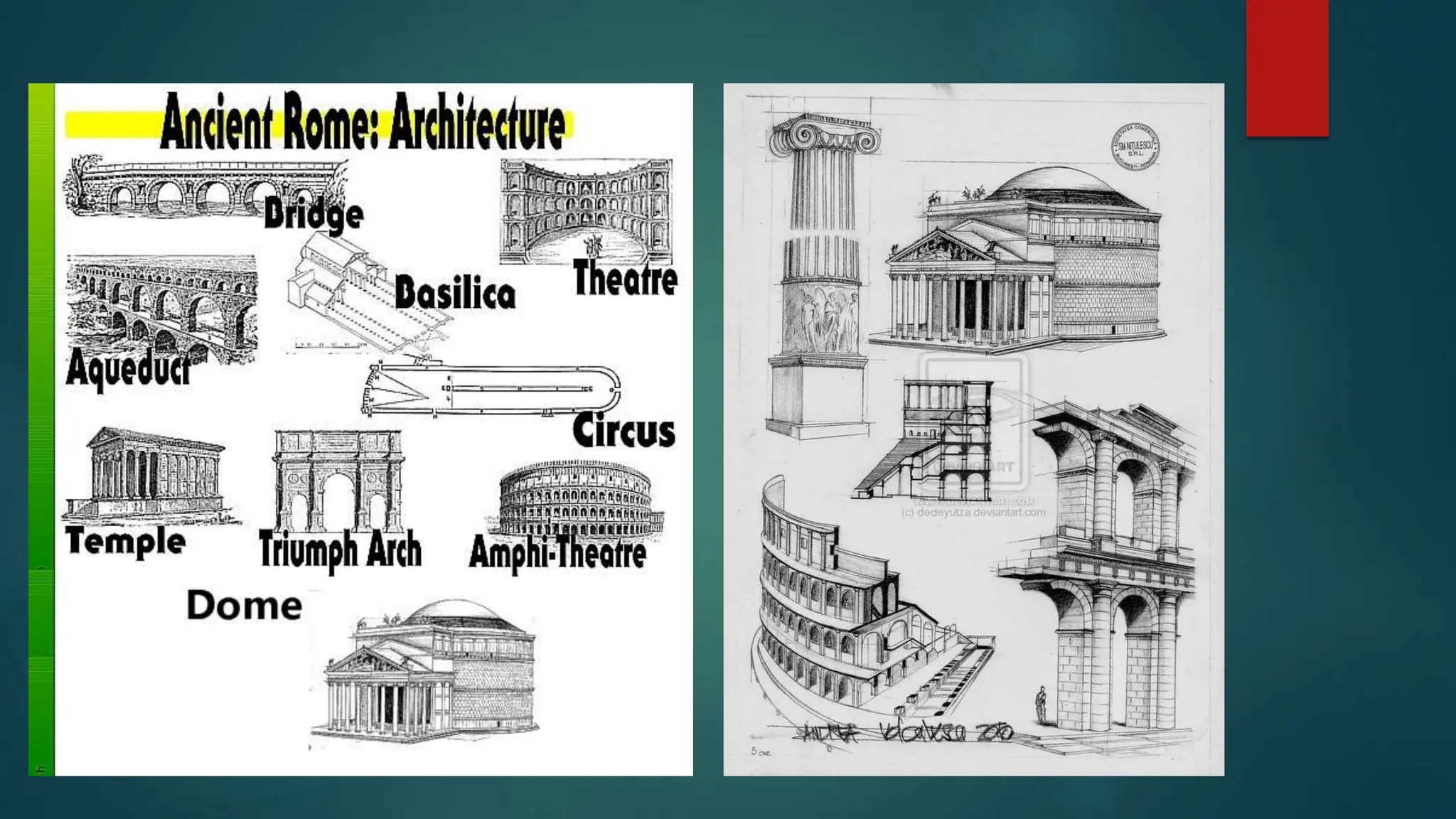
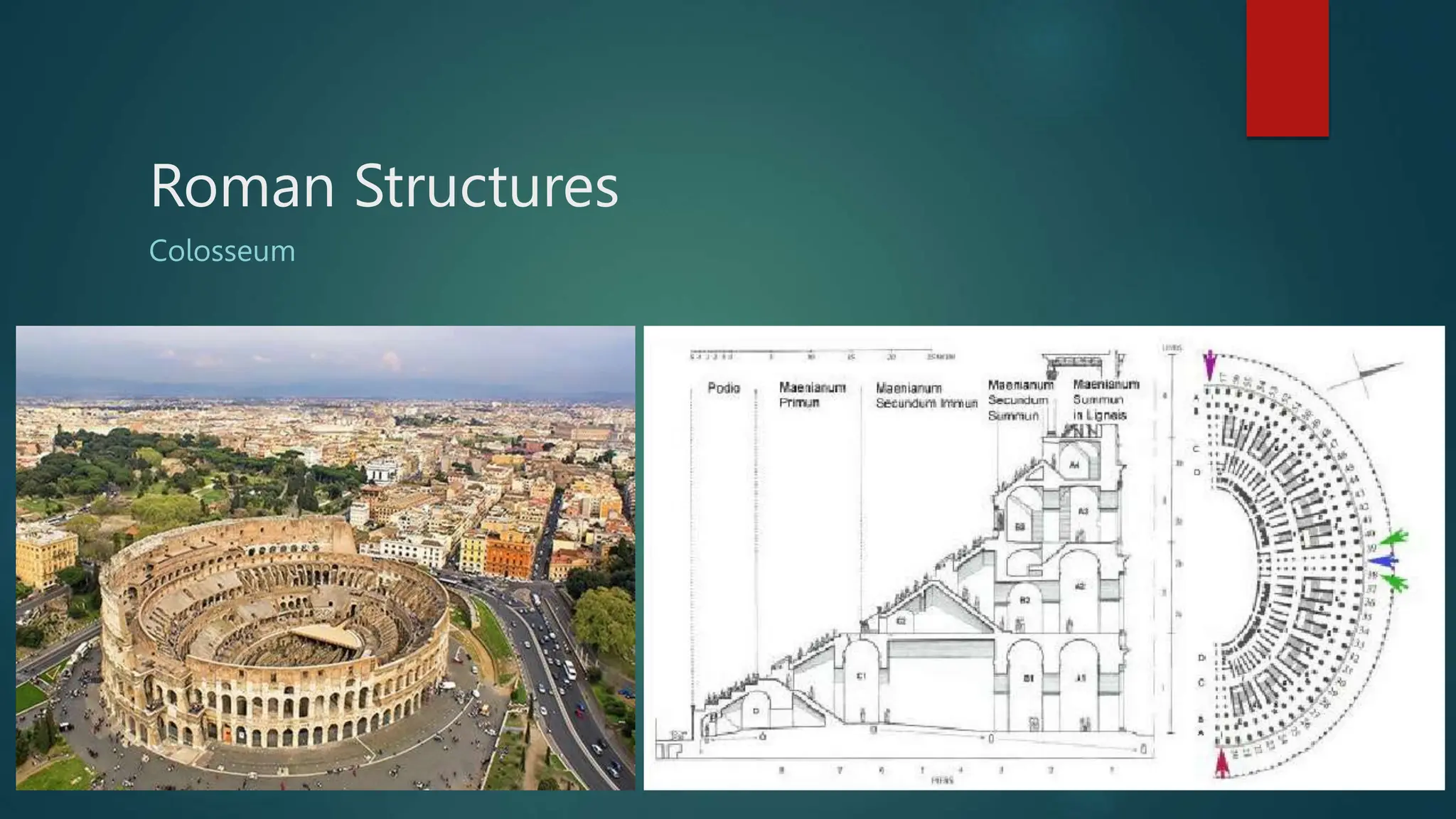
Roman Structures
Colosseum
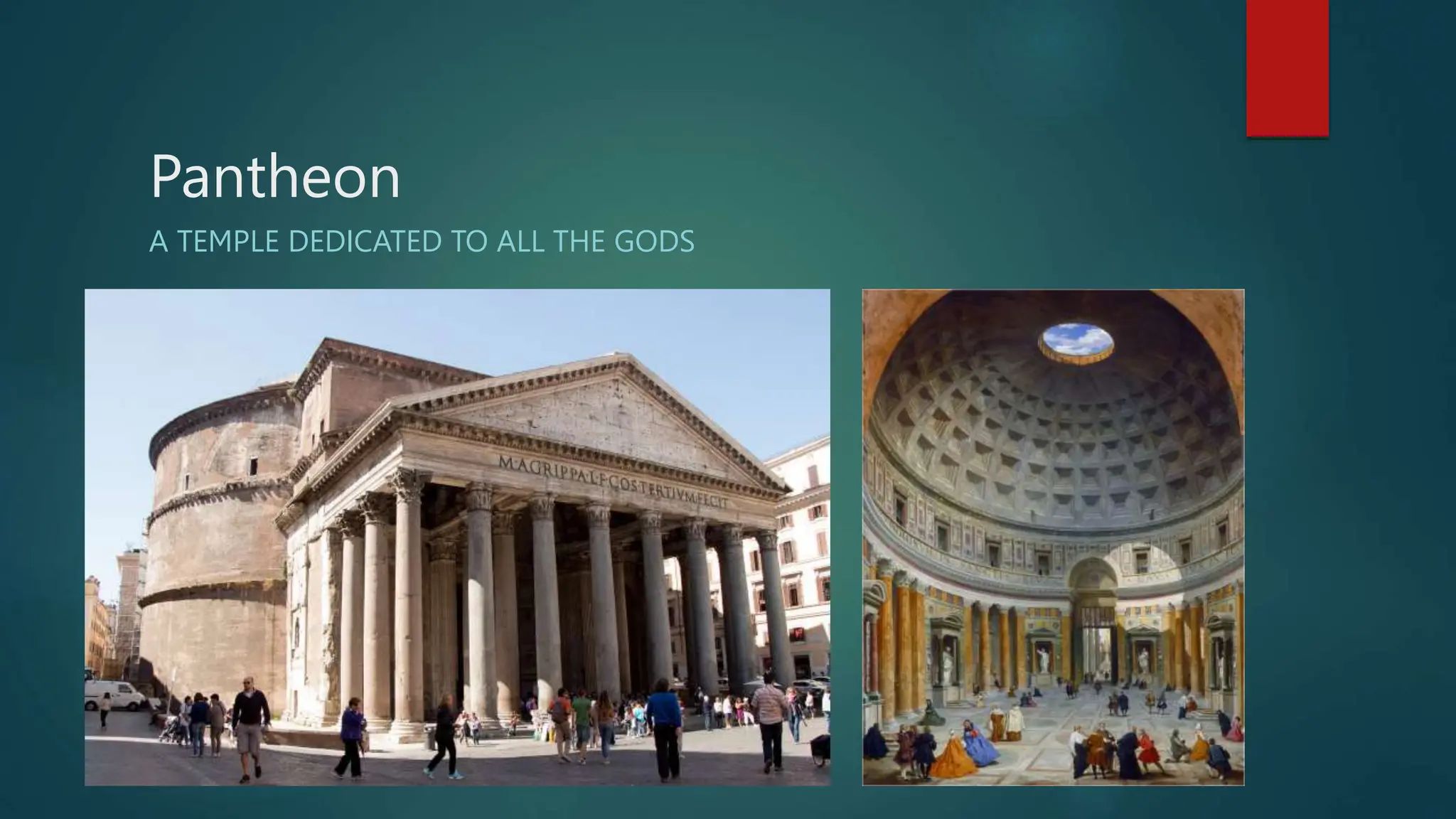
Pantheon
A TEMPLE DEDICATED TO ALL THE GODS
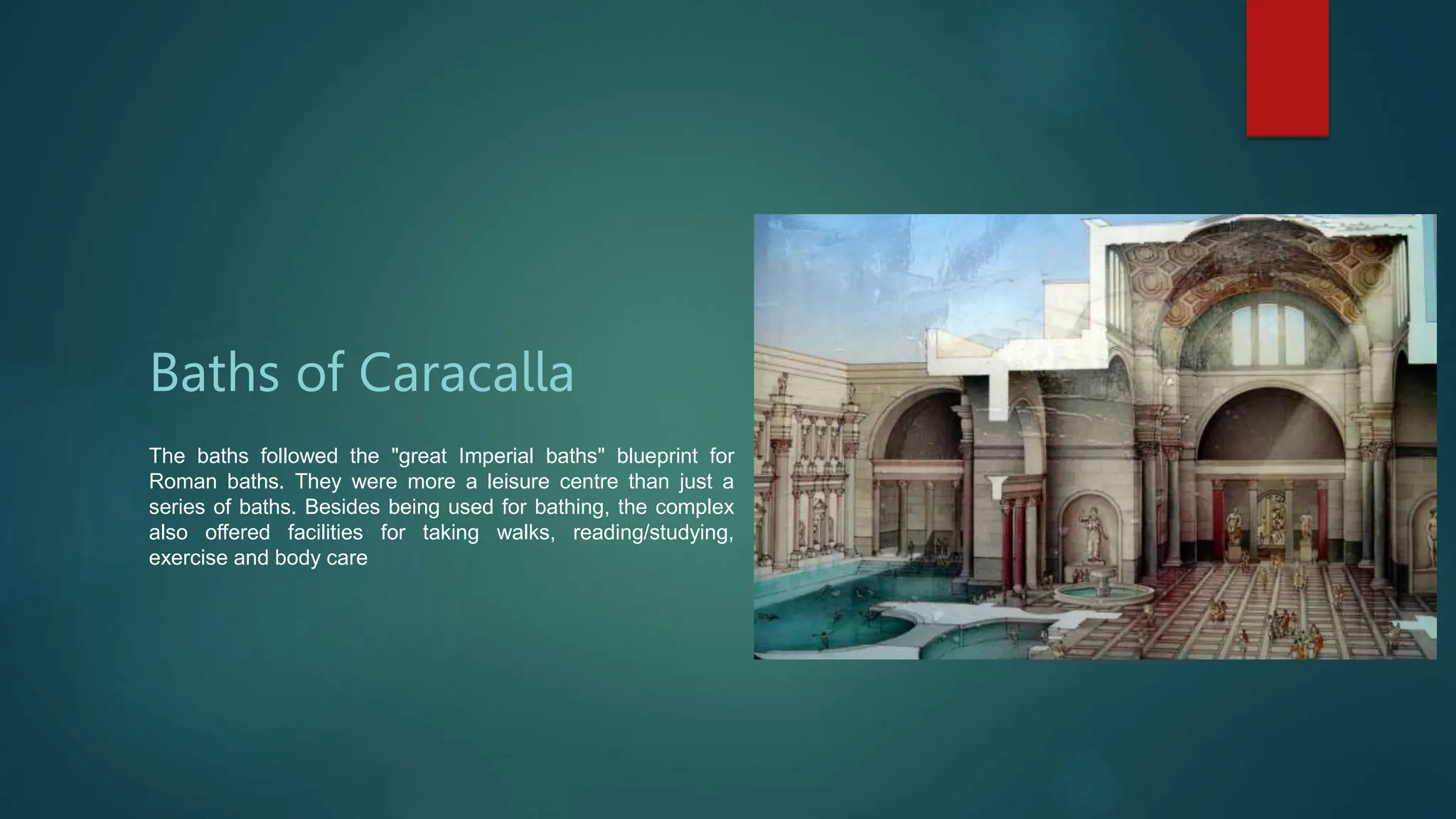
Baths of Caracalla
The baths followed the "great Imperial baths" blueprint for
Roman baths. They were more a leisure centre than just a
series of baths. Besides being used for bathing, the complex
also offered facilities for taking walks, reading/studying,
exercise and body care
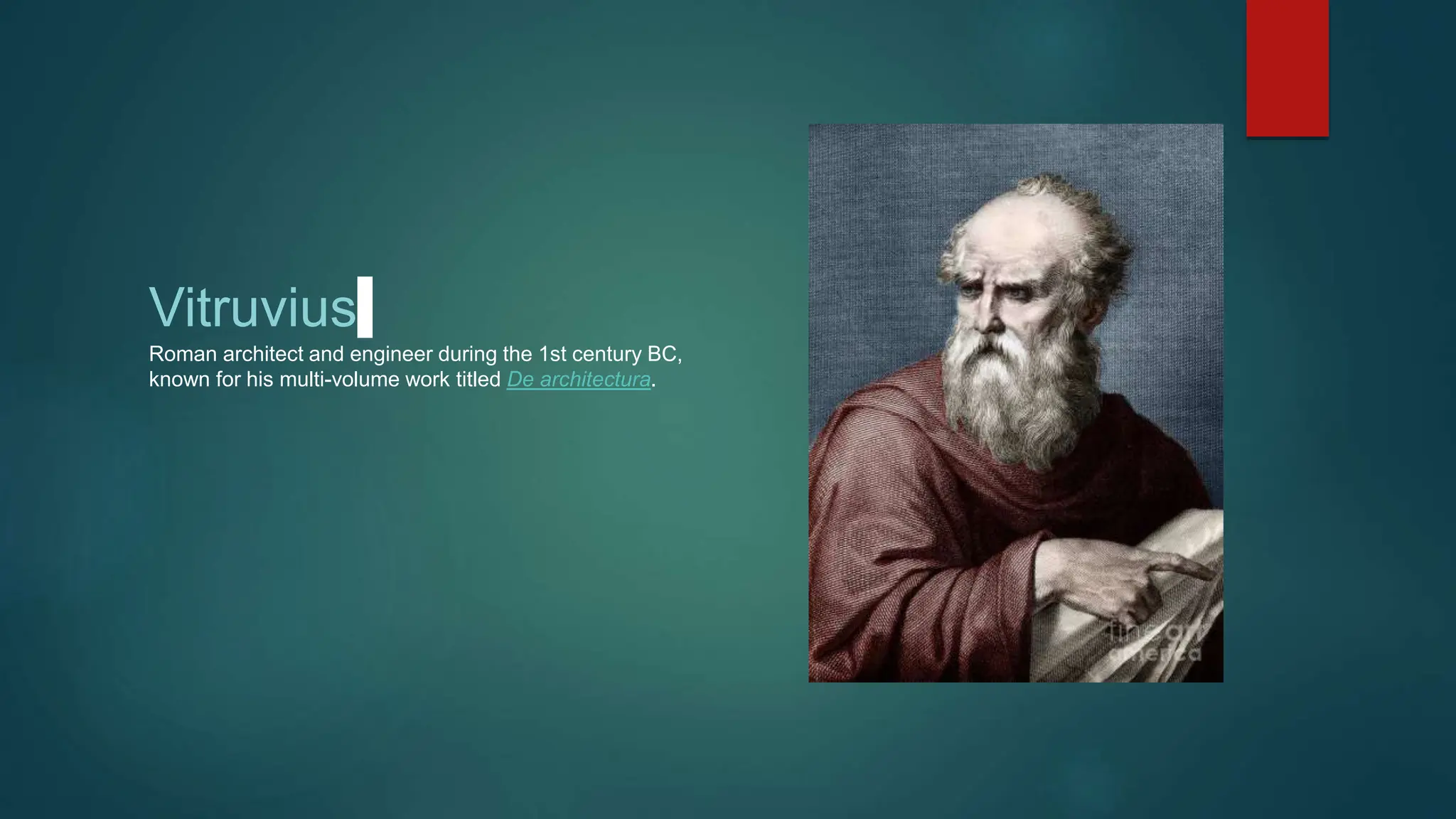
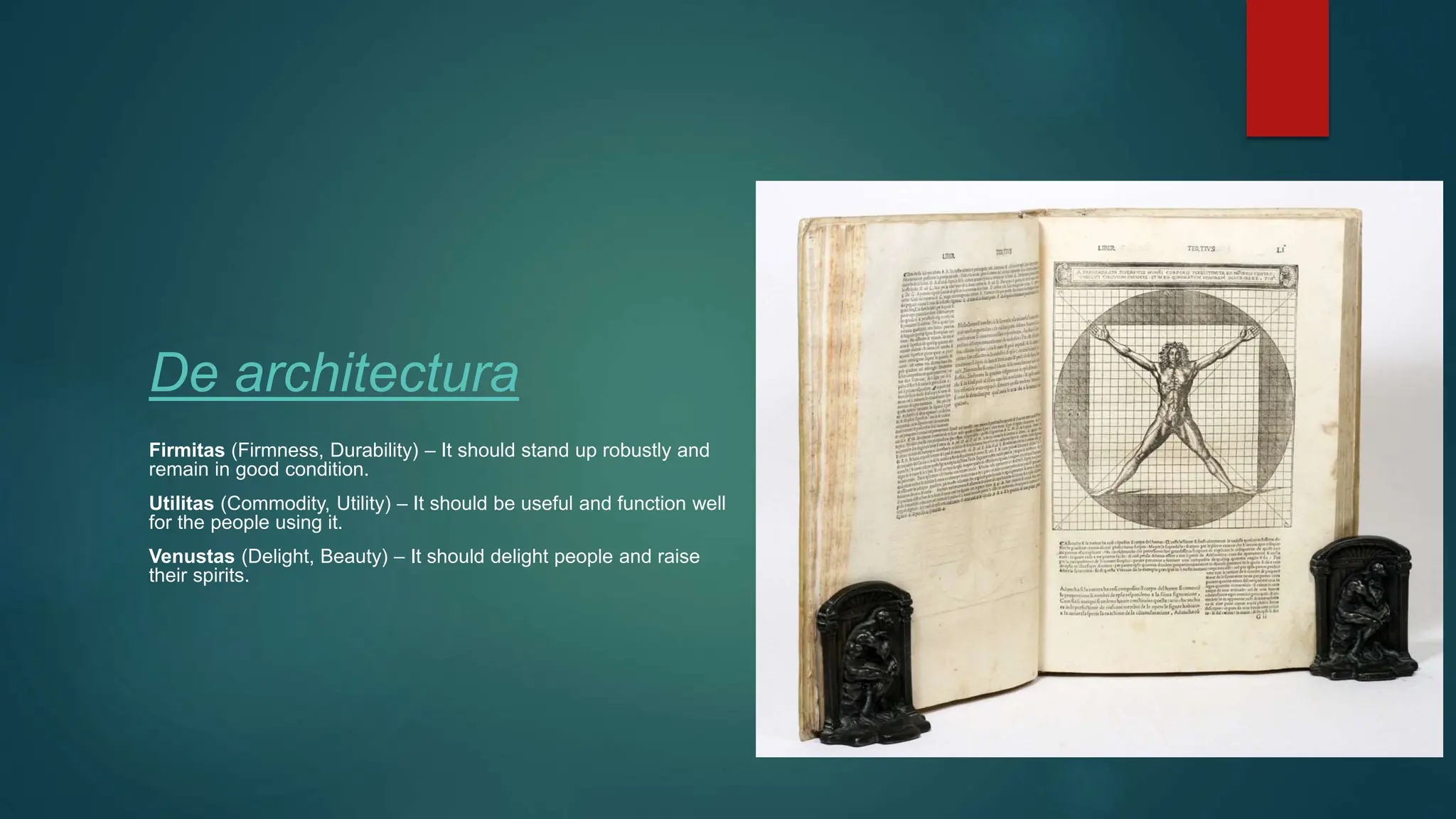
Vitruvius
Roman architect and engineer during the 1st century BC,
known for his multi-volume work titled De architectura.
De architectura
Firmitas (Firmness, Durability) – It should stand up robustly and
remain in good condition.
Utilitas (Commodity, Utility) – It should be useful and function well
for the people using it.
Venustas (Delight, Beauty) – It should delight people and raise
their spirits.
Romanesque
Architecture
(10th–12th century)
EVOLUTION OF ARCHITECTURAL STYLES
Romanesque Architecture
• Romanesque Architecture: Prevailed in Europe from the mid-11th century until the
rise of Gothic architecture.
• Influences: Fusion of Roman, Carolingian, Ottonian, Byzantine, and local Germanic
traditions.
• Origins: Emerged due to the expansion of monasticism in the 10th–11th century,
necessitating larger churches.
• Architectural Features:
• Semicircular arches for windows, doors, and arcades.
• Barrel or groin vaults supporting the roof of the nave.
• Massive piers and walls to resist vault thrust, with few windows.
• Side aisles with galleries above.
• Large tower over the crossing of nave and transept, with smaller towers at the western end.
• French Influence: Expansion on the early Christian basilica plan, incorporating
radiating chapels, ambulatories, and large transepts.
Key Characteristics of Romanesque
Architecture
 Thick, sturdy walls with small windows to support heavy stone roofs
 Rounded arches, barrel vaults, and groin vaults
 Use of piers and columns to support the weight of the structure
 Decorative elements such as sculptural reliefs, ornate doorways, and frescoes
Architectural Elements in Romanesque
Buildings
Detailing the components of Romanesque structures:
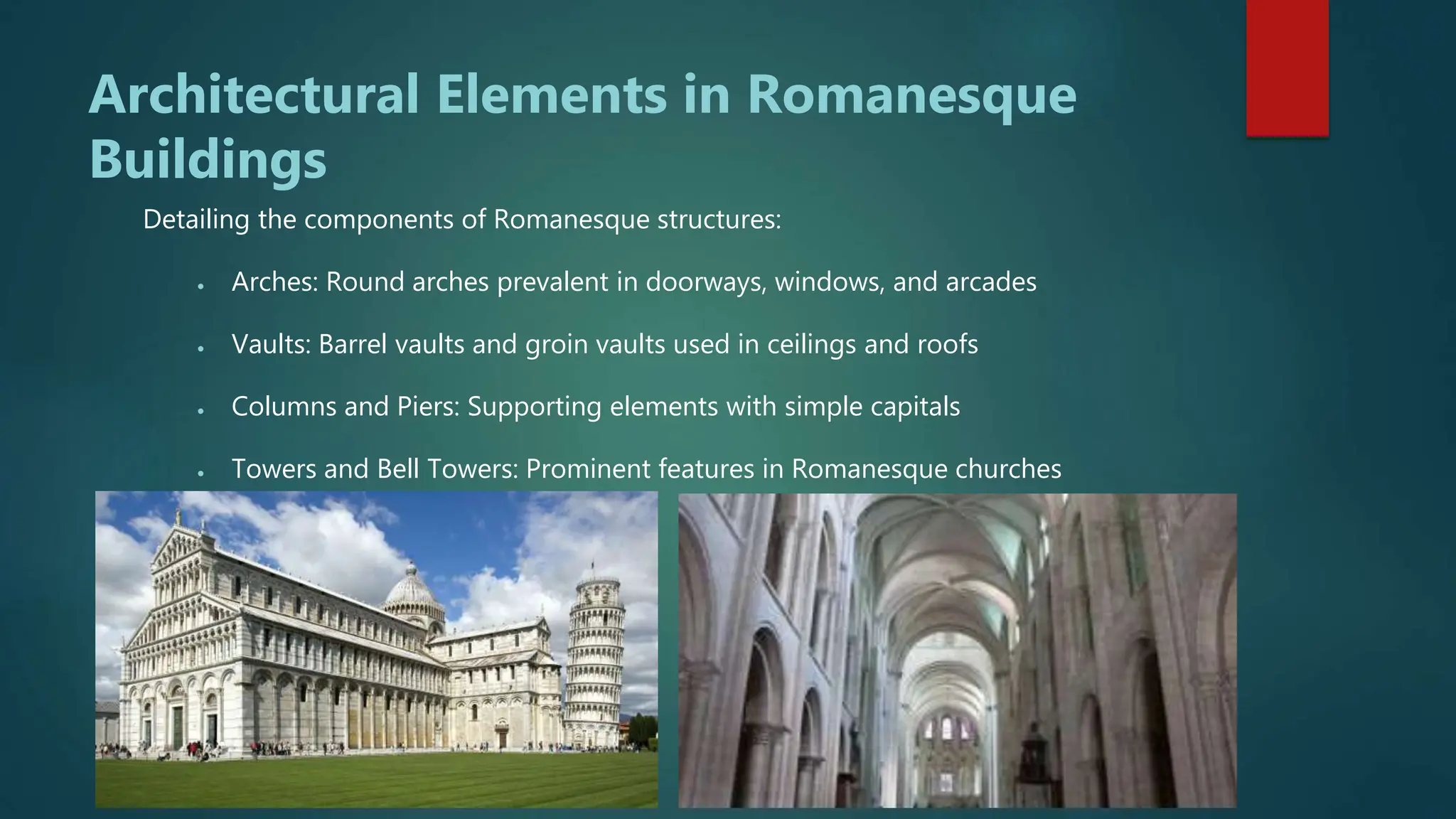
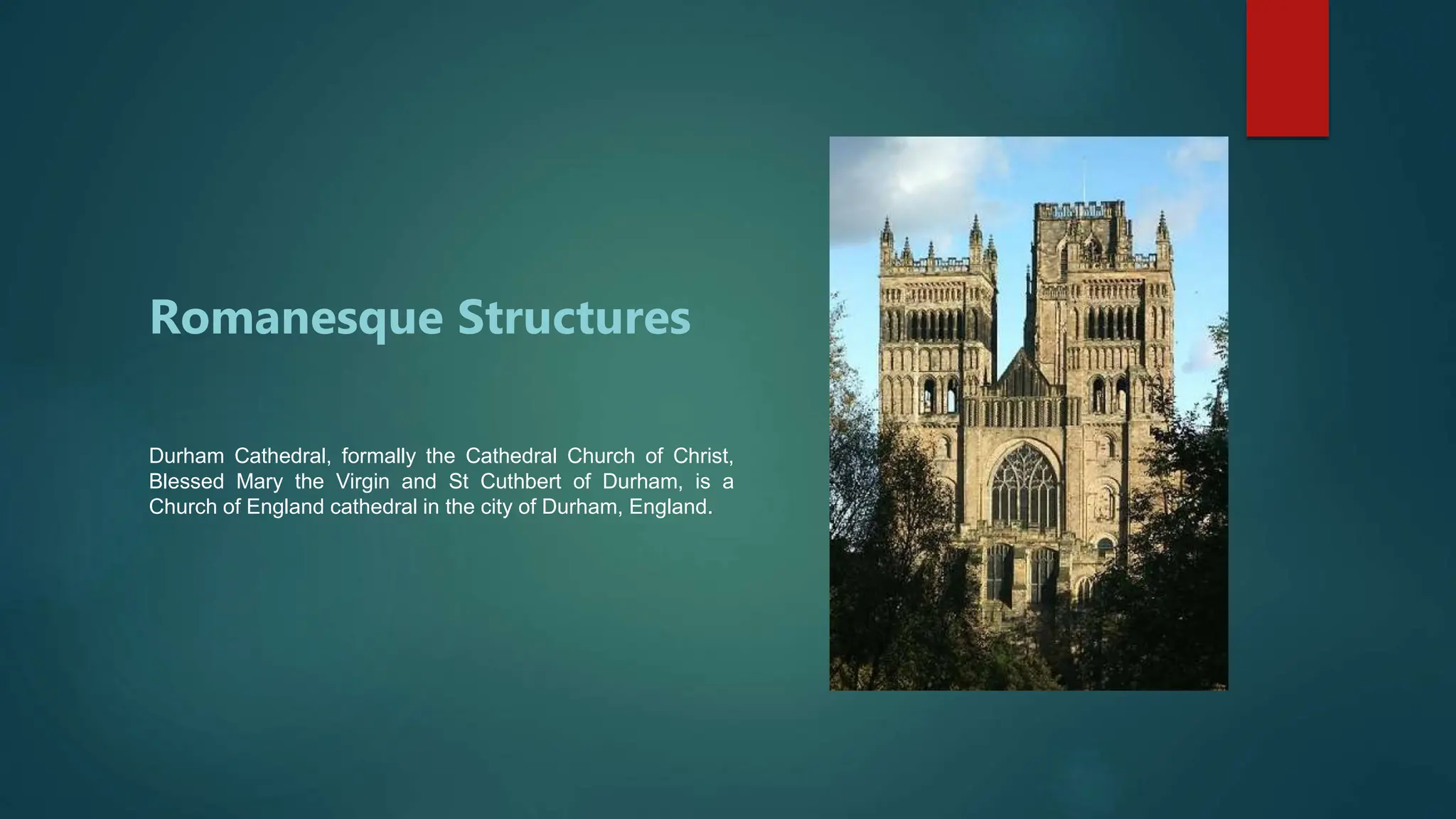
 Arches: Round arches prevalent in doorways, windows, and arcades
 Vaults: Barrel vaults and groin vaults used in ceilings and roofs
 Columns and Piers: Supporting elements with simple capitals
 Towers and Bell Towers: Prominent features in Romanesque churches
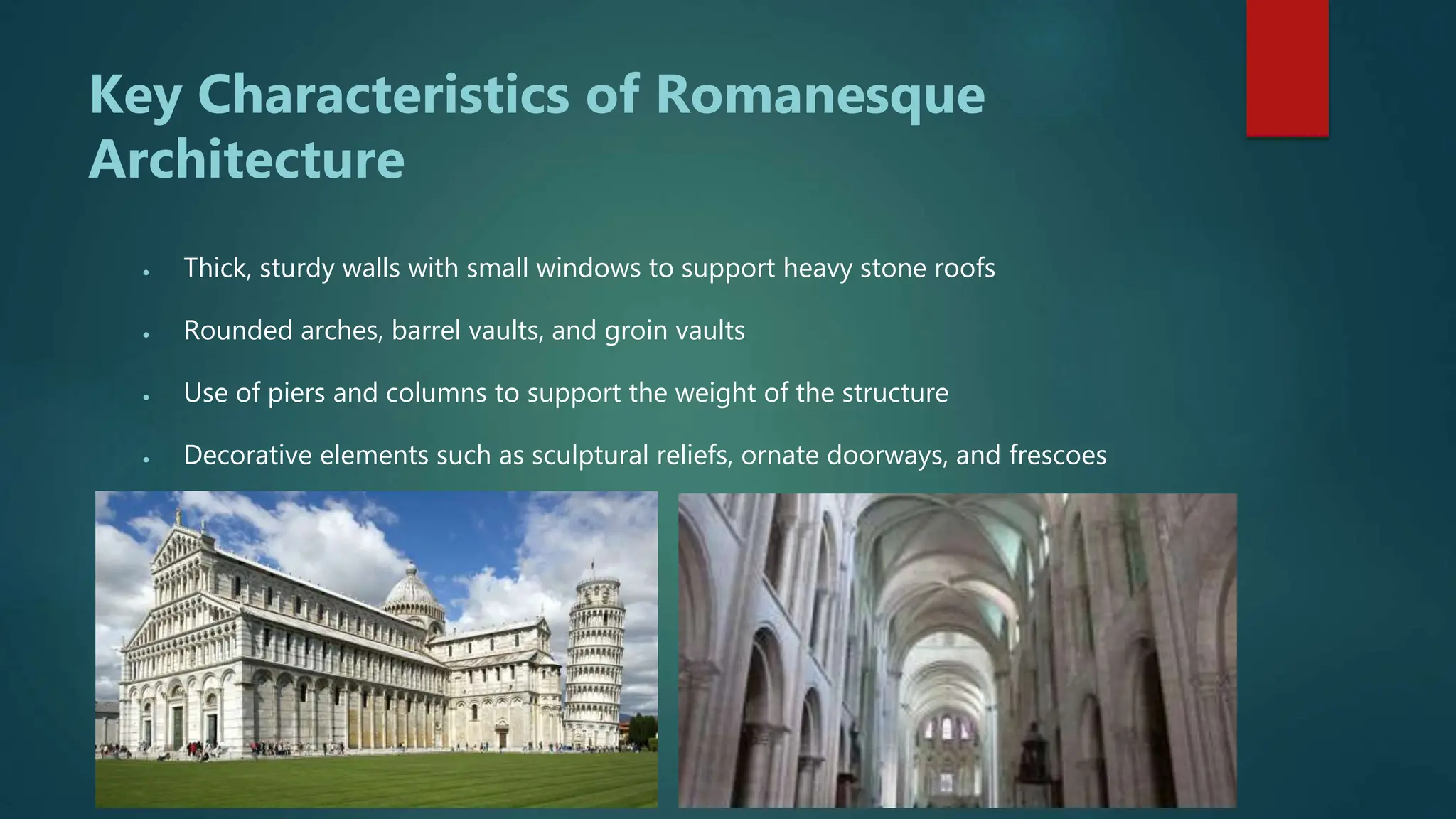
Romanesque Structures
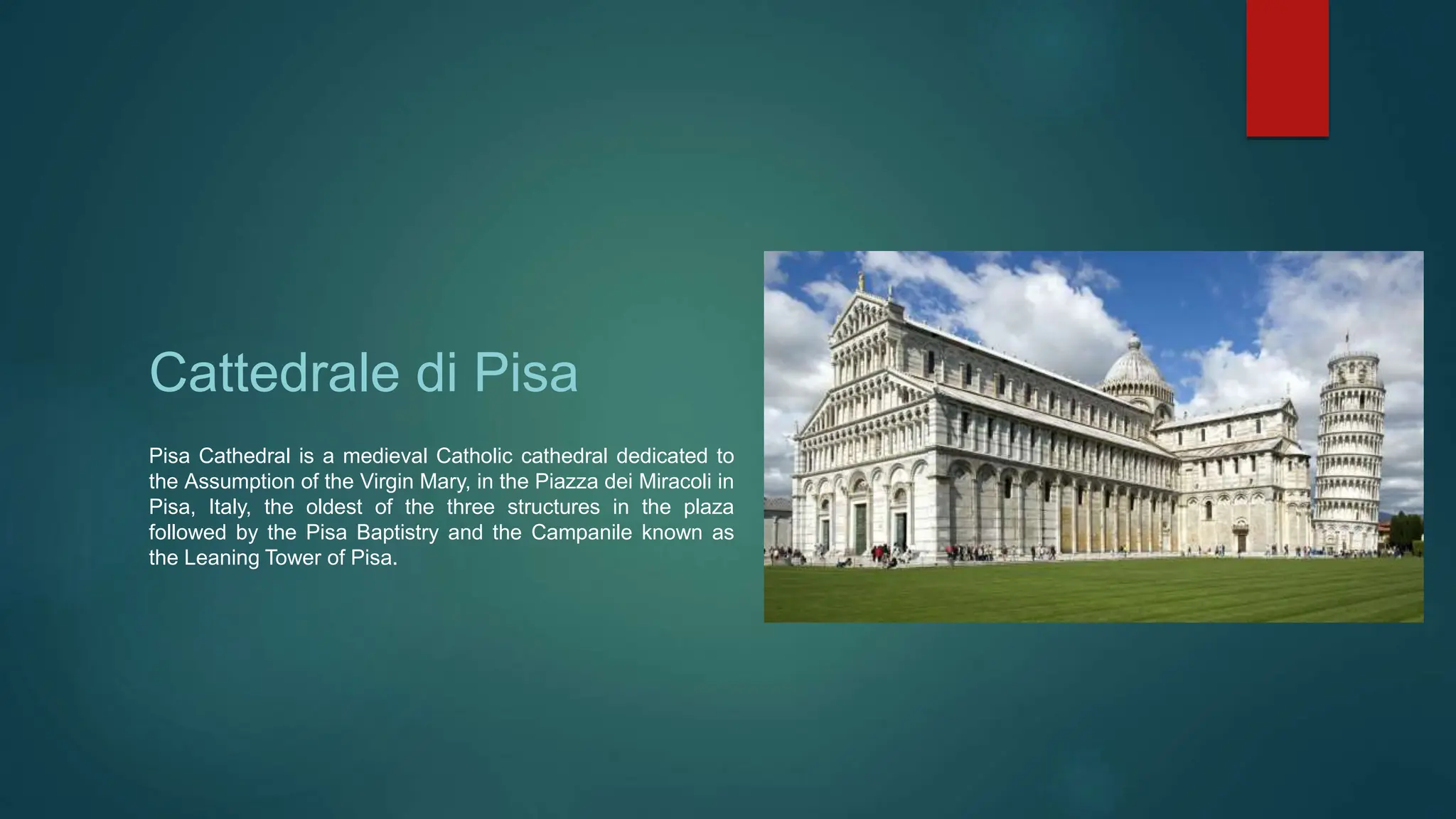
Durham Cathedral, formally the Cathedral Church of Christ,
Blessed Mary the Virgin and St Cuthbert of Durham, is a
Church of England cathedral in the city of Durham, England.
Cattedrale di Pisa
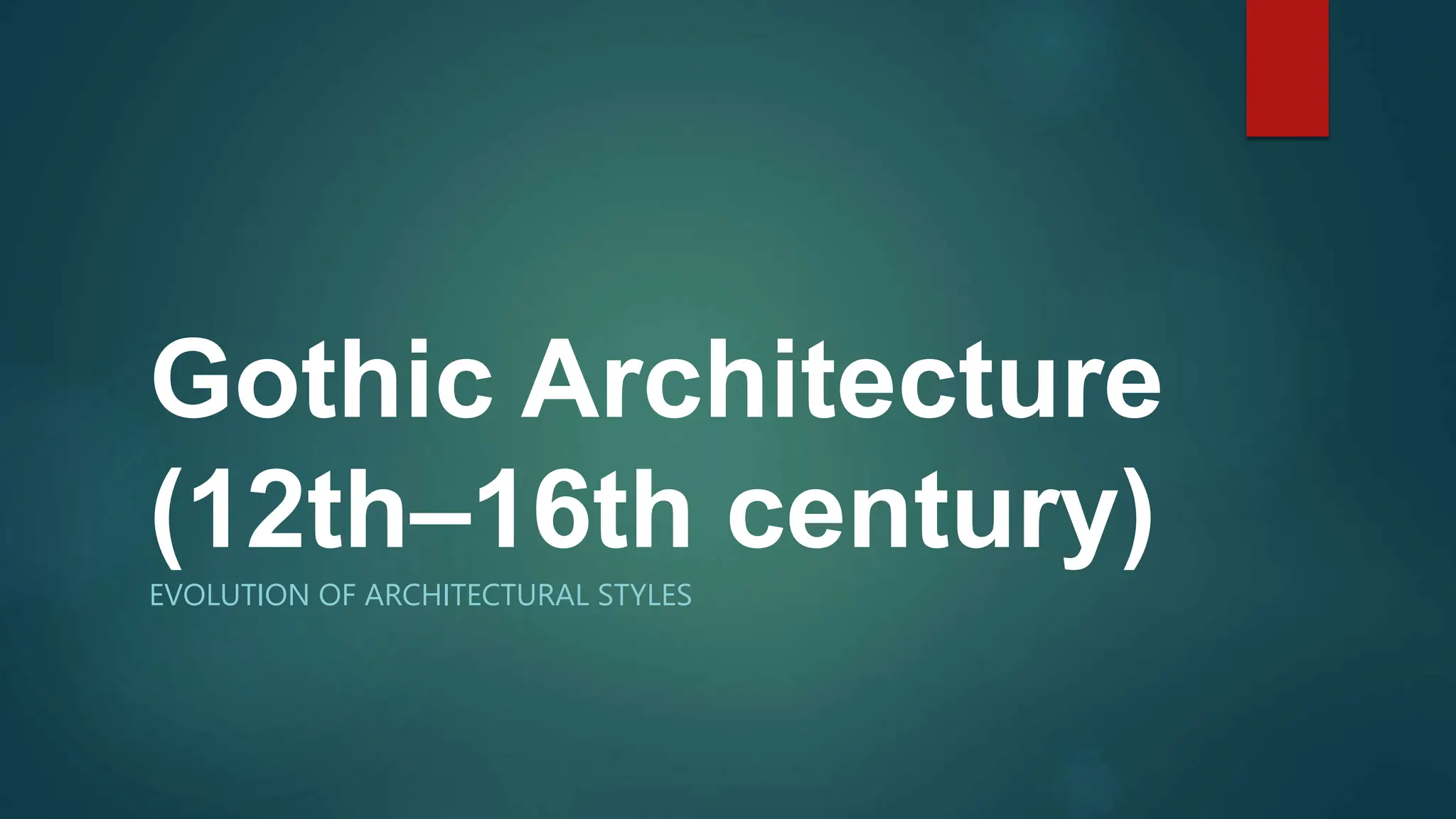
Pisa Cathedral is a medieval Catholic cathedral dedicated to
the Assumption of the Virgin Mary, in the Piazza dei Miracoli in
Pisa, Italy, the oldest of the three structures in the plaza
followed by the Pisa Baptistry and the Campanile known as
the Leaning Tower of Pisa.
Gothic Architecture
(12th–16th century)
EVOLUTION OF ARCHITECTURAL STYLES
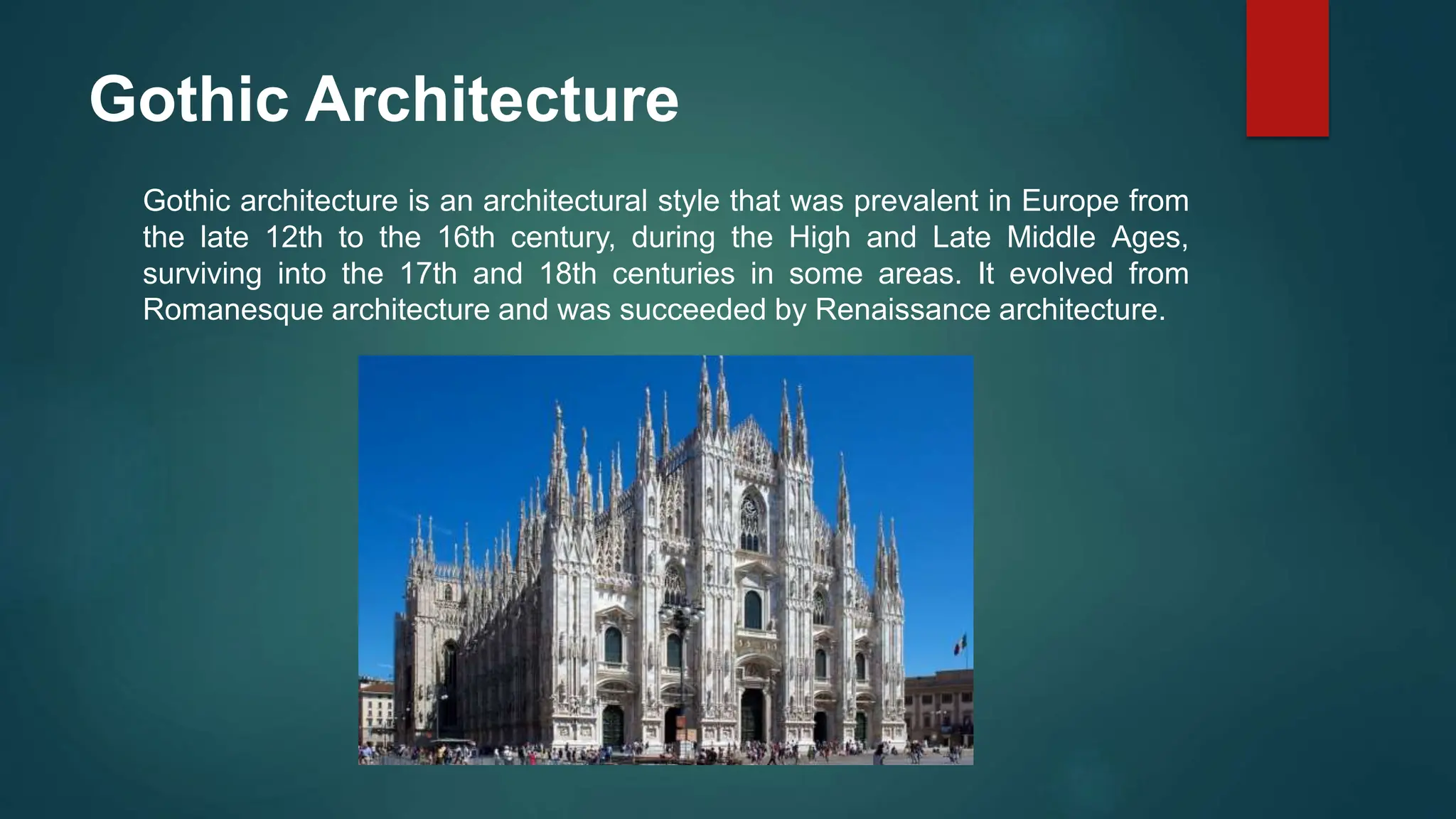
Gothic Architecture
Gothic architecture is an architectural style that was prevalent in Europe from
the late 12th to the 16th century, during the High and Late Middle Ages,
surviving into the 17th and 18th centuries in some areas. It evolved from
Romanesque architecture and was succeeded by Renaissance architecture.
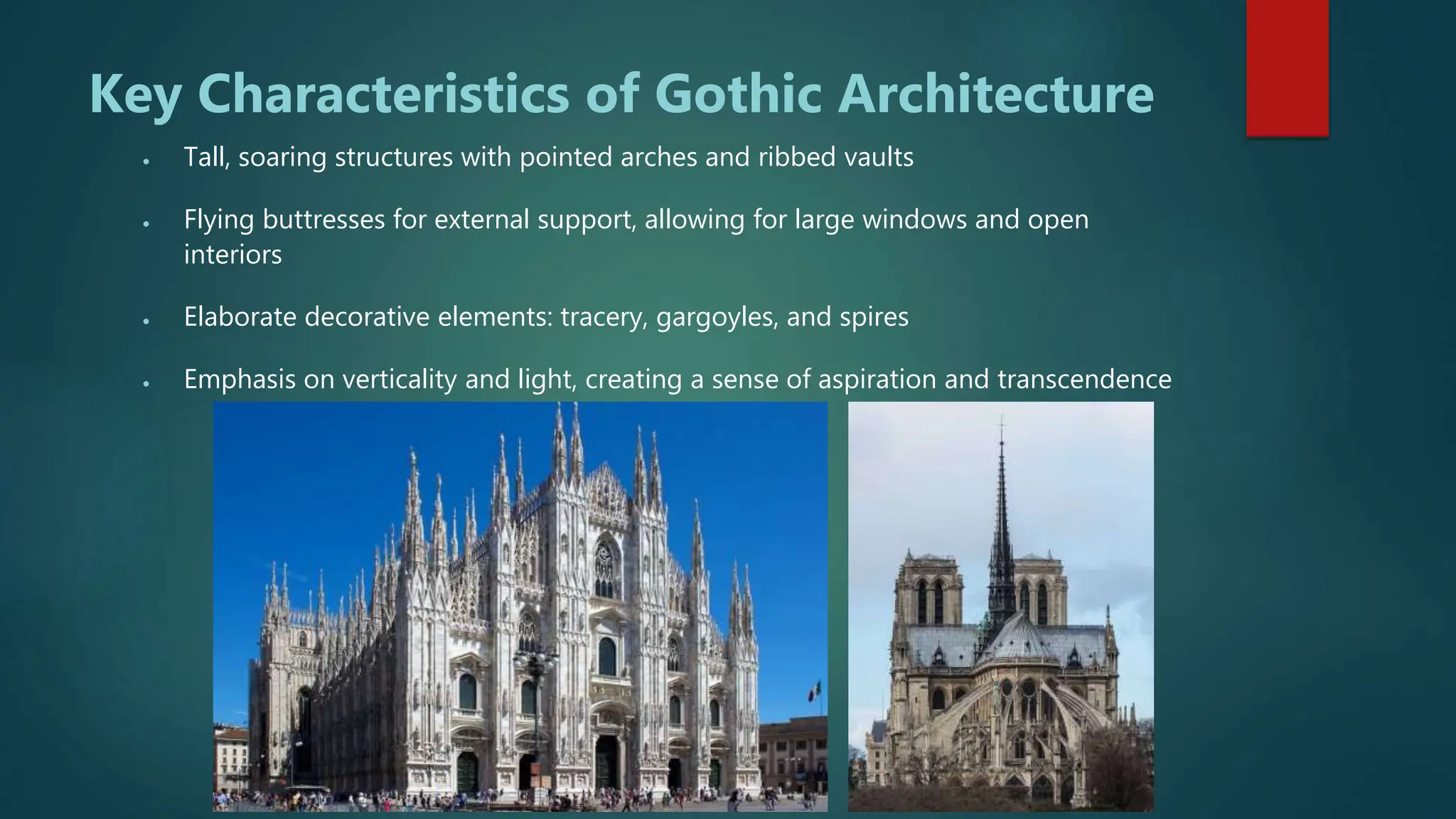
Key Characteristics of Gothic Architecture
 Tall, soaring structures with pointed arches and ribbed vaults
 Flying buttresses for external support, allowing for large windows and open
interiors
 Elaborate decorative elements: tracery, gargoyles, and spires
 Emphasis on verticality and light, creating a sense of aspiration and transcendence
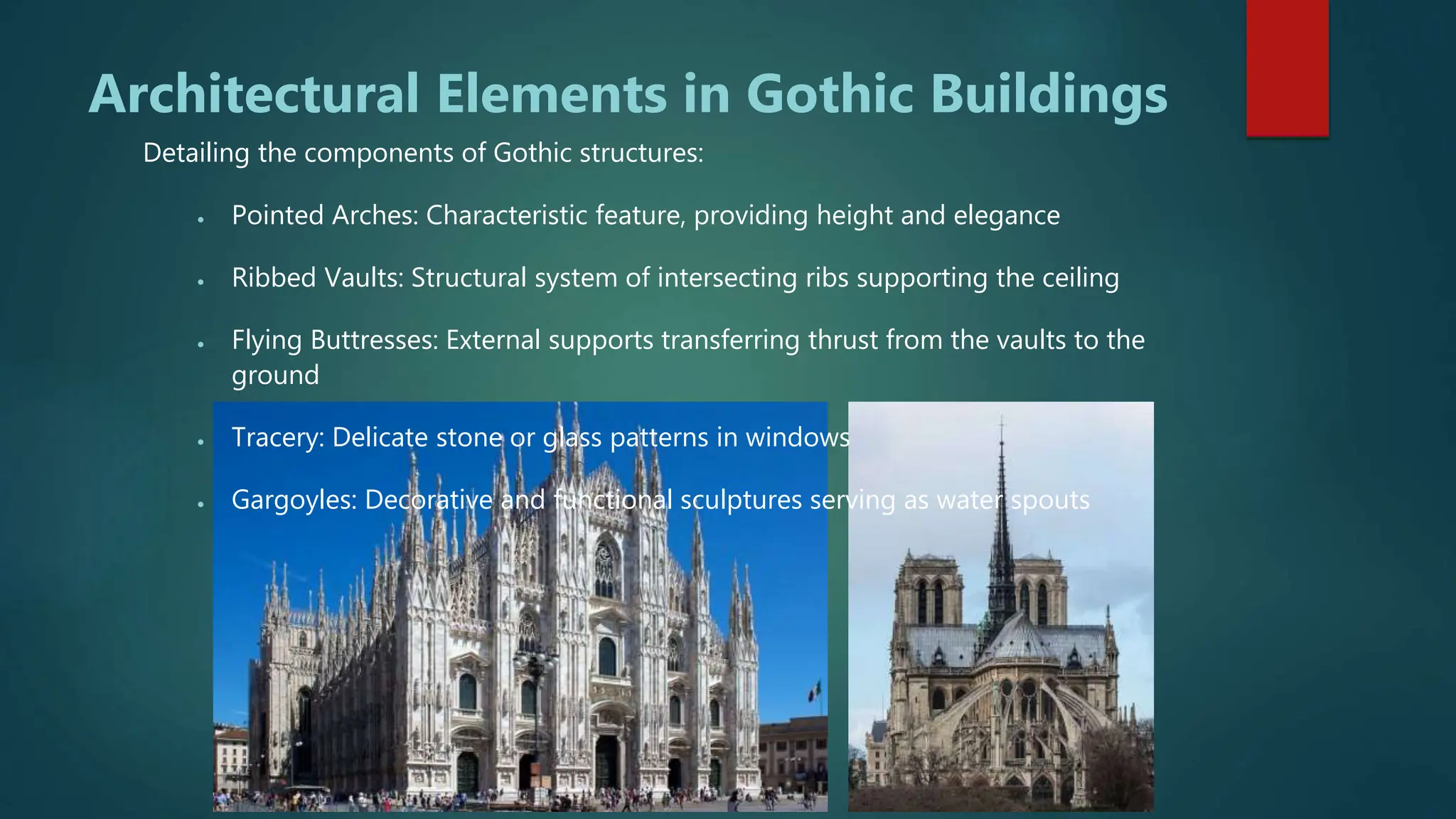
Architectural Elements in Gothic Buildings
Detailing the components of Gothic structures:
 Pointed Arches: Characteristic feature, providing height and elegance
 Ribbed Vaults: Structural system of intersecting ribs supporting the ceiling
 Flying Buttresses: External supports transferring thrust from the vaults to the
ground
 Tracery: Delicate stone or glass patterns in windows
 Gargoyles: Decorative and functional sculptures serving as water spouts
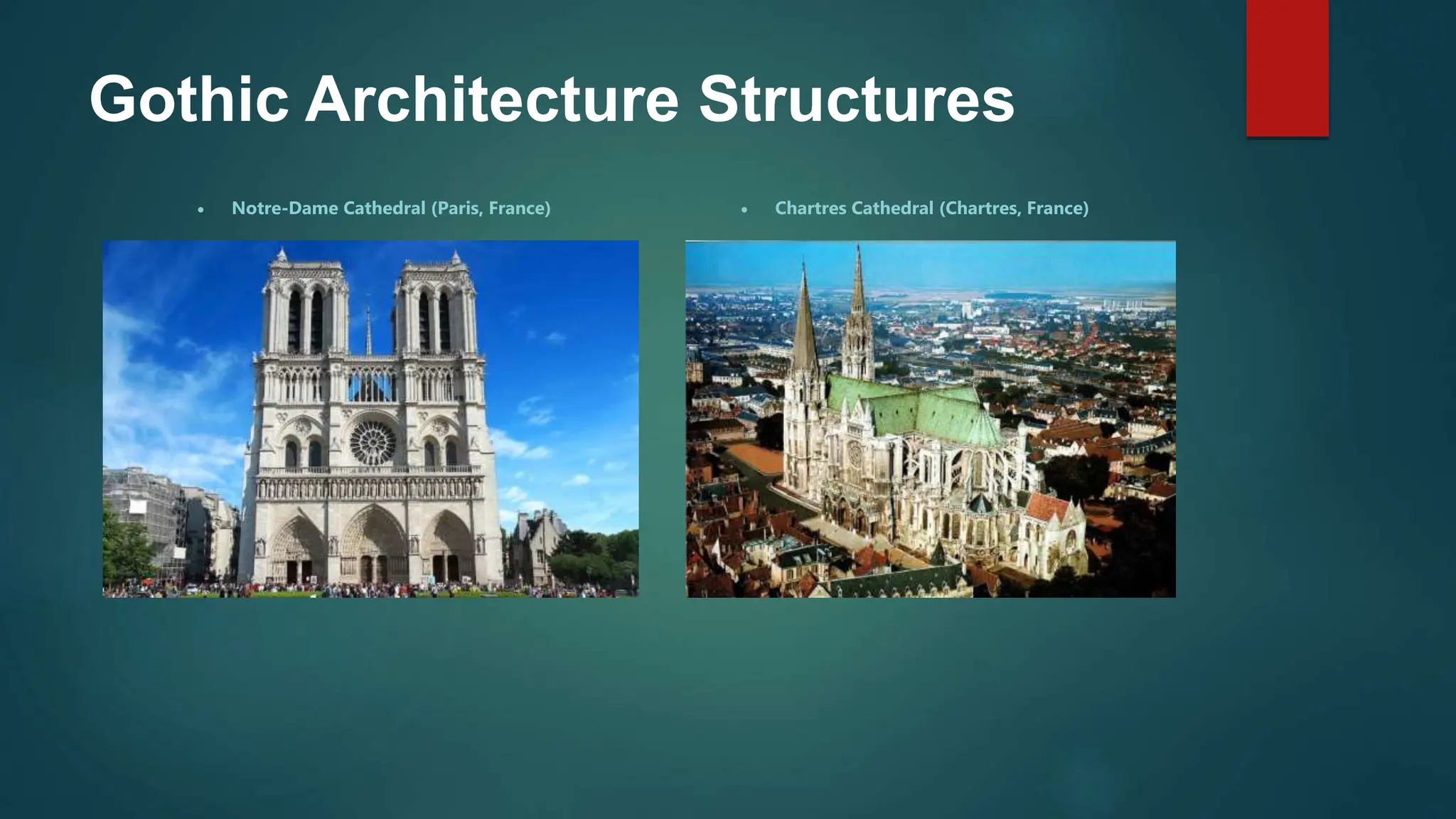
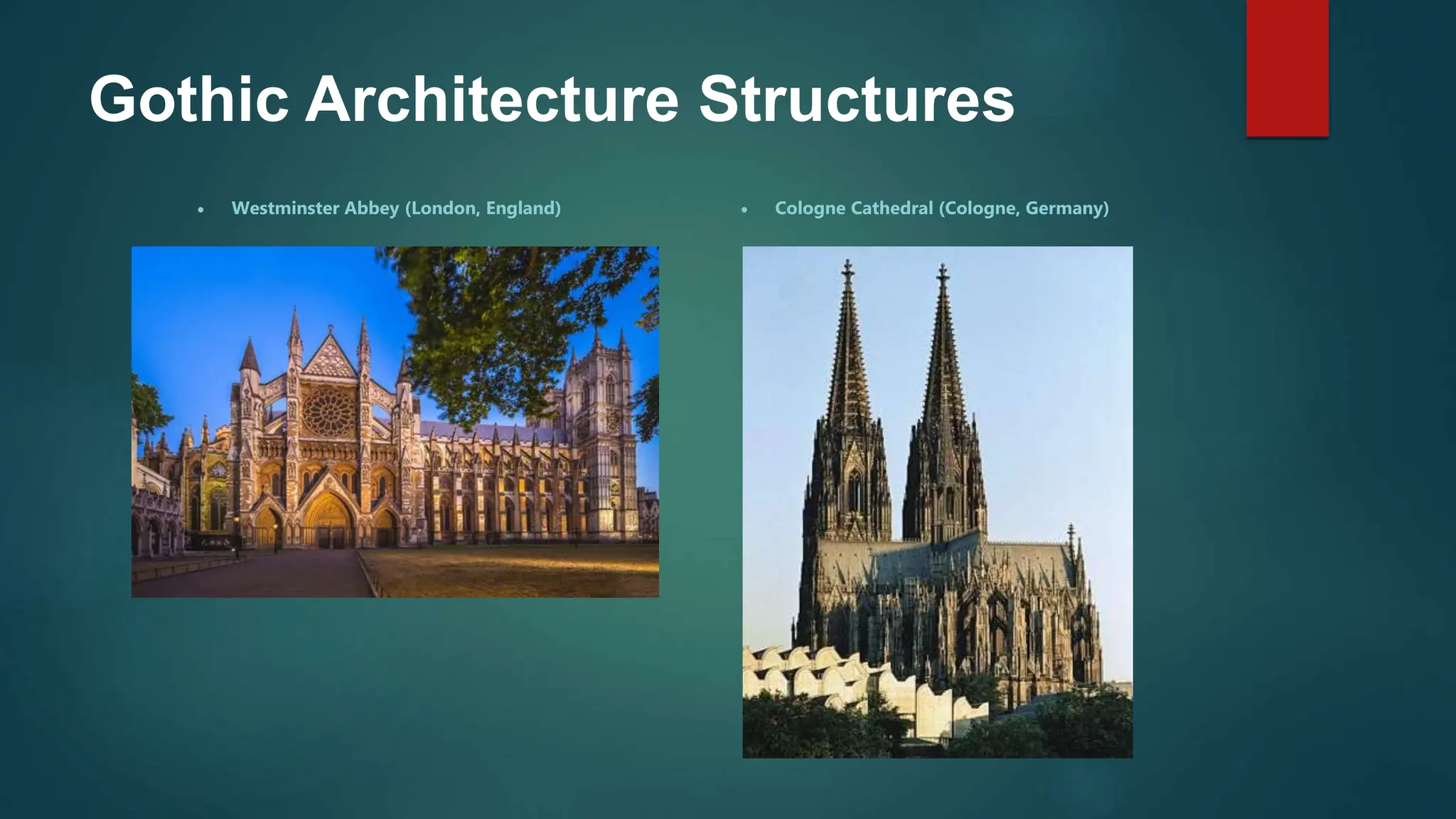
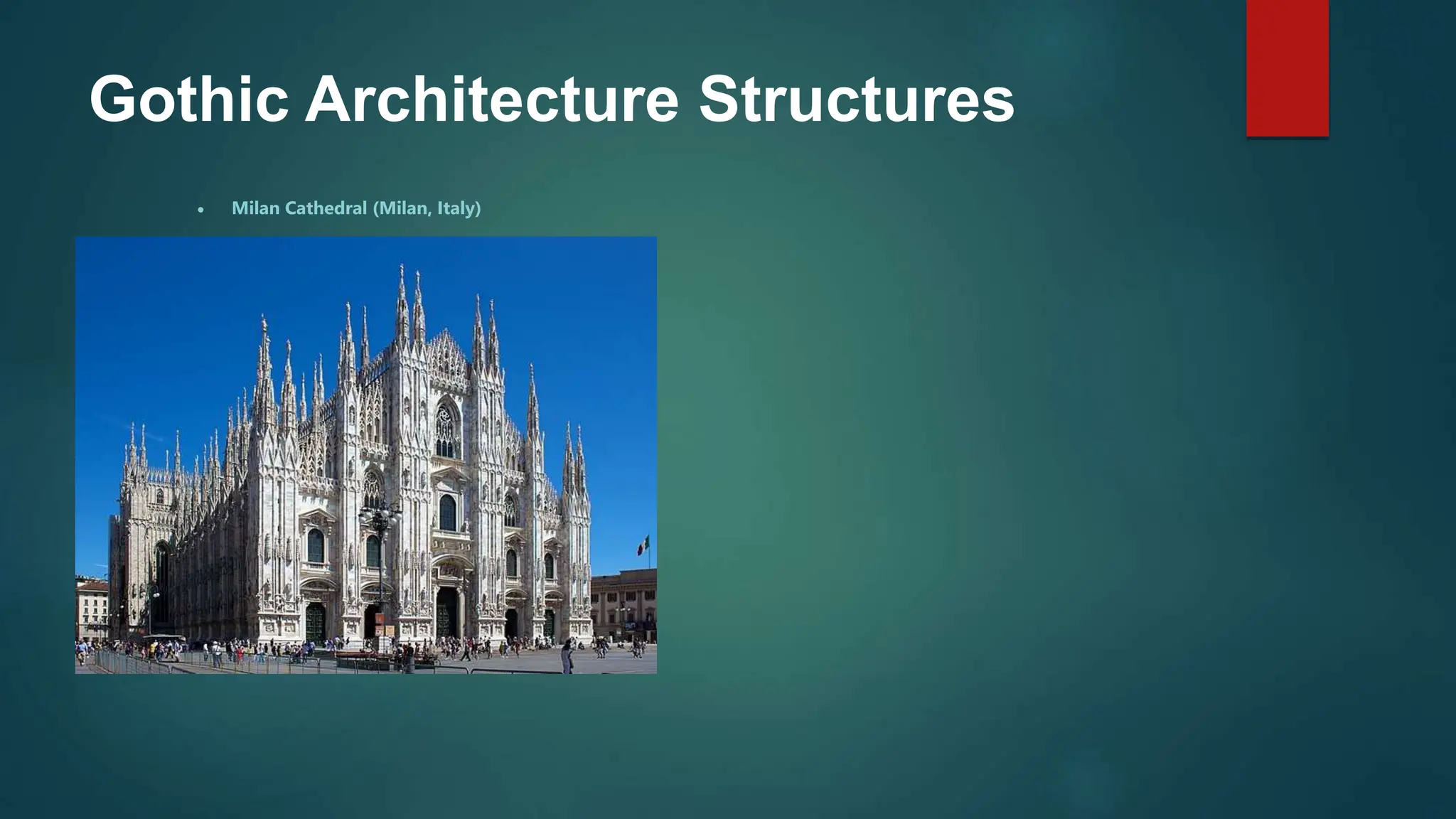
Gothic Architecture Structures
 Notre-Dame Cathedral (Paris, France)  Chartres Cathedral (Chartres, France)
Gothic Architecture Structures
 Westminster Abbey (London, England)  Cologne Cathedral (Cologne, Germany)
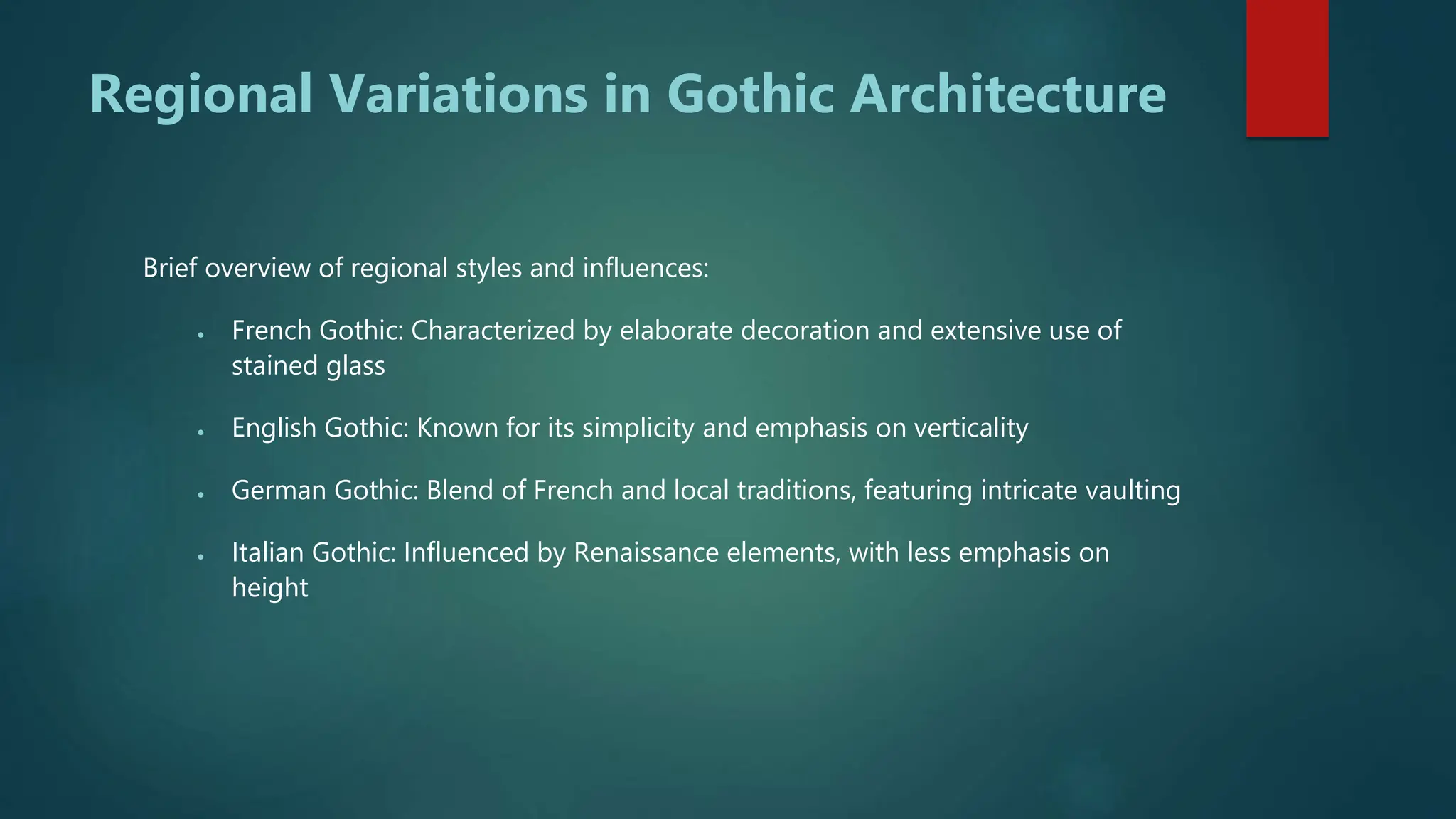
Gothic Architecture Structures
 Milan Cathedral (Milan, Italy)
Regional Variations in Gothic Architecture
Brief overview of regional styles and influences:
 French Gothic: Characterized by elaborate decoration and extensive use of
stained glass
 English Gothic: Known for its simplicity and emphasis on verticality
 German Gothic: Blend of French and local traditions, featuring intricate vaulting
 Italian Gothic: Influenced by Renaissance elements, with less emphasis on
height
Famous Old & New "Gothic
Architecture" Architects
 Arnolfo di Cambio (–1302)
Cambio's legacy endures in the Cathedral of Florence, a jewel that epitomizes his architectural brilliance.
 Peter Parler (1330–1399)
Prague's St. Vitus Cathedral stands tall as Parler's magnum opus, showcasing his mastery in Central European Gothic
architecture.
 Suger (1081–1151)
A trailblazer in Gothic architecture, Suger's Basilica of Saint-Denis symbolizes the dawn of this transformative
architectural style.
 Eugène Viollet-le-Duc (1814–1879)
Viollet-le-Duc's restoration work on Notre Dame de Paris rekindled interest in Gothic architecture during the 19th
century.
 Erwin von Steinbach (–1318)
The Strasbourg Cathedral is a testament to von Steinbach's architectural finesse and dedication.
 Thomas de Cormont
De Cormont's contributions to French Gothic architecture shine through in the intricate designs of Amiens Cathedral.
Renaissance
Architecture
(14th–17th century)
EVOLUTION OF ARCHITECTURAL STYLES
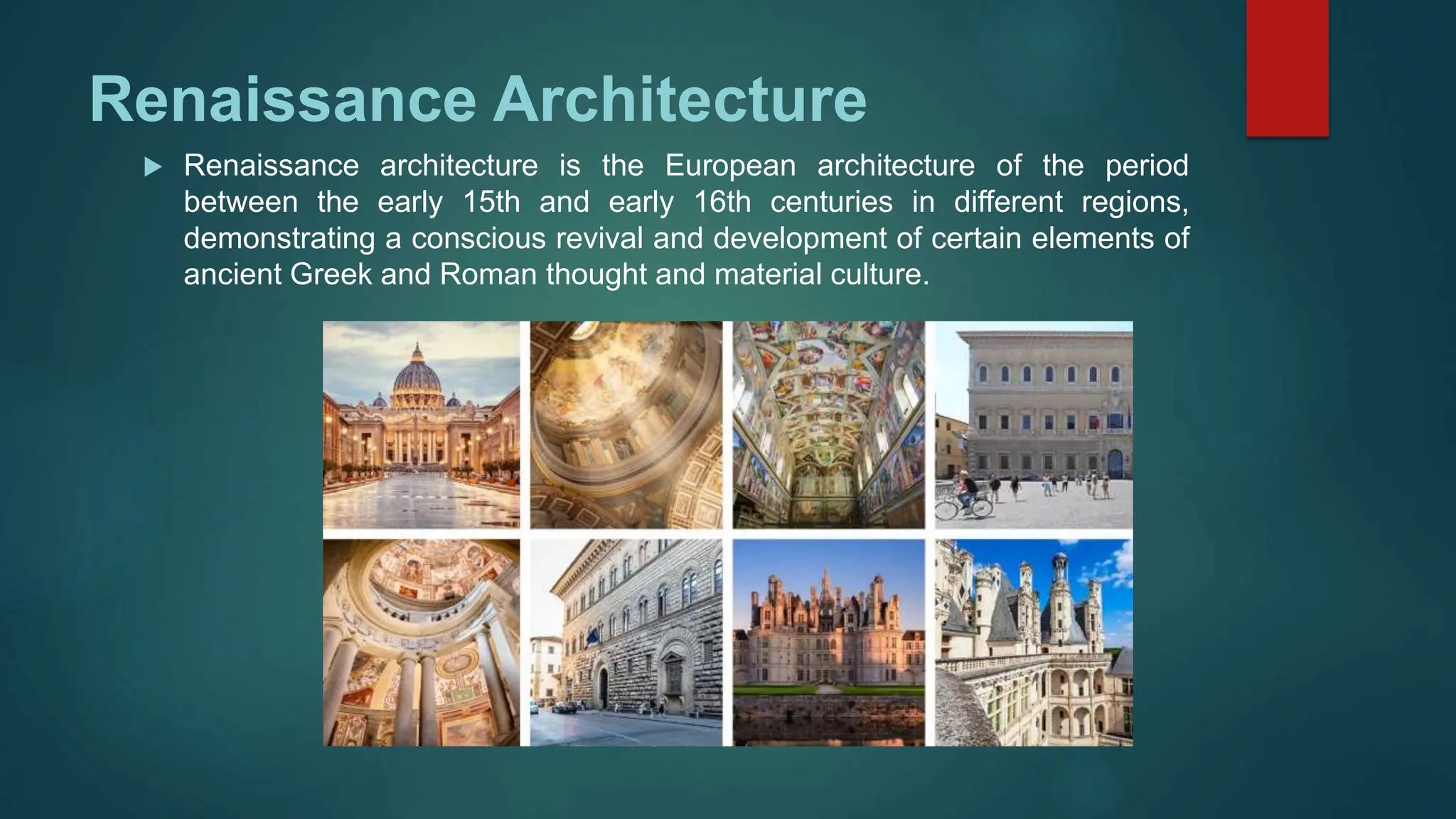
Renaissance Architecture
 Renaissance architecture is the European architecture of the period
between the early 15th and early 16th centuries in different regions,
demonstrating a conscious revival and development of certain elements of
ancient Greek and Roman thought and material culture.
Key Characteristics of Renaissance
Architecture
• Return to classical principles of balance, symmetry, and proportion
• Emphasis on mathematical precision and rationality in design
• Integration of classical elements such as columns, pediments, and domes
• Human-centered approach, with focus on perspective, proportion, and the
idealized human form
Architectural Elements in
Renaissance Buildings
Detailing the components of Renaissance structures:
• Classical Orders: Doric, Ionic, Corinthian, and Composite columns
• Pilasters: Flat, shallow columns often used for decorative purposes
• Pediments: Triangular gables often crowning facades or entrances
• Domes: Inspired by ancient Roman and Byzantine examples, used as focal
points in buildings
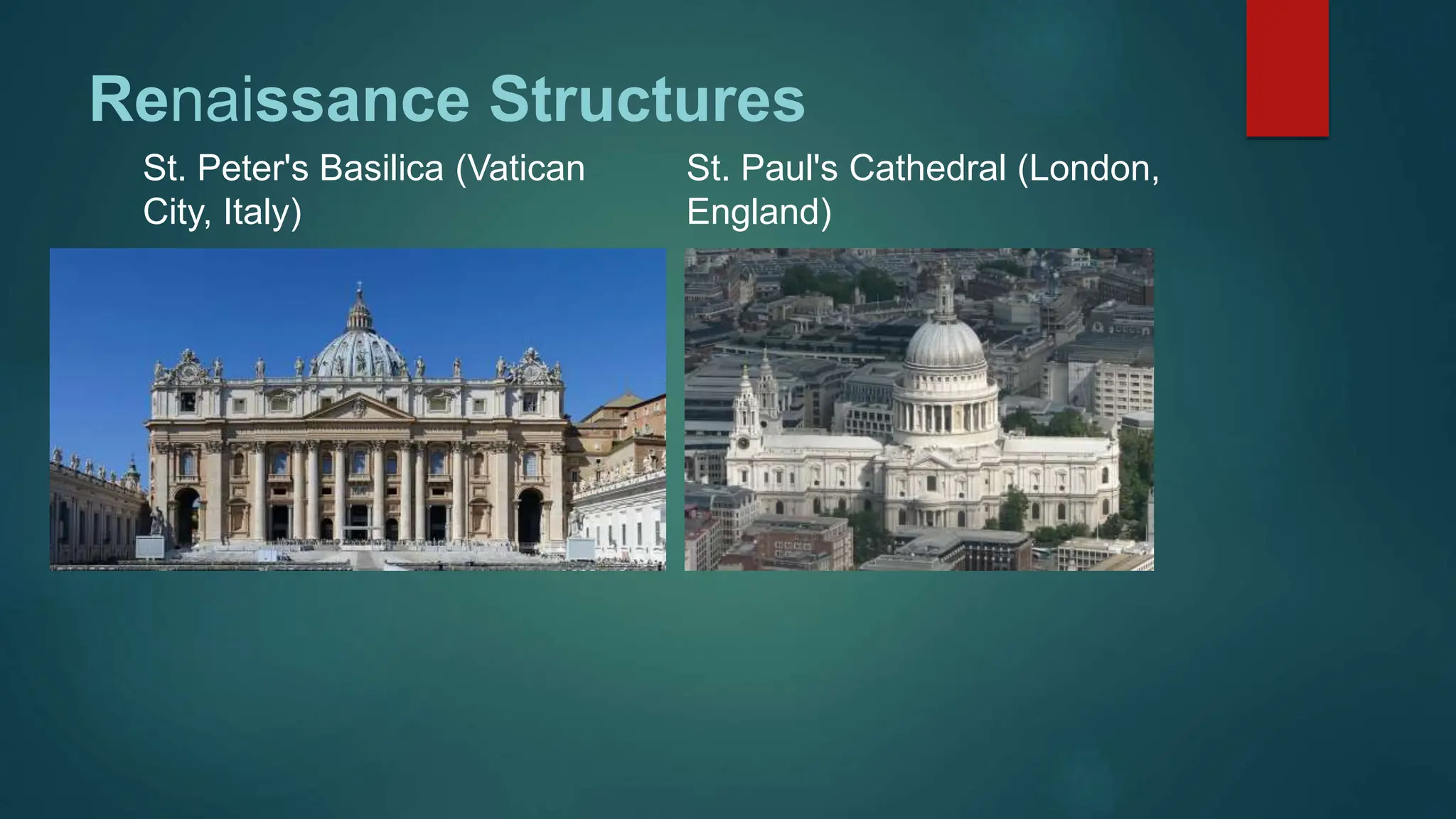
Renaissance Structures
St. Peter's Basilica (Vatican
City, Italy)
St. Paul's Cathedral (London,
England)
Notable Renaissance Architects
• Filippo Brunelleschi (1377–1446)
• Leon Battista Alberti (1404–1472)
• Donato Bramante(1444–1514)
• Andrea Palladio (1508–1580)
• Michelangelo Buonarroti (1475–1564)
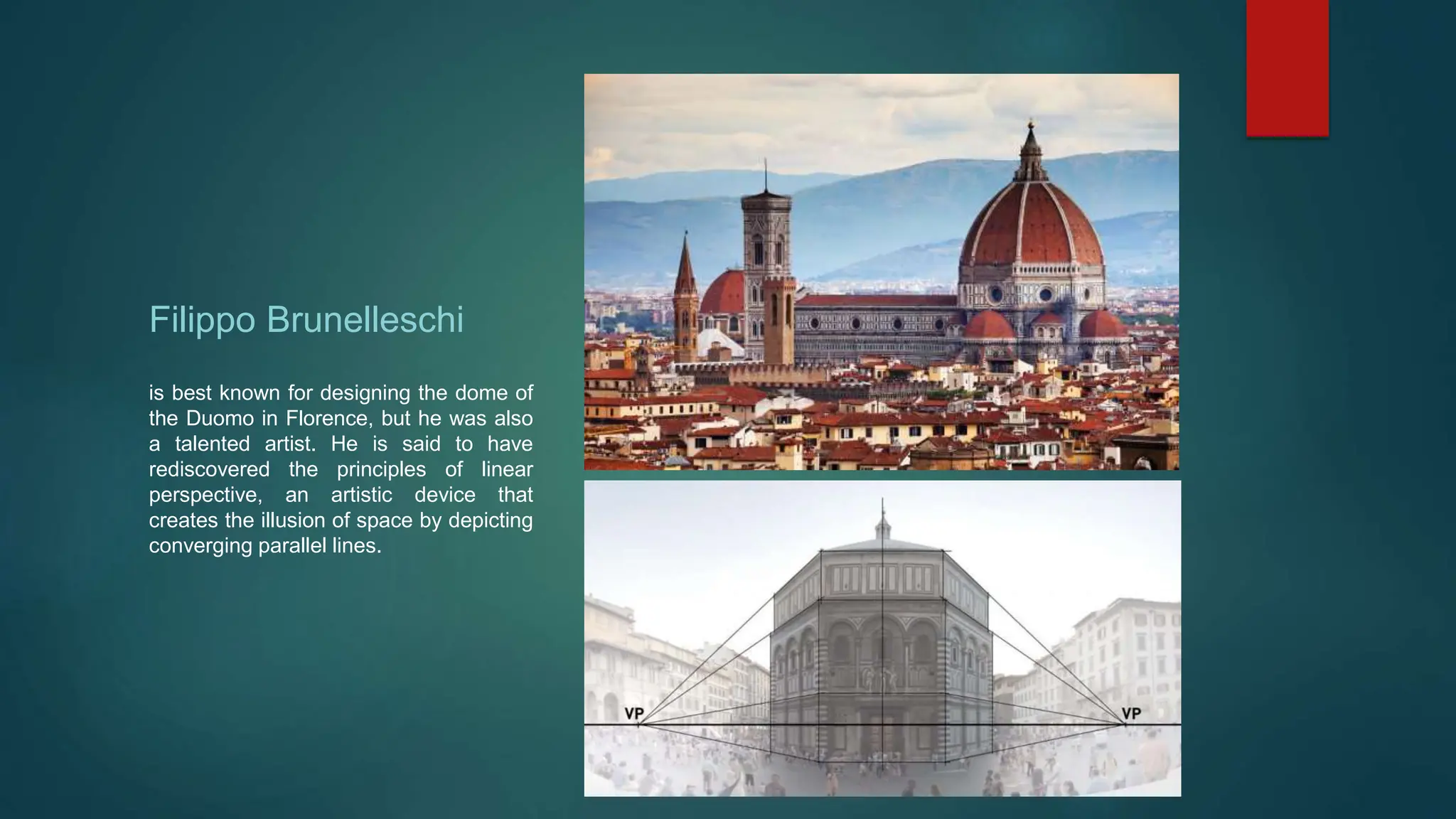
Filippo Brunelleschi
is best known for designing the dome of
the Duomo in Florence, but he was also
a talented artist. He is said to have
rediscovered the principles of linear
perspective, an artistic device that
creates the illusion of space by depicting
converging parallel lines.
Leon Battista Alberti
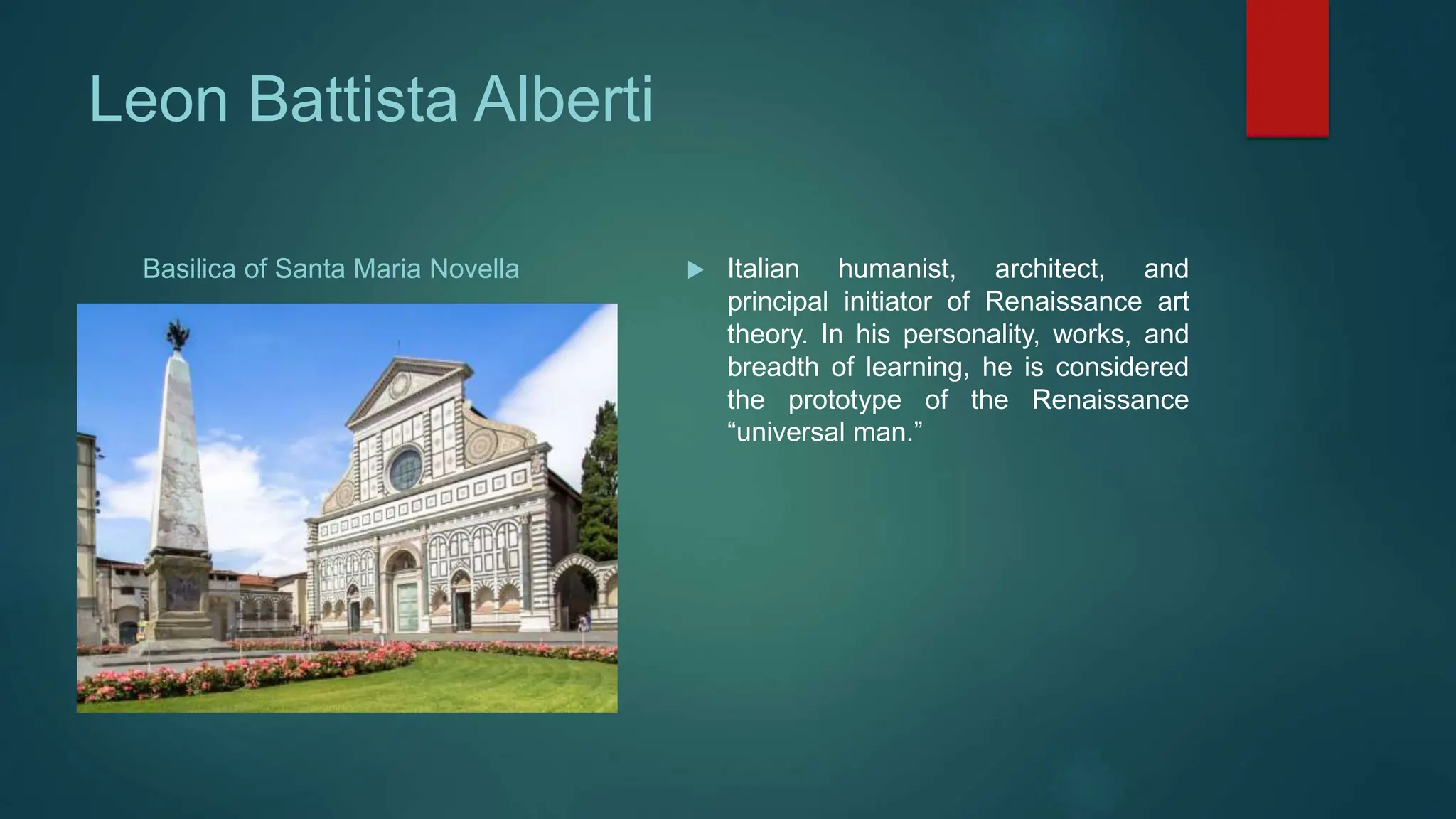
Basilica of Santa Maria Novella  Italian humanist, architect, and
principal initiator of Renaissance art
theory. In his personality, works, and
breadth of learning, he is considered
the prototype of the Renaissance
“universal man.”
Andrea Palladio
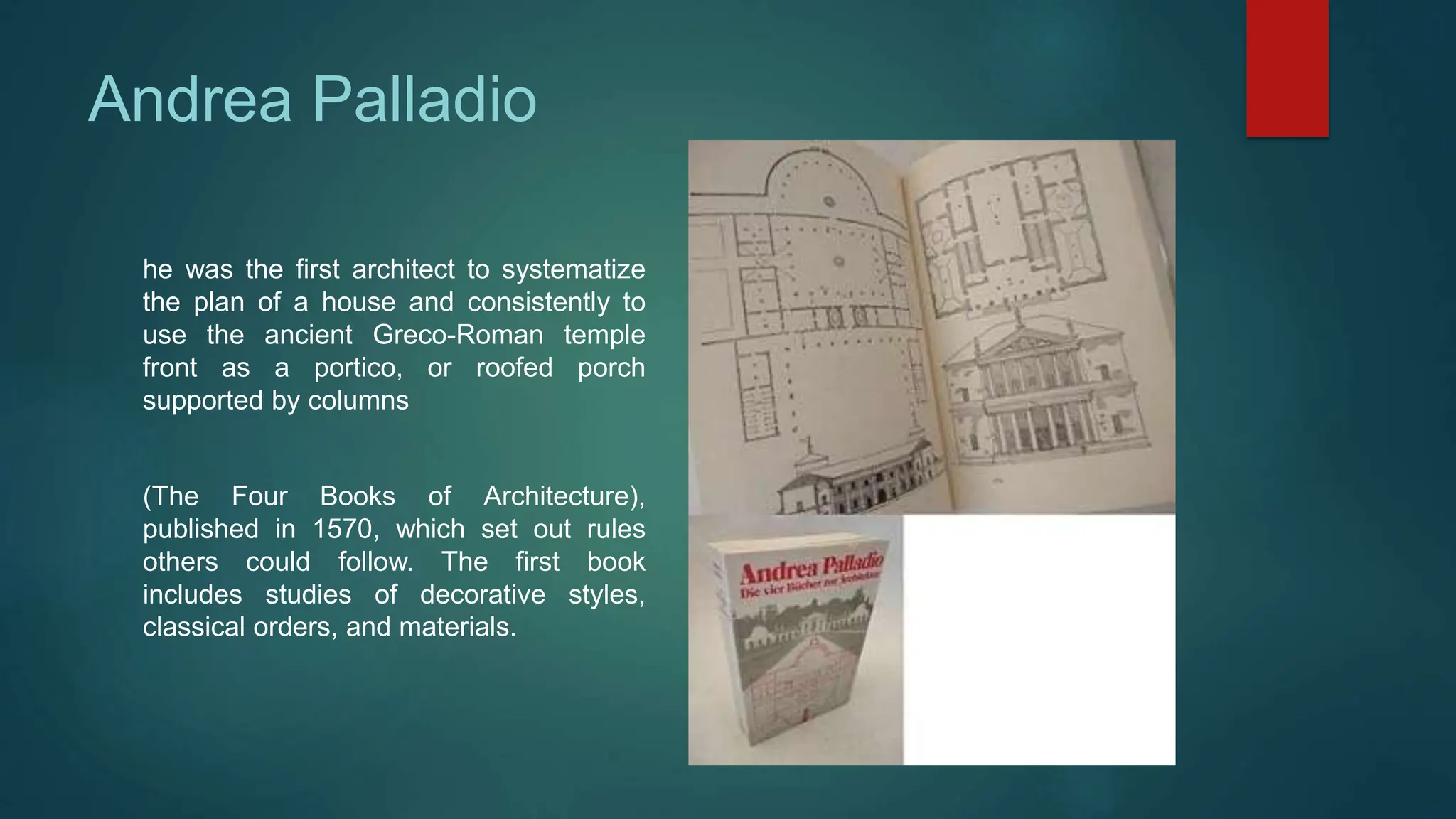
he was the first architect to systematize
the plan of a house and consistently to
use the ancient Greco-Roman temple
front as a portico, or roofed porch
supported by columns
(The Four Books of Architecture),
published in 1570, which set out rules
others could follow. The first book
includes studies of decorative styles,
classical orders, and materials.
Michelangelo Buonarroti
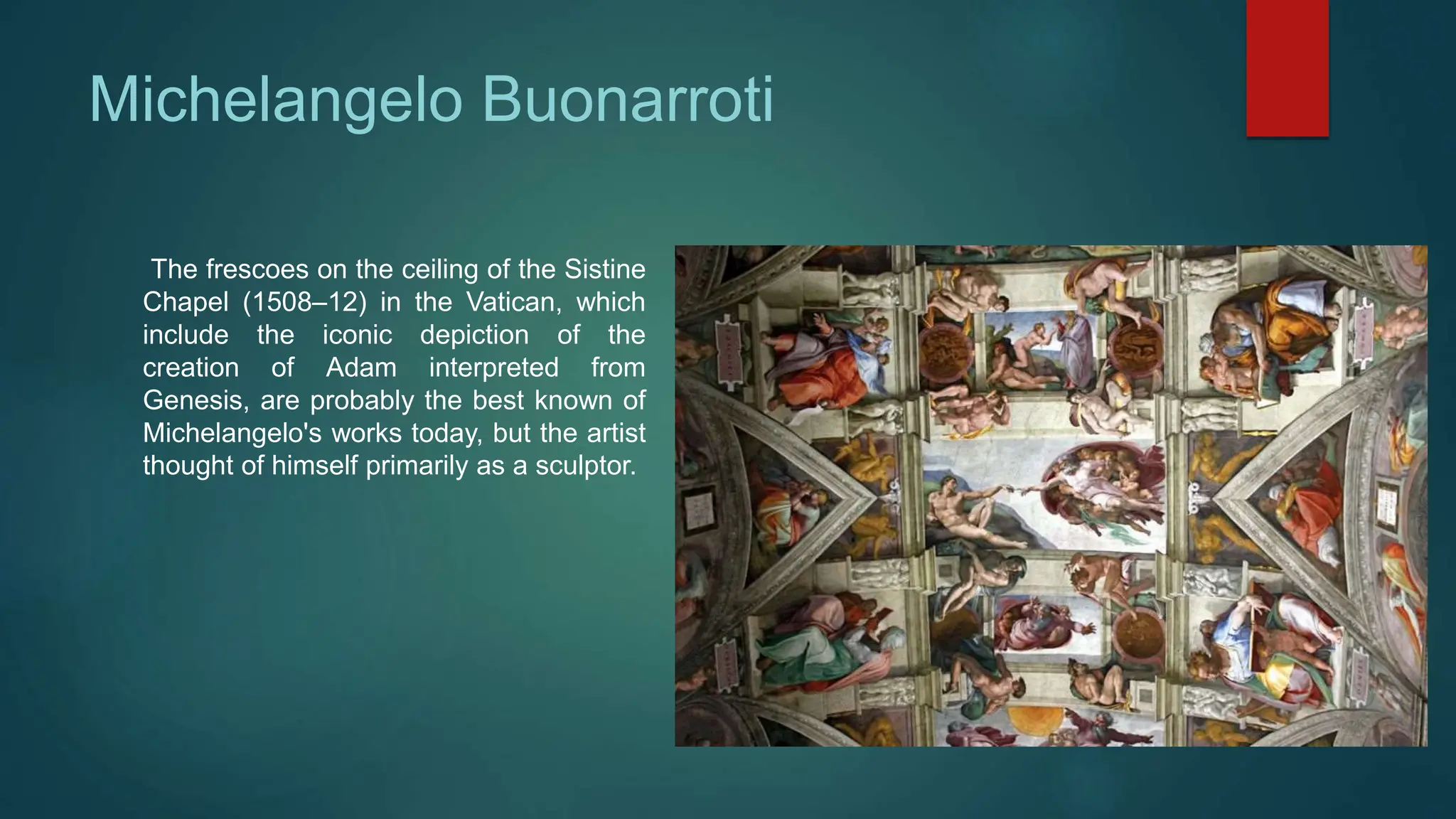
The frescoes on the ceiling of the Sistine
Chapel (1508–12) in the Vatican, which
include the iconic depiction of the
creation of Adam interpreted from
Genesis, are probably the best known of
Michelangelo's works today, but the artist
thought of himself primarily as a sculptor.
Baroque Architecture
(17th–18th century)
EVOLUTION OF ARCHITECTURAL STYLES
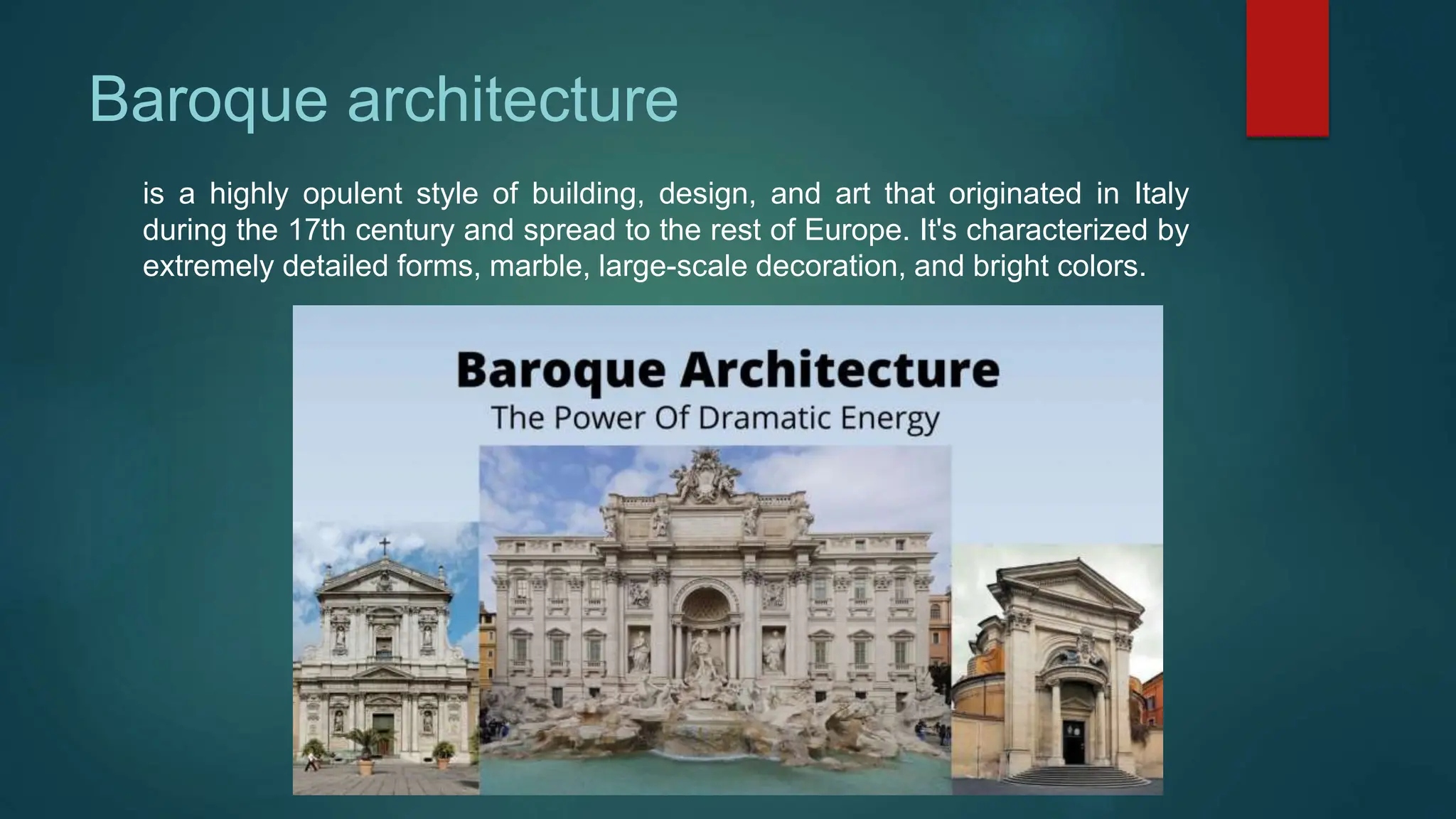
Baroque architecture
is a highly opulent style of building, design, and art that originated in Italy
during the 17th century and spread to the rest of Europe. It's characterized by
extremely detailed forms, marble, large-scale decoration, and bright colors.
Key Characteristics of Baroque
Architecture
• Emphasis on theatricality, grandeur, and emotional impact
• Dynamic use of space, light, and shadow to create dramatic effects
• Ornate decoration, including elaborate stucco work, gilding, and sculptural
elements
• Curvilinear forms, fluidity of movement, and illusionistic techniques
Architectural Elements in Baroque
Buildings
• Curvilinear Facades: Dramatic use of curves and convex-concave forms
• Centralized Plans: Oval or elliptical layouts, often with domes or cupolas
• Dynamic Interior Spaces: Dramatic staircases, vaulted ceilings, and light-
filled interiors
• Sculptural Decoration: Statues, reliefs, and ornamental details integrated
into architecture
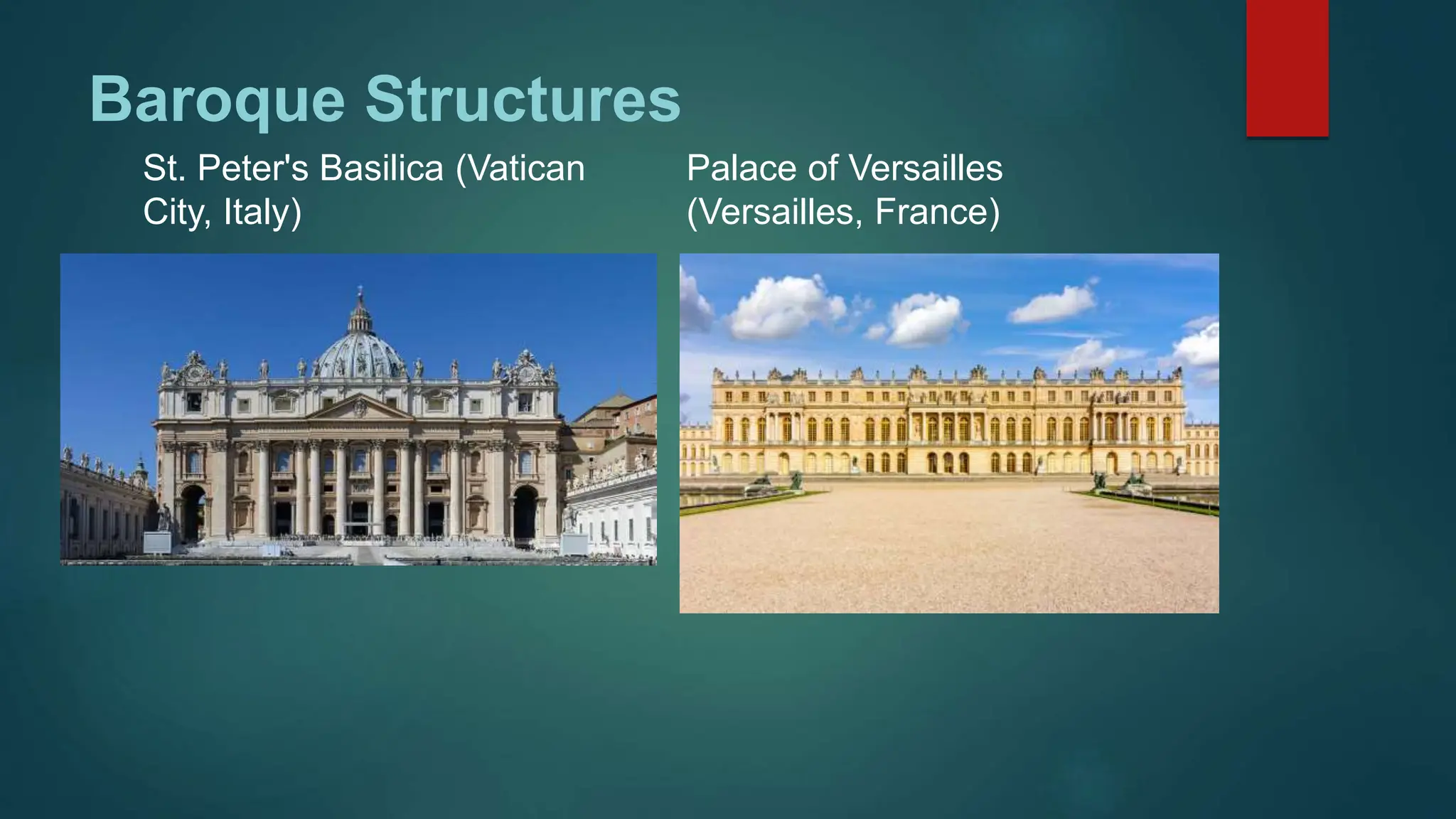
Baroque Structures
St. Peter's Basilica (Vatican
City, Italy)
Palace of Versailles
(Versailles, France)
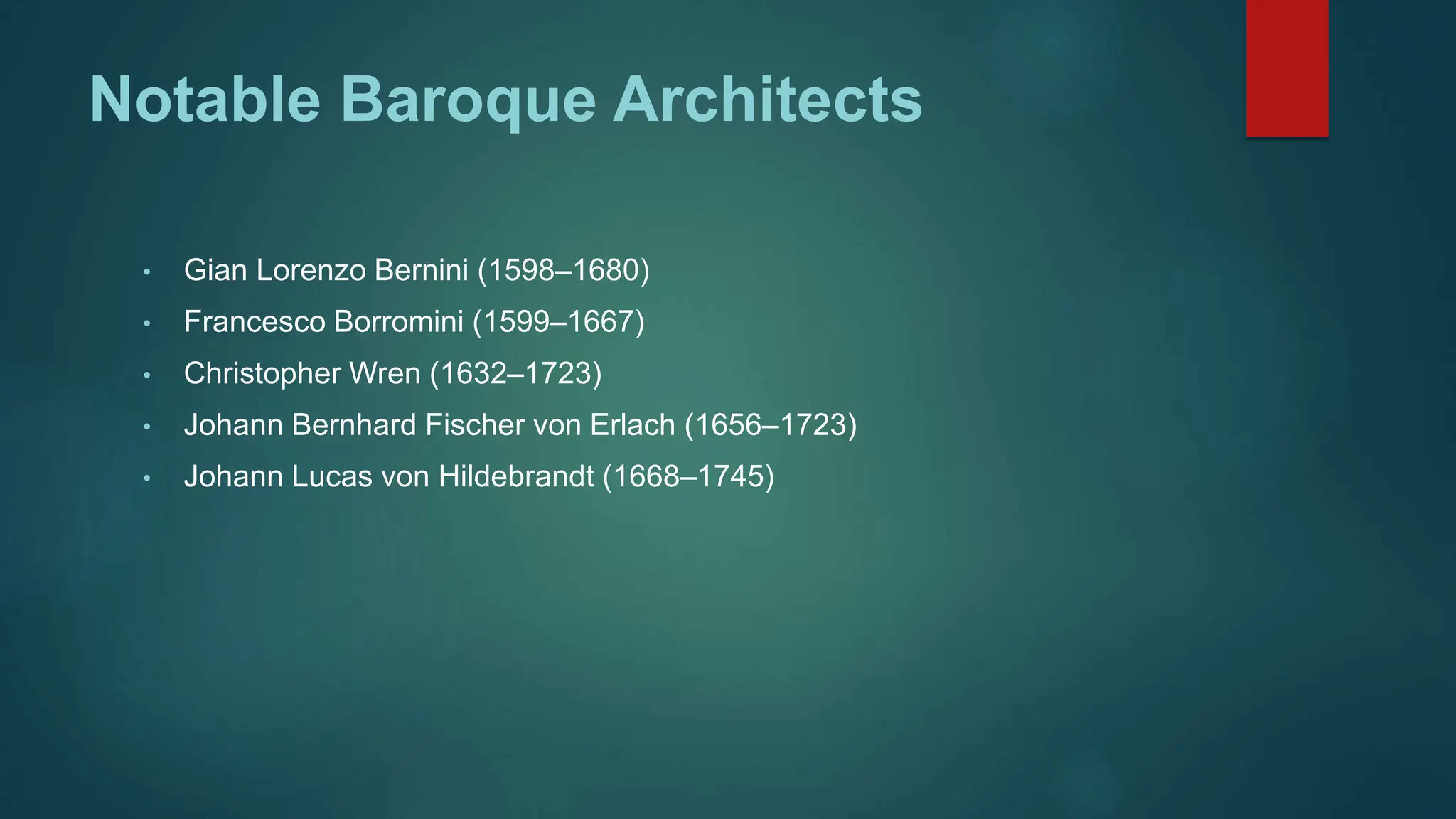
Notable Baroque Architects
• Gian Lorenzo Bernini (1598–1680)
• Francesco Borromini (1599–1667)
• Christopher Wren (1632–1723)
• Johann Bernhard Fischer von Erlach (1656–1723)
• Johann Lucas von Hildebrandt (1668–1745)
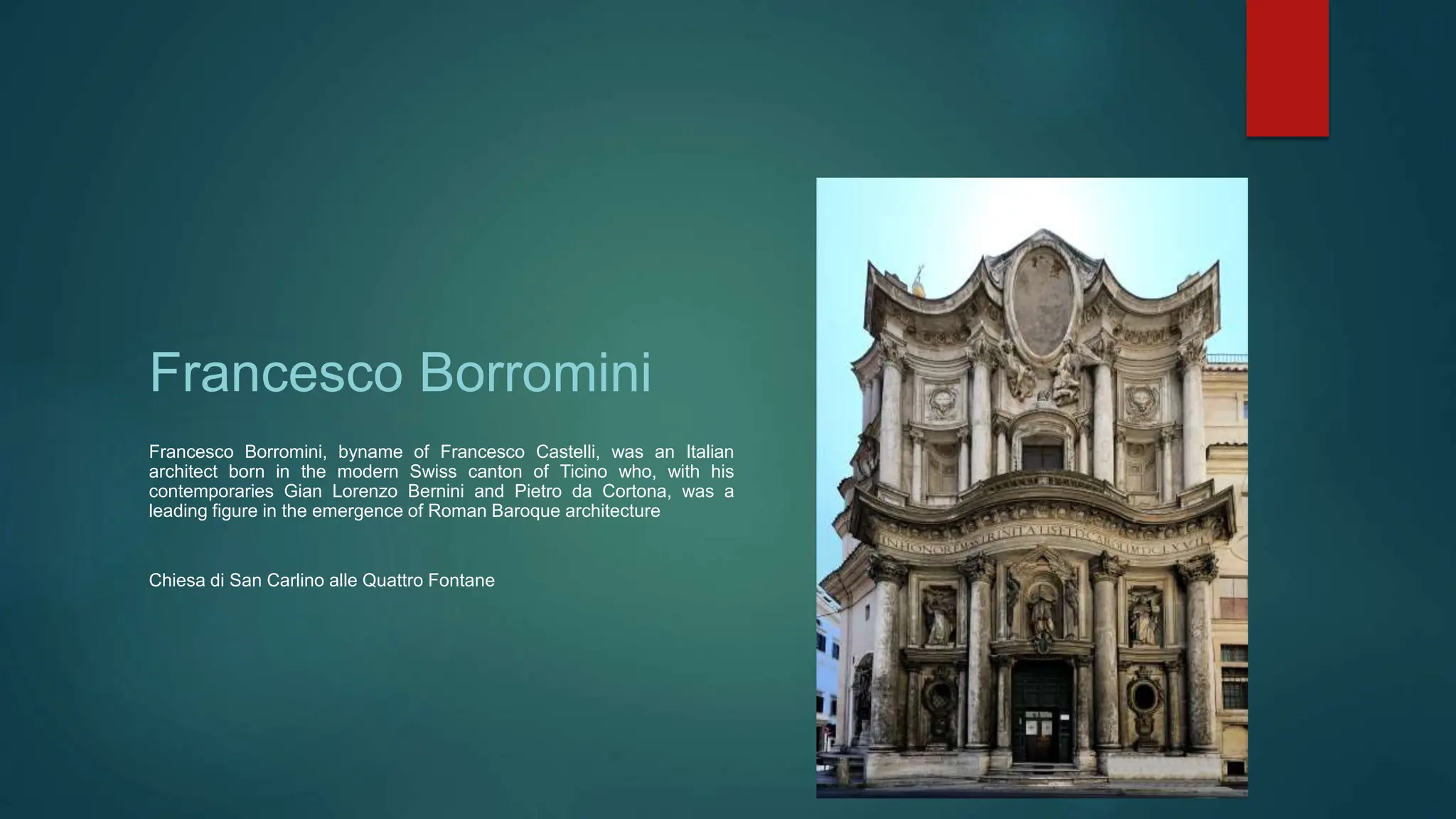
Francesco Borromini
Francesco Borromini, byname of Francesco Castelli, was an Italian
architect born in the modern Swiss canton of Ticino who, with his
contemporaries Gian Lorenzo Bernini and Pietro da Cortona, was a
leading figure in the emergence of Roman Baroque architecture
Chiesa di San Carlino alle Quattro Fontane
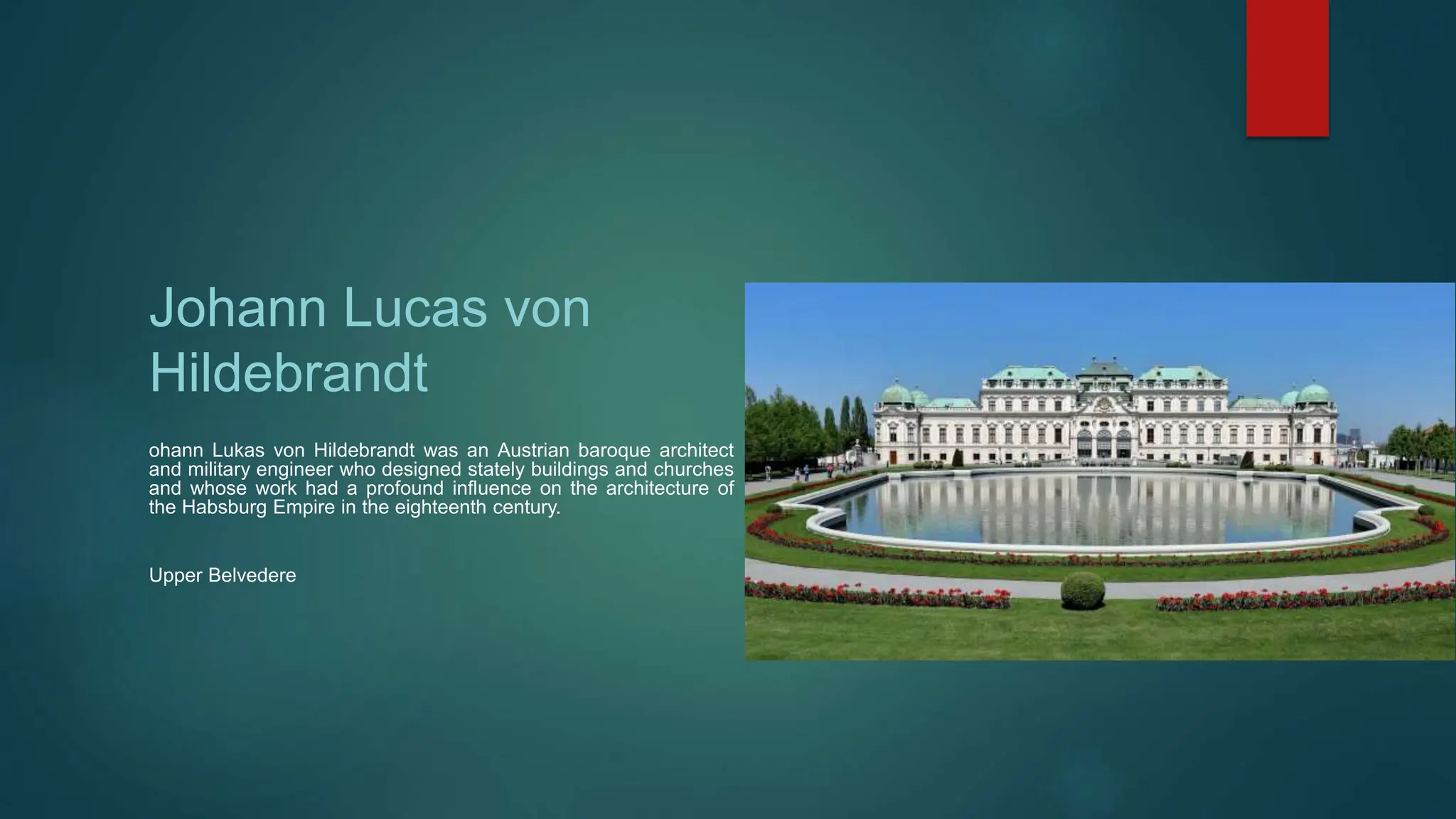
Johann Lucas von
Hildebrandt
ohann Lukas von Hildebrandt was an Austrian baroque architect
and military engineer who designed stately buildings and churches
and whose work had a profound influence on the architecture of
the Habsburg Empire in the eighteenth century.
Upper Belvedere
Brief overview of regional styles and
influences
• Italian Baroque: Characterized by grandeur, emotion, and sculptural
decoration
• French Baroque: Influence of classicism, symmetry, and formal gardens
• Central European Baroque: Fusion of local traditions with Italian and
French influences
• Spanish Baroque: Rich ornamentation, dramatic chiaroscuro effects, and
religious symbolism
Neoclassical
Architecture (18th–
19th century)
EVOLUTION OF ARCHITECTURAL STYLES
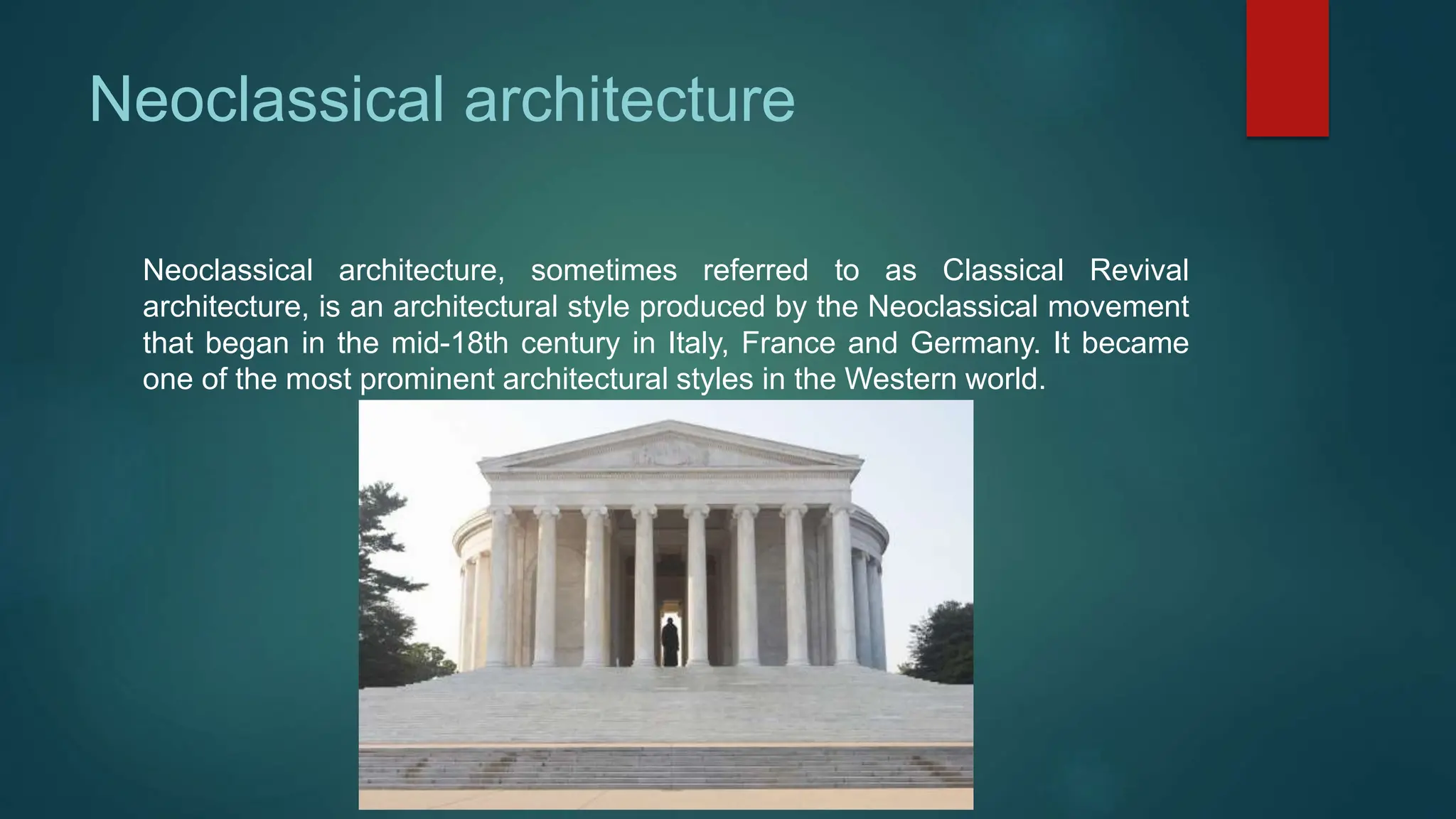
Neoclassical architecture
Neoclassical architecture, sometimes referred to as Classical Revival
architecture, is an architectural style produced by the Neoclassical movement
that began in the mid-18th century in Italy, France and Germany. It became
one of the most prominent architectural styles in the Western world.
Key Characteristics of Neoclassical
Architecture
• Emphasis on symmetry, proportion, and simplicity
• Use of classical orders: Doric, Ionic, and Corinthian columns
• Monumentality and grandeur in public buildings and civic structures
• Neoclassical motifs: pediments, porticos, and entablatures
Architectural Elements in
Neoclassical Buildings
• Pediments: Triangular gables often crowning facades
• Porticos: Colonnaded entranceways with projecting roof structures
• Entablatures: Horizontal bands of decoration above columns
• Friezes: Decorative bands often featuring sculptural reliefs
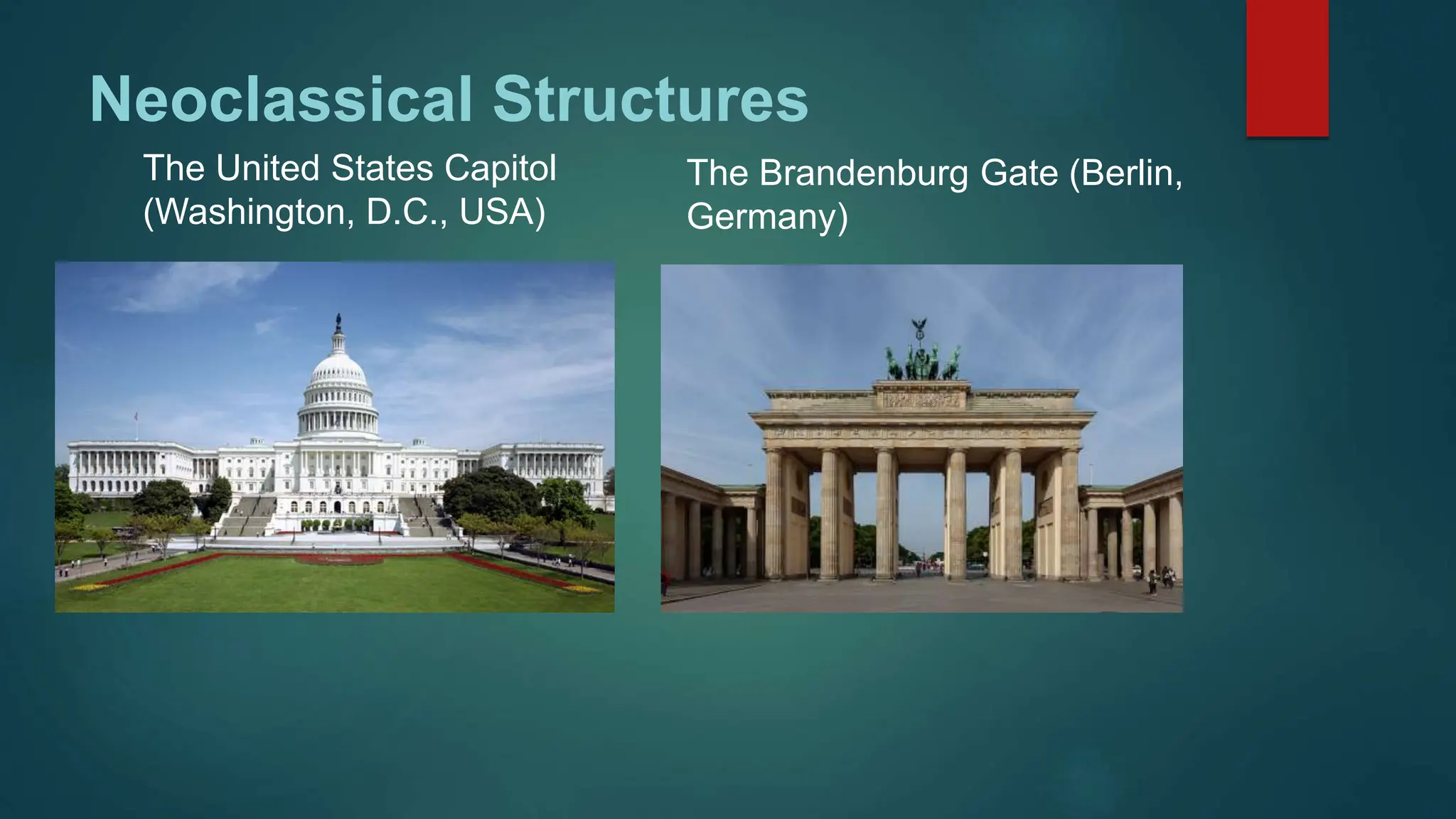
Neoclassical Structures
The United States Capitol
(Washington, D.C., USA)
The Brandenburg Gate (Berlin,
Germany)
Notable Neoclassical Architects
• Andrea Palladio (1508–1580)
• Étienne-Louis Boullée (1728–1799)
• John Nash (1752–1835)
• Thomas Jefferson (1743–1826)
• Karl Friedrich Schinkel (1781–1841)
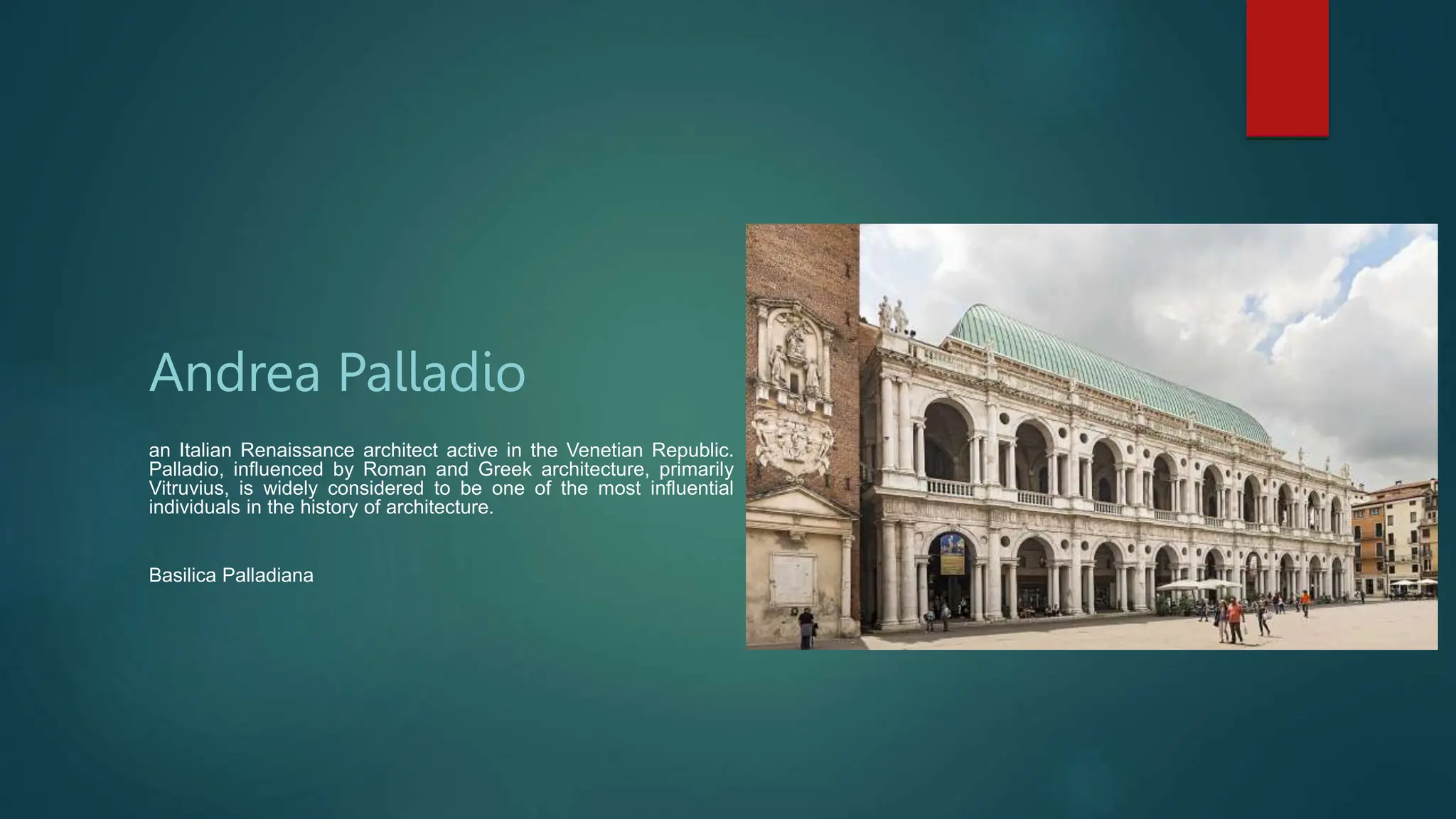
Andrea Palladio
an Italian Renaissance architect active in the Venetian Republic.
Palladio, influenced by Roman and Greek architecture, primarily
Vitruvius, is widely considered to be one of the most influential
individuals in the history of architecture.
Basilica Palladiana
Étienne-Louis Boullée
Étienne-Louis Boullée was a visionary French neoclassical
architect whose work greatly influenced contemporary
architects.
Boullée promoted the idea of making architecture expressive
of its purpose, a doctrine that his detractors
termed architecture parlante ("talking architecture"), which
was an essential element in Beaux-Arts architectural
training in the later 19th century.
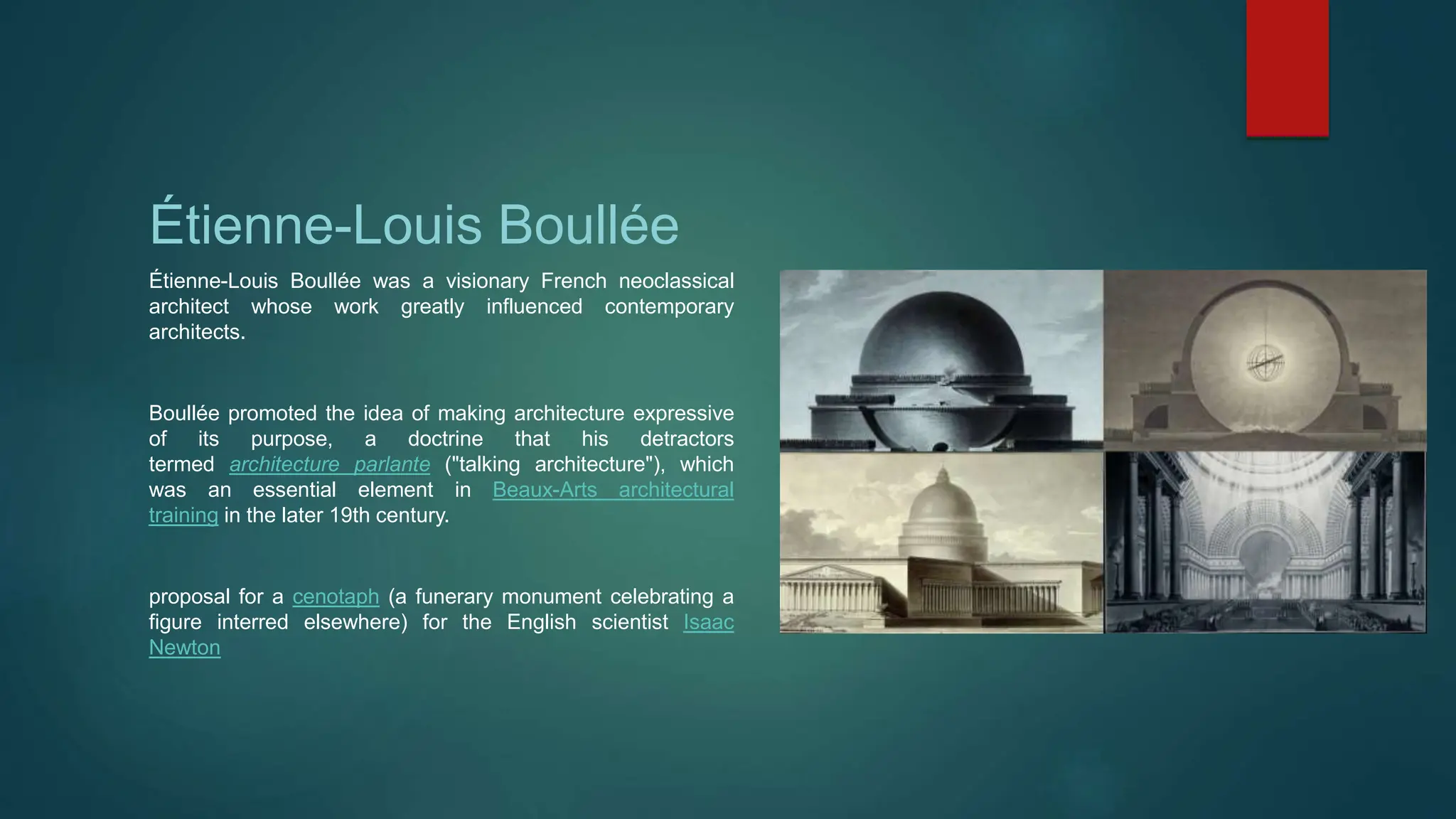
proposal for a cenotaph (a funerary monument celebrating a
figure interred elsewhere) for the English scientist Isaac
Newton
Karl Friedrich Schinkel
Prussian architect, city planner and painter who also designed
furniture and stage sets. Schinkel was one of the most
prominent architects of Germany and designed both
Neoclassical and neo-Gothic buildings. His most famous
buildings are found in and around Berlin.
Regional Variations in Neoclassical
Architecture
• Greek Revival in the United States: Emphasis on democratic ideals and
civic pride
• Palladianism in Britain: Influence of Andrea Palladio's classical villas
• Empire Style in France: Blend of Neoclassicism with Napoleonic
symbolism
• Federal Style in the United States: Elegant simplicity and geometric forms
Victorian Architecture
(19th century)
EVOLUTION OF ARCHITECTURAL STYLES
Victorian Architecture
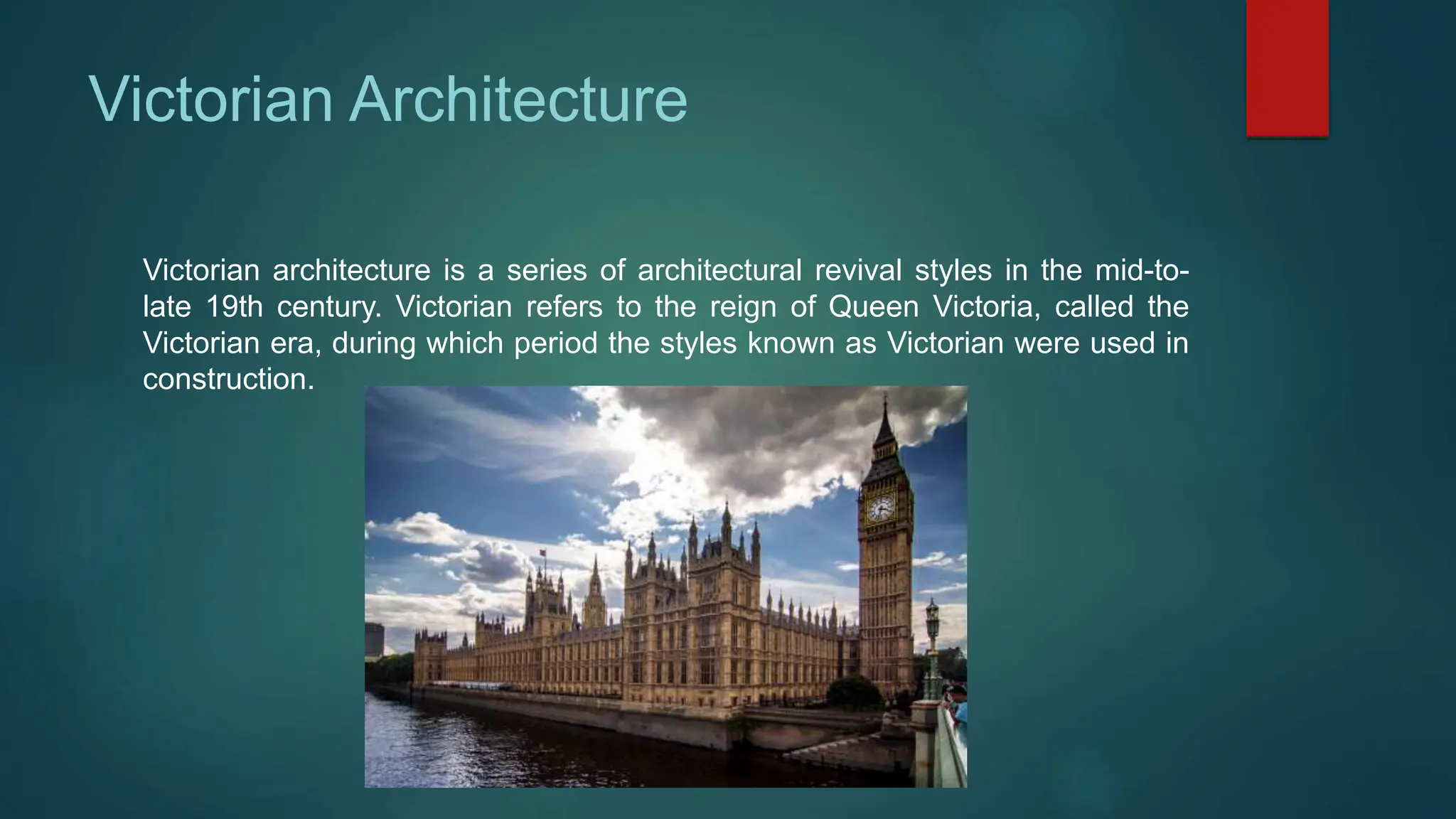
Victorian architecture is a series of architectural revival styles in the mid-to-
late 19th century. Victorian refers to the reign of Queen Victoria, called the
Victorian era, during which period the styles known as Victorian were used in
construction.
Key Characteristics of Victorian
Architecture
• Eclecticism: Combination of various architectural styles, including Gothic
Revival, Italianate, Queen Anne, and Romanesque
• Ornamentation: Elaborate decorative details such as intricate moldings,
carvings, and trimmings
• Asymmetry: Irregular floor plans and asymmetrical facades, often featuring
towers, turrets, and bay windows
• Use of new materials and technologies, such as iron and glass, allowing
for larger windows and open interior spaces
Architectural Elements in Victorian
Buildings
• Steeply pitched roofs with decorative gables and dormer windows
• Ornate porches, verandas, and balconies
• Richly decorated facades with contrasting materials and textures
• Towering chimneys and intricate brickwork or stonework
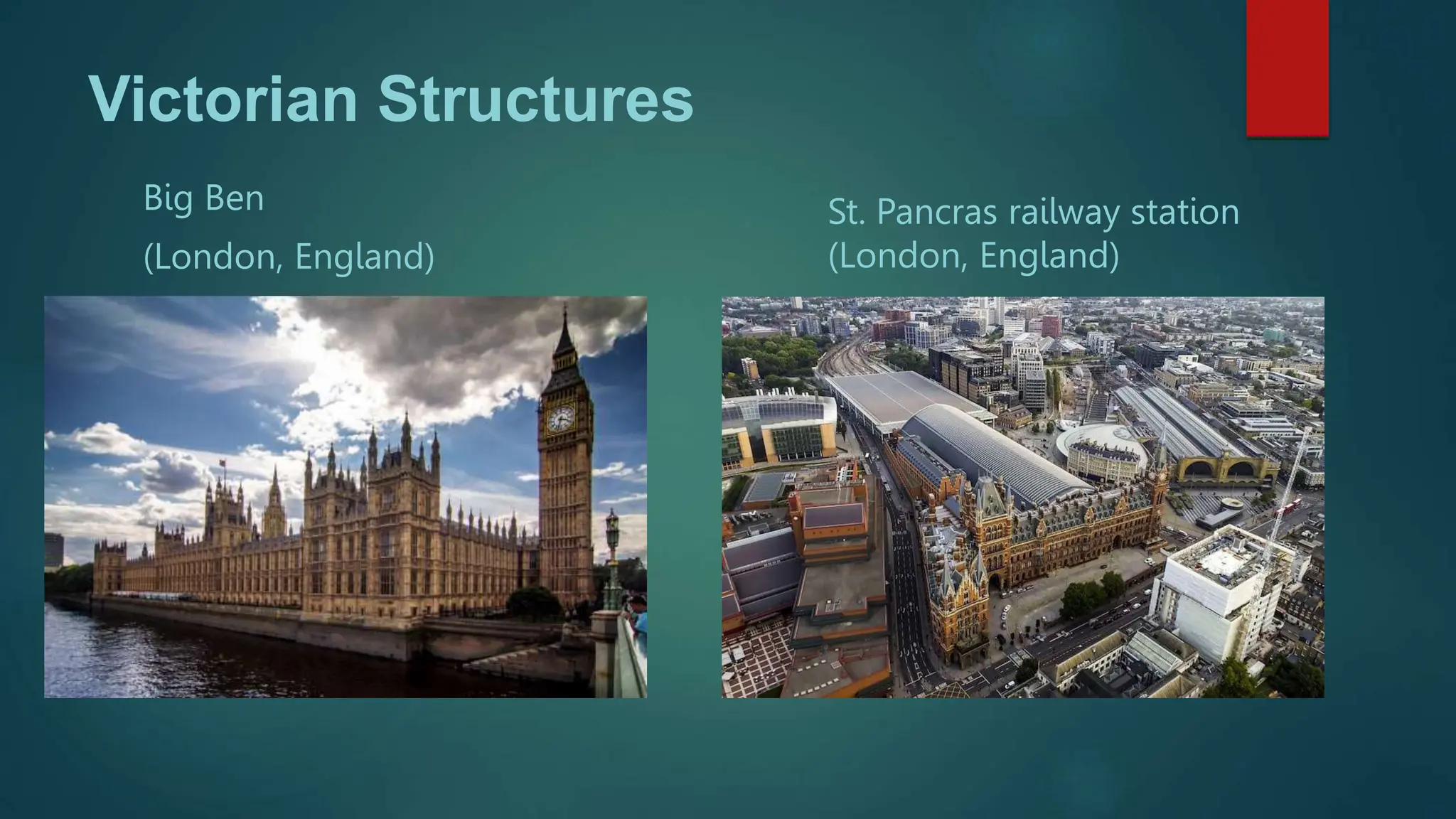
Victorian Structures
Big Ben
(London, England)
St. Pancras railway station
(London, England)
Notable Victorian Architects
• Sir Charles Barry (1795–1860)
• Augustus Pugin (1812–1852)
• George Gilbert Scott (1811–1878)
• Richard Norman Shaw (1831–1912)
• Frank Lloyd Wright (1867–1959)
Regional Variations in Victorian
Architecture
• British Victorian: Gothic Revival, Italianate, and Queen Anne styles
prevalent in Britain
• American Victorian: Adaptation of Victorian styles with local materials and
influences
• Australian Victorian: Combination of Victorian styles with colonial and
indigenous elements
Art and Decoration in Victorian
Architecture
• Intricate woodwork, stained glass windows, and decorative tile work
• Richly patterned wallpapers, textiles, and upholstery
• Incorporation of symbolism and allegory in architectural ornamentation

evolution of architectural styles from classical

  • 1.
  • 2.
    Classical Architecture: Ancient Greeceand Rome A Journey Through Timeless Design
  • 3.
    Classical Architecture  Classicalarchitecture derives from Greek and Roman architectural principles, often influenced by the works of Vitruvius.  Its roots can be traced back to the Carolingian Renaissance and gained prominence during the Italian Renaissance.  Classical styles encompass a range of variations but share a common vocabulary of decorative and constructive elements.  These styles have dominated Western architecture from the Renaissance until World War II.  Classical architecture continues to inspire architects and inform architectural practices today.  Key characteristics: balance, symmetry, proportion, and harmony
  • 4.
    Ancient Greek Architecture Greek architectural style can be divided into three separate orders: the Doric Order, the Ionic Order, and the Corinthian Order. These styles have had a profound impact on Western architecture of later periods. In particular, the architecture of ancient Rome grew out of Greek architecture.
  • 7.
  • 8.
    Temple of Artemis (Artemision) locatednear the ancient city of Ephesus, about 75 kilometres (47 mi) south from the modern port city of İzmir, in Turkey. Today the site lies on the edge of the modern town of Selçuk. The sacred site (temenos) at Ephesus was far older than the Artemision itself.
  • 9.
    Erechtheion The Erechtheion, alsoknown as the Erechtheum, is an ancient Greek temple dedicated to the goddess Athena and the god Poseidon-Erechtheus. (Athena was the ancient Greek goddess of wisdom and warfare; Poseidon was the ancient Greek god of the sea.) It was built on the Acropolis in Athens, Greece, circa 430–405 BCE.
  • 10.
    Roman Architecture  Influencesof Greek architecture on Roman design  Development of new architectural elements: arches, domes, and vaults  Roman architectural styles: Tuscan, Doric, Ionic, Corinthian, and Composite orders
  • 13.
  • 14.
  • 15.
    Baths of Caracalla Thebaths followed the "great Imperial baths" blueprint for Roman baths. They were more a leisure centre than just a series of baths. Besides being used for bathing, the complex also offered facilities for taking walks, reading/studying, exercise and body care
  • 16.
    Vitruvius Roman architect andengineer during the 1st century BC, known for his multi-volume work titled De architectura.
  • 17.
    De architectura Firmitas (Firmness,Durability) – It should stand up robustly and remain in good condition. Utilitas (Commodity, Utility) – It should be useful and function well for the people using it. Venustas (Delight, Beauty) – It should delight people and raise their spirits.
  • 18.
  • 19.
    Romanesque Architecture • RomanesqueArchitecture: Prevailed in Europe from the mid-11th century until the rise of Gothic architecture. • Influences: Fusion of Roman, Carolingian, Ottonian, Byzantine, and local Germanic traditions. • Origins: Emerged due to the expansion of monasticism in the 10th–11th century, necessitating larger churches. • Architectural Features: • Semicircular arches for windows, doors, and arcades. • Barrel or groin vaults supporting the roof of the nave. • Massive piers and walls to resist vault thrust, with few windows. • Side aisles with galleries above. • Large tower over the crossing of nave and transept, with smaller towers at the western end. • French Influence: Expansion on the early Christian basilica plan, incorporating radiating chapels, ambulatories, and large transepts.
  • 20.
    Key Characteristics ofRomanesque Architecture  Thick, sturdy walls with small windows to support heavy stone roofs  Rounded arches, barrel vaults, and groin vaults  Use of piers and columns to support the weight of the structure  Decorative elements such as sculptural reliefs, ornate doorways, and frescoes
  • 21.
    Architectural Elements inRomanesque Buildings Detailing the components of Romanesque structures:  Arches: Round arches prevalent in doorways, windows, and arcades  Vaults: Barrel vaults and groin vaults used in ceilings and roofs  Columns and Piers: Supporting elements with simple capitals  Towers and Bell Towers: Prominent features in Romanesque churches
  • 22.
    Romanesque Structures Durham Cathedral,formally the Cathedral Church of Christ, Blessed Mary the Virgin and St Cuthbert of Durham, is a Church of England cathedral in the city of Durham, England.
  • 23.
    Cattedrale di Pisa PisaCathedral is a medieval Catholic cathedral dedicated to the Assumption of the Virgin Mary, in the Piazza dei Miracoli in Pisa, Italy, the oldest of the three structures in the plaza followed by the Pisa Baptistry and the Campanile known as the Leaning Tower of Pisa.
  • 24.
  • 25.
    Gothic Architecture Gothic architectureis an architectural style that was prevalent in Europe from the late 12th to the 16th century, during the High and Late Middle Ages, surviving into the 17th and 18th centuries in some areas. It evolved from Romanesque architecture and was succeeded by Renaissance architecture.
  • 26.
    Key Characteristics ofGothic Architecture  Tall, soaring structures with pointed arches and ribbed vaults  Flying buttresses for external support, allowing for large windows and open interiors  Elaborate decorative elements: tracery, gargoyles, and spires  Emphasis on verticality and light, creating a sense of aspiration and transcendence
  • 27.
    Architectural Elements inGothic Buildings Detailing the components of Gothic structures:  Pointed Arches: Characteristic feature, providing height and elegance  Ribbed Vaults: Structural system of intersecting ribs supporting the ceiling  Flying Buttresses: External supports transferring thrust from the vaults to the ground  Tracery: Delicate stone or glass patterns in windows  Gargoyles: Decorative and functional sculptures serving as water spouts
  • 28.
    Gothic Architecture Structures Notre-Dame Cathedral (Paris, France)  Chartres Cathedral (Chartres, France)
  • 29.
    Gothic Architecture Structures Westminster Abbey (London, England)  Cologne Cathedral (Cologne, Germany)
  • 30.
    Gothic Architecture Structures Milan Cathedral (Milan, Italy)
  • 31.
    Regional Variations inGothic Architecture Brief overview of regional styles and influences:  French Gothic: Characterized by elaborate decoration and extensive use of stained glass  English Gothic: Known for its simplicity and emphasis on verticality  German Gothic: Blend of French and local traditions, featuring intricate vaulting  Italian Gothic: Influenced by Renaissance elements, with less emphasis on height
  • 32.
    Famous Old &New "Gothic Architecture" Architects  Arnolfo di Cambio (–1302) Cambio's legacy endures in the Cathedral of Florence, a jewel that epitomizes his architectural brilliance.  Peter Parler (1330–1399) Prague's St. Vitus Cathedral stands tall as Parler's magnum opus, showcasing his mastery in Central European Gothic architecture.  Suger (1081–1151) A trailblazer in Gothic architecture, Suger's Basilica of Saint-Denis symbolizes the dawn of this transformative architectural style.  Eugène Viollet-le-Duc (1814–1879) Viollet-le-Duc's restoration work on Notre Dame de Paris rekindled interest in Gothic architecture during the 19th century.  Erwin von Steinbach (–1318) The Strasbourg Cathedral is a testament to von Steinbach's architectural finesse and dedication.  Thomas de Cormont De Cormont's contributions to French Gothic architecture shine through in the intricate designs of Amiens Cathedral.
  • 33.
  • 34.
    Renaissance Architecture  Renaissancearchitecture is the European architecture of the period between the early 15th and early 16th centuries in different regions, demonstrating a conscious revival and development of certain elements of ancient Greek and Roman thought and material culture.
  • 35.
    Key Characteristics ofRenaissance Architecture • Return to classical principles of balance, symmetry, and proportion • Emphasis on mathematical precision and rationality in design • Integration of classical elements such as columns, pediments, and domes • Human-centered approach, with focus on perspective, proportion, and the idealized human form
  • 36.
    Architectural Elements in RenaissanceBuildings Detailing the components of Renaissance structures: • Classical Orders: Doric, Ionic, Corinthian, and Composite columns • Pilasters: Flat, shallow columns often used for decorative purposes • Pediments: Triangular gables often crowning facades or entrances • Domes: Inspired by ancient Roman and Byzantine examples, used as focal points in buildings
  • 37.
    Renaissance Structures St. Peter'sBasilica (Vatican City, Italy) St. Paul's Cathedral (London, England)
  • 38.
    Notable Renaissance Architects •Filippo Brunelleschi (1377–1446) • Leon Battista Alberti (1404–1472) • Donato Bramante(1444–1514) • Andrea Palladio (1508–1580) • Michelangelo Buonarroti (1475–1564)
  • 39.
    Filippo Brunelleschi is bestknown for designing the dome of the Duomo in Florence, but he was also a talented artist. He is said to have rediscovered the principles of linear perspective, an artistic device that creates the illusion of space by depicting converging parallel lines.
  • 40.
    Leon Battista Alberti Basilicaof Santa Maria Novella  Italian humanist, architect, and principal initiator of Renaissance art theory. In his personality, works, and breadth of learning, he is considered the prototype of the Renaissance “universal man.”
  • 41.
    Andrea Palladio he wasthe first architect to systematize the plan of a house and consistently to use the ancient Greco-Roman temple front as a portico, or roofed porch supported by columns (The Four Books of Architecture), published in 1570, which set out rules others could follow. The first book includes studies of decorative styles, classical orders, and materials.
  • 42.
    Michelangelo Buonarroti The frescoeson the ceiling of the Sistine Chapel (1508–12) in the Vatican, which include the iconic depiction of the creation of Adam interpreted from Genesis, are probably the best known of Michelangelo's works today, but the artist thought of himself primarily as a sculptor.
  • 43.
  • 44.
    Baroque architecture is ahighly opulent style of building, design, and art that originated in Italy during the 17th century and spread to the rest of Europe. It's characterized by extremely detailed forms, marble, large-scale decoration, and bright colors.
  • 45.
    Key Characteristics ofBaroque Architecture • Emphasis on theatricality, grandeur, and emotional impact • Dynamic use of space, light, and shadow to create dramatic effects • Ornate decoration, including elaborate stucco work, gilding, and sculptural elements • Curvilinear forms, fluidity of movement, and illusionistic techniques
  • 46.
    Architectural Elements inBaroque Buildings • Curvilinear Facades: Dramatic use of curves and convex-concave forms • Centralized Plans: Oval or elliptical layouts, often with domes or cupolas • Dynamic Interior Spaces: Dramatic staircases, vaulted ceilings, and light- filled interiors • Sculptural Decoration: Statues, reliefs, and ornamental details integrated into architecture
  • 47.
    Baroque Structures St. Peter'sBasilica (Vatican City, Italy) Palace of Versailles (Versailles, France)
  • 48.
    Notable Baroque Architects •Gian Lorenzo Bernini (1598–1680) • Francesco Borromini (1599–1667) • Christopher Wren (1632–1723) • Johann Bernhard Fischer von Erlach (1656–1723) • Johann Lucas von Hildebrandt (1668–1745)
  • 49.
    Francesco Borromini Francesco Borromini,byname of Francesco Castelli, was an Italian architect born in the modern Swiss canton of Ticino who, with his contemporaries Gian Lorenzo Bernini and Pietro da Cortona, was a leading figure in the emergence of Roman Baroque architecture Chiesa di San Carlino alle Quattro Fontane
  • 50.
    Johann Lucas von Hildebrandt ohannLukas von Hildebrandt was an Austrian baroque architect and military engineer who designed stately buildings and churches and whose work had a profound influence on the architecture of the Habsburg Empire in the eighteenth century. Upper Belvedere
  • 51.
    Brief overview ofregional styles and influences • Italian Baroque: Characterized by grandeur, emotion, and sculptural decoration • French Baroque: Influence of classicism, symmetry, and formal gardens • Central European Baroque: Fusion of local traditions with Italian and French influences • Spanish Baroque: Rich ornamentation, dramatic chiaroscuro effects, and religious symbolism
  • 52.
  • 53.
    Neoclassical architecture Neoclassical architecture,sometimes referred to as Classical Revival architecture, is an architectural style produced by the Neoclassical movement that began in the mid-18th century in Italy, France and Germany. It became one of the most prominent architectural styles in the Western world.
  • 54.
    Key Characteristics ofNeoclassical Architecture • Emphasis on symmetry, proportion, and simplicity • Use of classical orders: Doric, Ionic, and Corinthian columns • Monumentality and grandeur in public buildings and civic structures • Neoclassical motifs: pediments, porticos, and entablatures
  • 55.
    Architectural Elements in NeoclassicalBuildings • Pediments: Triangular gables often crowning facades • Porticos: Colonnaded entranceways with projecting roof structures • Entablatures: Horizontal bands of decoration above columns • Friezes: Decorative bands often featuring sculptural reliefs
  • 56.
    Neoclassical Structures The UnitedStates Capitol (Washington, D.C., USA) The Brandenburg Gate (Berlin, Germany)
  • 57.
    Notable Neoclassical Architects •Andrea Palladio (1508–1580) • Étienne-Louis Boullée (1728–1799) • John Nash (1752–1835) • Thomas Jefferson (1743–1826) • Karl Friedrich Schinkel (1781–1841)
  • 58.
    Andrea Palladio an ItalianRenaissance architect active in the Venetian Republic. Palladio, influenced by Roman and Greek architecture, primarily Vitruvius, is widely considered to be one of the most influential individuals in the history of architecture. Basilica Palladiana
  • 59.
    Étienne-Louis Boullée Étienne-Louis Boulléewas a visionary French neoclassical architect whose work greatly influenced contemporary architects. Boullée promoted the idea of making architecture expressive of its purpose, a doctrine that his detractors termed architecture parlante ("talking architecture"), which was an essential element in Beaux-Arts architectural training in the later 19th century. proposal for a cenotaph (a funerary monument celebrating a figure interred elsewhere) for the English scientist Isaac Newton
  • 60.
    Karl Friedrich Schinkel Prussianarchitect, city planner and painter who also designed furniture and stage sets. Schinkel was one of the most prominent architects of Germany and designed both Neoclassical and neo-Gothic buildings. His most famous buildings are found in and around Berlin.
  • 61.
    Regional Variations inNeoclassical Architecture • Greek Revival in the United States: Emphasis on democratic ideals and civic pride • Palladianism in Britain: Influence of Andrea Palladio's classical villas • Empire Style in France: Blend of Neoclassicism with Napoleonic symbolism • Federal Style in the United States: Elegant simplicity and geometric forms
  • 62.
  • 63.
    Victorian Architecture Victorian architectureis a series of architectural revival styles in the mid-to- late 19th century. Victorian refers to the reign of Queen Victoria, called the Victorian era, during which period the styles known as Victorian were used in construction.
  • 64.
    Key Characteristics ofVictorian Architecture • Eclecticism: Combination of various architectural styles, including Gothic Revival, Italianate, Queen Anne, and Romanesque • Ornamentation: Elaborate decorative details such as intricate moldings, carvings, and trimmings • Asymmetry: Irregular floor plans and asymmetrical facades, often featuring towers, turrets, and bay windows • Use of new materials and technologies, such as iron and glass, allowing for larger windows and open interior spaces
  • 65.
    Architectural Elements inVictorian Buildings • Steeply pitched roofs with decorative gables and dormer windows • Ornate porches, verandas, and balconies • Richly decorated facades with contrasting materials and textures • Towering chimneys and intricate brickwork or stonework
  • 66.
    Victorian Structures Big Ben (London,England) St. Pancras railway station (London, England)
  • 67.
    Notable Victorian Architects •Sir Charles Barry (1795–1860) • Augustus Pugin (1812–1852) • George Gilbert Scott (1811–1878) • Richard Norman Shaw (1831–1912) • Frank Lloyd Wright (1867–1959)
  • 68.
    Regional Variations inVictorian Architecture • British Victorian: Gothic Revival, Italianate, and Queen Anne styles prevalent in Britain • American Victorian: Adaptation of Victorian styles with local materials and influences • Australian Victorian: Combination of Victorian styles with colonial and indigenous elements
  • 69.
    Art and Decorationin Victorian Architecture • Intricate woodwork, stained glass windows, and decorative tile work • Richly patterned wallpapers, textiles, and upholstery • Incorporation of symbolism and allegory in architectural ornamentation