Spanish 2 Grammar Book—First SemesterCatalina VivlamoreSpanish 2H period 2
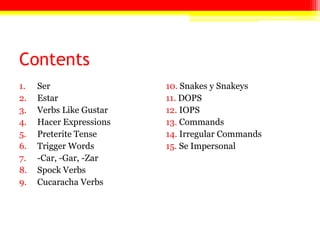
ContentsSerEstarVerbs Like GustarHacer ExpressionsPreterite TenseTrigger Words-Car, -Gar, -ZarSpock VerbsCucaracha Verbs10. Snakes y Snakeys11. DOPS12. IOPS13. Commands14. Irregular Commands15. Se Impersonal
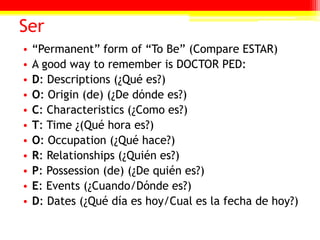
Ser“Permanent” form of “To Be” (Compare ESTAR)A good way to remember is DOCTOR PED:D: Descriptions (¿Qué es?)O: Origin (de) (¿De dónde es?)C: Characteristics (¿Como es?)T: Time ¿(Qué hora es?)O: Occupation (¿Qué hace?)R: Relationships (¿Quién es?)P: Possession (de) (¿De quién es?)E: Events (¿Cuando/Dónde es?)D: Dates (¿Qué día es hoy/Cual es la fecha de hoy?)
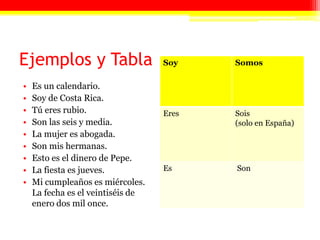
Ejemplos y TablaEs un calendario.Soy de Costa Rica.Tú eres rubio.Son las seis y media.La mujer es abogada.Son mis hermanas.Esto es el dinero de Pepe.La fiesta es jueves.Mi cumpleaños es miércoles. La fecha es el veintiséis de enero dos mil once.
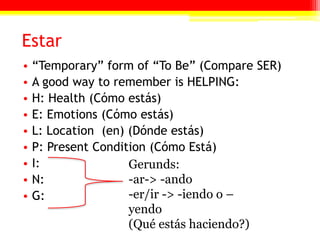
Estar“Temporary” form of “To Be” (Compare SER)A good way to remember is HELPING:H: Health (Cómo estás)E: Emotions (Cómo estás)L: Location  (en) (Dónde estás)P: Present Condition (Cómo Está)I:N:G:Gerunds:-ar-> -ando-er/ir -> -iendo o –yendo(Qué estás haciendo?)
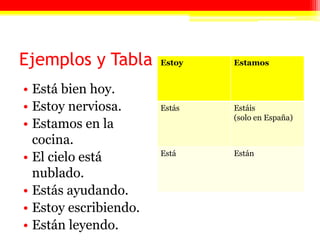
Ejemplos y TablaEstá bien hoy.Estoy nerviosa.Estamos en la cocina.El cielo está nublado.Estás ayudando.Estoy escribiendo.Están leyendo.
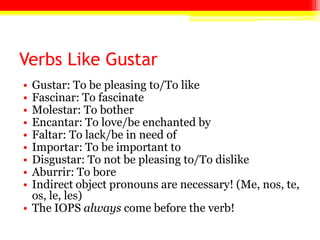
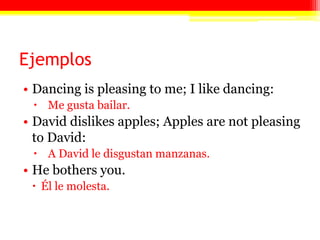
Verbs Like GustarGustar: To be pleasing to/To likeFascinar: To fascinateMolestar: To botherEncantar: To love/be enchanted byFaltar: To lack/be in need ofImportar: To be important toDisgustar: To not be pleasing to/To dislikeAburrir: To boreIndirect object pronouns are necessary! (Me, nos, te, os, le, les)The IOPS always come before the verb!
EjemplosDancing is pleasing to me; I like dancing:Me gusta bailar.David dislikes apples; Apples are not pleasing to David: A David le disgustan manzanas.He bothers you.Él le molesta.
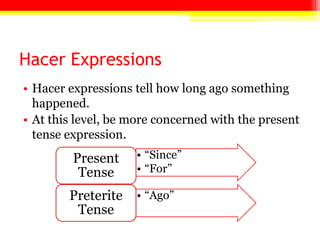
Hacer ExpressionsHacer expressions tell how long ago something happened.At this level, be more concerned with the present tense expression.
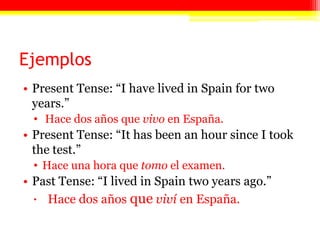
EjemplosPresent Tense: “I have lived in Spain for two years.”Hace dos años que vivo en España. Present Tense: “It has been an hour since I took the test.”Hace una hora que tomo el examen.Past Tense: “I lived in Spain two years ago.”Hace dos años queviví en España.
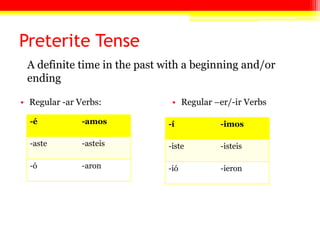
Preterite TenseRegular -ar Verbs:Regular –er/-ir VerbsA definite time in the past with a beginning and/or ending
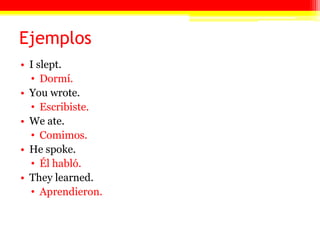
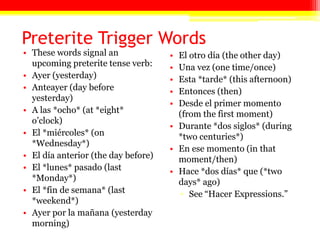
EjemplosI slept. Dormí.You wrote. Escribiste.We ate. Comimos.He spoke. Él habló.They learned.Aprendieron.Preterite Trigger WordsThese words signal an upcoming preterite tense verb:Ayer (yesterday)Anteayer (day before yesterday)A las *ocho* (at *eight* o’clock)El *miércoles* (on *Wednesday*)El día anterior (the day before)El *lunes* pasado (last *Monday*)El *fin de semana* (last *weekend*)Ayer por la mañana (yesterday morning)El otro día (the other day)Una vez (one time/once)Esta *tarde* (this afternoon)Entonces (then)Desde el primer momento (from the first moment)Durante *dos siglos* (during *two centuries*)En ese momento (in that moment/then)Hace *dos días* que (*two days* ago)See “Hacer Expressions.”
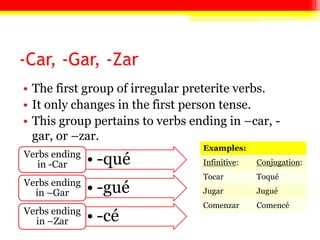
-Car, -Gar, -ZarThe first group of irregular preterite verbs. It only changes in the first person tense.This group pertains to verbs ending in –car, -gar, or –zar.
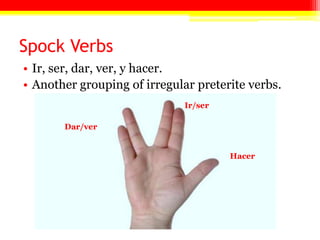
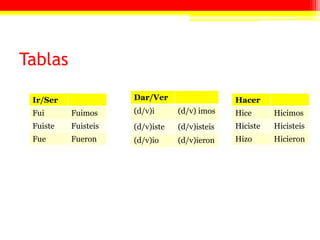
Spock VerbsIr, ser, dar, ver, y hacer.Another grouping of irregular preterite verbs.Ir/serDar/verHacer
Tablas
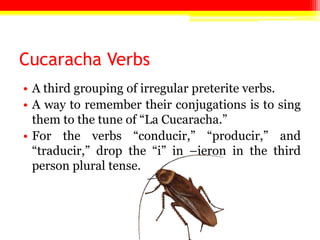
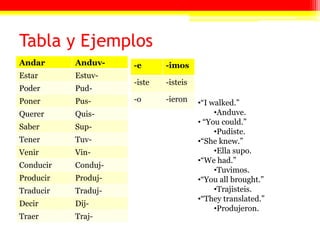
Cucaracha VerbsA third grouping of irregular preterite verbs.A way to remember their conjugations is to sing them to the tune of “La Cucaracha.” For the verbs “conducir,” “producir,” and “traducir,” drop the “i” in –ieron in the third person plural tense.
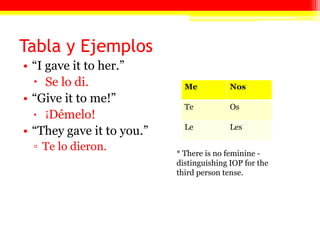
Tabla y Ejemplos“I walked.”
Anduve.
 “You could.”
Pudiste.
“She knew.”
Ella supo.
“We had.”
Tuvimos.
“You all brought.”
Trajisteis.
“They translated.”
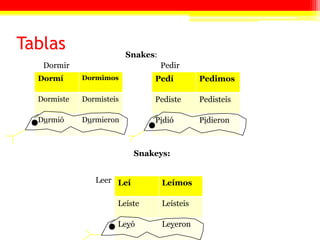
Produjeron.Snakes and SnakeysThe last groupings of irregular preterite verbs.In the “snakes” group, there is a stem change in the third person.In the “snakeys” group, the “i” changes to a “y” in the third person. These verbs usually have double vowels in infinitive form.
TablasSnakes:DormirPedirSnakeys:Leer

Spanish 2 grammar book—first semester

  • 1.
    Spanish 2 GrammarBook—First SemesterCatalina VivlamoreSpanish 2H period 2
  • 2.
    ContentsSerEstarVerbs Like GustarHacerExpressionsPreterite TenseTrigger Words-Car, -Gar, -ZarSpock VerbsCucaracha Verbs10. Snakes y Snakeys11. DOPS12. IOPS13. Commands14. Irregular Commands15. Se Impersonal
  • 3.
    Ser“Permanent” form of“To Be” (Compare ESTAR)A good way to remember is DOCTOR PED:D: Descriptions (¿Qué es?)O: Origin (de) (¿De dónde es?)C: Characteristics (¿Como es?)T: Time ¿(Qué hora es?)O: Occupation (¿Qué hace?)R: Relationships (¿Quién es?)P: Possession (de) (¿De quién es?)E: Events (¿Cuando/Dónde es?)D: Dates (¿Qué día es hoy/Cual es la fecha de hoy?)
  • 4.
    Ejemplos y TablaEsun calendario.Soy de Costa Rica.Tú eres rubio.Son las seis y media.La mujer es abogada.Son mis hermanas.Esto es el dinero de Pepe.La fiesta es jueves.Mi cumpleaños es miércoles. La fecha es el veintiséis de enero dos mil once.
  • 5.
    Estar“Temporary” form of“To Be” (Compare SER)A good way to remember is HELPING:H: Health (Cómo estás)E: Emotions (Cómo estás)L: Location (en) (Dónde estás)P: Present Condition (Cómo Está)I:N:G:Gerunds:-ar-> -ando-er/ir -> -iendo o –yendo(Qué estás haciendo?)
  • 6.
    Ejemplos y TablaEstábien hoy.Estoy nerviosa.Estamos en la cocina.El cielo está nublado.Estás ayudando.Estoy escribiendo.Están leyendo.
  • 7.
    Verbs Like GustarGustar:To be pleasing to/To likeFascinar: To fascinateMolestar: To botherEncantar: To love/be enchanted byFaltar: To lack/be in need ofImportar: To be important toDisgustar: To not be pleasing to/To dislikeAburrir: To boreIndirect object pronouns are necessary! (Me, nos, te, os, le, les)The IOPS always come before the verb!
  • 8.
    EjemplosDancing is pleasingto me; I like dancing:Me gusta bailar.David dislikes apples; Apples are not pleasing to David: A David le disgustan manzanas.He bothers you.Él le molesta.
  • 9.
    Hacer ExpressionsHacer expressionstell how long ago something happened.At this level, be more concerned with the present tense expression.
  • 10.
    EjemplosPresent Tense: “Ihave lived in Spain for two years.”Hace dos años que vivo en España. Present Tense: “It has been an hour since I took the test.”Hace una hora que tomo el examen.Past Tense: “I lived in Spain two years ago.”Hace dos años queviví en España.
  • 11.
    Preterite TenseRegular -arVerbs:Regular –er/-ir VerbsA definite time in the past with a beginning and/or ending
  • 12.
    EjemplosI slept. Dormí.Youwrote. Escribiste.We ate. Comimos.He spoke. Él habló.They learned.Aprendieron.Preterite Trigger WordsThese words signal an upcoming preterite tense verb:Ayer (yesterday)Anteayer (day before yesterday)A las *ocho* (at *eight* o’clock)El *miércoles* (on *Wednesday*)El día anterior (the day before)El *lunes* pasado (last *Monday*)El *fin de semana* (last *weekend*)Ayer por la mañana (yesterday morning)El otro día (the other day)Una vez (one time/once)Esta *tarde* (this afternoon)Entonces (then)Desde el primer momento (from the first moment)Durante *dos siglos* (during *two centuries*)En ese momento (in that moment/then)Hace *dos días* que (*two days* ago)See “Hacer Expressions.”
  • 13.
    -Car, -Gar, -ZarThefirst group of irregular preterite verbs. It only changes in the first person tense.This group pertains to verbs ending in –car, -gar, or –zar.
  • 14.
    Spock VerbsIr, ser,dar, ver, y hacer.Another grouping of irregular preterite verbs.Ir/serDar/verHacer
  • 15.
  • 16.
    Cucaracha VerbsA thirdgrouping of irregular preterite verbs.A way to remember their conjugations is to sing them to the tune of “La Cucaracha.” For the verbs “conducir,” “producir,” and “traducir,” drop the “i” in –ieron in the third person plural tense.
  • 17.
  • 18.
  • 19.
  • 20.
  • 21.
  • 22.
  • 23.
  • 24.
  • 25.
  • 26.
  • 27.
  • 28.
    Produjeron.Snakes and SnakeysThelast groupings of irregular preterite verbs.In the “snakes” group, there is a stem change in the third person.In the “snakeys” group, the “i” changes to a “y” in the third person. These verbs usually have double vowels in infinitive form.
  • 29.