NOTF ORS ALE 
FRESEA MPCLOEI Y 
VirginiaE vans- JennyD ooley 
!# 
m 
ExpresPsu blishing
VirginiaE vans 
JennyD ooley 
GJ 
ExpresPsu blishing
Contents 
1 rher nderinite#.1,:]"..". .......... 
2 PersonaSlu bjecUObjePcrt onouns.. ..... 
3 The verb'to be' . . . . . . . . . 
ExplorinGg ramma(rU nits1 -3) .......... 
Revisio(nU nits1 -3). ........ 
iliodu[s? 
4 The verb'have got' 
5 Plurals 
6 This/Thes-e T hat/Those.. ...... 
ExplorinGg ramma(rU nits4 -6) .......... 
Revisio(nU nits1 -6). ........ 
ffi*c{u[e 3 
7 Therei s/There,a re ......... 
8 Some/An.y. . . . . . . . . 
9 PossessivAed jectives.. ......... 
10 Prepositionso f Place 
ExplorinGg ramma(rU nits7 -10) ........ 
Revisio(nU nits1 -10). ...... 
Module 4 
11 Can . . . . . . . . . 
12 PossessivCea se. ...... 
13 PresenSt imple 
14 Prepositionosf Time:a t, on, in ......... 
ExplorinGg ramma(rU nits1 1-141.. ..... 
Revisio(nU nits1 -141. ...... 
Module 5 
15 Adverbso f Frequehc.y. ......... 
16 QuestionW ords 
ExplorinGg ramma(rU nits1 5-16). ...... 
Revisio(nU nits1 -16). ...... 
/V{mdu6le 
17 PresenCt ont inuous . . . . . . . . . p.46 
18 PresenSt imple- PresenCt ontinuous.. p.49 
ExplorinGgr amma(rU nits1 7-181.. ....... p. 52 
Revisio(nU ni ts1 -18). . . . . . . . . . . . . . . . . . . . . .p . 53 
Mndule7 
19 Was/Were ...... p. 54 
20 PastS imple( regularv erbs) p. 56 
ExplorinGgr amma(rU nits1 9-20). ........ p. 60 
Revisio(nU ni ts1 -20). . . . . . . . . . . . . . . . . . . . . .p . 61 
ModuleS 
21 PastS imple(i rregulavre rbs). ............ p. 62 
22 Countable/UncountNaboluen s.. .......... p. 65 
23 Some/An-y H owm uch/Howm any. ....... p. 66 
ExploringG ramma(rU nits2 1-231 p. 68 
Revisio(nU ni ts1 -23). . . . . . . p.69 
24 A'An -'n" . . . . . : : : : : : . : . . . . . . . . . . . . . . . . . . p. 70 
25 A{us-t Itlustn't .. p.71 
ExplorinGg ramma(rU nits2 4-251. ........ p.72 
Revisio(nU ni ts1 -25). . . . . . . p.73 
Moduls t0 
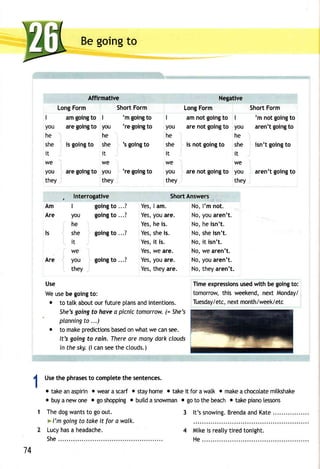
26 Begoingto........... ......... p.74 
27 fmperative ...... p.77 
28 Can- Can' t . . . . . p.78 
ExplorinGg ramma(rU nits2 6-281. ........ p.79 
Revisio(nU nits1 -28). ...... p. 80 
lrregularV erbs 
p.5 
p.6 
p.7 
p.10 
p. 11 
p.12 
p. 15 
p.17 
p. 18 
p. 19 
p. 20 
p.22 
P.24 
p.25 
p.26 
p.27 
p. 28 
p. 30 
p.32 
p. 36 
p. 38 
p. 39 
p.40 
p.41 
p.43 
p.44 
3
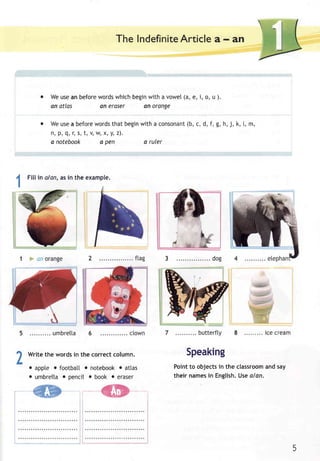
The IndefiniteA rticle d - d(r 
o We use an before words which begin with a vowel (a, e, i, o, u ). 
an atlas on eraser an orange 
o Weu sea beforew ordst hat beginw ith a consonan(tb , c, d, f ,9,h, j, k, [, m, 
[, p, g, l, s, t, v, w, x, y, z). 
a notebook a pen a ruler 
but ter f ty I . . . . . . . . .ic ec ream 
2Write the words in the correct column. 
. appte o footbatl o notebook o attas 
o umbretta o pencil o book o eraser 
Speaking 
Pointt o objectsi n the classrooma nd say 
their namesin EnglishU. sea lan. 
5 
4 Fillin olan, as in the example. 
I 
i 
umbretta
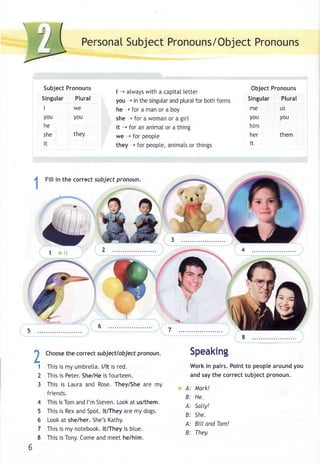
PersonaSlu bjecPt ronouns/ObjePcrto nouns 
Subject Pronouns 
Singular Plural 
lwe 
you you 
he 
she theY 
i t 
| -- atwaysw ith a capitall etter 
you r in the singulaar ndp lura[f or bothf orms 
he r for a man or a boy 
she r for a woman or a girl 
it --+ for an animal or a thins 
we -+ for peopte 
they r for peoptea, nimatos r things 
Object Pronouns 
Singular Plural 
me us 
you you 
him 
her 
them 
i t 
4 Filli n the corrects ubjectp ronoun. 
! ___. " 
?1 
2 
3 
4 
5 
6 
7 
8 
Chooseth e correct subjectlobjectp ronoun. 
Thisi s my umbrettal./ lt is red. 
Thisi s Peter.S he/Hei s fourteen. 
This is Laura and Rose. They/She are my 
friends. 
Thisi sT oma ndI 'm StevenL. ooka t us/them. 
This is Rex and Spot. lt/They are my dogs. 
Looka t she/her.S he'sK athy. 
Thisi s my notebookl.t /They is btue. 
Thisi s Tony.C omea ndm eet he/him. 
Speaking 
Work in pairs. Point to people around you 
and say the correct subject pronoun. 
A: Mark! 
B: He. 
A: Sally! 
B: She. 
A: Bill and Tom! 
B: They. 
7
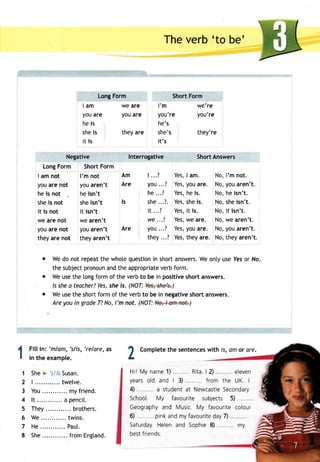
The verb 'to be' 
Long Form 
lam 
you are 
he is 
she is 
it is 
Negative 
Long Form Short Form 
I am not l'm not 
you are not you aren't 
he is not he isn't 
she is not she isn't 
it is not it isn't 
we are not we aren't 
you are not you aren't 
they are not they aren't 
Wed o not repeat he whoteq uestionin shorta nswersW. eo ntyu seY eso r No, 
thes ubjecpt ronouann dt hea ppropriatvee rbf orm. 
Weu set he [ongf ormo f thev erbt o be in positives horta nswers. 
/ss heo teocherY? es,s hei s. (NOI: ) 
Weu set hes hortf ormo f thev erbt o be in negatives horta nswers. 
Are you in grade 7? No, l'm not. (NOT: ) 
Fill in:'mlem,'slis,'relare, as 
in the example. 
She > 'slis Susan. 
1. . . . . . . . . . .t.w elve. 
You. . .. myf riend. 
I t . . . . . . . . . . .a. penci l . 
They... . brothers. 
We... . twins. 
He. . . . . . . . . . .P. aut . 
She.. .. from Engtand. 
Short Form 
we are 
you are 
they are 
I'm 
you're 
he's 
she's 
i t ' s 
Interrogative 
we're 
you're 
they're 
Short Answers 
Am | . . .? Yesl,a m. No,I 'mn ot . 
Are you. ..? Yesy, oua re. No,y oua ren't. 
he. . .? Yesh, ei s. No,h ei sn' t . 
ls she. ..?. Yess, hei s. No,s hei sn't. 
i t . . .? Yesi,t is. No,i t isn' t . 
we. . .? Yesw, ea re. No,w ea ren' t . 
Are you. ..? Yesy, oua re. No,y oua ren't. 
they. ..? Yest,h eya re. No,t heya ren't. 
Hi! My name 1) 2) eleven 
years old and | 3) from the UK. I 
4) a studenta t NewcastleS econdary 
School. My favourite subjects 5)..... 
Geographya nd Music.M y favour i tec olou 
6) pinka ndm yf avourited ay7 ) 
SaturdayH. elena nd Sophie8 ) my 
best friends. 
1 
2 
3 
4 
5 
6 
7 
8
E 
a, 
1 
2 
3 
4 
5 
6 
fl 
.t 
A: 
B: 
A: 
B: 
A: 
B: 
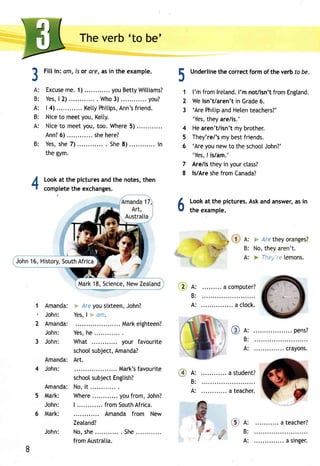
The verb 'to be' 
Fill in: am, is or ore, as in the example. 
Excusme e.1 ) youB ettyW ittiams? 
Yesl,2 ) . . . Who3 ) . . . . . . . . . . .y. ou? 
| 4) .... KettyP hitipsA,n n'sfr iend. 
Nicet o meety ou,K etty. 
Niceto meety ou,t oo.W here5 ) . . . . . . . . . . . . 
Ann?6 ) ... sheh ere? 
Yess, he7 ) . . . . . She8 ) . . . . . . . . . . . .i n 
the gym. 
Underlineth e correctf ormo f the verbt o be. 
I'mf roml retandI.' m not/isn'tf romE ngtand. 
Wei sn't/aren'itn Grade6 . 
'AreP hitipa ndH elente achers?' 
'Yest,h eya re/is.' 
He aren't/isn't my brother. 
They're/'sm yb estf riends. 
'Arey oun ewt o thes chooJl ohn?' 
'YesI, i s/am.' 
Are/ls they in your ctass? 
ls/Ares hef romC anada? 
Looka t the picturesA. ska nda nswera, si n 
the example. 
7 
8 
A 
Looka t the picturesa ndt he notes,t hen 
t completeth e exchanges. 
6 
2 
Amanda: 
John: 
Amanda: 
John: 
John: 
Amanda: 
John: 
Amanda: 
Mark: 
John: 
Mark: 
John: 
w Arey ous ixteenJ, ohn? 
YesI. m*a m. 
Mark eighteen? 
Yesh, e 
What your favourite 
schoosl ubjectA, manda? 
Art. 
schoosl ubjecEt ngtish? 
No, it 
Where .... you from, John? 
| . . . . . . . . . . .f.r omS outAh f r ica. 
Amanda from New 
Zeatand? 
No, she ... . She 
from Austratia. 
C A: .. pens? 
B: 
A: 
Mark'sfa vourite ,.* n, .... a student? 
...... crayons. 
... a teacher? 
B: 
A: ... a teacher. 
5 A: 
B: 
A: 
8 
F r i r 1 A: '--A. re they oranges? 
" 
ffirya B: Not,h eya ren't. 
A: They're[e mons. 
2A: 
B: 
A: 
a computer? 
.... a srnger.
1A: 
Fill in: ere, is, 's, 're, 'm, aren't or isn't. 
B: 
2A: 
B: 
3A: 
B: 
4A: 
B: 
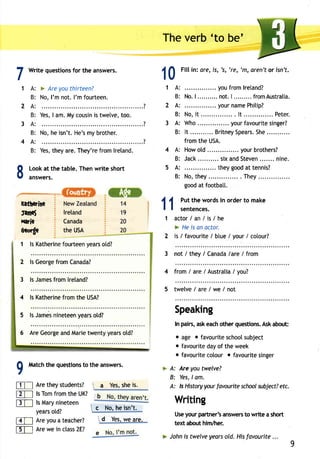
Write questionsfo r the answers. 
> Are you thirteen? 
No, l'm not. I'm fourteen. 
8 
5A: 
B: I 
1 
2 
3 
4 
lreland 
Canada 
the usA 
1 ls Katherinfeo urteeny earso td? 
lsG eorgfer omC anada? 
lsJ amesfr oml reland? 
ls Katherinfer omt he USA? 
lsJ amesn ineteeyne arso ld? 
AreG eorgea ndM ariet wentyy earso td? 
Matcht he questiontso the answers. 
Aret heys tudents?  a Yess, hei s. 
ls Tom from the UK? 
f3T-l lsM aryn ineteen 
yearos td? 
lZT-l Are you a teacher? 
tET-l Arew ei n class2 E? 
. . . . . . . . . . . . ? 
YesI, am.M yc ousinis twetvet,o o. 
*;,;;,;;;;;;;il;;; 
? 
Yest,h eya re.T hey'refr oml retand. 
Look at the table. Then write short 
answers. 
The verb 'to be' 
10 
11 
1 
. . . . . .y ouf roml retand? 
No.| . . . . . . . . .n. ot .| . . . . . . . .f.r omAust ral ia. 
. . . . . . .y ourn ameP hi t ip? 
No,i t . . l t . . . . . .P eter . 
Who. ... ... yourf avouritsei nger? 
I t . . . . . . . . . .B. r i tneSyp earSs.h e. . . . . . . . . . . 
from the USA. 
How old . your brothers? 
Jack. . sixa ndS teve.n. . . . . .n ine. 
. they good at tennis? 
No, they ... . They 
good at footbatl. 
Put the words in order to make 
sentences. 
actor/an/is/he 
> He is an octor. 
is / favourite/ btue/ your/ cotour? 
not / they/ Canadala reI from 
from / are / Australia/ you? 
twelve/a re/we/not 
Speaking 
In pairs,a ske acho ther questionsA. ska bout: 
o age o favourite school subject 
o favourite day of the week 
o favourite cotour o favourite singer 
Are you twelve? 
Yes,ol m. 
ls Historyy ourf avourite schoowl bject?e tc. 
faftcrine 
tarnet 
Haric 
Aeorge 
2 
3 
2 
3 
4 
5 
4 
5 
6 
9M 
FTI 
ET-l 
>A: 
B: 
A: 
 A Yesw, e are. 
9 
 c No, he isn't. 
Wri ing 
Usey ourp artner'sa nswertso write a short 
text about him/her. 
John is twelve years old. His favourite ...
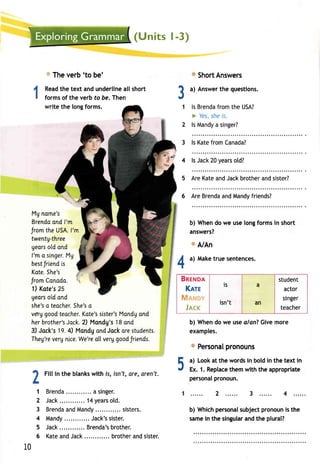
(Units l-3) 
w The verb 'to be' 
Readth e text andu nderlinea ll short 
forms of the verb to be. Then 
write the long forms. 
Mg ncme's 
Brendao nd f' m 
Jromt heU SAl.' m 
twentg-three 
gecrso lda nd 
l'm a singerM. g 
bestJrienids 
KateS. he's 
fromCanada. i 
1)K ote'2s5 
georos tdo nd 
she'sa teacherS. he'so 
vergg oodt eacherK. cte'ss ister'sM andgo nd 
herb rother'sJ ock.2 ) l4andg's1 8c nd 
3) Jock's 19. 4) Mandg and Jock are students. 
Theg'rev eryn ice.W e'rea Lvl,e rgg oodJ rtends. 
Fillin the blanksw ith is, isn't,a re,a ren't. 
Brenda a singer. 
Jack. . . . . . .... . . 14y earos ld. 
Brendaan dM andy .... sisters. 
Mandy .... Jack'si ster. 
Jack. .. Brenda'bsr other. 
Katea ndJ ack. . . . . . . . . . .b. rothearn ds ister . 
Short Answers 
Answetrh e questions. 
W 
a) 31 
lsB rendfar omt he USA? 
+ Yess, hel s. 
lsM anday singer? 
3 lsK atef romC anada? 
-T 
!E, 
lsJ ack2 0y earso td? 
5 AreK atea ndJ ackb rothear nds ister? 
6 AreB rendan dM andyfr iends? 
b) When do we use long forms in short 
answers? 
w A/An 
A a) Maket rue sentences. 
-r 
Bnrruon 
Knrr 
fiffimmwumv 
Jeex 
b) When do we use alanT Give more 
examples. 
w rsonapl ronouns 
a) Looka t the wordsi n boldi n the text in 
Ex. 1. Replacteh emw ith the appropriate 
personapl ronoun. 
2 ...... 3 ...... 4 
b) Whichp ersonasl ubjectp ronounis the 
samein the singulaarn dt he plural? 
4 
5 A 
L 
1 
2 
3 
4 
5 
6 
ls 
isn't 
a 
an 
student 
actor 
singer 
teacher 
10
Circlet he correcti tem. 
Cathyfr oml reland? 
Als BAre CAm 
What. .......y ourf avouritsec hooslu bject? 
Ais Bam Care 
We. . . . . . . .f romN ewZ eatand. 
A isn't B am not C aren't 
they from Engtand? 
AAre Bis CAm 
'ls she a teacher?' 
'Yess, he 
A isn't B is 
Thisis appte. 
Aa Ban 
C aren't 
c 
7 Where Bettya ndT homafsr om? 
Aam Bis 
Thisis . . . . . . . .a t las. 
Aa Ban 
Look at 
Ashd Bhe 
I t 's. . . . . . . .n otebook. . 
A- Ban 
This. . . . . . . .m yf r iend. 
Aam Bis 
C are 
C are 
'Are you from Australia?' 
A YesI,' m. 
C Yest,h eya re. 
Whois . . . . . . . .?' 
'Mr Watter.' 
Ait Bhe 
My name Kevin. 
Aam Bare 
Howo td. . . . . . . .y ou? 
Ais Bam 
12 
13 
14 
15 
16 Look at Tom and Pete. Look at 
17 
18 
A him B they C them 
Stevea ndM ary.. .. ....20y earso td. 
A 'm not B isn't C aren't 
'ls this a ruter?' 
'Yes.,. . . . . . .i s. ' 
Ahe Bthey Cit 
19 'ls he your brother?' 
'No, he.........' 
A is B isn't 
B No, I'm not. 
C him 
Cis 
C are 
C aren't 
c 
C her 
10 
11 
Ca 
'Are they students?' 
'Yes,.........t 
A we are B you are C they are 
11
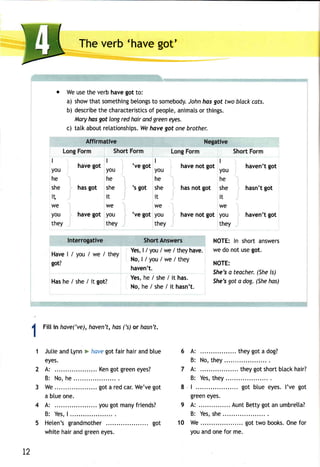
The verb 'have got' 
o We use the verb have got to: 
a) showt hat somethingb etongsto somebodyJ.o hn has got two block cats. 
b) describeth e characteristicosf people,a nimatso r things. 
lvlary has got long red hair and green eyes. 
c) tatk aboutr etationshipsW. eh aveg ot oneb rother. 
'-r:: ! :j :: 
,1r:. :i : I 
I 
you 
he 
she 
iq 
we 
you 
they 
I 
havee- ot you 
he 
has got she 
, i t 
we 
,' have got you 
they 
I 
've qot 
' you 
,he 
.. 's got she 
, i t 
,We 
' 've got you 
they 
I 
have not got 
- you 
he 
i has not got she 
: i t 
,We 
. have not got you 
; they 
haven't got 
hasn't got 
/ thev 
Yes,| / you/ we / theyh ave. 
- No,l /you/we/ they 
haven't. 
Yes, he / she / it has. 
No, he / she / it hasn't. 
haven't got 
NOTE:I n shorta nswers 
we do not use got. 
NOTE: 
She'sa teacher(.S heis ) 
She'sg ot a dog.( Sheh as) 
A: ... they got a dog? 
B: No, they 
A: .... theyg ots horbt tackh air? 
B: Yest,h ey 
| . . . . . . . . . . . . got btuee yes.I 'veg ot 
greene yes. 
A: . . . . . . . . . . . . . .A. untB et tyg ota nu mbre[ la? 
B: Yess, he. . . 
We. . . . . . . . . . . .gott wob ooksO. nef or 
you and one for me. 
Has he / she / it got? 
r':::l 
I Filli n have('ve)h, aven'th, as( 's)o r hasn't. 
I 
Jutie and Lynn >- have got fair hair and blue 
eyes. 
A: . Ken got green eyes? 
B: No, he 
We. .. ......g ota redc ar.W e'veg ot 
a btue one. 
A: youg otm anyfr iends? 
B: Yes|, . 
Heten'gs randmoth.e.r. . . . . . . . . . . .... .. . got 
whiteh aira ndg reene yes. 
L2 
10
4 
-f-- --- N 
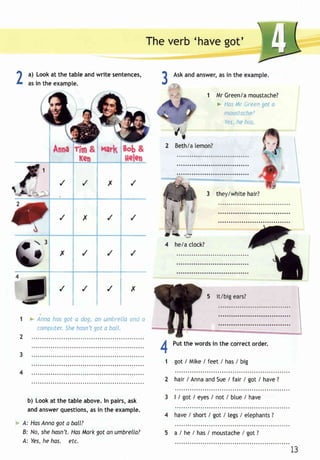
h Anna has got a dog, an umbrello ,ut!;lt l 
.omDuter. She hasn't eot o boll. 
b) Looka t the tablea bove.I n pairs,a sk 
anda nswerq uestionsa,s i n the example. 
= A: Hos Anno got a ball? 
B: No,s heh asn'tH. asM arkg ot an umbrella? 
A: Yesh, e has. etc. 
The verb 'have got' 
a) Look at the table and write sentences, 
as in the example. 
ftd 
1 MrG reen/am oustache? 
* 1,o... 
2 Beth/al emon? 
"" 
fi -egn ,.-. ' : 
I : ' . ' r ,SlCi ' . ra. 
i25r ; | "","': 
'-=:=: 
3 they/whiteh air? 
it/big ears? 
a ctock? 
/ 
4 he/ 
x 
/ 
A Putt he wordsi n the correcto rder. -r 
1 got i Mike / feet / has / big 
2 hair / Anna and Sue / fair / got / have ? 
| / got / eyes / not / btue / have 
have/ short/ got / tegs/ etephant?s 
a / he / has/ moustach/e got? 
13
The verb 'have got' 
5 
Find and write the six differences. 
,/- 
1 
2 
(hat)F /n picture A the clown has got a big hat. i 'x ;iir lti'r' ii l"'e . '.1',r k;sn't got 
3 (eyes) 
A laerc 
sqr J, 
(nose) 
/faaf  
Speaking Writing 
Writea shortd escriptiono f the person 
sitting next to you. 
> Pedro is short and slim. He's got brown eyes 
and short brown hair. He's got a small mouth 
and a small nose. etc. 
. Heh ass ,ot. .. 
(hair)...... 
5 
6 
Describey ourselft o the class. 
> /'rn tall and slim. I've got blue eyes and long 
black hair. l've got a smoll mouth and small 
eors. etc. 
L4
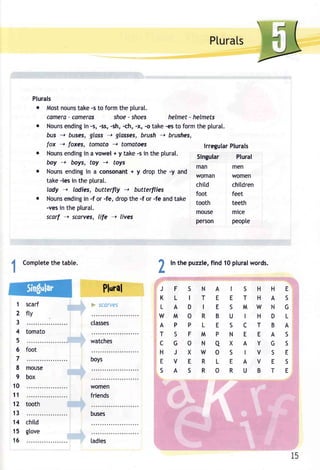
Plurals 
e Mostn ounsta ke- s to formt he plural. 
cQmera- cameras shoe- shoes helmet- helmets 
r Nounesn dingin -s, -ss,- sh,- ch,- X,- o take- est o formt he plurat. 
bus --+ buses, glass --+ glasses, brush -+ brushes, 
fox -- foxes, tomato --+ tomatoes lrregular plurals 
o Nounes ndingin a vowel+ y take- s in the plural. Singular plural 
boy -+ boys, toy --+ toys 
man men 
o Nounse ndingin a consonan+t y dropt he -y and 
woman women 
take -ies in the plural. 
Iady --+ ladies, butterfly -t butterflies 
chitd children 
foot feet 
o Nounse ndingin -f or -fe, dropt he -f or -fe andt ake 
tooth teeth 
-ves in the plurat. 
scarf --t scarves, Iife --+ Iives 
mouse mlce 
person people 
i 
'l'i:::t 
7 In the puzzlef,i nd 10p luralwords. 
L 
F SCOrVeS 
classes 
watches 
boys 
women 
friends 
buses 
tomato 
foot 
tooth 
1 
2 
3 
4 
5 
6 
7 
8 
9 
10 
11 
12 
13 
14 
15 
16 
scarf 
ftv 
mouse 
box 
chitd 
gtove 
JFSNA 
KLITE 
LADIE 
WMORB 
APPLE 
TSFMP 
cGoNq 
HJXWO 
EVERL 
SASRO 
I 
E 
S 
U 
s 
N 
X 
s 
E 
R 
5H 
TH 
MW 
IH 
CT 
EE 
AY 
IV 
AV 
UB 
E 
S 
G 
L 
A 
S 
s 
E 
S 
E 
H 
A 
N 
D 
B 
A 
G 
5 
E 
T 
ladies
This/Thes-eT hat/Those 
ru ruh 
This - These 
o We uset his (singular)/ these (plural)t o point 
peoptet,h ingsa nda nimatnse aru s. 
That - Those 
o We uset hat (singular/) those( plural)t o point to 
peoptet,h ingso r animatfsa r awayf rom us. 
Weu set his / thesea ndt hat / thosei n questionsW. ea nswetrh eseq uestionws ith it or they. 
What's this I that? lt's a pencil. (NOT: ) 
Whata re theselthose? Theya re pencils(. NOT: ) 
1 + Ihis i. a bicyctea nd > rhci fs a helmet. 
fhis is a chair. 
These are chairs. 
That is a choir. 
Those are chairs. 
[g 
[g il 
t 
[g 
h 
L 
1 
2 
3 
4 
5 
!g 
. . . . . . . cameraasn d 
teddy bears. 
rruururu 
s@' 
ctocks and 
watches. 
a fty and 
butterfly. 
Writet he sentenceisn the plural. 
Thati s a cap.* fho.sea re( ops. 
This is a box. 
Thisi sa nu mbretta. 
That is a mouse. 
Thisi s a watch. 
Speaking 
Work in pairs. Point to objects near or far 
from you and make sentences. 
Ihis is an eroserT. hosea re pencils. etc. 
L] 
[g 
a kangaroo. 
an elephanat nd
(Units 4-6) 
* Havegot 
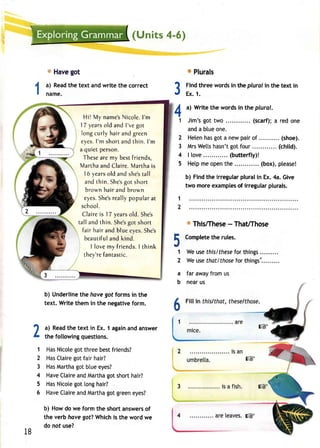
a) Read the text and write the correct 
name. 
Hi ! My name'Ns icole.I 'm 
17 yearso ld andl 'veg ot 
long curly hair and green 
eyesI.' m shorta ndt hin. I'm 
a quiet person. 
These are my best friends, 
Mar thaa ndC lai reM. ar thai s 
1 6 years old and shes tall 
and thin. Shes got short 
brown hair and brown 
eyes. Shes really popular at 
school. 
Clai reis 17 yearso ld.S hes 
tall and thin. Shes got short 
fair hair andb luee yesS. hes 
beaut i fual ndk ind. 
I lovem y f r iendsI. think 
they'ref antastic. 
b) Underlineth e haveg ot formsi n the 
text. Writet hemi n the negativefo rm. 
a) Readth e text in Ex.1 againa nda nswer 
the followingq uestions. 
HasN icoleg ott hreeb estf riends? 
HasC taireg otf air hair? 
HasM arthag ot bluee yes? 
HaveC tairea ndM arthag ots horth air? 
HasN icoteg ot[ ongh air? 
HaveC tairea ndM arthag otg reene yes? 
b) Howd o we form the shorta nswerso f 
the verbh oveg ot?W hichi s the wordw e 
do not use? 
3 
41 
2 
3 
4 
5 
0 Plurals 
Findt hreew ordsi n the plurali n the text in 
Ex.1. 
a) Write the words in the plural. 
Jim'sg ot two .. (scarf);a red one 
and a btue one. 
Hetenh asg ota newp airo f . (shoe). 
MrsW ettsh asn'tg otf our (child). 
llove.... (butterfly)! 
Hetpm eo penth e .... (box),p lease! 
b) Findt he irregulapr luralinE x.4 a.G ive 
two moree xampleosf irregularp lurals. 
s This/Thes-e ThaUThose 
Completeth e rules. 
Weu set hislthesefo r things 
Weu set hat / thosfeo rt hings' . . . . . . . . . 
far away from us 
F 
tl 
.a 
IU 
1 
2 
a 
b 
I I 
near us 
ar 
h 
1 
2 
3 
4 
5 
6 
18
Circle the correct item. 
1 NicoteK idmaann dM e[G ibson popular 11 is a teacher. 
Australianactors. A She B I C You 
Aam Bis Care 
12 How old Ken and Mike? 
2 Etephan.t.s.. ....g gts trong[e gs. A is B are C am 
A have B has C hasn't 
13 "What are those?" 
3 Catherinise l rishS. he. .......S cottish. "........a ref lies." 
A 'm not B isn't C aren't A Those B These C They 
4 Lynng ot redh air? 14 "What'st his?" 
A Haven' t B Has C Have " l t 's. . . . . . . .m ouse. " 
, Aan Ba C 
5 Theya re. . . . . . . .. 
A box B boxes C boxs 15 Fiona.. ...... gott wo bikesS. he'sg oto ne. 
A have B hasn't C has 
6 you an actor? 
A ls B lsn't C Are 16 Jim's got two new 
A scarves B scarfs C scarfes 
7 . . . . . . . .a rem ice. 
A These B That C This 17 I ........ thirteeny earso ld.l 'm twelve. 
A isn't B aren't C 'm not 
8 "Have you got a dictionary?" 
"No,w e ......... " 18 Lucya ndJ aneat res isters. aret wins. 
A have B hasn't C haven't A They B We C You 
9 Myn aine. . . . . . . .W i l t iam. 
A'm B's C're 
10 Looka t . . . . . . . .m an! 
A that B those C these 
Revisio(nU nits l'6) 
19 Greg got green eyes? 
A Hasn't B Have C Has 
20 Bobh asn'tg otb ig 
A foot B foots C feet 
/mart: -  
 20/ 
19
Therei s/Therea re 
Affirmative 
Negative 
Interrogative 
Singular 
Therei s a cat./There'as cat. 
Therei sn't a cat. 
ls there a cat? 
Plural 
There are two cats. 
Therea ren'tt woc ats. 
Are there two cats? 
Weu set herei s to listt hingsin the singutar. 
There'sa n umbrellaa, n applea nda n orangeo n the table. 
(NOT: an umbrellaa, n applea nda n orangeo n the table.) 
Weu set herea ret o listt hingsin the pturalT. herea re hasn'tg ota shortf orm. 
Therea re five desksin the classroom. 
Short Answers 
ls there ...? 
Yest,h erei s' 
No, there isn't. 
Are there ...? 
Yest' herea re' 
No, there aren't. 
Look at the picture and fill in there islisn't 
and there arel aren't, 
a bed but 
.. a carpet. 
. . . .a tampb ut 
... a windowb ut 
...... a painting. 
o In shorta nswerws e useY es,t here 
is/are or No, there isn't/aren't. We 
do notr epeath ew holeq uestion. 
ls there a fly in the kitchen? Yes, 
there rs. (NOI: 
Uset he promptsto aska nda nswer 
questionsa,s i n the example. 
fivet emons/ paperb ag?- No. 
A: > Aret heref ive lemonsin thep aperb ag? 
B: No, there aren't. 
ten students/ ctassroom- ?Y es. 
A: . . . . 
B:.......... 
dog/house?-Yes. 
A: . . . . . . 
B: . . . . . . . . 
fourc ats/ garden-? No 
A: . . . . 
B: . . . . 
orange/fridge?-Yes. 
A: . . . . 
2 
a bookcase. 
threep illowsb ut 
B: 
cushions. 6 threeb ooks/ schoolba-g ?N o. 
A: 
B: 
20
Therei s/Therea re 
Putt he wordsi n ordert o makes entences. 
is / desk/ there/ a / the / in / ctassroom 
aren't / books/ three / schootba/g there / 
in/my 
3 there/ a/ in/ dog/t he/ park/ is? 
4 two / mugs/ on / there/ the / table/ are7 
5 isn't/ a / computero/ n/ desk/t he/ there 
6 there/ are/ pencits/ four/ in / penci[/ 
case/ the? 
A 
J 
1 
2 
3 
4 
5 
6 
7 
8 
E 
J 
Rewriteth e sentencesa,s i n the example. 
Thereis a chairi n thel ivingr oom.( four) 
p lhere aref our chairsin the livingr oom. 
Therea ret wo mugso nt het able.( one) 
> Thereis onem ugo n the table. 
Thereis onew indowin the room.( two) 
Therea ref iveb edroomins thef tat. (one) 
Therea ret ens tudentisn thec tassroom(o.n e) 
There isn't one dog in the garden. (three) 
Therea ren'ts ixp ensin the pencict ase(. one) 
41 
2 
Thereis n'to nea ppteo nt het abte.( six) 7 on/bed/ the/ isn' t / there/ teddy/ a/bear 
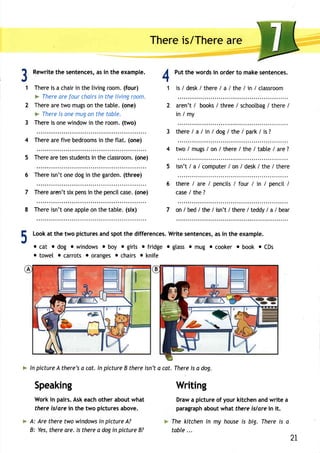
Look at the two pictures and spot the differences. Write sentences, as in the example. 
ocat odog owindows oboy egirls ofridge ogtass orTlug ocooker obook oCDs 
o towe[ o carrots o oranges o chairs o knife 
* ln pictureA there'sa cot. ln pictureB therei sn'ta cat. Thereis a dog. 
Speaking Writing 
Work in pairs. Ask each other about what 
therei slare in the two picturesa bove. 
* A: Are theret wo windowsin pictureA ? 
B: Yest,h erea re. ls therea dogi n pictureB ? 
Draw a picture of your kitchen and write a 
paragrapahb outw hat therei slorei n it. 
F Ihe kitcheni n my houseis big. Therei s a 
table ... 
2L
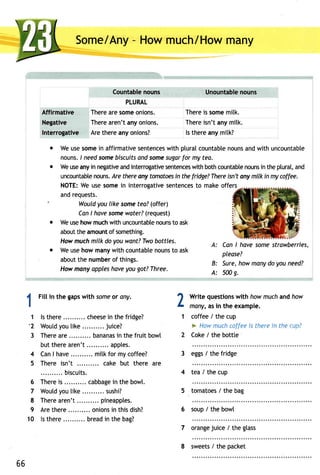
Some/Any 
Countablneo uns 
Plural 
Affirmative There are some erasers. 
Negative Therea ren'ta nye rasers. 
Interrogative Are there any erasers? 
Unountablen ouns 
Therei s someo rangeju ice. 
Therei sn't anyo rangeju ice. 
ls therea ny orangeju ice? 
Some 
o We use somei n affirmatives entencews ith pluratc ountabten ounsa nd with 
uncountabntoeu ns. 
We need some eggs and some coffee. 
Any 
o Weu sea nyi n negativea ndi nterrogativsee ntencewsi th bothc ountabtneo unsin 
thep turala, ndu ncountabnteo uns. 
Are thereo ny |emonisn thef ridge?T herei sn'ta ny soup. 
NOTE:W eu ses omein interrogativsee ntencetos makeo ffersa ndr equests. 
Wouldy ou likes omep izza?(o ffer) 
CanI haves omefr uit juice?( request) 
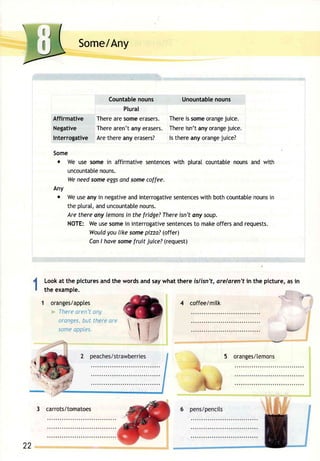
Looka t the picturesa ndt he wordsa nds aywhatt here islisn't,a relaren'ti n the picture,a si n 
the example. 
1 oranges/apptes 
= Therea ren'ta ny 
orangesb,u t therea re 
someo pples. 
keerl 
5 oranges/temons 
4 coffee/mitk 
22 
3 carrots/tomatoes
A 
L 
1 
2 
3 
4 
5 
6 
7 
8 
9 
10 
Fill in someo r ony,a si n the example. 
Woutdy oul ike ts somec offee? 
ls there ..... pizzaT 
Therea ren't ..... deskisn the 
ctassroom. 
Are there ...... pens? 
Thereis n't . icec reamin the 
fridge. 
Thereis . . . . . . . . . . . mi tki n thef r idge. 
CanI have .... orangeju ice? 
Therea re ..... . pencilos nt hed esk. 
Aret here .......a ppleisn theb asket? 
Therea ren't towelsin the 
bathroom*. 
Tick (/) the corrects entencesl.f a 
sentenceis wrong,c orrectt he mistake. 
Some/A ny 
A: Aret here1 ) . . . . . . . . . . .b. iscui ttse f t? 
B: Yesw, outdy oul ike2 l .... biscuits? 
A:Y esa nd3 ) ... tea,p tease. 
B: Coming! 
A: Havew eg ot1 ) .... apptes? 
B: Yes,t herea re 2) .... in the fruit 
bowt. 
A: Great!L et'sm akea na pptep ie. 
Speaking 
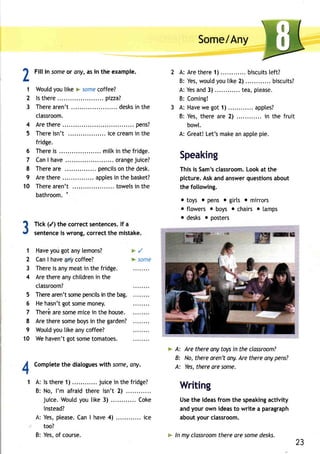
Thisi s Sam'sc lassroomL.o oka t the 
picture.A ska nda nswerq uestionas bout 
the following. 
. toys o pens o girts r mirrors 
o ftowers o boys r chairs o lamps 
o desks o posters 
* A: Are there any toys in the clossroomT 
B: No, there eren't ony. Are there any pens? 
A: Yest,h ereo re some. 
Uset he ideasf rom the speakinga ctivity 
and your own ideas to write a paragraph 
about your classroom. 
> ln my classroomth ere are somed esks. 
3 
1 
2 
3 
4 
5 
6 
7 
8 
9 
10 
>/ 
> some 
Have you got any lemons? 
Can I have coffee? 
Thereis anym eati n the fridge. 
Aret herea nyc hitdrenin the 
ctassroom? 
Therea ren'ts omep encitisn the bag. 
He hasn't got some money. 
Therira res omem icei n the house. 
Aret heres omeb oysi n the garden? 
Woutdy oul ike anyc offee? 
Weh aven'tg ot somet omatoes. 
41 
Completeth e dialoguesw ith some,e ny. 
lst here1 ) . . . . . . . . . . .j.u icei n thef r idge? Writing No, l'm afraid there isn't 2) 
juice.W outdy oul ike3 ) . . . . . . . . . . . .C oke 
instead? 
Yes,p teaseC. anI have4 ) ... ice 
too? 
Yes, of course. 
A: 
B: 
B: 
23
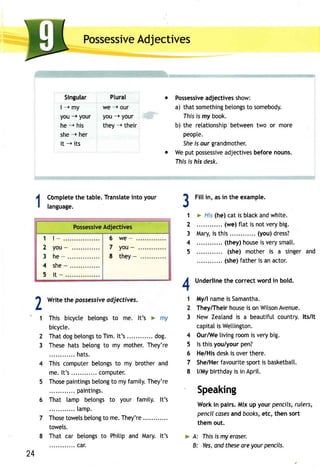
PossessiAved jectives 
Singular 
l--+ my 
you -r your 
he --+ his 
she --+ her 
it --+ its 
Cbmpletteh e table.T ranslatien to your 
language. 
Writet he possessivaed jectives. 
This bicycleb elongst o me. lt's > my 
bicycte. 
Thatd ogb etongtos T im.l t 's. . . . . . . . . . .d. og. 
Theseh ats betongt o my mother.T hey're 
.... hats. 
Thisc omputerb etongsto my brothera nd 
me. lt's .... computer. 
Thosep aintingbse longto myf amityT. hey're 
. paintings. 
That lamp belongs to your famity. lt's 
[amp. 
Thoseto welsb elongto me.T hey're 
towels. 
That car betongsto Phitipa nd Mary.l t's 
... car. 
Plural 
we --+ our 
you --t your 
theY --+ 1691t 
Possessivaed jectivess how: 
a) thats omethinbge tongtso somebody. 
Ihis fs my book. 
b) the retationshibpe tweentw o or more 
peopte. 
Sheis o ur grandmother. 
Wep ut possessivaed jectivesb eforen ouns. 
Ihis fs his desk. 
1 
tt 
1 
2 
3 
4 
5 
41 
2 
3 
21 
4 
5 
6 
7 
I 
2 
3 
Fillin, as in the example. 
> His (he) cat is black and white. 
... (we) ftat is not very big. 
Mary is this .. (you) dress? 
... (they)h ouseis v erys matt. 
(she) mother is a singer and 
.... (she)fa theris a na ctor. 
Underlineth e correctw ordi n bold. 
lrty/ln ameis Samantha. 
They/Theihr ouseis onW itsoAn venue. 
NewZ ealandis a beautifulc ountry.lt s/lt 
capitails Wettington. 
OurAffeli vingr oomi s veryb ig. 
lst hisy ou/yourp en? 
He/Hisd eskis overt here. 
She/Hefra vourites oorti s basketbatt. 
l/Myb irthdayis in Aprit. 
Speaking 
Worki n pairs.M ix up your pencilsr,u lers, 
pencicl asesa nd bookse, tc, then sort 
them out. 
A: Ihis is my eraser. 
B: Yesa, nd thesea rey our pencils. 
4l 6 we-, 
7 you- 
8 they - 
2 you- 
3 he- 
4 she- 
5 i t - . 
24
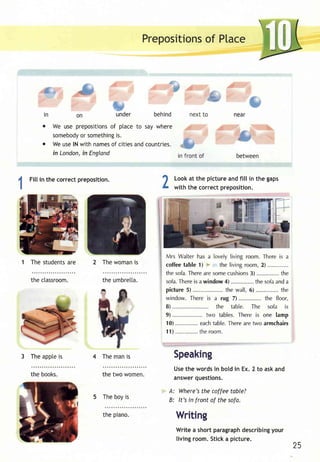
Prepositionosf Ptace 
& 
near 
ffi 
J 
bunder next to 
z./lzt 
in front of 
ln 
o We use prepositionosf place 
somebodoyr s omethinisg. 
behind 
to say where 
Weu sel Nw ith nameos f citiesa ndc ountries. 
in Londoni,n England between 
1 
Fillin the correctp reposition. 
1 Thes tudentas re 2 Thew omanis 
the ctassroom. 
3 Thea ppteis 
the umbrella. 
fi 
Look at the picture and fill in the gaps 
with the correct preposition. 
Mrs Walter has a lovely living room. There is a 
cotfeet able 1) s' r,' the livingr oom,2 ) 
thes ofaT. herea res omec ushion3s) ...........t.h..e. 
sofaT. hereis a window4 ) ...........t.h..e.s ofaa nda 
picture5 ). . . . . . . . . .. . . . .t hew al l ,5 ) . . . . . . . . , . .t.h. .e. 
window.T herei s a rug 7). ...........t.h..e floor, 
B) .......... the table. The sofa is 
9) .........,......t.w..o. tablesT. herei s one lamp 
10). ..........e..a..c hta bleT. herea ret woa rmchairs 
11 ) . . . . . . . . . . .t.h. .e.r oom. 
4 Them ani s Speaking 
the two women. 
5 The boy is 
Writing 
2 
Uset he wordsi n boldi n Ex.2 to aska nd 
answerq uestions. 
==A=: Where'sth e coffeet able? 
B: lt's in front of the sofa. 
Writea shortp aragrapdhe scribinygo ur 
living room. Stick a picture. 
25 
the books. 
the piano.
{Units 7- | 0} 
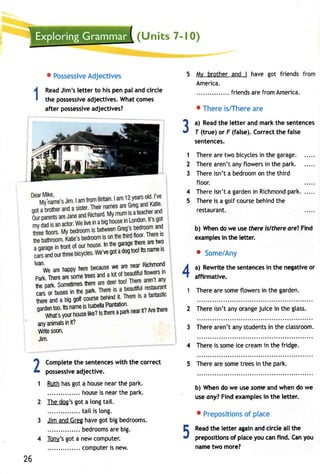
o PossessiAved jectives 
ReadJ im'sl ettert o hisp enp alandc ircle 
the possessivaed jectivesW. hatc omes 
after possessivaed jectives? 
Completeth e sentencews ith the correct 
possessivaed jective. 
Ruthh asg ot a housen eart he park. 
.......h ouseis n eart hep ark. 
Thed oe'sg ota longt ail. 
. tail is tong. 
Jim and Greg have got big bedrooms. 
. bedroomasr eb ig. 
Tony'sg ot a newc omputer. 
... computeirs new. 
My brother and I have got friends 
America. 
friendsa ref romA merica. 
o Therei s/Therea re 
a) Readt he letter and markt he sentences 
T (true)o r F (false).C orrectt he false 
sentences. 
Therea ret wo bicyclesin the garage. 
Therea ren'ta nyf towersin the park. 
Thereis n'ta bedroomon t het hird 
floor. 
Thereis n'ta gardenin Richmonpda rk. 
Thereis a gotfc ourseb ehindth e 
restaurant. 
b) When do we use fhere islthere are? Find 
examplesin the letter. 
o Some/Any 
a) Rewritet he sentenceisn the negativeo r 
affirmative. 
Therea res omef towersin the garden. 
2 Thereis n'ta nyo rangeju icei n the glass. 
3 Therea ren'ta nys tudentisn thec lassroom. 
4 Thereis someic ec reamin thef ridge. 
5 Therea res omet reesi n the park. 
b) When do we use some and when do we 
usea ny?F inde xamplesin the letter. 
o Prepositionosf place 
Readth e letter againa ndc irclea ll the 
prepositionosf placey ouc anf ind. Cany ou 
name two more? 
3 
1 
2 
3 
4 
5 
l. ln ttreg araghee rea ret wo 
e'veg ota d ogto ol!t sn amles 
tu, 
areh appyh ereb ecauswee are nearR ichmond 
ParkT. heraer es omere esa 
he ParkS. ometimheesr et 
.." t busesin theP ark" 
therea nda bigg otcf ourseD enlllu rt' rr'! 
;;;it. too.t tsn amies lsabelPlala ntation' 
Whatsy oun' ou" tiiii tt t'ttt a parkn eairt ?A reh ere 
anYa nimailnsi t? 
Wriles oon' 
Jim. 
4 
1 
2 
1 
5 
26
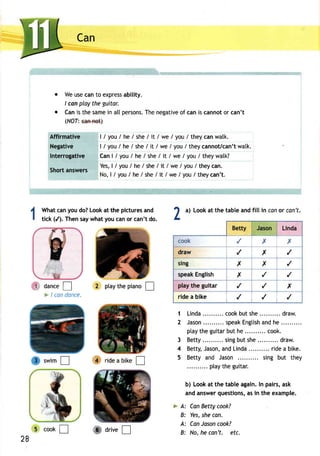
Can 
Weu sec ant o expresasb ility. 
I can ploy the guitar. 
Cani s thes amein atl personsT.h en egativoef cani s cannoto r can't 
(NOf: ) 
Affirmative 
Negative 
Interrogative 
Short answers 
| / you I he / she / it / we / you / theycanwatk. 
l/ you lhe /she / it /we /you / theycannot/can'twatk. 
Can | / you / he / she / it / we I you / theywatk? 
Yes|, / you/ he / she/ it / we / you/ theycan. 
No,l / you/ he/ she/ i t / we/ you/ theycan' t . 
Whatc any ou do?L ooka t the picturesa nd 
tick (/). Then say what you can or can't do. 
t a) Look at the table and fill in con or cen't. 
L 
fl dance 
*/can 
T 
donc 
2 ptayth ep iano! 
o 
1 
2 
3 
4 
5 
Linda. cookb uts he. . . . . . . . .d. raw. 
Jason .. speakE ngtisahn dh e 
ptay the guitar but he .. cook. 
Bet ty. . singb uts he. . . . . . . . .d. raw. 
BettyJ, asona, ndL inda .. ridea bike. 
Betty and Jason sing but they 
.. ptay the guitar. 
b) Looka t the tablea gain.I n pairs,a sk 
anda nswerq uestionsa,s i n the example. 
swim ! i4 ride a bike ! 
* A: Can Betty cook? 
8: Yes, she can, 
A: CanJ asonc ook? 
8: No, he can't. etc. 
28 
cookilXX 
____|___ 
dl - - -r, - lat tvwt i l i ,X/ 
,/ 
,/ 
x 
rideabike i / t ,/ 1 ,/ 
5 cook! ffi arive!
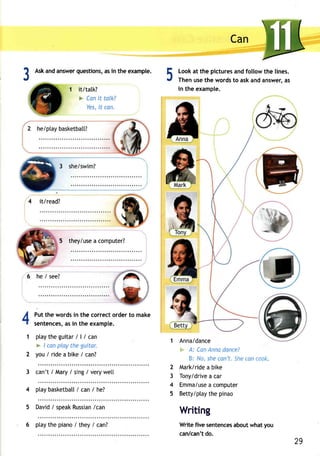
? Aska nda nsweqr uestionsa,s i n the example. 
.t 5 
Can 
Looka t the picturesa ndf ollowt he lines. 
Thenu set he wordst o aska nda nswera, s 
in the example. 
1 Anna/dance 
F,-A- : CanA nnad ancei 
B: No, she can't" Sne ton ea2" 
2 Mark/ride a bike 
3 Tony/drivea car 
4 Emma/usae computer 
5 Betty/ptayt he pinao 
Writing 
Writef ive sentenceasb outw haty ou 
can/cand't o. 
1 it/tatk? 
* Canit talk? 
Yesi,t can. 
 
4 it/read? 
5 they/usea computer? 
6 he / see? 
4 
1 
2 
3 
4 
5 
Putt he wordsi n the correcto rdert o make 
sentencesa,s i n the example. 
ptaytheguita/r | / can 
* / can play the guitor. 
you/rideabike/can? 
can't / Mary / sing / very wet[ 
ptayb asketbal/l can / he? 
Davidi speakR ussia/nc an 
6 ptay the piano / they / canT 
29
PossessivCea se 
To show possession: 
a) We add 's to namesa nds ingutanro uns. 
Ihfs is Sally'sh ondbag. 
b) Wea dd' to pluraln ounse ndingin -s. 
Ihis is the girls'ball. 
1 
Matchth e phrasetso the pictures. 
the boyss' kateboards3 the girt'sc amera 
the girts'c ameras 4 the boy'ss kateboard 
Circle the correct item. 
Thisis . . . . . . . .dog. 
c) In generatlh e possessivcea sei s usedf or 
peopteI.n o rdert o tatka bout hingsw, e use 
the prepositiono f. Mory'sm other,t he legs 
of the table. 
We use whose to ask about possession. 
Whosed ogi s this?l t's Mike's. 
Thesaer e. . . . . . . .p enci ts. 
A the girts B the girt C the girt's 
My. . . . . . . .S ue. 
A sisters B sister's C sisters' 
Thisis t he. . . . . . . .h ouse. 
A woman's B women C 
woman 
Looka t that bicycteo vert here. 
ls i t 
bicycte? 
A Paul's B Pau[ C 
Pauts 
Thisis handbag. 
A Helen B Heten's C 
Hetens' 
? 
Circle the correct word in bold. 
r 
-* ffi* who's = who is 
1 
2 
A: Whose/ Who'sL inda? 
B: She'As nna'sm other. 
A: Who's/ Whosep eni s this? 
B: lt's Tom's. 
A: Whose/ Who'sh e? 
B: He's my teacher. 
A: Who's/ Whosen otebookasr et hese? 
B: They'reN ancy's. 
A: Whose/ Who'sb rotheris Derek? 
B: He'sJ ohn'sb rother. 
A: Who's/ WhoseS usan? 
B: She'sm yf riend. 
2 
1 
30 
A John B John's C Johns'
4 
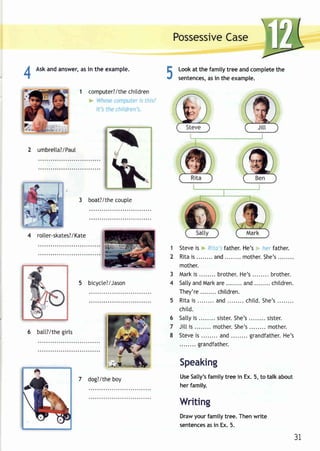
Aska nda nswera, si n the example. 
1 computer?/thechildren 
3 boat?/thceo upte 
5 bicycte?/Jason 
PossessiCvea se 
Look at the family tree and complete the 
sentencesa, si n the example. 
Steveis father.H e's= -= father. 
Ri tais and. . . . . . . .m otheSr .h e's 
mother. 
Markis brotheHr .e 's. . . . . . . .b rother . 
Satlay ndM arka re and. .......c hitdren. 
They're chitdren. 
Ri tais and. . . . . . .c. hi tdS. he's. . . . . . . . 
chitd. 
Sattyis sisterS. he's.. ......s ister. 
Jittis........mother.She's mother. 
Steveis and. . . . . . . .g randfatheHre. 's 
grandfather. 
Speaking 
UseS ally'sf amily tree in Ex. 5, to talk about 
her family. 
Writing 
Draw your family tree. Then write 
sentenceass i n Ex.5 . 
5 
2 umbrelta?/PauI 
4 rotter-skates?/Kate 
6 batt?/thgei rls 
1 
2 
3 
4 
6 
7 
8 
7 dog?/theb oy 
31
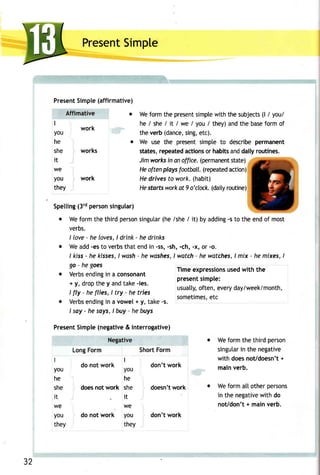
PresenSt imple 
Wef ormt he presenst imptew ith the subject(sl / you/ 
he / she/ it / we / you/ they)a ndt he basefo rmo f 
thev erb( dances,i nge, tc). 
We use the presents imptet o describep ermanent 
statesr, epeateda ctionso r habitsa ndd ailyr outines. 
Jim work in ono ffice.( permanenst ate) 
Heo ftenp laysf ootbo{l.( repeateadc tion) 
He drives to work. (habit) 
Hes tartsw orka t 9 o'clock(. daityr outine) 
Present Simple (affirmative) 
Affimative o 
I 
work 
Spelling(3 'dp ersons ingular) 
o Wef ormt het hirdp ersonsi nguta(rh e/ she/ it) by adding-s to the endo f most 
verbs. 
I love- he loves,I drink^ he drinks 
o Wea dd- est o verbsth ate ndi n -ss,- sh,- ch,- x, or -o. 
/ kiss- he kfssesI, wash- he washesl,w atch - he watchesI, mix - he mixes,I 
go - he goes 
o Verbse ndingin a consonant 
+ y, drop the y and take -ies. 
I fly - he flies, I try - he tries 
o Verbse ndingin a vowel+ y, take- s. 
I say - he says, I buy - he buys 
PresenSt imple( negative& interrogative) 
Timee xpressionuss edw ith the 
presenst imple: 
usualtyo,f ten,e veryd ay/week/month, 
sometimeest.c 
We form the third person 
singutainr the negative 
with doesn ot/doesn'+t 
main verb. 
We form all other persons 
in the negativwe ith do 
not/don't + main verb. 
you 
he 
she works 
it 
we 
you work 
they 
Negative 
Long Form 
t l 
do not work 
you 
they 
does not work 
do not work 
Short Form 
don't work 
doesn'wt ork 
you 
he 
she 
it 
we 
you 
he 
she 
it 
we 
you 
they 
32 
don't work
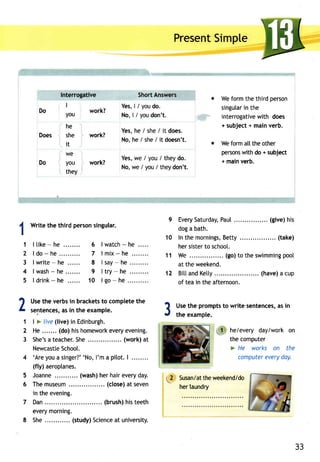
PresenSt imple 
We form the third person 
singulainr the 
interrogativwe ith does 
+ subject + main verb. 
We form allthe other 
personws ith do + subject 
+ main verb. 
Short Answers 
Yes, he / she / it does. 
No, he / she / it doesn't. 
Yes, we / you / they do. 
No, we / you / they don't. 
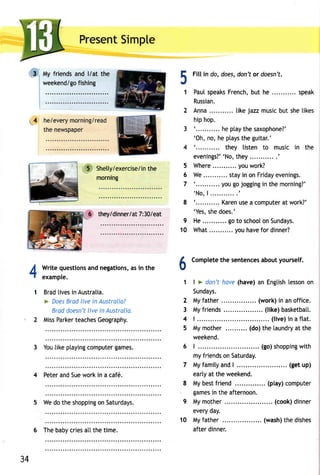
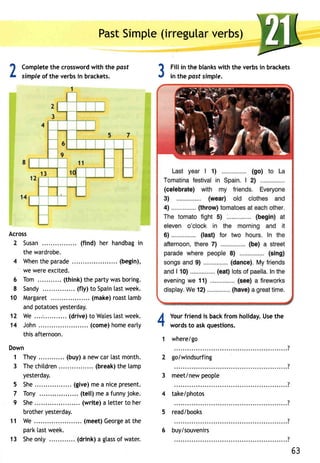
EveryS aturdayP, au[ (give)h is 
dog a bath. 
Int hem orningBs,e tty. ..... .. (take) 
hers isterto schoot. 
We .. . (go)t o thes wimminpgo ol 
at the weekend. 
Bitta ndK etty. .... (havea) cup 
of tea in the afternoon. 
Uset he promptst o write sentencesa, si n 
the example. 
Do 
Does 
Do 
Interrogative 
I 
you 
he 
she 
it 
we 
you 
they 
work? 
work? 
work? 
Yes,l/youdo. 
No, l/youdon't. 
6 | watch- he . . . . . 
7 lmix-he 
8 lsay-he 
9 ltry-he 
10 lgo-he 
9 
10 
11 
12 
A Writet he third persons ingular. 
I 
1 
2 
3 
4 
5 
3 ar 
L 
1 
2 
3 
I tike - he 
ldo-he 
I write - he 
I wash- he 
I drink- he 
Uset he verbsi n bracketsto completet he 
sentencesa,s i n the example. 
| > live (live) in Edinburgh. 
He. ......( do)h ish omeworekv erye vening. 
She'as teacheSr .h e. . . . . . . . . . . . . . .(.w orka) t 
NewcasttSe choot. 
'Arey oua singer?'N' o, l'm a pitot.I 
(fly) aeroptanes. 
5 Joanne (washh) erh aire veryd ay. 
6 Them useum ... (closea) t seven 
in the evening. 
7 Dan. ... . (brushh) ist eeth 
every morning. 
8 She .. (study)S ciencaet university. 
2 
tl.t- he/every day/work on 
the computer 
> He works on the 
computeer veryd ay. 
Susan/atht ew eekend/do 
her taundry 
33
PresenSt impte 
My friendsa nd l/at the 
T::::::::::T:: 
he/everym orning/read 
the newspaper 
!3' 
mornrng 
they/dinner/a7t: 3 0/eat 
Writeq uestionasn dn egationsa,s i n the 
example. 
Bradli vesin Australia. 
> DoeBs radl ivei n Austrolia? 
Bradd oesn'lti vei n Australia. 
MissP arketre achesG eography. 
3 Yout ikep tayincgo mputegra mes. 
4 Petera ndS uew orki n a caf6. 
5 Wed ot hes hoppinogn S aturdays. 
Fill in do, does,d on'to r doesn't. 
Pau[s peaksF renchb, ut he ... speak 
Russian. 
Anna. .. tikej azzm usicb ut she 
hip hop. 
' . . . . . . . . . .h. ep tayth es axophone?' 
'Oh,n o,h ep taysth e guitar.' 
'........... they listen to music in the 
evenings?' 'Nthoe,y . . . . . . . . . . . ' 
Where ... you work? 
We. . . . . . . . . .s.t ayin onF r idaeyv enings. 
' . . . . . . . . . .y. oug oj ogginign them orning?' 
'No,1 . . . . . . . . . . . ' 
' . . . . . . . . . .K. areuns ea computeart work?' 
'Yess, hed oes.' 
He. . . . . . . . . .g. ot o schoooln S undays. 
What. . youh avef or dinner? 
51 
4 
i..5 Shetty/exerciset/hine 5 
6 
7 
8 
9 
10 
Iv 
1 
2 
3 
4 
5 
4 
1 
Completteh e sentenceasb outy ourself. 
| > don'th ave( have)a n Engtislhe ssono n 
Sundays. 
Myf ather .. (work)i n ano ffice. 
Myf riends .... (like)b asketbatt. 
| . . . . . . . . . . . ( l ive)in a f lat . 
Mym other (do)t he laundrya t the 
weekend. 
| . . . . . . (go)s hoppinwgi t h 
myf riendso n Saturday. 
7 Myf ami tya nd| . . . . . . . (getu p) 
earty at the weekend. 
8 Myb estf riend .. (play)c omputer 
gameisn thea fternoon. 
9 Mym other (cook)d inner 
every day. 
10 Myf ather (washt)h ed ishes 
after dinner. 
34 
6 Theb abyc riesa tlt het ime.
7 Matchth e questiontso the answers. 
, 
tlT--] What time does she get up? 
ET--] How does she go to schoot? 
lST--] Doess heh aveb reakfaset veryd ay? 
FT-l What does she do in the afternoon? 
fdl-l When does she go to bed? 
a Sheg oesto beda t 10:00. 
b Shew atksto schoot. 
c She gets up at 7:00. 
d No, she doesn't. 
e She does her homework. 
Writet hg questionisn full, andt hen 
answetrh em. 
when/start/schoo[ 
> Whend oy ous torts chool? 
how / go /school 
3 what/ have/ lunch 
4 what / do / afternoons 
5 how often / play tennis 
Put the words in the correct order to make 
questionsT.h ena nswetrh em. 
you/ do / Swedis/h speak? 
2 you/ do/ ride/ bikel your / schoo/[ to? 
3 work / does / your / mother / in / bank / a? 
4 like / jazz / do / you / music? 
5 you / the /guitar / do / ptay? 
do / eat / the / dinner / with / your / in / 
fami ty/y ou/evenings? 
PresenSt imple 
your / take / father / does / work / bus / 
the / to? 
{ flWnat 
do Bill, Betty and Peter do in the 
r v eveningasf ters chool?L ooka t the table 
anda ska nda nswera, si n the example. 
8 
1 
9 
1 
watch a DVD 
listent o music 
* A: Does Bill watch a DVD in the evenings? 
B: Yes, he does. 
Speaking 
In pairs,a ska nda nsweqr uestiontso find 
out abouty ourp artner'sd ailyr outine. 
Ask about: 
r when/geut p 
o morning/afternoon/eveancintigv ities 
o when/goto bed 
> A: When do you get up in the morning? 
B: I get up at 7:00. 
A: Doyouh aveb reakfaset verym orning? 
B: YesI, do. 
Writing 
Usey ourp artner'sa nswertso write a 
shortt ext abouth is/herd ailyr outine. 
Marting etsu p at 7:00i n them orningH. e has 
breakfas.t. . etc 
35
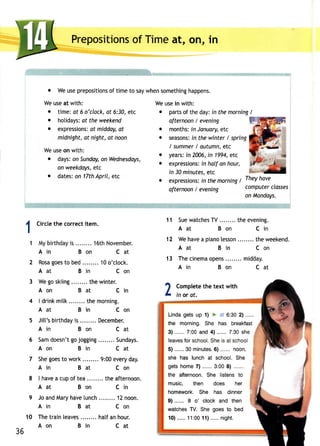
Prepositionosf T imea t, on, in 
o Weu sep repositionosf t imet o sayw hens omethinhga ppens. 
Weu sei n with: 
o partso f the day:i n them orning/ 
afternoonI evening 
o monthsi:n Januarye, tc 
o seasonsin: thew inter/ spring 
/ summe/r autumn,e tc 
o years:in 2006,i n 1994e, tc 
. expressionisn: h alf an hour, 
in 30 minutese, tc 
We use at with: 
o time:a t 6 o'clocka, t 6:30,e tc 
o hotidaysa:t the weekend 
o expressionasf: middaya, t 
midnighta, t night,a t noon 
We use on with: 
o days:o n Sundayo, n Wednesdays, 
on weekdayse, tc 
o dates:o n 17thA pril, etc o expressions: in them orning/ 
ofternoon/ evening 
They have 
computecr lasses 
on lvlondays. 
1 
Circleth ec orrecitt em. 
Ain Bon Cat 
2 Rosgao esto bed. . . . . . . .1 0o 'ctock. 
Aat Bin Con 
3 We go skiing the winter. 
Aon Bat Cin 
4 ldr inkm i tk. . . . . . .t.h em orning. 
Aat Bin Con 
5 Ji t t 'sb i r thdaiys . . . . . . . .D ecember . 
Ain Bon Cat 
6 Sam doesn't go jogging Sundays. 
Aon Bin Cat 
7 Sheg oesto work 9:00e veryd ay. 
Ain Bat Con 
8 | havea cupo f tea. .......t hea fternoon. 
Aat Bon Cin 
Joa ndM aryh avelu nch. . . . . . . .1 2n oon. 
Ain Bat Con 
The train leaves hatf an hour. 
11 Suew atcheTsV . . . . . . . .t hee vening. 
Aat Bon Cin 
12 Weh avea pianole sson thew eekend. 
Aat Bin Con 
Thec inemao pens midday. 
Ain Bon Cat 
13 
36 
Completeth e text with 
in or at. 
Lindag etsu p 1) * at 6:302 l ...... 
the morning. She has breakfast 
3) . . . . . .7. :00a nd4 ) . . . . . .7. :30s he 
leavefso rs choolS. hei s at school 
5) . . . . . . .3m0 inutes.6. .). . . .n. oon, 
she has lunch at school. She i 
getsh ome7 l . . . . . . .3:080) . . . . . . . €= 
the afternoonS. he listenst o 
music. then does her 
homework. She has dinner {i 
9) .......8 o' clock and then 
watches TV. She goes to bed 
10 10) . . . .1. .1 :001 1) . . . .n. .i ght . 
Aon Bin Cat
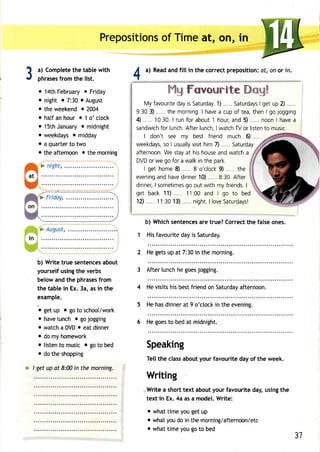
Prepositionosf Timea t, otr,i n 
3 4 
a) Completteh e tablew ith 
phrasesfr om the list. 
. 14thF ebruaryo Friday 
o night o 7:30 o August 
o the weekend o 7004 
o hatf an hour o 1 o' ctock 
o 15thJ anuaryo midnight 
o weekdayso midday 
o a quarter to two 
o the afternoon o the morning 
b) Writet rue sentenceasb out 
yourseluf singth e verbs 
belowa ndt he phrasefsr om 
the table in Ex. 3a, as in the 
example. 
o get up o go to schoot/work 
o havelu nch o goj ogging 
o watch a DVD o eat dinner 
o do my homework 
o listent o music o got o bed 
o do the shopping 
> / get up at 8:00 in the morning. 
a) Reada ndf illin the correctp repositionai t,o no r in. 
ffi96F ovorxm"ft*tme g6$ 
My favouritdea yi sS aturday1.) .....S. aturdaylgse t up 2) .. . 
9:303 ) . . . . . .t he morningI. h avea cupo f tea,t henl go jogging 
4) 10:30I. runf or aboutt hour ,a nd5 ) . . . . . .n oonI havea 
sandwicfho r lunchA. fterl unchI, w atchT Vo r listento music. 
I don't see my best friend much 6) 
weekdays,o I usuallvyi sith im7 ) ......S aturday 
afternoonW. e staya t hish ousea ndw atcha 
DVD or we go for a walk in the park. 
| get home8 ) 8 o'clock9 ) . . . . . the 
eveninagn dh aved inner1 0). . . . .8. :30.A f ter 
dinnelI sometimegso out with myf riendsI. 
get back 1 1) 1 1:00 and I go to bed 
12) 11:301 3). . . . .n. ightI. loveS aturdays! 
b) Whichs entenceasr et rue?C orrecth e falseo nes. 
Hisf avourited ayi s Saturday. 
Heg etsu pa t 7:30in them orning. 
3 After lunchh e goesj ogging. 
4 Hev isitsh isb estf riendo nS aturdaayf ternoon. 
5 Heh asd innear t 9 o'clockin thee vening. 
6 He goes to bed at midnight. 
Speaking 
Tellt he classa bouty our favourited ayo f the week. 
Writing 
Write a short text about your favourite day, using the 
text in Ex. 4a as a model. Write: 
o what time you get up 
o what you do in the morning/afternoon/etc 
o what time you go to bed 
31
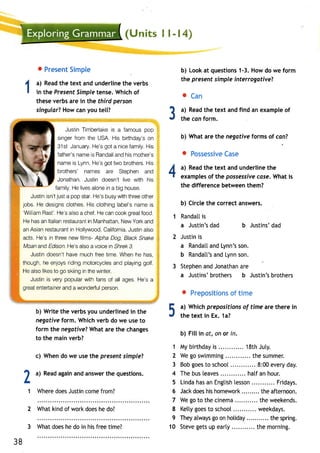
(Units I l- l4> 
o Present Simple 
a) Readth e text andu nderlineth e verbs 
in the PresenSt implete nse.W hicho f 
these verbs are in the third person 
singularH? owc any out ell? 
JustinT imberlakies a famouso oo 
singerf romt he USA,H is birthday'osn 
31st JanuaryH, e'sg ota nicef amilyH, is 
father'nsa meis R andallanhdi sm other's 
namei s LynnH. e'sg ott wob rothersH.i s 
brothers' names are Steohen and 
JonathanJ. ustind oesn'tl ive with his 
familyH. el ivesa lonein a bigh ouse. 
Justinis n'jtu sta pops tarH. e'sb usyw itht hreeo ther 
jobs,H e designsc lothesH. isc lothingla bel'sn amei s 
'WilliamR ast'H. e'sa lsoa chefH. ec anc ookg reafto od. 
Heh asa n ltalianre stauranint ManhattanN,e wY orka nd 
anA sianr estaurainnt H ollywooCd,a liforniJau stina lso 
acts.H e'si n threen ewf ilms-A lphaD og,B lackS nake 
Moana ndE disonH. e'sa lsoa voicei n Shrek3 . 
Justind oesn'ht avem uchf reet ime.W henh e has, 
thoughh, e enjoysri dingm otorcycleasn dp layingg olf. 
Hea lsol ikesto go skiingin t hew inter. 
Justinis veryp opulawr ithf anso f all ages.H e'sa 
greate ntertainearn da wonderfuple rson. 
b) Writet he verbsy ouu nderlinedin the 
negativefo rm.W hichv erbd o we uset o 
formt he negativeWT hata ret he changes 
to the main verb? 
c) When do we use the present simple? 
a) Reada gaina nda nswetrh e questions. 
Whered oesJ ustinc omefr om? 
2 What kind of work does he do? 
3 
4 
b) Looka t question1s- 3.H owd ow ef orm 
thep resents implein terrogative? 
o Can 
a) Readth e text andf ind an exampleo f 
the can form. 
b) What are the negative forms of canT 
I PossessiveC ase 
a) Readth e text andu nderlineth e 
exampleso f the possessiycea se.W hati s 
the differenceb etweenth em? 
b) Circlet he correcta nswers. 
Randatis[ 
a Justin'sd ad b Just ins'dad 
Justinis 
a Randaatln dL ynn'sso n. 
b Randatla'sn dL ynns on. 
Stepheann dJ onathaanr e 
a Justinsb' rothers b Justin'sb rothers 
. Prepositionso f tlme 
a) Whichp repositionosf timea ret herei n 
the text in Ex. 1a? 
b) Fill in ot, on or in. 
Myb i r thdaiys . . . . . . . . . . .1. 8thJ uty. 
We go swimming ... the summer. 
Bobg oesto schoo[ .... 8:00e veryd ay. 
Theb usl eaves .... hatfa nh our. 
Lindah asa nE ngtislhe sson ... Fridays. 
Jackd oesh ish omework......t.h.e. a fternoon. 
We go to the cinema ... the weekends. 
Kellyg oesto school .. weekdays. 
Theya twaygs oo n hotiday thes pring. 
Steveg etsu pe arty ... them orning. 
5 
21 
1 
2 
3 
4 
5 
6 
7 
8 
9 
10 
38 
3 Whatd oesh ed oi n hisf reet ime?
Revisio(nU nits l- l4) 
Circle the correct item. 
This is appte. 
Aa B Can 
2 is my friend. 
AI B They CHe 
3 Where he from? 
Ais B are Cam 
got a computer? 
A She has B Has she C She hasn't 
5 Theyare, . . . . ... . . 
A butterfty B butterftys C butterflies 
6 ........ scarveasr ef romS cotland. 
Alt B These C That 
7 there a dog in the park? 
AAm Bls C Are 
A any Ba C some 
A can't B can C can not 
12 Thesea ret he. .......b atts. 
A boy B boys C boy's 
13 Bitt. .......t o schooelv eryd ay. 
A watk B don't walk C walks 
14 | usuallrye ada book. ....... thee vening. 
Aon Bin Cat 
15 John. . . . . . .l.ik eF rencfhi t ms. 
A doesn't B don't C isn't 
16 My. .......n ameis F tuffy. 
A cat's B cats C cats' 
A Does B Do C Are 
18 Maggieb'sir thdayis ........ October. 
Aon Bin Cat 
Fish. . . . . .s. .w im. 
A can't B can C can not 
Aat Bin 
19 
A. Our B Her C His 
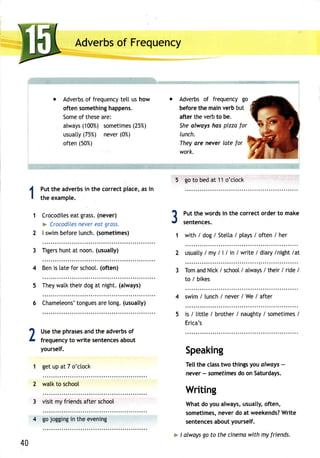
10 There'sa window the kitchen. 
A under B in Con Con 
/ttlarr: -  
 20/ 
39
Adverbso f Frequency 
Adverbosf frequenctye tl ush ow 
oftens omethinhga ppens. 
Someo f thesea re: 
atways(1 00%)s ometime(s2 5%) 
usuatt(y7 5%) never( 0%) 
often (50%) 
Putt he adverbsin the correctp lace,a si n 
the example. 
Crocoditeesa tg rass(.n ever) 
* Crocodilense vere atg rass. 
I swimb efore[u nch(. sometimes) 
Tigersh unta t noon.( usually) 
Beni s latef or schoot(.o ften) 
They watk their dog at night. (always) 
Chameleontosn' gueasr el ong.( usually) 
Uset he phrasesa ndt he adverbso f 
frequencyto write sentenceasb out 
yourself. 
get up at 7 o'ctock 
walk to school 
visit my friends after school 
Adverbso f frequencyg o 
before the main verb but 
after the verb to be. 
She alwoys has pizza for 
Iunch. 
They are never late for 
work. 
5 go to bed at 11 o'ctock 
Putt he wordsi n the correcto rdert o make 
sentences. 
with / dog/ Stetta/ ptays/ often/ her 
2 usua[t/y m y/ | / in / write/ diary/ night/ at 
Toma ndN ick/ schoo/[ atways/ their / ride / 
to / bikes 
swim/ tunch/ never/ We/ after 
is / tittte/ brother/ naughty/ sometime/s 
Erica's 
Speaking 
Tellthec lasstw o thingsy oua lways-never- 
sometimeds o on Saturdays. 
Writing 
Whatd oy oua lwaysu, suallyo, ften, 
sometimesn, everd o at weekendsW? rite 
sentenceasb outy ourself. 
* I alwaysg o to the cinemaw ith myf riends. 
A 
I 
1 
z 
3 
4 
5 
6 
3 
1 
4 
5 
2 
1 
2 
3 
4 
40 
go joggingin the evening
QuestionW ords 
Wh-q uestionasr eq uestiontsh at startw ith wordss ucha sw ho, what,w here,w hen,e tc. To 
formw h-questionwse, putt hea uxitiarvye rbb eforeth es ubject. 
Questionw ord + auxiliaryv erb + subject 
Peoplew: ho/whose 
"Who is your best f riend?" "Mary." 
"Whoseis thatd og?"" lt'sJ ohn's." 
Objects:w hat/which 
"What is that?" "lt's e hat." 
"Which scarf do you |ike?" "The red 
one." 
Placdsw: here 
"Where do you live?" "ln Madrid." 
Time:w hen/whatti me/howo ften/ how 
long 
"When do you go to bed?" "At 10 
o'clock." 
"Whot time does Helen get up?" "At 6 
o'clock." 
"How often do they visit their friends?" 
"Everyd ay." 
"Howl ongd o polarb earsl ive?" 
"Fifteent o eighteeny ears." 
o Size: how long /how tall 
"How long is a tiger's toil?" "About 1 
metre long." 
"Howt oll isy ourb rother?"" He's1 .%)m." 
o Quantities/numbehrso:w m uch/how 
many 
"How muchd oesS allyw eigh?' "50 kilos." 
"How manyo rangesd o you eat every 
day?' "Three." 
o Mannerh: ow 
"Howd o youg o to school?"'B y bike." 
o Reasonw: hy 
"Whyc on't penguinfsly ?" 
"Beceusteh ey'ret oo heavy." 
o Age: how old 
"How old is Tom?" "Eighteen," 
o Distanceh:o wf ar 
"How far is the zoo?" "About 10 
minutes'walk." 
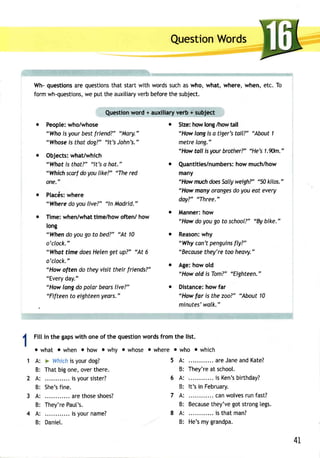
Filli n the gapsw ith oneo f the questionw ordsf romt he list. 
owhat owhen ohOw owhy owhose owhere owho owhich 
A: > Whichis yourd og? 5 A: areJ anea ndK ate? 
B: Thatb igo ne,o vert here. B: They'rea t school. 
A: .. isy ours ister? 6 A: .... is Ken'sb irthday? 
B: She'sfi ne. B: lt's in February. 
A: .... aret hoses hoes?. 7 A: ... canw olversu nf ast? 
B: They'reP aut's. B: Becausteh ey'veg ots trong[e gs. 
A: .... is your name? 8 A: .. is that man? 
B: Daniet. B: He'sm yg randpa. 
41,
2 
QuestionW ords 
Firstf ill in the gapsi n the questionsw ith 
what time, how often, how long (x21, how 
toll, how much, how mony, how old, or how 
/ar. Thenm atcht he questionsto the 
answers. 
> How/ ongi s a giraffe'sn eck? 
penciI case? 
pencilsh avey oug oti n your 
does he go to school? 
is the museum? 
tea do you drink every day? 
doesS altyg ot o the cinema? 
do rhinos[i ve? 
cats have you got? 
I've got two. 
... are their names? 
Mittya ndP aco. 
... are they? 
Mittyi s one and Pacois three years 
otd. 
Peter: do they eat? 
Rita: Oh,a lmoste verythingB. utt heyl ove 
fish! 
Peter: And ......... do they sleep? 
Rita: On my bed, of course! 
Look at the 
answersa nd 
fill in the 
questions. 
A: 1) > Whati s thisa nimal? 
B: lt's a ltama. 
A: 2) ........ . . . . . . . . . . . . . . ? 
B: lt eatsg rassa ndp lants. 
A: 3) .......... . . . . . . . . . . . . . ? 
B: lt livesin SouthA merica., 
A: 4) ..... .......? 
B: lt's1 .20mta [[. 
A: 5) .......... . . . . . . . . . . . . . . . . ? 
B: lt weighsa bout1 20k g. 
A: 6) ....... . . . . . . . . . . . . . . . ? 
B: lt lives for about 20 years. 
tr Put the words in the correct order to form 
- l 
J questionsa,s i n the example. 
1 is / your I what / cotour / favourite? 
2 live I do I giraffes/ howl ong? 
3 who/ Jenny's/ is / brother? 
4 sleep / what time / tucy / does? 
1 
2 
3 
4 
5 
6 
7 
4 
8 ... .......is y ourm other? 
9 . . . . . . . . . . .a ret het wins? 
l-t-f-l 50y earso r more. 
l-5-l-_l Atmoset veryw eek. 
fc-l---] Two cups. 
F-T-_l At 8 o'ctock. 
ij 
th]-_l They're1 7y earso ld. 
tl-T__l Abou2t 0m inutes'walk. 
Peter: 
Rita: 
Peter: 
Rita: 
Peter: 
Rita: 
42 
Fill in the gapsw ith the 
correctq uestionw ords. 
5 tickets I got I John / how many / has?
[ ' 
QuestionW ords 
6 
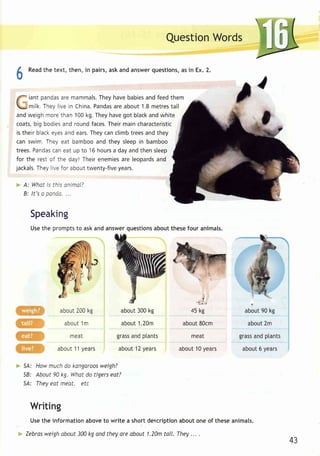
Readth e text,t hen,i n pairsa, ska nda nsweqr uestionsa,s i n Ex.2 . 
f iant pandasa rem ammalsT.h eyh aveb abiesa ndf eedt hem 
lL- 
 -mi lk. Theyl ivei n ChinaP. andaas rea bout1 .8m et resta l l 
andw eighm oret han1 00k g.T heyh aveg ot blacka ndw hi te 
coats,b ig bodiesa nd roundf acesT. heirm ainc haracteristic 
ist hei rb lacke yesa nde arsT. heyc anc l imbt reesa ndt hey 
can swim. They eat bamboo and they sleep in bamboo 
t rees.P andacsa ne at up to 16h oursa daya ndt hens leep 
for the resto f the day!T hei re nemiesa re leopardas nd 
jackalsT. heyl ivef or aboutt wenty-fivey ears. 
A: Whatl s thlso nimal? 
B: l t 'so pont ia... . 
Speaknig 
Uset he promptst o aska nda nswerq uestionsa boutt hesef our animals. 
about 200 kg 
about 1 m 
meat 
about 1 1 years 
about 300 kg 
abou1t .20m 
grasas ndp lants 
about1 2y ears 
v 
45 kg 
about 80cm 
meat 
about1 0y ears 
54: 
58: 
5A: 
7 
about 90 kg 
abou2t m 
grassa ndp tants 
about 6 years 
Howm uchd o kangaroows eigh? 
About 90 kg. What do tigers eat? 
They eat meat. etc 
Writing 
Use the information above to write a short description about one of these animals. 
Zebrasw eigha bout 300k g and theya re about 1.20mt all. They. .. . 
43
(Units I5- l6) 
o Adverbs of Frequency 
a) Readth e text andc ircle the adverbso f 
frequency. 
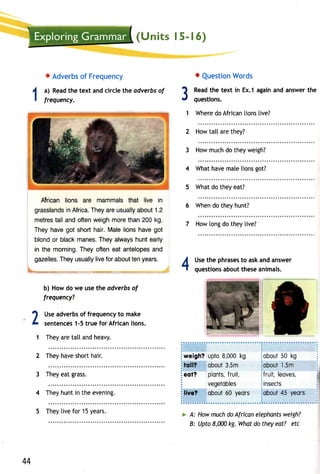
Atrican lions are mammals that live in 
grasslandins A fricaT. heya reu suallya bout1 .2 
metresta lla ndo ftenw eighm oret han2 00k g. 
They have got short hair. Male lions have got 
blondo r blackm anesT. heya lwaysh unte arly 
in the morningT, heyo ftene at antelopeasn d 
gazellesT.h eyu suallyli vef ora bout eny ears. 
b) How do we use the adverbs of 
frequency? 
o Question Words 
Readt he text in Ex.1a gaina nda nswert he 
questions. 
Whered oA fricanli ons[ ive? 
How tatl are they? 
How much do they weigh? 
What have male lions got? 
What do they eat? 
Whend o theyh unt? 
How long do they [ive? 
Uset he phrasetso aska nda nswer 
questionasb outt hesea nimals. 
2 
,t 
1 
2 
3 
4 
5 
6 
7 
4 
A 
L 
1 
2 
3 
4 
5 
Usea dverbso f frequencyt o make 
sentence1s- 5t rue forAfricanl ions. 
They are tatl and heavy. 
They have short hair. weigh? 
tqll? 
eot? 
upto 8,000 kg 
lobou3l .5m 
plontsf,r uit, 
vegetobles 
oboul 60 yeors 
obout 50 kg 
oboutl .5m 
fruit,l eoves, 
insects 
They eat grass. 
Theyh unti n thee vening. obou4t 5 yeors i 
> A: Howm uchd oA fricane lephantws eigh? 
B: Upto 8,0N kg. What do they eat? etc 
44 
They [ive for 15 years.
Revisio(nU nits l- | 6) 
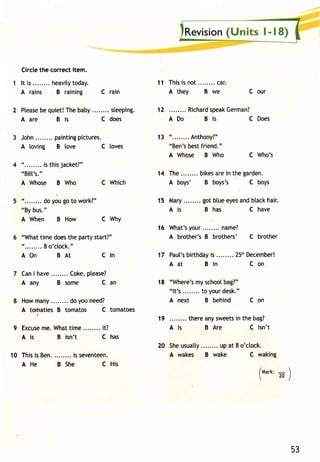
Circle the correct item. 
1 Sheitaa lwaysc omest ate. She's. ....... on 
time. 
A usuatty B never 
2 "Do you [ike dancing?" 
"Yes, . . . . . .d. .o . " 
A they B you 
C sometimes 
3 Henryw atcheTs V. ....... thee vening. 
Ain Bat Con 
4 "........d oesTomgo jogging?' 
"Everyd ay.". 
A Where B Why C How often 
5 Thisis ........t owel. 
A Mary B Mary's C lvlarys' 
6 "........ is that woman?" 
"She'sm ym um." 
A Whose B How old C Who 
7 got a CD ptayer? 
A HasK im B Haven'tK im C Kimh asn't 
11 What. .......y ourn ickname? 
Aare Bam Cis 
12 Havey oug ota ny. .......? 
A matches B match C matchs 
13 Therea ren't booksin the cupboard. 
Asome Bany Ca 
14 "Are these tickets?" 
"No, they aren't our tickets." 
A your B her C their 
15 Thef ridgei s ........ thec ookear ndt hes ink. 
cl 
c that 
C boys' 
A on B under 
16 "CanH etens ing?" 
"Yess,h e. . . . . . ..." 
A cannot B can't 
C between 
C can 
8 "Whosies ........c ar?" 
A thdse B those 
9 Thisis t he. .......r oom. 
A boy B boys 
17 owlss leepd uringt he day? 
A Do B Does C Doesn't 
18 Cows.. ...... eatm eat.T heye atg rass. 
A usually B atways C never 
19 Thisi s Jo. ........ myf riendf romE ngland. 
A He B He's C His 
20 Myb irthdayis ........A prit. 
Ain Bon 
10 Thereis ........ armchairn the livingr oom. 
Cat 
(u"n' . ) 
45 
A_ Ban Ca
PresenCt ontinuous 
Affirmative Negative 
Long Form 
I 
you 
he 
she 
it 
we 
you 
they 
Short Form 
am reading I 
are reading you 
he 
is reading she 
i t 
we 
are reading you 
they 
'm reading I 
're reading you 
he 
's reading she 
it 
we 
're reading you 
they 
Long Form 
am not reading 
are not reading 
is not reading 
Short Form 
| 'm not reading 
you aren't reading 
he 
she isn't reading 
it 
we 
you aren't reading 
they 
Interrogative Short Answers 
Am I reading? Yesl,a m. No,I 'm not. 
Are your eading?Y esy, oua re. No,y oua ren't. 
he reading? Yesh, ei s. No,h ei sn't. 
ls sher eading?Y ess, hei s. No,s hei sn't. 
it reading? Yesi,t is. No,i t isn't. 
we reading? Yesw, e are. No,w e aren't. 
Are your eading?Y esy, oua re. No,y oua ren't. 
theyr eading?Y est,h eya re. No,t heya ren't. 
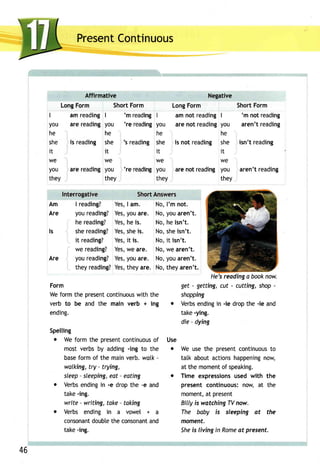
He's reading a book now. 
get - getting, cut - cutting, shop - 
shopping 
o Verbse ndingin -ie dropt he -ie and 
take -ying. 
die - dying 
Form 
Wef ormt he presenct ontinuouwsi th the 
verb to be and the main ys1! + ing 
ending. 
Spelling 
o Wef ormt he presenct ontinuouosf Use 
mostv erbsb y adding- ing to the o We uset he presenct ontinuoutso 
basef ormo f the mainv erb.w alk- tatk abouta ctionsh appeninngo w, 
walking,t ry - trying, at the momenot f speaking. 
sleep- sleepinge, at - eating o Time expressionsu sed with the 
o Verbse ndingin -e dropt he -e and presentc ontinuousn: ow,a t the 
take -ing. 
write - writing, take - taking 
o Verbs ending in a vowel + a 
consonadnot ubteth ec onsonaannt d 
take -ing. 
are not reading 
momenta,t present 
Billy is watching TV now. 
The baby is sleeping at the 
moment. 
Shei s livingi n Romea t present. 
46
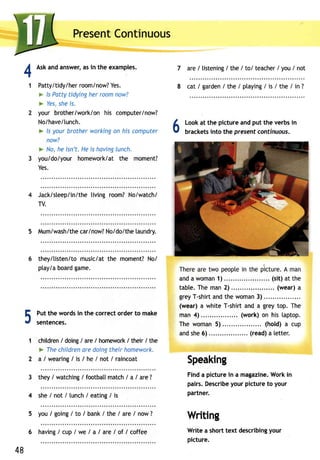
1 
Putt hev erbsin thec orrecbt ox. 
PresenCt ontinuous 
o make a pizza 
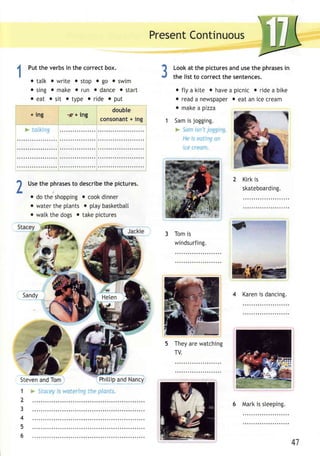
1 Sami s jogging. 
? 
Looka t the picturesa ndu set he phraseisn 
{ the list to correct the sentences. 
o fly a kite o have a picnic o ride a bike 
o reada newspapeor eat ani cec ream 
o talk o write o stop 
o Sing o make o run 
o eat o sit . type . 
+ ing -2r + Ing 
o go o swim 
o dance o start 
ride o put 
double 
consonan+t i ng 
2Uset he phrasetso describeth e pictures. 
o dot hes hoppingo cookd inner 
o water the ptants o ptay basketbat[ 
o watk the dogs . take pictures 
Tom is 
windsurfing. 
5 They are watching 
TV. 
2 Kirki s 
skateboarding. 
G 
Sandy 4 Karenis d ancing. 
Steven and Tom 
1 
2 
3 
4 
5 
6 
41 
Heten 
Phittiapn dN ancy 
6 Mark is sleeping.
PresenCt ontinuous 
Aska nda nswera, si n the examples. 
Patty/tidy/h er room/n ow?Y es. 
> ls Patty tidying her room now? 
* Yess, hei s. 
your brother/work/onh is computer/now? 
No/have/[unch. 
> ls your brother working on his computer 
now? 
> No,h e isn't.H ei s havinglu nch. 
you/do/your homework/at the moment? 
Yes. 
Jack/sleep/in/theli ving room?N o/watch/ 
TV. 
5 Mum/wash/thcea rlnow?N o/do/thela undry. 
they/listen/tom usic/att he moment?N o/ 
ptay/a board game. 
7 
8 
6 
41 
Put the words in the correct order to make 
sentences. 
chitdren/ doingI areI homewor/k t heir/ the 
l" Ihe childreno red oingt heirh omework. 
a / wearing/ is / he / not I raincoat 
they/ watching/ footbatmt atch/ a I are? 
she / not / lunch / eating / is 
you/ going/ to I bank/ the / are/ now? 
are/ listening/ the / to/ teacher/ you/ not 
cat / garden/ the / ptaying/ is / the / in ? 
Look at the picture and put the verbs in 
bracketsin to the presentc ontinuous. 
anda woman1 ). . . . . . . . . . . . . (si t )a t the 
table.T hem an2 ) . . . . . . (wear )a 
greyT -shirat ndt he woman3 ) .... 
(wear) a white T-shirt and a grey top. The 
man 4) ..... (work) on his taptop. 
The woman 5).... ..... (hold) a cup 
ands he6 ) . . . . . . . . . . . . . . . . .(.r eada) let ter . 
Speaking 
Finda picturei n a magazineW. orki n 
pairs.D escribey our picturet o your 
partner. 
Writing 
Write a shortt ext describingy our 
picture. 
A 
. l .U 
1 
2 
3 
4 
5 
6 
48 
having / cup / we / a I are I of / coffee
PresenSt impte- PresenCt ontinuous 
o Weu set he presenst impteto describdea ityr outinesh, abitsa ndp ermanenstt ates. 
o Weu set hep resencto ntinuoutos describaec tionsh appeninngo w,a t them omenot f 
speaking. 
5ueg efsu p at 7 o'clock.( daityr outine) 
Shet okest heb ust o work.( habit) 
Sheli vesi n thec ity.( permanenstt ate) 
Suei s typinga letter at the moment.( happeninagt the 
moment 
of speaking) 
Non-ContinuoVuse rbs 
- I want to watch a DVD. (NOT: to watch a 
DVD.) 
- I love skateboarding(N. OT: skateboarding.) 
- I knowW illiam(. NOT: William.) 
- I like my news chool.( NOT: my new school.) 
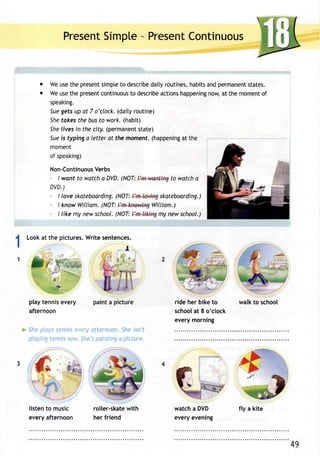
I Looka t the picturesW. rites entences. 
I I 
:=:-- 
play tennis every 
afternoon 
ride her bike to 
schooal t 8 o'clock 
every morning 
walk to school 
She :,' r ' 
pln,/: "c 
' 'c:,Pra! iternoon.S hei sn't 
'-,'r She'ps aintinga picture. 
listen to music 
every afternoon 
roller-skatwe ith 
her friend 
watch a DVD 
every evening 
49 
fly a kite
PresenSt impte- PresenCt ontinuous 
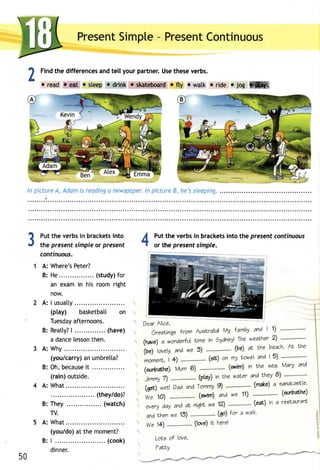
1 Findt he differencesa ndt ell your partner.U set hesev erbs. 
L 
oreadr efrt rsleepo drinke skateboarrfdt y rwatk oride.log ffiffi 
ln plctureA , Adomi s readinga newspoDelyn. pictureB , he'ss leeping. 
3Putt he verbsi n bracketsin to 
the present simple or present 
continuous. 
A: Where'sP eter? 
B: He .... (studyf)o r 
an exam in his room right 
now. 
A: I usualty 
(play) basketbatl on 
Tuesdaayf ternoons. 
B: Reat ty| ?. . . . . . . . . . . . .(.h ave) 
a dancele ssonth en. 
A: Why 
(you/carrya) n umbretta? 
B: Oh,b ecausi te . . . . . . . . . . . . . . . 
(rain) outside. 
A: What 
.. (they/do)? 
B: They ... (watch) 
TV. 
A: What 
(you/doa) t the moment? 
B: | .. ..... (cook) 
dinner. 
ll Putt he verbsi n bracketsin to the presentc ontinuous 
-t or the present simple. 
Dear Alice, 
Greelinqe lrom Auslralid' Vy lamily and | 1) 
(twe) a wondertulilm e in gydnei the weatrhe2' ) "----"--"' 
'tourty 
irrl 
and we 5) " """""""' ' (ve) rt Nhe beach' AL rhe 
momert|c 4, ) ......',,"""""("s"i r) on my towel and I 5) """""""""""' 
(anbathe). Mum 6) 
Jimmyn ".".".,'..--"('p lay)i n Lhew ater and thev e) "" """' " "' 
(6rt) werl Dad,andT ommy9 ) """"" """"' (make)a eandcaEtte' 
We 10) ........,..,,."(.g rvrm)a ndw e 11) """"""""""" ' (annbarhe) 
every day and aL niqhl we 12) """""""""- (eac) in a reetauranl 
50 
and r'hen we 13) (qo) tor a walk' 
We 14) (lorc) ft herel 
LoLe of love, 
7ffiY 
^ **a.f*""rd*"**.4_'1tr4-=*'*3,*-'/F4"--4F 
#:# -ru4"*eff-
PresenSt imple- PresenCt ontinuous 
Putt he verbsi n bracketsin to the present 
simple or present continuous. 
Steve. ..... (wear)h isn ewh att oday. 
Theb aby (sleepa) t 
the moment. 
Karens ometimes (wear) 
long skirts. 
.......( it/snowh) eaviltyo day? 
How much ...... (it/cost)? 
They. . (not/play)computer 
gamens ow. 
Mr Harris . (work) in a museum. 
How often ..... (you/go) 
to the cinema? 
Pleasbee q uiet!| ...... (try)t o do 
my homework. 
| ...... (not/liker)a inyd ays. 
Correct the mistakes. 
She dinnere verye vening. 
Doesth eyt ikea pptes? 
Shei s weara btued ressto day. 
Hei s doingh ish omeworikn 
the moment. 
She'se ata hotd og. 
I startss chooal t 8:00a m. 
Do she drive to work? 
What are they read now? 
She don't live in London. 
We are watch TV now. 
> cooks 
5 
1 
2 
4 
5 
6 
2 
3 
4 
5 
6 
7 
8 
7 
8 
Speaking 
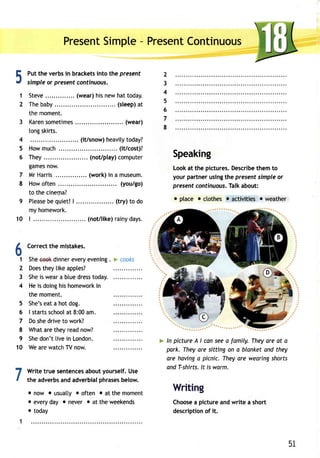
Looka t the pictures.D escribeth emt o 
your partner using the present simple or 
presentc ontinuousT. alka bout: 
o ptace o clothes r activities o weather 
10 
Iv 
1 
2 
3 
4 
5 
6 
7 
8 
9 
10 
T 
Writet rue sentenceas bouty ourself.U se 
the adverbsa nda dverbiapl hrasesb elow. 
. now o usualty o often o at the moment 
o eveu day o never o at the weekends 
o today 
ln picture A I can see a family. They are at o 
pork. They are sitting on a blanket and they 
are having a picnic. They are wearing shorts 
andT -shirtsI.f is warm. 
Writing 
Choosea picturea ndw rite a short 
descriptiono f it. 
51
o PresenCt ontinuous 
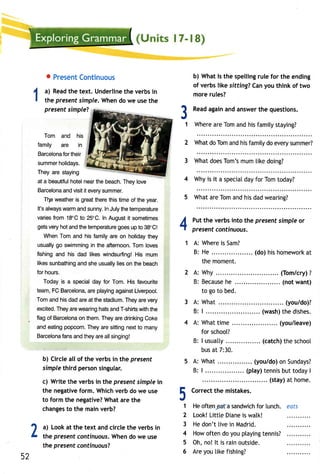
a) Readth e text. Underlineth e verbsi n 
the presents imple.W hend o we uset he 
present simpleT 
Tom and his 
family are in 
Barcelonfao rt heir 
summehr olidays. 
They are staying 
at a beautifuhl oteln eart he beach.T heyl ove 
Barcelonaan dv isiti t everys ummer. 
Tlle weatheirs greatt heret hist imeo f the year. 
It'sa lwayws arma nds unnyI.n J ulyt het emperature 
variesfr om 18"Ct o 25"C.I n Augustit sometimes 
getsv eryh ota ndt het emperaturgeo esu p to 38"C| 
WhenT oma nd hisf amilya reo n holidayth ey 
usuallyg o swimmingin the afternoonT.o ml oves 
fishinga nd his dad likesw indsurfinHg!i s mum 
likess unbathinagn ds heu suallyli eso n theb each 
for hours. 
Todayi s a speciadl ay for Tom.H isf avourite 
team,F CB arcelona,r ep layinga gainsLt iverpool. 
Toma ndh isd ada rea t thes tadiumT. heya rev ery 
excitedT. heya rew earingh atsa ndT -shirtws itht he 
flago f Barcelonoan them.T heya red rinkingC oke 
ande atingp opcornT. heya res ittingn extt o many 
Barcelonfa nsa ndt heya rea lls inging! 
b) Circle all of the verbs in the present 
simple third person singular. 
c) Write the verbs in the present simple in 
the negative form. Which verb do we use 
to form the negative? What are the 
changesto the mainv erb? 
b) Whati s the spellingru lef or the ending 
of verbs like sitting? Can you think of two 
more rules? 
Reada gaina nda nswetrh e questions. 
Wherea reT oma ndh isf amitys taying? 
2 Whatd oT oma ndh isf amilyd oe verys ummer? 
3 What does Tom's mum like doing? 
4 Why is it a special day for Tom today? 
5 What are Tom and his dad wearing? 
Putt he verbsi nto the presents impleo r 
present continuous. 
A: Whereis Sam? 
B: He (do)h ish omeworakt 
the moment. 
31 
4 
2A: 
B: 
3A: 
B: 
4 A: What time . .... (you/leave) 
for schoot? 
B: I usuatty .. (catcht)h es choo[ 
bus at 7:30. 
A: What (you/doo) nS undays? 
B: | .. (play)t ennisb utt odayI 
(stay)a t home. 
Correctth e mistakes. 
Heo ften a sandwicfho r lunch. eats 
Look!L ittte Dianeis walk! 
He don't [ive in Madrid. 
Howo ften do you ptayingte nnis? 
Oh, no! lt is rain outside. 
Are you tike fishing? 
E 
.a 
.J 
1 
2 
1 a) Looka t the text andc irclet he verbsi n 3 
L t the presentc ontinuousW. hend o we use 
4 
the present continuousT 
5 
52 
6
2 Pteasbee q uiet!T heb aby sleeping. 
Aare Bis C does 
11 Thisis n ot . . . . . . . .c ar . 
A they B we 
12 Richarsdp eakG erman? 
ADo Bls CDoes 
13 " . . . . . . . .A nthony?" 
"Ben'sb estf riend." 
A Whose B Who 
A wakes B wake 
Circle the correct item. 
I t is. . . . . . . .h eavi ltyo day. 
A rains B raining C rain 
loves 
Which 
C our 
C Who's 
John. . . . . . . .p aint inpgi ctures. 
A loving B love C 
" . . . . . . . .i st hisj acket?" 
"Bitt's". 
A Whose B Who C 
"........ Oo yo, go to work?" 
"By bus." 
A When B How C Why 
"What time does the party start?" 
"........ 8 o'c[ock." 
AOn BAt Cln 
Can I have Coke, please? 
A any B some C an 
How many do you need? 
A tomaties B tomatos C tomatoes 
9 Excusme e.W hat ime. .......i t? 
Ais B isn't C has 
10 Thisi s Ben.. .......i ss eventeen. 
AHe B She C His 
14 The. . . . . . . .b ikesa rei n theg arden. 
A boys' B boys's C boys 
15 Mary. .......g otb luee yesa ndb tackh air. 
A is B has C have 
16 What 'yso ur. . . . . . . .n ame? 
A brother'sB brothers' C brother 
17 Paut'bsi rthdaiys ........2 5'hD ecember! 
Aat Bin Con 
18 "Where'ms ys choobl ag?" 
" l t 's. . . . . . . .t o yourd esk". 
A next B behind C on 
19 therea nys weetsin the bag? 
Als B Are C lsn't 
20 She usuatty up at 8 o'clock. 
C waking 
/tvtart<-:  
 20/ 
53
Was/Were 
Affirmative 
I 
you 
he 
she 
it 
we 
you 
they 
was I 
were you 
he 
was she 
i t 
we 
were you 
they 
Long Form 
Negative 
was not 
were not 
was not 
were not 
Short Form 
I wasn't 
you weren't 
he 
she wasn't 
i t 
WC 
you weren't 
they 
Interrogative 
Was 
Were 
Was 
Were 
| ...? 
you ...? 
he ...? 
she. . .? 
it ...? 
we...? 
you ..? 
they ...? 
Short Answers 
Yes,l / he/she/ i twas. 
No, l/ he / she / itwasn't. 
Yes, you / we I they were. 
No, you / we / they weren't. 
o Wef orm the interrogativew ith was/were+ subject pronoun. 
Where wos he last week? 
o We form the negative with was/were 
+ not. 
They weren't at the park yesterday. 
4 Looka t the picturesa nda nswetrh e questions. 
! 
Where was Tom yesterday? 
Was he alone? 
Where were his friends? 
o The past simple of the verb to 
be is was/were. 
o We use was with /, he, she, it. 
o We use were with we, Vou, 
they. 
5 
6 
7 
8 
Marilyn Monroe was 
an octress. 
Timee xpressionuss edw ith the past 
simple:y esterdalya,s tw eek/monthtw, o 
days/weekms/o nths/yeaargs o,in 1997e, tc 
Wherei s Tomt oday? 
ls he atone? 
Where are his friends? 
1 
2 
3 
4 
TODAY 
54 
Was he happy? ls he happy?
Was/Were 
SatvadoDra t/i e xptorer/ 
artist 
AgathaC hristie/ 
composer/writer 
Speaking 
Use the ideas below to ask your partner 
questions. 
o what/favouritteo y/young 
o who/favourittee achear t school 
o who/besftr iend(s)/when/sevyeena rso ld 
o what/favouritefo od/fivey earsa go 
o how otd/in 2000 
o when/tasbt irthdayp arty 
o where/laswt eekend 
o where/at9 o' ctock/lasnt ight 
> A: Wherew erey oua t 9 o'clockl ostn ight?e tc 
B: lwas at home. etc 
Writin 
Usey our partner'sa nswersto write a 
shortp aragrapha bouth im/her. 
> fularia'fsa vouritet oy whens hew asy oungw as 
a doll. Herf ovouritet eocheor t schoowl as. .. . 
etc 
2Matcht he sentenceisn columnA with the 
onesi n columnB to form exchanges. 
What was the fitm tike? 
Was Mary with them? 
I wasi n Milant wo daysa go. 
When was Tim's birthday? 
He was a great writer. 
Were you at work? 
,, ,.,, 
,, ,,, 
..1.,1- 
a Were you? 
'1"-''-"-.=,=. 
b Yes,I was. 
It was wonderfut! 
Whichw ereh ism ostf amousb ooks? 
Last month. 
f No, she wasn't. She was at 
schoot. 
Uset he promptsb elowt o aska nda nswer 
questionsa,s i n the example. 
1 NadiaComaneci/artist/ 
gymnast 
* A: WasN adiaC anonect 
an artist? 
B: No, shew asnr . Slrc 
wos o gymnast. 
NeiIA rmstrong/ 
professor/astronaut 
ThomaEs disoni 
president/inventor 
mm 
E] 
fl 
t 
f, 
A 
GI 
Y 
c 
d 
e 
3 
55
PastS impte(r egutavre rbs) 
Affirmative 
worked 
worked 
Interrogative 
Did | / you / he / she / it / we / you / 
they work? 
Spelling 
o Wef ormt he pasts impteo f regutar 
verbs by adding -ed to the main 
verb. 
I pack-I packedI, cook-I cooked 
o Wea dd- d to verbse ndingin -e. 
I sove - I saved, I type - I typed 
o Verbse ndingin consonan+t y, drop 
the -y and add -ied I cry - l cried, I 
study - I studied 
o Verbse ndingin one stressevdo wel 
betweentw o consonandtso ubteth e 
lastc onsonaannt dt ake- ed. 
stop - stopped 
Form 
o Wef ormq uestionwsi th the auxiliary 
verb did + subject pronoun + the 
base form of the verb. 
Did he walk the dog yesterday 
afternoon? 
Negative 
Long Form 
did not work 
I 
did not work 
Short Form 
didn't work 
you 
he 
she didn't work 
it 
we 
did not work didn't work 
Short Answers 
Yes|, / you/ he/ she/ it / we / you/ theydid. 
No, | / you / he / she / it / we / you / they 
didn't. 
o We form negationsw ith did noU 
didn't+ the basefo rmo f the verb. 
He didn't walk the dog yesterday 
afternoon. 
Use 
o Weu set he pasts impteto describe 
actionsw hichs tarteda ndf inished 
in the past. The time is either 
statedo r implied. 
She cooked dinner on Saturday. 
(When?O n Saturday.T he time is 
stated.) 
We travelled to Barcelona last 
night.( When?L astn ight.) 
We trovelled by aeroplane(.W hen? 
The time is not mentionedb ut it's 
implied.T heyt ravelledl astn ight.) 
Timee xpressionuss edw ith the past 
simple: yesterday,l ast week, last 
month, [ast year, two days/weeks/ 
months/yeaargso ,in 1979e, tc 
I 
you 
he 
she 
it 
you 
they 
we 
you worked 
they 
I 
you 
he 
she 
i t 
we 
you 
they 
56
At 
1 
2 
3 
4 
5 
6 
7 
8 
9 
10 
A 
L 
Write the post simple of the 
verbs. 
> appeared 
PasSt impte(r egulavre rbs) 
1 
2 
3 
4 
5 
6 
7 
8 
9 
10 
Looka t Fred'sa gendafo r yesterdaya nd make 
sentences. . 8:oO walkdo+{ 
Fifteeny earsa go. 
With his lance. 
Their friends. 
At 6 o' ctock. 
o Q:oo pla4E olfw ith?aul) ( tv. 
. 1 1:OO water flowerg X 
. 17:OO c*oEIvwh? { 
a 7:OO workonr,ompv*e/r 
. 5:OOv ieit qrandp/a 
i i i 
. 6:OQ reVair'tl { 
o 7:OOr ,oakdinnoXr 
. 6:oohd4hougs) ( 
o J:OO rntr.h a|VP / 
* YesterdayF, red walked the dog. 
Put the verbs into the past simple, then match the 
questionsto the answers. 
Where .... (you/livet)e n yearsa go? 
Who . ... (Tom and Sue/visit) 
tast night? 
What ime . . . . . . .( yourm um/ 
cook)d innery esterday? 
When (Ann/startp) tayingte nnis? 
When ...... (they/moveto) Portugat? 
How. .... (SaintG eorge/kill) 
the dragon? 
What. . ... (Helen/studyy)e sterday 
afternoon? 
How many letters . (you/type) 
[ast month? 
3 
appear 
borrow 
carry 
close 
ptay 
jog 
tive 
smile 
wash 
grab 
Put the verbsi n bracketsin to 
the post simple. 
Last yea[ Ketty and Diane 
1) . . . . . . : . . . . . . . .(.d ecidet)o go to 
FranceT. hey2 ) . (travel) 
by aeroplanteo Parisa nd3 ) 
(share)a rooma t a wonderfuhl otel. 
They 4) . (love) the Eiffet 
Towera ndt he ChampEs tys6esT.h ey 
5) . . . . . . . . . . . . . .(. .w alka) t td ayi n the 
beautifuI streets of the city and 
6) .............(. visit)m anym useums. 
Theya lso7 ) ................(.t ravelt)o 
Nice, where they 8) 
(sunbatheo) n the beachf or hours. 
They 9) . (enjoy) their 
hotidaya [ot! 
4 
1 
2 
4 
5 
6 
t 
trl 
t 
il 
Chemistry. 
ln lretand. 
Only four. 
Whens hew as8 yearso td. 
51
PastS impte(r egutavre rbs) 
E Looka t the picturesa nda nswetrh e questions. 
.t 
DidS ophiec ookr ice tastn ight? 
i,'o,s hec iclnt . trc ccc,<epda .-iu. 
DidS ophiee njoyt he party [astw eek? 
4 DidS ophieti dy herr oomy esterday? 
5 DidS ophietr avelt o Parisla sts ummer? 
3 DidS ophiwe atchT Vy esterdaayf ternoon? 6 DidS ophieh avea picnic[ astw eekend? 
6Putt he verbsi n bracketsin to the correctf ormo f the pasf simple. 
1 Kena ndM ark. .......( watcha) great 
film at thec inematw ow eeksa go. 
" . . . . . . . . (Kendra/studfoyr) 
thee xamla stn ight?""Y ess, hed id." 
Phitip. .... (not/askh)i sd adt o 
borrowth ec arl astn ight. 
Howm anys ongs. . . . . . . . .( you/ 
downloadf)r omt he Internelta stw eek? 
When ...... (Bill/move) 
to this house? 
| . . . . . . . . . . (not /enjoyth) ep tay 
at alt. lt wasr eattyb oring! 
Theb ravem an, . . . . . .( ki l l )t he 
monstearn d. . . . . . . . . . . . .(.s. aveth) ep r incess. 
My dad ... (not/repair) 
myc omputesr,o | .. (not/use) 
it altweekend. 
58
PastS impte(r egulavr erbs) 
Put the words in the correct order to make 
sentences. 
last / Petera ndJ osh/ to I weekend/ did I 
Itaty / travel ? 
not / we I the / water I did / yesterday 
flowers 
3 my/days/grandpa/ two/ l /ago /visi ted 
their / Fiona and Martha / tidy / not / 
bedroomi did 
9 
1 
7 
1 
Formq uestionst,h en asky our partnert o 
answerth em. 
you / watch TV last night? 
> A: Dld you watch TV last night? 
8: No. ldidn't. 
your parents / visit / their friends last 
weekend? 
3 your parents / travel / abroad / tast 
summer? 
4 your best friend i ptay footbatl / last 
weekend? 
I Readth e emaila ndp ut the verbsi n 
bracketsin to the correctf orm of the pasf 
simple. 
DearB i[[, 
Howa rey ou?H ow1 ) ...... . (be)y our 
weekendM? ine2 ) (be) great. 
The weather 3) . (not/be) good 
so | 4) (stay) at home and 
5) . . . . . . ; . . . . . . . . . . .(.i nvi tem) yf r iendtso visi t . 
We 6) (play)c omputegr ames, 
7) . . . . . . . . . . . . . . . . .(.l istent)o musiac ndt henw e 
8) ...... .... (watchT) V.W hata bouyt ou? 
9) .... ... (you/playb)a sketbatt? 
Hope you are 0K. Tatk to you soon. 
Steve 
5 you/ tistent o music/ yesterdaay fternoon? 
Speaking 
In pairs,a ska nda nswerq uestionas bout 
what you did last Saturday. 
> A: Did you visit your grandparentslo st 
Soturdoy? 
B: Yes,dl id. 
A: Did you clean the houseT 
8: No, ldidn't. etc 
Writing 
Usey our partner'sa nswersto write a 
shortp aragrapha boutw hat he/shed id 
last Saturday. 
> LostS aturdayM, anuevl isitedh isg randporents. 
He didn't clean the house. etc 
59
(Units l9-20) 
o PasSt imple(r egulavr erbs) 
a) Readt he text andf ill in the gapsw ith 
the verbs below in the post simple, 
play dr'.rcC e reach join cry 
,.;' .:: ..ii' aPPeaf Staft 
The Beatles were the most successful pop band 
of all time. The members were John lrnnon, Paul 
McCartney, George Harrison and Ringo Starr. 
It all l) inl957,when lennon formed a 
band, called The Quarrymen, with some friends 
from school. Paul McCartney 2) the band 
in 1957 and George Harrison joined in 1958. In 
1960, the band 3) their name to The Beatles 
and started playing in music clubs. Soon, the 
drummer Ringo Starr joined the band. 
In 1963, the band recorded their first album, 
which was a huge success. Many of their songs 
4) ............N. o. 1 in the charts and The Beatles 
5) .............i n many concerts. They were very 
popular. People loved them so much that many 
even 6) or screamed during their concerts. 
In 1966, The Beatles D ............t.h eir last 
concert in San Francisco. They continued to make 
recordsu ntil 1970,w hen they 8) ............t.o break 
up. 
They were a fantastic band. They created some 
of the most brilliant albums in music history and 
they changed the face of pop music forever. 
b) Howd o we form the interrogatfvea nd 
negativep astf orms?W hata uxiliaryv erb 
do we use?W hath appentso the main 
verb? 
2a) Howd o we form shorta nswersin the 
past simple? 
b) Readth e text in Ex. 1 againa nda nswer 
the questions. 
DidR ingoS tarrf orm TheQ uarrymenT 
2 DidG eorgeH arrisojno in the bandin 1958? 
Didl he Beatlesre cordt heir first atbumin 
1960? 
4 Didp eople[ ovet hem? 
5 Didt heyb reaku pi n 1980? 
. WasAilere 
a) What is the past simple of the verb "fo 
be"?F inde xampleisn the text. 
b) How do we form the interrogotive and 
negative past forms of the verb "to be"? 
Uset he time expressionins bracketsto 
rewritet he sentenceisn the pasf simple. 
lss hea famousb allerina(?te ny earsa go) 
Fionaa ndM arkd on'tc heckth eire mails 
every week. (last week) 
3 
4 
1 
3 Myp arentsa rea t work.( yesterday) 
Doy oug oj oggingin thea fternoon(?la st 
night) 
5 | livei n Bristol(.t hreem onthsa go) 
60 
6 Peteirs n'ta student(.i n 1998)
Circle the correct item. 
"ls this bike?" 
"No,i t isn'tm yb ike.l t'sB en's." 
A you B your C his 
"........a ret heyc arryinagn u mbretla?" 
"Becausiet's raining". 
A Where B Why C When 
3 ........y oua ndL isaa t thec inemata stn ight? 
A Were B Did C Was 
4 Therea ren't carrotsin thef ridge. 
Ano E some C any 
5 . . . . . . . .t heyh aved innear t 8 o'ctock? 
A Are B Does CDo 
6 Myd adg oesfi shing Sundays. 
Aon Bat Cin 
got a son? 
A Jim hasn't B Has Jim C Jim has 
8 What . . . . . . .A. untB rendcao oking? 
Aam B are Cis 
9 is a bigm ousein the kitchen! 
A They B There C Their 
10 Tigerhsa veg otb ig. ........ 
A teeth B tooths C teeths 
11 youw atert he ptantsta stn ight? 
ADo B Did C Were 
"CanP hitipr idea bike?" 
"No, he........." 
A can B can't C doesn't 
13 | loveS hakira.... .....i s myf avouritsei nger. 
A She B Her C Hers 
14 "Didy ourb rothetri dy hisr oom?" 
"Yesh, e. . . . . . . . . " 
A didn't B was c did 
15 arem yn ephewsT,e ddya ndS cott. 
A That B This C These 
"WasE tvisP resteay famouss inger?" 
"Yesh, e. . . . . . . . . " 
A was B did C wasn't 
A stared B star C starred 
Havey oug ot. .......n ewC Ds? 
Asome Bany Ca 
Kevin.. ......t o ltatye verys ummer. 
A travel B is travettingC travets 
20 you tike rock music? 
ADo B Are 
12 
16 
18 
19 
C Have 
/t,larx: - 
20 
61
Affirmative 
I left 
you left 
she left 
he left 
it left 
we left 
you left 
they left 
PastS impte(i rregulavre rbs) 
Negative 
Long Form Short Form 
I did not leave I didn't leave 
you did not leave you didn't leave 
she did not leave she didn't leave 
he did not leave he didn't leave 
it did not leave it didn't leave 
we did not leave we didn't leave 
you did not [eave you didn't leave 
they did not teave they didn't leave 
Interrogative 
Did | leave? 
Did you leave? 
Did she leave? 
Did he leave? 
Did it leave? 
Did we leave? 
Did you leave? 
Did they [eave? 
lrregutavre rbsd o notf ormt he pasts impteb ya dding-e d. 
leave - Ieft, make - made, soy - said 
(Seeti sto f irregutavre rbsa t thee ndo f the book). 
Theyf ormq uestionasn dn egationwsi th did/didn ot (didn't)a ndb asicfo rmo f the 
verb. Hel eft - Did he leave?- Hed idn't leave. 
4 Looka t the picturesU. set he phraseisn the pasts impleto write whatt he peopled idy esterday. 
T' 
I 
r go to the cinema e drink tea o catch the bus o ride his bike o eat cherries 
Pauul suattwy atcheTs Vo n 
Sundaysb,u t yesterdahye 
Saltyu suattyg oest o school 
by car, but yesterdays he 
Karenu suattyd rinksc offee 
in the morning, but 
yesterdasyh e. . . . . . . . . . . . . . . 
Jimu suallpyl aysfo otbatton 
Saturdaybsu, t yesterdahye 
Theyu suatthy avec akef or 
dessertb,u ty esterdatyh ey 
62
PasSt impte(i rregulavre rbs) 
2 Completeth e crosswordw ith the post 
3 
simple of the verbs in brackets. 
Across 
2 Susan (find) her handbagin 
the wardrobe. 
4 Whenth ep arade .... (begin), 
we were excited. 
6 Tom . .. (think) the party was boring. 
8 Sandy ....... (fly)t o Spainta stw eek. 
10 Margaret .. (make)r oastl amb 
andp otatoesy esterday. 
12 We ... .... (drive)t o Walesla stw eek. 
14 John. . . . . .( comeh) omee ar ly 
this afternoon. 
Down 
1 They .... (buy) a new car last month. 
3 Thec hitdren (break)t he lamp 
yesterday. 
She. . ....... (give)m ea nicep resent. 
Tony . . (tell)m ea funnyj oke. 
She ... .. (write) a letter to her 
brother yesterday. 
We .. ..... (meet)G eorgaet the 
park last week. 
Sheo nty ... (drink)a gtasso f water. 
Fill in the blanks with the verbs in brackets 
in the past simple. 
Yourf riendi s backf rom holidayU. set he 
words to ask questions. 
where/go 
4 
1 
2 golwindsurfing 
3 meet/newp eopte 
4 take/photos 
5 read/books 
5 
7 
9 
11 
63 
13 
6 buy/souvenirs
PasSt impte(i rregulavre rbs) 
5 7 
1 
Putt he wordsin the correcto rdert o make 
sentences. 
we / the I go / didn't / to / park / yesterday 
read / he / book/ science-fiction/ a / week / 
last 
buy/ she/ new/ bicycle/ last/ a / month/ 
did 
4 they/ have/ didn't/ party/ a /week/ last 
did / bed / your / you/ make / yesterday 
:"""' """? 
saw / we / a / [ast / fitm / good / night 
Annie: He[to. 
Betty: HiAnnieH. owa rey ou? 
Annie: I'm fine. Thanks. 
Betty: Wet[, 1l > did you go to the bank? 
Annie:Y esa, nd| 2) .... . thec atb utI 
3)........ the laundry. 
Bet ty: l t doesn'mt at ter4. ) . . . . . . . . . . . . . . . . .t.h. e 
livingr oom? 
Annie: Yesa, ndI atso5 ) ..... the dog 
for a walk. 
Bet ty: Good6. ) . . . . . . . . . . . dinner? 
Annie: No,B etty.I 'm sorryI. forgot. 
Betty: That'so kayW. ec ano rdert akeaway. 
Annie: ThankBs ettyT. hat'sg reat. 
2 Cathy: 
3 Peter& Heten: Wem etG eorgefo r dinner. 
J-- 4 satty<: .-.1 iglght3 I"gI!tTJ, 
5 Martha: I rented a car. 
6 
1 
Somep eoplea ret ellingl ies.R eadw hat 
they say,t hen uset he wordsi n bracketsto 
correct the false statements. 
1 Tony: I went to a street parade 
yesterdaayf ternoon. 
A 
Annie'sf latmatel eft a list of thingsf or her 
v to do. Now,t heya ret alkingo n the phone. 
Uset he notest o completeth e dialogue. 
Annied on'tf orgeto ... 
feed the cat take the dog for a watk 
Kevin'l I ateY orkshirpeu ddingy esterday. 
(party) 
F No, he didn't go to a street parade. 
Hew entt o a partyy esterdoayf ternoon. 
(biscuits) 
3 (lunch) 
4 (skirt) 
5 (bicycle) 
6 (roast beef) 
Speaking 
In pairs,a ska nda nswerq uestionasb out 
whaty oud id lastw eekendI.n cludetw o 
lies.S eei f yourp artnerc ang uessth em. 
Writin 
Writea shortp aragrapahb outw hat you 
did last weekend. 
64
Countable/ UncountablNe ouns 
Countablneo unsa re nounsw hichw e canc ount. 
one tomoto - two tomotoes 
Uncountabtneo unsa re nounsw hichw e cannotc ount. 
some bread, some milk 
Uncountablneo unsu suallyh aveo nlys ingutafro rms.T hesen ounsin clude: 
food: bread, meot, cheeser,i ce, sugorp, asta,e tc 
liquid: coffee, woter, milk, tea, etc 
Wec anu set hef ottowinngo unisn fronto f someu ncountabnleo untso showq uantity: 
o bottle of oil, o cup of teo, a glass of water, a bowl of rice, a slice of pizza, a 
loof of breod,o kilo of meat,o pieceo f cakea, cortono f eggs 
4 a) Put the words in the right column. 
T 
. meat o soup r onion . sausage 
o egg o bread r ice cream r biscuit 
r watermelon o peach o pasta o coffee 
Circleth e uncountabnleo unI n eachg roup. 
potato- biscui-t rice- cherry 
honey- egg- sausag- eb anana 
pumpki-n mitk- peach- appte 
sausag-e c heese- lemon- carrot 
bread- onion- watermelo-n tomato 
slice - piece - kilo - pasta 
Writing 
Youn eedt o gos hoppingW. ritey our 
shopplnlgis t. 
tr 
J 
I 
2 
3 
4 
5 
6 
b) Whicho f the above'wordcsa nb ep lural? 
1 Matchth e columnsa,s i n the example. 
L 
mt 
ro 
t 
a glasso f 
a cup of 
a loaf of 
a kito of 
a bottle of 
a bowl of 
a bread 
b meat 
c water 
d rice 
e coffee 
f oil 
F 
a 
e 
a 
(. 
e 
fA 
e 
? 
a 
e 
F 
55
Som/eA ny- Howm uch/Howm any 
Countablen ouns 
PLURAL 
Affirmative There are some onions. 
Negative There aren't any onions. 
Interrogative Are there any onions? 
1 
o Weu ses omei n affirmatives entencewsi th pturalc ountabtneo unsa ndw ith uncountabte 
nounsI. needs omeb iscuitsa nd somes ugarf or my tea. 
o Weu sea nyi n negativea ndi ntenogativese ntencewsi th bothc ountabtneo unsin the plural,a nd 
uncountabtneo unsA. re therea ny tomatoeisn thef ridge?T herei sn'ta ny milki n myc offee. 
NOTE:W e uses omei n interrogatives entencetso makeo ffers 
and requests. 
Would you like some fea? (offer) 
Can I have some water? (request) 
Weu seh owm uchw ith uncountabnleo unsto ask 
about hea mounot f something. 
How much milk do you want? Two bottles. 
Weu seh ow manyw ith countabtneo unsto ask 
about the number of things. 
How many apples hove you got? Three. 
Fillin theg apsw iths omeo r ony. 
1 1 
'2 
3 
lst here .. cheesein the fridge? 
Woutdy out ike . juice? 
Therea re. . . . . . . . .b. ananains t hef rui tb owl 
but there aren't . apples. 
4 Can I have .. mitk for my coffee? 
5 There isn't cake but there are 
.. biscuits. 
6 Thereis . . . . . . . . . .c abbagien theb owt . 
7 Woutdy oul ike .. sushi? 
8 There aren't .. pineapples. 
9 Aret here onionsin thisd ish? 
10 lst here . breadin the bag? 
Unountablen ouns 
Thereis somem itk. 
Thereis n'ta nym itk. 
ls there any mitk? 
Can I have some strawberries, 
please? 
Sure,h owm anyd o youn eed? 
500 g. 
B: 
A: 
Write questionsw ith howm ucha ndh ow 
many, as in the example. 
coffee / the cup 
* Howm uchc offeei s therei n the evp? 
Coke / the bottte 
2 
3 eggs/ the fridge 
4 tea / the cup 
5 tomatoes/ the bag 
6 soup / the bowl 
7 orangeju ice / the glass 
66 
8 sweets/ the packet
Som/eA ny- Howm uch/Howm any 
Fill in the sentencews ith howm uch,h ow 
meny, some and any. 
Thereis 1). . . . . . .m i tki n thef r idge. 
2l .... .. is there? 
A bottte. 
and sisters have 
but I haven't got 
E rlatcht he questionsto the answers. 
J 
tlTl How much does this book cost? 
ET--l Woutdy oul ike somes ugarin yourc offee? 
f3T-l Aret herea nyc hocotateisn the box? 
lZT--.l Howm anyg tasseosf water do you drink 
every day? 
fdT-l ls there any tea in the cup? 
reTl How much coffee do you drink every day? 
tt 
.t 
A: 
B: 
A: 
A: 
B: 
A: 
A: 
B: 
A: 
A: 
B: 
A: 
A: 
B: 
3).... brothers 
you got? 
l've got two brothers 
4l .... .. sisters. 
5).... pens have you got in your 
pencicI ase? 
l've got three. 
CanI have6 ) ...'. .. meat,p lease? 
7l . . . . . . . woutdy ou[ ike? 
A kito, ptease. 
0h, no!| haven'gt ot8 ) . . . . . .w ater ! 
9) .... ... do you need? 
A bottte. 
10). .. .. booksa ret herei n yourb ag? 
Therea ren' t1 1). . . . 
I Underlinea ndc orrectt he mistakes. 
-r 
1 Howm anys ugairs therei n yourc offee? 
2 Therea rea nyb ookso n the tabte. 
3 Aret heres omec herrieisn the basket? 
4 Howm uchm eatsd oy oue at everyd ay? 
5 How many coffee would you [ike? 
6 Thereis n'ts omeC okein the bottte. 
7 Howm uchs liceso f pizzac any oue at? 
8 | have got any meat and potatoes for my 
dinnetro night! 
9 How much hours do you study every day? 
10 Howm anym oneyd oesa bust icketc ost? 
Yesp, tease. 
No, there aren't 
any. 
Eight. 
d 115 
e Yest,h erei s some. 
f Two cups. 
Looka t the followingd ialoguea ndp ut the 
sentenceisn the righto rder. 
A: HettoC. anI hetpy ou? 
B: A kito, please. 
A: Yes, there are. How many woutd you 
tike? 
B: YesA. ret herea nyb ananas? 
A: Of courseH. owm uchw ouldy ou[ ike? 
B: Twob otttesp, tease. 
A: Of courseH. owm anyb otttes? 
A: Here you are. lt's f,15 attogether. 
B: Six,p leaseA. ndc anI haves omeC oke? 
B: HettoC. anI haves omec heesep, lease? 
A: Anythinegt se? 
Speaking 
In pairsa skq uestionas boute acho ther's 
everydaye atingh abits.A ska bout: 
o water o milk o cheese o apples 
. carrots . eggs o meat o biscuits 
o coffee o orangeju ice 
a 
b 
6 
E 
fl 
EEEEEEEE 
* A: How much water do you drink every doy? 
B: Six glosses. 
61
{Ur"rits2 I -23) 
o PasSt imple(i rregulavr erbs) 
Lista ll the verbsi n the pastt ensei n the 
text. Whicha re regular?W hicha re 
irregularT 
Last year I celebrated Halloween, on October 3lst, 
with rny hmily and friends. My mum bought a 
pumpkin and we cut a scary hce in it and put it in 
the window. My friends and I went trick-or-treating 
in the afternoon.Wew ore scaryc ostumesa ndw ent 
from house to house and people gave us sweets. In 
the evening, I had a Halloween costume party'. My 
mum and I decorated our house.We tied black and 
orangeb alloonsto the backo f the chairsa ndp ut old 
horror film posters on the walls. My mum made 
pizzaa nd some sandwichesM. y friends arrived at 
eighto 'clock.E veryones at in the livingr oom anda te 
some food and drank some lemonadeT. hen we 
played party games. My favourite game was apple 
bobbing.We put some apples in a bucket of water 
and tried to take an apple from the water with our 
teeth. I got all wet but I didnt catch any apples! 
Later, we had a costume contest and we voted for 
the best costume. I took lots of pictures of my 
friends.M y party was a huges uccessa nd everyone 
had lots of fun. 
3 
4 
o Countabl/e U ncountabNleo uns 
Findt hree uncountablen ounsa ndt wo 
countablen ounsr elatedt o foodi n the 
text in Ex. 1. 
Write Cf or countablea ndU for 
uncountablnee xtt o eachi tem. 
1 
2 
3 
4 
5 
tomato 
meat 
rice 
biscuit 
egg 
6 
7 
8 
9 
10 
fish 
bread 
cherry 
potato 
tea 
"Niil}i€4Mqs -w@w{ e+::@i ry::. 
o Some/ Any/ Howm uch/ How 
many 
5 
a) Whend o we uses omea ndo ny?F ind 
J exampleisn the text. 
b) Looka t the sentencebse low. 
A: Howm ucho rangeju ice do youw ant? 
B: Three cartons. 
A: Howm anyo rangehs avey oug ot? 
B: Two. 
When do we use how much and how many? 
A 
Fill in the gaps with some, any, how much 
v and how mony. 
1 Therea re. . . . . . . . . . . . .b. .a nanainst heb asket . 
2 Thereis n' t. . . . . . . . . . . . .m. . i tkin t hef r idge. 
3 . . . . . . . . . . . . .b. .i scuiatsre i nt hep acket? 
4 coffeeis in thec upboard? 
5 . . . . . . . . . . . . .g. .i r lsa ret herein y ourc tass? 
1 a) Find a negotive post form in the text. 
L How is it formed? 
b) How do we form 
in the past simple? 
68 
the interrogativefo rm
Revisio(nU nits l-23) 
11 How. . . . . . . .m i tkd ow en eed? 
A many B long C much 
12 There anya eroplane2s0 0y earsa go. 
A wasn't B weren't C aren't 
13 She. . . . . . .h. erh omewoarkt them oment . 
A do B does C is doing 
14 Bitt often letters. 
A writes B write C is writing 
Circle the correct item. 
1 . . . . . . . .y ourn ameT om? 
AAm BAre Cls 
2 got a bike? 
A She has B She hasn't C Has she 
3 ........a res ometr eesin theg arden. 
A There B They C This 
4 you tike apples? 
A Does B Doesn't C Do 
5 Thereis n't. .....n.r icei n thec upboard. 15 | ........y ours istelra stw eek. 
A some B a c any A see B saw c amseeing 
6 Tomc anr idea bikeb uth e. . . . . . . .c ook. 16 We. . . . . . . .t o thecinemtaa stn ight . 
A can B can't c can not A go B went c are going 
7 she. . . . . . .b. reakfaesvt eryd ay. 17 How. . . . . . .p. etsh avey oug ot? 
A has B have C don't have A much B tong C many 
8 | drinka cupo f coffee them orning. 18 woutdy out ike. .......t ea? 
Aon Bat Cin Aany Ba Csome 
9 He........c omees artyH. e'sn ever[a te. 19 youg ot o schoolyesterday? 
A sometimes B always C usuatly A Did B Do C Are 
10 Laura. . . . . . . .m akinag c ake. 
A is B does C has 
20 Satty.. ......h erl egl astS unday. 
A breaks B is breaking C broke 
/tvtart<-:  
 20/ 
69
A/An - The 
TheI ndefiniteA rticle'A./An" 
r The indefinite articte a/an is used 
befores ingulacro untabtneo unsW. eu se 
a before nouns which begin with a 
consonansto unda nd an beforen ouns 
whichb eginw itha vowetsound. 
a unicorn(c onsonansot und) 
an umbrella( vowesl ound) 
a hat (consonansot und) 
an hour (h is sitent) 
We use a/an 
o with singutar countabte 
nounsw henw e wantt o say 
what somebody/something 
We don't use a/an 
o with uncountabloer ptura[n ounsW. e 
canu ses omei nstead. 
somec heeses, omeb iscuifs,e tc 
Fill in with o, an or the. 
.......s kirty oub oughits lovely. 
Borderiss ....... bookshop .. shopn ext 
to it is famousb akery. 
.......w omanin thisp ictureis J ohn's ister. 
lwant to buy. . . . . . . newspapebru, t . . . . . . . 
newsagenti'ss c tosed. 
Lisa'bsr otheirs . . . . . . .a crobat . 
I cans ee. . . . . . .b icyctein the gardenl.t is 
....... otd bicycte. 
NeitArmstronwga s. ...... astronauHt. ew as 
first man to watk on the moon. 
in fronto f ana djectivew hent herei s no 
noun after it. But when there is a noun 
after the adjective, we use a for 
adjectivews hichb eginw ith a consonant 
sounda nda n for adjectivews hichb egin 
with a vowel sound. 
It is a bike.l t is new 
It is a new bike. 
It is olso an expensive 
Y 
11 
2 
3 
4 
The DefiniteA rticle" The' 
o The definite articte the is used with 
singutaorr pturanl ouns. 
the boy, the women, the foresf, etc 
We use the 
o with nounsw henw e are tatkinga bout 
somethinsgp ecificf,o r examptew hen 
the nouni s mentionedfo r a second 
time or is atready known. In other 
words, when we can aiswer the 
question"W ho?o" r "Which?" 
7 
Fill in the gaps with o, an or the. 
**,a_* -- 
Maria is from ltaly. She lives with her parents in 
1)....... small village near Parma. They have got 
2) ......b. eautifuhl ousew ith 3) ......g. arden.4 ) ....... 
garden is very big and Maria plays in it all the time. 
Mariah asg ot 5) .......c at.6 ) .......c at'sn amei s Luna 
and it follows Maria everywhere. 
Every day Maria goes to school by bus. 7) ....... 
bus stop is not far from her house.S ometimess he 
goes to school on her bike, which was B) ....... 
presentf or her birthday.l t is 9) .......e xpensivere d 
bike and Maria loves it. 
5 
6 
10
Must - Mustn't 
Weu sem ust/mustn'tto : 
o describeo btigationo r duty.Y oum ustl istent o yourt eacher. 
o gives tronga dvice.Y oum usth elpo therp eople.Y oum ustn'te at 
too muchju nk food. 
. expresps rohibitionY. oum ustn'td rivef ast. 
Fill in the sentencews ith musta nd mustn't. 
3 
I 
I 
1 
2 
3 
4 
5 
6 
7 
8 
9 
10 
You. . .. (o yourh omeworekv eryd ay. 
You .. be rude to your parents. 
You. . . . . . . . . . .w or rya boutth ee xam. 
We ...........b. uys omeft owerfso rt hep arty. 
You. . . drinkt oo muchc offee. 
You. ... cteany ourt eethe veryd ay. 
You. . . . . . . . . . .d r ivefa st . 
You. ............d. rinka cupo f mitke veryd ay. 
You. .............e. xercisther eeti mesa week. 
You .. ... eat too many sweets. 
Writef ull sentencesa,s i n the example. 
Thed ogi s itt. (You/takiet/ vet) 
* You must take it to the vet. 
Johnh asa headache(H. e/take/aspirin) 
3 Them ilks mellbs ad.( You/nodtr inkit ) 
4 lt's a rainy day. (l/take/umbrelta) 
5 Thew ateri s dirty.( You/nostw imh ere) 
6 Theb abyi s hungry(.l /feed/her) 
You must wear a 
helmet when you 
ride a bicycle. 
Insectkse epo urg ardencsl ean.( We/nokt itt 
them) 
The studentsa re havinga test. (They/not 
talk to each other) 
Matcht he signsto the sentencesT.h erei s 
one extra sentence. 
21 
l-1T--] 
ET_-l 
f3T-] 
FT-l 
fs-l--] 
FTI 
Youm ustn'wt alkh ere. 
You must turn right. 
Youm ustn'te nter. 
You must stop. 
Youm ustn't urnr ight. 
Youm ustn'ts wimh ere. 
Writing 
Whatm usfo r mustn'yt oud o in class?U se 
the verbs/phraseasn dm akes entences. 
o tatk o be tate o listen to your teacher 
o be potite to your teacher o be quiet 
r- eat and drink 
7 Maryis cotd.( She/wear/sweater) 
7L
Revisio(nU nits | -25) 
Circle the correct item. 
1 Mary be at school at 8.30 every 11 Heten was sad yesterday. She att 
morning. night. 
A mustn't B can c must A crying B cried c cryed 
2 . shopn extt o the cinemas ettsb ooks. 12 AmadeuMs ozart a composer. 
AThe BA CAn Awere Bwas Chas 
3 Lasts ummeTr oms aw dotphinin the 13 where youl astn ight? 
sea. Awas Bare cwere 
Aan Bthe Ca 
14 Wea re . for oure xamsa t the moment. 
4 LeicesteSrq uaries ........ London. A studyingB study c studied 
Aon BFt Cin 
15 is your birthday? 
5 Have you got photos from your A why B when c where 
summehr otidays? 
A any B some C these 16 Ronaldaon d. .......s isterti vei n Brazit. 
A her B his C he's 
6 Peter . travelling! 
A love B loves c loving 1l rhere anym oneyin the purse. 
A is B aren't C isn't 
7 How. .......m eatd oy oue ate veryw eek? 
A many B much C any 18 He,sg otv eryb ig. . . . . . . .! 
A foots B feets C feet 
8........ speed timit is 70mph on the 
motorway. 19 Anna tikes swimming but she tike 
AThis BThe CA sunbathing. 
A don't B doesn't C didn't 
9 you go to the cinema tast night? 
A Are B Do c Did z0 Thisi s interestinfgit m. 
Athe Ba Can 
10 The Smith famity to Austratiat ast 
summer. 
A go B goes C went (Mark: _   -.to-l 
 / 
13
Be going to 
Affirmative 
Long Form 
I am goingto I 
you areg oingto you 
he he 
she is goingto she 
it it 
we we 
you areg oingto you 
they they 
* lnterrogative 
Am 
Are 
Are 
Use 
Weu seb e goingto : 
o to talka bouot urf uturep tansa ndi ntentions. 
She'sg oingt o havea picnict omorrow(.= Shet 
planningto ...) 
o to makep redictionbsa sedo nw hatw e cans ee. 
It's going to rain. There are many dark clouds 
in the sky. (l can see the ctouds.) 
I Uset he phrasetso completeth e sentences. 
I 
o take an aspirin o wear a scarf 
o buy a new one o go shopping 
1 The dog wants to go out. 
> I'm going to take it for a walk. 
Lucy has a headache. 
Negative 
ShortF orm LongF orm 
'm going to 
're going to 
's going to 
I am not going to 
you are not going to 
he 
she is not going to 
it 
we 
you are not going to 
they 
Short Answers 
Short Form 
'm not going to 
aren't going to 
isn't going to 
I 
you 
he 
she 
it 
we 
you 
they 
I 
you 
he 
she 
it 
we 
you 
they 
're going to 
goingto ...? YesI, a m. 
goingto ...? Yesy, oua re. 
Yesh, ei s. 
goingto ...? Yess, hei s. 
Yesi,t is. 
Yesw, e are. 
goingto ...? Yesy, oua re. 
Yest,h eya re. 
aren'tg oingto 
No, l'm not. 
No, you aren't. 
No, he isn't. 
No,s hei sn't. 
No,i t isn' t . 
No, we aren't. 
No, you aren't. 
No, they aren't. 
Timee xpressionuss edw ith be goingt o: 
tomorrowt,h is weekendn, ext Monday/ 
Tuesday/etnce, xtm onth/week/etc 
r stdvh ome o takei t for a watk o makea chocotatem itkshake 
o buitd a snowman o go to the beach o take piano lessons 
3 lt'ss nowingB. rendan dK ate 
Mikeis reallyt iredt onight. 
14 
She He
5 
6 
7 
8 
9 
10 
Beg oingt o 
We'veg ots omec hocotatiece c reama ndm ilk. 'r 6 pack/heavy ctothes (I) 
We.. 
It'sv eryw indyo utsideA. nna. . 
Mra ndM rsJ ohnsonc'sa ri sv eryo ld. 
They . 7 
Heten[o vesm usic. 
She.. 
I needs omen ewc tothes. 
t . . . . . 
It'sv eryh ott odayB. itta ndJ im. . 
go swimming/at 
beach(/ ) 
8 steep/manhyo urs(I ) 
1 Cathyis plannlnga holidayto Mexico. 
L Looka t the picturesa ndw rite whats he 9 buy/souvenifrosr 
islisn't goingt o do. famity( /) 
1 golskiing(., ,r) 
= She isn't going to 
go skiing. 31 
3 goifishing (X) 
2 eat/[ocatd ishes( /) 
."..... i 
Write questionsw ith goingf o. 
l'm goingt o Carol'sb irthdayp arty.( what/ 
wear)? 
2 Bitti s goingo n holiday(.w here/go)? 
take/totso f 
pictures(/ ) 
3 Patty and Sam are going to the cinema. 
(what/watch)? 
4 Suei s goingt o Barcelona(h. ow long/stay)? 
5 Her grandmais comingf or lunch.( what/ 
cook)? 
send/postcartdos 
friends( /) 
7 
.8 
6 l'm goingto thes hops(.w ho/gow ith)? 
Harryis goingto university(w. hat/study)? 
Marka ndJ ima reg oingto the supermarket. 
(what/buy)? 
15 
-6'cl
4 
Beg oingt o 
Looka t the Parkersf'a milyd iaryf or next 
week.I n pairs,a ska nda nswerq uestions 
usingth e promptsa, si n the example. 
qeoYge- tldg hLsr oovw 
Mrs Parkcr - w ateY the ?Lanf,s 
cLwdg - vklt her b est frlev'A 
MrParleer- rePaLrthec ar 
qeoYge- ln1footbaLL 
Mr awd MrsPnrktr - go shaPql"4 
cLwdg avrA qeorge - watoh a DVD 
Ken. .. ..... (not/playt)e nnisth is 
weekenbde caushee 'ss ick. 
(you/helpm) ed ot he 
laundryto morrow? 
Betty . (not/comet)o the 
cinemaw ith us.S he'sv eryt ired. 
Chrisa ndR ita . ... (visit)t heir 
parentsn extT hursday. 
When (we/buy) a new car? 
This one is very otd! 
Put the words in the correct order to make 
sentences. 
wear / are / to / your / new / going / the / 
you/dress/ t o/par ty? 
out / dinner / going / Tim and | / tonight / go / 
for/to/are 
a / is / this/ going/ buy/ bike/ summer/ 
not/Bob/to 
next/ l/ NewYor/k to / going/ month/ 
fty/not/to/am 
week/ paint/ MrW ilson/ our/ to / this/ is / 
house/ going? 
10 
Speaking 
Tellthec lassa bouyt ourp lansfo r this 
weekend. 
I amg oingt o gos wimmingth isw eekend. 
Writing 
Youa rep lanningto goo n holidayto lvlajorca. 
Write an email to your friend about your 
plansfo r yourh olidayW. ritea bout: 
o how/goo where/stay. what/do 
Sunday 
Monday 
Tuesday 
WedqesdaY 
Thursday 
Friday 
Saturday 
6 
1 
1 George/tidhyi sr oom/Sunday? 
> A: ls Georgeg oingt o tidy hisr oomo n 
Sundoy? 
B: Yesh, e is. 
2 MrsP arker/watethr e plants/Friday? 
3 Cindy/vishite rb estf riend/Tuesday? 
4 MrP arker/platye nnis/Wednesday? 
5 George/plafoyo tbatt/Thursday? 
6, Mra ndM rsP arker/gsoh opping/Friday? 
7 Cindya ndG eorge/wasthhe d og/Saturday? 
Fill in the gaps with the correct form of be 
going fo and the verbs in brackets. 
Lucy. . . . . . . . (go)o na toura round 
Europnee xts ummer. 
(you/hire)a motorbike 
when you are in ltaty? 
Looka t thatm anH! e . . . . . . . . . .( steal ) 
thatw oman'bsa g! 
| . . . . . . . . . . . . (walkt)o workt omor row. 
Theb usi s always[a te! 
Martha'bsi rthdaiys n extw eek,s o| .......... 
(buy) her a gift. 
5 
1 
76
We form the imperativew ith the 
base form of the verb without the 
subject. 
Feed the dog, please! 
We form the negative imperative 
with do noVdon'ta ndt he basefo rm 
of the verb. Don't close the door! 
Matcht he sentencews ith the pictures. 
o Blowo utt hec andteso! Raiseyo urh ands! 
o Geto ut! o deq uiet! o Looko vert here! 
e Write on the board! 
@ 
2 
lmperative 
We use the imperative to tetl 
someonweh att o doo r nott o do. 
Be quiet! Don't talk. 
We use the imperative to give 
ordersD: on'tg o out! Comei n! 
Rewriteth e following 
sentencesa,s i n the example. 
The. 
gooq athlete 
Youm ustn'ts leep[a te. 
> Don'st leepla te! 
z l'z 
You must eat a [ot of fruit and vegetables. 
. . . . . . . . . . ! 
Youm ustn'te atf attyf oods. 
I ;;;il;;;;;i;;;;;"; 
. . . . . . . . . . . . . . ! 
You mustn't drink coffee. 
I ;;;il;;;;:;;;;;;; 
I 
Speaking 
Tellyour partner what to dolnot to do in 
the classroomU. set he verbs: 
o write o eat o listen . tatk o ptay 
o shout o steep o dance 
Don't write on the walls! 
Write in your notebook! etc 
Writing 
Write ten rules for your classroom. 
11
Can - Can't 
We use can to: 
. talk abouta bitity.I canp lay the 
piano. 
o givep ermissionY. ouc anb orrow 
my car. 
1 
Circleth ec orrecwt ord. 
5 
6 
o showp ossibitityY.o uc an 
Weu sec an't to refusep ermission. 
You can't use my pencil. I need it. 
Youc an /Ql)go to the cinemato night, 
becausyeo uh avet o do yourh omework. 
I can't7 canc omea nds eey out omorrowif 
you like. 
You can / can't play toud music in the 
tibrary. 
You can't / can borrow my ruter. I don't 
needit . 
We can / can't eat in the ctassroom. 
Theyc an't / canw alko n the grassl.t 's not 
atlowed. 
Satlyc an / can't take picturesw ith her 
mobitep honel.t doesn'ht avea camera. 
Tom can't / can dance very wett. He's a 
goods ingert,o o. 
.Youc an/ can't ptayf ootbatiln the house, 
Jack. 
10 Hetenc an't/ cans wimv eryw ett,b ut she's 
taking[ essons. 
1 Matchth e picturesto their meanings. 
L 
buy booksh ere. 
Youc an'ts mokeh ere. 
You can't drink the water. 
You can ride a bike here. 
You can't drive fast. 
Youc anc rossth e road. 
tlTl 
ETI 
t3Tl 
t4Tt 
fsT-l 
Speaking 
Whatc anlcan'yf ou do with a DVDp layer?U se 
the verbs to tellyour partner. 
o take photos o listen to CDs 
o ptayc omputegra mes 
o watch DVDs 
o send emails 
o take videos 
Writing 
Myb edroomru les.W ritea shortn otea bout 
whatp eoplec ana ndc an'td ow hent heya re 
in yourr @m.U set he phrasebse lowa nd 
your own ideas. 
. use my computer o eot in my room 
. borrow my CDs . remove my posters 
c reod my books o play loud music 
78
Re Edt YR lM tut -,* iiry Elp 
'-J de 
s(d 
In; 3, "S I l! . -r 
drcd SpckE Atbdr mty 9S 
L-i -b 
tuDt Ofirr 
From: louise@spotmail.com 
To: sandy@yg11rworldu.r cco. 
Subject:S ummepr lans! 
Hi Sandy! 
Howa rey ou?l 'm finea ndl 'veg ots omeg reatn ewsM. y friendE ricaa ndI arep lanninogu rs ummer 
holidaya, ndw e'ved ecidedto got o Menorcaa, Spanisihs landC! any oui magineT?w ow holew eekso n 
thisb eautifuMl editerraneainsl and!lt 's goingt o bef antasticW! e'reb othv erye xciteda ndk eept hinking 
abouta llt hed ifferentth ingsth atw e'reg oingt o do oncew e'ret here! 
BothE ricaa ndI lovet he seaa ndt he sun,s ow e areg oingt o spenda lot of timeo n the beachW. e're 
goingt o do as manyt hingst herea s possibleW! e'reg oingt o go windsurfinagn d,o f coursew, e're 
goingt o sunbathfeo r hoursW! e cana lsog oj et skiinga nds ailingE. ricaa lsow antst o go scubad iving, 
but I'm not goinFt o join her,b ecausel'm afraido f beingu nderwatefro r so long. 
We'rea lsog oingt o go sightseeinagn, dl earna sm ucha sp ossiblaeb out her ichh istorya ndc ulture 
of MenorcaW. e arec ertainlyg oingt o attends omeo f the localf iestasa ndt ry someo f the famouslo cal 
cheesec,a lled'F ormatgdee Mao.' 
It's goingt o be a greath olidaya ndw e can'tw ait to go! Whata bouty ou?W hata rey ou goingt o do for 
thes ummehr olidayY?o uc anj oin usi f youw ant,y ouk now!W rites oona ndt ellm ew haty out hink! 
I havet o go now. l'm goingt o buya presenfto r my sister'sp artyt omorrow. 
Love, 
Louise 
o Beg oingto 
a) When do we use be going to? 
b) Readth ee mailandu nderlinea lltheb e 
going to forms. What form of the verb do 
we use after be going fo? How do we form 
the interrogative and negative? 
o lmperatives 
a) Find two imperafiyes in the email. 
What is the negative form of the 
imperotiveT 
b) Uset he verbsb elowt o completet he 
sentences. 
tidy worry look close write 
.. thew indowl!t 's tooc old! 
..... youra nswerisn yourn otebook. 
! l'm goingto helpy ou. 
..... over there! Do you see that 
mountain? 
.... yourr oom!lt 'sr eatlym essy! 
o Can - Can't 
Readth e emaila gaina ndf ind:a ) one 
examplew herec oni s usedt o express 
possibilitayn db ) onee xamplew herec on 
is usedt o expressp ermission. 
1 
2 
3 
4 
2 3 
79
Circle the correct item. 
1 CanI havea ........o f meatp tease? 
A kito B bottte C loaf 
2 touch that knife! 
ADo B Does C Don't 
eggs do we need for the cake? 
A How much B How many C How long 
You park your car here. lt's not 
allowed. 
A can B mustn't C don't 
t 
She. ....... somep ostcardtso morrow. 
11 Bi t tis g oingto meetN ina. . . . . . .n. oon. 
Ain Bon Cat 
"Did you a letter to your grandma?" 
"Yes,I did." 
A wrote B write C writes 
There anyp tanes3 00y earsa go. 
A aren't B wasn't C weren't 
14 Jitt........ ride a bike but she can't drive a 
car. 
A must B mustn't C can 
15 Maryt ikew hite-watera fting? 
Als B Does C Has 
"........ do they go swimming?" 
"EveryS aturday." 
A How often B How much C How 
That'sn otR ita'sh at.. .......h ati s pink. 
A Your B Our C Her 
18 We. . . . . . . .a compasasn da map. 
A 's got B 've got C hasn't got 
19 You can't borrow jacket. 
A BiII B Bitts' C Bitt's 
20 CanI have gtasso f water,P tease? 
A is goingt o send 
C sends 
B sent 
12 
13 
16 
17 
There is a boat in the water. boat is 
white. 
AA BThe CAn 
7 You. .......s wimn earw indsurfers. 
A must B mustn't C can 
Lucy. .......a newh aty esterdaY. 
A bought B is goingt o buY 
C buys 
eat that slice of gizza?. 
A Arey oug oingt o B AmY oug oingt o 
C lsy oug oingt o 
There are two in the office. 
A womens B womans C women 
Asome Ba Can 
(ma'r' 
- 
) 
10 
80
be itcil 
beat ibrti 
become brknm/ 
begin /brgln/ 
bite lbarV 
blow /blou/ 
break /lcrerk/ 
bring /brq/ 
buitd lbrld/ 
burn /bs:rn/ 
buy toal 
can /k@n/ 
catch /k€et/ 
choose /tJu:z/ 
come /k^m/ 
cost /kost/ 
cut /k^t/ 
dig tdts/ 
do ldvl 
draw ldrct 
dream /dri:m/ ' 
drink /drmkl 
drive /drarv/ 
eat /tt/ 
fa[[ ltcy 
feed ffidl 
feel fill 
fight /fat/ 
find ltarnd/ 
fly fiiail 
forget fergqt/ 
forgive /fergry/ 
freeze lfti:zl 
get /ggt/ 
give lgy 
go tsgpl 
grov't,lgtqul 
hang nenl 
have /hav/ 
hear /hrer/ 
hide /had/ 
hit /rril 
hotd /troold/ 
hurt /hs:rV 
keep ftqpl 
know /nou/ 
tay /e/ 
lead /li:d/ 
learn /lsrn/ 
leave /li:v/ 
lend /lend/ 
was 
beat 
became 
began 
bit 
blew 
broke 
br.ought 
buitt 
burnt (burned) 
bought 
could 
caught 
chose 
came 
cost 
cut 
dug 
did 
drew 
dreamt (dreamed) 
drank 
drove 
ate 
fett 
fed 
fett 
fought 
found 
ftew 
forgot 
forgave 
froze 
let /let/ 
lie /|arl 
tie /arl 
tight /aru 
lose /lu:z/ 
hung (hanged) 
had 
heard 
hid 
hit 
hetd 
hurt 
leamt (tearned) 
make /merk/ 
mean /min/ 
meet /mif/ 
pay tpq1,l 
put /puv 
read /ri:d/ 
nde lratdl 
ring trnl 
rise lrazl 
run /r^n/ 
say /se/ 
see /si:/ 
sell /sel/ 
send /send/ 
set /set/ 
sew /sou/ 
shake 4et/ 
shine 4anl 
shoot 4u:t/ 
show 4qol 
shut 4lV 
sing /stD/ 
sit /srV 
sleep lstip/ 
sme[[ /smel/ 
speak /spild 
spell /spql/ 
spend /spend/ 
stand /st@nd/ 
stea[ /sti:l/ 
stick /stru 
sting /stn/ 
swear /sweer/ 
sweep /sw!p/ 
swim /swrm/ 
take /teild 
teach 
tear /te^iet/r/ 
tell /tet/ 
think /0mU 
throw /0roo/ 
lrreffil[nVr el'bm 
understand/A nQerstend/ 
got 
gave 
went 
grew il 
! 
: i 
il 
; , ;r 
kept it 
knew 
taid 
ted 
li; wake /werk/ 
wear /weer/ 
ii win /wln/ 
t I write /rat/ 
i ' 
"i,-"" 
tet 
tay 
tied 
tit 
Iost 
made 
meant 
met 
paid 
put 
read 
rode 
rang 
rose 
ran 
said 
saw 
sold 
sent 
set 
sewed 
shook 
shone 
shot 
showed 
shut 
sang 
sat 
stept 
smett (smetted) 
spoke 
spett (spelted) 
spent 
stood 
stole 
stuck 
stung 
swore 
swept 
swam 
took 
taught 
tore 
totd 
thought 
threw 
understood 
woke 
wore 
won 
wrote 
teft 
i::: *i
Access is a four-leveEl nglishc oursed esignede xcrusivelfyo r 
students studying English at Beginner Level. The course follows 
the principleso f the Councilo f EuropeC ommon 
Frameworko f ReferenceL evel4 1. 
v@@_@tw I 
- 
4- 
*_1*.----kt*n 
',' * .S.t-u, .d' *e=n.f's CD tqFld*m 
"" " 
trarnmarBoo< 
E46Pdele 
Workbook 
ClassC Ds 
Teocher's 
ResourceP ock 
Teacher'Rs esourceP ack 
(WorksheetPs,a irworAk ctivities, 
PortfoliAoc tivitiesG, ames& Tests) 
i ft;'s Bofrlfterieaved) 
lsBN9 78--'t8 4679-426-.1 
Exprh ing,l lilJll[ilfll[[[[[l1il 
Esdrdnh

177764907 access-1-grammar-book

  • 1.
    NOTF ORS ALE FRESEA MPCLOEI Y VirginiaE vans- JennyD ooley !# m ExpresPsu blishing
  • 2.
    VirginiaE vans JennyDooley GJ ExpresPsu blishing
  • 3.
    Contents 1 rhernderinite#.1,:]"..". .......... 2 PersonaSlu bjecUObjePcrt onouns.. ..... 3 The verb'to be' . . . . . . . . . ExplorinGg ramma(rU nits1 -3) .......... Revisio(nU nits1 -3). ........ iliodu[s? 4 The verb'have got' 5 Plurals 6 This/Thes-e T hat/Those.. ...... ExplorinGg ramma(rU nits4 -6) .......... Revisio(nU nits1 -6). ........ ffi*c{u[e 3 7 Therei s/There,a re ......... 8 Some/An.y. . . . . . . . . 9 PossessivAed jectives.. ......... 10 Prepositionso f Place ExplorinGg ramma(rU nits7 -10) ........ Revisio(nU nits1 -10). ...... Module 4 11 Can . . . . . . . . . 12 PossessivCea se. ...... 13 PresenSt imple 14 Prepositionosf Time:a t, on, in ......... ExplorinGg ramma(rU nits1 1-141.. ..... Revisio(nU nits1 -141. ...... Module 5 15 Adverbso f Frequehc.y. ......... 16 QuestionW ords ExplorinGg ramma(rU nits1 5-16). ...... Revisio(nU nits1 -16). ...... /V{mdu6le 17 PresenCt ont inuous . . . . . . . . . p.46 18 PresenSt imple- PresenCt ontinuous.. p.49 ExplorinGgr amma(rU nits1 7-181.. ....... p. 52 Revisio(nU ni ts1 -18). . . . . . . . . . . . . . . . . . . . . .p . 53 Mndule7 19 Was/Were ...... p. 54 20 PastS imple( regularv erbs) p. 56 ExplorinGgr amma(rU nits1 9-20). ........ p. 60 Revisio(nU ni ts1 -20). . . . . . . . . . . . . . . . . . . . . .p . 61 ModuleS 21 PastS imple(i rregulavre rbs). ............ p. 62 22 Countable/UncountNaboluen s.. .......... p. 65 23 Some/An-y H owm uch/Howm any. ....... p. 66 ExploringG ramma(rU nits2 1-231 p. 68 Revisio(nU ni ts1 -23). . . . . . . p.69 24 A'An -'n" . . . . . : : : : : : . : . . . . . . . . . . . . . . . . . . p. 70 25 A{us-t Itlustn't .. p.71 ExplorinGg ramma(rU nits2 4-251. ........ p.72 Revisio(nU ni ts1 -25). . . . . . . p.73 Moduls t0 26 Begoingto........... ......... p.74 27 fmperative ...... p.77 28 Can- Can' t . . . . . p.78 ExplorinGg ramma(rU nits2 6-281. ........ p.79 Revisio(nU nits1 -28). ...... p. 80 lrregularV erbs p.5 p.6 p.7 p.10 p. 11 p.12 p. 15 p.17 p. 18 p. 19 p. 20 p.22 P.24 p.25 p.26 p.27 p. 28 p. 30 p.32 p. 36 p. 38 p. 39 p.40 p.41 p.43 p.44 3
  • 4.
    The IndefiniteA rticled - d(r o We use an before words which begin with a vowel (a, e, i, o, u ). an atlas on eraser an orange o Weu sea beforew ordst hat beginw ith a consonan(tb , c, d, f ,9,h, j, k, [, m, [, p, g, l, s, t, v, w, x, y, z). a notebook a pen a ruler but ter f ty I . . . . . . . . .ic ec ream 2Write the words in the correct column. . appte o footbatl o notebook o attas o umbretta o pencil o book o eraser Speaking Pointt o objectsi n the classrooma nd say their namesin EnglishU. sea lan. 5 4 Fillin olan, as in the example. I i umbretta
  • 5.
    PersonaSlu bjecPt ronouns/ObjePcrtonouns Subject Pronouns Singular Plural lwe you you he she theY i t | -- atwaysw ith a capitall etter you r in the singulaar ndp lura[f or bothf orms he r for a man or a boy she r for a woman or a girl it --+ for an animal or a thins we -+ for peopte they r for peoptea, nimatos r things Object Pronouns Singular Plural me us you you him her them i t 4 Filli n the corrects ubjectp ronoun. ! ___. " ?1 2 3 4 5 6 7 8 Chooseth e correct subjectlobjectp ronoun. Thisi s my umbrettal./ lt is red. Thisi s Peter.S he/Hei s fourteen. This is Laura and Rose. They/She are my friends. Thisi sT oma ndI 'm StevenL. ooka t us/them. This is Rex and Spot. lt/They are my dogs. Looka t she/her.S he'sK athy. Thisi s my notebookl.t /They is btue. Thisi s Tony.C omea ndm eet he/him. Speaking Work in pairs. Point to people around you and say the correct subject pronoun. A: Mark! B: He. A: Sally! B: She. A: Bill and Tom! B: They. 7
  • 6.
    The verb 'tobe' Long Form lam you are he is she is it is Negative Long Form Short Form I am not l'm not you are not you aren't he is not he isn't she is not she isn't it is not it isn't we are not we aren't you are not you aren't they are not they aren't Wed o not repeat he whoteq uestionin shorta nswersW. eo ntyu seY eso r No, thes ubjecpt ronouann dt hea ppropriatvee rbf orm. Weu set he [ongf ormo f thev erbt o be in positives horta nswers. /ss heo teocherY? es,s hei s. (NOI: ) Weu set hes hortf ormo f thev erbt o be in negatives horta nswers. Are you in grade 7? No, l'm not. (NOT: ) Fill in:'mlem,'slis,'relare, as in the example. She > 'slis Susan. 1. . . . . . . . . . .t.w elve. You. . .. myf riend. I t . . . . . . . . . . .a. penci l . They... . brothers. We... . twins. He. . . . . . . . . . .P. aut . She.. .. from Engtand. Short Form we are you are they are I'm you're he's she's i t ' s Interrogative we're you're they're Short Answers Am | . . .? Yesl,a m. No,I 'mn ot . Are you. ..? Yesy, oua re. No,y oua ren't. he. . .? Yesh, ei s. No,h ei sn' t . ls she. ..?. Yess, hei s. No,s hei sn't. i t . . .? Yesi,t is. No,i t isn' t . we. . .? Yesw, ea re. No,w ea ren' t . Are you. ..? Yesy, oua re. No,y oua ren't. they. ..? Yest,h eya re. No,t heya ren't. Hi! My name 1) 2) eleven years old and | 3) from the UK. I 4) a studenta t NewcastleS econdary School. My favourite subjects 5)..... Geographya nd Music.M y favour i tec olou 6) pinka ndm yf avourited ay7 ) SaturdayH. elena nd Sophie8 ) my best friends. 1 2 3 4 5 6 7 8
  • 7.
    E a, 1 2 3 4 5 6 fl .t A: B: A: B: A: B: The verb 'to be' Fill in: am, is or ore, as in the example. Excusme e.1 ) youB ettyW ittiams? Yesl,2 ) . . . Who3 ) . . . . . . . . . . .y. ou? | 4) .... KettyP hitipsA,n n'sfr iend. Nicet o meety ou,K etty. Niceto meety ou,t oo.W here5 ) . . . . . . . . . . . . Ann?6 ) ... sheh ere? Yess, he7 ) . . . . . She8 ) . . . . . . . . . . . .i n the gym. Underlineth e correctf ormo f the verbt o be. I'mf roml retandI.' m not/isn'tf romE ngtand. Wei sn't/aren'itn Grade6 . 'AreP hitipa ndH elente achers?' 'Yest,h eya re/is.' He aren't/isn't my brother. They're/'sm yb estf riends. 'Arey oun ewt o thes chooJl ohn?' 'YesI, i s/am.' Are/ls they in your ctass? ls/Ares hef romC anada? Looka t the picturesA. ska nda nswera, si n the example. 7 8 A Looka t the picturesa ndt he notes,t hen t completeth e exchanges. 6 2 Amanda: John: Amanda: John: John: Amanda: John: Amanda: Mark: John: Mark: John: w Arey ous ixteenJ, ohn? YesI. m*a m. Mark eighteen? Yesh, e What your favourite schoosl ubjectA, manda? Art. schoosl ubjecEt ngtish? No, it Where .... you from, John? | . . . . . . . . . . .f.r omS outAh f r ica. Amanda from New Zeatand? No, she ... . She from Austratia. C A: .. pens? B: A: Mark'sfa vourite ,.* n, .... a student? ...... crayons. ... a teacher? B: A: ... a teacher. 5 A: B: A: 8 F r i r 1 A: '--A. re they oranges? " ffirya B: Not,h eya ren't. A: They're[e mons. 2A: B: A: a computer? .... a srnger.
  • 8.
    1A: Fill in:ere, is, 's, 're, 'm, aren't or isn't. B: 2A: B: 3A: B: 4A: B: Write questionsfo r the answers. > Are you thirteen? No, l'm not. I'm fourteen. 8 5A: B: I 1 2 3 4 lreland Canada the usA 1 ls Katherinfeo urteeny earso td? lsG eorgfer omC anada? lsJ amesfr oml reland? ls Katherinfer omt he USA? lsJ amesn ineteeyne arso ld? AreG eorgea ndM ariet wentyy earso td? Matcht he questiontso the answers. Aret heys tudents? a Yess, hei s. ls Tom from the UK? f3T-l lsM aryn ineteen yearos td? lZT-l Are you a teacher? tET-l Arew ei n class2 E? . . . . . . . . . . . . ? YesI, am.M yc ousinis twetvet,o o. *;,;;,;;;;;;;il;;; ? Yest,h eya re.T hey'refr oml retand. Look at the table. Then write short answers. The verb 'to be' 10 11 1 . . . . . .y ouf roml retand? No.| . . . . . . . . .n. ot .| . . . . . . . .f.r omAust ral ia. . . . . . . .y ourn ameP hi t ip? No,i t . . l t . . . . . .P eter . Who. ... ... yourf avouritsei nger? I t . . . . . . . . . .B. r i tneSyp earSs.h e. . . . . . . . . . . from the USA. How old . your brothers? Jack. . sixa ndS teve.n. . . . . .n ine. . they good at tennis? No, they ... . They good at footbatl. Put the words in order to make sentences. actor/an/is/he > He is an octor. is / favourite/ btue/ your/ cotour? not / they/ Canadala reI from from / are / Australia/ you? twelve/a re/we/not Speaking In pairs,a ske acho ther questionsA. ska bout: o age o favourite school subject o favourite day of the week o favourite cotour o favourite singer Are you twelve? Yes,ol m. ls Historyy ourf avourite schoowl bject?e tc. faftcrine tarnet Haric Aeorge 2 3 2 3 4 5 4 5 6 9M FTI ET-l >A: B: A: A Yesw, e are. 9 c No, he isn't. Wri ing Usey ourp artner'sa nswertso write a short text about him/her. John is twelve years old. His favourite ...
  • 9.
    (Units l-3) wThe verb 'to be' Readth e text andu nderlinea ll short forms of the verb to be. Then write the long forms. Mg ncme's Brendao nd f' m Jromt heU SAl.' m twentg-three gecrso lda nd l'm a singerM. g bestJrienids KateS. he's fromCanada. i 1)K ote'2s5 georos tdo nd she'sa teacherS. he'so vergg oodt eacherK. cte'ss ister'sM andgo nd herb rother'sJ ock.2 ) l4andg's1 8c nd 3) Jock's 19. 4) Mandg and Jock are students. Theg'rev eryn ice.W e'rea Lvl,e rgg oodJ rtends. Fillin the blanksw ith is, isn't,a re,a ren't. Brenda a singer. Jack. . . . . . .... . . 14y earos ld. Brendaan dM andy .... sisters. Mandy .... Jack'si ster. Jack. .. Brenda'bsr other. Katea ndJ ack. . . . . . . . . . .b. rothearn ds ister . Short Answers Answetrh e questions. W a) 31 lsB rendfar omt he USA? + Yess, hel s. lsM anday singer? 3 lsK atef romC anada? -T !E, lsJ ack2 0y earso td? 5 AreK atea ndJ ackb rothear nds ister? 6 AreB rendan dM andyfr iends? b) When do we use long forms in short answers? w A/An A a) Maket rue sentences. -r Bnrruon Knrr fiffimmwumv Jeex b) When do we use alanT Give more examples. w rsonapl ronouns a) Looka t the wordsi n boldi n the text in Ex. 1. Replacteh emw ith the appropriate personapl ronoun. 2 ...... 3 ...... 4 b) Whichp ersonasl ubjectp ronounis the samein the singulaarn dt he plural? 4 5 A L 1 2 3 4 5 6 ls isn't a an student actor singer teacher 10
  • 10.
    Circlet he correctitem. Cathyfr oml reland? Als BAre CAm What. .......y ourf avouritsec hooslu bject? Ais Bam Care We. . . . . . . .f romN ewZ eatand. A isn't B am not C aren't they from Engtand? AAre Bis CAm 'ls she a teacher?' 'Yess, he A isn't B is Thisis appte. Aa Ban C aren't c 7 Where Bettya ndT homafsr om? Aam Bis Thisis . . . . . . . .a t las. Aa Ban Look at Ashd Bhe I t 's. . . . . . . .n otebook. . A- Ban This. . . . . . . .m yf r iend. Aam Bis C are C are 'Are you from Australia?' A YesI,' m. C Yest,h eya re. Whois . . . . . . . .?' 'Mr Watter.' Ait Bhe My name Kevin. Aam Bare Howo td. . . . . . . .y ou? Ais Bam 12 13 14 15 16 Look at Tom and Pete. Look at 17 18 A him B they C them Stevea ndM ary.. .. ....20y earso td. A 'm not B isn't C aren't 'ls this a ruter?' 'Yes.,. . . . . . .i s. ' Ahe Bthey Cit 19 'ls he your brother?' 'No, he.........' A is B isn't B No, I'm not. C him Cis C are C aren't c C her 10 11 Ca 'Are they students?' 'Yes,.........t A we are B you are C they are 11
  • 11.
    The verb 'havegot' o We use the verb have got to: a) showt hat somethingb etongsto somebodyJ.o hn has got two block cats. b) describeth e characteristicosf people,a nimatso r things. lvlary has got long red hair and green eyes. c) tatk aboutr etationshipsW. eh aveg ot oneb rother. '-r:: ! :j :: ,1r:. :i : I I you he she iq we you they I havee- ot you he has got she , i t we ,' have got you they I 've qot ' you ,he .. 's got she , i t ,We ' 've got you they I have not got - you he i has not got she : i t ,We . have not got you ; they haven't got hasn't got / thev Yes,| / you/ we / theyh ave. - No,l /you/we/ they haven't. Yes, he / she / it has. No, he / she / it hasn't. haven't got NOTE:I n shorta nswers we do not use got. NOTE: She'sa teacher(.S heis ) She'sg ot a dog.( Sheh as) A: ... they got a dog? B: No, they A: .... theyg ots horbt tackh air? B: Yest,h ey | . . . . . . . . . . . . got btuee yes.I 'veg ot greene yes. A: . . . . . . . . . . . . . .A. untB et tyg ota nu mbre[ la? B: Yess, he. . . We. . . . . . . . . . . .gott wob ooksO. nef or you and one for me. Has he / she / it got? r':::l I Filli n have('ve)h, aven'th, as( 's)o r hasn't. I Jutie and Lynn >- have got fair hair and blue eyes. A: . Ken got green eyes? B: No, he We. .. ......g ota redc ar.W e'veg ot a btue one. A: youg otm anyfr iends? B: Yes|, . Heten'gs randmoth.e.r. . . . . . . . . . . .... .. . got whiteh aira ndg reene yes. L2 10
  • 12.
    4 -f-- ---N h Anna has got a dog, an umbrello ,ut!;lt l .omDuter. She hasn't eot o boll. b) Looka t the tablea bove.I n pairs,a sk anda nswerq uestionsa,s i n the example. = A: Hos Anno got a ball? B: No,s heh asn'tH. asM arkg ot an umbrella? A: Yesh, e has. etc. The verb 'have got' a) Look at the table and write sentences, as in the example. ftd 1 MrG reen/am oustache? * 1,o... 2 Beth/al emon? "" fi -egn ,.-. ' : I : ' . ' r ,SlCi ' . ra. i25r ; | "","': '-=:=: 3 they/whiteh air? it/big ears? a ctock? / 4 he/ x / A Putt he wordsi n the correcto rder. -r 1 got i Mike / feet / has / big 2 hair / Anna and Sue / fair / got / have ? | / got / eyes / not / btue / have have/ short/ got / tegs/ etephant?s a / he / has/ moustach/e got? 13
  • 13.
    The verb 'havegot' 5 Find and write the six differences. ,/- 1 2 (hat)F /n picture A the clown has got a big hat. i 'x ;iir lti'r' ii l"'e . '.1',r k;sn't got 3 (eyes) A laerc sqr J, (nose) /faaf Speaking Writing Writea shortd escriptiono f the person sitting next to you. > Pedro is short and slim. He's got brown eyes and short brown hair. He's got a small mouth and a small nose. etc. . Heh ass ,ot. .. (hair)...... 5 6 Describey ourselft o the class. > /'rn tall and slim. I've got blue eyes and long black hair. l've got a smoll mouth and small eors. etc. L4
  • 14.
    Plurals e Mostnounsta ke- s to formt he plural. cQmera- cameras shoe- shoes helmet- helmets r Nounesn dingin -s, -ss,- sh,- ch,- X,- o take- est o formt he plurat. bus --+ buses, glass --+ glasses, brush -+ brushes, fox -- foxes, tomato --+ tomatoes lrregular plurals o Nounes ndingin a vowel+ y take- s in the plural. Singular plural boy -+ boys, toy --+ toys man men o Nounse ndingin a consonan+t y dropt he -y and woman women take -ies in the plural. Iady --+ ladies, butterfly -t butterflies chitd children foot feet o Nounse ndingin -f or -fe, dropt he -f or -fe andt ake tooth teeth -ves in the plurat. scarf --t scarves, Iife --+ Iives mouse mlce person people i 'l'i:::t 7 In the puzzlef,i nd 10p luralwords. L F SCOrVeS classes watches boys women friends buses tomato foot tooth 1 2 3 4 5 6 7 8 9 10 11 12 13 14 15 16 scarf ftv mouse box chitd gtove JFSNA KLITE LADIE WMORB APPLE TSFMP cGoNq HJXWO EVERL SASRO I E S U s N X s E R 5H TH MW IH CT EE AY IV AV UB E S G L A S s E S E H A N D B A G 5 E T ladies
  • 15.
    This/Thes-eT hat/Those ruruh This - These o We uset his (singular)/ these (plural)t o point peoptet,h ingsa nda nimatnse aru s. That - Those o We uset hat (singular/) those( plural)t o point to peoptet,h ingso r animatfsa r awayf rom us. Weu set his / thesea ndt hat / thosei n questionsW. ea nswetrh eseq uestionws ith it or they. What's this I that? lt's a pencil. (NOT: ) Whata re theselthose? Theya re pencils(. NOT: ) 1 + Ihis i. a bicyctea nd > rhci fs a helmet. fhis is a chair. These are chairs. That is a choir. Those are chairs. [g [g il t [g h L 1 2 3 4 5 !g . . . . . . . cameraasn d teddy bears. rruururu s@' ctocks and watches. a fty and butterfly. Writet he sentenceisn the plural. Thati s a cap.* fho.sea re( ops. This is a box. Thisi sa nu mbretta. That is a mouse. Thisi s a watch. Speaking Work in pairs. Point to objects near or far from you and make sentences. Ihis is an eroserT. hosea re pencils. etc. L] [g a kangaroo. an elephanat nd
  • 16.
    (Units 4-6) *Havegot a) Read the text and write the correct name. Hi ! My name'Ns icole.I 'm 17 yearso ld andl 'veg ot long curly hair and green eyesI.' m shorta ndt hin. I'm a quiet person. These are my best friends, Mar thaa ndC lai reM. ar thai s 1 6 years old and shes tall and thin. Shes got short brown hair and brown eyes. Shes really popular at school. Clai reis 17 yearso ld.S hes tall and thin. Shes got short fair hair andb luee yesS. hes beaut i fual ndk ind. I lovem y f r iendsI. think they'ref antastic. b) Underlineth e haveg ot formsi n the text. Writet hemi n the negativefo rm. a) Readth e text in Ex.1 againa nda nswer the followingq uestions. HasN icoleg ott hreeb estf riends? HasC taireg otf air hair? HasM arthag ot bluee yes? HaveC tairea ndM arthag ots horth air? HasN icoteg ot[ ongh air? HaveC tairea ndM arthag otg reene yes? b) Howd o we form the shorta nswerso f the verbh oveg ot?W hichi s the wordw e do not use? 3 41 2 3 4 5 0 Plurals Findt hreew ordsi n the plurali n the text in Ex.1. a) Write the words in the plural. Jim'sg ot two .. (scarf);a red one and a btue one. Hetenh asg ota newp airo f . (shoe). MrsW ettsh asn'tg otf our (child). llove.... (butterfly)! Hetpm eo penth e .... (box),p lease! b) Findt he irregulapr luralinE x.4 a.G ive two moree xampleosf irregularp lurals. s This/Thes-e ThaUThose Completeth e rules. Weu set hislthesefo r things Weu set hat / thosfeo rt hings' . . . . . . . . . far away from us F tl .a IU 1 2 a b I I near us ar h 1 2 3 4 5 6 18
  • 17.
    Circle the correctitem. 1 NicoteK idmaann dM e[G ibson popular 11 is a teacher. Australianactors. A She B I C You Aam Bis Care 12 How old Ken and Mike? 2 Etephan.t.s.. ....g gts trong[e gs. A is B are C am A have B has C hasn't 13 "What are those?" 3 Catherinise l rishS. he. .......S cottish. "........a ref lies." A 'm not B isn't C aren't A Those B These C They 4 Lynng ot redh air? 14 "What'st his?" A Haven' t B Has C Have " l t 's. . . . . . . .m ouse. " , Aan Ba C 5 Theya re. . . . . . . .. A box B boxes C boxs 15 Fiona.. ...... gott wo bikesS. he'sg oto ne. A have B hasn't C has 6 you an actor? A ls B lsn't C Are 16 Jim's got two new A scarves B scarfs C scarfes 7 . . . . . . . .a rem ice. A These B That C This 17 I ........ thirteeny earso ld.l 'm twelve. A isn't B aren't C 'm not 8 "Have you got a dictionary?" "No,w e ......... " 18 Lucya ndJ aneat res isters. aret wins. A have B hasn't C haven't A They B We C You 9 Myn aine. . . . . . . .W i l t iam. A'm B's C're 10 Looka t . . . . . . . .m an! A that B those C these Revisio(nU nits l'6) 19 Greg got green eyes? A Hasn't B Have C Has 20 Bobh asn'tg otb ig A foot B foots C feet /mart: - 20/ 19
  • 18.
    Therei s/Therea re Affirmative Negative Interrogative Singular Therei s a cat./There'as cat. Therei sn't a cat. ls there a cat? Plural There are two cats. Therea ren'tt woc ats. Are there two cats? Weu set herei s to listt hingsin the singutar. There'sa n umbrellaa, n applea nda n orangeo n the table. (NOT: an umbrellaa, n applea nda n orangeo n the table.) Weu set herea ret o listt hingsin the pturalT. herea re hasn'tg ota shortf orm. Therea re five desksin the classroom. Short Answers ls there ...? Yest,h erei s' No, there isn't. Are there ...? Yest' herea re' No, there aren't. Look at the picture and fill in there islisn't and there arel aren't, a bed but .. a carpet. . . . .a tampb ut ... a windowb ut ...... a painting. o In shorta nswerws e useY es,t here is/are or No, there isn't/aren't. We do notr epeath ew holeq uestion. ls there a fly in the kitchen? Yes, there rs. (NOI: Uset he promptsto aska nda nswer questionsa,s i n the example. fivet emons/ paperb ag?- No. A: > Aret heref ive lemonsin thep aperb ag? B: No, there aren't. ten students/ ctassroom- ?Y es. A: . . . . B:.......... dog/house?-Yes. A: . . . . . . B: . . . . . . . . fourc ats/ garden-? No A: . . . . B: . . . . orange/fridge?-Yes. A: . . . . 2 a bookcase. threep illowsb ut B: cushions. 6 threeb ooks/ schoolba-g ?N o. A: B: 20
  • 19.
    Therei s/Therea re Putt he wordsi n ordert o makes entences. is / desk/ there/ a / the / in / ctassroom aren't / books/ three / schootba/g there / in/my 3 there/ a/ in/ dog/t he/ park/ is? 4 two / mugs/ on / there/ the / table/ are7 5 isn't/ a / computero/ n/ desk/t he/ there 6 there/ are/ pencits/ four/ in / penci[/ case/ the? A J 1 2 3 4 5 6 7 8 E J Rewriteth e sentencesa,s i n the example. Thereis a chairi n thel ivingr oom.( four) p lhere aref our chairsin the livingr oom. Therea ret wo mugso nt het able.( one) > Thereis onem ugo n the table. Thereis onew indowin the room.( two) Therea ref iveb edroomins thef tat. (one) Therea ret ens tudentisn thec tassroom(o.n e) There isn't one dog in the garden. (three) Therea ren'ts ixp ensin the pencict ase(. one) 41 2 Thereis n'to nea ppteo nt het abte.( six) 7 on/bed/ the/ isn' t / there/ teddy/ a/bear Look at the two pictures and spot the differences. Write sentences, as in the example. ocat odog owindows oboy egirls ofridge ogtass orTlug ocooker obook oCDs o towe[ o carrots o oranges o chairs o knife * ln pictureA there'sa cot. ln pictureB therei sn'ta cat. Thereis a dog. Speaking Writing Work in pairs. Ask each other about what therei slare in the two picturesa bove. * A: Are theret wo windowsin pictureA ? B: Yest,h erea re. ls therea dogi n pictureB ? Draw a picture of your kitchen and write a paragrapahb outw hat therei slorei n it. F Ihe kitcheni n my houseis big. Therei s a table ... 2L
  • 20.
    Some/Any Countablneo uns Plural Affirmative There are some erasers. Negative Therea ren'ta nye rasers. Interrogative Are there any erasers? Unountablen ouns Therei s someo rangeju ice. Therei sn't anyo rangeju ice. ls therea ny orangeju ice? Some o We use somei n affirmatives entencews ith pluratc ountabten ounsa nd with uncountabntoeu ns. We need some eggs and some coffee. Any o Weu sea nyi n negativea ndi nterrogativsee ntencewsi th bothc ountabtneo unsin thep turala, ndu ncountabnteo uns. Are thereo ny |emonisn thef ridge?T herei sn'ta ny soup. NOTE:W eu ses omein interrogativsee ntencetos makeo ffersa ndr equests. Wouldy ou likes omep izza?(o ffer) CanI haves omefr uit juice?( request) Looka t the picturesa ndt he wordsa nds aywhatt here islisn't,a relaren'ti n the picture,a si n the example. 1 oranges/apptes = Therea ren'ta ny orangesb,u t therea re someo pples. keerl 5 oranges/temons 4 coffee/mitk 22 3 carrots/tomatoes
  • 21.
    A L 1 2 3 4 5 6 7 8 9 10 Fill in someo r ony,a si n the example. Woutdy oul ike ts somec offee? ls there ..... pizzaT Therea ren't ..... deskisn the ctassroom. Are there ...... pens? Thereis n't . icec reamin the fridge. Thereis . . . . . . . . . . . mi tki n thef r idge. CanI have .... orangeju ice? Therea re ..... . pencilos nt hed esk. Aret here .......a ppleisn theb asket? Therea ren't towelsin the bathroom*. Tick (/) the corrects entencesl.f a sentenceis wrong,c orrectt he mistake. Some/A ny A: Aret here1 ) . . . . . . . . . . .b. iscui ttse f t? B: Yesw, outdy oul ike2 l .... biscuits? A:Y esa nd3 ) ... tea,p tease. B: Coming! A: Havew eg ot1 ) .... apptes? B: Yes,t herea re 2) .... in the fruit bowt. A: Great!L et'sm akea na pptep ie. Speaking Thisi s Sam'sc lassroomL.o oka t the picture.A ska nda nswerq uestionas bout the following. . toys o pens o girts r mirrors o ftowers o boys r chairs o lamps o desks o posters * A: Are there any toys in the clossroomT B: No, there eren't ony. Are there any pens? A: Yest,h ereo re some. Uset he ideasf rom the speakinga ctivity and your own ideas to write a paragraph about your classroom. > ln my classroomth ere are somed esks. 3 1 2 3 4 5 6 7 8 9 10 >/ > some Have you got any lemons? Can I have coffee? Thereis anym eati n the fridge. Aret herea nyc hitdrenin the ctassroom? Therea ren'ts omep encitisn the bag. He hasn't got some money. Therira res omem icei n the house. Aret heres omeb oysi n the garden? Woutdy oul ike anyc offee? Weh aven'tg ot somet omatoes. 41 Completeth e dialoguesw ith some,e ny. lst here1 ) . . . . . . . . . . .j.u icei n thef r idge? Writing No, l'm afraid there isn't 2) juice.W outdy oul ike3 ) . . . . . . . . . . . .C oke instead? Yes,p teaseC. anI have4 ) ... ice too? Yes, of course. A: B: B: 23
  • 22.
    PossessiAved jectives Singular l--+ my you -r your he --+ his she --+ her it --+ its Cbmpletteh e table.T ranslatien to your language. Writet he possessivaed jectives. This bicycleb elongst o me. lt's > my bicycte. Thatd ogb etongtos T im.l t 's. . . . . . . . . . .d. og. Theseh ats betongt o my mother.T hey're .... hats. Thisc omputerb etongsto my brothera nd me. lt's .... computer. Thosep aintingbse longto myf amityT. hey're . paintings. That lamp belongs to your famity. lt's [amp. Thoseto welsb elongto me.T hey're towels. That car betongsto Phitipa nd Mary.l t's ... car. Plural we --+ our you --t your theY --+ 1691t Possessivaed jectivess how: a) thats omethinbge tongtso somebody. Ihis fs my book. b) the retationshibpe tweentw o or more peopte. Sheis o ur grandmother. Wep ut possessivaed jectivesb eforen ouns. Ihis fs his desk. 1 tt 1 2 3 4 5 41 2 3 21 4 5 6 7 I 2 3 Fillin, as in the example. > His (he) cat is black and white. ... (we) ftat is not very big. Mary is this .. (you) dress? ... (they)h ouseis v erys matt. (she) mother is a singer and .... (she)fa theris a na ctor. Underlineth e correctw ordi n bold. lrty/ln ameis Samantha. They/Theihr ouseis onW itsoAn venue. NewZ ealandis a beautifulc ountry.lt s/lt capitails Wettington. OurAffeli vingr oomi s veryb ig. lst hisy ou/yourp en? He/Hisd eskis overt here. She/Hefra vourites oorti s basketbatt. l/Myb irthdayis in Aprit. Speaking Worki n pairs.M ix up your pencilsr,u lers, pencicl asesa nd bookse, tc, then sort them out. A: Ihis is my eraser. B: Yesa, nd thesea rey our pencils. 4l 6 we-, 7 you- 8 they - 2 you- 3 he- 4 she- 5 i t - . 24
  • 23.
    Prepositionosf Ptace & near ffi J bunder next to z./lzt in front of ln o We use prepositionosf place somebodoyr s omethinisg. behind to say where Weu sel Nw ith nameos f citiesa ndc ountries. in Londoni,n England between 1 Fillin the correctp reposition. 1 Thes tudentas re 2 Thew omanis the ctassroom. 3 Thea ppteis the umbrella. fi Look at the picture and fill in the gaps with the correct preposition. Mrs Walter has a lovely living room. There is a cotfeet able 1) s' r,' the livingr oom,2 ) thes ofaT. herea res omec ushion3s) ...........t.h..e. sofaT. hereis a window4 ) ...........t.h..e.s ofaa nda picture5 ). . . . . . . . . .. . . . .t hew al l ,5 ) . . . . . . . . , . .t.h. .e. window.T herei s a rug 7). ...........t.h..e floor, B) .......... the table. The sofa is 9) .........,......t.w..o. tablesT. herei s one lamp 10). ..........e..a..c hta bleT. herea ret woa rmchairs 11 ) . . . . . . . . . . .t.h. .e.r oom. 4 Them ani s Speaking the two women. 5 The boy is Writing 2 Uset he wordsi n boldi n Ex.2 to aska nd answerq uestions. ==A=: Where'sth e coffeet able? B: lt's in front of the sofa. Writea shortp aragrapdhe scribinygo ur living room. Stick a picture. 25 the books. the piano.
  • 24.
    {Units 7- |0} o PossessiAved jectives ReadJ im'sl ettert o hisp enp alandc ircle the possessivaed jectivesW. hatc omes after possessivaed jectives? Completeth e sentencews ith the correct possessivaed jective. Ruthh asg ot a housen eart he park. .......h ouseis n eart hep ark. Thed oe'sg ota longt ail. . tail is tong. Jim and Greg have got big bedrooms. . bedroomasr eb ig. Tony'sg ot a newc omputer. ... computeirs new. My brother and I have got friends America. friendsa ref romA merica. o Therei s/Therea re a) Readt he letter and markt he sentences T (true)o r F (false).C orrectt he false sentences. Therea ret wo bicyclesin the garage. Therea ren'ta nyf towersin the park. Thereis n'ta bedroomon t het hird floor. Thereis n'ta gardenin Richmonpda rk. Thereis a gotfc ourseb ehindth e restaurant. b) When do we use fhere islthere are? Find examplesin the letter. o Some/Any a) Rewritet he sentenceisn the negativeo r affirmative. Therea res omef towersin the garden. 2 Thereis n'ta nyo rangeju icei n the glass. 3 Therea ren'ta nys tudentisn thec lassroom. 4 Thereis someic ec reamin thef ridge. 5 Therea res omet reesi n the park. b) When do we use some and when do we usea ny?F inde xamplesin the letter. o Prepositionosf place Readth e letter againa ndc irclea ll the prepositionosf placey ouc anf ind. Cany ou name two more? 3 1 2 3 4 5 l. ln ttreg araghee rea ret wo e'veg ota d ogto ol!t sn amles tu, areh appyh ereb ecauswee are nearR ichmond ParkT. heraer es omere esa he ParkS. ometimheesr et .." t busesin theP ark" therea nda bigg otcf ourseD enlllu rt' rr'! ;;;it. too.t tsn amies lsabelPlala ntation' Whatsy oun' ou" tiiii tt t'ttt a parkn eairt ?A reh ere anYa nimailnsi t? Wriles oon' Jim. 4 1 2 1 5 26
  • 25.
    Can Weu secant o expresasb ility. I can ploy the guitar. Cani s thes amein atl personsT.h en egativoef cani s cannoto r can't (NOf: ) Affirmative Negative Interrogative Short answers | / you I he / she / it / we / you / theycanwatk. l/ you lhe /she / it /we /you / theycannot/can'twatk. Can | / you / he / she / it / we I you / theywatk? Yes|, / you/ he / she/ it / we / you/ theycan. No,l / you/ he/ she/ i t / we/ you/ theycan' t . Whatc any ou do?L ooka t the picturesa nd tick (/). Then say what you can or can't do. t a) Look at the table and fill in con or cen't. L fl dance */can T donc 2 ptayth ep iano! o 1 2 3 4 5 Linda. cookb uts he. . . . . . . . .d. raw. Jason .. speakE ngtisahn dh e ptay the guitar but he .. cook. Bet ty. . singb uts he. . . . . . . . .d. raw. BettyJ, asona, ndL inda .. ridea bike. Betty and Jason sing but they .. ptay the guitar. b) Looka t the tablea gain.I n pairs,a sk anda nswerq uestionsa,s i n the example. swim ! i4 ride a bike ! * A: Can Betty cook? 8: Yes, she can, A: CanJ asonc ook? 8: No, he can't. etc. 28 cookilXX ____|___ dl - - -r, - lat tvwt i l i ,X/ ,/ ,/ x rideabike i / t ,/ 1 ,/ 5 cook! ffi arive!
  • 26.
    ? Aska ndansweqr uestionsa,s i n the example. .t 5 Can Looka t the picturesa ndf ollowt he lines. Thenu set he wordst o aska nda nswera, s in the example. 1 Anna/dance F,-A- : CanA nnad ancei B: No, she can't" Sne ton ea2" 2 Mark/ride a bike 3 Tony/drivea car 4 Emma/usae computer 5 Betty/ptayt he pinao Writing Writef ive sentenceasb outw haty ou can/cand't o. 1 it/tatk? * Canit talk? Yesi,t can. 4 it/read? 5 they/usea computer? 6 he / see? 4 1 2 3 4 5 Putt he wordsi n the correcto rdert o make sentencesa,s i n the example. ptaytheguita/r | / can * / can play the guitor. you/rideabike/can? can't / Mary / sing / very wet[ ptayb asketbal/l can / he? Davidi speakR ussia/nc an 6 ptay the piano / they / canT 29
  • 27.
    PossessivCea se Toshow possession: a) We add 's to namesa nds ingutanro uns. Ihfs is Sally'sh ondbag. b) Wea dd' to pluraln ounse ndingin -s. Ihis is the girls'ball. 1 Matchth e phrasetso the pictures. the boyss' kateboards3 the girt'sc amera the girts'c ameras 4 the boy'ss kateboard Circle the correct item. Thisis . . . . . . . .dog. c) In generatlh e possessivcea sei s usedf or peopteI.n o rdert o tatka bout hingsw, e use the prepositiono f. Mory'sm other,t he legs of the table. We use whose to ask about possession. Whosed ogi s this?l t's Mike's. Thesaer e. . . . . . . .p enci ts. A the girts B the girt C the girt's My. . . . . . . .S ue. A sisters B sister's C sisters' Thisis t he. . . . . . . .h ouse. A woman's B women C woman Looka t that bicycteo vert here. ls i t bicycte? A Paul's B Pau[ C Pauts Thisis handbag. A Helen B Heten's C Hetens' ? Circle the correct word in bold. r -* ffi* who's = who is 1 2 A: Whose/ Who'sL inda? B: She'As nna'sm other. A: Who's/ Whosep eni s this? B: lt's Tom's. A: Whose/ Who'sh e? B: He's my teacher. A: Who's/ Whosen otebookasr et hese? B: They'reN ancy's. A: Whose/ Who'sb rotheris Derek? B: He'sJ ohn'sb rother. A: Who's/ WhoseS usan? B: She'sm yf riend. 2 1 30 A John B John's C Johns'
  • 28.
    4 Aska ndanswera, si n the example. 1 computer?/thechildren 3 boat?/thceo upte 5 bicycte?/Jason PossessiCvea se Look at the family tree and complete the sentencesa, si n the example. Steveis father.H e's= -= father. Ri tais and. . . . . . . .m otheSr .h e's mother. Markis brotheHr .e 's. . . . . . . .b rother . Satlay ndM arka re and. .......c hitdren. They're chitdren. Ri tais and. . . . . . .c. hi tdS. he's. . . . . . . . chitd. Sattyis sisterS. he's.. ......s ister. Jittis........mother.She's mother. Steveis and. . . . . . . .g randfatheHre. 's grandfather. Speaking UseS ally'sf amily tree in Ex. 5, to talk about her family. Writing Draw your family tree. Then write sentenceass i n Ex.5 . 5 2 umbrelta?/PauI 4 rotter-skates?/Kate 6 batt?/thgei rls 1 2 3 4 6 7 8 7 dog?/theb oy 31
  • 29.
    PresenSt imple Weformt he presenst imptew ith the subject(sl / you/ he / she/ it / we / you/ they)a ndt he basefo rmo f thev erb( dances,i nge, tc). We use the presents imptet o describep ermanent statesr, epeateda ctionso r habitsa ndd ailyr outines. Jim work in ono ffice.( permanenst ate) Heo ftenp laysf ootbo{l.( repeateadc tion) He drives to work. (habit) Hes tartsw orka t 9 o'clock(. daityr outine) Present Simple (affirmative) Affimative o I work Spelling(3 'dp ersons ingular) o Wef ormt het hirdp ersonsi nguta(rh e/ she/ it) by adding-s to the endo f most verbs. I love- he loves,I drink^ he drinks o Wea dd- est o verbsth ate ndi n -ss,- sh,- ch,- x, or -o. / kiss- he kfssesI, wash- he washesl,w atch - he watchesI, mix - he mixes,I go - he goes o Verbse ndingin a consonant + y, drop the y and take -ies. I fly - he flies, I try - he tries o Verbse ndingin a vowel+ y, take- s. I say - he says, I buy - he buys PresenSt imple( negative& interrogative) Timee xpressionuss edw ith the presenst imple: usualtyo,f ten,e veryd ay/week/month, sometimeest.c We form the third person singutainr the negative with doesn ot/doesn'+t main verb. We form all other persons in the negativwe ith do not/don't + main verb. you he she works it we you work they Negative Long Form t l do not work you they does not work do not work Short Form don't work doesn'wt ork you he she it we you he she it we you they 32 don't work
  • 30.
    PresenSt imple Weform the third person singulainr the interrogativwe ith does + subject + main verb. We form allthe other personws ith do + subject + main verb. Short Answers Yes, he / she / it does. No, he / she / it doesn't. Yes, we / you / they do. No, we / you / they don't. EveryS aturdayP, au[ (give)h is dog a bath. Int hem orningBs,e tty. ..... .. (take) hers isterto schoot. We .. . (go)t o thes wimminpgo ol at the weekend. Bitta ndK etty. .... (havea) cup of tea in the afternoon. Uset he promptst o write sentencesa, si n the example. Do Does Do Interrogative I you he she it we you they work? work? work? Yes,l/youdo. No, l/youdon't. 6 | watch- he . . . . . 7 lmix-he 8 lsay-he 9 ltry-he 10 lgo-he 9 10 11 12 A Writet he third persons ingular. I 1 2 3 4 5 3 ar L 1 2 3 I tike - he ldo-he I write - he I wash- he I drink- he Uset he verbsi n bracketsto completet he sentencesa,s i n the example. | > live (live) in Edinburgh. He. ......( do)h ish omeworekv erye vening. She'as teacheSr .h e. . . . . . . . . . . . . . .(.w orka) t NewcasttSe choot. 'Arey oua singer?'N' o, l'm a pitot.I (fly) aeroptanes. 5 Joanne (washh) erh aire veryd ay. 6 Them useum ... (closea) t seven in the evening. 7 Dan. ... . (brushh) ist eeth every morning. 8 She .. (study)S ciencaet university. 2 tl.t- he/every day/work on the computer > He works on the computeer veryd ay. Susan/atht ew eekend/do her taundry 33
  • 31.
    PresenSt impte Myfriendsa nd l/at the T::::::::::T:: he/everym orning/read the newspaper !3' mornrng they/dinner/a7t: 3 0/eat Writeq uestionasn dn egationsa,s i n the example. Bradli vesin Australia. > DoeBs radl ivei n Austrolia? Bradd oesn'lti vei n Australia. MissP arketre achesG eography. 3 Yout ikep tayincgo mputegra mes. 4 Petera ndS uew orki n a caf6. 5 Wed ot hes hoppinogn S aturdays. Fill in do, does,d on'to r doesn't. Pau[s peaksF renchb, ut he ... speak Russian. Anna. .. tikej azzm usicb ut she hip hop. ' . . . . . . . . . .h. ep tayth es axophone?' 'Oh,n o,h ep taysth e guitar.' '........... they listen to music in the evenings?' 'Nthoe,y . . . . . . . . . . . ' Where ... you work? We. . . . . . . . . .s.t ayin onF r idaeyv enings. ' . . . . . . . . . .y. oug oj ogginign them orning?' 'No,1 . . . . . . . . . . . ' ' . . . . . . . . . .K. areuns ea computeart work?' 'Yess, hed oes.' He. . . . . . . . . .g. ot o schoooln S undays. What. . youh avef or dinner? 51 4 i..5 Shetty/exerciset/hine 5 6 7 8 9 10 Iv 1 2 3 4 5 4 1 Completteh e sentenceasb outy ourself. | > don'th ave( have)a n Engtislhe ssono n Sundays. Myf ather .. (work)i n ano ffice. Myf riends .... (like)b asketbatt. | . . . . . . . . . . . ( l ive)in a f lat . Mym other (do)t he laundrya t the weekend. | . . . . . . (go)s hoppinwgi t h myf riendso n Saturday. 7 Myf ami tya nd| . . . . . . . (getu p) earty at the weekend. 8 Myb estf riend .. (play)c omputer gameisn thea fternoon. 9 Mym other (cook)d inner every day. 10 Myf ather (washt)h ed ishes after dinner. 34 6 Theb abyc riesa tlt het ime.
  • 32.
    7 Matchth equestiontso the answers. , tlT--] What time does she get up? ET--] How does she go to schoot? lST--] Doess heh aveb reakfaset veryd ay? FT-l What does she do in the afternoon? fdl-l When does she go to bed? a Sheg oesto beda t 10:00. b Shew atksto schoot. c She gets up at 7:00. d No, she doesn't. e She does her homework. Writet hg questionisn full, andt hen answetrh em. when/start/schoo[ > Whend oy ous torts chool? how / go /school 3 what/ have/ lunch 4 what / do / afternoons 5 how often / play tennis Put the words in the correct order to make questionsT.h ena nswetrh em. you/ do / Swedis/h speak? 2 you/ do/ ride/ bikel your / schoo/[ to? 3 work / does / your / mother / in / bank / a? 4 like / jazz / do / you / music? 5 you / the /guitar / do / ptay? do / eat / the / dinner / with / your / in / fami ty/y ou/evenings? PresenSt imple your / take / father / does / work / bus / the / to? { flWnat do Bill, Betty and Peter do in the r v eveningasf ters chool?L ooka t the table anda ska nda nswera, si n the example. 8 1 9 1 watch a DVD listent o music * A: Does Bill watch a DVD in the evenings? B: Yes, he does. Speaking In pairs,a ska nda nsweqr uestiontso find out abouty ourp artner'sd ailyr outine. Ask about: r when/geut p o morning/afternoon/eveancintigv ities o when/goto bed > A: When do you get up in the morning? B: I get up at 7:00. A: Doyouh aveb reakfaset verym orning? B: YesI, do. Writing Usey ourp artner'sa nswertso write a shortt ext abouth is/herd ailyr outine. Marting etsu p at 7:00i n them orningH. e has breakfas.t. . etc 35
  • 33.
    Prepositionosf T imeat, on, in o Weu sep repositionosf t imet o sayw hens omethinhga ppens. Weu sei n with: o partso f the day:i n them orning/ afternoonI evening o monthsi:n Januarye, tc o seasonsin: thew inter/ spring / summe/r autumn,e tc o years:in 2006,i n 1994e, tc . expressionisn: h alf an hour, in 30 minutese, tc We use at with: o time:a t 6 o'clocka, t 6:30,e tc o hotidaysa:t the weekend o expressionasf: middaya, t midnighta, t night,a t noon We use on with: o days:o n Sundayo, n Wednesdays, on weekdayse, tc o dates:o n 17thA pril, etc o expressions: in them orning/ ofternoon/ evening They have computecr lasses on lvlondays. 1 Circleth ec orrecitt em. Ain Bon Cat 2 Rosgao esto bed. . . . . . . .1 0o 'ctock. Aat Bin Con 3 We go skiing the winter. Aon Bat Cin 4 ldr inkm i tk. . . . . . .t.h em orning. Aat Bin Con 5 Ji t t 'sb i r thdaiys . . . . . . . .D ecember . Ain Bon Cat 6 Sam doesn't go jogging Sundays. Aon Bin Cat 7 Sheg oesto work 9:00e veryd ay. Ain Bat Con 8 | havea cupo f tea. .......t hea fternoon. Aat Bon Cin Joa ndM aryh avelu nch. . . . . . . .1 2n oon. Ain Bat Con The train leaves hatf an hour. 11 Suew atcheTsV . . . . . . . .t hee vening. Aat Bon Cin 12 Weh avea pianole sson thew eekend. Aat Bin Con Thec inemao pens midday. Ain Bon Cat 13 36 Completeth e text with in or at. Lindag etsu p 1) * at 6:302 l ...... the morning. She has breakfast 3) . . . . . .7. :00a nd4 ) . . . . . .7. :30s he leavefso rs choolS. hei s at school 5) . . . . . . .3m0 inutes.6. .). . . .n. oon, she has lunch at school. She i getsh ome7 l . . . . . . .3:080) . . . . . . . €= the afternoonS. he listenst o music. then does her homework. She has dinner {i 9) .......8 o' clock and then watches TV. She goes to bed 10 10) . . . .1. .1 :001 1) . . . .n. .i ght . Aon Bin Cat
  • 34.
    Prepositionosf Timea t,otr,i n 3 4 a) Completteh e tablew ith phrasesfr om the list. . 14thF ebruaryo Friday o night o 7:30 o August o the weekend o 7004 o hatf an hour o 1 o' ctock o 15thJ anuaryo midnight o weekdayso midday o a quarter to two o the afternoon o the morning b) Writet rue sentenceasb out yourseluf singth e verbs belowa ndt he phrasefsr om the table in Ex. 3a, as in the example. o get up o go to schoot/work o havelu nch o goj ogging o watch a DVD o eat dinner o do my homework o listent o music o got o bed o do the shopping > / get up at 8:00 in the morning. a) Reada ndf illin the correctp repositionai t,o no r in. ffi96F ovorxm"ft*tme g6$ My favouritdea yi sS aturday1.) .....S. aturdaylgse t up 2) .. . 9:303 ) . . . . . .t he morningI. h avea cupo f tea,t henl go jogging 4) 10:30I. runf or aboutt hour ,a nd5 ) . . . . . .n oonI havea sandwicfho r lunchA. fterl unchI, w atchT Vo r listento music. I don't see my best friend much 6) weekdays,o I usuallvyi sith im7 ) ......S aturday afternoonW. e staya t hish ousea ndw atcha DVD or we go for a walk in the park. | get home8 ) 8 o'clock9 ) . . . . . the eveninagn dh aved inner1 0). . . . .8. :30.A f ter dinnelI sometimegso out with myf riendsI. get back 1 1) 1 1:00 and I go to bed 12) 11:301 3). . . . .n. ightI. loveS aturdays! b) Whichs entenceasr et rue?C orrecth e falseo nes. Hisf avourited ayi s Saturday. Heg etsu pa t 7:30in them orning. 3 After lunchh e goesj ogging. 4 Hev isitsh isb estf riendo nS aturdaayf ternoon. 5 Heh asd innear t 9 o'clockin thee vening. 6 He goes to bed at midnight. Speaking Tellt he classa bouty our favourited ayo f the week. Writing Write a short text about your favourite day, using the text in Ex. 4a as a model. Write: o what time you get up o what you do in the morning/afternoon/etc o what time you go to bed 31
  • 35.
    (Units I l-l4> o Present Simple a) Readth e text andu nderlineth e verbs in the PresenSt implete nse.W hicho f these verbs are in the third person singularH? owc any out ell? JustinT imberlakies a famouso oo singerf romt he USA,H is birthday'osn 31st JanuaryH, e'sg ota nicef amilyH, is father'nsa meis R andallanhdi sm other's namei s LynnH. e'sg ott wob rothersH.i s brothers' names are Steohen and JonathanJ. ustind oesn'tl ive with his familyH. el ivesa lonein a bigh ouse. Justinis n'jtu sta pops tarH. e'sb usyw itht hreeo ther jobs,H e designsc lothesH. isc lothingla bel'sn amei s 'WilliamR ast'H. e'sa lsoa chefH. ec anc ookg reafto od. Heh asa n ltalianre stauranint ManhattanN,e wY orka nd anA sianr estaurainnt H ollywooCd,a liforniJau stina lso acts.H e'si n threen ewf ilms-A lphaD og,B lackS nake Moana ndE disonH. e'sa lsoa voicei n Shrek3 . Justind oesn'ht avem uchf reet ime.W henh e has, thoughh, e enjoysri dingm otorcycleasn dp layingg olf. Hea lsol ikesto go skiingin t hew inter. Justinis veryp opulawr ithf anso f all ages.H e'sa greate ntertainearn da wonderfuple rson. b) Writet he verbsy ouu nderlinedin the negativefo rm.W hichv erbd o we uset o formt he negativeWT hata ret he changes to the main verb? c) When do we use the present simple? a) Reada gaina nda nswetrh e questions. Whered oesJ ustinc omefr om? 2 What kind of work does he do? 3 4 b) Looka t question1s- 3.H owd ow ef orm thep resents implein terrogative? o Can a) Readth e text andf ind an exampleo f the can form. b) What are the negative forms of canT I PossessiveC ase a) Readth e text andu nderlineth e exampleso f the possessiycea se.W hati s the differenceb etweenth em? b) Circlet he correcta nswers. Randatis[ a Justin'sd ad b Just ins'dad Justinis a Randaatln dL ynn'sso n. b Randatla'sn dL ynns on. Stepheann dJ onathaanr e a Justinsb' rothers b Justin'sb rothers . Prepositionso f tlme a) Whichp repositionosf timea ret herei n the text in Ex. 1a? b) Fill in ot, on or in. Myb i r thdaiys . . . . . . . . . . .1. 8thJ uty. We go swimming ... the summer. Bobg oesto schoo[ .... 8:00e veryd ay. Theb usl eaves .... hatfa nh our. Lindah asa nE ngtislhe sson ... Fridays. Jackd oesh ish omework......t.h.e. a fternoon. We go to the cinema ... the weekends. Kellyg oesto school .. weekdays. Theya twaygs oo n hotiday thes pring. Steveg etsu pe arty ... them orning. 5 21 1 2 3 4 5 6 7 8 9 10 38 3 Whatd oesh ed oi n hisf reet ime?
  • 36.
    Revisio(nU nits l-l4) Circle the correct item. This is appte. Aa B Can 2 is my friend. AI B They CHe 3 Where he from? Ais B are Cam got a computer? A She has B Has she C She hasn't 5 Theyare, . . . . ... . . A butterfty B butterftys C butterflies 6 ........ scarveasr ef romS cotland. Alt B These C That 7 there a dog in the park? AAm Bls C Are A any Ba C some A can't B can C can not 12 Thesea ret he. .......b atts. A boy B boys C boy's 13 Bitt. .......t o schooelv eryd ay. A watk B don't walk C walks 14 | usuallrye ada book. ....... thee vening. Aon Bin Cat 15 John. . . . . . .l.ik eF rencfhi t ms. A doesn't B don't C isn't 16 My. .......n ameis F tuffy. A cat's B cats C cats' A Does B Do C Are 18 Maggieb'sir thdayis ........ October. Aon Bin Cat Fish. . . . . .s. .w im. A can't B can C can not Aat Bin 19 A. Our B Her C His 10 There'sa window the kitchen. A under B in Con Con /ttlarr: - 20/ 39
  • 37.
    Adverbso f Frequency Adverbosf frequenctye tl ush ow oftens omethinhga ppens. Someo f thesea re: atways(1 00%)s ometime(s2 5%) usuatt(y7 5%) never( 0%) often (50%) Putt he adverbsin the correctp lace,a si n the example. Crocoditeesa tg rass(.n ever) * Crocodilense vere atg rass. I swimb efore[u nch(. sometimes) Tigersh unta t noon.( usually) Beni s latef or schoot(.o ften) They watk their dog at night. (always) Chameleontosn' gueasr el ong.( usually) Uset he phrasesa ndt he adverbso f frequencyto write sentenceasb out yourself. get up at 7 o'ctock walk to school visit my friends after school Adverbso f frequencyg o before the main verb but after the verb to be. She alwoys has pizza for Iunch. They are never late for work. 5 go to bed at 11 o'ctock Putt he wordsi n the correcto rdert o make sentences. with / dog/ Stetta/ ptays/ often/ her 2 usua[t/y m y/ | / in / write/ diary/ night/ at Toma ndN ick/ schoo/[ atways/ their / ride / to / bikes swim/ tunch/ never/ We/ after is / tittte/ brother/ naughty/ sometime/s Erica's Speaking Tellthec lasstw o thingsy oua lways-never- sometimeds o on Saturdays. Writing Whatd oy oua lwaysu, suallyo, ften, sometimesn, everd o at weekendsW? rite sentenceasb outy ourself. * I alwaysg o to the cinemaw ith myf riends. A I 1 z 3 4 5 6 3 1 4 5 2 1 2 3 4 40 go joggingin the evening
  • 38.
    QuestionW ords Wh-questionasr eq uestiontsh at startw ith wordss ucha sw ho, what,w here,w hen,e tc. To formw h-questionwse, putt hea uxitiarvye rbb eforeth es ubject. Questionw ord + auxiliaryv erb + subject Peoplew: ho/whose "Who is your best f riend?" "Mary." "Whoseis thatd og?"" lt'sJ ohn's." Objects:w hat/which "What is that?" "lt's e hat." "Which scarf do you |ike?" "The red one." Placdsw: here "Where do you live?" "ln Madrid." Time:w hen/whatti me/howo ften/ how long "When do you go to bed?" "At 10 o'clock." "Whot time does Helen get up?" "At 6 o'clock." "How often do they visit their friends?" "Everyd ay." "Howl ongd o polarb earsl ive?" "Fifteent o eighteeny ears." o Size: how long /how tall "How long is a tiger's toil?" "About 1 metre long." "Howt oll isy ourb rother?"" He's1 .%)m." o Quantities/numbehrso:w m uch/how many "How muchd oesS allyw eigh?' "50 kilos." "How manyo rangesd o you eat every day?' "Three." o Mannerh: ow "Howd o youg o to school?"'B y bike." o Reasonw: hy "Whyc on't penguinfsly ?" "Beceusteh ey'ret oo heavy." o Age: how old "How old is Tom?" "Eighteen," o Distanceh:o wf ar "How far is the zoo?" "About 10 minutes'walk." Filli n the gapsw ith oneo f the questionw ordsf romt he list. owhat owhen ohOw owhy owhose owhere owho owhich A: > Whichis yourd og? 5 A: areJ anea ndK ate? B: Thatb igo ne,o vert here. B: They'rea t school. A: .. isy ours ister? 6 A: .... is Ken'sb irthday? B: She'sfi ne. B: lt's in February. A: .... aret hoses hoes?. 7 A: ... canw olversu nf ast? B: They'reP aut's. B: Becausteh ey'veg ots trong[e gs. A: .... is your name? 8 A: .. is that man? B: Daniet. B: He'sm yg randpa. 41,
  • 39.
    2 QuestionW ords Firstf ill in the gapsi n the questionsw ith what time, how often, how long (x21, how toll, how much, how mony, how old, or how /ar. Thenm atcht he questionsto the answers. > How/ ongi s a giraffe'sn eck? penciI case? pencilsh avey oug oti n your does he go to school? is the museum? tea do you drink every day? doesS altyg ot o the cinema? do rhinos[i ve? cats have you got? I've got two. ... are their names? Mittya ndP aco. ... are they? Mittyi s one and Pacois three years otd. Peter: do they eat? Rita: Oh,a lmoste verythingB. utt heyl ove fish! Peter: And ......... do they sleep? Rita: On my bed, of course! Look at the answersa nd fill in the questions. A: 1) > Whati s thisa nimal? B: lt's a ltama. A: 2) ........ . . . . . . . . . . . . . . ? B: lt eatsg rassa ndp lants. A: 3) .......... . . . . . . . . . . . . . ? B: lt livesin SouthA merica., A: 4) ..... .......? B: lt's1 .20mta [[. A: 5) .......... . . . . . . . . . . . . . . . . ? B: lt weighsa bout1 20k g. A: 6) ....... . . . . . . . . . . . . . . . ? B: lt lives for about 20 years. tr Put the words in the correct order to form - l J questionsa,s i n the example. 1 is / your I what / cotour / favourite? 2 live I do I giraffes/ howl ong? 3 who/ Jenny's/ is / brother? 4 sleep / what time / tucy / does? 1 2 3 4 5 6 7 4 8 ... .......is y ourm other? 9 . . . . . . . . . . .a ret het wins? l-t-f-l 50y earso r more. l-5-l-_l Atmoset veryw eek. fc-l---] Two cups. F-T-_l At 8 o'ctock. ij th]-_l They're1 7y earso ld. tl-T__l Abou2t 0m inutes'walk. Peter: Rita: Peter: Rita: Peter: Rita: 42 Fill in the gapsw ith the correctq uestionw ords. 5 tickets I got I John / how many / has?
  • 40.
    [ ' QuestionWords 6 Readth e text,t hen,i n pairsa, ska nda nsweqr uestionsa,s i n Ex.2 . f iant pandasa rem ammalsT.h eyh aveb abiesa ndf eedt hem lL- -mi lk. Theyl ivei n ChinaP. andaas rea bout1 .8m et resta l l andw eighm oret han1 00k g.T heyh aveg ot blacka ndw hi te coats,b ig bodiesa nd roundf acesT. heirm ainc haracteristic ist hei rb lacke yesa nde arsT. heyc anc l imbt reesa ndt hey can swim. They eat bamboo and they sleep in bamboo t rees.P andacsa ne at up to 16h oursa daya ndt hens leep for the resto f the day!T hei re nemiesa re leopardas nd jackalsT. heyl ivef or aboutt wenty-fivey ears. A: Whatl s thlso nimal? B: l t 'so pont ia... . Speaknig Uset he promptst o aska nda nswerq uestionsa boutt hesef our animals. about 200 kg about 1 m meat about 1 1 years about 300 kg abou1t .20m grasas ndp lants about1 2y ears v 45 kg about 80cm meat about1 0y ears 54: 58: 5A: 7 about 90 kg abou2t m grassa ndp tants about 6 years Howm uchd o kangaroows eigh? About 90 kg. What do tigers eat? They eat meat. etc Writing Use the information above to write a short description about one of these animals. Zebrasw eigha bout 300k g and theya re about 1.20mt all. They. .. . 43
  • 41.
    (Units I5- l6) o Adverbs of Frequency a) Readth e text andc ircle the adverbso f frequency. Atrican lions are mammals that live in grasslandins A fricaT. heya reu suallya bout1 .2 metresta lla ndo ftenw eighm oret han2 00k g. They have got short hair. Male lions have got blondo r blackm anesT. heya lwaysh unte arly in the morningT, heyo ftene at antelopeasn d gazellesT.h eyu suallyli vef ora bout eny ears. b) How do we use the adverbs of frequency? o Question Words Readt he text in Ex.1a gaina nda nswert he questions. Whered oA fricanli ons[ ive? How tatl are they? How much do they weigh? What have male lions got? What do they eat? Whend o theyh unt? How long do they [ive? Uset he phrasetso aska nda nswer questionasb outt hesea nimals. 2 ,t 1 2 3 4 5 6 7 4 A L 1 2 3 4 5 Usea dverbso f frequencyt o make sentence1s- 5t rue forAfricanl ions. They are tatl and heavy. They have short hair. weigh? tqll? eot? upto 8,000 kg lobou3l .5m plontsf,r uit, vegetobles oboul 60 yeors obout 50 kg oboutl .5m fruit,l eoves, insects They eat grass. Theyh unti n thee vening. obou4t 5 yeors i > A: Howm uchd oA fricane lephantws eigh? B: Upto 8,0N kg. What do they eat? etc 44 They [ive for 15 years.
  • 42.
    Revisio(nU nits l-| 6) Circle the correct item. 1 Sheitaa lwaysc omest ate. She's. ....... on time. A usuatty B never 2 "Do you [ike dancing?" "Yes, . . . . . .d. .o . " A they B you C sometimes 3 Henryw atcheTs V. ....... thee vening. Ain Bat Con 4 "........d oesTomgo jogging?' "Everyd ay.". A Where B Why C How often 5 Thisis ........t owel. A Mary B Mary's C lvlarys' 6 "........ is that woman?" "She'sm ym um." A Whose B How old C Who 7 got a CD ptayer? A HasK im B Haven'tK im C Kimh asn't 11 What. .......y ourn ickname? Aare Bam Cis 12 Havey oug ota ny. .......? A matches B match C matchs 13 Therea ren't booksin the cupboard. Asome Bany Ca 14 "Are these tickets?" "No, they aren't our tickets." A your B her C their 15 Thef ridgei s ........ thec ookear ndt hes ink. cl c that C boys' A on B under 16 "CanH etens ing?" "Yess,h e. . . . . . ..." A cannot B can't C between C can 8 "Whosies ........c ar?" A thdse B those 9 Thisis t he. .......r oom. A boy B boys 17 owlss leepd uringt he day? A Do B Does C Doesn't 18 Cows.. ...... eatm eat.T heye atg rass. A usually B atways C never 19 Thisi s Jo. ........ myf riendf romE ngland. A He B He's C His 20 Myb irthdayis ........A prit. Ain Bon 10 Thereis ........ armchairn the livingr oom. Cat (u"n' . ) 45 A_ Ban Ca
  • 43.
    PresenCt ontinuous AffirmativeNegative Long Form I you he she it we you they Short Form am reading I are reading you he is reading she i t we are reading you they 'm reading I 're reading you he 's reading she it we 're reading you they Long Form am not reading are not reading is not reading Short Form | 'm not reading you aren't reading he she isn't reading it we you aren't reading they Interrogative Short Answers Am I reading? Yesl,a m. No,I 'm not. Are your eading?Y esy, oua re. No,y oua ren't. he reading? Yesh, ei s. No,h ei sn't. ls sher eading?Y ess, hei s. No,s hei sn't. it reading? Yesi,t is. No,i t isn't. we reading? Yesw, e are. No,w e aren't. Are your eading?Y esy, oua re. No,y oua ren't. theyr eading?Y est,h eya re. No,t heya ren't. He's reading a book now. get - getting, cut - cutting, shop - shopping o Verbse ndingin -ie dropt he -ie and take -ying. die - dying Form Wef ormt he presenct ontinuouwsi th the verb to be and the main ys1! + ing ending. Spelling o Wef ormt he presenct ontinuouosf Use mostv erbsb y adding- ing to the o We uset he presenct ontinuoutso basef ormo f the mainv erb.w alk- tatk abouta ctionsh appeninngo w, walking,t ry - trying, at the momenot f speaking. sleep- sleepinge, at - eating o Time expressionsu sed with the o Verbse ndingin -e dropt he -e and presentc ontinuousn: ow,a t the take -ing. write - writing, take - taking o Verbs ending in a vowel + a consonadnot ubteth ec onsonaannt d take -ing. are not reading momenta,t present Billy is watching TV now. The baby is sleeping at the moment. Shei s livingi n Romea t present. 46
  • 44.
    1 Putt heverbsin thec orrecbt ox. PresenCt ontinuous o make a pizza 1 Sami s jogging. ? Looka t the picturesa ndu set he phraseisn { the list to correct the sentences. o fly a kite o have a picnic o ride a bike o reada newspapeor eat ani cec ream o talk o write o stop o Sing o make o run o eat o sit . type . + ing -2r + Ing o go o swim o dance o start ride o put double consonan+t i ng 2Uset he phrasetso describeth e pictures. o dot hes hoppingo cookd inner o water the ptants o ptay basketbat[ o watk the dogs . take pictures Tom is windsurfing. 5 They are watching TV. 2 Kirki s skateboarding. G Sandy 4 Karenis d ancing. Steven and Tom 1 2 3 4 5 6 41 Heten Phittiapn dN ancy 6 Mark is sleeping.
  • 45.
    PresenCt ontinuous Askanda nswera, si n the examples. Patty/tidy/h er room/n ow?Y es. > ls Patty tidying her room now? * Yess, hei s. your brother/work/onh is computer/now? No/have/[unch. > ls your brother working on his computer now? > No,h e isn't.H ei s havinglu nch. you/do/your homework/at the moment? Yes. Jack/sleep/in/theli ving room?N o/watch/ TV. 5 Mum/wash/thcea rlnow?N o/do/thela undry. they/listen/tom usic/att he moment?N o/ ptay/a board game. 7 8 6 41 Put the words in the correct order to make sentences. chitdren/ doingI areI homewor/k t heir/ the l" Ihe childreno red oingt heirh omework. a / wearing/ is / he / not I raincoat they/ watching/ footbatmt atch/ a I are? she / not / lunch / eating / is you/ going/ to I bank/ the / are/ now? are/ listening/ the / to/ teacher/ you/ not cat / garden/ the / ptaying/ is / the / in ? Look at the picture and put the verbs in bracketsin to the presentc ontinuous. anda woman1 ). . . . . . . . . . . . . (si t )a t the table.T hem an2 ) . . . . . . (wear )a greyT -shirat ndt he woman3 ) .... (wear) a white T-shirt and a grey top. The man 4) ..... (work) on his taptop. The woman 5).... ..... (hold) a cup ands he6 ) . . . . . . . . . . . . . . . . .(.r eada) let ter . Speaking Finda picturei n a magazineW. orki n pairs.D escribey our picturet o your partner. Writing Write a shortt ext describingy our picture. A . l .U 1 2 3 4 5 6 48 having / cup / we / a I are I of / coffee
  • 46.
    PresenSt impte- PresenCtontinuous o Weu set he presenst impteto describdea ityr outinesh, abitsa ndp ermanenstt ates. o Weu set hep resencto ntinuoutos describaec tionsh appeninngo w,a t them omenot f speaking. 5ueg efsu p at 7 o'clock.( daityr outine) Shet okest heb ust o work.( habit) Sheli vesi n thec ity.( permanenstt ate) Suei s typinga letter at the moment.( happeninagt the moment of speaking) Non-ContinuoVuse rbs - I want to watch a DVD. (NOT: to watch a DVD.) - I love skateboarding(N. OT: skateboarding.) - I knowW illiam(. NOT: William.) - I like my news chool.( NOT: my new school.) I Looka t the picturesW. rites entences. I I :=:-- play tennis every afternoon ride her bike to schooal t 8 o'clock every morning walk to school She :,' r ' pln,/: "c ' 'c:,Pra! iternoon.S hei sn't '-,'r She'ps aintinga picture. listen to music every afternoon roller-skatwe ith her friend watch a DVD every evening 49 fly a kite
  • 47.
    PresenSt impte- PresenCtontinuous 1 Findt he differencesa ndt ell your partner.U set hesev erbs. L oreadr efrt rsleepo drinke skateboarrfdt y rwatk oride.log ffiffi ln plctureA , Adomi s readinga newspoDelyn. pictureB , he'ss leeping. 3Putt he verbsi n bracketsin to the present simple or present continuous. A: Where'sP eter? B: He .... (studyf)o r an exam in his room right now. A: I usualty (play) basketbatl on Tuesdaayf ternoons. B: Reat ty| ?. . . . . . . . . . . . .(.h ave) a dancele ssonth en. A: Why (you/carrya) n umbretta? B: Oh,b ecausi te . . . . . . . . . . . . . . . (rain) outside. A: What .. (they/do)? B: They ... (watch) TV. A: What (you/doa) t the moment? B: | .. ..... (cook) dinner. ll Putt he verbsi n bracketsin to the presentc ontinuous -t or the present simple. Dear Alice, Greelinqe lrom Auslralid' Vy lamily and | 1) (twe) a wondertulilm e in gydnei the weatrhe2' ) "----"--"' 'tourty irrl and we 5) " """""""' ' (ve) rt Nhe beach' AL rhe momert|c 4, ) ......',,"""""("s"i r) on my towel and I 5) """""""""""' (anbathe). Mum 6) Jimmyn ".".".,'..--"('p lay)i n Lhew ater and thev e) "" """' " "' (6rt) werl Dad,andT ommy9 ) """"" """"' (make)a eandcaEtte' We 10) ........,..,,."(.g rvrm)a ndw e 11) """"""""""" ' (annbarhe) every day and aL niqhl we 12) """""""""- (eac) in a reetauranl 50 and r'hen we 13) (qo) tor a walk' We 14) (lorc) ft herel LoLe of love, 7ffiY ^ **a.f*""rd*"**.4_'1tr4-=*'*3,*-'/F4"--4F #:# -ru4"*eff-
  • 48.
    PresenSt imple- PresenCtontinuous Putt he verbsi n bracketsin to the present simple or present continuous. Steve. ..... (wear)h isn ewh att oday. Theb aby (sleepa) t the moment. Karens ometimes (wear) long skirts. .......( it/snowh) eaviltyo day? How much ...... (it/cost)? They. . (not/play)computer gamens ow. Mr Harris . (work) in a museum. How often ..... (you/go) to the cinema? Pleasbee q uiet!| ...... (try)t o do my homework. | ...... (not/liker)a inyd ays. Correct the mistakes. She dinnere verye vening. Doesth eyt ikea pptes? Shei s weara btued ressto day. Hei s doingh ish omeworikn the moment. She'se ata hotd og. I startss chooal t 8:00a m. Do she drive to work? What are they read now? She don't live in London. We are watch TV now. > cooks 5 1 2 4 5 6 2 3 4 5 6 7 8 7 8 Speaking Looka t the pictures.D escribeth emt o your partner using the present simple or presentc ontinuousT. alka bout: o ptace o clothes r activities o weather 10 Iv 1 2 3 4 5 6 7 8 9 10 T Writet rue sentenceas bouty ourself.U se the adverbsa nda dverbiapl hrasesb elow. . now o usualty o often o at the moment o eveu day o never o at the weekends o today ln picture A I can see a family. They are at o pork. They are sitting on a blanket and they are having a picnic. They are wearing shorts andT -shirtsI.f is warm. Writing Choosea picturea ndw rite a short descriptiono f it. 51
  • 49.
    o PresenCt ontinuous a) Readth e text. Underlineth e verbsi n the presents imple.W hend o we uset he present simpleT Tom and his family are in Barcelonfao rt heir summehr olidays. They are staying at a beautifuhl oteln eart he beach.T heyl ove Barcelonaan dv isiti t everys ummer. Tlle weatheirs greatt heret hist imeo f the year. It'sa lwayws arma nds unnyI.n J ulyt het emperature variesfr om 18"Ct o 25"C.I n Augustit sometimes getsv eryh ota ndt het emperaturgeo esu p to 38"C| WhenT oma nd hisf amilya reo n holidayth ey usuallyg o swimmingin the afternoonT.o ml oves fishinga nd his dad likesw indsurfinHg!i s mum likess unbathinagn ds heu suallyli eso n theb each for hours. Todayi s a speciadl ay for Tom.H isf avourite team,F CB arcelona,r ep layinga gainsLt iverpool. Toma ndh isd ada rea t thes tadiumT. heya rev ery excitedT. heya rew earingh atsa ndT -shirtws itht he flago f Barcelonoan them.T heya red rinkingC oke ande atingp opcornT. heya res ittingn extt o many Barcelonfa nsa ndt heya rea lls inging! b) Circle all of the verbs in the present simple third person singular. c) Write the verbs in the present simple in the negative form. Which verb do we use to form the negative? What are the changesto the mainv erb? b) Whati s the spellingru lef or the ending of verbs like sitting? Can you think of two more rules? Reada gaina nda nswetrh e questions. Wherea reT oma ndh isf amitys taying? 2 Whatd oT oma ndh isf amilyd oe verys ummer? 3 What does Tom's mum like doing? 4 Why is it a special day for Tom today? 5 What are Tom and his dad wearing? Putt he verbsi nto the presents impleo r present continuous. A: Whereis Sam? B: He (do)h ish omeworakt the moment. 31 4 2A: B: 3A: B: 4 A: What time . .... (you/leave) for schoot? B: I usuatty .. (catcht)h es choo[ bus at 7:30. A: What (you/doo) nS undays? B: | .. (play)t ennisb utt odayI (stay)a t home. Correctth e mistakes. Heo ften a sandwicfho r lunch. eats Look!L ittte Dianeis walk! He don't [ive in Madrid. Howo ften do you ptayingte nnis? Oh, no! lt is rain outside. Are you tike fishing? E .a .J 1 2 1 a) Looka t the text andc irclet he verbsi n 3 L t the presentc ontinuousW. hend o we use 4 the present continuousT 5 52 6
  • 50.
    2 Pteasbee quiet!T heb aby sleeping. Aare Bis C does 11 Thisis n ot . . . . . . . .c ar . A they B we 12 Richarsdp eakG erman? ADo Bls CDoes 13 " . . . . . . . .A nthony?" "Ben'sb estf riend." A Whose B Who A wakes B wake Circle the correct item. I t is. . . . . . . .h eavi ltyo day. A rains B raining C rain loves Which C our C Who's John. . . . . . . .p aint inpgi ctures. A loving B love C " . . . . . . . .i st hisj acket?" "Bitt's". A Whose B Who C "........ Oo yo, go to work?" "By bus." A When B How C Why "What time does the party start?" "........ 8 o'c[ock." AOn BAt Cln Can I have Coke, please? A any B some C an How many do you need? A tomaties B tomatos C tomatoes 9 Excusme e.W hat ime. .......i t? Ais B isn't C has 10 Thisi s Ben.. .......i ss eventeen. AHe B She C His 14 The. . . . . . . .b ikesa rei n theg arden. A boys' B boys's C boys 15 Mary. .......g otb luee yesa ndb tackh air. A is B has C have 16 What 'yso ur. . . . . . . .n ame? A brother'sB brothers' C brother 17 Paut'bsi rthdaiys ........2 5'hD ecember! Aat Bin Con 18 "Where'ms ys choobl ag?" " l t 's. . . . . . . .t o yourd esk". A next B behind C on 19 therea nys weetsin the bag? Als B Are C lsn't 20 She usuatty up at 8 o'clock. C waking /tvtart<-: 20/ 53
  • 51.
    Was/Were Affirmative I you he she it we you they was I were you he was she i t we were you they Long Form Negative was not were not was not were not Short Form I wasn't you weren't he she wasn't i t WC you weren't they Interrogative Was Were Was Were | ...? you ...? he ...? she. . .? it ...? we...? you ..? they ...? Short Answers Yes,l / he/she/ i twas. No, l/ he / she / itwasn't. Yes, you / we I they were. No, you / we / they weren't. o Wef orm the interrogativew ith was/were+ subject pronoun. Where wos he last week? o We form the negative with was/were + not. They weren't at the park yesterday. 4 Looka t the picturesa nda nswetrh e questions. ! Where was Tom yesterday? Was he alone? Where were his friends? o The past simple of the verb to be is was/were. o We use was with /, he, she, it. o We use were with we, Vou, they. 5 6 7 8 Marilyn Monroe was an octress. Timee xpressionuss edw ith the past simple:y esterdalya,s tw eek/monthtw, o days/weekms/o nths/yeaargs o,in 1997e, tc Wherei s Tomt oday? ls he atone? Where are his friends? 1 2 3 4 TODAY 54 Was he happy? ls he happy?
  • 52.
    Was/Were SatvadoDra t/ie xptorer/ artist AgathaC hristie/ composer/writer Speaking Use the ideas below to ask your partner questions. o what/favouritteo y/young o who/favourittee achear t school o who/besftr iend(s)/when/sevyeena rso ld o what/favouritefo od/fivey earsa go o how otd/in 2000 o when/tasbt irthdayp arty o where/laswt eekend o where/at9 o' ctock/lasnt ight > A: Wherew erey oua t 9 o'clockl ostn ight?e tc B: lwas at home. etc Writin Usey our partner'sa nswersto write a shortp aragrapha bouth im/her. > fularia'fsa vouritet oy whens hew asy oungw as a doll. Herf ovouritet eocheor t schoowl as. .. . etc 2Matcht he sentenceisn columnA with the onesi n columnB to form exchanges. What was the fitm tike? Was Mary with them? I wasi n Milant wo daysa go. When was Tim's birthday? He was a great writer. Were you at work? ,, ,.,, ,, ,,, ..1.,1- a Were you? '1"-''-"-.=,=. b Yes,I was. It was wonderfut! Whichw ereh ism ostf amousb ooks? Last month. f No, she wasn't. She was at schoot. Uset he promptsb elowt o aska nda nswer questionsa,s i n the example. 1 NadiaComaneci/artist/ gymnast * A: WasN adiaC anonect an artist? B: No, shew asnr . Slrc wos o gymnast. NeiIA rmstrong/ professor/astronaut ThomaEs disoni president/inventor mm E] fl t f, A GI Y c d e 3 55
  • 53.
    PastS impte(r egutavrerbs) Affirmative worked worked Interrogative Did | / you / he / she / it / we / you / they work? Spelling o Wef ormt he pasts impteo f regutar verbs by adding -ed to the main verb. I pack-I packedI, cook-I cooked o Wea dd- d to verbse ndingin -e. I sove - I saved, I type - I typed o Verbse ndingin consonan+t y, drop the -y and add -ied I cry - l cried, I study - I studied o Verbse ndingin one stressevdo wel betweentw o consonandtso ubteth e lastc onsonaannt dt ake- ed. stop - stopped Form o Wef ormq uestionwsi th the auxiliary verb did + subject pronoun + the base form of the verb. Did he walk the dog yesterday afternoon? Negative Long Form did not work I did not work Short Form didn't work you he she didn't work it we did not work didn't work Short Answers Yes|, / you/ he/ she/ it / we / you/ theydid. No, | / you / he / she / it / we / you / they didn't. o We form negationsw ith did noU didn't+ the basefo rmo f the verb. He didn't walk the dog yesterday afternoon. Use o Weu set he pasts impteto describe actionsw hichs tarteda ndf inished in the past. The time is either statedo r implied. She cooked dinner on Saturday. (When?O n Saturday.T he time is stated.) We travelled to Barcelona last night.( When?L astn ight.) We trovelled by aeroplane(.W hen? The time is not mentionedb ut it's implied.T heyt ravelledl astn ight.) Timee xpressionuss edw ith the past simple: yesterday,l ast week, last month, [ast year, two days/weeks/ months/yeaargso ,in 1979e, tc I you he she it you they we you worked they I you he she i t we you they 56
  • 54.
    At 1 2 3 4 5 6 7 8 9 10 A L Write the post simple of the verbs. > appeared PasSt impte(r egulavre rbs) 1 2 3 4 5 6 7 8 9 10 Looka t Fred'sa gendafo r yesterdaya nd make sentences. . 8:oO walkdo+{ Fifteeny earsa go. With his lance. Their friends. At 6 o' ctock. o Q:oo pla4E olfw ith?aul) ( tv. . 1 1:OO water flowerg X . 17:OO c*oEIvwh? { a 7:OO workonr,ompv*e/r . 5:OOv ieit qrandp/a i i i . 6:OQ reVair'tl { o 7:OOr ,oakdinnoXr . 6:oohd4hougs) ( o J:OO rntr.h a|VP / * YesterdayF, red walked the dog. Put the verbs into the past simple, then match the questionsto the answers. Where .... (you/livet)e n yearsa go? Who . ... (Tom and Sue/visit) tast night? What ime . . . . . . .( yourm um/ cook)d innery esterday? When (Ann/startp) tayingte nnis? When ...... (they/moveto) Portugat? How. .... (SaintG eorge/kill) the dragon? What. . ... (Helen/studyy)e sterday afternoon? How many letters . (you/type) [ast month? 3 appear borrow carry close ptay jog tive smile wash grab Put the verbsi n bracketsin to the post simple. Last yea[ Ketty and Diane 1) . . . . . . : . . . . . . . .(.d ecidet)o go to FranceT. hey2 ) . (travel) by aeroplanteo Parisa nd3 ) (share)a rooma t a wonderfuhl otel. They 4) . (love) the Eiffet Towera ndt he ChampEs tys6esT.h ey 5) . . . . . . . . . . . . . .(. .w alka) t td ayi n the beautifuI streets of the city and 6) .............(. visit)m anym useums. Theya lso7 ) ................(.t ravelt)o Nice, where they 8) (sunbatheo) n the beachf or hours. They 9) . (enjoy) their hotidaya [ot! 4 1 2 4 5 6 t trl t il Chemistry. ln lretand. Only four. Whens hew as8 yearso td. 51
  • 55.
    PastS impte(r egutavrerbs) E Looka t the picturesa nda nswetrh e questions. .t DidS ophiec ookr ice tastn ight? i,'o,s hec iclnt . trc ccc,<epda .-iu. DidS ophiee njoyt he party [astw eek? 4 DidS ophieti dy herr oomy esterday? 5 DidS ophietr avelt o Parisla sts ummer? 3 DidS ophiwe atchT Vy esterdaayf ternoon? 6 DidS ophieh avea picnic[ astw eekend? 6Putt he verbsi n bracketsin to the correctf ormo f the pasf simple. 1 Kena ndM ark. .......( watcha) great film at thec inematw ow eeksa go. " . . . . . . . . (Kendra/studfoyr) thee xamla stn ight?""Y ess, hed id." Phitip. .... (not/askh)i sd adt o borrowth ec arl astn ight. Howm anys ongs. . . . . . . . .( you/ downloadf)r omt he Internelta stw eek? When ...... (Bill/move) to this house? | . . . . . . . . . . (not /enjoyth) ep tay at alt. lt wasr eattyb oring! Theb ravem an, . . . . . .( ki l l )t he monstearn d. . . . . . . . . . . . .(.s. aveth) ep r incess. My dad ... (not/repair) myc omputesr,o | .. (not/use) it altweekend. 58
  • 56.
    PastS impte(r egulavrerbs) Put the words in the correct order to make sentences. last / Petera ndJ osh/ to I weekend/ did I Itaty / travel ? not / we I the / water I did / yesterday flowers 3 my/days/grandpa/ two/ l /ago /visi ted their / Fiona and Martha / tidy / not / bedroomi did 9 1 7 1 Formq uestionst,h en asky our partnert o answerth em. you / watch TV last night? > A: Dld you watch TV last night? 8: No. ldidn't. your parents / visit / their friends last weekend? 3 your parents / travel / abroad / tast summer? 4 your best friend i ptay footbatl / last weekend? I Readth e emaila ndp ut the verbsi n bracketsin to the correctf orm of the pasf simple. DearB i[[, Howa rey ou?H ow1 ) ...... . (be)y our weekendM? ine2 ) (be) great. The weather 3) . (not/be) good so | 4) (stay) at home and 5) . . . . . . ; . . . . . . . . . . .(.i nvi tem) yf r iendtso visi t . We 6) (play)c omputegr ames, 7) . . . . . . . . . . . . . . . . .(.l istent)o musiac ndt henw e 8) ...... .... (watchT) V.W hata bouyt ou? 9) .... ... (you/playb)a sketbatt? Hope you are 0K. Tatk to you soon. Steve 5 you/ tistent o music/ yesterdaay fternoon? Speaking In pairs,a ska nda nswerq uestionas bout what you did last Saturday. > A: Did you visit your grandparentslo st Soturdoy? B: Yes,dl id. A: Did you clean the houseT 8: No, ldidn't. etc Writing Usey our partner'sa nswersto write a shortp aragrapha boutw hat he/shed id last Saturday. > LostS aturdayM, anuevl isitedh isg randporents. He didn't clean the house. etc 59
  • 57.
    (Units l9-20) oPasSt imple(r egulavr erbs) a) Readt he text andf ill in the gapsw ith the verbs below in the post simple, play dr'.rcC e reach join cry ,.;' .:: ..ii' aPPeaf Staft The Beatles were the most successful pop band of all time. The members were John lrnnon, Paul McCartney, George Harrison and Ringo Starr. It all l) inl957,when lennon formed a band, called The Quarrymen, with some friends from school. Paul McCartney 2) the band in 1957 and George Harrison joined in 1958. In 1960, the band 3) their name to The Beatles and started playing in music clubs. Soon, the drummer Ringo Starr joined the band. In 1963, the band recorded their first album, which was a huge success. Many of their songs 4) ............N. o. 1 in the charts and The Beatles 5) .............i n many concerts. They were very popular. People loved them so much that many even 6) or screamed during their concerts. In 1966, The Beatles D ............t.h eir last concert in San Francisco. They continued to make recordsu ntil 1970,w hen they 8) ............t.o break up. They were a fantastic band. They created some of the most brilliant albums in music history and they changed the face of pop music forever. b) Howd o we form the interrogatfvea nd negativep astf orms?W hata uxiliaryv erb do we use?W hath appentso the main verb? 2a) Howd o we form shorta nswersin the past simple? b) Readth e text in Ex. 1 againa nda nswer the questions. DidR ingoS tarrf orm TheQ uarrymenT 2 DidG eorgeH arrisojno in the bandin 1958? Didl he Beatlesre cordt heir first atbumin 1960? 4 Didp eople[ ovet hem? 5 Didt heyb reaku pi n 1980? . WasAilere a) What is the past simple of the verb "fo be"?F inde xampleisn the text. b) How do we form the interrogotive and negative past forms of the verb "to be"? Uset he time expressionins bracketsto rewritet he sentenceisn the pasf simple. lss hea famousb allerina(?te ny earsa go) Fionaa ndM arkd on'tc heckth eire mails every week. (last week) 3 4 1 3 Myp arentsa rea t work.( yesterday) Doy oug oj oggingin thea fternoon(?la st night) 5 | livei n Bristol(.t hreem onthsa go) 60 6 Peteirs n'ta student(.i n 1998)
  • 58.
    Circle the correctitem. "ls this bike?" "No,i t isn'tm yb ike.l t'sB en's." A you B your C his "........a ret heyc arryinagn u mbretla?" "Becausiet's raining". A Where B Why C When 3 ........y oua ndL isaa t thec inemata stn ight? A Were B Did C Was 4 Therea ren't carrotsin thef ridge. Ano E some C any 5 . . . . . . . .t heyh aved innear t 8 o'ctock? A Are B Does CDo 6 Myd adg oesfi shing Sundays. Aon Bat Cin got a son? A Jim hasn't B Has Jim C Jim has 8 What . . . . . . .A. untB rendcao oking? Aam B are Cis 9 is a bigm ousein the kitchen! A They B There C Their 10 Tigerhsa veg otb ig. ........ A teeth B tooths C teeths 11 youw atert he ptantsta stn ight? ADo B Did C Were "CanP hitipr idea bike?" "No, he........." A can B can't C doesn't 13 | loveS hakira.... .....i s myf avouritsei nger. A She B Her C Hers 14 "Didy ourb rothetri dy hisr oom?" "Yesh, e. . . . . . . . . " A didn't B was c did 15 arem yn ephewsT,e ddya ndS cott. A That B This C These "WasE tvisP resteay famouss inger?" "Yesh, e. . . . . . . . . " A was B did C wasn't A stared B star C starred Havey oug ot. .......n ewC Ds? Asome Bany Ca Kevin.. ......t o ltatye verys ummer. A travel B is travettingC travets 20 you tike rock music? ADo B Are 12 16 18 19 C Have /t,larx: - 20 61
  • 59.
    Affirmative I left you left she left he left it left we left you left they left PastS impte(i rregulavre rbs) Negative Long Form Short Form I did not leave I didn't leave you did not leave you didn't leave she did not leave she didn't leave he did not leave he didn't leave it did not leave it didn't leave we did not leave we didn't leave you did not [eave you didn't leave they did not teave they didn't leave Interrogative Did | leave? Did you leave? Did she leave? Did he leave? Did it leave? Did we leave? Did you leave? Did they [eave? lrregutavre rbsd o notf ormt he pasts impteb ya dding-e d. leave - Ieft, make - made, soy - said (Seeti sto f irregutavre rbsa t thee ndo f the book). Theyf ormq uestionasn dn egationwsi th did/didn ot (didn't)a ndb asicfo rmo f the verb. Hel eft - Did he leave?- Hed idn't leave. 4 Looka t the picturesU. set he phraseisn the pasts impleto write whatt he peopled idy esterday. T' I r go to the cinema e drink tea o catch the bus o ride his bike o eat cherries Pauul suattwy atcheTs Vo n Sundaysb,u t yesterdahye Saltyu suattyg oest o school by car, but yesterdays he Karenu suattyd rinksc offee in the morning, but yesterdasyh e. . . . . . . . . . . . . . . Jimu suallpyl aysfo otbatton Saturdaybsu, t yesterdahye Theyu suatthy avec akef or dessertb,u ty esterdatyh ey 62
  • 60.
    PasSt impte(i rregulavrerbs) 2 Completeth e crosswordw ith the post 3 simple of the verbs in brackets. Across 2 Susan (find) her handbagin the wardrobe. 4 Whenth ep arade .... (begin), we were excited. 6 Tom . .. (think) the party was boring. 8 Sandy ....... (fly)t o Spainta stw eek. 10 Margaret .. (make)r oastl amb andp otatoesy esterday. 12 We ... .... (drive)t o Walesla stw eek. 14 John. . . . . .( comeh) omee ar ly this afternoon. Down 1 They .... (buy) a new car last month. 3 Thec hitdren (break)t he lamp yesterday. She. . ....... (give)m ea nicep resent. Tony . . (tell)m ea funnyj oke. She ... .. (write) a letter to her brother yesterday. We .. ..... (meet)G eorgaet the park last week. Sheo nty ... (drink)a gtasso f water. Fill in the blanks with the verbs in brackets in the past simple. Yourf riendi s backf rom holidayU. set he words to ask questions. where/go 4 1 2 golwindsurfing 3 meet/newp eopte 4 take/photos 5 read/books 5 7 9 11 63 13 6 buy/souvenirs
  • 61.
    PasSt impte(i rregulavrerbs) 5 7 1 Putt he wordsin the correcto rdert o make sentences. we / the I go / didn't / to / park / yesterday read / he / book/ science-fiction/ a / week / last buy/ she/ new/ bicycle/ last/ a / month/ did 4 they/ have/ didn't/ party/ a /week/ last did / bed / your / you/ make / yesterday :"""' """? saw / we / a / [ast / fitm / good / night Annie: He[to. Betty: HiAnnieH. owa rey ou? Annie: I'm fine. Thanks. Betty: Wet[, 1l > did you go to the bank? Annie:Y esa, nd| 2) .... . thec atb utI 3)........ the laundry. Bet ty: l t doesn'mt at ter4. ) . . . . . . . . . . . . . . . . .t.h. e livingr oom? Annie: Yesa, ndI atso5 ) ..... the dog for a walk. Bet ty: Good6. ) . . . . . . . . . . . dinner? Annie: No,B etty.I 'm sorryI. forgot. Betty: That'so kayW. ec ano rdert akeaway. Annie: ThankBs ettyT. hat'sg reat. 2 Cathy: 3 Peter& Heten: Wem etG eorgefo r dinner. J-- 4 satty<: .-.1 iglght3 I"gI!tTJ, 5 Martha: I rented a car. 6 1 Somep eoplea ret ellingl ies.R eadw hat they say,t hen uset he wordsi n bracketsto correct the false statements. 1 Tony: I went to a street parade yesterdaayf ternoon. A Annie'sf latmatel eft a list of thingsf or her v to do. Now,t heya ret alkingo n the phone. Uset he notest o completeth e dialogue. Annied on'tf orgeto ... feed the cat take the dog for a watk Kevin'l I ateY orkshirpeu ddingy esterday. (party) F No, he didn't go to a street parade. Hew entt o a partyy esterdoayf ternoon. (biscuits) 3 (lunch) 4 (skirt) 5 (bicycle) 6 (roast beef) Speaking In pairs,a ska nda nswerq uestionasb out whaty oud id lastw eekendI.n cludetw o lies.S eei f yourp artnerc ang uessth em. Writin Writea shortp aragrapahb outw hat you did last weekend. 64
  • 62.
    Countable/ UncountablNe ouns Countablneo unsa re nounsw hichw e canc ount. one tomoto - two tomotoes Uncountabtneo unsa re nounsw hichw e cannotc ount. some bread, some milk Uncountablneo unsu suallyh aveo nlys ingutafro rms.T hesen ounsin clude: food: bread, meot, cheeser,i ce, sugorp, asta,e tc liquid: coffee, woter, milk, tea, etc Wec anu set hef ottowinngo unisn fronto f someu ncountabnleo untso showq uantity: o bottle of oil, o cup of teo, a glass of water, a bowl of rice, a slice of pizza, a loof of breod,o kilo of meat,o pieceo f cakea, cortono f eggs 4 a) Put the words in the right column. T . meat o soup r onion . sausage o egg o bread r ice cream r biscuit r watermelon o peach o pasta o coffee Circleth e uncountabnleo unI n eachg roup. potato- biscui-t rice- cherry honey- egg- sausag- eb anana pumpki-n mitk- peach- appte sausag-e c heese- lemon- carrot bread- onion- watermelo-n tomato slice - piece - kilo - pasta Writing Youn eedt o gos hoppingW. ritey our shopplnlgis t. tr J I 2 3 4 5 6 b) Whicho f the above'wordcsa nb ep lural? 1 Matchth e columnsa,s i n the example. L mt ro t a glasso f a cup of a loaf of a kito of a bottle of a bowl of a bread b meat c water d rice e coffee f oil F a e a (. e fA e ? a e F 55
  • 63.
    Som/eA ny- Howmuch/Howm any Countablen ouns PLURAL Affirmative There are some onions. Negative There aren't any onions. Interrogative Are there any onions? 1 o Weu ses omei n affirmatives entencewsi th pturalc ountabtneo unsa ndw ith uncountabte nounsI. needs omeb iscuitsa nd somes ugarf or my tea. o Weu sea nyi n negativea ndi ntenogativese ntencewsi th bothc ountabtneo unsin the plural,a nd uncountabtneo unsA. re therea ny tomatoeisn thef ridge?T herei sn'ta ny milki n myc offee. NOTE:W e uses omei n interrogatives entencetso makeo ffers and requests. Would you like some fea? (offer) Can I have some water? (request) Weu seh owm uchw ith uncountabnleo unsto ask about hea mounot f something. How much milk do you want? Two bottles. Weu seh ow manyw ith countabtneo unsto ask about the number of things. How many apples hove you got? Three. Fillin theg apsw iths omeo r ony. 1 1 '2 3 lst here .. cheesein the fridge? Woutdy out ike . juice? Therea re. . . . . . . . .b. ananains t hef rui tb owl but there aren't . apples. 4 Can I have .. mitk for my coffee? 5 There isn't cake but there are .. biscuits. 6 Thereis . . . . . . . . . .c abbagien theb owt . 7 Woutdy oul ike .. sushi? 8 There aren't .. pineapples. 9 Aret here onionsin thisd ish? 10 lst here . breadin the bag? Unountablen ouns Thereis somem itk. Thereis n'ta nym itk. ls there any mitk? Can I have some strawberries, please? Sure,h owm anyd o youn eed? 500 g. B: A: Write questionsw ith howm ucha ndh ow many, as in the example. coffee / the cup * Howm uchc offeei s therei n the evp? Coke / the bottte 2 3 eggs/ the fridge 4 tea / the cup 5 tomatoes/ the bag 6 soup / the bowl 7 orangeju ice / the glass 66 8 sweets/ the packet
  • 64.
    Som/eA ny- Howmuch/Howm any Fill in the sentencews ith howm uch,h ow meny, some and any. Thereis 1). . . . . . .m i tki n thef r idge. 2l .... .. is there? A bottte. and sisters have but I haven't got E rlatcht he questionsto the answers. J tlTl How much does this book cost? ET--l Woutdy oul ike somes ugarin yourc offee? f3T-l Aret herea nyc hocotateisn the box? lZT--.l Howm anyg tasseosf water do you drink every day? fdT-l ls there any tea in the cup? reTl How much coffee do you drink every day? tt .t A: B: A: A: B: A: A: B: A: A: B: A: A: B: 3).... brothers you got? l've got two brothers 4l .... .. sisters. 5).... pens have you got in your pencicI ase? l've got three. CanI have6 ) ...'. .. meat,p lease? 7l . . . . . . . woutdy ou[ ike? A kito, ptease. 0h, no!| haven'gt ot8 ) . . . . . .w ater ! 9) .... ... do you need? A bottte. 10). .. .. booksa ret herei n yourb ag? Therea ren' t1 1). . . . I Underlinea ndc orrectt he mistakes. -r 1 Howm anys ugairs therei n yourc offee? 2 Therea rea nyb ookso n the tabte. 3 Aret heres omec herrieisn the basket? 4 Howm uchm eatsd oy oue at everyd ay? 5 How many coffee would you [ike? 6 Thereis n'ts omeC okein the bottte. 7 Howm uchs liceso f pizzac any oue at? 8 | have got any meat and potatoes for my dinnetro night! 9 How much hours do you study every day? 10 Howm anym oneyd oesa bust icketc ost? Yesp, tease. No, there aren't any. Eight. d 115 e Yest,h erei s some. f Two cups. Looka t the followingd ialoguea ndp ut the sentenceisn the righto rder. A: HettoC. anI hetpy ou? B: A kito, please. A: Yes, there are. How many woutd you tike? B: YesA. ret herea nyb ananas? A: Of courseH. owm uchw ouldy ou[ ike? B: Twob otttesp, tease. A: Of courseH. owm anyb otttes? A: Here you are. lt's f,15 attogether. B: Six,p leaseA. ndc anI haves omeC oke? B: HettoC. anI haves omec heesep, lease? A: Anythinegt se? Speaking In pairsa skq uestionas boute acho ther's everydaye atingh abits.A ska bout: o water o milk o cheese o apples . carrots . eggs o meat o biscuits o coffee o orangeju ice a b 6 E fl EEEEEEEE * A: How much water do you drink every doy? B: Six glosses. 61
  • 65.
    {Ur"rits2 I -23) o PasSt imple(i rregulavr erbs) Lista ll the verbsi n the pastt ensei n the text. Whicha re regular?W hicha re irregularT Last year I celebrated Halloween, on October 3lst, with rny hmily and friends. My mum bought a pumpkin and we cut a scary hce in it and put it in the window. My friends and I went trick-or-treating in the afternoon.Wew ore scaryc ostumesa ndw ent from house to house and people gave us sweets. In the evening, I had a Halloween costume party'. My mum and I decorated our house.We tied black and orangeb alloonsto the backo f the chairsa ndp ut old horror film posters on the walls. My mum made pizzaa nd some sandwichesM. y friends arrived at eighto 'clock.E veryones at in the livingr oom anda te some food and drank some lemonadeT. hen we played party games. My favourite game was apple bobbing.We put some apples in a bucket of water and tried to take an apple from the water with our teeth. I got all wet but I didnt catch any apples! Later, we had a costume contest and we voted for the best costume. I took lots of pictures of my friends.M y party was a huges uccessa nd everyone had lots of fun. 3 4 o Countabl/e U ncountabNleo uns Findt hree uncountablen ounsa ndt wo countablen ounsr elatedt o foodi n the text in Ex. 1. Write Cf or countablea ndU for uncountablnee xtt o eachi tem. 1 2 3 4 5 tomato meat rice biscuit egg 6 7 8 9 10 fish bread cherry potato tea "Niil}i€4Mqs -w@w{ e+::@i ry::. o Some/ Any/ Howm uch/ How many 5 a) Whend o we uses omea ndo ny?F ind J exampleisn the text. b) Looka t the sentencebse low. A: Howm ucho rangeju ice do youw ant? B: Three cartons. A: Howm anyo rangehs avey oug ot? B: Two. When do we use how much and how many? A Fill in the gaps with some, any, how much v and how mony. 1 Therea re. . . . . . . . . . . . .b. .a nanainst heb asket . 2 Thereis n' t. . . . . . . . . . . . .m. . i tkin t hef r idge. 3 . . . . . . . . . . . . .b. .i scuiatsre i nt hep acket? 4 coffeeis in thec upboard? 5 . . . . . . . . . . . . .g. .i r lsa ret herein y ourc tass? 1 a) Find a negotive post form in the text. L How is it formed? b) How do we form in the past simple? 68 the interrogativefo rm
  • 66.
    Revisio(nU nits l-23) 11 How. . . . . . . .m i tkd ow en eed? A many B long C much 12 There anya eroplane2s0 0y earsa go. A wasn't B weren't C aren't 13 She. . . . . . .h. erh omewoarkt them oment . A do B does C is doing 14 Bitt often letters. A writes B write C is writing Circle the correct item. 1 . . . . . . . .y ourn ameT om? AAm BAre Cls 2 got a bike? A She has B She hasn't C Has she 3 ........a res ometr eesin theg arden. A There B They C This 4 you tike apples? A Does B Doesn't C Do 5 Thereis n't. .....n.r icei n thec upboard. 15 | ........y ours istelra stw eek. A some B a c any A see B saw c amseeing 6 Tomc anr idea bikeb uth e. . . . . . . .c ook. 16 We. . . . . . . .t o thecinemtaa stn ight . A can B can't c can not A go B went c are going 7 she. . . . . . .b. reakfaesvt eryd ay. 17 How. . . . . . .p. etsh avey oug ot? A has B have C don't have A much B tong C many 8 | drinka cupo f coffee them orning. 18 woutdy out ike. .......t ea? Aon Bat Cin Aany Ba Csome 9 He........c omees artyH. e'sn ever[a te. 19 youg ot o schoolyesterday? A sometimes B always C usuatly A Did B Do C Are 10 Laura. . . . . . . .m akinag c ake. A is B does C has 20 Satty.. ......h erl egl astS unday. A breaks B is breaking C broke /tvtart<-: 20/ 69
  • 67.
    A/An - The TheI ndefiniteA rticle'A./An" r The indefinite articte a/an is used befores ingulacro untabtneo unsW. eu se a before nouns which begin with a consonansto unda nd an beforen ouns whichb eginw itha vowetsound. a unicorn(c onsonansot und) an umbrella( vowesl ound) a hat (consonansot und) an hour (h is sitent) We use a/an o with singutar countabte nounsw henw e wantt o say what somebody/something We don't use a/an o with uncountabloer ptura[n ounsW. e canu ses omei nstead. somec heeses, omeb iscuifs,e tc Fill in with o, an or the. .......s kirty oub oughits lovely. Borderiss ....... bookshop .. shopn ext to it is famousb akery. .......w omanin thisp ictureis J ohn's ister. lwant to buy. . . . . . . newspapebru, t . . . . . . . newsagenti'ss c tosed. Lisa'bsr otheirs . . . . . . .a crobat . I cans ee. . . . . . .b icyctein the gardenl.t is ....... otd bicycte. NeitArmstronwga s. ...... astronauHt. ew as first man to watk on the moon. in fronto f ana djectivew hent herei s no noun after it. But when there is a noun after the adjective, we use a for adjectivews hichb eginw ith a consonant sounda nda n for adjectivews hichb egin with a vowel sound. It is a bike.l t is new It is a new bike. It is olso an expensive Y 11 2 3 4 The DefiniteA rticle" The' o The definite articte the is used with singutaorr pturanl ouns. the boy, the women, the foresf, etc We use the o with nounsw henw e are tatkinga bout somethinsgp ecificf,o r examptew hen the nouni s mentionedfo r a second time or is atready known. In other words, when we can aiswer the question"W ho?o" r "Which?" 7 Fill in the gaps with o, an or the. **,a_* -- Maria is from ltaly. She lives with her parents in 1)....... small village near Parma. They have got 2) ......b. eautifuhl ousew ith 3) ......g. arden.4 ) ....... garden is very big and Maria plays in it all the time. Mariah asg ot 5) .......c at.6 ) .......c at'sn amei s Luna and it follows Maria everywhere. Every day Maria goes to school by bus. 7) ....... bus stop is not far from her house.S ometimess he goes to school on her bike, which was B) ....... presentf or her birthday.l t is 9) .......e xpensivere d bike and Maria loves it. 5 6 10
  • 68.
    Must - Mustn't Weu sem ust/mustn'tto : o describeo btigationo r duty.Y oum ustl istent o yourt eacher. o gives tronga dvice.Y oum usth elpo therp eople.Y oum ustn'te at too muchju nk food. . expresps rohibitionY. oum ustn'td rivef ast. Fill in the sentencews ith musta nd mustn't. 3 I I 1 2 3 4 5 6 7 8 9 10 You. . .. (o yourh omeworekv eryd ay. You .. be rude to your parents. You. . . . . . . . . . .w or rya boutth ee xam. We ...........b. uys omeft owerfso rt hep arty. You. . . drinkt oo muchc offee. You. ... cteany ourt eethe veryd ay. You. . . . . . . . . . .d r ivefa st . You. ............d. rinka cupo f mitke veryd ay. You. .............e. xercisther eeti mesa week. You .. ... eat too many sweets. Writef ull sentencesa,s i n the example. Thed ogi s itt. (You/takiet/ vet) * You must take it to the vet. Johnh asa headache(H. e/take/aspirin) 3 Them ilks mellbs ad.( You/nodtr inkit ) 4 lt's a rainy day. (l/take/umbrelta) 5 Thew ateri s dirty.( You/nostw imh ere) 6 Theb abyi s hungry(.l /feed/her) You must wear a helmet when you ride a bicycle. Insectkse epo urg ardencsl ean.( We/nokt itt them) The studentsa re havinga test. (They/not talk to each other) Matcht he signsto the sentencesT.h erei s one extra sentence. 21 l-1T--] ET_-l f3T-] FT-l fs-l--] FTI Youm ustn'wt alkh ere. You must turn right. Youm ustn'te nter. You must stop. Youm ustn't urnr ight. Youm ustn'ts wimh ere. Writing Whatm usfo r mustn'yt oud o in class?U se the verbs/phraseasn dm akes entences. o tatk o be tate o listen to your teacher o be potite to your teacher o be quiet r- eat and drink 7 Maryis cotd.( She/wear/sweater) 7L
  • 69.
    Revisio(nU nits |-25) Circle the correct item. 1 Mary be at school at 8.30 every 11 Heten was sad yesterday. She att morning. night. A mustn't B can c must A crying B cried c cryed 2 . shopn extt o the cinemas ettsb ooks. 12 AmadeuMs ozart a composer. AThe BA CAn Awere Bwas Chas 3 Lasts ummeTr oms aw dotphinin the 13 where youl astn ight? sea. Awas Bare cwere Aan Bthe Ca 14 Wea re . for oure xamsa t the moment. 4 LeicesteSrq uaries ........ London. A studyingB study c studied Aon BFt Cin 15 is your birthday? 5 Have you got photos from your A why B when c where summehr otidays? A any B some C these 16 Ronaldaon d. .......s isterti vei n Brazit. A her B his C he's 6 Peter . travelling! A love B loves c loving 1l rhere anym oneyin the purse. A is B aren't C isn't 7 How. .......m eatd oy oue ate veryw eek? A many B much C any 18 He,sg otv eryb ig. . . . . . . .! A foots B feets C feet 8........ speed timit is 70mph on the motorway. 19 Anna tikes swimming but she tike AThis BThe CA sunbathing. A don't B doesn't C didn't 9 you go to the cinema tast night? A Are B Do c Did z0 Thisi s interestinfgit m. Athe Ba Can 10 The Smith famity to Austratiat ast summer. A go B goes C went (Mark: _ -.to-l / 13
  • 70.
    Be going to Affirmative Long Form I am goingto I you areg oingto you he he she is goingto she it it we we you areg oingto you they they * lnterrogative Am Are Are Use Weu seb e goingto : o to talka bouot urf uturep tansa ndi ntentions. She'sg oingt o havea picnict omorrow(.= Shet planningto ...) o to makep redictionbsa sedo nw hatw e cans ee. It's going to rain. There are many dark clouds in the sky. (l can see the ctouds.) I Uset he phrasetso completeth e sentences. I o take an aspirin o wear a scarf o buy a new one o go shopping 1 The dog wants to go out. > I'm going to take it for a walk. Lucy has a headache. Negative ShortF orm LongF orm 'm going to 're going to 's going to I am not going to you are not going to he she is not going to it we you are not going to they Short Answers Short Form 'm not going to aren't going to isn't going to I you he she it we you they I you he she it we you they 're going to goingto ...? YesI, a m. goingto ...? Yesy, oua re. Yesh, ei s. goingto ...? Yess, hei s. Yesi,t is. Yesw, e are. goingto ...? Yesy, oua re. Yest,h eya re. aren'tg oingto No, l'm not. No, you aren't. No, he isn't. No,s hei sn't. No,i t isn' t . No, we aren't. No, you aren't. No, they aren't. Timee xpressionuss edw ith be goingt o: tomorrowt,h is weekendn, ext Monday/ Tuesday/etnce, xtm onth/week/etc r stdvh ome o takei t for a watk o makea chocotatem itkshake o buitd a snowman o go to the beach o take piano lessons 3 lt'ss nowingB. rendan dK ate Mikeis reallyt iredt onight. 14 She He
  • 71.
    5 6 7 8 9 10 Beg oingt o We'veg ots omec hocotatiece c reama ndm ilk. 'r 6 pack/heavy ctothes (I) We.. It'sv eryw indyo utsideA. nna. . Mra ndM rsJ ohnsonc'sa ri sv eryo ld. They . 7 Heten[o vesm usic. She.. I needs omen ewc tothes. t . . . . . It'sv eryh ott odayB. itta ndJ im. . go swimming/at beach(/ ) 8 steep/manhyo urs(I ) 1 Cathyis plannlnga holidayto Mexico. L Looka t the picturesa ndw rite whats he 9 buy/souvenifrosr islisn't goingt o do. famity( /) 1 golskiing(., ,r) = She isn't going to go skiing. 31 3 goifishing (X) 2 eat/[ocatd ishes( /) ."..... i Write questionsw ith goingf o. l'm goingt o Carol'sb irthdayp arty.( what/ wear)? 2 Bitti s goingo n holiday(.w here/go)? take/totso f pictures(/ ) 3 Patty and Sam are going to the cinema. (what/watch)? 4 Suei s goingt o Barcelona(h. ow long/stay)? 5 Her grandmais comingf or lunch.( what/ cook)? send/postcartdos friends( /) 7 .8 6 l'm goingto thes hops(.w ho/gow ith)? Harryis goingto university(w. hat/study)? Marka ndJ ima reg oingto the supermarket. (what/buy)? 15 -6'cl
  • 72.
    4 Beg oingto Looka t the Parkersf'a milyd iaryf or next week.I n pairs,a ska nda nswerq uestions usingth e promptsa, si n the example. qeoYge- tldg hLsr oovw Mrs Parkcr - w ateY the ?Lanf,s cLwdg - vklt her b est frlev'A MrParleer- rePaLrthec ar qeoYge- ln1footbaLL Mr awd MrsPnrktr - go shaPql"4 cLwdg avrA qeorge - watoh a DVD Ken. .. ..... (not/playt)e nnisth is weekenbde caushee 'ss ick. (you/helpm) ed ot he laundryto morrow? Betty . (not/comet)o the cinemaw ith us.S he'sv eryt ired. Chrisa ndR ita . ... (visit)t heir parentsn extT hursday. When (we/buy) a new car? This one is very otd! Put the words in the correct order to make sentences. wear / are / to / your / new / going / the / you/dress/ t o/par ty? out / dinner / going / Tim and | / tonight / go / for/to/are a / is / this/ going/ buy/ bike/ summer/ not/Bob/to next/ l/ NewYor/k to / going/ month/ fty/not/to/am week/ paint/ MrW ilson/ our/ to / this/ is / house/ going? 10 Speaking Tellthec lassa bouyt ourp lansfo r this weekend. I amg oingt o gos wimmingth isw eekend. Writing Youa rep lanningto goo n holidayto lvlajorca. Write an email to your friend about your plansfo r yourh olidayW. ritea bout: o how/goo where/stay. what/do Sunday Monday Tuesday WedqesdaY Thursday Friday Saturday 6 1 1 George/tidhyi sr oom/Sunday? > A: ls Georgeg oingt o tidy hisr oomo n Sundoy? B: Yesh, e is. 2 MrsP arker/watethr e plants/Friday? 3 Cindy/vishite rb estf riend/Tuesday? 4 MrP arker/platye nnis/Wednesday? 5 George/plafoyo tbatt/Thursday? 6, Mra ndM rsP arker/gsoh opping/Friday? 7 Cindya ndG eorge/wasthhe d og/Saturday? Fill in the gaps with the correct form of be going fo and the verbs in brackets. Lucy. . . . . . . . (go)o na toura round Europnee xts ummer. (you/hire)a motorbike when you are in ltaty? Looka t thatm anH! e . . . . . . . . . .( steal ) thatw oman'bsa g! | . . . . . . . . . . . . (walkt)o workt omor row. Theb usi s always[a te! Martha'bsi rthdaiys n extw eek,s o| .......... (buy) her a gift. 5 1 76
  • 73.
    We form theimperativew ith the base form of the verb without the subject. Feed the dog, please! We form the negative imperative with do noVdon'ta ndt he basefo rm of the verb. Don't close the door! Matcht he sentencews ith the pictures. o Blowo utt hec andteso! Raiseyo urh ands! o Geto ut! o deq uiet! o Looko vert here! e Write on the board! @ 2 lmperative We use the imperative to tetl someonweh att o doo r nott o do. Be quiet! Don't talk. We use the imperative to give ordersD: on'tg o out! Comei n! Rewriteth e following sentencesa,s i n the example. The. gooq athlete Youm ustn'ts leep[a te. > Don'st leepla te! z l'z You must eat a [ot of fruit and vegetables. . . . . . . . . . . ! Youm ustn'te atf attyf oods. I ;;;il;;;;;i;;;;;"; . . . . . . . . . . . . . . ! You mustn't drink coffee. I ;;;il;;;;:;;;;;;; I Speaking Tellyour partner what to dolnot to do in the classroomU. set he verbs: o write o eat o listen . tatk o ptay o shout o steep o dance Don't write on the walls! Write in your notebook! etc Writing Write ten rules for your classroom. 11
  • 74.
    Can - Can't We use can to: . talk abouta bitity.I canp lay the piano. o givep ermissionY. ouc anb orrow my car. 1 Circleth ec orrecwt ord. 5 6 o showp ossibitityY.o uc an Weu sec an't to refusep ermission. You can't use my pencil. I need it. Youc an /Ql)go to the cinemato night, becausyeo uh avet o do yourh omework. I can't7 canc omea nds eey out omorrowif you like. You can / can't play toud music in the tibrary. You can't / can borrow my ruter. I don't needit . We can / can't eat in the ctassroom. Theyc an't / canw alko n the grassl.t 's not atlowed. Satlyc an / can't take picturesw ith her mobitep honel.t doesn'ht avea camera. Tom can't / can dance very wett. He's a goods ingert,o o. .Youc an/ can't ptayf ootbatiln the house, Jack. 10 Hetenc an't/ cans wimv eryw ett,b ut she's taking[ essons. 1 Matchth e picturesto their meanings. L buy booksh ere. Youc an'ts mokeh ere. You can't drink the water. You can ride a bike here. You can't drive fast. Youc anc rossth e road. tlTl ETI t3Tl t4Tt fsT-l Speaking Whatc anlcan'yf ou do with a DVDp layer?U se the verbs to tellyour partner. o take photos o listen to CDs o ptayc omputegra mes o watch DVDs o send emails o take videos Writing Myb edroomru les.W ritea shortn otea bout whatp eoplec ana ndc an'td ow hent heya re in yourr @m.U set he phrasebse lowa nd your own ideas. . use my computer o eot in my room . borrow my CDs . remove my posters c reod my books o play loud music 78
  • 75.
    Re Edt YRlM tut -,* iiry Elp '-J de s(d In; 3, "S I l! . -r drcd SpckE Atbdr mty 9S L-i -b tuDt Ofirr From: louise@spotmail.com To: sandy@yg11rworldu.r cco. Subject:S ummepr lans! Hi Sandy! Howa rey ou?l 'm finea ndl 'veg ots omeg reatn ewsM. y friendE ricaa ndI arep lanninogu rs ummer holidaya, ndw e'ved ecidedto got o Menorcaa, Spanisihs landC! any oui magineT?w ow holew eekso n thisb eautifuMl editerraneainsl and!lt 's goingt o bef antasticW! e'reb othv erye xciteda ndk eept hinking abouta llt hed ifferentth ingsth atw e'reg oingt o do oncew e'ret here! BothE ricaa ndI lovet he seaa ndt he sun,s ow e areg oingt o spenda lot of timeo n the beachW. e're goingt o do as manyt hingst herea s possibleW! e'reg oingt o go windsurfinagn d,o f coursew, e're goingt o sunbathfeo r hoursW! e cana lsog oj et skiinga nds ailingE. ricaa lsow antst o go scubad iving, but I'm not goinFt o join her,b ecausel'm afraido f beingu nderwatefro r so long. We'rea lsog oingt o go sightseeinagn, dl earna sm ucha sp ossiblaeb out her ichh istorya ndc ulture of MenorcaW. e arec ertainlyg oingt o attends omeo f the localf iestasa ndt ry someo f the famouslo cal cheesec,a lled'F ormatgdee Mao.' It's goingt o be a greath olidaya ndw e can'tw ait to go! Whata bouty ou?W hata rey ou goingt o do for thes ummehr olidayY?o uc anj oin usi f youw ant,y ouk now!W rites oona ndt ellm ew haty out hink! I havet o go now. l'm goingt o buya presenfto r my sister'sp artyt omorrow. Love, Louise o Beg oingto a) When do we use be going to? b) Readth ee mailandu nderlinea lltheb e going to forms. What form of the verb do we use after be going fo? How do we form the interrogative and negative? o lmperatives a) Find two imperafiyes in the email. What is the negative form of the imperotiveT b) Uset he verbsb elowt o completet he sentences. tidy worry look close write .. thew indowl!t 's tooc old! ..... youra nswerisn yourn otebook. ! l'm goingto helpy ou. ..... over there! Do you see that mountain? .... yourr oom!lt 'sr eatlym essy! o Can - Can't Readth e emaila gaina ndf ind:a ) one examplew herec oni s usedt o express possibilitayn db ) onee xamplew herec on is usedt o expressp ermission. 1 2 3 4 2 3 79
  • 76.
    Circle the correctitem. 1 CanI havea ........o f meatp tease? A kito B bottte C loaf 2 touch that knife! ADo B Does C Don't eggs do we need for the cake? A How much B How many C How long You park your car here. lt's not allowed. A can B mustn't C don't t She. ....... somep ostcardtso morrow. 11 Bi t tis g oingto meetN ina. . . . . . .n. oon. Ain Bon Cat "Did you a letter to your grandma?" "Yes,I did." A wrote B write C writes There anyp tanes3 00y earsa go. A aren't B wasn't C weren't 14 Jitt........ ride a bike but she can't drive a car. A must B mustn't C can 15 Maryt ikew hite-watera fting? Als B Does C Has "........ do they go swimming?" "EveryS aturday." A How often B How much C How That'sn otR ita'sh at.. .......h ati s pink. A Your B Our C Her 18 We. . . . . . . .a compasasn da map. A 's got B 've got C hasn't got 19 You can't borrow jacket. A BiII B Bitts' C Bitt's 20 CanI have gtasso f water,P tease? A is goingt o send C sends B sent 12 13 16 17 There is a boat in the water. boat is white. AA BThe CAn 7 You. .......s wimn earw indsurfers. A must B mustn't C can Lucy. .......a newh aty esterdaY. A bought B is goingt o buY C buys eat that slice of gizza?. A Arey oug oingt o B AmY oug oingt o C lsy oug oingt o There are two in the office. A womens B womans C women Asome Ba Can (ma'r' - ) 10 80
  • 77.
    be itcil beatibrti become brknm/ begin /brgln/ bite lbarV blow /blou/ break /lcrerk/ bring /brq/ buitd lbrld/ burn /bs:rn/ buy toal can /k@n/ catch /k€et/ choose /tJu:z/ come /k^m/ cost /kost/ cut /k^t/ dig tdts/ do ldvl draw ldrct dream /dri:m/ ' drink /drmkl drive /drarv/ eat /tt/ fa[[ ltcy feed ffidl feel fill fight /fat/ find ltarnd/ fly fiiail forget fergqt/ forgive /fergry/ freeze lfti:zl get /ggt/ give lgy go tsgpl grov't,lgtqul hang nenl have /hav/ hear /hrer/ hide /had/ hit /rril hotd /troold/ hurt /hs:rV keep ftqpl know /nou/ tay /e/ lead /li:d/ learn /lsrn/ leave /li:v/ lend /lend/ was beat became began bit blew broke br.ought buitt burnt (burned) bought could caught chose came cost cut dug did drew dreamt (dreamed) drank drove ate fett fed fett fought found ftew forgot forgave froze let /let/ lie /|arl tie /arl tight /aru lose /lu:z/ hung (hanged) had heard hid hit hetd hurt leamt (tearned) make /merk/ mean /min/ meet /mif/ pay tpq1,l put /puv read /ri:d/ nde lratdl ring trnl rise lrazl run /r^n/ say /se/ see /si:/ sell /sel/ send /send/ set /set/ sew /sou/ shake 4et/ shine 4anl shoot 4u:t/ show 4qol shut 4lV sing /stD/ sit /srV sleep lstip/ sme[[ /smel/ speak /spild spell /spql/ spend /spend/ stand /st@nd/ stea[ /sti:l/ stick /stru sting /stn/ swear /sweer/ sweep /sw!p/ swim /swrm/ take /teild teach tear /te^iet/r/ tell /tet/ think /0mU throw /0roo/ lrreffil[nVr el'bm understand/A nQerstend/ got gave went grew il ! : i il ; , ;r kept it knew taid ted li; wake /werk/ wear /weer/ ii win /wln/ t I write /rat/ i ' "i,-"" tet tay tied tit Iost made meant met paid put read rode rang rose ran said saw sold sent set sewed shook shone shot showed shut sang sat stept smett (smetted) spoke spett (spelted) spent stood stole stuck stung swore swept swam took taught tore totd thought threw understood woke wore won wrote teft i::: *i
  • 78.
    Access is afour-leveEl nglishc oursed esignede xcrusivelfyo r students studying English at Beginner Level. The course follows the principleso f the Councilo f EuropeC ommon Frameworko f ReferenceL evel4 1. v@@_@tw I - 4- *_1*.----kt*n ',' * .S.t-u, .d' *e=n.f's CD tqFld*m "" " trarnmarBoo< E46Pdele Workbook ClassC Ds Teocher's ResourceP ock Teacher'Rs esourceP ack (WorksheetPs,a irworAk ctivities, PortfoliAoc tivitiesG, ames& Tests) i ft;'s Bofrlfterieaved) lsBN9 78--'t8 4679-426-.1 Exprh ing,l lilJll[ilfll[[[[[l1il Esdrdnh