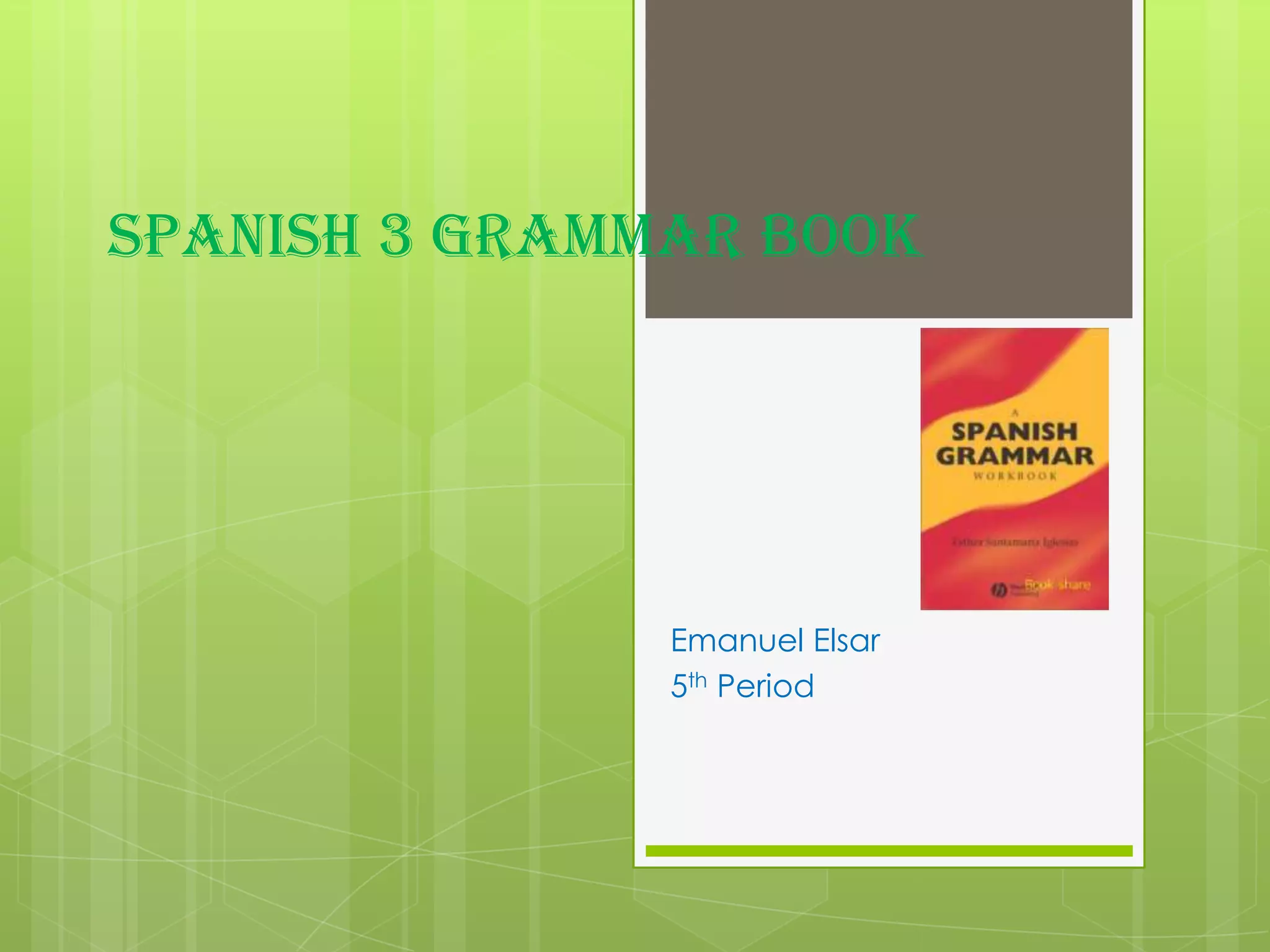
Spanish 3 Grammar BookEmanuel Elsar5th Period
TABLE OF CONTENTSEl PretéritoPretérito TriggerWordsEl ImperfectoImperfecto TriggerWordsComparativos y SuperlativosConnecting/TransitionWordsVerbslike GustarSnake-y & Snake VerbsSpock VerbsCar/Gar/Zar VerbsSer vs EstarEl FuturoFutureTriggerWordsIrregular-FuturoPorParaCucaracha Verbs
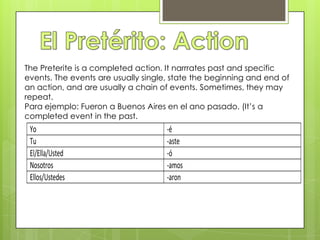
El Pretérito: ActionThe Preterite is a completed action. It narrrates past and specific events. The events are usually single, state the beginning and end of an action, and are usually a chain of events. Sometimes, they may repeat.Para ejemplo: Fueron a Buenos Aires en el anopasado. (It’s a completed event in the past.
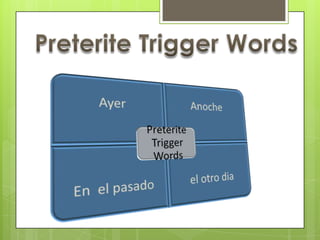
Preterite Trigger Words
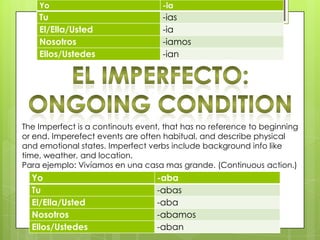
El Imperfecto: OngoingconditionTheImperfectis a continouts event, that has no referencetobeginningorend. Imperefectevents are often habitual, and describe physical and emotionalstates. Imperfectverbsincludebackgroundinfolike time, weather, and location.Para ejemplo: Vivíamos en una casa mas grande. (Continuousaction.)
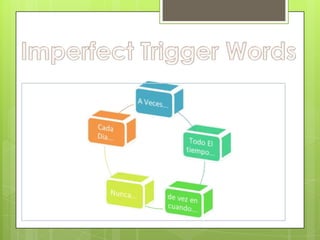
Imperfect Trigger Words
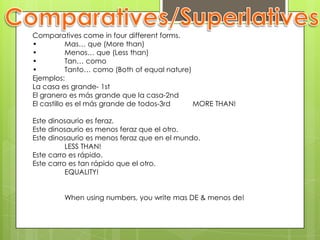
Comparatives/SuperlativesComparatives come in four different forms.•	Mas… que (More than)•	Menos… que (Less than)•	Tan… como•	Tanto… como (Both of equal nature)Ejemplos: La casa es grande- 1stEl granero es más grande que la casa-2ndEl castillo es el más grande de todos-3rd	MORE THAN!Este dinosaurio es feraz.Este dinosaurio es menos feraz que el otro.Este dinosaurio es menos feraz que en el mundo.	LESS THAN!Este carro es rápido.Este carro es tan rápido que el otro.	EQUALITY!	When using numbers, you write mas DE & menos de!
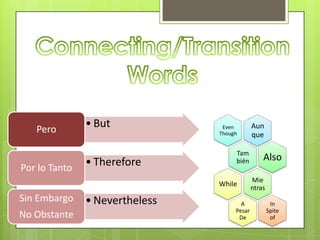
Connecting/Transition Words
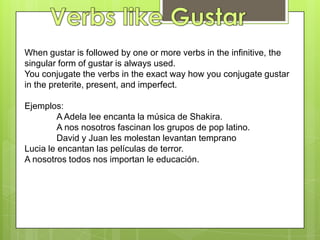
Verbs like GustarWhen gustar is followed by one or more verbs in the infinitive, the singular form of gustar is always used.You conjugate the verbs in the exact way how you conjugate gustar in the preterite, present, and imperfect. Ejemplos:	A Adela lee encanta la música de Shakira.	A nosnosotrosfascinan los grupos de pop latino. 	David y Juan les molestanlevantantempranoLucia le encantanlaspelículas de terror.A nosotrostodosnosimportan le educación.
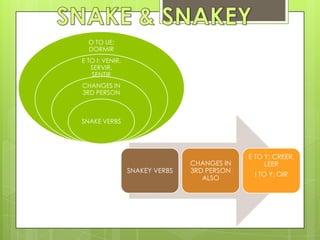
SNAKE & SNAKEY
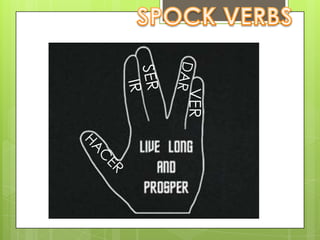
SPOCK VERBSSERDARIRVERHACER
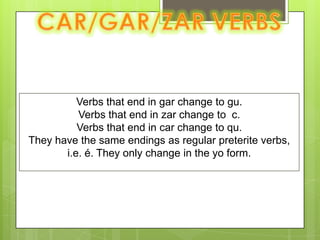
CAR/GAR/ZAR VERBSVerbs that end in gar change to gu.Verbs that end in zar change to  c.Verbs that end in car change to qu.They have the same endings as regular preterite verbs, i.e. é. They only change in the yo form.
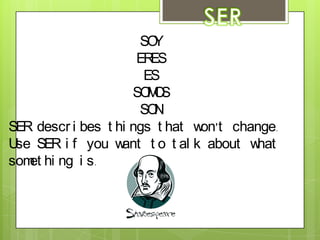
SERSOYERESESSOMOSSONSER describes things that won’t change. Use SER if you want to talk about what something is.
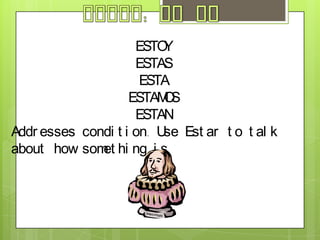
ESTAR: TO BEESTOYESTASESTAESTAMOSESTANAddresses condition. Use Estar to talk about how something is.
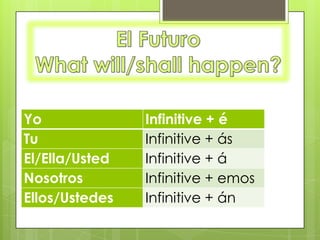
El FuturoWhat will/shall happen?
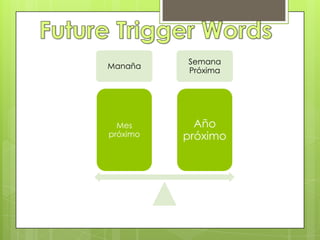
Future Trigger Words
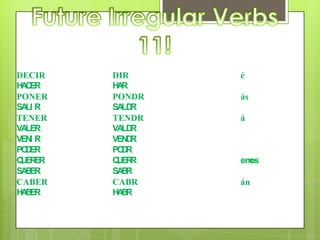
Future Irregular Verbs11!DECIR			DIR				é		HACER			HAR					PONER			PONDR				ásSALIR			SALDR	TENER			TENDR				áVALER			VALDRVENIR			VENDR			PODER			PODRQUERER			QUERRemosSABER			SABRCABER			CABR				ánHABER		HABR
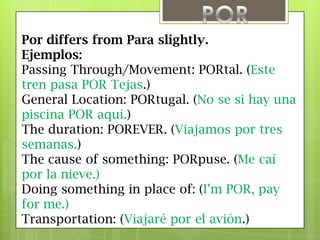
PORPor differs from Para slightly.Ejemplos: Passing Through/Movement: PORtal. (Este trenpasa POR Tejas.)General Location: PORtugal. (No se si hay unapiscina POR aqui.)The duration: POREVER. (Viajamosportressemanas.)The cause of something: PORpuse. (Me caípor la nieve.)Doing something in place of: (I’m POR, pay for me.)Transportation: (Viajarépor el avión.)
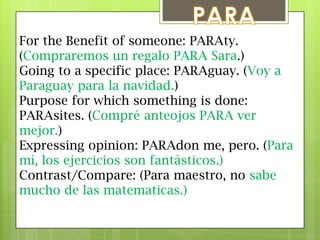
PARAFor the Benefit of someone: PARAty. (Compraremos un regalo PARA Sara.)Going to a specific place: PARAguay. (Voy a Paraguay para la navidad.)Purpose for which something is done: PARAsites. (Compréanteojos PARA vermejor.)Expressing opinion: PARAdon me, pero. (Para mí, los ejercicios son fantásticos.)Contrast/Compare: (Para maestro, no sabe mucho de lasmatematicas.)
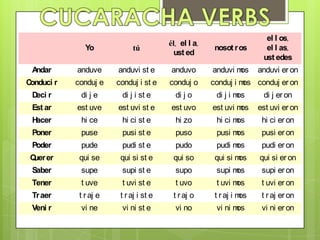
CUCARACHA VERBS

Emanuel Elsar Grammar Book

  • 1.
    Spanish 3 GrammarBookEmanuel Elsar5th Period
  • 2.
    TABLE OF CONTENTSElPretéritoPretérito TriggerWordsEl ImperfectoImperfecto TriggerWordsComparativos y SuperlativosConnecting/TransitionWordsVerbslike GustarSnake-y & Snake VerbsSpock VerbsCar/Gar/Zar VerbsSer vs EstarEl FuturoFutureTriggerWordsIrregular-FuturoPorParaCucaracha Verbs
  • 3.
    El Pretérito: ActionThePreterite is a completed action. It narrrates past and specific events. The events are usually single, state the beginning and end of an action, and are usually a chain of events. Sometimes, they may repeat.Para ejemplo: Fueron a Buenos Aires en el anopasado. (It’s a completed event in the past.
  • 4.
  • 5.
    El Imperfecto: OngoingconditionTheImperfectisa continouts event, that has no referencetobeginningorend. Imperefectevents are often habitual, and describe physical and emotionalstates. Imperfectverbsincludebackgroundinfolike time, weather, and location.Para ejemplo: Vivíamos en una casa mas grande. (Continuousaction.)
  • 6.
  • 7.
    Comparatives/SuperlativesComparatives come infour different forms.• Mas… que (More than)• Menos… que (Less than)• Tan… como• Tanto… como (Both of equal nature)Ejemplos: La casa es grande- 1stEl granero es más grande que la casa-2ndEl castillo es el más grande de todos-3rd MORE THAN!Este dinosaurio es feraz.Este dinosaurio es menos feraz que el otro.Este dinosaurio es menos feraz que en el mundo. LESS THAN!Este carro es rápido.Este carro es tan rápido que el otro. EQUALITY! When using numbers, you write mas DE & menos de!
  • 8.
  • 9.
    Verbs like GustarWhengustar is followed by one or more verbs in the infinitive, the singular form of gustar is always used.You conjugate the verbs in the exact way how you conjugate gustar in the preterite, present, and imperfect. Ejemplos: A Adela lee encanta la música de Shakira. A nosnosotrosfascinan los grupos de pop latino. David y Juan les molestanlevantantempranoLucia le encantanlaspelículas de terror.A nosotrostodosnosimportan le educación.
  • 10.
  • 11.
  • 12.
    CAR/GAR/ZAR VERBSVerbs thatend in gar change to gu.Verbs that end in zar change to c.Verbs that end in car change to qu.They have the same endings as regular preterite verbs, i.e. é. They only change in the yo form.
  • 13.
    SERSOYERESESSOMOSSONSER describes thingsthat won’t change. Use SER if you want to talk about what something is.
  • 14.
    ESTAR: TO BEESTOYESTASESTAESTAMOSESTANAddressescondition. Use Estar to talk about how something is.
  • 15.
  • 16.
  • 17.
  • 18.
    PORPor differs fromPara slightly.Ejemplos: Passing Through/Movement: PORtal. (Este trenpasa POR Tejas.)General Location: PORtugal. (No se si hay unapiscina POR aqui.)The duration: POREVER. (Viajamosportressemanas.)The cause of something: PORpuse. (Me caípor la nieve.)Doing something in place of: (I’m POR, pay for me.)Transportation: (Viajarépor el avión.)
  • 19.
    PARAFor the Benefitof someone: PARAty. (Compraremos un regalo PARA Sara.)Going to a specific place: PARAguay. (Voy a Paraguay para la navidad.)Purpose for which something is done: PARAsites. (Compréanteojos PARA vermejor.)Expressing opinion: PARAdon me, pero. (Para mí, los ejercicios son fantásticos.)Contrast/Compare: (Para maestro, no sabe mucho de lasmatematicas.)
  • 20.