006-013_LB2-SB2B_U01.indd 6 3/28/07 10:15:26 AM
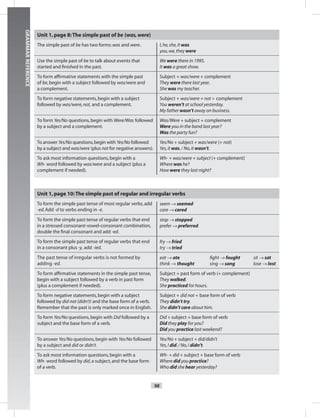
English
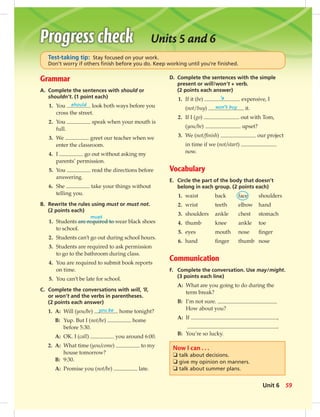
Level 4
Authorized adaptation from the United Kingdom edition, entitled
Snapshot, first edition, published by Pearson Education Limited
publishing under its Longman imprint.
Copyright © 1998.
American English adaptation, published by Pearson Education,
Inc. Copyright © 2008.
Copyright © 2008 by Pearson Education, Inc.
All rights reserved. No part of this publication may be
reproduced, stored in a retrieval system, or transmitted in any
form or by any means, electronic, mechanical, photocopying,
recording, or otherwise, without the prior permission of the
publisher.
Pearson Education, 10 Bank Street, White Plains, NY 10606
ISBN-13: 978-0-13-396536-0
ISBN-10: 0-13-396536-8
PRESIDENTE DE LA REPÚBLICA
Rafael Correa Delgado
MINISTRO DE EDUCACIÓN
Augusto Espinosa Andrade
VICEMINISTRO DE EDUCACIÓN
VICEMINISTRO DE GESTIÓN EDUCATIVA
SUBSECRETARIA DE FUNDAMENTOS EDUCATIVOS
DIRECTORA NACIONAL DE CURRÍCULO
© Ministerio de Educación del Ecuador, 2014
Av. Amazonas N34-451 y Atahualpa
Quito, Ecuador
www.educacion.gob.ec
La reproducción parcial o total de esta publicación, en cualquier forma y por
cualquier medio mecánico o electrónico, está permitida siempre y cuando
sea autorizada por los editores y se cite correctamente la fuente.
Tannya Lozada
Jaime Roca Gutiérrez
Isabel Ramos Castañeda
Freddy Peñafiel Larrea
Impreso por El Telégrafo
DISTRIBUCIÓN GRATUITA - PROHIBIDA SU VENTA
Primera edición: julio 2014
DIRECTORA NACIONAL DE COMUNICACIÓN
DISEÑADOR GRÁFICO
Lorena Portalanza
José Antonio Valencia
006-013_LB2-SB2B_U01.indd 6 3/28/07 10:15:26 AM
Postcards 2B, Teacher's Book
TEACHER'S BOOK - LEVEL 4
First Edition
006-013_LB2-SB2B_U01.indd 6 3/28/07 10:15:26 AM
TO OUR TEACHERS
e
The Ministry of Education aims at providing Ecuador’s students with both the foreign
language knowledge and the skills needed to succeed in today’s globalized world
as English is the international language that will allow them to access knowledge
and information and that will become an instrument of personal and professional
empowerment to build a more prosperous, equitable society.
rst time, the Ministry of Education will provid free English textbooks
to students. This will contribute to the learning process in a positive manner,
for every student will have an additional resource to aid them in their language
acquisition process.
These textbooks as well as the teaching-learning approach adopted are guided
by the Common European Framework of Reference for Languages: Learning,
Teaching, Assessment, which is an internationally recognized standard for the
explicit description of educational objectives, content elaboration, and methods as
ection on current educational practices.
Furthermore, because students will be taught under the Communicative Language
exible process, and
promotes learner autonomy, teachers and learners are enthusiastically invited to
make use of the English language for meaningful communication and as a tool to
open windows to the world, unlock doors to opportunities, and expand their minds
to the understanding of new ideas and other cultures.
The Ministry of Education has also created in-service teacher standards aligned
to TESOL, establishing the benchmark as to what teachers need to know.
ciency level
for pre-service and in-service English teachers, has also been institutionalized,
cient in the language.
Finally, through a rigorous evaluation procedure and teachers’ development plan,
the Ministry of Education will assist current in-service English teachers in improving
ciency levels to foster the teaching-learning processes
in the classroom.
We hope that by way of these innovations
—new standards, a new curriculum, and new
textbooks—students and teachers alike will be more
motivated in their classrooms to gain thorough
knowledge of English while developing their
personal language skills and enhancing their
professional abilities, respectively.
Ministry of Education
006-013_LB2-SB2B_U01.indd 6 3/28/07 10:15:26 AM
Contents
Teacher’s Edition
Scope and Sequence iv
Introduction vi
Characters xvi
Let’s get started. T2
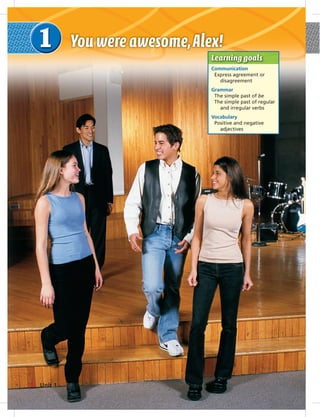
UNIT 1 You were awesome,Alex! T6
UNIT 2 I used to dream of ... T14
Progress check T21
Game 1 T22
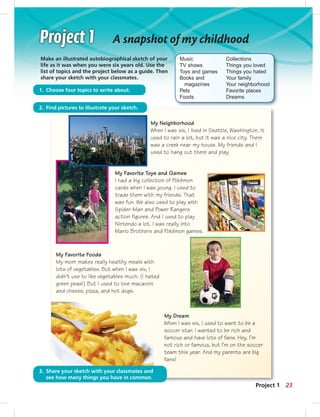
Project 1 T23
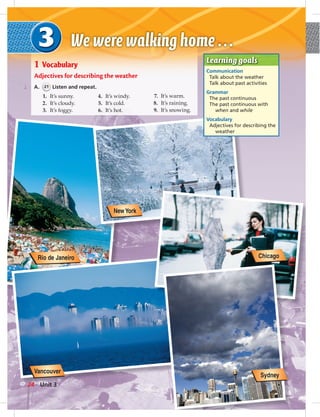
UNIT 3 We were walking home ... T24
Wide Angle 1 T32
UNIT 4 You’re the best in the group. T34
Progress check T41
UNIT 5 You shouldn’t be upset. T42
Game 2 T50
Project 2 T51
UNIT 6 I’ll teach you if you want
to learn. T52
Progress check T59
Wide Angle 2 T60
Fun with songs 1–2 T62
Focus on culture 1–2 T64
Fun with grammar T68
Word list 70
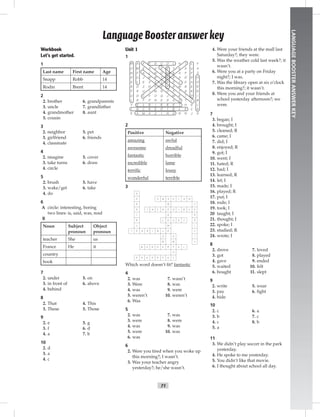
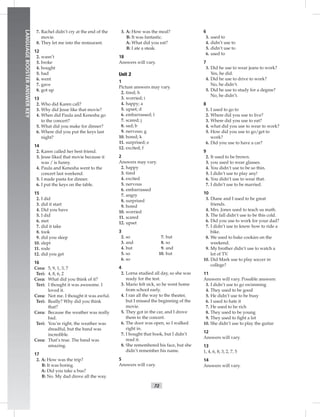
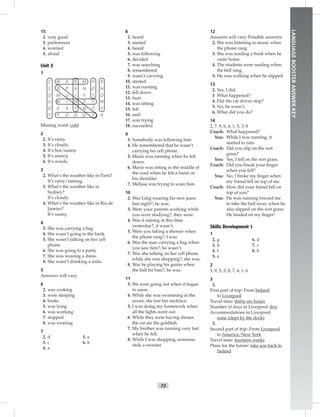
Language Booster answer keys 71
Unit tests 79
Quarterly tests 86
Tests answer key 94
Grammar reference 97
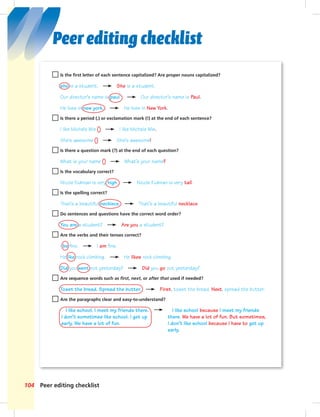
Peer editing checklist 104
Student self-evaluation checklist 105
Certificate of achievement 107
iv Scope and Sequence
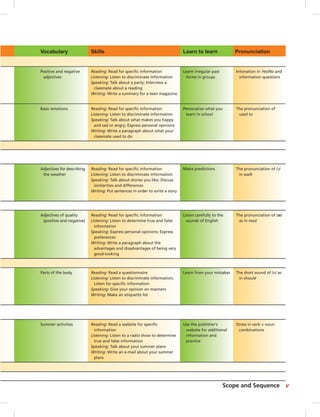
Unit Title Communication Grammar
Scope and Sequence
You were awesome,
Alex!
Pages 6–13
Express agreement or
disagreement
The simple past of be
The simple past of regular and irregular verbs
I used to dream of ...
Pages 14–20
Express opinion Conjunctions: and, but, so
Used to for past habits
Page 21
Page 22
Page 23
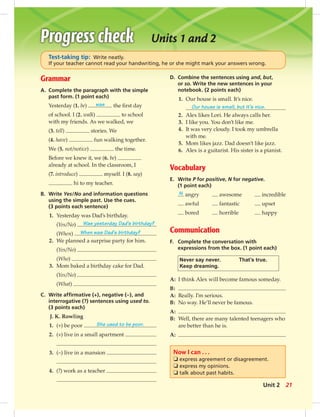
Progress check Units 1 and 2 Test-taking tip: Write neatly.
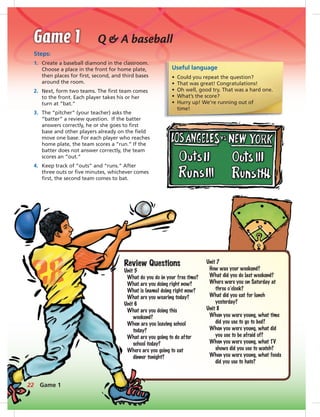
Game 1: Q & A baseball
Project 1: A snapshot of my childhood
We were walking
home ...
Pages 24–31
Talk about the weather
Talk about past activities
The past continuous
The past continuous with when and while
The simple past and the past continuous
Pages 32–33 Wide Angle 1: A traditional story
You’re the best in the
group.
Pages 34–40
Talk about preferences The comparative and superlative forms of
adjectives
Making comparisons with as + adjective + as
Page 41 Progress check Units 3 and 4 Test-taking tip: Look out for key words.
You shouldn’t be upset.
Pages 42–49
Express decisions Will for predictions and decisions
Should/Shouldn’t for advice
Must/Must not for rules and obligations
Page 50
Page 51
Game 2: Say and do the opposite
Project 2: A snapshot of a trip
I’ll teach you if you
want to learn.
Pages 52–58
Talk about summer plans May/Might for possibility
First conditional: If clause + will/might
Progress check Units 5 and 6 Test-taking tip: Stay focused on your work.Page 59
Wide Angle 2: Summer campsPages 60–61
Pages 2–5 Let’s get started.
vScope and Sequence
Vocabulary Skills Learn to learn Pronunciation
The pronunciation of /æ/
as in mad
Positive and negative
adjectives
Reading: Read for specific information
Listening: Listen to discriminate information
Speaking: Talk about a party; Interview a
classmate about a reading
Writing: Write a summary for a teen magazine
Learn irregular past
forms in groups
Intonation in Yes/No and
information questions
Basic emotions Reading: Read for specific information
Listening: Listen to discriminate information
Speaking: Talk about what makes you happy
and sad or angry; Express personal opinions
Writing: Write a paragraph about what your
classmate used to do
Personalize what you
learn in school
The pronunciation of
used to
Adjectives for describing
the weather
Reading: Read for specific information
Listening: Listen to discriminate information
Speaking: Talk about stories you like; Discuss
similarities and differences
Writing: Put sentences in order to write a story
Make predictions The pronunciation of /ɔ/
in walk
Adjectives of quality
(positive and negative)
Reading: Read for specific information
Listening: Listen to determine true and false
information
Speaking: Express personal opinions; Express
preferences
Writing: Write a paragraph about the
advantages and disadvantages of being very
good-looking
Listen carefully to the
sounds of English
The short sound of /u/ as
in should
Parts of the body Reading: Read a questionnaire
Listening: Listen to discriminate information;
Listen for specific information
Speaking: Give your opinion on manners
Writing: Make an etiquette list
Learn from your mistakes
Summer activities Reading: Read a website for specific
information
Listening: Listen to a radio show to determine
true and false information
Speaking: Talk about your summer plans
Writing: Write an e-mail about your summer
plans
Use the publisher’s
website for additional
information and
practice
Stress in verb + noun
combinations
vi
INTRODUCTION
Introduction
Dear Teacher,
Welcome to the second edition of Postcards, a
four-level language course designed specifically for
young teenagers who are studying English.
1. Postcards immediately captures students’
attention by:
• Introducing teenage characters with whom
students readily identify
• Presenting the real-life language that young
speakers of American English use
• Focusing on up-to-date situations, topics, and
themes that teenagers inherently recognize and
respond to
• Providing stimulating sensory input through
engaging photos, illustrations, and realia chosen
especially for the teen learner
2. Postcards holds teenagers’ attention by:
• Offering a great variety of lesson formats,
exercises, and activities
• Personalizing learning through activities that
allow students to talk about themselves, their
world, and their ideas
• Providing activities that challenge students’ minds
as well as their linguistic skills
• Offering extensive communicative practice,
cross-cultural exploration, group and individual
projects, song activities, games, and competitions
3. Postcards gives all students the opportunity to
achieve success and a sense of achievement by:
• Giving clear, concise, and easy-to-understand
language presentations
• Providing carefully sequenced exercises that
allow students to easily master English grammar
and vocabulary
• Offering level-appropriate communicative
activities that enable students to express
themselves with the English they’ve learned
• Providing extensive recycling as well as follow-
up reinforcement and practice in the Language
Booster Workbook and Grammar Builder
4. Postcards helps students set goals, develop
learner independence, and monitor progress by:
• Setting clear goals for each unit and section
• Presenting an inductive approach to grammar
• Providing explicit instruction and practice in
learning strategies
• Offering extensive pair and group work with a
focus on cooperative learning and peer feedback
• Allowing opportunities for students to regularly
monitor their progress through Progress checks,
Student self-evaluation checklists, and unit and
quarterly tests
Student Book
Each Student Book consists of six units divided
into sections of two units. Each unit is followed
either by Putting it together (a photostory activity)
or a Progress check. The pattern is as follows:
Photo
StoryUnit Pages
Progress
CheckUnit Pages
Unit 1
Unit 2
Each Student Book also contains optional materials
that can be done with or after each of the units.
Suggestions as to when to complete each activity
are listed in this Teacher’s Edition. The optional
activities are: Games, Projects, Wide Angle on the
world, Fun with songs, Focus on culture, and Fun
with grammar.
Language Booster
The Language Booster is divided into two parts:
• A Workbook, and
• A Grammar Builder containing grammar reference
pages and extra grammar practice exercises.
The Workbook section is divided into units
that correspond to those in the Student Book.
It gives practice in Grammar, Vocabulary, and
Communication. It also provides additional practice
in reading and writing.
The Workbook includes three levels of exercises for
each Grammar, Vocabulary, and Communication
section: Get started (easy), Move on (medium),
and Reach for the top (challenging). Designed
for mixed-level and mixed-ability classes, the
Language Booster recognizes that all students will
be motivated if they are given tasks that allow them
to succeed as well as to achieve higher goals.
Most students will benefit from completing the first
two levels of the Workbook exercises, and some may
wish to attempt all three. Students who already have
a basic knowledge of English may find they need to
complete only the second and third levels.
vii
INTRODUCTION
The Skills development section includes additional
readings and skills practice.
The Grammar Builder section provides additional
grammar exercises as well as grammar reference
pages called Grammar highlights. This section
reviews and clarifies structures presented in each
unit of the Student Book.
The Grammar Builder can be used alongside
the Workbook units or at a later stage for extra
reinforcement or review.
The Language Booster is a flexible resource that
offers self-access material for students in a wide
range of teaching situations. It is not necessary for
students to work through all the material, although
they can do so if they wish.
Teacher’s Edition
The Teacher’s Edition contains unit-by-unit lesson
notes interleaved with the relevant Student Book
pages. The notes include suggestions on how to
teach the material, ideas for extension activities, as
well as all answer keys and listening audioscripts.
Photocopiable unit and quarterly tests are provided
at the end of the Teacher’s Edition, as well as an
extensive Grammar reference section.
All answer keys to the Language Booster and the
tests are found at the end of the Teacher’s Edition.
Class Audio CDs
The Class Audio CDs contain all the recorded
material from the Student Book: the Dialogues, the
Pronunciation, Useful expressions, and Vocabulary
sections, the Listening exercises, the models for the
Communication activities, the Readings, and the
Putting it together photostories.
Classroom management
Setting up an environment where students feel
encouraged, motivated, challenged, and valued is
the key to a successful class. Some helpful practices
include:
• Maintain class structure. Plan each lesson well.
Maintain a regular routine when beginning and
ending class, when doing exercises and practices,
when assigning pairs and groups, and when
checking work; in this way students will have a
clear understanding of the structure of the class
and what is expected of them.
• Personalize. Learn student names at the start of
the term; learn about your students’ personalities
and interests; use this to tailor exercises and
content to a particular class. Maintain eye contact
with your students as you teach. Let each student
know you are interested in his or her progress.
• Keep students involved. Limit the amount of
time you spend explaining information—instead,
elicit information from students by asking simple
questions in English. Alternate asking questions of
the entire class and calling on individual students
to answer; this will ensure all students are listening,
involved, and have an opportunity to participate.
• Maintain a fun, challenging pace. Set a time limit
for activities so students will know they have a
limited amount of time to complete the activity;
when most students have finished an activity,
move on to the next stage—this will motivate
students to work hard and maintain student
interest in the lesson.
• Give clear instructions. Always elicit one or
more answers at the start of a written exercise
or provide a model (teacher-student, student-
student, etc.) for pair and group work so that all
students understand what to do. If you discover
at the start of an exercise that many students have
misunderstood the instructions, immediately stop
the activity to clarify instructions and provide
another model.
• Monitor and reward students. Walk around the
room as individuals, pairs, or groups are working
on an activity. Keep an eye on all students so that
you know which ones need your help or guidance.
Reward students both verbally and non-verbally
for their effort and achievement as they work.
When students have finished an activity, always
perform a check for the class and give feedback.
viii
INTRODUCTION
Teaching techniques
The choice of teaching techniques obviously
depends on the individual classroom situation
and your preferred teaching style. Below are some
suggested techniques:
➤Pair and group work
Many of the exercises in Postcards are designed so
that students can work in pairs simultaneously.
In pair work, students’ talking time is increased
dramatically, and students engage in extensive
practice in a short period of time. It’s important
to vary pairings in class so each student gets an
opportunity to work with a variety of others. Vary
pairs by having students work with the student on
the left, on the right, in front of, or behind them.
To assign pairs efficiently, give explicit verbal
instructions and examples, such as Work with the
partner on your right. (pointing to the student at the
end of the row) You’re A. (pointing to the student on
his/her right) You’re B. (pointing at the next pair)
You’re A; you’re B. (pointing at the next row) You’re A;
you’re B. Etc.
You can also form random pairs. This works
especially well when you have pairs stand to perform
the exercise. Say, for example: Stand and find a partner
you haven’t worked with before. You have fifteen seconds to
find a partner. Everybody, stand and find a partner!
Students can work in groups when they do
discussions, task-based activities, role-plays,
questionnaires, and projects. Group work is an
effective vehicle for encouraging cooperation and
independent learning. It also provides shy students
the opportunity to open up and participate. You
can form groups with students of similar ability so
that each student is performing at his/her level.
Alternatively, you can form groups of students with
mixed ability so that the more capable students can
help others. As with pairs, vary group members so
students are exposed to a variety of others. To assign
groups efficiently, give explicit instructions and
examples of how students are to form their groups.
Setting up: modeling and time limits
When students will be working independently in
pairs or groups, follow written or verbal instructions
with a model to ensure all students understand how
to proceed. Depending on student level and the
complexity of the task, you may wish to model in
more than one of the following ways to make sure
students know what to do:
• Teacher to self (T-T):
T: What’s your name? (Pause) I’m Mr. Mori.
• Teacher to student (T-S):
T: (pointing to student) What’s your name? S: I’m Taro.
• Student to teacher (S-T):
T: (pointing to student) Ask me. S: What’s your
name? T: I’m Mr. Mori.
• Student to student (S-S):
T: (pointing to student) Ask Taro. S1: What’s your
name? S2: I’m Taro.
• Student 1 to Student 2 to Student 3, etc., in a chain
(S1-S2-S3):
T: (pointing to student) Taro, ask Miki. Miki, answer
and ask Tomo. Tomo, answer and ask the next student,
and so on. S1: What’s your name? S2: I’m Miki.
What’s your name? S3: I’m Tomo. What’s your name?
S4: I’m . . .
To make sure students are focused and work
quickly, set a time limit for the task. Warn students
halfway through the task how many minutes they
have left. Warn them again one minute or so before
the time is up.
Monitoring and correction
After modeling, it’s important to move around
the classroom and unobtrusively monitor pairs or
groups. While monitoring:
• Make sure students are demonstrating that
they understand how to do the exercise; if most
students have not understood, you may need to
do another model.
• Make sure that students are using the main target
language (the grammatical or lexical focus of the
practice) correctly; if most students are not, you may
want to stop to do a quick review and encourage
students to pay attention to language usage.
• Don’t correct minor errors. Just take note of any
important ones or ones which would be helpful
for the whole class to give feedback on later.
• Move unobtrusively from group to group to help,
encourage, and praise students as needed. Listen
for pairs or groups with typical or interesting
conversations—you may wish to call on these to
share their work during the check.
Following through: checking
After pairs or groups have finished an exercise, it
is important to check by calling on a few pairs or
groups to present their exchanges, ideas, summaries,
etc., to the class. This will allow the class to see
typical or interesting examples of pair and group
work, and provide feedback and closure. For
dialogues and exchanges, call on pairs or groups
to stand and perform for the class. For discussions,
you may wish to call on one person from the pair or
group to summarize the conversation.
➤Repetition and choral practice
Repetition and choral practice helps students
reproduce and remember sounds, words, and
structural patterns. Repeating chorally can also help
students gain confidence before they are asked to
perform individually. Repetition and choral practice
can be used with Dialogues, Putting it together
photostories, Grammar focus charts, Pronunciation
exercises, Vocabulary lists, Useful expressions, and
Communication and Speaking exchanges.
ix
INTRODUCTION
Options
Below are some different patterns for repetition and
choral practice:
• Whole class: Everyone, repeat after me/the CD.
Optimal for the first time a dialogue, exchange,
or vocabulary item is presented—the whole class
repeats after the teacher or audio.
• Half the class at a time: This half of the class repeat
after A, then this half of the class after B. Useful for
dialogues or exchanges with two roles, or for
encouraging competition between two sides of a
class for each line of a dialogue or exchange. This
can also be done with horizontal or vertical rows:
(pointing to the appropriate rows) Even-numbered
rows repeat after A, odd-numbered rows repeat after B.
• Groups: This group repeats after A, this group after
B, and this group after C. Useful with dialogues or
exchanges involving multiple roles. Make sure
each group gets to repeat after each role once.
• Individual checks: Pedro, repeat. Useful for
monitoring individual pronunciation and
keeping all students actively involved, individual
checks can be interspersed with any class or
group choral repetition.
Techniques
A good technique for choral practice is
“backchaining,” in which students repeat an
utterance—usually a sentence—in parts, starting
from the end and building up to the complete
utterance; for example: Repeat after me, everybody
. . . start? . . . movie start? . . . does the movie start?
. . . What time does the movie start? The key to effective
backchaining is to keep intonation consistent.
Choral repetition must be fast-paced and
challenging in order to maintain student
involvement. A good technique for maintaining
pace is “overlapping,” or presenting the beginning
of a new line or phrase just as students are finishing
repeating the previous one; for example:
Teacher: How are you?
Class: How are you?
Teacher: I’m fine, thanks. (as students
are saying you)
Important stress and intonation patterns can be
emphasized by exaggerating and using body
language during choral repetition; for example,
saying stressed words more loudly and with
gestures: What TIME does the movie START?
➤Homework and homework correction
The writing exercises in the Student Book and in
the Language Booster may be given as homework.
It is a good idea to prepare students beforehand
for homework by making sure that instructions
are understood, clarifying any new vocabulary or
expressions, and eliciting one or two exercise items
for each step or exercise.
Homework can be corrected in the following ways:
• Check answers to exercises by eliciting the
answers orally in class and writing answers on the
board as needed.
• Have students correct their partner’s exercises
using a photocopied answer key or with the
teacher reading out the answers.
• For written paragraphs and compositions, have
students check their partner’s work using the Peer
editing checklist (page 104 of the Student Book).
Suggested procedures for the Student Book
The Student Book offers an array of interesting and
engaging material that students will enjoy doing in
class. Below are some suggested general procedures
for each element in the Student Book.
➤Learning goals
The Learning goals highlight the main points of
Communication, Grammar, and Vocabulary in each
unit. Before starting a lesson, you may want to have
students look at the Learning goals.
Suggested procedures
• Draw students’ attention to the items in the
Communication section; for example, Express
agreement or disagreement (Unit 1). Ask the class to
give examples, either in English or L1, of language
that they expect to learn in the unit.
• Read or call on a student to read aloud the
Grammar goals. Don’t explain the grammar point
at this time; it is enough to introduce students to
the terminology at this point. Tell students that
they will learn more about the Grammar points in
the unit.
• Refer students to the word groups listed in the
Vocabulary section; for example, Positive and
negative adjectives (Unit 1). Elicit examples of
English words students already know in these
groups.
• After students have completed the unit, you may
wish to have students refer back to the Learning
goals. Ask them to give examples for each of the
goals listed, and to confirm that they have met
the goal.
➤Large photographs
The large photographs that accompany the
presentation material at the beginning of each unit
are an important teaching resource. They can be
used for warm-up and to help students predict the
scene of the dialogue or the focus of the activity.
They can also be used to elicit key vocabulary or to
teach cultural differences between the United States
and the students’ own culture. After the lesson, the
photographs can also be used to review what the
students already know about the characters, such as
their names, ages, and relationships.
Suggested questions for exploiting the large
photographs are given in the teaching notes.
x
INTRODUCTION
Dialogues and Comprehension exercises
The dialogues in Postcards develop the storyline and
present new structures and functions in context.
The following guidelines are for handling dialogues
in general. Specific suggestions for teaching the
dialogues are given in the lesson notes.
Suggested procedures
Before you play the dialogue:
• Ask questions about the large photograph to
set the scene for the dialogue and help students
predict what it will be about.
• Have students cover the dialogue with a notebook,
a piece of paper, or their hand.
• Tell them to look at the Comprehension
questions. Read or call on students to read the
Comprehension questions aloud. Alternatively,
have students read the questions silently. Preteach
any new vocabulary students will need to
understand to answer the questions.
Depending on your students’ abilities, play the
audio once, twice, or three times. After each
listening, give your students a moment to complete
their answers to the Comprehension questions. You
may want to ask students to raise their hands if
they would like to listen again. When students have
completed the questions:
• Have students uncover the dialogue. Play the
audio and have students read along to check their
answers to the comprehension questions.
• Elicit the answers, writing them on the board if
needed. If students have difficulty with any of the
items, elicit the line(s) of the dialogue where the
answer is given.
• Play the audio again, stopping at intervals to
explain or elicit the meanings of new vocabulary
or expressions, to elicit the unit’s grammatical
structures, or to give background information
(see dialogue Background notes in this Teacher’s
Edition). Some techniques for teaching new
vocabulary are:
tnemnorivnemoorssalcehtnistcejbolaergnisu•
flgniwohs• ashcards or magazine pictures
rodraobehtnosmargaiddnasehcteksgnisu•
overhead projector
gnitcadnagnimim•
hsilgnEelpmisnisgninaemgninialpxe•
seiranoitcidesustnedutsgnivah•
Depending on your students’ needs and your
situation, you may want to either move on to the
next exercise at this point, or you may instead want
to have students practice the dialogue to further
familiarize them with it. Procedures for further
practice are:
• Read or play the dialogue again, pausing after
each sentence or line for students to listen and
repeat chorally and individually. Work on
students’ pronunciation, intonation, and stress.
Vary the choral repetition pattern for different
dialogues (see Options, page ix) and use a
variety of techniques (backchaining, overlapping,
exaggeration and body language; see Techniques,
page ix).
• Assign students to pairs or groups, depending on
the number of characters in the dialogue, and have
them practice reading aloud. Make sure students
switch roles so that each student has the chance to
read each role at least once.
• Time permitting, after the initial pair or group
readings, you may want to do one of the following
activities to increase students’ fluency and grasp of
the language:
dnaspuorgrosrentrapegnahcstnedutsevaH•
practice each role again; encourage students to
read as quickly and as naturally as they can.
koolneht,enilhcaedaeryltnelisstnedutsevaH•
up and say it, making eye contact with their
partner(s) as they speak.
strapehttuotcadnadnatsstnedutsevaH•
dramatically, using facial expressions and
gestures.
• After pair or group practice, call on one or two
pairs or groups to stand and perform the dialogue
in front of the class.
Useful expressions
The Useful expressions are a selected list of phrases
and expressions from the dialogue that are either
common collocations or colloquial expressions. The
students should learn these as fixed items. Do not
attempt to explain the grammar behind the phrases
unless the students ask specifically for information
of this kind. Useful expressions are recycled in
appropriate contexts in the rest of the unit and in the
subsequent units.
Suggested procedures
• Check that the students understand the meanings
of the expressions by eliciting the meaning or
having them give examples of situations when the
expressions are used.
• Play the audio and ask the students to repeat the
phrases chorally. Work on pronunciation, stress,
and intonation as needed. Then have students
complete the exercises.
• You may want to keep a list of the Useful
expressions presented during the course so that
you can use them yourself when interacting with
students and review them at regular intervals.
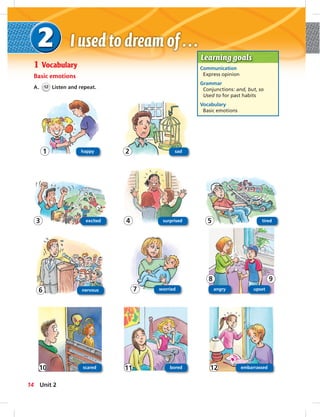
Vocabulary
Vocabulary is presented in lexical groups and
practiced through exercises and tasks linked to the
grammatical or communicative focus of the unit.
The illustrations in Postcards have been carefully
chosen to help you teach new vocabulary.
xi
INTRODUCTION
Suggested procedures
• Play the CD and have students practice
pronouncing the vocabulary items. Pause the
audio and help students as needed. Use the
illustration or another teaching device to make
sure students understand the vocabulary.
• Model or elicit the first one or two exercise items.
Then have students work individually, in pairs, or
in groups to complete each exercise. Monitor, help,
and praise students as they work. When most
students are finished, call on students to share
their answers with the class.
• You may want to have students keep a small
notebook in which they list new words and
expressions along with their definitions.
➤Pronunciation
The Pronunciation exercises isolate and practice
important sounds, stress and intonation patterns,
as well as suprasegmental features (linking,
blending, etc.).
Suggested procedures
• Briefly introduce the pronunciation feature.
Model mouth position for basic sounds; use
the board or gestures for stress, intonation, and
suprasegmental features. Special tips for teaching
each pronunciation item are included in the lesson
notes for each unit.
• Play the audio and have students practice the
target sound several times. Pause the audio and
help students as needed. When students are able
to form the correct sounds, have them complete
the related exercise.
Phonetic transcriptions in the Teacher’s Edition
follow those used in the Longman Dictionary of
American English.
➤Grammar focus, Discovering grammar, and
Practicing grammar
The Grammar focus charts present the grammatical
forms or structures taught in a unit. The Grammar
focus presentations are always followed by
Discovering grammar. This section invites students
to learn grammar inductively—that is, to figure out
the main grammar rules by themselves. Discovering
grammar is followed by the Practicing grammar
section, which consists of several practice exercises
that enable students to produce the relevant
grammatical form or structure presented in the
Grammar focus chart.
Suggested procedures
• Read the grammar chart heading aloud, or call
on a student to read it. Explain or elicit any new
grammatical terms.
• Have students read the examples, either silently or
aloud. Tell them to pay particular attention to the
parts in boldface.
• Ask students to think about the grammar rule or
rules involved. Then have them work individually
or in pairs to complete the Discovering grammar
section.
• Elicit answers to the Discovering grammar section.
Clarify any difficulties.
• Explain or elicit other relevant information about
the grammatical item(s) presented in the chart (see
specific teaching notes for each lesson, as well as
the Grammar reference section at the back of this
Teacher’s Edition). Refer the students back to the
dialogue or presentation text to find examples of
the structures, if helpful.
• Move on to the Practicing grammar section
immediately. These exercises should be done in
class rather than as homework. This will enable
you to detect any problems the students may
have with applying the grammar. The exercises
progress from more controlled to less controlled
application of the grammar.
• For each Practice exercise, model or elicit the first
one or two answers or exchanges. Have students
work individually, in pairs, or groups to complete
each exercise. Walk around the room to monitor,
help, and praise students as they work. When the
majority of the class is finished, elicit the answers
or call on pairs or groups to present to the class.
Write answers on the board as needed.
➤Communication
The Communication sections focus on the important
communicative functions to be practiced in the
unit. The communication exchanges develop
the grammar from the unit in a communicative
context—for example, Express agreement or
disagreement (Unit 1).
Suggested procedures
• Point out the communicative function to be
practiced and play the audio.
• Practice the exchanges chorally, using
backchaining to help students with overall rhythm
and intonation (see Techniques, page ix).
• Read the instructions for Exercise B and model
the role-play (teacher-student, student-student,
etc.). Have students practice in pairs or groups,
with each student practicing each role one or
more times. To help students internalize and gain
fluency with the language, assign new partners
and have students practice again; alternatively,
have students stand and practice, changing
partners several times (say, for example, Practice
with at least four other students).
• Call on one or more pairs or groups to stand and
perform for the class. If helpful, you may want to
have students write out the conversation after the
oral practice.
xii
INTRODUCTION
➤Learn to learn
The Learn to learn sections are designed to help
students become better language learners. This
section presents general learning strategies as well
as specific strategies for reading, listening, speaking,
writing, and vocabulary acquisition. Students are
then given a task with which they can practice
applying the learning strategy.
Suggested procedures
• Read the strategy aloud or call on a student
to read it. Elicit or explain how the strategy is
helpful.
• Tell students that they will now practice using the
strategy. Read or call on students to read the task
instructions. Model or elicit one or more answers if
needed. Then have students complete the task.
• After checking the task, ask students if they found
the strategy helpful. Elicit when and where they
could apply this strategy.
• Recycle the strategy whenever applicable: recycle
a reading strategy in the next reading exercise,
recycle a listening strategy in the next listening
exercise, etc. Recycle by reminding students of the
strategy, eliciting how to perform it, and asking
students to practice applying it. By repeatedly
applying the strategy, students will internalize it.
➤Teen talk
The Teen talk sections are designed to let students
talk about topics of interest in a casual, relaxing
manner with little or no teacher intervention.
While many of the activities in Postcards focus on
accuracy, Teen talk focuses primarily on teen-to-teen
communication. It gives students a chance to pay
less attention to form and more attention to getting
their ideas across in English.
Suggested procedures
• Read or have students read the instructions, then
quickly chorus the Useful language. Follow with
a teacher-student or student-student model of the
beginning of the discussion.
• Assign groups and let students discuss. Walk
around and monitor as students work. You may
occasionally need to mediate—for example, to
encourage shy students to give their opinions—
but avoid correcting or offering language help
unless asked.
• When students have finished, call on several
students to share their thoughts and ideas on the
topic with the class.
➤Your turn
The Your turn section personalizes a topic and allows
students to apply recently learned language. The
activity may be oral or written. Follow standard
procedures for pair, group, or writing activities.
➤Listening
There are a variety of types of Listening exercises in
Postcards. All include the structures, functions, and
vocabulary in focus. Audioscripts may highlight
a telephone conversation, an extract from a radio
program, an interview, or a recorded continuation
of the storyline featuring the main characters. Each
listening is accompanied by a simple task such as
completing a chart or answering comprehension
questions. Some tasks ask students to listen for
specific information, while others encourage them to
listen for gist rather than at word level.
Suggested procedures
• Set the context of the Listening. Ask warm-up
questions to generate interest.
• Make sure that students understand the
instructions and task.
• Always have students read over the questions,
chart, etc., before they begin. Elicit or explain any
new words in the task.
• Play the audio once for students to grasp the
general idea. Ask a few simple comprehension
questions. Play the audio again once or twice
and have students complete the answers to the
task as they listen. If students still have difficulty
completing the task after a third listening, play
the audio once more and stop at key points where
students need to record information.
• Check the answers to the task. Replay the audio
if helpful.
➤Reading
The importance of reading cannot be overestimated.
It gives confidence and motivates learning. It
provides context for new language and serves as
a model for writing. Most important of all, it is
a stimulus for ideas and discussion. The reading
texts in Postcards are varied in type and length and
are often adapted from authentic sources such as
brochures, newspapers, and magazines.
Suggested procedures
• Ask a few general warm-up questions to set the
context of the reading. Elicit the title and ask
questions about the photographs. Ask students to
predict what the reading will cover.
• Have students read the instructions and questions
or task, explaining any new vocabulary words
therein. Make sure students understand what they
are to do.
• Have the students read the text silently once
or twice to themselves. Alternatively, play the
audio or read the text aloud the first time with
the students following along in their books, then
let them read the text again silently. Encourage
students to guess the meaning of new words and
expressions as they read.
• Have the class do the comprehension task, either
individually or in pairs.
xiii
INTRODUCTION
• Check the answers. Elicit or explain the meanings
of any key vocabulary items. If helpful, have the
students do a final confirmation reading of the text.
➤Writing
Writing tasks have a twofold purpose: to consolidate
the language in focus and to help students produce
specific text types. The detailed lesson notes give
guidance for handling specific writing tasks.
Suggested procedures
• There is often a model reading or set of questions
that will help guide students through the Writing
exercise. Encourage them to consider the model as
they think about and then write their paragraph(s).
• Help students brainstorm about what kind of
content they might include in their writing. You
may wish to do this as a class, in groups, or in pairs.
• Encourage students to make notes or an outline
before they begin writing. If helpful, review the
relevant paragraph structure with your students;
for example:
• topic sentence
• examples or support
• conclusion
• If students are performing the Writing exercise
in class, circulate to monitor and help them.
Encourage them to check a dictionary for the
spellings of new words.
• After students have finished their writing, have
them exchange papers with a partner and mark
their partner’s work using the Peer editing
checklist on page 104. Then have students take
back and correct their writing before turning it
in to you. You may wish to have students use the
following correction symbols when marking each
others’ work:
sp = spelling gr = grammar wo = word order
v = vocabulary p = punctuation
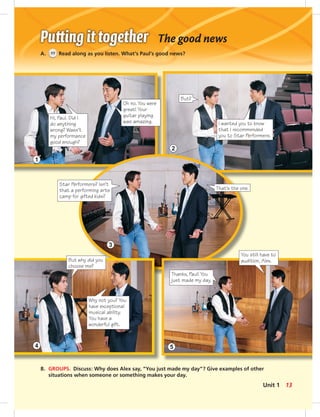
➤Putting it together
Putting it together is a photostory activity that
occurs at the end of odd-numbered units (Units
1, 3, and 5). It features the main characters and
consolidates previously learned language with a
predicting and listening activity. Follow standard
listening activity procedures.
You may want to extend this section by treating the
photostory text as a dialogue with chorusing and
pronunciation work, pair or group practice, and
dramatic enactment. The photographs and dialogue
can also be used to discuss American life and culture
and compare it with students’ own.
➤Progress checks
The Progress checks are found after every two
units (Units 2, 4, and 6). They give students a
chance to measure their progress on a regular basis.
Each begins with a Test-taking tip to help students
learn strategies for doing their best on tests. The
Progress check tasks are divided into three sections:
Grammar, Vocabulary, and Communication. There
is also a Now I can . . . checklist for students to
reflect on what they have learned in the previous
two units.
To calculate student scores on the Progress checks,
simply total the number of possible points per
section (the number of items minus the examples).
Then divide the number of correct responses by the
total number of points. For example, on a test with
63 possible points, a student answered 46 correctly.
Divide 46, the number of correct responses, by 63,
the number of possible points. The calculation (46 ÷
63 = .73) results in a score of 73%.
Optional Sections
The following are optional sections that can be
done with or after units. Suggestions as to teaching
procedure and when to complete each activity are
listed at the optional point of use. You may wish to
use all of these activities or just a few, depending on
your situation and student needs.
➤Games
Games are found after Units 2 and 5 of the Student
Book. The Games are designed to practice relevant
grammar and vocabulary in a relaxed and fun format.
They provide students with the opportunity to
consolidate language while having fun.
➤Projects
Projects are found after each game. These Projects
provide students with the opportunity to produce a
piece of work based on their own input and ideas,
while at the same time consolidating and expanding
on the language they have learned. Project work
fosters creativity, learner independence, and
cooperation with other students.
Make sure that you and the students can give
sufficient time to each Project. Some may be
completed in one or two class hours, while others
are longer-term assignments.
➤Wide Angle on the world
Wide Angle readings come after every third unit.
Each expands on a theme from previous units.
Wide angle offers additional integrated practice in
reading, speaking, listening, writing, vocabulary
development, and learning strategies.
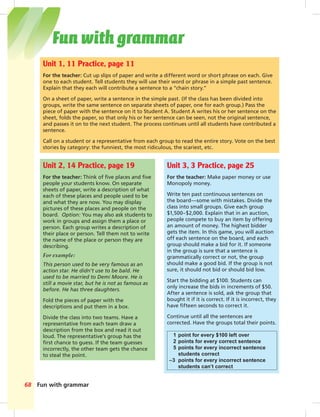
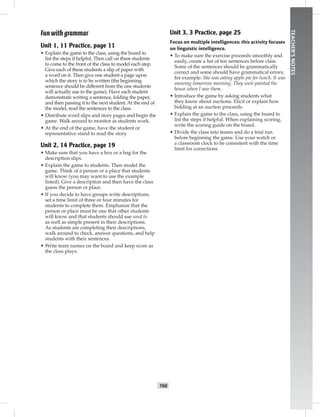
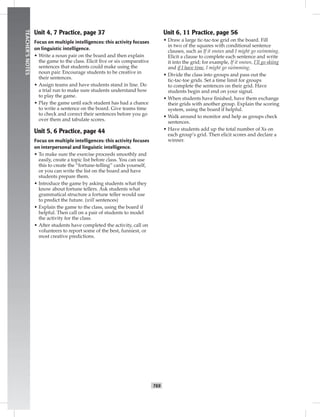
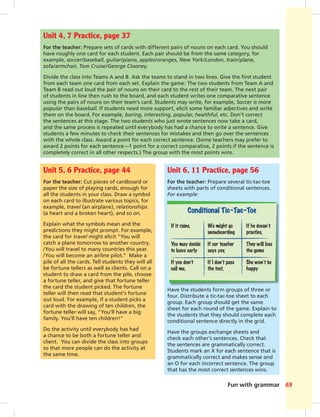
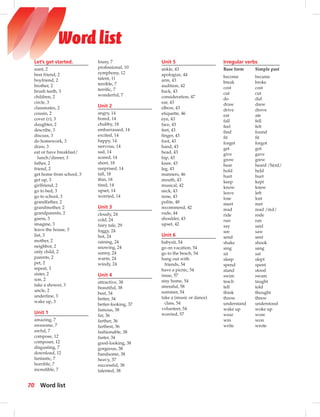
➤Fun with grammar
Throughout the units, students are referred to
the Fun with grammar activities located in the
back of the Student Book. These grammar-based
competitions are designed to be fun while at the
same time allow for review and reinforcement of
unit content.
xiv
INTRODUCTION
➤Fun with songs
The Fun with songs section is found at the end of
the Student Book. These song projects provide an
opportunity for students to take a break and relax,
listen to and discuss music and musicians, and
gain a greater appreciation and understanding of
English songs.
➤Focus on culture
Focus on culture pages are found at the end of the
Student Book. These readings allow students to gain
cross-cultural understanding through the study of
other cultures and comparisons with their own. Each
Focus on culture spread includes discussion and
writing practice.
Special Features in the Teacher’s Edition
➤Background notes
Background notes in this Teacher’s Edition present
in-depth information on U.S. and world culture as
touched on in the dialogues, exercises, and readings
presented in the Student Book. Relevant information
from the notes can be shared with students to
increase their cross-cultural understanding.
➤Focus on multiple intelligences
Recognizing that students have a variety of learning
styles and abilities, teaching suggestions in this
Teacher’s Edition include notes on activities with
a strong focus on multiple intelligences. These
activities will benefit students with natural affinities
for specific intelligences and related learning styles.
At the same time, focusing on different intelligences
can help all students explore and further develop
a wider range of learning modes. The intelligences
highlighted in the teaching notes are:
Kinesthetic: Students with a strong kinesthetic, or
bodily, intelligence will learn well when engaging
in activities involving motor skills. Activities such
as hands-on projects, games, total physical response
exercises (TPR), and the acting out of dialogues
and scripts with movement and gestures stimulate
kinesthetic intelligence.
Visual: A student with visual/spacial intelligence
responds to visual representations and is good at
creating mental images. Making or using pictures,
diagrams, graphic organizers, maps, symbols,
photos or videos, etc., will be helpful for this type of
learner, as will activities involving visualizing.
Auditory: A student with strong auditory/musical
intelligence is sensitive to sounds and patterns of
rhythm, intonation, and pitch. Students with this
type of intelligence will be stimulated by activities
involving sound—pronunciation and intonation
work, listening exercises, songs, jazz chants, etc.
Logical: A student with developed logical/
mathematical intelligence is good at thinking
logically, recognizing patterns, and doing
calculations. A logical learner will benefit from
activities involving deductive and inductive
thinking, classification, rules, and processes.
Linguistic: Students with a high degree of linguistic
intelligence are talented at extracting meaning from
text and using language to express meaning. They
tend to be good at learning languages and generally
have an affinity for writing, reading, summarizing,
giving speeches, and other language-based activities.
Interpersonal: Students with a high degree of
interpersonal intelligence have a developed
sensitivity to others and learn well through social
interactions. Pair and group work, collaborative
learning, interviewing, writing dialogues, and
reflecting on social situations presented in dialogues
are examples of activities helpful to an interpersonal
learner.
Intrapersonal: A student who is self-reflective
and sensitive to his or her own feelings tends to
have a high degree of intrapersonal intelligence.
Independent work, self-assessment, self-reflection,
personalizing, journal-writing, and thinking about
one’s personal reaction to situations and topics will
be of benefit to the intrapersonal learner.
➤Focus on values
As the classroom is one of the best places to help
young people develop values and character, each
unit of the Teacher’s Edition includes notes focusing
on values. The characters and situations presented
in the dialogues and photostories are modeled after
real teens and thus present numerous opportunities
for reflection on appropriate and inappropriate
behavior. Focus on values notes provide suggestions
on how to help students recognize and react to
implicit and explicit values, attitudes, and behavior
in dialogues and photostories.
➤Cross-curricular activities
The Teacher’s Edition includes Cross-curricular
activity suggestions for each unit of the Student
Book. These activities encourage students to
use—and sometimes expand—their knowledge of
social studies, science, literature, and the arts while
practicing English.
➤Home/School connection
Parents play a fundamental role in the education
of their children. The more they get involved and
encourage their children to work at home, the
better results students achieve. For this reason
the Teacher’s Edition provides Home/School
connection suggestions on increasing parental
involvement in students’ English education.
➤Grammar reference
The Grammar reference section found at the end of
the Teacher’s Edition provides in-depth grammatical
xv
INTRODUCTION
background about the structures and elements in
each of the grammar charts in the Student Book. The
Grammar reference section provides any necessary
grammatical information the teacher needs to
successfully teach the unit grammar. Depending
on the level and prior knowledge of students, the
teacher may wish to share or elicit some or all of this
extra grammatical information in class.
➤Unit and Quarterly tests
Photocopiable Unit and Quarterly tests (every
three units), as well as their answer keys, are found
at the end of the Teacher’s Edition. The answer
keys specify the total number of possible points for
each test: 50 points for Unit tests and 150 points for
Quarterly tests. To calculate student scores, simply
divide the number of correct responses by the total
number of possible points. For example, on a test
with 50 possible points, a student answered 45
correctly. Divide 45, the number of correct responses,
by 50, the number of possible points. The calculation
(45 ÷ 50 = .90) results in a score of 90 percent.
➤Student self-evaluation checklists
A photocopiable Student self-evaluation checklist is
found at the end of the Teacher’s Edition. You may
copy and give this to students after each unit so that
they may reflect on and assess their own progress.
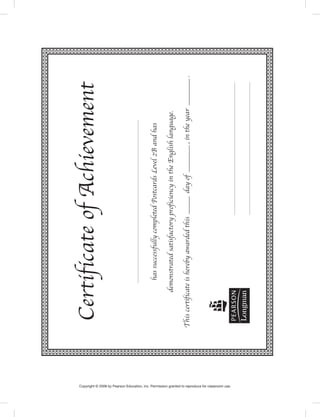
➤Certificate of completion
The Certificate of completion at the back of this
Teacher’s Edition may be photocopied and given to
students at the successful completion of this course.
The certificate serves as a concrete symbol of the
effort and progress the student has made in his or
her English study.
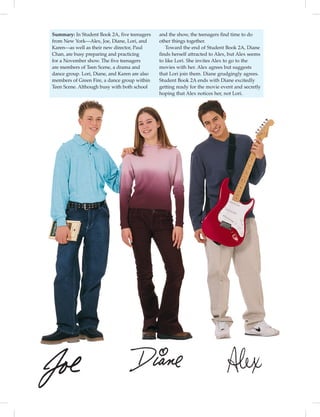
Summary: In Student Book 2A, five teenagers
from New York—Alex, Joe, Diane, Lori, and
Karen—as well as their new director, Paul
Chan, are busy preparing and practicing
for a November show. The five teenagers
are members of Teen Scene, a drama and
dance group. Lori, Diane, and Karen are also
members of Green Fire, a dance group within
Teen Scene. Although busy with both school
and the show, the teenagers find time to do
other things together.
Toward the end of Student Book 2A, Diane
finds herself attracted to Alex, but Alex seems
to like Lori. She invites Alex to go to the
movies with her. Alex agrees but suggests
that Lori join them. Diane grudgingly agrees.
Student Book 2A ends with Diane excitedly
getting ready for the movie event and secretly
hoping that Alex notices her, not Lori.
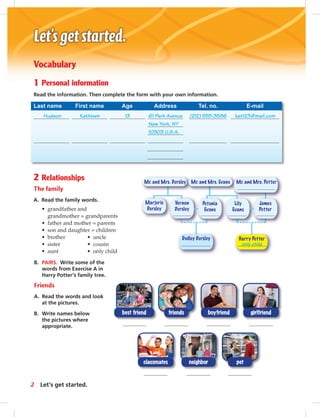
Mr. and Mrs. Evans Mr. and Mrs. PotterMr. and Mrs. Dursley
Dudley Dursley Harry Potter
Marjorie
Dursley
Vernon
Dursley
Petunia
Evans
Lily
Evans
James
Potter
only child
Vocabulary
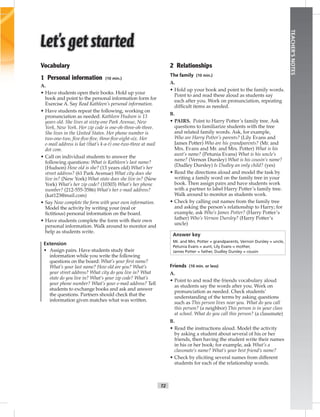
1 Personal information
Read the information. Then complete the form with your own information.
Last name First name Age Address Tel. no. E-mail
Hudson Kathleen 13 61 Park Avenue (212) 555-3586 kat123@mail.com
New York, NY
10303 U.S.A.
2 Relationships
The family
A. Read the family words.
• grandfather and
grandmother = grandparents
• father and mother = parents
• son and daughter = children
• brother • uncle
• sister • cousin
• aunt • only child
B. PAIRS. Write some of the
words from Exercise A in
Harry Potter’s family tree.
Friends
A. Read the words and look
at the pictures.
B. Write names below
the pictures where
appropriate.
classmates neighbor pet
girlfriendboyfriendbest friend friends
2 Let’s get started.
T2
TEACHER’SNOTES
Vocabulary
1 Personal information (10 min.)
A.
• Have students open their books. Hold up your
book and point to the personal information form for
Exercise A. Say Read Kathleen’s personal information.
• Have students repeat the following, working on
pronunciation as needed: Kathleen Hudson is 13
years old. She lives at sixty-one Park Avenue, New
York, New York. Her zip code is one-oh-three-oh-three.
She lives in the United States. Her phone number is
two-one-two, five-five-five, three-five-eight-six. Her
e-mail address is kat (that’s k-a-t) one-two-three at mail
dot com.
• Call on individual students to answer the
following questions: What is Kathleen’s last name?
(Hudson) How old is she? (13 years old) What’s her
street address? (61 Park Avenue) What city does she
live in? (New York) What state does she live in? (New
York) What’s her zip code? (10303) What’s her phone
number? (212-555-3586) What’s her e-mail address?
(kat123@mail.com)
• Say Now complete the form with your own information.
Model the activity by writing your (real or
fictitious) personal information on the board.
• Have students complete the form with their own
personal information. Walk around to monitor and
help as students write.
Extension
• Assign pairs. Have students study their
information while you write the following
questions on the board: What’s your first name?
What’s your last name? How old are you? What’s
your street address? What city do you live in? What
state do you live in? What’s your zip code? What’s
your phone number? What’s your e-mail address? Tell
students to exchange books and ask and answer
the questions. Partners should check that the
information given matches what was written.
2 Relationships
The family (10 min.)
A.
• Hold up your book and point to the family words.
Point to and read these aloud as students say
each after you. Work on pronunciation, repeating
difficult items as needed.
B.
• PAIRS. Point to Harry Potter’s family tree. Ask
questions to familiarize students with the tree
and related family words. Ask, for example,
Who are Harry Potter’s parents? (Lily Evans and
James Potter) Who are his grandparents? (Mr. and
Mrs. Evans and Mr. and Mrs. Potter) What is his
aunt’s name? (Petunia Evans) What is his uncle’s
name? (Vernon Dursley) What is his cousin’s name?
(Dudley Dursley) Is Dudley an only child? (yes)
• Read the directions aloud and model the task by
writing a family word on the family tree in your
book. Then assign pairs and have students work
with a partner to label Harry Potter’s family tree.
Walk around to monitor as students work.
• Check by calling out names from the family tree
and asking the person’s relationship to Harry; for
example, ask Who’s James Potter? (Harry Potter’s
father) Who’s Vernon Dursley? (Harry Potter’s
uncle)
Answer key
Mr. and Mrs. Potter = grandparents, Vernon Dursley = uncle,
Petunia Evans = aunt, Lily Evans = mother,
James Potter = father, Dudley Dursley = cousin
Friends (10 min. or less)
A.
• Point to and read the friends vocabulary aloud
as students say the words after you. Work on
pronunciation as needed. Check students’
understanding of the terms by asking questions
such as This person lives near you. What do you call
this person? (a neighbor) This person is in your class
at school. What do you call this person? (a classmate)
B.
• Read the instructions aloud. Model the activity
by asking a student about several of his or her
friends, then having the student write their names
in his or her book; for example, ask What’s a
classmate’s name? What’s your best friend’s name?
• Check by eliciting several names from different
students for each of the relationship words.
T3
TEACHER’SNOTES
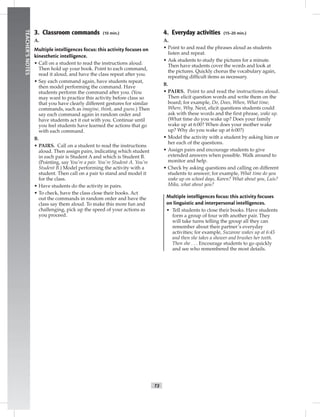
4. Everyday activities (15–20 min.)
A.
• Point to and read the phrases aloud as students
listen and repeat.
• Ask students to study the pictures for a minute.
Then have students cover the words and look at
the pictures. Quickly chorus the vocabulary again,
repeating difficult items as necessary.
B.
• PAIRS. Point to and read the instructions aloud.
Then elicit question words and write them on the
board; for example, Do, Does, When, What time,
Where, Why. Next, elicit questions students could
ask with these words and the first phrase, wake up.
(What time do you wake up? Does your family
wake up at 6:00? When does your mother wake
up? Why do you wake up at 6:00?)
• Model the activity with a student by asking him or
her each of the questions.
• Assign pairs and encourage students to give
extended answers when possible. Walk around to
monitor and help.
• Check by asking questions and calling on different
students to answer; for example, What time do you
wake up on school days, Karen? What about you, Luis?
Mika, what about you?
Multiple intelligences focus: this activity focuses
on linguistic and interpersonal intelligences.
• Tell students to close their books. Have students
form a group of four with another pair. They
will take turns telling the group all they can
remember about their partner’s everyday
activities; for example, Suzanne wakes up at 6:45
and then she takes a shower and brushes her teeth.
Then she . . . Encourage students to go quickly
and see who remembered the most details.
3. Classroom commands (10 min.)
A.
Multiple intelligences focus: this activity focuses on
kinesthetic intelligence.
• Call on a student to read the instructions aloud.
Then hold up your book. Point to each command,
read it aloud, and have the class repeat after you.
• Say each command again, have students repeat,
then model performing the command. Have
students perform the command after you. (You
may want to practice this activity before class so
that you have clearly different gestures for similar
commands, such as imagine, think, and guess.) Then
say each command again in random order and
have students act it out with you. Continue until
you feel students have learned the actions that go
with each command.
B.
• PAIRS. Call on a student to read the instructions
aloud. Then assign pairs, indicating which student
in each pair is Student A and which is Student B.
(Pointing, say You’re a pair. You’re Student A. You’re
Student B.) Model performing the activity with a
student. Then call on a pair to stand and model it
for the class.
• Have students do the activity in pairs.
• To check, have the class close their books. Act
out the commands in random order and have the
class say them aloud. To make this more fun and
challenging, pick up the speed of your actions as
you proceed.
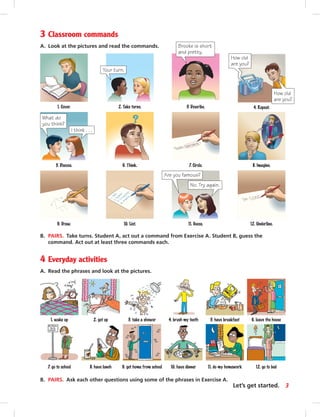
3 Classroom commands
A. Look at the pictures and read the commands.
6. leave the house5. have breakfast4. brush my teeth3. take a shower2. get up1. wake up
B. PAIRS. Take turns. Student A, act out a command from Exercise A. Student B, guess the
command. Act out at least three commands each.
4 Everyday activities
A. Read the phrases and look at the pictures.
12. Underline.
7. Circle.
10. List.9. Draw.
6. Think. 8. Imagine.
3. Describe.
5. Discuss.
1. Cover.
What do
you think?
I think . . .
11. Guess.
Are you famous?
No. Try again.
2. Take turns.
Your turn.
4. Repeat.
How old
are you?
How old
are you?
B. PAIRS. Ask each other questions using some of the phrases in Exercise A.
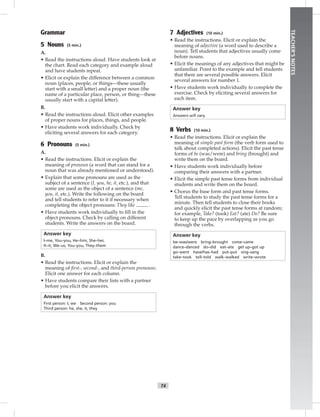
12. go to bed11. do my homework10. have dinner9. get home from school7. go to school 8. have lunch
Brooke is short
and pretty.
3Let’s get started.
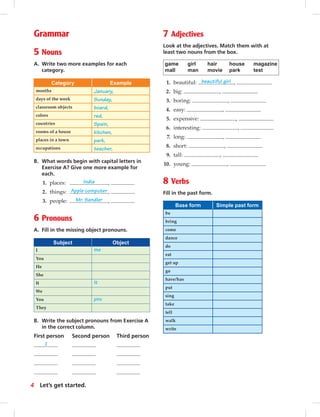
Grammar
5 Nouns
A. Write two more examples for each
category.
Category Example
months January,
days of the week Sunday,
classroom objects board,
colors red,
countries Spain,
rooms of a house kitchen,
places in a town park,
occupations teacher,
B. What words begin with capital letters in
Exercise A? Give one more example for
each.
1. places: India ,
2. things: Apple computer ,
3. people: Mr. Sandler ,
6 Pronouns
A. Fill in the missing object pronouns.
Subject Object
I me
You
He
She
It it
We
You you
They
B. Write the subject pronouns from Exercise A
in the correct column.
First person Second person Third person
I
7 Adjectives
Look at the adjectives. Match them with at
least two nouns from the box.
game girl hair house magazine
mall man movie park test
1. beautiful: beautiful girl ,
2. big: ,
3. boring: ,
4. easy: ,
5. expensive: ,
6. interesting: ,
7. long: ,
8. short: ,
9. tall: ,
10. young: ,
8 Verbs
Fill in the past form.
Base form Simple past form
be
bring
come
dance
do
eat
get up
go
have/has
put
sing
take
tell
walk
write
4 Let’s get started.
T4
TEACHER’SNOTES
Grammar
5 Nouns (5 min.)
A.
• Read the instructions aloud. Have students look at
the chart. Read each category and example aloud
and have students repeat.
• Elicit or explain the difference between a common
noun (places, people, or things—these usually
start with a small letter) and a proper noun (the
name of a particular place, person, or thing—these
usually start with a capital letter).
B.
• Read the instructions aloud. Elicit other examples
of proper nouns for places, things, and people.
• Have students work individually. Check by
eliciting several answers for each category.
6 Pronouns (5 min.)
A.
• Read the instructions. Elicit or explain the
meaning of pronoun (a word that can stand for a
noun that was already mentioned or understood).
• Explain that some pronouns are used as the
subject of a sentence (I, you, he, it, etc.), and that
some are used as the object of a sentence (me,
you, it, etc.). Write the following on the board
and tell students to refer to it if necessary when
completing the object pronouns: They like .
• Have students work individually to fill in the
object pronouns. Check by calling on different
students. Write the answers on the board.
Answer key
I–me, You–you, He–him, She–her,
It–it, We–us, You–you, They–them
B.
• Read the instructions. Elicit or explain the
meaning of first-, second-, and third-person pronouns.
Elicit one answer for each column.
• Have students compare their lists with a partner
before you elicit the answers.
Answer key
First person: I, we Second person: you
Third person: he, she, it, they
7 Adjectives (10 min.)
• Read the instructions. Elicit or explain the
meaning of adjective (a word used to describe a
noun). Tell students that adjectives usually come
before nouns.
• Elicit the meanings of any adjectives that might be
unfamiliar. Point to the example and tell students
that there are several possible answers. Elicit
several answers for number 1.
• Have students work individually to complete the
exercise. Check by eliciting several answers for
each item.
Answer key
Answers will vary.
8 Verbs (10 min.)
• Read the instructions. Elicit or explain the
meaning of simple past form (the verb form used to
talk about completed actions). Elicit the past tense
forms of be (was/were) and bring (brought) and
write them on the board.
• Have students work individually before
comparing their answers with a partner.
• Elicit the simple past tense forms from individual
students and write them on the board.
• Chorus the base form and past tense forms.
Tell students to study the past tense forms for a
minute. Then tell students to close their books
and quickly elicit the past tense forms at random;
for example, Take? (took) Eat? (ate) Do? Be sure
to keep up the pace by overlapping as you go
through the verbs.
Answer key
be–was/were bring–brought come–came
dance–danced do–did eat–ate get up–got up
go–went have/has–had put–put sing–sang
take–took tell–told walk–walked write–wrote
T5
TEACHER’SNOTES
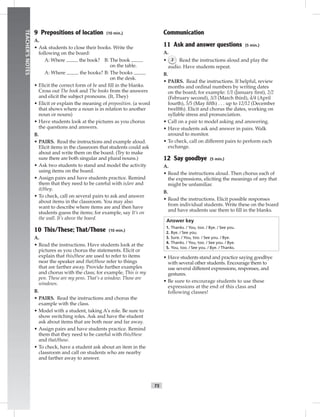
9 Prepositions of location (10 min.)
A.
• Ask students to close their books. Write the
following on the board:
A: Where the book? B: The book
on the table.
A: Where the books? B: The books
on the desk.
• Elicit the correct form of be and fill in the blanks.
Cross out The book and The books from the answers
and elicit the subject pronouns. (It, They)
• Elicit or explain the meaning of preposition. (a word
that shows where a noun is in relation to another
noun or nouns)
• Have students look at the pictures as you chorus
the questions and answers.
B.
• PAIRS. Read the instructions and example aloud.
Elicit items in the classroom that students could ask
about and write them on the board. (Try to make
sure there are both singular and plural nouns.)
• Ask two students to stand and model the activity
using items on the board.
• Assign pairs and have students practice. Remind
them that they need to be careful with is/are and
it/they.
• To check, call on several pairs to ask and answer
about items in the classroom. You may also
want to describe where items are and then have
students guess the items; for example, say It’s on
the wall. It’s above the board.
10 This/These; That/Those (10 min.)
A.
• Read the instructions. Have students look at the
pictures as you chorus the statements. Elicit or
explain that this/these are used to refer to items
near the speaker and that/those refer to things
that are farther away. Provide further examples
and chorus with the class; for example, This is my
pen. These are my pens. That’s a window. Those are
windows.
B.
• PAIRS. Read the instructions and chorus the
example with the class.
• Model with a student, taking A’s role. Be sure to
show switching roles. Ask and have the student
ask about items that are both near and far away.
• Assign pairs and have students practice. Remind
them that they need to be careful with this/these
and that/those.
• To check, have a student ask about an item in the
classroom and call on students who are nearby
and farther away to answer.
Communication
11 Ask and answer questions (5 min.)
A.
• 2 Read the instructions aloud and play the
audio. Have students repeat.
B.
• PAIRS. Read the instructions. If helpful, review
months and ordinal numbers by writing dates
on the board; for example: 1/1 (January first), 2/2
(February second), 3/3 (March third), 4/4 (April
fourth), 5/5 (May fifth) . . . up to 12/12 (December
twelfth). Elicit and chorus the dates, working on
syllable stress and pronunciation.
• Call on a pair to model asking and answering.
• Have students ask and answer in pairs. Walk
around to monitor.
• To check, call on different pairs to perform each
exchange.
12 Say goodbye (5 min.)
A.
• Read the instructions aloud. Then chorus each of
the expressions, eliciting the meanings of any that
might be unfamiliar.
B.
• Read the instructions. Elicit possible responses
from individual students. Write these on the board
and have students use them to fill in the blanks.
Answer key
1. Thanks. / You, too. / Bye. / See you.
2. Bye. / See you.
3. Sure. / You, too. / See you. / Bye.
4. Thanks. / You, too. / See you. / Bye.
5. You, too. / See you. / Bye. / Thanks.
• Have students stand and practice saying goodbye
with several other students. Encourage them to
use several different expressions, responses, and
gestures.
• Be sure to encourage students to use these
expressions at the end of this class and
following classes!
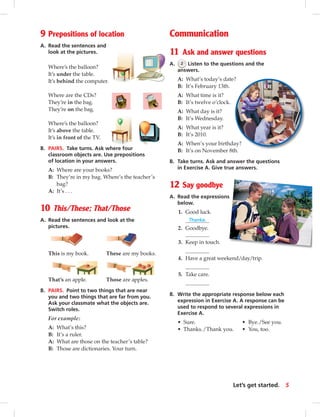
9 Prepositions of location
A. Read the sentences and
look at the pictures.
Where’s the balloon?
It’s under the table.
It’s behind the computer.
Where are the CDs?
They’re in the bag.
They’re on the bag.
Where’s the balloon?
It’s above the table.
It’s in front of the TV.
B. PAIRS. Take turns. Ask where four
classroom objects are. Use prepositions
of location in your answers.
A: Where are your books?
B: They’re in my bag. Where’s the teacher’s
bag?
A: It’s . . .
10 This/These; That/Those
A. Read the sentences and look at the
pictures.
This is my book. These are my books.
That’s an apple. Those are apples.
B. PAIRS. Point to two things that are near
you and two things that are far from you.
Ask your classmate what the objects are.
Switch roles.
For example:
A: What’s this?
B: It’s a ruler.
A: What are those on the teacher’s table?
B: Those are dictionaries. Your turn.
Communication
11 Ask and answer questions
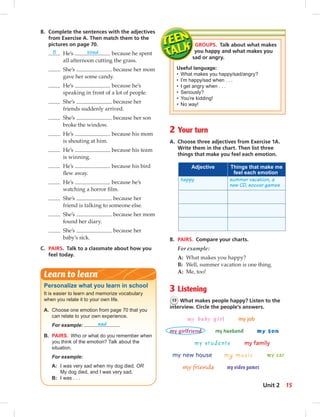
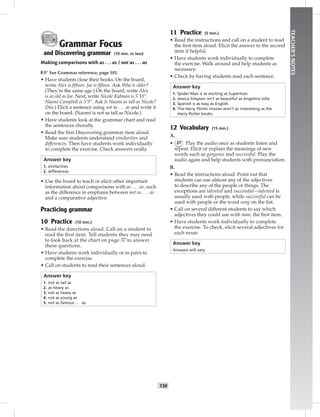
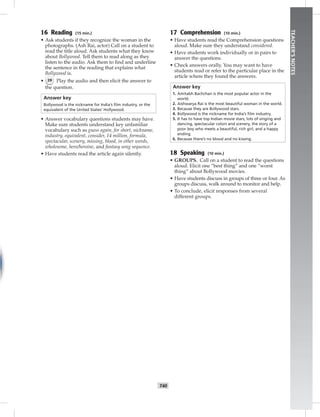
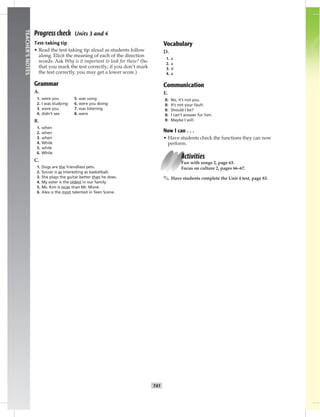
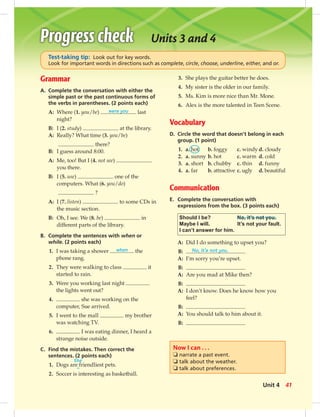
A. 2 Listen to the questions and the
answers.
A: What’s today’s date?
B: It’s February 13th.
A: What time is it?
B: It’s twelve o’clock.
A: What day is it?
B: It’s Wednesday.
A: What year is it?
B: It’s 2010.
A: When’s your birthday?
B: It’s on November 8th.
B. Take turns. Ask and answer the questions
in Exercise A. Give true answers.
12 Say goodbye
A. Read the expressions
below.
1. Good luck.
Thanks.
2. Goodbye.
3. Keep in touch.
4. Have a great weekend/day/trip.
5. Take care.
B. Write the appropriate response below each
expression in Exercise A. A response can be
used to respond to several expressions in
Exercise A.
• Sure. • Bye./See you.
• Thanks./Thank you. • You, too.
5Let’s get started.
Learning goals
Communication
Express agreement or
disagreement
Grammar
The simple past of be
The simple past of regular
and irregular verbs
Vocabulary
Positive and negative
adjectives
6 Unit 1
T6
TEACHER’SNOTES
Warm-up (5 min. or less)
• Ask students to watch carefully. Say I’m going to do
several things and then ask you what I did. Perform
a series of familiar activities that can be described
using regular past forms; for example, walk to the
door, open the door, close the door, walk to your
desk, and pick up a pencil. Pause for a moment
between each action. On the board, write What
did I do? Ask students if this question is in present
or past. (past) Then call on different students to
describe what you did, helping students with the
simple past verbs as needed. Write the verbs on
the board. Tell the class that in this unit they will
practice talking about the past.
Using the large photo (5 min. or less)
• Call on a student to read the unit title aloud.
Elicit the meaning of awesome. (great) Have the
class look at the picture. Ask questions to create a
framework for the dialogue, such as Who do you see
in the picture? (Lori, Alex, Paul, and Diane) Where
are they? (in an auditorium; on stage) What are they
doing? (smiling; Lori, Alex, and Diane are walking
off the stage.) How do you think everyone is feeling?
(happy, excited) Have students guess why Paul
and the kids might be feeling happy.
Learning strategy
• Learn irregular past forms in groups
Pronunciation
• Intonation in Yes/No and information
questions
Skills
• Read for specific information
• Listen to discriminate information
• Talk about a party
• Interview a classmate about a reading
• Write a summary for a teen magazine
Learning goals The following are additional learning goals in this unit:
T7
TEACHER’SNOTES
1 Dialogue and 2 Comprehension (10 min.)
• Have students cover the dialogue.
A.
• Read the Comprehension directions aloud and
have students silently read items one through five.
Ask Are these statements in present or past? (past)
Tell students to listen carefully for what Lori,
Diane, Alex, and Paul say.
• 3 Play the audio two or more times as students
work individually to complete the statements.
B.
• 4 Have students uncover the dialogue and read
along as you play the audio.
• To check, call on students to read each statement
aloud.
Answer key
1. awesome
2. incredible
3. amazing
4. talented
5. terrific
• To extend work with the dialogue, select key
vocabulary and communicative phrases to discuss
more fully, such as congratulations, dance number
(dance performance), dance moves (dance steps),
you guys (informal plural you that can be used for
either boys or girls), There you are (I was looking
for you and you are there), Way to go! (You did
very well!), backstage, for a couple of minutes (for a
short time), and Take your time (Don’t hurry; I can
wait.). Ask Which past forms of be can you find in the
dialogue? (were, was) Which regular past verbs can
you find in the dialogue? (sounded, liked) Point out
the irregular past verbs taught and knew.
• Have students practice the dialogue. Play the
audio or read the dialogue aloud, pausing for
students to repeat. Work on pronunciation as
needed. Then have students work in groups of
four to read the dialogue aloud, switching roles
after each reading so that all students read each
role once. When students have finished, select a
group to perform for the class.
3 Useful expressions (10 min.)
A.
• Direct students’ attention to the Useful
expressions. Quickly elicit the meaning of each.
• 5 Play the audio and have students listen and
repeat. Work on pronunciation as needed.
B.
• Call on a student to read the directions and each of
the items aloud. Make sure students understand
passed a test. Tell students to use each expression
only once. Elicit the answer to the first item, and
then have students work individually or in pairs
to complete the exercise.
• To elicit the answers, call on one student to
read the statement and another to say the
appropriate expression.
Answer key
1. Congratulations!
2. Just for a couple minutes.
3. Way to go!
4. Take your time.
5. There you are.
4 Vocabulary (10 min.)
A.
• 6 Play the audio once as students listen and
repeat. Elicit or explain the meanings of dreadful
and lousy (terrible). Play the audio again and help
students with pronunciation.
B.
• PAIRS. Call on a student to read the directions
aloud. Read the example exchange and have
students say it after you. Elicit some names of
people or movies the students can talk about.
Write these on the board, if helpful. Then have a
pair of students model an original exchange for
the class.
• Have students work in pairs. Walk around as
students talk, helping as necessary.
• To conclude the exercise, call on several pairs to
stand and present an exchange for the class.
Extension
• Have each student write the names of three
famous people they like and three famous
people they don’t like. Then have the class
stand to do a “find someone who” activity. Tell
students to find out others’ opinions by asking
What do you think of . . . ? For each celebrity,
students should write down the name of one
other student who shares their opinion.
Focus on values
• Have students look back at the dialogue. Ask
What adjectives did the characters use to describe
each other’s performances? (awesome, great,
incredible, amazing, terrific) Are these positive or
negative adjectives? (positive) Say Imagine a friend’s
performance is not very good. Would you still use
these positive adjectives? Would you use the negative
adjectives you learned in the Vocabulary section?
• Elicit or explain that sometimes we can help
friends improve if we tell them honestly what we
think. However, it’s always best to mention the
good points first, then make polite suggestions
about what needs to be improved. You may want
to teach students the “3 to 1” rule—it’s helpful
to give three compliments with every suggestion
for improvement.
1 Dialogue
3 Cover the dialogue and listen.
Lori: You were awesome, Alex!
Alex: Thanks! Your dance number was
great, too.
Diane: Congratulations, Alex! You were
incredible! You sounded amazing on
the guitar!
Alex: Thanks. So, who taught you those
dance moves?
Diane: Nobody. Actually, most of our moves
were pretty simple.
Alex: I always knew you guys were
talented.
Paul: There you are. Way to go, kids! That
was a terrific show.
Diane: Did you really think so, Paul? We’re
glad you liked our performance.
Paul: I really did. Um, Alex, can I see
you backstage? Just for a couple of
minutes.
Alex: Sure. Guys, can you wait for me here,
please?
Diane: No problem. Take your time.
2 Comprehension
A. Complete the statements with words from
the dialogue.
1. Lori said Alex was awesome .
2. Diane said Alex was .
3. She also said Alex was
on the guitar.
4. Alex said the girls were .
5. Paul said the show was .
B. 4 Read along as you listen again. Check
your answers.
3 Useful expressions
A. 5 Listen and repeat.
• Congratulations!
• Way to go!
• There you are.
• Just for a couple of minutes.
• Take your time.
B. Which expression from Exercise A would
be appropriate to say for each of these
situations?
1. Your friend just won a spelling
competition. Congratulations!
2. You’re telling someone you only need a
little of their time.
3. Your friend passed a really difficult test.
4. You’re going somewhere with a friend,
but you’re not in a hurry.
5. You’re looking for someone and you
finally find him or her.
4 Vocabulary
Positive and negative adjectives
A. 6 Listen and repeat.
Positive
awesome
amazing
incredible
fantastic
terrific
wonderful
Negative
awful
terrible
horrible
dreadful
disgusting
lousy
B. PAIRS. Give your opinions of some famous
people or movies using some of the
adjectives above. Find out your partner’s
opinions.
For example:
A: I think James Bond movies are fantastic.
What do you think?
B: Oh, I think they’re dreadful!
7Unit 1
Discovering grammar
Look at the grammar chart. Complete the
rules with was or were.
1. The simple past forms of be are
and .
2. With I, He, She, and It, use in
simple past statements.
3. With You, We, and They, use in
simple past statements.
GRAMMAR FOCUS
The simple past of be (was, were)
Affirmative statements Negative statements
I was I wasn’t
You were You weren’t
He/She was
at the party last night.
He/She wasn’t
home last night.
You were You weren’t
We were We weren’t
They were They weren’t
Yes/No Questions Short answers
Were you Yes, I was./No, I wasn’t.
Was he/she
at the party last night?
Yes, he/she was./No, he/she wasn’t.
Were you Yes, we were./No, we weren’t.
Were they Yes, they were./No, they weren’t.
Information questions Answers
Who was at the party last night? I was./We were.
Where was the party? At the school auditorium.
Practicing grammar
5 Practice
Complete the conversation with the past form
of be.
Lori: How was
(1)
the party last Saturday?
Alex: It
(2)
great!
Lori:
(3)
you there all night?
Alex: Oh, yeah. It
(4)
so much fun.
Lori: Who else
(5)
there?
Alex: Paul, of course. His sister
(6)
with him.
Lori: Really? What about the other Teen
Scene members?
(7)
they all
there?
Alex: Yes, they
(8)
. Hey, what’s up
with Diane? She (not)
(9)
happy
at all.
Lori: Beats me. She (not)
(10)
very
talkative earlier.
8 Unit 1
T8
TEACHER’SNOTES
Grammar Focus
and Discovering grammar (10 min. or less)
The simple past of be (was, were)
☞See Grammar reference, page 98.
• To review the formation of the simple past of be,
write on the board Where are you now? Elicit an
answer from an individual and write it on the
board. (I’m in English class.) On the board, cross
out now and write yesterday. Ask the class How do
we change the be verb when we talk about yesterday?
Elicit the changes for both the question and
answer and write them on the board. (were, was)
• Have students look at the grammar chart. Ask
What’s the Grammar focus for this lesson? (the simple
past of be) Divide the class into two groups.
Have one group read the affirmative statements
aloud and the other group read the negative
statements. Do the same with the Yes/No questions
and answers and the information questions and
answers.
• Call on a student to read the Discovering grammar
directions. Elicit the answers to the first item.
• Have students complete the exercise individually.
Elicit answers orally.
Answer key
1. was, were
2. was
3. were
• Use the board to teach or elicit other important
information about the simple past of be, such as
how to form questions and contractions. (See the
Grammar reference.)
Practicing grammar
5 Practice (5 min.)
• Read the directions aloud. Call on students to
identify the people in the picture. (Alex and
Lori) Have a student read the first line of the
conversation aloud. Call on another student to
read the second line and fill in the blank.
• Have students read through the conversation first
without filling in the blanks. Explain or elicit the
meaning of Who else, what’s up with (what’s wrong
with), beats me (I don’t know), and talkative. Then
have students work individually to complete the
exercise.
• Elicit answers by calling on students to read each
line of the conversation aloud.
Answer key
1. was
2. was
3. Were
4. was
5. was
6. was
7. Were
8. were
9. wasn’t
10. wasn’t
• To extend the exercise and prepare students for
the next activity, have them work in pairs to
practice the conversation. Encourage students
to use expressive intonation; model this with
a student if helpful. Have them practice the
conversation several times, switching roles each
time. To conclude, call on a pair to perform the
conversation for the class.
T9
TEACHER’SNOTES
6 Practice (10 min.)
A.
• Read the directions aloud. Call on a student to
read the first item. Review the formation of Yes/No
questions using the simple past of be. You may
want to have students look at the grammar chart
again. Then elicit the answer to the second item.
• Have students work individually or in pairs to
complete the exercise.
• To check, call on individual students to read their
questions aloud.
Answer key
1. Were you at a party recently?
2. When was it?
3. Where was it?
4. What kind of party was it?
5. Who was at the party?
6. How was it?
B.
• PAIRS. Read the directions aloud. Tell students
that if they were at a party recently, they should
give true answers. If they were not at a party
recently, tell them they should make up answers.
You may want to have them guess whether
their partner was giving true or false answers
afterward. Call on a pair to model if helpful.
• Walk around monitoring and helping students as
they practice.
• To check, call on one or more pairs to perform a
conversation for the class.
7 Pronunciation (5 min.)
A.
• 7 Have students look at the Yes/No questions
and information questions. For each, ask students
whether the intonation is rising or falling. Elicit
the rule. (Intonation rises in Yes/No questions and
falls in information questions.) Then play the
audio once or twice and have students repeat.
B.
• PAIRS. Call on a student to read the directions
aloud. Call on a pair of students to model the
exercise.
• Have students practice the sentences in pairs,
paying close attention to correct intonation. After
students have practiced for a few minutes, have
them close their books and practice again.
• Call on pairs to ask the questions without looking
at their books.
8 Communication (10 min.)
A.
• Read the heading. Tell students You’re going to
practice a conversation among three people.
• 8 Play the audio once or twice, pausing for
students to repeat. Emphasize that they should
say the lines with appropriate intonation and
expression.
B.
• GROUPS. Have students work in groups of three.
Tell them to practice the conversation in Exercise A
several times, switching roles each time.
• When students are performing the conversation
fairly fluently, tell them to change the underlined
parts to add their own ideas. If helpful, elicit
some substitutions for the different lines and
write them on the board. Have a group model the
conversation for the class.
• Walk around to monitor and help as students
practice.
• Call on one or two groups to perform a
conversation for the class.
(10 min.)
• GROUPS. Call on a student to read the directions
aloud. Tell students that they should talk about a
party they really attended.
• Do a choral reading of the Useful language by
reading each line and having the class repeat
after you.
• Model using the Useful language in a discussion
with a strong student. Read the first line (I was at a
birthday party last Saturday), then have the student
ask you how it was. Encourage the student to ask
you questions; refer the student to the questions in
Exercise 6 if helpful. Respond using the structures
in the Useful language box.
• Have students form new groups of three. Walk
around to monitor for correct past usage as
students discuss.
• To conclude the exercise, ask several students
What was the last party you attended? Ask each
student several follow-up questions.
6 Practice
A. Write questions with the past tense of be.
Use the cues.
1. (you/at a party recently)
Were you at a party recently?
2. (When/it)
3. (Where/it)
4. (What kind of party/it)
5. (Who/at the party)
6. (How/it)
B. PAIRS. Ask your partner the questions in
Exercise A. Switch roles.
For example:
A: Were you at a party recently?
B: Yes, I was.
7 Pronunciation
Intonation in Yes/No and
information questions
A. 7 Listen and repeat.
Yes/No questions
Were you at a party recently?
Was he there?
Was it fun?
Information questions
When was the party?
What kind of party was it?
How was the party?
B. PAIRS. Alternate reading the examples
above. Student A, read the Yes/No
questions. Student B, read the information
questions.
8 Communication
Express agreement or disagreement
A. 8 Listen to the conversation.
A: Were you at Mike’s party last night?
B: Yes, I was.
A: How was it?
B: It was awesome. I loved it.
C: Not me. I thought it was awful. The food
was really bad.
B: You’re right about that. But the music was
great.
C: That’s true. It was fantastic.
B. GROUPS. Practice the conversation. Then
role-play, replacing the underlined parts
with your own ideas.
GROUPS. Talk about a party you
were at recently. Talk about the
food, the people at the party, and
the activities. Use the questions in
Exercise 6 for ideas.
Useful language:
• I was at a birthday party [last Saturday].
• Really? How was it?
• It was awesome/amazing/incredible/boring.
• There were . . .
• The food/music/dancing was . . .
9Unit 1
Discovering grammar
Look at the grammar chart. Complete the rules with regular, irregular, or both regular and
irregular.
1. With verbs in the simple past, the spelling changes.
2. To form the simple past of verbs, add –ed or –d.
3. In negative statements with verbs, use didn’t and the base form.
4. In questions with verbs, use did and the base form.
Practicing grammar
9 Practice
Complete the biography with the past forms of the verbs in parentheses.
GRAMMAR FOCUS
The simple past of regular and irregular verbs
Affirmative statements Negative statements
I studied music in school. I didn’t study acting.
He/She taught music years ago. He/She didn’t teach acting.
Yes/No questions Short answers
Did you study music? Yes, I did./No, I didn’t.
Did he/she teach music last year? Yes, he/she did./No, he/she didn’t.
Information questions Answers
Where did you study music? I studied at Juilliard.
Where did they teach last year? In Korea.
Wolfgang Amadeus Mozart (1. be) was born on January 27, 1756, in Salzburg, Austria.
Mozart (2. be) a musical prodigy. He (3. be) exceptionally talented in
music. He (4. begin) playing the piano when he (5. be) only three years
old. Soon after, he could play the piano like a professional. At the age of four, Mozart
(6. learn) to play the harpsichord and violin. At ve, he (7. write) his
own music. Mozart (8. give) his rst public performance at the age of six for the
Empress of Austria. Recognizing his child’s talent, Mozart’s father (9. take) his son
on concert tours throughout Europe.
Mozart (10. play) for the rich and for royalty. As a teenager, he (11. write)
and completed his rst opera. He (12. continue) to write great music as an adult, but
(13. not/become) famous. Mozart (14. get married) when he (15. be) 26 years
old. He (16. not/make) much money from his compositions, so he (17. teach) to support
his family. Sadly, his wife (18. become) sick from not eating properly. Soon, Mozart also
(19. got) sick. Before he (20. die) , Mozart (21. give) one of his
students instructions on how to complete his last work, the Requiem Mass.
Mozart (22. die) on December 5, 1791, in Vienna, Austria.
Some irregular verbs
begin ➔ began bring ➔ brought
choose ➔ chose come ➔ came
have ➔ had let ➔ let
make ➔ made put ➔ put
speak ➔ spoke teach ➔ taught
think➔ thought write ➔ wrote
Note: See page 70 for a list of more
irregular verbs.
10 Unit 1
T10
TEACHER’SNOTES
Grammar Focus
and Discovering grammar (10 min.)
The simple past of regular and irregular verbs
☞ See Grammar reference, page 98.
• On the board, write several simple present
sentences which have regular and irregular verbs
when transformed into their past forms; for
example, I walk to school, I study English, I write
e-mail, I have a cat. For each, elicit the past form
of the verb and write it on the board. (walked,
studied, wrote, had) Which verbs are regular verbs?
(walked, studied) Which verbs are irregular verbs?
(wrote, had)
• Have a student read the grammar chart heading
aloud. Then divide the class into two groups. Have
one group read the affirmative statements aloud
and the other group read the negative statements.
Do the same with the Yes/No questions and answers
and the information questions and answers.
• Point out the irregular verbs box. Read the base
form and the past tense form aloud for each and
have students repeat them after you.
• Call on a student to read the Discovering grammar
directions. Elicit the answer to the first item. Then
have students complete the exercise individually
or in pairs.
• Check answers by having students give
complete sentences.
Answer key
1. both regular and irregular
2. regular
3. both regular and irregular
4. both regular and irregular
• Use the board to teach or elicit other important
information about the simple past tense of regular
and irregular verbs, such as spelling rules for the
past tense of regular verbs; how some irregular
verbs don’t change spelling at all; and how to
form Yes/No and information questions. (See the
Grammar reference.)
Focus on multiple intelligences: this activity
focuses on visual intelligence.
• Have students form groups of four or five. Tell
the class that in this activity they will be using
their observation and memory skills.
• Explain the rules of the game. Each group takes
turns going out of the room for 30 seconds.
While they are outside the classroom, the other
students move or put away one object in the
room. They can alternately put something new
out that was not there before. Then the group is
called back into the room. They have one minute
to look around and discuss what has changed.
To confirm their observations, they must ask
Yes/No questions in the simple past; for example,
Did you move the books on the teacher’s table? The
class will have to answer Yes, we did or No, we
didn’t. Each group is allowed only three guesses.
• The groups who are able to correctly guess what
was changed are the winners.
Practicing grammar
9 Practice (15 min.)
• Call on a student to read the directions. Elicit
or explain biography. Have students look at the
picture. Ask if they know who the composer is.
(Mozart) Tell students that as they read the article,
they will complete the sentences by filling in
blanks with the simple past forms of verbs.
• Have students silently read through the article
to get a general idea of the topic. Make sure
they understand key words and phrases, such
as musical prodigy, exceptionally talented, like a
professional, harpsichord, public performance, Empress,
recognizing, concert tours, royalty, completed,
compositions, support his family, and properly.
• Elicit the answers for the first two items. Then
have students work individually or in pairs to
complete the exercise.
• Walk around, monitoring and helping students as
they work.
• Check answers by calling on a different student to
read each sentence. Elicit the spelling of regular
and irregular verbs and write them on the board.
Answer key
1. was 2. was 3. was 4. began 5. was 6. learned
7. wrote 8. gave 9. took 10. played 11. wrote
12. continued 13. didn’t become 14. got married
15. was 16. didn’t make 17. taught 18. became
19. got 20. died 21. gave 22. died
T11
TEACHER’SNOTES
10. Practice (15 min.)
A.
• Call on a student to read the directions aloud.
Elicit the answers to the first four items and then
have students work individually or in pairs to
complete the exercise.
• Check by calling on a different student to read
each question aloud. (See Answer key below.)
B.
• PAIRS. Read the directions and example aloud.
Tell students they should answer in complete
sentences. Call on a pair to model the first few
questions and answers.
• To check, call on a pair to ask and answer each
question.
Answer key
1. Where was he born? He was born in Salzburg, Austria.
2. Did he have a special talent as a child? Yes, he was
exceptionally talented in music.
3. How old was he when he began playing the piano? He
was only three years old.
4. What did he learn at the age of four? He learned to
play the harpsichord and violin.
5. What did he write at the age of five? He wrote his own
music.
6. What did he do when he was six? He gave his first
public performance for the Empress of Austria.
7. Where did his father take him? His father took him on
concert tours throughout Europe.
8. Who did he play for? He played for the rich and for
royalty.
9. When did he get married? He got married when he was
26 years old.
10. Did he make a lot of money? No, he did not make much
money.
11. Why did his wife become sick? She became sick from
not eating properly.
12. When did he die? He died on December 5, 1791.
11 Practice
• Turn to page 68 and have students play a game.
Learn to learn (5–10 min.)
• Go over the strategy and directions with the class.
• Elicit the answer to the first item and have
students work in pairs to find and write the past
form of each item. Then ask students to group the
verbs in their notebooks.
• Elicit the grouped verbs and write them on the
board.
Answer key
Answers may vary; possible answers:
1. bend/bent, build/built, spend/spent, send/sent
2. feel/felt, keep/kept, leave/left, sleep/slept, meet/met
3. break/broke, choose/chose, ride/rode, write/wrote
4. know/knew, grow/grew
5. take/took
12 Listening (10 min. or less)
• Call on students to read the directions and answer
choices aloud. Ask As you listen, whose statements
should you pay attention to? (Rob’s) Make sure
students understand gifted, balanced schedule, genius,
physics, weird, intelligence exam, and got involved.
• 9 Play the audio again two or more times and
have students complete the statements. Elicit
answers orally. Play the audio again to confirm
if helpful.
Answer key
1. at a university
2. difficult
3. weird
4. didn’t want to be different
5. has a balanced schedule
Audioscript
Interviewer: Hi, Rob. Thanks for coming to our show. Is it
true that you got accepted to Harvard?
Rob: Yeah, I’m going to study at Harvard.
Interviewer: How old are you?!
Rob: Fourteen.
Interviewer: What will a fourteen-year-old do at Harvard?
You’re a genius in physics and math, and you
have the vocabulary of a college professor!
What can your professors teach you?
Rob: I’m sure there’s a lot I can learn.
Interviewer: What’s it like to be so smart?
Rob: It’s not always easy. Kids my age—even some
of my friends—think I’m weird. When I was
in a regular school, my teachers didn’t know
what to do with me.
Interviewer: So what did you do?
Rob: I failed an intelligence exam. I knew the
answers, but I didn’t answer the questions.
Interviewer: Because?
Rob: I didn’t want to be different anymore.
Interviewer: And what happened after that?
Rob: My mom decided to homeschool me. My
parents are making sure I grow up to be a
normal kid. I have a balanced schedule. I
study at certain times, but I also do other
activities. I play video games and hang out
with my friends.
Interviewer: What about girls?
Rob: I’m only fourteen.
13 Your turn (5 min.)
• GROUPS. Call on students to read the directions
and the questions for discussion. Have students
work in groups of three. Conclude the activity by
calling on volunteers to share their opinions with
the class.
10 Practice
A. Read Mozart’s biography again. Use the
cues to write questions about Mozart.
1. (Where / he born)
Where was he born?
2. (have / a special talent as a child)
Did he have a special talent as a
child?
3. (How old / he when he began
playing the piano)
4. (What / he learn at the age of four)
5. (What / he write at the age of five)
6. (What / he do when he was six)
7. (Where / his father take him)
8. (Who / he play for)
9. (When / he get married)
10. (he make / a lot of money)
11. (Why / his wife become sick)
12. (When / he die)
B. PAIRS. Student A, role-play a reporter
interviewing an expert on Mozart. Ask the
questions in Exercise A. Student B, you’re
an expert on Mozart. Answer the reporter’s
questions.
For example:
Q: Where was he born?
A: He was born in Salzburg, Austria.
11 Practice
Play a game. Go to page 68.
Learn irregular past forms in groups
You can learn irregular past forms faster if you
memorize them in groups.
Write the past forms of these verbs. You may
use a dictionary. In your notebook, group them
according to how they form the simple past.
bend choose
take feel
know sleep
leave spend
break grow
build keep
ride meet
send write
Learn to learn
12 Listening
9 Listen to the interview. Then circle the
correct answers.
1. Rob is going to study (at a university /
at home).
2. Rob says it’s (exciting / difficult) being gifted.
3. Rob’s school friends thought he was
(smart / weird).
4. Rob failed an exam because he
(didn’t know the answers /
didn’t want to be different).
5. Rob’s parents make sure he
(has a balanced schedule / studies many hours).
13 Your turn
GROUPS. Discuss the following:
1. What sort of problems do you think Rob had
at school?
2. What do you think his friends thought of
him? What about his teachers?
3. Would you like to be gifted? Why or
why not?
11Unit 1
14 Reading
A. Think of a famous person or someone you know who has exceptional talent. What special talent
does he or she have?
B. 10 Read along as you listen to the story about a young musical prodigy.
15 Comprehension
Answer the questions.
1. What kind of school is Juilliard?
2. What is Jay Greenberg’s exceptional ability?
3. Which great composer is Jay compared to?
4. What’s special about Jay’s composing talent?
16 Speaking
PAIRS. Take three minutes to reread Jay’s
story. Then ask and answer questions about
Jay. Try not to look back at the reading.
For example:
A: Where is Jay studying?
B: At Juilliard, in New York.
A: What did he write for the New Haven
Symphony?
B: I think it’s called The Storm.
17 Writing
In your notebook, write a summary for a teen
magazine about Jay and his exceptional talent.
A Modern-Day Mozart
The Juilliard School is an internationally
famous performing arts school in New York
City. There is a student at Juilliard who,
according to music experts, is the greatest
talent to come along in 200 years. This
student recently wrote five complete
symphonies, and he is only 12 years old!
His name is Jay Greenberg.
Jay wrote a musical piece called The Storm
in just a few hours for the New Haven
Symphony in Connecticut, U.S.A. A
well-respected American composer, Sam
Zyman, compares Jay to great prodigies
like Mozart. Jay can compose
a piano sonata in twenty-five
minutes, and it’s a great piece
of classical music!
In an interview, Jay said that
he doesn’t know where the
music comes from. The music
comes fully written, playing
like an orchestra in his head. These days,
while kids are downloading music off the In-
ternet, Jay downloads music from his head.
Using a computer program, he composes so
fast that he often crashes his computer.
Jay’s father, Robert, who became blind at
36, is a linguist. His mother is a painter from
Israel. Neither of his parents is a professional
musician, but as a child Jay heard music in
his head all the time. He started composing
when he was in elementary school. His
teachers didn’t know what to do with him.
At age 10, he began his studies at Juilliard.
When Jay was 11, he began studying with
third-year college students.
Jay continues to hear music in his head.
When music enters his head, he writes it
down. Beethoven changed his compositions
many times. Jay never has to. He says,
“It just comes out right the first
time.”
12 Unit 1
T12
TEACHER’SNOTES
14 Reading (10 min.)
Background notes
What is now known as the Juilliard School was founded in
1905 as the Institute of Musical Art. In 1919, Augustus D.
Juilliard, a wealthy textile merchant, died and left a large
amount of money for the advancement of music. In 1924,
the trustees founded the Juilliard Graduate School to help
worthy music students complete their education. In 1926,
the Institute of Musical Art and the Juilliard Graduate
School merged as the Juilliard School of Music.
Since then, the school has added an Evening Division
(for adults who want to continue their arts and music
education), a Drama Division, a Dance Division, a College
Division, and a Pre-College Division to teach music to
talented young people from 8 to 18 years old. It also offers
a jazz program in collaboration with the Lincoln Center.
A.
• Read the directions aloud. Elicit the names of a
few people with exceptional talent. Then have
students form small groups to make lists of people
and their special talents.
• Elicit names and talents from different groups.
B.
• 10 Tell students that the first reading is for
them to get a general idea of what the article
is all about. Play the audio as students read
silently along. After reading the article, answer
vocabulary questions students may have. Make
sure they understand key words and phrases such
as internationally famous, performing arts, according
to, experts, symphonies, musical piece, well-respected,
piano sonata, orchestra, blind, and linguist. Then
have students read the article again silently.
15 Comprehension (5 min.)
• Have students read the directions and the
Comprehension questions aloud. Then have
students work individually to complete the exercise.
• Call on students to answer the questions. You
may want to have them read or refer to the
particular place in the article where they found
the answers.
Answer key
1. The Juilliard School is an internationally famous
performing arts school.
2. Jay can quickly compose symphonies and piano sonatas.
3. He is compared to Mozart.
4. He hears the music in his head. Then he writes it down.
It comes out right the first time.
• Depending on your students’ level and interests,
you may want to lead a class discussion in the
similarities and differences between Jay Greenberg
and Mozart.
16 Speaking (10 min.)
• PAIRS. Call on students to read the directions
and the example conversation aloud. Give them
three minutes to reread Jay’s story. As students are
reading, write question words on the board such
as What, Where, When, Who, How, How long, Did,
Was, Does and Is.
• When students have finished reading, direct their
attention to the board. Elicit a question about the
reading for each of the question words on the board.
• Have them turn their textbooks face down.
Assign pairs and tell students to take turns
asking and answering.
• Conclude the exercise by having students ask a
question and then select a classmate to answer.
17 Writing (20 min.)
• Call on a student to read the directions aloud.
• Have students write two or three paragraphs
about Jay. Tell them their paragraphs should
consist of at least four sentences. You may assign
this for homework or have students complete their
writing in class.
• When students have completed their summaries,
have them exchange papers with a partner and
edit each other’s work using the Peer editing
checklist on page 104. You may want to collect the
papers for grading when students have finished
any rewriting. Alternately, call on a few students
to read their summaries to the class.
Cross-curricular activity: social studies
• Have students form groups of four or five. Tell
each group to choose a famous person and do
research on the person’s life and work. Then
have them make a poster about the person’s life.
The poster should include pictures and one or
two paragraphs about the person. It should be
mainly written in the past tense. Allow the class
time to do research and put together the poster.
• Have each group present their poster to the
class. If possible, display the posters in the
classroom for other students to see and read.
T13
TEACHER’SNOTES
Putting it together The good news (15 min.)
Background notes
In the United States, performing arts programs in a variety
of fields are available to teenagers. These offerings range
from one-week summer camp experiences to intensive
study programs sponsored by colleges and universities
lasting for several weeks. Students often must be
recommended by a teacher and pass an audition in order
to be admitted. There are programs in all areas of music
and the performing arts. Most students pay to attend such
programs, but full scholarships are also often available for
a few very talented applicants.
• Elicit the title of the photostory. Ask some general
questions such as Who are the two people in the
photos? (Alex and Paul) How do they look in the
first picture? (Alex looks worried and Paul looks
happy.) How do they look in the last picture? (They
both look happy.)
A.
• 11 Read the directions and question aloud. Play
the audio as students listen and read.
• Elicit the answer to the question.
Answer key
He recommended Alex to Star Performers, a performing arts
camp for gifted/talented kids.
• Make sure students understand key words and
concepts such as recommended, gifted, exceptional,
and made my day (made my day very happy).
• You may want to have students practice the
dialogue. Work on students’ pronunciation and
intonation as you play the audio or read the
dialogue aloud. Then have students work in pairs
to practice the dialogue, switching roles after each
reading so that all students read each role once.
Call on one or more pairs to perform for the class.
B.
• GROUPS. Read the discussion question aloud.
Have students make groups of four or five.
• As students discuss, walk around, helping when
needed.
• After students have finished discussing, elicit
examples from each group.
Activities
Fun with songs 1, page 62.
Focus on culture 1, pages 64–65.
✎ Have students complete the Unit 1 test, page 79.
Hi, Paul. Did I
do anything
wrong? Wasn’t
my performance
good enough?
Oh no. You were
great! Your
guitar playing
was amazing.
But?
I wanted you to know
that I recommended
you to Star Performers.
Star Performers? Isn’t
that a performing arts
camp for gifted kids?
That’s the one.
But why did you
choose me?
Why not you? You
have exceptional
musical ability.
You have a
wonderful gift.
Thanks, Paul! You
just made my day.
You still have to
audition, Alex.
The good news
A. 11 Read along as you listen. What’s Paul’s good news?
B. GROUPS. Discuss: Why does Alex say, “You just made my day”? Give examples of other
situations when someone or something makes your day.
1
2
3
4 5
13Unit 1
bored11 embarrassed12
1 Vocabulary
Basic emotions
A. 12 Listen and repeat.
Learning goals
Communication
Express opinion
Grammar
Conjunctions: and, but, so
Used to for past habits
Vocabulary
Basic emotions
happy1 sad2
excited3 surprised4 tired5
nervous6 worried7
scared10
angry upset
8 9
14 Unit 2
T14
TEACHER’SNOTES
Background notes
Studies show that many facial expressions are instantly
recognizable across cultures. However, some usages of these
expressions may be culturally specific. For example, a Central
American boy talking to a North American teacher may
look at the ground because his culture has taught him that
this is the correct way to show respect. The North American
teacher may want the boy to look in his or her eyes because
North American culture requires eye contact from students
to signal that they are paying attention. Another example
comes from Asia. Many Asian cultures place a very high
value on consensus. People often nod and smile even when
someone says something they disagree with. These verbal
cues may be misunderstood by people from other cultures
who assume these expressions indicate total agreement.
Warm-up (5 min. or less)
• On the board, write Basic Emotions. Underneath,
write happy and sad. Ask What other words do
you know for basic emotions? Elicit the emotion
adjectives students already know and write them
on the board. Tell the class that in this lesson
they’ll practice talking about their feelings.
1 Vocabulary (15 min.)
A.
• 12 Call on a student to read the unit title aloud.
Have students look at the pictures. Play the audio
once or twice, pausing for students to repeat.
Do extra pronunciation work on any words that
students find difficult.
Learning strategy
• Personalize what you learn in school
Pronunciation
• The pronunciation of used to
Skills
• Read for specific information
• Listen to discriminate information
• Talk about what makes you happy
and sad or angry
• Express personal opinions
• Write a paragraph about what your
classmate used to do
Learning goals The following are additional learning goals in this unit:
T15
TEACHER’SNOTES
B.
• Read the instructions and elicit answers to the
first two items. Make sure students understand
vocabulary such as cut the grass, broke, shout,
flew away, and diary. Then have students work
individually or in pairs to complete the exercise.
• As you check, allow more than one answer when
the emotion words are similar; for example, excited
and happy, or angry and upset.
Answer key
5 tired 1 happy 6 nervous 4 surprised
8 angry 9 upset 3 excited 2 sad
10 scared 11 bored 12 embarrassed 7 worried
C.
• PAIRS. Read the directions aloud. Model asking
and answering with a student. Then have students
form pairs and practice.
• To extend this exercise, have students stand and
ask five other students how they feel today.
Learn to learn (5 min.)
A.
• Call on a student to read the learning strategy
and explanation. Explain the meaning of relate.
Demonstrate the activity by choosing an emotion
and telling students how this word relates to your
own experiences.
B.
• PAIRS. Elicit a few of the words students chose
in Exercise A. Ask Who or what do you remember
when you think of the emotion? Help students with
sentence composition if needed.
• Have students work in pairs to complete the
activity. Then have them change partners and
practice again.
(15 min.)
• GROUPS. Read the instructions and chorus the
Useful language. Then model a short discussion
with a strong student.
• Have students discuss in groups of four or five.
Walk around to monitor the discussions.
2 Your turn (10 min.)
A.
• Call on a student to read the directions aloud.
Read the chart aloud and elicit some other things
that make students feel happy.
• Have students work individually to complete
their charts.
B.
• PAIRS. Have students compare what they wrote.
Model this with a student.
• Conclude the activity by calling on several students
to tell you adjectives they chose. For each, ask the
student What makes you . . . ? Then ask several other
students what makes them feel that way.
3 Listening (10 min.)
• Tell students they will be listening to a reporter
interviewing people on the street. Read the
directions and the list aloud.
• 13 Play the audio two or more times.
• Elicit the answers orally.
Answer key
my girlfriend, my daughter, my friends, my video games, my
music, my family
Audioscript
Reporter: Excuse me. Do you mind if I ask you a few
questions?
Man: No. Go ahead.
Reporter: How old are you?
Man: I’m twenty-five.
Reporter: Can you tell me one thing that makes you
happy?
Man: Hmm . . . just one thing? I’d have to say my
girlfriend.
Reporter: Your girlfriend?
Man: Yeah. Being with her makes me very happy.
Reporter: Thank you. . . . Uh . . . Excuse me? Can I ask you
a question?
Woman: OK.
Reporter: What makes you happy?
Woman: My baby girl, of course. Don’t you, baby?
Reporter: She’s adorable. Thanks. . . . Um, excuse me, do
you have a minute?
Teen: Uh, I guess so.
Reporter: How old are you?
Teen: Fourteen.
Reporter: And, can you tell me what makes you happy?
Teen: I guess I’d have to say music.
Reporter: Music?
Teen: Yeah, I’m happiest when I’m playing my guitar.
Reporter: Oh, I see. Thanks. . . . Excuse me? Can I ask you
a question?
Man: All right, but I don’t have much time.
Reporter: What makes you happy?
Man: What do you mean what makes me happy?
Reporter: I mean, does your job make you happy? A new
car?
Man: No way. Those things don’t make me happy. It’s
my wife and my children. My family makes me
happy.
Reporter: I see. Thank you. There you go, folks. What
about you? What makes you happy?
Personalize what you learn in school
It is easier to learn and memorize vocabulary
when you relate it to your own life.
A. Choose one emotion from page 70 that you
can relate to your own experience.
For example: sad
B. PAIRS. Who or what do you remember when
you think of the emotion? Talk about the
situation.
For example:
A: I was very sad when my dog died. OR
My dog died, and I was very sad.
B: I was . . .
Learn to learn
GROUPS. Talk about what makes
you happy and what makes you
sad or angry.
Useful language:
• What makes you happy/sad/angry?
• I’m happy/sad when . . .
• I get angry when . . .
• Seriously?
• You’re kidding!
• No way!
B. Complete the sentences with the adjectives
from Exercise A. Then match them to the
pictures on page 70.
5 He’s tired because he spent
all afternoon cutting the grass.
She’s because her mom
gave her some candy.
He’s because he’s
speaking in front of a lot of people.
She’s because her
friends suddenly arrived.
She’s because her son
broke the window.
He’s because his mom
is shouting at him.
He’s because his team
is winning.
He’s because his bird
flew away.
He’s because he’s
watching a horror film.
She’s because her
friend is talking to someone else.
She’s because her mom
found her diary.
She’s because her
baby’s sick.
C. PAIRS. Talk to a classmate about how you
feel today.
2 Your turn
A. Choose three adjectives from Exercise 1A.
Write them in the chart. Then list three
things that make you feel each emotion.
Adjective Things that make me
feel each emotion.
happy summer vacation, a
new CD, soccer games
B. PAIRS. Compare your charts.
For example:
A: What makes you happy?
B: Well, summer vacation is one thing.
A: Me, too!
3 Listening
13 What makes people happy? Listen to the
interview. Circle the people’s answers.
my baby girl my job
my girlfriend my husband my son
my students my family
my new house my music my car
my friends my video games
15Unit 2
4 Dialogue
14 Cover the dialogue and listen.
Alex: You know, Joe, I used to dream of being an actor.
Joe: Keep dreaming, Alex.
Alex: I’m serious. I didn’t use to care about my studies. I just
wanted to be an actor.
Joe: And you don’t want to do that anymore?
Alex: Not anymore. I’m going to be a professional musician.
Joe: Wait a minute. Did you get into Juilliard?
Alex: I wish, but that’s never going to happen. I’m not that
good!
Joe: Never say never. Hey, it’s not too late to apply.
Alex: I know, but Paul’s recommending me to Star Performers,
so I’m keeping my fingers crossed.
Joe: Star Performers! That’s awesome! There’s Lori. Hey, Lori.
Paul’s recommending Alex to Star Performers.
Lori: Oh? When did Paul talk to you, Alex?
Alex: Just now.
Lori: I just talked to Paul, too, but he didn’t mention it. Excuse
me. I have to go.
Alex: Wait. Lori, are you coming to the party?
Joe: What’s wrong with her?
5 Comprehension
A. Write True or False for each
statement.
True 1. Alex wants to
be a professional musician.
2. He got
accepted at Juilliard.
3. Joe is happy
for Alex.
4. Alex told Lori
the good news.
5. Lori learned
the news from Paul.
6. Lori is excited
about Alex’s news.
B. 15 Read along as you
listen again. Check your
answers.
16 Unit 2
T16
TEACHER’SNOTES
Using the large photo (5 min. or less)
• Have students look at the photos and identify
the people and situation. (Alex, Joe, and Lori are
outside the auditorium after their performance)
4 Dialogue and 5 Comprehension (10–15 min.)
• Have students cover the dialogue.
A.
• Read the Comprehension directions and call on
students to read each True/False statement aloud.
• 14 Play the audio two or more times as students
complete the exercise.
B.
• 15 Have students uncover the dialogue. Tell
them to check their answers as you play the audio
once more.
• Elicit the answers orally. You may want to ask
students to correct the false statements by giving
the correct information.
Answer key
1. True 2. False 3. True 4. False 5. False 6. False
• To extend work with the dialogue, select key
vocabulary, structures, and communicative
phrases to discuss more fully, such as Keep
dreaming (That can’t happen), Not anymore (Not
now), Wait a minute (What?), get into Juilliard (to
have one’s application accepted by Juilliard), I
wish (I want it to be true, but it’s not), Never say
never (Don’t give up), I’m keeping my fingers crossed
(I’m hoping it will happen), Just now (a moment
ago), and mention. Elicit or explain the meaning of
used to (I did before, but now I don’t) and didn’t use
to (I didn’t before, but now I do). Point out how
but and so (therefore; for that reason) are used to
make longer sentences with more information.
• Have students practice the dialogue. Play the
audio or read the dialogue aloud, pausing
for students to repeat the lines. Work on
pronunciation as needed. Then have students
work in groups of three to read the dialogue
aloud, switching roles after each reading so that all
students read each role once. When students have
finished, select one or more groups to perform
for the class. For further extension ideas, see
the Dialogues and Comprehension notes in the
Introduction, page x.
T17
TEACHER’SNOTES
6 Useful expressions (10 min.)
A.
• Tell students to look at the list of expressions.
Quickly elicit the meaning of each.
• 16 Play the audio and have students listen and
repeat. Work on pronunciation and intonation as
needed.
B.
• Call on a student to read the directions and the
first question aloud. Elicit the answer. Explain
that more than one response can be given for the
second item.
• Have students work individually or in pairs to
complete the exercise. Elicit answers orally.
Answer key
1. Not anymore. 2. I wish. / I’m keeping my fingers crossed.
3. Never say never. 4. Just now. 5. Keep dreaming.
6. I’m keeping my fingers crossed.
• Have students form pairs and practice the
exchanges, switching roles after the first practice.
Then call on a few pairs to role-play exchanges for
the class.
Focus on multiple intelligences: this activity
focuses on linguistic and interpersonal
intelligences.
• Have students work with a partner to create and
write out a short dialogue using three or four of
the Useful expressions. Have them practice their
dialogue, then present it to another pair. Select
several pairs with interesting dialogues to role-
play for the class.
Grammar Focus
and Discovering grammar (10 min.)
Conjunctions: and, but, so
☞See Grammar reference, page 99.
• Read the examples in the grammar chart aloud
and have students say them after you.
• Read the Discovering grammar instructions and
items 1–3 aloud. Elicit the meaning of contrast
(two things are different) and result (something
made something else happen). Then have students
complete the Discovering grammar exercise. Elicit
the answers orally.
Answer key
1. but 2. so 3. and
• Use the board to teach or elicit other important
information about these conjunctions, such as the
use of a comma before each.
Practicing grammar
7 Practice (5 min.)
• Read the directions aloud and elicit the answers to
the first two items. Point out the use of commas.
Then have students work individually.
Answer key
1. ,so 2. ,and/so 3. ,but 4. ,so 5. ,but
8 Practice (10 min.)
• Read the directions and elicit the answers to the
first two items. Point out the use of the comma
and the lower-case d in don’t. Then have students
work individually. Check orally.
Answer key
1. I opened the door, and I saw a puppy.
2. Do something good, but don’t tell anyone about it.
3. Laugh, and the world will laugh with you.
4. I’d like to join Teen Scene, but I can’t because I’m only
thirteen.
5. The news makes me sad, so I don’t read the newspapers.
Extension
• Divide the class into two teams. Give the teams
three minutes to write down five sentences
describing situations like those in Exercises
7 and 8. Each sentence must be able to take a
second clause that starts with and, but, and so.
• Teams take turns reading a sentence aloud. The
first person on the other team completes the
sentence with a second clause using and.
S1: I didn’t study for the test.
S2: I didn’t study for the test, and I failed it.
• The second person must complete the sentence
using but. (I didn’t study for the test, but I passed
it.) The third person completes the sentence using
so. (I didn’t study for the test, so I failed it.)
• Continue to play until all students have had a
chance to participate.
9 Communication (15 min.)
A.
• 17 Play the audio once or twice, pausing for
students to repeat.
B.
• PAIRS. Have pairs practice the conversation in
Exercise A several times. Then tell them to talk
about an entertainer, changing the underlined
parts. Have a pair model for the class.
• Walk around to monitor and help.
• Call on one or two pairs to perform for the class.
6 Useful expressions
A. 16 Listen and repeat.
• Keep dreaming.
• Not anymore.
• I wish.
• Never say never.
• I’m keeping my fingers crossed.
• Just now.
B. Write the appropriate response. Use the
expressions in Exercise A.
1. A: Do you still enjoy watching cartoons?
B: Not anymore.
2. A: Did you get an A in math?
B:
3. A: I’ll never be an actor!
B:
4. A: When did you see Jennifer Aniston?
B:
5. A: I dream of being famous someday.
B:
6. A: I hope you get into Juilliard.
B:
Discovering grammar
Look at the grammar chart. Complete the
rules with and, but, or so.
1. Use to show contrast.
2. Use to express a result.
3. Use to add information.
Practicing grammar
7 Practice
Fill in the blanks with and, but, or so. Then
insert a comma (,) where it’s needed.
1. Teen Scene had a good show, so Paul
is very happy.
2. Alex told Joe his news Joe was
excited.
3. Lori talked to Paul he didn’t
mention the news about Alex.
4. Paul thinks Alex is talented he is
recommending him to Star Performers.
5. Lori is also talented Paul didn’t
recommend her.
8 Practice
Combine the sentences with and, but, or so.
Write the new sentences in your notebook.
1. I opened the door. I saw a puppy.
I opened the door, and I saw a puppy.
2. Do something good. Don’t tell anyone
about it.
3. Laugh. The world will laugh with you.
4. I’d like to join Teen Scene. I can’t because I’m
only thirteen.
5. The news makes me sad. I don’t read
newspapers.
9 Communication
Express opinion
A. 17 Listen to the conversation.
A: Do you think Alex is a good musician?
B: I think he’s a terrific singer, and he’s
great on the guitar.
A: You really think so? Honestly, I don’t
think he’s that great, but he’s very
popular.
B. PAIRS. Choose an entertainer to talk about.
Express your opinions about the person’s
abilities.
GRAMMAR FOCUS
Conjunctions:
and, but, so
Alex is excited, and Joe is happy, too.
Alex and Joe are happy, but Lori feels bad.
Lori felt sick, so she went home.
17Unit 2
Discovering grammar
Look at the grammar chart. Circle the correct answers.
1. Use the (past / base) form of a verb with used to.
2. Use used to to talk about past situations that are (still true /
no longer true).
Practicing grammar
10 Practice
Look at the pictures of Alexis. Write sentences comparing the
past and the present.
When Alexis was three years old, . . . Now . . .
short and chubby tall and thin
For example:
She used to be short and chubby, but now she’s tall and thin.
1. afraid of the dark / not afraid anymore
2. really shy / very outgoing
3. like going to bed early / like to stay up late
4. love playing in the rain / hate it when it rains
GRAMMAR FOCUS
Used to
Affirmative statements Negative statements
I I
You You
He/She used to be an actor. He/She didn’t use to be famous.
You used to work in Hollywood. You didn’t use to like acting.
We We
They They
Yes/No Questions Short answers
Did you use to be an actor? Yes, I did./No, I didn’t.
Did he use to work in Hollywood? Yes, he did./No, he didn’t.
Did they use to work in Hollywood? Yes, they did./No, they didn’t.
Information questions Long answers
What did he use to be? He used to be an actor.
Where did they use to work? They used to work in Hollywood.
18 Unit 2
T18
TEACHER’SNOTES
Grammar Focus
and Discovering grammar (10 min. or less)
Used to
☞See Grammar reference, page 99.
• On the board, write I liked Madonna. Elicit the form
of the verb. (past: liked) Then write I don’t like
Madonna now. Elicit the form of the verb. (present:
don’t like)
• Say To show the difference between how I felt about
Madonna in the past and how I feel about her now, I
can use used to. On the board, write I used to like
Madonna. Paraphrase the meaning of this sentence.
(I liked Madonna in the past; I don’t like her now.)
Circle used to.
• Have students look at the grammar chart. Read
the heading aloud. Divide the class into two
groups. Call on one group to read the affirmative
sentences aloud and the other group to read the
negative statements. Do the same with the Yes/No
and information questions.
• Have students complete Discovering grammar.
Elicit the answers orally.
Answer key
1. base
2. no longer true
• Use the board to teach or elicit other important
information about used to, such as the use of didn’t
+ use to (not used to) for negative statements, the
meaning of negative statements (you didn’t before,
but now you do), and the use of did + use to (not
used to) for questions.
Practicing grammar
10 Practice (5 min.)
• Read the directions aloud and then point to the
pictures and read the phrases. Elicit the example
answer. Then read the first item aloud and elicit
the answer.
• Have students work individually to complete the
exercise.
• Elicit answers orally.
Answer key
1. I used to be afraid of the dark, but now I’m not afraid
anymore.
2. I used to be really shy, but now I’m very outgoing.
3. I used to like going to bed early, but now I like to stay
up late.
4. I used to like playing in the rain, but now I hate it when
it rains.
T19
TEACHER’SNOTES
11 Practice (10 min.)
A.
• PAIRS. Read the directions aloud. Call on a
student to read the example statement from
Exercise 10 aloud, then the example question in
Exercise 11. Point out how the question is formed
with content from the first clause (short and
chubby). Remind students to use use to, not used to,
in questions.
• Give students a few minutes to write out their
questions. Check orally.
Answer key
1. Did you use to be afraid of the dark?
2. Did you use to be (really) shy?
3. Did you use to like going to bed early?
4. Did you use to love playing in the rain?
• Model the first item with a student; ask the
student the questions and write notes about his or
her answer on the board.
• Assign pairs. Remind students to change roles
after the first interview. Walk around to monitor as
students practice.
12 Writing (15 min.)
A.
• Read the directions and example aloud. Then call
on a student to read his or her notes on the partner’s
response to the first question. Elicit a sentence based
on the notes, then write it on the board.
• Have students work individually to complete their
paragraphs. Walk around to monitor and help as
students write.
B.
• Have students read their paragraphs aloud
and elicit guesses. Alternately, collect all the
paragraphs and read them aloud yourself, asking
the class to guess who the person might be.
13 Pronunciation (10 min.)
A.
• Read aloud the pronunciation focus. Write used to
on the board. Cross out the d in used. Explain that
when d is followed by t, the d is not pronounced.
Point out that in speech, the pronunciation of used
to and use to is exactly the same.
• Write didn’t use to on the board. Cross out the t in
didn’t, then draw a line connecting the n in didn’t
to the u in use. Point out that when n is followed
by a t at the end of a word, the final t is usually
not pronounced. The n sound is then linked to
the u in use.
• Write did you use to on the board. Draw a line
between the final d in did and the y in you. Explain
that when d and y are linked, they produce the
new sound /d�/.
• 18 Play the audio several times and have
students listen and repeat. Work on pronunciation
as needed.
B.
• 19 Play the audio several times and have
students listen and repeat. Work on pronunciation
as needed.
• Have students form pairs and practice the
conversation. Walk around, helping and praising
students. Remind partners to switch roles.
• Call on pairs to perform for the class.
14 Practice (10 min.)
• Turn to page 68 and let students engage in a
competition.
Cross-curricular activity: history
• Have students form groups of four or five.
Have them compare the behavior, appearance,
and activities of teenagers a generation ago
(their parents’ generation) and teenagers
of the present. Tell groups to make a list of
comparisons using used to. Before groups begin,
elicit some example comparisons and write
them on the board.
• Have groups share their lists with the class and
find common observations.
11 Practice
PAIRS. Use the sentences from Exercise 10 to
write questions. Interview your classmate.
Take notes.
For example:
Did you use to be chubby?
1.
2.
3.
4.
12 Writing
A. Write a short paragraph about the
classmate you talked to in Exercise 11.
Don’t write your classmate’s name.
When this person was a young child, he/she
used to . . .
B. Read the paragraph to the class. Ask your
classmates to guess who the person is.
For example:
B: Is it Caitlin?
A: No.
C: Is it Emily?
A: Yes, it is.
13 Pronunciation
The pronunciation of used to
A. 18 Listen and repeat.
• used to I used to feel nervous
speaking in front of the
class.
• didn’t use to I didn’t use to be afraid
of flying.
• did you use to What did you use to do
when you were nervous?
B. 19 Listen to the conversation. Then
practice it.
A: What did you use to be nervous about?
B: I used to be nervous about going to the
principal’s office.
A: Me, too. But I’m not anymore.
B: Really? Why not?
A: Because the principal’s my mom!
14 Practice
Have a competition! Go to page 68.
19Unit 2
15 Reading
A. What do you think the expression “Laugh and the world laughs with you” means?
Do you agree?
B. 20 Read along as you listen.
16 Comprehension
Answer the questions.
1. Who started the Laughter Club?
2. What do members of the club do every day?
3. Why did the doctor start the club?
4. What are the benefits of laughter?
5. What two groups of people laugh a lot?
6. What kinds of people find it hard to laugh?
Why?
17 Speaking
GROUPS. Discuss: What kind of people seem
to laugh a lot? What kind of people seem to
laugh only rarely?
A: Children laugh a lot. For example, my baby
brother laughs all the time.
B: My baby sister laughs a lot, too. But
principals rarely laugh.
A: Yeah. Mrs. Darren always looks serious.
All over the world,groups
of people meet early
each morning for one
reason:to laugh.But what
makes them so happy?
There are no funny stories
or comedians—everyone
just laughs.At first,the laughter
is forced.But after a few minutes,the laughter
becomes real and fun.Are these people crazy?
That’s exactly the reaction Dr.Madan Kataria got
when he asked some people at a park in Mumbai,
India,where he lives,to start a laughter club with
him.Four of those people somehow agreed,and
they laughed with Dr.Kataria in one corner of the
park.The small group of five quickly grew to fifty.
Before long,the Laughter Club spread all over the
world.
Why a laughter club? When Dr.Kataria was
younger,he used to enjoy reading the section
“Laughter,the Best Medicine”in the magazine
Reader’s Digest.During his research as a doctor,
he learned the many health benefits of laughter,
so he thought,“If laughter is so good,why not
start a laughter club?”
What are the benefits of laughter? Various
studies show that laughter has a positive effect
on the body.It helps remove the negative
effects of stress,and it is an important element
for maintaining good health.Some doctors use
laughter therapy to help their patients feel better.
Children can laugh up to 300 times a day,but as
they become adults,most of the laughter stops.
Dr.Kataria also observed that people from the
countryside laugh easily and often.He himself
used to laugh a lot when he was a kid,but he no
longer laughs as much as an
adult.This is true for most
people as they get older:They
laugh less.Why is this so? And
what kinds of people find it
hardest to laugh?
It seems that educated and
successful people like doctors,
scientists,journalists,and
CEOs of companies find it
very hard to laugh.It must
be because they are too
busy and have too much
responsibility to laugh at little
things.Does this mean that
success and wealth do not
guarantee happiness? What
do you think?
A
o
e
r
m
The
or com
just laug
20 Unit 2
T20
TEACHER’SNOTES
15 Reading (15 min.)
A.
• Read the discussion question aloud and have
students form groups of four or five to discuss
their response.
• Elicit students’ ideas about the expression. (Most
people interpret the expression to mean that when
one is laughing and happy, the world seems like a
happier place.)
B.
• 20 Play the audio as students read along to get
a general idea of the article. After reading the
article, answer vocabulary questions students
may have. Make sure they understand key words
and expressions such as comedians, forced, reaction,
research, benefits, studies, effects, element, maintain,
therapy, no longer, journalists, CEOs, responsibility,
and guarantee.
• Have students read the article again silently.
16 Comprehension (10 min.)
A.
• Have students work individually or in pairs to
answer the Comprehension questions.
• Call on students for their answers. You may want
to have them read or refer to the particular place
in the article where they found the answers.
Answer key
1. Dr. Madan Katariagot
2. They laugh.
3. There are many health benefits to laughter.
4. Laughter helps remove the negative effects of stress and
it is an important element for maintaining good health.
5. Children and people from the countryside laugh a lot.
6. Adults and educated and successful people find it
hard to laugh. They are too busy and have too much
responsibility to laugh at little things.
• Refer students to the last two lines of the reading.
Read the two questions aloud and elicit students’
responses.
17 Speaking (10 min.)
• GROUPS. Read the discussion questions aloud,
then call on a pair to read the example exchange
for the class.
• Tell students to form groups of three or four. As
groups discuss, walk around to monitor.
• To conclude the activity, elicit responses from
several different groups.
T21
TEACHER’SNOTES
Progress check Units 1 and 2
Test-taking tip
• Read the test-taking tip aloud as students follow
along. To check comprehension, ask What might
happen if you don’t write neatly?
Grammar
A.
1. was
2. walked
3. told
4. had
5. did not notice
6. were
7. introduced
8. said
B.
1. Was yesterday Dad’s birthday?
When was Dad’s birthday?
2. Did you plan a surprise party for him?
Who planned a surprise party for him? / Who did you
plan a surprise party for?
3. Did Mom bake a birthday cake for Dad?
What did Mom bake for Dad?
C.
1. She used to be poor.
2. She used to live in a small apartment.
3. She didn’t use to live in a mansion.
4. Did she use to work as a teacher?
D.
1. Our house is small, but it’s nice.
2. Alex likes Lori, so / and he always calls her.
3. I like you, but you don’t like me.
4. It was very cloudy, so / and I took my umbrella with me.
5. Mom likes jazz, but / and Dad doesn’t like jazz.
6. Alex is a guitarist, and / but his sister is a pianist.
Vocabulary
E.
1. N angry 4. P awesome
2. N awful 5. P fantastic
3. N bored 6. N horrible
Communication
F.
B: Keep dreaming.
A: Never say never.
A: That’s true.
Now I can . . .
• Have students check the functions they can now
perform.
✎ Have students complete the Unit 2 test, page 81.
Grammar
A. Complete the paragraph with the simple
past form. (1 point each)
Yesterday (1. be) was the first day
of school. I (2. walk) to school
with my friends. As we walked, we
(3. tell) stories. We
(4. have) fun walking together.
We (5. not/notice) the time.
Before we knew it, we (6. be)
already at school. In the classroom, I
(7. introduce) myself. I (8. say)
hi to my teacher.
B. Write Yes/No and information questions
using the simple past. Use the cues.
(3 points each sentence)
1. Yesterday was Dad’s birthday.
(Yes/No) Was yesterday Dad’s birthday?
(When) When was Dad’s birthday?
2. We planned a surprise party for him.
(Yes/No)
(Who)
3. Mom baked a birthday cake for Dad.
(Yes/No)
(What)
C. Write affirmative (+), negative (–), and
interrogative (?) sentences using used to.
(3 points each)
J. K. Rowling
1. (+) be poor She used to be poor.
2. (+) live in a small apartment
3. (–) live in a mansion
4. (?) work as a teacher
Units 1 and 2
D. Combine the sentences using and, but,
or so. Write the new sentences in your
notebook. (2 points each)
1. Our house is small. It’s nice.
Our house is small, but it’s nice.
2. Alex likes Lori. He always calls her.
3. I like you. You don’t like me.
4. It was very cloudy. I took my umbrella
with me.
5. Mom likes jazz. Dad doesn’t like jazz.
6. Alex is a guitarist. His sister is a pianist.
Vocabulary
E. Write P for positive, N for negative.
(1 point each)
N angry awesome incredible
awful fantastic upset
bored horrible happy
Communication
F. Complete the conversation with
expressions from the box. (1 point each)
Never say never. That’s true.
Keep dreaming.
A: I think Alex will become famous someday.
B:
A: Really. I’m serious.
B: No way. He’ll never be famous.
A:
B: Well, there are many talented teenagers who
are better than he is.
A:
Now I can . . .
❏ express agreement or disagreement.
❏ express my opinions.
❏ talk about past habits.
Test-taking tip: Write neatly.
If your teacher cannot read your handwriting, he or she might mark your answers wrong.
21Unit 2
Q & A baseball
Steps:
1. Create a baseball diamond in the classroom.
Choose a place in the front for home plate,
then places for first, second, and third bases
around the room.
2. Next, form two teams. The first team comes
to the front. Each player takes his or her
turn at “bat.”
3. The “pitcher” (your teacher) asks the
“batter” a review question. If the batter
answers correctly, he or she goes to first
base and other players already on the field
move one base. For each player who reaches
home plate, the team scores a “run.” If the
batter does not answer correctly, the team
scores an “out.”
4. Keep track of “outs” and “runs.” After
three outs or five minutes, whichever comes
first, the second team comes to bat.
Useful language
• Could you repeat the question?
• That was great! Congratulations!
• Oh well, good try. That was a hard one.
• What’s the score?
• Hurry up! We’re running out of
time!
Review Questions
Unit 5
What do you do in your free time?
What are you doing right now?
What is (name) doing right now?
What are you wearing today?
Unit 6
What are you doing this
weekend?
When are you leaving school
today?
What are you going to do after
school today?
Where are you going to eat
dinner tonight?
Unit 7
How was your weekend?
What did you do last weekend?
Where were you on Saturday at
three o’clock?
What did you eat for lunch
yesterday?
Unit 8
When you were young, what time
did you use to go to bed?
When you were young, what did
you use to be afraid of?
When you were young, what TV
shows did you use to watch?
When you were young, what foods
did you use to hate?
22 Game 1
T22
TEACHER’SNOTES
Game 1 Q & A baseball
• Tell students that they will review questions they
have studied so far by playing a game of question
and answer baseball.
• Read or have a student read aloud each of the four
numbered steps.
• Arrange the classroom as much as possible to
resemble the layout of a baseball diamond, with
a home plate at the front of the class and places
for first, second, and third bases around the room.
(If arranging your classroom this way is difficult
because of limited space, etc., draw a large
baseball diamond on the board and keep track of
the “players” as they “move” around the bases.)
• Divide the class into two teams. Ask each team to
decide on a name. Write these names on the board.
Under the names, write outs and runs.
• Point out the Useful language and explain that
students should try to use these expressions
during the game. Read the expressions aloud and
have the class say them after you.
• Depending on your students’ abilities, you may
want to give them three minutes to review the
questions and think of correct, full-sentence
answers.
• At your signal, all students close their books.
Decide which team goes first by flipping a coin.
• Call on the first team to come to the front of the
classroom. Ask the first “batter” a review question
chosen at random. If the batter gives a correct, full-
sentence answer, he or she goes to first base and
the next player comes up to bat. As players answer
correctly, those already on the field move one base.
The team scores a run for each player who reaches
home plate. If the batter answers incorrectly, the
team scores an out. After three outs or five minutes
(whichever comes first) the other team comes to bat.
• End the game after every player has had a chance
at bat. Announce the score and congratulate the
winning team.
T23
TEACHER’SNOTES
Project 1 A snapshot of my childhood
• Tell students that for this project they will make a
project about their life when they were six years
old and share it with their classmates.
• Read or have a student read the introduction and
list of topics aloud.
• Hold up your book and ask What do you see in
the first two photos? Elicit which topic the boy
has written about (Your neighborhood) and ask
students to guess what he might have written
about the topic. Tell students to keep the writing
covered and listen as you read the first paragraph.
Repeat for the remaining three photos and topics.
• Call on a student to read each paragraph aloud.
Tell students to read the paragraphs again and
underline phrases containing the words used to.
Explain that they should use used to when they
want to tell about things that they did often or
regularly.
• Tell students to circle four topics from the box to
write about.
• Ask students to write paragraphs about their
topics. Tell students that as they write their
paragraphs, they should also be thinking about
what photo or drawing could go with them.
Go around the class helping, monitoring, and
encouraging students.
• Have students form pairs and exchange their
draft paragraphs. They should offer one another
comments and suggestions for improvement.
Encourage them to talk about what they liked,
what they didn’t understand clearly, and what
suggestions they may have for correcting any
mistakes they noticed in their partner’s work.
If helpful, have students use the Peer editing
checklist on page 104. They should also describe
to each other the picture they plan to include with
the paragraph.
• As homework, ask students to write a final draft
of their paragraphs, using the comments and
suggestions they got from their partners. They
should also collect the photos and other items they
plan to include, or make drawings to illustrate
their writing.
This is a Home/School connection activity.
• Suggest that students share their paragraphs
with their parents and other family members,
explaining what they have written about. Tell
students to ask their family members to share
their memories about these topics or events.
• At the next class, have students complete their
sketches on construction paper, poster board,
or sheets of notebook paper. You may want to
provide art materials such as crayons, colored
pencils, markers, colored paper, scissors, glue,
or tape. Alternatively, you may want to have
students create an electronic document on a
computer. Encourage students to be creative in
their designs.
• When students have produced final versions
of their sketches, you may want to have them
display the sketches on the walls so everybody
can see and read them. Alternatively, you may
want to have students present their sketches to
groups or the class.
• As a wrap-up activity, you may want to ask
students to make a list of how many things they
have in common with other students.
2323
A snapshot of my childhood
Make an illustrated autobiographical sketch of your
life as it was when you were six years old. Use the
list of topics and the project below as a guide. Then
share your sketch with your classmates.
My Dream
When I was six, I used to want to be a
soccer star. I wanted to be rich and
famous and have lots of fans. Hey, I’m
not rich or famous, but I’m on the soccer
team this year. And my parents are big
fans!
Music
TV shows
Toys and games
Books and
magazines
Pets
Foods
Collections
Things you loved
Things you hated
Your family
Your neighborhood
Favorite places
Dreams
My Neighborhood
When I was six, I lived in Seattle, Washington. It
used to rain a lot, but it was a nice city. There
was a creek near my house. My friends and I
used to hang out there and play.
My Favorite Toys and Games
I had a big collection of Pokémon
cards when I was young. I used to
trade them with my friends. That
was fun. We also used to play with
Spider-Man and Power Rangers
action figures. And I used to play
Nintendo a lot. I was really into
Mario Brothers and Pokémon games.
My Favorite Foods
My mom makes really healthy meals with
lots of vegetables. But when I was six, I
didn’t use to like vegetables much. (I hated
green peas!) But I used to love macaroni
and cheese, pizza, and hot dogs.
Project 1
2. Find pictures to illustrate your sketch.
3. Share your sketch with your classmates and
see how many things you have in common.
1. Choose four topics to write about.
Learning goals
Communication
Talk about the weather
Talk about past activities
Grammar
The past continuous
The past continuous with
when and while
Vocabulary
Adjectives for describing the
weather
1 Vocabulary
Adjectives for describing the weather
A. 21 Listen and repeat.
1. It’s sunny.
2. It’s cloudy.
3. It’s foggy.
4. It’s windy.
5. It’s cold.
6. It’s hot.
7. It’s warm.
8. It’s raining.
9. It’s snowing.
Vancouver
NewYork
Chicago
Sydney
Rio de Janeiro
24 Unit 3
T24
TEACHER’SNOTES
Background notes
The weather is the source of many idioms. Write some of
these on the board and discuss what they mean:
It’s raining cats and dogs. (It’s raining very hard.)
He has his head in the clouds. (He isn’t thinking clearly.)
She can run like the wind. (She can run very fast.)
Ask students if there are any similar weather-related
sayings in their first language. Help them translate these
sayings into English.
Warm-up (5 min.)
• Ask students to describe the current weather
where they live using vocabulary they already
know. Then display a world map and point to
some different places. Ask What do you think the
weather is like here? Accept all reasonable answers.
Tell the class that at the start of this unit they will
practice talking about weather.
Using the large photos (5 min. or less)
• Call on a student to read the unit title aloud. Then
point to each city and ask where it is. Ask the
class what they know about each city, including
information about the weather.
1 Vocabulary (10 min.)
A.
• 21 Play the audio once as students listen and
repeat. Elicit or explain the meanings of new
words such as foggy and windy. Play the audio
again and help students with pronunciation.
Learning strategy
• Make predictions
Pronunciation
• The pronunciation of /ɔ/ in walk
Skills
• Read for specific information
• Listen to discriminate information
• Talk about stories you like
• Discuss similarities and differences
• Put sentences in order to write a story
Learning goals The following are additional learning goals in this unit:
T25
TEACHER’SNOTES
B.
• PAIRS. Call on a student to read the instructions
aloud. Ask a pair to model the example exchange,
and then change roles to ask and answer about the
next city.
• Have students form pairs. Walk around to monitor
as students practice. Have students change roles
and practice again.
• Point to each city and ask one or more students
about the weather there. Students’ answers will
vary; accept all possible answers.
C.
• 22 Play the audio and have students listen.
Grammar Focus
and Discovering grammar (10 min. or less)
The past continuous
☞See Grammar reference, page 100.
• Call on volunteers to read the telephone
conversation between the two teenagers in
Exercise C. Have the students pause after B’s first
line (It’s snowing). Ask Why is B using be + verb
-ing? (B is talking about something happening
right now.) Have the pair finish reading the
conversation. Ask Why does B say was snowing
when talking about the day before? (B is talking about
the past.) Explain that you can use past continuous
(be + verb -ing) to talk about an event that was
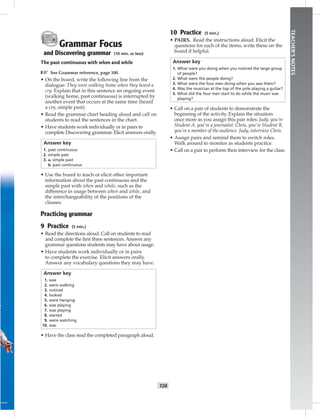
happening, or was in progress, at a certain time in
the past.
• Divide the class into two groups. Call on one
group to read aloud the affirmative statements
in the grammar chart and the other to read
the negative statements. Do the same with the
questions and answers.
• Have students complete Discovering grammar.
Elicit answers orally.
Answer key
1. was or were
2. something that was in progress
• Use the board to teach or elicit other important
information about the past continuous, such as the
fact that it is only used with action verbs.
Practicing grammar
2 Practice (15 min.)
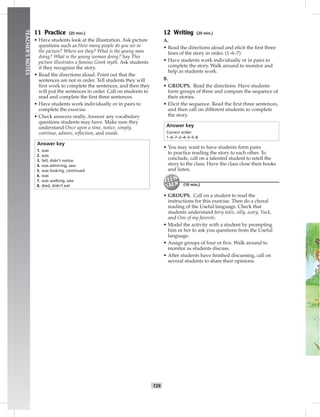
A.
• Read the directions and call on a student to read
the first sentence aloud. Write the full sentence on
the board: Late last night, I was sleeping when I heard
a noise outside. Point out that the writer is talking
about an event occurring at a certain time in the
past, so past continuous is used.
• Elicit the answer to the second sentence. Then have
students work individually or in pairs to complete
the exercise. Remind them that they should be
using the past continuous form of the verbs.
• Elicit the answers orally. You may want to have
the class read aloud the completed paragraph.
Answer key
1. was sleeping
2. was running
3. was wearing
4. was raining
5. wasn’t wearing
6. was carrying
B.
• PAIRS. Read the instructions aloud. Elicit the
question for each of the items; write these on the
board if helpful.
Answer key
1. What were you doing last night?
2. What was the man doing?
3. Was he wearing a white T-shirt?
4. What kind of shoes was he wearing?
5. Was he carrying a big bag?
• Call on a pair of students to demonstrate the
beginning of the activity. Explain the situation
once more as you assign this pair roles: Maria,
you’re Student A, you’re a police officer. Koji, you’re
Student B, you saw the man running away. Maria,
interview Koji. Koji, use the information in Exercise A
to answer.
• Assign pairs and remind them to switch roles.
Walk around to monitor as students practice.
• Call on one or more pairs to perform their
interview for the class.
3 Practice
• Turn to page 68 and have students play a game.
B. PAIRS. Look at the pictures
on page 80. Ask each other
what the weather is like in
the different places.
For example:
A: What’s the weather like
in Rio de Janeiro?
B: It’s warm and sunny.
C. 22 Listen to the
conversation.
A: What’s the weather like
there today?
B: It’s snowing.
A: Really? It’s warm and
sunny here. What was it
like yesterday?
B: It was snowing
yesterday, too.
Discovering grammar
Look at the grammar chart. Circle the correct answers.
1. To form the past continuous, use (is or are / was or were) +
verb-ing.
2. Use the past continuous to describe (something that was in
progress / an event that happened).
Practicing grammar
2 Practice
A. Complete the sentences with the past continuous form.
Late last night, I (1. sleep) was sleeping when I heard a noise
outside. I looked out and I saw a man. He (2. run)
away from a neighbor’s house. He (3. wear) a white
T-shirt and white sneakers. It (4. rain) , but he (5. not
wear) a jacket. He (6. carry) a small bag.
B. PAIRS. Student A, you’re a police officer. Student B, you’re
the person who saw the man running away. Student A,
interview Student B about what he or she saw. Use the cues.
1. Q: What/you/do last night?
2. Q: What/the man/do?
3. Q: he/wear/a white T-shirt?
4. Q: What kind of shoes/he/wear?
5. Q: he/carry/a big bag?
3 Practice
Play a game. Go to page 68.
GRAMMAR FOCUS
The past continuous
Affirmative statements Negative statements
It was snowing at this time It wasn’t snowing at this time
yesterday. yesterday.
We were playing in the snow. We weren’t playing in the snow.
Yes/No questions Answers
Was it snowing at this time Yes, it was./No, it wasn’t.
yesterday?
Were you playing in the snow? Yes, we were./No, we weren’t.
Information questions Answers
What was happening at this It was snowing.
time yesterday?
What were you doing? We were playing in the snow.
25Unit 3
4 Dialogue
23 Read along as you listen.
5 Comprehension
A. Answer the questions.
1. What was Diane pointing at when she said, “Look!”?
2. Who volunteers to call 911?
3. What’s on its way?
4. What does the 911 person tell Joe not to do?
5. Why did they decide to cover the man with Joe’s jacket?
B. 24 Read along as you listen again. Check your answers.
Did you hear
that? Look!
Is he hurt?
I’m going to call 911.
911. What’s your emergency?
Hello. We found a man on
the street. I think he’s hurt.
We’re on 82nd Street
and 5th Avenue.
An ambulance is on its
way. Don’t move him.
Oh, no. It’s
starting
to rain.
Here, cover him
with my jacket.
Did you see
what happened?
No, we didn’t.
We were walking
home from a
party when we
found him.
Wait here for
the police. Tell
them what
happened.
Where are you, sir?
26 Unit 3
T26
TEACHER’SNOTES
Background notes
In most areas in the United States, emergency help is
available by dialing 911. This number puts the caller in
contact with a telephone dispatcher who can send police
officers, ambulances, and firefighters to take care of an
emergency. In a few areas far from large cities, it is still
necessary to call the local police department.
4 Dialogue and 5 Comprehension (15 min.)
• Ask students to identify the people in the pictures.
(Diane, Alex, Joe, Karen, and an unknown man)
Ask Where are they? (on a street next to a park)
What time of day is it? (It’s night.) Why do you
think the man is on the ground? (elicit a variety of
opinions) What is Alex doing in the next picture?
(talking on the phone)
A.
• Have students read the Comprehension questions.
Elicit or explain the meaning of volunteer.
• 23 Play the audio once as students read along.
Then have them complete the exercise.
B.
• 24 Play the audio again for students to check
their answers.
• Elicit the answers orally.
Answer key
1. She was pointing at a man on the street.
2. Alex volunteers to call 911.
3. The ambulance is on its way.
4. The 911 person tells Joe not to move the man.
5. Because it was starting to rain.
• Have students practice the dialogue. Play the
audio or read the dialogue aloud, pausing
for students to repeat the lines. Work on
pronunciation, intonation, and emotive expression
as needed. Then assign groups of five and tell
students to read the dialogue aloud, changing
roles after each reading so that all students read
each role once. When groups have finished, select
one or more groups to perform for the class.
Focus on values
• Have groups discuss the situation presented in
the dialogue. Write some discussion questions on
the board such as Do you think Diane, Joe, and Alex
did the right thing? Was what they did dangerous?
What would you do if you heard someone calling for
help? What would you do if you found a man lying on
the street?
• Have students form groups of four or five to
discuss these questions.
• Elicit responses to the questions from different
groups. As a class, reach a consensus about the
best response to such a situation, balancing
personal safety with the importance of helping a
person in trouble.
T27
TEACHER’SNOTES
Learn to learn (5 min. or less)
• Call on a student to read the strategy line. Explain
or elicit the meaning.
• Read the strategy application instructions aloud.
Tell students that they will be listening to a police
officer interviewing Joe about what happened.
Elicit possible questions the officer might ask and
write them on the board.
6 Listening (10 min.)
• Call on students to read each statement and
answer choice aloud.
• 25 Play the audio two or more times as students
answer the Comprehension questions. Check
answers orally.
Answer key
1. b
2. c
3. a
4. b
5. a
Audioscript
Police officer: What were you doing when you found the
man on the street?
Joe: Well, we just came from a party after a
school performance. I was walking home
through the park with my sister and my
friends when we heard a man’s cry for help.
Police officer: What did you do then?
Joe: We looked around. At first we didn’t see
anything. So we decided to check across the
street. While we were crossing 82nd Street,
we heard another cry. I think we heard
“Help!” or something. I’m not really sure
what . . . uh.
Police officer: Go on. Don’t be nervous. You’re doing OK.
As you were crossing the street, you heard a
man cry for help again.
Joe: Yeah. Then we saw the man. He was
unconscious. At first, we were scared. We
didn’t know what to do. We were talking
about what to do when my friend Alex
suggested calling 911.
Police officer: That was a good idea. Why was your jacket
on the man?
Joe: Uh, it started to rain while we were waiting
for the ambulance. It was cold, too, and we
were worried the man might be hurt.
Police officer: That was nice of you. I’d better call your
parents. They must be worried.
Joe: Oh, no. Please don’t. I mean, my mom
might think we did something wrong.
Another police officer is driving us home.
We can explain then.
Police officer: All right then. Thanks, kid. You guys did
great today.
7 Pronunciation (5 min.)
A.
• Read the Pronunciation focus aloud. Have
students silently read the list of words.
• 26 Play the audio one or more times as students
listen and repeat. Help with pronunciation as
needed.
B.
• Have students read the items silently. Answer any
vocabulary questions they may have.
• 27 Play the audio twice as students listen and
circle their answers.
• Have students check their answers with a partner.
Elicit the words with the /ɔ/ sound and write
them on the board.
Answer key
1. bought
2. talk, Paul
3. thought, mall
4. crosswalk
5. ball
• 27 Play the audio again and pause after each
item for students to repeat.
• To give students further practice, assign pairs and
have students take turns reading the sentences.
Check by calling on several different students to
read a sentence.
8 Communication (10 min. or less)
• 28 Tell students that they will practice a
conversation in which A is a police officer and B
saw something happen. Play the audio once or
twice, pausing for students to repeat.
• Assign pairs and have students practice the
conversation several times, changing roles after
each reading.
B.
• PAIRS. Read the directions aloud. Remind
students that A is a police officer asking about
something unusual that happened. Model a
conversation with a student, then change roles
and model a different conversation. Encourage
students to create several different conversations.
• Have students form pairs and role-play several
times.
• Call on pairs to perform a role-play for the class.
6 Listening
25 Listen to the conversation between Joe
and a police officer. Circle the letter of the
phrase that completes each sentence.
1. The four friends just came from .
a. a Broadway show c. a meeting
b. a party
2. While they were walking home, Diane
heard .
a. music b. laughter c. a man’s cry
3. The man was lying .
a. on the street c. in an ambulance
b. in the park
4. The kids covered the man with Joe’s jacket
because .
a. it started to snow c. it was windy
b. it started to rain
5. The police officer wanted to call .
a. Joe’s parents b. Joe’s school c. 911
7 Pronunciation
The pronunciation of / / in walk
A. 26 Listen and repeat.
• walk
• talk
• saw
• cross
• call
• fall
B. 27 Listen to the sentences. Circle the
words with the / / sound.
1. We bought four tickets to the show.
2. Did you talk to Paul?
3. I thought you were at the mall.
4. Let’s go over to that crosswalk.
5. Can you throw that ball to me?
8 Communication
Talk about past activities
A. 28 Listen to the conversation.
A: What was the man wearing when you
saw him?
B: He was wearing business clothes.
A: What were you doing at the time?
B: We were walking home.
B. PAIRS. Role-play the conversation. Replace
the underlined parts with other activities.
Make predictions
To better understand a listening or a reading text,
try to guess what will happen next.
Before you listen to Joe’s conversation with the
police officer, try to predict the questions the
officer will ask.
Learn to learn
c
c
27Unit 3
Discovering grammar
Look at the grammar chart. Circle the
correct answers.
1. “She was playing” is (simple past / past
continuous).
2. “It started” is the (simple past / past
continuous).
3. In sentences like the ones in the chart,
a. the (simple past / past continuous)
often comes after when clauses.
b. the (simple past / past continuous)
often comes after while clauses.
Practicing grammar
9 Practice
Complete the sentences with the simple past
or the past continuous.
It (1. be) was a sunny day in Mexico
City. My friend and I (2. walk) in
Chapultepec Park when we (3. notice)
a large group of people. They (4. look)
up. Four men (5. hang) upside down
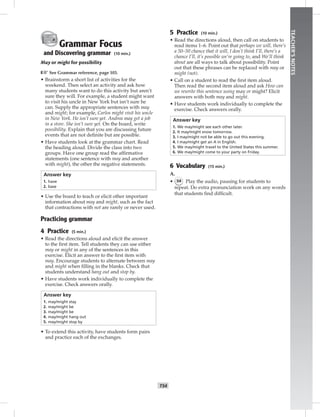
from a 75-foot pole while a musician at the top
of the pole (6. play) a flute. While
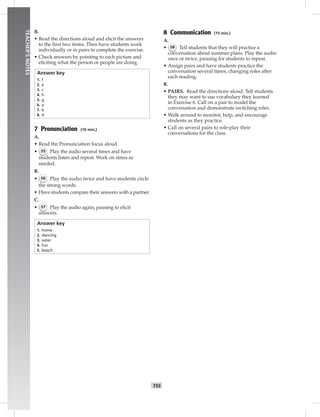
the music (7. play) , the four men
(8. start) to turn around and around
the pole. We didn’t know it at the time, but we
(9. watch) Mexico’s famous flying
dancers, or Voladores. It (10. be) a
spectacular sight!
GRAMMAR FOCUS
The past continuous
with when and while
They were walking home when they heard a cry.
When they heard a cry, they were walking home.
They heard a cry while they were walking home.
While they were walking home, they heard a cry.
10 Practice
PAIRS. Student A, you’re a journalist.
Student B, you’re a member of the audience.
Student A, ask Student B about the Voladores.
Student B, answer Student A’s questions.
For example:
Q: What were you doing when you noticed a
large group of people?
A: I was walking with my friend in
Chapultepec Park.
1. Q: What/you/do/when/you/notice/
the large group of people?
2. Q: What/the people/do?
3. Q: What/the four men/do/when /
you/see/them?
4. Q: the musician at the top of the
pole/play a guitar?
5. Q: What/the four men/start to do/
while/the music/play?
28 Unit 3
T28
TEACHER’SNOTES
Grammar Focus
and Discovering grammar (10 min. or less)
The past continuous with when and while
☞ See Grammar reference, page 100.
• On the board, write the following line from the
dialogue: They were walking home when they heard a
cry. Explain that in this sentence an ongoing event
(walking home, past continuous) is interrupted by
another event that occurs at the same time (heard
a cry, simple past).
• Read the grammar chart heading aloud and call on
students to read the sentences in the chart.
• Have students work individually or in pairs to
complete Discovering grammar. Elicit answers orally.
Answer key
1. past continuous
2. simple past
3. a. simple past
b. past continuous
• Use the board to teach or elicit other important
information about the past continuous and the
simple past with when and while, such as the
difference in usage between when and while, and
the interchangeability of the positions of the
clauses.
Practicing grammar
9 Practice (5 min.)
• Read the directions aloud. Call on students to read
and complete the first three sentences. Answer any
grammar questions students may have about usage.
• Have students work individually or in pairs
to complete the exercise. Elicit answers orally.
Answer any vocabulary questions they may have.
Answer key
1. was
2. were walking
3. noticed
4. looked
5. were hanging
6. was playing
7. was playing
8. started
9. were watching
10. was
• Have the class read the completed paragraph aloud.
10 Practice (5 min.)
• PAIRS. Read the instructions aloud. Elicit the
questions for each of the items; write these on the
board if helpful.
Answer key
1. What were you doing when you noticed the large group
of people?
2. What were the people doing?
3. What were the four men doing when you saw them?
4. Was the musician at the top of the pole playing a guitar?
5. What did the four men start to do while the music was
playing?
• Call on a pair of students to demonstrate the
beginning of the activity. Explain the situation
once more as you assign this pair roles: Judy, you’re
Student A, you’re a journalist. Chris, you’re Student B,
you’re a member of the audience. Judy, interview Chris.
• Assign pairs and remind them to switch roles.
Walk around to monitor as students practice.
• Call on a pair to perform their interview for the class.
T29
TEACHER’SNOTES
11 Practice (20 min.)
• Have students look at the illustration. Ask picture
questions such as How many people do you see in
the picture? Where are they? What is the young man
doing? What is the young woman doing? Say This
picture illustrates a famous Greek myth. Ask students
if they recognize the story.
• Read the directions aloud. Point out that the
sentences are not in order. Tell students they will
first work to complete the sentences, and then they
will put the sentences in order. Call on students to
read and complete the first three sentences.
• Have students work individually or in pairs to
complete the exercise.
• Check answers orally. Answer any vocabulary
questions students may have. Make sure they
understand Once upon a time, notice, simply,
continue, admire, reflection, and woods.
Answer key
1. was
2. was
3. fell, didn’t notice
4. was admiring, saw
5. was looking, continued
6. was
7. was walking, saw
8. died, didn’t eat
12 Writing (20 min.)
A.
• Read the directions aloud and elicit the first three
lines of the story in order. (1–6–7)
• Have students work individually or in pairs to
complete the story. Walk around to monitor and
help as students work.
B.
• GROUPS. Read the directions. Have students
form groups of three and compare the sequence of
their stories.
• Elicit the sequence. Read the first three sentences,
and then call on different students to complete
the story.
Answer key
Correct order:
1–6–7–2–4–3–5–8
• You may want to have students form pairs
to practice reading the story to each other. To
conclude, call on a talented student to retell the
story to the class. Have the class close their books
and listen.
(10 min.)
• GROUPS. Call on a student to read the
instructions for this exercise. Then do a choral
reading of the Useful language. Check that
students understand fairy tales, silly, scary, Yuck,
and One of my favorite.
• Model the activity with a student by prompting
him or her to ask you questions from the Useful
language.
• Assign groups of four or five. Walk around to
monitor as students discuss.
• After students have finished discussing, call on
several students to share their opinions.
11 Practice
Complete the sentences with the simple past
or the past continuous.
1. Once upon a time, there (be)
a beautiful young woman.
2. The man’s name (be)
Narcissus.
3. Echo (fall) in love with
Narcissus right away, but Narcissus
(not/notice) her.
4. Narcissus (admire) his
reflection in the water when Echo
(see) him.
5. While Echo (look) at him, he
(continue) to admire his
reflection in the water.
6. Her name (be) Echo.
7. One day, while Echo (walk) in
the woods, she (see) a young
man by the river.
8. In the end, Narcissus (die)
because he (not/eat) or drink.
12 Writing
A. Rewrite the sentences in Exercise 11,
putting them in the correct order to make
a story.
B. GROUPS. Compare your story with another
group’s story. Are the stories the same?
GROUPS. Talk about the stories
you like to read, for example,
fairy tales, scary stories, love
stories, and other types of stories.
Useful language:
• Do you like fairy tales?
• Of course. Everyone loves fairy tales.
• One of my favorite fairy tales is . . .
• No. I’m too old for fairy tales.
• Don’t be silly. Fairy tales aren’t just for kids.
• I prefer scary stories.
• Me, too.
• I don’t. I like love stories.
• Yuck. I hate . . .
Once upon a time,
In the end,
29Unit 3
13 Reading
A. GROUPS. Discuss: What is a fairy? What does a good fairy
usually do in a fairy tale?
B. 29 Read along as you listen.
ONCE upon a time, there lived
a poor man with a pretty wife. One
winter night, while they were sitting
by the re, they were talking about
their rich neighbors. Their neighbors
were happy because they could
buy anything they wanted. The
wife said, “I wish there were a good
fairy right now to give us whatever
we wanted.” The husband said he
was thinking the very same thing. At that instant, a very beautiful
woman appeared in the room. She said, “I am a fairy. I promise to
give you anything you ask for. But think carefully. You have only
three wishes.” Then she disappeared.
The wife told her husband, “Personally, I’d ask to be beautiful
and rich.” But the husband said, “Being beautiful and rich is
useless if you get sick and you die. Let’s ask for good health and a
long life.” “But,” said the wife, “what’s the purpose of a long life
if you’re very poor? We would be miserable for a long time!” “All
right,” the husband said. “Let’s think about this some more.”
While he was talking, his wife put more rewood on the re
because it was a very cold night. She said to her husband, “This
is such a nice re. I wish we had sausages to cook on this re for
supper.” Before she could nish her sentence, down came a long
link of sausages from the chimney. The husband angrily shouted,
“Now we only have two wishes left! I wish those sausages would
stick to your nose!” And then it happened. The sausages got stuck
to the wife’s nose. The wife screamed because she couldn’t take
the sausages off her nose. There was only one wish left. The man
and his wife argued about the third wish—to ask for riches or for
the sausages to disappear? While they were arguing, the woman
ran toward the window. She wanted to jump out of the window
because she couldn’t live with the sausages that were hanging
from her nose. The man loved his wife so much and couldn’t live
without her, so he said, “Stop, my dear wife. All right. You make
the last wish.” The wife wished for the sausages to drop off, and the
sausages fell to the oor. Both husband and wife were very happy.
They realized that they didn’t need riches or a long life. They were
happy the way they were because they loved each other.
14 Comprehension
Answer the questions.
1. Why did the man and his
wife think their neighbors
were happy?
2. Why did the wife wish for a
good fairy?
3. What did the fairy promise
to do?
4. What did the wife want for
herself?
5. What about the husband?
6. What did the wife
accidentally wish for?
7. What did the husband
accidentally wish for?
8. What was the third and last
wish?
15 Speaking
A. GROUPS. Make all-boy and
all-girl groups. Each group,
list several things you’d like
to ask a good fairy.
For example:
Girls: I’d ask to be
president of my
country.
Boys: I’d ask for
intelligence.
Girls Boys
I’d ask for … I’d ask for …
I’d ask to
be …
I’d ask to
be …
B. Compare your results. Are
there similarities in what
boys want and what girls
want? What are they?
What are the differences?
30 Unit 3
T30
TEACHER’SNOTES
13 Reading (10 min.)
A.
• GROUPS. Read the questions aloud and then
have students form groups to discuss their
responses. After groups have discussed the
questions, elicit responses from several students.
(Fairies are magical beings who have special
powers to help people. A good fairy usually helps
the main character in a fairy tale.)
B.
• Have students look at the illustration. Ask picture
questions to set the context and elicit or teach
vocabulary such as wife, husband, fire, and poor.
• 29 Play the audio as students read silently
along. Tell students that the first reading is for
them to get a general idea of what the article is all
about.
• After this first reading, answer any vocabulary
questions students may have. Make sure students
understand key unfamiliar vocabulary such as
whatever, instant, appeared, disappeared, personally,
purpose, miserable, link of sausages, chimney, argued,
and realized.
• Have students read the article again silently.
14 Comprehension (10 min. or less)
• Have students read the questions aloud. Make
sure they understand accidentally.
• Have students work individually or in pairs to
answer the questions.
• Check answers orally. You may want to have
students read or refer to the particular place in the
article where they found the answers.
Answer key
1. Because they could buy anything they wanted.
2. Because she wanted the fairy to give them whatever
they wanted.
3. She promises to give them anything they ask for.
4. She wanted to be beautiful and rich.
5. He wanted good health and a long life.
6. She accidentally wished for sausages.
7. He accidentally wished the sausages would stick to the
end of his wife’s nose.
8. The wife wished for the sausages to drop off.
Cross-curricular activity: drama
• To extend the activity, have students form
groups of three and create a short skit based on
the story. One student should play the role of
the husband, another the wife, and another the
fairy. Give students time to formulate and then
practice their skit. Finally, call on one or more
groups to perform for the class.
15 Speaking (20 min.)
A.
• GROUPS. Read the instructions aloud. Write the
following question on the board: What would you
like to ask a good fairy? Read the example answers.
Point out the use of I’d ask for/to be . . . for answers.
• Have students form all-boy and all-girl groups of
three or four to discuss this question and complete
their charts.
• Walk around as students work, helping when
needed.
B.
• Read the directions. Have boy and girl groups
combine to form new groups of six to eight. Tell
students to compare their wishes.
• Elicit common similarities and differences from
several groups.
T31
TEACHER’SNOTES
Putting it together Back at home (20 min.)
A.
• Ask the class to look at each picture and predict
what is happening. Tell students to look just at the
pictures and not at the written words. Accept any
reasonable ideas.
• 30 Read the directions and question aloud. Play
the audio as students listen and read.
• Elicit the answer to the question.
Answer key
He had a medical condition and he blacked out while he
was walking home from work.
• Make sure students understand key words and
concepts such as responsible, you’d better, a good reason,
police station, adventure, the important thing, medical
condition, blacked out, fainted, and proud of.
• You may want to have students practice the
dialogue. Work on students’ pronunciation and
intonation as you play the audio or read the
dialogue aloud. Then have students work in
groups of four to practice the dialogue, switching
roles after each reading so that all students read
each role once. Call on one or more pairs to
perform for the class.
B.
• Read the questions aloud. Begin a class discussion
by calling on volunteers to share their opinions
with the class.
Have students complete Workbook Skills
Development 1 Exercises (1–4) in the Workbook.
✎ Have students complete the Unit 3 test, page 82, and
the Test for Units 1–3, pages 86–89.
Back at home
A. 30 Read along as you listen. Underline the information that explains what was
wrong with the man.
Where are those kids? Did you
tell Joe to call after the party?
B. Discuss this question: Were Joe and Diane wrong in not calling their parents?
Why or why not?
I did. Joe is usually
very responsible.
Here they come. You’d better
have a good reason, Joe, Diane.
We do, Dad. We were at
the police station.
At the police station? Did
you do anything wrong?
Of course not, Mom. While we were walking home
after the party, we heard a man cry for help.
Yeah. We called 911 and rode
in a police car. It was exciting!
OK, but while you were having an
adventure, we were worried!
The important thing
is you’re both OK.
How was the man?
Oh, he’s going to be OK. He had a
medical condition, and he blacked out
while he was walking home from work.
He was talking to his
wife on his cell phone
before he fainted. She
got there while we were
talking to the police.
We’re proud of what you did.
But next time, call home.
Promise, Dad. Sorry.
We’re really sorry, Mom.
1
3
5
2
4
6
31Unit 3
32
1 Reading
Reading skill: Visualizing
As you read, let the words in the story form pictures in
your mind.
A. Read the story. As you read, think about the images the story
is describing.
B. PAIRS. Take a few minutes to visualize four scenes from the
story. Describe the scenes to your partner.
2 Listening
31 There are many stories all over the world that are similar
to “Taro and the Palace at the Bottom of the Sea.” Listen to a
storyteller tell the American story “Rip Van Winkle.” As you
listen, number the parts of the story in the correct order.
His house was empty and most of his friends were dead.
He met a group of people playing a bowling game.
He drank some liquor.
He said, “I am your father!”
He fell asleep.
He helped an old man carry a keg.
He woke up and went back home.
1 Rip Van Winkle went for a walk in the mountains.
A woman said Rip disappeared twenty years ago.
3 Speaking
GROUPS. Discuss these questions.
1. How are “Taro and the Palace at the Bottom of the Sea” and
“Rip Van Winkle” similar?
2. How are the stories different?
4 Writing
GROUPS. Work together as a group to make up a very short,
simple fairy tale similar to the Taro and Rip Van Winkle stories.
Set it in the modern day with a teenager as the main character.
Wide Angle 1
T32
TEACHER’SNOTES
Pictures (5 min.)
• Call on a student to read the title. Have students
look at the pictures.
• Tell them that the pictures describe a famous story.
Ask What country do you think the story is from?
(Japan) Point to the first picture and ask What do
you see in this picture? (a fisherman, a boat, baskets,
waves, a turtle, rocks, plants, etc.) Tell students
Look at this fancy box. What do you think is in it?
(Elicit guesses—don’t tell students what is in it at
this point.)
1. Reading (15 min.)
A.
• Call on a student to read aloud the Reading
skill. Explain that visualizing means using your
imagination and creating a mental picture of what
you read.
• Read the instructions aloud. Model the activity
by reading the first few sentences aloud and
explaining what you are visualizing.
• Tell students to start reading and to think about
the images described in the story.
B.
• Read the instructions aloud. Tell students to close
their books and visualize four scenes from the story.
• Assign pairs and have students describe the scenes
they visualized.
• Ask pairs if any of the scenes they visualized were
the same. Elicit these.
2 Listening (10 min.)
• Read the instructions aloud. Tell students to read
through and visualize the statements.
• 31 Play the audio two or more times as students
listen and number the statements from 1 to 9.
• Elicit the answers from volunteers and write them
on the board.
Answer key
7, 3, 4, 9, 5, 2, 6, 1, 8
• You may want to make copies of the audioscript
and give it to the students to follow along with as
they listen to the audio one final time.
Audioscript
Rip Van Winkle was a farmer. He was a friendly, outgoing
sort of person, but he didn’t like work. His wife was always
arguing with him, so he used to escape to the village inn to
meet his friends. He also used to go walking in the woods
and the mountains. While he was walking in the Catskill
Mountains one day, he met a man who was carrying a
keg of liquor. The keg was heavy, so Rip helped the man
carry it. As they were climbing up the mountain, Rip heard
the sound of thunder, but they carried on. In time, they
arrived at their destination and Rip saw a group of people
who were wearing very strange clothes. They didn’t look
American; they looked like people from an old Dutch
painting. They were playing ninepins, a bowling game.
Rip was tired and thirsty, so when no one was looking,
he took a drink from the keg. Then he took another, and
another . . . and he soon fell asleep on the grass. When
Rip woke up, it was morning. The old men were gone,
and he was very hungry. He walked back to his village, but
when he arrived, he didn’t know any of the people there.
He walked to his house, and to his surprise, it was old and
empty. He couldn’t find his family anywhere. He walked up
to a group of people in the village. Rip didn’t know any of
them, so he asked about several of his friends. And every
friend he asked about was dead. Rip was very sad and
confused. Finally, he asked, “Does anybody here know Rip
Van Winkle?” A woman holding a child said, “Yes. I knew
Rip Van Winkle. He was my father. He disappeared twenty
years ago!” Rip looked at the woman, and said, “I am your
father!” Rip had been asleep in the mountains for a very
long time. His daughter was grown, his wife and many of
his friends were dead, and he was a very old man. When
he left, George III was the king, but now he was a citizen
of the United States! Rip’s daughter took him home to live
with her. He lived a very happy life. He went for walks and
visited friends at the inn, just as he used to do all those
years ago. And he was very popular with young people,
because he told them such wonderful stories.
3 Speaking (10 min.)
• GROUPS. Assign groups of three or four. Read
the questions aloud and elicit one or two answers
from the students.
• Walk around, monitoring and helping students as
they discuss.
• To check, elicit answers from individual groups or
the class as a whole.
4 Writing (20 min.)
• Have the same groups work together to make up a
short fairy tale about a modern-day teenager. Tell
them to keep their story short, just listing the main
points as in the Listening.
• Ask volunteers to read their stories to the class.
T33
TEACHER’SNOTES
Extension
• Bring, or have students bring, a very short
folktale in L1 to class. Make one copy for
each student. Tell students they will practice
translating and get some idea of how a
professional translator works. Have students
work in pairs or groups to translate the story
into English. Have them use a dictionary to find
English equivalents for difficult items. Walk
around to help and monitor as students work. To
check, call on a volunteer to read the translation
to the class. Ask students if any of them might
want to work as translators in the future.
33
Taro and the Palace at the Bottom of the Sea
There was once a poor young fisherman named Taro Urashima. One day
while he was fishing, he caught a small sea turtle.Taro took the hook out
of the turtle’s mouth and put it back into the sea.
Some time later,a giant sea turtle swam up toTaro’s boat.The turtle thanked
Taro for taking the hook out of his mouth.He invitedTaro to Princess Oto’s
Palace at the bottom of the sea.The turtle said the princess wanted to
thank Taro, too. So Taro jumped onto the turtle’s back and they
went deep into the ocean.
SoonTaro and the turtle arrived at an enormous palace.
The beautiful Princess Oto welcomed Taro. She had
a big party for him with the most delicious food.
The princess asked Taro to stay at the palace a
little longer, and Taro agreed. Every day at the
palace was wonderful and exciting. He stayed
for many, many days.
After some time, though, Taro began to feel
homesick. Taro told Princess Oto that he
needed to return home. Crying, the princess
gave Taro a beautiful round box. She told him to
keep it with him always, but never to open it.The
sea turtle was waiting to take Taro back home.
WhenTaro arrived at his village,he didn’t know any of
the people. He went to his parents’ house, but it wasn’t
there. He asked an old woman, “Where is the Urashima
family?” She laughed and said,“They moved away over a hundred
years ago!”
Taro went back to the beach. Feeling very confused, he noticed the box
from Princess Oto in his pocket and opened it. A cloud of white smoke
came out.When the smoke disappeared,Taro was a very old man. He had
stayed at Princess Oto’s palace for many, many years.
Wide Angle 1 33
1 Dialogue
32 Cover the dialogue and listen.
Alex: Are you mad at me, Lori?
Lori: Should I be?
Alex: I don’t know. Did I do anything wrong?
Lori: No, it’s not you. It’s Paul. Why didn’t
he give the rest of us the chance to
apply for the program? Does he really
believe you’re the best in the group?
Alex: I can’t answer for Paul, Lori. But I
certainly don’t think that I’m better
than you. Your voice is as good as
mine. And you’re faster at learning
your lines.
Lori: I know I’m being unfair to you. It’s not
your fault. I guess I’m not as talented
as you are on the guitar, but I really
worked hard on that show.
Alex: I know that, Lori. Look. Why don’t you
talk to Paul?
Lori: Maybe I will. Can we talk about
something else? What time are we
meeting Joe and Diane?
2 Comprehension
A. Answer the questions.
1. Why is Lori upset?
2. How does Alex make her feel better?
3. What’s Alex’s advice?
4. Is Lori going to take Alex’s advice?
5. What’s happening later?
B. 33 Read along as you listen again. Check
your answers.
Learning goals
Communication
Talk about preferences
Grammar
The comparative and superlative
forms of adjectives
Making comparisons with
as . . . as/not as . . . as
Vocabulary
Adjectives of quality
(positive and
negative)
34 Unit 4
T34
TEACHER’SNOTES
Background notes
The name Times Square originated in the early 1900s
when the New York Times newspaper built a tall building
at the intersection of 43rd Street and Broadway. The area
soon became a popular tourist destination, with hundreds
of hotels, theaters, and movie houses. Times Square is
probably most famous for the annual New Year’s Eve
celebration, when half a million people crowd the area to
watch a lighted ball drop at the start of the new year.
Warm-up (5 min. or less)
• Ask students if they ever argue with their friends
or family members. Ask What kinds of things do
you fight about? Elicit some common reasons for
arguments, helping with language as needed. Tell
students In this lesson’s dialogue, two of the characters
are fighting.
Using the large photo (5 min. or less)
• Call on a student to read the unit title aloud. Elicit
the meaning of best. Have students identify the
characters in the picture. (Lori and Alex) Ask Where
are they? (on the street; in Times Square) What are
they doing? (They’re fighting/arguing.) How do you
think they’re feeling? (angry, upset, unhappy)
1 Dialogue and 2 Comprehension (15 min.)
• Have students cover the dialogue.
A.
• Call on students to read the Comprehension
statements aloud. Make sure students
understand advice.
• 32 Play the audio two or more times as students
work individually to complete the statements.
B.
• 33 Have students uncover the dialogue and read
along as you play the audio.
• Elicit answers orally.
Answer key
1. Lori is upset because Paul didn’t give the rest of them
the chance to apply for the program.
2. He says, “I certainly don’t think that I’m better than
you. Your voice is as good as mine. And you’re faster at
learning your lines.”
3. He says, “Why don’t you talk to Paul?”
4. Maybe she will.
5. Alex and Lori are meeting Joe and Diane.
• To extend work with the dialogue, select key
vocabulary, structures, and communicative
phrases to discuss more fully, such as mad (angry),
Should I be? (Should I be mad at you?), it’s not
you (I’m not angry at you), the rest of us (the other
members of our group), I can’t answer for Paul
(I don’t know what Paul thinks.), I know that (I
believe/agree with you), Maybe I will (Maybe
I’ll do that), and It’s not your fault (You didn’t do
anything wrong). Elicit or explain the meaning of
better than, as good as, faster, and not as talented as.
• Have students practice the dialogue in pairs. Play
the audio or read the dialogue aloud, pausing for
students to repeat the lines. Encourage students
to mimic the intonation, stress, and tone used
to express the characters’ emotions. Work on
pronunciation and expression as needed. Then
have students work in pairs to read the dialogue
aloud, switching roles after each reading. When
students have finished, select one or more pairs to
perform for the class.
Focus on values
• On the board, write When did you last feel angry with
a friend? What did you do? What happened after that?
Have students discuss the questions in groups.
• Elicit responses from several groups. Refer
to the dialogue and ask students how the
misunderstanding between Alex and Lori was
resolved. Point out that in this particular case,
being honest with each other about how they felt
helped Alex understand why Lori was upset. It
also gave Lori a chance to express her feelings
and get some ideas from Alex about what to do.
Learning strategy
• Listen carefully to the sounds of
English
Pronunciation
• The pronunciation of / / as in mad
Skills
• Read for specific information
• Listen to determine true and false
information
• Express personal opinions
• Express preferences
• Write a paragraph about the
advantages and disadvantages of
being very good-looking
Learning goals The following are additional learning goals in this unit:
T35
TEACHER’SNOTES
3 Useful expressions (10 min.)
A.
• Direct students’ attention to the Useful
expressions. Quickly elicit the meaning of each.
• 34 Play the audio and have students listen and
repeat. Work on pronunciation as needed.
B.
• Read the directions aloud and call on students to
read items 1-6. Answer any vocabulary questions.
Elicit the answer to the first item, and then have
students work individually or in pairs to complete
the exercise. Tell students that they can use more
than one response for some items.
• To elicit the answers, read the statement and call
on students to say the possible responses.
Answer key
1. Maybe I will.
2. I know that.
3. I can’t answer for [him]. / No, it’s not you.
4. Should I be?
5. No, it’s not you. / It’s not your fault.
6. It’s not your fault. / I know that.
4 Pronunciation (10 min.)
A.
• 35 Tell students to listen carefully. Play the
audio several times and have students listen and
repeat. Work on pronunciation as needed.
• For further practice, divide the class into two
groups. Call on each group to read one column
aloud. Do two rounds so that each group gets a
chance to say all the words.
B.
• PAIRS. Have students form pairs. Walk around,
helping and praising students as they practice the
conversation. Remind partners to switch roles.
• Call on pairs to perform for the class.
Learn to learn (5 min.)
• Call on a student to read the learning strategy
and explanation. Make sure students know the
meaning of improve and focus.
• Ask the class What are some sounds that are difficult
for you to pronounce? Elicit several and write them
on the board. Say Focus on these sounds, practice
them often, and you can improve your pronunciation.
• PAIRS. Read the instruction line aloud. Assign
pairs and have students take turns saying the
words with a classmate.
3 Useful expressions
A. 34 Listen and repeat.
• Should I be? • It’s not your fault.
• No, it’s not you. • I know that.
• I can’t answer for [him]. • Maybe I will.
B. Write the appropriate responses. Use some of the expressions
from Exercise A.
1. You don’t look good. Why don’t you stay home and get
some rest? Maybe I will.
2. We have an exam today.
3. Is he mad at me?
4. Aren’t you happy about the news?
5. Did I do something to hurt you?
6. I’m sorry about that.
4 Pronunciation
The pronunciation of /æ/ as in mad
A. 35 Listen and repeat.
• mad • matter
• chance • talent
• can’t • happen
• glad • happy
B. PAIRS. Practice the conversation. Make sure you pronounce
the words with the /æ/ sound correctly.
A: Are you mad at me?
B: No, but I’m mad at Sandra.
A: Why? What happened?
B: I can’t talk about it. Can we change the topic?
A: OK.
Listen carefully to the sounds of English.
To improve your pronunciation, choose certain sounds in English that
are difficult for you. Focus on these difficult sounds and practice them
often.
Listen carefully to the sound /æ/ in each word in Exercise 4A.
PAIRS. Practice saying the words with a classmate.
Learn to learn
35Unit 4
Discovering grammar
Look at the grammar chart. Then answer
the exercises.
A. Complete the rules.
Short, one-syllable adjectives (for
example, short and fast)
1. To form the comparative, add
to the adjective.
2. To form the superlative, add
to the adjective.
Long adjectives (for example, interesting)
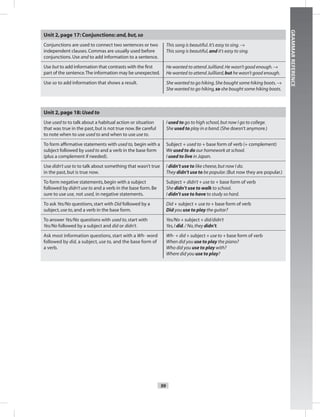
3. To make the comparative, use the word
before the adjective.
4. To make the superlative, use the words
and before the
adjective.
B. Circle the correct answers.
1. Use the (comparative / superlative) to
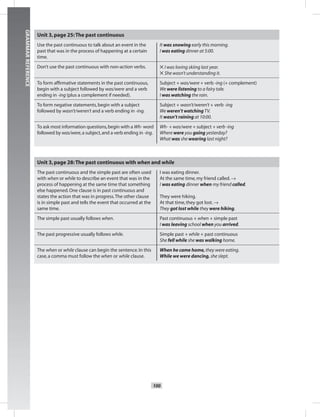
compare two people, two places, or
two things.
2. Use the (comparative / superlative) to
compare one person, place, or thing
with others in a group.
1. Which is (cold) colder ?
a. –5º C
b. –18º F
2. Which is (hot) ?
a. 100º C
b. 100º F
3. Which is (old) ?
a. the Eiffel Tower
b. the Great Pyramid of Giza
c. the Empire State Building
4. Which is (heavy) ?
a. a kilo of potatoes
b. a kilo of cotton
c. neither
5. Which continent is (small) ?
a. Asia
b. Australia
c. Antarctica
6. Which is (far) distance?
a. 100 yards
b. 100 meters
c. 100 feet
GRAMMAR FOCUS
The comparative and
superlative forms of adjectives
Adjective Comparative Superlative
short shorter than the shortest
big bigger than the biggest
funny funnier the funniest
famous more famous the most
than famous
interesting more interesting the most
than interesting
Irregular adjectives
good better than the best
bad worse than the worst
far farther than the farthest
Joe is shorter than Paul.
Alex is the shortest among the three men.
He is the best guitarist in the group.
Practicing grammar
5 Practice
A. First, fill in the blanks with either the
comparative or superlative form of the
verbs in parentheses.
B. Now test yourself! Circle the correct
answers.
36 Unit 4
T36
TEACHER’SNOTES
Grammar Focus
and Discovering grammar (10 min.)
The comparative and superlative forms of
adjectives
☞ See Grammar reference, page 101.
• On the board, write big. Then write:
Superlative Comparative
is the biggest. is bigger than .
• Hold up three items of different sizes, such as an
eraser, a cup, and a book. Ask students Which is
the biggest? Complete the sentence on the board
with the students’ response. Hold up just two
of the items and ask Which is bigger? Write the
response on the board. Then have the class read
the sentences aloud.
• Explain or elicit the fact that you usually use
superlatives to talk about three or more items and
comparatives to talk about two items.
• Have students look at the grammar chart. Read
the heading aloud. Divide the class into three
groups. Have one group read the adjective,
another the comparative, and another the
superlative for the regular and irregular adjectives.
Then have each group read an example sentence.
• Review the meaning of syllable, then have
students complete Discovering grammar. Elicit
the answers orally.
Answer key
A.
1. -er 2. -est 3. more 4. the, most
B.
1. comparative 2. superlative
• Use the board to teach or elicit other important
information about comparative and superlative
forms, such as spelling rules.
Practicing grammar
5 Practice (10 min.)
A.
• Read the quiz title and directions aloud, then
go over the questions. Make sure students
understand clever, C (Celsius), F (Fahrenheit),
neither, distance, yards, and feet. Check that students
know the Eiffel Tower, the Great Pyramid of Giza,
and the Empire State Building.
• Call on a student to read the first item aloud. Elicit
the adjective form. (comparative) Remind students
to pay attention to whether the quiz is comparing
two things (comparative usage) or three things
(superlative usage).
• Have students work individually to complete the
exercise. Elicit answers orally.
Answer key
1. colder 2. hotter 3. the oldest
4. heavier 5. the smallest 6. the farthest
B.
• Read the directions aloud.
• Have students work individually to complete the
exercise. Check by calling out answer choices and
having students who chose that answer raise their
hands. Give an explanation for each answer (see
Answer key).
Answer key
1. a (–5º C = 23ºF and –18ºF = –28ºC.)
2. a (100º C = the boiling point of water. 100º F = just a
little above normal body temperature.)
3. b (It was built c. 2500 BC. The Eiffel Tower was built in
1889 and the Empire State Building in1929.)
4. c (It’s a trick question. A kilo of anything weighs the
same as a kilo of anything else.)
5. b (Asia = about 17 million square miles. Australia/
Oceania = about 3 million square miles. Antarctica =
about 5 million square miles.)
6. b (1 yard = 0.91 meters. 1 meter = 3.28 feet.)
Cross-curricular activity: science and history
• Divide the class into groups of four or five. Prepare
a set of word cards with different superlatives for
each group; for example, tallest, smallest, oldest,
biggest, shortest, longest, coldest, hottest.
• Each group must come up with a question and
answer using each superlative; for example,
What’s the hottest planet? Mercury is the hottest
planet. Have each group do research on
objects, places, animals, or people that fit the
superlatives. You may assign this as homework
or allow time for Internet or library research.
• Call on each group to ask their questions to the
class. You may want to make this a game and give
points to groups who answer questions correctly.
Focus on multiple intelligences: this activity
focuses on visual intelligence.
• To further practice comparative and superlative
forms, ask students to work in pairs. Tell them
to think of one comparative and one superlative
sentence that they can illustrate with simple
drawings. Model with some example pictures
on the board; for example, draw pictures for A
truck is bigger than a car and Tom is the tallest boy
in the class. Tell students not to write out their
sentences but just to “draw” them. When pairs
have completed their illustrations, have them
exchange pictures with another pair. Tell pairs to
try to guess the sentence illustrated.
T37
TEACHER’SNOTES
6 Practice (10 min.)
• Read the directions aloud and have students look
at the pictures. Elicit the names of the celebrities
and what students know about each. If students
are not familiar with Aishwarya Rai, point out that
she is a famous Indian “Bollywood” actor. They
will learn more about her later in this unit.
• Have students look at the chart. Check that they
understand the symbols for feet ('), inches ("), and
pounds (lbs.).
• Elicit the answers for the first two items and then
have students work individually or in pairs.
• Elicit answers and write them on the board.
Answer key
1. younger than; older than
2. the oldest; the youngest
3. taller than; shorter than
4. the shortest
5. heavier than
7 Practice (10 min.)
• Turn to page 69 and let students have a
competition.
8 Communication (10 min.)
A.
• 36 Tell students that they will practice a
conversation in which they compare two people.
Play the audio once or twice, pausing for students
to repeat.
• Assign pairs and have students practice the
conversation several times, changing roles after
each reading.
B.
• PAIRS. Read the directions aloud. Model a
conversation with a student.
• Have students form pairs and role-play the
conversation several times.
• Call on pairs to perform a role-play for the class.
9 Your turn (10 min.)
A.
• PAIRS. Call on a student to read the directions
aloud. Ask students to raise their hands if they
know Coldplay (pictured) and U2. Read the
example conversation aloud and have students
repeat. Elicit some celebrities and comparatives
that students can use in their conversations. Then
model a role-play with a student. Encourage
students to talk about a number of celebrities.
• Walk around to monitor as students talk.
• To conclude the activity, elicit the names of two
celebrities from different professions (actors,
singers, groups, etc.). Then have the class compare
the celebrities by asking, Which do you think is (more
talented/better looking/etc.), (celebrity A) or (celebrity
B)? Ask the class to vote with a show of hands.
Angelina Jolie
actor (U.S.A.)
Birthdate: June 4, 1975
Height: 5’8”
Weight: 120 lbs.
Naomi Campbell
international model (UK)
Birthdate: May 22, 1970
Height: 5’9”
Weight: 122 lbs.
Aishwarya Rai (Ash)
Bollywood actor and model (India)
Birthdate: November 11, 1972
Height: 5’7”
Weight: 122 lbs.
6 Practice
Look at the pictures and the information. Then complete the sentences with the comparative
or superlative form.
9 Your turn
PAIRS. Take turns asking questions about your
favorite celebrities.
For example:
A: Who do you prefer, Coldplay or U2?
B: Coldplay.
A: Really? Why?
B: Because they’re more talented than U2.
1. Ash Rai is (young) younger than Naomi Campbell, but she is (old) Angelina Jolie.
2. Naomi Campbell is (old) of the three, and Angelina Jolie is (young) .
3. Angelina Jolie is (tall) Ash, but she is (short) Naomi.
4. Ash is (short) of the three.
5. Naomi is (heavy) Angelina Jolie.
7 Practice
Have a competition! Go to page 69.
8 Communication
Talk about preferences
A. 36 Listen to the conversation.
A: Who do you prefer, Alex or Joe?
B: I like Joe better. I think he’s smarter than
Alex. And he’s taller.
A: Oh, I prefer Alex.
B: Why?
A: Well, he’s better-looking and more
talented, too.
B. PAIRS. Role-play the conversation. Change
the underlined parts with Lori and Diane
and your own opinions about them.
37Unit 4
Discovering grammar
Look at the grammar chart. Circle the
correct answers.
1. Use as . . . as to express the
(similarities / differences) between
two items.
2. Use not as . . . as to express the
(similarities / differences) between
two items.
Practicing grammar
10 Practice
Complete the sentences with as . . . as and not
as . . . as. Use the information in Exercise 6 on
page 37 for your answers.
1. Ash is (not tall) not as tall as Naomi.
2. Naomi Campbell is (heavy)
Ash.
3. Angelina Jolie is (not heavy)
Naomi and Ash.
4. Naomi Campbell is (not young)
Angelina Jolie.
5. Ash Rai (not famous) in
Hollywood she is in
Bollywood.
11 Practice
Rewrite the pairs of sentences using as . . . as
and not as . . . as.
1. Spider-Man is exciting. Superman is
also exciting.
Spider-Man is as exciting as
Superman.
2. Jessica Simpson is beautiful. Angelina Jolie
is more beautiful.
3. English is easy. Spanish is easy, too.
4. The Harry Potter movies are interesting. The
Harry Potter books are more interesting.
12 Vocabulary
Adjectives of quality
A. 37 Listen and repeat.
• famous • good-looking
• attractive • talented
• beautiful • successful
• gorgeous • fashionable
• handsome • incredible
B. Write an adjective before each noun. Use a
or an and the adjectives in Exercise A.
1. a handsome man
2. woman
3. building
4. song
5. jacket
6. singer
7. shoes
GRAMMAR FOCUS
Making comparisons
with as . . . as / not as . . . as
Alex is fifteen. Joe is also fifteen.
Alex is as old as Joe.
Nicole Kidman is 5'10". Naomi Campbell is 5'9".
Naomi Campbell is not as tall as Nicole Kidman.
38 Unit 4
T38
TEACHER’SNOTES
Grammar Focus
and Discovering grammar (10 min. or less)
Making comparisons with as . . . as / not as . . . as
☞See Grammar reference, page 101.
• Have students close their books. On the board,
write Alex is fifteen. Joe is fifteen. Ask Who is older?
(They’re the same age.) On the board, write Alex
is as old as Joe. Next, write Nicole Kidman is 5'10".
Naomi Campbell is 5'9". Ask Is Naomi as tall as Nicole?
(No.) Elicit a sentence using not as . . . as and write it
on the board. (Naomi is not as tall as Nicole.)
• Have students look at the grammar chart and read
the sentences chorally.
• Read the first Discovering grammar item aloud.
Make sure students understand similarities and
differences. Then have students work individually
to complete the exercise. Check answers orally.
Answer key
1. similarities
2. differences
• Use the board to teach or elicit other important
information about comparisons with as . . . as, such
as the difference in emphasis between not as . . . as
and a comparative adjective.
Practicing grammar
10 Practice (10 min.)
• Read the directions aloud. Call on a student to
read the first item. Tell students they may need
to look back at the chart on page 37 to answer
these questions.
• Have students work individually or in pairs to
complete the exercise.
• Call on students to read their sentences aloud.
Answer key
1. not as tall as
2. as heavy as
3. not as heavy as
4. not as young as
5. not as famous . . . as
11 Practice (5 min.)
• Read the instructions and call on a student to read
the first item aloud. Elicit the answer to the second
item if helpful.
• Have students work individually to complete
the exercise. Walk around and help students as
necessary.
• Check by having students read each sentence.
Answer key
1. Spider-Man is as exciting as Superman.
2. Jessica Simpson isn’t as beautiful as Angelina Jolie.
3. Spanish is as easy as English.
4. The Harry Potter movies aren’t as interesting as the
Harry Potter books.
12 Vocabulary (15 min.)
A.
• 37 Play the audio once as students listen and
repeat. Elicit or explain the meanings of new
words such as gorgeous and successful. Play the
audio again and help students with pronunciation.
B.
• Read the instructions aloud. Point out that
students can use almost any of the adjectives
to describe any of the people or things. The
exceptions are talented and successful—talented is
usually used with people, while successful can be
used with people or the word song on the list.
• Call on several different students to say which
adjectives they could use with man, the first item.
• Have students work individually to complete
the exercise. To check, elicit several adjectives for
each noun.
Answer key
Answers will vary.
T39
TEACHER’SNOTES
13 Practice (10 min. or less)
• GROUPS. Read the directions aloud, then call on
a pair of students to read the example. If helpful,
elicit names of sports people that students can talk
about. Model a conversation with a student, then
change roles and model a conversation about a
different celebrity.
• Have students form groups of three or four and
talk about several different celebrities.
• Call on groups to present a conversation to the
class.
(15 min.)
• GROUPS. Call on a student to read the
instructions for this exercise. Then do a choral
reading of the Useful language. Make sure
students understand ever (at any time). Elicit some
phrases that students can use to agree and write
them on the board; for example, I think so too, I
agree, Me too, and You’re right about that.
• Model the activity with one or more students.
• Assign groups of four or five. Walk around to
monitor as students discuss.
• After students have finished discussing, call on
several students to share their opinions.
14 Listening (10 min.)
• Tell students they will be listening to a TV reporter
interviewing Sasha from Teen Magazine about
Sasha’s meeting with Indian actress Aishwarya
Rai. Call on students to read the True/False
statements aloud. Make sure students understand
physical beauty, temporary, and hire.
• 38 Play the audio two or more times as students
complete the exercise.
• Elicit answers orally. You may want to ask
students to correct the false sentences. Play the
audio again to confirm answers if helpful.
Answer key
1. False
2. False
3. True
4. False
5. True
6. False
7. True
Audioscript
TV host: Hi, everyone. Thanks for joining us. Teen
Magazine’s editor-at-large, eighteen-year-old
Sasha, recently traveled to India to talk to the
world’s most beautiful woman.
Hi, Sasha. So you recently met her. Is there really
no woman more beautiful than she is on this
planet?
Sasha: You know the saying, “Beauty is in the eye of the
beholder”? What’s beautiful to one person may
not be to another. But once you meet her, you’ll
agree that she is, indeed, the most beautiful
person you will ever meet. She’s beautiful both
inside and outside.
TV host: What’s her name?
Sasha: Aishwarya Rai, Ash for short. Here’s a picture of
her. She’s from Mumbai in India.
TV host: Wow! You’re right. She’s perfect! Those are the
most gorgeous eyes I’ve ever seen.
Sasha: The best part of her is that she’s not into her
good looks. She knows that her beautiful face
and beautiful body will someday change.
TV host: Smart girl.
Sasha: You said it.
TV host: I heard she’s also the most famous movie star in
Bollywood.
Sasha: She is. But now Hollywood wants her, too.
TV host: I can’t wait to have her on the show.
Sasha: You’ll have to wait a long time. Robert de Niro
and other big-time Hollywood producers are
ahead of you in the line.
TV host: I’ll try, anyway. Thanks, Sasha. Let me know
where your travels take you next.
Sasha: Definitely.
15 Writing (15 min.)
A.
• PAIRS. Call on a student to read the directions
aloud. Elicit or explain the meanings of advantages
and disadvantages. Tell students to form pairs
and list at least three advantages and three
disadvantages of being attractive.
• Elicit advantages and disadvantages from several
pairs. Write these on the board.
B.
• As a model, write the beginning of an example
paragraph on the board using the advantages
and disadvantages you elicited from students in
Exercise A.
• Walk around to monitor and help as students
write.
C.
• PAIRS. Read the directions, and then have
students form pairs and check each other’s
paragraphs. You may want to collect the papers
for grading when students have finished any
rewriting. Alternately, call on a few students to
read their paragraphs to the class.
13 Practice
GROUPS. Use the adjectives in Exercise 12 to
talk about famous actors, musicians, or sports
people.
For example:
A: I think Johnny Depp is the most handsome
movie star today.
B: Johnny Depp! No way! Jude Law is better-
looking than Johnny Depp.
GROUPS. Think of some famous
people. Give your opinions about
them. Who do you think are
beautiful or good-looking? Who are
good actors or good singers?
Useful language:
• Do you think is beautiful/
good-looking?
• What do you think of ?
• You really think so?
• I don’t think so.
• I think is more beautiful/
better-looking than .
• I disagree.
• I think is the most beautiful/the
most handsome ever.
• No way!
B. Write a paragraph about your ideas in
Exercise A.
C. PAIRS. Read your classmate’s paragraph.
Circle any errors. Use the Peer editing
checklist on page 138 to help you with your
comments.
14 Listening
38 Listen to the conversation. Write True or
False for each statement.
According to the conversation . . . ,
1. Sasha is the most beautiful woman
in the world.
2. People usually agree on what or
who they think is beautiful.
3. The most beautiful woman in the
world is from India.
4. Ash Rai thinks physical beauty is
important.
5. She also thinks that beauty is
temporary.
6. Ash is a famous Hollywood actor.
7. Robert de Niro wants to hire her.
15 Writing
A. PAIRS. List some advantages and some
disadvantages of being very beautiful or
good-looking.
Advantages Disadvantages
You could become rich
and famous.
39Unit 4
WELCOME TO BOLLYWOOD!
16 Reading
39 Read along as you listen. Underline the sentence that explains what Bollywood is.
Who is the most popular movie actor in the world?
Tom Cruise? Guess again. It’s Amitabh Bachchan.
Amitabh who? What about the most beautiful
woman in the world? If your answer is Nicole
Kidman or Angelina Jolie, try again. It’s
Aishwarya Rai, Ash for short. If Amitabh
Bachchan is more famous than Tom
Cruise, and Ash Rai is more
beautiful than Nicole Kidman
or any Hollywood movie
star, why haven’t we heard
of them? It’s because they
are Bollywood stars.
Bollywood is the nickname for
India’s lm industry, or the equivalent
of the United States’ Hollywood.
But Bollywood is much bigger
than Hollywood. Consider these
numbers: Every day 14 million
Indians watch a movie. And
that’s only in India! Each year
Bollywood makes more than 900
lms. Hollywood makes less than
half of that.
What is a Bollywood movie like? To begin with,
it is three to four hours long. And it follows a
formula: It has to have top Indian movie stars like
Amitabh and Ash, lots of singing and dancing
(more than one hundred dancers!), spectacular
colors, and in between all the singing and
dancing is the story of a poor boy who meets
a beautiful, rich girl. And, of
course, there’s always a
happy ending. But wait!
There are two things missing
— there’s no kissing and there’s no blood,
even if there’s a lot of action. In other
words, a Bollywood movie is what can be
called “wholesome.” The hero and the
heroine don’t kiss; in fact, they never
touch each other, except in a fantasy
song sequence, where they hold
hands. In other words, in Hollywood,
they call it a musical.
In India, it’s just
a movie.
17 Comprehension
Answer the questions.
According to the reading, . . .
1. Who is the most popular actor in the world?
2. Who is the most beautiful woman in the world?
3. Why are their names not as well known as
Tom Cruise and Nicole Kidman?
4. What is Bollywood?
5. What are the elements in a Bollywood movie?
6. Why is a Bollywood movie considered
“wholesome”?
18 Speaking
GROUPS. Discuss these questions:
1. What are the best and worst things about
Bollywood movies?
2. What are the best and worst things about
Hollywood movies?
40 Unit 4
T40
TEACHER’SNOTES
16 Reading (15 min.)
• Ask students if they recognize the woman in the
photographs. (Ash Rai, actor) Call on a student to
read the title aloud. Ask students what they know
about Bollywood. Tell them to read along as they
listen to the audio. Ask them to find and underline
the sentence in the reading that explains what
Bollywood is.
• 39 Play the audio and then elicit the answer to
the question.
Answer key
Bollywood is the nickname for India’s film industry, or the
equivalent of the United States’ Hollywood.
• Answer vocabulary questions students may have.
Make sure students understand key unfamiliar
vocabulary such as guess again, for short, nickname,
industry, equivalent, consider, 14 million, formula,
spectacular, scenery, missing, blood, in other words,
wholesome, hero/heroine, and fantasy song sequence.
• Have students read the article again silently.
17 Comprehension (10 min.)
• Have students read the Comprehension questions
aloud. Make sure they understand considered.
• Have students work individually or in pairs to
answer the questions.
• Check answers orally. You may want to have
students read or refer to the particular place in the
article where they found the answers.
Answer key
1. Amitabh Bachchan is the most popular actor in the
world.
2. Aishwarya Rai is the most beautiful woman in the world.
3. Because they are Bollywood stars.
4. Bollywood is the nickname for India’s film industry.
5. It has to have top Indian movie stars, lots of singing and
dancing, spectacular colors and scenery, the story of a
poor boy who meets a beautiful, rich girl, and a happy
ending.
6. Because there’s no blood and no kissing.
18 Speaking (10 min.)
• GROUPS. Call on a student to read the questions
aloud. Elicit one “best thing” and one “worst
thing” about Bollywood movies.
• Have students discuss in groups of three or four. As
groups discuss, walk around to monitor and help.
• To conclude, elicit responses from several
different groups.
T41
TEACHER’SNOTES
Progress check Units 3 and 4
Test-taking tip
• Read the test-taking tip aloud as students follow
along. Elicit the meaning of each of the direction
words. Ask Why is it important to look for these? (So
that you mark the test correctly; if you don’t mark
the test correctly, you may get a lower score.)
Grammar
A.
1. were you 5. was using
2. I was studying 6. were you doing
3. were you 7. was listening
4. didn’t see 8. were
B.
1. when
2. when
3. when
4. While
5. while
6. While
C.
1. Dogs are the friendliest pets.
2. Soccer is as interesting as basketball.
3. She plays the guitar better than he does.
4. My sister is the oldest in our family.
5. Ms. Kim is nicer than Mr. Mone.
6. Alex is the most talented in Teen Scene.
Vocabulary
D.
1. a
2. a
3. d
4. a
Communication
E.
B: No, it’s not you.
B: It’s not your fault.
B: Should I be?
B: I can’t answer for him.
B: Maybe I will.
Now I can . . .
• Have students check the functions they can now
perform.
Activities
Fun with songs 2, page 63.
Focus on culture 2, pages 66–67.
✎ Have students complete the Unit 4 test, page 83.
Grammar
A. Complete the conversation with either the
simple past or the past continuous forms of
the verbs in parentheses. (2 points each)
A: Where (1. you/be) were you last
night?
B: I (2. study) at the library.
A: Really? What time (3. you/be)
there?
B: I guess around 8:00.
A: Me, too! But I (4. not see)
you there.
B: I (5. use) one of the
computers. What (6. you/do)
?
A: I (7. listen) to some CDs in
the music section.
B: Oh, I see. We (8. be) in
different parts of the library.
B. Complete the sentences with when or
while. (2 points each)
1. I was taking a shower when the
phone rang.
2. They were walking to class it
started to rain.
3. Were you working last night
the lights went out?
4. she was working on the
computer, Sue arrived.
5. I went to the mall my brother
was watching TV.
6. I was eating dinner, I heard a
strange noise outside.
C. Find the mistakes. Then correct the
sentences. (2 points each)
1. Dogs are friendliest pets.
2. Soccer is interesting as basketball.
3. She plays the guitar better he does.
4. My sister is the older in our family.
5. Ms. Kim is more nice than Mr. Mone.
6. Alex is the more talented in Teen Scene.
Vocabulary
D. Circle the word that doesn’t belong in each
group. (1 point)
1. a. hot b. foggy c. windy d. cloudy
2. a. sunny b. hot c. warm d. cold
3. a. short b. chubby c. thin d. funny
4. a. far b. attractive c. ugly d. beautiful
Communication
E. Complete the conversation with
expressions from the box. (3 points each)
Should I be? No, it’s not you.
Maybe I will. It’s not your fault.
I can’t answer for him.
A: Did I do something to upset you?
B: No, it’s not you.
A: I’m sorry you’re upset.
B:
A: Are you mad at Mike then?
B:
A: I don’t know. Does he know how you
feel?
B:
A: You should talk to him about it.
B:
Units 3 and 4
Now I can . . .
❏ narrate a past event.
❏ talk about the weather.
❏ talk about preferences.
Test-taking tip: Look out for key words.
Look for important words in directions such as complete, circle, choose, underline, either, and or.
the
^
41Unit 4
1 Dialogue
40 Cover the dialogue and listen.
Paul: You’re late, Lori.
Lori: Sorry, Paul.
Paul: It’s OK. Here’s the script for our spring
musical. You should audition for the
lead part. You’ll be perfect for it.
Lori: Thanks. I’ll read it tonight. Is that all?
Paul: I think so. What’s the matter? Your eyes
look red. Are you all right?
Lori: I’m just tired. Uh, actually, there’s
something else. Why did you
recommend only Alex to Star
Performers?
Paul: Is that why you’re upset? You shouldn’t
be. I’m going to recommend you to
Talented Teens.
Lori: In Los Angeles? You’re kidding.
Paul: Nope.
Lori: You mean . . . ? Oh no. I have to go talk
to Alex. I’m sorry, I have to go.
Paul: That’s OK. And, Lori . . . You must be
on time for your audition.
Lori: I will. I promise.
Learning goals
Communication
Express decisions
Grammar
Will for predictions and
decisions
Should/Shouldn’t for advice
Must/Must not for rules and
obligations
Vocabulary
Parts of the body
Comprehension
A. Answer the questions.
1. Why is Paul annoyed with Lori?
2. What does Paul give to Lori?
3. What is Paul going to do for Lori?
4. Why does Lori leave hurriedly?
5 What does Paul tell Lori about the
42 Unit 5
T42
TEACHER’SNOTES
Background notes
In the dialogue, Paul is irritated that Lori is ten minutes
late. In the United States, people are expected to arrive
on time—if not a few minutes early—to a class, an
appointment, or a meeting. Teachers can be strict with
late students. Some professionals, including doctors, may
put someone at the end of the line if he or she is not on
time for a scheduled appointment. In a business situation,
arriving late is unprofessional.
Warm-up (5 min. or less)
• Ask students to summarize the dialogue in Unit
3. Be sure to elicit the fact that Lori was upset
that Paul recommended Alex, not her, to Star
Performers. Tell students that in this dialogue, Lori
will speak with Paul about this.
Using the large photo (5 min. or less)
• Call on a student to read the unit title aloud. Elicit
the meaning of shouldn’t. Ask students to identify
the people in the picture. (Lori and Paul) Ask What
do you see on the desk? (papers, a computer, a phone,
tape, a telephone, a light, a notebook) Where are
they? (in Paul’s office) How does Lori look? (serious)
1 Dialogue and 2 Comprehension (15 min.)
• Have students cover the dialogue.
A.
• Call on students to read the Comprehension
statements aloud. Make sure students understand
annoyed and hurriedly.
• 40 Play the audio two or more times as students
work individually to answer the questions.
B.
• 41 Have students uncover the dialogue and read
along as you play the audio.
• Elicit answers orally.
Answer key
1. Because she was ten minutes late.
2. He gives her the script for the spring musical.
3. He’s going to recommend her to Talented Teens.
4. She has to go talk to Alex.
5. He says, “You must be on time for your audition.”
• To extend work with the dialogue, select key
vocabulary, structures, and communicative
phrases to discuss more fully, such as script, lead,
You’ll be perfect for it, Is that all?, What’s the matter?,
Are you alright?, actually, there’s something else,
you’re kidding, and must.
• Have students practice the dialogue. Play the
audio or read the dialogue aloud, pausing
for students to repeat the lines. Work on
pronunciation, intonation, and expression as
needed. Then assign pairs and tell students to read
the dialogue aloud, changing roles after reading.
When students have finished, select one or more
pairs to perform for the class.
Learning strategy
• Learn from your mistakes
Pronunciation
• The short sound of /υ/ as in should
Skills
• Read a questionnaire
• Listen to discriminate information
• Listen for specific information
• Give your opinion on manners
• Make an etiquette list
Learning goals The following are additional learning goals in this unit:
T43
TEACHER’SNOTES
3 Useful expressions (10 min.)
A.
• Direct students’ attention to the Useful
expressions. Quickly elicit the meanings of new
expressions.
• 42 Play the audio and have students listen and
repeat. Work on pronunciation as needed.
B.
• Read the directions aloud. Elicit the answer to the
first item and then have students complete the
activity individually.
• Check answers orally.
Answer key
1. d
2. c
3. b
4. a
• Have students practice each short exchange. When
students have finished, select pairs to perform
each exchange for the class.
4 Vocabulary (10 min.)
A.
• Have students close their books. Ask What do you
call this? and, using yourself as a model, point to
the different parts that students will learn in this
lesson. Elicit the name for each. For vocabulary
that is unfamiliar to students, write the term on
the board.
• 43 Play the audio, pausing for students to
repeat. Give focused practice with words students
find difficult. For example, point out that the ch in
stomach is pronounced like a k.
B.
• Have students work individually to match the
numbers on the photo with the corresponding
vocabulary words. Then have them check their
work with a partner. Review answers by calling
out the name of a body part and eliciting the
matching number.
Answer key
ankle 22 knee 19 arm 6 leg 20
back 15 mouth 12 ear 11 neck 13
elbow 5 nose 9 eye 10 shoulder 14
face 8 stomach 16 finger 1 thumb 2
foot 21 toe 23 hand 3 waist 17
head 7 wrist 4 hip 18
C.
• Call on a student to read the instructions aloud.
Then have students work individually or with a
partner to complete the exercise.
• Check answers orally.
Answer key
Head Body Arm Leg
eye stomach arm ankle
face back finger knee
mouth neck thumb leg
ear waist hand foot/feet
head hip elbow toe
nose wrist
shoulder
Focus on multiple intelligences: this activity
focuses on visual and kinesthetic intelligences.
• Have students form groups of three. Student
A, book closed, points to the different parts of
his/her body and asks What’s this called? Student
B, also book closed, answers. Student C, book
open, checks and corrects Student B’s answers.
Have students change roles three times, so that
all students get to a chance to be quizzed. To
conclude the activity, have all students close
their books. Select a volunteer to come to the
front of the class, point to different body parts,
and elicit names from the class as a whole.
3 Useful expressions
A. 42 Listen and repeat.
• Is that all?
• What’s the matter?
• I think so.
• Actually, . . .
• Are you all right?
• You’re kidding.
B. Match each expression with the
appropriate response.
d 1. Is that all? a. Nothing.
2. Are you all b. You’re
right? kidding.
3. You got the c. Actually, no.
highest grade I’m upset about
in English. something.
4. What’s the d. I think so.
matter?
4 Vocabulary
Parts of the body
A. 43 Listen and repeat.
ankle 22
arm
back
ear
elbow
eye
face
finger
hand
head
hip
knee
leg
mouth
neck
nose
shoulder
stomach
thumb
toe
waist
wrist
foot (pl feet)
B. Match the numbers and the parts of
the body.
C. Write the words from Exercise A under
these headings.
Head Body Arm Leg
eye
1
4
2
3
5
6
14
17
18
20
19
16
7
8
9
10
11
12
13
22
21
23
15
43Unit 5
Discovering grammar
Look at the grammar chart. Circle the
correct answers.
1. Use will + the (-ing form / base form) of a
verb to talk about the future.
2. The simple future form of will is (the same /
not the same) for all subjects.
3. The contraction of will not is (willn’t /
won’t).
Practicing grammar
5 Practice
Complete the conversation with will or ’ll and
the verbs in parentheses.
Abby: Dad, can I go to Central Park with
Sandra?
Dad: Central Park? Is your ankle OK now?
You shouldn’t do too much walking.
Abby: Don’t worry, Dad. I (1. be) ’ll be
fine.
Dad: Oh, all right, but not just you and
Sandra.
Dave: I (2. go) with them, Dad.
Dad: Good, but how (3. you/get)
there?
Abby: We (4. take) the bus to 42nd
Street, then we (5. take) the
subway to 59th Street.
Dad: And how (6. you/get) back?
Dave: We (7. take) the bus back.
Can you pick us up at the bus station?
Dad: Fine. I (8. tell) your mom.
Oh, what time (9. you/be)
home?
Abby: I’m not sure, but we (10. call)
you when we’re on the bus.
6 Practice
Play a game. Go to page 69.
7 Communication
Express decisions
A. 44 Listen to the conversation.
A: What’s the matter? Are you all right?
B: Not really. I said something rude to my
mom. I feel awful.
A: What will you do?
B: I’ll talk to her and apologize.
B. PAIRS. Talk about any of the situations
below. Use the conversation in Exercise A
as a model.
• You were in a bad mood, and you were
rude to someone.
• You forgot your friend’s or family
member’s birthday.
GRAMMAR FOCUS
Will for predictions
and decisions
Affirmative statements Negative statements
She’ll be perfect for the He won’t like it.
role.
I’ll read the script tonight. We won’t stay long.
We’ll talk to him. I won’t be with you.
Yes/No questions Short answers
Will you be OK? Yes, I will./No, I won’t.
Will they be here? Yes, they will./No, they
won’t.
Contractions
I’ll ➔ I will they’ll ➔ they will
you’ll ➔ you will he’ll ➔ he will
it’ll ➔ it will she’ll ➔ she will
we’ll ➔ we will won’t ➔ will not
44 Unit 5
T44
TEACHER’SNOTES
Grammar Focus
and Discovering grammar (10 min. or less)
Will for predictions and decisions
☞See Grammar reference, page 102.
• Have students look back at the dialogue. Point
out the sentences I think you’ll be perfect for it and
I’ll read it tonight. On the board, write will (‘ll),
prediction, and decision. Tell students We use will
to talk about the future—what you’re going to do later
in the day, tomorrow, next week, or next year. We use
will to talk about decisions about the future—what we
decide we’re going to do. We also use will to talk about
predictions about the future—what we think might
happen. Have students identify which of the two
sentences in the dialogue is a prediction (I think
you’ll be perfect for it) and which is a decision (I’ll
read it tonight).
• Have students look at the grammar chart. Read the
heading aloud. Divide the class into two groups.
Have one group read the affirmative statements,
the other the negative statements. Lead the whole
class in a choral reading of the contractions.
• Have students complete Discovering grammar.
Elicit the answers orally.
Answer key
1. base form
2. the same
3. won’t
• Use the board to teach or elicit other important
information about will, such as how to form
questions and contractions.
Practicing grammar
5 Practice (15 min.)
• Read the instructions and call on a student to
read Abby’s first two lines (You can take the role
of Dad.). Have the student give the answer to the
second item.
• Have students work individually or in pairs to
complete the exercise. Walk around and help
students as necessary.
• Check by having three students read the roles in
the conservation.
Answer key
1. ’ll be 2. ’ll go 3. will you 4. ’ll take 5. ’ll take
6. will you 7. ’ll take 8. ’ll tell 9. will you be 10. ’ll call
• Have students practice the conversation in their
group, changing roles after each reading.
• Call on a group to perform the conversation for
the class.
6 Practice (10 min.)
• Turn to page 69 and have students play a game.
7 Communication (10 min.)
A.
• 44 Tell students that they will practice a
conversation in which one person uses will to
express a decision. Play the audio once or twice,
pausing for students to repeat. Make sure students
understand rude and apologize.
• Assign pairs and have students practice the
conversation several times, changing roles after
each reading.
B.
• PAIRS. Read the directions and situations
aloud. Make sure students understand bad
mood and forgot. Model a conversation based on
the first situation with a student, then change
roles and model a conversation based on the
second situation. Encourage students to practice
conversations based on all three situations.
• Have students form pairs and role-play the
conversation several times.
• Call on pairs to perform a role-play for the class.
Focus on values
• In small groups, have students discuss their
experiences about apologizing to someone or
having someone apologize to them. Have groups
come up with a list of things that were done or
said to show remorse or express apologies. Some
examples are saying I’m sorry to the person;
writing and sending a note, letter, or card of
apology; sending flowers or other gifts; and
having someone intercede on one’s behalf.
• Have groups share their lists with the class.
During the class discussion, students may want
to vote for the most effective, most original,
funniest, or most creative way to apologize.
Cross-curricular activity: science
• Ask students What new advances in science and
technology will we see in the next fifty years? Give
some examples, such as We will travel to the moon
on vacation. We will have a cure for cancer. Work
together as a class to make a list of predictions
about the future. Help students with vocabulary
as needed. You may want to write students’
predictions on a poster for display in the class.
T45
TEACHER’SNOTES
Grammar Focus
and Discovering grammar (10 min. or less)
Should/Shouldn’t for advice
Must/Must not for rules and obligations
☞See Grammar reference, page 101.
• Put your hand to your head and say I have a cold.
Pause and ask What should I do? Students may
answer See a doctor, Drink a lot of water, or Don’t stay
up late tonight. Write some of the pieces of advice
students stated on the board. Point to each and
restate it using should or shouldn’t; for example, You
should see a doctor, You shouldn’t stay up late tonight.
• Have students look at the grammar chart. Read
the heading aloud. Divide the class into two
groups. Have one group read the affirmative
statements, the other the negative statements.
Then read the second heading in the grammar
chart. Explain or elicit the meaning of obligation
(something that you have to do). Call on students
to read the affirmative and negative examples.
• Have students complete Discovering grammar.
Elicit the answers orally.
Answer key
1. should 2. must 3. the base form
• Use the board to teach or elicit other important
information about should and must, such as the
usage of must primarily in written American
English.
Practicing grammar
8 Practice (5 min.)
• PAIRS. Read the directions aloud. Call on two
students to read the first item—the problem and
the advice—aloud. Read the second item aloud
and elicit the answer. Tell students to use each
verb or verb phrase in the box only once.
• Have students work in pairs to complete the
exercise. Then have them switch roles and
practice again.
• Check answers by calling on pairs to read the
problem and advice.
Answer key
1. You should put on a Band-Aid.
2. You should see a doctor.
3. You should study tonight.
4. You should tell your parents.
5. You should apologize to them.
6. You should practice.
9 Practice (10 min.)
• Have students look at the pictures. Ask picture
questions to elicit what each person is doing. Then
read the directions and the first item aloud. Tell
students to use shouldn’t in the sentences.
• Have students work individually to write
sentences.
• Call on students to read aloud their advice to the
class.
Answer key
1. She shouldn’t ride without a helmet.
2. He shouldn’t sleep so much.
3. She shouldn’t watch so much TV.
4. He shouldn’t eat so much ice cream.
• To extend the activity, go back and ask students
to say one thing the person in each picture should
do; for example, for the first item, She should use a
helmet.
10 Practice (5 min.)
• Read the directions and the first item aloud.
Tell students they can use some verbs in the box
more than once. Make sure students understand
permission, certificate, and valid ID.
• Have students work independently to fill in the
blanks.
• Elicit answers orally; elicit both answers when two
are possible.
Answer key
1. must take
2. must wear
3. must not leave
4. must have
5. must pass/take
6. must show/have
• To extend the activity, ask students which rules in
this exercise are true for their school. Elicit some
other school rules.
Discovering grammar
Look at the grammar chart. Circle the correct answers.
1. Use (should / must) to give advice.
2. Use (should / must) to state rules or express obligations.
3. Use should and must with (the base form / the –ing form).
Practicing grammar
8 Practice
PAIRS. Student A, say any of the situations below. Student B,
give Student A advice. Use the advice from the box.
study tonight apologize to them see a doctor
put on a Band-Aid®
tell your parents practice
1. A: I cut my finger.
B: You should put on a Band-Aid.
2. My neck and back hurt all the time.
3. I have a final exam tomorrow.
4. I lost my parents’ car keys.
5. I was rude to my parents.
6. My team has a game this weekend.
9 Practice
What shouldn’t the people in the pictures do?
1. ride a bike without a helmet:
She shouldn’t ride a bike without a helmet.
2. eat so much ice cream:
3. watch so much TV:
4. sleep so much:
10 Practice
Complete the rules below. Use
must and must not with the
verbs in the box.
have pass take
leave show wear
1. All students must take
one foreign language class.
2. All students
a uniform on school days.
3. Students
the classroom without the
teacher’s permission.
4. Students
written permission from
parents to leave the school
during school hours.
5. A student
the oral exam to get an
English certificate.
6. You a valid
ID to enter.
GRAMMAR FOCUS
Should/Shouldn’t for advice
Affirmative statements Negative statements
He/She He/She
You
should get some rest.
You
shouldn’t worry so much.
They They
You
should talk to Paul.
You
shouldn’t talk to me.
Must/Must not for rules and obligations
He/She He/She
You must be on time for school. You must not be late.
They They
45Unit 5
11 Reading
A. GROUPS. Form all-boy and all-girl groups. On a piece of paper, list five rules of proper behavior.
For example:
Say “thank you” when someone hands me something.
B. Read and answer the questionnaire.
Do good manners matter anymore?
C. Boys and girls, compare your answers. Do you agree on the proper etiquette? Which ones do
you disagree on?
Read the rules for proper behavior. Write A, O, or S next to each one.
A = agree O = old-fashioned but OK S = silly
On buses and trains, you should . . .
• never put your feet on the seats.
• offer your seat to old people.
• never throw litter on the floor.
• always listen to music with headphones.
At school, you should . . .
• never chew gum in the classroom.
• stand up when your teacher enters the classroom.
• stand up when you answer your teacher’s questions.
• call your teachers Mr., Ms., or Mrs. and the last name.
Boys, you should . . .
• help a girl carry heavy things.
• hold the door open for a girl.
• offer your seat to a girl on a crowded bus or train.
• always tell a girl that she looks nice.
Girls, you should . . .
• always offer to pay your share when you go out.
• never be the first to call a boy.
• never invite a boy out.
• never go out with a boy alone.
46 Unit 5
T46
TEACHER’SNOTES
11 Reading (15 min.)
A.
• GROUPS. Read the instructions and example
aloud. Elicit or explain the meaning of proper
behavior. Have students form all-boy or all-girl
groups of three or four. Give them a few minutes
to complete their lists.
B.
• Tell students they will take a survey on good
manners. Play the audio as students read along.
• Elicit or explain key unfamiliar vocabulary and
expressions such as good manners, matter,
old-fashioned, offer, litter, chew gum, crowded, pay your
share, invite, and go out.
• Have students work with the same group they
worked with for Exercise A. Walk around to
monitor and help as students discuss.
C.
• When students have finished filling out their
questionnaires, have each boy group join a girl
group to compare their answers.
• Elicit which items the boy and girl groups agreed
on and which ones they didn’t. You may want to
ask students whether they are surprised by the
level of agreement or disagreement between the
sexes.
T47
TEACHER’SNOTES
12 Speaking (5 min.)
• PAIRS. Read the instructions aloud and then have
a pair read the example exchange. Have the pair
model another conversation about a different item.
13 Pronunciation (5 min.)
A.
• Read aloud the Pronunciation focus. Have students
silently read the list of words. Point out that in
some words u, ou, and oo represent the /υ/ sound.
• 45 Play the audio several times and have
students listen and repeat. Work on pronunciation
as needed.
B.
• Have students read the sentences silently. Answer
any vocabulary questions they may have.
• 46 Play the audio as students listen and
underline their answers.
C.
• 47 Play the audio again and pause after each
sentence for students to repeat. Elicit the words
with the /υ/ sound.
Answer key
1. should, put, foot
2. could, push, pull
3. Would, look, book
14 Listening (15 min.)
A.
• Tell students that they will be listening to an
interview with an author of a bestselling book
on teen behavior. Call on students to read the
directions and Comprehension questions aloud.
Check that students understand editor, lawyer, role
models, and politicians.
• 48 Play the audio two or more times as students
answer the Comprehension questions. Check
answers orally.
Answer key
1. c 2. a 3. c 4. c 5. b
B.
• Read the directions and fill-in items. Make sure
students understand consideration, meaning it, and
each other’s differences.
• 49 Play the second part of the interview
two or more times as students answer the
Comprehension questions. Check answers orally.
Answer key
1. “please,” “thank you”
2. polite
3. kindness
4. sorry
5. respectful
Audioscript
A.
Host: Hello. We’re honored to have Dr. Ed Banker
with us today. Dr. Banker is the author of Be
Cool, Be Nice, the bestselling book on teen
etiquette. Dr. Banker, why did you write a
book of etiquette for teenagers?
Dr. Banker: Let’s just say I was getting worried.
Host: Worried about what?
Dr. Banker: That young people seem to be forgetting
the importance of good manners and proper
etiquette. It’s not their fault really.
Host: Why do you say that it’s not their fault?
Dr. Banker: People are always in a hurry, and we forget
the little nice things that we should do for one
another.
Host: Like?
Dr. Banker: Saying “Good morning,” “Excuse me,” or
“Thank you.”
Host: Why write an etiquette book for teenagers?
Dr. Banker: Because they’ll be the next role models. They’ll
soon be adults, and we don’t need another
generation of rude, selfish adults.
Host: Are you saying that our generation—meaning
you and I—are rude?
Dr. Banker: I’m talking in general terms. Of course, there
are many people who are very polite, and that
includes teenagers.
Host: But?
Dr. Banker: There are many young people who aren’t, and
we should tell these kids that good manners
are cool. Teens with good manners come out
on top; they stand out.
Host: I agree. Let’s take a break there . . . We’ll be
back after this.
B.
Host: Welcome back, everyone. We’re talking to Dr.
Ed Banker, the author of Be Cool, Be Nice. So,
Dr. Banker, what behaviors do you think are
important?
Dr. Banker: Let me answer that question with the answers
teachers gave me:
1. Saying “please” and “thank you.”
2. Asking for help in a polite manner.
3. Showing kindness and consideration toward
classmates and others.
4. Saying you’re sorry and meaning it.
5. Being kind and respectful of each other’s
differences.
Host: And I’ll end our conversation with those
beautiful thoughts. As always, thank you, Dr.
Banker.
Dr. Banker: My pleasure.
12 Speaking
PAIRS. Each girl should pair
up with a boy. Talk about
the rules of behavior you
discussed in Exercise 11A.
Choose two and give your
opinions about them.
For example:
Girl: What do you think: A
boy should help a girl
carry heavy things.
Boy: Well, I agree. But
maybe girls should
offer to help boys, too!
13 Pronunciation
The short sound /u/ as in
should
A. 45 Listen and repeat.
• should
• put
• could
• took
• would
• book
B. 46 Listen to the
sentences. Underline the
words with the short /u/
sound.
1. You should put your
swollen foot in warm
water.
2. We could push this up
and pull that down.
3. Would you like to look
at my new book?
C. 47 Listen to the sentences
and repeat them. Check
your answers.
14 Listening
A. 48 Listen to the first part of the interview. Then circle the
correct answers.
1. Dr. Banker is .
a. an editor b. a lawyer c. an author
2. Be Cool, Be Nice is book.
a. an etiquette b. a teen language c. a comic
3. Be Cool, Be Nice is for .
a. parents b. teenagers c. teachers
4. Dr. Banker says we often forget to say “Good morning”
and .
a. “See you later.” b. “You’re cool.” c. “Thank you.”
5. Dr. Banker says today’s are tomorrow’s role models.
a. parents b. teenagers c. politicians
B. 49 Listen to the second part of the interview. Complete
these rules of behavior.
According to Dr. Banker, teachers like these types of behavior
in their students:
1. Saying and
.
2. Asking for help in a
manner.
3. Showing and
consideration toward
classmates and others.
4. Saying you’re
and meaning it.
5. Being kind and
of each other’s differences.
47Unit 5
GROUPS. Discuss: Do you think
teenagers, and people in general,
are not as well mannered as they
should be? Explain your answers. Give
examples.
Useful language:
• I agree. Many people are . . ./Many people
forget . . .
• I don’t agree. We . . .
• I don’t think that’s true./I don’t think so.
• For example, most people . . ./most people
don’t . . .
• People should . . ./shouldn’t . . .
Learn from your mistakes.
When you make a mistake, stop and think how
you can learn from that mistake.
PAIRS. Look back to the activities you did in this
unit: pronunciation, grammar activities, writing,
etc. Choose one area where you made mistakes,
and identify your difficulties.
• For example, if there are spelling mistakes,
write the words out three times correctly.
• Or if you made mistakes with grammar, check
the examples and the rules in the grammar
charts and correct your sentences. (You could
also ask your teacher to give you another
practice exercise for homework.)
Learn to learn
Spelling Grammar
etiquette I’ll be fine.
etiquette We’ll go with you.
etiquette
15 Writing
A. CLASS. Discuss rules of etiquette for your
class to practice. Choose a classmate to
write the ideas on the board.
B. GROUPS. Choose five rules from the list
on the board that you think are important.
Write them on a piece of paper. Use should,
shouldn’t, will, or must. Decorate your
“etiquette list.”
48 Unit 5
T48
TEACHER’SNOTES
(10 min.)
• GROUPS. Call on a student to read the
instructions. Then do a choral reading of the
Useful language. After students repeat each line,
give or elicit a complete sentence using the target
pattern; for example, I agree. Many people are rude.
Many people forget to say “please” and “thank you.”
• Have students form groups of three or four to
discuss the question.
• After students have finished discussing, call on
several students to share their opinions.
15 Writing (20 min.)
A.
• CLASS. Read the directions and have the class
select a student to write ideas on the board.
Encourage the class to come up with as many rules
of etiquette as they can; for example, You shouldn’t
speak when the teacher or a classmate is speaking. You
should come to class ready to learn. You should come to
class on time. You shouldn’t forget to say “please” and
“thank you.”
• Help the class, and the representative at the board,
as needed.
B.
• GROUPS. Read the directions. Have students
form groups of three or four. Tell them to choose
five rules from among the ideas on the board and
make a class “etiquette list.” Depending on time
and resources, you may wish to have students
create their lists on paper or posterboard, or
simply complete the list in the Student Book.
Remind students to use should, shouldn’t, must, and
must not as they write their lists.
• When students have completed their lists, ask
groups to decide which one of the rules they feel is
the most important. Then elicit and tally responses
to arrive at a class consensus.
Learn to learn (15 min.)
• PAIRS. Call on students to read the strategy line
and then the directions. Then have students work
individually to review Unit 5 for a few minutes.
• Write the following on the board:
I had difficulty with . . .
I made mistakes with . . .
I/You should . . .
• Have students form pairs to discuss the areas
where they had difficulty. Tell them to come up
with at least one strategy for improving in that
area.
• Walk around and help students identify strategies
for improvement.
• Elicit common areas of difficulty and strategies for
improvement.
T49
TEACHER’SNOTES
Putting it together Joe’s Advice (15 min.)
A.
• Call on a student to read the title. Ask picture
questions to identify the characters and setting.
Then ask the class to look at frames 1 and 2. Ask
How do Lori and Diane look? (serious)
• 50 Read the directions and question aloud. Play
the audio as students listen and read.
• Elicit the answer to the question. Check that
students understand confidential.
Answer key
He says, “Just apologize.”
• You may want to have students practice the
dialogue. Work on students’ pronunciation and
intonation as you play the audio or read the
dialogue aloud. Then have students work in
groups of three to practice the dialogue, switching
roles after each reading so that all students read
each role once. Call on one or more pairs to
perform for the class.
B.
• Read the directions and have students discuss the
questions in groups of four or five.
• Elicit students’ opinions of Diane, and then lead the
class in a discussion of what makes a good friend.
✎ Have students complete the Unit 5 test, page 84.
1 2
3 4
5 6
Joe’s advice
A. 50 Read along as you listen. What advice does Joe give Lori?
Hi, Lori. What’s up?
B. Discuss these questions: Is Diane a good friend? In your opinion, what makes a good friend?
Hi, Joe. Do you
have a minute? Sure. Should
we go inside?
No, it’s OK here.
Is this
confidential?
Should I leave?
It’s OK. You can stay. You know,
I was really jealous of Alex.
Yeah, we know.
What should I do? I was
really rude to him.
Just apologize. I’ll walk
with you to his house
if you want me to.
I have an idea. We’re meeting Alex later
at the park. Why don’t you come?
Are you
sure? Will
Alex want
to see
me after
what I
said to
him?
Of course, he will.
That was really cool, Diane.
Well, I just want
them to be
friends again.
49Unit 5
Say and do the opposite
Steps:
1. Look at the pictures of the girl and learn
the new words.
2. Divide into two teams. A person from
one team stands and challenges a person
from the other team, who also stands. The
challenger rubs, points at, touches, or pats
a part of his body, but says he is doing
something different. The person from the
other team must do and say the opposite.
For example, if the challenger rubs his
stomach and says “I am patting my head,”
the other player pats her head and says “I
am rubbing my stomach.”
Useful language
• I challenge (name)!
• Let’s try another one.
• A-ha! My team gets a point!
• That was good. Your team
gets a point.
3. The challenger gets three tries to get the
other player to make a mistake. If the player
makes a mistake, the challenger’s team gets
one point. If not, the other team gets one
point.
4. Teams switch roles and challengers after
each play. Your teacher will keep score on
the board.
RUB POINT AT
PATTOUCH
50 Game 2
T50
TEACHER’SNOTES
Game 2 Say and do the opposite
• Tell students that they will play a game that
involves actions and parts of the body.
• Read or have a student read aloud each of the four
numbered steps.
• Direct students’ attention to the four illustrations.
Chorus the words and have the students perform
the actions.
• Review the parts of the body by telling the
students to practice doing actions as you say them;
for example, Point at your nose. Rub your elbow. Pat
your head. Touch your ear. Rub your neck, etc.
• Divide the class into two teams, ask each team to
decide on a name, and write them on the board.
• Point out the Useful language and explain that
students should try to use these expressions
during the game. Read the expressions aloud and
have the class say them after you.
• Tell students you want to practice with someone
before starting the game. Choose an able student
to model the game with and say I challenge (name)!
As you stand facing each other, tell the student
Let’s practice the example in the instructions. Rub
your stomach and say I am patting my head. The
student should pat his or her head and say I am
rubbing my stomach. Continue by rubbing, pointing
at, touching, or patting a part of your body, but
saying something different. The student tries to
do and say the opposite. You have three tries to
get the student to make a mistake. If the student
makes a mistake, you score a point; if not, the
student scores a point.
• Start the game, telling the teams The winner is the
first team to score (ten) points.
• Keep score on the board, making sure the teams
switch roles and challengers after each play. End
the game when one team wins.
T51
TEACHER’SNOTES
Project 2 A snapshot of a trip
• In order to send an actual e-mail, all students
need to have an e-mail account and access to a
computer and the Internet at school or at home.
• If Internet access is unavailable, create a blank
e-mail form with To: From: Subject: Message: and
Reply: sections. Make up a list of fictitious student
e-mail addresses containing the students’ names
(for example, mariasanchez@email.com). Students
then complete their e-mails on paper and give
them to the right person.
• Before class, print out a list of students’ e-mail
addresses (real or fictitious), cut them up, and put
them in a bag. Students will later reach in and pick
an e-mail address to send their message to.
• Introduce the activity by telling students that today
they will write about a trip they have taken. Read
or have a student read the introduction aloud.
• Point to the pictures and ask Where do you think
these pictures were taken? Would you like to visit this
place? Why or why not?
• Ask students to look at steps one and two. Have
a student read the instructions and example text.
Tell the class they have one minute to study the
first part of the e-mail and remember the details.
When time is up, tell students to cover the e-mail.
Ask the following questions and elicit answers
from individual students: Where did the writer go?
When did she go there? Who did she go with? Where
is Kings Canyon? How did they get there? How long
did they stay?
• Tell students to look at step three. Have a student
read the paragraph aloud. Ask the students to
silently read the sentences again and underline all
the be verbs used for describing. Elicit all of the
examples of be usage. Explain that students should
use be and the simple present to describe what a
place is like.
• Ask students to look at step four. Have a student
read the instructions. Ask a different student to
read each paragraph aloud. Ask the students to
silently read the paragraphs again and circle all
the simple past verbs. Elicit these. Explain that
students should use the simple past to describe
what they did or what happened on their trip.
• Tell students to make notes about a trip they took. If
necessary, model how to do this on the board, using
a memorable trip you’ve taken. As students are
making notes, circulate and help with vocabulary.
• Have students write a first draft of their e-mail.
Go around the class helping, monitoring, and
encouraging students.
• Have students form pairs and exchange their draft
e-mails for corrections and feedback.
• Tell students that they will now pick someone
to send their e-mail to. Ask students to pick an
address from the bag.
• In class or as homework, ask students to write a
final draft of their e-mail using the comments and
suggestions of their partners. Remind students
to attach pictures if they have any and to type
carefully when entering their classmate’s e-mail
address. Also tell students to enter My Trip in the
subject line of the e-mail and to make sure that
they add their name in the closing.
• You may want to give students your e-mail
address and ask that they enter your address
in the Cc: line before sending their reply. This
way you will receive a final version of their
correspondence.
• In situations where Internet access is not available,
ask students to give their e-mail to the person
whose name appears in the e-mail address.
Students can then write a reply and hand it back to
the writer.
• Tell students a date by which they should reply to
the e-mail.
51
A snapshot of a trip
Write an e-mail about a trip you took: a day trip, a weekend trip, or a vacation.
Then send or give your e-mail to a classmate. Comment on your classmate’s trip.
Project 2
1 Hey! What’s up?
2 I went to Kings Canyon last weekend with my
grandparents. It’s about four hours from L.A. We
drove there on Saturday morning, and we stayed until
Sunday evening.
3 Kings Canyon is really amazing. It’s one of the oldest
national parks in America. It’s not as famous as
Yellowstone or Yosemite, but it’s just as nice and
it’s not as crowded. There are a lot of beautiful
mountains, valleys, lakes, and rivers.
4 The first day we drove around the park. We saw a
forest of giant redwood trees. They’re a lot bigger
than I thought. We also saw Mount Whitney, one of
the tallest mountains in the United States. It was
huge. In the late afternoon, we parked, hiked up a
mountain, and set up our tent. It was fun cooking,
eating, and sleeping outdoors.
We woke up early on Sunday morning and made
breakfast. After breakfast, a group of deer walked by
our tent. I’m attaching the picture I took! At about
10:30, we packed up our tent and hiked back to the
car. We took a scenic route and stopped a lot along
the way to take short hikes and see the views. We
finally started to head back home around 6:00. It
was a great weekend. You should go to Kings Canyon
sometime!
5 Hope to hear from you soon.
Chris
1. Write a greeting.
2. Introduce the trip. Say:
• where and when you went
• who you went with
• where the place is
• how you got there
• how long you stayed there
3. Describe the place.
4. Say what you did there.
5. Write a closing. Attach pictures.
6. Exchange e-mail with a classmate.
7. Comment on your classmate’s trip.
1 Dialogue
51 Cover the dialogue and listen.
Lori: Alex, you do have Rollerblades!
Alex: They’re my cousin’s. I thought I
should give Rollerblading a try. If I
like it, I might buy my own pair.
Lori: I’ll teach you if you want to learn.
Alex: OK. Thanks.
Joe: So, what’s up with Star Performers?
Any news?
Alex: Well . . . I got accepted. I’m in!
Diane: Congratulations! We knew you could
do it!
Lori: I’m really happy for you, Alex. Sorry
about how I acted earlier.
Alex: Don’t worry about it, Lori. I’m happy
for you, too. Paul told me about
Talented Teens.
Lori: I know. I can’t believe it. I might not
get past the audition stage. But if I
don’t give it a try, I’ll never know!
Alex: Well, good luck, Lori.
Lori: Thanks. You, too.
Learning goals
Communication
Talk about summer plans
Grammar
May/Might for possibility
First conditional: If clause +
will or may/might
Vocabulary
Summer activities
52 Unit 6
T52
TEACHER’SNOTES
Background notes
A live audition is usually required in order to be accepted
into a performance school or group. In most cases, students
who want to get into an arts program are interviewed
by a panel of teachers and/or administrative staff during
the audition period. They usually must also show their
talent in person. At The Juilliard School, one of the many
requirements for a drama audition is that the applicant
must memorize and present a monologue in verse, such as
a monologue from a play by Shakespeare.
Warm-up (5 min. or less)
• Ask students to summarize the storyline up
to now. Be sure to elicit the fact that Alex was
recommended to Star Performers, that Lori was
recommended to Talented Teens, and that Lori had
been rude to Alex and wanted to apologize. Tell
students that in this dialogue they will find out
how Alex’s audition went, and Lori will apologize
to Alex.
Using the large photo (5 min. or less)
• Have students open their books and read the unit
title. Ask students to identify the people in the
picture. (Diane, Lori, Karen, Alex, Joe) Ask How do
they look? (happy and excited) Where are they? (in a
park) What’s Alex holding? (Rollerblades)
1 Dialogue and 2 Comprehension (15 min.)
• Have students cover the dialogue.
(Suggested procedures are continued on the next
page.)
Learning strategy
• Use the publisher’s website for
additional information and practice
Pronunciation
• Stress in verb + noun combinations
Skills
• Read a website for specific information
• Listen to a radio show to determine
true and false information
• Talk about your summer plans
• Write an e-mail about your summer
plans
Learning goals The following are additional learning goals in this unit:
T53
TEACHER’SNOTES
1 Dialogue and 2 Comprehension (continued)
A.
• Call on students to read the Comprehension
statements aloud. Make sure students understand
congratulate and accept.
• 51 Play the audio two or more times as students
work individually to answer the questions.
B.
• 52 Have students uncover the dialogue and read
along as you play the audio.
• Elicit answers orally.
Answer key
1. Alex has Rollerblades.
2. He wants to give Rollerblading a try.
3. Alex got accepted by Star Performers.
4. Yes. He says, “Don’t worry about it, Lori.”
• To extend work with the dialogue, select key
vocabulary, structures, and communicative phrases
to discuss more fully, such as you do have (The
do/did form of a verb is often used to emphasize
something. Lori thought Alex didn’t have
Rollerblades. When she sees him, she says, “You
do have Rollerblades!”), What’s up with (Tell us
about), I got accepted/I’m in (I’m part of the group/
program.), acted, the audition stage (the part where
people show what they can do), and give it a try.
• Have students practice the dialogue in groups of
four. Play the audio or read the dialogue aloud,
pausing for students to repeat the lines. Work
on pronunciation, intonation, and expression as
needed. Then have students work in groups to
read the dialogue aloud, switching roles after each
reading. When students have finished, select one
or more groups to perform for the class.
3 Useful expressions (10 min.)
A.
• Direct students’ attention to the Useful
expressions. Quickly elicit the meanings of new
expressions.
• 53 Play the audio and have students listen and
repeat. Work on pronunciation as needed.
B.
• Read the directions aloud. Elicit the answers to the
first two items and then have students complete
the activity individually or in pairs.
• Check answers orally.
Answer key
1. Nothing much.
2. Actually, there is.
3. Congratulations!
4. Neither can I.
5. Don’t worry about it.
6. Maybe I will.
• Have students practice each short exchange. When
students have finished, select pairs to perform
exchanges for the class.
Focus on multiple intelligences: this activity
focuses on interpersonal and linguistic
intelligences.
• Have pairs create, practice, and present
their own short dialogues using the Useful
expressions. You may want to have some or all
pairs perform their dialogues for the class. Then
have the class vote on which is the most creative,
funniest, or best dialogue.
2 Comprehension
A. Answer the questions.
1. Why is Lori surprised when she sees
Alex?
2. What does Alex want to try?
3. Why does Diane congratulate Alex?
4. Does Alex accept Lori’s apology? Explain
your answer.
B. 52 Read along as you listen again. Check
your answers.
3 Useful expressions
A. 53 Listen and repeat.
1. What’s up with Star Performers?
Nothing much.
2. Any news?
3. I’m in!
4. I can’t believe it.
5. Sorry about how I acted.
6. Give it a try!
B. Write these responses below the
appropriate expressions in Exercise A.
a. Nothing much.
b. Neither can I.
c. Actually, there is.
d. Maybe I will.
e. Congratulations!
f. Don’t worry
about it.
53Unit 6
Discovering grammar
Look at the grammar chart. Circle the correct answers.
1. May and might (have / don’t have) the same meaning.
2. May and might are followed by the (past / base) form
of a main verb.
Practicing grammar
4 Practice
Complete the conversations with may/might + the verbs in
parentheses.
1. A: What are you going to do this weekend?
B: I’m not sure. I (stay) might stay home.
2. A: Are you going to be in tomorrow?
B: I don’t know. I (be) in around 7:00.
3. A: What’s the weather going to be like tomorrow?
B: I’m not really sure. It (be) warm and sunny.
4. A: What are you going to do tonight?
B: I don’t know. We (hang out) at the
Boulevard Café.
5. A: Are they coming over tonight?
B: They (stop by) for an hour, but I’m not sure.
GRAMMAR FOCUS
May or might for possibility
Affirmative statements Negative statements
I may/might get an audition. I may not/might not get past the
audition stage.
It may/might rain tomorrow. It may/might not snow.
We may/might go to the We may/might not be home tonight.
movies tonight.
5 Practice
Rewrite the sentences. Use
may/might.
1. Perhaps we’ll see each
other later.
We might see each
other later.
2. There’s a 50–50 chance that
it will snow tomorrow.
3. I don’t think I’ll be able to
go out this evening.
4. There’s a chance I’ll get an
A in English.
5. It’s possible we’re going to
travel to the United States
this summer.
6. We’ll think about coming to
your party on Friday.
6 Vocabulary
Summer activities
A. 54 Listen and repeat.
1. f babysit
2. hang out with
friends
3. go on vacation
4. go to the beach
5. have a picnic
6. stay home
7. take a music class/
take a dance class
8. volunteer
54 Unit 6
T54
TEACHER’SNOTES
Grammar Focus
and Discovering grammar (10 min.)
May or might for possibility
☞See Grammar reference, page 103.
• Brainstorm a short list of activities for the
weekend. Then select an activity and ask how
many students want to do this activity but aren’t
sure they will. For example, a student might want
to visit his uncle in New York but isn’t sure he
can. Supply the appropriate sentences with may
and might; for example, Carlos might visit his uncle
in New York. He isn’t sure yet. Andrea may get a job
in a store. She isn’t sure yet. On the board, write
possibility. Explain that you are discussing future
events that are not definite but are possible.
• Have students look at the grammar chart. Read
the heading aloud. Divide the class into two
groups. Have one group read the affirmative
statements (one sentence with may and another
with might), the other the negative statements.
Answer key
1. have
2. base
• Use the board to teach or elicit other important
information about may and might, such as the fact
that contractions with not are rarely or never used.
Practicing grammar
4 Practice (5 min.)
• Read the directions aloud and elicit the answer
to the first item. Tell students they can use either
may or might in any of the sentences in this
exercise. Elicit an answer to the first item with
may. Encourage students to alternate between may
and might when filling in the blanks. Check that
students understand hang out and stop by.
• Have students work individually to complete the
exercise. Check answers orally.
Answer key
1. may/might stay
2. may/might be
3. may/might be
4. may/might hang out
5. may/might stop by
• To extend this activity, have students form pairs
and practice each of the exchanges.
5 Practice (10 min.)
• Read the directions aloud, then call on students to
read items 1–6. Point out that perhaps we will, there’s
a 50–50 chance that it will, I don’t think I’ll, there’s a
chance I’ll, it’s possible we’re going to, and We’ll think
about are all ways to talk about possibility. Point
out that these phrases can be replaced with may or
might (not).
• Call on a student to read the first item aloud.
Then read the second item aloud and ask How can
we rewrite this sentence using may or might? Elicit
answers with both may and might.
• Have students work individually to complete the
exercise. Check answers orally.
Answer key
1. We may/might see each other later.
2. It may/might snow tomorrow.
3. I may/might not be able to go out this evening.
4. I may/might get an A in English.
5. We may/might travel to the United States this summer.
6. We may/might come to your party on Friday.
6 Vocabulary (15 min.)
A.
• 54 Play the audio, pausing for students to
repeat. Do extra pronunciation work on any words
that students find difficult.
T55
TEACHER’SNOTES
B.
• Read the directions aloud and elicit the answers
to the first two items. Then have students work
individually or in pairs to complete the exercise.
• Check answers by pointing to each picture and
eliciting what the person or people are doing.
Answer key
1. f
2. e
3. c
4. h
5. g
6. a
7. b
8. d
7 Pronunciation (10 min.)
A.
• Read the Pronunciation focus aloud.
• 55 Play the audio several times and have
students listen and repeat. Work on stress as
needed.
B.
• 56 Play the audio twice and have students circle
the strong words.
• Have students compare their answers with a partner.
C.
• 57 Play the audio again, pausing to elicit
answers.
Answer key
1. home
2. dancing
3. sister
4. fun
5. beach
8 Communication (15 min.)
A.
• 58 Tell students that they will practice a
conversation about summer plans. Play the audio
once or twice, pausing for students to repeat.
• Assign pairs and have students practice the
conversation several times, changing roles after
each reading.
B.
• PAIRS. Read the directions aloud. Tell students
they may want to use vocabulary they learned
in Exercise 6. Call on a pair to model the
conversation and demonstrate switching roles.
• Walk around to monitor, help, and encourage
students as they practice.
• Call on several pairs to role-play their
conversations for the class.
7 Pronunciation
Stress in verb + noun combinations
A. 55 Listen and repeat. Notice the strong
word in each phrase.
• take classes • go on vacation
• stay home • have a picnic
B. 56 Listen. Circle the strong words.
1. I’ll just stay home.
2. She’ll take dancing.
3. He’ll babysit his sister.
4. We’ll have fun tomorrow.
5. They’ll go to the beach.
C. 57 Listen again and check your answers.
8 Communication
Talk about summer plans
A. 58 Listen to the conversation.
A: What are you going to do this summer?
B: I’m not sure. I might visit my
grandparents. What about you?
A: I have a new guitar, so I may take guitar
classes.
B: That sounds like fun!
B. PAIRS. Role-play the conversation. Ask
and answer questions about your summer
plans. Replace the underlined parts with
your own plans.
B. Match the activities in Exercise A to the pictures.
a b c
d e f
g h
55Unit 6
Discovering grammar
Look at the grammar chart. Write True or
False.
1. Use the first conditional to express an
activity that will happen under certain
conditions. True
2. Use will in the if clause.
3. Use will or may/might in the result clause.
4. Use will for unsure statements.
5. Use may or might for sure statements.
6. Use a comma between the clauses when
the if clause comes first.
Practicing grammar
9 Practice
Complete the sentences with either the
simple present or will/won’t + the verbs in
parentheses.
1. If she (e-mail) me the
pictures, I (forward) them.
2. You (meet) my cousin from
New York if you (come) to my
house tonight.
3. If he (win) the spelling bee,
he (have) a party afterwards.
4. If I (not see) you tomorrow,
I (call) you.
5. If you (not hurry) , you
(not catch) the bus.
10 Practice
Complete the sentences with may/might or
may not/might not + one of the phrases in
the box.
catch the bus enjoy skiing
be at school today get a table
be able to lend you some
want to take an English class this summer
1. If we leave now, we might catch the bus.
2. If you don’t have money, I
.
3. If we don’t make a reservation, we
.
4. If you don’t like cold weather, you
.
5. If you want to improve your English, you
.
6. If she’s sick, she
.
11 Practice
Have a competition. Go to page 69.
GRAMMAR FOCUS
First conditional:
If clause + will or may/might
Affirmative statements
If clause Result clause
If you want to learn, I’ll teach you. (sure)
If the weather’s nice, we’ll go to the beach.
If I like it, I may/might buy my
own Rollerblades.
(not sure)
If the weather’s nice, I may/might go to the
beach.
Negative statements
If I don’t try, I won’t know. (sure)
If it rains this weekend, we won’t go to the beach.
If it rains this weekend, we may not/might not go
to the beach. (not sure)
Look!
You can reverse the if clause and the result
clause.
Result clause If clause
I’ll go to the beach if the weather’s nice.
56 Unit 6
T56
TEACHER’SNOTES
Grammar Focus
and Discovering grammar (10 min. or less)
First conditional: If clause + will or may/might
☞See Grammar reference, page 103.
• Write on the board First Conditional. Underneath,
write If you study, you will pass the test. Elicit the
form of the verb in the if clause (simple present:
study) and the result clause (future: will pass). Ask
students if this result is certain. (It is.) Explain that
the first conditional is used to express an activity
that will happen under certain conditions.
• Next, write on the board If you study, you might pass
the test. Elicit the form of the verb in the if clause
(simple present: study) and the result clause (might
to express possibility: might pass). Ask students if
this result is certain. (It is not.) Explain that the first
conditional is also used to express an activity that
might happen under certain conditions.
• Have students look at the grammar chart. Read
the heading aloud. Divide the class into two
groups. Call on one group to read the affirmative
sentences aloud and the other group to read the
negative statements. Call on a student to read.
Look! Explain that you can start with the result
clause. Revisit the affirmative and negative
statements above and elicit how these would read.
• Read the Discovering grammar directions aloud.
Have students work individually or in pairs to
complete the exercise. Elicit answers orally.
Answer key
1. True
2. False
3. True
4. False
5. False
6. True
• Use the board to teach or elicit other important
information about the first conditional, such as the
usage of a negative in either or both of the clauses.
Practicing grammar
9 Practice (5 min.)
• Read the directions aloud and elicit the answer to
the first item. Remind students that the verb in the
if clause is in the simple present tense and the verb
in the result clause is in the future tense.
• Have students work individually to complete
the exercise.
• Elicit the answers by calling on students to read
the complete sentence.
Answer key
1. e-mails . . . will forward
2. will meet . . . come
3. wins . . . will have
4. don’t see . . . will call
5. don’t hurry . . . won’t catch
10 Practice (10 min.)
• Read the directions aloud. Call on students to
read the phrases in the box and the sentences to
be completed. Make sure they understand lend
and sick. Elicit the answer to the first item. Remind
students to use may or might in their answers.
• Have students work individually or in pairs to
complete the exercise.
• Check by calling on students to read the
complete sentences.
Answer key
1. might catch the bus.
2. might be able to lend you some.
3. might not get a table.
4. might not enjoy skiing.
5. might want to go take an English class this summer.
6. might not be at school today.
11 Practice
• Turn to page 69 and let students have a
competition.
T57
TEACHER’SNOTES
12 Reading (15 min.)
A.
• Read the focus question aloud. Explain or elicit the
meaning of go with the flow. Take an informal class
poll: How many students plan their vacation? How
many go with the flow?
B.
• 59 Play the audio as students read along silently
to get a general idea of the article. Then answer
vocabulary questions students may have. Make
sure they understand key words and expressions,
such as full time, supervise, entire, get into trouble,
leave him alone, argument, issue, exact words, control
freak, useless, frustrated, realize, and plus.
• Have students read the article again.
13 Comprehension (10 min.)
• Have students work individually to answer the
questions.
• Elicit answers orally. You may want to have
students read or refer to the particular place in the
article where they found the answers.
Answer key
1. He plans to just “hang out.”
2. She worries that he’ll get into trouble.
3. He tells her to leave him alone.
4. He has a yearly argument with his daughter.
5. Parents can get summer activity ideas for their children.
12 Reading
A. Before you read, think about this question:
Do you plan your summer vacation, or do
you “go with the flow” (just wait and see
what happens)?
B. 59 Read along as you listen.
13 Comprehension
Answer the questions.
1. What does Worried Mom’s son want to do
this summer?
2. Why is Worried Mom worried?
3. What does Worried Mom’s son say when she
makes plans for summer?
4. What problem does Frustrated Dad have
with his daughter every summer?
5. What are the advantages of talking with
other parents about summer activities?
Frustrated Dad, you might want to try talking to other
parents. That might give you ideas for summer activities.
Your daughter might decide to do some of those activities
with her friends. Plus, if she realizes that her friends won’t
be at home during the vacation, she will want to plan
things with you. Good luck!
My fourteen-year-old plans to just “hang out” this summer. I work
full-time, so I can’t supervise my son during the day. If he has
nothing to do for the entire summer, I worry that he’ll get into trouble.
If I leave him alone, he’ll do nothing but watch TV, listen to music all
day, or hang out with his friends. My son has several interests. He
loves sports and music. But if I talk to him about making plans for
the summer, he’ll tell me to leave him alone. What should I do?
Worried Mom
Summer’s almost here—time for the yearly argument with my
daughter. The issue: What should she do during the long summer
vacation? My daughter likes to “go with the flow,” her exact words.
If I make plans for her, she’ll say I’m a control freak. But if I wait for
her to make the decisions, she might end up facing a long, useless
summer, and she’ll get terribly bored. Help!
Frustrated Dad
All of us parents face the same issues every summer. Our children
don’t realize that “just hanging out” is fun only for a short time.
Worried Mom, if your son has a close friend, you might
suggest to the friend’s parents that your children do an
activity together. This strategy always works with my
children. Try it.
57Unit 6
GROUPS. Talk about your plans
for the summer.
Useful language:
• What are you going to do in the
summer?
• It depends.
• I’m not sure.
• I might just hang out.
• Nothing much.
• If the weather is , I
might . . .
• That sounds like fun.
14 Listening
A. 60 Listen to the radio show. Write True or
False after each statement.
True 1. Summertime is stressful for
Irene and her husband.
2. Irene’s son is busy during the
summer break.
3. The radio host advises Irene to
plan fun morning activities for
her son.
4. Sherri’s daughter is always on
the Internet.
5. Sherri finds it difficult to talk
to her daughter.
6. The radio host says that
Sherri’s daughter should not
have a cell phone.
7. The radio host says it’s OK to
listen to an iPod when you’re
with people.
B. 61 Listen again. Check (✔) the pieces of
advice you hear.
❏ Plan different things to do in the
morning.
❏ Invite your son to go biking or jogging.
❏ Have an instant picnic.
❏ Set the alarm clock to wake up your son.
❏ Tell your children not to use the house
phone too much.
❏ Be firm and consistent with your rules.
❏ Leave your teenagers alone.
❏ Keep your teenagers active and busy.
15 Writing
Write an e-mail to a friend about your plans
for the summer. Use may/might, going to,
and will.
• What are you going to do? Where might
you go?
• What activities are you going to do? What
activities might you do?
• What about the weather? What if it rains?
• What are some of your friends doing this
summer?
Hi.
Summer’s almost here. I can’t wait. Dad
says we might go to . . .
Use the publisher’s website for
additional information and practice.
Did you know that your book’s publisher has a
website that includes additional activities and
games?
If you’re looking for additional activities, you’ll find
them at www.longman.com/postcards.
Learn to learn
58 Unit 6
T58
TEACHER’SNOTES
14 Listening (10 min.)
A.
• Tell students they will be listening to a radio show.
Call on students to read the directions and each
of the True/False statements aloud. Answer any
vocabulary questions students may have.
• 60 Play the audio two or more times as students
complete the exercise. Elicit the answers orally.
Answer key
1. True 2. False 3. True 4. False
5. True 6. False 7. False
B.
• Call on students to read the directions and each of
the items. Answer vocabulary questions.
• 61 Play the audio two or more times. Elicit the
answers orally.
Answer key
Plan different things to do in the morning.
Invite your son to go biking or jogging.
Have an instant picnic.
Be firm and consistent with your rules.
Keep your teenagers active and busy during the
summer break.
Audioscript
Host: Hello. Thanks for tuning in to my show, Parents
and Teens. This is your host, Charles Brown. Today
we’re going to talk about summer activities for
teenagers. Who’s our first caller?
Irene: Hi. My name’s Irene. Summertime is always stressful
for me and my husband. During the summer break,
my fifteen-year-old son seems to sleep all day. He
says he’s bored and has nothing to do.
Host: Do you work?
Irene: I’m a stay-at-home mom.
Host: Good. Try this because it worked with my kids.
If you can manage it, you might try different
activities with your son. If you do different fun
activities, with rewards . . . you know, things like
eating out, a fun outing, then your son might
start getting up earlier. For example, invite him to
go biking or jogging with you at a specific time
in the morning. On the way back, stop at a diner
or a café and have breakfast together—that’s the
reward! Or take your breakfast to a local park and
have an instant picnic with your son and his friend
or cousin. Good luck. And our next caller is Sherri.
Sherri: Hi. I’m Sherri. My daughter is permanently attached
to her cell phone and her iPod. If I take away her
phone, she’ll say she needs one especially when
she goes out. It’s very difficult to have a decent
conversation with her. She’s either talking on her
phone or she’s listening to music on her iPod.
Host: How old is your daughter?
Sherri: She’s almost fourteen.
Host: Yes, teens should carry cell phones whenever they
leave the house. But you could set ground rules
once they’re home. Limit the use of cell phones.
Tell them to use the house phone when they’re
home. This way, you can monitor their calls.
Remind your teenager that it is rude to have their
ears plugged into their iPods when they’re with
other people. Be firm with your rules. If you’re
firm and consistent, odds are, your teenager will
probably listen to you. Remember, parents, keep
your teenagers active and busy during the summer.
Be creative. Be involved in your children’s lives.
(10 min.)
• GROUPS. Call on a student to read the
instructions. Then do a choral reading of the Useful
language. Model a conversation with a student.
• Have students form groups of three or four to
discuss the question.
• After students have finished discussing, call on
several students to share their plans.
15 Writing (15 min.)
• Call on a student to read the directions aloud,
then read the question prompts. Remind students
to use will, may, might, and the first conditional in
their e-mail.
• When students have finished, have them exchange
their e-mail with a partner to check each other’s
work. You may want to collect the papers for
grading when students have finished any
rewriting. Alternately, call on a few students to
read their e-mails to the class.
Extension
• Ask students to think further into the future and
write about what they will, may, and might do
when they finish school. Supply dictionaries
for students to look up English terms for
various kinds of higher education, careers, and
adventurous activities.
Learn to learn (5 min.)
• Call on a student to read the learning strategy and
explanation. Explain the meaning of additional.
• If possible, demonstrate the strategy by logging on
to www.longman.com/postcards.
T59
TEACHER’SNOTES
Progress check Units 5 and 6
Test-taking tip
• Read the test-taking tip aloud as students follow
along. Say Why shouldn’t you worry if others finish
before you? (You should take your time to answer
the questions carefully at your own pace.)
Grammar
A.
1. should
2. shouldn’t
3. should
4. shouldn’t
5. should
6. shouldn’t
B.
1. Students must wear black shoes to school.
2. Students must not go out during school hours.
3. Students must ask permission to go to the bathroom
during class.
4. You must submit book reports on time.
5. You must not be late for school.
C.
1. A: you be
B: won’t be
A: ’ll call
2. A: will you come
A: won’t be
D.
1. ’s . . . won’t buy
2. go . . . will you be
3. won’t finish . . . don’t start
Vocabulary
E.
1. face
2. teeth
3. ankle
4. thumb
5. finger
6. nose
Communication
F.
Answers will vary.
Now I can . . .
• Have students check the functions they can now
perform.
Have students complete Workbook Skills
Development 2 Exercises (1–4) in the Workbook.
✎ Have students complete the Unit 6 test, page 85, and
the Test for Units 4–6, pages 90–93.
D. Complete the sentences with the simple
present or will/won’t + verb.
(2 points each answer)
1. If it (be) ’s expensive, I
(not/buy) won’t buy it.
2. If I (go) out with Tom,
(you/be) upset?
3. We (not/finish) our project
in time if we (not/start)
now.
Vocabulary
E. Circle the part of the body that doesn’t
belong in each group. (2 points each)
1. waist back face shoulders
2. wrist teeth elbow hand
3. shoulders ankle chest stomach
4. thumb knee ankle toe
5. eyes mouth nose finger
6. hand finger thumb nose
Communication
F. Complete the conversation. Use may/might.
(3 points each line)
A: What are you going to do during the
term break?
B: I’m not sure.
How about you?
A: If ,
.
B: You’re so lucky.
Units 5 and 6
Test-taking tip: Stay focused on your work.
Don’t worry if others finish before you do. Keep working until you’re finished.
Now I can . . .
❏ talk about decisions.
❏ give my opinion on manners.
❏ talk about summer plans.
Grammar
A. Complete the sentences with should or
shouldn’t. (1 point each)
1. You should look both ways before you
cross the street.
2. You speak when your mouth is
full.
3. We greet our teacher when we
enter the classroom.
4. I go out without asking my
parents’ permission.
5. You read the directions before
answering.
6. She take your things without
telling you.
B. Rewrite the rules using must or must not.
(2 points each)
1. Students are required to wear black shoes
to school.
2. Students can’t go out during school hours.
3. Students are required to ask permission
to go to the bathroom during class.
4. You are required to submit book reports
on time.
5. You can’t be late for school.
C. Complete the conversations with will, ’ll,
or won’t and the verbs in parentheses.
(2 points each answer)
1. A: Will (you/be) you be home tonight?
B: Yup. But I (not/be) home
before 5:30.
A: OK. I (call) you around 6:00.
2. A: What time (you/come) to my
house tomorrow?
B: 9:30.
A: Promise you (not/be) late.
must
59Unit 6
1 Reading
Reading skill: Working with a learning partner
After reading a text, work with a learning partner to ask
and answer comprehension questions.
A. Read the article. Then write four comprehension questions.
1.
2.
3.
4.
B. PAIRS. Take turns asking and answering your questions with
a learning partner.
2 Listening
62 Listen to a radio advertisement. Complete the chart.
Ages: to
Programs: to weeks
Lessons: guitar, bass, , and vocals
• Form your own rock band
• Write an original
• Perform live in a
• Make your own CD and
• Design a poster, T-shirt, and
3 Speaking
GROUPS. Discuss these questions.
1. Which one of these camps would you most like to attend? Why?
2. Which of these camps are you not interested in? Why?
3. Are there summer camps in your country? If yes, what kinds?
4. You own a summer camp. What kind of program do you offer?
4 Writing
You own a summer camp. Write about your program.
60 Wide Angle 2
T60
TEACHER’SNOTES
Pictures (5 min.)
• Tell the class that they are going to read about
interesting summer camps that teens can go to.
Ask Can you guess what kind of summer camps you
are going to read about?
• Have students discuss their ideas about the photos
in small groups. Then elicit their ideas.
• Tell students to find the names of the camps. Elicit
these. (Survival Camp, Private Pilot Camp, Where
There Be Dragons Summer Youth Programs, and
Hollywood Stunt Camp) Ask individual students
to identify which photo goes with which camp.
1 Reading (15 min.)
A.
• Call on a student to read aloud the Reading skill.
Tell students that this skill is helpful not only in
English class but also in other classes. Explain
that by asking and answering comprehension
questions with other learners, students can
confirm what they understand and better
comprehend sections they are having difficulty
with.
• Read or have a student read the directions aloud.
Ask students to silently read the article.
• While students read, write the following
on the board: What kinds of outdoor activities
did American camps have in the past? When
students have finished, tell them you have
written a comprehension question about the
introduction. Elicit the answer. (hiking, swimming,
boating, camping) Tell students to write one
comprehension question about each camp.
• Walk around, monitoring and helping students
as needed.
B.
• PAIRS. Read the instructions aloud. Have
students form pairs to take turns asking and
answering their comprehension questions. Call on
a pair to model first if helpful.
• Check by eliciting questions and answers from
individual students.
2 Listening (5 min.)
• Tell students they are going to listen to an
advertisement for Rock Camp. Have them read
through the chart first to help them listen for
specific information.
• 62 Play the audio two or more times as students
listen and fill in the blanks.
• Elicit the answers orally.
Answer key
Ages: 9 to 15
Programs: 1 to 4 weeks
Lessons: guitar, bass, drums , and vocals
• Form your own rock band
• Write an original song
• Perform live in a concert
• Make your own CD and rock video
• Design a poster, t-shirt, and CD cover
Audioscript
Have you always wanted to be a rock star? Spend some
time at Rock Camp this summer. Rock Camp is a summer
rock music camp for ages nine to fifteen. Our camp is
for both beginning and experienced musicians. And our
programs last from one week to four weeks.
At Rock Camp, you’ll have lessons in guitar, bass, drums, or
vocals with a professional musician. And best of all, you’ll
form your own rock band. You’ll help write an original
song for your band—and your band will perform your song
live in a concert! You’ll record your own CD—and make a
rock music video! You’ll also design a poster for your band,
a t-shirt, and a CD cover! So you’ll have something to take
home to show your family and friends and, who knows,
maybe to a music producer! There are twenty-five Rock
Camp locations all over the United States! Sign up for a
summer program at Rock Camp today!
3 Speaking (10 min.)
• GROUPS. Assign groups of three or four. Read
the first question aloud and elicit one or two
answers from students. Then call on students to
read the other questions aloud. Point out that for
the last question they will need to imagine they
own a summer camp.
• Walk around, monitoring and helping as
students discuss.
• To check, elicit answers from individual groups.
4 Writing (20 min.)
• Tell students to use their imagination and write a
paragraph about the kind of summer camp they
would like to create. Tell them they can use the
speaking questions and the paragraphs about the
summer camps as a guide. Circulate to help as
students write.
• Call on several students to read their paragraphs.
T61
TEACHER’SNOTES
Extension
• Have students form groups of three to four
students. Tell students that each member of the
group will read his or her paragraph aloud. As he
or she reads, the other group members will take
notes about the main details of the paragraphs.
Then they will take turns asking and answering
comprehension questions about what they have
heard. Model this with one group.
• After students have finished the activity, have
them vote on the best summer camp paragraph
in their group. Have the “winners” in each
group come to the front to read their paragraphs
for the class. Then have the class vote on the best
summer camp idea.
Summer camps are an American tradition. In the past, going to a
summer camp meant hiking, swimming, boating, and camping.
Today, there is a large variety of camps for teens to choose from.
Here are some of them.
What should you do if an earthquake or tsunami strikes? How can you
survive if you get lost in a forest? How can you tell a strong storm is coming?
What should you do if a volcano erupts? Survival Camp will give you the
answers to all these questions and more. You’ll learn survival skills, map
reading, and how to be ready for emergencies.
Would you like to learn how to fly a plane? Private Pilot Camp provides an
introduction to the basics of flying. You’ll learn about instruments, turns, climbs,
takeoffs, and landings. With two other campers, you’ll spend time in the air with
a flight instructor in your own Cessna airplane. The week-long course ends with
a cross-country flight.
Are you interested in adventure and cultural travel? Where There Be Dragons
Summer Youth Programs offer group tours for teens to Tibet, India, Africa,
Mongolia, and many other exciting destinations around the world. You’ll spend
four to six weeks in one country learning about the
culture, language, and lifestyles there. You’ll travel
with the locals on trains, boats, bikes, and buses to
really get to know the country and the people. You’ll
hike through jungles and over mountains, and stay
in small village guest houses and camps. It’s an
experience you’ll never forget.
Would you like to be in the movies? At Hollywood
Stunt Camp professional stunt men teach you how
to perform some of the exciting action stunts
you see in the movies. Learn how to do a high
fall—fall head first or back first from 40 feet
up! Learn how to perform realistic-
looking hand-to-hand combat and
amazing swordplay techniques. In
addition, you’ll learn how to create
your own movie fight scene!
61Wide Angle 2
Rewriting a favorite song
A. GROUPS. Your teacher will give you a copy
of one or two verses from a song. Read
the lyrics as the teacher plays the song.
Then discuss what the song is about. Use a
dictionary if helpful.
B. GROUPS. Your teacher will tell you to
replace either (1) all the verbs, or (2) all the
adjectives in the verse(s). Underline the
words to be replaced.
Materials:
• Recording and lyrics of one or two verses
of a song
• A thesaurus and/or a dictionary
Fun with songs 1
Useful language:
• What can we replace this word with?
• No, that’s a noun. We have to use an
adjective/a verb.
• Let’s choose a word with the same number
of syllables.
• That word really changes the meaning!
• I think it makes the song sound funny!
• Does it still make sense?
• I think this works.
Fun with songs 162
C. GROUPS. Work together to find new words
to replace the underlined words. Choose
words that will change the meaning or tone
of the song. Use a dictionary or a thesaurus
if helpful. Use the Useful language in your
discussion.
D. GROUPS. Review your work to make sure
your replacements make sense. Practice
your new song.
E. GROUPS. Perform your song for the class.
Ask your classmates for their comments.
F. CLASS. Vote on the following:
• The most creative version
• The funniest version
• The best performance
T62
TEACHER’SNOTES
Fun with songs 1 Rewriting a favorite song
• Beforehand, choose a popular English song. Make
enlarged, double-spaced copies of one or two of
the verses and bring a recording of the song to
class.
A.
• GROUPS. Ask a student to read the instructions
aloud. Play the recording and have students listen
and read along. Give groups a few minutes to
discuss the meaning of the verse(s). Then go over
the meaning with the class, explaining unfamiliar
words as necessary.
B.
• GROUPS. Ask a student to read the instructions
aloud. Tell students to look for and underline all of
the main verbs or adjectives. As students work on
this, write the verse(s) on the board. Then elicit the
main verbs or adjectives and underline them on
the board.
C.
• GROUPS. Tell students they will now change
the verse(s) you gave them. Elicit some possible
changes to the first few lines. Remind students
to use their dictionary or thesaurus as needed.
Chorus the expressions from the Useful language
box and encourage students to use them as they
make changes to the verse. Go around the class,
monitoring, helping, and answering any questions
that arise.
D.
• GROUPS. Ask groups to make sure that their
replacements make sense. Suggest that they show
you their final product before they start practicing it.
E.
• GROUPS. When all groups are ready, play the
recording of the verse(s) again a few times. Have
the class practice keeping the beat by clapping
their hands or tapping on their desks. Then have
groups take turns performing their songs in front
of the class while their classmates keep the beat.
• Encourage students to make comments after each
group’s performance.
F.
• CLASS. Ask the class to vote on the most creative
version, the funniest version, and the best
performance. Have students vote by raising their
hands or by writing their choices on slips of paper.
Extension
Depending on the interests of your class, you may
want to do one or more of the following activities:
1. Sing-along. Make copies of the song lyrics
and distribute them to the class. Ask for
volunteers or appoint several outgoing
students to lead their classmates in singing
the song.
2. Listening comprehension. On the board write
three or four guide questions for the song.
Have students answer the questions while
listening to the song.
T63
TEACHER’SNOTES
Fun with songs 2
A comic strip of a favorite song
• Beforehand, transcribe or copy the lyrics of a short
and relatively easy English song that tells a story.
Also prepare a recording of the song to bring to
class.
A.
• CLASS. Ask a student to read the instructions
aloud. Play the recording and have students listen
and read along.
B.
• GROUPS. Have students get in groups of three
or four. Ask a student to read the instructions and
questions aloud. Tell the groups to use the questions
to discuss the meaning of the song and the story
it tells. Then chorus the Useful language and
encourage students to use it as they discuss. Give
guidelines as to how long their comic strip should
be and how much time they have to create it. Go
around the class, monitoring and helping as needed.
C.
• GROUPS. Read the directions aloud. Have
students create their comic strips, using ideas they
came up with during their discussions. Again,
remind students to use the Useful language as
they discuss their comic strips. Go around the
room, answering any questions that arise.
D.
• GROUPS. Have each group display their
completed comic strip and read aloud the lines
in the speech bubbles. Encourage questions or
comments from the class.
E.
• CLASS. Ask the class to vote on which group had
the most creative comic strip, the funniest comic
strip, and finally, which comic strip was the class
favorite. Have students vote by raising their hands
or by writing their choices on slips of paper.
Extension
Depending on the interests of your class, you may
want to do one or more of the following activities:
1. Sing-along. Ask for volunteers or appoint
several outgoing students to lead their
classmates in singing the song.
2. Find the part of speech. Have students look for
and circle specific parts of speech in the lyrics of
the song; for example, pronouns or adjectives.
3. Words and pictures. Have the groups put their
comic strips on the wall so others can look at
them at their leisure.
Fun with songs 2 63
Fun with songs 2
Useful language:
• Let’s read the whole song again first.
• Do you want to work on the whole song
or give each person a few lines?
• What kind of pictures can we draw?
• For the first two lines, let’s draw a . . .
• Next, we can show . . .
• Finally, the last frame can show . . .
• That’s so funny/awesome/cool.
Materials:
• Recording and lyrics of a song
• Paper or poster board for each group
• Markers or colored pencils
A comic strip of a favorite song
A. CLASS. Your teacher will hand out the
lyrics to a short song that tells a story. Read
the lyrics as you listen to the song.
B. GROUPS. Discuss the song and the story it
tells. Use a dictionary if helpful. Talk about
how to illustrate the song in a comic strip.
Use the Useful language as you discuss.
Answer these questions:
• What’s the song about?
• Who are the characters?
• What’s happening in the story?
• What pictures and lines can you use to
illustrate your comic strip?
C. GROUPS. Draw your comic strip. Write lines
in speech bubbles for each frame.
D. GROUPS. Show your comic strip to the
class. Role-play your comic strip by reading
the lines in the speech bubbles. Ask
your classmates for their comments and
questions.
E. CLASS. Vote on the following:
• The most creative comic strip
• The funniest comic strip
• Your favorite comic strip
Focus on culture 1
Focus on culture 164
Traditional clothing can be very stylish. In fact, if you look
at today’s high fashion, you’ll see many ideas borrowed from
traditional styles. Here are some beautiful traditional items of
clothing from around the world.
yukata
kilt
kokoshnik
Traditional Style
sarong
T64
TEACHER’SNOTES
Focus on culture 1 Traditional Style
• Call on a student to read the title and
introduction aloud.
• Point to and chorus the clothing name on
each photo.
T65
TEACHER’SNOTES
1 Comprehension
A.
• Read the instructions aloud, then call on a student
to read the first paragraph aloud.
• Have students work by themselves to complete
the exercise before comparing answers with a
partner.
• Walk around, helping and monitoring students as
they work.
• Check answers by calling on individual students
to read a paragraph aloud.
Answer key
1. kilt
2. kokoshnik
3. kente
4. yukata
5. sarong
B.
• PAIRS. Read the instructions and quickly model
taking turns asking picture questions. You might
want to put the following on the board:
A: Where do you see a skirt?
B: (pointing) Here and here.
• Check answers by asking which photos the items
can be found in.
Answer key
1. skirt: in the kilt and sarong photos
2. beads: in the kokoshnik photo
3. sash: in the yukata and sarong photos
4. robe: in the yukata photo
5. shirt: in the kilt and sarong photos
• Extend work with the reading by asking further
comprehension questions such as Which clothing
items are worn by men? (kilt, kente, yukata,
sarong) Which clothing item is only worn by women?
(kokoshnik) Which clothing items keep people cool?
(yukata, sarong) Which item keeps people warm? (kilt)
C.
• Check that students know where these countries are
located. Then have students work by themselves
before comparing answers with a partner.
• Check answers by calling on individual students.
Answer key
kilt Scotland
yukata Japan
sarong Indonesia
kokoshnik Russia
kente Ghana
2 Comparing cultures
• PAIRS. Read the first question aloud and elicit
one or two answers from students. Then call on
students to read the other questions aloud.
• Circulate as pairs discuss, helping as needed.
• To check, elicit answers from individual students.
Write the names of the traditional clothing items
on the board. Help students with vocabulary for
specific materials and patterns, using the board
as needed.
3 Your turn
A.
• Tell students they will now write about a
traditional clothing item people wear in their
country. Suggest that they use the questions in
Exercise 2 and the paragraphs on page 65 to guide
them in their writing.
• Have students complete their paragraphs in class
if there is time or assign this as homework. If you
assign it as homework, ask students to try to find
pictures of the clothing item to bring to class.
B.
• Assign groups of four to six. Ask students to read
their paragraphs to their group. Group members
will listen and then try to guess what it is. After
the group finishes guessing, students can show
any pictures of the clothing item they may have
brought.
Focus on culture 1 65
kente
1 Comprehension
A. Look at the pictures. Read the descriptions
and fill in the names of the clothing items.
1. Men in this country wear a kilt
on special occasions. It’s a short wool
skirt, usually plaid. You wear it with a
wide black belt. Men say it’s warm and
comfortable.
2. Women wear a on special
occasions in this country. This headdress
is made of cloth and can be round or
pointed. It sits on top of the head, and
is decorated with embroidered designs.
Beads often hang down to cover the
woman’s hair and forehead.
3. Men and women in this country
sometimes wear a on special
occasions. It’s a beautiful multi-colored
piece of cloth. You wear it over the
shoulder. Women also tie it under their
arms to make a dress.
4. In the summer, men and women in this
country sometimes wear a
to festivals. It’s a light cotton robe with
a sash. Women’s robes are usually in
colorful prints, while men’s robes are
usually blue and white.
5. Men and women in this tropical country
usually wear a to keep them
cool and comfortable. It’s a piece of cotton
cloth that comes in beautiful prints or
solid colors. People usually tie the cloth
around their waist, sometimes with a
sash, and wear it with a shirt or blouse.
B. PAIRS. Take turns pointing to the following
in the pictures:
1. skirt 4. robe
2. beads 5. shirt
3. sash
C. Write the name of each clothing item next
to the country where you think people
wear it.
Scotland Russia
Japan Ghana
Indonesia
2 Comparing cultures
PAIRS. Discuss these questions.
1. Which of these traditional clothing items
would you like to wear? Why?
2. Which of the items would you not like to
wear? Why not?
3. What are some traditional clothing items in
your country? Describe them:
• Who wears them?
• When and where do people wear them?
• What are they made of?
• What colors or patterns do they come in?
3 Your turn
A. Write a description of a traditional clothing
item from your country.
B. GROUPS. Take turns describing the clothing
item you wrote about. See if others in the
group can guess what it is.
Focus on culture 2
66 Focus on culture 2
Dubai is one of the seven emirates in the
United Arab Emirates, a small country
between Saudi Arabia and Oman. It’s one of
the most popular tourist destinations in the
Middle East.
Dubai is on the Persian Gulf, and it’s famous for
its beaches. The most beautiful beach in Dubai
is Jumeirah Beach, with its white sand and clear
blue water. There are a lot of luxury hotels
around the beach, including the Burj Al Arab,
one of the largest hotels in the world. It’s on a
man-made island, and it looks like the sail of a
boat. It’s one of the best hotels in the world,
and it’s also one of the most expensive. It costs
over $1,000 a night to stay in the least expensive
room, while the most expensive room is $28,000
a night.
Nearby are the Palm Islands. These are the
three largest artificial islands in the world. The
biggest of the three is the Palm Diera—it’s 8.4
miles long and 5.1 miles wide. Each island is in
the shape of a palm tree. They were made from
sand and rock from the Persian Gulf. The islands
have beach-front hotels, villas, malls, and water
parks.
The most exciting water park in Dubai is the Wild
Wadi Water Park. It features thirty rides and
attractions, including a huge wave pool with an
artificial beach. The most exciting ride is the
Jumeirah Sceirah, one of the tallest and fastest
speed slides in the world. You drop an incredible
89 feet and reach a speed of 50 miles per hour!
One of the newest and largest shopping malls
in Dubai is the Mall of the Emirates. There
are over 400 shops and restaurants and a
fourteen-screen movie theater. Best of all, the
mall features the Middle East’s first indoor ski
resort—Ski Dubai. It’s a 25-story ski resort with
chair lifts and five ski runs. When you enter Ski
Dubai, be sure to put on a coat. Although it may
be over 100 degrees Fahrenheit outside, it’s
always at least 30 degrees in Ski Dubai.
8.4 miles = 14 km 5.1 miles = 8.5 km 89 feet = 27 m
50 miles = 80 km 100˚F = 40˚ C 30˚F = –1˚C
The Best of Dubai
T66
TEACHER’SNOTES
Focus on culture 2 The Best of Dubai
• Call on a student to read the title and
introduction aloud.
• Point out and read the distance and temperature
vocabulary at the bottom of the text.
• Tell students to look at the photos and the world
map. Ask Where is Dubai? (in the Middle East) Ask
students what they see in each picture.
• Have students silently read the passage.
T67
TEACHER’SNOTES
1 Comprehension
A.
• PAIRS. Assign pairs and read the instructions
aloud. Point to the photo of Palm Diera; elicit the
name of the island and its special features. Then
ask students to discuss the attractions and features
in the other photos.
• Check answers by holding up your book and
pointing to each photo. Elicit the attractions and
features.
Answer key
(Page 128 top) Palm Diera: artificial island, in shape of
palm tree, made from sand and rock, in the Persian Gulf,
beaches, hotels, villas, malls
(Page 128 bottom) Jumeirah Beach: beautiful beach, white
sand, clear blue water; Burj Al Arab: on man-made island,
looks like the sail of a boat, one of the largest and most
expensive hotels in the world
(Page 129 top) Wadi Wadi Water Park: many rides and
attractions; the Jumeirah Sceirah: one of the tallest and
fastest speed slides in the world, drop of 89 feet
(Page 129 bottom) Mall of the Emirates: one of the newest
and largest shopping malls in Dubai; Ski Dubai: indoor ski
resort, 25 stories, chairs lifts and ski runs, snow
B.
• Ask a student to read the instructions. Elicit
answers for the first two items.
• Walk around, helping and monitoring as students
work. Elicit answers from the class.
Answer key
Dubai: one of the most popular tourist destinations in the
Middle East
Jumeirah Beach: the most beautiful tourist beach in Dubai
Burj Al Arab: one of the largest hotels in the world, one of
the most expensive
The Palm Islands: the three largest artificial islands in the
world
Wild Wadi Water Park: the most exciting water park in
Dubai
Jumeirah Sceirah: one of the tallest and fastest speed slides
in the world
The Mall of the Emirates: one of the newest and largest
shopping malls in Dubai
• Extend work with the reading by asking further
comprehension questions such as What costs over
$1,000 a night? (the least expensive room at the Burj
Al Arab hotel) How much is the most expensive room?
($28,000) How big is the Palm Diera? (8.4 miles long
and 5.1 miles wide)
2 Comparing cultures
• GROUPS. Assign groups of three or four. Read
the first question aloud and elicit one or two
answers from students. Call on students to read
the other questions aloud.
• Have students discuss the questions in their
groups. Circulate among the groups, helping and
encouraging students.
• To check, elicit answers from individual groups or
the class as a whole.
3 Your turn
• GROUPS. Read or have a student read the
instructions. Tell students they should decide on
five interesting attractions in their city or country
to write about. Suggest that they use the questions
in Exercise 2 and the paragraphs on page 66 to
guide them in their writing.
• Have students complete their paragraphs in class
if there is time or assign this as homework. If
you assign it as homework, ask students to find
pictures of the attraction to share.
• Ask students to share their paragraphs and any
pictures with other group members.
• You may want to have groups create a tourist
brochure or poster about their town or city. They
should incorporate pictures along with their
paragraphs. The group can present their work
to the class, or you might post it on the wall for
others to read and look at.
67Fun with culture 2
Dubai
1 Comprehension
A. PAIRS. Identify which attraction each
photo shows. Discuss what features of the
attraction you can see in the photo.
B. What superlatives are used to describe
Dubai’s attractions? Complete the chart.
Dubai one of the most popular tourist
destinations in the Middle East
Jumeirah Beach
Burj Al Arab
The Palm Islands
Wild Wadi Water Park
Jumeirah Sceirah
The Mall of the Emirates
2 Comparing cultures
GROUPS. Discuss these questions.
1. Which of the attractions in Dubai would you
most like to visit? Why?
2. What are the five best places to visit and
things to do in your country? Why?
3. What are the five best places to visit and
things to do in your town? Why?
3 Your turn
GROUPS. With your group, decide whether
to write about your town or your country.
Choose which attractions to write about.
Each group member should write a
paragraph about one of the five best
places to visit or things to do.
Fun with grammar68
Unit 1, 11 Practice, page 11
For the teacher: Cut up slips of paper and write a different word or short phrase on each. Give
one to each student. Tell students they will use their word or phrase in a simple past sentence.
Explain that they each will contribute a sentence to a “chain story.”
On a sheet of paper, write a sentence in the simple past. (If the class has been divided into
groups, write the same sentence on separate sheets of paper, one for each group.) Pass the
piece of paper with the sentence on it to Student A. Student A writes his or her sentence on the
sheet, folds the paper, so that only his or her sentence can be seen, not the original sentence,
and passes it on to the next student. The process continues until all students have contributed a
sentence.
Call on a student or a representative from each group to read the entire story. Vote on the best
stories by category: the funniest, the most ridiculous, the scariest, etc.
Unit 2, 14 Practice, page 19
For the teacher: Think of five places and five
people your students know. On separate
sheets of paper, write a description of what
each of these places and people used to be
and what they are now. You may display
pictures of these places and people on the
board. Option: You may also ask students to
work in groups and assign them a place or
person. Each group writes a description of
their place or person. Tell them not to write
the name of the place or person they are
describing.
For example:
This person used to be very famous as an
action star. He didn’t use to be bald. He
used to be married to Demi Moore. He is
still a movie star, but he is not as famous as
before. He has three daughters.
Fold the pieces of paper with the
descriptions and put them in a box.
Divide the class into two teams. Have a
representative from each team draw a
description from the box and read it out
loud. The representative’s group has the
first chance to guess. If the team guesses
incorrectly, the other team gets the chance
to steal the point.
Unit 3, 3 Practice, page 25
For the teacher: Make paper money or use
Monopoly money.
Write ten past continuous sentences on
the board—some with mistakes. Divide the
class into small groups. Give each group
$1,500–$2,000. Explain that in an auction,
people compete to buy an item by offering
an amount of money. The highest bidder
gets the item. In this game, you will auction
off each sentence on the board, and each
group should make a bid for it. If someone
in the group is sure that a sentence is
grammatically correct or not, the group
should make a good bid. If the group is not
sure, it should not bid or should bid low.
Start the bidding at $100. Students can
only increase the bids in increments of $50.
After a sentence is sold, ask the group that
bought it if it is correct. If it is incorrect, they
have fifteen seconds to correct it.
Continue until all the sentences are
corrected. Have the groups total their points.
1 point for every $100 left over
2 points for every correct sentence
5 points for every incorrect sentence
students correct
–3 points for every incorrect sentence
students can’t correct
Fun with grammar
T68
TEACHER’SNOTES
Fun with grammar
Unit 1, 11 Practice, page 11
• Explain the game to the class, using the board to
list the steps if helpful. Then call on three students
to come to the front of the class to model each step.
Give each of these students a slip of paper with
a word on it. Then give one student a page upon
which the story is to be written (the beginning
sentence should be different from the one students
will actually use in the game). Have each student
demonstrate writing a sentence, folding the paper,
and then passing it to the next student. At the end of
the model, read the sentences to the class.
• Distribute word slips and story pages and begin the
game. Walk around to monitor as students work.
• At the end of the game, have the student or
representative stand to read the story.
Unit 2, 14 Practice, page 19
• Make sure that you have a box or a bag for the
description slips.
• Explain the game to students. Then model the
game. Think of a person or a place that students
will know (you may want to use the example
listed). Give a description and then have the class
guess the person or place.
• If you decide to have groups write descriptions,
set a time limit of three or four minutes for
students to complete them. Emphasize that the
person or place must be one that other students
will know and that students should use used to
as well as simple present in their descriptions.
As students are completing their descriptions,
walk around to check, answer questions, and help
students with their sentences.
• Write team names on the board and keep score as
the class plays.
Unit 3, 3 Practice, page 25
Focus on multiple intelligences: this activity focuses
on linguistic intelligence.
• To make sure the exercise proceeds smoothly and
easily, create a list of ten sentences before class.
Some of the sentences should be grammatically
correct and some should have grammatical errors;
for example: She was eating apple pie for lunch. It was
snowing tomorrow morning. They were painted the
house when I saw them.
• Introduce the game by asking students what
they know about auctions. Elicit or explain how
bidding at an auction proceeds.
• Explain the game to the class, using the board to
list the steps if helpful. When explaining scoring,
write the scoring guide on the board.
• Divide the class into teams and do a trial run
before beginning the game. Use your watch or
a classroom clock to be consistent with the time
limit for corrections.
T69
TEACHER’SNOTES
Unit 4, 7 Practice, page 37
Focus on multiple intelligences: this activity focuses
on linguistic intelligence.
• Write a noun pair on the board and then explain
the game to the class. Elicit five or six comparative
sentences that students could make using the
noun pair. Encourage students to be creative in
their sentences.
• Assign teams and have students stand in line. Do
a trial run to make sure students understand how
to play the game.
• Play the game until each student has had a chance
to write a sentence on the board. Give teams time
to check and correct their sentences before you go
over them and tabulate scores.
Unit 5, 6 Practice, page 44
Focus on multiple intelligences: this activity focuses
on interpersonal and linguistic intelligence.
• To make sure the exercise proceeds smoothly and
easily, create a topic list before class. You can use
this to create the “fortune-telling” cards yourself,
or you can write the list on the board and have
students prepare them.
• Introduce the game by asking students what they
know about fortune tellers. Ask students what
grammatical structure a fortune teller would use
to predict the future. (will sentences)
• Explain the game to the class, using the board if
helpful. Then call on a pair of students to model
the activity for the class.
• After students have completed the activity, call on
volunteers to report some of the best, funniest, or
most creative predictions.
Unit 6, 11 Practice, page 56
• Draw a large tic-tac-toe grid on the board. Fill
in two of the squares with conditional sentence
clauses, such as If it snows and I might go swimming.
Elicit a clause to complete each sentence and write
it into the grid; for example, If it snows, I’ll go skiing
and if I have time, I might go swimming.
• Divide the class into groups and pass out the
tic-tac-toe grids. Set a time limit for groups
to complete the sentences on their grid. Have
students begin and end on your signal.
• When students have finished, have them exchange
their grids with another group. Explain the scoring
system, using the board if helpful.
• Walk around to monitor and help as groups check
sentences.
• Have students add up the total number of Xs on
each group’s grid. Then elicit scores and declare a
winner.
Fun with grammar 69
Unit 4, 7 Practice, page 37
For the teacher: Prepare sets of cards with different pairs of nouns on each card. You should
have roughly one card for each student. Each pair should be from the same category, for
example, soccer/baseball, guitar/piano, apples/oranges, New York/London, train/plane,
sofa/armchair, Tom Cruise/George Clooney.
Divide the class into Teams A and B. Ask the teams to stand in two lines. Give the first student
from each team one card from each set. Explain the game: The two students from Team A and
Team B read out loud the pair of nouns on their card to the rest of their team. The next pair
of students in line then rush to the board, and each student writes one comparative sentence
using the pairs of nouns on their team’s card. Students may write, for example, Soccer is more
popular than baseball. If students need more support, elicit some familiar adjectives and write
them on the board. For example, boring, interesting, popular, healthful, etc. Don’t correct
the sentences at this stage. The two students who just wrote sentences now take a card,
and the same process is repeated until everybody has had a chance to write a sentence. Give
students a few minutes to check their sentences for mistakes and then go over the sentences
with the whole class. Award a point for each correct sentence. (Some teachers may prefer to
award 2 points for each sentence—1 point for a correct comparative, 2 points if the sentence is
completely correct in all other respects.) The group with the most points wins.
Unit 5, 6 Practice, page 44
For the teacher: Cut pieces of cardboard or
paper the size of playing cards, enough for
all the students in your class. Draw a symbol
on each card to illustrate various topics, for
example, travel (an airplane), relationships
(a heart and a broken heart), and so on.
Explain what the symbols mean and the
predictions they might prompt. For example,
the card for travel might elicit “You will
catch a plane tomorrow to another country.
/You will travel to many countries this year.
/You will become an airline pilot.” Make a
pile of all the cards. Tell students they will all
be fortune tellers as well as clients. Call on a
student to draw a card from the pile, choose
a fortune teller, and give that fortune teller
the card the student picked. The fortune
teller will then read that student’s fortune
out loud. For example, if a student picks a
card with the drawing of ten children, the
fortune teller will say, “You’ll have a big
family. You’ll have ten children!”
Do the activity until everybody has had
a chance to be both a fortune teller and
client. You can divide the class into groups
so that more people can do the activity at
the same time.
Unit 6, 11 Practice, page 56
For the teacher: Prepare several tic-tac-toe
sheets with parts of conditional sentences.
For example:
Have the students form groups of three or
four. Distribute a tic-tac-toe sheet to each
group. Each group should get the same
sheet for each round of the game. Explain to
the students that they should complete each
conditional sentence directly in the grid.
Have the groups exchange sheets and
check each other’s sentences. Check that
the sentences are grammatically correct.
Students mark an X for each sentence that is
grammatically correct and makes sense and
an O for each incorrect sentence. The group
that has the most correct sentences wins.
If it rains, We might go If he doesn’t
snowboarding practice,
You may decide If our teacher They will lose
to leave early says yes, the game
If you don’t If I don’t pass She won’t be
call me, the test, happy
Let’s get started.
aunt, 2
best friend, 2
boyfriend, 2
brother, 2
brush teeth, 3
children, 2
circle, 3
classmates, 2
cousin, 2
cover (v), 3
daughter, 2
describe, 3
discuss, 3
do homework, 3
draw, 3
eat or have breakfast/
lunch/dinner, 3
father, 2
friend, 2
get home from school, 3
get up, 3
girlfriend, 2
go to bed, 3
go to school, 3
grandfather, 2
grandmother, 2
grandparents, 2
guess, 3
imagine, 3
leave the house, 3
list, 3
mother, 2
neighbor, 2
only child, 2
parents, 2
pet, 2
repeat, 3
sister, 2
son, 2
take a shower, 3
uncle, 2
underline, 3
wake up, 3
Unit 1
amazing, 7
awesome, 7
awful, 7
compose, 12
composer, 12
disgusting, 7
download, 12
fantastic, 7
horrible, 7
incredible, 7
lousy, 7
professional, 10
symphony, 12
talent, 11
terrible, 7
terrific, 7
wonderful, 7
Unit 2
angry, 14
bored, 14
chubby, 18
embarrassed, 14
excited, 14
happy, 14
nervous, 14
sad, 14
scared, 14
short, 18
surprised, 14
tall, 18
thin, 18
tired, 14
upset, 14
worried, 14
Unit 3
cloudy, 24
cold, 24
fairy tale, 29
foggy, 24
hot, 24
raining, 24
snowing, 24
sunny, 24
warm, 24
windy, 24
Unit 4
attractive, 38
beautiful, 38
best, 34
better, 34
better-looking, 37
famous, 38
far, 36
farther, 36
farthest, 36
fashionable, 38
faster, 34
good-looking, 38
gorgeous, 38
handsome, 38
heavy, 37
successful, 38
talented, 38
Unit 5
ankle, 43
apologize, 44
arm, 43
audition, 42
back, 43
consideration, 47
ear, 43
elbow, 43
etiquette, 46
eye, 43
face, 43
feet, 43
finger, 43
foot, 43
hand, 43
head, 43
hip, 43
knee, 43
leg, 43
manners, 46
mouth, 43
musical, 42
neck, 43
nose, 43
polite, 48
recommend, 42
rude, 44
shoulder, 43
upset, 42
Unit 6
babysit, 54
go on vacation, 54
go to the beach, 54
hang out with
friends, 54
have a picnic, 54
issue, 57
stay home, 54
stressful, 58
summer, 54
take a (music or dance)
class, 54
volunteer, 54
worried, 57
Irregular verbs
Base form Simple past
become became
break broke
cost cost
cut cut
do did
draw drew
drive drove
eat ate
fall fell
feel felt
find found
fit fit
forget forgot
get got
give gave
grow grew
hear heard /hεrd/
hold held
hurt hurt
keep kept
know knew
leave left
lose lost
meet met
read read /rεd/
ride rode
run ran
say said
see saw
send sent
shake shook
sing sang
sit sat
sleep slept
spend spent
stand stood
swim swam
teach taught
tell told
think thought
throw threw
understand understood
wake up woke up
wear wore
win won
write wrote
70 Word list
Word list
71
LANGUAGEBOOSTERANSWERKEY
Workbook
Let’s get started.
1
Last name First name Age
Snapp Robb 14
Rodin Brent 14
2
6. grandparents
7. grandfather
8. aunt
2. brother
3. uncle
4. grandmother
5. cousin
3
5. pet
6. friends
2. neighbor
3. girlfriend
4. classmate
4
5. cover
6. draw
2. imagine
3. take turns
4. circle
5
5. have
6. take
2. brush
3. wake/get
4. do
6
A circle: interesting, boring
two lines: is, said, was, read
B
Noun Subject
pronoun
Object
pronoun
teacher She us
France He it
country
book
7
5. on
6. above
2. under
3. in front of
4. behind
8
4. This
5. Those
2. That
3. These
9
5. g
6. d
7. b
2. e
3. f
4. a
10
2. d
3. a
4. c
Unit 1
1
W A F Y S U O L H T L
O W E A U E X T E A U
N F A L N O M R A P F
D U J W B T R A A G D
E L E X E I A D L D A
R G Z G F S F S W B E
F R U I M S O F T S R
U G C V O Q J M E I D
L R F P N E D A E Y C
Y E L B I R R E T H S
I N C R E D I B L E C
E A M A Z I N G N N J
F
A
Z
H
O
R
R
I
B
L
E
S
2
Positive Negative
amazing awful
awesome dreadful
fantastic horrible
incredible lame
terrific lousy
wonderful terrible
3
8
E
W
S
O U S YL
M
M
U LF
W
A
U
L
REDNOW
UFDAERD
L
B
I
E LB ER R IT
R
R
O
H
i
c
f
I
R
R
E
T
A
D I B LI N C R
A M A Z I N G
Which word doesn’t fit? fantastic
4
7. wasn’t
8. was
9. were
10. weren’t
2. was
3. Were
4. was
5. weren’t
6. Was
5
7. was
8. were
9. was
10. was
2. was
3. were
4. was
5. were
6. was
6
2. Were you tired when you woke up
this morning?; I wasn’t.
3. Was your teacher angry
yesterday?; he/she wasn’t.
4. Were your friends at the mall last
Saturday?; they were.
5. Was the weather cold last week?; it
wasn’t.
6. Were you at a party on Friday
night?; I was.
7. Was the library open at six o’clock
this morning?; it wasn’t.
8. Were you and your friends at
school yesterday afternoon?; we
were.
7
3. began; I
4. brought; I
5. cleaned; R
6. came; I
7. did; I
8. enjoyed; R
9. got; I
10. went; I
11. hated; R
12. had; I
13. learned; R
14. let; I
15. made; I
16. played; R
17. put; I
18. rode; I
19. took; I
20 taught; I
21. thought; I
22. spoke; I
23. studied; R
24. wrote; I
8
7. loved
8. played
9. ended
10. felt
11. slept
2. drove
3. got
4. gave
5. waited
6. bought
9
5. wear
6. fight
2. write
3. pay
4. hide
10
6. a
7. c
8. b
2. c
3. b
4. c
5. a
11
3. We didn’t play soccer in the park
yesterday.
4. He spoke to me yesterday.
5. You didn’t like that movie.
6. I thought about school all day.
Language Boosteranswerkey
72
LANGUAGEBOOSTERANSWERKEY
7. Rachel didn’t cry at the end of the
movie.
8. They let me into the restaurant.
12
2. wasn’t
3. broke
4. bought
5. had
6. went
7. gave
8. got up
13
2. Who did Karen call?
3. Why did Jesse like that movie?
4. When did Paula and Kenesha go
to the concert?
5. What did you make for dinner?
6. Where did you put the keys last
night?
14
2. Karen called her best friend.
3. Jesse liked that movie because it
was / is funny.
4. Paula and Kenesha went to the
concert last weekend.
5. I made pasta for dinner.
6. I put the keys on the table.
15
2. I did
3. did it start
4. Did you have
5. I did
6. met
7. did it take
8. took
9. did you sleep
10. slept
11. rode
12. did you get
16
Cora: 5, 9, 1, 3, 7
Teri: 4, 8, 6, 2
Cora: What did you think of it?
Teri: I thought it was awesome. I
loved it.
Cora: Not me. I thought it was awful.
Teri: Really? Why did you think
that?
Cora: Because the weather was really
bad.
Teri: You’re right, the weather was
dreadful, but the band was
incredible.
Cora: That’s true. The band was
amazing.
17
2. A: How was the trip?
B: It was boring.
A: Did you take a bus?
B: No. My dad drove all the way.
3. A: How was the meal?
B: It was fantastic.
A: What did you eat?
B: I ate a steak.
18
Answers will vary.
Unit 2
1
Picture answers may vary.
2. tired; h
3. worried; i
4. happy; a
5. upset; d
6. embarrassed; l
7. scared; j
8. sad; b
9. nervous; g
10. bored; k
11. surprised; e
12. excited; f
2
Answers may vary.
2. happy
3. tired
4. excited
5. nervous
6. embarrassed
7. angry
8. surprised
9. bored
10. worried
11. scared
12. upset
3
7. but
8. so
9. and
10. but
2. so
3. and
4. but
5. so
6. so
4
2. Lorna studied all day, so she was
ready for the test.
3. Mario felt sick, so he went home
from school early.
4. I ran all the way to the theater,
but I missed the beginning of the
movie.
5. They got in the car, and I drove
them to the concert.
6. The door was open, so I walked
right in.
7. I bought that book, but I didn’t
read it.
8. She remembered his face, but she
didn’t remember his name.
5
Answers will vary.
6
3. used to
4. didn’t use to
5. didn’t use to
6. used to
7
3. Did he use to wear jeans to work?
Yes, he did.
4. Did he use to drive to work?
No, he didn’t.
5. Did he use to study for a degree?
No, he didn’t.
8
1. I used to go to
2. Where did you use to live?
3. Where did you use to eat?
4. what did you use to wear to work?
5. How did you use to go/get to
work?
6. Did you use to have a car?
9
2. It used to be brown.
3. you used to wear glasses.
4. You didn’t use to be so thin.
5. I didn’t use to play any!
6. You didn’t use to wear that.
7. I didn’t use to be married.
10
3. Diane and I used to be great
friends.
4. Mrs. Jones used to teach us math.
5. The fall didn’t use to be this cold.
6. Did you use to work for your dad?
7. I didn’t use to know how to ride a
bike.
8. We used to bake cookies on the
weekend.
9. My brother didn’t use to watch a
lot of TV.
10. Did Mark use to play soccer in
college?
11
Answers will vary. Possible answers:
3. I didn’t use to go swimming
4. They used to be good
5. He didn’t use to be busy
6. I used to hate it
7. He used to be rich
8. They used to be young
9. They used to fight a lot
10. She didn’t use to play the guitar
12
Answers will vary.
13
1, 4, 6, 8, 3, 2, 7, 5
14
Answers will vary.
73
LANGUAGEBOOSTERANSWERKEY
15
2. very good
3. preferences
4. worried
5. afraid
Unit 3
1
C W A R M H S
L S P A N O N
O M U I Y T O
U W I N D Y W
D E A Y N O Y
Y F O G G Y A
Missing word: cold
2
2. It’s rainy.
3. It’s cloudy.
4. It’s hot/sunny.
5. It’s snowy.
6. It’s windy.
3
2. What’s the weather like in Paris?
It’s rainy/raining.
3. What’s the weather like in
Sydney?
It’s cloudy.
4. What’s the weather like in Rio de
Janeiro?
It’s sunny.
4
3. She was carrying a bag.
4. She wasn’t going to the bank.
5. She wasn’t talking on her cell
phone.
6. She was going to a party.
7. She was wearing a dress.
8. She wasn’t drinking a soda.
5
Answers will vary.
6
2. was cooking
3. were sleeping
4. broke
5. was lying
6. was working
7. stopped
8. was wearing
7
5. e
6. b
2. d
3. c
4. a
8
2. heard
3. started
4. heard
5. was following
6. decided
7. was searching
8. remembered
9. wasn’t carrying
10. started
11. was running
12. fell down
13. hurt
14. was sitting
15. felt
16. said
17. was trying
18. succeeded
9
3. Somebody was following him.
4. He remembered that he wasn’t
carrying his cell phone.
5. Mario was running when he fell
down.
6. Mario was sitting in the middle of
the road when he felt a hand on
his shoulder.
7. Melissa was trying to scare him.
10
2. Was Greg wearing his new jeans
last night?; he was.
3. Were your parents working while
you were studying?; they were.
4. Was it raining at this time
yesterday?; it wasn’t.
5. Were you taking a shower when
the phone rang?; I was.
6. Was the man carrying a bag when
you saw him?; he wasn’t.
7. Was she talking on her cell phone
while she was shopping?; she was.
8. Was he playing his guitar when
the ball hit him?; he was.
11
3. We were going out when it began
to snow.
4. While she was swimming in the
ocean, she lost her necklace.
5. I was doing my homework when
all the lights went out.
6. While they were having dinner,
the cat ate the goldfish.
7. My brother was running very fast
when he fell.
8. While I was shopping, someone
stole a sweater.
12
Answers will vary. Possible answers:
2. She was listening to music when
the phone rang.
3. She was reading a book when he
came home.
4. The students were reading when
the bell rang.
5. He was walking when he slipped.
13
2. Yes, I did.
3 What happened?
4. Did the car driver stop?
5. No, he wasn’t.
6. What did you do?
14
2, 7, 9, 6, 4, 1, 5, 3, 8
Coach: What happened?
You: While I was running, it
started to rain.
Coach: Did you slip on the wet
grass?
You: Yes, I fell on the wet grass.
Coach: Did you break your finger
when you fell?
You: No, I broke my finger when
my friend fell on top of me.
Coach: How did your friend fall on
top of you?
You: He was running toward me
to take the ball away when he
also slipped on the wet grass.
He landed on my finger!
Skills Development 1
1
6. d
7. c
8. b
2. g
3. h
4. f
5. a
2
3, 9, 5, 2, 8, 7, 4, 1, 6
3
2.
First part of trip: From Ireland
to Liverpool
Travel time: thirty-six hours
Number of days in Liverpool: five
Accommodations in Liverpool:
none (slept by the dock)
3.
Second part of trip: From Liverpool
to America/New York
Travel time: fourteen weeks
Plans for the future: take son back to
Ireland
74
LANGUAGEBOOSTERANSWERKEY
4
Answers will vary.
Unit 4
1
3. worse; the worst
4. hotter; the hottest
5. happier; the happiest
6. more exciting; the most exciting
7. younger; the youngest
8. farther; the farthest
9. better; the best
10. bigger; the biggest
2
2. heavier
3. more beautiful
4. farther
5. better
6. bigger
7. more interesting
8. worse
9. more famous
10. more difficult
3
2. older
3. higher
4. fastest
5. faster
6. highest
7. longer
8. largest
9. oldest
10. more famous
4
1. b. taller
c. the tallest
2. a. looser
b. looser
c. the loosest
3. a. bigger
b. bigger
c. the biggest
5
2. Baseball is the most popular sport
in the U.S.
3. Brad Pitt is the handsomest actor.
4. My dad is the strongest person I
know.
5. Math is the hardest subject.
6. Shakira is the best singer.
7. Ronaldo is the fastest runner.
8. Hawaii is the most beautiful place.
9. My aunt is the nicest person I
know.
10. My grandfather is the oldest
person in my family.
6
2. as hard as
3. as talented as
4. as tall as
5. as fast as
6. as important as
7
2. Our house isn’t as big as yours.
3. He doesn’t play the guitar as well
as she does.
4. That bike isn’t as fast as this one.
5. The station isn’t as far as the
bookstore.
6. January wasn’t as bad as February.
7. You aren’t as old as I am.
8. That movie isn’t as scary as this
movie.
9. Your job isn’t as interesting as
mine.
10. These boots aren’t as narrow as
those boots.
8
3. Golf isn’t as easy as tennis.
4. Jenn is as smart as Robin.
5. Your steak isn’t as delicious as my
chicken.
6. Soccer isn’t as popular as baseball.
7. Argentina isn’t as big as Brazil.
8. Reading a book is as fun as
watching a movie.
9. Bill isn’t as fast as Mateo.
10. My brother is as outgoing as my
sister.
9
3. Rosa isn’t as tall as Kenji.
4. Rosa is as old as Kenji.
5. Kenji doesn’t live as close to
school as Rosa.
6. Kenji’s family isn’t as big as
Rosa’s.
10
A L V D H M B F C E O
S E F N I U N E A S L
T A A B E A U T I F U
I T M O A N E S O D F
B T O T N L A A E B S
C R U S E T I T U O S
F A S H I O N A B L E
B C S U O E G R O G C
U T B A L U H I S U C
F I E A U H E N N E U
S V T L U E U F S L S
N E L B I D E R C N I
E
I
L
E
M
O
S
D
N
A
H
I
11
5. c
6. a
2. d
3. b
4. f
12
2. handsome
3. successful
4. fashionable
5. beautiful
6. talented
13
2. Which do you like better—the
black jacket or the white one?
3. Which pair of shoes is more
fashionable—the high heels or the
low heels?
4. But I like the high heels better.
5. I think you look cool!
14
Answers will vary.
Unit 5
1
1
2
6
9
3
7
11
5
4
12
810
8. ankle
9. elbow
10. foot
11. back
12. leg
2. hand
3. mouth
4. waist
5. shoulder
6. eye
7. stomach
2
wrist
arm
neck
nose
ear
head
face
knee
toe
hip
thumb
7. head
8. face
9. knee
10. hip
11. toe
2. neck
3. arm
4. ear
5. nose
6. thumb
75
LANGUAGEBOOSTERANSWERKEY
3
5
2
N CE K
N
E Y S
E
1 3 4
6
8
13
15 16
14
121110
9
7
F I N G E R
A N K E
S
E H
E S T MO
U
L
DO
A H
I
P
C
LE B W
R A
I
SA
S
T
O
RW I S
T O S
H
M
E
E
B A KC
U TM O H E
T
4
3. It’ll
4. They’ll
5. It won’t
6. We’ll
7. He won’t
8. I won’t
9. I’ll
5
3. ’ll eat
4. ’ll get
5. ’ll leave
6. ’ll meet
7. ’ll go
8. ’ll practice
6
2. Will he take a shower?
Yes, he will.
3. Will he get dressed before
breakfast?
No, he won’t.
4. Will he meet his friend?
Yes, he will.
5. Will they go to school by bus?
Yes, they will.
6. Will they practice football after
school?
No, they won’t.
7
3. ’ll feel
4. ’ll see
5. won’t take
6. ’ll answer
7. will get; won’t
8. will; get; ’ll walk
8
2. shouldn’t
3. should
4. should; should
5. shouldn’t
6. should; shouldn’t
7. shouldn’t
9
2. should put
3. shouldn’t feed
4. Should; keep; shouldn’t; should
try
5. should write
10
Answers will vary. Possible answers:
2. You should see a doctor. / You
shouldn’t run down the stairs.
3. You should buy bigger shoes. /
You shouldn’t wear them.
4. She should practice more often.
5. You shouldn’t eat there.
11
2. must not
3. must not
4. must
5. must not
6. must
12
2. You must be polite.
3. You must not eat in class.
4. You must work hard.
5. You must arrive on time.
6. You must not smoke.
7. You must not forget your
homework.
8. You must not copy another
student’s work.
9. You must practice every day.
10. You must take four math classes to
graduate.
13
3, 2, 6, 5, 1, 4
14
Answers will vary.
15
2. upset
3. matter
4. Mark; laptop; gave; back; broken
5. terrible; do
6. ask; fix; buy; new
Unit 6
1
2. may/might not like
3. may/might find
4. may/might start
5. may/might not rain
6. may/might break
7. may/might not finish
8. may/might wear
9. may/might not come
10. may/might bring
2
2. I may/might take a trip.
3. I may/might go to Miami.
4. I may/might ask Nancy.
5. I may/might just stay home and
watch TV.
6. I may/might just order a pizza.
3
2. We may/might go on vacation
with you.
3. The weather may/might be nice.
4. You may/might like this movie.
/ You may/might not like this
movie.
5. John may/might be sleeping in the
garden.
4
2. f; If it is rainy, I’ll stay in the hotel.
3. a; If I don’t like the hotel, I’ll find a
better one.
4. d; If there’s a bike rental store, I’ll
get a bike.
5. b; If I get a bike, I’ll go for a ride in
the mountains.
6. c; If the hotel has a computer, I’ll
e-mail my friends.
5
2. are
3. ’ll be
4. don’t get
5. will be
6. ’ll eat
7. won’t be
8. ’ll fail
6
2. will get; are
3. will miss; don’t hurry
4. will go; is
5. help; will be
6. do; will buy
7. will come; promise
7
2. e; If the movie is too scary, he
won’t watch it.
3. g; If you don’t wear a sweater,
you’ll be cold.
4. d; If it’s sunny, we’ll go to the
park.
5. f; If I start work late, I won’t finish
everything.
6. c; If she doesn’t feel well
tomorrow, she won’t go to school.
7. h; If it snows, we’ll go skiing.
8. a; If the phone rings, I’ll answer it.
76
LANGUAGEBOOSTERANSWERKEY
8
2. If Fran doesn’t feel better, she
won’t play in the game.
3. If Ed gets home late, he may/
might not come to the next lesson.
4. If they hang out this weekend,
they may/might go bowling.
5. If it snows, I’ll build a snowman.
6. If we don’t go on vacation, we
may/might volunteer at the camp.
9
Answers will vary.
10
4. c
5. a
2. e
3. d
11
2. hang out with friends
3. take dance classes
4. have a picnic
5. go on vacation
6. stay home
7. go to the beach
12
2. babysit
3. hang out with friends
4. have a picnic
5. stay home
6. take dance classes
7. go on vacation
13
Tony: 3, 5, 1, 7
Chuck: 2, 6, 8, 4
Chuck: I’m well, thanks. What about
you?
Tony: I’m fine. What are you going
to do this summer?
Chuck: Well, the whole family is
going to Mexico. Then I’m not
sure. I might take some guitar
lessons.
Tony: Mexico? That sounds like fun!
Chuck: What are you going to do?
Tony: We’re not going on vacation,
so I might just hang out with
friends all summer.
Chuck: That’s cool.
14
Answers will vary.
15
Answers will vary.
Skills Development 2
1
2. f
3. a
4. c
5. g
6. b
7. e
2
2. Kathy Bethell gets the highest
allowance each week.
3. He always hangs out with his
friends at the movies.
4. She pays for her gym membership
every month.
5. Kathy babysits.
6. She’s saving money for her
summer vacation.
7. He spends his money on music,
computer games, and movie
tickets.
8. He will buy new computer games.
9. She wants the new iPod because
it’s better than the one she has
now.
10. She will go to Florida.
3
2. Alana
3. Jose
4. Alana and Kathy
5. Alana
6. Jose, Alana, and Kathy
7. Kathy
8. Kathy
4
Answers will vary.
Grammar Builder
Unit 1
1
2. were
3. was
4. wasn’t
5. was
6. were
7. was
2
2. Was the hotel terrible?; No, it
wasn’t.
3. Were the children happy?; Yes,
they were.
4. Was the food expensive?; No, it
wasn’t.
5. Was Disney World fantastic?; Yes,
it was.
6. Were the people friendly?; Yes,
they were.
3
2. She wasn’t very hungry.
3. We weren’t late for class.
4. Were they from France?
5. Where were the children?
6. It was a very funny movie.
7. They weren’t at home.
8. Were you angry?
9. What time was it?
10. Was it your birthday?
4
2. wanted
3. went
4. had
5. played
6. heard
7. thought
8. left
9. stayed
5
2. He didn’t get home from school at
three o’clock.
3. I didn’t do my homework after
dinner.
4. We didn’t enjoy our meal.
5. You didn’t eat three chicken
sandwiches!
6. My brother didn’t take a taxi home
from the party.
7. I didn’t enjoy that movie.
8. She didn’t put the teapot on the
stove.
9. We didn’t meet Antonio and Elena
at the theater.
10. She didn’t clean the house all day.
11. You didn’t sleep well last night.
12. The new student didn’t say hello
to me.
13. I didn’t call you at seven o’clock.
14. She didn’t teach me how to dance.
6
2. he did
3. I didn’t; took
4. you did
5. it didn’t; rained
6. she didn’t; said
7. we didn’t; bought
8. he did
9. I didn’t; made
7
2. Who did James choose?
3. What did Tina and Ed do after
school?
4. Where did Kelly and Jack meet
yesterday afternoon?
5. Why did you watch Everybody
Loves Raymond?
6. When did you and your family
celebrate your birthday?
8
2. Why did James choose Carmen?
3. Who studied after school?
4. When did Kelly and Jack meet at
the amusement park?
9
2. He chose Carmen because she is
smart.
3. They studied after school.
4. They met at the amusement park
yesterday afternoon.
77
LANGUAGEBOOSTERANSWERKEY
Unit 2
1
2. and/so
3. so
4. and
5. but
6. but
7. so
8. so
9. but
10. but
11. so
12. but
13. and
14. but
2
2. Han-su caught five fish, and his
mother cooked them for dinner.
3. It started to rain, so we left the
park.
4. I got an invitation to the dance last
night, but I stayed home.
5. He wants to go to the movies, but
he doesn’t have any money.
6. She wants to get an A on her test,
so she is studying tonight.
7. She finished the dance, and then
the audience applauded.
3
2. used to be
3. didn’t use to make
4. used to take
5. used to eat
6. used to dream
7. used to get up
8. didn’t use to go out
4
2. She didn’t use to live in a big
apartment. She used to live in a
tiny apartment.
3. She didn’t use to live in Chicago.
She used to live in Buffalo.
4. She didn’t use to take the bus to
work. She used to take the train.
5. She didn’t use to cook dinner at
home. She used to eat dinner at
the restaurant.
6. She didn’t use to go home at five
o’clock. She used to go home at
one o’clock in the morning.
7. She didn’t use to dream about
living in Los Angeles. She used to
dream about living in New York.
8. She didn’t use to get up at seven
every morning. She used to get up
at six.
5
2. use to study
3. use to play
4. used to live
5. did; use to work
6. used to wear
7. used to ride
8. used to run
Unit 3
1
2. was making
3. was using
4. were listening
5. was raining
6. was fixing
7. were having
8. were trying
2
2. Mom wasn’t making dinner.
3. Carlos wasn’t using the computer.
4. Kate and Abby weren’t listening to
music.
5. It wasn’t raining.
6. Dan wasn’t fixing the camera.
7. The neighbors weren’t having a
party.
8. You weren’t trying to study.
3
2. Were we swimming in the river?;
No, we weren’t.
3. Was Mom making breakfast?; No,
she wasn’t.
4. Were the children playing in
class?; Yes, they were.
5. Were you cleaning your room?;
Yes, I was.
6. Was Daniel sleeping at three
o’clock?; No, he wasn’t.
7. Was she wearing boots?; Yes, she
was.
8. Were they studying for the test?;
No, they weren’t.
4
2. while
3. while
4. When
5. While
6. When
5
2. was reading; fell
3. was wearing; saw
4. were dancing; stepped
5. were using; started
6. were talking; came by
7. jumped; was sleeping
8. was thinking; called
9. was swimming; saw
10. flew; were sitting
6
2. was walking; lost
3. turned; were doing
4. were discussing; walked
5. met; was working
6. was jogging; found
7. was using; crashed
8. were having; arrived
9. was watching; called
10. was talking; came over
7
2. when
3. when
4. while
5. when
6. While
7. When
8. while
9. when
8
2. Isabella was drinking a soda.
3. Dave and Maria were dancing.
4. Lily and Oscar were laughing.
5. Dan was eating a sandwich.
6. a few students were sitting on the
floor.
8. Martina and Lucy went into the
kitchen.
9. Yumiko took a photograph.
10. the lights went out in the room.
11. everybody started to sing.
Unit 4
1
2. easier than
3. bigger than
4. lazier than
5. older than
6. taller than
7. more popular than
8. more exciting than
9. more expensive than
10. shorter than
2
3. A runner is faster than a jogger.
4. That suitcase is larger than my
backpack.
5. Su-Mi is shorter than Elena.
6. Studying for my test is more
important than going to the
movies.
7. A Chevrolet is cheaper than a
Ferrari.
8. The cheese slices are thinner than
the turkey slices.
9. These oranges are sweeter than
those apples.
10. The ruler is longer than the pen.
11. Today’s homework is more
difficult than yesterday’s
homework.
12. Orlando, Florida, is hotter than
New York City.
78
LANGUAGEBOOSTERANSWERKEY
3
Answers will vary.
4
2. the most relaxing
3. the heaviest
4. the slowest
5. the healthiest
6. the most exciting
7. the most comfortable
8. the softest
5
Answers will vary.
6
2. bigger than
3. the biggest
5. cheaper than
6. the cheapest
8. luckier than
9. the luckiest
7
2. farther than
3. the farthest
4. worse than
5. the worst
6. the largest
7. better than
8. the best
8
3. The movie is not as scary as the
book.
4. Picasso is as famous as Monet.
5. Tom Cruise is not as handsome as
Johnny Depp.
9
Answers will vary.
Unit 5
1
2. will
3. won’t
4. will
5. ’ll
6. ’ll
7. ’ll
8. ’ll
9. ’ll
10. ’ll
11. will
12. won’t
13. ’ll
14. ’ll
15. ’ll
16. won’t
2
2. Will Maria take a year off after
high school?; she will.
3. Will they get jobs?; they will.
4. Will Josh travel to Mexico?; he
will.
5. Will Maria travel with Josh?; she
won’t.
6. Will Josh have enough time to visit
everything?; he won’t.
7. Will Josh and Maria get married
before they get jobs?; they won’t.
3
2. will get
3. will visit
4. will meet
5. will win
6. will become
7. will keep
8. will start
4
Answers may vary. Possible answers:
3. Will your friends visit you after
you move to London?; they will.
4. Will Sarah meet a great guy?; she
will.
5. Will Yumiko win the lottery?; she
will.
6. Will Carl become a famous artist?;
he won’t.
7. Will Elena tell her friend’s secret?;
she won’t.
8. Will the math test start at ten
o’clock?; it won’t.
5
2. should
3. should
4. shouldn’t
5. should
6. shouldn’t
7. shouldn’t
8. shouldn’t
9. shouldn’t
10. should
6
2. shouldn’t stay up
3. shouldn’t go out
4. should exercise
5. should take
6. should see
7. should sleep
8. shouldn’t eat
9. should send
10. shouldn’t wear
7
2. must
3. must
4. must not
5. must not
6. must not
7. must not
8. must
9. must
10. must
Unit 6
1
2. may/might hang out
3. may/might snow
4. may/might not like it
5. may/might not be
6. may/might get
2
2. They may/might arrive tomorrow.
3. I may/might not be able to help
you.
4. You may/might be the winner.
5. I may/might buy a new car.
6. You may/might not want to go to
college.
7. I may/might see him tomorrow. / I
may/might not see him tomorrow.
8. She may/might ask him on a date.
3
2. will
3. may
4. might
5. will
6. may, may not
4
4. Will
5. ’ll
6. Will
7. may/might
8. ’ll
9. may/might
10. Will
11. ’ll
12. ’ll
5
Answers will vary.
6
5. works
6. might bake
2. will be
3. has
4. feel
7
2. If you eat healthful food, you
won’t get sick very often.
3. If you eat cheese before bedtime,
you may/might have bad dreams.
4. If you are not over eighteen years
old, they won’t let you in.
5. If I am not home before 10 p.m.,
my parents will worry.
6. If she drinks another soda, she
may/might not sleep very well
tonight.
7. If you break a mirror, you’ll have
bad luck for seven years.
8. If she gets home soon, she may/
might watch the baseball game on
TV.
8
Answers will vary.
LET’SGETSTARTEDTEST
79
Let’s get started test
A. Circle the word that does not belong in each group. (1 point each)
Ex: one she five ten 3. above behind teeth under
1. beautiful long easy walk 4. went took had eat
2. aunt cousin bring son 5. them her him we
B. Fill in the blanks with the correct word. (2 points each)
Ex: I have no brothers or sisters. I am an only child . 3. My mother’s father is my .
1. My mother’s sister is my . 4. My mother’s mother is my .
2. My mother and father are my . 5. My uncle’s son and daughter are my .
C. Circle the letters of the correct answers. (1 point each)
Ex: After I wake up in the morning, I . 3. I usually at about 10:00 at night.
a. go to bed b. take a shower a. go to bed b. get up
1. I at school. 4. I usually at 7:30 in the morning.
a. eat lunch b. have dinner a. leave the house b. get home from school
2. When I get home from school, I . 5. I after breakfast, lunch, and dinner.
a. have breakfast b. do my homework a. take a shower b. brush my teeth
D. Write the missing object pronoun next to each subject pronoun. (1 point each)
Ex: she her 2. we 4. they
1. I 3. he 5. you
E. Circle the letters of the correct answers. (2 points each)
Ex: I in Tokyo last summer. 3. I early last Saturday.
a. be b. was c. am a. got up b. get up c. gets up
1. are my cats over there. 4. CD is my favorite.
a. This b. That c. Those a. Those b. These c. This
2. We a test yesterday. 5. My brother a whole pizza last night.
a. take b. took c. taked a. eats b. eated c. ate
F. Unscramble the words to make questions and statements. (3 points each)
Ex: birthday / your / When’s / ? 3. Where / books / your / are / ?
When’s your birthday?
1. is / time / What / it / ? 4. TV / front / is / of / the / It / in / .
2. great / a / Have / weekend / . 5. bag / teacher’s / is / the / Where / ?
Copyright © 2008 by Pearson Education, Inc.
Permission granted to reproduce for classroom use.
Name___________________________________________________________________________ Date__________________________
80
UNIT1TEST
Vocabulary
A. Circle the correct adjectives. (1 point each)
Ex: He needs to take some dance lessons. His dancing
was (fantastic / awful ).
1. Your mother is an (awful / amazing) musician! She’s
fantastic!
2. I had a (terrific / lousy) day. Everything went
wrong.
3. That’s a (terrible / terrific) excuse. I don’t believe
you.
4. Last night’s performance was (dreadful / incredible).
They were awesome.
5. The party was great and the food was (wonderful /
horrible).
Grammar
B. Write the verbs in the simple past. (1 point each)
Then write Yes/No questions. (2 points each)
Ex: She (miss) missed the bus this morning.
Did she miss the bus this morning?
1. They (walk) home from the party.
2. He (be) excited about his performance.
3. They (play) the piano together.
4. They (be) in the audience.
5. She (teach) music at our school.
C. Write information questions about the sentences
in Exercise B using the cues. (2 points each)
Ex: (When) When did she miss the bus?
1. (Who)
2. (Why)
3. (What)
4. (Where)
5. (What)
D. Make the sentences negative. (2 points each)
Ex: He studied music with a famous musician.
He didn’t study music with a famous musician.
1. She practiced the piano all weekend.
2. I made a chocolate chip pizza.
3. Dad was home at 8:00 last night.
4. John brought his computer to school.
5. She always wrote her own music.
Communication
E. Complete the conversation with expressions from
the box. (2 points each)
I thought the music was terrific.
You’re right about the food.
How was the party? What was wrong with it?
I don’t agree with you. The DJ was awful.
Mom: You’re home early, kids.
(Ex:) How was the party?
Kim: It was fantastic, Mom!
Luke: (1) The party wasn’t
that great.
Kim: (2)
Luke: Well, the music was terrible.
Kim: (3) The DJ was
awesome.
Luke: (4) and the food was
lousy, too.
Kim: Hmm. (5) But I still
think it was a wonderful party.
Name___________________________________________________________________________ Date__________________________
Copyright © 2008 by Pearson Education, Inc.
Permission granted to reproduce for classroom use.
Unit 1 test
81
UNIT2TEST
Name___________________________________________________________________________ Date__________________________
Vocabulary
A. Write the missing vowels to complete the emotion
adjectives. (1 point each)
Ex. h a pp y 3. ps t
1. n rv s 4. sc r d
2. w rr d 5. s rpr s d
Grammar
B. Fill in the blanks with and, but, or so. (1 point each)
Ex: It was raining yesterday, so we didn’t go
to the beach.
1. He’s a great singer, he isn’t very good
on the guitar.
2. Dad is happy that I passed the test,
Mom is happy, too.
3. We were tired after the performance,
we went to bed.
4. I needed to talk to a friend, I called
Alexandra.
5. She’s talented, she’s not going to get
into Star Performers.
6. They were excited when they heard the news,
I was, too.
7. She wanted to go to the movies, she
stayed home and cleaned her room.
C. Unscramble the words to make sentences.
(3 points each)
Ex: didn’t / She / to / use / shy / be / .
She didn’t use to be shy.
1. used / play / He / to / piano / the/ .
2. didn’t / I / like / use / rap / to/ .
3. My / used / actor / be / dad / to / an / .
4. mother / to / My / used / English / teach/ .
5. to / She / band / in / play / use / didn’t / the/ .
6. used / We / to / belong / a / club / laughter/ .
D. Write the sentences as Yes/No questions or
negative statements. (2 points each)
Ex: They used to live in Ecuador. (question)
Did they use to live in Ecuador?
1. He used to like to eat carrots. (negative)
2. She used to read me stories at night. (question)
3. My uncle used to play in a rock band. (question)
4. My sister used to get good grades. (negative)
5. I used to want to live in Hollywood. (negative)
Communication
E. Complete the conversation with expressions from
the box. (2 points each)
Maybe he’s nervous. I’m worried about Pete.
I’m serious. Keep dreaming.
That’s awesome! But not anymore.
Mark: (Ex:) I’m worried about Pete. He always
used to come to rehearsals.
(1)
He wasn’t at rehearsal today, or last week either.
Pam: He has a really big part.
(2)
Mark: Maybe. But if he doesn’t come to the next rehearsal,
the director’s going to give his part to me.
Pam: No way. (3)
Mark: (4) He really is.
Pam: (5) You can do it.
Copyright © 2008 by Pearson Education, Inc.
Permission granted to reproduce for classroom use.
Unit 2 test
82
UNIT3TEST
Name___________________________________________________________________________ Date__________________________
Vocabulary
A. Fill in the blanks with the correct weather
vocabulary. (1 point each)
cold hot cloudy foggy windy sunny
Ex: It’s hot in Florida. I’m wearing shorts.
1. It’s pretty . I think it’s going to rain.
2. It’s really . I can’t see anything.
3. It’s outside! I need to get my coat.
4. I’m going to get my sunglasses. It’s so .
5. It’s so . I almost lost my cap.
Grammar
B. Unscramble the sentences. Put a comma (,) after a
when or while clause that begins a sentence.
(3 points each)
Ex: home / I / walked / the / party / from / .
I walked home from the party.
1. wasn’t / when / raining / It / arrived / we / .
2. thinking / I / of / you / you / when / called /
was / .
3. dreamed / my / friends / While / sleeping / was /
I / about / I / .
4. reading / was / She / when / came / in / he / .
5. to / snow / While / it / waiting / were / we /
started / .
C. Fill in the blanks with the past continuous or the
simple past form of the verbs in parentheses. (2
points each) Then rewrite each sentence with the
clauses reversed. (2 points each)
Ex: The sun (shine) was shining when they (arrive)
arrived .
When they arrived, the sun was shining.
1. When she (see) him, he (talk)
to his math teacher.
2. My father (ski) when he (break)
his leg.
3. We (watch) TV when the police
officer (knock) on the door.
4. They (sit) by the fire when the
fairy (appear) .
5. While I (jog) , I (find)
a cell phone.
Communication
D. Complete the conversations with expressions from
the box. (2 points each)
heard cries for help was playing tennis
hearing cries for help is starting to rain
played tennis started to rain
Ex: A: I’m hearingcriesforhelp . Are you?
B: Yes! Let’s call 911.
1. A: Why did you come back so soon?
B: We were having fun when it .
2. A: Do you want to play tennis?
B: I don’t think so. I think it .
3. A: What were you doing yesterday at two?
B: At two? I with Tom.
4. A: What did you do last weekend?
B: I with Tom, Sue, and Jane.
5. A: How did you find the man?
B: We were walking down the street when we
.
Copyright © 2008 by Pearson Education, Inc.
Permission granted to reproduce for classroom use.
Unit 3 test
83
UNIT4TEST
Name___________________________________________________________________________ Date__________________________
Vocabulary
A. Complete the table. (1 point each)
Adjective Comparative Superlative
Ex: big bigger than the biggest
small 1.
funny 2.
famous 3.
good 4.
interesting 5.
smart 6.
important 7.
bad 8.
Grammar
B. Fill in the blanks with the comparative or
superlative form of the adjectives in parentheses.
(2 points each)
Ex: February is (short) the shortest month of the
year.
1. Tom Cruise is (short) than Nicole
Kidman.
2. Which is (big) , the African elephant
or the Indian elephant?
3. Juan tells a lot of jokes. He’s (funny)
person I know.
4. Susan is (tall) girl in the class.
5. Marco is two years (young) than
Helena.
6. What was (bad) film you saw last
year?
7. Your house is (close) to school than
my house.
8. John is (heavy) than Phil.
9. Do you think Ash Rai is (beautiful)
woman in the world?
10. Who is (old) , Leonardo DiCaprio
or Antonio Banderas?
C. Unscramble the words to make sentences.
(3 points each)
Ex: not / I’m / tall / as / as / you / .
I’m not as tall as you.
1. as / as / brother / My / brother / big / is / your / .
2. isn’t / Gary / funny / I / as / as / am / .
3. difficult / as / as / not / Skateboarding / surfing /
is / .
4. as / as / Josh Hartnett / famous / not / You /
are / .
Communication
D. Complete the conversation with expressions from
the box. (2 points each)
Really? Why? How about you?
Which do you prefer better for you
Who do you like better more talented
John: Paula, let’s see how similar we are.
(Ex:) Which do you prefer , juice or soda?
Paula: I prefer juice. It’s (1)
than soda.
John: (2) , Nicole Kidman
or Angelina Jolie?
Paula: Hmm. I like Nicole Kidman.
John: (3)
Paula: Because I think she’s a
(4) actor.
(5)
John: Definitely Angelina. I think she’s more interesting.
Copyright © 2008 by Pearson Education, Inc.
Permission granted to reproduce for classroom use.
Unit 4 test
84
UNIT5TEST
Name___________________________________________________________________________ Date__________________________
Vocabulary
A. Fill in the blanks with the correct parts of the body.
(1 point each)
waist fingers ankle mouth
toes foot ears wrist
Ex: There are five fingers on each hand.
1. There are five on each foot.
2. You hear with your .
3. You wear a belt around your .
4. Your is between your foot and your leg.
5. Your teeth are in your .
6. You kick a ball with your .
7. Your is between your hand and your
arm.
Grammar
B. Rewrite the sentences as negative or affirmative
statements or as questions. (2 points each)
Ex: I’ll be on time for my audition tomorrow. (negative)
I won’t be on time for my audition tomorrow.
1. She’ll be a star someday. (question)
2. He won’t get accepted at Juilliard. (affirmative)
3. They should try out for the smaller parts. (negative)
4. She’ll do very well on the test tomorrow. (negative)
5. He’ll be a successful actor in the future. (question)
C. Fill in the blanks with should, shouldn’t or must.
(1 point each)
Ex: You shouldn’t drive too fast.
1. You be eighteen years old to vote.
2. Students cheat on their exams.
3. You look sick. You see a doctor.
4. You look tired. You stay out so late.
5. To drive, you be sixteen.
D. Unscramble the words to make sentences.
(3 points each)
Ex: You / be / for / shouldn’t / late / school / .
You shouldn’t be late for school.
1. polite / everyone / be / You / to / should / .
2. will / fun / in / have / She / Miami / .
3. famous / He / one / day / will / very / be / .
4. should / lead / get / She / the / part / .
5. won’t /long / stay / Saturday / We / on / .
6. shouldn’t / You / rude / your / be / to / parents / .
Communication
E. Complete the conversation with expressions from
the box. (2 points each)
You don’t think I should see a doctor?
Actually, there is something. What’s the matter?
I’ll take your advice. Is that all? It’s nothing.
Tommy: You look upset. (Ex:) What’s the matter?
Grace: (1)
Tommy: You can tell me. Are you all right?
Grace: (2)
I have an audition, but my neck hurts.
Tommy: (3)
You’re just nervous. Go home and relax.
Grace: (4)
Tommy: Only if you feel worse this afternoon.
Grace: Thanks, Tommy. (5)
Copyright © 2008 by Pearson Education, Inc.
Permission granted to reproduce for classroom use.
Unit 5 test
85
UNIT6TEST
Name___________________________________________________________________________ Date__________________________
Vocabulary
A. Fill in the blanks with activities from the box.
(1 point each)
take language classes volunteer babysit
go to the beach have a picnic stay home
Ex: I’ll volunteer to help others.
1. I may to swim.
2. I might and watch TV.
3. I’m going to to make money.
4. I’m going to to learn French.
5. Let’s in the park.
Grammar
B. Combine the sentences to make first conditional
sentences. (3 points each)
Ex: It rains tomorrow. → We cancel the picnic.
If it rains tomorrow, we’ll cancel the picnic.
1. The weather is nice. → We go to the beach.
2. We leave now. → We aren’t late.
3. It’s too expensive. → We go somewhere else.
4. He doesn’t get first prize. → I am very surprised.
5. You want to pass. → You need to study harder.
C. Circle the letters of the correct answers.
(1 point each)
Ex: We have plenty of time. We miss it.
a. won’t b. should c. might
1. Kate isn’t at school. She be sick.
a. will b. may c. may not
2. I didn’t study. I pass the test!
a. must b. may c. may not
3. She like this CD. She hates rap.
a. shouldn’t b. will c. won’t
4. If it’s sunny, we go swimming.
a. might b. may not c. will not
5. I take lessons if I get a guitar.
a. am b. may c. shouldn’t
D. Unscramble the words to make sentences.
(3 points each)
Ex: cold / might / it / If / I / go / too / not / is / .
If it is too cold, I might not go.
1. may / We / home / this / be / weekend / not / .
2. learn / I’ll / if / teach / want / you / to / you / .
3. you / study / don’t / If / won’t / pass / you / .
4. audition / might / get / an / She / not / .
5. we / If / rains / may / it / go / not / .
Communication
E. Complete the conversation with expressions from
the box. (2 points each)
Neither can I. Maybe I will. Not much.
If we don’t hurry, we won’t catch it.
I might take dance classes. Don’t worry about it.
Andy: Hey, Linda. What’s up?
Linda: (Ex:) Not much. I’m sorry I forgot to call.
Andy: (1) I was pretty busy.
Linda: So what are you going to do this summer?
Andy: I’m not sure. (2)
Linda: Really? I can’t dance at all.
Andy: (3) That’s why I
need to take classes! You should take them with me.
Linda: (4) Here’s the bus!
Andy: Let’s run. (5)
Copyright © 2008 by Pearson Education, Inc.
Permission granted to reproduce for classroom use.
Unit 6 test
T86
UNITTESTSANSWERKEY
86
TESTFORUNITS1–3
Name___________________________________________________________________________ Date__________________________
Test forUnits 1–3
Copyright © 2008 by Pearson Education, Inc.
Permission granted to reproduce for classroom use.
Vocabulary
A. Circle the word that does not belong in each
group. (1 point each)
Ex: swimming biking raining running
1. tomorrow yesterday last month a year ago
2. ambulance police foggy emergency
3. sad upset worried happy
4. awesome dreadful amazing terrific
5. rainy cloudy scary sunny
B. Fill in the blanks with words from the box.
(1 point each)
angry happy surprised nervous sad tired
Ex: She’s always smiling. She’s a very happy girl.
1. I feel because my dog died.
2. Please don’t be with me. I didn’t mean
to hurt you.
3. She always feels before an important
exam.
4. I’m so I think I’ll go to bed now.
5. We were to see him because we
thought he was in Europe.
C. Fill in the blanks with weather words. (1 point each)
Ex: The sun is out. It’s a sunny day today.
1. Bring an umbrella. It’s outside.
2. It was so in Chicago. The wind blew
my cap off.
3. I think it’s going to rain. The sky is very gray and
.
4. It’s often really in London. You can’t
see very far in front of you.
5. It’s ! I can make snowmen with my
friends.
Grammar
D. Fill in the blanks with the simple past of the verbs
in parentheses. (1 point each) Then rewrite the
statements as Yes/No questions. (2 points each)
Ex: The singer Selena (die) died in 1995.
Did the singer Selena die in 1995?
1. They (thank) us for the present.
2. Susan (call) at ten o’clock last night.
3. He (think) you were the best in the
show.
4. The clock (stop) at two o’clock
yesterday.
5. Ted (go) to Rome last summer.
6. Her sister (bring) the music for the
party.
7. They (arrive) too late to eat.
8. They (enjoy) the movie last weekend.
9. You (see) Sara at school today.
10. Mrs. Lane (be) at work all day
Saturday.
87
TESTFORUNITS1–3
Name___________________________________________________________________________ Date__________________________
Copyright © 2008 by Pearson Education, Inc.
Permission granted to reproduce for classroom use.
E. Complete the responses with used to or use to.
(1 point each)
Ex: We used to visit our grandmother every
Sunday afternoon.
1. Did you sing in the school chorus?
2. He didn’t get good grades.
3. I think Alex practice with Lori.
4. Didn’t she be an actress?
5. We didn’t ask for help.
6. My brother let us play his CDs.
F. Read the questions. Then write answers in
complete sentences. Use the cues. (2 points each)
Ex: What did you study last night? (history and science)
I studied history and science.
1. Where did the kids have the party? (at Simon’s
house)
2. Why did she go home? (sick)
3. When did he leave for California? (a month ago)
4. What time did you go to bed? (at eleven o’clock)
5. Who helped Tina with her luggage? (Michael)
6. What did you buy at the store? (a new jacket)
7. Where did she go last summer? (Mexico City)
8. What did you read on Friday night? (a Harry Potter
book)
G. Unscramble the words to make sentences and
questions. Add periods or question marks.
(3 points each)
Ex: our / finish / did / early / not / homework / We
We did not finish our homework early.
1. an / girls / hour / were / The / auditorium / in /
ago / the
2. stay / Where / during / they / vacation / their /
did
3. make / They / good / wishes / didn’t
4. from / absent / class / She / was / again
5. taught / Who / her / dance / those / moves
H. Fill in the blanks with and, but, or so. (1 point each)
Ex: I got up very early, but I still missed the
bus!
1. She didn’t feel very well, she left the
party before it ended.
2. I stayed at school after classes, I
played sports for an hour.
3. Darren really likes Tina, she doesn’t
like him.
4. You loved that film, I thought it was
boring.
5. He wanted to pass his exams, he
studied really hard.
I. Fill in the blanks with the past continuous form of
the verbs in parentheses. (1 point each)
When our grandparents arrived . . .
Ex: Paula (listen) was listening to the radio.
1. Dad (watch) a baseball
game on TV.
2. Mom (do) the dishes.
3. James (write) a report in
his room.
4. Jenny (talk) on the phone.
5. the dog (run) after the cat.
88
Name___________________________________________________________________________ Date__________________________
Copyright © 2008 by Pearson Education, Inc.
Permission granted to reproduce for classroom use.
TESTFORUNITS1–3
J. Match each clause in column A with the correct clause in column B. Write the letter. (1 point) Then write
sentences using the past continuous and simple past forms of the verbs in parentheses. (2 points each)
A B
Ex: I (break) my arm when d . a. he (jog) in the park.
1. She (have) a car accident while . b. it (start) to snow.
2. My car (stop) while . c. she (see) a shark.
3. He (hurt) his foot while . d. I (play) football.
4. She (swim) in the sea when . e. she (drive) home from work.
5. They (ski) when . f. I (drive) on the highway last night.
6. I (talk) on the phone when . g. I (see) a spider on the wall.
Ex: I broke my arm when I was playing football. 4.
1. 5.
2. 6.
3.
Communication
K. Circle the letters of the correct answers. (1 point each)
Ex: You were awesome!
a. Thanks.
b. I can believe that.
c. Congratulations.
1. I’m sure I’ll get into Juilliard.
a. Nothing much.
b. Keep dreaming.
c. I’m bored.
2. Did you clean your room?
a. Yes, I was.
b. Yes, it is.
c. Yes, I did.
3. What did you think of the movie?
a. It was really boring.
b. Fine, thanks.
c. I’m keeping my fingers crossed.
4. Hey, are you all right?
a. Never say never.
b. Yes, I’m horrible.
c. No, I’m not. I’m upset.
5. Can you wait for me?
a. No problem.
b. Way to go!
c. There you are.
6. I passed the test!
a. Awful!
b. Take your time!
c. Congratulations!
7. Why didn’t you call me?
a. I didn’t have time.
b. Of course I didn’t.
c. I’m calling 911.
8. I’ll never get into Juilliard.
a. Keep dreaming.
b. Never say never.
c. I wish.
9. Did you enjoy the show?
a. Yes, it was fantastic.
b. Yes, it was terrible.
c. Yes, it was dreadful.
10. Why are you so nervous?
a. Because I love watching TV.
b. Because I have a big test today.
c. Because I love dancing.
89
TESTFORUNITS1–3
Name___________________________________________________________________________ Date__________________________
Copyright © 2008 by Pearson Education, Inc.
Permission granted to reproduce for classroom use.
Reading
L. Read the conversation. Then put a check (✔) if a problem below is mentioned in the conversation and an ✘ if the
problem is not mentioned. (1 point each)
Betty: Hi, Annie. How was the trip to Silver Beach?
Annie: It was terrible.
Betty: Why? What happened?
Annie: Well, first the bus was two hours late. We left at eleven o’clock on
Saturday morning.
Betty: That’s late.
Annie: Along the way, we stopped at a café for lunch. But the food there was
awful. And guess what! It was raining when we arrived at the beach!
Betty: That’s too bad. Did you spend the night at Silver Beach?
Annie: Yes, we did. We stayed at Sunny Bay Hotel. The beds were really
uncomfortable.
Betty: Was there anything to do there?
Annie: Well, they had a disco. They were playing boring ‘90s music when I got
there. While I was dancing, I fell and hurt my ankle. So I left the club and
went to bed early.
Betty: Was there anything good about the weekend?
Annie: Oh, yeah. It was good to get home!
✘ Ex: The bus station was dirty. 6. The food at the hotel was bad.
1. The bus was uncomfortable. 7. The beds were not comfortable.
2. The bus was early. 8. The disco music was too loud.
3. The bus didn’t leave on time. 9. The disco music was boring.
4. Annie didn’t like lunch. 10. Annie hurt herself.
5. The shops at the beach were closed.
Writing
M. Write about a trip or a vacation that you didn’t enjoy. Write about the trip, the food, the place you stayed, and
what you did. (20 points)
90
TESTFORUNITS4–6
Name___________________________________________________________________________ Date__________________________
Test forUnits 4–6
Copyright © 2008 by Pearson Education, Inc.
Permission granted to reproduce for classroom use.
Vocabulary
A. Circle the word that does not belong in each
group. (1 point each)
Ex: hot tall heavy nose
1. hand elbow farther ankle
2. gorgeous attractive audition beautiful
3. thumb fault wrist knee
4. like prefer love rude
5. shorter funnier bigger sneaker
B. Unscramble the letters and write the words for the
parts of the body. (1 point each)
Ex: y e e eye 6. s t w i a
1. e n o s 7. e o t
2. k e n a l 8. w o e b l
3. t o o f 9. e f c a
4. c a b k 10. h t m b u
5. h p i 11. f n i r g
C. Write the parts of the body from Exercise B above
in the correct category below. (1 point each)
The head The leg
The arm The body
Grammar
D. Circle the letters of the correct answers.
(1 point each)
Ex: I am shorter my brother.
a. that b. than c. as
1. You drink more water.
a. should b. are c. have
2. I don’t think it rain tomorrow.
a. must b. will c. shouldn’t
3. To get a permit you be at least fifteen.
a. will b. must c. might
4. He is important player on his team.
a. the most b. more c. much
5. What was movie you saw last year?
a. good b. better c. the best
E. Each sentence below is missing a word. Write the
corrected sentences. (2 points each)
Ex: Dave’s a better singer you.
Dave’s a better singer than you.
1. That was worst joke in the show!
2. This book is interesting than that one.
3. I’m not talented as my sister.
4. Who is the famous person in the world?
5. The first one is bigger the second one.
Name___________________________________________________________________________ Date__________________________
91
TESTFORUNITS4–6
Copyright © 2008 by Pearson Education, Inc.
Permission granted to reproduce for classroom use.
F. Rewrite the sentences using the comparative or
superlative form of the adjectives in parentheses.
(2 points each)
Ex: Her shoes were (expensive) than her dress.
Her shoes were more expensive than her dress.
1. Rock climbing is (dangerous) than windsurfing.
2. No, he’s not (good) student in the class.
3. I think her car is (fast) than his.
4. She thinks this dress is (pretty) than that one.
5. This is the (exciting) ride in the amusement park.
G. Fill in the blanks with should, shouldn’t, or must.
(1 point each)
Ex: You should always be polite.
1. You eat too much candy.
2. You pass your tests to graduate.
3. You run when it’s hot outside.
4. You show an ID to get on a plane.
5. You go to bed early when you’re tired.
6. You be late for your auditions.
H. Combine the two sentences to make first
conditional sentences. (2 points each)
Ex: The train doesn’t come. → We take the bus.
If the train doesn’t come, we’ll take the bus.
1. We don’t leave now. → We are late.
2. It starts to rain. → We go inside to eat.
3. I win the money. → I give some to you.
4. He wants to learn to drive. → He needs to take
driving lessons.
5. She doesn’t come to the party. → I am very
disappointed.
6. You want to get into Juilliard. → You need to
practice more.
I. Fill in the blanks with will or won’t. (1 point for
each blank)
Ex: I will definitely get a good grade on this
English test.
1. I break it, I promise. I be
really careful.
2. If you don’t leave now, you be late for
your next class.
3. It rain on Saturday, so bring your
umbrella.
4. If you don’t hurry, you be on time for
your audition.
5. A: Sonia be there, right?
B: No, she , but Amy be.
6. If you do that, you be in a lot of
trouble. Everyone be upset.
Name___________________________________________________________________________ Date__________________________
92
TESTFORUNITS4–6
Copyright © 2008 by Pearson Education, Inc.
Permission granted to reproduce for classroom use.
J. Circle the correct answers. (1 point each)
Ex: I will / might come to the game. I’m not sure yet.
1. Don’t worry. I promise I won’t / may forget your
birthday.
2. Don’t buy her flowers yet! She won’t / may not get
the part!
3. Do you promise you will / might be careful out
there?
4. Sally’s not sure, but she said she will / might be a bit
late.
5. My mom doesn’t know if she will / may be able to
come.
K. Unscramble the statements and questions. Be
sure to add commas and periods where they are
needed. (3 points each)
Ex: you / If / hurt / won’t / able / wrist / play / on /
your / Saturday / you / be / to
Ifyouhurtyourwrist,youwon’tbeabletoplayonSaturday.
1. thinks / she / He / in / is / the / best / group /
the / singer
2. might / My / dad / take / camping / us / time /
he / if / has
3. He / talented / Tom / as / as / just / is
4. most / intelligent / class / in / student / Who /
the / the / is /
5. most / star / Bollywood / beautiful / She / in / is /
the
Communication
L. Circle the letters of the correct answers.
(1 point each)
Ex: Is it snowing?
a. Yes, it is.
b. Yes, it was.
c. Yes, I am.
1. Are you mad at me?
a. I’m in.
b. Should I be?
c. Congratulations!
2. Which do you prefer, cheese or ham?
a. In a sandwich.
b. No, I don’t.
c. Ham.
3. You got the best grade.
a. You’re kidding!
b. Maybe I will.
c. Actually, there’s something.
4. What’s the matter?
a. It’s mine.
b. It’s nothing.
c. I’m sorry to hear that.
5. Any news?
a. I know that.
b. It’s not your fault.
c. Yes, I got into Star Performers.
6. I think Nicole is the most talented actress.
a. I agree.
b. It’s nothing.
c. What’s up?
7. Are you going to go to the movie?
a. If I will, I mustn’t go.
b. If I have time, I’ll go.
c. If I go to the movie, I may.
8. What are you going to do this summer?
a. Give it a try!
b. I must not litter.
c. I might take music lessons.
9. I feel really sick.
a. If you’ll see a doctor.
b. You should see a doctor.
c. You must not see a doctor.
10. I got accepted into the program!
a. Neither can I!
b. Nothing much!
c. Congratulations!
Name___________________________________________________________________________ Date__________________________
93
TESTFORUNITS4–6
Copyright © 2008 by Pearson Education, Inc.
Permission granted to reproduce for classroom use.
Reading
M. Read the e-mail. Then answer the questions below. Give short answers. (2 points each)
Sandra,
I’m very excited about your visit to New York! I think you’ll have a lot of fun here. There’s a lot to do, and a lot
of fun things to see.
What kinds of things do you want to do here? I know you’ll just be here for three days. So we should choose a
few things you really want to do. If you like museums, we’ll go to the Metropolitan or the Museum of Modern
Art. If you want to get a good view of the city, we’ll visit the Empire State Building. It’s the tallest building in
New York and the views are awesome. If you want to buy designer clothes, we can go to Madison Avenue. The
best (and most expensive) stores are there. Or if you’re interested in trendy, casual clothes, we’ll go shopping in
Soho. And if you want to just hang out and relax, we’ll go to Central Park. It’s the biggest park in the city and
there are walking trails, a lake, and a zoo.
New York is often hot in the summer, so you should bring some shorts and t-shirts. You should bring a few
dressy things, too. But the most important thing to bring is comfortable shoes. We’ll be walking a lot!
Looking forward to your visit. See you soon!
Chris
Ex: Who’s going to visit New York? Sandra
1. How long will she be there?
2. Where can she see a good view of the city?
3. Where are the most expensive shops?
4. Where can she buy casual, trendy clothes?
5. What’s the biggest park in the city?
6. What’s the weather like in the summer?
7. What’s the most important thing to bring?
Writing
N. Imagine a pen friend is going to stay with you for a few days this summer. Write a letter giving him or her
information and advice. (20 points)
T94
UNITTESTSANSWERKEY
94
UNITTESTSANSWERKEY
Unit tests answer key
Let’s get started.
A
1. walk 4. eat
2. bring 5. we
3. teeth
B
1. aunt 4. grandmother
2. parents 5. cousins
3. grandfather
C
1. a 4. a
2. b 5. b
3. a
D
1. me 4. them
2. us 5. you
3. him
E
1. c 4. c
2. b 5. c
3. a
F
1. What time is it?
2. Have a great weekend.
3. Where are your books?
4. It is in front of the TV.
5. Where is the teacher’s bag?
Unit 1
Vocabulary
A
1. amazing 4. incredible
2. lousy 5. wonderful
3. terrible
Grammar
B
1. walked; Did they walk home from
the party?
2. was; Was he excited about his
performance?
3. played; Did they play the piano
together?
4. were; Were they in the audience?
5. taught; Did she teach music at our
school?
C
1. Who walked home from the party?
2. Why was he excited about his
performance?
3. What did they play/do together?
4. Where were they?
5. What did she teach at our school?
D
1. She didn’t practice the piano all
weekend.
2. I didn’t make a chocolate chip pizza.
3. Dad wasn’t at home at 8:00 last
night.
4. John didn’t bring his computer.
5. She didn’t always write her own
music.
Communication
E
1. I don’t agree with you.
2. What was wrong with it?
3. I thought the music was terrific.
4. The DJ was awful.
5. You’re right about the food.
Unit 2
Vocabulary
A
1. nervous 4. scared
2. worried 5. surprised
3. upset
Grammar
B
1. but 5. but
2. and 6. and
3. so/and 7. but
4. so/and
C
1. He used to play the piano.
2. I didn’t use to like rap.
3. My dad used to be an actor.
4. My mother used to teach English.
5. She didn’t use to play in the band.
6. We used to belong to a laughter club.
D
1. He didn’t use to like to eat carrots.
2. Did she use to read you stories at
night?
3. Did your uncle use to play in a rock
band?
4. My sister didn’t use to get good
grades.
5. I didn’t use to want to live in
Hollywood.
Communication
E
1. But not anymore.
2. Maybe he’s nervous.
3. Keep dreaming.
4. I’m serious.
5. That’s awesome.
Unit 3
Vocabulary
A
1. cloudy 4. sunny
2. foggy 5. windy
3. cold
Grammar
B
1. It wasn’t raining when we arrived.
2. I was thinking of you when you
called.
3. While I was sleeping, I dreamed
about my friends.
4. She was reading when he came in.
5. While we were waiting, it started to
snow.
C
1. saw, was talking; He was talking to
his math teacher when she saw him.
2. was skiing, broke; When he broke
his leg, my father was skiing.
3. were watching, knocked; When the
police officer knocked on the door,
we were watching TV.
4. were sitting, appeared; When the
fairy appeared, they were sitting by
the fire.
5. was jogging, found; I found a cell
phone while I was jogging.
Communication
D
1. started to rain
2. is starting to rain
3. was playing tennis
4. played tennis
5. heard cries for help
Unit 4
Vocabulary
A
1. smaller than, the smallest
2. funnier than, the funniest
3. more famous than, the most famous
4. better than, the best
5. more interesting than, the most
interesting
6. smarter than, the smartest
7. more important than, the most
important
8. worse than, the worst
Grammar
B
1. shorter
2. bigger
3. the funniest
4. the tallest
5. younger
Tests answerkey
95
UNITTESTSANSWERKEY
6. the worst
7. closer
8. heavier
9. the most beautiful
10. older
C
1. My brother is as big as your brother.
2. Gary isn’t as funny as I am.
3. Skateboarding is not as difficult as
surfing.
4. You are not as famous as Josh Hartnett.
Communication
D
1. better for you
2. Who do you like better
3. Really? Why?
4. more talented
5. How about you?
Unit 5
Vocabulary
A
1. toes 5. mouth
2. ears 6. foot
3. waist 7. wrist
4. ankle
Grammar
B
1. Will she be a star someday?
2. He’ll get accepted at Juilliard.
3. They shouldn’t try out for the
smaller parts.
4. She won’t do very well on the test
tomorrow.
5. Will he be a successful actor in the
future?
C
1. must 4. shouldn’t
2. shouldn’t 5. must
3. should
D
1. You should be polite to everyone.
2. She will have fun in Miami.
3. He will be very famous one day.
4. She should get the lead part.
5. We won’t stay long on Saturday.
6. You shouldn’t be rude to your
parents.
Communication
E
1. It’s nothing.
2. Actually, there is something.
3. Is that all?
4. You don’t think I should see a
doctor?
5. I’ll take your advice.
Unit 6
Vocabulary
A
1. go to the beach
2. stay home
3. babysit
4. take language classes
5. have a picnic
Grammar
B
1. If the weather is nice, we’ll go to the
beach.
2. If we leave now, we won’t be late.
3. If it’s too expensive, we’ll go
somewhere else.
4. If he doesn’t get first prize, I’ll be
very surprised.
5. If you want to pass, you’ll need to
study harder.
C
1. b 4. a
2. c 5. b
3. c
D
1. We may not be home this weekend.
2. I’ll teach you if you want to learn.
3. If you don’t study, you won’t pass.
4. She might not get an audition.
5. If it rains, we may not go.
Communication
E
1. Don’t worry about it.
2. I might take dance classes.
3. Neither can I.
4. Maybe I will.
5. If we don’t hurry, we won’t catch it.
Quarterly tests answer key
Units 1–3
Vocabulary
A
1. tomorrow 4. dreadful
2. foggy 5. scary
3. happy
B
1. sad 4. tired
2. angry 5. surprised
3. nervous
C
1. raining 4. foggy
2. windy 5. snowing
3. cloudy
Grammar
D
1. thanked; Did they thank us for the
present?
2. called; Did Susan call at ten o’clock
last night?
3. thought; Did he think you were the
best in the show?
4. stopped; Did the clock stop at two
o’clock yesterday?
5. went; Did Ted go to Rome last
summer?
6. brought; Did her sister bring the
music for the party?
7. arrived; Did they arrive too late to
eat?
8. enjoy; Did they enjoy the movie last
weekend?
9. saw; Did you see Sara at school
today?
10. was; Was Mrs. Lane at work all day
Saturday?
E
1. use to 4. use to
2. use to 5. use to
3. used to 6. used to
F
1. The kids had the party at Simon’s
house.
2. (She went home) Because she was
sick.
3. He left (for California) a month ago.
4. I went to bed at eleven o’clock.
5. Michael helped Tina with her
luggage.
6. I bought a new jacket (at the store).
7. She went to Mexico City (last
summer).
8. I read a Harry Potter book (on
Friday night).
G
1. The girls were in the auditorium an
hour ago.
2. Where did they stay during their
vacation?
3. They didn’t make good wishes.
4. She was absent from class again.
5. Who taught her those dance moves?
H
1. so/and 4. but
2. and 5. so/and
3. but
I
1. was watching
2. was doing
3. was writing
4. was talking
5. was running
96
UNITTESTSANSWERKEY
J
1. e; She had a car accident while she
was driving home from work.
2. f; My car stopped while I was
driving on the highway last night.
3. a; He hurt his foot while he was
jogging in the park.
4. c; She was swimming in the sea
when she saw a shark.
5. b; They were skiing when it started
to snow.
6. g; I was talking on the phone when I
saw a spider on the wall.
Communication
K
1. b 6. c
2. c 7. a
3. a 8. b
4. c 9. a
5. a 10. b
Reading
L
1. ✕ 6. ✕
2. ✕ 7. ✔
3. ✔ 8. ✕
4. ✔ 9. ✔
5. ✕ 10. ✔
Writing
M
Answers will vary.
Units 4–6
Vocabulary
A
1. farther 4. rude
2. audition 5. sneaker
3. fault
B
1. nose 7. toe
2. ankle 8. elbow
3. foot 9. face
4. back 10. thumb
5. hip 11. finger
6. waist
C
The head The leg
eye ankle
nose foot
face toe
The arm The body
elbow back
thumb hip
finger waist
Grammar
D
1. a 4. a
2. b 5. c
3. b
E
1. That was the worst joke in the show.
2. This book is more interesting than
that one.
3. I’m not as talented as my sister.
4. Who is the most famous person in
the world?
5. The first one is bigger than the
second one.
F
1. Rock climbing is more dangerous
than windsurfing.
2. No, he’s not the best student in the
class.
3. I think her car is faster than his.
4. She thinks this dress is prettier than
that one.
5. This is the most exciting ride in the
amusement park.
G
1. shouldn’t 4. must
2. must 5. should
3. shouldn’t 6. shouldn’t
H
1. If we don’t leave now, we’ll be late.
2. If it starts to rain, we’ll go inside to
eat.
3. If I win the money, I’ll give some to
you.
4. If he wants to learn to drive, he’ll
need to take driving lessons.
5. If she doesn’t come to the party, I’ll
be very disappointed.
6. If you want to get into Juilliard,
you’ll need to practice more.
Communication
I
1. won’t, will 4. won’t
2. will 5. will, won’t, will
3. will 6. will, will
J
1. won’t 4. might
2. may not 5. will
3. will
K
1. He thinks she is the best singer in
the group.
2. My dad might take us camping if he
has time.
3. He is just as talented as Tom.
4. Who is the most intelligent student
in the class?
5. She is the most beautiful star in
Bollywood.
Communication
L
1. b 6. a
2. c 7. b
3. a 8. c
4. b 9. b
5. c 10. c
Reading
M
1. three days
2. the Empire State Building
3. Madison Avenue
4. Soho
5. Central Park
6. often hot
7. comfortable shoes
Writing
N
Answers will vary.
97
GRAMMARREFERENCE
The Grammar reference section presents in-depth information for each of the grammar charts in the
Student Book. It can serve as a quick refresher on grammar, give you ideas for further exploiting the
grammar charts, and help prepare you for student questions. Each Grammar reference item consists
of two parts: an explanation and an example.
When preparing for class, review the information in the relevant Grammar reference section. Make
note of any helpful information in the chart that you think your students need to know. Write
down any examples you might want to put on the board. Be careful, however, not to overload your
students with information—choose additional points carefully and sparingly.
Suggested procedures
• After students have read the grammar chart and completed Discovering grammar, introduce the
grammar point you want to share with your students by writing the example on the board. Then
ask questions about the example to help students figure out the rule for themselves. For example,
for the first Grammar reference point from Unit 1, page 8:
(Explanation)
The simple past of be has two forms:was and were.
(Example)
I,he,she,it was
you,we,they were
• Say The simple past of be has two forms.
• On the board, write the pronouns found in the example:
I, he, she, it
you, we, they
• Ask What’s the simple past of be for I, he, she, and it? (was) What’s the simple past of be for you, we,
and they? (were) Write was and were on the board next to the appropriate pronouns.
• Elicit one or two example sentences for each form. Ask Who can give me a sentence using was? Who
can give me a sentence using were?
Grammarreference
Unit 1,page 8:The simple past of be (was,were)
The simple past of be has two forms:was and were. I,he,she,it was
you,we,they were
Use the simple past of be to talk about events that
started and finished in the past.
We were there in 1995.
It was a great show.
To form affirmative statements with the simple past
of be,begin with a subject followed by was/were and
a complement.
Subject + was/were + complement
They were there last year.
She was my teacher.
To form negative statements,begin with a subject
followed by was/were,not, and a complement.
Subject + was/were + not + complement
You weren’t at school yesterday.
My father wasn’t away on business.
To form Yes/No questions,begin with Were/Was followed
by a subject and a complement.
Was/Were + subject + complement
Were you in the band last year?
Was the party fun?
To answer Yes/No questions,begin with Yes/No followed
by a subject and was/were (plus not for negative answers).
Yes/No + subject + was/were (+ not)
Yes,it was./ No,it wasn’t.
To ask most information questions,begin with a
Wh- word followed by was/were and a subject (plus a
complement if needed).
Wh- + was/were + subject (+ complement)
Where was he?
How were they last night?
Unit 1,page 10:The simple past of regular and irregular verbs
To form the simple past tense of most regular verbs,add
-ed.Add -d to verbs ending in -e.
seem → seemed
care → cared
To form the simple past tense of regular verbs that end
in a stressed consonant-vowel-consonant combination,
double the final consonant and add -ed.
stop → stopped
prefer → preferred
To form the simple past tense of regular verbs that end
in a consonant plus -y, add -ied.
fry → fried
try → tried
The past tense of irregular verbs is not formed by
adding -ed.
eat → ate fight → fought sit → sat
think → thought sing → sang lose → lost
To form affirmative statements in the simple past tense,
begin with a subject followed by a verb in past form
(plus a complement if needed).
Subject + past form of verb (+ complement)
They walked.
She practiced for hours.
To form negative statements,begin with a subject
followed by did not (didn’t) and the base form of a verb.
Remember that the past is only marked once in English.
Subject + did not + base form of verb
They didn’t try.
She didn’t care about him.
To form Yes/No questions,begin with Did followed by a
subject and the base form of a verb.
Did + subject + base form of verb
Did they play for you?
Did you practice last weekend?
To answer Yes/No questions,begin with Yes/No followed
by a subject and did or didn’t.
Yes/No + subject + did/didn’t
Yes,I did./ No,I didn’t.
To ask most information questions,begin with a
Wh- word followed by did,a subject,and the base form
of a verb.
Wh- + did + subject + base form of verb
Where did you practice?
Who did she hear yesterday?
98
GRAMMARREFERENCE
99
GRAMMARREFERENCE
Unit 2,page 17: Conjunctions: and,but,so
Conjunctions are used to connect two sentences or two
independent clauses.Commas are usually used before
conjunctions.Use and to add information to a sentence.
This song is beautiful.It’s easy to sing.→
This song is beautiful,and it’s easy to sing.
Use but to add information that contrasts with the first
part of the sentence.The information may be unexpected.
He wanted to attend Juilliard.He wasn’t good enough.→
He wanted to attend Juilliard,but he wasn’t good enough.
Use so to add information that shows a result. She wanted to go hiking.She bought some hiking boots.→
She wanted to go hiking,so she bought some hiking boots.
Unit 2,page 18: Used to
Use used to to talk about a habitual action or situation
that was true in the past,but is not true now.Be careful
to note when to use used to and when to use use to.
I used to go to high school,but now I go to college.
She used to play in a band.(She doesn’t anymore.)
To form affirmative statements with used to, begin with a
subject followed by used to and a verb in the base form
(plus a complement if needed).
Subject + used to + base form of verb (+ complement)
We used to do our homework at school.
I used to live in Japan.
Use didn’t use to to talk about something that wasn’t true
in the past,but is true now.
I didn’t use to like cheese,but now I do.
They didn’t use to be popular.(But now they are popular.)
To form negative statements,begin with a subject
followed by didn’t use to and a verb in the base form.Be
sure to use use, not used, in negative statements.
Subject + didn’t + use to + base form of verb
She didn’t use to walk to school.
I didn’t use to have to study so hard.
To ask Yes/No questions,start with Did followed by a
subject,use to,and a verb in the base form.
Did + subject + use to + base form of verb
Did you use to play the guitar?
To answer Yes/No questions with used to,start with
Yes/No followed by a subject and did or didn’t.
Yes/No + subject + did/didn’t
Yes,I did./ No,they didn’t.
Ask most information questions, start with a Wh- word
followed by did, a subject, use to, and the base form of
a verb.
Wh- + did + subject + use to + base form of verb
When did you use to play the piano?
Who did you use to play with?
Where did you use to play?
100
GRAMMARREFERENCE
Unit 3,page 25:The past continuous
Use the past continuous to talk about an event in the
past that was in the process of happening at a certain
time.
It was snowing early this morning.
I was eating dinner at 5:00.
Don’t use the past continuous with non-action verbs. ✕ I was loving skiing last year.
✕ She wasn’t understanding it.
To form affirmative statements in the past continuous,
begin with a subject followed by was/were and a verb
ending in -ing (plus a complement if needed).
Subject + was/were + verb -ing (+ complement)
We were listening to a fairy tale.
I was watching the rain.
To form negative statements,begin with a subject
followed by wasn’t/weren’t and a verb ending in -ing.
Subject + wasn’t/weren’t + verb -ing
We weren’t watchingTV.
It wasn’t raining at 10:00.
To ask most information questions,begin with a Wh- word
followed by was/were,a subject,and a verb ending in -ing.
Wh- + was/were + subject + verb -ing
Where were you going yesterday?
What was she wearing last night?
Unit 3,page 28:The past continuous with when and while
The past continuous and the simple past are often used
with when or while to describe an event that was in the
process of happening at the same time that something
else happened.One clause is in past continuous and
states the action that was in progress.The other clause
is in simple past and tells the event that occurred at the
same time.
I was eating dinner.
At the same time,my friend called.→
I was eating dinner when my friend called.
They were hiking.
At that time,they got lost.→
They got lost while they were hiking.
The simple past usually follows when. Past continuous + when + simple past
I was leaving school when you arrived.
The past progressive usually follows while. Simple past + while + past continuous
She fell while she was walking home.
The when or while clause can begin the sentence.In this
case,a comma must follow the when or while clause.
When he came home,they were eating.
While we were dancing, she slept.
101
GRAMMARREFERENCE
Unit 4,page 36:The comparative and superlative forms of adjectives
To compare two things or point out the difference
between them,use the comparative form of an adjective
and the word than.
Tom Cruise is older than Jude Law.
Your voice is better than mine.
Form the comparative of most one-syllable adjectives by
adding -er. Add -r to one-syllable words that end in -e.
long → longer nice → nicer
Bollywood movies are longer than Hollywood movies.
Alex is a lot nicer than Joe.
Form the comparative of one-syllable words that end in
the pattern consonant-vowel-consonant by doubling
the last consonant and adding -er.
big → bigger hot → hotter
It’s bigger than I thought.
Your soup is hotter than mine.
Form the comparative of two syllable adjectives that end
in -y by replacing the -y with -ier.
silly → sillier easy → easier
Becca’s song is sillier than Katie’s.
The math test was easier than the Spanish test.
To form the comparative of most adjectives that have
two syllables or more,use more in front of the word.
talented → more talented
Alex is more talented than Lori.
expensive → more expensive
Meat is more expensive than bread.
The correct way of comparing two people is to use the
subject pronoun after than.In informal speech,however,
the object pronoun is often used.
Formal
John is smarter than he (is).
She’s older than I (am).
Informal
Everyone knows she is smarter than me.
My boyfriend is cuter than him.
To compare three or more things,use the plus the
superlative form of an adjective.
She’s the fastest woman in Japan.
That’s the funniest joke in the book.
Form the superlative of one-syllable adjectives by
adding -est.
high → highest short → shortest
Chimborazo is the highest mountain in Ecuador.
Theo gave the shortest speech.
Form the superlative of longer adjectives by using the
word most in front of them.
honest → most honest
Abraham Lincoln was the most honest president.
Some adjectives are irregular. good → better → the best
bad → worse → the worst
Unit 4,page 38: Making comparisons with as ...as / not as ...as
To say two things are equal,use as ...as with the adjective. Lori is as talented as Alex.
Use not as ...as to compare two things that are not equal. Joe is not as talented as Alex.
Comparatives can often be used instead of not as ...as.
However, not as ...as emphasizes the lesser of the
two subjects.
Alex is more talented than Joe.
Joe is not as talented as Alex.
102
GRAMMARREFERENCE
Unit 5,page 44: Will for predictions and decisions
Use will to talk about things you believe will happen in
the future.
Ecuador will win the next World Cup.
Cristina Aguilera will win an Emmy Award.
Use will to tell about something you suddenly decide to
do in the future.
A: How can you improve your score?
B: I think I’ll practice harder next time.
To form affirmative statements with will,begin with a
subject followed by will and the base form of a verb
(plus a complement if needed).The contracted form of
will is ’ll.
Subject + will + base form of verb (+ complement)
We’ll have world peace someday.
To form negative statements,begin with a subject
followed by won’t and the base form of a verb.
Subject + won’t + base form of verb
It won’t rain onThursday.
To ask Yes/No questions,begin with Will followed by a
subject and the base form of a verb.
Will + subject + base form of verb
Will she be on time?
To answer Yes/No questions,use Yes/No,a subject,and
will/won’t.
Yes/No + subject + will/won’t
Yes,she will./ No,she won’t.
Use probably to make a prediction less definite. He’ll probably be late again.
It probably won’t snow until December.
Unit 5,page 45: Should/Shouldn’t for advice; Must/Must not for rules and obligations
Use should to give advice or talk about the correct thing
to do.
I think you should talk to him about it.
You should be nice to everyone.
Use should not to recommend that someone not do
something or to say that something is not the correct
thing to do.The contraction of should not is shouldn’t.
Actors should not go out the night before a performance.
He shouldn’t be so nervous.
Use must in formal situations and in writing to talk about
a rule that has to be followed.In casual spoken American
English,must can sound very strong or even rude;it’s
best to use have to instead of must in casual spoken
English.
You must show an ID to get on the plane.
(You have to show an ID to get on the plane.)
Use must not in formal situations and in writing to talk
about something that is prohibited.In casual spoken
American English,it’s best to use shouldn’t instead of
must not.
You must not eat in class.
(You shouldn’t eat in class.)
103
GRAMMARREFERENCE
Unit 6,page 54: May or might for possibility
Use may or might to talk about a possibility or
expectation at the present time or in the future.
I may not get the part.
My mom might get mad.
To form an affirmative sentence with may or might,start
with a subject followed by may/might and the base form
of a verb (plus a complement if needed).
Subject + may/might + base form of verb (+ complement)
She may take French next semester.
We might go to Mexico this summer.
To form negative sentences,start with a subject followed
by may/might not and the base form of a verb.
Subject + may/might not + base form of verb
We may not have time after class.
She might not want to see them.
The contraction for might not is considered old-fashioned
and is rarely used.There isn’t a contraction for may not.
Rare: mightn’t
✕ mayn’t
May is used to ask permission in Yes/No questions.Don’t
use may to ask a Yes/No question about possibility.
✔ May I go with you?
✕ May you go to the auditions in Los Angeles?
Unit 6,page 56: First conditional: If clause + will or may/might
Use a first conditional sentence to talk about something
that can only happen if a specific condition occurs.
If it’s sunny tomorrow,we will have a picnic.
If it rains tomorrow,we will go to the movies.
A first conditional sentence has two clauses:a condition
clause with if and a result clause.
Condition clause Result clause
If I pass the audition,I will be in the play.
To form an affirmative first conditional,begin with If
in the condition clause and follow with the subject
and a verb in the simple present (plus a complement if
needed).In the result clause,use a subject followed by
will and the base form of the verb (plus complement if
needed).Use a comma after the if clause.
Condition clause
If + subject + present verb (+ complement)
If I pass the test
Result clause
subject + will + base form of verb (+ complement)
I’ll get an A in the class.
If I pass the test,I’ll get an A in the class.
The order of these clauses may be switched.No comma
is needed when the if clause comes last.
I’ll get an A in the class if I pass the test.
Use may or might in the result clause to show you are
not certain.
Certain:If I’m tired,I’ll stay home.
Not certain:If I’m tired,I may/might stay home.
Negative conditional sentences can have the negative
word in either or both of the two clauses.
If it snows,we won’t have school.
If it doesn’t snow,we’ll have school.
If it doesn’t snow,we won’t get to stay home.
Peer editing checklist104
Peer editing checklist
Is the first letter of each sentence capitalized? Are proper nouns capitalized?
she is a student. She is a student.
Our director’s name is paul. Our director’s name is Paul.
He lives in new york. He lives in New York.
Is there a period (.) or exclamation mark (!) at the end of each sentence?
I like Michele Wie I like Michele Wie.
She’s awesome She’s awesome!
Is there a question mark (?) at the end of each question?
What is your name What’s your name?
Is the vocabulary correct?
Nicole Kidman is very high. Nicole Kidman is very tall.
Is the spelling correct?
That’s a beautiful necklece. That’s a beautiful necklace.
Do sentences and questions have the correct word order?
You are a student? Are you a student?
Are the verbs and their tenses correct?
I be fine. I am fine.
He like rock climbing. He likes rock climbing.
Did you went out yesterday? Did you go out yesterday?
Are sequence words such as first, next, or after that used if needed?
Toast the bread. Spread the butter. First, toast the bread. Next, spread the butter.
Are the paragraphs clear and easy-to-understand?
I like school. I meet my friends there.
I don’t sometimes like school. I get up
early. We have a lot of fun.
I like school because I meet my friends
there. We have a lot of fun. But sometimes,
I don’t like school because I have to get up
early.
105
STUDENTSELF-EVALUATION
Student self-evaluation
Copyright © 2008 by Pearson Education, Inc.
Permission granted to reproduce for classroom use.
Name Unit: Date
Look back over the last unit. Think about what you learned. Answer these questions:
1. For me, everything in this unit was:
easy OK difficult.
[If you checked “difficult,” answer this question:]
How can I learn the material in this unit?
2. The grammar was:
easy OK difficult.
[If you checked “difficult,” answer this question:]
How can I learn the grammar in this unit?
3. The vocabulary was:
easy OK difficult.
[If you checked “difficult,” answer this question:]
How can I learn the vocabulary in this unit?
4. My favorite words in this unit are:
, , , and .
5. My favorite useful expression in this unit is:
6. Lately, I think I am improving my:
speaking listening pronunciation.
7. Lately, I think I need more practice with:
speaking listening pronunciation.
8. Lately, I am…
always sometimes not so often
…attending class regularly.
…speaking English only in class.
…studying at home.
…completing all assignments.
…asking the teacher or other students for help.
CertificateofAchievement
hassuccessfullycompletedPostcardsLevel2Bandhas
demonstratedsatisfactoryproficiencyintheEnglishlanguage.
Thiscertificateisherebyawardedthis_dayof_,intheyear_.
Copyright © 2008 by Pearson Education, Inc. Permission granted to reproduce for classroom use.

English book 4 teacher

  • 1.
    006-013_LB2-SB2B_U01.indd 6 3/28/0710:15:26 AM English Level 4
  • 2.
    Authorized adaptation fromthe United Kingdom edition, entitled Snapshot, first edition, published by Pearson Education Limited publishing under its Longman imprint. Copyright © 1998. American English adaptation, published by Pearson Education, Inc. Copyright © 2008. Copyright © 2008 by Pearson Education, Inc. All rights reserved. No part of this publication may be reproduced, stored in a retrieval system, or transmitted in any form or by any means, electronic, mechanical, photocopying, recording, or otherwise, without the prior permission of the publisher. Pearson Education, 10 Bank Street, White Plains, NY 10606 ISBN-13: 978-0-13-396536-0 ISBN-10: 0-13-396536-8 PRESIDENTE DE LA REPÚBLICA Rafael Correa Delgado MINISTRO DE EDUCACIÓN Augusto Espinosa Andrade VICEMINISTRO DE EDUCACIÓN VICEMINISTRO DE GESTIÓN EDUCATIVA SUBSECRETARIA DE FUNDAMENTOS EDUCATIVOS DIRECTORA NACIONAL DE CURRÍCULO © Ministerio de Educación del Ecuador, 2014 Av. Amazonas N34-451 y Atahualpa Quito, Ecuador www.educacion.gob.ec La reproducción parcial o total de esta publicación, en cualquier forma y por cualquier medio mecánico o electrónico, está permitida siempre y cuando sea autorizada por los editores y se cite correctamente la fuente. Tannya Lozada Jaime Roca Gutiérrez Isabel Ramos Castañeda Freddy Peñafiel Larrea Impreso por El Telégrafo DISTRIBUCIÓN GRATUITA - PROHIBIDA SU VENTA Primera edición: julio 2014 DIRECTORA NACIONAL DE COMUNICACIÓN DISEÑADOR GRÁFICO Lorena Portalanza José Antonio Valencia 006-013_LB2-SB2B_U01.indd 6 3/28/07 10:15:26 AM Postcards 2B, Teacher's Book TEACHER'S BOOK - LEVEL 4 First Edition
  • 3.
    006-013_LB2-SB2B_U01.indd 6 3/28/0710:15:26 AM TO OUR TEACHERS e The Ministry of Education aims at providing Ecuador’s students with both the foreign language knowledge and the skills needed to succeed in today’s globalized world as English is the international language that will allow them to access knowledge and information and that will become an instrument of personal and professional empowerment to build a more prosperous, equitable society. rst time, the Ministry of Education will provid free English textbooks to students. This will contribute to the learning process in a positive manner, for every student will have an additional resource to aid them in their language acquisition process. These textbooks as well as the teaching-learning approach adopted are guided by the Common European Framework of Reference for Languages: Learning, Teaching, Assessment, which is an internationally recognized standard for the explicit description of educational objectives, content elaboration, and methods as ection on current educational practices. Furthermore, because students will be taught under the Communicative Language exible process, and promotes learner autonomy, teachers and learners are enthusiastically invited to make use of the English language for meaningful communication and as a tool to open windows to the world, unlock doors to opportunities, and expand their minds to the understanding of new ideas and other cultures. The Ministry of Education has also created in-service teacher standards aligned to TESOL, establishing the benchmark as to what teachers need to know. ciency level for pre-service and in-service English teachers, has also been institutionalized, cient in the language. Finally, through a rigorous evaluation procedure and teachers’ development plan, the Ministry of Education will assist current in-service English teachers in improving ciency levels to foster the teaching-learning processes in the classroom. We hope that by way of these innovations —new standards, a new curriculum, and new textbooks—students and teachers alike will be more motivated in their classrooms to gain thorough knowledge of English while developing their personal language skills and enhancing their professional abilities, respectively. Ministry of Education
  • 4.
  • 5.
    Contents Teacher’s Edition Scope andSequence iv Introduction vi Characters xvi Let’s get started. T2 UNIT 1 You were awesome,Alex! T6 UNIT 2 I used to dream of ... T14 Progress check T21 Game 1 T22 Project 1 T23 UNIT 3 We were walking home ... T24 Wide Angle 1 T32 UNIT 4 You’re the best in the group. T34 Progress check T41 UNIT 5 You shouldn’t be upset. T42 Game 2 T50 Project 2 T51 UNIT 6 I’ll teach you if you want to learn. T52 Progress check T59 Wide Angle 2 T60 Fun with songs 1–2 T62 Focus on culture 1–2 T64 Fun with grammar T68 Word list 70 Language Booster answer keys 71 Unit tests 79 Quarterly tests 86 Tests answer key 94 Grammar reference 97 Peer editing checklist 104 Student self-evaluation checklist 105 Certificate of achievement 107
  • 6.
    iv Scope andSequence Unit Title Communication Grammar Scope and Sequence You were awesome, Alex! Pages 6–13 Express agreement or disagreement The simple past of be The simple past of regular and irregular verbs I used to dream of ... Pages 14–20 Express opinion Conjunctions: and, but, so Used to for past habits Page 21 Page 22 Page 23 Progress check Units 1 and 2 Test-taking tip: Write neatly. Game 1: Q & A baseball Project 1: A snapshot of my childhood We were walking home ... Pages 24–31 Talk about the weather Talk about past activities The past continuous The past continuous with when and while The simple past and the past continuous Pages 32–33 Wide Angle 1: A traditional story You’re the best in the group. Pages 34–40 Talk about preferences The comparative and superlative forms of adjectives Making comparisons with as + adjective + as Page 41 Progress check Units 3 and 4 Test-taking tip: Look out for key words. You shouldn’t be upset. Pages 42–49 Express decisions Will for predictions and decisions Should/Shouldn’t for advice Must/Must not for rules and obligations Page 50 Page 51 Game 2: Say and do the opposite Project 2: A snapshot of a trip I’ll teach you if you want to learn. Pages 52–58 Talk about summer plans May/Might for possibility First conditional: If clause + will/might Progress check Units 5 and 6 Test-taking tip: Stay focused on your work.Page 59 Wide Angle 2: Summer campsPages 60–61 Pages 2–5 Let’s get started.
  • 7.
    vScope and Sequence VocabularySkills Learn to learn Pronunciation The pronunciation of /æ/ as in mad Positive and negative adjectives Reading: Read for specific information Listening: Listen to discriminate information Speaking: Talk about a party; Interview a classmate about a reading Writing: Write a summary for a teen magazine Learn irregular past forms in groups Intonation in Yes/No and information questions Basic emotions Reading: Read for specific information Listening: Listen to discriminate information Speaking: Talk about what makes you happy and sad or angry; Express personal opinions Writing: Write a paragraph about what your classmate used to do Personalize what you learn in school The pronunciation of used to Adjectives for describing the weather Reading: Read for specific information Listening: Listen to discriminate information Speaking: Talk about stories you like; Discuss similarities and differences Writing: Put sentences in order to write a story Make predictions The pronunciation of /ɔ/ in walk Adjectives of quality (positive and negative) Reading: Read for specific information Listening: Listen to determine true and false information Speaking: Express personal opinions; Express preferences Writing: Write a paragraph about the advantages and disadvantages of being very good-looking Listen carefully to the sounds of English The short sound of /u/ as in should Parts of the body Reading: Read a questionnaire Listening: Listen to discriminate information; Listen for specific information Speaking: Give your opinion on manners Writing: Make an etiquette list Learn from your mistakes Summer activities Reading: Read a website for specific information Listening: Listen to a radio show to determine true and false information Speaking: Talk about your summer plans Writing: Write an e-mail about your summer plans Use the publisher’s website for additional information and practice Stress in verb + noun combinations
  • 8.
    vi INTRODUCTION Introduction Dear Teacher, Welcome tothe second edition of Postcards, a four-level language course designed specifically for young teenagers who are studying English. 1. Postcards immediately captures students’ attention by: • Introducing teenage characters with whom students readily identify • Presenting the real-life language that young speakers of American English use • Focusing on up-to-date situations, topics, and themes that teenagers inherently recognize and respond to • Providing stimulating sensory input through engaging photos, illustrations, and realia chosen especially for the teen learner 2. Postcards holds teenagers’ attention by: • Offering a great variety of lesson formats, exercises, and activities • Personalizing learning through activities that allow students to talk about themselves, their world, and their ideas • Providing activities that challenge students’ minds as well as their linguistic skills • Offering extensive communicative practice, cross-cultural exploration, group and individual projects, song activities, games, and competitions 3. Postcards gives all students the opportunity to achieve success and a sense of achievement by: • Giving clear, concise, and easy-to-understand language presentations • Providing carefully sequenced exercises that allow students to easily master English grammar and vocabulary • Offering level-appropriate communicative activities that enable students to express themselves with the English they’ve learned • Providing extensive recycling as well as follow- up reinforcement and practice in the Language Booster Workbook and Grammar Builder 4. Postcards helps students set goals, develop learner independence, and monitor progress by: • Setting clear goals for each unit and section • Presenting an inductive approach to grammar • Providing explicit instruction and practice in learning strategies • Offering extensive pair and group work with a focus on cooperative learning and peer feedback • Allowing opportunities for students to regularly monitor their progress through Progress checks, Student self-evaluation checklists, and unit and quarterly tests Student Book Each Student Book consists of six units divided into sections of two units. Each unit is followed either by Putting it together (a photostory activity) or a Progress check. The pattern is as follows: Photo StoryUnit Pages Progress CheckUnit Pages Unit 1 Unit 2 Each Student Book also contains optional materials that can be done with or after each of the units. Suggestions as to when to complete each activity are listed in this Teacher’s Edition. The optional activities are: Games, Projects, Wide Angle on the world, Fun with songs, Focus on culture, and Fun with grammar. Language Booster The Language Booster is divided into two parts: • A Workbook, and • A Grammar Builder containing grammar reference pages and extra grammar practice exercises. The Workbook section is divided into units that correspond to those in the Student Book. It gives practice in Grammar, Vocabulary, and Communication. It also provides additional practice in reading and writing. The Workbook includes three levels of exercises for each Grammar, Vocabulary, and Communication section: Get started (easy), Move on (medium), and Reach for the top (challenging). Designed for mixed-level and mixed-ability classes, the Language Booster recognizes that all students will be motivated if they are given tasks that allow them to succeed as well as to achieve higher goals. Most students will benefit from completing the first two levels of the Workbook exercises, and some may wish to attempt all three. Students who already have a basic knowledge of English may find they need to complete only the second and third levels.
  • 9.
    vii INTRODUCTION The Skills developmentsection includes additional readings and skills practice. The Grammar Builder section provides additional grammar exercises as well as grammar reference pages called Grammar highlights. This section reviews and clarifies structures presented in each unit of the Student Book. The Grammar Builder can be used alongside the Workbook units or at a later stage for extra reinforcement or review. The Language Booster is a flexible resource that offers self-access material for students in a wide range of teaching situations. It is not necessary for students to work through all the material, although they can do so if they wish. Teacher’s Edition The Teacher’s Edition contains unit-by-unit lesson notes interleaved with the relevant Student Book pages. The notes include suggestions on how to teach the material, ideas for extension activities, as well as all answer keys and listening audioscripts. Photocopiable unit and quarterly tests are provided at the end of the Teacher’s Edition, as well as an extensive Grammar reference section. All answer keys to the Language Booster and the tests are found at the end of the Teacher’s Edition. Class Audio CDs The Class Audio CDs contain all the recorded material from the Student Book: the Dialogues, the Pronunciation, Useful expressions, and Vocabulary sections, the Listening exercises, the models for the Communication activities, the Readings, and the Putting it together photostories. Classroom management Setting up an environment where students feel encouraged, motivated, challenged, and valued is the key to a successful class. Some helpful practices include: • Maintain class structure. Plan each lesson well. Maintain a regular routine when beginning and ending class, when doing exercises and practices, when assigning pairs and groups, and when checking work; in this way students will have a clear understanding of the structure of the class and what is expected of them. • Personalize. Learn student names at the start of the term; learn about your students’ personalities and interests; use this to tailor exercises and content to a particular class. Maintain eye contact with your students as you teach. Let each student know you are interested in his or her progress. • Keep students involved. Limit the amount of time you spend explaining information—instead, elicit information from students by asking simple questions in English. Alternate asking questions of the entire class and calling on individual students to answer; this will ensure all students are listening, involved, and have an opportunity to participate. • Maintain a fun, challenging pace. Set a time limit for activities so students will know they have a limited amount of time to complete the activity; when most students have finished an activity, move on to the next stage—this will motivate students to work hard and maintain student interest in the lesson. • Give clear instructions. Always elicit one or more answers at the start of a written exercise or provide a model (teacher-student, student- student, etc.) for pair and group work so that all students understand what to do. If you discover at the start of an exercise that many students have misunderstood the instructions, immediately stop the activity to clarify instructions and provide another model. • Monitor and reward students. Walk around the room as individuals, pairs, or groups are working on an activity. Keep an eye on all students so that you know which ones need your help or guidance. Reward students both verbally and non-verbally for their effort and achievement as they work. When students have finished an activity, always perform a check for the class and give feedback.
  • 10.
    viii INTRODUCTION Teaching techniques The choiceof teaching techniques obviously depends on the individual classroom situation and your preferred teaching style. Below are some suggested techniques: ➤Pair and group work Many of the exercises in Postcards are designed so that students can work in pairs simultaneously. In pair work, students’ talking time is increased dramatically, and students engage in extensive practice in a short period of time. It’s important to vary pairings in class so each student gets an opportunity to work with a variety of others. Vary pairs by having students work with the student on the left, on the right, in front of, or behind them. To assign pairs efficiently, give explicit verbal instructions and examples, such as Work with the partner on your right. (pointing to the student at the end of the row) You’re A. (pointing to the student on his/her right) You’re B. (pointing at the next pair) You’re A; you’re B. (pointing at the next row) You’re A; you’re B. Etc. You can also form random pairs. This works especially well when you have pairs stand to perform the exercise. Say, for example: Stand and find a partner you haven’t worked with before. You have fifteen seconds to find a partner. Everybody, stand and find a partner! Students can work in groups when they do discussions, task-based activities, role-plays, questionnaires, and projects. Group work is an effective vehicle for encouraging cooperation and independent learning. It also provides shy students the opportunity to open up and participate. You can form groups with students of similar ability so that each student is performing at his/her level. Alternatively, you can form groups of students with mixed ability so that the more capable students can help others. As with pairs, vary group members so students are exposed to a variety of others. To assign groups efficiently, give explicit instructions and examples of how students are to form their groups. Setting up: modeling and time limits When students will be working independently in pairs or groups, follow written or verbal instructions with a model to ensure all students understand how to proceed. Depending on student level and the complexity of the task, you may wish to model in more than one of the following ways to make sure students know what to do: • Teacher to self (T-T): T: What’s your name? (Pause) I’m Mr. Mori. • Teacher to student (T-S): T: (pointing to student) What’s your name? S: I’m Taro. • Student to teacher (S-T): T: (pointing to student) Ask me. S: What’s your name? T: I’m Mr. Mori. • Student to student (S-S): T: (pointing to student) Ask Taro. S1: What’s your name? S2: I’m Taro. • Student 1 to Student 2 to Student 3, etc., in a chain (S1-S2-S3): T: (pointing to student) Taro, ask Miki. Miki, answer and ask Tomo. Tomo, answer and ask the next student, and so on. S1: What’s your name? S2: I’m Miki. What’s your name? S3: I’m Tomo. What’s your name? S4: I’m . . . To make sure students are focused and work quickly, set a time limit for the task. Warn students halfway through the task how many minutes they have left. Warn them again one minute or so before the time is up. Monitoring and correction After modeling, it’s important to move around the classroom and unobtrusively monitor pairs or groups. While monitoring: • Make sure students are demonstrating that they understand how to do the exercise; if most students have not understood, you may need to do another model. • Make sure that students are using the main target language (the grammatical or lexical focus of the practice) correctly; if most students are not, you may want to stop to do a quick review and encourage students to pay attention to language usage. • Don’t correct minor errors. Just take note of any important ones or ones which would be helpful for the whole class to give feedback on later. • Move unobtrusively from group to group to help, encourage, and praise students as needed. Listen for pairs or groups with typical or interesting conversations—you may wish to call on these to share their work during the check. Following through: checking After pairs or groups have finished an exercise, it is important to check by calling on a few pairs or groups to present their exchanges, ideas, summaries, etc., to the class. This will allow the class to see typical or interesting examples of pair and group work, and provide feedback and closure. For dialogues and exchanges, call on pairs or groups to stand and perform for the class. For discussions, you may wish to call on one person from the pair or group to summarize the conversation. ➤Repetition and choral practice Repetition and choral practice helps students reproduce and remember sounds, words, and structural patterns. Repeating chorally can also help students gain confidence before they are asked to perform individually. Repetition and choral practice can be used with Dialogues, Putting it together photostories, Grammar focus charts, Pronunciation exercises, Vocabulary lists, Useful expressions, and Communication and Speaking exchanges.
  • 11.
    ix INTRODUCTION Options Below are somedifferent patterns for repetition and choral practice: • Whole class: Everyone, repeat after me/the CD. Optimal for the first time a dialogue, exchange, or vocabulary item is presented—the whole class repeats after the teacher or audio. • Half the class at a time: This half of the class repeat after A, then this half of the class after B. Useful for dialogues or exchanges with two roles, or for encouraging competition between two sides of a class for each line of a dialogue or exchange. This can also be done with horizontal or vertical rows: (pointing to the appropriate rows) Even-numbered rows repeat after A, odd-numbered rows repeat after B. • Groups: This group repeats after A, this group after B, and this group after C. Useful with dialogues or exchanges involving multiple roles. Make sure each group gets to repeat after each role once. • Individual checks: Pedro, repeat. Useful for monitoring individual pronunciation and keeping all students actively involved, individual checks can be interspersed with any class or group choral repetition. Techniques A good technique for choral practice is “backchaining,” in which students repeat an utterance—usually a sentence—in parts, starting from the end and building up to the complete utterance; for example: Repeat after me, everybody . . . start? . . . movie start? . . . does the movie start? . . . What time does the movie start? The key to effective backchaining is to keep intonation consistent. Choral repetition must be fast-paced and challenging in order to maintain student involvement. A good technique for maintaining pace is “overlapping,” or presenting the beginning of a new line or phrase just as students are finishing repeating the previous one; for example: Teacher: How are you? Class: How are you? Teacher: I’m fine, thanks. (as students are saying you) Important stress and intonation patterns can be emphasized by exaggerating and using body language during choral repetition; for example, saying stressed words more loudly and with gestures: What TIME does the movie START? ➤Homework and homework correction The writing exercises in the Student Book and in the Language Booster may be given as homework. It is a good idea to prepare students beforehand for homework by making sure that instructions are understood, clarifying any new vocabulary or expressions, and eliciting one or two exercise items for each step or exercise. Homework can be corrected in the following ways: • Check answers to exercises by eliciting the answers orally in class and writing answers on the board as needed. • Have students correct their partner’s exercises using a photocopied answer key or with the teacher reading out the answers. • For written paragraphs and compositions, have students check their partner’s work using the Peer editing checklist (page 104 of the Student Book). Suggested procedures for the Student Book The Student Book offers an array of interesting and engaging material that students will enjoy doing in class. Below are some suggested general procedures for each element in the Student Book. ➤Learning goals The Learning goals highlight the main points of Communication, Grammar, and Vocabulary in each unit. Before starting a lesson, you may want to have students look at the Learning goals. Suggested procedures • Draw students’ attention to the items in the Communication section; for example, Express agreement or disagreement (Unit 1). Ask the class to give examples, either in English or L1, of language that they expect to learn in the unit. • Read or call on a student to read aloud the Grammar goals. Don’t explain the grammar point at this time; it is enough to introduce students to the terminology at this point. Tell students that they will learn more about the Grammar points in the unit. • Refer students to the word groups listed in the Vocabulary section; for example, Positive and negative adjectives (Unit 1). Elicit examples of English words students already know in these groups. • After students have completed the unit, you may wish to have students refer back to the Learning goals. Ask them to give examples for each of the goals listed, and to confirm that they have met the goal. ➤Large photographs The large photographs that accompany the presentation material at the beginning of each unit are an important teaching resource. They can be used for warm-up and to help students predict the scene of the dialogue or the focus of the activity. They can also be used to elicit key vocabulary or to teach cultural differences between the United States and the students’ own culture. After the lesson, the photographs can also be used to review what the students already know about the characters, such as their names, ages, and relationships. Suggested questions for exploiting the large photographs are given in the teaching notes.
  • 12.
    x INTRODUCTION Dialogues and Comprehensionexercises The dialogues in Postcards develop the storyline and present new structures and functions in context. The following guidelines are for handling dialogues in general. Specific suggestions for teaching the dialogues are given in the lesson notes. Suggested procedures Before you play the dialogue: • Ask questions about the large photograph to set the scene for the dialogue and help students predict what it will be about. • Have students cover the dialogue with a notebook, a piece of paper, or their hand. • Tell them to look at the Comprehension questions. Read or call on students to read the Comprehension questions aloud. Alternatively, have students read the questions silently. Preteach any new vocabulary students will need to understand to answer the questions. Depending on your students’ abilities, play the audio once, twice, or three times. After each listening, give your students a moment to complete their answers to the Comprehension questions. You may want to ask students to raise their hands if they would like to listen again. When students have completed the questions: • Have students uncover the dialogue. Play the audio and have students read along to check their answers to the comprehension questions. • Elicit the answers, writing them on the board if needed. If students have difficulty with any of the items, elicit the line(s) of the dialogue where the answer is given. • Play the audio again, stopping at intervals to explain or elicit the meanings of new vocabulary or expressions, to elicit the unit’s grammatical structures, or to give background information (see dialogue Background notes in this Teacher’s Edition). Some techniques for teaching new vocabulary are: tnemnorivnemoorssalcehtnistcejbolaergnisu• flgniwohs• ashcards or magazine pictures rodraobehtnosmargaiddnasehcteksgnisu• overhead projector gnitcadnagnimim• hsilgnEelpmisnisgninaemgninialpxe• seiranoitcidesustnedutsgnivah• Depending on your students’ needs and your situation, you may want to either move on to the next exercise at this point, or you may instead want to have students practice the dialogue to further familiarize them with it. Procedures for further practice are: • Read or play the dialogue again, pausing after each sentence or line for students to listen and repeat chorally and individually. Work on students’ pronunciation, intonation, and stress. Vary the choral repetition pattern for different dialogues (see Options, page ix) and use a variety of techniques (backchaining, overlapping, exaggeration and body language; see Techniques, page ix). • Assign students to pairs or groups, depending on the number of characters in the dialogue, and have them practice reading aloud. Make sure students switch roles so that each student has the chance to read each role at least once. • Time permitting, after the initial pair or group readings, you may want to do one of the following activities to increase students’ fluency and grasp of the language: dnaspuorgrosrentrapegnahcstnedutsevaH• practice each role again; encourage students to read as quickly and as naturally as they can. koolneht,enilhcaedaeryltnelisstnedutsevaH• up and say it, making eye contact with their partner(s) as they speak. strapehttuotcadnadnatsstnedutsevaH• dramatically, using facial expressions and gestures. • After pair or group practice, call on one or two pairs or groups to stand and perform the dialogue in front of the class. Useful expressions The Useful expressions are a selected list of phrases and expressions from the dialogue that are either common collocations or colloquial expressions. The students should learn these as fixed items. Do not attempt to explain the grammar behind the phrases unless the students ask specifically for information of this kind. Useful expressions are recycled in appropriate contexts in the rest of the unit and in the subsequent units. Suggested procedures • Check that the students understand the meanings of the expressions by eliciting the meaning or having them give examples of situations when the expressions are used. • Play the audio and ask the students to repeat the phrases chorally. Work on pronunciation, stress, and intonation as needed. Then have students complete the exercises. • You may want to keep a list of the Useful expressions presented during the course so that you can use them yourself when interacting with students and review them at regular intervals. Vocabulary Vocabulary is presented in lexical groups and practiced through exercises and tasks linked to the grammatical or communicative focus of the unit. The illustrations in Postcards have been carefully chosen to help you teach new vocabulary.
  • 13.
    xi INTRODUCTION Suggested procedures • Playthe CD and have students practice pronouncing the vocabulary items. Pause the audio and help students as needed. Use the illustration or another teaching device to make sure students understand the vocabulary. • Model or elicit the first one or two exercise items. Then have students work individually, in pairs, or in groups to complete each exercise. Monitor, help, and praise students as they work. When most students are finished, call on students to share their answers with the class. • You may want to have students keep a small notebook in which they list new words and expressions along with their definitions. ➤Pronunciation The Pronunciation exercises isolate and practice important sounds, stress and intonation patterns, as well as suprasegmental features (linking, blending, etc.). Suggested procedures • Briefly introduce the pronunciation feature. Model mouth position for basic sounds; use the board or gestures for stress, intonation, and suprasegmental features. Special tips for teaching each pronunciation item are included in the lesson notes for each unit. • Play the audio and have students practice the target sound several times. Pause the audio and help students as needed. When students are able to form the correct sounds, have them complete the related exercise. Phonetic transcriptions in the Teacher’s Edition follow those used in the Longman Dictionary of American English. ➤Grammar focus, Discovering grammar, and Practicing grammar The Grammar focus charts present the grammatical forms or structures taught in a unit. The Grammar focus presentations are always followed by Discovering grammar. This section invites students to learn grammar inductively—that is, to figure out the main grammar rules by themselves. Discovering grammar is followed by the Practicing grammar section, which consists of several practice exercises that enable students to produce the relevant grammatical form or structure presented in the Grammar focus chart. Suggested procedures • Read the grammar chart heading aloud, or call on a student to read it. Explain or elicit any new grammatical terms. • Have students read the examples, either silently or aloud. Tell them to pay particular attention to the parts in boldface. • Ask students to think about the grammar rule or rules involved. Then have them work individually or in pairs to complete the Discovering grammar section. • Elicit answers to the Discovering grammar section. Clarify any difficulties. • Explain or elicit other relevant information about the grammatical item(s) presented in the chart (see specific teaching notes for each lesson, as well as the Grammar reference section at the back of this Teacher’s Edition). Refer the students back to the dialogue or presentation text to find examples of the structures, if helpful. • Move on to the Practicing grammar section immediately. These exercises should be done in class rather than as homework. This will enable you to detect any problems the students may have with applying the grammar. The exercises progress from more controlled to less controlled application of the grammar. • For each Practice exercise, model or elicit the first one or two answers or exchanges. Have students work individually, in pairs, or groups to complete each exercise. Walk around the room to monitor, help, and praise students as they work. When the majority of the class is finished, elicit the answers or call on pairs or groups to present to the class. Write answers on the board as needed. ➤Communication The Communication sections focus on the important communicative functions to be practiced in the unit. The communication exchanges develop the grammar from the unit in a communicative context—for example, Express agreement or disagreement (Unit 1). Suggested procedures • Point out the communicative function to be practiced and play the audio. • Practice the exchanges chorally, using backchaining to help students with overall rhythm and intonation (see Techniques, page ix). • Read the instructions for Exercise B and model the role-play (teacher-student, student-student, etc.). Have students practice in pairs or groups, with each student practicing each role one or more times. To help students internalize and gain fluency with the language, assign new partners and have students practice again; alternatively, have students stand and practice, changing partners several times (say, for example, Practice with at least four other students). • Call on one or more pairs or groups to stand and perform for the class. If helpful, you may want to have students write out the conversation after the oral practice.
  • 14.
    xii INTRODUCTION ➤Learn to learn TheLearn to learn sections are designed to help students become better language learners. This section presents general learning strategies as well as specific strategies for reading, listening, speaking, writing, and vocabulary acquisition. Students are then given a task with which they can practice applying the learning strategy. Suggested procedures • Read the strategy aloud or call on a student to read it. Elicit or explain how the strategy is helpful. • Tell students that they will now practice using the strategy. Read or call on students to read the task instructions. Model or elicit one or more answers if needed. Then have students complete the task. • After checking the task, ask students if they found the strategy helpful. Elicit when and where they could apply this strategy. • Recycle the strategy whenever applicable: recycle a reading strategy in the next reading exercise, recycle a listening strategy in the next listening exercise, etc. Recycle by reminding students of the strategy, eliciting how to perform it, and asking students to practice applying it. By repeatedly applying the strategy, students will internalize it. ➤Teen talk The Teen talk sections are designed to let students talk about topics of interest in a casual, relaxing manner with little or no teacher intervention. While many of the activities in Postcards focus on accuracy, Teen talk focuses primarily on teen-to-teen communication. It gives students a chance to pay less attention to form and more attention to getting their ideas across in English. Suggested procedures • Read or have students read the instructions, then quickly chorus the Useful language. Follow with a teacher-student or student-student model of the beginning of the discussion. • Assign groups and let students discuss. Walk around and monitor as students work. You may occasionally need to mediate—for example, to encourage shy students to give their opinions— but avoid correcting or offering language help unless asked. • When students have finished, call on several students to share their thoughts and ideas on the topic with the class. ➤Your turn The Your turn section personalizes a topic and allows students to apply recently learned language. The activity may be oral or written. Follow standard procedures for pair, group, or writing activities. ➤Listening There are a variety of types of Listening exercises in Postcards. All include the structures, functions, and vocabulary in focus. Audioscripts may highlight a telephone conversation, an extract from a radio program, an interview, or a recorded continuation of the storyline featuring the main characters. Each listening is accompanied by a simple task such as completing a chart or answering comprehension questions. Some tasks ask students to listen for specific information, while others encourage them to listen for gist rather than at word level. Suggested procedures • Set the context of the Listening. Ask warm-up questions to generate interest. • Make sure that students understand the instructions and task. • Always have students read over the questions, chart, etc., before they begin. Elicit or explain any new words in the task. • Play the audio once for students to grasp the general idea. Ask a few simple comprehension questions. Play the audio again once or twice and have students complete the answers to the task as they listen. If students still have difficulty completing the task after a third listening, play the audio once more and stop at key points where students need to record information. • Check the answers to the task. Replay the audio if helpful. ➤Reading The importance of reading cannot be overestimated. It gives confidence and motivates learning. It provides context for new language and serves as a model for writing. Most important of all, it is a stimulus for ideas and discussion. The reading texts in Postcards are varied in type and length and are often adapted from authentic sources such as brochures, newspapers, and magazines. Suggested procedures • Ask a few general warm-up questions to set the context of the reading. Elicit the title and ask questions about the photographs. Ask students to predict what the reading will cover. • Have students read the instructions and questions or task, explaining any new vocabulary words therein. Make sure students understand what they are to do. • Have the students read the text silently once or twice to themselves. Alternatively, play the audio or read the text aloud the first time with the students following along in their books, then let them read the text again silently. Encourage students to guess the meaning of new words and expressions as they read. • Have the class do the comprehension task, either individually or in pairs.
  • 15.
    xiii INTRODUCTION • Check theanswers. Elicit or explain the meanings of any key vocabulary items. If helpful, have the students do a final confirmation reading of the text. ➤Writing Writing tasks have a twofold purpose: to consolidate the language in focus and to help students produce specific text types. The detailed lesson notes give guidance for handling specific writing tasks. Suggested procedures • There is often a model reading or set of questions that will help guide students through the Writing exercise. Encourage them to consider the model as they think about and then write their paragraph(s). • Help students brainstorm about what kind of content they might include in their writing. You may wish to do this as a class, in groups, or in pairs. • Encourage students to make notes or an outline before they begin writing. If helpful, review the relevant paragraph structure with your students; for example: • topic sentence • examples or support • conclusion • If students are performing the Writing exercise in class, circulate to monitor and help them. Encourage them to check a dictionary for the spellings of new words. • After students have finished their writing, have them exchange papers with a partner and mark their partner’s work using the Peer editing checklist on page 104. Then have students take back and correct their writing before turning it in to you. You may wish to have students use the following correction symbols when marking each others’ work: sp = spelling gr = grammar wo = word order v = vocabulary p = punctuation ➤Putting it together Putting it together is a photostory activity that occurs at the end of odd-numbered units (Units 1, 3, and 5). It features the main characters and consolidates previously learned language with a predicting and listening activity. Follow standard listening activity procedures. You may want to extend this section by treating the photostory text as a dialogue with chorusing and pronunciation work, pair or group practice, and dramatic enactment. The photographs and dialogue can also be used to discuss American life and culture and compare it with students’ own. ➤Progress checks The Progress checks are found after every two units (Units 2, 4, and 6). They give students a chance to measure their progress on a regular basis. Each begins with a Test-taking tip to help students learn strategies for doing their best on tests. The Progress check tasks are divided into three sections: Grammar, Vocabulary, and Communication. There is also a Now I can . . . checklist for students to reflect on what they have learned in the previous two units. To calculate student scores on the Progress checks, simply total the number of possible points per section (the number of items minus the examples). Then divide the number of correct responses by the total number of points. For example, on a test with 63 possible points, a student answered 46 correctly. Divide 46, the number of correct responses, by 63, the number of possible points. The calculation (46 ÷ 63 = .73) results in a score of 73%. Optional Sections The following are optional sections that can be done with or after units. Suggestions as to teaching procedure and when to complete each activity are listed at the optional point of use. You may wish to use all of these activities or just a few, depending on your situation and student needs. ➤Games Games are found after Units 2 and 5 of the Student Book. The Games are designed to practice relevant grammar and vocabulary in a relaxed and fun format. They provide students with the opportunity to consolidate language while having fun. ➤Projects Projects are found after each game. These Projects provide students with the opportunity to produce a piece of work based on their own input and ideas, while at the same time consolidating and expanding on the language they have learned. Project work fosters creativity, learner independence, and cooperation with other students. Make sure that you and the students can give sufficient time to each Project. Some may be completed in one or two class hours, while others are longer-term assignments. ➤Wide Angle on the world Wide Angle readings come after every third unit. Each expands on a theme from previous units. Wide angle offers additional integrated practice in reading, speaking, listening, writing, vocabulary development, and learning strategies. ➤Fun with grammar Throughout the units, students are referred to the Fun with grammar activities located in the back of the Student Book. These grammar-based competitions are designed to be fun while at the same time allow for review and reinforcement of unit content.
  • 16.
    xiv INTRODUCTION ➤Fun with songs TheFun with songs section is found at the end of the Student Book. These song projects provide an opportunity for students to take a break and relax, listen to and discuss music and musicians, and gain a greater appreciation and understanding of English songs. ➤Focus on culture Focus on culture pages are found at the end of the Student Book. These readings allow students to gain cross-cultural understanding through the study of other cultures and comparisons with their own. Each Focus on culture spread includes discussion and writing practice. Special Features in the Teacher’s Edition ➤Background notes Background notes in this Teacher’s Edition present in-depth information on U.S. and world culture as touched on in the dialogues, exercises, and readings presented in the Student Book. Relevant information from the notes can be shared with students to increase their cross-cultural understanding. ➤Focus on multiple intelligences Recognizing that students have a variety of learning styles and abilities, teaching suggestions in this Teacher’s Edition include notes on activities with a strong focus on multiple intelligences. These activities will benefit students with natural affinities for specific intelligences and related learning styles. At the same time, focusing on different intelligences can help all students explore and further develop a wider range of learning modes. The intelligences highlighted in the teaching notes are: Kinesthetic: Students with a strong kinesthetic, or bodily, intelligence will learn well when engaging in activities involving motor skills. Activities such as hands-on projects, games, total physical response exercises (TPR), and the acting out of dialogues and scripts with movement and gestures stimulate kinesthetic intelligence. Visual: A student with visual/spacial intelligence responds to visual representations and is good at creating mental images. Making or using pictures, diagrams, graphic organizers, maps, symbols, photos or videos, etc., will be helpful for this type of learner, as will activities involving visualizing. Auditory: A student with strong auditory/musical intelligence is sensitive to sounds and patterns of rhythm, intonation, and pitch. Students with this type of intelligence will be stimulated by activities involving sound—pronunciation and intonation work, listening exercises, songs, jazz chants, etc. Logical: A student with developed logical/ mathematical intelligence is good at thinking logically, recognizing patterns, and doing calculations. A logical learner will benefit from activities involving deductive and inductive thinking, classification, rules, and processes. Linguistic: Students with a high degree of linguistic intelligence are talented at extracting meaning from text and using language to express meaning. They tend to be good at learning languages and generally have an affinity for writing, reading, summarizing, giving speeches, and other language-based activities. Interpersonal: Students with a high degree of interpersonal intelligence have a developed sensitivity to others and learn well through social interactions. Pair and group work, collaborative learning, interviewing, writing dialogues, and reflecting on social situations presented in dialogues are examples of activities helpful to an interpersonal learner. Intrapersonal: A student who is self-reflective and sensitive to his or her own feelings tends to have a high degree of intrapersonal intelligence. Independent work, self-assessment, self-reflection, personalizing, journal-writing, and thinking about one’s personal reaction to situations and topics will be of benefit to the intrapersonal learner. ➤Focus on values As the classroom is one of the best places to help young people develop values and character, each unit of the Teacher’s Edition includes notes focusing on values. The characters and situations presented in the dialogues and photostories are modeled after real teens and thus present numerous opportunities for reflection on appropriate and inappropriate behavior. Focus on values notes provide suggestions on how to help students recognize and react to implicit and explicit values, attitudes, and behavior in dialogues and photostories. ➤Cross-curricular activities The Teacher’s Edition includes Cross-curricular activity suggestions for each unit of the Student Book. These activities encourage students to use—and sometimes expand—their knowledge of social studies, science, literature, and the arts while practicing English. ➤Home/School connection Parents play a fundamental role in the education of their children. The more they get involved and encourage their children to work at home, the better results students achieve. For this reason the Teacher’s Edition provides Home/School connection suggestions on increasing parental involvement in students’ English education. ➤Grammar reference The Grammar reference section found at the end of the Teacher’s Edition provides in-depth grammatical
  • 17.
    xv INTRODUCTION background about thestructures and elements in each of the grammar charts in the Student Book. The Grammar reference section provides any necessary grammatical information the teacher needs to successfully teach the unit grammar. Depending on the level and prior knowledge of students, the teacher may wish to share or elicit some or all of this extra grammatical information in class. ➤Unit and Quarterly tests Photocopiable Unit and Quarterly tests (every three units), as well as their answer keys, are found at the end of the Teacher’s Edition. The answer keys specify the total number of possible points for each test: 50 points for Unit tests and 150 points for Quarterly tests. To calculate student scores, simply divide the number of correct responses by the total number of possible points. For example, on a test with 50 possible points, a student answered 45 correctly. Divide 45, the number of correct responses, by 50, the number of possible points. The calculation (45 ÷ 50 = .90) results in a score of 90 percent. ➤Student self-evaluation checklists A photocopiable Student self-evaluation checklist is found at the end of the Teacher’s Edition. You may copy and give this to students after each unit so that they may reflect on and assess their own progress. ➤Certificate of completion The Certificate of completion at the back of this Teacher’s Edition may be photocopied and given to students at the successful completion of this course. The certificate serves as a concrete symbol of the effort and progress the student has made in his or her English study.
  • 18.
    Summary: In StudentBook 2A, five teenagers from New York—Alex, Joe, Diane, Lori, and Karen—as well as their new director, Paul Chan, are busy preparing and practicing for a November show. The five teenagers are members of Teen Scene, a drama and dance group. Lori, Diane, and Karen are also members of Green Fire, a dance group within Teen Scene. Although busy with both school and the show, the teenagers find time to do other things together. Toward the end of Student Book 2A, Diane finds herself attracted to Alex, but Alex seems to like Lori. She invites Alex to go to the movies with her. Alex agrees but suggests that Lori join them. Diane grudgingly agrees. Student Book 2A ends with Diane excitedly getting ready for the movie event and secretly hoping that Alex notices her, not Lori.
  • 20.
    Mr. and Mrs.Evans Mr. and Mrs. PotterMr. and Mrs. Dursley Dudley Dursley Harry Potter Marjorie Dursley Vernon Dursley Petunia Evans Lily Evans James Potter only child Vocabulary 1 Personal information Read the information. Then complete the form with your own information. Last name First name Age Address Tel. no. E-mail Hudson Kathleen 13 61 Park Avenue (212) 555-3586 kat123@mail.com New York, NY 10303 U.S.A. 2 Relationships The family A. Read the family words. • grandfather and grandmother = grandparents • father and mother = parents • son and daughter = children • brother • uncle • sister • cousin • aunt • only child B. PAIRS. Write some of the words from Exercise A in Harry Potter’s family tree. Friends A. Read the words and look at the pictures. B. Write names below the pictures where appropriate. classmates neighbor pet girlfriendboyfriendbest friend friends 2 Let’s get started.
  • 21.
    T2 TEACHER’SNOTES Vocabulary 1 Personal information(10 min.) A. • Have students open their books. Hold up your book and point to the personal information form for Exercise A. Say Read Kathleen’s personal information. • Have students repeat the following, working on pronunciation as needed: Kathleen Hudson is 13 years old. She lives at sixty-one Park Avenue, New York, New York. Her zip code is one-oh-three-oh-three. She lives in the United States. Her phone number is two-one-two, five-five-five, three-five-eight-six. Her e-mail address is kat (that’s k-a-t) one-two-three at mail dot com. • Call on individual students to answer the following questions: What is Kathleen’s last name? (Hudson) How old is she? (13 years old) What’s her street address? (61 Park Avenue) What city does she live in? (New York) What state does she live in? (New York) What’s her zip code? (10303) What’s her phone number? (212-555-3586) What’s her e-mail address? (kat123@mail.com) • Say Now complete the form with your own information. Model the activity by writing your (real or fictitious) personal information on the board. • Have students complete the form with their own personal information. Walk around to monitor and help as students write. Extension • Assign pairs. Have students study their information while you write the following questions on the board: What’s your first name? What’s your last name? How old are you? What’s your street address? What city do you live in? What state do you live in? What’s your zip code? What’s your phone number? What’s your e-mail address? Tell students to exchange books and ask and answer the questions. Partners should check that the information given matches what was written. 2 Relationships The family (10 min.) A. • Hold up your book and point to the family words. Point to and read these aloud as students say each after you. Work on pronunciation, repeating difficult items as needed. B. • PAIRS. Point to Harry Potter’s family tree. Ask questions to familiarize students with the tree and related family words. Ask, for example, Who are Harry Potter’s parents? (Lily Evans and James Potter) Who are his grandparents? (Mr. and Mrs. Evans and Mr. and Mrs. Potter) What is his aunt’s name? (Petunia Evans) What is his uncle’s name? (Vernon Dursley) What is his cousin’s name? (Dudley Dursley) Is Dudley an only child? (yes) • Read the directions aloud and model the task by writing a family word on the family tree in your book. Then assign pairs and have students work with a partner to label Harry Potter’s family tree. Walk around to monitor as students work. • Check by calling out names from the family tree and asking the person’s relationship to Harry; for example, ask Who’s James Potter? (Harry Potter’s father) Who’s Vernon Dursley? (Harry Potter’s uncle) Answer key Mr. and Mrs. Potter = grandparents, Vernon Dursley = uncle, Petunia Evans = aunt, Lily Evans = mother, James Potter = father, Dudley Dursley = cousin Friends (10 min. or less) A. • Point to and read the friends vocabulary aloud as students say the words after you. Work on pronunciation as needed. Check students’ understanding of the terms by asking questions such as This person lives near you. What do you call this person? (a neighbor) This person is in your class at school. What do you call this person? (a classmate) B. • Read the instructions aloud. Model the activity by asking a student about several of his or her friends, then having the student write their names in his or her book; for example, ask What’s a classmate’s name? What’s your best friend’s name? • Check by eliciting several names from different students for each of the relationship words.
  • 22.
    T3 TEACHER’SNOTES 4. Everyday activities(15–20 min.) A. • Point to and read the phrases aloud as students listen and repeat. • Ask students to study the pictures for a minute. Then have students cover the words and look at the pictures. Quickly chorus the vocabulary again, repeating difficult items as necessary. B. • PAIRS. Point to and read the instructions aloud. Then elicit question words and write them on the board; for example, Do, Does, When, What time, Where, Why. Next, elicit questions students could ask with these words and the first phrase, wake up. (What time do you wake up? Does your family wake up at 6:00? When does your mother wake up? Why do you wake up at 6:00?) • Model the activity with a student by asking him or her each of the questions. • Assign pairs and encourage students to give extended answers when possible. Walk around to monitor and help. • Check by asking questions and calling on different students to answer; for example, What time do you wake up on school days, Karen? What about you, Luis? Mika, what about you? Multiple intelligences focus: this activity focuses on linguistic and interpersonal intelligences. • Tell students to close their books. Have students form a group of four with another pair. They will take turns telling the group all they can remember about their partner’s everyday activities; for example, Suzanne wakes up at 6:45 and then she takes a shower and brushes her teeth. Then she . . . Encourage students to go quickly and see who remembered the most details. 3. Classroom commands (10 min.) A. Multiple intelligences focus: this activity focuses on kinesthetic intelligence. • Call on a student to read the instructions aloud. Then hold up your book. Point to each command, read it aloud, and have the class repeat after you. • Say each command again, have students repeat, then model performing the command. Have students perform the command after you. (You may want to practice this activity before class so that you have clearly different gestures for similar commands, such as imagine, think, and guess.) Then say each command again in random order and have students act it out with you. Continue until you feel students have learned the actions that go with each command. B. • PAIRS. Call on a student to read the instructions aloud. Then assign pairs, indicating which student in each pair is Student A and which is Student B. (Pointing, say You’re a pair. You’re Student A. You’re Student B.) Model performing the activity with a student. Then call on a pair to stand and model it for the class. • Have students do the activity in pairs. • To check, have the class close their books. Act out the commands in random order and have the class say them aloud. To make this more fun and challenging, pick up the speed of your actions as you proceed.
  • 23.
    3 Classroom commands A.Look at the pictures and read the commands. 6. leave the house5. have breakfast4. brush my teeth3. take a shower2. get up1. wake up B. PAIRS. Take turns. Student A, act out a command from Exercise A. Student B, guess the command. Act out at least three commands each. 4 Everyday activities A. Read the phrases and look at the pictures. 12. Underline. 7. Circle. 10. List.9. Draw. 6. Think. 8. Imagine. 3. Describe. 5. Discuss. 1. Cover. What do you think? I think . . . 11. Guess. Are you famous? No. Try again. 2. Take turns. Your turn. 4. Repeat. How old are you? How old are you? B. PAIRS. Ask each other questions using some of the phrases in Exercise A. 12. go to bed11. do my homework10. have dinner9. get home from school7. go to school 8. have lunch Brooke is short and pretty. 3Let’s get started.
  • 24.
    Grammar 5 Nouns A. Writetwo more examples for each category. Category Example months January, days of the week Sunday, classroom objects board, colors red, countries Spain, rooms of a house kitchen, places in a town park, occupations teacher, B. What words begin with capital letters in Exercise A? Give one more example for each. 1. places: India , 2. things: Apple computer , 3. people: Mr. Sandler , 6 Pronouns A. Fill in the missing object pronouns. Subject Object I me You He She It it We You you They B. Write the subject pronouns from Exercise A in the correct column. First person Second person Third person I 7 Adjectives Look at the adjectives. Match them with at least two nouns from the box. game girl hair house magazine mall man movie park test 1. beautiful: beautiful girl , 2. big: , 3. boring: , 4. easy: , 5. expensive: , 6. interesting: , 7. long: , 8. short: , 9. tall: , 10. young: , 8 Verbs Fill in the past form. Base form Simple past form be bring come dance do eat get up go have/has put sing take tell walk write 4 Let’s get started.
  • 25.
    T4 TEACHER’SNOTES Grammar 5 Nouns (5min.) A. • Read the instructions aloud. Have students look at the chart. Read each category and example aloud and have students repeat. • Elicit or explain the difference between a common noun (places, people, or things—these usually start with a small letter) and a proper noun (the name of a particular place, person, or thing—these usually start with a capital letter). B. • Read the instructions aloud. Elicit other examples of proper nouns for places, things, and people. • Have students work individually. Check by eliciting several answers for each category. 6 Pronouns (5 min.) A. • Read the instructions. Elicit or explain the meaning of pronoun (a word that can stand for a noun that was already mentioned or understood). • Explain that some pronouns are used as the subject of a sentence (I, you, he, it, etc.), and that some are used as the object of a sentence (me, you, it, etc.). Write the following on the board and tell students to refer to it if necessary when completing the object pronouns: They like . • Have students work individually to fill in the object pronouns. Check by calling on different students. Write the answers on the board. Answer key I–me, You–you, He–him, She–her, It–it, We–us, You–you, They–them B. • Read the instructions. Elicit or explain the meaning of first-, second-, and third-person pronouns. Elicit one answer for each column. • Have students compare their lists with a partner before you elicit the answers. Answer key First person: I, we Second person: you Third person: he, she, it, they 7 Adjectives (10 min.) • Read the instructions. Elicit or explain the meaning of adjective (a word used to describe a noun). Tell students that adjectives usually come before nouns. • Elicit the meanings of any adjectives that might be unfamiliar. Point to the example and tell students that there are several possible answers. Elicit several answers for number 1. • Have students work individually to complete the exercise. Check by eliciting several answers for each item. Answer key Answers will vary. 8 Verbs (10 min.) • Read the instructions. Elicit or explain the meaning of simple past form (the verb form used to talk about completed actions). Elicit the past tense forms of be (was/were) and bring (brought) and write them on the board. • Have students work individually before comparing their answers with a partner. • Elicit the simple past tense forms from individual students and write them on the board. • Chorus the base form and past tense forms. Tell students to study the past tense forms for a minute. Then tell students to close their books and quickly elicit the past tense forms at random; for example, Take? (took) Eat? (ate) Do? Be sure to keep up the pace by overlapping as you go through the verbs. Answer key be–was/were bring–brought come–came dance–danced do–did eat–ate get up–got up go–went have/has–had put–put sing–sang take–took tell–told walk–walked write–wrote
  • 26.
    T5 TEACHER’SNOTES 9 Prepositions oflocation (10 min.) A. • Ask students to close their books. Write the following on the board: A: Where the book? B: The book on the table. A: Where the books? B: The books on the desk. • Elicit the correct form of be and fill in the blanks. Cross out The book and The books from the answers and elicit the subject pronouns. (It, They) • Elicit or explain the meaning of preposition. (a word that shows where a noun is in relation to another noun or nouns) • Have students look at the pictures as you chorus the questions and answers. B. • PAIRS. Read the instructions and example aloud. Elicit items in the classroom that students could ask about and write them on the board. (Try to make sure there are both singular and plural nouns.) • Ask two students to stand and model the activity using items on the board. • Assign pairs and have students practice. Remind them that they need to be careful with is/are and it/they. • To check, call on several pairs to ask and answer about items in the classroom. You may also want to describe where items are and then have students guess the items; for example, say It’s on the wall. It’s above the board. 10 This/These; That/Those (10 min.) A. • Read the instructions. Have students look at the pictures as you chorus the statements. Elicit or explain that this/these are used to refer to items near the speaker and that/those refer to things that are farther away. Provide further examples and chorus with the class; for example, This is my pen. These are my pens. That’s a window. Those are windows. B. • PAIRS. Read the instructions and chorus the example with the class. • Model with a student, taking A’s role. Be sure to show switching roles. Ask and have the student ask about items that are both near and far away. • Assign pairs and have students practice. Remind them that they need to be careful with this/these and that/those. • To check, have a student ask about an item in the classroom and call on students who are nearby and farther away to answer. Communication 11 Ask and answer questions (5 min.) A. • 2 Read the instructions aloud and play the audio. Have students repeat. B. • PAIRS. Read the instructions. If helpful, review months and ordinal numbers by writing dates on the board; for example: 1/1 (January first), 2/2 (February second), 3/3 (March third), 4/4 (April fourth), 5/5 (May fifth) . . . up to 12/12 (December twelfth). Elicit and chorus the dates, working on syllable stress and pronunciation. • Call on a pair to model asking and answering. • Have students ask and answer in pairs. Walk around to monitor. • To check, call on different pairs to perform each exchange. 12 Say goodbye (5 min.) A. • Read the instructions aloud. Then chorus each of the expressions, eliciting the meanings of any that might be unfamiliar. B. • Read the instructions. Elicit possible responses from individual students. Write these on the board and have students use them to fill in the blanks. Answer key 1. Thanks. / You, too. / Bye. / See you. 2. Bye. / See you. 3. Sure. / You, too. / See you. / Bye. 4. Thanks. / You, too. / See you. / Bye. 5. You, too. / See you. / Bye. / Thanks. • Have students stand and practice saying goodbye with several other students. Encourage them to use several different expressions, responses, and gestures. • Be sure to encourage students to use these expressions at the end of this class and following classes!
  • 27.
    9 Prepositions oflocation A. Read the sentences and look at the pictures. Where’s the balloon? It’s under the table. It’s behind the computer. Where are the CDs? They’re in the bag. They’re on the bag. Where’s the balloon? It’s above the table. It’s in front of the TV. B. PAIRS. Take turns. Ask where four classroom objects are. Use prepositions of location in your answers. A: Where are your books? B: They’re in my bag. Where’s the teacher’s bag? A: It’s . . . 10 This/These; That/Those A. Read the sentences and look at the pictures. This is my book. These are my books. That’s an apple. Those are apples. B. PAIRS. Point to two things that are near you and two things that are far from you. Ask your classmate what the objects are. Switch roles. For example: A: What’s this? B: It’s a ruler. A: What are those on the teacher’s table? B: Those are dictionaries. Your turn. Communication 11 Ask and answer questions A. 2 Listen to the questions and the answers. A: What’s today’s date? B: It’s February 13th. A: What time is it? B: It’s twelve o’clock. A: What day is it? B: It’s Wednesday. A: What year is it? B: It’s 2010. A: When’s your birthday? B: It’s on November 8th. B. Take turns. Ask and answer the questions in Exercise A. Give true answers. 12 Say goodbye A. Read the expressions below. 1. Good luck. Thanks. 2. Goodbye. 3. Keep in touch. 4. Have a great weekend/day/trip. 5. Take care. B. Write the appropriate response below each expression in Exercise A. A response can be used to respond to several expressions in Exercise A. • Sure. • Bye./See you. • Thanks./Thank you. • You, too. 5Let’s get started.
  • 28.
    Learning goals Communication Express agreementor disagreement Grammar The simple past of be The simple past of regular and irregular verbs Vocabulary Positive and negative adjectives 6 Unit 1
  • 29.
    T6 TEACHER’SNOTES Warm-up (5 min.or less) • Ask students to watch carefully. Say I’m going to do several things and then ask you what I did. Perform a series of familiar activities that can be described using regular past forms; for example, walk to the door, open the door, close the door, walk to your desk, and pick up a pencil. Pause for a moment between each action. On the board, write What did I do? Ask students if this question is in present or past. (past) Then call on different students to describe what you did, helping students with the simple past verbs as needed. Write the verbs on the board. Tell the class that in this unit they will practice talking about the past. Using the large photo (5 min. or less) • Call on a student to read the unit title aloud. Elicit the meaning of awesome. (great) Have the class look at the picture. Ask questions to create a framework for the dialogue, such as Who do you see in the picture? (Lori, Alex, Paul, and Diane) Where are they? (in an auditorium; on stage) What are they doing? (smiling; Lori, Alex, and Diane are walking off the stage.) How do you think everyone is feeling? (happy, excited) Have students guess why Paul and the kids might be feeling happy. Learning strategy • Learn irregular past forms in groups Pronunciation • Intonation in Yes/No and information questions Skills • Read for specific information • Listen to discriminate information • Talk about a party • Interview a classmate about a reading • Write a summary for a teen magazine Learning goals The following are additional learning goals in this unit:
  • 30.
    T7 TEACHER’SNOTES 1 Dialogue and2 Comprehension (10 min.) • Have students cover the dialogue. A. • Read the Comprehension directions aloud and have students silently read items one through five. Ask Are these statements in present or past? (past) Tell students to listen carefully for what Lori, Diane, Alex, and Paul say. • 3 Play the audio two or more times as students work individually to complete the statements. B. • 4 Have students uncover the dialogue and read along as you play the audio. • To check, call on students to read each statement aloud. Answer key 1. awesome 2. incredible 3. amazing 4. talented 5. terrific • To extend work with the dialogue, select key vocabulary and communicative phrases to discuss more fully, such as congratulations, dance number (dance performance), dance moves (dance steps), you guys (informal plural you that can be used for either boys or girls), There you are (I was looking for you and you are there), Way to go! (You did very well!), backstage, for a couple of minutes (for a short time), and Take your time (Don’t hurry; I can wait.). Ask Which past forms of be can you find in the dialogue? (were, was) Which regular past verbs can you find in the dialogue? (sounded, liked) Point out the irregular past verbs taught and knew. • Have students practice the dialogue. Play the audio or read the dialogue aloud, pausing for students to repeat. Work on pronunciation as needed. Then have students work in groups of four to read the dialogue aloud, switching roles after each reading so that all students read each role once. When students have finished, select a group to perform for the class. 3 Useful expressions (10 min.) A. • Direct students’ attention to the Useful expressions. Quickly elicit the meaning of each. • 5 Play the audio and have students listen and repeat. Work on pronunciation as needed. B. • Call on a student to read the directions and each of the items aloud. Make sure students understand passed a test. Tell students to use each expression only once. Elicit the answer to the first item, and then have students work individually or in pairs to complete the exercise. • To elicit the answers, call on one student to read the statement and another to say the appropriate expression. Answer key 1. Congratulations! 2. Just for a couple minutes. 3. Way to go! 4. Take your time. 5. There you are. 4 Vocabulary (10 min.) A. • 6 Play the audio once as students listen and repeat. Elicit or explain the meanings of dreadful and lousy (terrible). Play the audio again and help students with pronunciation. B. • PAIRS. Call on a student to read the directions aloud. Read the example exchange and have students say it after you. Elicit some names of people or movies the students can talk about. Write these on the board, if helpful. Then have a pair of students model an original exchange for the class. • Have students work in pairs. Walk around as students talk, helping as necessary. • To conclude the exercise, call on several pairs to stand and present an exchange for the class. Extension • Have each student write the names of three famous people they like and three famous people they don’t like. Then have the class stand to do a “find someone who” activity. Tell students to find out others’ opinions by asking What do you think of . . . ? For each celebrity, students should write down the name of one other student who shares their opinion. Focus on values • Have students look back at the dialogue. Ask What adjectives did the characters use to describe each other’s performances? (awesome, great, incredible, amazing, terrific) Are these positive or negative adjectives? (positive) Say Imagine a friend’s performance is not very good. Would you still use these positive adjectives? Would you use the negative adjectives you learned in the Vocabulary section? • Elicit or explain that sometimes we can help friends improve if we tell them honestly what we think. However, it’s always best to mention the good points first, then make polite suggestions about what needs to be improved. You may want to teach students the “3 to 1” rule—it’s helpful to give three compliments with every suggestion for improvement.
  • 31.
    1 Dialogue 3 Coverthe dialogue and listen. Lori: You were awesome, Alex! Alex: Thanks! Your dance number was great, too. Diane: Congratulations, Alex! You were incredible! You sounded amazing on the guitar! Alex: Thanks. So, who taught you those dance moves? Diane: Nobody. Actually, most of our moves were pretty simple. Alex: I always knew you guys were talented. Paul: There you are. Way to go, kids! That was a terrific show. Diane: Did you really think so, Paul? We’re glad you liked our performance. Paul: I really did. Um, Alex, can I see you backstage? Just for a couple of minutes. Alex: Sure. Guys, can you wait for me here, please? Diane: No problem. Take your time. 2 Comprehension A. Complete the statements with words from the dialogue. 1. Lori said Alex was awesome . 2. Diane said Alex was . 3. She also said Alex was on the guitar. 4. Alex said the girls were . 5. Paul said the show was . B. 4 Read along as you listen again. Check your answers. 3 Useful expressions A. 5 Listen and repeat. • Congratulations! • Way to go! • There you are. • Just for a couple of minutes. • Take your time. B. Which expression from Exercise A would be appropriate to say for each of these situations? 1. Your friend just won a spelling competition. Congratulations! 2. You’re telling someone you only need a little of their time. 3. Your friend passed a really difficult test. 4. You’re going somewhere with a friend, but you’re not in a hurry. 5. You’re looking for someone and you finally find him or her. 4 Vocabulary Positive and negative adjectives A. 6 Listen and repeat. Positive awesome amazing incredible fantastic terrific wonderful Negative awful terrible horrible dreadful disgusting lousy B. PAIRS. Give your opinions of some famous people or movies using some of the adjectives above. Find out your partner’s opinions. For example: A: I think James Bond movies are fantastic. What do you think? B: Oh, I think they’re dreadful! 7Unit 1
  • 32.
    Discovering grammar Look atthe grammar chart. Complete the rules with was or were. 1. The simple past forms of be are and . 2. With I, He, She, and It, use in simple past statements. 3. With You, We, and They, use in simple past statements. GRAMMAR FOCUS The simple past of be (was, were) Affirmative statements Negative statements I was I wasn’t You were You weren’t He/She was at the party last night. He/She wasn’t home last night. You were You weren’t We were We weren’t They were They weren’t Yes/No Questions Short answers Were you Yes, I was./No, I wasn’t. Was he/she at the party last night? Yes, he/she was./No, he/she wasn’t. Were you Yes, we were./No, we weren’t. Were they Yes, they were./No, they weren’t. Information questions Answers Who was at the party last night? I was./We were. Where was the party? At the school auditorium. Practicing grammar 5 Practice Complete the conversation with the past form of be. Lori: How was (1) the party last Saturday? Alex: It (2) great! Lori: (3) you there all night? Alex: Oh, yeah. It (4) so much fun. Lori: Who else (5) there? Alex: Paul, of course. His sister (6) with him. Lori: Really? What about the other Teen Scene members? (7) they all there? Alex: Yes, they (8) . Hey, what’s up with Diane? She (not) (9) happy at all. Lori: Beats me. She (not) (10) very talkative earlier. 8 Unit 1
  • 33.
    T8 TEACHER’SNOTES Grammar Focus and Discoveringgrammar (10 min. or less) The simple past of be (was, were) ☞See Grammar reference, page 98. • To review the formation of the simple past of be, write on the board Where are you now? Elicit an answer from an individual and write it on the board. (I’m in English class.) On the board, cross out now and write yesterday. Ask the class How do we change the be verb when we talk about yesterday? Elicit the changes for both the question and answer and write them on the board. (were, was) • Have students look at the grammar chart. Ask What’s the Grammar focus for this lesson? (the simple past of be) Divide the class into two groups. Have one group read the affirmative statements aloud and the other group read the negative statements. Do the same with the Yes/No questions and answers and the information questions and answers. • Call on a student to read the Discovering grammar directions. Elicit the answers to the first item. • Have students complete the exercise individually. Elicit answers orally. Answer key 1. was, were 2. was 3. were • Use the board to teach or elicit other important information about the simple past of be, such as how to form questions and contractions. (See the Grammar reference.) Practicing grammar 5 Practice (5 min.) • Read the directions aloud. Call on students to identify the people in the picture. (Alex and Lori) Have a student read the first line of the conversation aloud. Call on another student to read the second line and fill in the blank. • Have students read through the conversation first without filling in the blanks. Explain or elicit the meaning of Who else, what’s up with (what’s wrong with), beats me (I don’t know), and talkative. Then have students work individually to complete the exercise. • Elicit answers by calling on students to read each line of the conversation aloud. Answer key 1. was 2. was 3. Were 4. was 5. was 6. was 7. Were 8. were 9. wasn’t 10. wasn’t • To extend the exercise and prepare students for the next activity, have them work in pairs to practice the conversation. Encourage students to use expressive intonation; model this with a student if helpful. Have them practice the conversation several times, switching roles each time. To conclude, call on a pair to perform the conversation for the class.
  • 34.
    T9 TEACHER’SNOTES 6 Practice (10min.) A. • Read the directions aloud. Call on a student to read the first item. Review the formation of Yes/No questions using the simple past of be. You may want to have students look at the grammar chart again. Then elicit the answer to the second item. • Have students work individually or in pairs to complete the exercise. • To check, call on individual students to read their questions aloud. Answer key 1. Were you at a party recently? 2. When was it? 3. Where was it? 4. What kind of party was it? 5. Who was at the party? 6. How was it? B. • PAIRS. Read the directions aloud. Tell students that if they were at a party recently, they should give true answers. If they were not at a party recently, tell them they should make up answers. You may want to have them guess whether their partner was giving true or false answers afterward. Call on a pair to model if helpful. • Walk around monitoring and helping students as they practice. • To check, call on one or more pairs to perform a conversation for the class. 7 Pronunciation (5 min.) A. • 7 Have students look at the Yes/No questions and information questions. For each, ask students whether the intonation is rising or falling. Elicit the rule. (Intonation rises in Yes/No questions and falls in information questions.) Then play the audio once or twice and have students repeat. B. • PAIRS. Call on a student to read the directions aloud. Call on a pair of students to model the exercise. • Have students practice the sentences in pairs, paying close attention to correct intonation. After students have practiced for a few minutes, have them close their books and practice again. • Call on pairs to ask the questions without looking at their books. 8 Communication (10 min.) A. • Read the heading. Tell students You’re going to practice a conversation among three people. • 8 Play the audio once or twice, pausing for students to repeat. Emphasize that they should say the lines with appropriate intonation and expression. B. • GROUPS. Have students work in groups of three. Tell them to practice the conversation in Exercise A several times, switching roles each time. • When students are performing the conversation fairly fluently, tell them to change the underlined parts to add their own ideas. If helpful, elicit some substitutions for the different lines and write them on the board. Have a group model the conversation for the class. • Walk around to monitor and help as students practice. • Call on one or two groups to perform a conversation for the class. (10 min.) • GROUPS. Call on a student to read the directions aloud. Tell students that they should talk about a party they really attended. • Do a choral reading of the Useful language by reading each line and having the class repeat after you. • Model using the Useful language in a discussion with a strong student. Read the first line (I was at a birthday party last Saturday), then have the student ask you how it was. Encourage the student to ask you questions; refer the student to the questions in Exercise 6 if helpful. Respond using the structures in the Useful language box. • Have students form new groups of three. Walk around to monitor for correct past usage as students discuss. • To conclude the exercise, ask several students What was the last party you attended? Ask each student several follow-up questions.
  • 35.
    6 Practice A. Writequestions with the past tense of be. Use the cues. 1. (you/at a party recently) Were you at a party recently? 2. (When/it) 3. (Where/it) 4. (What kind of party/it) 5. (Who/at the party) 6. (How/it) B. PAIRS. Ask your partner the questions in Exercise A. Switch roles. For example: A: Were you at a party recently? B: Yes, I was. 7 Pronunciation Intonation in Yes/No and information questions A. 7 Listen and repeat. Yes/No questions Were you at a party recently? Was he there? Was it fun? Information questions When was the party? What kind of party was it? How was the party? B. PAIRS. Alternate reading the examples above. Student A, read the Yes/No questions. Student B, read the information questions. 8 Communication Express agreement or disagreement A. 8 Listen to the conversation. A: Were you at Mike’s party last night? B: Yes, I was. A: How was it? B: It was awesome. I loved it. C: Not me. I thought it was awful. The food was really bad. B: You’re right about that. But the music was great. C: That’s true. It was fantastic. B. GROUPS. Practice the conversation. Then role-play, replacing the underlined parts with your own ideas. GROUPS. Talk about a party you were at recently. Talk about the food, the people at the party, and the activities. Use the questions in Exercise 6 for ideas. Useful language: • I was at a birthday party [last Saturday]. • Really? How was it? • It was awesome/amazing/incredible/boring. • There were . . . • The food/music/dancing was . . . 9Unit 1
  • 36.
    Discovering grammar Look atthe grammar chart. Complete the rules with regular, irregular, or both regular and irregular. 1. With verbs in the simple past, the spelling changes. 2. To form the simple past of verbs, add –ed or –d. 3. In negative statements with verbs, use didn’t and the base form. 4. In questions with verbs, use did and the base form. Practicing grammar 9 Practice Complete the biography with the past forms of the verbs in parentheses. GRAMMAR FOCUS The simple past of regular and irregular verbs Affirmative statements Negative statements I studied music in school. I didn’t study acting. He/She taught music years ago. He/She didn’t teach acting. Yes/No questions Short answers Did you study music? Yes, I did./No, I didn’t. Did he/she teach music last year? Yes, he/she did./No, he/she didn’t. Information questions Answers Where did you study music? I studied at Juilliard. Where did they teach last year? In Korea. Wolfgang Amadeus Mozart (1. be) was born on January 27, 1756, in Salzburg, Austria. Mozart (2. be) a musical prodigy. He (3. be) exceptionally talented in music. He (4. begin) playing the piano when he (5. be) only three years old. Soon after, he could play the piano like a professional. At the age of four, Mozart (6. learn) to play the harpsichord and violin. At ve, he (7. write) his own music. Mozart (8. give) his rst public performance at the age of six for the Empress of Austria. Recognizing his child’s talent, Mozart’s father (9. take) his son on concert tours throughout Europe. Mozart (10. play) for the rich and for royalty. As a teenager, he (11. write) and completed his rst opera. He (12. continue) to write great music as an adult, but (13. not/become) famous. Mozart (14. get married) when he (15. be) 26 years old. He (16. not/make) much money from his compositions, so he (17. teach) to support his family. Sadly, his wife (18. become) sick from not eating properly. Soon, Mozart also (19. got) sick. Before he (20. die) , Mozart (21. give) one of his students instructions on how to complete his last work, the Requiem Mass. Mozart (22. die) on December 5, 1791, in Vienna, Austria. Some irregular verbs begin ➔ began bring ➔ brought choose ➔ chose come ➔ came have ➔ had let ➔ let make ➔ made put ➔ put speak ➔ spoke teach ➔ taught think➔ thought write ➔ wrote Note: See page 70 for a list of more irregular verbs. 10 Unit 1
  • 37.
    T10 TEACHER’SNOTES Grammar Focus and Discoveringgrammar (10 min.) The simple past of regular and irregular verbs ☞ See Grammar reference, page 98. • On the board, write several simple present sentences which have regular and irregular verbs when transformed into their past forms; for example, I walk to school, I study English, I write e-mail, I have a cat. For each, elicit the past form of the verb and write it on the board. (walked, studied, wrote, had) Which verbs are regular verbs? (walked, studied) Which verbs are irregular verbs? (wrote, had) • Have a student read the grammar chart heading aloud. Then divide the class into two groups. Have one group read the affirmative statements aloud and the other group read the negative statements. Do the same with the Yes/No questions and answers and the information questions and answers. • Point out the irregular verbs box. Read the base form and the past tense form aloud for each and have students repeat them after you. • Call on a student to read the Discovering grammar directions. Elicit the answer to the first item. Then have students complete the exercise individually or in pairs. • Check answers by having students give complete sentences. Answer key 1. both regular and irregular 2. regular 3. both regular and irregular 4. both regular and irregular • Use the board to teach or elicit other important information about the simple past tense of regular and irregular verbs, such as spelling rules for the past tense of regular verbs; how some irregular verbs don’t change spelling at all; and how to form Yes/No and information questions. (See the Grammar reference.) Focus on multiple intelligences: this activity focuses on visual intelligence. • Have students form groups of four or five. Tell the class that in this activity they will be using their observation and memory skills. • Explain the rules of the game. Each group takes turns going out of the room for 30 seconds. While they are outside the classroom, the other students move or put away one object in the room. They can alternately put something new out that was not there before. Then the group is called back into the room. They have one minute to look around and discuss what has changed. To confirm their observations, they must ask Yes/No questions in the simple past; for example, Did you move the books on the teacher’s table? The class will have to answer Yes, we did or No, we didn’t. Each group is allowed only three guesses. • The groups who are able to correctly guess what was changed are the winners. Practicing grammar 9 Practice (15 min.) • Call on a student to read the directions. Elicit or explain biography. Have students look at the picture. Ask if they know who the composer is. (Mozart) Tell students that as they read the article, they will complete the sentences by filling in blanks with the simple past forms of verbs. • Have students silently read through the article to get a general idea of the topic. Make sure they understand key words and phrases, such as musical prodigy, exceptionally talented, like a professional, harpsichord, public performance, Empress, recognizing, concert tours, royalty, completed, compositions, support his family, and properly. • Elicit the answers for the first two items. Then have students work individually or in pairs to complete the exercise. • Walk around, monitoring and helping students as they work. • Check answers by calling on a different student to read each sentence. Elicit the spelling of regular and irregular verbs and write them on the board. Answer key 1. was 2. was 3. was 4. began 5. was 6. learned 7. wrote 8. gave 9. took 10. played 11. wrote 12. continued 13. didn’t become 14. got married 15. was 16. didn’t make 17. taught 18. became 19. got 20. died 21. gave 22. died
  • 38.
    T11 TEACHER’SNOTES 10. Practice (15min.) A. • Call on a student to read the directions aloud. Elicit the answers to the first four items and then have students work individually or in pairs to complete the exercise. • Check by calling on a different student to read each question aloud. (See Answer key below.) B. • PAIRS. Read the directions and example aloud. Tell students they should answer in complete sentences. Call on a pair to model the first few questions and answers. • To check, call on a pair to ask and answer each question. Answer key 1. Where was he born? He was born in Salzburg, Austria. 2. Did he have a special talent as a child? Yes, he was exceptionally talented in music. 3. How old was he when he began playing the piano? He was only three years old. 4. What did he learn at the age of four? He learned to play the harpsichord and violin. 5. What did he write at the age of five? He wrote his own music. 6. What did he do when he was six? He gave his first public performance for the Empress of Austria. 7. Where did his father take him? His father took him on concert tours throughout Europe. 8. Who did he play for? He played for the rich and for royalty. 9. When did he get married? He got married when he was 26 years old. 10. Did he make a lot of money? No, he did not make much money. 11. Why did his wife become sick? She became sick from not eating properly. 12. When did he die? He died on December 5, 1791. 11 Practice • Turn to page 68 and have students play a game. Learn to learn (5–10 min.) • Go over the strategy and directions with the class. • Elicit the answer to the first item and have students work in pairs to find and write the past form of each item. Then ask students to group the verbs in their notebooks. • Elicit the grouped verbs and write them on the board. Answer key Answers may vary; possible answers: 1. bend/bent, build/built, spend/spent, send/sent 2. feel/felt, keep/kept, leave/left, sleep/slept, meet/met 3. break/broke, choose/chose, ride/rode, write/wrote 4. know/knew, grow/grew 5. take/took 12 Listening (10 min. or less) • Call on students to read the directions and answer choices aloud. Ask As you listen, whose statements should you pay attention to? (Rob’s) Make sure students understand gifted, balanced schedule, genius, physics, weird, intelligence exam, and got involved. • 9 Play the audio again two or more times and have students complete the statements. Elicit answers orally. Play the audio again to confirm if helpful. Answer key 1. at a university 2. difficult 3. weird 4. didn’t want to be different 5. has a balanced schedule Audioscript Interviewer: Hi, Rob. Thanks for coming to our show. Is it true that you got accepted to Harvard? Rob: Yeah, I’m going to study at Harvard. Interviewer: How old are you?! Rob: Fourteen. Interviewer: What will a fourteen-year-old do at Harvard? You’re a genius in physics and math, and you have the vocabulary of a college professor! What can your professors teach you? Rob: I’m sure there’s a lot I can learn. Interviewer: What’s it like to be so smart? Rob: It’s not always easy. Kids my age—even some of my friends—think I’m weird. When I was in a regular school, my teachers didn’t know what to do with me. Interviewer: So what did you do? Rob: I failed an intelligence exam. I knew the answers, but I didn’t answer the questions. Interviewer: Because? Rob: I didn’t want to be different anymore. Interviewer: And what happened after that? Rob: My mom decided to homeschool me. My parents are making sure I grow up to be a normal kid. I have a balanced schedule. I study at certain times, but I also do other activities. I play video games and hang out with my friends. Interviewer: What about girls? Rob: I’m only fourteen. 13 Your turn (5 min.) • GROUPS. Call on students to read the directions and the questions for discussion. Have students work in groups of three. Conclude the activity by calling on volunteers to share their opinions with the class.
  • 39.
    10 Practice A. ReadMozart’s biography again. Use the cues to write questions about Mozart. 1. (Where / he born) Where was he born? 2. (have / a special talent as a child) Did he have a special talent as a child? 3. (How old / he when he began playing the piano) 4. (What / he learn at the age of four) 5. (What / he write at the age of five) 6. (What / he do when he was six) 7. (Where / his father take him) 8. (Who / he play for) 9. (When / he get married) 10. (he make / a lot of money) 11. (Why / his wife become sick) 12. (When / he die) B. PAIRS. Student A, role-play a reporter interviewing an expert on Mozart. Ask the questions in Exercise A. Student B, you’re an expert on Mozart. Answer the reporter’s questions. For example: Q: Where was he born? A: He was born in Salzburg, Austria. 11 Practice Play a game. Go to page 68. Learn irregular past forms in groups You can learn irregular past forms faster if you memorize them in groups. Write the past forms of these verbs. You may use a dictionary. In your notebook, group them according to how they form the simple past. bend choose take feel know sleep leave spend break grow build keep ride meet send write Learn to learn 12 Listening 9 Listen to the interview. Then circle the correct answers. 1. Rob is going to study (at a university / at home). 2. Rob says it’s (exciting / difficult) being gifted. 3. Rob’s school friends thought he was (smart / weird). 4. Rob failed an exam because he (didn’t know the answers / didn’t want to be different). 5. Rob’s parents make sure he (has a balanced schedule / studies many hours). 13 Your turn GROUPS. Discuss the following: 1. What sort of problems do you think Rob had at school? 2. What do you think his friends thought of him? What about his teachers? 3. Would you like to be gifted? Why or why not? 11Unit 1
  • 40.
    14 Reading A. Thinkof a famous person or someone you know who has exceptional talent. What special talent does he or she have? B. 10 Read along as you listen to the story about a young musical prodigy. 15 Comprehension Answer the questions. 1. What kind of school is Juilliard? 2. What is Jay Greenberg’s exceptional ability? 3. Which great composer is Jay compared to? 4. What’s special about Jay’s composing talent? 16 Speaking PAIRS. Take three minutes to reread Jay’s story. Then ask and answer questions about Jay. Try not to look back at the reading. For example: A: Where is Jay studying? B: At Juilliard, in New York. A: What did he write for the New Haven Symphony? B: I think it’s called The Storm. 17 Writing In your notebook, write a summary for a teen magazine about Jay and his exceptional talent. A Modern-Day Mozart The Juilliard School is an internationally famous performing arts school in New York City. There is a student at Juilliard who, according to music experts, is the greatest talent to come along in 200 years. This student recently wrote five complete symphonies, and he is only 12 years old! His name is Jay Greenberg. Jay wrote a musical piece called The Storm in just a few hours for the New Haven Symphony in Connecticut, U.S.A. A well-respected American composer, Sam Zyman, compares Jay to great prodigies like Mozart. Jay can compose a piano sonata in twenty-five minutes, and it’s a great piece of classical music! In an interview, Jay said that he doesn’t know where the music comes from. The music comes fully written, playing like an orchestra in his head. These days, while kids are downloading music off the In- ternet, Jay downloads music from his head. Using a computer program, he composes so fast that he often crashes his computer. Jay’s father, Robert, who became blind at 36, is a linguist. His mother is a painter from Israel. Neither of his parents is a professional musician, but as a child Jay heard music in his head all the time. He started composing when he was in elementary school. His teachers didn’t know what to do with him. At age 10, he began his studies at Juilliard. When Jay was 11, he began studying with third-year college students. Jay continues to hear music in his head. When music enters his head, he writes it down. Beethoven changed his compositions many times. Jay never has to. He says, “It just comes out right the first time.” 12 Unit 1
  • 41.
    T12 TEACHER’SNOTES 14 Reading (10min.) Background notes What is now known as the Juilliard School was founded in 1905 as the Institute of Musical Art. In 1919, Augustus D. Juilliard, a wealthy textile merchant, died and left a large amount of money for the advancement of music. In 1924, the trustees founded the Juilliard Graduate School to help worthy music students complete their education. In 1926, the Institute of Musical Art and the Juilliard Graduate School merged as the Juilliard School of Music. Since then, the school has added an Evening Division (for adults who want to continue their arts and music education), a Drama Division, a Dance Division, a College Division, and a Pre-College Division to teach music to talented young people from 8 to 18 years old. It also offers a jazz program in collaboration with the Lincoln Center. A. • Read the directions aloud. Elicit the names of a few people with exceptional talent. Then have students form small groups to make lists of people and their special talents. • Elicit names and talents from different groups. B. • 10 Tell students that the first reading is for them to get a general idea of what the article is all about. Play the audio as students read silently along. After reading the article, answer vocabulary questions students may have. Make sure they understand key words and phrases such as internationally famous, performing arts, according to, experts, symphonies, musical piece, well-respected, piano sonata, orchestra, blind, and linguist. Then have students read the article again silently. 15 Comprehension (5 min.) • Have students read the directions and the Comprehension questions aloud. Then have students work individually to complete the exercise. • Call on students to answer the questions. You may want to have them read or refer to the particular place in the article where they found the answers. Answer key 1. The Juilliard School is an internationally famous performing arts school. 2. Jay can quickly compose symphonies and piano sonatas. 3. He is compared to Mozart. 4. He hears the music in his head. Then he writes it down. It comes out right the first time. • Depending on your students’ level and interests, you may want to lead a class discussion in the similarities and differences between Jay Greenberg and Mozart. 16 Speaking (10 min.) • PAIRS. Call on students to read the directions and the example conversation aloud. Give them three minutes to reread Jay’s story. As students are reading, write question words on the board such as What, Where, When, Who, How, How long, Did, Was, Does and Is. • When students have finished reading, direct their attention to the board. Elicit a question about the reading for each of the question words on the board. • Have them turn their textbooks face down. Assign pairs and tell students to take turns asking and answering. • Conclude the exercise by having students ask a question and then select a classmate to answer. 17 Writing (20 min.) • Call on a student to read the directions aloud. • Have students write two or three paragraphs about Jay. Tell them their paragraphs should consist of at least four sentences. You may assign this for homework or have students complete their writing in class. • When students have completed their summaries, have them exchange papers with a partner and edit each other’s work using the Peer editing checklist on page 104. You may want to collect the papers for grading when students have finished any rewriting. Alternately, call on a few students to read their summaries to the class. Cross-curricular activity: social studies • Have students form groups of four or five. Tell each group to choose a famous person and do research on the person’s life and work. Then have them make a poster about the person’s life. The poster should include pictures and one or two paragraphs about the person. It should be mainly written in the past tense. Allow the class time to do research and put together the poster. • Have each group present their poster to the class. If possible, display the posters in the classroom for other students to see and read.
  • 42.
    T13 TEACHER’SNOTES Putting it togetherThe good news (15 min.) Background notes In the United States, performing arts programs in a variety of fields are available to teenagers. These offerings range from one-week summer camp experiences to intensive study programs sponsored by colleges and universities lasting for several weeks. Students often must be recommended by a teacher and pass an audition in order to be admitted. There are programs in all areas of music and the performing arts. Most students pay to attend such programs, but full scholarships are also often available for a few very talented applicants. • Elicit the title of the photostory. Ask some general questions such as Who are the two people in the photos? (Alex and Paul) How do they look in the first picture? (Alex looks worried and Paul looks happy.) How do they look in the last picture? (They both look happy.) A. • 11 Read the directions and question aloud. Play the audio as students listen and read. • Elicit the answer to the question. Answer key He recommended Alex to Star Performers, a performing arts camp for gifted/talented kids. • Make sure students understand key words and concepts such as recommended, gifted, exceptional, and made my day (made my day very happy). • You may want to have students practice the dialogue. Work on students’ pronunciation and intonation as you play the audio or read the dialogue aloud. Then have students work in pairs to practice the dialogue, switching roles after each reading so that all students read each role once. Call on one or more pairs to perform for the class. B. • GROUPS. Read the discussion question aloud. Have students make groups of four or five. • As students discuss, walk around, helping when needed. • After students have finished discussing, elicit examples from each group. Activities Fun with songs 1, page 62. Focus on culture 1, pages 64–65. ✎ Have students complete the Unit 1 test, page 79.
  • 43.
    Hi, Paul. DidI do anything wrong? Wasn’t my performance good enough? Oh no. You were great! Your guitar playing was amazing. But? I wanted you to know that I recommended you to Star Performers. Star Performers? Isn’t that a performing arts camp for gifted kids? That’s the one. But why did you choose me? Why not you? You have exceptional musical ability. You have a wonderful gift. Thanks, Paul! You just made my day. You still have to audition, Alex. The good news A. 11 Read along as you listen. What’s Paul’s good news? B. GROUPS. Discuss: Why does Alex say, “You just made my day”? Give examples of other situations when someone or something makes your day. 1 2 3 4 5 13Unit 1
  • 44.
    bored11 embarrassed12 1 Vocabulary Basicemotions A. 12 Listen and repeat. Learning goals Communication Express opinion Grammar Conjunctions: and, but, so Used to for past habits Vocabulary Basic emotions happy1 sad2 excited3 surprised4 tired5 nervous6 worried7 scared10 angry upset 8 9 14 Unit 2
  • 45.
    T14 TEACHER’SNOTES Background notes Studies showthat many facial expressions are instantly recognizable across cultures. However, some usages of these expressions may be culturally specific. For example, a Central American boy talking to a North American teacher may look at the ground because his culture has taught him that this is the correct way to show respect. The North American teacher may want the boy to look in his or her eyes because North American culture requires eye contact from students to signal that they are paying attention. Another example comes from Asia. Many Asian cultures place a very high value on consensus. People often nod and smile even when someone says something they disagree with. These verbal cues may be misunderstood by people from other cultures who assume these expressions indicate total agreement. Warm-up (5 min. or less) • On the board, write Basic Emotions. Underneath, write happy and sad. Ask What other words do you know for basic emotions? Elicit the emotion adjectives students already know and write them on the board. Tell the class that in this lesson they’ll practice talking about their feelings. 1 Vocabulary (15 min.) A. • 12 Call on a student to read the unit title aloud. Have students look at the pictures. Play the audio once or twice, pausing for students to repeat. Do extra pronunciation work on any words that students find difficult. Learning strategy • Personalize what you learn in school Pronunciation • The pronunciation of used to Skills • Read for specific information • Listen to discriminate information • Talk about what makes you happy and sad or angry • Express personal opinions • Write a paragraph about what your classmate used to do Learning goals The following are additional learning goals in this unit:
  • 46.
    T15 TEACHER’SNOTES B. • Read theinstructions and elicit answers to the first two items. Make sure students understand vocabulary such as cut the grass, broke, shout, flew away, and diary. Then have students work individually or in pairs to complete the exercise. • As you check, allow more than one answer when the emotion words are similar; for example, excited and happy, or angry and upset. Answer key 5 tired 1 happy 6 nervous 4 surprised 8 angry 9 upset 3 excited 2 sad 10 scared 11 bored 12 embarrassed 7 worried C. • PAIRS. Read the directions aloud. Model asking and answering with a student. Then have students form pairs and practice. • To extend this exercise, have students stand and ask five other students how they feel today. Learn to learn (5 min.) A. • Call on a student to read the learning strategy and explanation. Explain the meaning of relate. Demonstrate the activity by choosing an emotion and telling students how this word relates to your own experiences. B. • PAIRS. Elicit a few of the words students chose in Exercise A. Ask Who or what do you remember when you think of the emotion? Help students with sentence composition if needed. • Have students work in pairs to complete the activity. Then have them change partners and practice again. (15 min.) • GROUPS. Read the instructions and chorus the Useful language. Then model a short discussion with a strong student. • Have students discuss in groups of four or five. Walk around to monitor the discussions. 2 Your turn (10 min.) A. • Call on a student to read the directions aloud. Read the chart aloud and elicit some other things that make students feel happy. • Have students work individually to complete their charts. B. • PAIRS. Have students compare what they wrote. Model this with a student. • Conclude the activity by calling on several students to tell you adjectives they chose. For each, ask the student What makes you . . . ? Then ask several other students what makes them feel that way. 3 Listening (10 min.) • Tell students they will be listening to a reporter interviewing people on the street. Read the directions and the list aloud. • 13 Play the audio two or more times. • Elicit the answers orally. Answer key my girlfriend, my daughter, my friends, my video games, my music, my family Audioscript Reporter: Excuse me. Do you mind if I ask you a few questions? Man: No. Go ahead. Reporter: How old are you? Man: I’m twenty-five. Reporter: Can you tell me one thing that makes you happy? Man: Hmm . . . just one thing? I’d have to say my girlfriend. Reporter: Your girlfriend? Man: Yeah. Being with her makes me very happy. Reporter: Thank you. . . . Uh . . . Excuse me? Can I ask you a question? Woman: OK. Reporter: What makes you happy? Woman: My baby girl, of course. Don’t you, baby? Reporter: She’s adorable. Thanks. . . . Um, excuse me, do you have a minute? Teen: Uh, I guess so. Reporter: How old are you? Teen: Fourteen. Reporter: And, can you tell me what makes you happy? Teen: I guess I’d have to say music. Reporter: Music? Teen: Yeah, I’m happiest when I’m playing my guitar. Reporter: Oh, I see. Thanks. . . . Excuse me? Can I ask you a question? Man: All right, but I don’t have much time. Reporter: What makes you happy? Man: What do you mean what makes me happy? Reporter: I mean, does your job make you happy? A new car? Man: No way. Those things don’t make me happy. It’s my wife and my children. My family makes me happy. Reporter: I see. Thank you. There you go, folks. What about you? What makes you happy?
  • 47.
    Personalize what youlearn in school It is easier to learn and memorize vocabulary when you relate it to your own life. A. Choose one emotion from page 70 that you can relate to your own experience. For example: sad B. PAIRS. Who or what do you remember when you think of the emotion? Talk about the situation. For example: A: I was very sad when my dog died. OR My dog died, and I was very sad. B: I was . . . Learn to learn GROUPS. Talk about what makes you happy and what makes you sad or angry. Useful language: • What makes you happy/sad/angry? • I’m happy/sad when . . . • I get angry when . . . • Seriously? • You’re kidding! • No way! B. Complete the sentences with the adjectives from Exercise A. Then match them to the pictures on page 70. 5 He’s tired because he spent all afternoon cutting the grass. She’s because her mom gave her some candy. He’s because he’s speaking in front of a lot of people. She’s because her friends suddenly arrived. She’s because her son broke the window. He’s because his mom is shouting at him. He’s because his team is winning. He’s because his bird flew away. He’s because he’s watching a horror film. She’s because her friend is talking to someone else. She’s because her mom found her diary. She’s because her baby’s sick. C. PAIRS. Talk to a classmate about how you feel today. 2 Your turn A. Choose three adjectives from Exercise 1A. Write them in the chart. Then list three things that make you feel each emotion. Adjective Things that make me feel each emotion. happy summer vacation, a new CD, soccer games B. PAIRS. Compare your charts. For example: A: What makes you happy? B: Well, summer vacation is one thing. A: Me, too! 3 Listening 13 What makes people happy? Listen to the interview. Circle the people’s answers. my baby girl my job my girlfriend my husband my son my students my family my new house my music my car my friends my video games 15Unit 2
  • 48.
    4 Dialogue 14 Coverthe dialogue and listen. Alex: You know, Joe, I used to dream of being an actor. Joe: Keep dreaming, Alex. Alex: I’m serious. I didn’t use to care about my studies. I just wanted to be an actor. Joe: And you don’t want to do that anymore? Alex: Not anymore. I’m going to be a professional musician. Joe: Wait a minute. Did you get into Juilliard? Alex: I wish, but that’s never going to happen. I’m not that good! Joe: Never say never. Hey, it’s not too late to apply. Alex: I know, but Paul’s recommending me to Star Performers, so I’m keeping my fingers crossed. Joe: Star Performers! That’s awesome! There’s Lori. Hey, Lori. Paul’s recommending Alex to Star Performers. Lori: Oh? When did Paul talk to you, Alex? Alex: Just now. Lori: I just talked to Paul, too, but he didn’t mention it. Excuse me. I have to go. Alex: Wait. Lori, are you coming to the party? Joe: What’s wrong with her? 5 Comprehension A. Write True or False for each statement. True 1. Alex wants to be a professional musician. 2. He got accepted at Juilliard. 3. Joe is happy for Alex. 4. Alex told Lori the good news. 5. Lori learned the news from Paul. 6. Lori is excited about Alex’s news. B. 15 Read along as you listen again. Check your answers. 16 Unit 2
  • 49.
    T16 TEACHER’SNOTES Using the largephoto (5 min. or less) • Have students look at the photos and identify the people and situation. (Alex, Joe, and Lori are outside the auditorium after their performance) 4 Dialogue and 5 Comprehension (10–15 min.) • Have students cover the dialogue. A. • Read the Comprehension directions and call on students to read each True/False statement aloud. • 14 Play the audio two or more times as students complete the exercise. B. • 15 Have students uncover the dialogue. Tell them to check their answers as you play the audio once more. • Elicit the answers orally. You may want to ask students to correct the false statements by giving the correct information. Answer key 1. True 2. False 3. True 4. False 5. False 6. False • To extend work with the dialogue, select key vocabulary, structures, and communicative phrases to discuss more fully, such as Keep dreaming (That can’t happen), Not anymore (Not now), Wait a minute (What?), get into Juilliard (to have one’s application accepted by Juilliard), I wish (I want it to be true, but it’s not), Never say never (Don’t give up), I’m keeping my fingers crossed (I’m hoping it will happen), Just now (a moment ago), and mention. Elicit or explain the meaning of used to (I did before, but now I don’t) and didn’t use to (I didn’t before, but now I do). Point out how but and so (therefore; for that reason) are used to make longer sentences with more information. • Have students practice the dialogue. Play the audio or read the dialogue aloud, pausing for students to repeat the lines. Work on pronunciation as needed. Then have students work in groups of three to read the dialogue aloud, switching roles after each reading so that all students read each role once. When students have finished, select one or more groups to perform for the class. For further extension ideas, see the Dialogues and Comprehension notes in the Introduction, page x.
  • 50.
    T17 TEACHER’SNOTES 6 Useful expressions(10 min.) A. • Tell students to look at the list of expressions. Quickly elicit the meaning of each. • 16 Play the audio and have students listen and repeat. Work on pronunciation and intonation as needed. B. • Call on a student to read the directions and the first question aloud. Elicit the answer. Explain that more than one response can be given for the second item. • Have students work individually or in pairs to complete the exercise. Elicit answers orally. Answer key 1. Not anymore. 2. I wish. / I’m keeping my fingers crossed. 3. Never say never. 4. Just now. 5. Keep dreaming. 6. I’m keeping my fingers crossed. • Have students form pairs and practice the exchanges, switching roles after the first practice. Then call on a few pairs to role-play exchanges for the class. Focus on multiple intelligences: this activity focuses on linguistic and interpersonal intelligences. • Have students work with a partner to create and write out a short dialogue using three or four of the Useful expressions. Have them practice their dialogue, then present it to another pair. Select several pairs with interesting dialogues to role- play for the class. Grammar Focus and Discovering grammar (10 min.) Conjunctions: and, but, so ☞See Grammar reference, page 99. • Read the examples in the grammar chart aloud and have students say them after you. • Read the Discovering grammar instructions and items 1–3 aloud. Elicit the meaning of contrast (two things are different) and result (something made something else happen). Then have students complete the Discovering grammar exercise. Elicit the answers orally. Answer key 1. but 2. so 3. and • Use the board to teach or elicit other important information about these conjunctions, such as the use of a comma before each. Practicing grammar 7 Practice (5 min.) • Read the directions aloud and elicit the answers to the first two items. Point out the use of commas. Then have students work individually. Answer key 1. ,so 2. ,and/so 3. ,but 4. ,so 5. ,but 8 Practice (10 min.) • Read the directions and elicit the answers to the first two items. Point out the use of the comma and the lower-case d in don’t. Then have students work individually. Check orally. Answer key 1. I opened the door, and I saw a puppy. 2. Do something good, but don’t tell anyone about it. 3. Laugh, and the world will laugh with you. 4. I’d like to join Teen Scene, but I can’t because I’m only thirteen. 5. The news makes me sad, so I don’t read the newspapers. Extension • Divide the class into two teams. Give the teams three minutes to write down five sentences describing situations like those in Exercises 7 and 8. Each sentence must be able to take a second clause that starts with and, but, and so. • Teams take turns reading a sentence aloud. The first person on the other team completes the sentence with a second clause using and. S1: I didn’t study for the test. S2: I didn’t study for the test, and I failed it. • The second person must complete the sentence using but. (I didn’t study for the test, but I passed it.) The third person completes the sentence using so. (I didn’t study for the test, so I failed it.) • Continue to play until all students have had a chance to participate. 9 Communication (15 min.) A. • 17 Play the audio once or twice, pausing for students to repeat. B. • PAIRS. Have pairs practice the conversation in Exercise A several times. Then tell them to talk about an entertainer, changing the underlined parts. Have a pair model for the class. • Walk around to monitor and help. • Call on one or two pairs to perform for the class.
  • 51.
    6 Useful expressions A.16 Listen and repeat. • Keep dreaming. • Not anymore. • I wish. • Never say never. • I’m keeping my fingers crossed. • Just now. B. Write the appropriate response. Use the expressions in Exercise A. 1. A: Do you still enjoy watching cartoons? B: Not anymore. 2. A: Did you get an A in math? B: 3. A: I’ll never be an actor! B: 4. A: When did you see Jennifer Aniston? B: 5. A: I dream of being famous someday. B: 6. A: I hope you get into Juilliard. B: Discovering grammar Look at the grammar chart. Complete the rules with and, but, or so. 1. Use to show contrast. 2. Use to express a result. 3. Use to add information. Practicing grammar 7 Practice Fill in the blanks with and, but, or so. Then insert a comma (,) where it’s needed. 1. Teen Scene had a good show, so Paul is very happy. 2. Alex told Joe his news Joe was excited. 3. Lori talked to Paul he didn’t mention the news about Alex. 4. Paul thinks Alex is talented he is recommending him to Star Performers. 5. Lori is also talented Paul didn’t recommend her. 8 Practice Combine the sentences with and, but, or so. Write the new sentences in your notebook. 1. I opened the door. I saw a puppy. I opened the door, and I saw a puppy. 2. Do something good. Don’t tell anyone about it. 3. Laugh. The world will laugh with you. 4. I’d like to join Teen Scene. I can’t because I’m only thirteen. 5. The news makes me sad. I don’t read newspapers. 9 Communication Express opinion A. 17 Listen to the conversation. A: Do you think Alex is a good musician? B: I think he’s a terrific singer, and he’s great on the guitar. A: You really think so? Honestly, I don’t think he’s that great, but he’s very popular. B. PAIRS. Choose an entertainer to talk about. Express your opinions about the person’s abilities. GRAMMAR FOCUS Conjunctions: and, but, so Alex is excited, and Joe is happy, too. Alex and Joe are happy, but Lori feels bad. Lori felt sick, so she went home. 17Unit 2
  • 52.
    Discovering grammar Look atthe grammar chart. Circle the correct answers. 1. Use the (past / base) form of a verb with used to. 2. Use used to to talk about past situations that are (still true / no longer true). Practicing grammar 10 Practice Look at the pictures of Alexis. Write sentences comparing the past and the present. When Alexis was three years old, . . . Now . . . short and chubby tall and thin For example: She used to be short and chubby, but now she’s tall and thin. 1. afraid of the dark / not afraid anymore 2. really shy / very outgoing 3. like going to bed early / like to stay up late 4. love playing in the rain / hate it when it rains GRAMMAR FOCUS Used to Affirmative statements Negative statements I I You You He/She used to be an actor. He/She didn’t use to be famous. You used to work in Hollywood. You didn’t use to like acting. We We They They Yes/No Questions Short answers Did you use to be an actor? Yes, I did./No, I didn’t. Did he use to work in Hollywood? Yes, he did./No, he didn’t. Did they use to work in Hollywood? Yes, they did./No, they didn’t. Information questions Long answers What did he use to be? He used to be an actor. Where did they use to work? They used to work in Hollywood. 18 Unit 2
  • 53.
    T18 TEACHER’SNOTES Grammar Focus and Discoveringgrammar (10 min. or less) Used to ☞See Grammar reference, page 99. • On the board, write I liked Madonna. Elicit the form of the verb. (past: liked) Then write I don’t like Madonna now. Elicit the form of the verb. (present: don’t like) • Say To show the difference between how I felt about Madonna in the past and how I feel about her now, I can use used to. On the board, write I used to like Madonna. Paraphrase the meaning of this sentence. (I liked Madonna in the past; I don’t like her now.) Circle used to. • Have students look at the grammar chart. Read the heading aloud. Divide the class into two groups. Call on one group to read the affirmative sentences aloud and the other group to read the negative statements. Do the same with the Yes/No and information questions. • Have students complete Discovering grammar. Elicit the answers orally. Answer key 1. base 2. no longer true • Use the board to teach or elicit other important information about used to, such as the use of didn’t + use to (not used to) for negative statements, the meaning of negative statements (you didn’t before, but now you do), and the use of did + use to (not used to) for questions. Practicing grammar 10 Practice (5 min.) • Read the directions aloud and then point to the pictures and read the phrases. Elicit the example answer. Then read the first item aloud and elicit the answer. • Have students work individually to complete the exercise. • Elicit answers orally. Answer key 1. I used to be afraid of the dark, but now I’m not afraid anymore. 2. I used to be really shy, but now I’m very outgoing. 3. I used to like going to bed early, but now I like to stay up late. 4. I used to like playing in the rain, but now I hate it when it rains.
  • 54.
    T19 TEACHER’SNOTES 11 Practice (10min.) A. • PAIRS. Read the directions aloud. Call on a student to read the example statement from Exercise 10 aloud, then the example question in Exercise 11. Point out how the question is formed with content from the first clause (short and chubby). Remind students to use use to, not used to, in questions. • Give students a few minutes to write out their questions. Check orally. Answer key 1. Did you use to be afraid of the dark? 2. Did you use to be (really) shy? 3. Did you use to like going to bed early? 4. Did you use to love playing in the rain? • Model the first item with a student; ask the student the questions and write notes about his or her answer on the board. • Assign pairs. Remind students to change roles after the first interview. Walk around to monitor as students practice. 12 Writing (15 min.) A. • Read the directions and example aloud. Then call on a student to read his or her notes on the partner’s response to the first question. Elicit a sentence based on the notes, then write it on the board. • Have students work individually to complete their paragraphs. Walk around to monitor and help as students write. B. • Have students read their paragraphs aloud and elicit guesses. Alternately, collect all the paragraphs and read them aloud yourself, asking the class to guess who the person might be. 13 Pronunciation (10 min.) A. • Read aloud the pronunciation focus. Write used to on the board. Cross out the d in used. Explain that when d is followed by t, the d is not pronounced. Point out that in speech, the pronunciation of used to and use to is exactly the same. • Write didn’t use to on the board. Cross out the t in didn’t, then draw a line connecting the n in didn’t to the u in use. Point out that when n is followed by a t at the end of a word, the final t is usually not pronounced. The n sound is then linked to the u in use. • Write did you use to on the board. Draw a line between the final d in did and the y in you. Explain that when d and y are linked, they produce the new sound /d�/. • 18 Play the audio several times and have students listen and repeat. Work on pronunciation as needed. B. • 19 Play the audio several times and have students listen and repeat. Work on pronunciation as needed. • Have students form pairs and practice the conversation. Walk around, helping and praising students. Remind partners to switch roles. • Call on pairs to perform for the class. 14 Practice (10 min.) • Turn to page 68 and let students engage in a competition. Cross-curricular activity: history • Have students form groups of four or five. Have them compare the behavior, appearance, and activities of teenagers a generation ago (their parents’ generation) and teenagers of the present. Tell groups to make a list of comparisons using used to. Before groups begin, elicit some example comparisons and write them on the board. • Have groups share their lists with the class and find common observations.
  • 55.
    11 Practice PAIRS. Usethe sentences from Exercise 10 to write questions. Interview your classmate. Take notes. For example: Did you use to be chubby? 1. 2. 3. 4. 12 Writing A. Write a short paragraph about the classmate you talked to in Exercise 11. Don’t write your classmate’s name. When this person was a young child, he/she used to . . . B. Read the paragraph to the class. Ask your classmates to guess who the person is. For example: B: Is it Caitlin? A: No. C: Is it Emily? A: Yes, it is. 13 Pronunciation The pronunciation of used to A. 18 Listen and repeat. • used to I used to feel nervous speaking in front of the class. • didn’t use to I didn’t use to be afraid of flying. • did you use to What did you use to do when you were nervous? B. 19 Listen to the conversation. Then practice it. A: What did you use to be nervous about? B: I used to be nervous about going to the principal’s office. A: Me, too. But I’m not anymore. B: Really? Why not? A: Because the principal’s my mom! 14 Practice Have a competition! Go to page 68. 19Unit 2
  • 56.
    15 Reading A. Whatdo you think the expression “Laugh and the world laughs with you” means? Do you agree? B. 20 Read along as you listen. 16 Comprehension Answer the questions. 1. Who started the Laughter Club? 2. What do members of the club do every day? 3. Why did the doctor start the club? 4. What are the benefits of laughter? 5. What two groups of people laugh a lot? 6. What kinds of people find it hard to laugh? Why? 17 Speaking GROUPS. Discuss: What kind of people seem to laugh a lot? What kind of people seem to laugh only rarely? A: Children laugh a lot. For example, my baby brother laughs all the time. B: My baby sister laughs a lot, too. But principals rarely laugh. A: Yeah. Mrs. Darren always looks serious. All over the world,groups of people meet early each morning for one reason:to laugh.But what makes them so happy? There are no funny stories or comedians—everyone just laughs.At first,the laughter is forced.But after a few minutes,the laughter becomes real and fun.Are these people crazy? That’s exactly the reaction Dr.Madan Kataria got when he asked some people at a park in Mumbai, India,where he lives,to start a laughter club with him.Four of those people somehow agreed,and they laughed with Dr.Kataria in one corner of the park.The small group of five quickly grew to fifty. Before long,the Laughter Club spread all over the world. Why a laughter club? When Dr.Kataria was younger,he used to enjoy reading the section “Laughter,the Best Medicine”in the magazine Reader’s Digest.During his research as a doctor, he learned the many health benefits of laughter, so he thought,“If laughter is so good,why not start a laughter club?” What are the benefits of laughter? Various studies show that laughter has a positive effect on the body.It helps remove the negative effects of stress,and it is an important element for maintaining good health.Some doctors use laughter therapy to help their patients feel better. Children can laugh up to 300 times a day,but as they become adults,most of the laughter stops. Dr.Kataria also observed that people from the countryside laugh easily and often.He himself used to laugh a lot when he was a kid,but he no longer laughs as much as an adult.This is true for most people as they get older:They laugh less.Why is this so? And what kinds of people find it hardest to laugh? It seems that educated and successful people like doctors, scientists,journalists,and CEOs of companies find it very hard to laugh.It must be because they are too busy and have too much responsibility to laugh at little things.Does this mean that success and wealth do not guarantee happiness? What do you think? A o e r m The or com just laug 20 Unit 2
  • 57.
    T20 TEACHER’SNOTES 15 Reading (15min.) A. • Read the discussion question aloud and have students form groups of four or five to discuss their response. • Elicit students’ ideas about the expression. (Most people interpret the expression to mean that when one is laughing and happy, the world seems like a happier place.) B. • 20 Play the audio as students read along to get a general idea of the article. After reading the article, answer vocabulary questions students may have. Make sure they understand key words and expressions such as comedians, forced, reaction, research, benefits, studies, effects, element, maintain, therapy, no longer, journalists, CEOs, responsibility, and guarantee. • Have students read the article again silently. 16 Comprehension (10 min.) A. • Have students work individually or in pairs to answer the Comprehension questions. • Call on students for their answers. You may want to have them read or refer to the particular place in the article where they found the answers. Answer key 1. Dr. Madan Katariagot 2. They laugh. 3. There are many health benefits to laughter. 4. Laughter helps remove the negative effects of stress and it is an important element for maintaining good health. 5. Children and people from the countryside laugh a lot. 6. Adults and educated and successful people find it hard to laugh. They are too busy and have too much responsibility to laugh at little things. • Refer students to the last two lines of the reading. Read the two questions aloud and elicit students’ responses. 17 Speaking (10 min.) • GROUPS. Read the discussion questions aloud, then call on a pair to read the example exchange for the class. • Tell students to form groups of three or four. As groups discuss, walk around to monitor. • To conclude the activity, elicit responses from several different groups.
  • 58.
    T21 TEACHER’SNOTES Progress check Units1 and 2 Test-taking tip • Read the test-taking tip aloud as students follow along. To check comprehension, ask What might happen if you don’t write neatly? Grammar A. 1. was 2. walked 3. told 4. had 5. did not notice 6. were 7. introduced 8. said B. 1. Was yesterday Dad’s birthday? When was Dad’s birthday? 2. Did you plan a surprise party for him? Who planned a surprise party for him? / Who did you plan a surprise party for? 3. Did Mom bake a birthday cake for Dad? What did Mom bake for Dad? C. 1. She used to be poor. 2. She used to live in a small apartment. 3. She didn’t use to live in a mansion. 4. Did she use to work as a teacher? D. 1. Our house is small, but it’s nice. 2. Alex likes Lori, so / and he always calls her. 3. I like you, but you don’t like me. 4. It was very cloudy, so / and I took my umbrella with me. 5. Mom likes jazz, but / and Dad doesn’t like jazz. 6. Alex is a guitarist, and / but his sister is a pianist. Vocabulary E. 1. N angry 4. P awesome 2. N awful 5. P fantastic 3. N bored 6. N horrible Communication F. B: Keep dreaming. A: Never say never. A: That’s true. Now I can . . . • Have students check the functions they can now perform. ✎ Have students complete the Unit 2 test, page 81.
  • 59.
    Grammar A. Complete theparagraph with the simple past form. (1 point each) Yesterday (1. be) was the first day of school. I (2. walk) to school with my friends. As we walked, we (3. tell) stories. We (4. have) fun walking together. We (5. not/notice) the time. Before we knew it, we (6. be) already at school. In the classroom, I (7. introduce) myself. I (8. say) hi to my teacher. B. Write Yes/No and information questions using the simple past. Use the cues. (3 points each sentence) 1. Yesterday was Dad’s birthday. (Yes/No) Was yesterday Dad’s birthday? (When) When was Dad’s birthday? 2. We planned a surprise party for him. (Yes/No) (Who) 3. Mom baked a birthday cake for Dad. (Yes/No) (What) C. Write affirmative (+), negative (–), and interrogative (?) sentences using used to. (3 points each) J. K. Rowling 1. (+) be poor She used to be poor. 2. (+) live in a small apartment 3. (–) live in a mansion 4. (?) work as a teacher Units 1 and 2 D. Combine the sentences using and, but, or so. Write the new sentences in your notebook. (2 points each) 1. Our house is small. It’s nice. Our house is small, but it’s nice. 2. Alex likes Lori. He always calls her. 3. I like you. You don’t like me. 4. It was very cloudy. I took my umbrella with me. 5. Mom likes jazz. Dad doesn’t like jazz. 6. Alex is a guitarist. His sister is a pianist. Vocabulary E. Write P for positive, N for negative. (1 point each) N angry awesome incredible awful fantastic upset bored horrible happy Communication F. Complete the conversation with expressions from the box. (1 point each) Never say never. That’s true. Keep dreaming. A: I think Alex will become famous someday. B: A: Really. I’m serious. B: No way. He’ll never be famous. A: B: Well, there are many talented teenagers who are better than he is. A: Now I can . . . ❏ express agreement or disagreement. ❏ express my opinions. ❏ talk about past habits. Test-taking tip: Write neatly. If your teacher cannot read your handwriting, he or she might mark your answers wrong. 21Unit 2
  • 60.
    Q & Abaseball Steps: 1. Create a baseball diamond in the classroom. Choose a place in the front for home plate, then places for first, second, and third bases around the room. 2. Next, form two teams. The first team comes to the front. Each player takes his or her turn at “bat.” 3. The “pitcher” (your teacher) asks the “batter” a review question. If the batter answers correctly, he or she goes to first base and other players already on the field move one base. For each player who reaches home plate, the team scores a “run.” If the batter does not answer correctly, the team scores an “out.” 4. Keep track of “outs” and “runs.” After three outs or five minutes, whichever comes first, the second team comes to bat. Useful language • Could you repeat the question? • That was great! Congratulations! • Oh well, good try. That was a hard one. • What’s the score? • Hurry up! We’re running out of time! Review Questions Unit 5 What do you do in your free time? What are you doing right now? What is (name) doing right now? What are you wearing today? Unit 6 What are you doing this weekend? When are you leaving school today? What are you going to do after school today? Where are you going to eat dinner tonight? Unit 7 How was your weekend? What did you do last weekend? Where were you on Saturday at three o’clock? What did you eat for lunch yesterday? Unit 8 When you were young, what time did you use to go to bed? When you were young, what did you use to be afraid of? When you were young, what TV shows did you use to watch? When you were young, what foods did you use to hate? 22 Game 1
  • 61.
    T22 TEACHER’SNOTES Game 1 Q& A baseball • Tell students that they will review questions they have studied so far by playing a game of question and answer baseball. • Read or have a student read aloud each of the four numbered steps. • Arrange the classroom as much as possible to resemble the layout of a baseball diamond, with a home plate at the front of the class and places for first, second, and third bases around the room. (If arranging your classroom this way is difficult because of limited space, etc., draw a large baseball diamond on the board and keep track of the “players” as they “move” around the bases.) • Divide the class into two teams. Ask each team to decide on a name. Write these names on the board. Under the names, write outs and runs. • Point out the Useful language and explain that students should try to use these expressions during the game. Read the expressions aloud and have the class say them after you. • Depending on your students’ abilities, you may want to give them three minutes to review the questions and think of correct, full-sentence answers. • At your signal, all students close their books. Decide which team goes first by flipping a coin. • Call on the first team to come to the front of the classroom. Ask the first “batter” a review question chosen at random. If the batter gives a correct, full- sentence answer, he or she goes to first base and the next player comes up to bat. As players answer correctly, those already on the field move one base. The team scores a run for each player who reaches home plate. If the batter answers incorrectly, the team scores an out. After three outs or five minutes (whichever comes first) the other team comes to bat. • End the game after every player has had a chance at bat. Announce the score and congratulate the winning team.
  • 62.
    T23 TEACHER’SNOTES Project 1 Asnapshot of my childhood • Tell students that for this project they will make a project about their life when they were six years old and share it with their classmates. • Read or have a student read the introduction and list of topics aloud. • Hold up your book and ask What do you see in the first two photos? Elicit which topic the boy has written about (Your neighborhood) and ask students to guess what he might have written about the topic. Tell students to keep the writing covered and listen as you read the first paragraph. Repeat for the remaining three photos and topics. • Call on a student to read each paragraph aloud. Tell students to read the paragraphs again and underline phrases containing the words used to. Explain that they should use used to when they want to tell about things that they did often or regularly. • Tell students to circle four topics from the box to write about. • Ask students to write paragraphs about their topics. Tell students that as they write their paragraphs, they should also be thinking about what photo or drawing could go with them. Go around the class helping, monitoring, and encouraging students. • Have students form pairs and exchange their draft paragraphs. They should offer one another comments and suggestions for improvement. Encourage them to talk about what they liked, what they didn’t understand clearly, and what suggestions they may have for correcting any mistakes they noticed in their partner’s work. If helpful, have students use the Peer editing checklist on page 104. They should also describe to each other the picture they plan to include with the paragraph. • As homework, ask students to write a final draft of their paragraphs, using the comments and suggestions they got from their partners. They should also collect the photos and other items they plan to include, or make drawings to illustrate their writing. This is a Home/School connection activity. • Suggest that students share their paragraphs with their parents and other family members, explaining what they have written about. Tell students to ask their family members to share their memories about these topics or events. • At the next class, have students complete their sketches on construction paper, poster board, or sheets of notebook paper. You may want to provide art materials such as crayons, colored pencils, markers, colored paper, scissors, glue, or tape. Alternatively, you may want to have students create an electronic document on a computer. Encourage students to be creative in their designs. • When students have produced final versions of their sketches, you may want to have them display the sketches on the walls so everybody can see and read them. Alternatively, you may want to have students present their sketches to groups or the class. • As a wrap-up activity, you may want to ask students to make a list of how many things they have in common with other students.
  • 63.
    2323 A snapshot ofmy childhood Make an illustrated autobiographical sketch of your life as it was when you were six years old. Use the list of topics and the project below as a guide. Then share your sketch with your classmates. My Dream When I was six, I used to want to be a soccer star. I wanted to be rich and famous and have lots of fans. Hey, I’m not rich or famous, but I’m on the soccer team this year. And my parents are big fans! Music TV shows Toys and games Books and magazines Pets Foods Collections Things you loved Things you hated Your family Your neighborhood Favorite places Dreams My Neighborhood When I was six, I lived in Seattle, Washington. It used to rain a lot, but it was a nice city. There was a creek near my house. My friends and I used to hang out there and play. My Favorite Toys and Games I had a big collection of Pokémon cards when I was young. I used to trade them with my friends. That was fun. We also used to play with Spider-Man and Power Rangers action figures. And I used to play Nintendo a lot. I was really into Mario Brothers and Pokémon games. My Favorite Foods My mom makes really healthy meals with lots of vegetables. But when I was six, I didn’t use to like vegetables much. (I hated green peas!) But I used to love macaroni and cheese, pizza, and hot dogs. Project 1 2. Find pictures to illustrate your sketch. 3. Share your sketch with your classmates and see how many things you have in common. 1. Choose four topics to write about.
  • 64.
    Learning goals Communication Talk aboutthe weather Talk about past activities Grammar The past continuous The past continuous with when and while Vocabulary Adjectives for describing the weather 1 Vocabulary Adjectives for describing the weather A. 21 Listen and repeat. 1. It’s sunny. 2. It’s cloudy. 3. It’s foggy. 4. It’s windy. 5. It’s cold. 6. It’s hot. 7. It’s warm. 8. It’s raining. 9. It’s snowing. Vancouver NewYork Chicago Sydney Rio de Janeiro 24 Unit 3
  • 65.
    T24 TEACHER’SNOTES Background notes The weatheris the source of many idioms. Write some of these on the board and discuss what they mean: It’s raining cats and dogs. (It’s raining very hard.) He has his head in the clouds. (He isn’t thinking clearly.) She can run like the wind. (She can run very fast.) Ask students if there are any similar weather-related sayings in their first language. Help them translate these sayings into English. Warm-up (5 min.) • Ask students to describe the current weather where they live using vocabulary they already know. Then display a world map and point to some different places. Ask What do you think the weather is like here? Accept all reasonable answers. Tell the class that at the start of this unit they will practice talking about weather. Using the large photos (5 min. or less) • Call on a student to read the unit title aloud. Then point to each city and ask where it is. Ask the class what they know about each city, including information about the weather. 1 Vocabulary (10 min.) A. • 21 Play the audio once as students listen and repeat. Elicit or explain the meanings of new words such as foggy and windy. Play the audio again and help students with pronunciation. Learning strategy • Make predictions Pronunciation • The pronunciation of /ɔ/ in walk Skills • Read for specific information • Listen to discriminate information • Talk about stories you like • Discuss similarities and differences • Put sentences in order to write a story Learning goals The following are additional learning goals in this unit:
  • 66.
    T25 TEACHER’SNOTES B. • PAIRS. Callon a student to read the instructions aloud. Ask a pair to model the example exchange, and then change roles to ask and answer about the next city. • Have students form pairs. Walk around to monitor as students practice. Have students change roles and practice again. • Point to each city and ask one or more students about the weather there. Students’ answers will vary; accept all possible answers. C. • 22 Play the audio and have students listen. Grammar Focus and Discovering grammar (10 min. or less) The past continuous ☞See Grammar reference, page 100. • Call on volunteers to read the telephone conversation between the two teenagers in Exercise C. Have the students pause after B’s first line (It’s snowing). Ask Why is B using be + verb -ing? (B is talking about something happening right now.) Have the pair finish reading the conversation. Ask Why does B say was snowing when talking about the day before? (B is talking about the past.) Explain that you can use past continuous (be + verb -ing) to talk about an event that was happening, or was in progress, at a certain time in the past. • Divide the class into two groups. Call on one group to read aloud the affirmative statements in the grammar chart and the other to read the negative statements. Do the same with the questions and answers. • Have students complete Discovering grammar. Elicit answers orally. Answer key 1. was or were 2. something that was in progress • Use the board to teach or elicit other important information about the past continuous, such as the fact that it is only used with action verbs. Practicing grammar 2 Practice (15 min.) A. • Read the directions and call on a student to read the first sentence aloud. Write the full sentence on the board: Late last night, I was sleeping when I heard a noise outside. Point out that the writer is talking about an event occurring at a certain time in the past, so past continuous is used. • Elicit the answer to the second sentence. Then have students work individually or in pairs to complete the exercise. Remind them that they should be using the past continuous form of the verbs. • Elicit the answers orally. You may want to have the class read aloud the completed paragraph. Answer key 1. was sleeping 2. was running 3. was wearing 4. was raining 5. wasn’t wearing 6. was carrying B. • PAIRS. Read the instructions aloud. Elicit the question for each of the items; write these on the board if helpful. Answer key 1. What were you doing last night? 2. What was the man doing? 3. Was he wearing a white T-shirt? 4. What kind of shoes was he wearing? 5. Was he carrying a big bag? • Call on a pair of students to demonstrate the beginning of the activity. Explain the situation once more as you assign this pair roles: Maria, you’re Student A, you’re a police officer. Koji, you’re Student B, you saw the man running away. Maria, interview Koji. Koji, use the information in Exercise A to answer. • Assign pairs and remind them to switch roles. Walk around to monitor as students practice. • Call on one or more pairs to perform their interview for the class. 3 Practice • Turn to page 68 and have students play a game.
  • 67.
    B. PAIRS. Lookat the pictures on page 80. Ask each other what the weather is like in the different places. For example: A: What’s the weather like in Rio de Janeiro? B: It’s warm and sunny. C. 22 Listen to the conversation. A: What’s the weather like there today? B: It’s snowing. A: Really? It’s warm and sunny here. What was it like yesterday? B: It was snowing yesterday, too. Discovering grammar Look at the grammar chart. Circle the correct answers. 1. To form the past continuous, use (is or are / was or were) + verb-ing. 2. Use the past continuous to describe (something that was in progress / an event that happened). Practicing grammar 2 Practice A. Complete the sentences with the past continuous form. Late last night, I (1. sleep) was sleeping when I heard a noise outside. I looked out and I saw a man. He (2. run) away from a neighbor’s house. He (3. wear) a white T-shirt and white sneakers. It (4. rain) , but he (5. not wear) a jacket. He (6. carry) a small bag. B. PAIRS. Student A, you’re a police officer. Student B, you’re the person who saw the man running away. Student A, interview Student B about what he or she saw. Use the cues. 1. Q: What/you/do last night? 2. Q: What/the man/do? 3. Q: he/wear/a white T-shirt? 4. Q: What kind of shoes/he/wear? 5. Q: he/carry/a big bag? 3 Practice Play a game. Go to page 68. GRAMMAR FOCUS The past continuous Affirmative statements Negative statements It was snowing at this time It wasn’t snowing at this time yesterday. yesterday. We were playing in the snow. We weren’t playing in the snow. Yes/No questions Answers Was it snowing at this time Yes, it was./No, it wasn’t. yesterday? Were you playing in the snow? Yes, we were./No, we weren’t. Information questions Answers What was happening at this It was snowing. time yesterday? What were you doing? We were playing in the snow. 25Unit 3
  • 68.
    4 Dialogue 23 Readalong as you listen. 5 Comprehension A. Answer the questions. 1. What was Diane pointing at when she said, “Look!”? 2. Who volunteers to call 911? 3. What’s on its way? 4. What does the 911 person tell Joe not to do? 5. Why did they decide to cover the man with Joe’s jacket? B. 24 Read along as you listen again. Check your answers. Did you hear that? Look! Is he hurt? I’m going to call 911. 911. What’s your emergency? Hello. We found a man on the street. I think he’s hurt. We’re on 82nd Street and 5th Avenue. An ambulance is on its way. Don’t move him. Oh, no. It’s starting to rain. Here, cover him with my jacket. Did you see what happened? No, we didn’t. We were walking home from a party when we found him. Wait here for the police. Tell them what happened. Where are you, sir? 26 Unit 3
  • 69.
    T26 TEACHER’SNOTES Background notes In mostareas in the United States, emergency help is available by dialing 911. This number puts the caller in contact with a telephone dispatcher who can send police officers, ambulances, and firefighters to take care of an emergency. In a few areas far from large cities, it is still necessary to call the local police department. 4 Dialogue and 5 Comprehension (15 min.) • Ask students to identify the people in the pictures. (Diane, Alex, Joe, Karen, and an unknown man) Ask Where are they? (on a street next to a park) What time of day is it? (It’s night.) Why do you think the man is on the ground? (elicit a variety of opinions) What is Alex doing in the next picture? (talking on the phone) A. • Have students read the Comprehension questions. Elicit or explain the meaning of volunteer. • 23 Play the audio once as students read along. Then have them complete the exercise. B. • 24 Play the audio again for students to check their answers. • Elicit the answers orally. Answer key 1. She was pointing at a man on the street. 2. Alex volunteers to call 911. 3. The ambulance is on its way. 4. The 911 person tells Joe not to move the man. 5. Because it was starting to rain. • Have students practice the dialogue. Play the audio or read the dialogue aloud, pausing for students to repeat the lines. Work on pronunciation, intonation, and emotive expression as needed. Then assign groups of five and tell students to read the dialogue aloud, changing roles after each reading so that all students read each role once. When groups have finished, select one or more groups to perform for the class. Focus on values • Have groups discuss the situation presented in the dialogue. Write some discussion questions on the board such as Do you think Diane, Joe, and Alex did the right thing? Was what they did dangerous? What would you do if you heard someone calling for help? What would you do if you found a man lying on the street? • Have students form groups of four or five to discuss these questions. • Elicit responses to the questions from different groups. As a class, reach a consensus about the best response to such a situation, balancing personal safety with the importance of helping a person in trouble.
  • 70.
    T27 TEACHER’SNOTES Learn to learn(5 min. or less) • Call on a student to read the strategy line. Explain or elicit the meaning. • Read the strategy application instructions aloud. Tell students that they will be listening to a police officer interviewing Joe about what happened. Elicit possible questions the officer might ask and write them on the board. 6 Listening (10 min.) • Call on students to read each statement and answer choice aloud. • 25 Play the audio two or more times as students answer the Comprehension questions. Check answers orally. Answer key 1. b 2. c 3. a 4. b 5. a Audioscript Police officer: What were you doing when you found the man on the street? Joe: Well, we just came from a party after a school performance. I was walking home through the park with my sister and my friends when we heard a man’s cry for help. Police officer: What did you do then? Joe: We looked around. At first we didn’t see anything. So we decided to check across the street. While we were crossing 82nd Street, we heard another cry. I think we heard “Help!” or something. I’m not really sure what . . . uh. Police officer: Go on. Don’t be nervous. You’re doing OK. As you were crossing the street, you heard a man cry for help again. Joe: Yeah. Then we saw the man. He was unconscious. At first, we were scared. We didn’t know what to do. We were talking about what to do when my friend Alex suggested calling 911. Police officer: That was a good idea. Why was your jacket on the man? Joe: Uh, it started to rain while we were waiting for the ambulance. It was cold, too, and we were worried the man might be hurt. Police officer: That was nice of you. I’d better call your parents. They must be worried. Joe: Oh, no. Please don’t. I mean, my mom might think we did something wrong. Another police officer is driving us home. We can explain then. Police officer: All right then. Thanks, kid. You guys did great today. 7 Pronunciation (5 min.) A. • Read the Pronunciation focus aloud. Have students silently read the list of words. • 26 Play the audio one or more times as students listen and repeat. Help with pronunciation as needed. B. • Have students read the items silently. Answer any vocabulary questions they may have. • 27 Play the audio twice as students listen and circle their answers. • Have students check their answers with a partner. Elicit the words with the /ɔ/ sound and write them on the board. Answer key 1. bought 2. talk, Paul 3. thought, mall 4. crosswalk 5. ball • 27 Play the audio again and pause after each item for students to repeat. • To give students further practice, assign pairs and have students take turns reading the sentences. Check by calling on several different students to read a sentence. 8 Communication (10 min. or less) • 28 Tell students that they will practice a conversation in which A is a police officer and B saw something happen. Play the audio once or twice, pausing for students to repeat. • Assign pairs and have students practice the conversation several times, changing roles after each reading. B. • PAIRS. Read the directions aloud. Remind students that A is a police officer asking about something unusual that happened. Model a conversation with a student, then change roles and model a different conversation. Encourage students to create several different conversations. • Have students form pairs and role-play several times. • Call on pairs to perform a role-play for the class.
  • 71.
    6 Listening 25 Listento the conversation between Joe and a police officer. Circle the letter of the phrase that completes each sentence. 1. The four friends just came from . a. a Broadway show c. a meeting b. a party 2. While they were walking home, Diane heard . a. music b. laughter c. a man’s cry 3. The man was lying . a. on the street c. in an ambulance b. in the park 4. The kids covered the man with Joe’s jacket because . a. it started to snow c. it was windy b. it started to rain 5. The police officer wanted to call . a. Joe’s parents b. Joe’s school c. 911 7 Pronunciation The pronunciation of / / in walk A. 26 Listen and repeat. • walk • talk • saw • cross • call • fall B. 27 Listen to the sentences. Circle the words with the / / sound. 1. We bought four tickets to the show. 2. Did you talk to Paul? 3. I thought you were at the mall. 4. Let’s go over to that crosswalk. 5. Can you throw that ball to me? 8 Communication Talk about past activities A. 28 Listen to the conversation. A: What was the man wearing when you saw him? B: He was wearing business clothes. A: What were you doing at the time? B: We were walking home. B. PAIRS. Role-play the conversation. Replace the underlined parts with other activities. Make predictions To better understand a listening or a reading text, try to guess what will happen next. Before you listen to Joe’s conversation with the police officer, try to predict the questions the officer will ask. Learn to learn c c 27Unit 3
  • 72.
    Discovering grammar Look atthe grammar chart. Circle the correct answers. 1. “She was playing” is (simple past / past continuous). 2. “It started” is the (simple past / past continuous). 3. In sentences like the ones in the chart, a. the (simple past / past continuous) often comes after when clauses. b. the (simple past / past continuous) often comes after while clauses. Practicing grammar 9 Practice Complete the sentences with the simple past or the past continuous. It (1. be) was a sunny day in Mexico City. My friend and I (2. walk) in Chapultepec Park when we (3. notice) a large group of people. They (4. look) up. Four men (5. hang) upside down from a 75-foot pole while a musician at the top of the pole (6. play) a flute. While the music (7. play) , the four men (8. start) to turn around and around the pole. We didn’t know it at the time, but we (9. watch) Mexico’s famous flying dancers, or Voladores. It (10. be) a spectacular sight! GRAMMAR FOCUS The past continuous with when and while They were walking home when they heard a cry. When they heard a cry, they were walking home. They heard a cry while they were walking home. While they were walking home, they heard a cry. 10 Practice PAIRS. Student A, you’re a journalist. Student B, you’re a member of the audience. Student A, ask Student B about the Voladores. Student B, answer Student A’s questions. For example: Q: What were you doing when you noticed a large group of people? A: I was walking with my friend in Chapultepec Park. 1. Q: What/you/do/when/you/notice/ the large group of people? 2. Q: What/the people/do? 3. Q: What/the four men/do/when / you/see/them? 4. Q: the musician at the top of the pole/play a guitar? 5. Q: What/the four men/start to do/ while/the music/play? 28 Unit 3
  • 73.
    T28 TEACHER’SNOTES Grammar Focus and Discoveringgrammar (10 min. or less) The past continuous with when and while ☞ See Grammar reference, page 100. • On the board, write the following line from the dialogue: They were walking home when they heard a cry. Explain that in this sentence an ongoing event (walking home, past continuous) is interrupted by another event that occurs at the same time (heard a cry, simple past). • Read the grammar chart heading aloud and call on students to read the sentences in the chart. • Have students work individually or in pairs to complete Discovering grammar. Elicit answers orally. Answer key 1. past continuous 2. simple past 3. a. simple past b. past continuous • Use the board to teach or elicit other important information about the past continuous and the simple past with when and while, such as the difference in usage between when and while, and the interchangeability of the positions of the clauses. Practicing grammar 9 Practice (5 min.) • Read the directions aloud. Call on students to read and complete the first three sentences. Answer any grammar questions students may have about usage. • Have students work individually or in pairs to complete the exercise. Elicit answers orally. Answer any vocabulary questions they may have. Answer key 1. was 2. were walking 3. noticed 4. looked 5. were hanging 6. was playing 7. was playing 8. started 9. were watching 10. was • Have the class read the completed paragraph aloud. 10 Practice (5 min.) • PAIRS. Read the instructions aloud. Elicit the questions for each of the items; write these on the board if helpful. Answer key 1. What were you doing when you noticed the large group of people? 2. What were the people doing? 3. What were the four men doing when you saw them? 4. Was the musician at the top of the pole playing a guitar? 5. What did the four men start to do while the music was playing? • Call on a pair of students to demonstrate the beginning of the activity. Explain the situation once more as you assign this pair roles: Judy, you’re Student A, you’re a journalist. Chris, you’re Student B, you’re a member of the audience. Judy, interview Chris. • Assign pairs and remind them to switch roles. Walk around to monitor as students practice. • Call on a pair to perform their interview for the class.
  • 74.
    T29 TEACHER’SNOTES 11 Practice (20min.) • Have students look at the illustration. Ask picture questions such as How many people do you see in the picture? Where are they? What is the young man doing? What is the young woman doing? Say This picture illustrates a famous Greek myth. Ask students if they recognize the story. • Read the directions aloud. Point out that the sentences are not in order. Tell students they will first work to complete the sentences, and then they will put the sentences in order. Call on students to read and complete the first three sentences. • Have students work individually or in pairs to complete the exercise. • Check answers orally. Answer any vocabulary questions students may have. Make sure they understand Once upon a time, notice, simply, continue, admire, reflection, and woods. Answer key 1. was 2. was 3. fell, didn’t notice 4. was admiring, saw 5. was looking, continued 6. was 7. was walking, saw 8. died, didn’t eat 12 Writing (20 min.) A. • Read the directions aloud and elicit the first three lines of the story in order. (1–6–7) • Have students work individually or in pairs to complete the story. Walk around to monitor and help as students work. B. • GROUPS. Read the directions. Have students form groups of three and compare the sequence of their stories. • Elicit the sequence. Read the first three sentences, and then call on different students to complete the story. Answer key Correct order: 1–6–7–2–4–3–5–8 • You may want to have students form pairs to practice reading the story to each other. To conclude, call on a talented student to retell the story to the class. Have the class close their books and listen. (10 min.) • GROUPS. Call on a student to read the instructions for this exercise. Then do a choral reading of the Useful language. Check that students understand fairy tales, silly, scary, Yuck, and One of my favorite. • Model the activity with a student by prompting him or her to ask you questions from the Useful language. • Assign groups of four or five. Walk around to monitor as students discuss. • After students have finished discussing, call on several students to share their opinions.
  • 75.
    11 Practice Complete thesentences with the simple past or the past continuous. 1. Once upon a time, there (be) a beautiful young woman. 2. The man’s name (be) Narcissus. 3. Echo (fall) in love with Narcissus right away, but Narcissus (not/notice) her. 4. Narcissus (admire) his reflection in the water when Echo (see) him. 5. While Echo (look) at him, he (continue) to admire his reflection in the water. 6. Her name (be) Echo. 7. One day, while Echo (walk) in the woods, she (see) a young man by the river. 8. In the end, Narcissus (die) because he (not/eat) or drink. 12 Writing A. Rewrite the sentences in Exercise 11, putting them in the correct order to make a story. B. GROUPS. Compare your story with another group’s story. Are the stories the same? GROUPS. Talk about the stories you like to read, for example, fairy tales, scary stories, love stories, and other types of stories. Useful language: • Do you like fairy tales? • Of course. Everyone loves fairy tales. • One of my favorite fairy tales is . . . • No. I’m too old for fairy tales. • Don’t be silly. Fairy tales aren’t just for kids. • I prefer scary stories. • Me, too. • I don’t. I like love stories. • Yuck. I hate . . . Once upon a time, In the end, 29Unit 3
  • 76.
    13 Reading A. GROUPS.Discuss: What is a fairy? What does a good fairy usually do in a fairy tale? B. 29 Read along as you listen. ONCE upon a time, there lived a poor man with a pretty wife. One winter night, while they were sitting by the re, they were talking about their rich neighbors. Their neighbors were happy because they could buy anything they wanted. The wife said, “I wish there were a good fairy right now to give us whatever we wanted.” The husband said he was thinking the very same thing. At that instant, a very beautiful woman appeared in the room. She said, “I am a fairy. I promise to give you anything you ask for. But think carefully. You have only three wishes.” Then she disappeared. The wife told her husband, “Personally, I’d ask to be beautiful and rich.” But the husband said, “Being beautiful and rich is useless if you get sick and you die. Let’s ask for good health and a long life.” “But,” said the wife, “what’s the purpose of a long life if you’re very poor? We would be miserable for a long time!” “All right,” the husband said. “Let’s think about this some more.” While he was talking, his wife put more rewood on the re because it was a very cold night. She said to her husband, “This is such a nice re. I wish we had sausages to cook on this re for supper.” Before she could nish her sentence, down came a long link of sausages from the chimney. The husband angrily shouted, “Now we only have two wishes left! I wish those sausages would stick to your nose!” And then it happened. The sausages got stuck to the wife’s nose. The wife screamed because she couldn’t take the sausages off her nose. There was only one wish left. The man and his wife argued about the third wish—to ask for riches or for the sausages to disappear? While they were arguing, the woman ran toward the window. She wanted to jump out of the window because she couldn’t live with the sausages that were hanging from her nose. The man loved his wife so much and couldn’t live without her, so he said, “Stop, my dear wife. All right. You make the last wish.” The wife wished for the sausages to drop off, and the sausages fell to the oor. Both husband and wife were very happy. They realized that they didn’t need riches or a long life. They were happy the way they were because they loved each other. 14 Comprehension Answer the questions. 1. Why did the man and his wife think their neighbors were happy? 2. Why did the wife wish for a good fairy? 3. What did the fairy promise to do? 4. What did the wife want for herself? 5. What about the husband? 6. What did the wife accidentally wish for? 7. What did the husband accidentally wish for? 8. What was the third and last wish? 15 Speaking A. GROUPS. Make all-boy and all-girl groups. Each group, list several things you’d like to ask a good fairy. For example: Girls: I’d ask to be president of my country. Boys: I’d ask for intelligence. Girls Boys I’d ask for … I’d ask for … I’d ask to be … I’d ask to be … B. Compare your results. Are there similarities in what boys want and what girls want? What are they? What are the differences? 30 Unit 3
  • 77.
    T30 TEACHER’SNOTES 13 Reading (10min.) A. • GROUPS. Read the questions aloud and then have students form groups to discuss their responses. After groups have discussed the questions, elicit responses from several students. (Fairies are magical beings who have special powers to help people. A good fairy usually helps the main character in a fairy tale.) B. • Have students look at the illustration. Ask picture questions to set the context and elicit or teach vocabulary such as wife, husband, fire, and poor. • 29 Play the audio as students read silently along. Tell students that the first reading is for them to get a general idea of what the article is all about. • After this first reading, answer any vocabulary questions students may have. Make sure students understand key unfamiliar vocabulary such as whatever, instant, appeared, disappeared, personally, purpose, miserable, link of sausages, chimney, argued, and realized. • Have students read the article again silently. 14 Comprehension (10 min. or less) • Have students read the questions aloud. Make sure they understand accidentally. • Have students work individually or in pairs to answer the questions. • Check answers orally. You may want to have students read or refer to the particular place in the article where they found the answers. Answer key 1. Because they could buy anything they wanted. 2. Because she wanted the fairy to give them whatever they wanted. 3. She promises to give them anything they ask for. 4. She wanted to be beautiful and rich. 5. He wanted good health and a long life. 6. She accidentally wished for sausages. 7. He accidentally wished the sausages would stick to the end of his wife’s nose. 8. The wife wished for the sausages to drop off. Cross-curricular activity: drama • To extend the activity, have students form groups of three and create a short skit based on the story. One student should play the role of the husband, another the wife, and another the fairy. Give students time to formulate and then practice their skit. Finally, call on one or more groups to perform for the class. 15 Speaking (20 min.) A. • GROUPS. Read the instructions aloud. Write the following question on the board: What would you like to ask a good fairy? Read the example answers. Point out the use of I’d ask for/to be . . . for answers. • Have students form all-boy and all-girl groups of three or four to discuss this question and complete their charts. • Walk around as students work, helping when needed. B. • Read the directions. Have boy and girl groups combine to form new groups of six to eight. Tell students to compare their wishes. • Elicit common similarities and differences from several groups.
  • 78.
    T31 TEACHER’SNOTES Putting it togetherBack at home (20 min.) A. • Ask the class to look at each picture and predict what is happening. Tell students to look just at the pictures and not at the written words. Accept any reasonable ideas. • 30 Read the directions and question aloud. Play the audio as students listen and read. • Elicit the answer to the question. Answer key He had a medical condition and he blacked out while he was walking home from work. • Make sure students understand key words and concepts such as responsible, you’d better, a good reason, police station, adventure, the important thing, medical condition, blacked out, fainted, and proud of. • You may want to have students practice the dialogue. Work on students’ pronunciation and intonation as you play the audio or read the dialogue aloud. Then have students work in groups of four to practice the dialogue, switching roles after each reading so that all students read each role once. Call on one or more pairs to perform for the class. B. • Read the questions aloud. Begin a class discussion by calling on volunteers to share their opinions with the class. Have students complete Workbook Skills Development 1 Exercises (1–4) in the Workbook. ✎ Have students complete the Unit 3 test, page 82, and the Test for Units 1–3, pages 86–89.
  • 79.
    Back at home A.30 Read along as you listen. Underline the information that explains what was wrong with the man. Where are those kids? Did you tell Joe to call after the party? B. Discuss this question: Were Joe and Diane wrong in not calling their parents? Why or why not? I did. Joe is usually very responsible. Here they come. You’d better have a good reason, Joe, Diane. We do, Dad. We were at the police station. At the police station? Did you do anything wrong? Of course not, Mom. While we were walking home after the party, we heard a man cry for help. Yeah. We called 911 and rode in a police car. It was exciting! OK, but while you were having an adventure, we were worried! The important thing is you’re both OK. How was the man? Oh, he’s going to be OK. He had a medical condition, and he blacked out while he was walking home from work. He was talking to his wife on his cell phone before he fainted. She got there while we were talking to the police. We’re proud of what you did. But next time, call home. Promise, Dad. Sorry. We’re really sorry, Mom. 1 3 5 2 4 6 31Unit 3
  • 80.
    32 1 Reading Reading skill:Visualizing As you read, let the words in the story form pictures in your mind. A. Read the story. As you read, think about the images the story is describing. B. PAIRS. Take a few minutes to visualize four scenes from the story. Describe the scenes to your partner. 2 Listening 31 There are many stories all over the world that are similar to “Taro and the Palace at the Bottom of the Sea.” Listen to a storyteller tell the American story “Rip Van Winkle.” As you listen, number the parts of the story in the correct order. His house was empty and most of his friends were dead. He met a group of people playing a bowling game. He drank some liquor. He said, “I am your father!” He fell asleep. He helped an old man carry a keg. He woke up and went back home. 1 Rip Van Winkle went for a walk in the mountains. A woman said Rip disappeared twenty years ago. 3 Speaking GROUPS. Discuss these questions. 1. How are “Taro and the Palace at the Bottom of the Sea” and “Rip Van Winkle” similar? 2. How are the stories different? 4 Writing GROUPS. Work together as a group to make up a very short, simple fairy tale similar to the Taro and Rip Van Winkle stories. Set it in the modern day with a teenager as the main character. Wide Angle 1
  • 81.
    T32 TEACHER’SNOTES Pictures (5 min.) •Call on a student to read the title. Have students look at the pictures. • Tell them that the pictures describe a famous story. Ask What country do you think the story is from? (Japan) Point to the first picture and ask What do you see in this picture? (a fisherman, a boat, baskets, waves, a turtle, rocks, plants, etc.) Tell students Look at this fancy box. What do you think is in it? (Elicit guesses—don’t tell students what is in it at this point.) 1. Reading (15 min.) A. • Call on a student to read aloud the Reading skill. Explain that visualizing means using your imagination and creating a mental picture of what you read. • Read the instructions aloud. Model the activity by reading the first few sentences aloud and explaining what you are visualizing. • Tell students to start reading and to think about the images described in the story. B. • Read the instructions aloud. Tell students to close their books and visualize four scenes from the story. • Assign pairs and have students describe the scenes they visualized. • Ask pairs if any of the scenes they visualized were the same. Elicit these. 2 Listening (10 min.) • Read the instructions aloud. Tell students to read through and visualize the statements. • 31 Play the audio two or more times as students listen and number the statements from 1 to 9. • Elicit the answers from volunteers and write them on the board. Answer key 7, 3, 4, 9, 5, 2, 6, 1, 8 • You may want to make copies of the audioscript and give it to the students to follow along with as they listen to the audio one final time. Audioscript Rip Van Winkle was a farmer. He was a friendly, outgoing sort of person, but he didn’t like work. His wife was always arguing with him, so he used to escape to the village inn to meet his friends. He also used to go walking in the woods and the mountains. While he was walking in the Catskill Mountains one day, he met a man who was carrying a keg of liquor. The keg was heavy, so Rip helped the man carry it. As they were climbing up the mountain, Rip heard the sound of thunder, but they carried on. In time, they arrived at their destination and Rip saw a group of people who were wearing very strange clothes. They didn’t look American; they looked like people from an old Dutch painting. They were playing ninepins, a bowling game. Rip was tired and thirsty, so when no one was looking, he took a drink from the keg. Then he took another, and another . . . and he soon fell asleep on the grass. When Rip woke up, it was morning. The old men were gone, and he was very hungry. He walked back to his village, but when he arrived, he didn’t know any of the people there. He walked to his house, and to his surprise, it was old and empty. He couldn’t find his family anywhere. He walked up to a group of people in the village. Rip didn’t know any of them, so he asked about several of his friends. And every friend he asked about was dead. Rip was very sad and confused. Finally, he asked, “Does anybody here know Rip Van Winkle?” A woman holding a child said, “Yes. I knew Rip Van Winkle. He was my father. He disappeared twenty years ago!” Rip looked at the woman, and said, “I am your father!” Rip had been asleep in the mountains for a very long time. His daughter was grown, his wife and many of his friends were dead, and he was a very old man. When he left, George III was the king, but now he was a citizen of the United States! Rip’s daughter took him home to live with her. He lived a very happy life. He went for walks and visited friends at the inn, just as he used to do all those years ago. And he was very popular with young people, because he told them such wonderful stories. 3 Speaking (10 min.) • GROUPS. Assign groups of three or four. Read the questions aloud and elicit one or two answers from the students. • Walk around, monitoring and helping students as they discuss. • To check, elicit answers from individual groups or the class as a whole. 4 Writing (20 min.) • Have the same groups work together to make up a short fairy tale about a modern-day teenager. Tell them to keep their story short, just listing the main points as in the Listening. • Ask volunteers to read their stories to the class.
  • 82.
    T33 TEACHER’SNOTES Extension • Bring, orhave students bring, a very short folktale in L1 to class. Make one copy for each student. Tell students they will practice translating and get some idea of how a professional translator works. Have students work in pairs or groups to translate the story into English. Have them use a dictionary to find English equivalents for difficult items. Walk around to help and monitor as students work. To check, call on a volunteer to read the translation to the class. Ask students if any of them might want to work as translators in the future.
  • 83.
    33 Taro and thePalace at the Bottom of the Sea There was once a poor young fisherman named Taro Urashima. One day while he was fishing, he caught a small sea turtle.Taro took the hook out of the turtle’s mouth and put it back into the sea. Some time later,a giant sea turtle swam up toTaro’s boat.The turtle thanked Taro for taking the hook out of his mouth.He invitedTaro to Princess Oto’s Palace at the bottom of the sea.The turtle said the princess wanted to thank Taro, too. So Taro jumped onto the turtle’s back and they went deep into the ocean. SoonTaro and the turtle arrived at an enormous palace. The beautiful Princess Oto welcomed Taro. She had a big party for him with the most delicious food. The princess asked Taro to stay at the palace a little longer, and Taro agreed. Every day at the palace was wonderful and exciting. He stayed for many, many days. After some time, though, Taro began to feel homesick. Taro told Princess Oto that he needed to return home. Crying, the princess gave Taro a beautiful round box. She told him to keep it with him always, but never to open it.The sea turtle was waiting to take Taro back home. WhenTaro arrived at his village,he didn’t know any of the people. He went to his parents’ house, but it wasn’t there. He asked an old woman, “Where is the Urashima family?” She laughed and said,“They moved away over a hundred years ago!” Taro went back to the beach. Feeling very confused, he noticed the box from Princess Oto in his pocket and opened it. A cloud of white smoke came out.When the smoke disappeared,Taro was a very old man. He had stayed at Princess Oto’s palace for many, many years. Wide Angle 1 33
  • 84.
    1 Dialogue 32 Coverthe dialogue and listen. Alex: Are you mad at me, Lori? Lori: Should I be? Alex: I don’t know. Did I do anything wrong? Lori: No, it’s not you. It’s Paul. Why didn’t he give the rest of us the chance to apply for the program? Does he really believe you’re the best in the group? Alex: I can’t answer for Paul, Lori. But I certainly don’t think that I’m better than you. Your voice is as good as mine. And you’re faster at learning your lines. Lori: I know I’m being unfair to you. It’s not your fault. I guess I’m not as talented as you are on the guitar, but I really worked hard on that show. Alex: I know that, Lori. Look. Why don’t you talk to Paul? Lori: Maybe I will. Can we talk about something else? What time are we meeting Joe and Diane? 2 Comprehension A. Answer the questions. 1. Why is Lori upset? 2. How does Alex make her feel better? 3. What’s Alex’s advice? 4. Is Lori going to take Alex’s advice? 5. What’s happening later? B. 33 Read along as you listen again. Check your answers. Learning goals Communication Talk about preferences Grammar The comparative and superlative forms of adjectives Making comparisons with as . . . as/not as . . . as Vocabulary Adjectives of quality (positive and negative) 34 Unit 4
  • 85.
    T34 TEACHER’SNOTES Background notes The nameTimes Square originated in the early 1900s when the New York Times newspaper built a tall building at the intersection of 43rd Street and Broadway. The area soon became a popular tourist destination, with hundreds of hotels, theaters, and movie houses. Times Square is probably most famous for the annual New Year’s Eve celebration, when half a million people crowd the area to watch a lighted ball drop at the start of the new year. Warm-up (5 min. or less) • Ask students if they ever argue with their friends or family members. Ask What kinds of things do you fight about? Elicit some common reasons for arguments, helping with language as needed. Tell students In this lesson’s dialogue, two of the characters are fighting. Using the large photo (5 min. or less) • Call on a student to read the unit title aloud. Elicit the meaning of best. Have students identify the characters in the picture. (Lori and Alex) Ask Where are they? (on the street; in Times Square) What are they doing? (They’re fighting/arguing.) How do you think they’re feeling? (angry, upset, unhappy) 1 Dialogue and 2 Comprehension (15 min.) • Have students cover the dialogue. A. • Call on students to read the Comprehension statements aloud. Make sure students understand advice. • 32 Play the audio two or more times as students work individually to complete the statements. B. • 33 Have students uncover the dialogue and read along as you play the audio. • Elicit answers orally. Answer key 1. Lori is upset because Paul didn’t give the rest of them the chance to apply for the program. 2. He says, “I certainly don’t think that I’m better than you. Your voice is as good as mine. And you’re faster at learning your lines.” 3. He says, “Why don’t you talk to Paul?” 4. Maybe she will. 5. Alex and Lori are meeting Joe and Diane. • To extend work with the dialogue, select key vocabulary, structures, and communicative phrases to discuss more fully, such as mad (angry), Should I be? (Should I be mad at you?), it’s not you (I’m not angry at you), the rest of us (the other members of our group), I can’t answer for Paul (I don’t know what Paul thinks.), I know that (I believe/agree with you), Maybe I will (Maybe I’ll do that), and It’s not your fault (You didn’t do anything wrong). Elicit or explain the meaning of better than, as good as, faster, and not as talented as. • Have students practice the dialogue in pairs. Play the audio or read the dialogue aloud, pausing for students to repeat the lines. Encourage students to mimic the intonation, stress, and tone used to express the characters’ emotions. Work on pronunciation and expression as needed. Then have students work in pairs to read the dialogue aloud, switching roles after each reading. When students have finished, select one or more pairs to perform for the class. Focus on values • On the board, write When did you last feel angry with a friend? What did you do? What happened after that? Have students discuss the questions in groups. • Elicit responses from several groups. Refer to the dialogue and ask students how the misunderstanding between Alex and Lori was resolved. Point out that in this particular case, being honest with each other about how they felt helped Alex understand why Lori was upset. It also gave Lori a chance to express her feelings and get some ideas from Alex about what to do. Learning strategy • Listen carefully to the sounds of English Pronunciation • The pronunciation of / / as in mad Skills • Read for specific information • Listen to determine true and false information • Express personal opinions • Express preferences • Write a paragraph about the advantages and disadvantages of being very good-looking Learning goals The following are additional learning goals in this unit:
  • 86.
    T35 TEACHER’SNOTES 3 Useful expressions(10 min.) A. • Direct students’ attention to the Useful expressions. Quickly elicit the meaning of each. • 34 Play the audio and have students listen and repeat. Work on pronunciation as needed. B. • Read the directions aloud and call on students to read items 1-6. Answer any vocabulary questions. Elicit the answer to the first item, and then have students work individually or in pairs to complete the exercise. Tell students that they can use more than one response for some items. • To elicit the answers, read the statement and call on students to say the possible responses. Answer key 1. Maybe I will. 2. I know that. 3. I can’t answer for [him]. / No, it’s not you. 4. Should I be? 5. No, it’s not you. / It’s not your fault. 6. It’s not your fault. / I know that. 4 Pronunciation (10 min.) A. • 35 Tell students to listen carefully. Play the audio several times and have students listen and repeat. Work on pronunciation as needed. • For further practice, divide the class into two groups. Call on each group to read one column aloud. Do two rounds so that each group gets a chance to say all the words. B. • PAIRS. Have students form pairs. Walk around, helping and praising students as they practice the conversation. Remind partners to switch roles. • Call on pairs to perform for the class. Learn to learn (5 min.) • Call on a student to read the learning strategy and explanation. Make sure students know the meaning of improve and focus. • Ask the class What are some sounds that are difficult for you to pronounce? Elicit several and write them on the board. Say Focus on these sounds, practice them often, and you can improve your pronunciation. • PAIRS. Read the instruction line aloud. Assign pairs and have students take turns saying the words with a classmate.
  • 87.
    3 Useful expressions A.34 Listen and repeat. • Should I be? • It’s not your fault. • No, it’s not you. • I know that. • I can’t answer for [him]. • Maybe I will. B. Write the appropriate responses. Use some of the expressions from Exercise A. 1. You don’t look good. Why don’t you stay home and get some rest? Maybe I will. 2. We have an exam today. 3. Is he mad at me? 4. Aren’t you happy about the news? 5. Did I do something to hurt you? 6. I’m sorry about that. 4 Pronunciation The pronunciation of /æ/ as in mad A. 35 Listen and repeat. • mad • matter • chance • talent • can’t • happen • glad • happy B. PAIRS. Practice the conversation. Make sure you pronounce the words with the /æ/ sound correctly. A: Are you mad at me? B: No, but I’m mad at Sandra. A: Why? What happened? B: I can’t talk about it. Can we change the topic? A: OK. Listen carefully to the sounds of English. To improve your pronunciation, choose certain sounds in English that are difficult for you. Focus on these difficult sounds and practice them often. Listen carefully to the sound /æ/ in each word in Exercise 4A. PAIRS. Practice saying the words with a classmate. Learn to learn 35Unit 4
  • 88.
    Discovering grammar Look atthe grammar chart. Then answer the exercises. A. Complete the rules. Short, one-syllable adjectives (for example, short and fast) 1. To form the comparative, add to the adjective. 2. To form the superlative, add to the adjective. Long adjectives (for example, interesting) 3. To make the comparative, use the word before the adjective. 4. To make the superlative, use the words and before the adjective. B. Circle the correct answers. 1. Use the (comparative / superlative) to compare two people, two places, or two things. 2. Use the (comparative / superlative) to compare one person, place, or thing with others in a group. 1. Which is (cold) colder ? a. –5º C b. –18º F 2. Which is (hot) ? a. 100º C b. 100º F 3. Which is (old) ? a. the Eiffel Tower b. the Great Pyramid of Giza c. the Empire State Building 4. Which is (heavy) ? a. a kilo of potatoes b. a kilo of cotton c. neither 5. Which continent is (small) ? a. Asia b. Australia c. Antarctica 6. Which is (far) distance? a. 100 yards b. 100 meters c. 100 feet GRAMMAR FOCUS The comparative and superlative forms of adjectives Adjective Comparative Superlative short shorter than the shortest big bigger than the biggest funny funnier the funniest famous more famous the most than famous interesting more interesting the most than interesting Irregular adjectives good better than the best bad worse than the worst far farther than the farthest Joe is shorter than Paul. Alex is the shortest among the three men. He is the best guitarist in the group. Practicing grammar 5 Practice A. First, fill in the blanks with either the comparative or superlative form of the verbs in parentheses. B. Now test yourself! Circle the correct answers. 36 Unit 4
  • 89.
    T36 TEACHER’SNOTES Grammar Focus and Discoveringgrammar (10 min.) The comparative and superlative forms of adjectives ☞ See Grammar reference, page 101. • On the board, write big. Then write: Superlative Comparative is the biggest. is bigger than . • Hold up three items of different sizes, such as an eraser, a cup, and a book. Ask students Which is the biggest? Complete the sentence on the board with the students’ response. Hold up just two of the items and ask Which is bigger? Write the response on the board. Then have the class read the sentences aloud. • Explain or elicit the fact that you usually use superlatives to talk about three or more items and comparatives to talk about two items. • Have students look at the grammar chart. Read the heading aloud. Divide the class into three groups. Have one group read the adjective, another the comparative, and another the superlative for the regular and irregular adjectives. Then have each group read an example sentence. • Review the meaning of syllable, then have students complete Discovering grammar. Elicit the answers orally. Answer key A. 1. -er 2. -est 3. more 4. the, most B. 1. comparative 2. superlative • Use the board to teach or elicit other important information about comparative and superlative forms, such as spelling rules. Practicing grammar 5 Practice (10 min.) A. • Read the quiz title and directions aloud, then go over the questions. Make sure students understand clever, C (Celsius), F (Fahrenheit), neither, distance, yards, and feet. Check that students know the Eiffel Tower, the Great Pyramid of Giza, and the Empire State Building. • Call on a student to read the first item aloud. Elicit the adjective form. (comparative) Remind students to pay attention to whether the quiz is comparing two things (comparative usage) or three things (superlative usage). • Have students work individually to complete the exercise. Elicit answers orally. Answer key 1. colder 2. hotter 3. the oldest 4. heavier 5. the smallest 6. the farthest B. • Read the directions aloud. • Have students work individually to complete the exercise. Check by calling out answer choices and having students who chose that answer raise their hands. Give an explanation for each answer (see Answer key). Answer key 1. a (–5º C = 23ºF and –18ºF = –28ºC.) 2. a (100º C = the boiling point of water. 100º F = just a little above normal body temperature.) 3. b (It was built c. 2500 BC. The Eiffel Tower was built in 1889 and the Empire State Building in1929.) 4. c (It’s a trick question. A kilo of anything weighs the same as a kilo of anything else.) 5. b (Asia = about 17 million square miles. Australia/ Oceania = about 3 million square miles. Antarctica = about 5 million square miles.) 6. b (1 yard = 0.91 meters. 1 meter = 3.28 feet.) Cross-curricular activity: science and history • Divide the class into groups of four or five. Prepare a set of word cards with different superlatives for each group; for example, tallest, smallest, oldest, biggest, shortest, longest, coldest, hottest. • Each group must come up with a question and answer using each superlative; for example, What’s the hottest planet? Mercury is the hottest planet. Have each group do research on objects, places, animals, or people that fit the superlatives. You may assign this as homework or allow time for Internet or library research. • Call on each group to ask their questions to the class. You may want to make this a game and give points to groups who answer questions correctly. Focus on multiple intelligences: this activity focuses on visual intelligence. • To further practice comparative and superlative forms, ask students to work in pairs. Tell them to think of one comparative and one superlative sentence that they can illustrate with simple drawings. Model with some example pictures on the board; for example, draw pictures for A truck is bigger than a car and Tom is the tallest boy in the class. Tell students not to write out their sentences but just to “draw” them. When pairs have completed their illustrations, have them exchange pictures with another pair. Tell pairs to try to guess the sentence illustrated.
  • 90.
    T37 TEACHER’SNOTES 6 Practice (10min.) • Read the directions aloud and have students look at the pictures. Elicit the names of the celebrities and what students know about each. If students are not familiar with Aishwarya Rai, point out that she is a famous Indian “Bollywood” actor. They will learn more about her later in this unit. • Have students look at the chart. Check that they understand the symbols for feet ('), inches ("), and pounds (lbs.). • Elicit the answers for the first two items and then have students work individually or in pairs. • Elicit answers and write them on the board. Answer key 1. younger than; older than 2. the oldest; the youngest 3. taller than; shorter than 4. the shortest 5. heavier than 7 Practice (10 min.) • Turn to page 69 and let students have a competition. 8 Communication (10 min.) A. • 36 Tell students that they will practice a conversation in which they compare two people. Play the audio once or twice, pausing for students to repeat. • Assign pairs and have students practice the conversation several times, changing roles after each reading. B. • PAIRS. Read the directions aloud. Model a conversation with a student. • Have students form pairs and role-play the conversation several times. • Call on pairs to perform a role-play for the class. 9 Your turn (10 min.) A. • PAIRS. Call on a student to read the directions aloud. Ask students to raise their hands if they know Coldplay (pictured) and U2. Read the example conversation aloud and have students repeat. Elicit some celebrities and comparatives that students can use in their conversations. Then model a role-play with a student. Encourage students to talk about a number of celebrities. • Walk around to monitor as students talk. • To conclude the activity, elicit the names of two celebrities from different professions (actors, singers, groups, etc.). Then have the class compare the celebrities by asking, Which do you think is (more talented/better looking/etc.), (celebrity A) or (celebrity B)? Ask the class to vote with a show of hands.
  • 91.
    Angelina Jolie actor (U.S.A.) Birthdate:June 4, 1975 Height: 5’8” Weight: 120 lbs. Naomi Campbell international model (UK) Birthdate: May 22, 1970 Height: 5’9” Weight: 122 lbs. Aishwarya Rai (Ash) Bollywood actor and model (India) Birthdate: November 11, 1972 Height: 5’7” Weight: 122 lbs. 6 Practice Look at the pictures and the information. Then complete the sentences with the comparative or superlative form. 9 Your turn PAIRS. Take turns asking questions about your favorite celebrities. For example: A: Who do you prefer, Coldplay or U2? B: Coldplay. A: Really? Why? B: Because they’re more talented than U2. 1. Ash Rai is (young) younger than Naomi Campbell, but she is (old) Angelina Jolie. 2. Naomi Campbell is (old) of the three, and Angelina Jolie is (young) . 3. Angelina Jolie is (tall) Ash, but she is (short) Naomi. 4. Ash is (short) of the three. 5. Naomi is (heavy) Angelina Jolie. 7 Practice Have a competition! Go to page 69. 8 Communication Talk about preferences A. 36 Listen to the conversation. A: Who do you prefer, Alex or Joe? B: I like Joe better. I think he’s smarter than Alex. And he’s taller. A: Oh, I prefer Alex. B: Why? A: Well, he’s better-looking and more talented, too. B. PAIRS. Role-play the conversation. Change the underlined parts with Lori and Diane and your own opinions about them. 37Unit 4
  • 92.
    Discovering grammar Look atthe grammar chart. Circle the correct answers. 1. Use as . . . as to express the (similarities / differences) between two items. 2. Use not as . . . as to express the (similarities / differences) between two items. Practicing grammar 10 Practice Complete the sentences with as . . . as and not as . . . as. Use the information in Exercise 6 on page 37 for your answers. 1. Ash is (not tall) not as tall as Naomi. 2. Naomi Campbell is (heavy) Ash. 3. Angelina Jolie is (not heavy) Naomi and Ash. 4. Naomi Campbell is (not young) Angelina Jolie. 5. Ash Rai (not famous) in Hollywood she is in Bollywood. 11 Practice Rewrite the pairs of sentences using as . . . as and not as . . . as. 1. Spider-Man is exciting. Superman is also exciting. Spider-Man is as exciting as Superman. 2. Jessica Simpson is beautiful. Angelina Jolie is more beautiful. 3. English is easy. Spanish is easy, too. 4. The Harry Potter movies are interesting. The Harry Potter books are more interesting. 12 Vocabulary Adjectives of quality A. 37 Listen and repeat. • famous • good-looking • attractive • talented • beautiful • successful • gorgeous • fashionable • handsome • incredible B. Write an adjective before each noun. Use a or an and the adjectives in Exercise A. 1. a handsome man 2. woman 3. building 4. song 5. jacket 6. singer 7. shoes GRAMMAR FOCUS Making comparisons with as . . . as / not as . . . as Alex is fifteen. Joe is also fifteen. Alex is as old as Joe. Nicole Kidman is 5'10". Naomi Campbell is 5'9". Naomi Campbell is not as tall as Nicole Kidman. 38 Unit 4
  • 93.
    T38 TEACHER’SNOTES Grammar Focus and Discoveringgrammar (10 min. or less) Making comparisons with as . . . as / not as . . . as ☞See Grammar reference, page 101. • Have students close their books. On the board, write Alex is fifteen. Joe is fifteen. Ask Who is older? (They’re the same age.) On the board, write Alex is as old as Joe. Next, write Nicole Kidman is 5'10". Naomi Campbell is 5'9". Ask Is Naomi as tall as Nicole? (No.) Elicit a sentence using not as . . . as and write it on the board. (Naomi is not as tall as Nicole.) • Have students look at the grammar chart and read the sentences chorally. • Read the first Discovering grammar item aloud. Make sure students understand similarities and differences. Then have students work individually to complete the exercise. Check answers orally. Answer key 1. similarities 2. differences • Use the board to teach or elicit other important information about comparisons with as . . . as, such as the difference in emphasis between not as . . . as and a comparative adjective. Practicing grammar 10 Practice (10 min.) • Read the directions aloud. Call on a student to read the first item. Tell students they may need to look back at the chart on page 37 to answer these questions. • Have students work individually or in pairs to complete the exercise. • Call on students to read their sentences aloud. Answer key 1. not as tall as 2. as heavy as 3. not as heavy as 4. not as young as 5. not as famous . . . as 11 Practice (5 min.) • Read the instructions and call on a student to read the first item aloud. Elicit the answer to the second item if helpful. • Have students work individually to complete the exercise. Walk around and help students as necessary. • Check by having students read each sentence. Answer key 1. Spider-Man is as exciting as Superman. 2. Jessica Simpson isn’t as beautiful as Angelina Jolie. 3. Spanish is as easy as English. 4. The Harry Potter movies aren’t as interesting as the Harry Potter books. 12 Vocabulary (15 min.) A. • 37 Play the audio once as students listen and repeat. Elicit or explain the meanings of new words such as gorgeous and successful. Play the audio again and help students with pronunciation. B. • Read the instructions aloud. Point out that students can use almost any of the adjectives to describe any of the people or things. The exceptions are talented and successful—talented is usually used with people, while successful can be used with people or the word song on the list. • Call on several different students to say which adjectives they could use with man, the first item. • Have students work individually to complete the exercise. To check, elicit several adjectives for each noun. Answer key Answers will vary.
  • 94.
    T39 TEACHER’SNOTES 13 Practice (10min. or less) • GROUPS. Read the directions aloud, then call on a pair of students to read the example. If helpful, elicit names of sports people that students can talk about. Model a conversation with a student, then change roles and model a conversation about a different celebrity. • Have students form groups of three or four and talk about several different celebrities. • Call on groups to present a conversation to the class. (15 min.) • GROUPS. Call on a student to read the instructions for this exercise. Then do a choral reading of the Useful language. Make sure students understand ever (at any time). Elicit some phrases that students can use to agree and write them on the board; for example, I think so too, I agree, Me too, and You’re right about that. • Model the activity with one or more students. • Assign groups of four or five. Walk around to monitor as students discuss. • After students have finished discussing, call on several students to share their opinions. 14 Listening (10 min.) • Tell students they will be listening to a TV reporter interviewing Sasha from Teen Magazine about Sasha’s meeting with Indian actress Aishwarya Rai. Call on students to read the True/False statements aloud. Make sure students understand physical beauty, temporary, and hire. • 38 Play the audio two or more times as students complete the exercise. • Elicit answers orally. You may want to ask students to correct the false sentences. Play the audio again to confirm answers if helpful. Answer key 1. False 2. False 3. True 4. False 5. True 6. False 7. True Audioscript TV host: Hi, everyone. Thanks for joining us. Teen Magazine’s editor-at-large, eighteen-year-old Sasha, recently traveled to India to talk to the world’s most beautiful woman. Hi, Sasha. So you recently met her. Is there really no woman more beautiful than she is on this planet? Sasha: You know the saying, “Beauty is in the eye of the beholder”? What’s beautiful to one person may not be to another. But once you meet her, you’ll agree that she is, indeed, the most beautiful person you will ever meet. She’s beautiful both inside and outside. TV host: What’s her name? Sasha: Aishwarya Rai, Ash for short. Here’s a picture of her. She’s from Mumbai in India. TV host: Wow! You’re right. She’s perfect! Those are the most gorgeous eyes I’ve ever seen. Sasha: The best part of her is that she’s not into her good looks. She knows that her beautiful face and beautiful body will someday change. TV host: Smart girl. Sasha: You said it. TV host: I heard she’s also the most famous movie star in Bollywood. Sasha: She is. But now Hollywood wants her, too. TV host: I can’t wait to have her on the show. Sasha: You’ll have to wait a long time. Robert de Niro and other big-time Hollywood producers are ahead of you in the line. TV host: I’ll try, anyway. Thanks, Sasha. Let me know where your travels take you next. Sasha: Definitely. 15 Writing (15 min.) A. • PAIRS. Call on a student to read the directions aloud. Elicit or explain the meanings of advantages and disadvantages. Tell students to form pairs and list at least three advantages and three disadvantages of being attractive. • Elicit advantages and disadvantages from several pairs. Write these on the board. B. • As a model, write the beginning of an example paragraph on the board using the advantages and disadvantages you elicited from students in Exercise A. • Walk around to monitor and help as students write. C. • PAIRS. Read the directions, and then have students form pairs and check each other’s paragraphs. You may want to collect the papers for grading when students have finished any rewriting. Alternately, call on a few students to read their paragraphs to the class.
  • 95.
    13 Practice GROUPS. Usethe adjectives in Exercise 12 to talk about famous actors, musicians, or sports people. For example: A: I think Johnny Depp is the most handsome movie star today. B: Johnny Depp! No way! Jude Law is better- looking than Johnny Depp. GROUPS. Think of some famous people. Give your opinions about them. Who do you think are beautiful or good-looking? Who are good actors or good singers? Useful language: • Do you think is beautiful/ good-looking? • What do you think of ? • You really think so? • I don’t think so. • I think is more beautiful/ better-looking than . • I disagree. • I think is the most beautiful/the most handsome ever. • No way! B. Write a paragraph about your ideas in Exercise A. C. PAIRS. Read your classmate’s paragraph. Circle any errors. Use the Peer editing checklist on page 138 to help you with your comments. 14 Listening 38 Listen to the conversation. Write True or False for each statement. According to the conversation . . . , 1. Sasha is the most beautiful woman in the world. 2. People usually agree on what or who they think is beautiful. 3. The most beautiful woman in the world is from India. 4. Ash Rai thinks physical beauty is important. 5. She also thinks that beauty is temporary. 6. Ash is a famous Hollywood actor. 7. Robert de Niro wants to hire her. 15 Writing A. PAIRS. List some advantages and some disadvantages of being very beautiful or good-looking. Advantages Disadvantages You could become rich and famous. 39Unit 4
  • 96.
    WELCOME TO BOLLYWOOD! 16Reading 39 Read along as you listen. Underline the sentence that explains what Bollywood is. Who is the most popular movie actor in the world? Tom Cruise? Guess again. It’s Amitabh Bachchan. Amitabh who? What about the most beautiful woman in the world? If your answer is Nicole Kidman or Angelina Jolie, try again. It’s Aishwarya Rai, Ash for short. If Amitabh Bachchan is more famous than Tom Cruise, and Ash Rai is more beautiful than Nicole Kidman or any Hollywood movie star, why haven’t we heard of them? It’s because they are Bollywood stars. Bollywood is the nickname for India’s lm industry, or the equivalent of the United States’ Hollywood. But Bollywood is much bigger than Hollywood. Consider these numbers: Every day 14 million Indians watch a movie. And that’s only in India! Each year Bollywood makes more than 900 lms. Hollywood makes less than half of that. What is a Bollywood movie like? To begin with, it is three to four hours long. And it follows a formula: It has to have top Indian movie stars like Amitabh and Ash, lots of singing and dancing (more than one hundred dancers!), spectacular colors, and in between all the singing and dancing is the story of a poor boy who meets a beautiful, rich girl. And, of course, there’s always a happy ending. But wait! There are two things missing — there’s no kissing and there’s no blood, even if there’s a lot of action. In other words, a Bollywood movie is what can be called “wholesome.” The hero and the heroine don’t kiss; in fact, they never touch each other, except in a fantasy song sequence, where they hold hands. In other words, in Hollywood, they call it a musical. In India, it’s just a movie. 17 Comprehension Answer the questions. According to the reading, . . . 1. Who is the most popular actor in the world? 2. Who is the most beautiful woman in the world? 3. Why are their names not as well known as Tom Cruise and Nicole Kidman? 4. What is Bollywood? 5. What are the elements in a Bollywood movie? 6. Why is a Bollywood movie considered “wholesome”? 18 Speaking GROUPS. Discuss these questions: 1. What are the best and worst things about Bollywood movies? 2. What are the best and worst things about Hollywood movies? 40 Unit 4
  • 97.
    T40 TEACHER’SNOTES 16 Reading (15min.) • Ask students if they recognize the woman in the photographs. (Ash Rai, actor) Call on a student to read the title aloud. Ask students what they know about Bollywood. Tell them to read along as they listen to the audio. Ask them to find and underline the sentence in the reading that explains what Bollywood is. • 39 Play the audio and then elicit the answer to the question. Answer key Bollywood is the nickname for India’s film industry, or the equivalent of the United States’ Hollywood. • Answer vocabulary questions students may have. Make sure students understand key unfamiliar vocabulary such as guess again, for short, nickname, industry, equivalent, consider, 14 million, formula, spectacular, scenery, missing, blood, in other words, wholesome, hero/heroine, and fantasy song sequence. • Have students read the article again silently. 17 Comprehension (10 min.) • Have students read the Comprehension questions aloud. Make sure they understand considered. • Have students work individually or in pairs to answer the questions. • Check answers orally. You may want to have students read or refer to the particular place in the article where they found the answers. Answer key 1. Amitabh Bachchan is the most popular actor in the world. 2. Aishwarya Rai is the most beautiful woman in the world. 3. Because they are Bollywood stars. 4. Bollywood is the nickname for India’s film industry. 5. It has to have top Indian movie stars, lots of singing and dancing, spectacular colors and scenery, the story of a poor boy who meets a beautiful, rich girl, and a happy ending. 6. Because there’s no blood and no kissing. 18 Speaking (10 min.) • GROUPS. Call on a student to read the questions aloud. Elicit one “best thing” and one “worst thing” about Bollywood movies. • Have students discuss in groups of three or four. As groups discuss, walk around to monitor and help. • To conclude, elicit responses from several different groups.
  • 98.
    T41 TEACHER’SNOTES Progress check Units3 and 4 Test-taking tip • Read the test-taking tip aloud as students follow along. Elicit the meaning of each of the direction words. Ask Why is it important to look for these? (So that you mark the test correctly; if you don’t mark the test correctly, you may get a lower score.) Grammar A. 1. were you 5. was using 2. I was studying 6. were you doing 3. were you 7. was listening 4. didn’t see 8. were B. 1. when 2. when 3. when 4. While 5. while 6. While C. 1. Dogs are the friendliest pets. 2. Soccer is as interesting as basketball. 3. She plays the guitar better than he does. 4. My sister is the oldest in our family. 5. Ms. Kim is nicer than Mr. Mone. 6. Alex is the most talented in Teen Scene. Vocabulary D. 1. a 2. a 3. d 4. a Communication E. B: No, it’s not you. B: It’s not your fault. B: Should I be? B: I can’t answer for him. B: Maybe I will. Now I can . . . • Have students check the functions they can now perform. Activities Fun with songs 2, page 63. Focus on culture 2, pages 66–67. ✎ Have students complete the Unit 4 test, page 83.
  • 99.
    Grammar A. Complete theconversation with either the simple past or the past continuous forms of the verbs in parentheses. (2 points each) A: Where (1. you/be) were you last night? B: I (2. study) at the library. A: Really? What time (3. you/be) there? B: I guess around 8:00. A: Me, too! But I (4. not see) you there. B: I (5. use) one of the computers. What (6. you/do) ? A: I (7. listen) to some CDs in the music section. B: Oh, I see. We (8. be) in different parts of the library. B. Complete the sentences with when or while. (2 points each) 1. I was taking a shower when the phone rang. 2. They were walking to class it started to rain. 3. Were you working last night the lights went out? 4. she was working on the computer, Sue arrived. 5. I went to the mall my brother was watching TV. 6. I was eating dinner, I heard a strange noise outside. C. Find the mistakes. Then correct the sentences. (2 points each) 1. Dogs are friendliest pets. 2. Soccer is interesting as basketball. 3. She plays the guitar better he does. 4. My sister is the older in our family. 5. Ms. Kim is more nice than Mr. Mone. 6. Alex is the more talented in Teen Scene. Vocabulary D. Circle the word that doesn’t belong in each group. (1 point) 1. a. hot b. foggy c. windy d. cloudy 2. a. sunny b. hot c. warm d. cold 3. a. short b. chubby c. thin d. funny 4. a. far b. attractive c. ugly d. beautiful Communication E. Complete the conversation with expressions from the box. (3 points each) Should I be? No, it’s not you. Maybe I will. It’s not your fault. I can’t answer for him. A: Did I do something to upset you? B: No, it’s not you. A: I’m sorry you’re upset. B: A: Are you mad at Mike then? B: A: I don’t know. Does he know how you feel? B: A: You should talk to him about it. B: Units 3 and 4 Now I can . . . ❏ narrate a past event. ❏ talk about the weather. ❏ talk about preferences. Test-taking tip: Look out for key words. Look for important words in directions such as complete, circle, choose, underline, either, and or. the ^ 41Unit 4
  • 100.
    1 Dialogue 40 Coverthe dialogue and listen. Paul: You’re late, Lori. Lori: Sorry, Paul. Paul: It’s OK. Here’s the script for our spring musical. You should audition for the lead part. You’ll be perfect for it. Lori: Thanks. I’ll read it tonight. Is that all? Paul: I think so. What’s the matter? Your eyes look red. Are you all right? Lori: I’m just tired. Uh, actually, there’s something else. Why did you recommend only Alex to Star Performers? Paul: Is that why you’re upset? You shouldn’t be. I’m going to recommend you to Talented Teens. Lori: In Los Angeles? You’re kidding. Paul: Nope. Lori: You mean . . . ? Oh no. I have to go talk to Alex. I’m sorry, I have to go. Paul: That’s OK. And, Lori . . . You must be on time for your audition. Lori: I will. I promise. Learning goals Communication Express decisions Grammar Will for predictions and decisions Should/Shouldn’t for advice Must/Must not for rules and obligations Vocabulary Parts of the body Comprehension A. Answer the questions. 1. Why is Paul annoyed with Lori? 2. What does Paul give to Lori? 3. What is Paul going to do for Lori? 4. Why does Lori leave hurriedly? 5 What does Paul tell Lori about the 42 Unit 5
  • 101.
    T42 TEACHER’SNOTES Background notes In thedialogue, Paul is irritated that Lori is ten minutes late. In the United States, people are expected to arrive on time—if not a few minutes early—to a class, an appointment, or a meeting. Teachers can be strict with late students. Some professionals, including doctors, may put someone at the end of the line if he or she is not on time for a scheduled appointment. In a business situation, arriving late is unprofessional. Warm-up (5 min. or less) • Ask students to summarize the dialogue in Unit 3. Be sure to elicit the fact that Lori was upset that Paul recommended Alex, not her, to Star Performers. Tell students that in this dialogue, Lori will speak with Paul about this. Using the large photo (5 min. or less) • Call on a student to read the unit title aloud. Elicit the meaning of shouldn’t. Ask students to identify the people in the picture. (Lori and Paul) Ask What do you see on the desk? (papers, a computer, a phone, tape, a telephone, a light, a notebook) Where are they? (in Paul’s office) How does Lori look? (serious) 1 Dialogue and 2 Comprehension (15 min.) • Have students cover the dialogue. A. • Call on students to read the Comprehension statements aloud. Make sure students understand annoyed and hurriedly. • 40 Play the audio two or more times as students work individually to answer the questions. B. • 41 Have students uncover the dialogue and read along as you play the audio. • Elicit answers orally. Answer key 1. Because she was ten minutes late. 2. He gives her the script for the spring musical. 3. He’s going to recommend her to Talented Teens. 4. She has to go talk to Alex. 5. He says, “You must be on time for your audition.” • To extend work with the dialogue, select key vocabulary, structures, and communicative phrases to discuss more fully, such as script, lead, You’ll be perfect for it, Is that all?, What’s the matter?, Are you alright?, actually, there’s something else, you’re kidding, and must. • Have students practice the dialogue. Play the audio or read the dialogue aloud, pausing for students to repeat the lines. Work on pronunciation, intonation, and expression as needed. Then assign pairs and tell students to read the dialogue aloud, changing roles after reading. When students have finished, select one or more pairs to perform for the class. Learning strategy • Learn from your mistakes Pronunciation • The short sound of /υ/ as in should Skills • Read a questionnaire • Listen to discriminate information • Listen for specific information • Give your opinion on manners • Make an etiquette list Learning goals The following are additional learning goals in this unit:
  • 102.
    T43 TEACHER’SNOTES 3 Useful expressions(10 min.) A. • Direct students’ attention to the Useful expressions. Quickly elicit the meanings of new expressions. • 42 Play the audio and have students listen and repeat. Work on pronunciation as needed. B. • Read the directions aloud. Elicit the answer to the first item and then have students complete the activity individually. • Check answers orally. Answer key 1. d 2. c 3. b 4. a • Have students practice each short exchange. When students have finished, select pairs to perform each exchange for the class. 4 Vocabulary (10 min.) A. • Have students close their books. Ask What do you call this? and, using yourself as a model, point to the different parts that students will learn in this lesson. Elicit the name for each. For vocabulary that is unfamiliar to students, write the term on the board. • 43 Play the audio, pausing for students to repeat. Give focused practice with words students find difficult. For example, point out that the ch in stomach is pronounced like a k. B. • Have students work individually to match the numbers on the photo with the corresponding vocabulary words. Then have them check their work with a partner. Review answers by calling out the name of a body part and eliciting the matching number. Answer key ankle 22 knee 19 arm 6 leg 20 back 15 mouth 12 ear 11 neck 13 elbow 5 nose 9 eye 10 shoulder 14 face 8 stomach 16 finger 1 thumb 2 foot 21 toe 23 hand 3 waist 17 head 7 wrist 4 hip 18 C. • Call on a student to read the instructions aloud. Then have students work individually or with a partner to complete the exercise. • Check answers orally. Answer key Head Body Arm Leg eye stomach arm ankle face back finger knee mouth neck thumb leg ear waist hand foot/feet head hip elbow toe nose wrist shoulder Focus on multiple intelligences: this activity focuses on visual and kinesthetic intelligences. • Have students form groups of three. Student A, book closed, points to the different parts of his/her body and asks What’s this called? Student B, also book closed, answers. Student C, book open, checks and corrects Student B’s answers. Have students change roles three times, so that all students get to a chance to be quizzed. To conclude the activity, have all students close their books. Select a volunteer to come to the front of the class, point to different body parts, and elicit names from the class as a whole.
  • 103.
    3 Useful expressions A.42 Listen and repeat. • Is that all? • What’s the matter? • I think so. • Actually, . . . • Are you all right? • You’re kidding. B. Match each expression with the appropriate response. d 1. Is that all? a. Nothing. 2. Are you all b. You’re right? kidding. 3. You got the c. Actually, no. highest grade I’m upset about in English. something. 4. What’s the d. I think so. matter? 4 Vocabulary Parts of the body A. 43 Listen and repeat. ankle 22 arm back ear elbow eye face finger hand head hip knee leg mouth neck nose shoulder stomach thumb toe waist wrist foot (pl feet) B. Match the numbers and the parts of the body. C. Write the words from Exercise A under these headings. Head Body Arm Leg eye 1 4 2 3 5 6 14 17 18 20 19 16 7 8 9 10 11 12 13 22 21 23 15 43Unit 5
  • 104.
    Discovering grammar Look atthe grammar chart. Circle the correct answers. 1. Use will + the (-ing form / base form) of a verb to talk about the future. 2. The simple future form of will is (the same / not the same) for all subjects. 3. The contraction of will not is (willn’t / won’t). Practicing grammar 5 Practice Complete the conversation with will or ’ll and the verbs in parentheses. Abby: Dad, can I go to Central Park with Sandra? Dad: Central Park? Is your ankle OK now? You shouldn’t do too much walking. Abby: Don’t worry, Dad. I (1. be) ’ll be fine. Dad: Oh, all right, but not just you and Sandra. Dave: I (2. go) with them, Dad. Dad: Good, but how (3. you/get) there? Abby: We (4. take) the bus to 42nd Street, then we (5. take) the subway to 59th Street. Dad: And how (6. you/get) back? Dave: We (7. take) the bus back. Can you pick us up at the bus station? Dad: Fine. I (8. tell) your mom. Oh, what time (9. you/be) home? Abby: I’m not sure, but we (10. call) you when we’re on the bus. 6 Practice Play a game. Go to page 69. 7 Communication Express decisions A. 44 Listen to the conversation. A: What’s the matter? Are you all right? B: Not really. I said something rude to my mom. I feel awful. A: What will you do? B: I’ll talk to her and apologize. B. PAIRS. Talk about any of the situations below. Use the conversation in Exercise A as a model. • You were in a bad mood, and you were rude to someone. • You forgot your friend’s or family member’s birthday. GRAMMAR FOCUS Will for predictions and decisions Affirmative statements Negative statements She’ll be perfect for the He won’t like it. role. I’ll read the script tonight. We won’t stay long. We’ll talk to him. I won’t be with you. Yes/No questions Short answers Will you be OK? Yes, I will./No, I won’t. Will they be here? Yes, they will./No, they won’t. Contractions I’ll ➔ I will they’ll ➔ they will you’ll ➔ you will he’ll ➔ he will it’ll ➔ it will she’ll ➔ she will we’ll ➔ we will won’t ➔ will not 44 Unit 5
  • 105.
    T44 TEACHER’SNOTES Grammar Focus and Discoveringgrammar (10 min. or less) Will for predictions and decisions ☞See Grammar reference, page 102. • Have students look back at the dialogue. Point out the sentences I think you’ll be perfect for it and I’ll read it tonight. On the board, write will (‘ll), prediction, and decision. Tell students We use will to talk about the future—what you’re going to do later in the day, tomorrow, next week, or next year. We use will to talk about decisions about the future—what we decide we’re going to do. We also use will to talk about predictions about the future—what we think might happen. Have students identify which of the two sentences in the dialogue is a prediction (I think you’ll be perfect for it) and which is a decision (I’ll read it tonight). • Have students look at the grammar chart. Read the heading aloud. Divide the class into two groups. Have one group read the affirmative statements, the other the negative statements. Lead the whole class in a choral reading of the contractions. • Have students complete Discovering grammar. Elicit the answers orally. Answer key 1. base form 2. the same 3. won’t • Use the board to teach or elicit other important information about will, such as how to form questions and contractions. Practicing grammar 5 Practice (15 min.) • Read the instructions and call on a student to read Abby’s first two lines (You can take the role of Dad.). Have the student give the answer to the second item. • Have students work individually or in pairs to complete the exercise. Walk around and help students as necessary. • Check by having three students read the roles in the conservation. Answer key 1. ’ll be 2. ’ll go 3. will you 4. ’ll take 5. ’ll take 6. will you 7. ’ll take 8. ’ll tell 9. will you be 10. ’ll call • Have students practice the conversation in their group, changing roles after each reading. • Call on a group to perform the conversation for the class. 6 Practice (10 min.) • Turn to page 69 and have students play a game. 7 Communication (10 min.) A. • 44 Tell students that they will practice a conversation in which one person uses will to express a decision. Play the audio once or twice, pausing for students to repeat. Make sure students understand rude and apologize. • Assign pairs and have students practice the conversation several times, changing roles after each reading. B. • PAIRS. Read the directions and situations aloud. Make sure students understand bad mood and forgot. Model a conversation based on the first situation with a student, then change roles and model a conversation based on the second situation. Encourage students to practice conversations based on all three situations. • Have students form pairs and role-play the conversation several times. • Call on pairs to perform a role-play for the class. Focus on values • In small groups, have students discuss their experiences about apologizing to someone or having someone apologize to them. Have groups come up with a list of things that were done or said to show remorse or express apologies. Some examples are saying I’m sorry to the person; writing and sending a note, letter, or card of apology; sending flowers or other gifts; and having someone intercede on one’s behalf. • Have groups share their lists with the class. During the class discussion, students may want to vote for the most effective, most original, funniest, or most creative way to apologize. Cross-curricular activity: science • Ask students What new advances in science and technology will we see in the next fifty years? Give some examples, such as We will travel to the moon on vacation. We will have a cure for cancer. Work together as a class to make a list of predictions about the future. Help students with vocabulary as needed. You may want to write students’ predictions on a poster for display in the class.
  • 106.
    T45 TEACHER’SNOTES Grammar Focus and Discoveringgrammar (10 min. or less) Should/Shouldn’t for advice Must/Must not for rules and obligations ☞See Grammar reference, page 101. • Put your hand to your head and say I have a cold. Pause and ask What should I do? Students may answer See a doctor, Drink a lot of water, or Don’t stay up late tonight. Write some of the pieces of advice students stated on the board. Point to each and restate it using should or shouldn’t; for example, You should see a doctor, You shouldn’t stay up late tonight. • Have students look at the grammar chart. Read the heading aloud. Divide the class into two groups. Have one group read the affirmative statements, the other the negative statements. Then read the second heading in the grammar chart. Explain or elicit the meaning of obligation (something that you have to do). Call on students to read the affirmative and negative examples. • Have students complete Discovering grammar. Elicit the answers orally. Answer key 1. should 2. must 3. the base form • Use the board to teach or elicit other important information about should and must, such as the usage of must primarily in written American English. Practicing grammar 8 Practice (5 min.) • PAIRS. Read the directions aloud. Call on two students to read the first item—the problem and the advice—aloud. Read the second item aloud and elicit the answer. Tell students to use each verb or verb phrase in the box only once. • Have students work in pairs to complete the exercise. Then have them switch roles and practice again. • Check answers by calling on pairs to read the problem and advice. Answer key 1. You should put on a Band-Aid. 2. You should see a doctor. 3. You should study tonight. 4. You should tell your parents. 5. You should apologize to them. 6. You should practice. 9 Practice (10 min.) • Have students look at the pictures. Ask picture questions to elicit what each person is doing. Then read the directions and the first item aloud. Tell students to use shouldn’t in the sentences. • Have students work individually to write sentences. • Call on students to read aloud their advice to the class. Answer key 1. She shouldn’t ride without a helmet. 2. He shouldn’t sleep so much. 3. She shouldn’t watch so much TV. 4. He shouldn’t eat so much ice cream. • To extend the activity, go back and ask students to say one thing the person in each picture should do; for example, for the first item, She should use a helmet. 10 Practice (5 min.) • Read the directions and the first item aloud. Tell students they can use some verbs in the box more than once. Make sure students understand permission, certificate, and valid ID. • Have students work independently to fill in the blanks. • Elicit answers orally; elicit both answers when two are possible. Answer key 1. must take 2. must wear 3. must not leave 4. must have 5. must pass/take 6. must show/have • To extend the activity, ask students which rules in this exercise are true for their school. Elicit some other school rules.
  • 107.
    Discovering grammar Look atthe grammar chart. Circle the correct answers. 1. Use (should / must) to give advice. 2. Use (should / must) to state rules or express obligations. 3. Use should and must with (the base form / the –ing form). Practicing grammar 8 Practice PAIRS. Student A, say any of the situations below. Student B, give Student A advice. Use the advice from the box. study tonight apologize to them see a doctor put on a Band-Aid® tell your parents practice 1. A: I cut my finger. B: You should put on a Band-Aid. 2. My neck and back hurt all the time. 3. I have a final exam tomorrow. 4. I lost my parents’ car keys. 5. I was rude to my parents. 6. My team has a game this weekend. 9 Practice What shouldn’t the people in the pictures do? 1. ride a bike without a helmet: She shouldn’t ride a bike without a helmet. 2. eat so much ice cream: 3. watch so much TV: 4. sleep so much: 10 Practice Complete the rules below. Use must and must not with the verbs in the box. have pass take leave show wear 1. All students must take one foreign language class. 2. All students a uniform on school days. 3. Students the classroom without the teacher’s permission. 4. Students written permission from parents to leave the school during school hours. 5. A student the oral exam to get an English certificate. 6. You a valid ID to enter. GRAMMAR FOCUS Should/Shouldn’t for advice Affirmative statements Negative statements He/She He/She You should get some rest. You shouldn’t worry so much. They They You should talk to Paul. You shouldn’t talk to me. Must/Must not for rules and obligations He/She He/She You must be on time for school. You must not be late. They They 45Unit 5
  • 108.
    11 Reading A. GROUPS.Form all-boy and all-girl groups. On a piece of paper, list five rules of proper behavior. For example: Say “thank you” when someone hands me something. B. Read and answer the questionnaire. Do good manners matter anymore? C. Boys and girls, compare your answers. Do you agree on the proper etiquette? Which ones do you disagree on? Read the rules for proper behavior. Write A, O, or S next to each one. A = agree O = old-fashioned but OK S = silly On buses and trains, you should . . . • never put your feet on the seats. • offer your seat to old people. • never throw litter on the floor. • always listen to music with headphones. At school, you should . . . • never chew gum in the classroom. • stand up when your teacher enters the classroom. • stand up when you answer your teacher’s questions. • call your teachers Mr., Ms., or Mrs. and the last name. Boys, you should . . . • help a girl carry heavy things. • hold the door open for a girl. • offer your seat to a girl on a crowded bus or train. • always tell a girl that she looks nice. Girls, you should . . . • always offer to pay your share when you go out. • never be the first to call a boy. • never invite a boy out. • never go out with a boy alone. 46 Unit 5
  • 109.
    T46 TEACHER’SNOTES 11 Reading (15min.) A. • GROUPS. Read the instructions and example aloud. Elicit or explain the meaning of proper behavior. Have students form all-boy or all-girl groups of three or four. Give them a few minutes to complete their lists. B. • Tell students they will take a survey on good manners. Play the audio as students read along. • Elicit or explain key unfamiliar vocabulary and expressions such as good manners, matter, old-fashioned, offer, litter, chew gum, crowded, pay your share, invite, and go out. • Have students work with the same group they worked with for Exercise A. Walk around to monitor and help as students discuss. C. • When students have finished filling out their questionnaires, have each boy group join a girl group to compare their answers. • Elicit which items the boy and girl groups agreed on and which ones they didn’t. You may want to ask students whether they are surprised by the level of agreement or disagreement between the sexes.
  • 110.
    T47 TEACHER’SNOTES 12 Speaking (5min.) • PAIRS. Read the instructions aloud and then have a pair read the example exchange. Have the pair model another conversation about a different item. 13 Pronunciation (5 min.) A. • Read aloud the Pronunciation focus. Have students silently read the list of words. Point out that in some words u, ou, and oo represent the /υ/ sound. • 45 Play the audio several times and have students listen and repeat. Work on pronunciation as needed. B. • Have students read the sentences silently. Answer any vocabulary questions they may have. • 46 Play the audio as students listen and underline their answers. C. • 47 Play the audio again and pause after each sentence for students to repeat. Elicit the words with the /υ/ sound. Answer key 1. should, put, foot 2. could, push, pull 3. Would, look, book 14 Listening (15 min.) A. • Tell students that they will be listening to an interview with an author of a bestselling book on teen behavior. Call on students to read the directions and Comprehension questions aloud. Check that students understand editor, lawyer, role models, and politicians. • 48 Play the audio two or more times as students answer the Comprehension questions. Check answers orally. Answer key 1. c 2. a 3. c 4. c 5. b B. • Read the directions and fill-in items. Make sure students understand consideration, meaning it, and each other’s differences. • 49 Play the second part of the interview two or more times as students answer the Comprehension questions. Check answers orally. Answer key 1. “please,” “thank you” 2. polite 3. kindness 4. sorry 5. respectful Audioscript A. Host: Hello. We’re honored to have Dr. Ed Banker with us today. Dr. Banker is the author of Be Cool, Be Nice, the bestselling book on teen etiquette. Dr. Banker, why did you write a book of etiquette for teenagers? Dr. Banker: Let’s just say I was getting worried. Host: Worried about what? Dr. Banker: That young people seem to be forgetting the importance of good manners and proper etiquette. It’s not their fault really. Host: Why do you say that it’s not their fault? Dr. Banker: People are always in a hurry, and we forget the little nice things that we should do for one another. Host: Like? Dr. Banker: Saying “Good morning,” “Excuse me,” or “Thank you.” Host: Why write an etiquette book for teenagers? Dr. Banker: Because they’ll be the next role models. They’ll soon be adults, and we don’t need another generation of rude, selfish adults. Host: Are you saying that our generation—meaning you and I—are rude? Dr. Banker: I’m talking in general terms. Of course, there are many people who are very polite, and that includes teenagers. Host: But? Dr. Banker: There are many young people who aren’t, and we should tell these kids that good manners are cool. Teens with good manners come out on top; they stand out. Host: I agree. Let’s take a break there . . . We’ll be back after this. B. Host: Welcome back, everyone. We’re talking to Dr. Ed Banker, the author of Be Cool, Be Nice. So, Dr. Banker, what behaviors do you think are important? Dr. Banker: Let me answer that question with the answers teachers gave me: 1. Saying “please” and “thank you.” 2. Asking for help in a polite manner. 3. Showing kindness and consideration toward classmates and others. 4. Saying you’re sorry and meaning it. 5. Being kind and respectful of each other’s differences. Host: And I’ll end our conversation with those beautiful thoughts. As always, thank you, Dr. Banker. Dr. Banker: My pleasure.
  • 111.
    12 Speaking PAIRS. Eachgirl should pair up with a boy. Talk about the rules of behavior you discussed in Exercise 11A. Choose two and give your opinions about them. For example: Girl: What do you think: A boy should help a girl carry heavy things. Boy: Well, I agree. But maybe girls should offer to help boys, too! 13 Pronunciation The short sound /u/ as in should A. 45 Listen and repeat. • should • put • could • took • would • book B. 46 Listen to the sentences. Underline the words with the short /u/ sound. 1. You should put your swollen foot in warm water. 2. We could push this up and pull that down. 3. Would you like to look at my new book? C. 47 Listen to the sentences and repeat them. Check your answers. 14 Listening A. 48 Listen to the first part of the interview. Then circle the correct answers. 1. Dr. Banker is . a. an editor b. a lawyer c. an author 2. Be Cool, Be Nice is book. a. an etiquette b. a teen language c. a comic 3. Be Cool, Be Nice is for . a. parents b. teenagers c. teachers 4. Dr. Banker says we often forget to say “Good morning” and . a. “See you later.” b. “You’re cool.” c. “Thank you.” 5. Dr. Banker says today’s are tomorrow’s role models. a. parents b. teenagers c. politicians B. 49 Listen to the second part of the interview. Complete these rules of behavior. According to Dr. Banker, teachers like these types of behavior in their students: 1. Saying and . 2. Asking for help in a manner. 3. Showing and consideration toward classmates and others. 4. Saying you’re and meaning it. 5. Being kind and of each other’s differences. 47Unit 5
  • 112.
    GROUPS. Discuss: Doyou think teenagers, and people in general, are not as well mannered as they should be? Explain your answers. Give examples. Useful language: • I agree. Many people are . . ./Many people forget . . . • I don’t agree. We . . . • I don’t think that’s true./I don’t think so. • For example, most people . . ./most people don’t . . . • People should . . ./shouldn’t . . . Learn from your mistakes. When you make a mistake, stop and think how you can learn from that mistake. PAIRS. Look back to the activities you did in this unit: pronunciation, grammar activities, writing, etc. Choose one area where you made mistakes, and identify your difficulties. • For example, if there are spelling mistakes, write the words out three times correctly. • Or if you made mistakes with grammar, check the examples and the rules in the grammar charts and correct your sentences. (You could also ask your teacher to give you another practice exercise for homework.) Learn to learn Spelling Grammar etiquette I’ll be fine. etiquette We’ll go with you. etiquette 15 Writing A. CLASS. Discuss rules of etiquette for your class to practice. Choose a classmate to write the ideas on the board. B. GROUPS. Choose five rules from the list on the board that you think are important. Write them on a piece of paper. Use should, shouldn’t, will, or must. Decorate your “etiquette list.” 48 Unit 5
  • 113.
    T48 TEACHER’SNOTES (10 min.) • GROUPS.Call on a student to read the instructions. Then do a choral reading of the Useful language. After students repeat each line, give or elicit a complete sentence using the target pattern; for example, I agree. Many people are rude. Many people forget to say “please” and “thank you.” • Have students form groups of three or four to discuss the question. • After students have finished discussing, call on several students to share their opinions. 15 Writing (20 min.) A. • CLASS. Read the directions and have the class select a student to write ideas on the board. Encourage the class to come up with as many rules of etiquette as they can; for example, You shouldn’t speak when the teacher or a classmate is speaking. You should come to class ready to learn. You should come to class on time. You shouldn’t forget to say “please” and “thank you.” • Help the class, and the representative at the board, as needed. B. • GROUPS. Read the directions. Have students form groups of three or four. Tell them to choose five rules from among the ideas on the board and make a class “etiquette list.” Depending on time and resources, you may wish to have students create their lists on paper or posterboard, or simply complete the list in the Student Book. Remind students to use should, shouldn’t, must, and must not as they write their lists. • When students have completed their lists, ask groups to decide which one of the rules they feel is the most important. Then elicit and tally responses to arrive at a class consensus. Learn to learn (15 min.) • PAIRS. Call on students to read the strategy line and then the directions. Then have students work individually to review Unit 5 for a few minutes. • Write the following on the board: I had difficulty with . . . I made mistakes with . . . I/You should . . . • Have students form pairs to discuss the areas where they had difficulty. Tell them to come up with at least one strategy for improving in that area. • Walk around and help students identify strategies for improvement. • Elicit common areas of difficulty and strategies for improvement.
  • 114.
    T49 TEACHER’SNOTES Putting it togetherJoe’s Advice (15 min.) A. • Call on a student to read the title. Ask picture questions to identify the characters and setting. Then ask the class to look at frames 1 and 2. Ask How do Lori and Diane look? (serious) • 50 Read the directions and question aloud. Play the audio as students listen and read. • Elicit the answer to the question. Check that students understand confidential. Answer key He says, “Just apologize.” • You may want to have students practice the dialogue. Work on students’ pronunciation and intonation as you play the audio or read the dialogue aloud. Then have students work in groups of three to practice the dialogue, switching roles after each reading so that all students read each role once. Call on one or more pairs to perform for the class. B. • Read the directions and have students discuss the questions in groups of four or five. • Elicit students’ opinions of Diane, and then lead the class in a discussion of what makes a good friend. ✎ Have students complete the Unit 5 test, page 84.
  • 115.
    1 2 3 4 56 Joe’s advice A. 50 Read along as you listen. What advice does Joe give Lori? Hi, Lori. What’s up? B. Discuss these questions: Is Diane a good friend? In your opinion, what makes a good friend? Hi, Joe. Do you have a minute? Sure. Should we go inside? No, it’s OK here. Is this confidential? Should I leave? It’s OK. You can stay. You know, I was really jealous of Alex. Yeah, we know. What should I do? I was really rude to him. Just apologize. I’ll walk with you to his house if you want me to. I have an idea. We’re meeting Alex later at the park. Why don’t you come? Are you sure? Will Alex want to see me after what I said to him? Of course, he will. That was really cool, Diane. Well, I just want them to be friends again. 49Unit 5
  • 116.
    Say and dothe opposite Steps: 1. Look at the pictures of the girl and learn the new words. 2. Divide into two teams. A person from one team stands and challenges a person from the other team, who also stands. The challenger rubs, points at, touches, or pats a part of his body, but says he is doing something different. The person from the other team must do and say the opposite. For example, if the challenger rubs his stomach and says “I am patting my head,” the other player pats her head and says “I am rubbing my stomach.” Useful language • I challenge (name)! • Let’s try another one. • A-ha! My team gets a point! • That was good. Your team gets a point. 3. The challenger gets three tries to get the other player to make a mistake. If the player makes a mistake, the challenger’s team gets one point. If not, the other team gets one point. 4. Teams switch roles and challengers after each play. Your teacher will keep score on the board. RUB POINT AT PATTOUCH 50 Game 2
  • 117.
    T50 TEACHER’SNOTES Game 2 Sayand do the opposite • Tell students that they will play a game that involves actions and parts of the body. • Read or have a student read aloud each of the four numbered steps. • Direct students’ attention to the four illustrations. Chorus the words and have the students perform the actions. • Review the parts of the body by telling the students to practice doing actions as you say them; for example, Point at your nose. Rub your elbow. Pat your head. Touch your ear. Rub your neck, etc. • Divide the class into two teams, ask each team to decide on a name, and write them on the board. • Point out the Useful language and explain that students should try to use these expressions during the game. Read the expressions aloud and have the class say them after you. • Tell students you want to practice with someone before starting the game. Choose an able student to model the game with and say I challenge (name)! As you stand facing each other, tell the student Let’s practice the example in the instructions. Rub your stomach and say I am patting my head. The student should pat his or her head and say I am rubbing my stomach. Continue by rubbing, pointing at, touching, or patting a part of your body, but saying something different. The student tries to do and say the opposite. You have three tries to get the student to make a mistake. If the student makes a mistake, you score a point; if not, the student scores a point. • Start the game, telling the teams The winner is the first team to score (ten) points. • Keep score on the board, making sure the teams switch roles and challengers after each play. End the game when one team wins.
  • 118.
    T51 TEACHER’SNOTES Project 2 Asnapshot of a trip • In order to send an actual e-mail, all students need to have an e-mail account and access to a computer and the Internet at school or at home. • If Internet access is unavailable, create a blank e-mail form with To: From: Subject: Message: and Reply: sections. Make up a list of fictitious student e-mail addresses containing the students’ names (for example, mariasanchez@email.com). Students then complete their e-mails on paper and give them to the right person. • Before class, print out a list of students’ e-mail addresses (real or fictitious), cut them up, and put them in a bag. Students will later reach in and pick an e-mail address to send their message to. • Introduce the activity by telling students that today they will write about a trip they have taken. Read or have a student read the introduction aloud. • Point to the pictures and ask Where do you think these pictures were taken? Would you like to visit this place? Why or why not? • Ask students to look at steps one and two. Have a student read the instructions and example text. Tell the class they have one minute to study the first part of the e-mail and remember the details. When time is up, tell students to cover the e-mail. Ask the following questions and elicit answers from individual students: Where did the writer go? When did she go there? Who did she go with? Where is Kings Canyon? How did they get there? How long did they stay? • Tell students to look at step three. Have a student read the paragraph aloud. Ask the students to silently read the sentences again and underline all the be verbs used for describing. Elicit all of the examples of be usage. Explain that students should use be and the simple present to describe what a place is like. • Ask students to look at step four. Have a student read the instructions. Ask a different student to read each paragraph aloud. Ask the students to silently read the paragraphs again and circle all the simple past verbs. Elicit these. Explain that students should use the simple past to describe what they did or what happened on their trip. • Tell students to make notes about a trip they took. If necessary, model how to do this on the board, using a memorable trip you’ve taken. As students are making notes, circulate and help with vocabulary. • Have students write a first draft of their e-mail. Go around the class helping, monitoring, and encouraging students. • Have students form pairs and exchange their draft e-mails for corrections and feedback. • Tell students that they will now pick someone to send their e-mail to. Ask students to pick an address from the bag. • In class or as homework, ask students to write a final draft of their e-mail using the comments and suggestions of their partners. Remind students to attach pictures if they have any and to type carefully when entering their classmate’s e-mail address. Also tell students to enter My Trip in the subject line of the e-mail and to make sure that they add their name in the closing. • You may want to give students your e-mail address and ask that they enter your address in the Cc: line before sending their reply. This way you will receive a final version of their correspondence. • In situations where Internet access is not available, ask students to give their e-mail to the person whose name appears in the e-mail address. Students can then write a reply and hand it back to the writer. • Tell students a date by which they should reply to the e-mail.
  • 119.
    51 A snapshot ofa trip Write an e-mail about a trip you took: a day trip, a weekend trip, or a vacation. Then send or give your e-mail to a classmate. Comment on your classmate’s trip. Project 2 1 Hey! What’s up? 2 I went to Kings Canyon last weekend with my grandparents. It’s about four hours from L.A. We drove there on Saturday morning, and we stayed until Sunday evening. 3 Kings Canyon is really amazing. It’s one of the oldest national parks in America. It’s not as famous as Yellowstone or Yosemite, but it’s just as nice and it’s not as crowded. There are a lot of beautiful mountains, valleys, lakes, and rivers. 4 The first day we drove around the park. We saw a forest of giant redwood trees. They’re a lot bigger than I thought. We also saw Mount Whitney, one of the tallest mountains in the United States. It was huge. In the late afternoon, we parked, hiked up a mountain, and set up our tent. It was fun cooking, eating, and sleeping outdoors. We woke up early on Sunday morning and made breakfast. After breakfast, a group of deer walked by our tent. I’m attaching the picture I took! At about 10:30, we packed up our tent and hiked back to the car. We took a scenic route and stopped a lot along the way to take short hikes and see the views. We finally started to head back home around 6:00. It was a great weekend. You should go to Kings Canyon sometime! 5 Hope to hear from you soon. Chris 1. Write a greeting. 2. Introduce the trip. Say: • where and when you went • who you went with • where the place is • how you got there • how long you stayed there 3. Describe the place. 4. Say what you did there. 5. Write a closing. Attach pictures. 6. Exchange e-mail with a classmate. 7. Comment on your classmate’s trip.
  • 120.
    1 Dialogue 51 Coverthe dialogue and listen. Lori: Alex, you do have Rollerblades! Alex: They’re my cousin’s. I thought I should give Rollerblading a try. If I like it, I might buy my own pair. Lori: I’ll teach you if you want to learn. Alex: OK. Thanks. Joe: So, what’s up with Star Performers? Any news? Alex: Well . . . I got accepted. I’m in! Diane: Congratulations! We knew you could do it! Lori: I’m really happy for you, Alex. Sorry about how I acted earlier. Alex: Don’t worry about it, Lori. I’m happy for you, too. Paul told me about Talented Teens. Lori: I know. I can’t believe it. I might not get past the audition stage. But if I don’t give it a try, I’ll never know! Alex: Well, good luck, Lori. Lori: Thanks. You, too. Learning goals Communication Talk about summer plans Grammar May/Might for possibility First conditional: If clause + will or may/might Vocabulary Summer activities 52 Unit 6
  • 121.
    T52 TEACHER’SNOTES Background notes A liveaudition is usually required in order to be accepted into a performance school or group. In most cases, students who want to get into an arts program are interviewed by a panel of teachers and/or administrative staff during the audition period. They usually must also show their talent in person. At The Juilliard School, one of the many requirements for a drama audition is that the applicant must memorize and present a monologue in verse, such as a monologue from a play by Shakespeare. Warm-up (5 min. or less) • Ask students to summarize the storyline up to now. Be sure to elicit the fact that Alex was recommended to Star Performers, that Lori was recommended to Talented Teens, and that Lori had been rude to Alex and wanted to apologize. Tell students that in this dialogue they will find out how Alex’s audition went, and Lori will apologize to Alex. Using the large photo (5 min. or less) • Have students open their books and read the unit title. Ask students to identify the people in the picture. (Diane, Lori, Karen, Alex, Joe) Ask How do they look? (happy and excited) Where are they? (in a park) What’s Alex holding? (Rollerblades) 1 Dialogue and 2 Comprehension (15 min.) • Have students cover the dialogue. (Suggested procedures are continued on the next page.) Learning strategy • Use the publisher’s website for additional information and practice Pronunciation • Stress in verb + noun combinations Skills • Read a website for specific information • Listen to a radio show to determine true and false information • Talk about your summer plans • Write an e-mail about your summer plans Learning goals The following are additional learning goals in this unit:
  • 122.
    T53 TEACHER’SNOTES 1 Dialogue and2 Comprehension (continued) A. • Call on students to read the Comprehension statements aloud. Make sure students understand congratulate and accept. • 51 Play the audio two or more times as students work individually to answer the questions. B. • 52 Have students uncover the dialogue and read along as you play the audio. • Elicit answers orally. Answer key 1. Alex has Rollerblades. 2. He wants to give Rollerblading a try. 3. Alex got accepted by Star Performers. 4. Yes. He says, “Don’t worry about it, Lori.” • To extend work with the dialogue, select key vocabulary, structures, and communicative phrases to discuss more fully, such as you do have (The do/did form of a verb is often used to emphasize something. Lori thought Alex didn’t have Rollerblades. When she sees him, she says, “You do have Rollerblades!”), What’s up with (Tell us about), I got accepted/I’m in (I’m part of the group/ program.), acted, the audition stage (the part where people show what they can do), and give it a try. • Have students practice the dialogue in groups of four. Play the audio or read the dialogue aloud, pausing for students to repeat the lines. Work on pronunciation, intonation, and expression as needed. Then have students work in groups to read the dialogue aloud, switching roles after each reading. When students have finished, select one or more groups to perform for the class. 3 Useful expressions (10 min.) A. • Direct students’ attention to the Useful expressions. Quickly elicit the meanings of new expressions. • 53 Play the audio and have students listen and repeat. Work on pronunciation as needed. B. • Read the directions aloud. Elicit the answers to the first two items and then have students complete the activity individually or in pairs. • Check answers orally. Answer key 1. Nothing much. 2. Actually, there is. 3. Congratulations! 4. Neither can I. 5. Don’t worry about it. 6. Maybe I will. • Have students practice each short exchange. When students have finished, select pairs to perform exchanges for the class. Focus on multiple intelligences: this activity focuses on interpersonal and linguistic intelligences. • Have pairs create, practice, and present their own short dialogues using the Useful expressions. You may want to have some or all pairs perform their dialogues for the class. Then have the class vote on which is the most creative, funniest, or best dialogue.
  • 123.
    2 Comprehension A. Answerthe questions. 1. Why is Lori surprised when she sees Alex? 2. What does Alex want to try? 3. Why does Diane congratulate Alex? 4. Does Alex accept Lori’s apology? Explain your answer. B. 52 Read along as you listen again. Check your answers. 3 Useful expressions A. 53 Listen and repeat. 1. What’s up with Star Performers? Nothing much. 2. Any news? 3. I’m in! 4. I can’t believe it. 5. Sorry about how I acted. 6. Give it a try! B. Write these responses below the appropriate expressions in Exercise A. a. Nothing much. b. Neither can I. c. Actually, there is. d. Maybe I will. e. Congratulations! f. Don’t worry about it. 53Unit 6
  • 124.
    Discovering grammar Look atthe grammar chart. Circle the correct answers. 1. May and might (have / don’t have) the same meaning. 2. May and might are followed by the (past / base) form of a main verb. Practicing grammar 4 Practice Complete the conversations with may/might + the verbs in parentheses. 1. A: What are you going to do this weekend? B: I’m not sure. I (stay) might stay home. 2. A: Are you going to be in tomorrow? B: I don’t know. I (be) in around 7:00. 3. A: What’s the weather going to be like tomorrow? B: I’m not really sure. It (be) warm and sunny. 4. A: What are you going to do tonight? B: I don’t know. We (hang out) at the Boulevard Café. 5. A: Are they coming over tonight? B: They (stop by) for an hour, but I’m not sure. GRAMMAR FOCUS May or might for possibility Affirmative statements Negative statements I may/might get an audition. I may not/might not get past the audition stage. It may/might rain tomorrow. It may/might not snow. We may/might go to the We may/might not be home tonight. movies tonight. 5 Practice Rewrite the sentences. Use may/might. 1. Perhaps we’ll see each other later. We might see each other later. 2. There’s a 50–50 chance that it will snow tomorrow. 3. I don’t think I’ll be able to go out this evening. 4. There’s a chance I’ll get an A in English. 5. It’s possible we’re going to travel to the United States this summer. 6. We’ll think about coming to your party on Friday. 6 Vocabulary Summer activities A. 54 Listen and repeat. 1. f babysit 2. hang out with friends 3. go on vacation 4. go to the beach 5. have a picnic 6. stay home 7. take a music class/ take a dance class 8. volunteer 54 Unit 6
  • 125.
    T54 TEACHER’SNOTES Grammar Focus and Discoveringgrammar (10 min.) May or might for possibility ☞See Grammar reference, page 103. • Brainstorm a short list of activities for the weekend. Then select an activity and ask how many students want to do this activity but aren’t sure they will. For example, a student might want to visit his uncle in New York but isn’t sure he can. Supply the appropriate sentences with may and might; for example, Carlos might visit his uncle in New York. He isn’t sure yet. Andrea may get a job in a store. She isn’t sure yet. On the board, write possibility. Explain that you are discussing future events that are not definite but are possible. • Have students look at the grammar chart. Read the heading aloud. Divide the class into two groups. Have one group read the affirmative statements (one sentence with may and another with might), the other the negative statements. Answer key 1. have 2. base • Use the board to teach or elicit other important information about may and might, such as the fact that contractions with not are rarely or never used. Practicing grammar 4 Practice (5 min.) • Read the directions aloud and elicit the answer to the first item. Tell students they can use either may or might in any of the sentences in this exercise. Elicit an answer to the first item with may. Encourage students to alternate between may and might when filling in the blanks. Check that students understand hang out and stop by. • Have students work individually to complete the exercise. Check answers orally. Answer key 1. may/might stay 2. may/might be 3. may/might be 4. may/might hang out 5. may/might stop by • To extend this activity, have students form pairs and practice each of the exchanges. 5 Practice (10 min.) • Read the directions aloud, then call on students to read items 1–6. Point out that perhaps we will, there’s a 50–50 chance that it will, I don’t think I’ll, there’s a chance I’ll, it’s possible we’re going to, and We’ll think about are all ways to talk about possibility. Point out that these phrases can be replaced with may or might (not). • Call on a student to read the first item aloud. Then read the second item aloud and ask How can we rewrite this sentence using may or might? Elicit answers with both may and might. • Have students work individually to complete the exercise. Check answers orally. Answer key 1. We may/might see each other later. 2. It may/might snow tomorrow. 3. I may/might not be able to go out this evening. 4. I may/might get an A in English. 5. We may/might travel to the United States this summer. 6. We may/might come to your party on Friday. 6 Vocabulary (15 min.) A. • 54 Play the audio, pausing for students to repeat. Do extra pronunciation work on any words that students find difficult.
  • 126.
    T55 TEACHER’SNOTES B. • Read thedirections aloud and elicit the answers to the first two items. Then have students work individually or in pairs to complete the exercise. • Check answers by pointing to each picture and eliciting what the person or people are doing. Answer key 1. f 2. e 3. c 4. h 5. g 6. a 7. b 8. d 7 Pronunciation (10 min.) A. • Read the Pronunciation focus aloud. • 55 Play the audio several times and have students listen and repeat. Work on stress as needed. B. • 56 Play the audio twice and have students circle the strong words. • Have students compare their answers with a partner. C. • 57 Play the audio again, pausing to elicit answers. Answer key 1. home 2. dancing 3. sister 4. fun 5. beach 8 Communication (15 min.) A. • 58 Tell students that they will practice a conversation about summer plans. Play the audio once or twice, pausing for students to repeat. • Assign pairs and have students practice the conversation several times, changing roles after each reading. B. • PAIRS. Read the directions aloud. Tell students they may want to use vocabulary they learned in Exercise 6. Call on a pair to model the conversation and demonstrate switching roles. • Walk around to monitor, help, and encourage students as they practice. • Call on several pairs to role-play their conversations for the class.
  • 127.
    7 Pronunciation Stress inverb + noun combinations A. 55 Listen and repeat. Notice the strong word in each phrase. • take classes • go on vacation • stay home • have a picnic B. 56 Listen. Circle the strong words. 1. I’ll just stay home. 2. She’ll take dancing. 3. He’ll babysit his sister. 4. We’ll have fun tomorrow. 5. They’ll go to the beach. C. 57 Listen again and check your answers. 8 Communication Talk about summer plans A. 58 Listen to the conversation. A: What are you going to do this summer? B: I’m not sure. I might visit my grandparents. What about you? A: I have a new guitar, so I may take guitar classes. B: That sounds like fun! B. PAIRS. Role-play the conversation. Ask and answer questions about your summer plans. Replace the underlined parts with your own plans. B. Match the activities in Exercise A to the pictures. a b c d e f g h 55Unit 6
  • 128.
    Discovering grammar Look atthe grammar chart. Write True or False. 1. Use the first conditional to express an activity that will happen under certain conditions. True 2. Use will in the if clause. 3. Use will or may/might in the result clause. 4. Use will for unsure statements. 5. Use may or might for sure statements. 6. Use a comma between the clauses when the if clause comes first. Practicing grammar 9 Practice Complete the sentences with either the simple present or will/won’t + the verbs in parentheses. 1. If she (e-mail) me the pictures, I (forward) them. 2. You (meet) my cousin from New York if you (come) to my house tonight. 3. If he (win) the spelling bee, he (have) a party afterwards. 4. If I (not see) you tomorrow, I (call) you. 5. If you (not hurry) , you (not catch) the bus. 10 Practice Complete the sentences with may/might or may not/might not + one of the phrases in the box. catch the bus enjoy skiing be at school today get a table be able to lend you some want to take an English class this summer 1. If we leave now, we might catch the bus. 2. If you don’t have money, I . 3. If we don’t make a reservation, we . 4. If you don’t like cold weather, you . 5. If you want to improve your English, you . 6. If she’s sick, she . 11 Practice Have a competition. Go to page 69. GRAMMAR FOCUS First conditional: If clause + will or may/might Affirmative statements If clause Result clause If you want to learn, I’ll teach you. (sure) If the weather’s nice, we’ll go to the beach. If I like it, I may/might buy my own Rollerblades. (not sure) If the weather’s nice, I may/might go to the beach. Negative statements If I don’t try, I won’t know. (sure) If it rains this weekend, we won’t go to the beach. If it rains this weekend, we may not/might not go to the beach. (not sure) Look! You can reverse the if clause and the result clause. Result clause If clause I’ll go to the beach if the weather’s nice. 56 Unit 6
  • 129.
    T56 TEACHER’SNOTES Grammar Focus and Discoveringgrammar (10 min. or less) First conditional: If clause + will or may/might ☞See Grammar reference, page 103. • Write on the board First Conditional. Underneath, write If you study, you will pass the test. Elicit the form of the verb in the if clause (simple present: study) and the result clause (future: will pass). Ask students if this result is certain. (It is.) Explain that the first conditional is used to express an activity that will happen under certain conditions. • Next, write on the board If you study, you might pass the test. Elicit the form of the verb in the if clause (simple present: study) and the result clause (might to express possibility: might pass). Ask students if this result is certain. (It is not.) Explain that the first conditional is also used to express an activity that might happen under certain conditions. • Have students look at the grammar chart. Read the heading aloud. Divide the class into two groups. Call on one group to read the affirmative sentences aloud and the other group to read the negative statements. Call on a student to read. Look! Explain that you can start with the result clause. Revisit the affirmative and negative statements above and elicit how these would read. • Read the Discovering grammar directions aloud. Have students work individually or in pairs to complete the exercise. Elicit answers orally. Answer key 1. True 2. False 3. True 4. False 5. False 6. True • Use the board to teach or elicit other important information about the first conditional, such as the usage of a negative in either or both of the clauses. Practicing grammar 9 Practice (5 min.) • Read the directions aloud and elicit the answer to the first item. Remind students that the verb in the if clause is in the simple present tense and the verb in the result clause is in the future tense. • Have students work individually to complete the exercise. • Elicit the answers by calling on students to read the complete sentence. Answer key 1. e-mails . . . will forward 2. will meet . . . come 3. wins . . . will have 4. don’t see . . . will call 5. don’t hurry . . . won’t catch 10 Practice (10 min.) • Read the directions aloud. Call on students to read the phrases in the box and the sentences to be completed. Make sure they understand lend and sick. Elicit the answer to the first item. Remind students to use may or might in their answers. • Have students work individually or in pairs to complete the exercise. • Check by calling on students to read the complete sentences. Answer key 1. might catch the bus. 2. might be able to lend you some. 3. might not get a table. 4. might not enjoy skiing. 5. might want to go take an English class this summer. 6. might not be at school today. 11 Practice • Turn to page 69 and let students have a competition.
  • 130.
    T57 TEACHER’SNOTES 12 Reading (15min.) A. • Read the focus question aloud. Explain or elicit the meaning of go with the flow. Take an informal class poll: How many students plan their vacation? How many go with the flow? B. • 59 Play the audio as students read along silently to get a general idea of the article. Then answer vocabulary questions students may have. Make sure they understand key words and expressions, such as full time, supervise, entire, get into trouble, leave him alone, argument, issue, exact words, control freak, useless, frustrated, realize, and plus. • Have students read the article again. 13 Comprehension (10 min.) • Have students work individually to answer the questions. • Elicit answers orally. You may want to have students read or refer to the particular place in the article where they found the answers. Answer key 1. He plans to just “hang out.” 2. She worries that he’ll get into trouble. 3. He tells her to leave him alone. 4. He has a yearly argument with his daughter. 5. Parents can get summer activity ideas for their children.
  • 131.
    12 Reading A. Beforeyou read, think about this question: Do you plan your summer vacation, or do you “go with the flow” (just wait and see what happens)? B. 59 Read along as you listen. 13 Comprehension Answer the questions. 1. What does Worried Mom’s son want to do this summer? 2. Why is Worried Mom worried? 3. What does Worried Mom’s son say when she makes plans for summer? 4. What problem does Frustrated Dad have with his daughter every summer? 5. What are the advantages of talking with other parents about summer activities? Frustrated Dad, you might want to try talking to other parents. That might give you ideas for summer activities. Your daughter might decide to do some of those activities with her friends. Plus, if she realizes that her friends won’t be at home during the vacation, she will want to plan things with you. Good luck! My fourteen-year-old plans to just “hang out” this summer. I work full-time, so I can’t supervise my son during the day. If he has nothing to do for the entire summer, I worry that he’ll get into trouble. If I leave him alone, he’ll do nothing but watch TV, listen to music all day, or hang out with his friends. My son has several interests. He loves sports and music. But if I talk to him about making plans for the summer, he’ll tell me to leave him alone. What should I do? Worried Mom Summer’s almost here—time for the yearly argument with my daughter. The issue: What should she do during the long summer vacation? My daughter likes to “go with the flow,” her exact words. If I make plans for her, she’ll say I’m a control freak. But if I wait for her to make the decisions, she might end up facing a long, useless summer, and she’ll get terribly bored. Help! Frustrated Dad All of us parents face the same issues every summer. Our children don’t realize that “just hanging out” is fun only for a short time. Worried Mom, if your son has a close friend, you might suggest to the friend’s parents that your children do an activity together. This strategy always works with my children. Try it. 57Unit 6
  • 132.
    GROUPS. Talk aboutyour plans for the summer. Useful language: • What are you going to do in the summer? • It depends. • I’m not sure. • I might just hang out. • Nothing much. • If the weather is , I might . . . • That sounds like fun. 14 Listening A. 60 Listen to the radio show. Write True or False after each statement. True 1. Summertime is stressful for Irene and her husband. 2. Irene’s son is busy during the summer break. 3. The radio host advises Irene to plan fun morning activities for her son. 4. Sherri’s daughter is always on the Internet. 5. Sherri finds it difficult to talk to her daughter. 6. The radio host says that Sherri’s daughter should not have a cell phone. 7. The radio host says it’s OK to listen to an iPod when you’re with people. B. 61 Listen again. Check (✔) the pieces of advice you hear. ❏ Plan different things to do in the morning. ❏ Invite your son to go biking or jogging. ❏ Have an instant picnic. ❏ Set the alarm clock to wake up your son. ❏ Tell your children not to use the house phone too much. ❏ Be firm and consistent with your rules. ❏ Leave your teenagers alone. ❏ Keep your teenagers active and busy. 15 Writing Write an e-mail to a friend about your plans for the summer. Use may/might, going to, and will. • What are you going to do? Where might you go? • What activities are you going to do? What activities might you do? • What about the weather? What if it rains? • What are some of your friends doing this summer? Hi. Summer’s almost here. I can’t wait. Dad says we might go to . . . Use the publisher’s website for additional information and practice. Did you know that your book’s publisher has a website that includes additional activities and games? If you’re looking for additional activities, you’ll find them at www.longman.com/postcards. Learn to learn 58 Unit 6
  • 133.
    T58 TEACHER’SNOTES 14 Listening (10min.) A. • Tell students they will be listening to a radio show. Call on students to read the directions and each of the True/False statements aloud. Answer any vocabulary questions students may have. • 60 Play the audio two or more times as students complete the exercise. Elicit the answers orally. Answer key 1. True 2. False 3. True 4. False 5. True 6. False 7. False B. • Call on students to read the directions and each of the items. Answer vocabulary questions. • 61 Play the audio two or more times. Elicit the answers orally. Answer key Plan different things to do in the morning. Invite your son to go biking or jogging. Have an instant picnic. Be firm and consistent with your rules. Keep your teenagers active and busy during the summer break. Audioscript Host: Hello. Thanks for tuning in to my show, Parents and Teens. This is your host, Charles Brown. Today we’re going to talk about summer activities for teenagers. Who’s our first caller? Irene: Hi. My name’s Irene. Summertime is always stressful for me and my husband. During the summer break, my fifteen-year-old son seems to sleep all day. He says he’s bored and has nothing to do. Host: Do you work? Irene: I’m a stay-at-home mom. Host: Good. Try this because it worked with my kids. If you can manage it, you might try different activities with your son. If you do different fun activities, with rewards . . . you know, things like eating out, a fun outing, then your son might start getting up earlier. For example, invite him to go biking or jogging with you at a specific time in the morning. On the way back, stop at a diner or a café and have breakfast together—that’s the reward! Or take your breakfast to a local park and have an instant picnic with your son and his friend or cousin. Good luck. And our next caller is Sherri. Sherri: Hi. I’m Sherri. My daughter is permanently attached to her cell phone and her iPod. If I take away her phone, she’ll say she needs one especially when she goes out. It’s very difficult to have a decent conversation with her. She’s either talking on her phone or she’s listening to music on her iPod. Host: How old is your daughter? Sherri: She’s almost fourteen. Host: Yes, teens should carry cell phones whenever they leave the house. But you could set ground rules once they’re home. Limit the use of cell phones. Tell them to use the house phone when they’re home. This way, you can monitor their calls. Remind your teenager that it is rude to have their ears plugged into their iPods when they’re with other people. Be firm with your rules. If you’re firm and consistent, odds are, your teenager will probably listen to you. Remember, parents, keep your teenagers active and busy during the summer. Be creative. Be involved in your children’s lives. (10 min.) • GROUPS. Call on a student to read the instructions. Then do a choral reading of the Useful language. Model a conversation with a student. • Have students form groups of three or four to discuss the question. • After students have finished discussing, call on several students to share their plans. 15 Writing (15 min.) • Call on a student to read the directions aloud, then read the question prompts. Remind students to use will, may, might, and the first conditional in their e-mail. • When students have finished, have them exchange their e-mail with a partner to check each other’s work. You may want to collect the papers for grading when students have finished any rewriting. Alternately, call on a few students to read their e-mails to the class. Extension • Ask students to think further into the future and write about what they will, may, and might do when they finish school. Supply dictionaries for students to look up English terms for various kinds of higher education, careers, and adventurous activities. Learn to learn (5 min.) • Call on a student to read the learning strategy and explanation. Explain the meaning of additional. • If possible, demonstrate the strategy by logging on to www.longman.com/postcards.
  • 134.
    T59 TEACHER’SNOTES Progress check Units5 and 6 Test-taking tip • Read the test-taking tip aloud as students follow along. Say Why shouldn’t you worry if others finish before you? (You should take your time to answer the questions carefully at your own pace.) Grammar A. 1. should 2. shouldn’t 3. should 4. shouldn’t 5. should 6. shouldn’t B. 1. Students must wear black shoes to school. 2. Students must not go out during school hours. 3. Students must ask permission to go to the bathroom during class. 4. You must submit book reports on time. 5. You must not be late for school. C. 1. A: you be B: won’t be A: ’ll call 2. A: will you come A: won’t be D. 1. ’s . . . won’t buy 2. go . . . will you be 3. won’t finish . . . don’t start Vocabulary E. 1. face 2. teeth 3. ankle 4. thumb 5. finger 6. nose Communication F. Answers will vary. Now I can . . . • Have students check the functions they can now perform. Have students complete Workbook Skills Development 2 Exercises (1–4) in the Workbook. ✎ Have students complete the Unit 6 test, page 85, and the Test for Units 4–6, pages 90–93.
  • 135.
    D. Complete thesentences with the simple present or will/won’t + verb. (2 points each answer) 1. If it (be) ’s expensive, I (not/buy) won’t buy it. 2. If I (go) out with Tom, (you/be) upset? 3. We (not/finish) our project in time if we (not/start) now. Vocabulary E. Circle the part of the body that doesn’t belong in each group. (2 points each) 1. waist back face shoulders 2. wrist teeth elbow hand 3. shoulders ankle chest stomach 4. thumb knee ankle toe 5. eyes mouth nose finger 6. hand finger thumb nose Communication F. Complete the conversation. Use may/might. (3 points each line) A: What are you going to do during the term break? B: I’m not sure. How about you? A: If , . B: You’re so lucky. Units 5 and 6 Test-taking tip: Stay focused on your work. Don’t worry if others finish before you do. Keep working until you’re finished. Now I can . . . ❏ talk about decisions. ❏ give my opinion on manners. ❏ talk about summer plans. Grammar A. Complete the sentences with should or shouldn’t. (1 point each) 1. You should look both ways before you cross the street. 2. You speak when your mouth is full. 3. We greet our teacher when we enter the classroom. 4. I go out without asking my parents’ permission. 5. You read the directions before answering. 6. She take your things without telling you. B. Rewrite the rules using must or must not. (2 points each) 1. Students are required to wear black shoes to school. 2. Students can’t go out during school hours. 3. Students are required to ask permission to go to the bathroom during class. 4. You are required to submit book reports on time. 5. You can’t be late for school. C. Complete the conversations with will, ’ll, or won’t and the verbs in parentheses. (2 points each answer) 1. A: Will (you/be) you be home tonight? B: Yup. But I (not/be) home before 5:30. A: OK. I (call) you around 6:00. 2. A: What time (you/come) to my house tomorrow? B: 9:30. A: Promise you (not/be) late. must 59Unit 6
  • 136.
    1 Reading Reading skill:Working with a learning partner After reading a text, work with a learning partner to ask and answer comprehension questions. A. Read the article. Then write four comprehension questions. 1. 2. 3. 4. B. PAIRS. Take turns asking and answering your questions with a learning partner. 2 Listening 62 Listen to a radio advertisement. Complete the chart. Ages: to Programs: to weeks Lessons: guitar, bass, , and vocals • Form your own rock band • Write an original • Perform live in a • Make your own CD and • Design a poster, T-shirt, and 3 Speaking GROUPS. Discuss these questions. 1. Which one of these camps would you most like to attend? Why? 2. Which of these camps are you not interested in? Why? 3. Are there summer camps in your country? If yes, what kinds? 4. You own a summer camp. What kind of program do you offer? 4 Writing You own a summer camp. Write about your program. 60 Wide Angle 2
  • 137.
    T60 TEACHER’SNOTES Pictures (5 min.) •Tell the class that they are going to read about interesting summer camps that teens can go to. Ask Can you guess what kind of summer camps you are going to read about? • Have students discuss their ideas about the photos in small groups. Then elicit their ideas. • Tell students to find the names of the camps. Elicit these. (Survival Camp, Private Pilot Camp, Where There Be Dragons Summer Youth Programs, and Hollywood Stunt Camp) Ask individual students to identify which photo goes with which camp. 1 Reading (15 min.) A. • Call on a student to read aloud the Reading skill. Tell students that this skill is helpful not only in English class but also in other classes. Explain that by asking and answering comprehension questions with other learners, students can confirm what they understand and better comprehend sections they are having difficulty with. • Read or have a student read the directions aloud. Ask students to silently read the article. • While students read, write the following on the board: What kinds of outdoor activities did American camps have in the past? When students have finished, tell them you have written a comprehension question about the introduction. Elicit the answer. (hiking, swimming, boating, camping) Tell students to write one comprehension question about each camp. • Walk around, monitoring and helping students as needed. B. • PAIRS. Read the instructions aloud. Have students form pairs to take turns asking and answering their comprehension questions. Call on a pair to model first if helpful. • Check by eliciting questions and answers from individual students. 2 Listening (5 min.) • Tell students they are going to listen to an advertisement for Rock Camp. Have them read through the chart first to help them listen for specific information. • 62 Play the audio two or more times as students listen and fill in the blanks. • Elicit the answers orally. Answer key Ages: 9 to 15 Programs: 1 to 4 weeks Lessons: guitar, bass, drums , and vocals • Form your own rock band • Write an original song • Perform live in a concert • Make your own CD and rock video • Design a poster, t-shirt, and CD cover Audioscript Have you always wanted to be a rock star? Spend some time at Rock Camp this summer. Rock Camp is a summer rock music camp for ages nine to fifteen. Our camp is for both beginning and experienced musicians. And our programs last from one week to four weeks. At Rock Camp, you’ll have lessons in guitar, bass, drums, or vocals with a professional musician. And best of all, you’ll form your own rock band. You’ll help write an original song for your band—and your band will perform your song live in a concert! You’ll record your own CD—and make a rock music video! You’ll also design a poster for your band, a t-shirt, and a CD cover! So you’ll have something to take home to show your family and friends and, who knows, maybe to a music producer! There are twenty-five Rock Camp locations all over the United States! Sign up for a summer program at Rock Camp today! 3 Speaking (10 min.) • GROUPS. Assign groups of three or four. Read the first question aloud and elicit one or two answers from students. Then call on students to read the other questions aloud. Point out that for the last question they will need to imagine they own a summer camp. • Walk around, monitoring and helping as students discuss. • To check, elicit answers from individual groups. 4 Writing (20 min.) • Tell students to use their imagination and write a paragraph about the kind of summer camp they would like to create. Tell them they can use the speaking questions and the paragraphs about the summer camps as a guide. Circulate to help as students write. • Call on several students to read their paragraphs.
  • 138.
    T61 TEACHER’SNOTES Extension • Have studentsform groups of three to four students. Tell students that each member of the group will read his or her paragraph aloud. As he or she reads, the other group members will take notes about the main details of the paragraphs. Then they will take turns asking and answering comprehension questions about what they have heard. Model this with one group. • After students have finished the activity, have them vote on the best summer camp paragraph in their group. Have the “winners” in each group come to the front to read their paragraphs for the class. Then have the class vote on the best summer camp idea.
  • 139.
    Summer camps arean American tradition. In the past, going to a summer camp meant hiking, swimming, boating, and camping. Today, there is a large variety of camps for teens to choose from. Here are some of them. What should you do if an earthquake or tsunami strikes? How can you survive if you get lost in a forest? How can you tell a strong storm is coming? What should you do if a volcano erupts? Survival Camp will give you the answers to all these questions and more. You’ll learn survival skills, map reading, and how to be ready for emergencies. Would you like to learn how to fly a plane? Private Pilot Camp provides an introduction to the basics of flying. You’ll learn about instruments, turns, climbs, takeoffs, and landings. With two other campers, you’ll spend time in the air with a flight instructor in your own Cessna airplane. The week-long course ends with a cross-country flight. Are you interested in adventure and cultural travel? Where There Be Dragons Summer Youth Programs offer group tours for teens to Tibet, India, Africa, Mongolia, and many other exciting destinations around the world. You’ll spend four to six weeks in one country learning about the culture, language, and lifestyles there. You’ll travel with the locals on trains, boats, bikes, and buses to really get to know the country and the people. You’ll hike through jungles and over mountains, and stay in small village guest houses and camps. It’s an experience you’ll never forget. Would you like to be in the movies? At Hollywood Stunt Camp professional stunt men teach you how to perform some of the exciting action stunts you see in the movies. Learn how to do a high fall—fall head first or back first from 40 feet up! Learn how to perform realistic- looking hand-to-hand combat and amazing swordplay techniques. In addition, you’ll learn how to create your own movie fight scene! 61Wide Angle 2
  • 140.
    Rewriting a favoritesong A. GROUPS. Your teacher will give you a copy of one or two verses from a song. Read the lyrics as the teacher plays the song. Then discuss what the song is about. Use a dictionary if helpful. B. GROUPS. Your teacher will tell you to replace either (1) all the verbs, or (2) all the adjectives in the verse(s). Underline the words to be replaced. Materials: • Recording and lyrics of one or two verses of a song • A thesaurus and/or a dictionary Fun with songs 1 Useful language: • What can we replace this word with? • No, that’s a noun. We have to use an adjective/a verb. • Let’s choose a word with the same number of syllables. • That word really changes the meaning! • I think it makes the song sound funny! • Does it still make sense? • I think this works. Fun with songs 162 C. GROUPS. Work together to find new words to replace the underlined words. Choose words that will change the meaning or tone of the song. Use a dictionary or a thesaurus if helpful. Use the Useful language in your discussion. D. GROUPS. Review your work to make sure your replacements make sense. Practice your new song. E. GROUPS. Perform your song for the class. Ask your classmates for their comments. F. CLASS. Vote on the following: • The most creative version • The funniest version • The best performance
  • 141.
    T62 TEACHER’SNOTES Fun with songs1 Rewriting a favorite song • Beforehand, choose a popular English song. Make enlarged, double-spaced copies of one or two of the verses and bring a recording of the song to class. A. • GROUPS. Ask a student to read the instructions aloud. Play the recording and have students listen and read along. Give groups a few minutes to discuss the meaning of the verse(s). Then go over the meaning with the class, explaining unfamiliar words as necessary. B. • GROUPS. Ask a student to read the instructions aloud. Tell students to look for and underline all of the main verbs or adjectives. As students work on this, write the verse(s) on the board. Then elicit the main verbs or adjectives and underline them on the board. C. • GROUPS. Tell students they will now change the verse(s) you gave them. Elicit some possible changes to the first few lines. Remind students to use their dictionary or thesaurus as needed. Chorus the expressions from the Useful language box and encourage students to use them as they make changes to the verse. Go around the class, monitoring, helping, and answering any questions that arise. D. • GROUPS. Ask groups to make sure that their replacements make sense. Suggest that they show you their final product before they start practicing it. E. • GROUPS. When all groups are ready, play the recording of the verse(s) again a few times. Have the class practice keeping the beat by clapping their hands or tapping on their desks. Then have groups take turns performing their songs in front of the class while their classmates keep the beat. • Encourage students to make comments after each group’s performance. F. • CLASS. Ask the class to vote on the most creative version, the funniest version, and the best performance. Have students vote by raising their hands or by writing their choices on slips of paper. Extension Depending on the interests of your class, you may want to do one or more of the following activities: 1. Sing-along. Make copies of the song lyrics and distribute them to the class. Ask for volunteers or appoint several outgoing students to lead their classmates in singing the song. 2. Listening comprehension. On the board write three or four guide questions for the song. Have students answer the questions while listening to the song.
  • 142.
    T63 TEACHER’SNOTES Fun with songs2 A comic strip of a favorite song • Beforehand, transcribe or copy the lyrics of a short and relatively easy English song that tells a story. Also prepare a recording of the song to bring to class. A. • CLASS. Ask a student to read the instructions aloud. Play the recording and have students listen and read along. B. • GROUPS. Have students get in groups of three or four. Ask a student to read the instructions and questions aloud. Tell the groups to use the questions to discuss the meaning of the song and the story it tells. Then chorus the Useful language and encourage students to use it as they discuss. Give guidelines as to how long their comic strip should be and how much time they have to create it. Go around the class, monitoring and helping as needed. C. • GROUPS. Read the directions aloud. Have students create their comic strips, using ideas they came up with during their discussions. Again, remind students to use the Useful language as they discuss their comic strips. Go around the room, answering any questions that arise. D. • GROUPS. Have each group display their completed comic strip and read aloud the lines in the speech bubbles. Encourage questions or comments from the class. E. • CLASS. Ask the class to vote on which group had the most creative comic strip, the funniest comic strip, and finally, which comic strip was the class favorite. Have students vote by raising their hands or by writing their choices on slips of paper. Extension Depending on the interests of your class, you may want to do one or more of the following activities: 1. Sing-along. Ask for volunteers or appoint several outgoing students to lead their classmates in singing the song. 2. Find the part of speech. Have students look for and circle specific parts of speech in the lyrics of the song; for example, pronouns or adjectives. 3. Words and pictures. Have the groups put their comic strips on the wall so others can look at them at their leisure.
  • 143.
    Fun with songs2 63 Fun with songs 2 Useful language: • Let’s read the whole song again first. • Do you want to work on the whole song or give each person a few lines? • What kind of pictures can we draw? • For the first two lines, let’s draw a . . . • Next, we can show . . . • Finally, the last frame can show . . . • That’s so funny/awesome/cool. Materials: • Recording and lyrics of a song • Paper or poster board for each group • Markers or colored pencils A comic strip of a favorite song A. CLASS. Your teacher will hand out the lyrics to a short song that tells a story. Read the lyrics as you listen to the song. B. GROUPS. Discuss the song and the story it tells. Use a dictionary if helpful. Talk about how to illustrate the song in a comic strip. Use the Useful language as you discuss. Answer these questions: • What’s the song about? • Who are the characters? • What’s happening in the story? • What pictures and lines can you use to illustrate your comic strip? C. GROUPS. Draw your comic strip. Write lines in speech bubbles for each frame. D. GROUPS. Show your comic strip to the class. Role-play your comic strip by reading the lines in the speech bubbles. Ask your classmates for their comments and questions. E. CLASS. Vote on the following: • The most creative comic strip • The funniest comic strip • Your favorite comic strip
  • 144.
    Focus on culture1 Focus on culture 164 Traditional clothing can be very stylish. In fact, if you look at today’s high fashion, you’ll see many ideas borrowed from traditional styles. Here are some beautiful traditional items of clothing from around the world. yukata kilt kokoshnik Traditional Style sarong
  • 145.
    T64 TEACHER’SNOTES Focus on culture1 Traditional Style • Call on a student to read the title and introduction aloud. • Point to and chorus the clothing name on each photo.
  • 146.
    T65 TEACHER’SNOTES 1 Comprehension A. • Readthe instructions aloud, then call on a student to read the first paragraph aloud. • Have students work by themselves to complete the exercise before comparing answers with a partner. • Walk around, helping and monitoring students as they work. • Check answers by calling on individual students to read a paragraph aloud. Answer key 1. kilt 2. kokoshnik 3. kente 4. yukata 5. sarong B. • PAIRS. Read the instructions and quickly model taking turns asking picture questions. You might want to put the following on the board: A: Where do you see a skirt? B: (pointing) Here and here. • Check answers by asking which photos the items can be found in. Answer key 1. skirt: in the kilt and sarong photos 2. beads: in the kokoshnik photo 3. sash: in the yukata and sarong photos 4. robe: in the yukata photo 5. shirt: in the kilt and sarong photos • Extend work with the reading by asking further comprehension questions such as Which clothing items are worn by men? (kilt, kente, yukata, sarong) Which clothing item is only worn by women? (kokoshnik) Which clothing items keep people cool? (yukata, sarong) Which item keeps people warm? (kilt) C. • Check that students know where these countries are located. Then have students work by themselves before comparing answers with a partner. • Check answers by calling on individual students. Answer key kilt Scotland yukata Japan sarong Indonesia kokoshnik Russia kente Ghana 2 Comparing cultures • PAIRS. Read the first question aloud and elicit one or two answers from students. Then call on students to read the other questions aloud. • Circulate as pairs discuss, helping as needed. • To check, elicit answers from individual students. Write the names of the traditional clothing items on the board. Help students with vocabulary for specific materials and patterns, using the board as needed. 3 Your turn A. • Tell students they will now write about a traditional clothing item people wear in their country. Suggest that they use the questions in Exercise 2 and the paragraphs on page 65 to guide them in their writing. • Have students complete their paragraphs in class if there is time or assign this as homework. If you assign it as homework, ask students to try to find pictures of the clothing item to bring to class. B. • Assign groups of four to six. Ask students to read their paragraphs to their group. Group members will listen and then try to guess what it is. After the group finishes guessing, students can show any pictures of the clothing item they may have brought.
  • 147.
    Focus on culture1 65 kente 1 Comprehension A. Look at the pictures. Read the descriptions and fill in the names of the clothing items. 1. Men in this country wear a kilt on special occasions. It’s a short wool skirt, usually plaid. You wear it with a wide black belt. Men say it’s warm and comfortable. 2. Women wear a on special occasions in this country. This headdress is made of cloth and can be round or pointed. It sits on top of the head, and is decorated with embroidered designs. Beads often hang down to cover the woman’s hair and forehead. 3. Men and women in this country sometimes wear a on special occasions. It’s a beautiful multi-colored piece of cloth. You wear it over the shoulder. Women also tie it under their arms to make a dress. 4. In the summer, men and women in this country sometimes wear a to festivals. It’s a light cotton robe with a sash. Women’s robes are usually in colorful prints, while men’s robes are usually blue and white. 5. Men and women in this tropical country usually wear a to keep them cool and comfortable. It’s a piece of cotton cloth that comes in beautiful prints or solid colors. People usually tie the cloth around their waist, sometimes with a sash, and wear it with a shirt or blouse. B. PAIRS. Take turns pointing to the following in the pictures: 1. skirt 4. robe 2. beads 5. shirt 3. sash C. Write the name of each clothing item next to the country where you think people wear it. Scotland Russia Japan Ghana Indonesia 2 Comparing cultures PAIRS. Discuss these questions. 1. Which of these traditional clothing items would you like to wear? Why? 2. Which of the items would you not like to wear? Why not? 3. What are some traditional clothing items in your country? Describe them: • Who wears them? • When and where do people wear them? • What are they made of? • What colors or patterns do they come in? 3 Your turn A. Write a description of a traditional clothing item from your country. B. GROUPS. Take turns describing the clothing item you wrote about. See if others in the group can guess what it is.
  • 148.
    Focus on culture2 66 Focus on culture 2 Dubai is one of the seven emirates in the United Arab Emirates, a small country between Saudi Arabia and Oman. It’s one of the most popular tourist destinations in the Middle East. Dubai is on the Persian Gulf, and it’s famous for its beaches. The most beautiful beach in Dubai is Jumeirah Beach, with its white sand and clear blue water. There are a lot of luxury hotels around the beach, including the Burj Al Arab, one of the largest hotels in the world. It’s on a man-made island, and it looks like the sail of a boat. It’s one of the best hotels in the world, and it’s also one of the most expensive. It costs over $1,000 a night to stay in the least expensive room, while the most expensive room is $28,000 a night. Nearby are the Palm Islands. These are the three largest artificial islands in the world. The biggest of the three is the Palm Diera—it’s 8.4 miles long and 5.1 miles wide. Each island is in the shape of a palm tree. They were made from sand and rock from the Persian Gulf. The islands have beach-front hotels, villas, malls, and water parks. The most exciting water park in Dubai is the Wild Wadi Water Park. It features thirty rides and attractions, including a huge wave pool with an artificial beach. The most exciting ride is the Jumeirah Sceirah, one of the tallest and fastest speed slides in the world. You drop an incredible 89 feet and reach a speed of 50 miles per hour! One of the newest and largest shopping malls in Dubai is the Mall of the Emirates. There are over 400 shops and restaurants and a fourteen-screen movie theater. Best of all, the mall features the Middle East’s first indoor ski resort—Ski Dubai. It’s a 25-story ski resort with chair lifts and five ski runs. When you enter Ski Dubai, be sure to put on a coat. Although it may be over 100 degrees Fahrenheit outside, it’s always at least 30 degrees in Ski Dubai. 8.4 miles = 14 km 5.1 miles = 8.5 km 89 feet = 27 m 50 miles = 80 km 100˚F = 40˚ C 30˚F = –1˚C The Best of Dubai
  • 149.
    T66 TEACHER’SNOTES Focus on culture2 The Best of Dubai • Call on a student to read the title and introduction aloud. • Point out and read the distance and temperature vocabulary at the bottom of the text. • Tell students to look at the photos and the world map. Ask Where is Dubai? (in the Middle East) Ask students what they see in each picture. • Have students silently read the passage.
  • 150.
    T67 TEACHER’SNOTES 1 Comprehension A. • PAIRS.Assign pairs and read the instructions aloud. Point to the photo of Palm Diera; elicit the name of the island and its special features. Then ask students to discuss the attractions and features in the other photos. • Check answers by holding up your book and pointing to each photo. Elicit the attractions and features. Answer key (Page 128 top) Palm Diera: artificial island, in shape of palm tree, made from sand and rock, in the Persian Gulf, beaches, hotels, villas, malls (Page 128 bottom) Jumeirah Beach: beautiful beach, white sand, clear blue water; Burj Al Arab: on man-made island, looks like the sail of a boat, one of the largest and most expensive hotels in the world (Page 129 top) Wadi Wadi Water Park: many rides and attractions; the Jumeirah Sceirah: one of the tallest and fastest speed slides in the world, drop of 89 feet (Page 129 bottom) Mall of the Emirates: one of the newest and largest shopping malls in Dubai; Ski Dubai: indoor ski resort, 25 stories, chairs lifts and ski runs, snow B. • Ask a student to read the instructions. Elicit answers for the first two items. • Walk around, helping and monitoring as students work. Elicit answers from the class. Answer key Dubai: one of the most popular tourist destinations in the Middle East Jumeirah Beach: the most beautiful tourist beach in Dubai Burj Al Arab: one of the largest hotels in the world, one of the most expensive The Palm Islands: the three largest artificial islands in the world Wild Wadi Water Park: the most exciting water park in Dubai Jumeirah Sceirah: one of the tallest and fastest speed slides in the world The Mall of the Emirates: one of the newest and largest shopping malls in Dubai • Extend work with the reading by asking further comprehension questions such as What costs over $1,000 a night? (the least expensive room at the Burj Al Arab hotel) How much is the most expensive room? ($28,000) How big is the Palm Diera? (8.4 miles long and 5.1 miles wide) 2 Comparing cultures • GROUPS. Assign groups of three or four. Read the first question aloud and elicit one or two answers from students. Call on students to read the other questions aloud. • Have students discuss the questions in their groups. Circulate among the groups, helping and encouraging students. • To check, elicit answers from individual groups or the class as a whole. 3 Your turn • GROUPS. Read or have a student read the instructions. Tell students they should decide on five interesting attractions in their city or country to write about. Suggest that they use the questions in Exercise 2 and the paragraphs on page 66 to guide them in their writing. • Have students complete their paragraphs in class if there is time or assign this as homework. If you assign it as homework, ask students to find pictures of the attraction to share. • Ask students to share their paragraphs and any pictures with other group members. • You may want to have groups create a tourist brochure or poster about their town or city. They should incorporate pictures along with their paragraphs. The group can present their work to the class, or you might post it on the wall for others to read and look at.
  • 151.
    67Fun with culture2 Dubai 1 Comprehension A. PAIRS. Identify which attraction each photo shows. Discuss what features of the attraction you can see in the photo. B. What superlatives are used to describe Dubai’s attractions? Complete the chart. Dubai one of the most popular tourist destinations in the Middle East Jumeirah Beach Burj Al Arab The Palm Islands Wild Wadi Water Park Jumeirah Sceirah The Mall of the Emirates 2 Comparing cultures GROUPS. Discuss these questions. 1. Which of the attractions in Dubai would you most like to visit? Why? 2. What are the five best places to visit and things to do in your country? Why? 3. What are the five best places to visit and things to do in your town? Why? 3 Your turn GROUPS. With your group, decide whether to write about your town or your country. Choose which attractions to write about. Each group member should write a paragraph about one of the five best places to visit or things to do.
  • 152.
    Fun with grammar68 Unit1, 11 Practice, page 11 For the teacher: Cut up slips of paper and write a different word or short phrase on each. Give one to each student. Tell students they will use their word or phrase in a simple past sentence. Explain that they each will contribute a sentence to a “chain story.” On a sheet of paper, write a sentence in the simple past. (If the class has been divided into groups, write the same sentence on separate sheets of paper, one for each group.) Pass the piece of paper with the sentence on it to Student A. Student A writes his or her sentence on the sheet, folds the paper, so that only his or her sentence can be seen, not the original sentence, and passes it on to the next student. The process continues until all students have contributed a sentence. Call on a student or a representative from each group to read the entire story. Vote on the best stories by category: the funniest, the most ridiculous, the scariest, etc. Unit 2, 14 Practice, page 19 For the teacher: Think of five places and five people your students know. On separate sheets of paper, write a description of what each of these places and people used to be and what they are now. You may display pictures of these places and people on the board. Option: You may also ask students to work in groups and assign them a place or person. Each group writes a description of their place or person. Tell them not to write the name of the place or person they are describing. For example: This person used to be very famous as an action star. He didn’t use to be bald. He used to be married to Demi Moore. He is still a movie star, but he is not as famous as before. He has three daughters. Fold the pieces of paper with the descriptions and put them in a box. Divide the class into two teams. Have a representative from each team draw a description from the box and read it out loud. The representative’s group has the first chance to guess. If the team guesses incorrectly, the other team gets the chance to steal the point. Unit 3, 3 Practice, page 25 For the teacher: Make paper money or use Monopoly money. Write ten past continuous sentences on the board—some with mistakes. Divide the class into small groups. Give each group $1,500–$2,000. Explain that in an auction, people compete to buy an item by offering an amount of money. The highest bidder gets the item. In this game, you will auction off each sentence on the board, and each group should make a bid for it. If someone in the group is sure that a sentence is grammatically correct or not, the group should make a good bid. If the group is not sure, it should not bid or should bid low. Start the bidding at $100. Students can only increase the bids in increments of $50. After a sentence is sold, ask the group that bought it if it is correct. If it is incorrect, they have fifteen seconds to correct it. Continue until all the sentences are corrected. Have the groups total their points. 1 point for every $100 left over 2 points for every correct sentence 5 points for every incorrect sentence students correct –3 points for every incorrect sentence students can’t correct Fun with grammar
  • 153.
    T68 TEACHER’SNOTES Fun with grammar Unit1, 11 Practice, page 11 • Explain the game to the class, using the board to list the steps if helpful. Then call on three students to come to the front of the class to model each step. Give each of these students a slip of paper with a word on it. Then give one student a page upon which the story is to be written (the beginning sentence should be different from the one students will actually use in the game). Have each student demonstrate writing a sentence, folding the paper, and then passing it to the next student. At the end of the model, read the sentences to the class. • Distribute word slips and story pages and begin the game. Walk around to monitor as students work. • At the end of the game, have the student or representative stand to read the story. Unit 2, 14 Practice, page 19 • Make sure that you have a box or a bag for the description slips. • Explain the game to students. Then model the game. Think of a person or a place that students will know (you may want to use the example listed). Give a description and then have the class guess the person or place. • If you decide to have groups write descriptions, set a time limit of three or four minutes for students to complete them. Emphasize that the person or place must be one that other students will know and that students should use used to as well as simple present in their descriptions. As students are completing their descriptions, walk around to check, answer questions, and help students with their sentences. • Write team names on the board and keep score as the class plays. Unit 3, 3 Practice, page 25 Focus on multiple intelligences: this activity focuses on linguistic intelligence. • To make sure the exercise proceeds smoothly and easily, create a list of ten sentences before class. Some of the sentences should be grammatically correct and some should have grammatical errors; for example: She was eating apple pie for lunch. It was snowing tomorrow morning. They were painted the house when I saw them. • Introduce the game by asking students what they know about auctions. Elicit or explain how bidding at an auction proceeds. • Explain the game to the class, using the board to list the steps if helpful. When explaining scoring, write the scoring guide on the board. • Divide the class into teams and do a trial run before beginning the game. Use your watch or a classroom clock to be consistent with the time limit for corrections.
  • 154.
    T69 TEACHER’SNOTES Unit 4, 7Practice, page 37 Focus on multiple intelligences: this activity focuses on linguistic intelligence. • Write a noun pair on the board and then explain the game to the class. Elicit five or six comparative sentences that students could make using the noun pair. Encourage students to be creative in their sentences. • Assign teams and have students stand in line. Do a trial run to make sure students understand how to play the game. • Play the game until each student has had a chance to write a sentence on the board. Give teams time to check and correct their sentences before you go over them and tabulate scores. Unit 5, 6 Practice, page 44 Focus on multiple intelligences: this activity focuses on interpersonal and linguistic intelligence. • To make sure the exercise proceeds smoothly and easily, create a topic list before class. You can use this to create the “fortune-telling” cards yourself, or you can write the list on the board and have students prepare them. • Introduce the game by asking students what they know about fortune tellers. Ask students what grammatical structure a fortune teller would use to predict the future. (will sentences) • Explain the game to the class, using the board if helpful. Then call on a pair of students to model the activity for the class. • After students have completed the activity, call on volunteers to report some of the best, funniest, or most creative predictions. Unit 6, 11 Practice, page 56 • Draw a large tic-tac-toe grid on the board. Fill in two of the squares with conditional sentence clauses, such as If it snows and I might go swimming. Elicit a clause to complete each sentence and write it into the grid; for example, If it snows, I’ll go skiing and if I have time, I might go swimming. • Divide the class into groups and pass out the tic-tac-toe grids. Set a time limit for groups to complete the sentences on their grid. Have students begin and end on your signal. • When students have finished, have them exchange their grids with another group. Explain the scoring system, using the board if helpful. • Walk around to monitor and help as groups check sentences. • Have students add up the total number of Xs on each group’s grid. Then elicit scores and declare a winner.
  • 155.
    Fun with grammar69 Unit 4, 7 Practice, page 37 For the teacher: Prepare sets of cards with different pairs of nouns on each card. You should have roughly one card for each student. Each pair should be from the same category, for example, soccer/baseball, guitar/piano, apples/oranges, New York/London, train/plane, sofa/armchair, Tom Cruise/George Clooney. Divide the class into Teams A and B. Ask the teams to stand in two lines. Give the first student from each team one card from each set. Explain the game: The two students from Team A and Team B read out loud the pair of nouns on their card to the rest of their team. The next pair of students in line then rush to the board, and each student writes one comparative sentence using the pairs of nouns on their team’s card. Students may write, for example, Soccer is more popular than baseball. If students need more support, elicit some familiar adjectives and write them on the board. For example, boring, interesting, popular, healthful, etc. Don’t correct the sentences at this stage. The two students who just wrote sentences now take a card, and the same process is repeated until everybody has had a chance to write a sentence. Give students a few minutes to check their sentences for mistakes and then go over the sentences with the whole class. Award a point for each correct sentence. (Some teachers may prefer to award 2 points for each sentence—1 point for a correct comparative, 2 points if the sentence is completely correct in all other respects.) The group with the most points wins. Unit 5, 6 Practice, page 44 For the teacher: Cut pieces of cardboard or paper the size of playing cards, enough for all the students in your class. Draw a symbol on each card to illustrate various topics, for example, travel (an airplane), relationships (a heart and a broken heart), and so on. Explain what the symbols mean and the predictions they might prompt. For example, the card for travel might elicit “You will catch a plane tomorrow to another country. /You will travel to many countries this year. /You will become an airline pilot.” Make a pile of all the cards. Tell students they will all be fortune tellers as well as clients. Call on a student to draw a card from the pile, choose a fortune teller, and give that fortune teller the card the student picked. The fortune teller will then read that student’s fortune out loud. For example, if a student picks a card with the drawing of ten children, the fortune teller will say, “You’ll have a big family. You’ll have ten children!” Do the activity until everybody has had a chance to be both a fortune teller and client. You can divide the class into groups so that more people can do the activity at the same time. Unit 6, 11 Practice, page 56 For the teacher: Prepare several tic-tac-toe sheets with parts of conditional sentences. For example: Have the students form groups of three or four. Distribute a tic-tac-toe sheet to each group. Each group should get the same sheet for each round of the game. Explain to the students that they should complete each conditional sentence directly in the grid. Have the groups exchange sheets and check each other’s sentences. Check that the sentences are grammatically correct. Students mark an X for each sentence that is grammatically correct and makes sense and an O for each incorrect sentence. The group that has the most correct sentences wins. If it rains, We might go If he doesn’t snowboarding practice, You may decide If our teacher They will lose to leave early says yes, the game If you don’t If I don’t pass She won’t be call me, the test, happy
  • 156.
    Let’s get started. aunt,2 best friend, 2 boyfriend, 2 brother, 2 brush teeth, 3 children, 2 circle, 3 classmates, 2 cousin, 2 cover (v), 3 daughter, 2 describe, 3 discuss, 3 do homework, 3 draw, 3 eat or have breakfast/ lunch/dinner, 3 father, 2 friend, 2 get home from school, 3 get up, 3 girlfriend, 2 go to bed, 3 go to school, 3 grandfather, 2 grandmother, 2 grandparents, 2 guess, 3 imagine, 3 leave the house, 3 list, 3 mother, 2 neighbor, 2 only child, 2 parents, 2 pet, 2 repeat, 3 sister, 2 son, 2 take a shower, 3 uncle, 2 underline, 3 wake up, 3 Unit 1 amazing, 7 awesome, 7 awful, 7 compose, 12 composer, 12 disgusting, 7 download, 12 fantastic, 7 horrible, 7 incredible, 7 lousy, 7 professional, 10 symphony, 12 talent, 11 terrible, 7 terrific, 7 wonderful, 7 Unit 2 angry, 14 bored, 14 chubby, 18 embarrassed, 14 excited, 14 happy, 14 nervous, 14 sad, 14 scared, 14 short, 18 surprised, 14 tall, 18 thin, 18 tired, 14 upset, 14 worried, 14 Unit 3 cloudy, 24 cold, 24 fairy tale, 29 foggy, 24 hot, 24 raining, 24 snowing, 24 sunny, 24 warm, 24 windy, 24 Unit 4 attractive, 38 beautiful, 38 best, 34 better, 34 better-looking, 37 famous, 38 far, 36 farther, 36 farthest, 36 fashionable, 38 faster, 34 good-looking, 38 gorgeous, 38 handsome, 38 heavy, 37 successful, 38 talented, 38 Unit 5 ankle, 43 apologize, 44 arm, 43 audition, 42 back, 43 consideration, 47 ear, 43 elbow, 43 etiquette, 46 eye, 43 face, 43 feet, 43 finger, 43 foot, 43 hand, 43 head, 43 hip, 43 knee, 43 leg, 43 manners, 46 mouth, 43 musical, 42 neck, 43 nose, 43 polite, 48 recommend, 42 rude, 44 shoulder, 43 upset, 42 Unit 6 babysit, 54 go on vacation, 54 go to the beach, 54 hang out with friends, 54 have a picnic, 54 issue, 57 stay home, 54 stressful, 58 summer, 54 take a (music or dance) class, 54 volunteer, 54 worried, 57 Irregular verbs Base form Simple past become became break broke cost cost cut cut do did draw drew drive drove eat ate fall fell feel felt find found fit fit forget forgot get got give gave grow grew hear heard /hεrd/ hold held hurt hurt keep kept know knew leave left lose lost meet met read read /rεd/ ride rode run ran say said see saw send sent shake shook sing sang sit sat sleep slept spend spent stand stood swim swam teach taught tell told think thought throw threw understand understood wake up woke up wear wore win won write wrote 70 Word list Word list
  • 157.
    71 LANGUAGEBOOSTERANSWERKEY Workbook Let’s get started. 1 Lastname First name Age Snapp Robb 14 Rodin Brent 14 2 6. grandparents 7. grandfather 8. aunt 2. brother 3. uncle 4. grandmother 5. cousin 3 5. pet 6. friends 2. neighbor 3. girlfriend 4. classmate 4 5. cover 6. draw 2. imagine 3. take turns 4. circle 5 5. have 6. take 2. brush 3. wake/get 4. do 6 A circle: interesting, boring two lines: is, said, was, read B Noun Subject pronoun Object pronoun teacher She us France He it country book 7 5. on 6. above 2. under 3. in front of 4. behind 8 4. This 5. Those 2. That 3. These 9 5. g 6. d 7. b 2. e 3. f 4. a 10 2. d 3. a 4. c Unit 1 1 W A F Y S U O L H T L O W E A U E X T E A U N F A L N O M R A P F D U J W B T R A A G D E L E X E I A D L D A R G Z G F S F S W B E F R U I M S O F T S R U G C V O Q J M E I D L R F P N E D A E Y C Y E L B I R R E T H S I N C R E D I B L E C E A M A Z I N G N N J F A Z H O R R I B L E S 2 Positive Negative amazing awful awesome dreadful fantastic horrible incredible lame terrific lousy wonderful terrible 3 8 E W S O U S YL M M U LF W A U L REDNOW UFDAERD L B I E LB ER R IT R R O H i c f I R R E T A D I B LI N C R A M A Z I N G Which word doesn’t fit? fantastic 4 7. wasn’t 8. was 9. were 10. weren’t 2. was 3. Were 4. was 5. weren’t 6. Was 5 7. was 8. were 9. was 10. was 2. was 3. were 4. was 5. were 6. was 6 2. Were you tired when you woke up this morning?; I wasn’t. 3. Was your teacher angry yesterday?; he/she wasn’t. 4. Were your friends at the mall last Saturday?; they were. 5. Was the weather cold last week?; it wasn’t. 6. Were you at a party on Friday night?; I was. 7. Was the library open at six o’clock this morning?; it wasn’t. 8. Were you and your friends at school yesterday afternoon?; we were. 7 3. began; I 4. brought; I 5. cleaned; R 6. came; I 7. did; I 8. enjoyed; R 9. got; I 10. went; I 11. hated; R 12. had; I 13. learned; R 14. let; I 15. made; I 16. played; R 17. put; I 18. rode; I 19. took; I 20 taught; I 21. thought; I 22. spoke; I 23. studied; R 24. wrote; I 8 7. loved 8. played 9. ended 10. felt 11. slept 2. drove 3. got 4. gave 5. waited 6. bought 9 5. wear 6. fight 2. write 3. pay 4. hide 10 6. a 7. c 8. b 2. c 3. b 4. c 5. a 11 3. We didn’t play soccer in the park yesterday. 4. He spoke to me yesterday. 5. You didn’t like that movie. 6. I thought about school all day. Language Boosteranswerkey
  • 158.
    72 LANGUAGEBOOSTERANSWERKEY 7. Rachel didn’tcry at the end of the movie. 8. They let me into the restaurant. 12 2. wasn’t 3. broke 4. bought 5. had 6. went 7. gave 8. got up 13 2. Who did Karen call? 3. Why did Jesse like that movie? 4. When did Paula and Kenesha go to the concert? 5. What did you make for dinner? 6. Where did you put the keys last night? 14 2. Karen called her best friend. 3. Jesse liked that movie because it was / is funny. 4. Paula and Kenesha went to the concert last weekend. 5. I made pasta for dinner. 6. I put the keys on the table. 15 2. I did 3. did it start 4. Did you have 5. I did 6. met 7. did it take 8. took 9. did you sleep 10. slept 11. rode 12. did you get 16 Cora: 5, 9, 1, 3, 7 Teri: 4, 8, 6, 2 Cora: What did you think of it? Teri: I thought it was awesome. I loved it. Cora: Not me. I thought it was awful. Teri: Really? Why did you think that? Cora: Because the weather was really bad. Teri: You’re right, the weather was dreadful, but the band was incredible. Cora: That’s true. The band was amazing. 17 2. A: How was the trip? B: It was boring. A: Did you take a bus? B: No. My dad drove all the way. 3. A: How was the meal? B: It was fantastic. A: What did you eat? B: I ate a steak. 18 Answers will vary. Unit 2 1 Picture answers may vary. 2. tired; h 3. worried; i 4. happy; a 5. upset; d 6. embarrassed; l 7. scared; j 8. sad; b 9. nervous; g 10. bored; k 11. surprised; e 12. excited; f 2 Answers may vary. 2. happy 3. tired 4. excited 5. nervous 6. embarrassed 7. angry 8. surprised 9. bored 10. worried 11. scared 12. upset 3 7. but 8. so 9. and 10. but 2. so 3. and 4. but 5. so 6. so 4 2. Lorna studied all day, so she was ready for the test. 3. Mario felt sick, so he went home from school early. 4. I ran all the way to the theater, but I missed the beginning of the movie. 5. They got in the car, and I drove them to the concert. 6. The door was open, so I walked right in. 7. I bought that book, but I didn’t read it. 8. She remembered his face, but she didn’t remember his name. 5 Answers will vary. 6 3. used to 4. didn’t use to 5. didn’t use to 6. used to 7 3. Did he use to wear jeans to work? Yes, he did. 4. Did he use to drive to work? No, he didn’t. 5. Did he use to study for a degree? No, he didn’t. 8 1. I used to go to 2. Where did you use to live? 3. Where did you use to eat? 4. what did you use to wear to work? 5. How did you use to go/get to work? 6. Did you use to have a car? 9 2. It used to be brown. 3. you used to wear glasses. 4. You didn’t use to be so thin. 5. I didn’t use to play any! 6. You didn’t use to wear that. 7. I didn’t use to be married. 10 3. Diane and I used to be great friends. 4. Mrs. Jones used to teach us math. 5. The fall didn’t use to be this cold. 6. Did you use to work for your dad? 7. I didn’t use to know how to ride a bike. 8. We used to bake cookies on the weekend. 9. My brother didn’t use to watch a lot of TV. 10. Did Mark use to play soccer in college? 11 Answers will vary. Possible answers: 3. I didn’t use to go swimming 4. They used to be good 5. He didn’t use to be busy 6. I used to hate it 7. He used to be rich 8. They used to be young 9. They used to fight a lot 10. She didn’t use to play the guitar 12 Answers will vary. 13 1, 4, 6, 8, 3, 2, 7, 5 14 Answers will vary.
  • 159.
    73 LANGUAGEBOOSTERANSWERKEY 15 2. very good 3.preferences 4. worried 5. afraid Unit 3 1 C W A R M H S L S P A N O N O M U I Y T O U W I N D Y W D E A Y N O Y Y F O G G Y A Missing word: cold 2 2. It’s rainy. 3. It’s cloudy. 4. It’s hot/sunny. 5. It’s snowy. 6. It’s windy. 3 2. What’s the weather like in Paris? It’s rainy/raining. 3. What’s the weather like in Sydney? It’s cloudy. 4. What’s the weather like in Rio de Janeiro? It’s sunny. 4 3. She was carrying a bag. 4. She wasn’t going to the bank. 5. She wasn’t talking on her cell phone. 6. She was going to a party. 7. She was wearing a dress. 8. She wasn’t drinking a soda. 5 Answers will vary. 6 2. was cooking 3. were sleeping 4. broke 5. was lying 6. was working 7. stopped 8. was wearing 7 5. e 6. b 2. d 3. c 4. a 8 2. heard 3. started 4. heard 5. was following 6. decided 7. was searching 8. remembered 9. wasn’t carrying 10. started 11. was running 12. fell down 13. hurt 14. was sitting 15. felt 16. said 17. was trying 18. succeeded 9 3. Somebody was following him. 4. He remembered that he wasn’t carrying his cell phone. 5. Mario was running when he fell down. 6. Mario was sitting in the middle of the road when he felt a hand on his shoulder. 7. Melissa was trying to scare him. 10 2. Was Greg wearing his new jeans last night?; he was. 3. Were your parents working while you were studying?; they were. 4. Was it raining at this time yesterday?; it wasn’t. 5. Were you taking a shower when the phone rang?; I was. 6. Was the man carrying a bag when you saw him?; he wasn’t. 7. Was she talking on her cell phone while she was shopping?; she was. 8. Was he playing his guitar when the ball hit him?; he was. 11 3. We were going out when it began to snow. 4. While she was swimming in the ocean, she lost her necklace. 5. I was doing my homework when all the lights went out. 6. While they were having dinner, the cat ate the goldfish. 7. My brother was running very fast when he fell. 8. While I was shopping, someone stole a sweater. 12 Answers will vary. Possible answers: 2. She was listening to music when the phone rang. 3. She was reading a book when he came home. 4. The students were reading when the bell rang. 5. He was walking when he slipped. 13 2. Yes, I did. 3 What happened? 4. Did the car driver stop? 5. No, he wasn’t. 6. What did you do? 14 2, 7, 9, 6, 4, 1, 5, 3, 8 Coach: What happened? You: While I was running, it started to rain. Coach: Did you slip on the wet grass? You: Yes, I fell on the wet grass. Coach: Did you break your finger when you fell? You: No, I broke my finger when my friend fell on top of me. Coach: How did your friend fall on top of you? You: He was running toward me to take the ball away when he also slipped on the wet grass. He landed on my finger! Skills Development 1 1 6. d 7. c 8. b 2. g 3. h 4. f 5. a 2 3, 9, 5, 2, 8, 7, 4, 1, 6 3 2. First part of trip: From Ireland to Liverpool Travel time: thirty-six hours Number of days in Liverpool: five Accommodations in Liverpool: none (slept by the dock) 3. Second part of trip: From Liverpool to America/New York Travel time: fourteen weeks Plans for the future: take son back to Ireland
  • 160.
    74 LANGUAGEBOOSTERANSWERKEY 4 Answers will vary. Unit4 1 3. worse; the worst 4. hotter; the hottest 5. happier; the happiest 6. more exciting; the most exciting 7. younger; the youngest 8. farther; the farthest 9. better; the best 10. bigger; the biggest 2 2. heavier 3. more beautiful 4. farther 5. better 6. bigger 7. more interesting 8. worse 9. more famous 10. more difficult 3 2. older 3. higher 4. fastest 5. faster 6. highest 7. longer 8. largest 9. oldest 10. more famous 4 1. b. taller c. the tallest 2. a. looser b. looser c. the loosest 3. a. bigger b. bigger c. the biggest 5 2. Baseball is the most popular sport in the U.S. 3. Brad Pitt is the handsomest actor. 4. My dad is the strongest person I know. 5. Math is the hardest subject. 6. Shakira is the best singer. 7. Ronaldo is the fastest runner. 8. Hawaii is the most beautiful place. 9. My aunt is the nicest person I know. 10. My grandfather is the oldest person in my family. 6 2. as hard as 3. as talented as 4. as tall as 5. as fast as 6. as important as 7 2. Our house isn’t as big as yours. 3. He doesn’t play the guitar as well as she does. 4. That bike isn’t as fast as this one. 5. The station isn’t as far as the bookstore. 6. January wasn’t as bad as February. 7. You aren’t as old as I am. 8. That movie isn’t as scary as this movie. 9. Your job isn’t as interesting as mine. 10. These boots aren’t as narrow as those boots. 8 3. Golf isn’t as easy as tennis. 4. Jenn is as smart as Robin. 5. Your steak isn’t as delicious as my chicken. 6. Soccer isn’t as popular as baseball. 7. Argentina isn’t as big as Brazil. 8. Reading a book is as fun as watching a movie. 9. Bill isn’t as fast as Mateo. 10. My brother is as outgoing as my sister. 9 3. Rosa isn’t as tall as Kenji. 4. Rosa is as old as Kenji. 5. Kenji doesn’t live as close to school as Rosa. 6. Kenji’s family isn’t as big as Rosa’s. 10 A L V D H M B F C E O S E F N I U N E A S L T A A B E A U T I F U I T M O A N E S O D F B T O T N L A A E B S C R U S E T I T U O S F A S H I O N A B L E B C S U O E G R O G C U T B A L U H I S U C F I E A U H E N N E U S V T L U E U F S L S N E L B I D E R C N I E I L E M O S D N A H I 11 5. c 6. a 2. d 3. b 4. f 12 2. handsome 3. successful 4. fashionable 5. beautiful 6. talented 13 2. Which do you like better—the black jacket or the white one? 3. Which pair of shoes is more fashionable—the high heels or the low heels? 4. But I like the high heels better. 5. I think you look cool! 14 Answers will vary. Unit 5 1 1 2 6 9 3 7 11 5 4 12 810 8. ankle 9. elbow 10. foot 11. back 12. leg 2. hand 3. mouth 4. waist 5. shoulder 6. eye 7. stomach 2 wrist arm neck nose ear head face knee toe hip thumb 7. head 8. face 9. knee 10. hip 11. toe 2. neck 3. arm 4. ear 5. nose 6. thumb
  • 161.
    75 LANGUAGEBOOSTERANSWERKEY 3 5 2 N CE K N EY S E 1 3 4 6 8 13 15 16 14 121110 9 7 F I N G E R A N K E S E H E S T MO U L DO A H I P C LE B W R A I SA S T O RW I S T O S H M E E B A KC U TM O H E T 4 3. It’ll 4. They’ll 5. It won’t 6. We’ll 7. He won’t 8. I won’t 9. I’ll 5 3. ’ll eat 4. ’ll get 5. ’ll leave 6. ’ll meet 7. ’ll go 8. ’ll practice 6 2. Will he take a shower? Yes, he will. 3. Will he get dressed before breakfast? No, he won’t. 4. Will he meet his friend? Yes, he will. 5. Will they go to school by bus? Yes, they will. 6. Will they practice football after school? No, they won’t. 7 3. ’ll feel 4. ’ll see 5. won’t take 6. ’ll answer 7. will get; won’t 8. will; get; ’ll walk 8 2. shouldn’t 3. should 4. should; should 5. shouldn’t 6. should; shouldn’t 7. shouldn’t 9 2. should put 3. shouldn’t feed 4. Should; keep; shouldn’t; should try 5. should write 10 Answers will vary. Possible answers: 2. You should see a doctor. / You shouldn’t run down the stairs. 3. You should buy bigger shoes. / You shouldn’t wear them. 4. She should practice more often. 5. You shouldn’t eat there. 11 2. must not 3. must not 4. must 5. must not 6. must 12 2. You must be polite. 3. You must not eat in class. 4. You must work hard. 5. You must arrive on time. 6. You must not smoke. 7. You must not forget your homework. 8. You must not copy another student’s work. 9. You must practice every day. 10. You must take four math classes to graduate. 13 3, 2, 6, 5, 1, 4 14 Answers will vary. 15 2. upset 3. matter 4. Mark; laptop; gave; back; broken 5. terrible; do 6. ask; fix; buy; new Unit 6 1 2. may/might not like 3. may/might find 4. may/might start 5. may/might not rain 6. may/might break 7. may/might not finish 8. may/might wear 9. may/might not come 10. may/might bring 2 2. I may/might take a trip. 3. I may/might go to Miami. 4. I may/might ask Nancy. 5. I may/might just stay home and watch TV. 6. I may/might just order a pizza. 3 2. We may/might go on vacation with you. 3. The weather may/might be nice. 4. You may/might like this movie. / You may/might not like this movie. 5. John may/might be sleeping in the garden. 4 2. f; If it is rainy, I’ll stay in the hotel. 3. a; If I don’t like the hotel, I’ll find a better one. 4. d; If there’s a bike rental store, I’ll get a bike. 5. b; If I get a bike, I’ll go for a ride in the mountains. 6. c; If the hotel has a computer, I’ll e-mail my friends. 5 2. are 3. ’ll be 4. don’t get 5. will be 6. ’ll eat 7. won’t be 8. ’ll fail 6 2. will get; are 3. will miss; don’t hurry 4. will go; is 5. help; will be 6. do; will buy 7. will come; promise 7 2. e; If the movie is too scary, he won’t watch it. 3. g; If you don’t wear a sweater, you’ll be cold. 4. d; If it’s sunny, we’ll go to the park. 5. f; If I start work late, I won’t finish everything. 6. c; If she doesn’t feel well tomorrow, she won’t go to school. 7. h; If it snows, we’ll go skiing. 8. a; If the phone rings, I’ll answer it.
  • 162.
    76 LANGUAGEBOOSTERANSWERKEY 8 2. If Frandoesn’t feel better, she won’t play in the game. 3. If Ed gets home late, he may/ might not come to the next lesson. 4. If they hang out this weekend, they may/might go bowling. 5. If it snows, I’ll build a snowman. 6. If we don’t go on vacation, we may/might volunteer at the camp. 9 Answers will vary. 10 4. c 5. a 2. e 3. d 11 2. hang out with friends 3. take dance classes 4. have a picnic 5. go on vacation 6. stay home 7. go to the beach 12 2. babysit 3. hang out with friends 4. have a picnic 5. stay home 6. take dance classes 7. go on vacation 13 Tony: 3, 5, 1, 7 Chuck: 2, 6, 8, 4 Chuck: I’m well, thanks. What about you? Tony: I’m fine. What are you going to do this summer? Chuck: Well, the whole family is going to Mexico. Then I’m not sure. I might take some guitar lessons. Tony: Mexico? That sounds like fun! Chuck: What are you going to do? Tony: We’re not going on vacation, so I might just hang out with friends all summer. Chuck: That’s cool. 14 Answers will vary. 15 Answers will vary. Skills Development 2 1 2. f 3. a 4. c 5. g 6. b 7. e 2 2. Kathy Bethell gets the highest allowance each week. 3. He always hangs out with his friends at the movies. 4. She pays for her gym membership every month. 5. Kathy babysits. 6. She’s saving money for her summer vacation. 7. He spends his money on music, computer games, and movie tickets. 8. He will buy new computer games. 9. She wants the new iPod because it’s better than the one she has now. 10. She will go to Florida. 3 2. Alana 3. Jose 4. Alana and Kathy 5. Alana 6. Jose, Alana, and Kathy 7. Kathy 8. Kathy 4 Answers will vary. Grammar Builder Unit 1 1 2. were 3. was 4. wasn’t 5. was 6. were 7. was 2 2. Was the hotel terrible?; No, it wasn’t. 3. Were the children happy?; Yes, they were. 4. Was the food expensive?; No, it wasn’t. 5. Was Disney World fantastic?; Yes, it was. 6. Were the people friendly?; Yes, they were. 3 2. She wasn’t very hungry. 3. We weren’t late for class. 4. Were they from France? 5. Where were the children? 6. It was a very funny movie. 7. They weren’t at home. 8. Were you angry? 9. What time was it? 10. Was it your birthday? 4 2. wanted 3. went 4. had 5. played 6. heard 7. thought 8. left 9. stayed 5 2. He didn’t get home from school at three o’clock. 3. I didn’t do my homework after dinner. 4. We didn’t enjoy our meal. 5. You didn’t eat three chicken sandwiches! 6. My brother didn’t take a taxi home from the party. 7. I didn’t enjoy that movie. 8. She didn’t put the teapot on the stove. 9. We didn’t meet Antonio and Elena at the theater. 10. She didn’t clean the house all day. 11. You didn’t sleep well last night. 12. The new student didn’t say hello to me. 13. I didn’t call you at seven o’clock. 14. She didn’t teach me how to dance. 6 2. he did 3. I didn’t; took 4. you did 5. it didn’t; rained 6. she didn’t; said 7. we didn’t; bought 8. he did 9. I didn’t; made 7 2. Who did James choose? 3. What did Tina and Ed do after school? 4. Where did Kelly and Jack meet yesterday afternoon? 5. Why did you watch Everybody Loves Raymond? 6. When did you and your family celebrate your birthday? 8 2. Why did James choose Carmen? 3. Who studied after school? 4. When did Kelly and Jack meet at the amusement park? 9 2. He chose Carmen because she is smart. 3. They studied after school. 4. They met at the amusement park yesterday afternoon.
  • 163.
    77 LANGUAGEBOOSTERANSWERKEY Unit 2 1 2. and/so 3.so 4. and 5. but 6. but 7. so 8. so 9. but 10. but 11. so 12. but 13. and 14. but 2 2. Han-su caught five fish, and his mother cooked them for dinner. 3. It started to rain, so we left the park. 4. I got an invitation to the dance last night, but I stayed home. 5. He wants to go to the movies, but he doesn’t have any money. 6. She wants to get an A on her test, so she is studying tonight. 7. She finished the dance, and then the audience applauded. 3 2. used to be 3. didn’t use to make 4. used to take 5. used to eat 6. used to dream 7. used to get up 8. didn’t use to go out 4 2. She didn’t use to live in a big apartment. She used to live in a tiny apartment. 3. She didn’t use to live in Chicago. She used to live in Buffalo. 4. She didn’t use to take the bus to work. She used to take the train. 5. She didn’t use to cook dinner at home. She used to eat dinner at the restaurant. 6. She didn’t use to go home at five o’clock. She used to go home at one o’clock in the morning. 7. She didn’t use to dream about living in Los Angeles. She used to dream about living in New York. 8. She didn’t use to get up at seven every morning. She used to get up at six. 5 2. use to study 3. use to play 4. used to live 5. did; use to work 6. used to wear 7. used to ride 8. used to run Unit 3 1 2. was making 3. was using 4. were listening 5. was raining 6. was fixing 7. were having 8. were trying 2 2. Mom wasn’t making dinner. 3. Carlos wasn’t using the computer. 4. Kate and Abby weren’t listening to music. 5. It wasn’t raining. 6. Dan wasn’t fixing the camera. 7. The neighbors weren’t having a party. 8. You weren’t trying to study. 3 2. Were we swimming in the river?; No, we weren’t. 3. Was Mom making breakfast?; No, she wasn’t. 4. Were the children playing in class?; Yes, they were. 5. Were you cleaning your room?; Yes, I was. 6. Was Daniel sleeping at three o’clock?; No, he wasn’t. 7. Was she wearing boots?; Yes, she was. 8. Were they studying for the test?; No, they weren’t. 4 2. while 3. while 4. When 5. While 6. When 5 2. was reading; fell 3. was wearing; saw 4. were dancing; stepped 5. were using; started 6. were talking; came by 7. jumped; was sleeping 8. was thinking; called 9. was swimming; saw 10. flew; were sitting 6 2. was walking; lost 3. turned; were doing 4. were discussing; walked 5. met; was working 6. was jogging; found 7. was using; crashed 8. were having; arrived 9. was watching; called 10. was talking; came over 7 2. when 3. when 4. while 5. when 6. While 7. When 8. while 9. when 8 2. Isabella was drinking a soda. 3. Dave and Maria were dancing. 4. Lily and Oscar were laughing. 5. Dan was eating a sandwich. 6. a few students were sitting on the floor. 8. Martina and Lucy went into the kitchen. 9. Yumiko took a photograph. 10. the lights went out in the room. 11. everybody started to sing. Unit 4 1 2. easier than 3. bigger than 4. lazier than 5. older than 6. taller than 7. more popular than 8. more exciting than 9. more expensive than 10. shorter than 2 3. A runner is faster than a jogger. 4. That suitcase is larger than my backpack. 5. Su-Mi is shorter than Elena. 6. Studying for my test is more important than going to the movies. 7. A Chevrolet is cheaper than a Ferrari. 8. The cheese slices are thinner than the turkey slices. 9. These oranges are sweeter than those apples. 10. The ruler is longer than the pen. 11. Today’s homework is more difficult than yesterday’s homework. 12. Orlando, Florida, is hotter than New York City.
  • 164.
    78 LANGUAGEBOOSTERANSWERKEY 3 Answers will vary. 4 2.the most relaxing 3. the heaviest 4. the slowest 5. the healthiest 6. the most exciting 7. the most comfortable 8. the softest 5 Answers will vary. 6 2. bigger than 3. the biggest 5. cheaper than 6. the cheapest 8. luckier than 9. the luckiest 7 2. farther than 3. the farthest 4. worse than 5. the worst 6. the largest 7. better than 8. the best 8 3. The movie is not as scary as the book. 4. Picasso is as famous as Monet. 5. Tom Cruise is not as handsome as Johnny Depp. 9 Answers will vary. Unit 5 1 2. will 3. won’t 4. will 5. ’ll 6. ’ll 7. ’ll 8. ’ll 9. ’ll 10. ’ll 11. will 12. won’t 13. ’ll 14. ’ll 15. ’ll 16. won’t 2 2. Will Maria take a year off after high school?; she will. 3. Will they get jobs?; they will. 4. Will Josh travel to Mexico?; he will. 5. Will Maria travel with Josh?; she won’t. 6. Will Josh have enough time to visit everything?; he won’t. 7. Will Josh and Maria get married before they get jobs?; they won’t. 3 2. will get 3. will visit 4. will meet 5. will win 6. will become 7. will keep 8. will start 4 Answers may vary. Possible answers: 3. Will your friends visit you after you move to London?; they will. 4. Will Sarah meet a great guy?; she will. 5. Will Yumiko win the lottery?; she will. 6. Will Carl become a famous artist?; he won’t. 7. Will Elena tell her friend’s secret?; she won’t. 8. Will the math test start at ten o’clock?; it won’t. 5 2. should 3. should 4. shouldn’t 5. should 6. shouldn’t 7. shouldn’t 8. shouldn’t 9. shouldn’t 10. should 6 2. shouldn’t stay up 3. shouldn’t go out 4. should exercise 5. should take 6. should see 7. should sleep 8. shouldn’t eat 9. should send 10. shouldn’t wear 7 2. must 3. must 4. must not 5. must not 6. must not 7. must not 8. must 9. must 10. must Unit 6 1 2. may/might hang out 3. may/might snow 4. may/might not like it 5. may/might not be 6. may/might get 2 2. They may/might arrive tomorrow. 3. I may/might not be able to help you. 4. You may/might be the winner. 5. I may/might buy a new car. 6. You may/might not want to go to college. 7. I may/might see him tomorrow. / I may/might not see him tomorrow. 8. She may/might ask him on a date. 3 2. will 3. may 4. might 5. will 6. may, may not 4 4. Will 5. ’ll 6. Will 7. may/might 8. ’ll 9. may/might 10. Will 11. ’ll 12. ’ll 5 Answers will vary. 6 5. works 6. might bake 2. will be 3. has 4. feel 7 2. If you eat healthful food, you won’t get sick very often. 3. If you eat cheese before bedtime, you may/might have bad dreams. 4. If you are not over eighteen years old, they won’t let you in. 5. If I am not home before 10 p.m., my parents will worry. 6. If she drinks another soda, she may/might not sleep very well tonight. 7. If you break a mirror, you’ll have bad luck for seven years. 8. If she gets home soon, she may/ might watch the baseball game on TV. 8 Answers will vary.
  • 165.
    LET’SGETSTARTEDTEST 79 Let’s get startedtest A. Circle the word that does not belong in each group. (1 point each) Ex: one she five ten 3. above behind teeth under 1. beautiful long easy walk 4. went took had eat 2. aunt cousin bring son 5. them her him we B. Fill in the blanks with the correct word. (2 points each) Ex: I have no brothers or sisters. I am an only child . 3. My mother’s father is my . 1. My mother’s sister is my . 4. My mother’s mother is my . 2. My mother and father are my . 5. My uncle’s son and daughter are my . C. Circle the letters of the correct answers. (1 point each) Ex: After I wake up in the morning, I . 3. I usually at about 10:00 at night. a. go to bed b. take a shower a. go to bed b. get up 1. I at school. 4. I usually at 7:30 in the morning. a. eat lunch b. have dinner a. leave the house b. get home from school 2. When I get home from school, I . 5. I after breakfast, lunch, and dinner. a. have breakfast b. do my homework a. take a shower b. brush my teeth D. Write the missing object pronoun next to each subject pronoun. (1 point each) Ex: she her 2. we 4. they 1. I 3. he 5. you E. Circle the letters of the correct answers. (2 points each) Ex: I in Tokyo last summer. 3. I early last Saturday. a. be b. was c. am a. got up b. get up c. gets up 1. are my cats over there. 4. CD is my favorite. a. This b. That c. Those a. Those b. These c. This 2. We a test yesterday. 5. My brother a whole pizza last night. a. take b. took c. taked a. eats b. eated c. ate F. Unscramble the words to make questions and statements. (3 points each) Ex: birthday / your / When’s / ? 3. Where / books / your / are / ? When’s your birthday? 1. is / time / What / it / ? 4. TV / front / is / of / the / It / in / . 2. great / a / Have / weekend / . 5. bag / teacher’s / is / the / Where / ? Copyright © 2008 by Pearson Education, Inc. Permission granted to reproduce for classroom use. Name___________________________________________________________________________ Date__________________________
  • 166.
    80 UNIT1TEST Vocabulary A. Circle thecorrect adjectives. (1 point each) Ex: He needs to take some dance lessons. His dancing was (fantastic / awful ). 1. Your mother is an (awful / amazing) musician! She’s fantastic! 2. I had a (terrific / lousy) day. Everything went wrong. 3. That’s a (terrible / terrific) excuse. I don’t believe you. 4. Last night’s performance was (dreadful / incredible). They were awesome. 5. The party was great and the food was (wonderful / horrible). Grammar B. Write the verbs in the simple past. (1 point each) Then write Yes/No questions. (2 points each) Ex: She (miss) missed the bus this morning. Did she miss the bus this morning? 1. They (walk) home from the party. 2. He (be) excited about his performance. 3. They (play) the piano together. 4. They (be) in the audience. 5. She (teach) music at our school. C. Write information questions about the sentences in Exercise B using the cues. (2 points each) Ex: (When) When did she miss the bus? 1. (Who) 2. (Why) 3. (What) 4. (Where) 5. (What) D. Make the sentences negative. (2 points each) Ex: He studied music with a famous musician. He didn’t study music with a famous musician. 1. She practiced the piano all weekend. 2. I made a chocolate chip pizza. 3. Dad was home at 8:00 last night. 4. John brought his computer to school. 5. She always wrote her own music. Communication E. Complete the conversation with expressions from the box. (2 points each) I thought the music was terrific. You’re right about the food. How was the party? What was wrong with it? I don’t agree with you. The DJ was awful. Mom: You’re home early, kids. (Ex:) How was the party? Kim: It was fantastic, Mom! Luke: (1) The party wasn’t that great. Kim: (2) Luke: Well, the music was terrible. Kim: (3) The DJ was awesome. Luke: (4) and the food was lousy, too. Kim: Hmm. (5) But I still think it was a wonderful party. Name___________________________________________________________________________ Date__________________________ Copyright © 2008 by Pearson Education, Inc. Permission granted to reproduce for classroom use. Unit 1 test
  • 167.
    81 UNIT2TEST Name___________________________________________________________________________ Date__________________________ Vocabulary A. Writethe missing vowels to complete the emotion adjectives. (1 point each) Ex. h a pp y 3. ps t 1. n rv s 4. sc r d 2. w rr d 5. s rpr s d Grammar B. Fill in the blanks with and, but, or so. (1 point each) Ex: It was raining yesterday, so we didn’t go to the beach. 1. He’s a great singer, he isn’t very good on the guitar. 2. Dad is happy that I passed the test, Mom is happy, too. 3. We were tired after the performance, we went to bed. 4. I needed to talk to a friend, I called Alexandra. 5. She’s talented, she’s not going to get into Star Performers. 6. They were excited when they heard the news, I was, too. 7. She wanted to go to the movies, she stayed home and cleaned her room. C. Unscramble the words to make sentences. (3 points each) Ex: didn’t / She / to / use / shy / be / . She didn’t use to be shy. 1. used / play / He / to / piano / the/ . 2. didn’t / I / like / use / rap / to/ . 3. My / used / actor / be / dad / to / an / . 4. mother / to / My / used / English / teach/ . 5. to / She / band / in / play / use / didn’t / the/ . 6. used / We / to / belong / a / club / laughter/ . D. Write the sentences as Yes/No questions or negative statements. (2 points each) Ex: They used to live in Ecuador. (question) Did they use to live in Ecuador? 1. He used to like to eat carrots. (negative) 2. She used to read me stories at night. (question) 3. My uncle used to play in a rock band. (question) 4. My sister used to get good grades. (negative) 5. I used to want to live in Hollywood. (negative) Communication E. Complete the conversation with expressions from the box. (2 points each) Maybe he’s nervous. I’m worried about Pete. I’m serious. Keep dreaming. That’s awesome! But not anymore. Mark: (Ex:) I’m worried about Pete. He always used to come to rehearsals. (1) He wasn’t at rehearsal today, or last week either. Pam: He has a really big part. (2) Mark: Maybe. But if he doesn’t come to the next rehearsal, the director’s going to give his part to me. Pam: No way. (3) Mark: (4) He really is. Pam: (5) You can do it. Copyright © 2008 by Pearson Education, Inc. Permission granted to reproduce for classroom use. Unit 2 test
  • 168.
    82 UNIT3TEST Name___________________________________________________________________________ Date__________________________ Vocabulary A. Fillin the blanks with the correct weather vocabulary. (1 point each) cold hot cloudy foggy windy sunny Ex: It’s hot in Florida. I’m wearing shorts. 1. It’s pretty . I think it’s going to rain. 2. It’s really . I can’t see anything. 3. It’s outside! I need to get my coat. 4. I’m going to get my sunglasses. It’s so . 5. It’s so . I almost lost my cap. Grammar B. Unscramble the sentences. Put a comma (,) after a when or while clause that begins a sentence. (3 points each) Ex: home / I / walked / the / party / from / . I walked home from the party. 1. wasn’t / when / raining / It / arrived / we / . 2. thinking / I / of / you / you / when / called / was / . 3. dreamed / my / friends / While / sleeping / was / I / about / I / . 4. reading / was / She / when / came / in / he / . 5. to / snow / While / it / waiting / were / we / started / . C. Fill in the blanks with the past continuous or the simple past form of the verbs in parentheses. (2 points each) Then rewrite each sentence with the clauses reversed. (2 points each) Ex: The sun (shine) was shining when they (arrive) arrived . When they arrived, the sun was shining. 1. When she (see) him, he (talk) to his math teacher. 2. My father (ski) when he (break) his leg. 3. We (watch) TV when the police officer (knock) on the door. 4. They (sit) by the fire when the fairy (appear) . 5. While I (jog) , I (find) a cell phone. Communication D. Complete the conversations with expressions from the box. (2 points each) heard cries for help was playing tennis hearing cries for help is starting to rain played tennis started to rain Ex: A: I’m hearingcriesforhelp . Are you? B: Yes! Let’s call 911. 1. A: Why did you come back so soon? B: We were having fun when it . 2. A: Do you want to play tennis? B: I don’t think so. I think it . 3. A: What were you doing yesterday at two? B: At two? I with Tom. 4. A: What did you do last weekend? B: I with Tom, Sue, and Jane. 5. A: How did you find the man? B: We were walking down the street when we . Copyright © 2008 by Pearson Education, Inc. Permission granted to reproduce for classroom use. Unit 3 test
  • 169.
    83 UNIT4TEST Name___________________________________________________________________________ Date__________________________ Vocabulary A. Completethe table. (1 point each) Adjective Comparative Superlative Ex: big bigger than the biggest small 1. funny 2. famous 3. good 4. interesting 5. smart 6. important 7. bad 8. Grammar B. Fill in the blanks with the comparative or superlative form of the adjectives in parentheses. (2 points each) Ex: February is (short) the shortest month of the year. 1. Tom Cruise is (short) than Nicole Kidman. 2. Which is (big) , the African elephant or the Indian elephant? 3. Juan tells a lot of jokes. He’s (funny) person I know. 4. Susan is (tall) girl in the class. 5. Marco is two years (young) than Helena. 6. What was (bad) film you saw last year? 7. Your house is (close) to school than my house. 8. John is (heavy) than Phil. 9. Do you think Ash Rai is (beautiful) woman in the world? 10. Who is (old) , Leonardo DiCaprio or Antonio Banderas? C. Unscramble the words to make sentences. (3 points each) Ex: not / I’m / tall / as / as / you / . I’m not as tall as you. 1. as / as / brother / My / brother / big / is / your / . 2. isn’t / Gary / funny / I / as / as / am / . 3. difficult / as / as / not / Skateboarding / surfing / is / . 4. as / as / Josh Hartnett / famous / not / You / are / . Communication D. Complete the conversation with expressions from the box. (2 points each) Really? Why? How about you? Which do you prefer better for you Who do you like better more talented John: Paula, let’s see how similar we are. (Ex:) Which do you prefer , juice or soda? Paula: I prefer juice. It’s (1) than soda. John: (2) , Nicole Kidman or Angelina Jolie? Paula: Hmm. I like Nicole Kidman. John: (3) Paula: Because I think she’s a (4) actor. (5) John: Definitely Angelina. I think she’s more interesting. Copyright © 2008 by Pearson Education, Inc. Permission granted to reproduce for classroom use. Unit 4 test
  • 170.
    84 UNIT5TEST Name___________________________________________________________________________ Date__________________________ Vocabulary A. Fillin the blanks with the correct parts of the body. (1 point each) waist fingers ankle mouth toes foot ears wrist Ex: There are five fingers on each hand. 1. There are five on each foot. 2. You hear with your . 3. You wear a belt around your . 4. Your is between your foot and your leg. 5. Your teeth are in your . 6. You kick a ball with your . 7. Your is between your hand and your arm. Grammar B. Rewrite the sentences as negative or affirmative statements or as questions. (2 points each) Ex: I’ll be on time for my audition tomorrow. (negative) I won’t be on time for my audition tomorrow. 1. She’ll be a star someday. (question) 2. He won’t get accepted at Juilliard. (affirmative) 3. They should try out for the smaller parts. (negative) 4. She’ll do very well on the test tomorrow. (negative) 5. He’ll be a successful actor in the future. (question) C. Fill in the blanks with should, shouldn’t or must. (1 point each) Ex: You shouldn’t drive too fast. 1. You be eighteen years old to vote. 2. Students cheat on their exams. 3. You look sick. You see a doctor. 4. You look tired. You stay out so late. 5. To drive, you be sixteen. D. Unscramble the words to make sentences. (3 points each) Ex: You / be / for / shouldn’t / late / school / . You shouldn’t be late for school. 1. polite / everyone / be / You / to / should / . 2. will / fun / in / have / She / Miami / . 3. famous / He / one / day / will / very / be / . 4. should / lead / get / She / the / part / . 5. won’t /long / stay / Saturday / We / on / . 6. shouldn’t / You / rude / your / be / to / parents / . Communication E. Complete the conversation with expressions from the box. (2 points each) You don’t think I should see a doctor? Actually, there is something. What’s the matter? I’ll take your advice. Is that all? It’s nothing. Tommy: You look upset. (Ex:) What’s the matter? Grace: (1) Tommy: You can tell me. Are you all right? Grace: (2) I have an audition, but my neck hurts. Tommy: (3) You’re just nervous. Go home and relax. Grace: (4) Tommy: Only if you feel worse this afternoon. Grace: Thanks, Tommy. (5) Copyright © 2008 by Pearson Education, Inc. Permission granted to reproduce for classroom use. Unit 5 test
  • 171.
    85 UNIT6TEST Name___________________________________________________________________________ Date__________________________ Vocabulary A. Fillin the blanks with activities from the box. (1 point each) take language classes volunteer babysit go to the beach have a picnic stay home Ex: I’ll volunteer to help others. 1. I may to swim. 2. I might and watch TV. 3. I’m going to to make money. 4. I’m going to to learn French. 5. Let’s in the park. Grammar B. Combine the sentences to make first conditional sentences. (3 points each) Ex: It rains tomorrow. → We cancel the picnic. If it rains tomorrow, we’ll cancel the picnic. 1. The weather is nice. → We go to the beach. 2. We leave now. → We aren’t late. 3. It’s too expensive. → We go somewhere else. 4. He doesn’t get first prize. → I am very surprised. 5. You want to pass. → You need to study harder. C. Circle the letters of the correct answers. (1 point each) Ex: We have plenty of time. We miss it. a. won’t b. should c. might 1. Kate isn’t at school. She be sick. a. will b. may c. may not 2. I didn’t study. I pass the test! a. must b. may c. may not 3. She like this CD. She hates rap. a. shouldn’t b. will c. won’t 4. If it’s sunny, we go swimming. a. might b. may not c. will not 5. I take lessons if I get a guitar. a. am b. may c. shouldn’t D. Unscramble the words to make sentences. (3 points each) Ex: cold / might / it / If / I / go / too / not / is / . If it is too cold, I might not go. 1. may / We / home / this / be / weekend / not / . 2. learn / I’ll / if / teach / want / you / to / you / . 3. you / study / don’t / If / won’t / pass / you / . 4. audition / might / get / an / She / not / . 5. we / If / rains / may / it / go / not / . Communication E. Complete the conversation with expressions from the box. (2 points each) Neither can I. Maybe I will. Not much. If we don’t hurry, we won’t catch it. I might take dance classes. Don’t worry about it. Andy: Hey, Linda. What’s up? Linda: (Ex:) Not much. I’m sorry I forgot to call. Andy: (1) I was pretty busy. Linda: So what are you going to do this summer? Andy: I’m not sure. (2) Linda: Really? I can’t dance at all. Andy: (3) That’s why I need to take classes! You should take them with me. Linda: (4) Here’s the bus! Andy: Let’s run. (5) Copyright © 2008 by Pearson Education, Inc. Permission granted to reproduce for classroom use. Unit 6 test
  • 172.
    T86 UNITTESTSANSWERKEY 86 TESTFORUNITS1–3 Name___________________________________________________________________________ Date__________________________ Test forUnits1–3 Copyright © 2008 by Pearson Education, Inc. Permission granted to reproduce for classroom use. Vocabulary A. Circle the word that does not belong in each group. (1 point each) Ex: swimming biking raining running 1. tomorrow yesterday last month a year ago 2. ambulance police foggy emergency 3. sad upset worried happy 4. awesome dreadful amazing terrific 5. rainy cloudy scary sunny B. Fill in the blanks with words from the box. (1 point each) angry happy surprised nervous sad tired Ex: She’s always smiling. She’s a very happy girl. 1. I feel because my dog died. 2. Please don’t be with me. I didn’t mean to hurt you. 3. She always feels before an important exam. 4. I’m so I think I’ll go to bed now. 5. We were to see him because we thought he was in Europe. C. Fill in the blanks with weather words. (1 point each) Ex: The sun is out. It’s a sunny day today. 1. Bring an umbrella. It’s outside. 2. It was so in Chicago. The wind blew my cap off. 3. I think it’s going to rain. The sky is very gray and . 4. It’s often really in London. You can’t see very far in front of you. 5. It’s ! I can make snowmen with my friends. Grammar D. Fill in the blanks with the simple past of the verbs in parentheses. (1 point each) Then rewrite the statements as Yes/No questions. (2 points each) Ex: The singer Selena (die) died in 1995. Did the singer Selena die in 1995? 1. They (thank) us for the present. 2. Susan (call) at ten o’clock last night. 3. He (think) you were the best in the show. 4. The clock (stop) at two o’clock yesterday. 5. Ted (go) to Rome last summer. 6. Her sister (bring) the music for the party. 7. They (arrive) too late to eat. 8. They (enjoy) the movie last weekend. 9. You (see) Sara at school today. 10. Mrs. Lane (be) at work all day Saturday.
  • 173.
    87 TESTFORUNITS1–3 Name___________________________________________________________________________ Date__________________________ Copyright ©2008 by Pearson Education, Inc. Permission granted to reproduce for classroom use. E. Complete the responses with used to or use to. (1 point each) Ex: We used to visit our grandmother every Sunday afternoon. 1. Did you sing in the school chorus? 2. He didn’t get good grades. 3. I think Alex practice with Lori. 4. Didn’t she be an actress? 5. We didn’t ask for help. 6. My brother let us play his CDs. F. Read the questions. Then write answers in complete sentences. Use the cues. (2 points each) Ex: What did you study last night? (history and science) I studied history and science. 1. Where did the kids have the party? (at Simon’s house) 2. Why did she go home? (sick) 3. When did he leave for California? (a month ago) 4. What time did you go to bed? (at eleven o’clock) 5. Who helped Tina with her luggage? (Michael) 6. What did you buy at the store? (a new jacket) 7. Where did she go last summer? (Mexico City) 8. What did you read on Friday night? (a Harry Potter book) G. Unscramble the words to make sentences and questions. Add periods or question marks. (3 points each) Ex: our / finish / did / early / not / homework / We We did not finish our homework early. 1. an / girls / hour / were / The / auditorium / in / ago / the 2. stay / Where / during / they / vacation / their / did 3. make / They / good / wishes / didn’t 4. from / absent / class / She / was / again 5. taught / Who / her / dance / those / moves H. Fill in the blanks with and, but, or so. (1 point each) Ex: I got up very early, but I still missed the bus! 1. She didn’t feel very well, she left the party before it ended. 2. I stayed at school after classes, I played sports for an hour. 3. Darren really likes Tina, she doesn’t like him. 4. You loved that film, I thought it was boring. 5. He wanted to pass his exams, he studied really hard. I. Fill in the blanks with the past continuous form of the verbs in parentheses. (1 point each) When our grandparents arrived . . . Ex: Paula (listen) was listening to the radio. 1. Dad (watch) a baseball game on TV. 2. Mom (do) the dishes. 3. James (write) a report in his room. 4. Jenny (talk) on the phone. 5. the dog (run) after the cat.
  • 174.
    88 Name___________________________________________________________________________ Date__________________________ Copyright ©2008 by Pearson Education, Inc. Permission granted to reproduce for classroom use. TESTFORUNITS1–3 J. Match each clause in column A with the correct clause in column B. Write the letter. (1 point) Then write sentences using the past continuous and simple past forms of the verbs in parentheses. (2 points each) A B Ex: I (break) my arm when d . a. he (jog) in the park. 1. She (have) a car accident while . b. it (start) to snow. 2. My car (stop) while . c. she (see) a shark. 3. He (hurt) his foot while . d. I (play) football. 4. She (swim) in the sea when . e. she (drive) home from work. 5. They (ski) when . f. I (drive) on the highway last night. 6. I (talk) on the phone when . g. I (see) a spider on the wall. Ex: I broke my arm when I was playing football. 4. 1. 5. 2. 6. 3. Communication K. Circle the letters of the correct answers. (1 point each) Ex: You were awesome! a. Thanks. b. I can believe that. c. Congratulations. 1. I’m sure I’ll get into Juilliard. a. Nothing much. b. Keep dreaming. c. I’m bored. 2. Did you clean your room? a. Yes, I was. b. Yes, it is. c. Yes, I did. 3. What did you think of the movie? a. It was really boring. b. Fine, thanks. c. I’m keeping my fingers crossed. 4. Hey, are you all right? a. Never say never. b. Yes, I’m horrible. c. No, I’m not. I’m upset. 5. Can you wait for me? a. No problem. b. Way to go! c. There you are. 6. I passed the test! a. Awful! b. Take your time! c. Congratulations! 7. Why didn’t you call me? a. I didn’t have time. b. Of course I didn’t. c. I’m calling 911. 8. I’ll never get into Juilliard. a. Keep dreaming. b. Never say never. c. I wish. 9. Did you enjoy the show? a. Yes, it was fantastic. b. Yes, it was terrible. c. Yes, it was dreadful. 10. Why are you so nervous? a. Because I love watching TV. b. Because I have a big test today. c. Because I love dancing.
  • 175.
    89 TESTFORUNITS1–3 Name___________________________________________________________________________ Date__________________________ Copyright ©2008 by Pearson Education, Inc. Permission granted to reproduce for classroom use. Reading L. Read the conversation. Then put a check (✔) if a problem below is mentioned in the conversation and an ✘ if the problem is not mentioned. (1 point each) Betty: Hi, Annie. How was the trip to Silver Beach? Annie: It was terrible. Betty: Why? What happened? Annie: Well, first the bus was two hours late. We left at eleven o’clock on Saturday morning. Betty: That’s late. Annie: Along the way, we stopped at a café for lunch. But the food there was awful. And guess what! It was raining when we arrived at the beach! Betty: That’s too bad. Did you spend the night at Silver Beach? Annie: Yes, we did. We stayed at Sunny Bay Hotel. The beds were really uncomfortable. Betty: Was there anything to do there? Annie: Well, they had a disco. They were playing boring ‘90s music when I got there. While I was dancing, I fell and hurt my ankle. So I left the club and went to bed early. Betty: Was there anything good about the weekend? Annie: Oh, yeah. It was good to get home! ✘ Ex: The bus station was dirty. 6. The food at the hotel was bad. 1. The bus was uncomfortable. 7. The beds were not comfortable. 2. The bus was early. 8. The disco music was too loud. 3. The bus didn’t leave on time. 9. The disco music was boring. 4. Annie didn’t like lunch. 10. Annie hurt herself. 5. The shops at the beach were closed. Writing M. Write about a trip or a vacation that you didn’t enjoy. Write about the trip, the food, the place you stayed, and what you did. (20 points)
  • 176.
    90 TESTFORUNITS4–6 Name___________________________________________________________________________ Date__________________________ Test forUnits4–6 Copyright © 2008 by Pearson Education, Inc. Permission granted to reproduce for classroom use. Vocabulary A. Circle the word that does not belong in each group. (1 point each) Ex: hot tall heavy nose 1. hand elbow farther ankle 2. gorgeous attractive audition beautiful 3. thumb fault wrist knee 4. like prefer love rude 5. shorter funnier bigger sneaker B. Unscramble the letters and write the words for the parts of the body. (1 point each) Ex: y e e eye 6. s t w i a 1. e n o s 7. e o t 2. k e n a l 8. w o e b l 3. t o o f 9. e f c a 4. c a b k 10. h t m b u 5. h p i 11. f n i r g C. Write the parts of the body from Exercise B above in the correct category below. (1 point each) The head The leg The arm The body Grammar D. Circle the letters of the correct answers. (1 point each) Ex: I am shorter my brother. a. that b. than c. as 1. You drink more water. a. should b. are c. have 2. I don’t think it rain tomorrow. a. must b. will c. shouldn’t 3. To get a permit you be at least fifteen. a. will b. must c. might 4. He is important player on his team. a. the most b. more c. much 5. What was movie you saw last year? a. good b. better c. the best E. Each sentence below is missing a word. Write the corrected sentences. (2 points each) Ex: Dave’s a better singer you. Dave’s a better singer than you. 1. That was worst joke in the show! 2. This book is interesting than that one. 3. I’m not talented as my sister. 4. Who is the famous person in the world? 5. The first one is bigger the second one.
  • 177.
    Name___________________________________________________________________________ Date__________________________ 91 TESTFORUNITS4–6 Copyright ©2008 by Pearson Education, Inc. Permission granted to reproduce for classroom use. F. Rewrite the sentences using the comparative or superlative form of the adjectives in parentheses. (2 points each) Ex: Her shoes were (expensive) than her dress. Her shoes were more expensive than her dress. 1. Rock climbing is (dangerous) than windsurfing. 2. No, he’s not (good) student in the class. 3. I think her car is (fast) than his. 4. She thinks this dress is (pretty) than that one. 5. This is the (exciting) ride in the amusement park. G. Fill in the blanks with should, shouldn’t, or must. (1 point each) Ex: You should always be polite. 1. You eat too much candy. 2. You pass your tests to graduate. 3. You run when it’s hot outside. 4. You show an ID to get on a plane. 5. You go to bed early when you’re tired. 6. You be late for your auditions. H. Combine the two sentences to make first conditional sentences. (2 points each) Ex: The train doesn’t come. → We take the bus. If the train doesn’t come, we’ll take the bus. 1. We don’t leave now. → We are late. 2. It starts to rain. → We go inside to eat. 3. I win the money. → I give some to you. 4. He wants to learn to drive. → He needs to take driving lessons. 5. She doesn’t come to the party. → I am very disappointed. 6. You want to get into Juilliard. → You need to practice more. I. Fill in the blanks with will or won’t. (1 point for each blank) Ex: I will definitely get a good grade on this English test. 1. I break it, I promise. I be really careful. 2. If you don’t leave now, you be late for your next class. 3. It rain on Saturday, so bring your umbrella. 4. If you don’t hurry, you be on time for your audition. 5. A: Sonia be there, right? B: No, she , but Amy be. 6. If you do that, you be in a lot of trouble. Everyone be upset.
  • 178.
    Name___________________________________________________________________________ Date__________________________ 92 TESTFORUNITS4–6 Copyright ©2008 by Pearson Education, Inc. Permission granted to reproduce for classroom use. J. Circle the correct answers. (1 point each) Ex: I will / might come to the game. I’m not sure yet. 1. Don’t worry. I promise I won’t / may forget your birthday. 2. Don’t buy her flowers yet! She won’t / may not get the part! 3. Do you promise you will / might be careful out there? 4. Sally’s not sure, but she said she will / might be a bit late. 5. My mom doesn’t know if she will / may be able to come. K. Unscramble the statements and questions. Be sure to add commas and periods where they are needed. (3 points each) Ex: you / If / hurt / won’t / able / wrist / play / on / your / Saturday / you / be / to Ifyouhurtyourwrist,youwon’tbeabletoplayonSaturday. 1. thinks / she / He / in / is / the / best / group / the / singer 2. might / My / dad / take / camping / us / time / he / if / has 3. He / talented / Tom / as / as / just / is 4. most / intelligent / class / in / student / Who / the / the / is / 5. most / star / Bollywood / beautiful / She / in / is / the Communication L. Circle the letters of the correct answers. (1 point each) Ex: Is it snowing? a. Yes, it is. b. Yes, it was. c. Yes, I am. 1. Are you mad at me? a. I’m in. b. Should I be? c. Congratulations! 2. Which do you prefer, cheese or ham? a. In a sandwich. b. No, I don’t. c. Ham. 3. You got the best grade. a. You’re kidding! b. Maybe I will. c. Actually, there’s something. 4. What’s the matter? a. It’s mine. b. It’s nothing. c. I’m sorry to hear that. 5. Any news? a. I know that. b. It’s not your fault. c. Yes, I got into Star Performers. 6. I think Nicole is the most talented actress. a. I agree. b. It’s nothing. c. What’s up? 7. Are you going to go to the movie? a. If I will, I mustn’t go. b. If I have time, I’ll go. c. If I go to the movie, I may. 8. What are you going to do this summer? a. Give it a try! b. I must not litter. c. I might take music lessons. 9. I feel really sick. a. If you’ll see a doctor. b. You should see a doctor. c. You must not see a doctor. 10. I got accepted into the program! a. Neither can I! b. Nothing much! c. Congratulations!
  • 179.
    Name___________________________________________________________________________ Date__________________________ 93 TESTFORUNITS4–6 Copyright ©2008 by Pearson Education, Inc. Permission granted to reproduce for classroom use. Reading M. Read the e-mail. Then answer the questions below. Give short answers. (2 points each) Sandra, I’m very excited about your visit to New York! I think you’ll have a lot of fun here. There’s a lot to do, and a lot of fun things to see. What kinds of things do you want to do here? I know you’ll just be here for three days. So we should choose a few things you really want to do. If you like museums, we’ll go to the Metropolitan or the Museum of Modern Art. If you want to get a good view of the city, we’ll visit the Empire State Building. It’s the tallest building in New York and the views are awesome. If you want to buy designer clothes, we can go to Madison Avenue. The best (and most expensive) stores are there. Or if you’re interested in trendy, casual clothes, we’ll go shopping in Soho. And if you want to just hang out and relax, we’ll go to Central Park. It’s the biggest park in the city and there are walking trails, a lake, and a zoo. New York is often hot in the summer, so you should bring some shorts and t-shirts. You should bring a few dressy things, too. But the most important thing to bring is comfortable shoes. We’ll be walking a lot! Looking forward to your visit. See you soon! Chris Ex: Who’s going to visit New York? Sandra 1. How long will she be there? 2. Where can she see a good view of the city? 3. Where are the most expensive shops? 4. Where can she buy casual, trendy clothes? 5. What’s the biggest park in the city? 6. What’s the weather like in the summer? 7. What’s the most important thing to bring? Writing N. Imagine a pen friend is going to stay with you for a few days this summer. Write a letter giving him or her information and advice. (20 points)
  • 180.
    T94 UNITTESTSANSWERKEY 94 UNITTESTSANSWERKEY Unit tests answerkey Let’s get started. A 1. walk 4. eat 2. bring 5. we 3. teeth B 1. aunt 4. grandmother 2. parents 5. cousins 3. grandfather C 1. a 4. a 2. b 5. b 3. a D 1. me 4. them 2. us 5. you 3. him E 1. c 4. c 2. b 5. c 3. a F 1. What time is it? 2. Have a great weekend. 3. Where are your books? 4. It is in front of the TV. 5. Where is the teacher’s bag? Unit 1 Vocabulary A 1. amazing 4. incredible 2. lousy 5. wonderful 3. terrible Grammar B 1. walked; Did they walk home from the party? 2. was; Was he excited about his performance? 3. played; Did they play the piano together? 4. were; Were they in the audience? 5. taught; Did she teach music at our school? C 1. Who walked home from the party? 2. Why was he excited about his performance? 3. What did they play/do together? 4. Where were they? 5. What did she teach at our school? D 1. She didn’t practice the piano all weekend. 2. I didn’t make a chocolate chip pizza. 3. Dad wasn’t at home at 8:00 last night. 4. John didn’t bring his computer. 5. She didn’t always write her own music. Communication E 1. I don’t agree with you. 2. What was wrong with it? 3. I thought the music was terrific. 4. The DJ was awful. 5. You’re right about the food. Unit 2 Vocabulary A 1. nervous 4. scared 2. worried 5. surprised 3. upset Grammar B 1. but 5. but 2. and 6. and 3. so/and 7. but 4. so/and C 1. He used to play the piano. 2. I didn’t use to like rap. 3. My dad used to be an actor. 4. My mother used to teach English. 5. She didn’t use to play in the band. 6. We used to belong to a laughter club. D 1. He didn’t use to like to eat carrots. 2. Did she use to read you stories at night? 3. Did your uncle use to play in a rock band? 4. My sister didn’t use to get good grades. 5. I didn’t use to want to live in Hollywood. Communication E 1. But not anymore. 2. Maybe he’s nervous. 3. Keep dreaming. 4. I’m serious. 5. That’s awesome. Unit 3 Vocabulary A 1. cloudy 4. sunny 2. foggy 5. windy 3. cold Grammar B 1. It wasn’t raining when we arrived. 2. I was thinking of you when you called. 3. While I was sleeping, I dreamed about my friends. 4. She was reading when he came in. 5. While we were waiting, it started to snow. C 1. saw, was talking; He was talking to his math teacher when she saw him. 2. was skiing, broke; When he broke his leg, my father was skiing. 3. were watching, knocked; When the police officer knocked on the door, we were watching TV. 4. were sitting, appeared; When the fairy appeared, they were sitting by the fire. 5. was jogging, found; I found a cell phone while I was jogging. Communication D 1. started to rain 2. is starting to rain 3. was playing tennis 4. played tennis 5. heard cries for help Unit 4 Vocabulary A 1. smaller than, the smallest 2. funnier than, the funniest 3. more famous than, the most famous 4. better than, the best 5. more interesting than, the most interesting 6. smarter than, the smartest 7. more important than, the most important 8. worse than, the worst Grammar B 1. shorter 2. bigger 3. the funniest 4. the tallest 5. younger Tests answerkey
  • 181.
    95 UNITTESTSANSWERKEY 6. the worst 7.closer 8. heavier 9. the most beautiful 10. older C 1. My brother is as big as your brother. 2. Gary isn’t as funny as I am. 3. Skateboarding is not as difficult as surfing. 4. You are not as famous as Josh Hartnett. Communication D 1. better for you 2. Who do you like better 3. Really? Why? 4. more talented 5. How about you? Unit 5 Vocabulary A 1. toes 5. mouth 2. ears 6. foot 3. waist 7. wrist 4. ankle Grammar B 1. Will she be a star someday? 2. He’ll get accepted at Juilliard. 3. They shouldn’t try out for the smaller parts. 4. She won’t do very well on the test tomorrow. 5. Will he be a successful actor in the future? C 1. must 4. shouldn’t 2. shouldn’t 5. must 3. should D 1. You should be polite to everyone. 2. She will have fun in Miami. 3. He will be very famous one day. 4. She should get the lead part. 5. We won’t stay long on Saturday. 6. You shouldn’t be rude to your parents. Communication E 1. It’s nothing. 2. Actually, there is something. 3. Is that all? 4. You don’t think I should see a doctor? 5. I’ll take your advice. Unit 6 Vocabulary A 1. go to the beach 2. stay home 3. babysit 4. take language classes 5. have a picnic Grammar B 1. If the weather is nice, we’ll go to the beach. 2. If we leave now, we won’t be late. 3. If it’s too expensive, we’ll go somewhere else. 4. If he doesn’t get first prize, I’ll be very surprised. 5. If you want to pass, you’ll need to study harder. C 1. b 4. a 2. c 5. b 3. c D 1. We may not be home this weekend. 2. I’ll teach you if you want to learn. 3. If you don’t study, you won’t pass. 4. She might not get an audition. 5. If it rains, we may not go. Communication E 1. Don’t worry about it. 2. I might take dance classes. 3. Neither can I. 4. Maybe I will. 5. If we don’t hurry, we won’t catch it. Quarterly tests answer key Units 1–3 Vocabulary A 1. tomorrow 4. dreadful 2. foggy 5. scary 3. happy B 1. sad 4. tired 2. angry 5. surprised 3. nervous C 1. raining 4. foggy 2. windy 5. snowing 3. cloudy Grammar D 1. thanked; Did they thank us for the present? 2. called; Did Susan call at ten o’clock last night? 3. thought; Did he think you were the best in the show? 4. stopped; Did the clock stop at two o’clock yesterday? 5. went; Did Ted go to Rome last summer? 6. brought; Did her sister bring the music for the party? 7. arrived; Did they arrive too late to eat? 8. enjoy; Did they enjoy the movie last weekend? 9. saw; Did you see Sara at school today? 10. was; Was Mrs. Lane at work all day Saturday? E 1. use to 4. use to 2. use to 5. use to 3. used to 6. used to F 1. The kids had the party at Simon’s house. 2. (She went home) Because she was sick. 3. He left (for California) a month ago. 4. I went to bed at eleven o’clock. 5. Michael helped Tina with her luggage. 6. I bought a new jacket (at the store). 7. She went to Mexico City (last summer). 8. I read a Harry Potter book (on Friday night). G 1. The girls were in the auditorium an hour ago. 2. Where did they stay during their vacation? 3. They didn’t make good wishes. 4. She was absent from class again. 5. Who taught her those dance moves? H 1. so/and 4. but 2. and 5. so/and 3. but I 1. was watching 2. was doing 3. was writing 4. was talking 5. was running
  • 182.
    96 UNITTESTSANSWERKEY J 1. e; Shehad a car accident while she was driving home from work. 2. f; My car stopped while I was driving on the highway last night. 3. a; He hurt his foot while he was jogging in the park. 4. c; She was swimming in the sea when she saw a shark. 5. b; They were skiing when it started to snow. 6. g; I was talking on the phone when I saw a spider on the wall. Communication K 1. b 6. c 2. c 7. a 3. a 8. b 4. c 9. a 5. a 10. b Reading L 1. ✕ 6. ✕ 2. ✕ 7. ✔ 3. ✔ 8. ✕ 4. ✔ 9. ✔ 5. ✕ 10. ✔ Writing M Answers will vary. Units 4–6 Vocabulary A 1. farther 4. rude 2. audition 5. sneaker 3. fault B 1. nose 7. toe 2. ankle 8. elbow 3. foot 9. face 4. back 10. thumb 5. hip 11. finger 6. waist C The head The leg eye ankle nose foot face toe The arm The body elbow back thumb hip finger waist Grammar D 1. a 4. a 2. b 5. c 3. b E 1. That was the worst joke in the show. 2. This book is more interesting than that one. 3. I’m not as talented as my sister. 4. Who is the most famous person in the world? 5. The first one is bigger than the second one. F 1. Rock climbing is more dangerous than windsurfing. 2. No, he’s not the best student in the class. 3. I think her car is faster than his. 4. She thinks this dress is prettier than that one. 5. This is the most exciting ride in the amusement park. G 1. shouldn’t 4. must 2. must 5. should 3. shouldn’t 6. shouldn’t H 1. If we don’t leave now, we’ll be late. 2. If it starts to rain, we’ll go inside to eat. 3. If I win the money, I’ll give some to you. 4. If he wants to learn to drive, he’ll need to take driving lessons. 5. If she doesn’t come to the party, I’ll be very disappointed. 6. If you want to get into Juilliard, you’ll need to practice more. Communication I 1. won’t, will 4. won’t 2. will 5. will, won’t, will 3. will 6. will, will J 1. won’t 4. might 2. may not 5. will 3. will K 1. He thinks she is the best singer in the group. 2. My dad might take us camping if he has time. 3. He is just as talented as Tom. 4. Who is the most intelligent student in the class? 5. She is the most beautiful star in Bollywood. Communication L 1. b 6. a 2. c 7. b 3. a 8. c 4. b 9. b 5. c 10. c Reading M 1. three days 2. the Empire State Building 3. Madison Avenue 4. Soho 5. Central Park 6. often hot 7. comfortable shoes Writing N Answers will vary.
  • 183.
    97 GRAMMARREFERENCE The Grammar referencesection presents in-depth information for each of the grammar charts in the Student Book. It can serve as a quick refresher on grammar, give you ideas for further exploiting the grammar charts, and help prepare you for student questions. Each Grammar reference item consists of two parts: an explanation and an example. When preparing for class, review the information in the relevant Grammar reference section. Make note of any helpful information in the chart that you think your students need to know. Write down any examples you might want to put on the board. Be careful, however, not to overload your students with information—choose additional points carefully and sparingly. Suggested procedures • After students have read the grammar chart and completed Discovering grammar, introduce the grammar point you want to share with your students by writing the example on the board. Then ask questions about the example to help students figure out the rule for themselves. For example, for the first Grammar reference point from Unit 1, page 8: (Explanation) The simple past of be has two forms:was and were. (Example) I,he,she,it was you,we,they were • Say The simple past of be has two forms. • On the board, write the pronouns found in the example: I, he, she, it you, we, they • Ask What’s the simple past of be for I, he, she, and it? (was) What’s the simple past of be for you, we, and they? (were) Write was and were on the board next to the appropriate pronouns. • Elicit one or two example sentences for each form. Ask Who can give me a sentence using was? Who can give me a sentence using were? Grammarreference
  • 184.
    Unit 1,page 8:Thesimple past of be (was,were) The simple past of be has two forms:was and were. I,he,she,it was you,we,they were Use the simple past of be to talk about events that started and finished in the past. We were there in 1995. It was a great show. To form affirmative statements with the simple past of be,begin with a subject followed by was/were and a complement. Subject + was/were + complement They were there last year. She was my teacher. To form negative statements,begin with a subject followed by was/were,not, and a complement. Subject + was/were + not + complement You weren’t at school yesterday. My father wasn’t away on business. To form Yes/No questions,begin with Were/Was followed by a subject and a complement. Was/Were + subject + complement Were you in the band last year? Was the party fun? To answer Yes/No questions,begin with Yes/No followed by a subject and was/were (plus not for negative answers). Yes/No + subject + was/were (+ not) Yes,it was./ No,it wasn’t. To ask most information questions,begin with a Wh- word followed by was/were and a subject (plus a complement if needed). Wh- + was/were + subject (+ complement) Where was he? How were they last night? Unit 1,page 10:The simple past of regular and irregular verbs To form the simple past tense of most regular verbs,add -ed.Add -d to verbs ending in -e. seem → seemed care → cared To form the simple past tense of regular verbs that end in a stressed consonant-vowel-consonant combination, double the final consonant and add -ed. stop → stopped prefer → preferred To form the simple past tense of regular verbs that end in a consonant plus -y, add -ied. fry → fried try → tried The past tense of irregular verbs is not formed by adding -ed. eat → ate fight → fought sit → sat think → thought sing → sang lose → lost To form affirmative statements in the simple past tense, begin with a subject followed by a verb in past form (plus a complement if needed). Subject + past form of verb (+ complement) They walked. She practiced for hours. To form negative statements,begin with a subject followed by did not (didn’t) and the base form of a verb. Remember that the past is only marked once in English. Subject + did not + base form of verb They didn’t try. She didn’t care about him. To form Yes/No questions,begin with Did followed by a subject and the base form of a verb. Did + subject + base form of verb Did they play for you? Did you practice last weekend? To answer Yes/No questions,begin with Yes/No followed by a subject and did or didn’t. Yes/No + subject + did/didn’t Yes,I did./ No,I didn’t. To ask most information questions,begin with a Wh- word followed by did,a subject,and the base form of a verb. Wh- + did + subject + base form of verb Where did you practice? Who did she hear yesterday? 98 GRAMMARREFERENCE
  • 185.
    99 GRAMMARREFERENCE Unit 2,page 17:Conjunctions: and,but,so Conjunctions are used to connect two sentences or two independent clauses.Commas are usually used before conjunctions.Use and to add information to a sentence. This song is beautiful.It’s easy to sing.→ This song is beautiful,and it’s easy to sing. Use but to add information that contrasts with the first part of the sentence.The information may be unexpected. He wanted to attend Juilliard.He wasn’t good enough.→ He wanted to attend Juilliard,but he wasn’t good enough. Use so to add information that shows a result. She wanted to go hiking.She bought some hiking boots.→ She wanted to go hiking,so she bought some hiking boots. Unit 2,page 18: Used to Use used to to talk about a habitual action or situation that was true in the past,but is not true now.Be careful to note when to use used to and when to use use to. I used to go to high school,but now I go to college. She used to play in a band.(She doesn’t anymore.) To form affirmative statements with used to, begin with a subject followed by used to and a verb in the base form (plus a complement if needed). Subject + used to + base form of verb (+ complement) We used to do our homework at school. I used to live in Japan. Use didn’t use to to talk about something that wasn’t true in the past,but is true now. I didn’t use to like cheese,but now I do. They didn’t use to be popular.(But now they are popular.) To form negative statements,begin with a subject followed by didn’t use to and a verb in the base form.Be sure to use use, not used, in negative statements. Subject + didn’t + use to + base form of verb She didn’t use to walk to school. I didn’t use to have to study so hard. To ask Yes/No questions,start with Did followed by a subject,use to,and a verb in the base form. Did + subject + use to + base form of verb Did you use to play the guitar? To answer Yes/No questions with used to,start with Yes/No followed by a subject and did or didn’t. Yes/No + subject + did/didn’t Yes,I did./ No,they didn’t. Ask most information questions, start with a Wh- word followed by did, a subject, use to, and the base form of a verb. Wh- + did + subject + use to + base form of verb When did you use to play the piano? Who did you use to play with? Where did you use to play?
  • 186.
    100 GRAMMARREFERENCE Unit 3,page 25:Thepast continuous Use the past continuous to talk about an event in the past that was in the process of happening at a certain time. It was snowing early this morning. I was eating dinner at 5:00. Don’t use the past continuous with non-action verbs. ✕ I was loving skiing last year. ✕ She wasn’t understanding it. To form affirmative statements in the past continuous, begin with a subject followed by was/were and a verb ending in -ing (plus a complement if needed). Subject + was/were + verb -ing (+ complement) We were listening to a fairy tale. I was watching the rain. To form negative statements,begin with a subject followed by wasn’t/weren’t and a verb ending in -ing. Subject + wasn’t/weren’t + verb -ing We weren’t watchingTV. It wasn’t raining at 10:00. To ask most information questions,begin with a Wh- word followed by was/were,a subject,and a verb ending in -ing. Wh- + was/were + subject + verb -ing Where were you going yesterday? What was she wearing last night? Unit 3,page 28:The past continuous with when and while The past continuous and the simple past are often used with when or while to describe an event that was in the process of happening at the same time that something else happened.One clause is in past continuous and states the action that was in progress.The other clause is in simple past and tells the event that occurred at the same time. I was eating dinner. At the same time,my friend called.→ I was eating dinner when my friend called. They were hiking. At that time,they got lost.→ They got lost while they were hiking. The simple past usually follows when. Past continuous + when + simple past I was leaving school when you arrived. The past progressive usually follows while. Simple past + while + past continuous She fell while she was walking home. The when or while clause can begin the sentence.In this case,a comma must follow the when or while clause. When he came home,they were eating. While we were dancing, she slept.
  • 187.
    101 GRAMMARREFERENCE Unit 4,page 36:Thecomparative and superlative forms of adjectives To compare two things or point out the difference between them,use the comparative form of an adjective and the word than. Tom Cruise is older than Jude Law. Your voice is better than mine. Form the comparative of most one-syllable adjectives by adding -er. Add -r to one-syllable words that end in -e. long → longer nice → nicer Bollywood movies are longer than Hollywood movies. Alex is a lot nicer than Joe. Form the comparative of one-syllable words that end in the pattern consonant-vowel-consonant by doubling the last consonant and adding -er. big → bigger hot → hotter It’s bigger than I thought. Your soup is hotter than mine. Form the comparative of two syllable adjectives that end in -y by replacing the -y with -ier. silly → sillier easy → easier Becca’s song is sillier than Katie’s. The math test was easier than the Spanish test. To form the comparative of most adjectives that have two syllables or more,use more in front of the word. talented → more talented Alex is more talented than Lori. expensive → more expensive Meat is more expensive than bread. The correct way of comparing two people is to use the subject pronoun after than.In informal speech,however, the object pronoun is often used. Formal John is smarter than he (is). She’s older than I (am). Informal Everyone knows she is smarter than me. My boyfriend is cuter than him. To compare three or more things,use the plus the superlative form of an adjective. She’s the fastest woman in Japan. That’s the funniest joke in the book. Form the superlative of one-syllable adjectives by adding -est. high → highest short → shortest Chimborazo is the highest mountain in Ecuador. Theo gave the shortest speech. Form the superlative of longer adjectives by using the word most in front of them. honest → most honest Abraham Lincoln was the most honest president. Some adjectives are irregular. good → better → the best bad → worse → the worst Unit 4,page 38: Making comparisons with as ...as / not as ...as To say two things are equal,use as ...as with the adjective. Lori is as talented as Alex. Use not as ...as to compare two things that are not equal. Joe is not as talented as Alex. Comparatives can often be used instead of not as ...as. However, not as ...as emphasizes the lesser of the two subjects. Alex is more talented than Joe. Joe is not as talented as Alex.
  • 188.
    102 GRAMMARREFERENCE Unit 5,page 44:Will for predictions and decisions Use will to talk about things you believe will happen in the future. Ecuador will win the next World Cup. Cristina Aguilera will win an Emmy Award. Use will to tell about something you suddenly decide to do in the future. A: How can you improve your score? B: I think I’ll practice harder next time. To form affirmative statements with will,begin with a subject followed by will and the base form of a verb (plus a complement if needed).The contracted form of will is ’ll. Subject + will + base form of verb (+ complement) We’ll have world peace someday. To form negative statements,begin with a subject followed by won’t and the base form of a verb. Subject + won’t + base form of verb It won’t rain onThursday. To ask Yes/No questions,begin with Will followed by a subject and the base form of a verb. Will + subject + base form of verb Will she be on time? To answer Yes/No questions,use Yes/No,a subject,and will/won’t. Yes/No + subject + will/won’t Yes,she will./ No,she won’t. Use probably to make a prediction less definite. He’ll probably be late again. It probably won’t snow until December. Unit 5,page 45: Should/Shouldn’t for advice; Must/Must not for rules and obligations Use should to give advice or talk about the correct thing to do. I think you should talk to him about it. You should be nice to everyone. Use should not to recommend that someone not do something or to say that something is not the correct thing to do.The contraction of should not is shouldn’t. Actors should not go out the night before a performance. He shouldn’t be so nervous. Use must in formal situations and in writing to talk about a rule that has to be followed.In casual spoken American English,must can sound very strong or even rude;it’s best to use have to instead of must in casual spoken English. You must show an ID to get on the plane. (You have to show an ID to get on the plane.) Use must not in formal situations and in writing to talk about something that is prohibited.In casual spoken American English,it’s best to use shouldn’t instead of must not. You must not eat in class. (You shouldn’t eat in class.)
  • 189.
    103 GRAMMARREFERENCE Unit 6,page 54:May or might for possibility Use may or might to talk about a possibility or expectation at the present time or in the future. I may not get the part. My mom might get mad. To form an affirmative sentence with may or might,start with a subject followed by may/might and the base form of a verb (plus a complement if needed). Subject + may/might + base form of verb (+ complement) She may take French next semester. We might go to Mexico this summer. To form negative sentences,start with a subject followed by may/might not and the base form of a verb. Subject + may/might not + base form of verb We may not have time after class. She might not want to see them. The contraction for might not is considered old-fashioned and is rarely used.There isn’t a contraction for may not. Rare: mightn’t ✕ mayn’t May is used to ask permission in Yes/No questions.Don’t use may to ask a Yes/No question about possibility. ✔ May I go with you? ✕ May you go to the auditions in Los Angeles? Unit 6,page 56: First conditional: If clause + will or may/might Use a first conditional sentence to talk about something that can only happen if a specific condition occurs. If it’s sunny tomorrow,we will have a picnic. If it rains tomorrow,we will go to the movies. A first conditional sentence has two clauses:a condition clause with if and a result clause. Condition clause Result clause If I pass the audition,I will be in the play. To form an affirmative first conditional,begin with If in the condition clause and follow with the subject and a verb in the simple present (plus a complement if needed).In the result clause,use a subject followed by will and the base form of the verb (plus complement if needed).Use a comma after the if clause. Condition clause If + subject + present verb (+ complement) If I pass the test Result clause subject + will + base form of verb (+ complement) I’ll get an A in the class. If I pass the test,I’ll get an A in the class. The order of these clauses may be switched.No comma is needed when the if clause comes last. I’ll get an A in the class if I pass the test. Use may or might in the result clause to show you are not certain. Certain:If I’m tired,I’ll stay home. Not certain:If I’m tired,I may/might stay home. Negative conditional sentences can have the negative word in either or both of the two clauses. If it snows,we won’t have school. If it doesn’t snow,we’ll have school. If it doesn’t snow,we won’t get to stay home.
  • 190.
    Peer editing checklist104 Peerediting checklist Is the first letter of each sentence capitalized? Are proper nouns capitalized? she is a student. She is a student. Our director’s name is paul. Our director’s name is Paul. He lives in new york. He lives in New York. Is there a period (.) or exclamation mark (!) at the end of each sentence? I like Michele Wie I like Michele Wie. She’s awesome She’s awesome! Is there a question mark (?) at the end of each question? What is your name What’s your name? Is the vocabulary correct? Nicole Kidman is very high. Nicole Kidman is very tall. Is the spelling correct? That’s a beautiful necklece. That’s a beautiful necklace. Do sentences and questions have the correct word order? You are a student? Are you a student? Are the verbs and their tenses correct? I be fine. I am fine. He like rock climbing. He likes rock climbing. Did you went out yesterday? Did you go out yesterday? Are sequence words such as first, next, or after that used if needed? Toast the bread. Spread the butter. First, toast the bread. Next, spread the butter. Are the paragraphs clear and easy-to-understand? I like school. I meet my friends there. I don’t sometimes like school. I get up early. We have a lot of fun. I like school because I meet my friends there. We have a lot of fun. But sometimes, I don’t like school because I have to get up early.
  • 191.
    105 STUDENTSELF-EVALUATION Student self-evaluation Copyright ©2008 by Pearson Education, Inc. Permission granted to reproduce for classroom use. Name Unit: Date Look back over the last unit. Think about what you learned. Answer these questions: 1. For me, everything in this unit was: easy OK difficult. [If you checked “difficult,” answer this question:] How can I learn the material in this unit? 2. The grammar was: easy OK difficult. [If you checked “difficult,” answer this question:] How can I learn the grammar in this unit? 3. The vocabulary was: easy OK difficult. [If you checked “difficult,” answer this question:] How can I learn the vocabulary in this unit? 4. My favorite words in this unit are: , , , and . 5. My favorite useful expression in this unit is: 6. Lately, I think I am improving my: speaking listening pronunciation. 7. Lately, I think I need more practice with: speaking listening pronunciation. 8. Lately, I am… always sometimes not so often …attending class regularly. …speaking English only in class. …studying at home. …completing all assignments. …asking the teacher or other students for help.
  • 192.