Some reflections on Teacher and
Teaching in the present scenario
Dr S G Deshmukh
Opening quote….
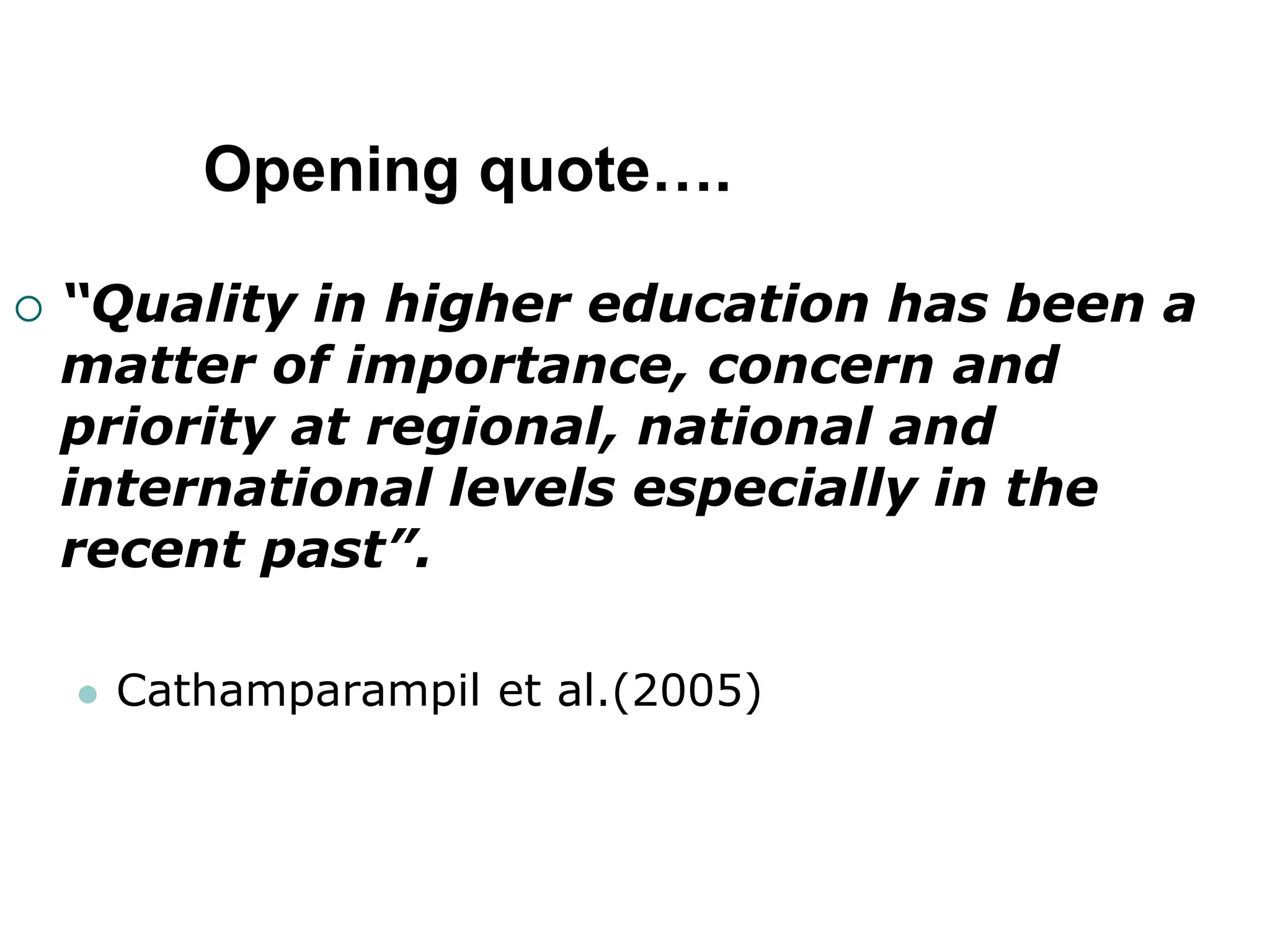
 “Quality in higher education has been a
matter of importance, concern and
priority at regional, national and
international levels especially in the
recent past”.
 Cathamparampil et al.(2005)
Speaking points
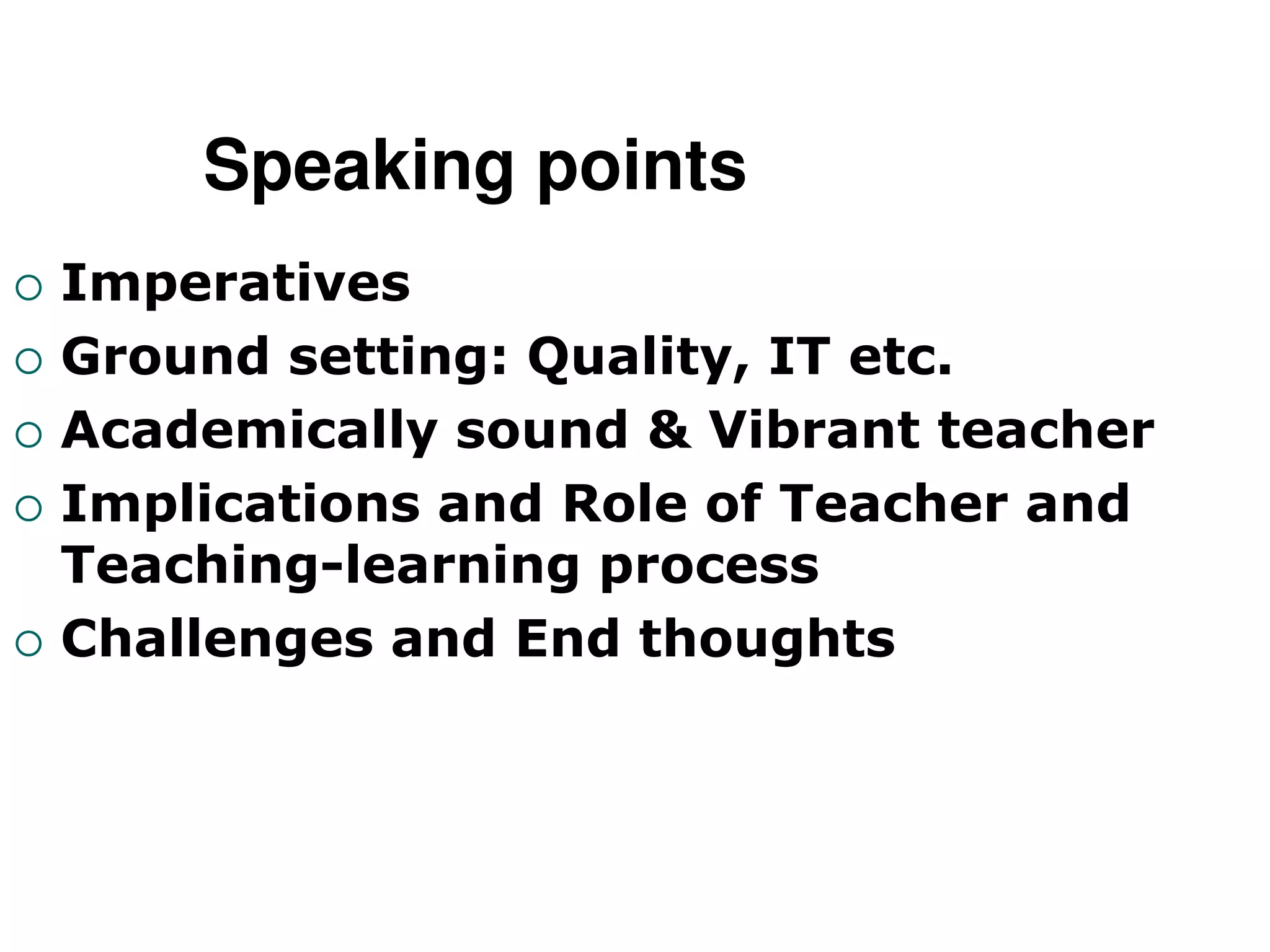
 Imperatives
 Ground setting: Quality, IT etc.
 Academically sound & Vibrant teacher
 Implications and Role of Teacher and
Teaching-learning process
 Challenges and End thoughts
Imperatives ..
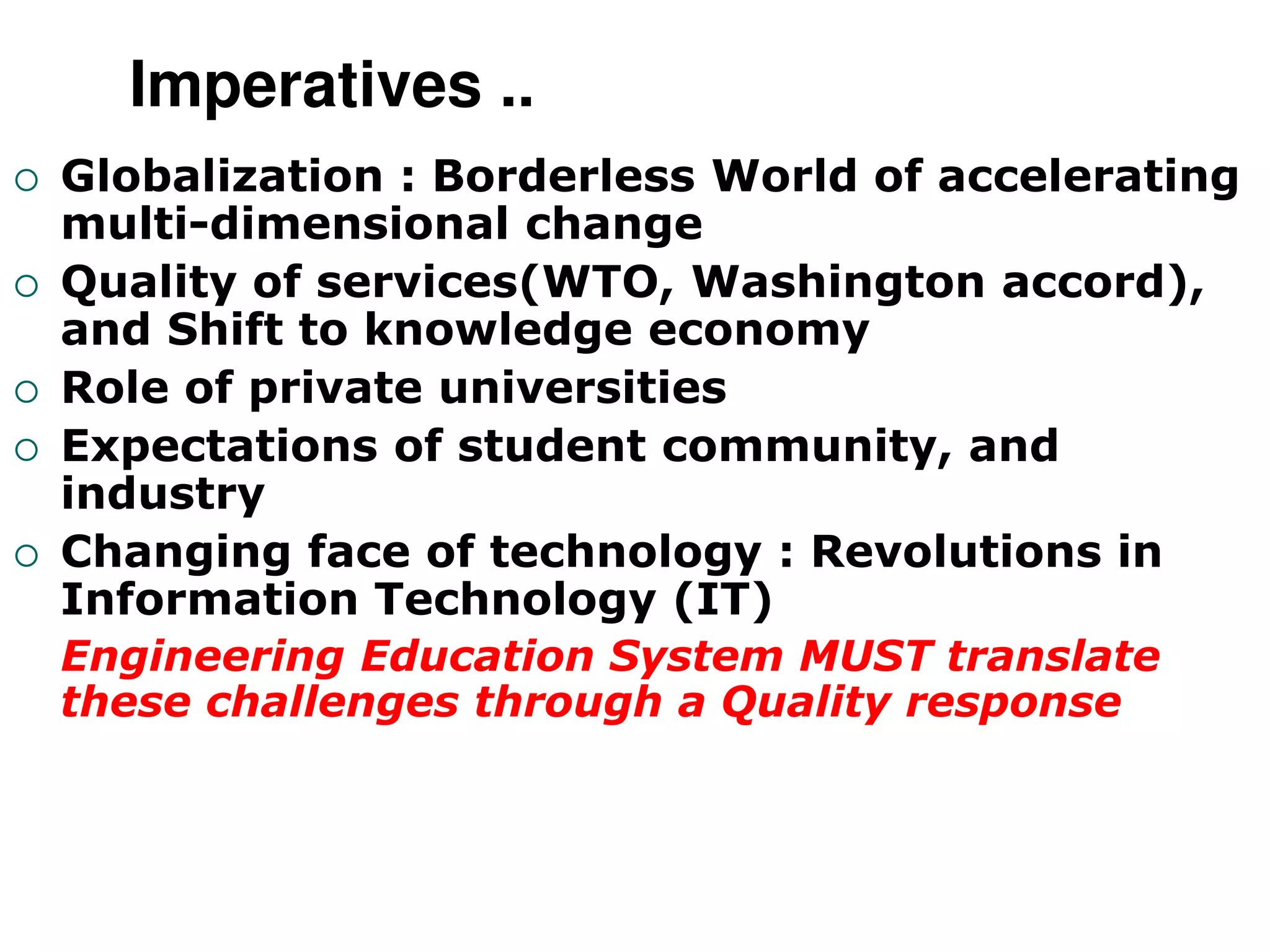
 Globalization : Borderless World of accelerating
multi-dimensional change
 Quality of services(WTO, Washington accord),
and Shift to knowledge economy
 Role of private universities
 Expectations of student community, and
industry
 Changing face of technology : Revolutions in
Information Technology (IT)
Engineering Education System MUST translate
these challenges through a Quality response
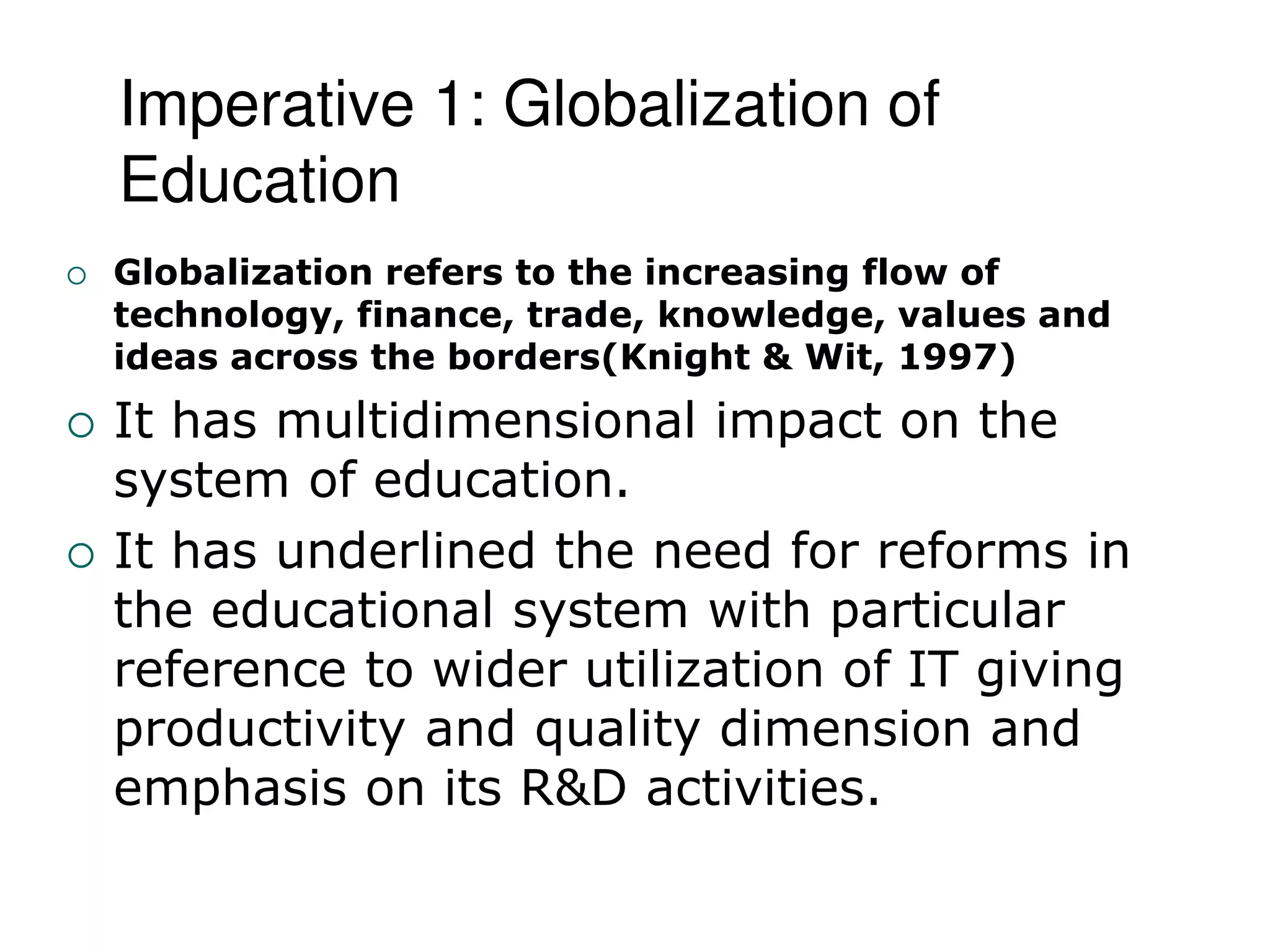
Imperative 1: Globalization of
Education
 Globalization refers to the increasing flow of
technology, finance, trade, knowledge, values and
ideas across the borders(Knight & Wit, 1997)
 It has multidimensional impact on the
system of education.
 It has underlined the need for reforms in
the educational system with particular
reference to wider utilization of IT giving
productivity and quality dimension and
emphasis on its R&D activities.
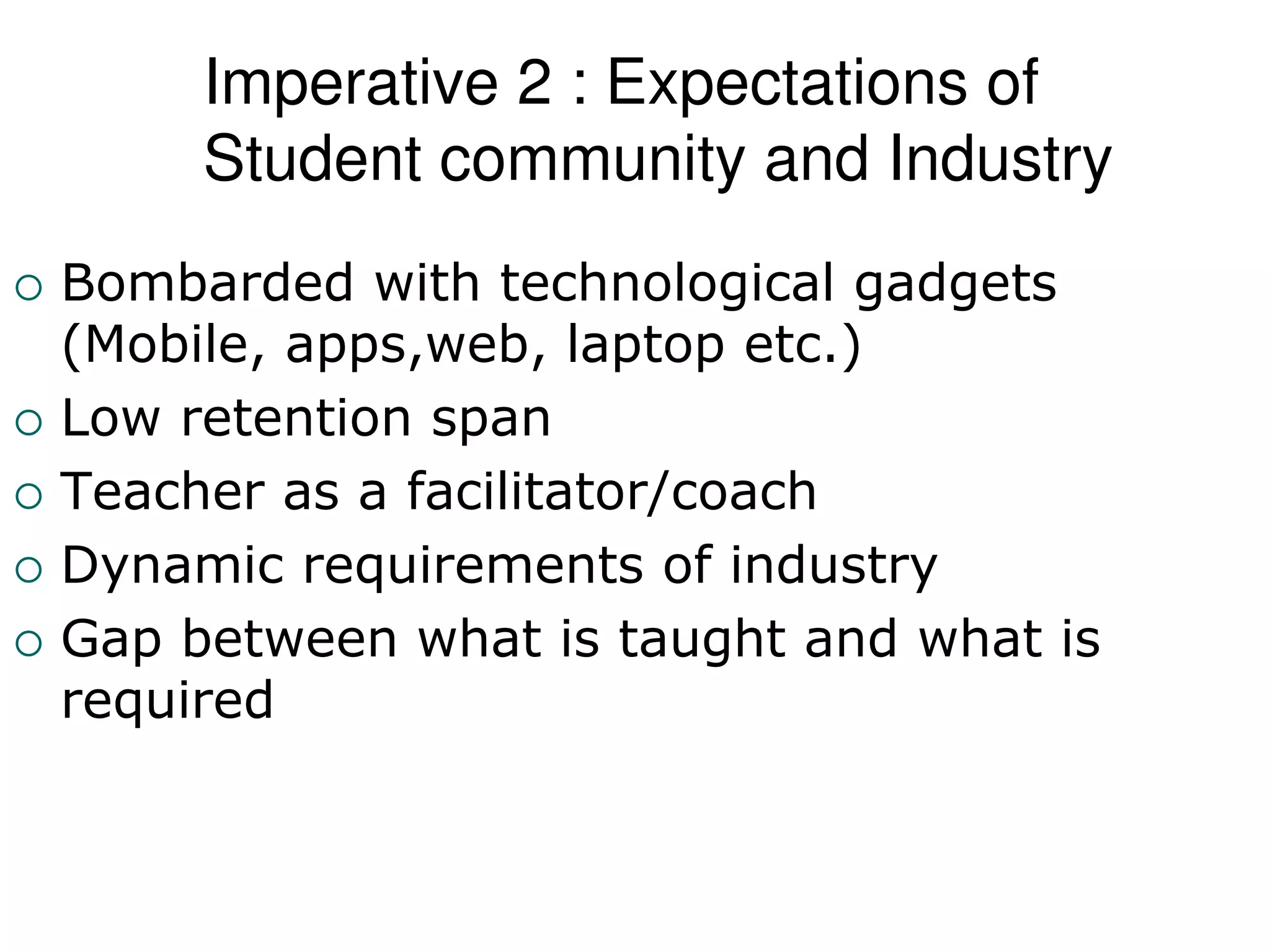
Imperative 2 : Expectations of
Student community and Industry
 Bombarded with technological gadgets
(Mobile, apps,web, laptop etc.)
 Low retention span
 Teacher as a facilitator/coach
 Dynamic requirements of industry
 Gap between what is taught and what is
required
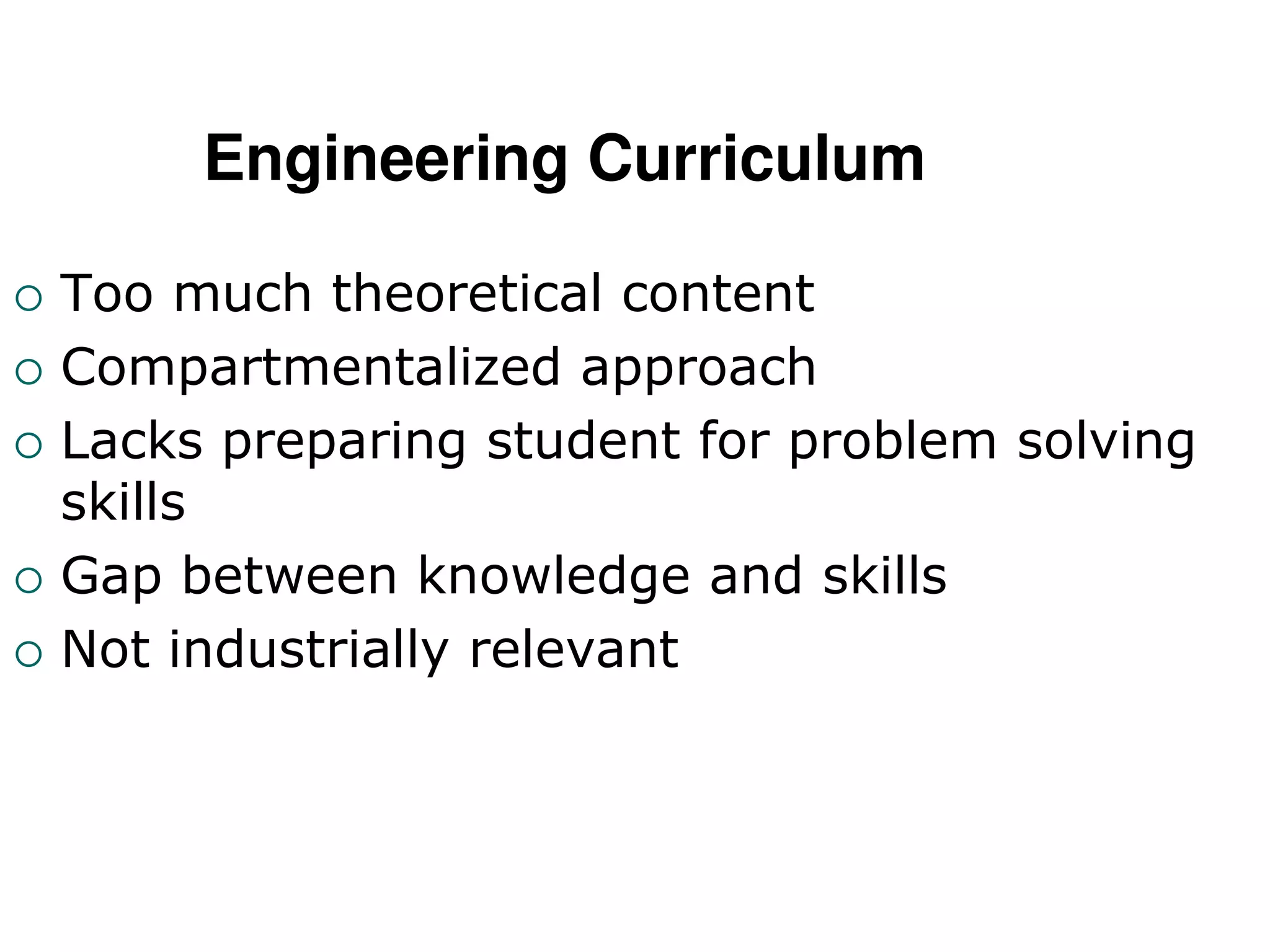
Engineering Curriculum
 Too much theoretical content
 Compartmentalized approach
 Lacks preparing student for problem solving
skills
 Gap between knowledge and skills
 Not industrially relevant
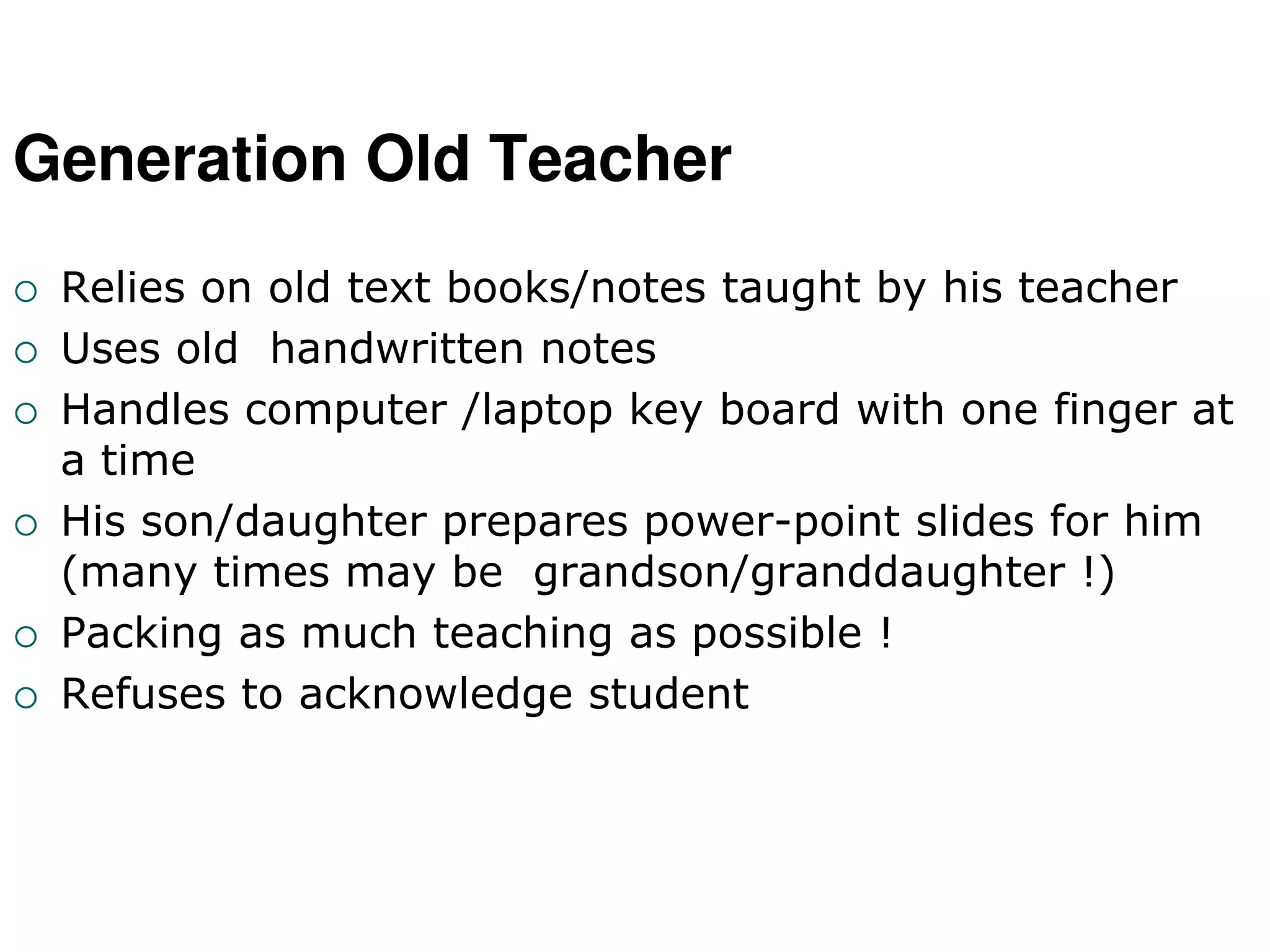
Generation Old Teacher
 Relies on old text books/notes taught by his teacher
 Uses old handwritten notes
 Handles computer /laptop key board with one finger at
a time
 His son/daughter prepares power-point slides for him
(many times may be grandson/granddaughter !)
 Packing as much teaching as possible !
 Refuses to acknowledge student
Generation New student
 Uses mobile on and off the class room
 Handles Laptop in a WiFi environment
 Watches ‘n’ number of channels on TV
 Sees YouTube
 Participates in blog discussions
 Hooked to Facebook , whatsapp !
 Downloads material from the web
 Adept in Cut and Paste mode
 Comfortable in handling ATM
 Reluctant to acknowledge teacher !!
Some perceptions about teaching
 Highly boring activity
 Monotonous
 Uninspiring
 Dull
 Routine
 We donot enjoy at all
 One has to change these perceptions!
 Make teaching interesting and enjoyable
 Thanks to presence of IT
IT is making world flatter !
(Thanks to Friedman)
 Outsourcing dominated paradigm
 Geography has become history: Time and distance are no longer the
important variables
 Mobile dense and multimedia rich environment has accelerated
digital environment.
 Connectivity has made the global village possible
 Working on-line, flexi-time, skype /videoconferencing, and continuous
learning are changing the traditional notions of how work gets done.
 Internet is changing the way we communicate with –suppliers,
customers, potential and current employees by way of 2-way
communications !
 SMS driven communication
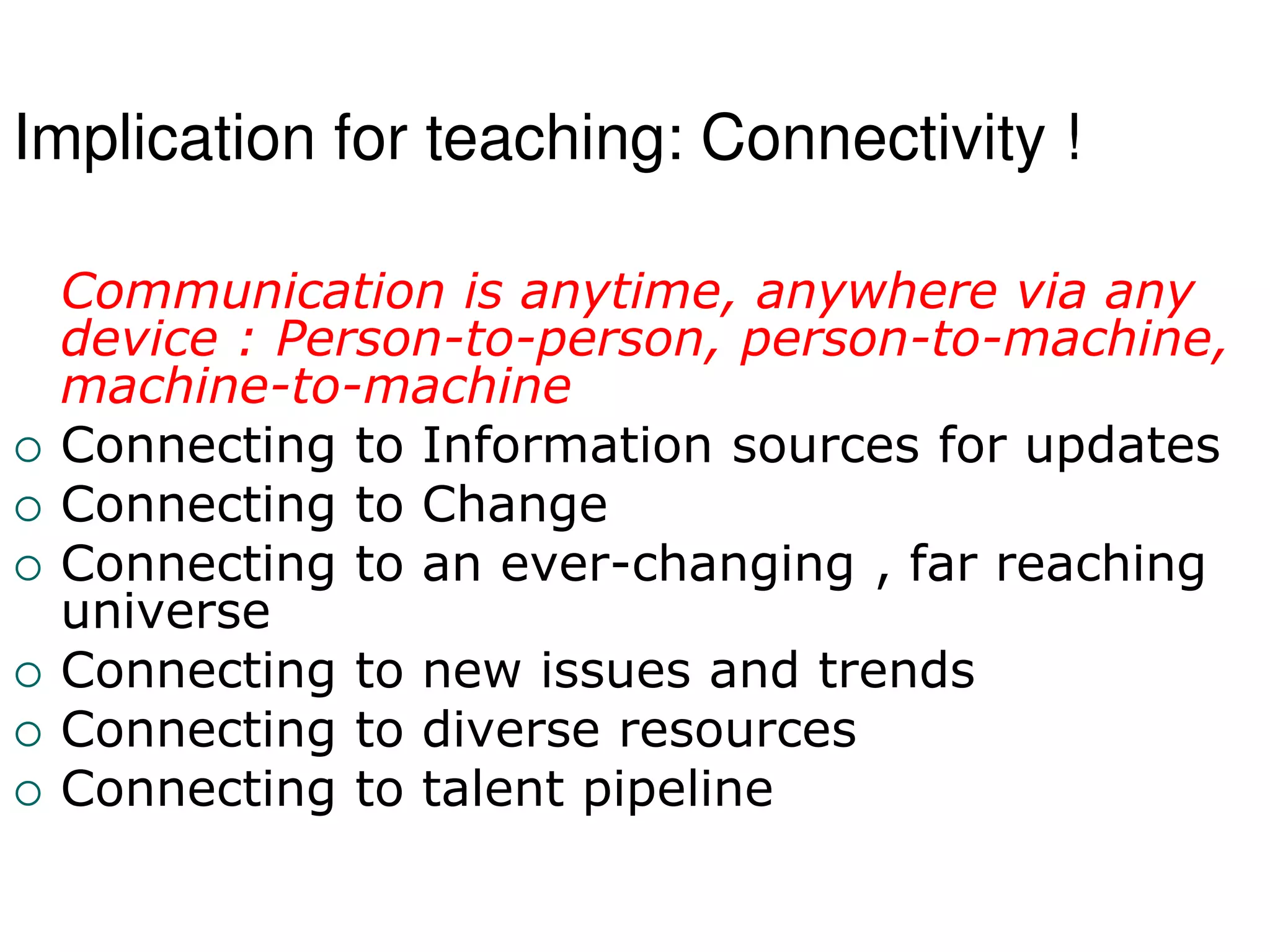
Implication for teaching: Connectivity !
Communication is anytime, anywhere via any
device : Person-to-person, person-to-machine,
machine-to-machine
 Connecting to Information sources for updates
 Connecting to Change
 Connecting to an ever-changing , far reaching
universe
 Connecting to new issues and trends
 Connecting to diverse resources
 Connecting to talent pipeline
Implications
 Connect between teacher & student
 Connect between subject and student
 Connect between curriculum and industry
needs
 Connect between teacher and society !
Basic tenets.
 Tenet 1 : Customers are vital to the operation of the organization.
Without customers, there is no business, and without business,
there is no organization (Deming ,1986).
Students as
 Customer
 Product
 Knowledge carrier
 Co-producer !
 Tenet 2 : Management needs to listen to nontraditional sources of
information in order to institute quality,
People want to do quality work and that they would do it if
managers would listen to them and create a workplace based on
their ideas (Deming, 1986).
Role of feedback vis-à-vis information systems
Remarks..
 Success as a teacher requires the presence
of many qualities - whereas failure
emanates from the absence of merely one
of them
 Success factors
 Energy
 Enthusiasm
 Subject expertise
 Body language
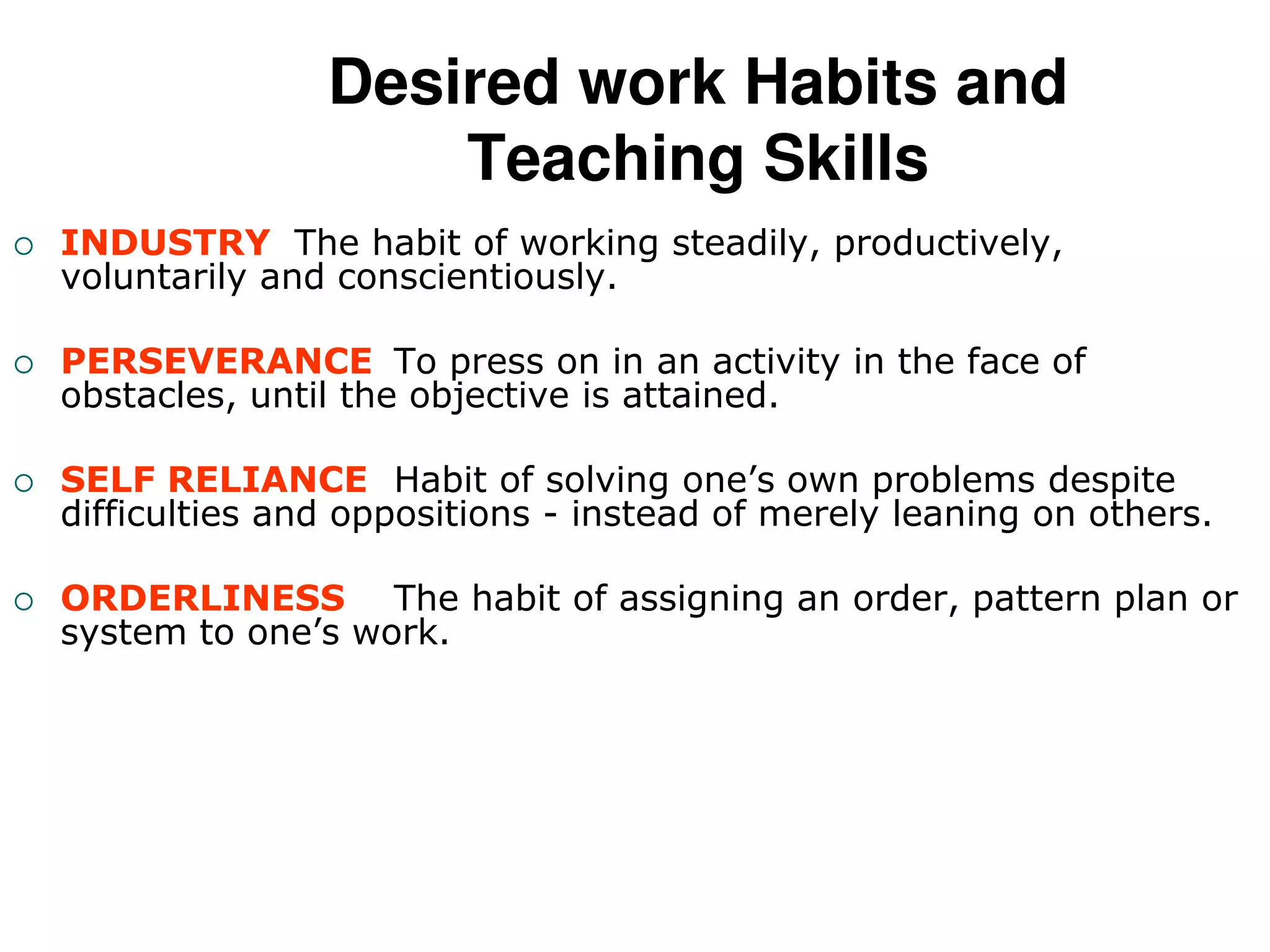
Desired work Habits and
Teaching Skills
 INDUSTRY The habit of working steadily, productively,
voluntarily and conscientiously.
 PERSEVERANCE To press on in an activity in the face of
obstacles, until the objective is attained.
 SELF RELIANCE Habit of solving one’s own problems despite
difficulties and oppositions - instead of merely leaning on others.
 ORDERLINESS The habit of assigning an order, pattern plan or
system to one’s work.
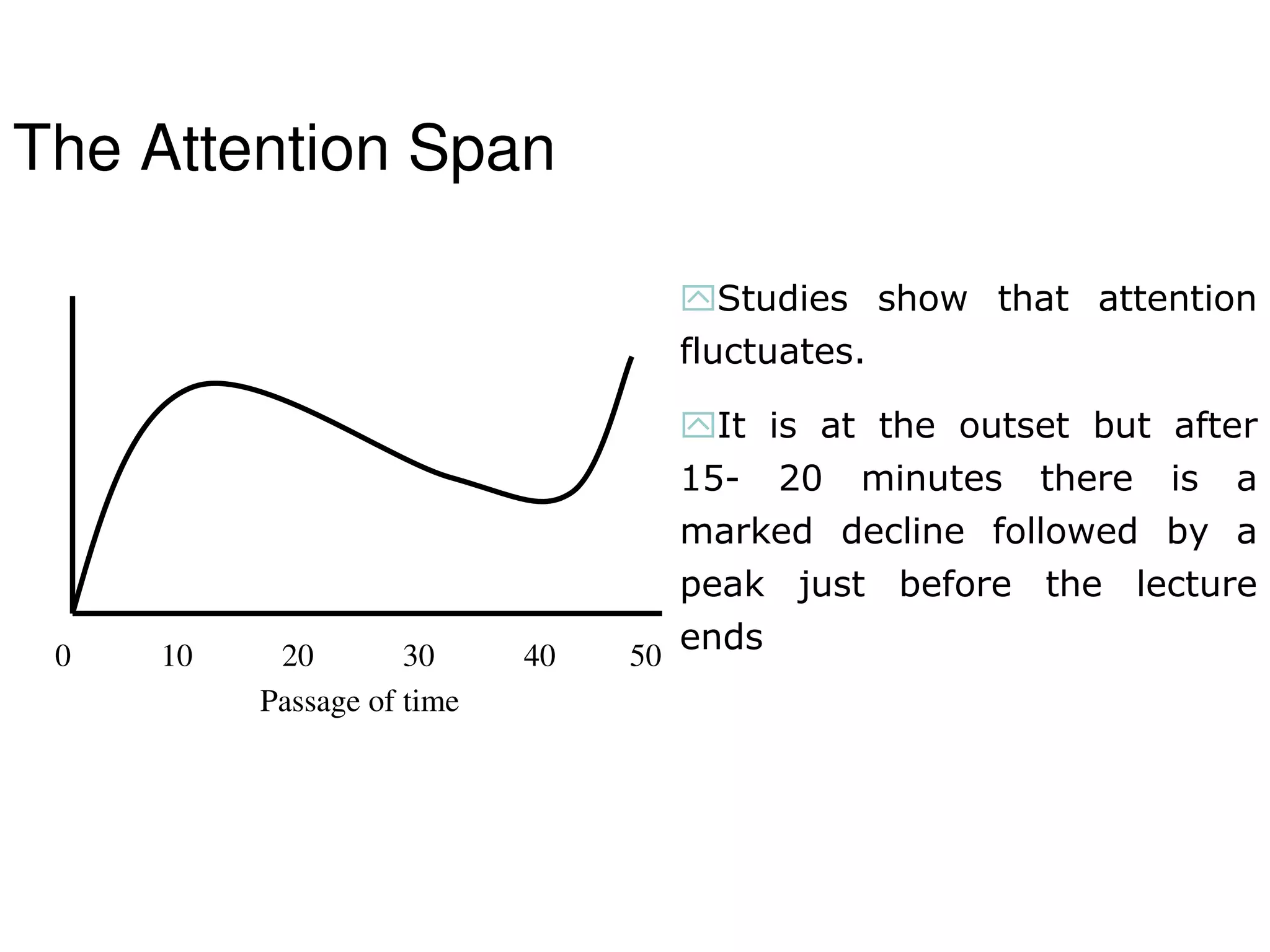
The Attention Span
10 30 5040200
Passage of time
Studies show that attention
fluctuates.
It is at the outset but after
15- 20 minutes there is a
marked decline followed by a
peak just before the lecture
ends
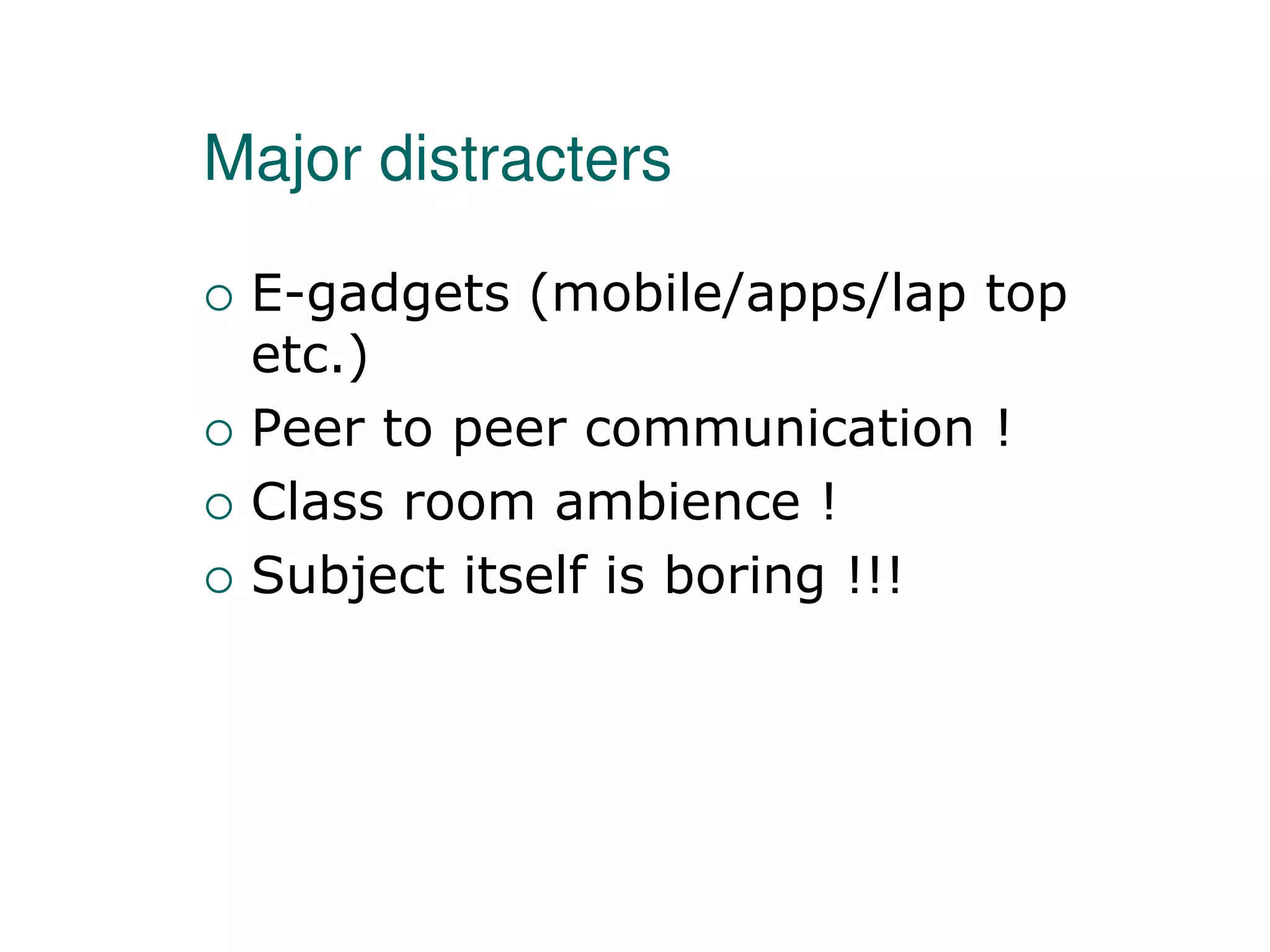
Major distracters
 E-gadgets (mobile/apps/lap top
etc.)
 Peer to peer communication !
 Class room ambience !
 Subject itself is boring !!!
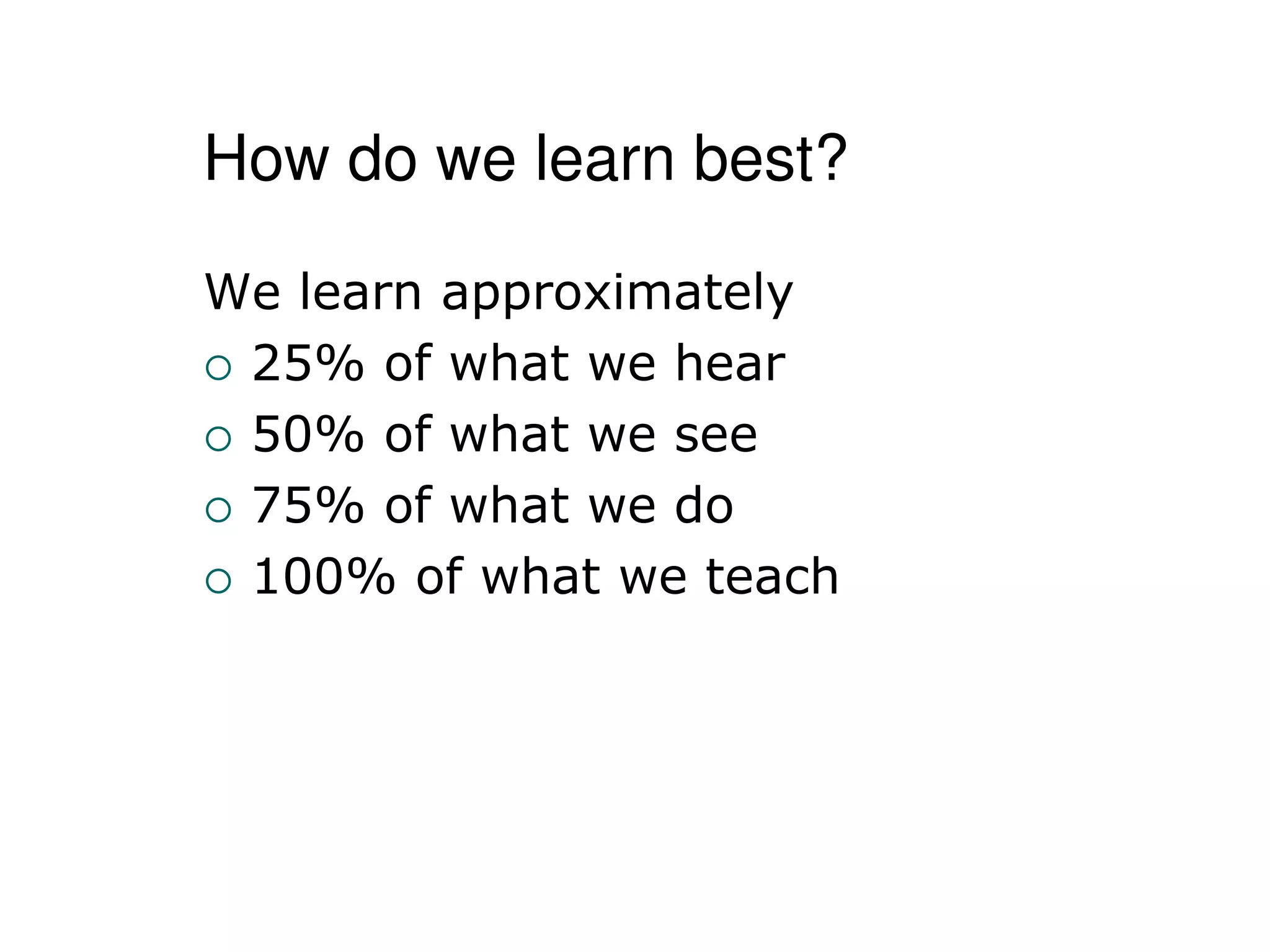
How do we learn best?
We learn approximately
 25% of what we hear
 50% of what we see
 75% of what we do
 100% of what we teach
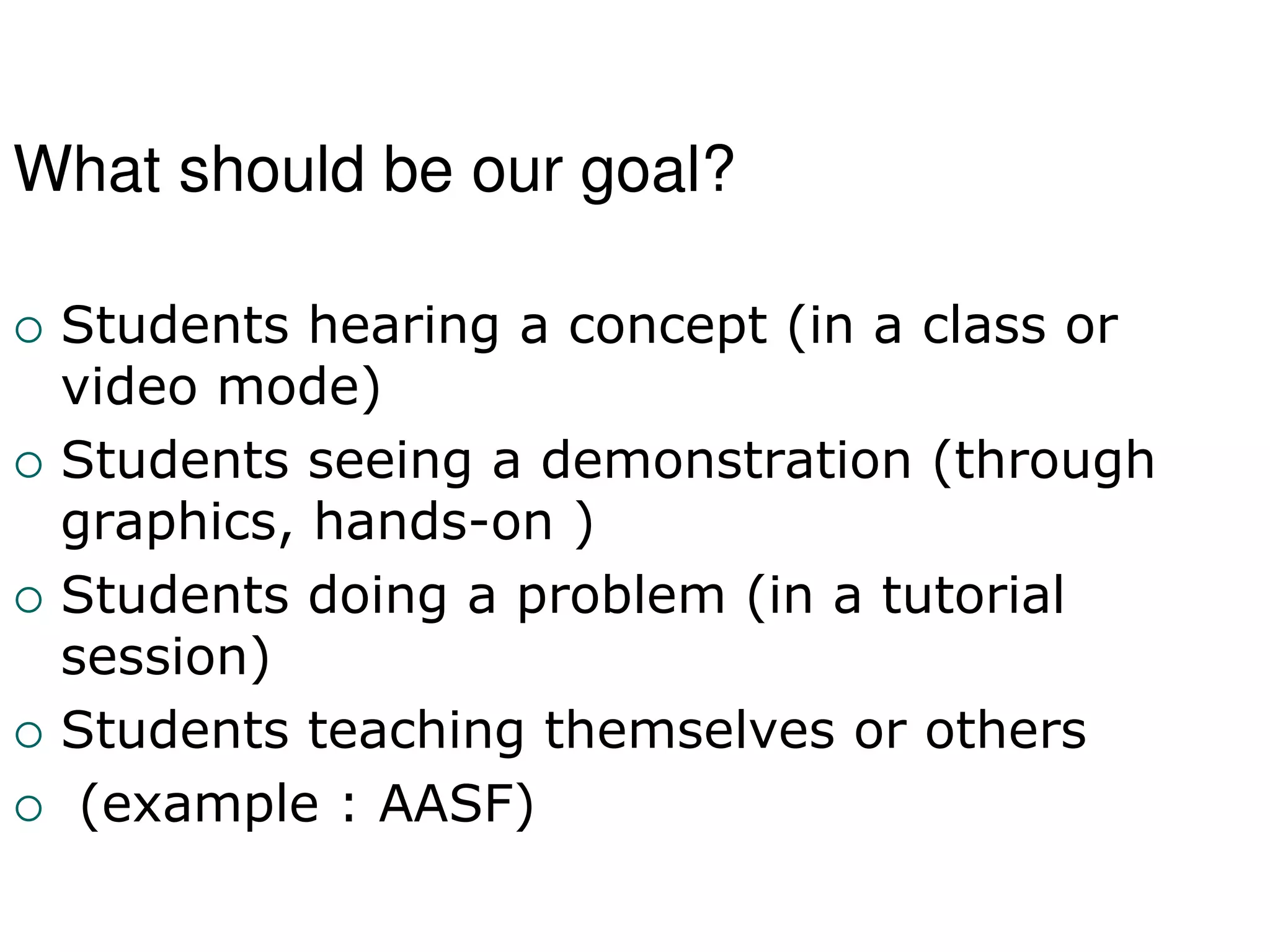
What should be our goal?
 Students hearing a concept (in a class or
video mode)
 Students seeing a demonstration (through
graphics, hands-on )
 Students doing a problem (in a tutorial
session)
 Students teaching themselves or others
 (example : AASF)
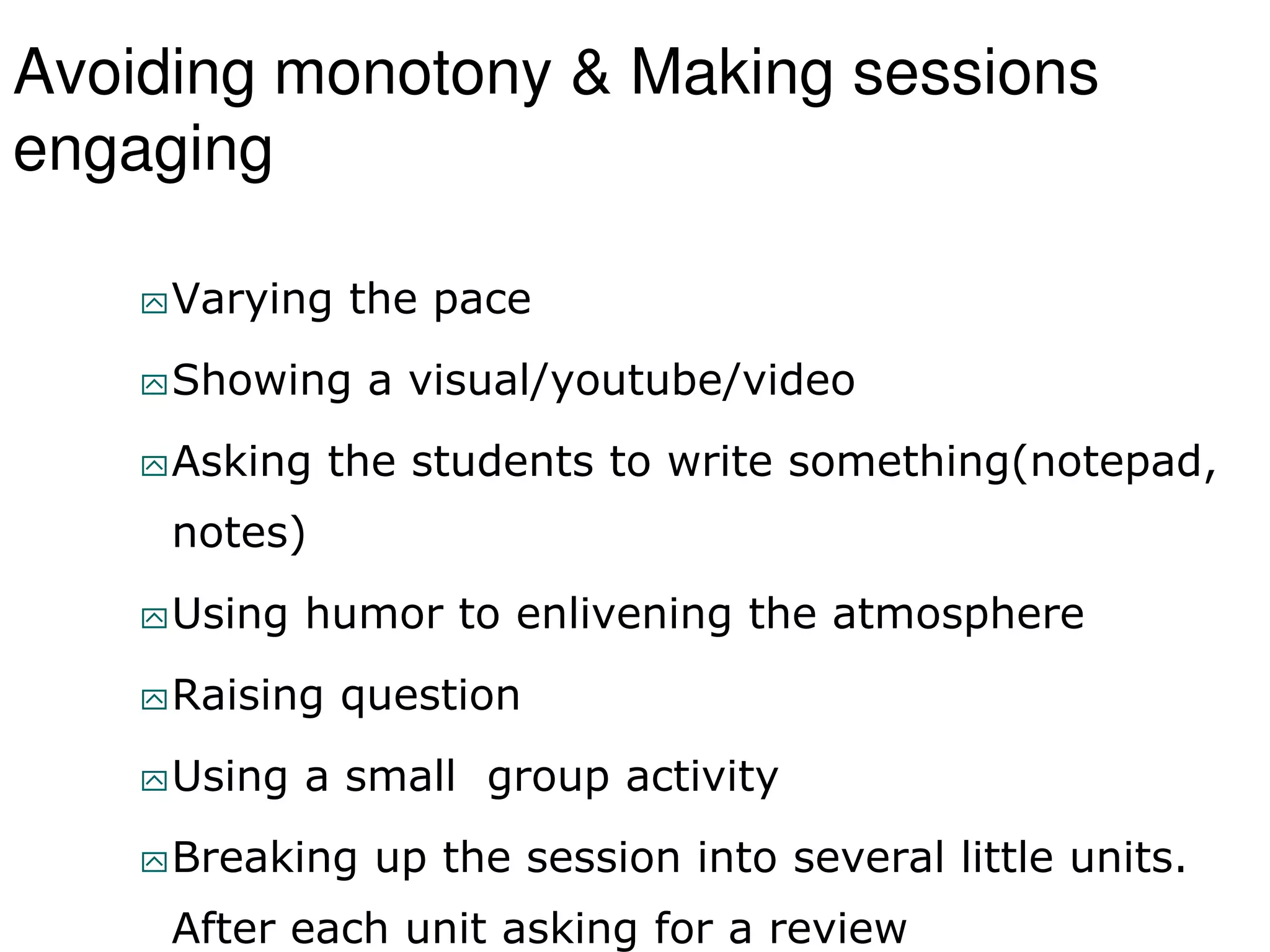
Avoiding monotony & Making sessions
engaging
Varying the pace
Showing a visual/youtube/video
Asking the students to write something(notepad,
notes)
Using humor to enlivening the atmosphere
Raising question
Using a small group activity
Breaking up the session into several little units.
After each unit asking for a review
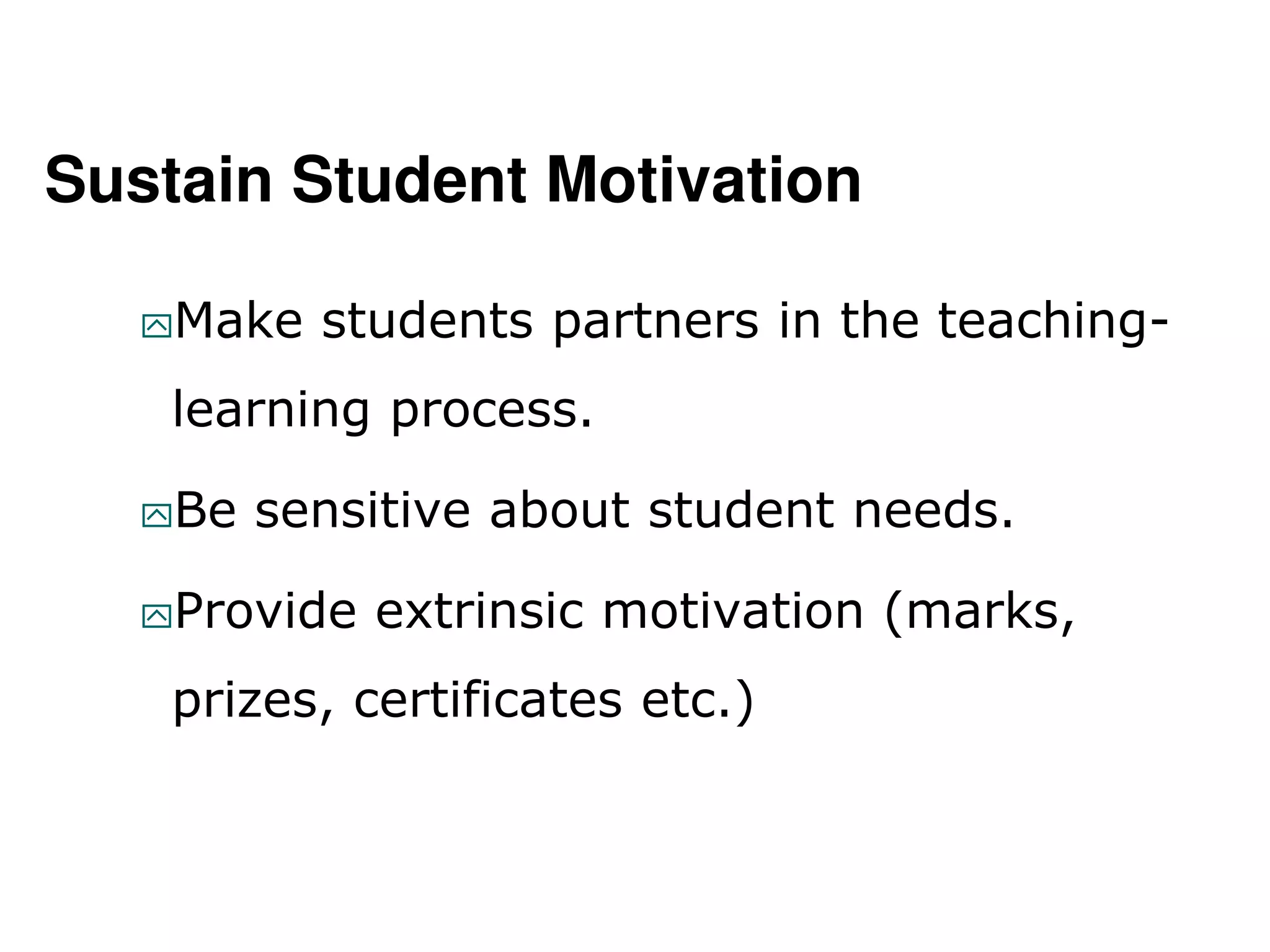
Sustain Student Motivation
Make students partners in the teaching-
learning process.
Be sensitive about student needs.
Provide extrinsic motivation (marks,
prizes, certificates etc.)
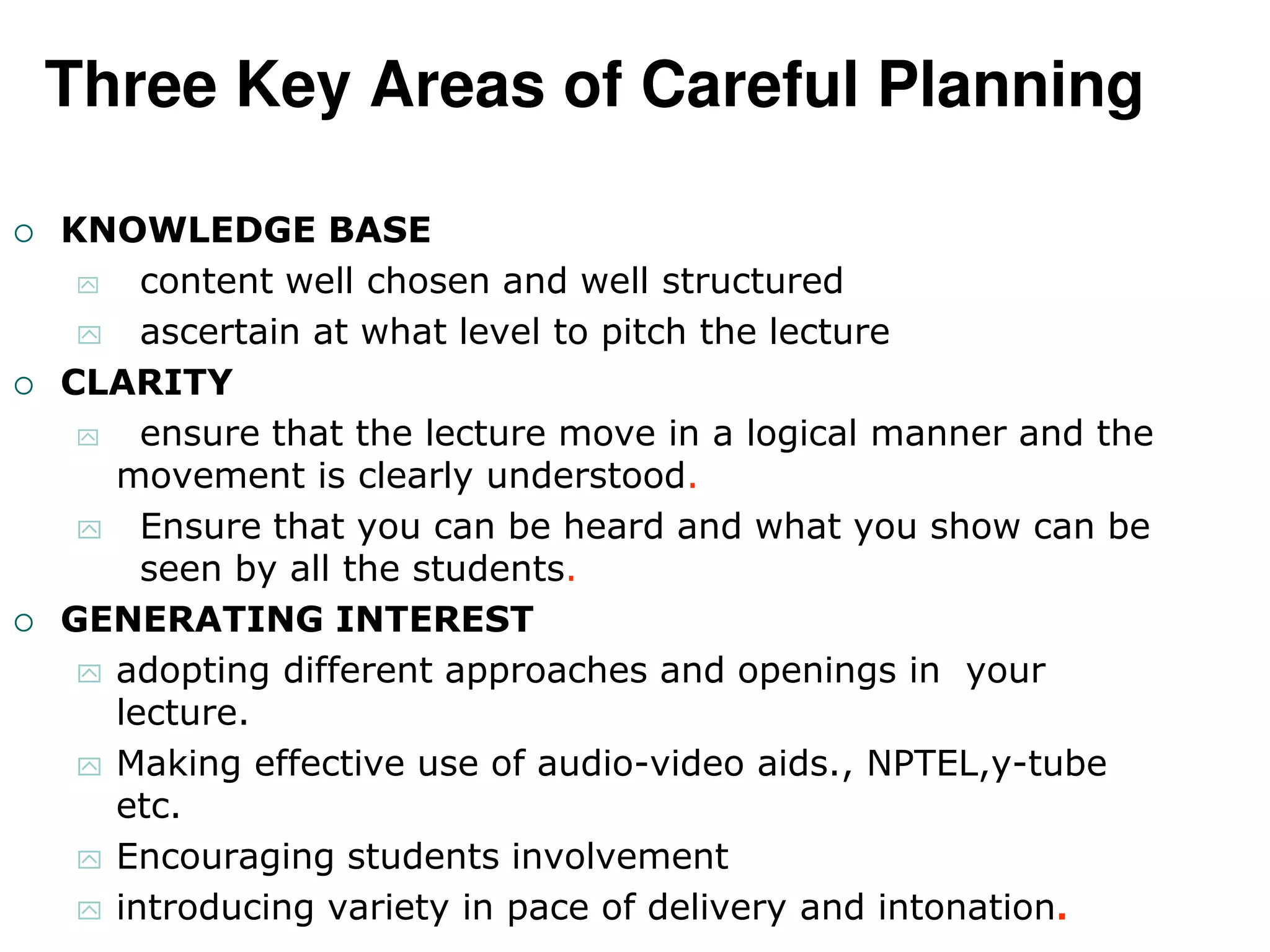
Three Key Areas of Careful Planning
 KNOWLEDGE BASE
 content well chosen and well structured
 ascertain at what level to pitch the lecture
 CLARITY
 ensure that the lecture move in a logical manner and the
movement is clearly understood.
 Ensure that you can be heard and what you show can be
seen by all the students.
 GENERATING INTEREST
 adopting different approaches and openings in your
lecture.
 Making effective use of audio-video aids., NPTEL,y-tube
etc.
 Encouraging students involvement
 introducing variety in pace of delivery and intonation.
E-learning 2.0
 New way of thinking about e-learning inspired
by web 2.0
 It emphasizes on social learning and use of
social software such as blogs, wikis, podcasts
and virtual worlds such as Second Life
 Knowledge is socially constructed and
construction takes place through
conversations and interactions with others !
Remarks..
 Both teachers and students construct
knowledge collaboratively and the student is
an active partner in this process.
 Teacher as a guide rather than a sage on the
stage !
 Self-directed and life –long learning
 Teacher's role not Extinct but Distinct (Fr Rex
Angelo, 2009)
 Teaching as a reflective practice not a reflex
practice
Involvement through Interactivity
 Interactivity (WAP, Web Services, XML) being
more recent in the IT evolution
 Enables to understand customer (student and
industry) better
 Establishes long term relationships with all
the stakeholders
 Helps in understanding various features and
add-ons by close interaction
 Feedback through blogging
27
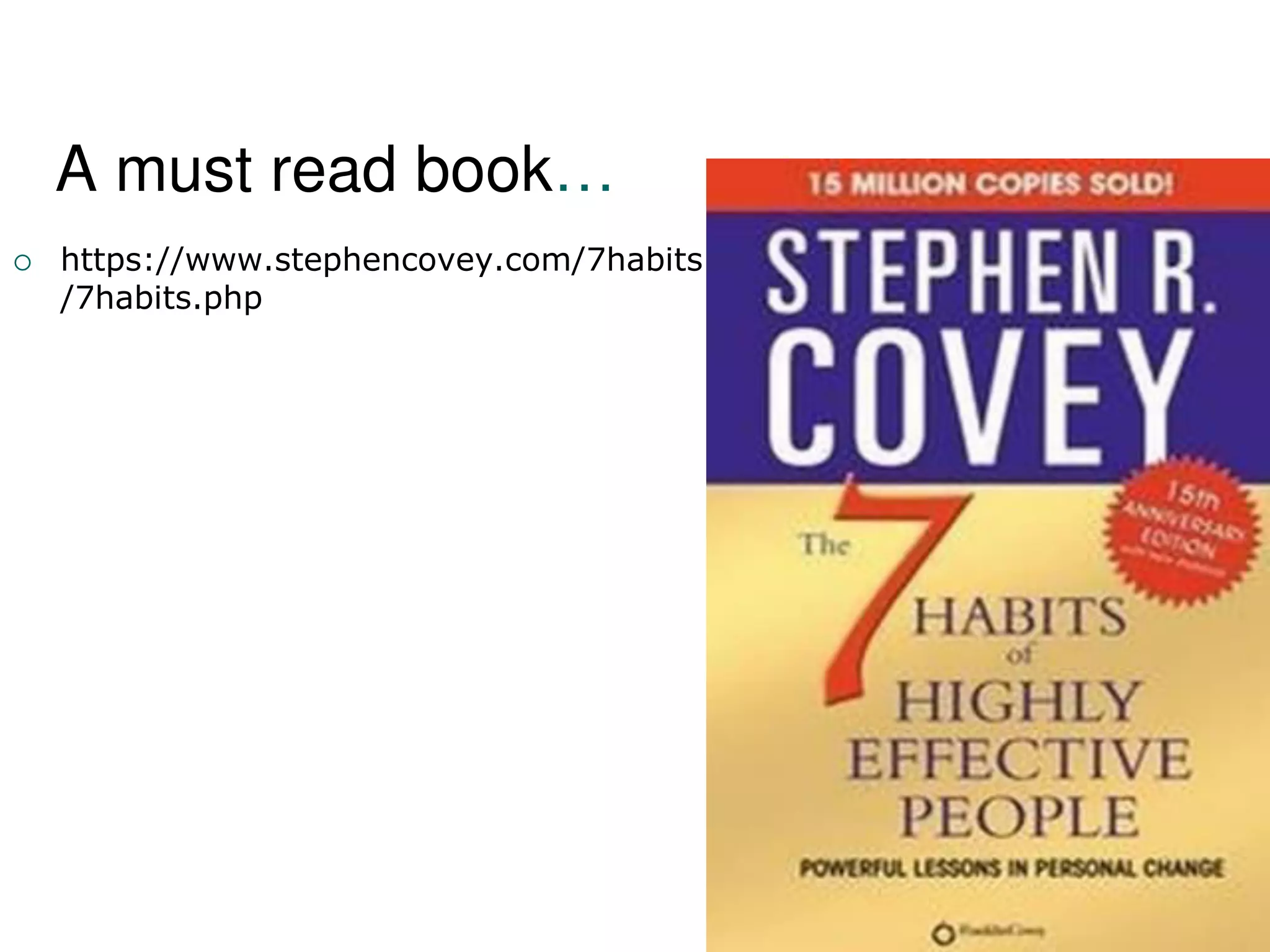
A must read book…
 https://www.stephencovey.com/7habits
/7habits.php
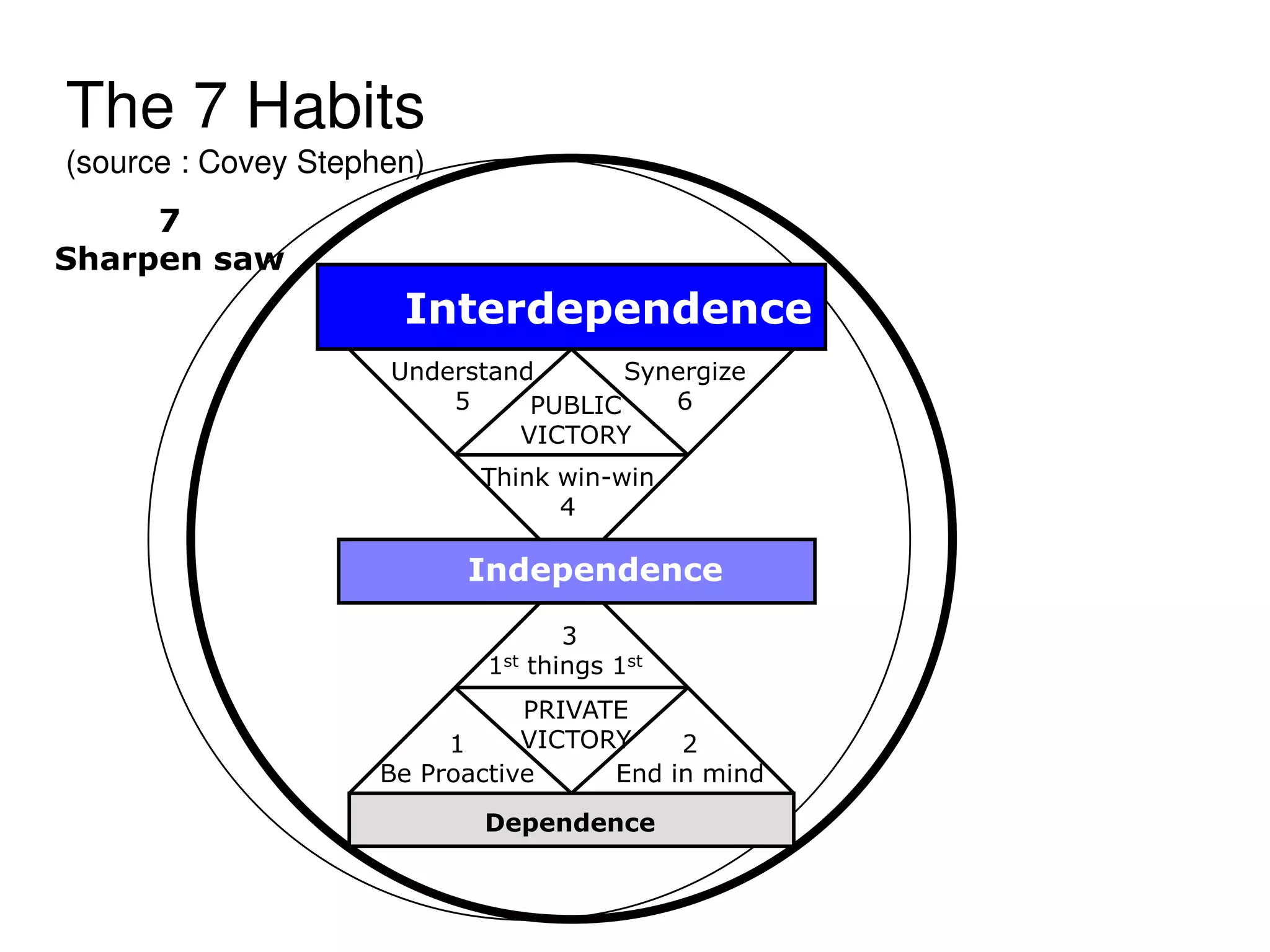
The 7 Habits
(source : Covey Stephen)
7
Sharpen saw
Independence
Interdependence
PUBLIC
VICTORY
Think win-win
4
Understand
5
Synergize
6
Dependence
1
Be Proactive
PRIVATE
VICTORY 2
End in mind
3
1st things 1st
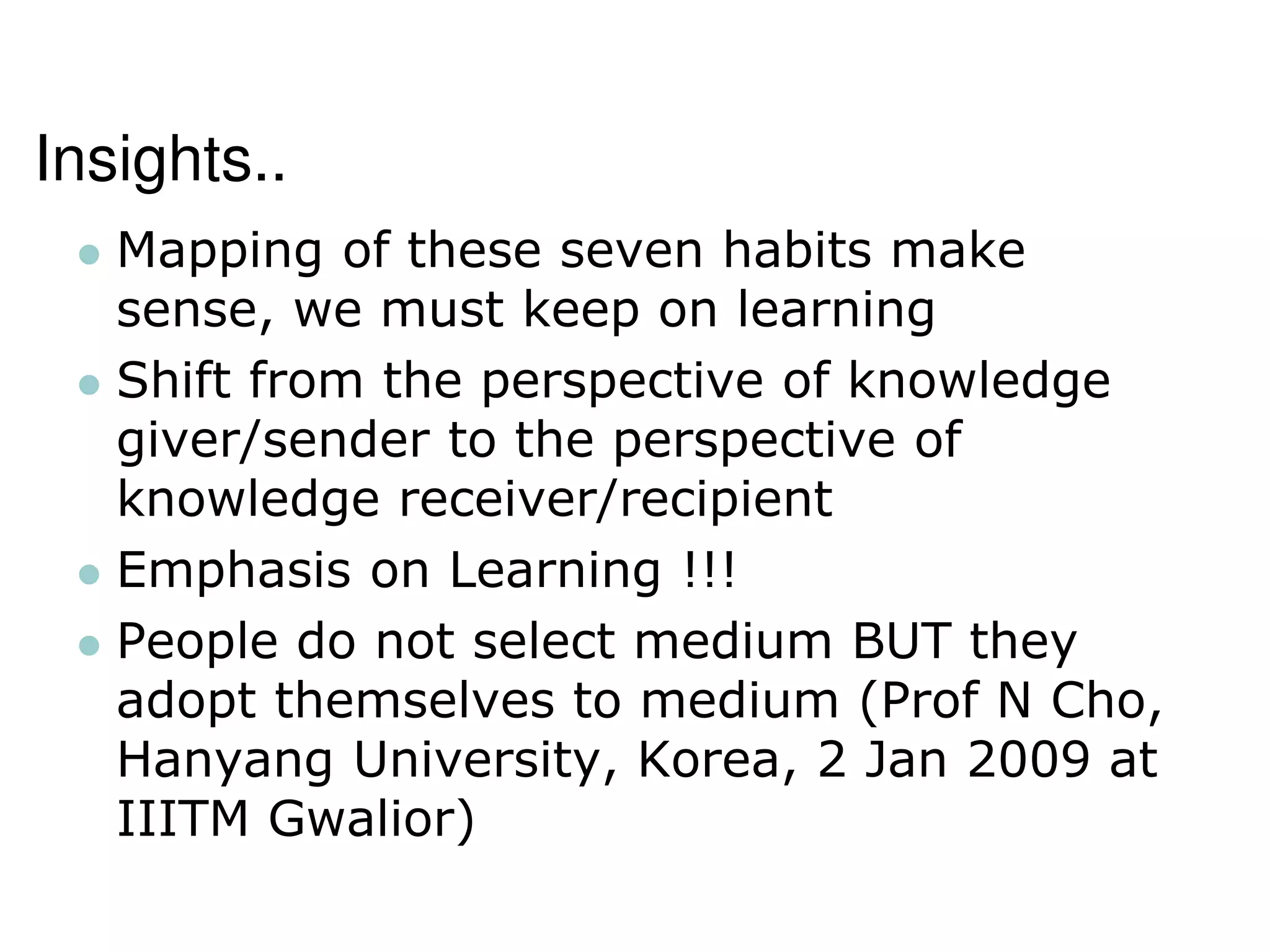
Insights..
 Mapping of these seven habits make
sense, we must keep on learning
 Shift from the perspective of knowledge
giver/sender to the perspective of
knowledge receiver/recipient
 Emphasis on Learning !!!
 People do not select medium BUT they
adopt themselves to medium (Prof N Cho,
Hanyang University, Korea, 2 Jan 2009 at
IIITM Gwalior)
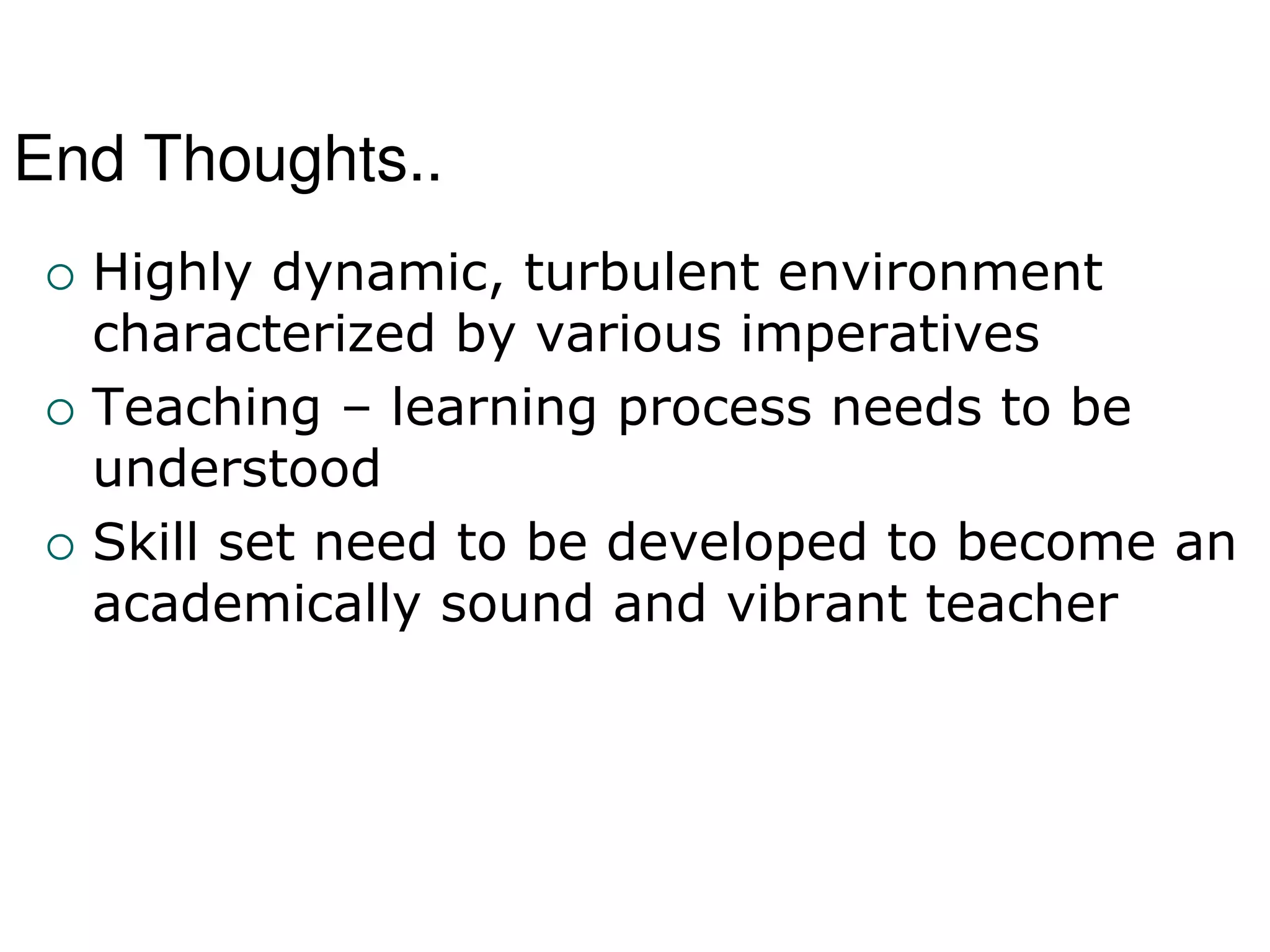
End Thoughts..
 Highly dynamic, turbulent environment
characterized by various imperatives
 Teaching – learning process needs to be
understood
 Skill set need to be developed to become an
academically sound and vibrant teacher
Thanks a lot for your patience …
My Coordinates :
deshmukh.sg@gmail.com
http://www.slideshare.net/SanjeevDeshmukh/
http://sgdeshmuk.blogspot.in

Some reflecctions tecaher and-teaching. (1) (1) (1)

  • 1.
    Some reflections onTeacher and Teaching in the present scenario Dr S G Deshmukh
  • 2.
    Opening quote….  “Qualityin higher education has been a matter of importance, concern and priority at regional, national and international levels especially in the recent past”.  Cathamparampil et al.(2005)
  • 3.
    Speaking points  Imperatives Ground setting: Quality, IT etc.  Academically sound & Vibrant teacher  Implications and Role of Teacher and Teaching-learning process  Challenges and End thoughts
  • 4.
    Imperatives ..  Globalization: Borderless World of accelerating multi-dimensional change  Quality of services(WTO, Washington accord), and Shift to knowledge economy  Role of private universities  Expectations of student community, and industry  Changing face of technology : Revolutions in Information Technology (IT) Engineering Education System MUST translate these challenges through a Quality response
  • 5.
    Imperative 1: Globalizationof Education  Globalization refers to the increasing flow of technology, finance, trade, knowledge, values and ideas across the borders(Knight & Wit, 1997)  It has multidimensional impact on the system of education.  It has underlined the need for reforms in the educational system with particular reference to wider utilization of IT giving productivity and quality dimension and emphasis on its R&D activities.
  • 6.
    Imperative 2 :Expectations of Student community and Industry  Bombarded with technological gadgets (Mobile, apps,web, laptop etc.)  Low retention span  Teacher as a facilitator/coach  Dynamic requirements of industry  Gap between what is taught and what is required
  • 7.
    Engineering Curriculum  Toomuch theoretical content  Compartmentalized approach  Lacks preparing student for problem solving skills  Gap between knowledge and skills  Not industrially relevant
  • 8.
    Generation Old Teacher Relies on old text books/notes taught by his teacher  Uses old handwritten notes  Handles computer /laptop key board with one finger at a time  His son/daughter prepares power-point slides for him (many times may be grandson/granddaughter !)  Packing as much teaching as possible !  Refuses to acknowledge student
  • 9.
    Generation New student Uses mobile on and off the class room  Handles Laptop in a WiFi environment  Watches ‘n’ number of channels on TV  Sees YouTube  Participates in blog discussions  Hooked to Facebook , whatsapp !  Downloads material from the web  Adept in Cut and Paste mode  Comfortable in handling ATM  Reluctant to acknowledge teacher !!
  • 10.
    Some perceptions aboutteaching  Highly boring activity  Monotonous  Uninspiring  Dull  Routine  We donot enjoy at all
  • 11.
     One hasto change these perceptions!  Make teaching interesting and enjoyable  Thanks to presence of IT
  • 12.
    IT is makingworld flatter ! (Thanks to Friedman)  Outsourcing dominated paradigm  Geography has become history: Time and distance are no longer the important variables  Mobile dense and multimedia rich environment has accelerated digital environment.  Connectivity has made the global village possible  Working on-line, flexi-time, skype /videoconferencing, and continuous learning are changing the traditional notions of how work gets done.  Internet is changing the way we communicate with –suppliers, customers, potential and current employees by way of 2-way communications !  SMS driven communication
  • 13.
    Implication for teaching:Connectivity ! Communication is anytime, anywhere via any device : Person-to-person, person-to-machine, machine-to-machine  Connecting to Information sources for updates  Connecting to Change  Connecting to an ever-changing , far reaching universe  Connecting to new issues and trends  Connecting to diverse resources  Connecting to talent pipeline
  • 14.
    Implications  Connect betweenteacher & student  Connect between subject and student  Connect between curriculum and industry needs  Connect between teacher and society !
  • 15.
    Basic tenets.  Tenet1 : Customers are vital to the operation of the organization. Without customers, there is no business, and without business, there is no organization (Deming ,1986). Students as  Customer  Product  Knowledge carrier  Co-producer !  Tenet 2 : Management needs to listen to nontraditional sources of information in order to institute quality, People want to do quality work and that they would do it if managers would listen to them and create a workplace based on their ideas (Deming, 1986). Role of feedback vis-à-vis information systems
  • 16.
    Remarks..  Success asa teacher requires the presence of many qualities - whereas failure emanates from the absence of merely one of them  Success factors  Energy  Enthusiasm  Subject expertise  Body language
  • 17.
    Desired work Habitsand Teaching Skills  INDUSTRY The habit of working steadily, productively, voluntarily and conscientiously.  PERSEVERANCE To press on in an activity in the face of obstacles, until the objective is attained.  SELF RELIANCE Habit of solving one’s own problems despite difficulties and oppositions - instead of merely leaning on others.  ORDERLINESS The habit of assigning an order, pattern plan or system to one’s work.
  • 18.
    The Attention Span 1030 5040200 Passage of time Studies show that attention fluctuates. It is at the outset but after 15- 20 minutes there is a marked decline followed by a peak just before the lecture ends
  • 19.
    Major distracters  E-gadgets(mobile/apps/lap top etc.)  Peer to peer communication !  Class room ambience !  Subject itself is boring !!!
  • 20.
    How do welearn best? We learn approximately  25% of what we hear  50% of what we see  75% of what we do  100% of what we teach
  • 21.
    What should beour goal?  Students hearing a concept (in a class or video mode)  Students seeing a demonstration (through graphics, hands-on )  Students doing a problem (in a tutorial session)  Students teaching themselves or others  (example : AASF)
  • 22.
    Avoiding monotony &Making sessions engaging Varying the pace Showing a visual/youtube/video Asking the students to write something(notepad, notes) Using humor to enlivening the atmosphere Raising question Using a small group activity Breaking up the session into several little units. After each unit asking for a review
  • 23.
    Sustain Student Motivation Makestudents partners in the teaching- learning process. Be sensitive about student needs. Provide extrinsic motivation (marks, prizes, certificates etc.)
  • 24.
    Three Key Areasof Careful Planning  KNOWLEDGE BASE  content well chosen and well structured  ascertain at what level to pitch the lecture  CLARITY  ensure that the lecture move in a logical manner and the movement is clearly understood.  Ensure that you can be heard and what you show can be seen by all the students.  GENERATING INTEREST  adopting different approaches and openings in your lecture.  Making effective use of audio-video aids., NPTEL,y-tube etc.  Encouraging students involvement  introducing variety in pace of delivery and intonation.
  • 25.
    E-learning 2.0  Newway of thinking about e-learning inspired by web 2.0  It emphasizes on social learning and use of social software such as blogs, wikis, podcasts and virtual worlds such as Second Life  Knowledge is socially constructed and construction takes place through conversations and interactions with others !
  • 26.
    Remarks..  Both teachersand students construct knowledge collaboratively and the student is an active partner in this process.  Teacher as a guide rather than a sage on the stage !  Self-directed and life –long learning  Teacher's role not Extinct but Distinct (Fr Rex Angelo, 2009)  Teaching as a reflective practice not a reflex practice
  • 27.
    Involvement through Interactivity Interactivity (WAP, Web Services, XML) being more recent in the IT evolution  Enables to understand customer (student and industry) better  Establishes long term relationships with all the stakeholders  Helps in understanding various features and add-ons by close interaction  Feedback through blogging 27
  • 28.
    A must readbook…  https://www.stephencovey.com/7habits /7habits.php
  • 29.
    The 7 Habits (source: Covey Stephen) 7 Sharpen saw Independence Interdependence PUBLIC VICTORY Think win-win 4 Understand 5 Synergize 6 Dependence 1 Be Proactive PRIVATE VICTORY 2 End in mind 3 1st things 1st
  • 30.
    Insights..  Mapping ofthese seven habits make sense, we must keep on learning  Shift from the perspective of knowledge giver/sender to the perspective of knowledge receiver/recipient  Emphasis on Learning !!!  People do not select medium BUT they adopt themselves to medium (Prof N Cho, Hanyang University, Korea, 2 Jan 2009 at IIITM Gwalior)
  • 31.
    End Thoughts..  Highlydynamic, turbulent environment characterized by various imperatives  Teaching – learning process needs to be understood  Skill set need to be developed to become an academically sound and vibrant teacher
  • 32.
    Thanks a lotfor your patience … My Coordinates : deshmukh.sg@gmail.com http://www.slideshare.net/SanjeevDeshmukh/ http://sgdeshmuk.blogspot.in