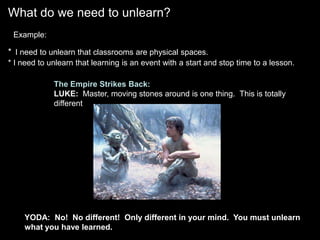
What do we need to unlearn? Example:*I need to unlearn that classrooms are physical spaces.* I need to unlearn that learning is an event with a start and stop time to a lesson.The Empire Strikes Back:LUKE:  Master, moving stones around is one thing.  This is totallydifferent. YODA:  No!  No different!  Only different in your mind.  You must unlearnwhat you have learned.
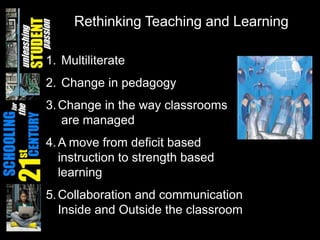
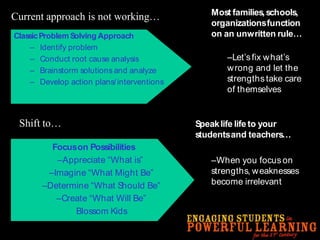
Rethinking Teaching and Learning Multiliterate Change in pedagogyChange in the way classrooms are managedA move from deficit based instruction to strength based learningCollaboration and communication Inside and Outside the classroom
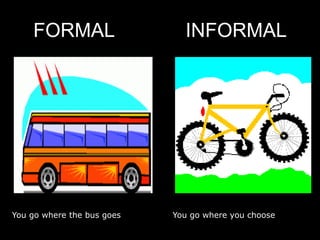
FORMAL             INFORMALYougowherethe bus goesYou go where you chooseJay Cross – Internet Time
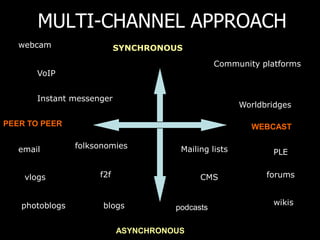
MULTI-CHANNEL APPROACHwebcamSYNCHRONOUSCommunity platformsVoIPConference roomsInstant messengerWorldbridgesPEER TO PEERWEBCASTfolksonomiesMailing listsemailPLEf2fforumsvlogsCMSwikisblogsphotoblogspodcastsASYNCHRONOUS
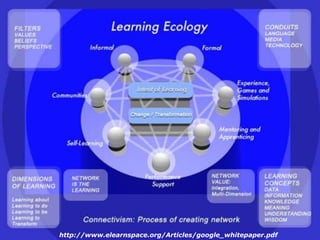
http://www.elearnspace.org/Articles/google_whitepaper.pdf
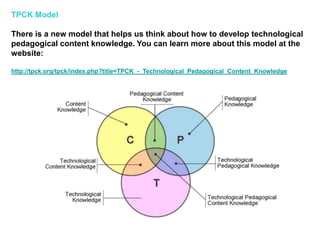
TPCK ModelThere is a new model that helps us think about how to develop technological pedagogical content knowledge. You can learn more about this model at the website: http://tpck.org/tpck/index.php?title=TPCK_-_Technological_Pedagogical_Content_Knowledge
SITE 2006IEA Second Information Technology in Education Study9000 School35,000 math and science teachers in 22 countriesHow are teachers using technology in their instruction?Law, N., Pelgrum, W.J. & Plomp, T. (eds.) (2008). Pedagogy and ICT use in schools around the world: Findings from the IEA SITES 2006 study. Hong Kong: CERC-Springer, the report presenting results for 22 educational systems participating in the IEA SITES 2006, was released by Dr Hans Wagemaker, IEA Executive Director and Dr Nancy Law, International Co-coordinator of the study.
Increased technology use does not lead to student learning. Rather, effectiveness of technology use depended on teaching approaches used in conjunction with the technology. How you integrate matters- not just the technology alone.It needs to be about the learning, not the technology. And you need to choose the right tool for the task.As long as we see content, technology and pedagogy as separate- technology will always be just an add on.Findings
Teacher as DesignerSee yourself as a curriculum designer– owners of the curriculum you teach.Honor creativity (yours first, then the student’s)Repurpose the technology! Go beyond simple “use” and “integration” to innovation!
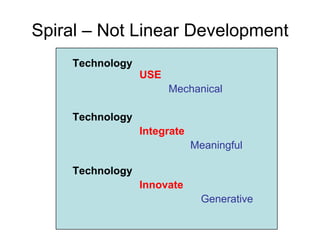
Spiral – Not Linear DevelopmentTechnologyUSEMechanicalTechnologyIntegrateMeaningfulTechnologyInnovateGenerative
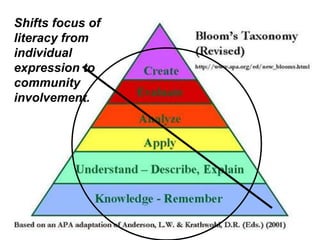
Shifts focus of literacy from individual expression to community involvement.
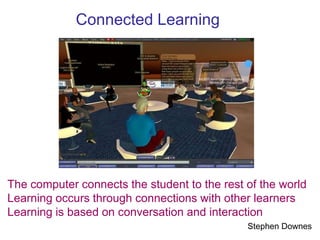
Connected LearningThe computer connects the student to the rest of the worldLearning occurs through connections with other learnersLearning is based on conversation and interactionStephen Downes
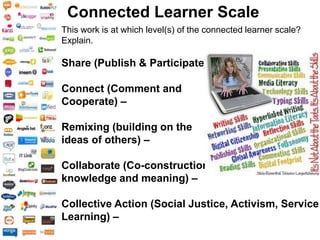
Connected Learner ScaleThis work is at which level(s) of the connected learner scale?Explain.Share (Publish & Participate) –Connect (Comment and Cooperate) –Remixing (building on the ideas of others) – Collaborate (Co-construction of knowledge and meaning) –Collective Action (Social Justice, Activism, Service Learning) –
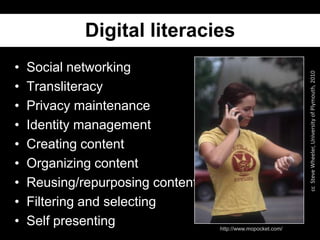
Digital literaciesSocial networkingTransliteracyPrivacy maintenanceIdentity managementCreating contentOrganizing contentReusing/repurposing contentFiltering and selectingSelf presentingcc  Steve Wheeler, University of Plymouth, 2010http://www.mopocket.com/
Spending most of your time in your area of weakness—while it will improve your skills, perhaps to a level of “average”—will NOT produce excellenceThis approach does NOT tap into motivation or lead to engagementThe biggest challenge facing us as leaders: how to engage the hearts and minds of the learners
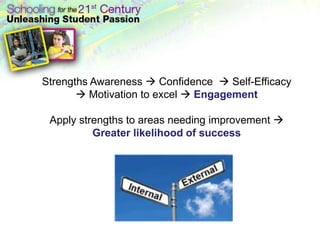
Strengths Awareness  Confidence   Self-Efficacy  Motivation to excel EngagementApply strengths to areas needing improvement  Greater likelihood of success
Students are IndividualsChildren are persons and should be treated as individuals as they are introduced to the variety and richness of the world in which they live.Children are not something to be molded and pruned. Their value is in who they are – not who they will become. They simply need to grow in knowledge.Think of the self-directed learning a child does from birth to three– most of it without language. As they mature they are even more capable of being self-directed learners. .
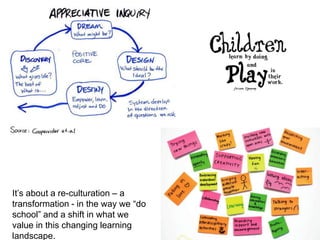
It’s about a re-culturation – a transformation - in the way we “do school” and a shift in what we value in this changing learning landscape.
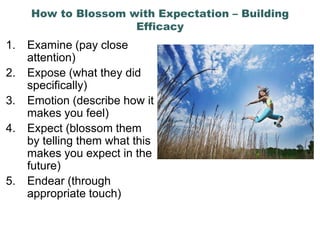
How to Blossom with Expectation – Building EfficacyExamine (pay close attention)Expose (what they did specifically)Emotion (describe how it makes you feel)Expect (blossom them by telling them what this makes you expect in the future)Endear (through appropriate touch)
21st Centurizing your Lesson PlansStep 1- Best PracticeResearchers at Mid-continent Research for Education and Learning (McREL) have identified nine instructional strategies that are most likely to improve student achievement across all content areas and across all grade levels. These strategies are explained in the book Classroom Instruction That Works by Robert Marzano, Debra Pickering, and Jane Pollock.1. Identifying similarities and differences2. Summarizing and note taking3. Reinforcing effort and providing recognition4. Homework and practice5. Nonlinguistic representations6. Cooperative learning7. Setting objectives and providing feedback8. Generating and testing hypotheses9. Cues, questions, and advance organizers
Step 2- What Tool Fits?Web 2.0 Tools and MarzanoDeveloped by Stephanie Sandifer (author of Change Agency)Web2.0 that Workshttp://web2thatworks.com/index.php?title=Main_PageNECC Presentationhttp://web2thatworks.com/index.php?title=NECC
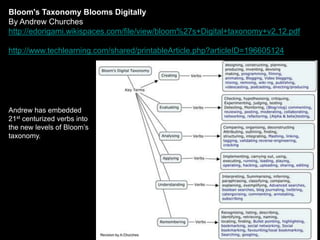
Bloom's Taxonomy Blooms DigitallyBy Andrew Churcheshttp://edorigami.wikispaces.com/file/view/bloom%27s+Digital+taxonomy+v2.12.pdfhttp://www.techlearning.com/shared/printableArticle.php?articleID=196605124Andrew has embedded 21st centurized verbs into the new levels of Bloom’s taxonomy.
What are specific strategies you use in your classroom for a particular discipline?
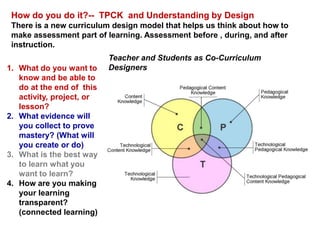
How do you do it?--  TPCK  and Understanding by DesignThere is a new curriculum design model that helps us think about how to make assessment part of learning. Assessment before , during, and after instruction. Teacher and Students as Co-Curriculum DesignersWhat do you want to    know and be able to do at the end of  this activity, project, or lesson?What evidence will you collect to prove mastery? (What will you create or do)What is the best way to learn what you want to learn?How are you making your learning transparent? (connected learning)
Pick the ContentChoose the StrategyChoose the ToolCreate the Learning ActivityUse Shirky to Make it 21st Century----------------------------------------1.Get in groups2. What are the Essential Instructional Activities you typically use?3. Have a discussion and list possible Web 2.0 tools that fit nicely with your disciplines essential instructional activities. 4. Create a 21st Century type instructional activityThink: Share, Connect, Collaborate, Collective Action
21st Century Learning – Check ListIt is never just about content. Learners are trying to get better at something.It is never just routine. It requires thinking with what you know and pushing further.It is never just problem solving. It also involves problem finding.It’s not just about right answers. It involves explanation and justification.It is not emotionally flat. It involves curiosity, discovery, creativity, and community. It’s not in a vacuum. It involves methods, purposes, and forms of one of more disciplines, situated in a social context.David Perkins- Making Learning Whole
Academic Learning TimeDavid BerlinerPace- Is each learner actively engaged? Timing and delivery paced well?Focus Are learning activities within core content aqnd aimed at helping them get better at something?Stretch Are learners being optimally challenged? Not too easy or difficult.Stickiness Is activity designed such that it will stick and not be memorized and forgotten?

Passion based techdout

  • 2.
    What do weneed to unlearn? Example:*I need to unlearn that classrooms are physical spaces.* I need to unlearn that learning is an event with a start and stop time to a lesson.The Empire Strikes Back:LUKE:  Master, moving stones around is one thing.  This is totallydifferent. YODA:  No!  No different!  Only different in your mind.  You must unlearnwhat you have learned.
  • 3.
    Rethinking Teaching andLearning Multiliterate Change in pedagogyChange in the way classrooms are managedA move from deficit based instruction to strength based learningCollaboration and communication Inside and Outside the classroom
  • 4.
    FORMAL INFORMALYougowherethe bus goesYou go where you chooseJay Cross – Internet Time
  • 5.
    MULTI-CHANNEL APPROACHwebcamSYNCHRONOUSCommunity platformsVoIPConferenceroomsInstant messengerWorldbridgesPEER TO PEERWEBCASTfolksonomiesMailing listsemailPLEf2fforumsvlogsCMSwikisblogsphotoblogspodcastsASYNCHRONOUS
  • 6.
  • 7.
    TPCK ModelThere isa new model that helps us think about how to develop technological pedagogical content knowledge. You can learn more about this model at the website: http://tpck.org/tpck/index.php?title=TPCK_-_Technological_Pedagogical_Content_Knowledge
  • 8.
    SITE 2006IEA SecondInformation Technology in Education Study9000 School35,000 math and science teachers in 22 countriesHow are teachers using technology in their instruction?Law, N., Pelgrum, W.J. & Plomp, T. (eds.) (2008). Pedagogy and ICT use in schools around the world: Findings from the IEA SITES 2006 study. Hong Kong: CERC-Springer, the report presenting results for 22 educational systems participating in the IEA SITES 2006, was released by Dr Hans Wagemaker, IEA Executive Director and Dr Nancy Law, International Co-coordinator of the study.
  • 9.
    Increased technology usedoes not lead to student learning. Rather, effectiveness of technology use depended on teaching approaches used in conjunction with the technology. How you integrate matters- not just the technology alone.It needs to be about the learning, not the technology. And you need to choose the right tool for the task.As long as we see content, technology and pedagogy as separate- technology will always be just an add on.Findings
  • 10.
    Teacher as DesignerSeeyourself as a curriculum designer– owners of the curriculum you teach.Honor creativity (yours first, then the student’s)Repurpose the technology! Go beyond simple “use” and “integration” to innovation!
  • 11.
    Spiral – NotLinear DevelopmentTechnologyUSEMechanicalTechnologyIntegrateMeaningfulTechnologyInnovateGenerative
  • 12.
    Shifts focus ofliteracy from individual expression to community involvement.
  • 13.
    Connected LearningThe computerconnects the student to the rest of the worldLearning occurs through connections with other learnersLearning is based on conversation and interactionStephen Downes
  • 14.
    Connected Learner ScaleThiswork is at which level(s) of the connected learner scale?Explain.Share (Publish & Participate) –Connect (Comment and Cooperate) –Remixing (building on the ideas of others) – Collaborate (Co-construction of knowledge and meaning) –Collective Action (Social Justice, Activism, Service Learning) –
  • 15.
    Digital literaciesSocial networkingTransliteracyPrivacymaintenanceIdentity managementCreating contentOrganizing contentReusing/repurposing contentFiltering and selectingSelf presentingcc Steve Wheeler, University of Plymouth, 2010http://www.mopocket.com/
  • 17.
    Spending most ofyour time in your area of weakness—while it will improve your skills, perhaps to a level of “average”—will NOT produce excellenceThis approach does NOT tap into motivation or lead to engagementThe biggest challenge facing us as leaders: how to engage the hearts and minds of the learners
  • 18.
    Strengths Awareness Confidence  Self-Efficacy  Motivation to excel EngagementApply strengths to areas needing improvement  Greater likelihood of success
  • 19.
    Students are IndividualsChildrenare persons and should be treated as individuals as they are introduced to the variety and richness of the world in which they live.Children are not something to be molded and pruned. Their value is in who they are – not who they will become. They simply need to grow in knowledge.Think of the self-directed learning a child does from birth to three– most of it without language. As they mature they are even more capable of being self-directed learners. .
  • 20.
    It’s about are-culturation – a transformation - in the way we “do school” and a shift in what we value in this changing learning landscape.
  • 21.
    How to Blossomwith Expectation – Building EfficacyExamine (pay close attention)Expose (what they did specifically)Emotion (describe how it makes you feel)Expect (blossom them by telling them what this makes you expect in the future)Endear (through appropriate touch)
  • 22.
    21st Centurizing yourLesson PlansStep 1- Best PracticeResearchers at Mid-continent Research for Education and Learning (McREL) have identified nine instructional strategies that are most likely to improve student achievement across all content areas and across all grade levels. These strategies are explained in the book Classroom Instruction That Works by Robert Marzano, Debra Pickering, and Jane Pollock.1. Identifying similarities and differences2. Summarizing and note taking3. Reinforcing effort and providing recognition4. Homework and practice5. Nonlinguistic representations6. Cooperative learning7. Setting objectives and providing feedback8. Generating and testing hypotheses9. Cues, questions, and advance organizers
  • 23.
    Step 2- WhatTool Fits?Web 2.0 Tools and MarzanoDeveloped by Stephanie Sandifer (author of Change Agency)Web2.0 that Workshttp://web2thatworks.com/index.php?title=Main_PageNECC Presentationhttp://web2thatworks.com/index.php?title=NECC
  • 24.
    Bloom's Taxonomy BloomsDigitallyBy Andrew Churcheshttp://edorigami.wikispaces.com/file/view/bloom%27s+Digital+taxonomy+v2.12.pdfhttp://www.techlearning.com/shared/printableArticle.php?articleID=196605124Andrew has embedded 21st centurized verbs into the new levels of Bloom’s taxonomy.
  • 25.
    What are specificstrategies you use in your classroom for a particular discipline?
  • 26.
    How do youdo it?-- TPCK and Understanding by DesignThere is a new curriculum design model that helps us think about how to make assessment part of learning. Assessment before , during, and after instruction. Teacher and Students as Co-Curriculum DesignersWhat do you want to know and be able to do at the end of this activity, project, or lesson?What evidence will you collect to prove mastery? (What will you create or do)What is the best way to learn what you want to learn?How are you making your learning transparent? (connected learning)
  • 27.
    Pick the ContentChoosethe StrategyChoose the ToolCreate the Learning ActivityUse Shirky to Make it 21st Century----------------------------------------1.Get in groups2. What are the Essential Instructional Activities you typically use?3. Have a discussion and list possible Web 2.0 tools that fit nicely with your disciplines essential instructional activities. 4. Create a 21st Century type instructional activityThink: Share, Connect, Collaborate, Collective Action
  • 28.
    21st Century Learning– Check ListIt is never just about content. Learners are trying to get better at something.It is never just routine. It requires thinking with what you know and pushing further.It is never just problem solving. It also involves problem finding.It’s not just about right answers. It involves explanation and justification.It is not emotionally flat. It involves curiosity, discovery, creativity, and community. It’s not in a vacuum. It involves methods, purposes, and forms of one of more disciplines, situated in a social context.David Perkins- Making Learning Whole
  • 29.
    Academic Learning TimeDavidBerlinerPace- Is each learner actively engaged? Timing and delivery paced well?Focus Are learning activities within core content aqnd aimed at helping them get better at something?Stretch Are learners being optimally challenged? Not too easy or difficult.Stickiness Is activity designed such that it will stick and not be memorized and forgotten?