Discrete Mathematics
Chapter 1
Sets Theory
Dr.Khaled Bakro
1
Course objectives
We will focus on two major goals:
Basic tools and techniques in discrete mathematics
Propositional logic
Set Theory
Simple algorithms
Functions, sequences, Relations
Counting methods
Introduction to number theory
Graph theory
Trees
Network models
Practice on Boolean algebra and Combinatorial
Circuits.
2
To do well you should
 Study with pen and paper
 Ask for help immediately
 Practice, practice, practice…
 Follow along in class rather than take
notes
 Ask questions in class
 Keep up with the class
 Read the book, not just the slides
3
4
What Is Discrete Mathematics?
 Discrete: consisting of distinct or
unconnected elements.
 Definition Discrete Mathematics
 Discrete Mathematics is a collection of
mathematical topics that examine and
use finite or countably infinite
mathematical objects.
Discrete vs. Continuous Mathematics
Continuous Mathematics
It considers objects that vary continuously;
Example: analog wristwatch (separate hour, minute, and
second hands).
From an analog watch perspective, between 1 :25 p.m. and 1
:26 p.m.
there are infinitely many possible different times as the
second hand moves around the watch face.
Real-number system --- core of continuous mathematics;
Continuous mathematics --- models and tools for analyzing
real-world phenomena that change smoothly over time.
(Differential equations etc.)
5
Discrete vs. Continuous Mathematics
Discrete Mathematics
It considers objects that vary in a discrete way.
Example: digital wristwatch.
On a digital watch, there are only finitely many possible
different times
between 1 :25 P.M. and 1:27 P.M. A digital watch does not
show split seconds: - no time between 1 :25:03 and
1 :25:04. The watch moves from one time to the next.
Integers --- core of discrete mathematics
Discrete mathematics --- models and tools for analyzing
real-world phenomena that change discretely over time
and therefore ideal for studying computer science.
6
7
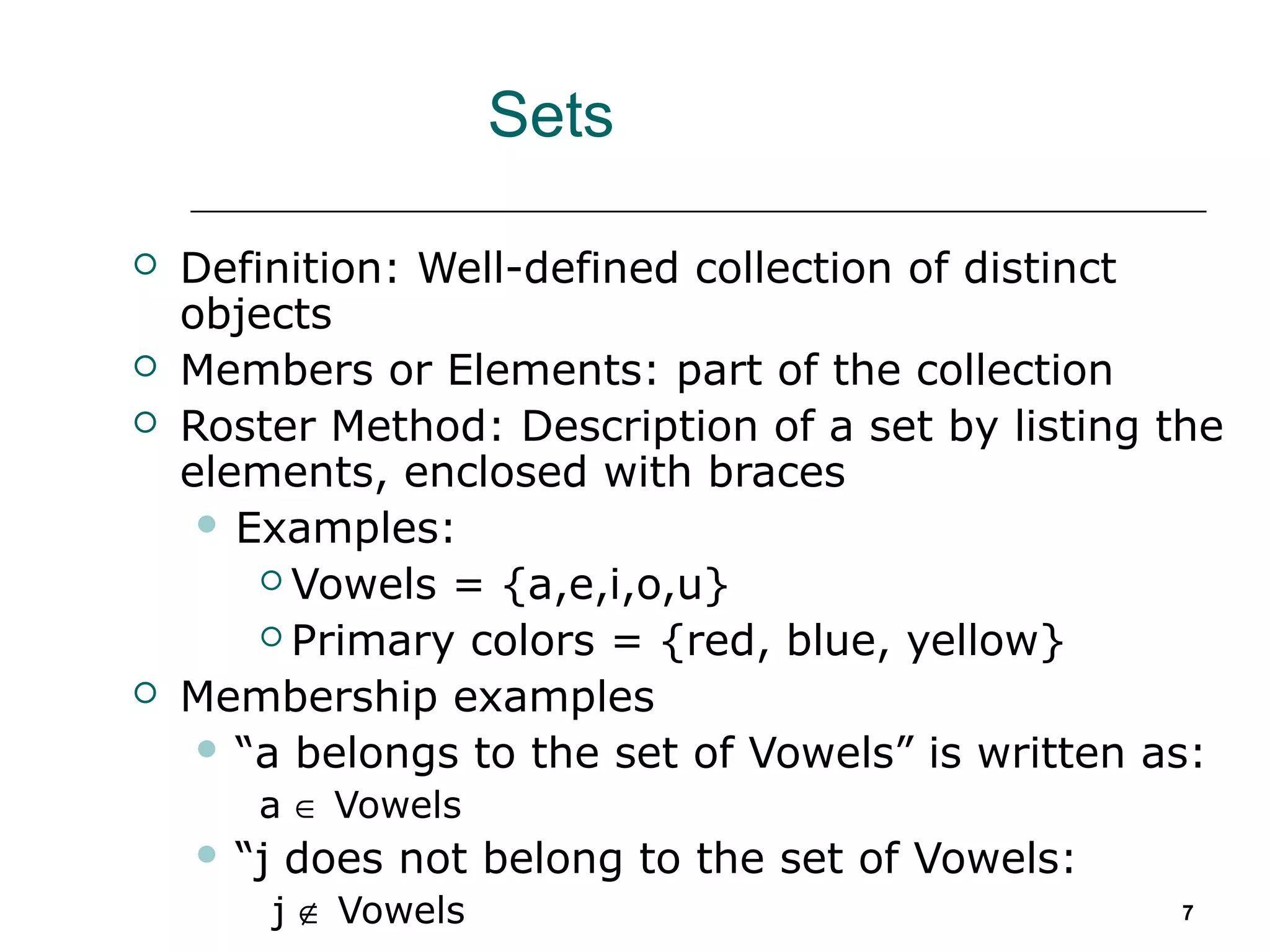
Sets
 Definition: Well-defined collection of distinct
objects
 Members or Elements: part of the collection
 Roster Method: Description of a set by listing the
elements, enclosed with braces
 Examples:
 Vowels = {a,e,i,o,u}
 Primary colors = {red, blue, yellow}
 Membership examples
 “a belongs to the set of Vowels” is written as:
a ∈ Vowels
 “j does not belong to the set of Vowels:
j ∉ Vowels
8
Sets
 Set-builder method
 A = { x | x ∈ S, P(x) } or A = { x ∈ S | P(x) }
 A is the set of all elements x of S, such that x
satisfies the property P
 Example:
 If X = {2,4,6,8,10}, then in set-builder
notation, X can be described as
X = {n ∈ Z | n is even and 2 ≤ n ≤ 10}
9
Sets
 Standard Symbols which denote sets of numbers
 N : The set of all natural numbers (i.e.,all positive integers)
 Z : The set of all integers
 Z+
: The set of all positive integers
 Z* : The set of all nonzero integers
 E : The set of all even integers
 Q : The set of all rational numbers
 Q* : The set of all nonzero rational numbers
 Q+
: The set of all positive rational numbers
 R : The set of all real numbers
 R* : The set of all nonzero real numbers
 R+
: The set of all positive real numbers
 C : The set of all complex numbers
 C* : The set of all nonzero complex numbers
10
Sets
 Subsets
 “X is a subset of Y” is written as X ⊆ Y
 “X is not a subset of Y” is written as X Y
 Example:
 X = {a,e,i,o,u}, Y = {a, i, u} and
Z= {b,c,d,f,g}
 Y ⊆ X, since every element of Y is an element of X
 Y Z, since a ∈ Y, but a ∉ Z
11
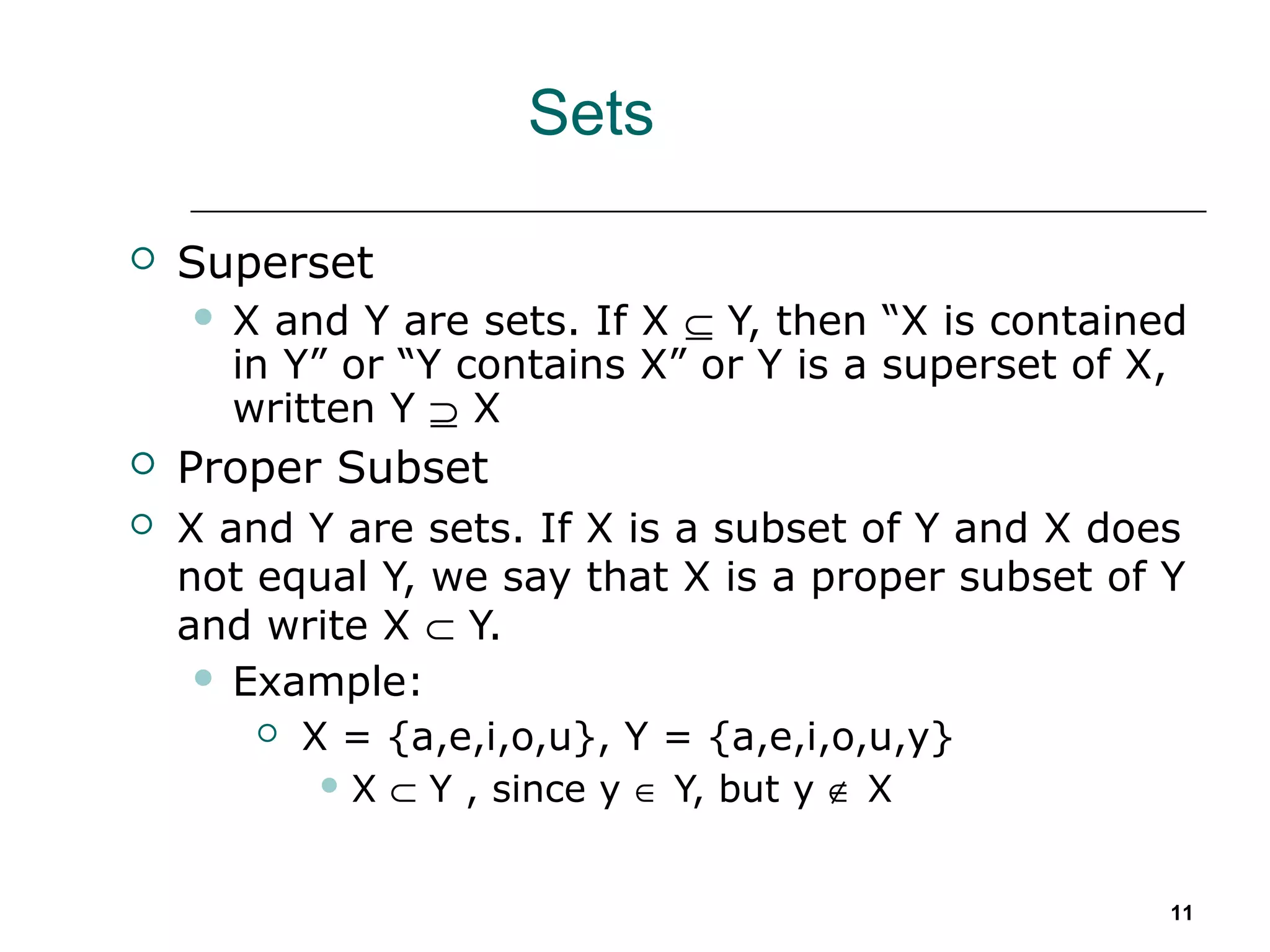
Sets
 Superset
 X and Y are sets. If X ⊆ Y, then “X is contained
in Y” or “Y contains X” or Y is a superset of X,
written Y ⊇ X
 Proper Subset
 X and Y are sets. If X is a subset of Y and X does
not equal Y, we say that X is a proper subset of Y
and write X ⊂ Y.
 Example:
 X = {a,e,i,o,u}, Y = {a,e,i,o,u,y}
 X ⊂ Y , since y ∈ Y, but y ∉ X
12
Sets
 Set Equality
 X and Y are sets. They are said to be equal if every
element of X is an element of Y and every element of
Y is an element of X, i.e. X ⊆ Y and Y ⊆ X
 Examples:
 {1,2,3} = {2,3,1}
 X = {red, blue, yellow} and Y = {c | c is a
primary color} Therefore, X=Y
 Empty (Null) Set
 A Set is Empty (Null) if it contains no elements.
 The Empty Set is written as ∅
 The Empty Set is a subset of every set
13
Sets
 Finite and Infinite Sets
 X is a set. If there exists a nonnegative integer n
such that X has n elements, then X is called a
finite set with n elements.
 If a set is not finite, then it is an infinite set.
 Examples:
 Y = {1,2,3} is a finite set
 P = {red, blue, yellow} is a finite set
 E , the set of all even integers, is an infinite
set
 ∅ , the Empty Set, is a finite set with 0
elements
14
Sets
 Cardinality of Sets
 Let S be a finite set with n distinct elements,
where n ≥ 0. Then |S| = n , where the
cardinality (number of elements) of S is n
 Example:
 If P = {red, blue, yellow}, then |P| = 3
 Singleton
 A set with only one element is a singleton
 Example:
H = { 4 }, |H| = 1, H is a singleton
15
Sets
 Power Set
 For any set X ,the power set of X ,written
P(X),is the set of all subsets of X
 Example:
 If X = {red, blue, yellow}, then P(X) = { ∅ ,
{red}, {blue}, {yellow}, {red,blue}, {red,
yellow}, {blue, yellow}, {red, blue, yellow} }
 Universal Set
 An arbitrarily chosen, but fixed set
16
Sets
 Venn Diagrams
 Abstract visualization of
a Universal set, U as a
rectangle, with all
subsets of U shown as
circles.
 Shaded portion
represents the
corresponding set
 Example:
 In Figure 1, Set X,
shaded, is a subset of
the Universal set, U
17
Sets
 Intersection of Sets
Example: If X = {1,2,3,4,5} and
Y = {5,6,7,8,9}, then X ∩ Y = {5}
18
Sets
 Disjoint Sets
Example: If X = {1,2,3,4,} and
Y = {6,7,8,9}, then X ∩ Y = ∅
19
Sets
 Difference
Example: If X =
{a,b,c,d} and
Y = {c,d,e,f}, then X –
Y = {a,b} and Y – X =
{e,f}
20
 Complement
The complement of a set X with respect to a universal set
U, denoted by , is defined to be = {x |x ∈ U, but x
∉ X}
Sets
X
Example: If U = {a,b,c,d,e,f} and
X = {c,d,e,f}, then = {a,b}
XX
21
Sets
22
Sets
 Ordered Pair
 X and Y are sets. If x ∈ X and y ∈ Y, then an
ordered pair is written (x,y)
 Order of elements is important. (x,y) is not
necessarily equal to (y,x)
 Cartesian Product
 The Cartesian product of two sets X and Y ,written X ×
Y ,is the set
 X × Y ={(x,y)|x ∈ X , y ∈ Y}
 For any set X, X × ∅ = ∅ = ∅ × X
 Example:
 X = {a,b}, Y = {c,d}
X × Y = {(a,c), (a,d), (b,c), (b,d)}
Y × X = {(c,a), (d,a), (c,b), (d,b)}
23
24
Computer Representation of Sets
 A Set may be stored in a computer in an array as an
unordered list
 Problem: Difficult to perform operations on the set.
 Linked List
 Solution: use Bit Strings (Bit Map)
 A Bit String is a sequence of 0s and 1s
 Length of a Bit String is the number of digits in the
string
 Elements appear in order in the bit string
 A 0 indicates an element is absent, a 1 indicates
that the element is present
 A set may be implemented as a file

Discrete mathematics Ch1 sets Theory_Dr.Khaled.Bakro د. خالد بكرو

  • 1.
    Discrete Mathematics Chapter 1 SetsTheory Dr.Khaled Bakro 1
  • 2.
    Course objectives We willfocus on two major goals: Basic tools and techniques in discrete mathematics Propositional logic Set Theory Simple algorithms Functions, sequences, Relations Counting methods Introduction to number theory Graph theory Trees Network models Practice on Boolean algebra and Combinatorial Circuits. 2
  • 3.
    To do wellyou should  Study with pen and paper  Ask for help immediately  Practice, practice, practice…  Follow along in class rather than take notes  Ask questions in class  Keep up with the class  Read the book, not just the slides 3
  • 4.
    4 What Is DiscreteMathematics?  Discrete: consisting of distinct or unconnected elements.  Definition Discrete Mathematics  Discrete Mathematics is a collection of mathematical topics that examine and use finite or countably infinite mathematical objects.
  • 5.
    Discrete vs. ContinuousMathematics Continuous Mathematics It considers objects that vary continuously; Example: analog wristwatch (separate hour, minute, and second hands). From an analog watch perspective, between 1 :25 p.m. and 1 :26 p.m. there are infinitely many possible different times as the second hand moves around the watch face. Real-number system --- core of continuous mathematics; Continuous mathematics --- models and tools for analyzing real-world phenomena that change smoothly over time. (Differential equations etc.) 5
  • 6.
    Discrete vs. ContinuousMathematics Discrete Mathematics It considers objects that vary in a discrete way. Example: digital wristwatch. On a digital watch, there are only finitely many possible different times between 1 :25 P.M. and 1:27 P.M. A digital watch does not show split seconds: - no time between 1 :25:03 and 1 :25:04. The watch moves from one time to the next. Integers --- core of discrete mathematics Discrete mathematics --- models and tools for analyzing real-world phenomena that change discretely over time and therefore ideal for studying computer science. 6
  • 7.
    7 Sets  Definition: Well-definedcollection of distinct objects  Members or Elements: part of the collection  Roster Method: Description of a set by listing the elements, enclosed with braces  Examples:  Vowels = {a,e,i,o,u}  Primary colors = {red, blue, yellow}  Membership examples  “a belongs to the set of Vowels” is written as: a ∈ Vowels  “j does not belong to the set of Vowels: j ∉ Vowels
  • 8.
    8 Sets  Set-builder method A = { x | x ∈ S, P(x) } or A = { x ∈ S | P(x) }  A is the set of all elements x of S, such that x satisfies the property P  Example:  If X = {2,4,6,8,10}, then in set-builder notation, X can be described as X = {n ∈ Z | n is even and 2 ≤ n ≤ 10}
  • 9.
    9 Sets  Standard Symbolswhich denote sets of numbers  N : The set of all natural numbers (i.e.,all positive integers)  Z : The set of all integers  Z+ : The set of all positive integers  Z* : The set of all nonzero integers  E : The set of all even integers  Q : The set of all rational numbers  Q* : The set of all nonzero rational numbers  Q+ : The set of all positive rational numbers  R : The set of all real numbers  R* : The set of all nonzero real numbers  R+ : The set of all positive real numbers  C : The set of all complex numbers  C* : The set of all nonzero complex numbers
  • 10.
    10 Sets  Subsets  “Xis a subset of Y” is written as X ⊆ Y  “X is not a subset of Y” is written as X Y  Example:  X = {a,e,i,o,u}, Y = {a, i, u} and Z= {b,c,d,f,g}  Y ⊆ X, since every element of Y is an element of X  Y Z, since a ∈ Y, but a ∉ Z
  • 11.
    11 Sets  Superset  Xand Y are sets. If X ⊆ Y, then “X is contained in Y” or “Y contains X” or Y is a superset of X, written Y ⊇ X  Proper Subset  X and Y are sets. If X is a subset of Y and X does not equal Y, we say that X is a proper subset of Y and write X ⊂ Y.  Example:  X = {a,e,i,o,u}, Y = {a,e,i,o,u,y}  X ⊂ Y , since y ∈ Y, but y ∉ X
  • 12.
    12 Sets  Set Equality X and Y are sets. They are said to be equal if every element of X is an element of Y and every element of Y is an element of X, i.e. X ⊆ Y and Y ⊆ X  Examples:  {1,2,3} = {2,3,1}  X = {red, blue, yellow} and Y = {c | c is a primary color} Therefore, X=Y  Empty (Null) Set  A Set is Empty (Null) if it contains no elements.  The Empty Set is written as ∅  The Empty Set is a subset of every set
  • 13.
    13 Sets  Finite andInfinite Sets  X is a set. If there exists a nonnegative integer n such that X has n elements, then X is called a finite set with n elements.  If a set is not finite, then it is an infinite set.  Examples:  Y = {1,2,3} is a finite set  P = {red, blue, yellow} is a finite set  E , the set of all even integers, is an infinite set  ∅ , the Empty Set, is a finite set with 0 elements
  • 14.
    14 Sets  Cardinality ofSets  Let S be a finite set with n distinct elements, where n ≥ 0. Then |S| = n , where the cardinality (number of elements) of S is n  Example:  If P = {red, blue, yellow}, then |P| = 3  Singleton  A set with only one element is a singleton  Example: H = { 4 }, |H| = 1, H is a singleton
  • 15.
    15 Sets  Power Set For any set X ,the power set of X ,written P(X),is the set of all subsets of X  Example:  If X = {red, blue, yellow}, then P(X) = { ∅ , {red}, {blue}, {yellow}, {red,blue}, {red, yellow}, {blue, yellow}, {red, blue, yellow} }  Universal Set  An arbitrarily chosen, but fixed set
  • 16.
    16 Sets  Venn Diagrams Abstract visualization of a Universal set, U as a rectangle, with all subsets of U shown as circles.  Shaded portion represents the corresponding set  Example:  In Figure 1, Set X, shaded, is a subset of the Universal set, U
  • 17.
    17 Sets  Intersection ofSets Example: If X = {1,2,3,4,5} and Y = {5,6,7,8,9}, then X ∩ Y = {5}
  • 18.
    18 Sets  Disjoint Sets Example:If X = {1,2,3,4,} and Y = {6,7,8,9}, then X ∩ Y = ∅
  • 19.
    19 Sets  Difference Example: IfX = {a,b,c,d} and Y = {c,d,e,f}, then X – Y = {a,b} and Y – X = {e,f}
  • 20.
    20  Complement The complementof a set X with respect to a universal set U, denoted by , is defined to be = {x |x ∈ U, but x ∉ X} Sets X Example: If U = {a,b,c,d,e,f} and X = {c,d,e,f}, then = {a,b} XX
  • 21.
  • 22.
    22 Sets  Ordered Pair X and Y are sets. If x ∈ X and y ∈ Y, then an ordered pair is written (x,y)  Order of elements is important. (x,y) is not necessarily equal to (y,x)  Cartesian Product  The Cartesian product of two sets X and Y ,written X × Y ,is the set  X × Y ={(x,y)|x ∈ X , y ∈ Y}  For any set X, X × ∅ = ∅ = ∅ × X  Example:  X = {a,b}, Y = {c,d} X × Y = {(a,c), (a,d), (b,c), (b,d)} Y × X = {(c,a), (d,a), (c,b), (d,b)}
  • 23.
  • 24.
    24 Computer Representation ofSets  A Set may be stored in a computer in an array as an unordered list  Problem: Difficult to perform operations on the set.  Linked List  Solution: use Bit Strings (Bit Map)  A Bit String is a sequence of 0s and 1s  Length of a Bit String is the number of digits in the string  Elements appear in order in the bit string  A 0 indicates an element is absent, a 1 indicates that the element is present  A set may be implemented as a file