
1
Vinayak V Khairnar
2
❖ Introduction
❖ Peptide synthesis
❖ History
❖ Solid and solution phase synthesis
❖ Side reactions
❖ Conclusion
3
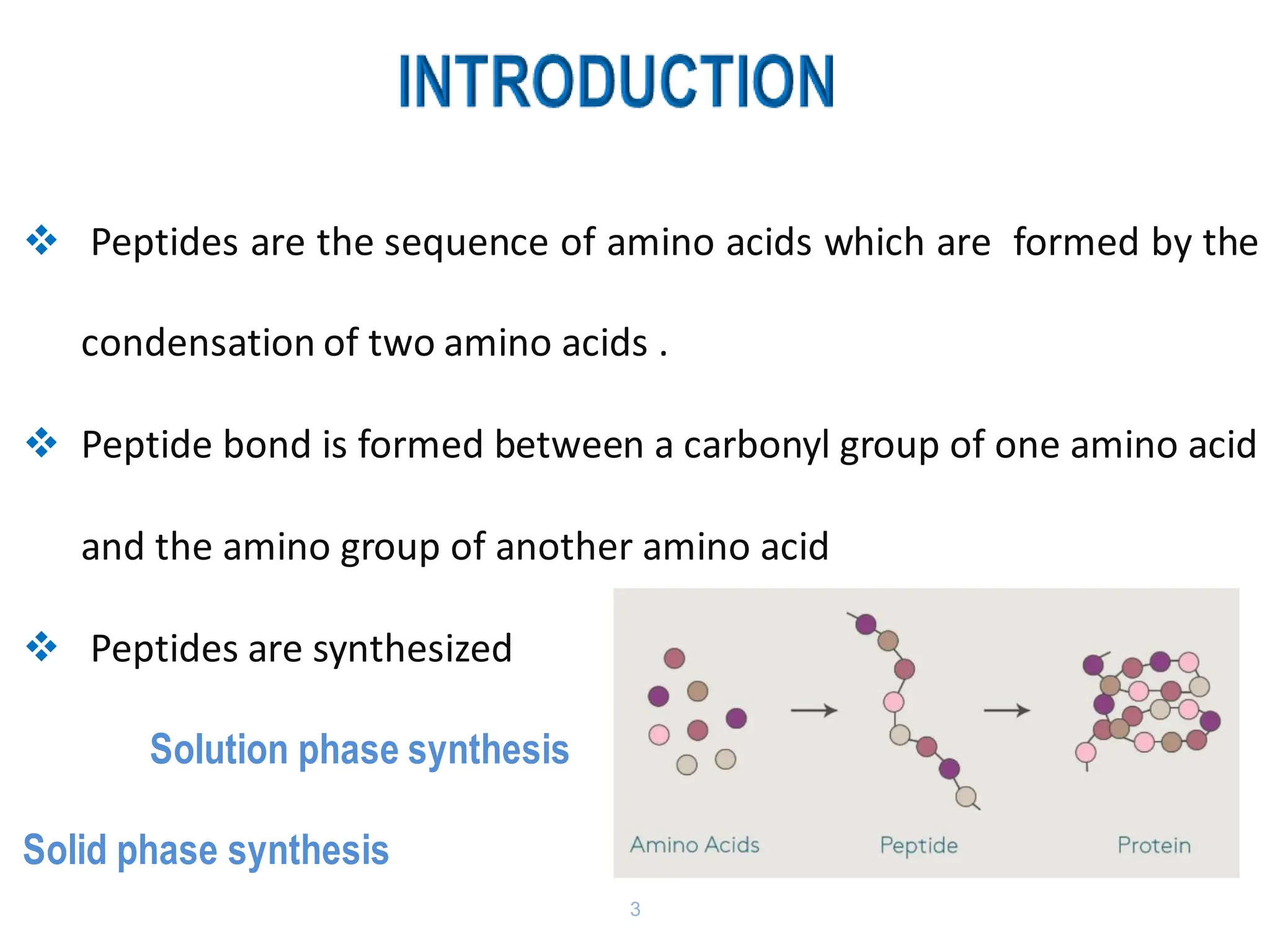
❖ Peptides are the sequence of amino acids which are formed by the
condensation of two amino acids .
❖ Peptide bond is formed between a carbonyl group of one amino acid
and the amino group of another amino acid
❖ Peptides are synthesized
Solution phase synthesis
Solid phase synthesis
4
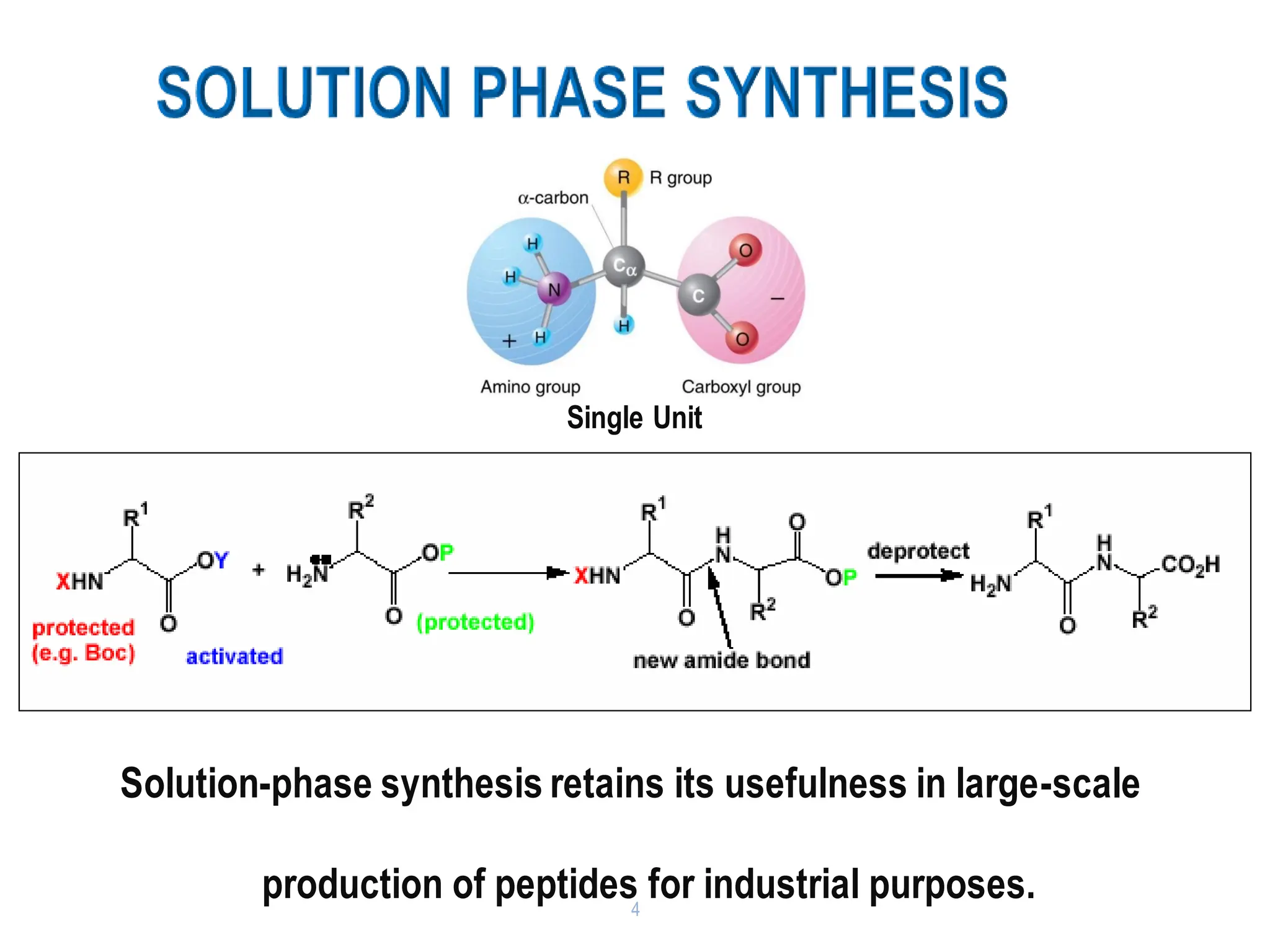
Solution-phase synthesis retains its usefulness in large-scale
production of peptides for industrial purposes.
Single Unit
5
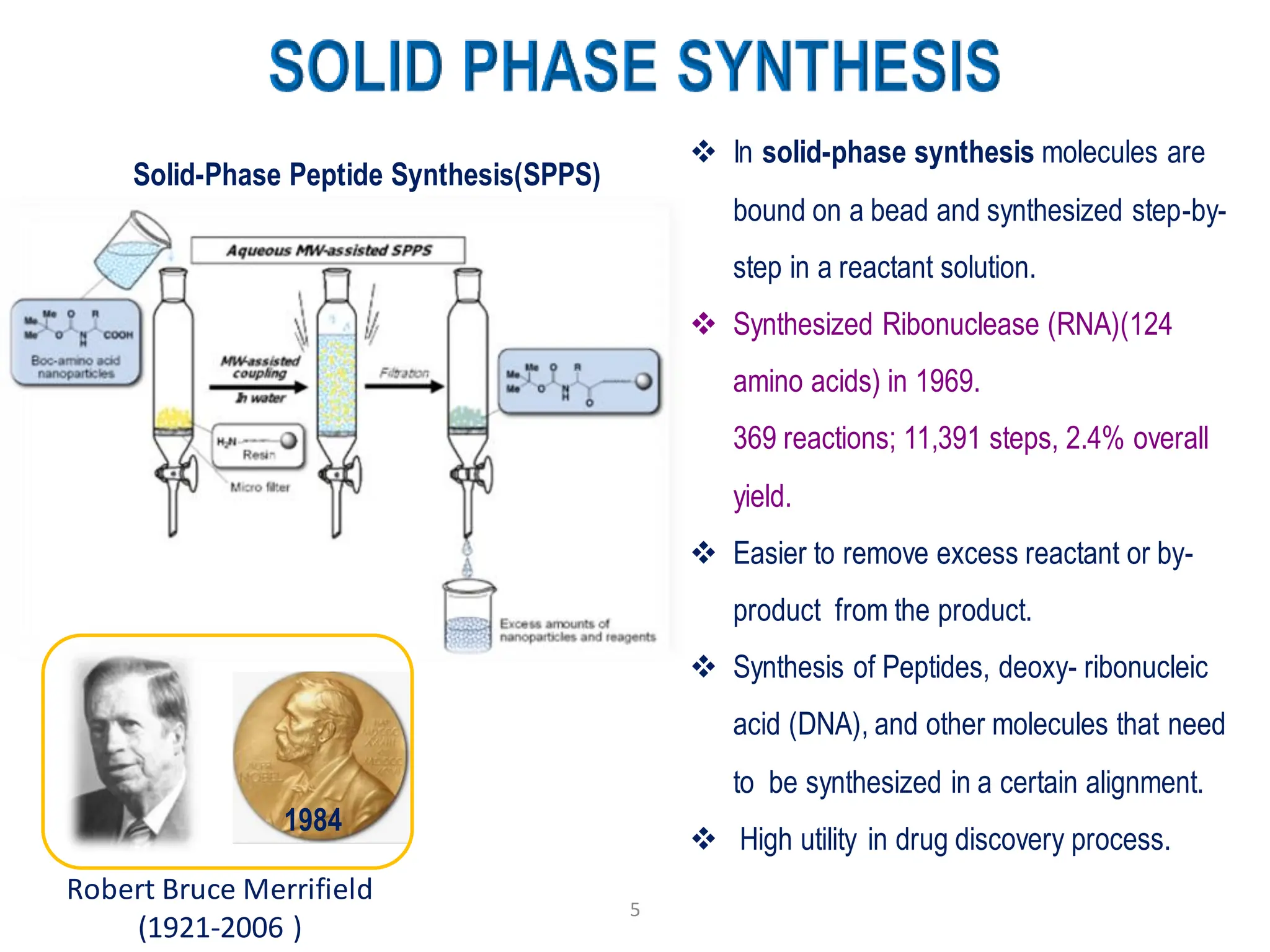
❖ In solid-phase synthesis molecules are
bound on a bead and synthesized step-by-
step in a reactant solution.
❖ Synthesized Ribonuclease (RNA)(124
amino acids) in 1969.
369 reactions; 11,391 steps, 2.4% overall
yield.
❖ Easier to remove excess reactant or by-
product from the product.
❖ Synthesis of Peptides, deoxy- ribonucleic
acid (DNA), and other molecules that need
to be synthesized in a certain alignment.
❖ High utility in drug discovery process.
Solid-Phase Peptide Synthesis(SPPS)
Robert Bruce Merrifield
(1921-2006 )
1984
6
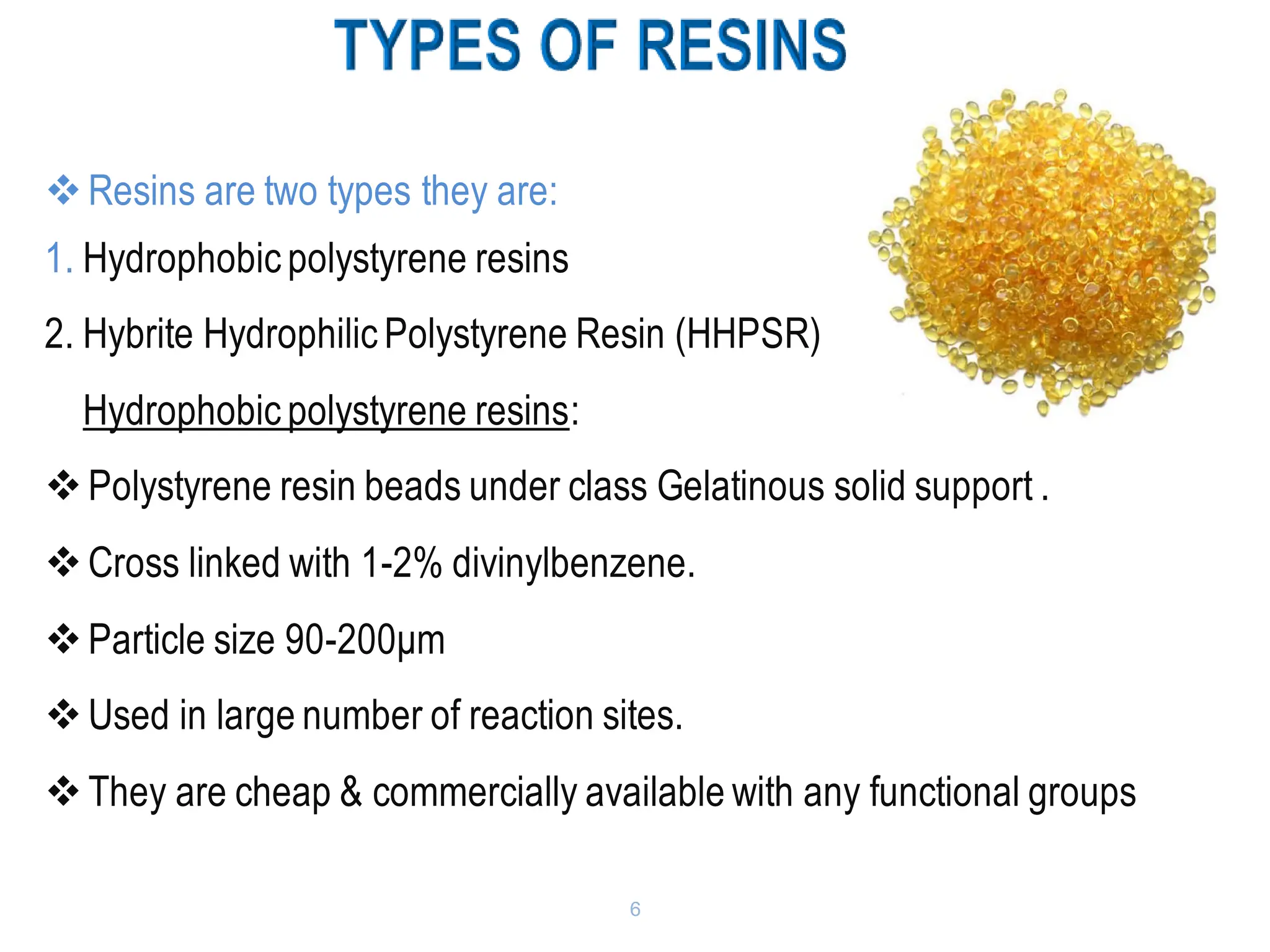
❖Resins are two types they are:
1. Hydrophobic polystyrene resins
2. Hybrite Hydrophilic Polystyrene Resin (HHPSR)
Hydrophobic polystyrene resins:
❖Polystyrene resin beads under class Gelatinous solid support .
❖Cross linked with 1-2% divinylbenzene.
❖Particle size 90-200μm
❖Used in large number of reaction sites.
❖They are cheap & commercially available with any functional groups
7
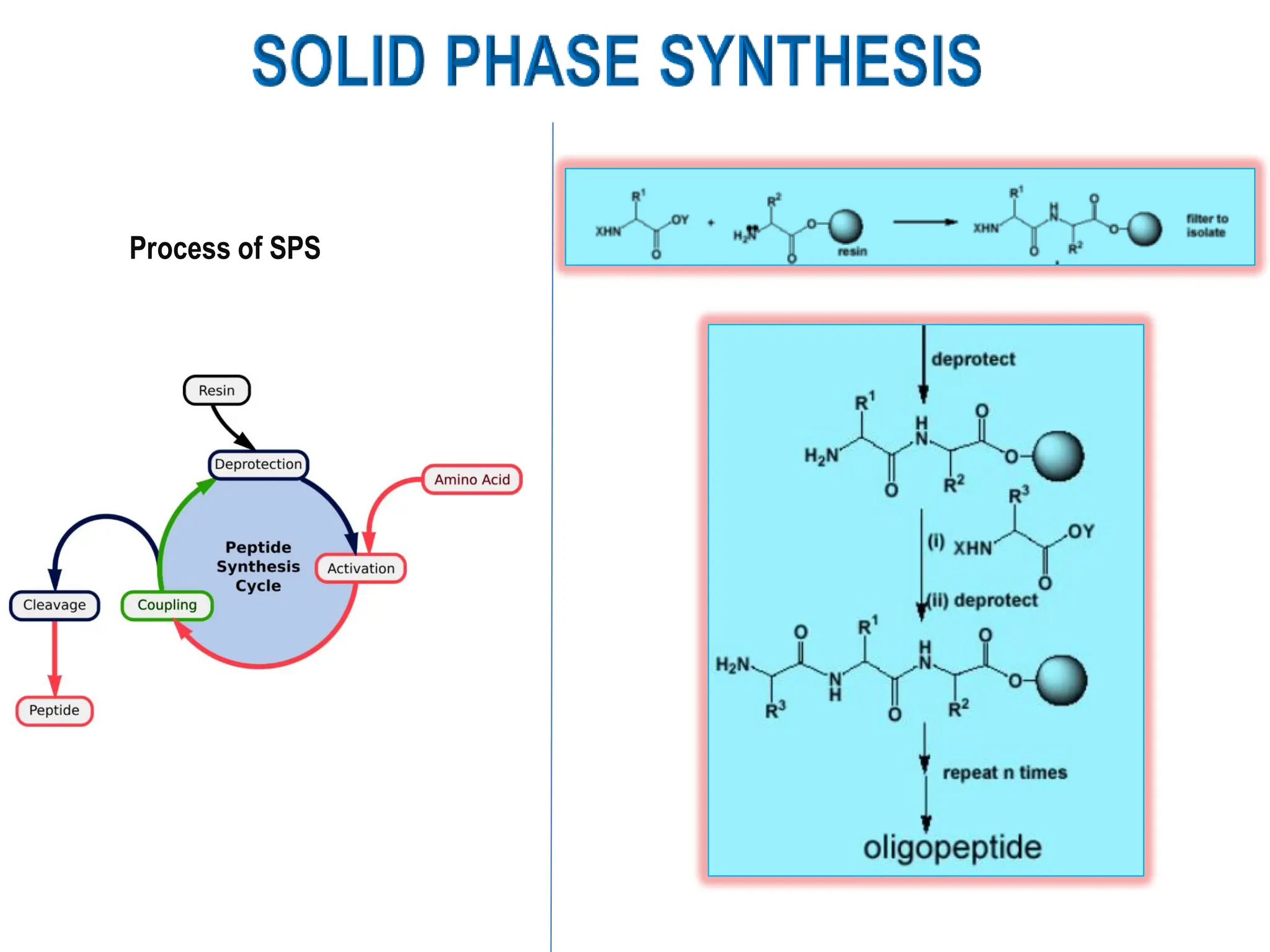
Process of SPS
9
SIDE REACTIONS
10
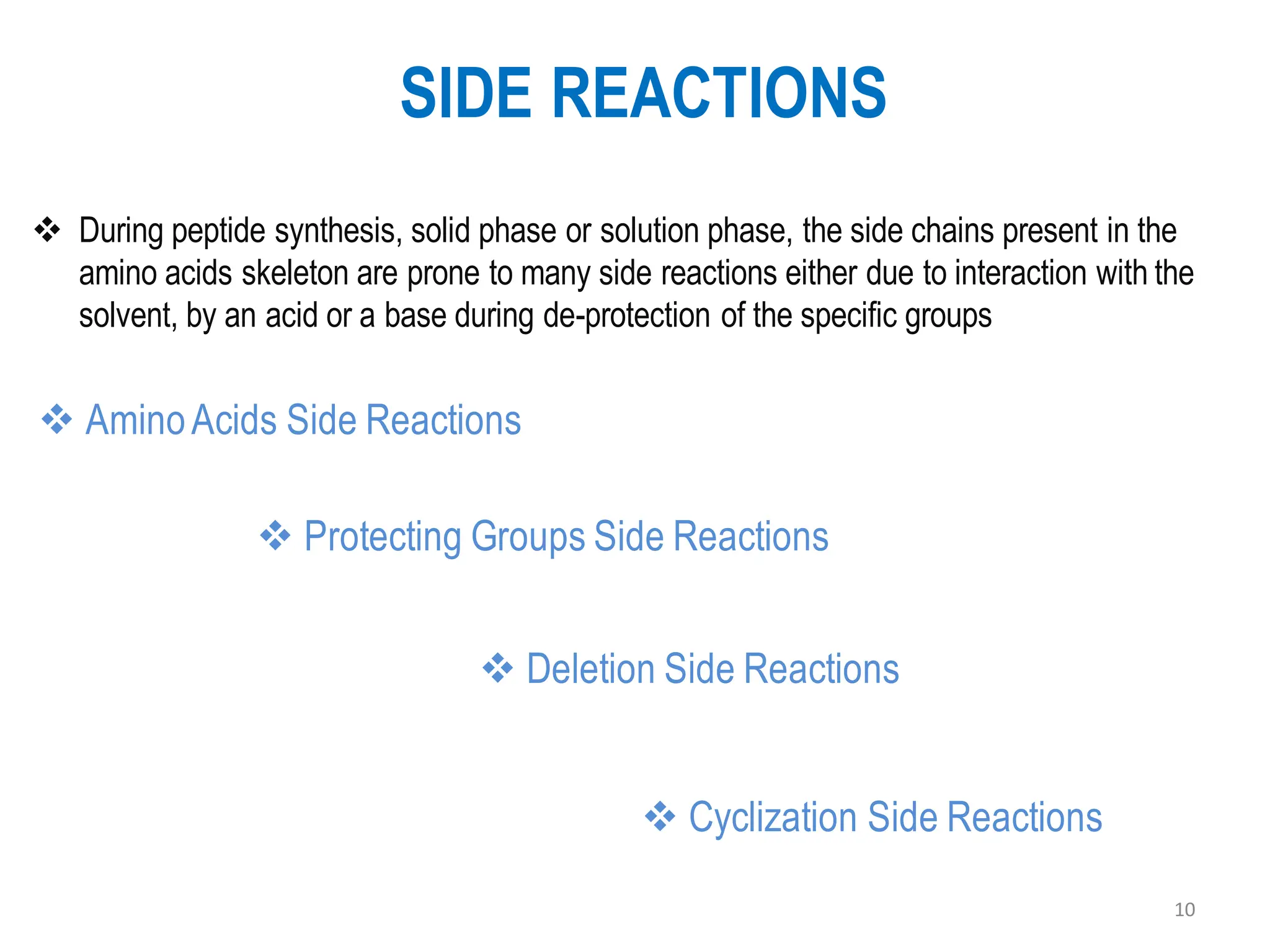
❖ AminoAcids Side Reactions
❖ During peptide synthesis, solid phase or solution phase, the side chains present in the
amino acids skeleton are prone to many side reactions either due to interaction with the
solvent, by an acid or a base during de-protection of the specific groups
❖ Deletion Side Reactions
❖ Cyclization Side Reactions
❖ Protecting Groups Side Reactions
Amino Acids Side Reactions
11
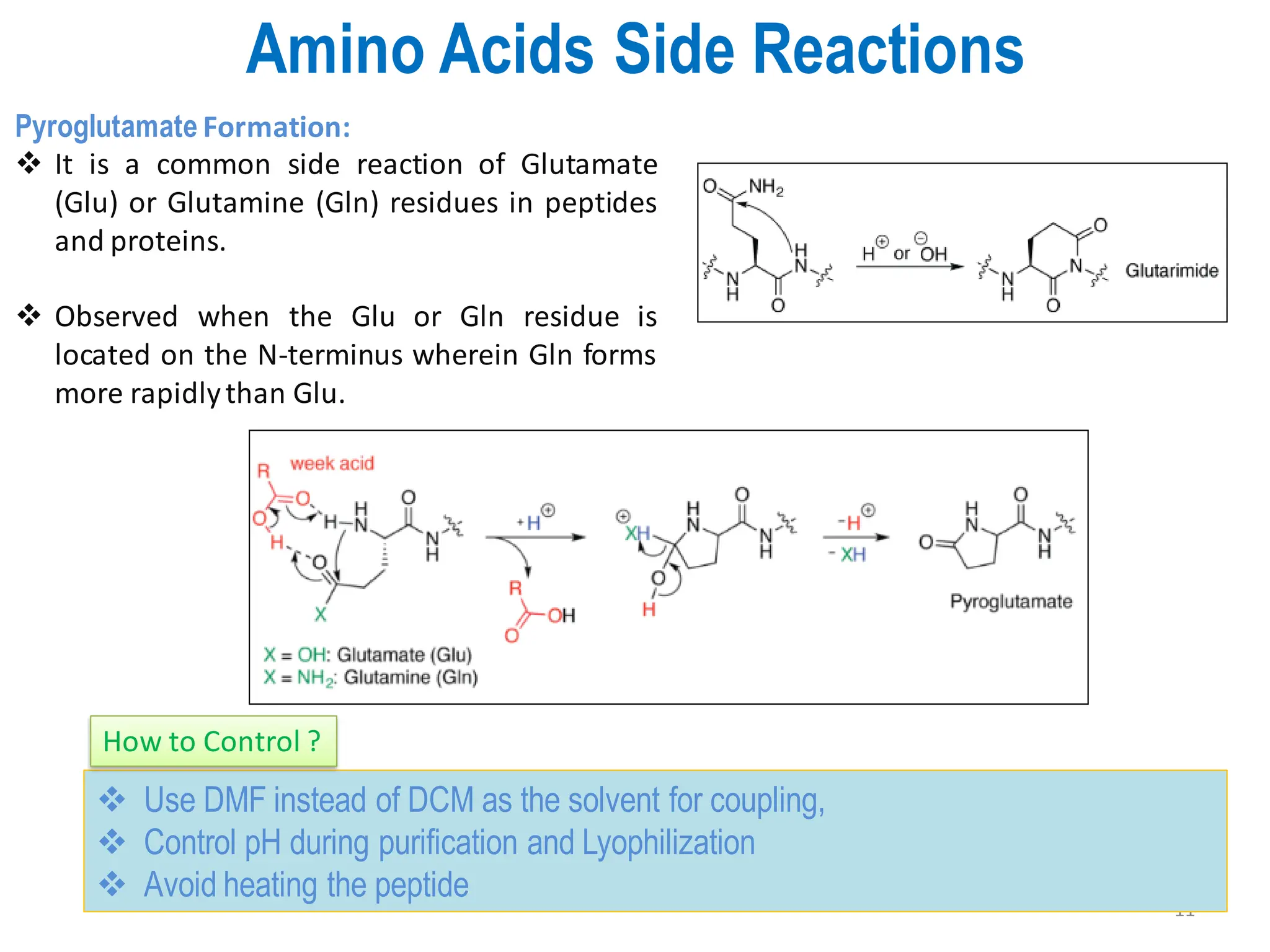
Pyroglutamate Formation:
❖ It is a common side reaction of Glutamate
(Glu) or Glutamine (Gln) residues in peptides
and proteins.
❖ Observed when the Glu or Gln residue is
located on the N-terminus wherein Gln forms
more rapidlythan Glu.
❖ Use DMF instead of DCM as the solvent for coupling,
❖ Control pH during purification and Lyophilization
❖ Avoid heating the peptide
How to Control ?
Dibenzofulvene Peptide Alkylation
12
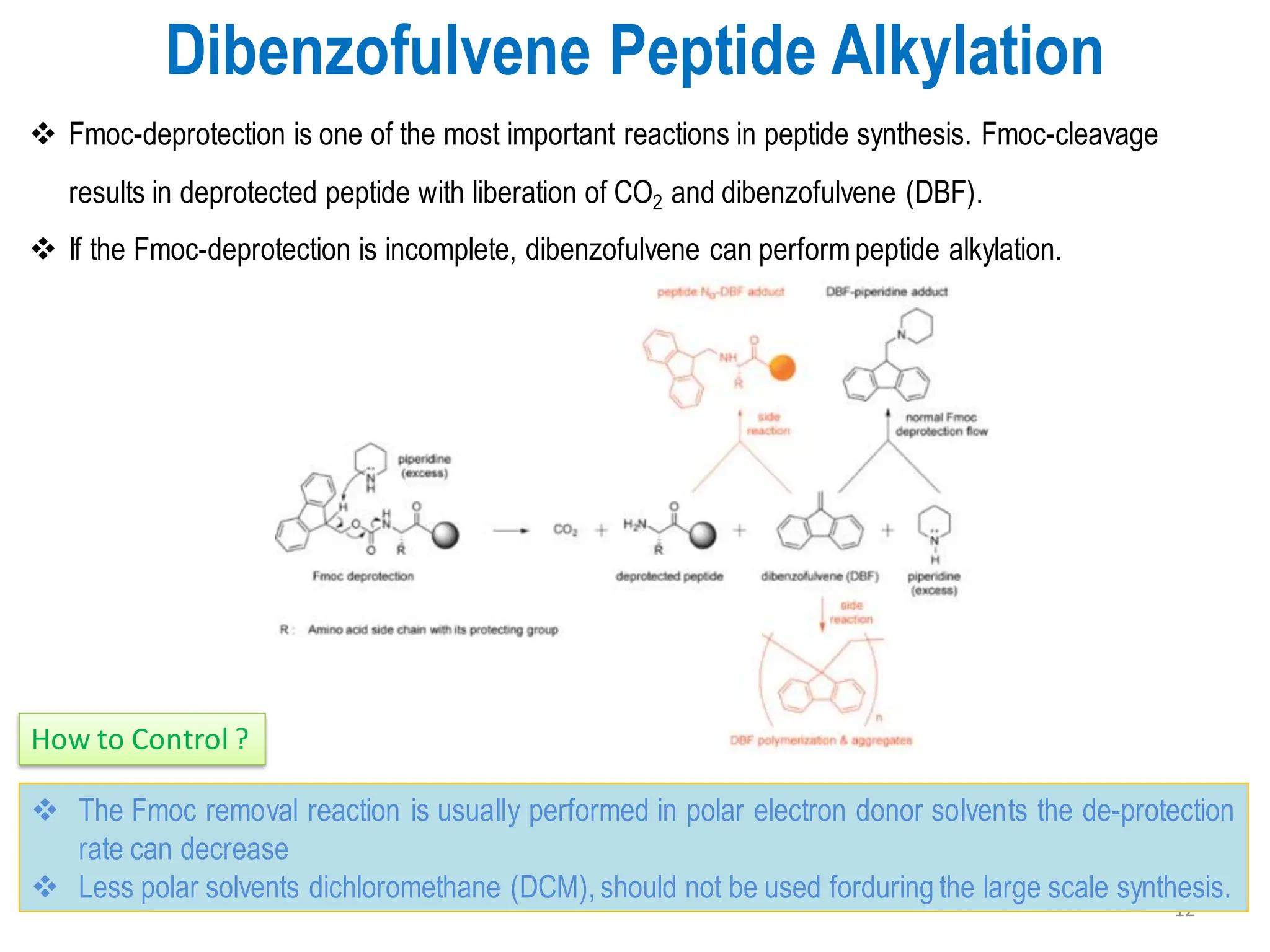
❖ Fmoc-deprotection is one of the most important reactions in peptide synthesis. Fmoc-cleavage
results in deprotected peptide with liberation of CO2 and dibenzofulvene (DBF).
❖ If the Fmoc-deprotection is incomplete, dibenzofulvene can performpeptide alkylation.
❖ The Fmoc removal reaction is usually performed in polar electron donor solvents the de-protection
rate can decrease
❖ Less polar solvents dichloromethane (DCM), should not be used forduring the large scale synthesis.
How to Control ?
13
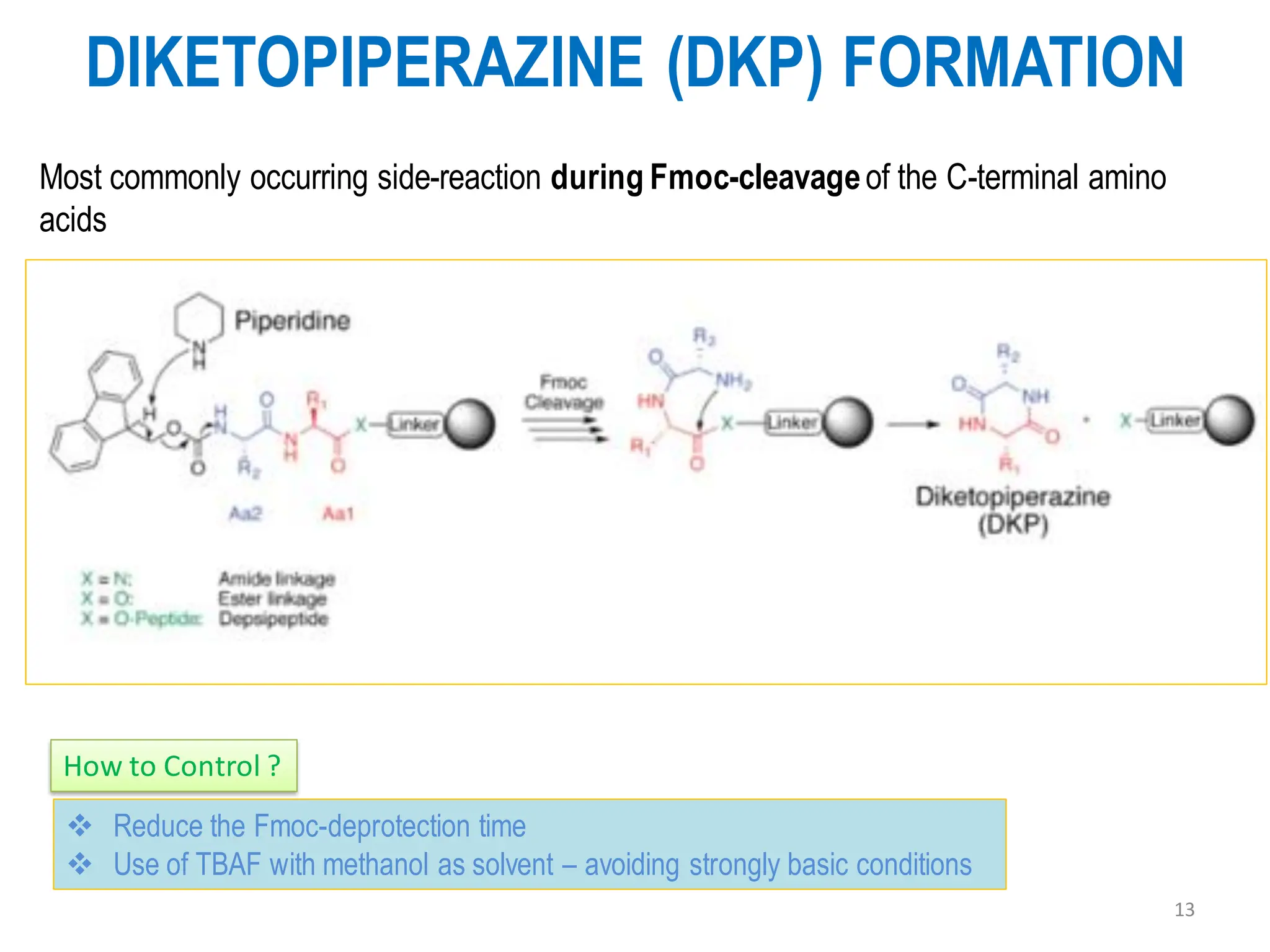
DIKETOPIPERAZINE (DKP) FORMATION
Most commonly occurring side-reaction during Fmoc-cleavageof the C-terminal amino
acids
❖ Reduce the Fmoc-deprotection time
❖ Use of TBAF with methanol as solvent – avoiding strongly basic conditions
How to Control ?
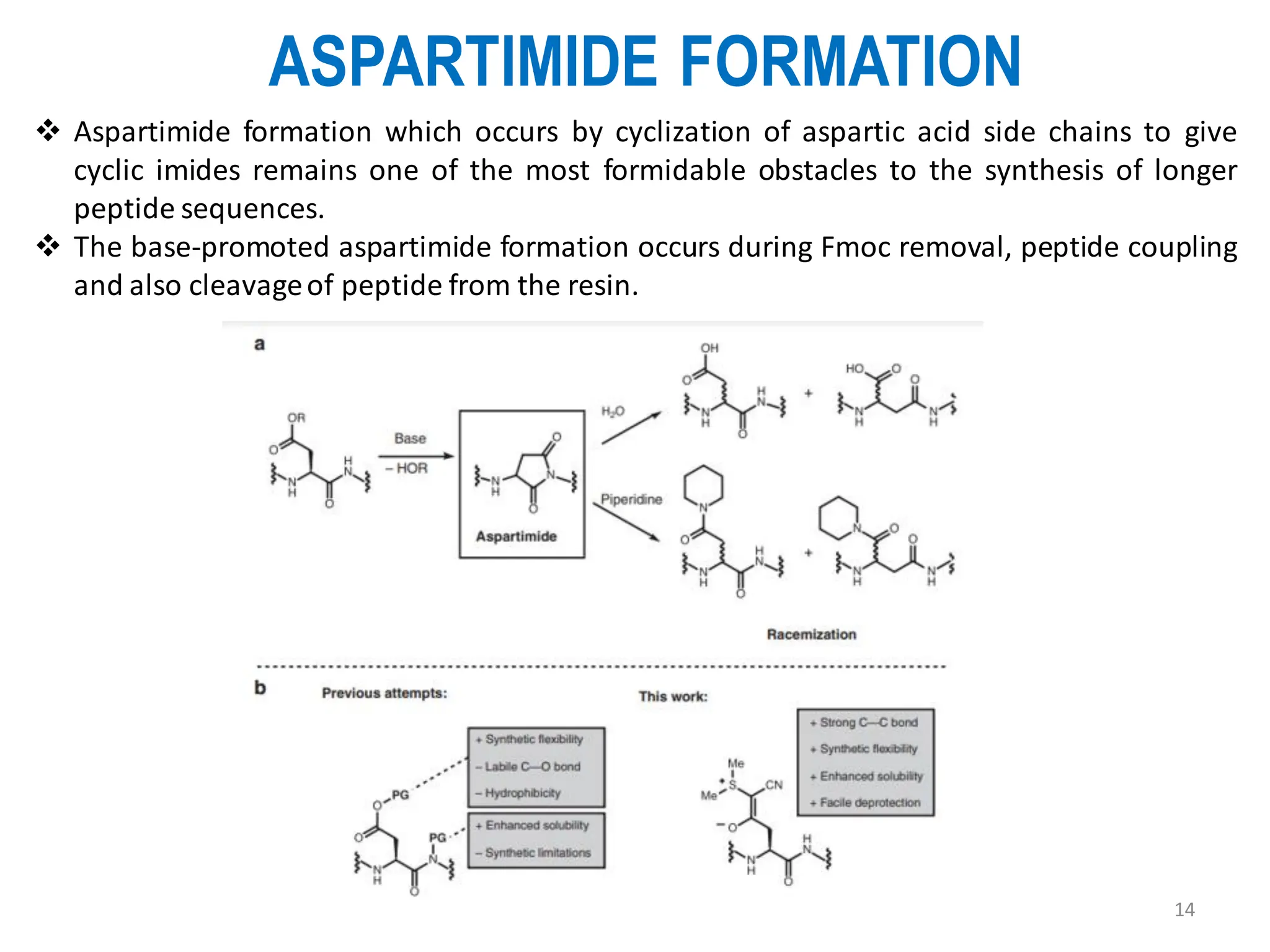
ASPARTIMIDE FORMATION
14
❖ Aspartimide formation which occurs by cyclization of aspartic acid side chains to give
cyclic imides remains one of the most formidable obstacles to the synthesis of longer
peptide sequences.
❖ The base-promoted aspartimide formation occurs during Fmoc removal, peptide coupling
and also cleavageof peptide from the resin.
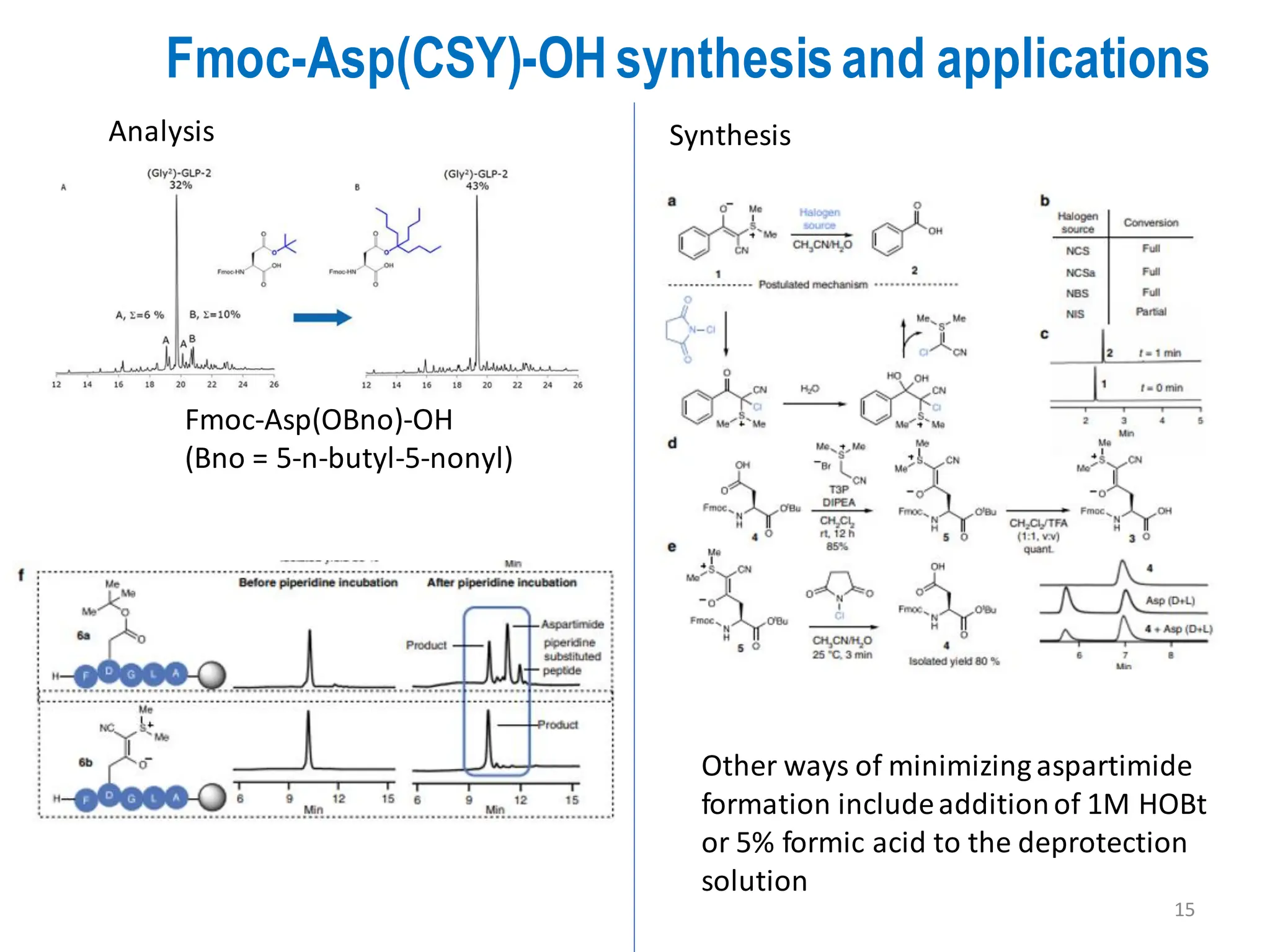
Fmoc-Asp(CSY)-OH synthesisand applications
15
Fmoc-Asp(OBno)-OH
(Bno = 5-n-butyl-5-nonyl)
Other ways of minimizingaspartimide
formation includeadditionof 1M HOBt
or 5% formic acid to the deprotection
solution
Synthesis
Analysis
Deletions Side Reactions
16
❖Deletion reactions are the ones in which a group,
side-chain, one or multiple amino acids are
eliminated from the peptide sequence, as a result
of the undesired side-reaction.
❖It causes synthetic and further, purification issues
and impacts the stability upon processing or
storage.
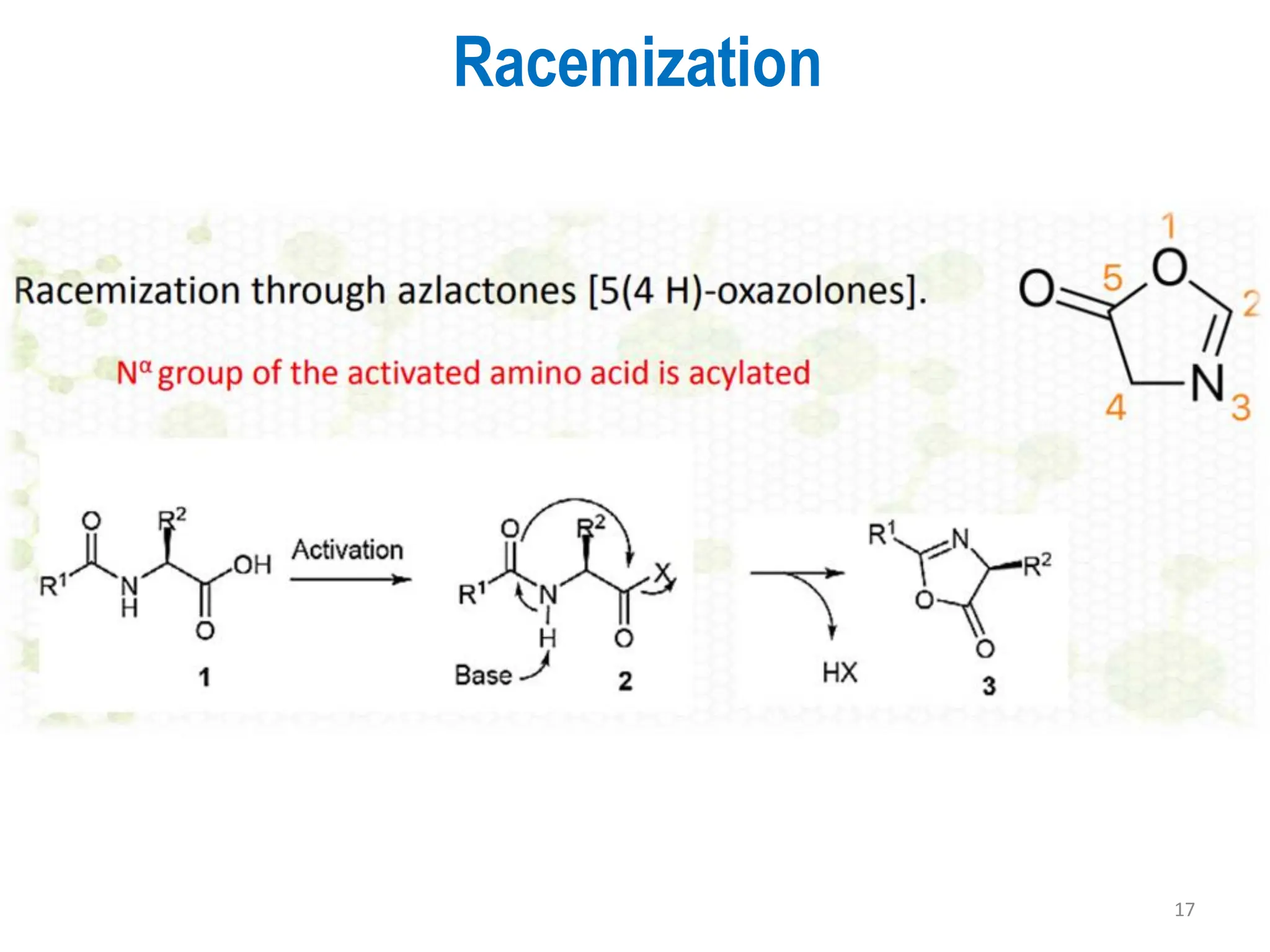
Racemization
17
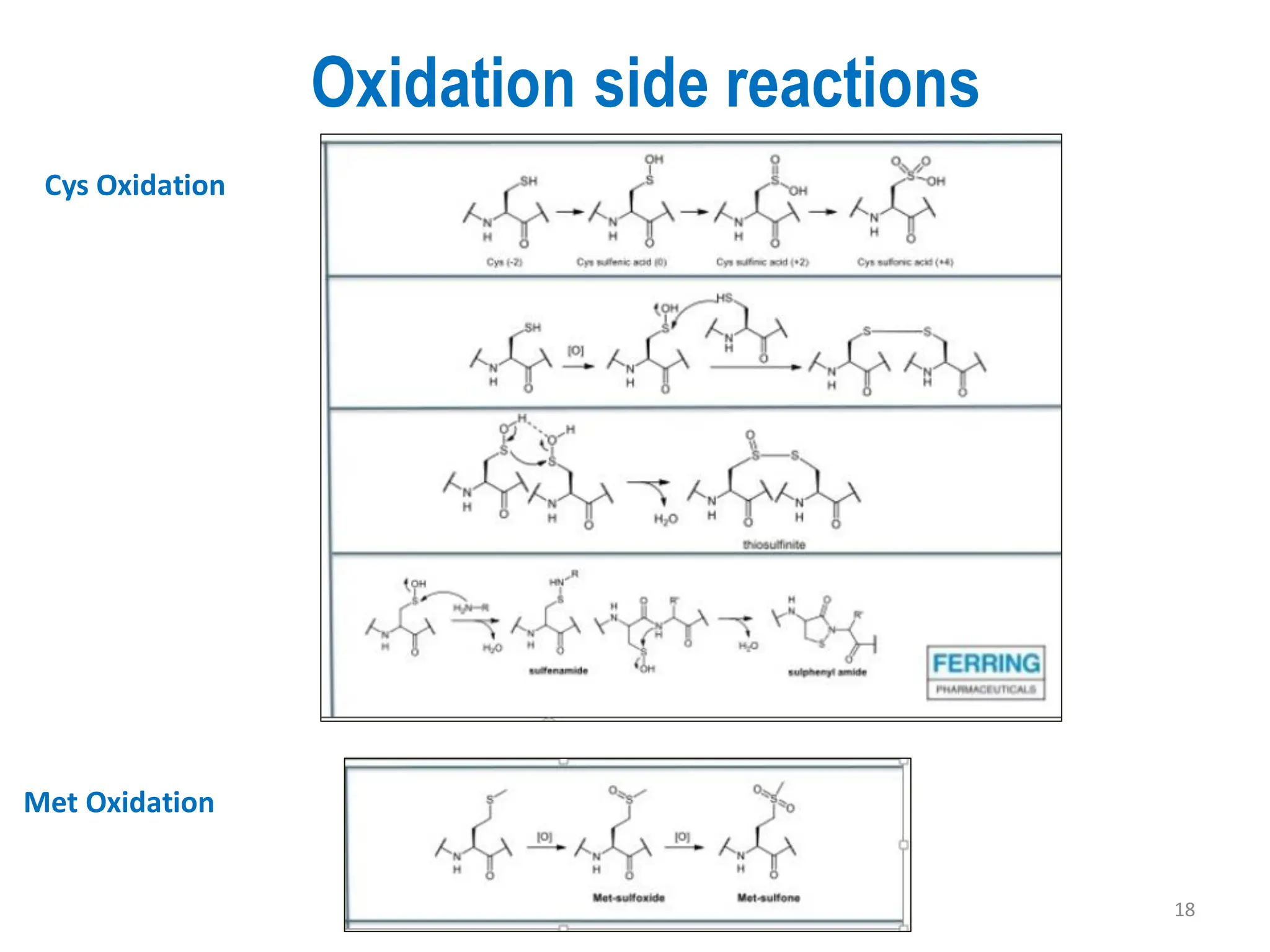
Oxidation side reactions
18
Cys Oxidation
Met Oxidation
19
Conclusion
❖Peptide synthesis involves different robust techniques .
❖In sps is used in the peptide, DNA and combinatiorial synthesis.
❖ Solid phase synthesis is green chemistry.
❖ In spps temporary and permanentprotecting groups are used.
❖The side chains in the peptides are prone to side reactions which can
degrade the amino acid or stop the peptide synthesis.
20
Bibilography
1. Chemical Biology & Drug Design. 1978; 12(2):69-74.
2. Nature communications (2020) 11:982
Bibliography
3.Introduction to medicinal chemistry 3rd edition by Patric.
4.Solid phase synthesis & combinatorial technologics P.Seneci,Wiley 2000. 5.Organic synthesis on
solid phase,F.Z.Dorwald Wiley-VCH2000.
6.Solid phase organic synthesis, A.R.Vanio, K.D.Janda, J.Comb. Chem. 2000. 7.Combinatorial
peptide and non peptide libraries-A Handbook, Jung, G.Ed.VCH Weinheim,1996.
8. R.B. Merriffield, G. Barany, W.L. Cosand, M. Engelhard and S. Mojsov, pept. Am pept. Symp. 5
th edittion 1997, page no 48-55.
21

Side Reactions in Peptide Synthesis: Solution and Solid phase synthesis

  • 1.
  • 2.
    2 ❖ Introduction ❖ Peptidesynthesis ❖ History ❖ Solid and solution phase synthesis ❖ Side reactions ❖ Conclusion
  • 3.
    3 ❖ Peptides arethe sequence of amino acids which are formed by the condensation of two amino acids . ❖ Peptide bond is formed between a carbonyl group of one amino acid and the amino group of another amino acid ❖ Peptides are synthesized Solution phase synthesis Solid phase synthesis
  • 4.
    4 Solution-phase synthesis retainsits usefulness in large-scale production of peptides for industrial purposes. Single Unit
  • 5.
    5 ❖ In solid-phasesynthesis molecules are bound on a bead and synthesized step-by- step in a reactant solution. ❖ Synthesized Ribonuclease (RNA)(124 amino acids) in 1969. 369 reactions; 11,391 steps, 2.4% overall yield. ❖ Easier to remove excess reactant or by- product from the product. ❖ Synthesis of Peptides, deoxy- ribonucleic acid (DNA), and other molecules that need to be synthesized in a certain alignment. ❖ High utility in drug discovery process. Solid-Phase Peptide Synthesis(SPPS) Robert Bruce Merrifield (1921-2006 ) 1984
  • 6.
    6 ❖Resins are twotypes they are: 1. Hydrophobic polystyrene resins 2. Hybrite Hydrophilic Polystyrene Resin (HHPSR) Hydrophobic polystyrene resins: ❖Polystyrene resin beads under class Gelatinous solid support . ❖Cross linked with 1-2% divinylbenzene. ❖Particle size 90-200μm ❖Used in large number of reaction sites. ❖They are cheap & commercially available with any functional groups
  • 7.
  • 8.
  • 9.
  • 10.
    SIDE REACTIONS 10 ❖ AminoAcidsSide Reactions ❖ During peptide synthesis, solid phase or solution phase, the side chains present in the amino acids skeleton are prone to many side reactions either due to interaction with the solvent, by an acid or a base during de-protection of the specific groups ❖ Deletion Side Reactions ❖ Cyclization Side Reactions ❖ Protecting Groups Side Reactions
  • 11.
    Amino Acids SideReactions 11 Pyroglutamate Formation: ❖ It is a common side reaction of Glutamate (Glu) or Glutamine (Gln) residues in peptides and proteins. ❖ Observed when the Glu or Gln residue is located on the N-terminus wherein Gln forms more rapidlythan Glu. ❖ Use DMF instead of DCM as the solvent for coupling, ❖ Control pH during purification and Lyophilization ❖ Avoid heating the peptide How to Control ?
  • 12.
    Dibenzofulvene Peptide Alkylation 12 ❖Fmoc-deprotection is one of the most important reactions in peptide synthesis. Fmoc-cleavage results in deprotected peptide with liberation of CO2 and dibenzofulvene (DBF). ❖ If the Fmoc-deprotection is incomplete, dibenzofulvene can performpeptide alkylation. ❖ The Fmoc removal reaction is usually performed in polar electron donor solvents the de-protection rate can decrease ❖ Less polar solvents dichloromethane (DCM), should not be used forduring the large scale synthesis. How to Control ?
  • 13.
    13 DIKETOPIPERAZINE (DKP) FORMATION Mostcommonly occurring side-reaction during Fmoc-cleavageof the C-terminal amino acids ❖ Reduce the Fmoc-deprotection time ❖ Use of TBAF with methanol as solvent – avoiding strongly basic conditions How to Control ?
  • 14.
    ASPARTIMIDE FORMATION 14 ❖ Aspartimideformation which occurs by cyclization of aspartic acid side chains to give cyclic imides remains one of the most formidable obstacles to the synthesis of longer peptide sequences. ❖ The base-promoted aspartimide formation occurs during Fmoc removal, peptide coupling and also cleavageof peptide from the resin.
  • 15.
    Fmoc-Asp(CSY)-OH synthesisand applications 15 Fmoc-Asp(OBno)-OH (Bno= 5-n-butyl-5-nonyl) Other ways of minimizingaspartimide formation includeadditionof 1M HOBt or 5% formic acid to the deprotection solution Synthesis Analysis
  • 16.
    Deletions Side Reactions 16 ❖Deletionreactions are the ones in which a group, side-chain, one or multiple amino acids are eliminated from the peptide sequence, as a result of the undesired side-reaction. ❖It causes synthetic and further, purification issues and impacts the stability upon processing or storage.
  • 17.
  • 18.
    Oxidation side reactions 18 CysOxidation Met Oxidation
  • 19.
    19 Conclusion ❖Peptide synthesis involvesdifferent robust techniques . ❖In sps is used in the peptide, DNA and combinatiorial synthesis. ❖ Solid phase synthesis is green chemistry. ❖ In spps temporary and permanentprotecting groups are used. ❖The side chains in the peptides are prone to side reactions which can degrade the amino acid or stop the peptide synthesis.
  • 20.
    20 Bibilography 1. Chemical Biology& Drug Design. 1978; 12(2):69-74. 2. Nature communications (2020) 11:982 Bibliography 3.Introduction to medicinal chemistry 3rd edition by Patric. 4.Solid phase synthesis & combinatorial technologics P.Seneci,Wiley 2000. 5.Organic synthesis on solid phase,F.Z.Dorwald Wiley-VCH2000. 6.Solid phase organic synthesis, A.R.Vanio, K.D.Janda, J.Comb. Chem. 2000. 7.Combinatorial peptide and non peptide libraries-A Handbook, Jung, G.Ed.VCH Weinheim,1996. 8. R.B. Merriffield, G. Barany, W.L. Cosand, M. Engelhard and S. Mojsov, pept. Am pept. Symp. 5 th edittion 1997, page no 48-55.
  • 21.