Merrifield
Synthesis
of Peptides
ACHARYA INSTITUTE OF
TECHNOLOGY
Piyush Pal I 1AY16BT013
Genomics
&
Proteomics
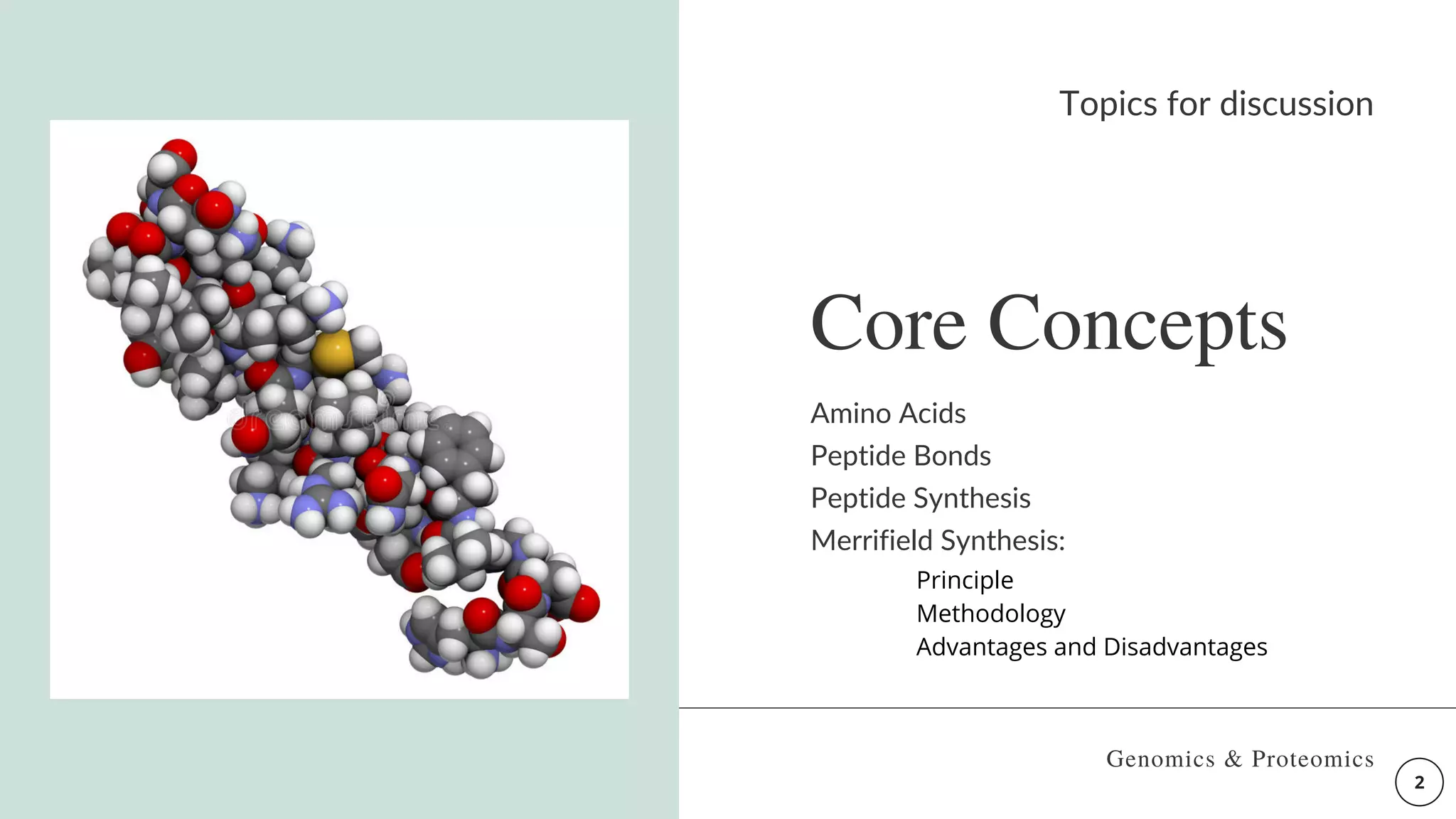
Core Concepts
Amino Acids
Peptide Bonds
Peptide Synthesis
Merrifield Synthesis:
Genomics & Proteomics
Topics for discussion
Principle
Methodology
Advantages and Disadvantages
DNA is a code of four
letters; proteins are
made up of amino acids
which come in 20 forms.
So the ribosome is a very
clever machine that
reads one language and
operates in another.
Ada Yonath
Defining
Amino
Acids
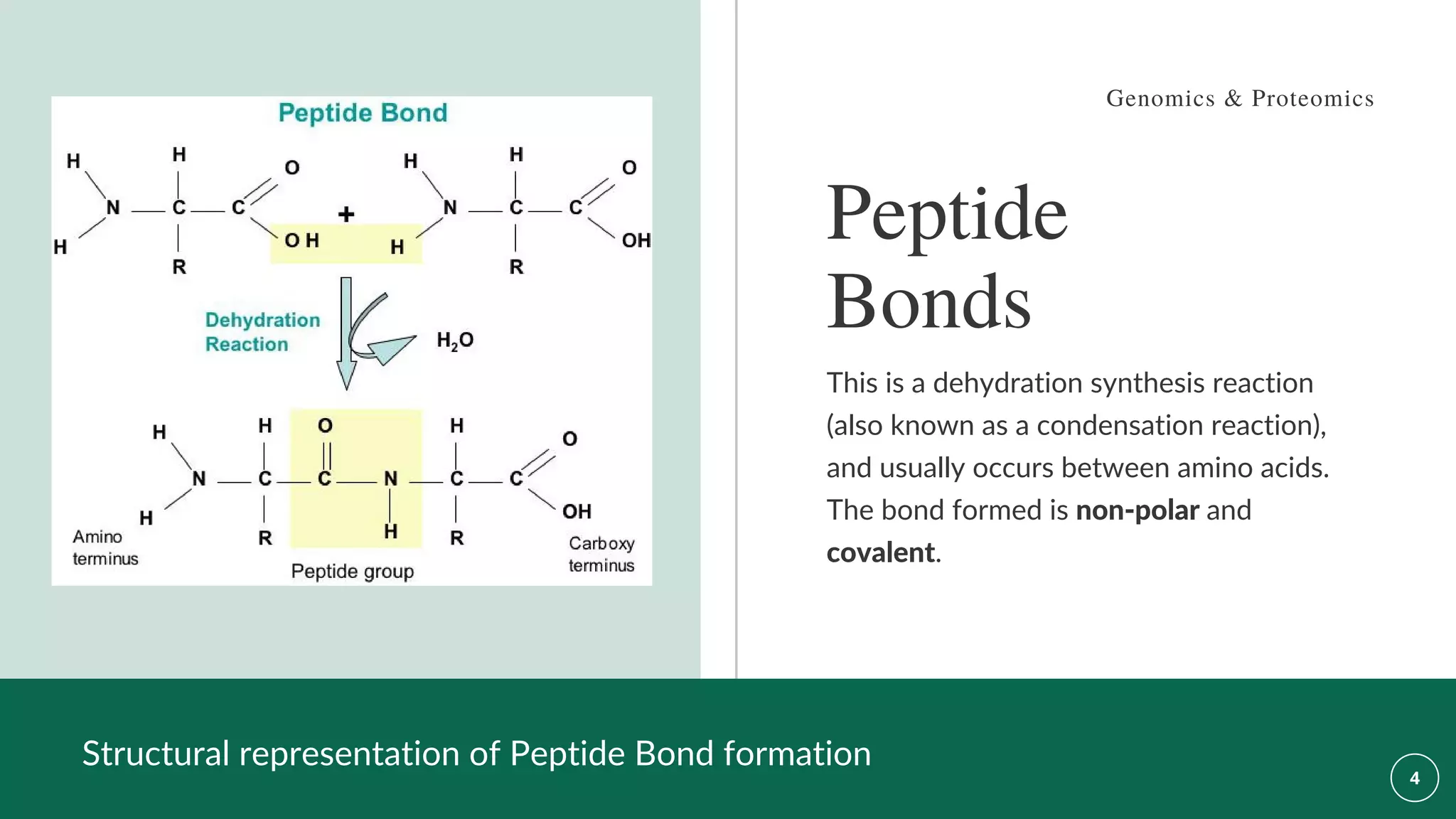
Structural representation of Peptide Bond formation
Peptide
Bonds
This is a dehydration synthesis reaction
(also known as a condensation reaction),
and usually occurs between amino acids.
The bond formed is non-polar and
covalent.
Genomics & Proteomics
Production of peptides,
compounds where
multiple amino acids are
linked
Peptide
Synthesis
Solution-phase synthesis retains its
usefulness in large-scale production of
peptides for industrial purposes.
Genomics
&
Proteomics
Chemical peptide synthesis most
commonly starts at the carboxyl end of the
peptide (C-terminus), and proceeds toward
the amino-terminus (N-terminus).
The chemical synthesis of peptides can be
carried out using classical solution-phase
techniques, although these have been
replaced in most research and
development settings by solid-phase
methods.
1. SPPS allows the rapid assembly of a peptide chain through successive
reactions of amino acid derivatives on an insoluble porous support.
2. With the growing chain covalently an insoluble matrix at all stages of the
synthesis, the peptide would also be completely insoluble and furthermore
would be in a suitable physical form to permit rapid filtration and washing
after completion of each of the synthetic reaction.
3. The fact that all of the steps just described are heterogeneous reactions
between a soluble reagent in the liquid phase and the growing peptide chain
in the soluble solid phase led to the introduction of the name solid phase
peptide synthesis.
Basic principle
of Merrifield's
Solid Phase
Peptide
Synthesis
(SPPS)
Genomics & Proteomics
Linkers may be used that provide a reversible linkage between the
synthetic peptide chain and the solid support.
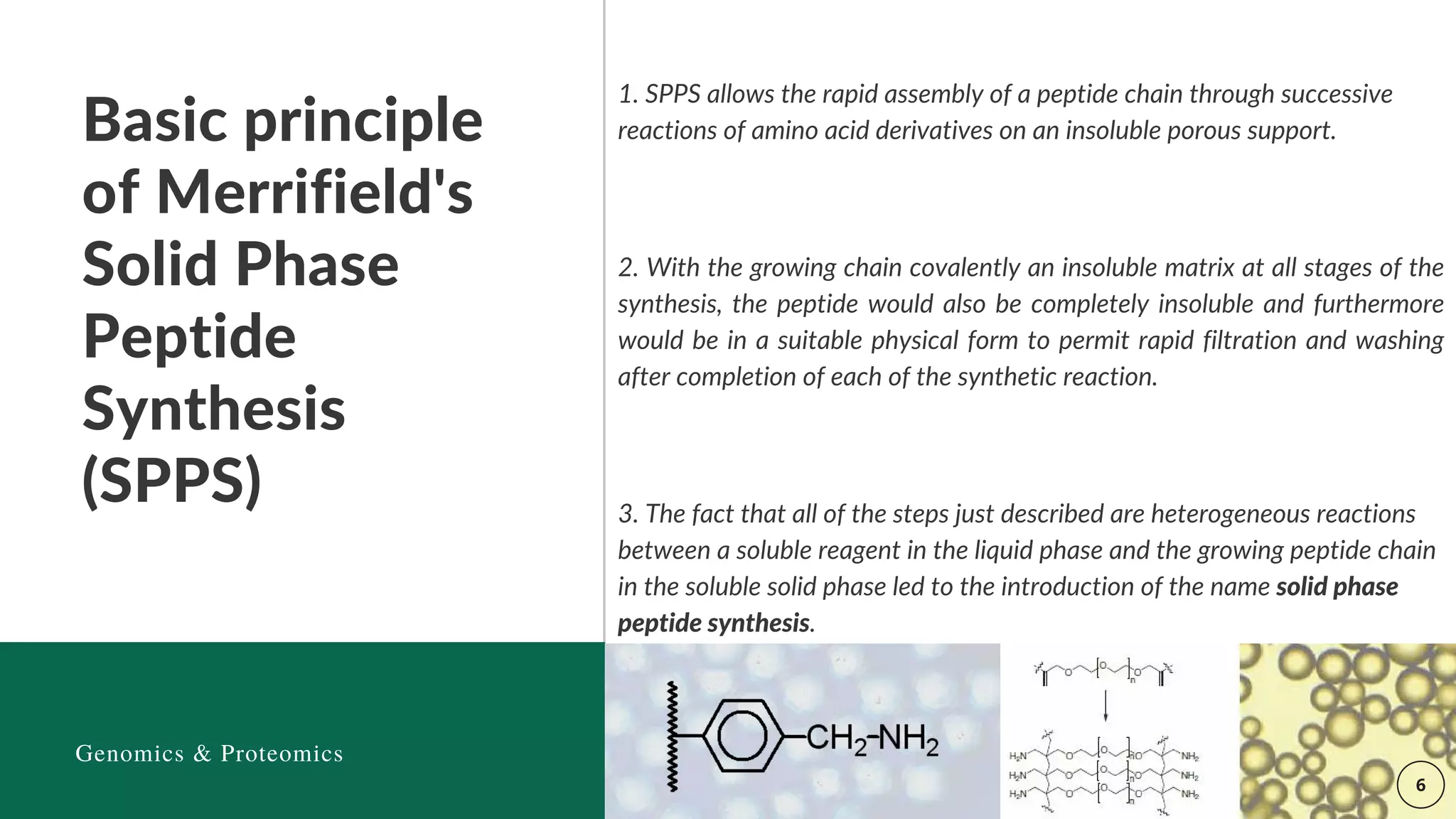
Resin is used as solid support. Dry polystyrene beads have an average diameter of 50 µm.
An ideal support should have the required mechanical stability, should be stable under
the reaction condition, could be functionalised easily and should have very good
swelling characteristics.
For effective swelling of the resin and solvation of the peptide, the polymer should have
optimum hydrophilic-hydrophobic balance.
Structure-reactivity, structure-property correlation in crosslinked polymer systems helped
to design new supports with optimum reactivity, mechanical stability and other essential
requirements of a polymeric support.
Solid Support
Genomics
&
Proteomics
A few notes on Protecting
Groups
Genomics
&
Proteomics
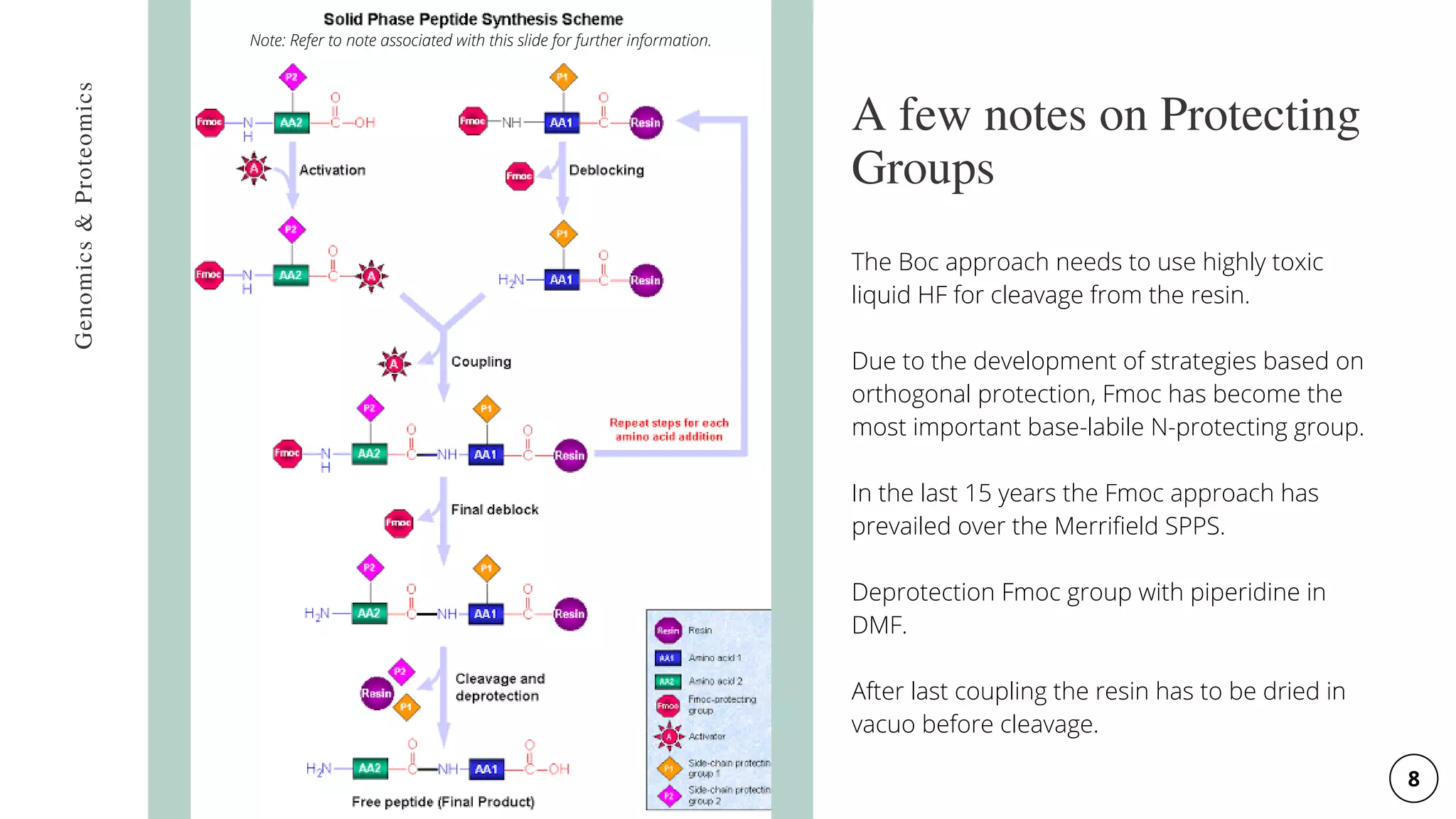
The Boc approach needs to use highly toxic
liquid HF for cleavage from the resin.
Due to the development of strategies based on
orthogonal protection, Fmoc has become the
most important base-labile N-protecting group.
In the last 15 years the Fmoc approach has
prevailed over the Merrifield SPPS.
Deprotection Fmoc group with piperidine in
DMF.
After last coupling the resin has to be dried in
vacuo before cleavage.
8
Note: Refer to note associated with this slide for further information.
Stages of isolation and
purification
Peptide
Isolation &
Purification
Genomics
&
Proteomics
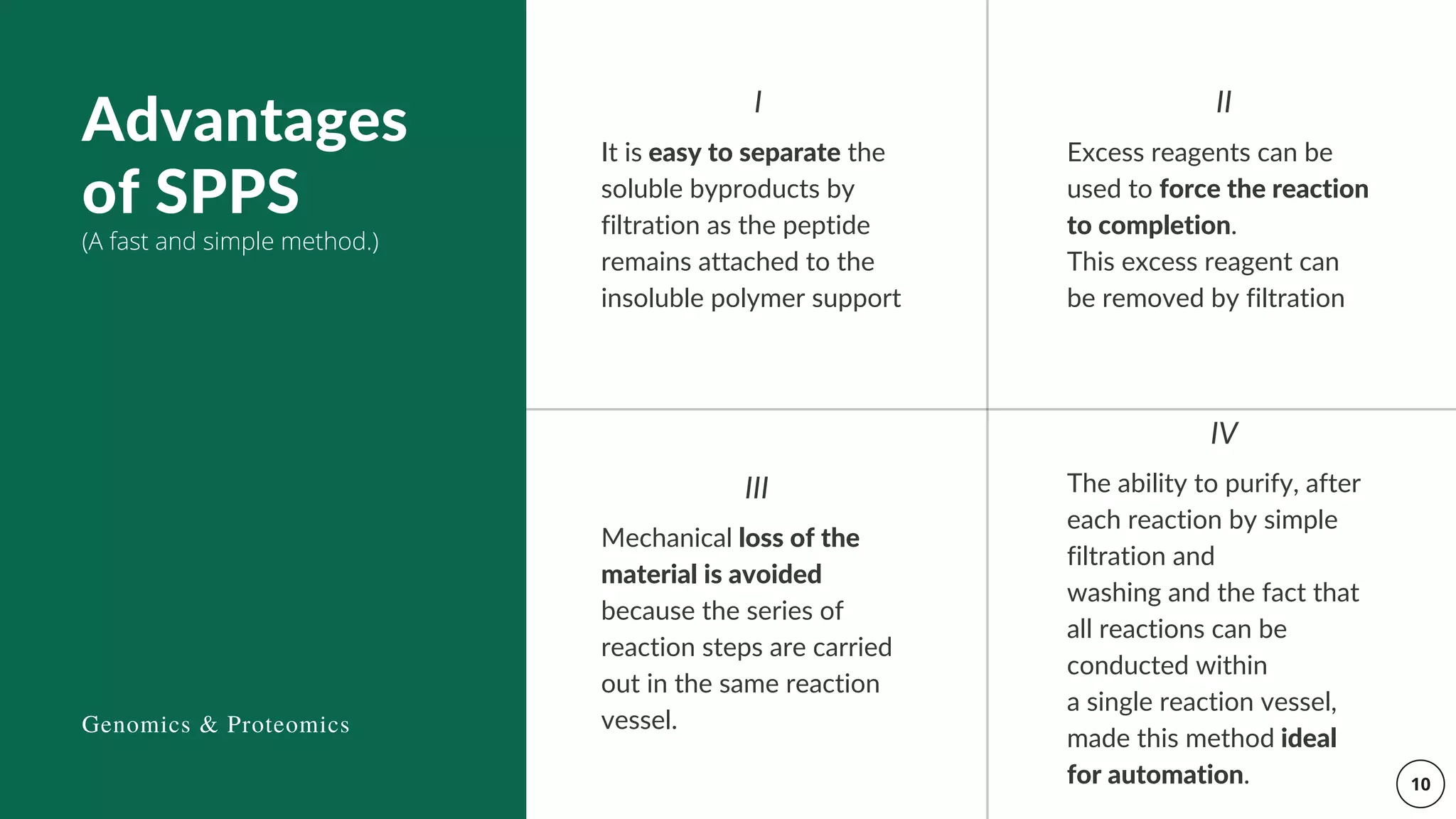
Precipitated by addition of cold diethyl
ether.
Directly from TFA solution or following
evaporation of TFA and volatile
scavengers.
Centrifuge and wash with Et2O 3 times.
Dry the solid in vacuo.
Purification by HPLC.
Characterisation by MALDI-TOF mass
spectrum, NMR spectrometry.
Advantages
of SPPS
I
It is easy to separate the
soluble byproducts by
filtration as the peptide
remains attached to the
insoluble polymer support
II
Excess reagents can be
used to force the reaction
to completion.
This excess reagent can
be removed by filtration
III
Mechanical loss of the
material is avoided
because the series of
reaction steps are carried
out in the same reaction
vessel.
IV
The ability to purify, after
each reaction by simple
filtration and
washing and the fact that
all reactions can be
conducted within
a single reaction vessel,
made this method ideal
for automation.
Genomics & Proteomics
(A fast and simple method.)
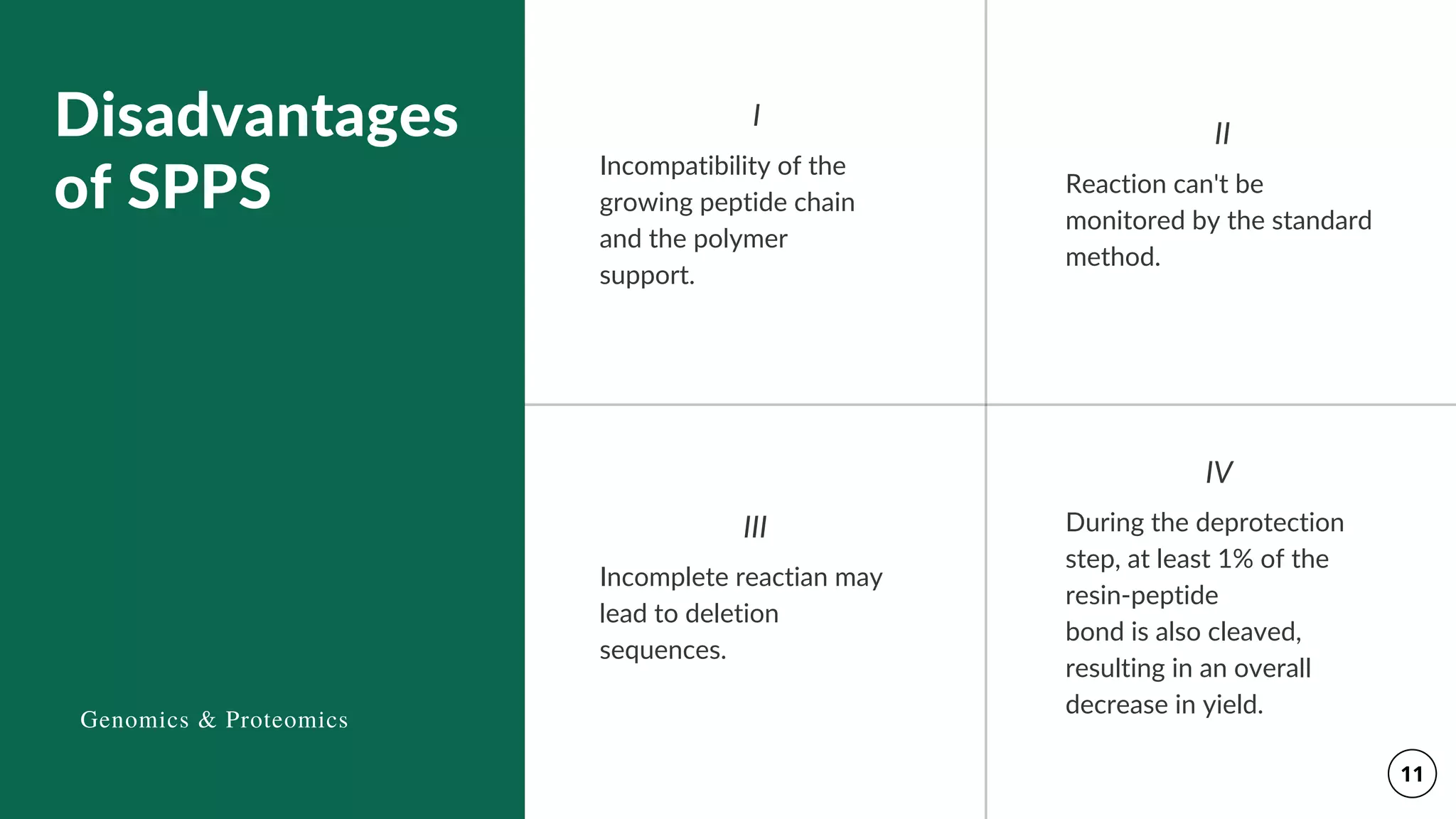
Disadvantages
of SPPS
I
Incompatibility of the
growing peptide chain
and the polymer
support.
II
Reaction can't be
monitored by the standard
method.
III
Incomplete reactian may
lead to deletion
sequences.
IV
During the deprotection
step, at least 1% of the
resin-peptide
bond is also cleaved,
resulting in an overall
decrease in yield.
Genomics & Proteomics
11
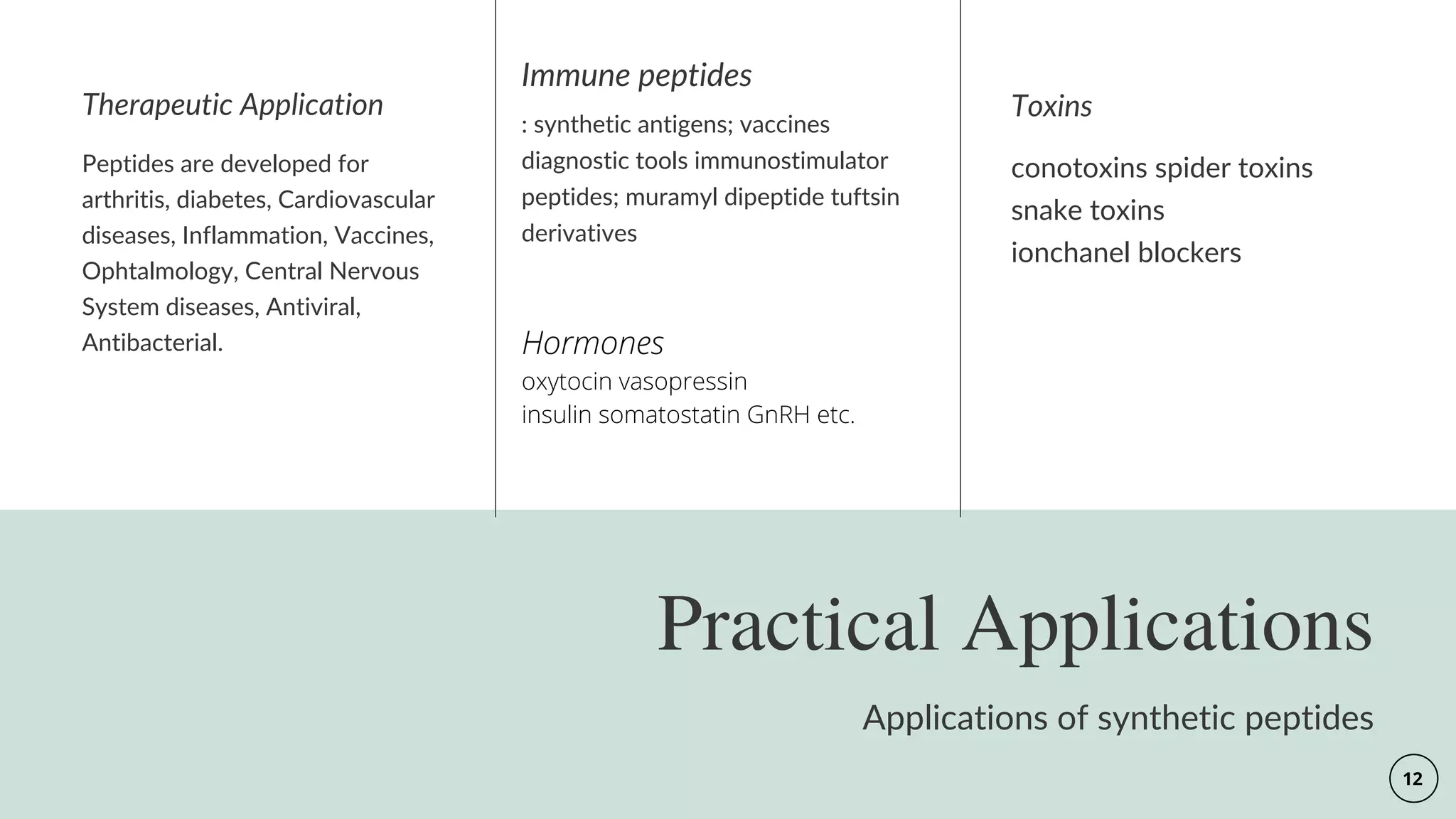
Practical Applications
Applications of synthetic peptides
Peptides are developed for
arthritis, diabetes, Cardiovascular
diseases, Inflammation, Vaccines,
Ophtalmology, Central Nervous
System diseases, Antiviral,
Antibacterial.
Therapeutic Application
: synthetic antigens; vaccines
diagnostic tools immunostimulator
peptides; muramyl dipeptide tuftsin
derivatives
Immune peptides
conotoxins spider toxins
snake toxins
ionchanel blockers
Toxins
12
Hormones
oxytocin vasopressin
insulin somatostatin GnRH etc.
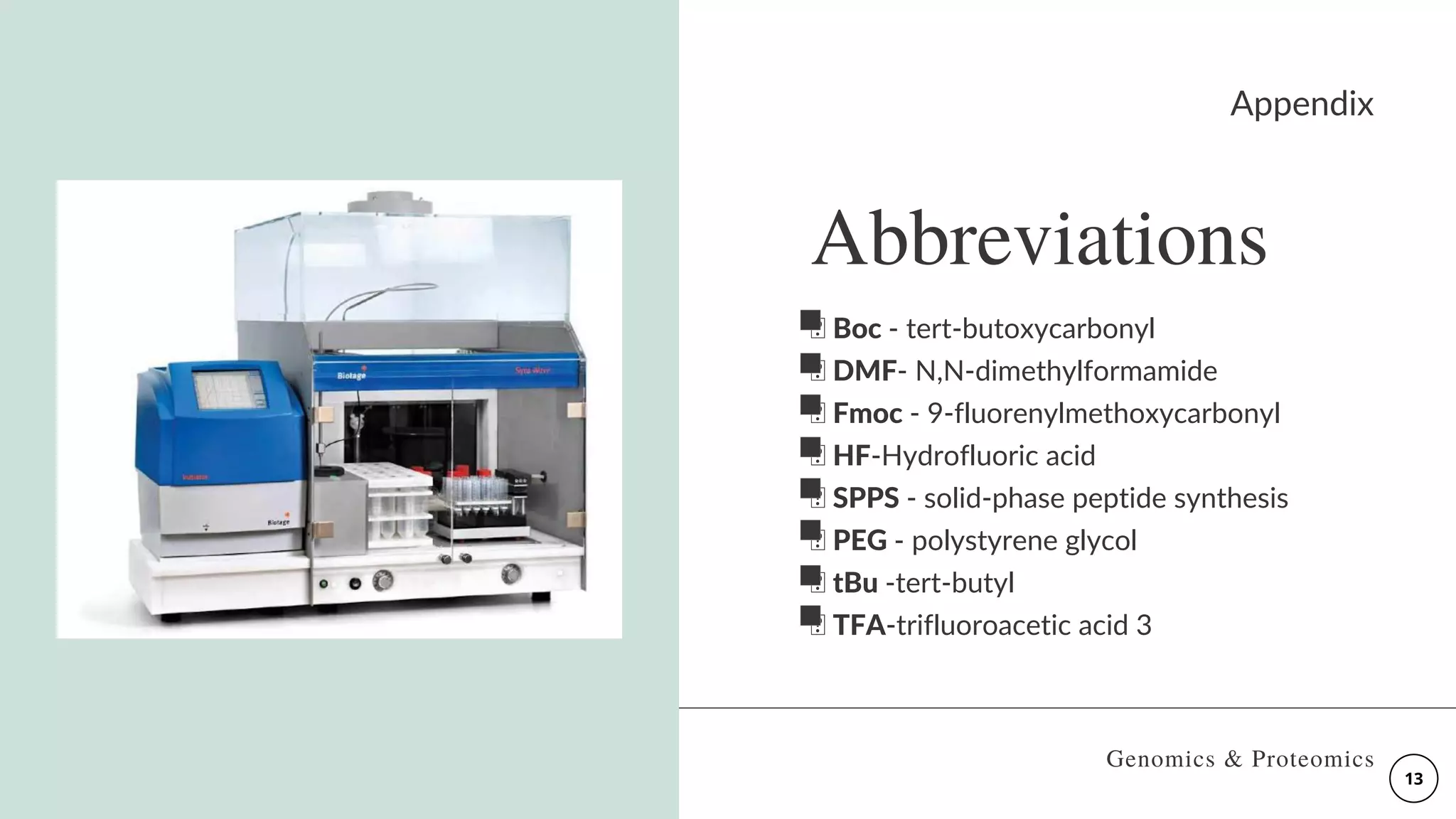
Abbreviations
Boc - tert-butoxycarbonyl
DMF- N,N-dimethylformamide
Fmoc - 9-fluorenylmethoxycarbonyl
HF-Hydrofluoric acid
SPPS - solid-phase peptide synthesis
PEG - polystyrene glycol
tBu -tert-butyl
TFA-trifluoroacetic acid 3
Genomics & Proteomics
Appendix
13
Resources
Peptide synthesis
https://en.wikipedia.org/wiki/Peptide_synthesis
Basic principles and procedures of solid phase peptide synthesis
http://www.cim.unito.it/website/documenti/IP_Probes_Turin_2011/lectures/Basic_principles_and_p
rocedures_of_SPPS_2011.pdf
SOLID PHASE PEPTIDE SYNTHESIS
https://www.bachem.com/fileadmin/user_upload/pdf/Catalogs_Brochures/Solid_Phase_Peptide_Syn
thesis.pdf
Genomics
&
Proteomics
Online
sources
used
14
Genomics
&
Proteomics
Disclaimer
Images used are for educational purpose only. No
copyright infringement intended.

Merrifield Synthesis of Peptides

  • 1.
    Merrifield Synthesis of Peptides ACHARYA INSTITUTEOF TECHNOLOGY Piyush Pal I 1AY16BT013 Genomics & Proteomics
  • 2.
    Core Concepts Amino Acids PeptideBonds Peptide Synthesis Merrifield Synthesis: Genomics & Proteomics Topics for discussion Principle Methodology Advantages and Disadvantages
  • 3.
    DNA is acode of four letters; proteins are made up of amino acids which come in 20 forms. So the ribosome is a very clever machine that reads one language and operates in another. Ada Yonath Defining Amino Acids
  • 4.
    Structural representation ofPeptide Bond formation Peptide Bonds This is a dehydration synthesis reaction (also known as a condensation reaction), and usually occurs between amino acids. The bond formed is non-polar and covalent. Genomics & Proteomics
  • 5.
    Production of peptides, compoundswhere multiple amino acids are linked Peptide Synthesis Solution-phase synthesis retains its usefulness in large-scale production of peptides for industrial purposes. Genomics & Proteomics Chemical peptide synthesis most commonly starts at the carboxyl end of the peptide (C-terminus), and proceeds toward the amino-terminus (N-terminus). The chemical synthesis of peptides can be carried out using classical solution-phase techniques, although these have been replaced in most research and development settings by solid-phase methods.
  • 6.
    1. SPPS allowsthe rapid assembly of a peptide chain through successive reactions of amino acid derivatives on an insoluble porous support. 2. With the growing chain covalently an insoluble matrix at all stages of the synthesis, the peptide would also be completely insoluble and furthermore would be in a suitable physical form to permit rapid filtration and washing after completion of each of the synthetic reaction. 3. The fact that all of the steps just described are heterogeneous reactions between a soluble reagent in the liquid phase and the growing peptide chain in the soluble solid phase led to the introduction of the name solid phase peptide synthesis. Basic principle of Merrifield's Solid Phase Peptide Synthesis (SPPS) Genomics & Proteomics
  • 7.
    Linkers may beused that provide a reversible linkage between the synthetic peptide chain and the solid support. Resin is used as solid support. Dry polystyrene beads have an average diameter of 50 µm. An ideal support should have the required mechanical stability, should be stable under the reaction condition, could be functionalised easily and should have very good swelling characteristics. For effective swelling of the resin and solvation of the peptide, the polymer should have optimum hydrophilic-hydrophobic balance. Structure-reactivity, structure-property correlation in crosslinked polymer systems helped to design new supports with optimum reactivity, mechanical stability and other essential requirements of a polymeric support. Solid Support Genomics & Proteomics
  • 8.
    A few noteson Protecting Groups Genomics & Proteomics The Boc approach needs to use highly toxic liquid HF for cleavage from the resin. Due to the development of strategies based on orthogonal protection, Fmoc has become the most important base-labile N-protecting group. In the last 15 years the Fmoc approach has prevailed over the Merrifield SPPS. Deprotection Fmoc group with piperidine in DMF. After last coupling the resin has to be dried in vacuo before cleavage. 8 Note: Refer to note associated with this slide for further information.
  • 9.
    Stages of isolationand purification Peptide Isolation & Purification Genomics & Proteomics Precipitated by addition of cold diethyl ether. Directly from TFA solution or following evaporation of TFA and volatile scavengers. Centrifuge and wash with Et2O 3 times. Dry the solid in vacuo. Purification by HPLC. Characterisation by MALDI-TOF mass spectrum, NMR spectrometry.
  • 10.
    Advantages of SPPS I It iseasy to separate the soluble byproducts by filtration as the peptide remains attached to the insoluble polymer support II Excess reagents can be used to force the reaction to completion. This excess reagent can be removed by filtration III Mechanical loss of the material is avoided because the series of reaction steps are carried out in the same reaction vessel. IV The ability to purify, after each reaction by simple filtration and washing and the fact that all reactions can be conducted within a single reaction vessel, made this method ideal for automation. Genomics & Proteomics (A fast and simple method.)
  • 11.
    Disadvantages of SPPS I Incompatibility ofthe growing peptide chain and the polymer support. II Reaction can't be monitored by the standard method. III Incomplete reactian may lead to deletion sequences. IV During the deprotection step, at least 1% of the resin-peptide bond is also cleaved, resulting in an overall decrease in yield. Genomics & Proteomics 11
  • 12.
    Practical Applications Applications ofsynthetic peptides Peptides are developed for arthritis, diabetes, Cardiovascular diseases, Inflammation, Vaccines, Ophtalmology, Central Nervous System diseases, Antiviral, Antibacterial. Therapeutic Application : synthetic antigens; vaccines diagnostic tools immunostimulator peptides; muramyl dipeptide tuftsin derivatives Immune peptides conotoxins spider toxins snake toxins ionchanel blockers Toxins 12 Hormones oxytocin vasopressin insulin somatostatin GnRH etc.
  • 13.
    Abbreviations Boc - tert-butoxycarbonyl DMF-N,N-dimethylformamide Fmoc - 9-fluorenylmethoxycarbonyl HF-Hydrofluoric acid SPPS - solid-phase peptide synthesis PEG - polystyrene glycol tBu -tert-butyl TFA-trifluoroacetic acid 3 Genomics & Proteomics Appendix 13
  • 14.
    Resources Peptide synthesis https://en.wikipedia.org/wiki/Peptide_synthesis Basic principlesand procedures of solid phase peptide synthesis http://www.cim.unito.it/website/documenti/IP_Probes_Turin_2011/lectures/Basic_principles_and_p rocedures_of_SPPS_2011.pdf SOLID PHASE PEPTIDE SYNTHESIS https://www.bachem.com/fileadmin/user_upload/pdf/Catalogs_Brochures/Solid_Phase_Peptide_Syn thesis.pdf Genomics & Proteomics Online sources used 14
  • 15.
    Genomics & Proteomics Disclaimer Images used arefor educational purpose only. No copyright infringement intended.