MAP - SPPS
BY-
Abhishek Sirsikar
Sameer Hadawale
• More than 40 marketed peptides worldwide
• 270 peptides in clinical trials
• 400 peptides in advanced preclinical phases
Peptides as Drugs Today
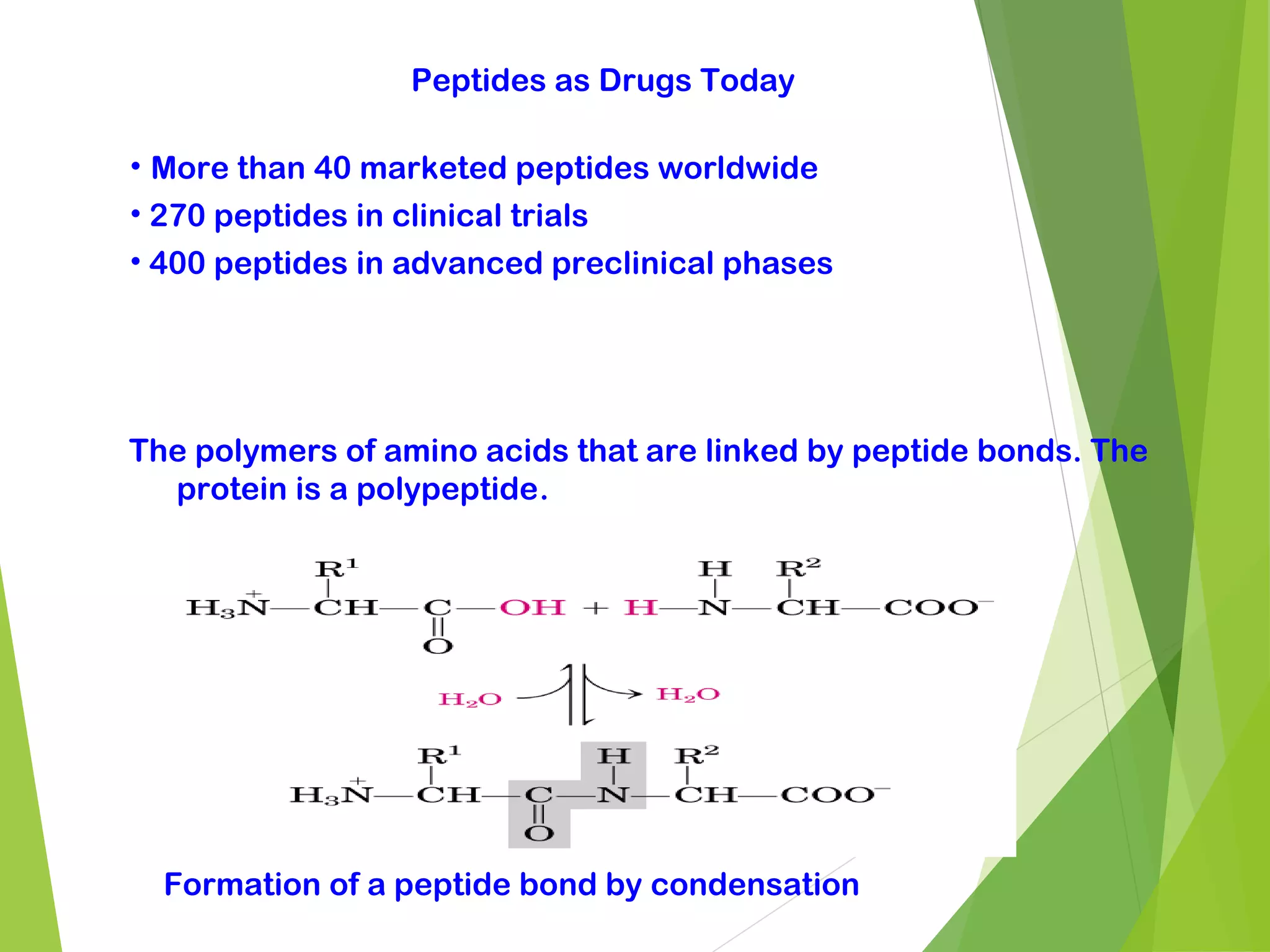
The polymers of amino acids that are linked by peptide bonds. The
protein is a polypeptide.
Formation of a peptide bond by condensation
Before starting….
• Choose the C-terminal protecting group
• Choose the N-terminal protecting group
• Choose the coupling reagent
Mainly peptide synthesis are two types
1. Solution phase peptide synthesis
2. Solid phase peptide synthesis
H2N
O
OH
R
1.C-terminal protecting group:
H2N
O
O
H2N
O
O
H2N
O
O
C2H5
Alanine methyl ester Alanine allyl esterAlanine ethyl ester
• The most common acid protecting group used is the methyl ester.
•It is stable in most coupling reaction and deprotection reaction conditions.
H2N
O
OH
R2.N-terminal protecting group
There are two standard types of N-protecting groups used,
1. Boc Group
2. Fmoc group O
O CH3
CH3
CH3
O
O
3.Coupling Reagents
N-(3-Dimethylaminopropyl)-N’-ethylcarbonate
(EDC)
N C N N C N NN C N N
N,N’-Dicyclohexylcarbodimide
(DCC)
N
N
N
O
Me2N NMe2
PF6 (BF4 ) N N
N
N
O
Me2N NMe2
HBTU (TBTU) HATU
PF6N
N
N
OH
N N
N
N
OH
HOBt HOAt
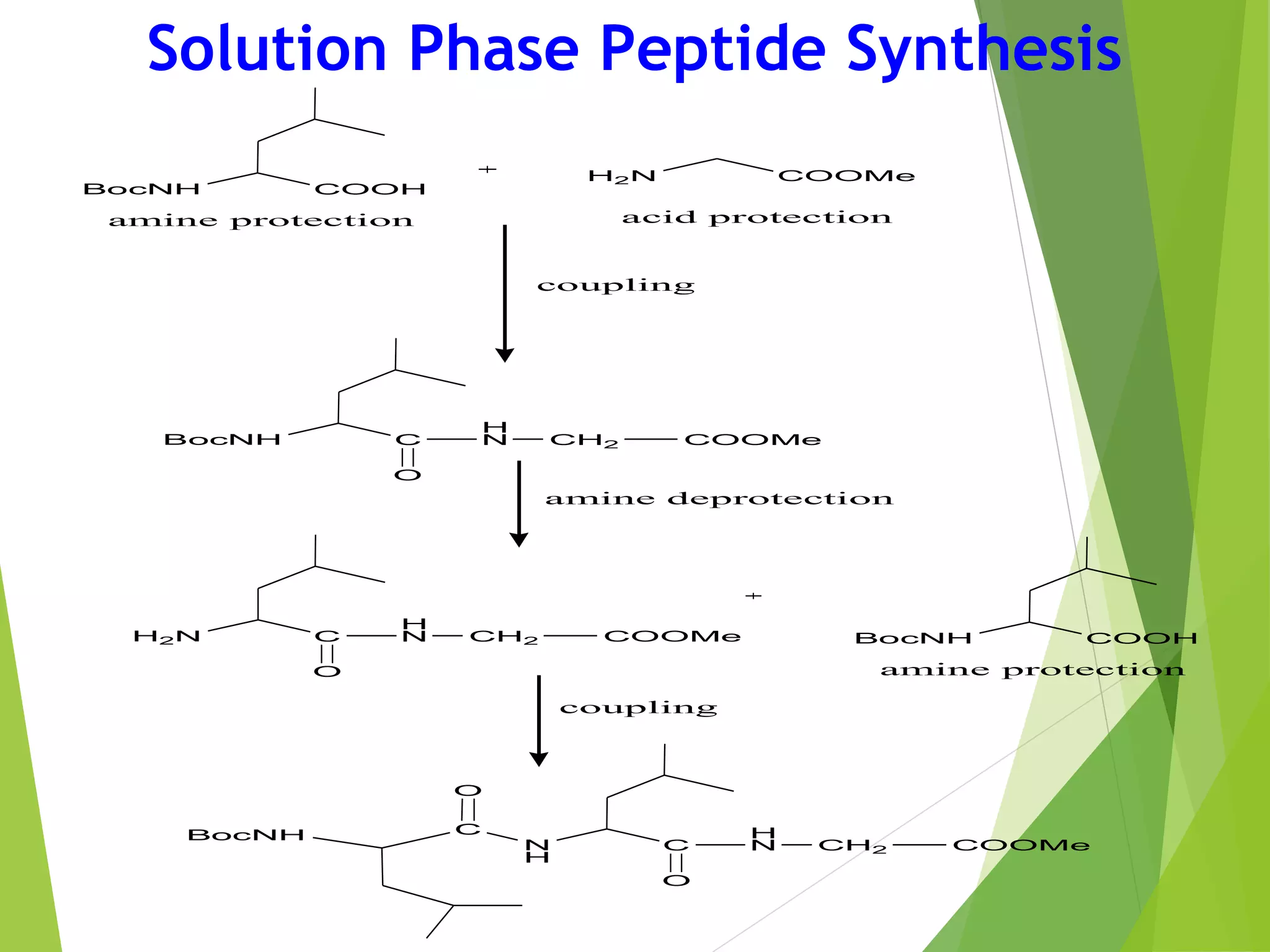
Solution Phase Peptide Synthesis
H2N COOMe
BocNH COOH
BocNH C
O
H
N CH2 COOMe
H2N C
H
N CH2 COOMe
O
acid protectionamine protection
coupling
amine deprotection
BocNH COOH
amine protection
coupling
N
H
C
H
N CH2 COOMe
O
C
O
BocNH
The Merrifield Method
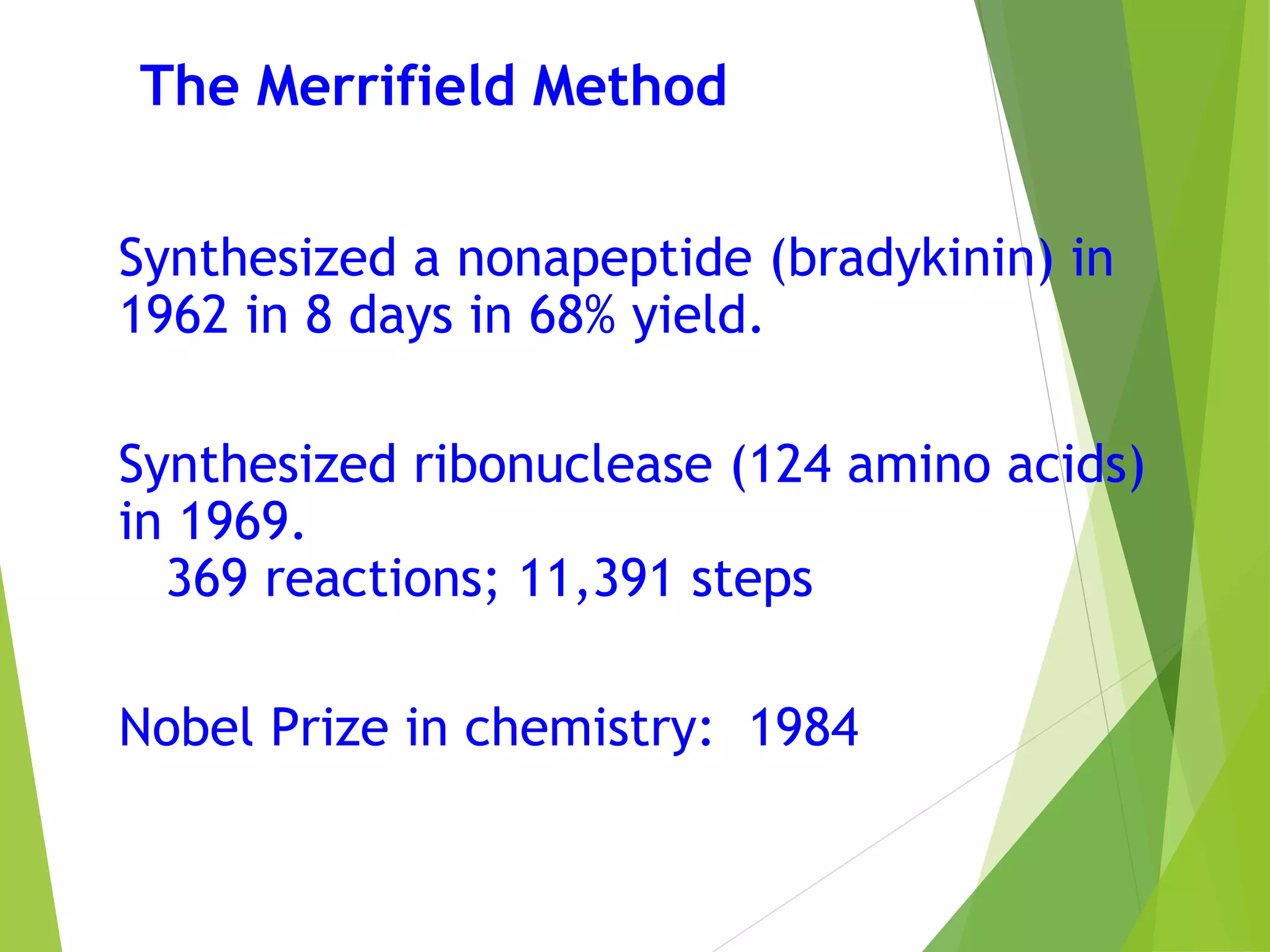
Synthesized a nonapeptide (bradykinin) in
1962 in 8 days in 68% yield.
Synthesized ribonuclease (124 amino acids)
in 1969.
369 reactions; 11,391 steps
Nobel Prize in chemistry: 1984
• Laboratory
• Industrial
Peptide
synthetiser
Solid Phase
Peptide Synthesizers
2.Solid-Phase Peptide Synthesis
Nobel prize in 1984
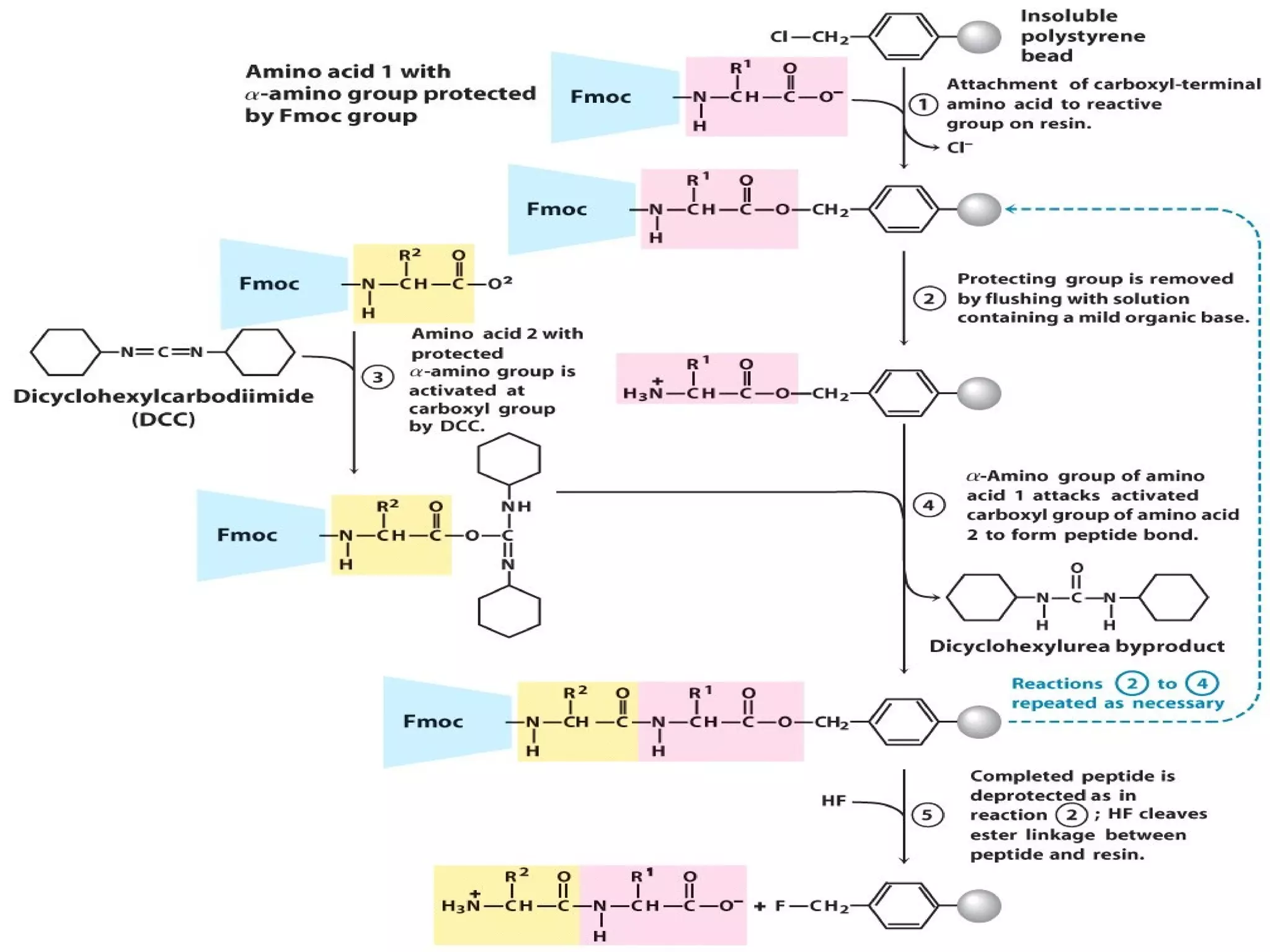
In solid-phase synthesis, the starting
material is bonded to an inert solid support
Reaction occurs at the interface between
the solid and the solution. Because the
starting material is bonded to the solid, any
product from the starting material remains
bonded as well.
Purification involves simply washing the
byproducts from the solid support.
• First step is to attach the starting
molecule to an inert solid.
– Typically inert polymers or resins are
used.
– These are commercially availableSince the molecule is attached to a solid,
any other chemicals added or products can
be removed by filtration.
After all reactions are done the product is
still attached to the insoluble bead.
Finally, the product is cleaved from the
bead and isolated.
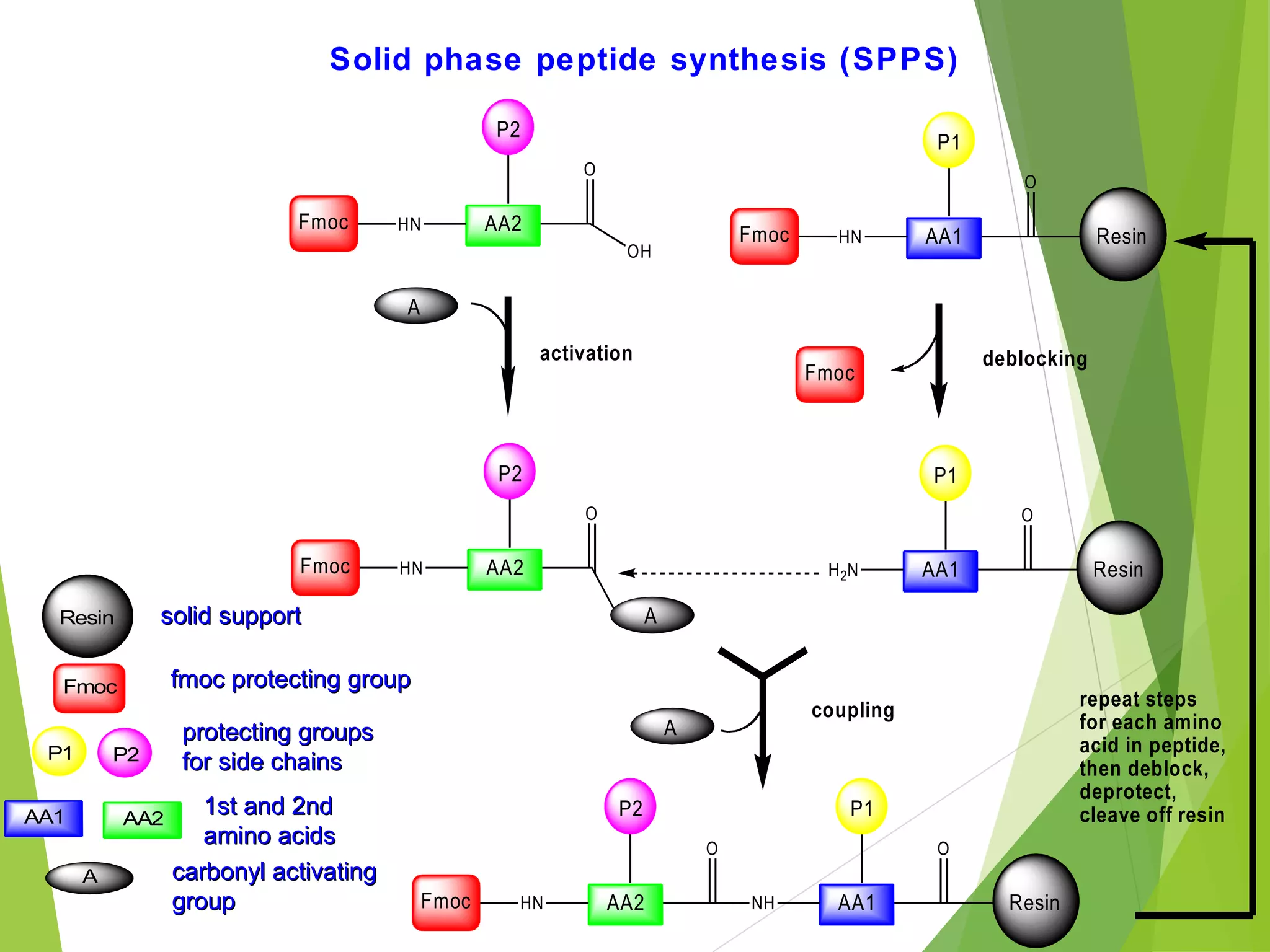
Solid phase peptide synthesis (SPPS)
Resin
O
AA1HNFmoc
Fmoc
P1
Resin
O
AA1H2N
P1
O
AA2HNFmoc
P2
OH
O
AA2HNFmoc
P2
A
A
Resin
O
AA1NH
P1
O
AA2HNFmoc
P2
A
activation deblocking
coupling repeat steps
for each amino
acid in peptide,
then deblock,
deprotect,
cleave off resin
Resin
Fmoc
P2P1
AA2AA1
A
solid supportsolid support
fmoc protecting groupfmoc protecting group
protecting groupsprotecting groups
for side chainsfor side chains
1st and 2nd1st and 2nd
amino acidsamino acids
carbonyl activatingcarbonyl activating
groupgroup
Resin
O
AA1NH
P1
O
AA2HNFmoc
P2
Fmoc
final
deblocking
Resin
O
AA1NH
P1
O
AA2H2N
P2
deprotection and
cleavageP1P2Resin
O
AA1NH
O
AA2H2N
OH
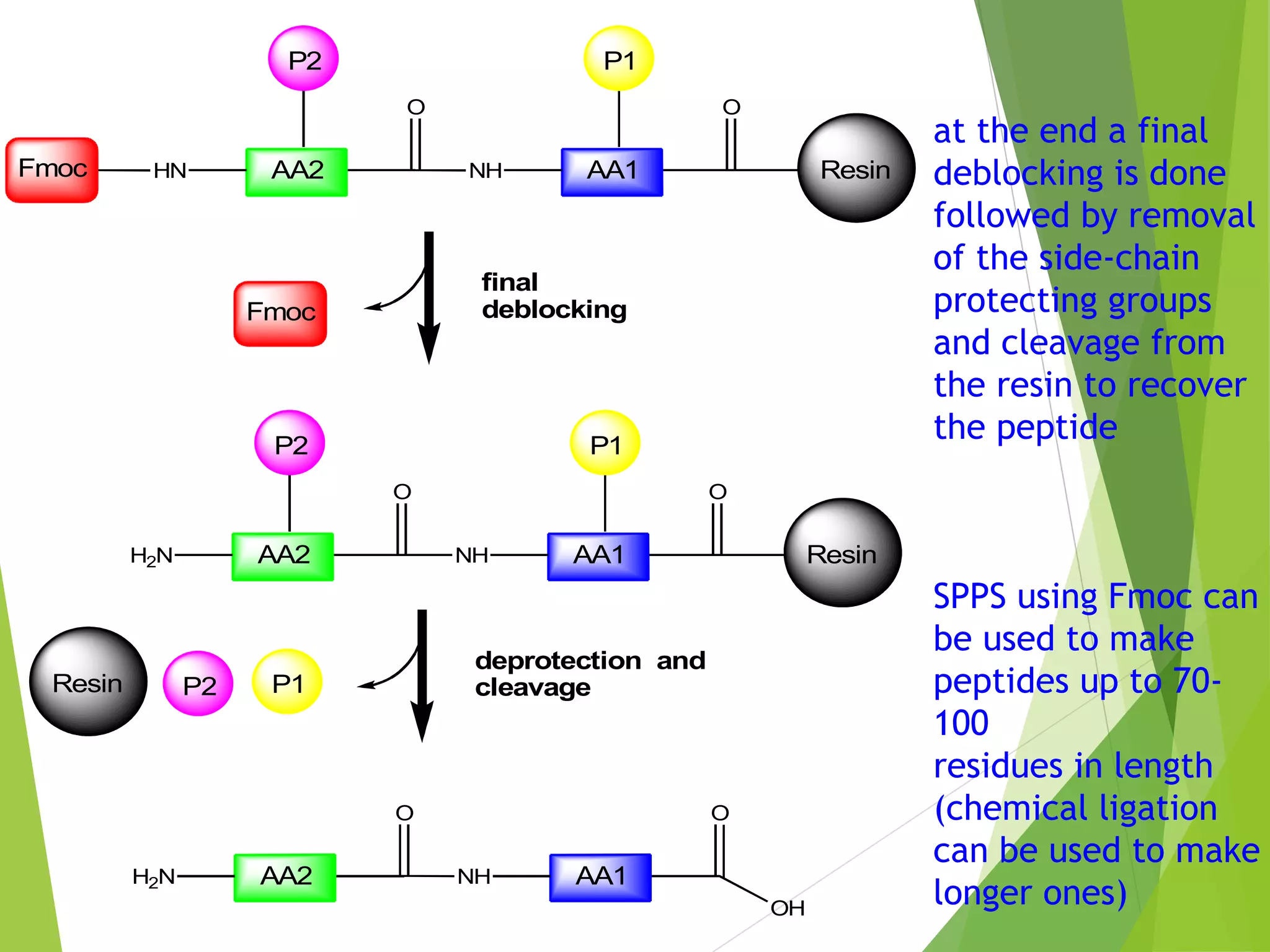
at the end a final
deblocking is done
followed by removal
of the side-chain
protecting groups
and cleavage from
the resin to recover
the peptide
SPPS using Fmoc can
be used to make
peptides up to 70-
100
residues in length
(chemical ligation
can be used to make
longer ones)
Applications of
synthetic peptides
Immune peptides:
synthetic antigens;
vaccines
diagnostic tools
immunostimulator peptides;
muramyl dipeptide
tuftsin derivatives
Hormones:
oxytocin
vasopressin
insulin
somatostatin
GnRH
etc.
Neuropeptides:
substance P
cholecystokinin
neurotensin
Antibiotics:
tachikinin
gramicidine S
Toxins:
conotoxins
spider toxins
snake toxins
ionchanel blockers
Enzymes and
enzyme inhibitors:
Ribonuclease A
Carriers:
templates
miniproteins
Peptides
for structural studies:
turn mimicking cyclic peptides
Transporter peptides:
penetratin
oligoarginine
HIV-Tat protein
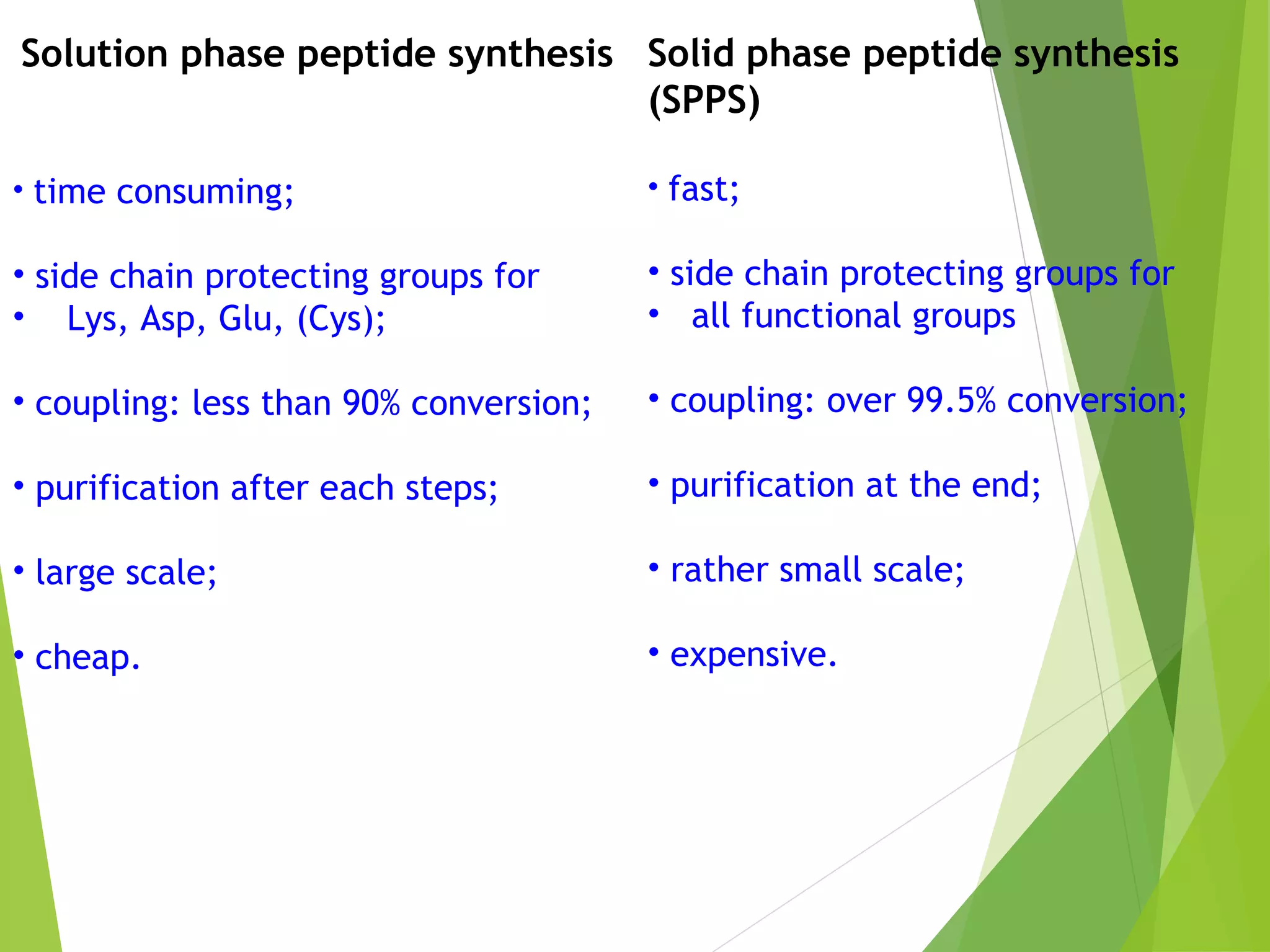
• time consuming;
• side chain protecting groups for
• Lys, Asp, Glu, (Cys);
• coupling: less than 90% conversion;
• purification after each steps;
• large scale;
• cheap.
• fast;
• side chain protecting groups for
• all functional groups
• coupling: over 99.5% conversion;
• purification at the end;
• rather small scale;
• expensive.
Solution phase peptide synthesis Solid phase peptide synthesis
(SPPS)
MAPS (Multiple Antigenic Peptide System)
MAPS is a method for producing high-titer
anti-peptide antibodies and synthetic peptide
vaccines. This system utilizes the α- and ε-
amino functional groups of lysine to form a
backbone to which multiple peptide chains
are attached. Depending on the number of
lysine tiers (2, 4, 8, etc.), different numbers of
peptide branches can be synthesized. Using
this new technology, our customers have
successfully produced high-titer antibodies.
Thank youThank you

Solid phase peptide synthesis

  • 1.
    MAP - SPPS BY- AbhishekSirsikar Sameer Hadawale
  • 2.
    • More than40 marketed peptides worldwide • 270 peptides in clinical trials • 400 peptides in advanced preclinical phases Peptides as Drugs Today The polymers of amino acids that are linked by peptide bonds. The protein is a polypeptide. Formation of a peptide bond by condensation
  • 3.
    Before starting…. • Choosethe C-terminal protecting group • Choose the N-terminal protecting group • Choose the coupling reagent Mainly peptide synthesis are two types 1. Solution phase peptide synthesis 2. Solid phase peptide synthesis
  • 4.
    H2N O OH R 1.C-terminal protecting group: H2N O O H2N O O H2N O O C2H5 Alaninemethyl ester Alanine allyl esterAlanine ethyl ester • The most common acid protecting group used is the methyl ester. •It is stable in most coupling reaction and deprotection reaction conditions.
  • 5.
    H2N O OH R2.N-terminal protecting group Thereare two standard types of N-protecting groups used, 1. Boc Group 2. Fmoc group O O CH3 CH3 CH3 O O
  • 6.
    3.Coupling Reagents N-(3-Dimethylaminopropyl)-N’-ethylcarbonate (EDC) N CN N C N NN C N N N,N’-Dicyclohexylcarbodimide (DCC) N N N O Me2N NMe2 PF6 (BF4 ) N N N N O Me2N NMe2 HBTU (TBTU) HATU PF6N N N OH N N N N OH HOBt HOAt
  • 7.
    Solution Phase PeptideSynthesis H2N COOMe BocNH COOH BocNH C O H N CH2 COOMe H2N C H N CH2 COOMe O acid protectionamine protection coupling amine deprotection BocNH COOH amine protection coupling N H C H N CH2 COOMe O C O BocNH
  • 8.
    The Merrifield Method Synthesizeda nonapeptide (bradykinin) in 1962 in 8 days in 68% yield. Synthesized ribonuclease (124 amino acids) in 1969. 369 reactions; 11,391 steps Nobel Prize in chemistry: 1984
  • 9.
    • Laboratory • Industrial Peptide synthetiser SolidPhase Peptide Synthesizers 2.Solid-Phase Peptide Synthesis Nobel prize in 1984
  • 10.
    In solid-phase synthesis,the starting material is bonded to an inert solid support Reaction occurs at the interface between the solid and the solution. Because the starting material is bonded to the solid, any product from the starting material remains bonded as well. Purification involves simply washing the byproducts from the solid support.
  • 11.
    • First stepis to attach the starting molecule to an inert solid. – Typically inert polymers or resins are used. – These are commercially availableSince the molecule is attached to a solid, any other chemicals added or products can be removed by filtration. After all reactions are done the product is still attached to the insoluble bead. Finally, the product is cleaved from the bead and isolated.
  • 12.
    Solid phase peptidesynthesis (SPPS) Resin O AA1HNFmoc Fmoc P1 Resin O AA1H2N P1 O AA2HNFmoc P2 OH O AA2HNFmoc P2 A A Resin O AA1NH P1 O AA2HNFmoc P2 A activation deblocking coupling repeat steps for each amino acid in peptide, then deblock, deprotect, cleave off resin Resin Fmoc P2P1 AA2AA1 A solid supportsolid support fmoc protecting groupfmoc protecting group protecting groupsprotecting groups for side chainsfor side chains 1st and 2nd1st and 2nd amino acidsamino acids carbonyl activatingcarbonyl activating groupgroup
  • 13.
    Resin O AA1NH P1 O AA2HNFmoc P2 Fmoc final deblocking Resin O AA1NH P1 O AA2H2N P2 deprotection and cleavageP1P2Resin O AA1NH O AA2H2N OH at theend a final deblocking is done followed by removal of the side-chain protecting groups and cleavage from the resin to recover the peptide SPPS using Fmoc can be used to make peptides up to 70- 100 residues in length (chemical ligation can be used to make longer ones)
  • 15.
    Applications of synthetic peptides Immunepeptides: synthetic antigens; vaccines diagnostic tools immunostimulator peptides; muramyl dipeptide tuftsin derivatives Hormones: oxytocin vasopressin insulin somatostatin GnRH etc. Neuropeptides: substance P cholecystokinin neurotensin Antibiotics: tachikinin gramicidine S Toxins: conotoxins spider toxins snake toxins ionchanel blockers Enzymes and enzyme inhibitors: Ribonuclease A Carriers: templates miniproteins Peptides for structural studies: turn mimicking cyclic peptides Transporter peptides: penetratin oligoarginine HIV-Tat protein
  • 16.
    • time consuming; •side chain protecting groups for • Lys, Asp, Glu, (Cys); • coupling: less than 90% conversion; • purification after each steps; • large scale; • cheap. • fast; • side chain protecting groups for • all functional groups • coupling: over 99.5% conversion; • purification at the end; • rather small scale; • expensive. Solution phase peptide synthesis Solid phase peptide synthesis (SPPS)
  • 17.
    MAPS (Multiple AntigenicPeptide System) MAPS is a method for producing high-titer anti-peptide antibodies and synthetic peptide vaccines. This system utilizes the α- and ε- amino functional groups of lysine to form a backbone to which multiple peptide chains are attached. Depending on the number of lysine tiers (2, 4, 8, etc.), different numbers of peptide branches can be synthesized. Using this new technology, our customers have successfully produced high-titer antibodies.
  • 18.