Solution on Automotive LED  Signal Lighting
Agenda Purpose An   Brief   study   on   LED’s   for   Automotive   Lighting   from   Maxim Outline Introduction   to   Automotive   Lighting Analog   and   Digital   LED   Driver PWM   dimming   and   simple   driver   circuit Design   Solution   for   3S3P,   Buck-Boost   LED   Driver   using   MAXIM MCU,   CAN   Transceiver,   voltage   regulator,   LED   driver   and   other   peripheral   from   Premier   Farnell Content 21   pages
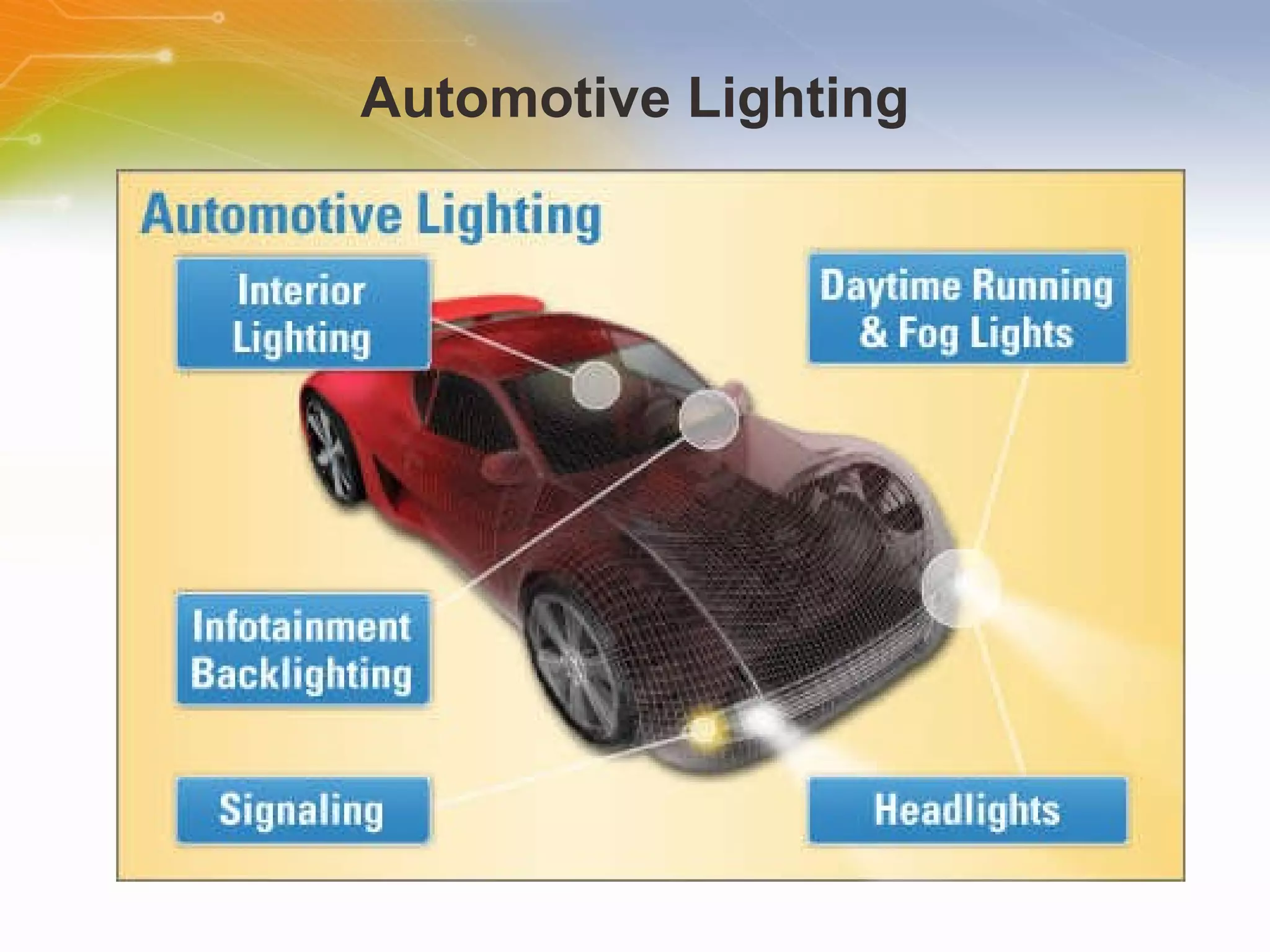
Automotive Lighting
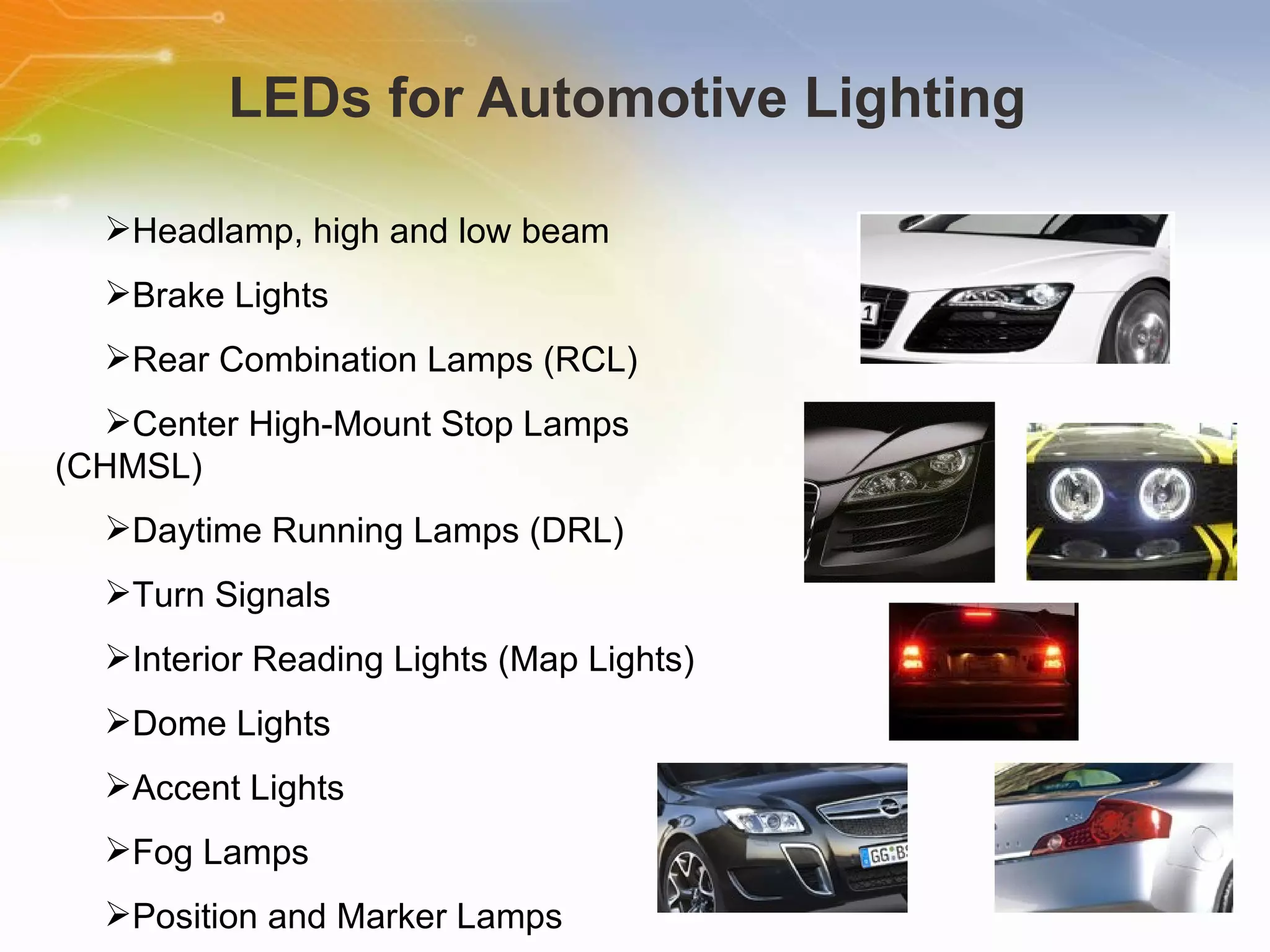
LEDs for Automotive Lighting  Headlamp, high and low beam  Brake Lights  Rear Combination Lamps (RCL)  Center High-Mount Stop Lamps (CHMSL)  Daytime Running Lamps (DRL)  Turn Signals Interior Reading Lights (Map Lights) Dome Lights  Accent Lights  Fog Lamps  Position and Marker Lamps
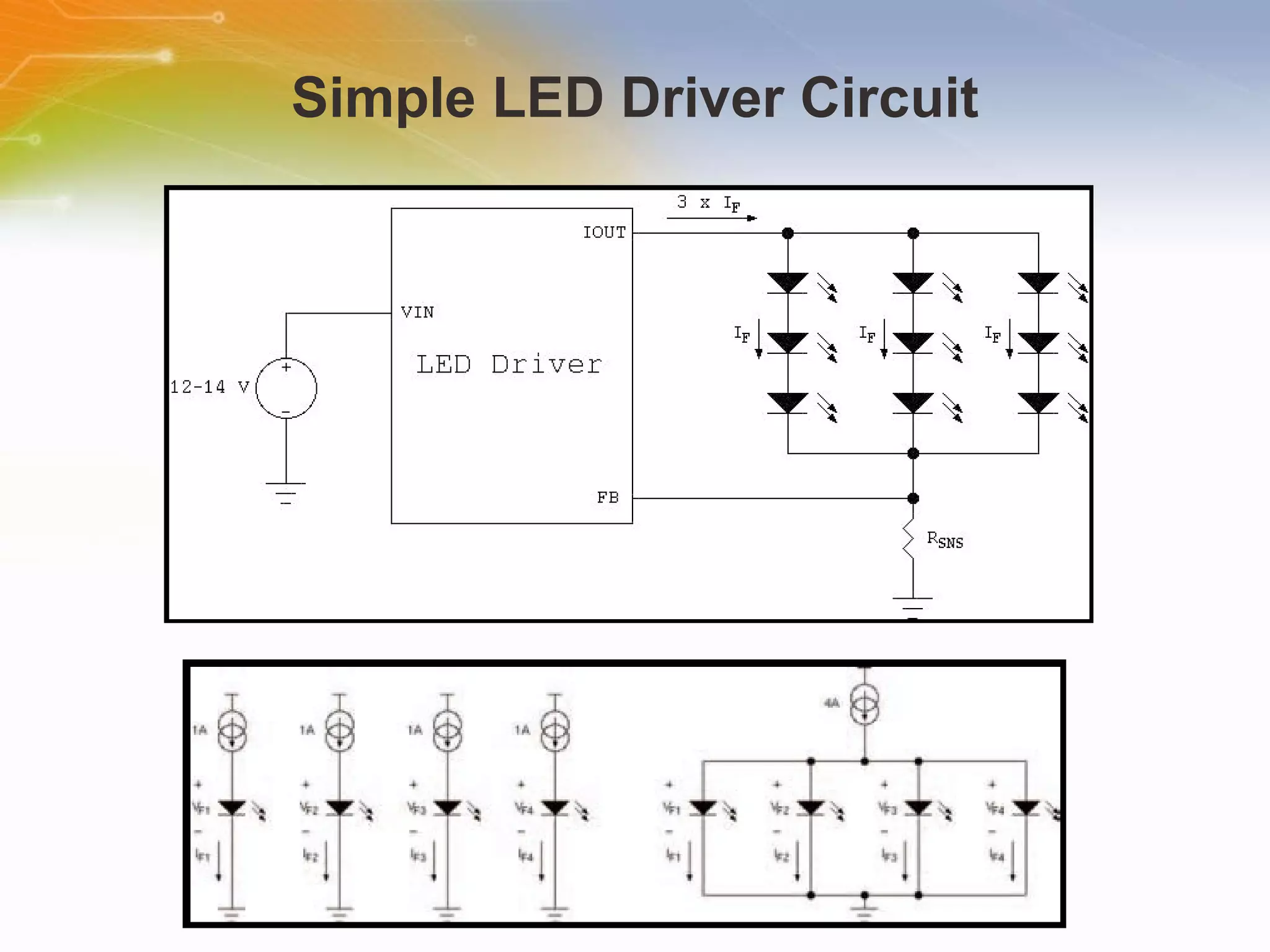
Simple LED Driver Circuit
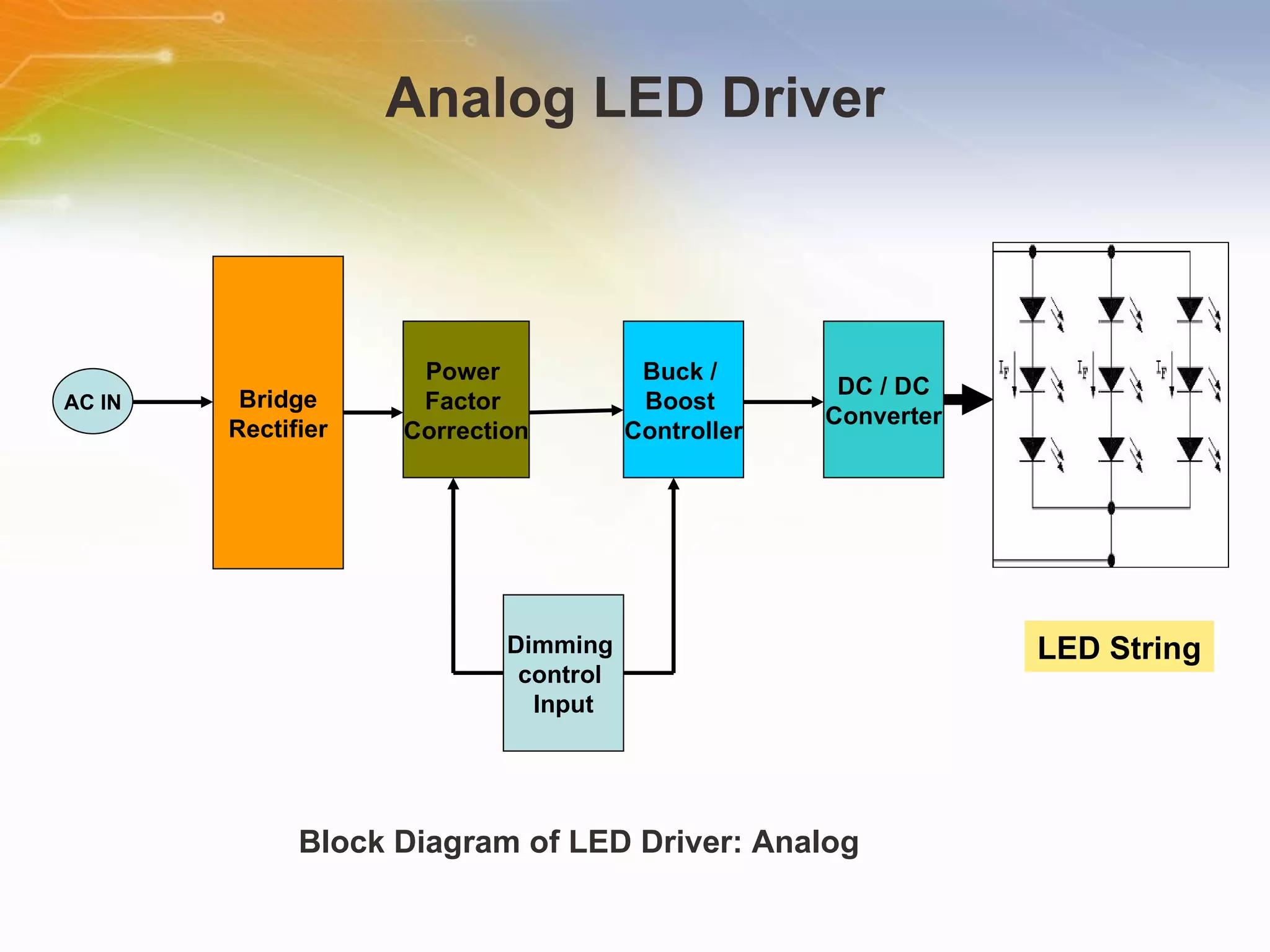
Analog LED Driver Block Diagram of LED Driver: Analog AC IN Bridge Rectifier Power  Factor  Correction Buck /  Boost  Controller DC / DC Converter Dimming  control  Input LED String
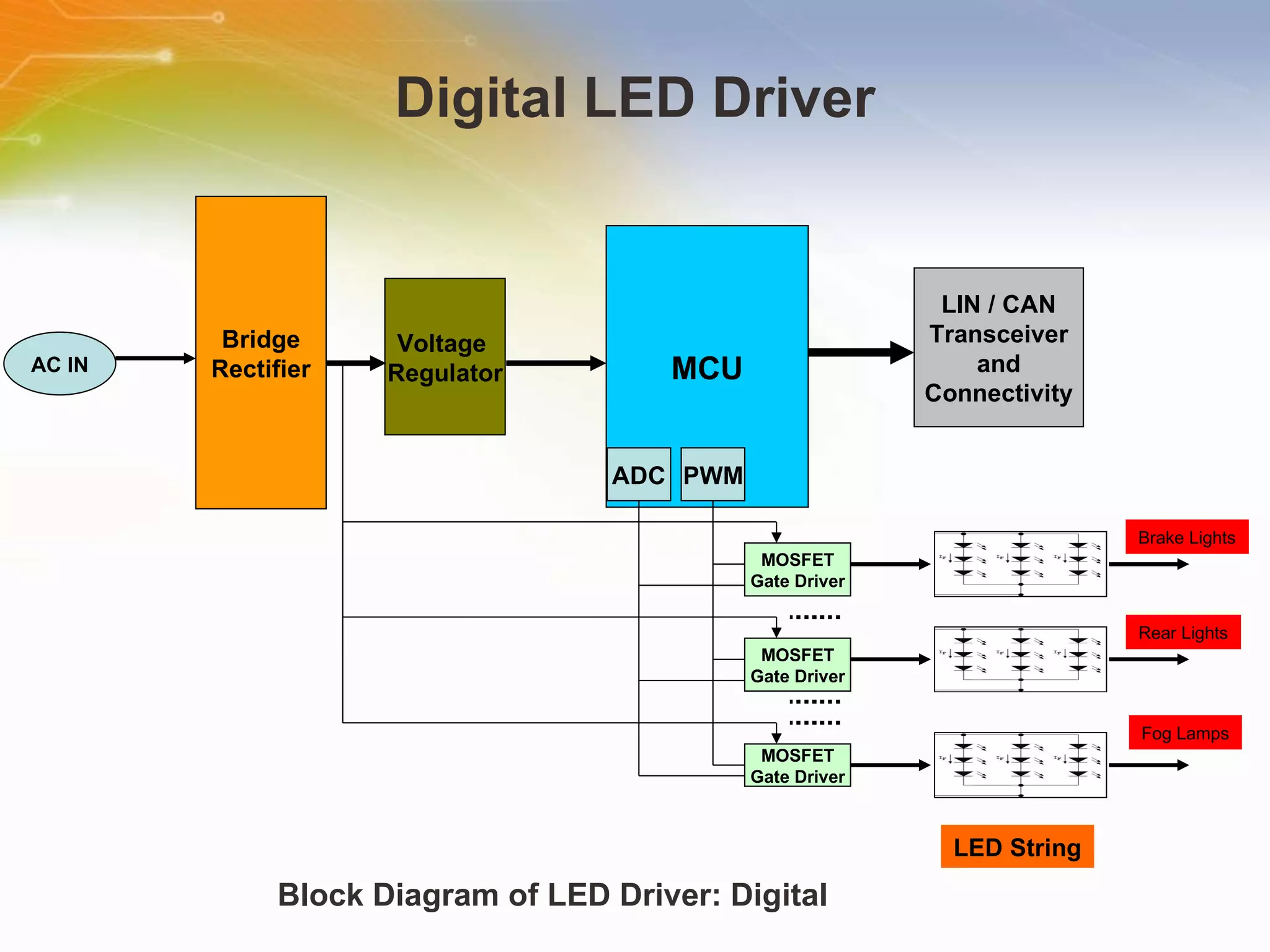
Digital LED Driver Block Diagram of LED Driver: Digital AC IN Bridge Rectifier Voltage  Regulator MCU MOSFET Gate Driver LED String MOSFET Gate Driver MOSFET Gate Driver ADC PWM LIN / CAN Transceiver and Connectivity Brake Lights Rear Lights Fog Lamps
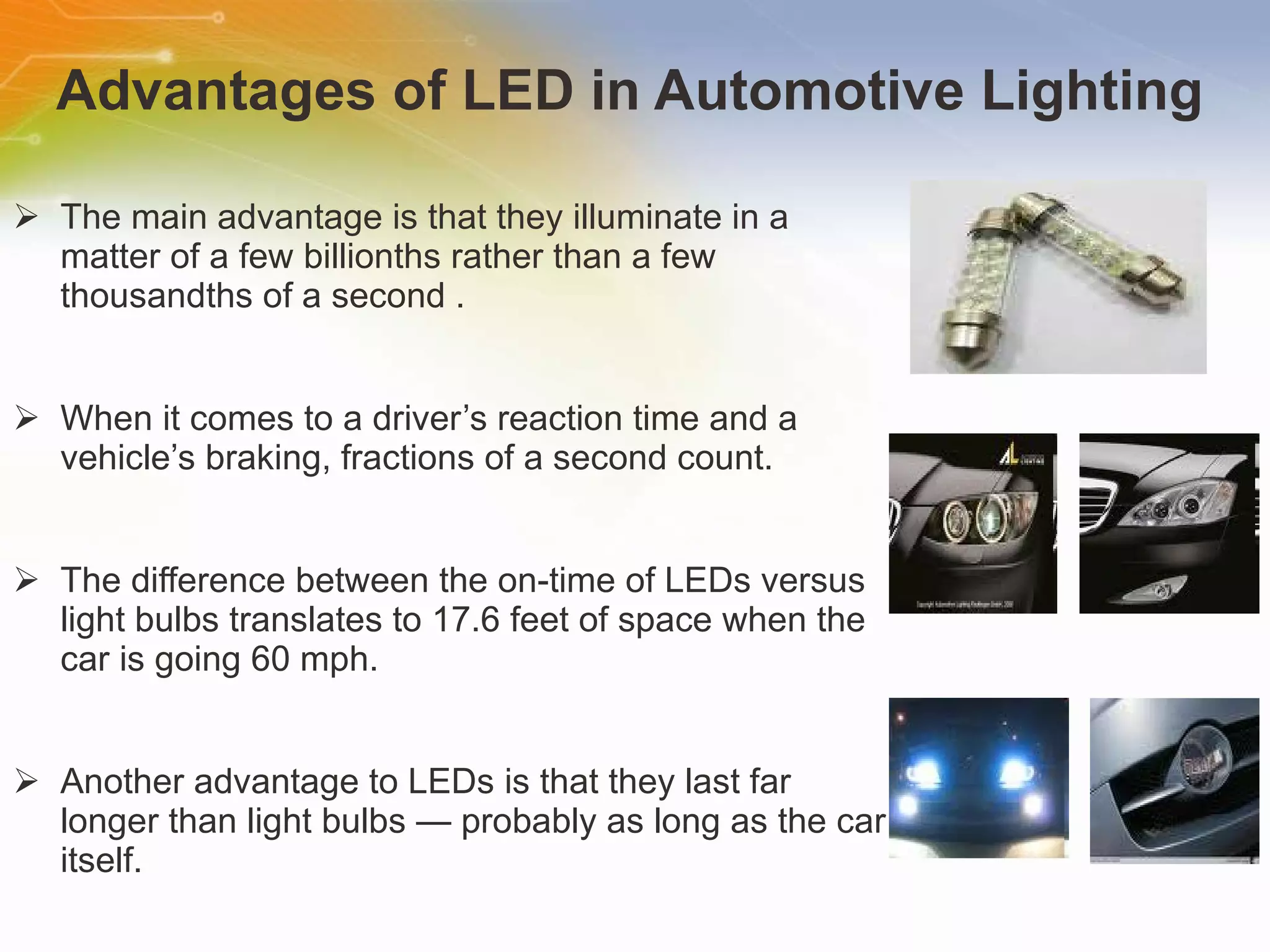
Advantages of LED in Automotive Lighting The main advantage is that they illuminate in a matter of a few billionths rather than a few thousandths of a second . When it comes to a driver’s reaction time and a vehicle’s braking, fractions of a second count. The difference between the on-time of LEDs versus light bulbs translates to 17.6 feet of space when the car is going 60 mph. Another advantage to LEDs is that they last far longer than light bulbs — probably as long as the car itself.
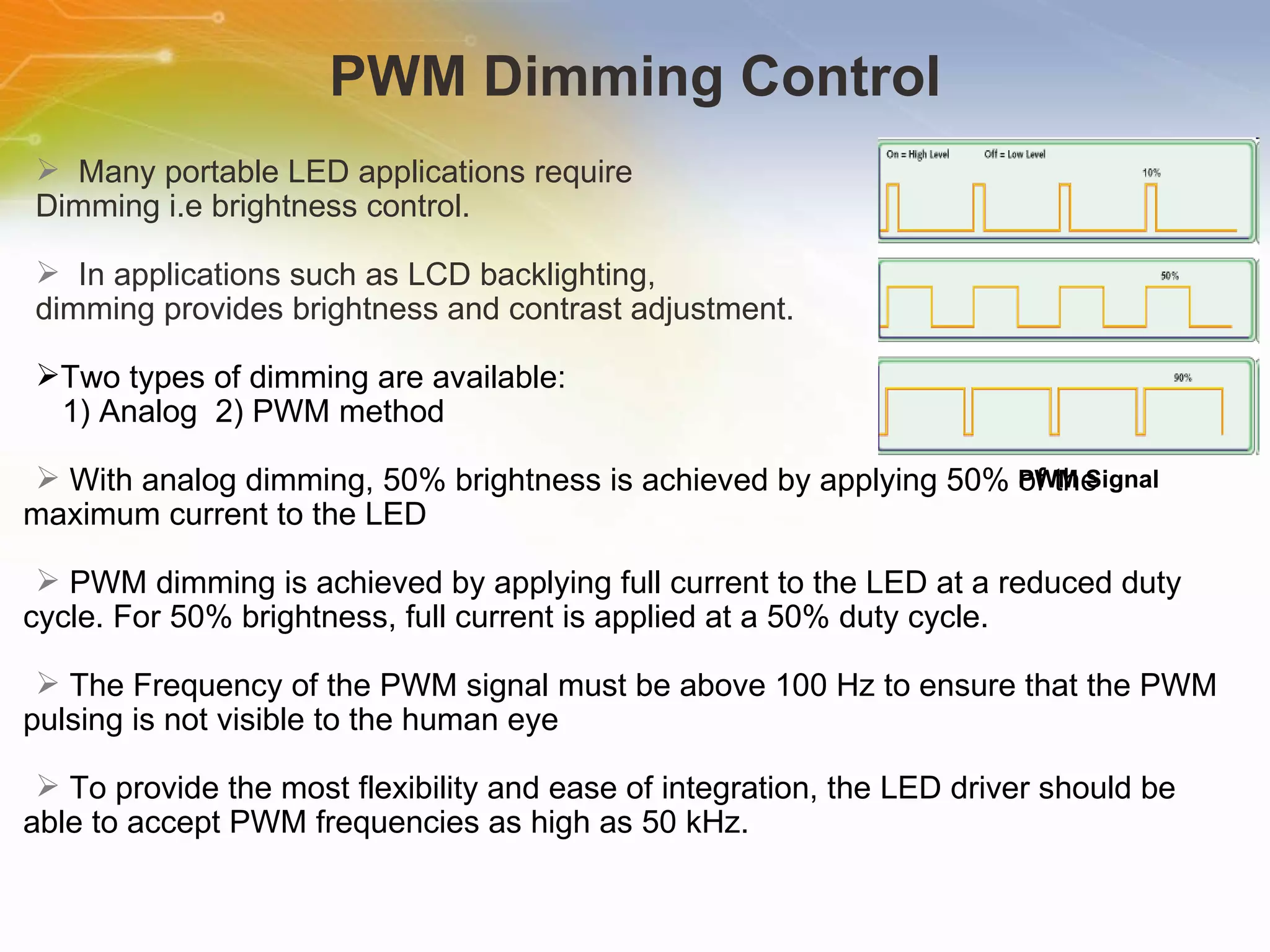
PWM Dimming Control Many   portable   LED   applications   require   Dimming   i.e   brightness   control. In   applications   such   as   LCD   backlighting,   dimming   provides   brightness   and   contrast   adjustment. Two   types   of   dimming   are   available:   1)   Analog   2)   PWM   method With   analog   dimming,   50%   brightness   is   achieved   by   applying   50%   of   the   maximum   current   to   the   LED PWM   dimming   is   achieved   by   applying   full   current   to   the   LED   at   a   reduced   duty   cycle.   For   50%   brightness,   full   current   is   applied   at   a   50%   duty   cycle. The   Frequency   of   the   PWM   signal   must   be   above   100   Hz   to   ensure   that   the   PWM   pulsing   is   not   visible   to   the   human   eye To   provide   the   most   flexibility   and   ease   of   integration,   the   LED   driver   should   be   able   to   accept   PWM   frequencies   as   high   as   50   kHz. PWM Signal
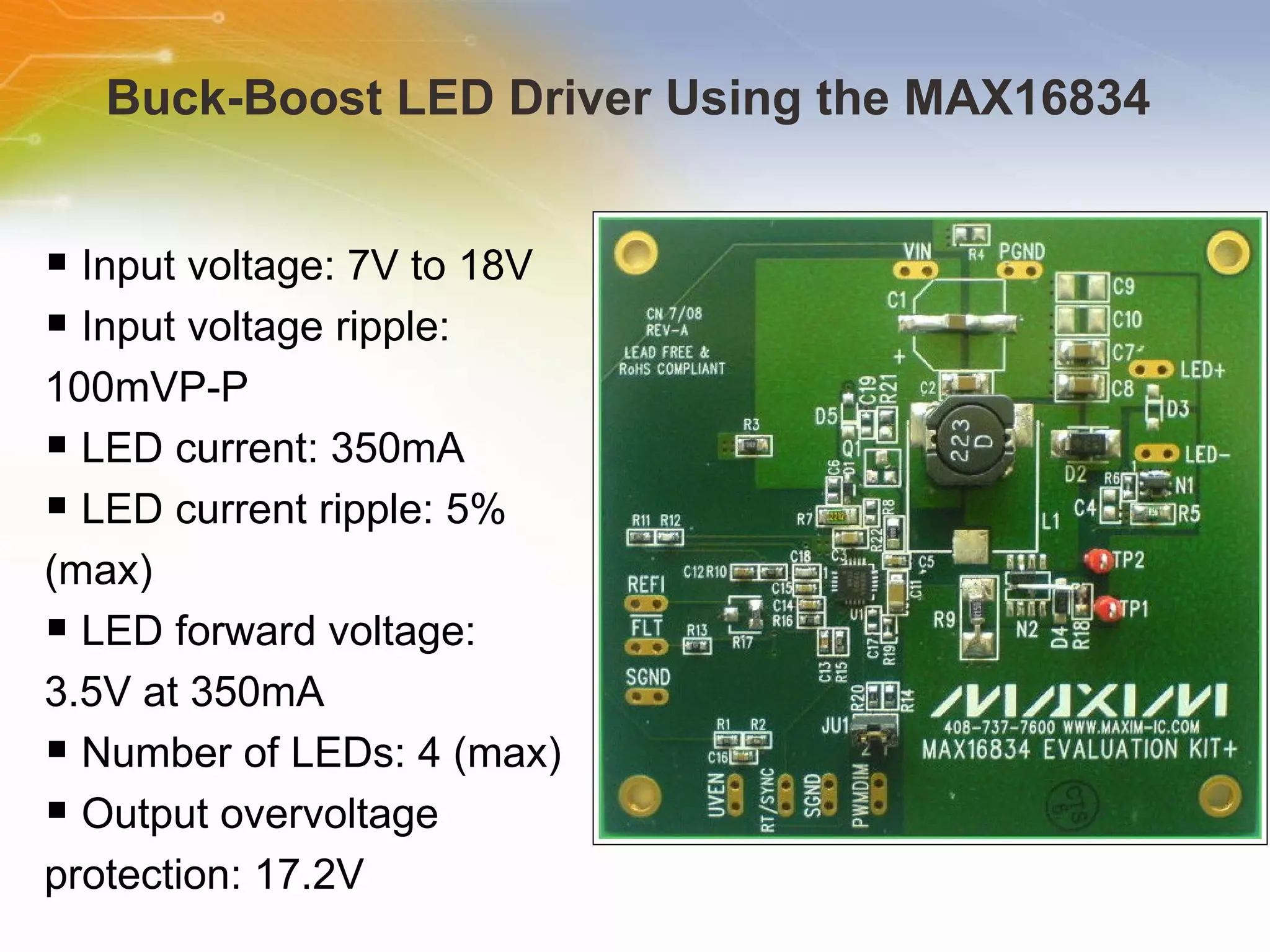
Buck-Boost LED Driver Using the MAX16834  Input voltage: 7V to 18V  Input voltage ripple: 100mVP-P  LED current: 350mA  LED current ripple: 5% (max)  LED forward voltage: 3.5V at 350mA  Number of LEDs: 4 (max)  Output overvoltage protection: 17.2V
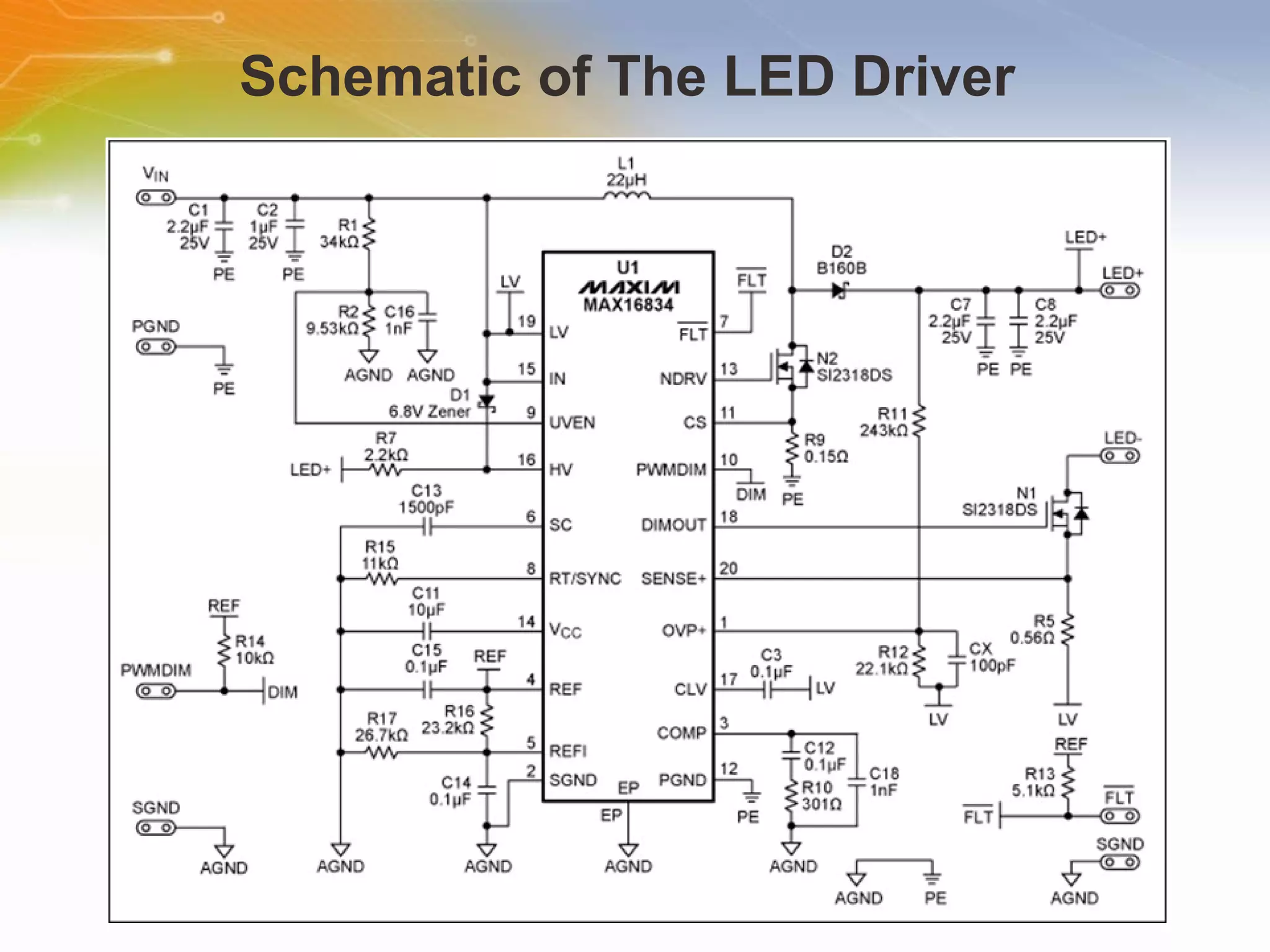
Schematic of The LED Driver
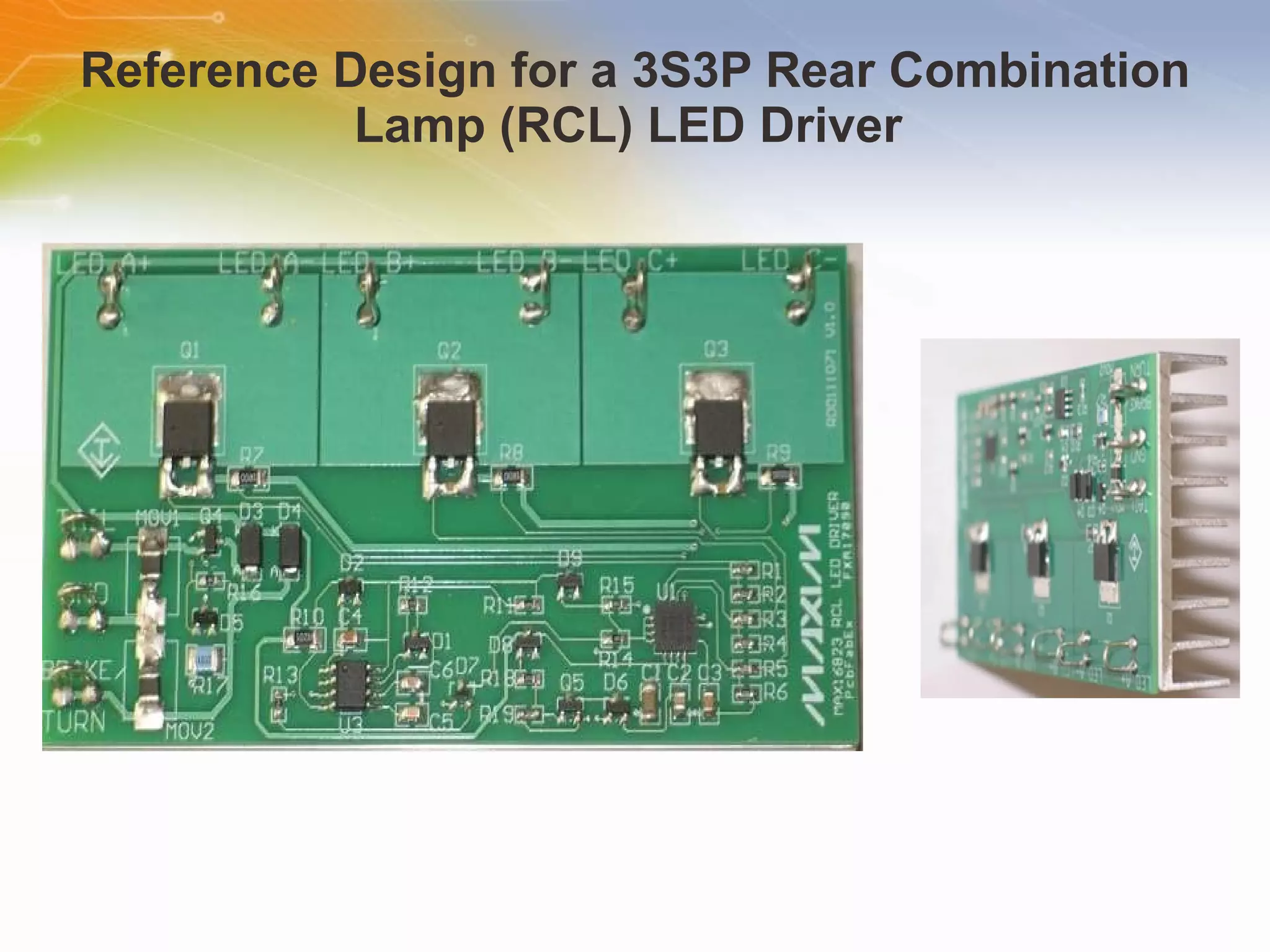
Reference Design for a 3S3P Rear Combination Lamp (RCL) LED Driver
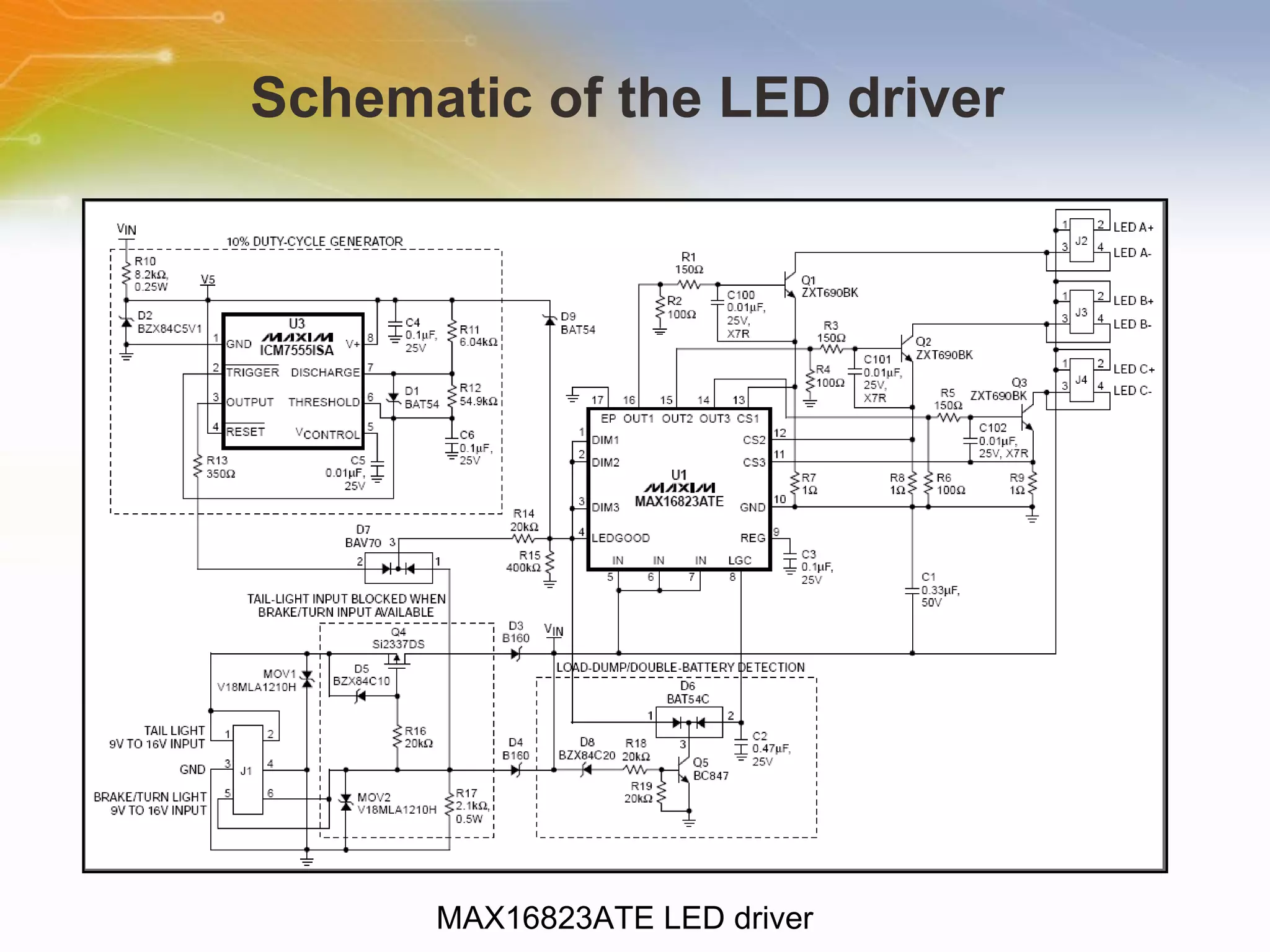
Schematic of the LED driver  MAX16823ATE LED driver
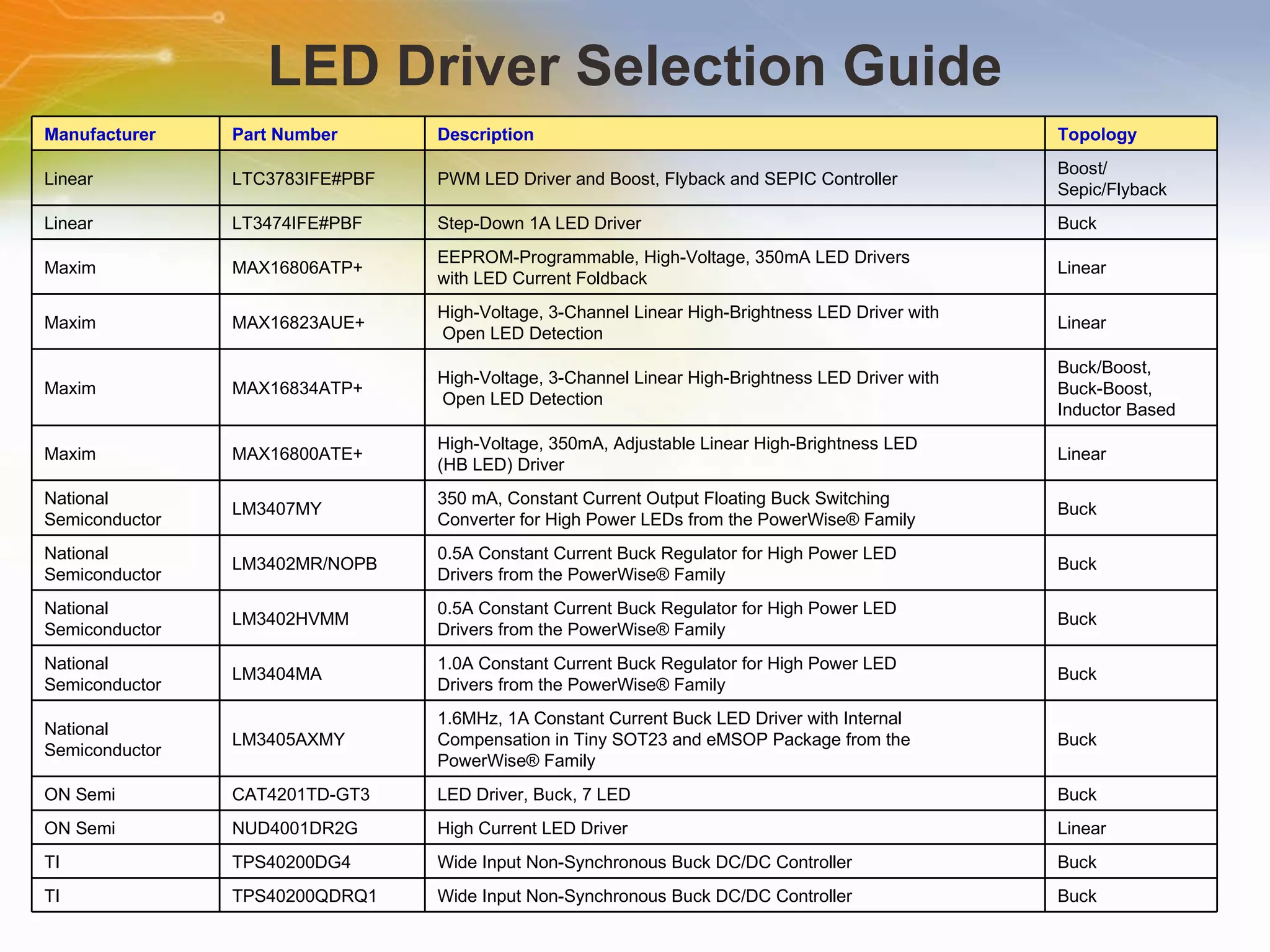
LED Driver Selection Guide Manufacturer Part Number Description Topology Linear LTC3783IFE#PBF  PWM LED Driver and Boost, Flyback and SEPIC Controller Boost/ Sepic/Flyback Linear LT3474IFE#PBF Step-Down 1A LED Driver Buck Maxim MAX16806ATP+  EEPROM-Programmable, High-Voltage, 350mA LED Drivers  with LED Current Foldback Linear Maxim MAX16823AUE+  High-Voltage, 3-Channel Linear High-Brightness LED Driver with Open LED Detection Linear  Maxim MAX16834ATP+  High-Voltage, 3-Channel Linear High-Brightness LED Driver with Open LED Detection  Buck/Boost,  Buck-Boost, Inductor Based Maxim MAX16800ATE+ High-Voltage, 350mA, Adjustable Linear High-Brightness LED  (HB LED) Driver  Linear National Semiconductor LM3407MY 350 mA, Constant Current Output Floating Buck Switching Converter for High Power LEDs from the PowerWise® Family Buck National Semiconductor LM3402MR/NOPB 0.5A Constant Current Buck Regulator for High Power LED  Drivers from the PowerWise® Family Buck National Semiconductor LM3402HVMM 0.5A Constant Current Buck Regulator for High Power LED Drivers from the PowerWise® Family Buck National Semiconductor LM3404MA 1.0A Constant Current Buck Regulator for High Power LED  Drivers from the PowerWise® Family Buck National Semiconductor LM3405AXMY 1.6MHz, 1A Constant Current Buck LED Driver with Internal Compensation in Tiny SOT23 and eMSOP Package from the PowerWise® Family Buck ON Semi CAT4201TD-GT3  LED Driver, Buck, 7 LED Buck ON Semi NUD4001DR2G High Current LED Driver Linear TI TPS40200DG4 Wide Input Non-Synchronous Buck DC/DC Controller Buck  TI TPS40200QDRQ1  Wide Input Non-Synchronous Buck DC/DC Controller Buck
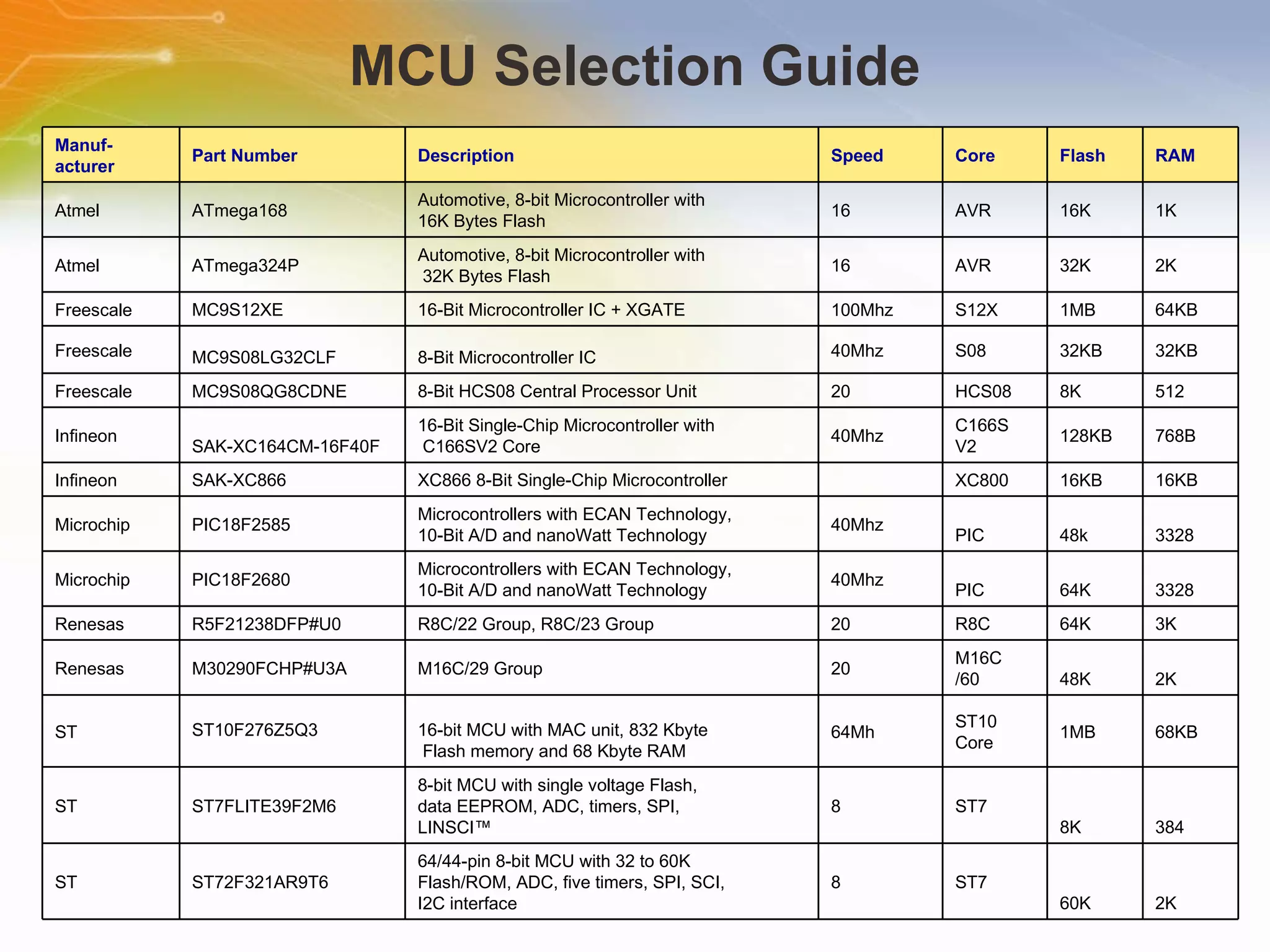
MCU Selection Guide Manuf- acturer Part Number Description Speed Core  Flash RAM  Atmel ATmega168 Automotive, 8-bit Microcontroller with 16K Bytes Flash 16 AVR 16K 1K Atmel ATmega324P Automotive, 8-bit Microcontroller with 32K Bytes Flash 16 AVR 32K 2K Freescale MC9S12XE 16-Bit Microcontroller IC + XGATE 100Mhz S12X 1MB 64KB Freescale MC9S08LG32CLF 8-Bit Microcontroller IC 40Mhz S08 32KB 32KB Freescale MC9S08QG8CDNE 8-Bit HCS08 Central Processor Unit 20 HCS08 8K 512 Infineon SAK-XC164CM-16F40F 16-Bit Single-Chip Microcontroller with C166SV2 Core 40Mhz C166S V2 128KB 768B Infineon SAK-XC866 XC866 8-Bit Single-Chip Microcontroller   XC800 16KB 16KB Microchip PIC18F2585 Microcontrollers with ECAN Technology, 10-Bit A/D and nanoWatt Technology 40Mhz PIC 48k 3328 Microchip PIC18F2680 Microcontrollers with ECAN Technology, 10-Bit A/D and nanoWatt Technology 40Mhz PIC 64K 3328 Renesas R5F21238DFP#U0  R8C/22 Group, R8C/23 Group 20 R8C 64K 3K Renesas M30290FCHP#U3A  M16C/29 Group 20 M16C /60 48K 2K ST ST10F276Z5Q3 16-bit MCU with MAC unit, 832 Kbyte Flash memory and 68 Kbyte RAM 64Mh ST10 Core  1MB 68KB ST ST7FLITE39F2M6 8-bit MCU with single voltage Flash, data EEPROM, ADC, timers, SPI, LINSCI™ 8 ST7 8K 384 ST ST72F321AR9T6 64/44-pin 8-bit MCU with 32 to 60K Flash/ROM, ADC, five timers, SPI, SCI, I2C interface 8 ST7 60K 2K
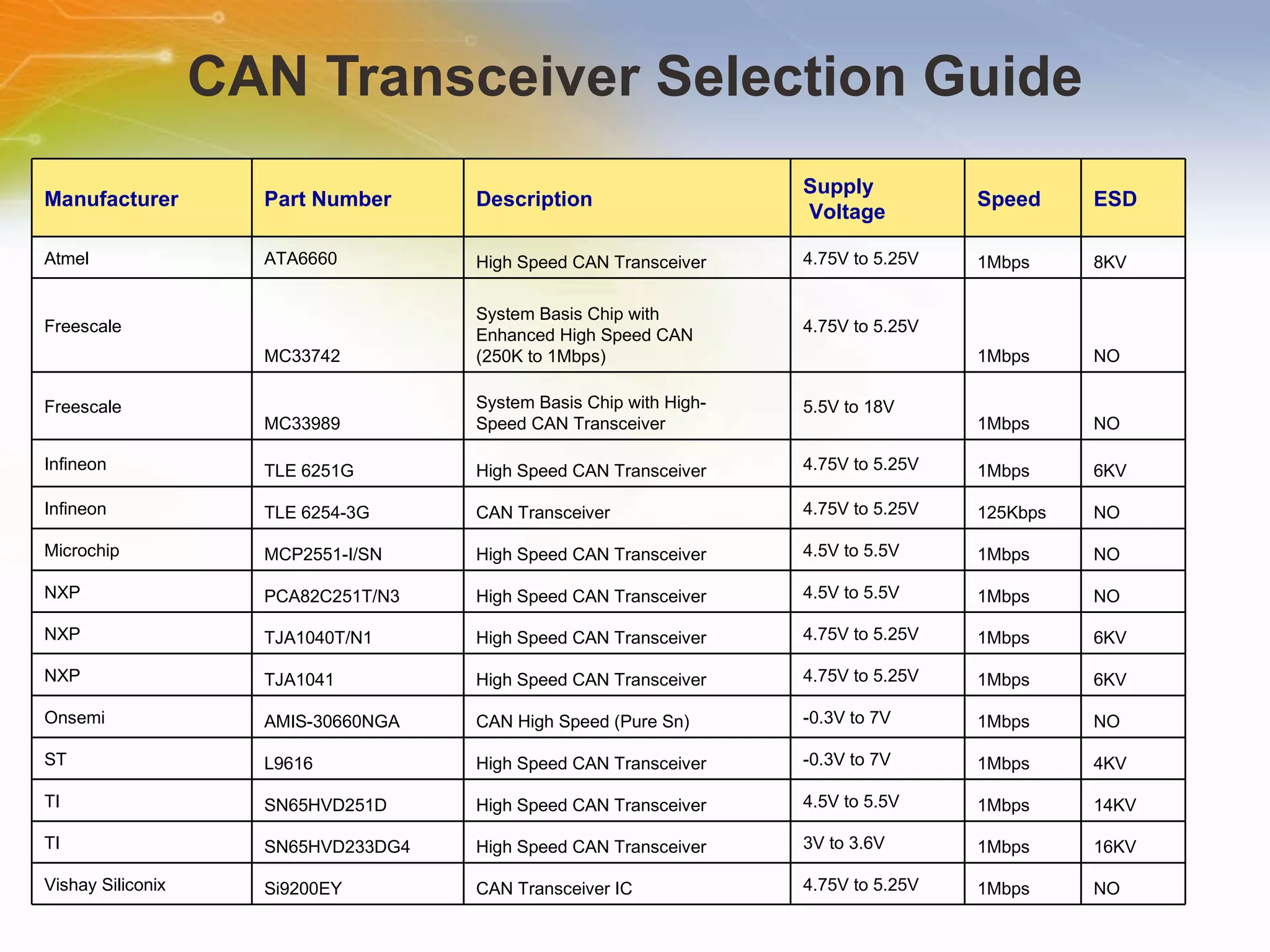
CAN Transceiver Selection Guide Manufacturer Part Number Description Supply Voltage Speed ESD Atmel ATA6660 High Speed CAN Transceiver 4.75V to 5.25V 1Mbps 8KV Freescale MC33742 System Basis Chip with  Enhanced High Speed CAN (250K to 1Mbps) 4.75V to 5.25V 1Mbps NO Freescale MC33989 System Basis Chip with High- Speed CAN Transceiver 5.5V to 18V 1Mbps NO Infineon TLE 6251G  High Speed CAN Transceiver 4.75V to 5.25V 1Mbps 6KV Infineon TLE 6254-3G  CAN Transceiver 4.75V to 5.25V 125Kbps NO Microchip MCP2551-I/SN High Speed CAN Transceiver 4.5V to 5.5V 1Mbps NO NXP PCA82C251T/N3 High Speed CAN Transceiver 4.5V to 5.5V 1Mbps NO NXP TJA1040T/N1 High Speed CAN Transceiver 4.75V to 5.25V 1Mbps 6KV NXP TJA1041 High Speed CAN Transceiver 4.75V to 5.25V 1Mbps 6KV Onsemi AMIS-30660NGA CAN High Speed (Pure Sn) -0.3V to 7V 1Mbps NO ST L9616 High Speed CAN Transceiver -0.3V to 7V 1Mbps 4KV TI SN65HVD251D High Speed CAN Transceiver 4.5V to 5.5V 1Mbps 14KV TI SN65HVD233DG4 High Speed CAN Transceiver 3V to 3.6V 1Mbps 16KV Vishay Siliconix Si9200EY CAN Transceiver IC  4.75V to 5.25V 1Mbps NO
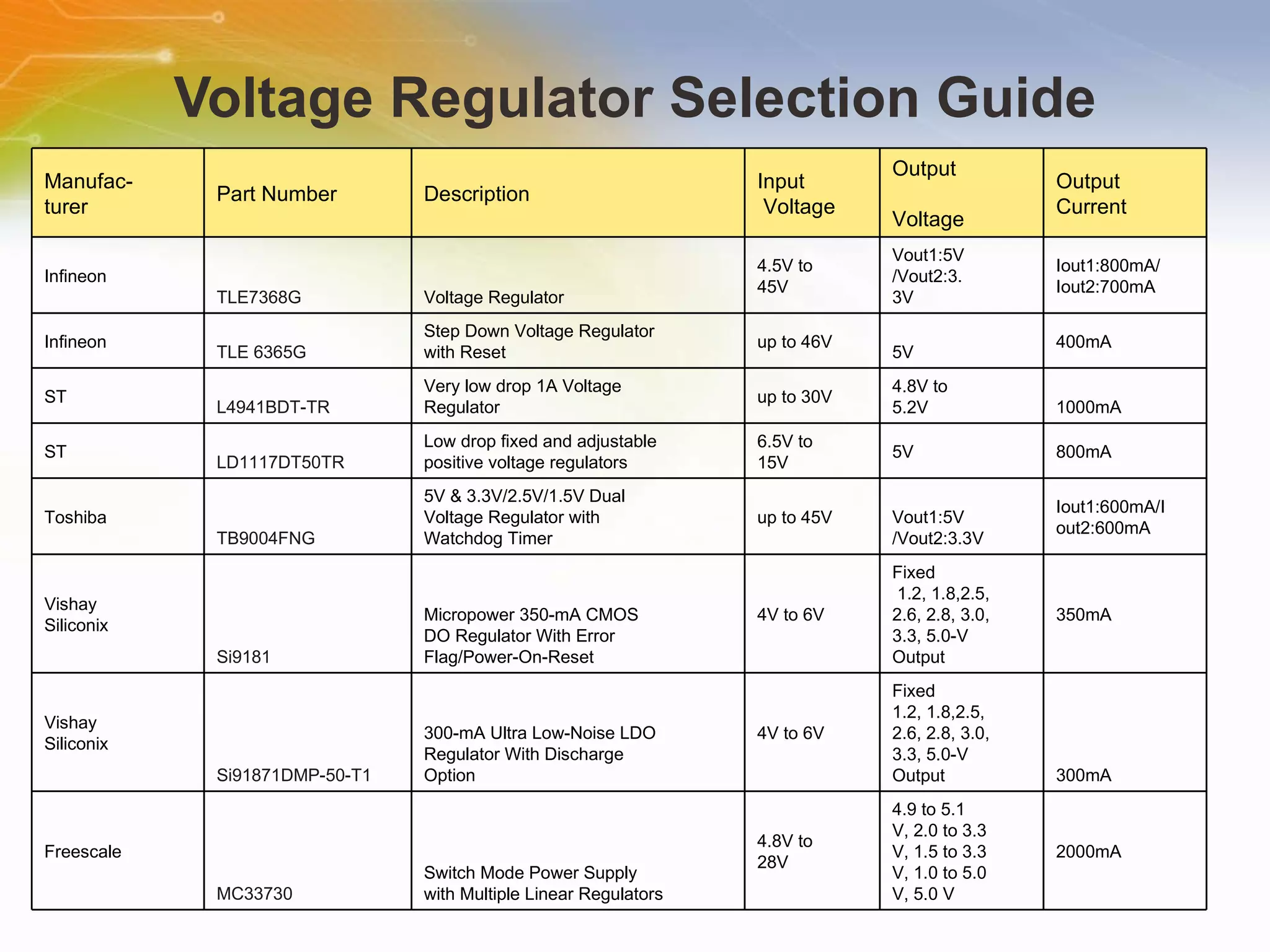
Voltage Regulator Selection Guide Manufac- turer Part Number Description Input Voltage Output Voltage Output  Current Infineon TLE7368G Voltage Regulator 4.5V to  45V Vout1:5V /Vout2:3. 3V Iout1:800mA/ Iout2:700mA Infineon TLE 6365G Step Down Voltage Regulator  with Reset up to 46V 5V 400mA ST L4941BDT-TR Very low drop 1A Voltage  Regulator up to 30V 4.8V to  5.2V 1000mA ST LD1117DT50TR Low drop fixed and adjustable  positive voltage regulators 6.5V to  15V 5V 800mA Toshiba TB9004FNG 5V & 3.3V/2.5V/1.5V Dual  Voltage Regulator with  Watchdog Timer up to 45V Vout1:5V /Vout2:3.3V Iout1:600mA/I out2:600mA Vishay Siliconix Si9181 Micropower 350-mA CMOS  DO Regulator With Error  Flag/Power-On-Reset 4V to 6V Fixed 1.2, 1.8,2.5,  2.6, 2.8, 3.0,  3.3, 5.0-V  Output 350mA Vishay Siliconix Si91871DMP-50-T1 300-mA Ultra Low-Noise LDO  Regulator With Discharge  Option 4V to 6V Fixed  1.2, 1.8,2.5,  2.6, 2.8, 3.0,  3.3, 5.0-V  Output 300mA Freescale MC33730 Switch Mode Power Supply  with Multiple Linear Regulators 4.8V to  28V 4.9 to 5.1  V, 2.0 to 3.3  V, 1.5 to 3.3  V, 1.0 to 5.0  V, 5.0 V 2000mA
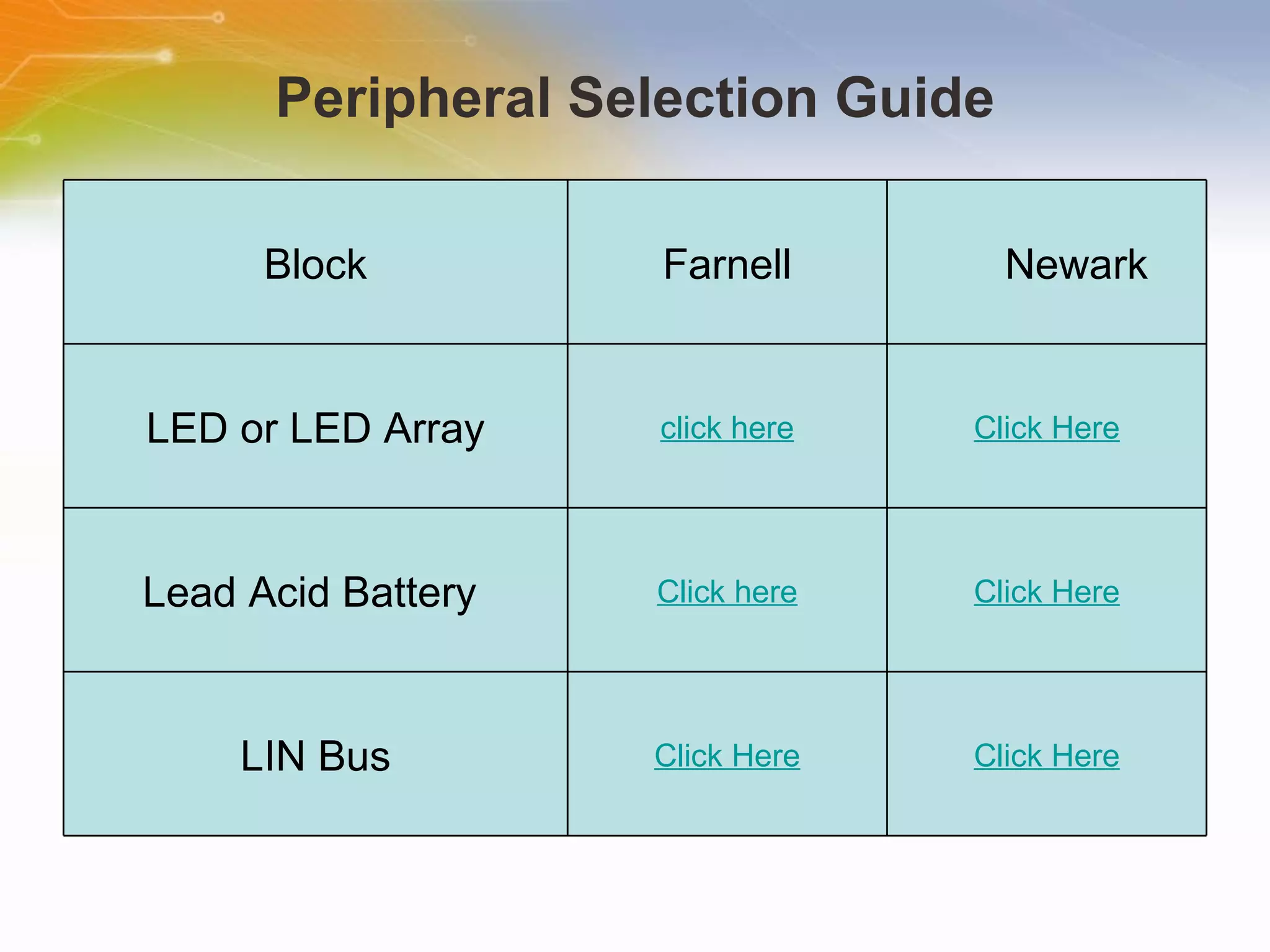
Peripheral Selection Guide Block Farnell Newark LED or LED Array click here Click Here Lead Acid Battery  Click here Click Here LIN Bus Click Here Click Here
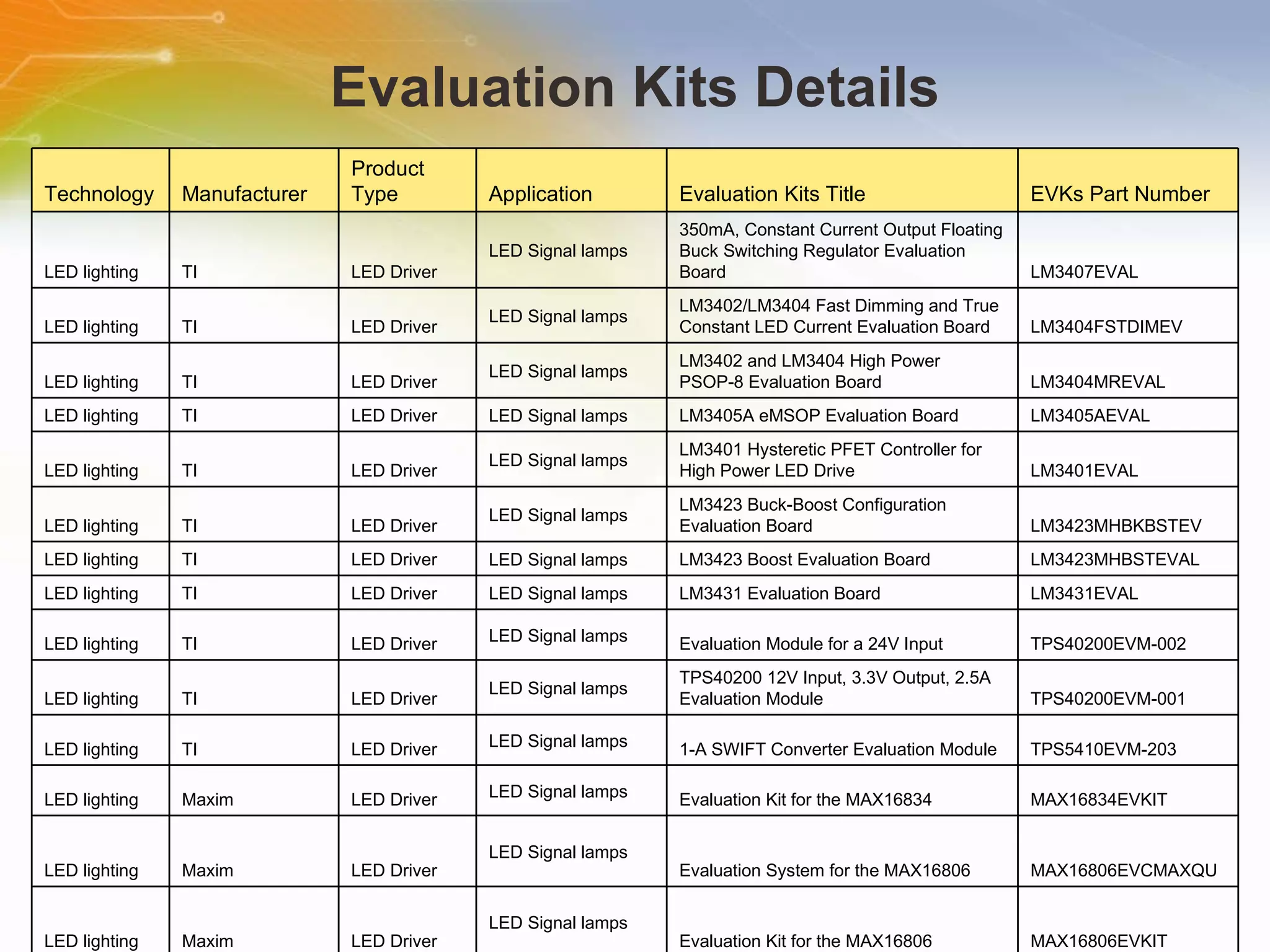
Evaluation Kits Details Technology Manufacturer Product Type Application Evaluation Kits Title EVKs Part Number LED lighting TI LED Driver LED Signal lamps 350mA, Constant Current Output Floating Buck Switching Regulator Evaluation Board LM3407EVAL LED lighting TI LED Driver LED Signal lamps LM3402/LM3404 Fast Dimming and True Constant LED Current Evaluation Board LM3404FSTDIMEV LED lighting TI LED Driver LED Signal lamps LM3402 and LM3404 High Power PSOP-8 Evaluation Board LM3404MREVAL LED lighting TI LED Driver LED Signal lamps LM3405A eMSOP Evaluation Board LM3405AEVAL LED lighting TI LED Driver LED Signal lamps LM3401 Hysteretic PFET Controller for High Power LED Drive LM3401EVAL LED lighting TI LED Driver LED Signal lamps LM3423 Buck-Boost Configuration Evaluation Board LM3423MHBKBSTEV LED lighting TI LED Driver LED Signal lamps LM3423 Boost Evaluation Board LM3423MHBSTEVAL LED lighting TI LED Driver LED Signal lamps LM3431 Evaluation Board LM3431EVAL LED lighting TI LED Driver LED Signal lamps Evaluation Module for a 24V Input TPS40200EVM-002 LED lighting TI LED Driver LED Signal lamps TPS40200 12V Input, 3.3V Output, 2.5A Evaluation Module TPS40200EVM-001 LED lighting TI LED Driver LED Signal lamps 1-A SWIFT Converter Evaluation Module TPS5410EVM-203 LED lighting Maxim LED Driver LED Signal lamps Evaluation Kit for the MAX16834  MAX16834EVKIT LED lighting Maxim LED Driver LED Signal lamps Evaluation System for the MAX16806  MAX16806EVCMAXQU LED lighting Maxim LED Driver LED Signal lamps Evaluation Kit for the MAX16806  MAX16806EVKIT
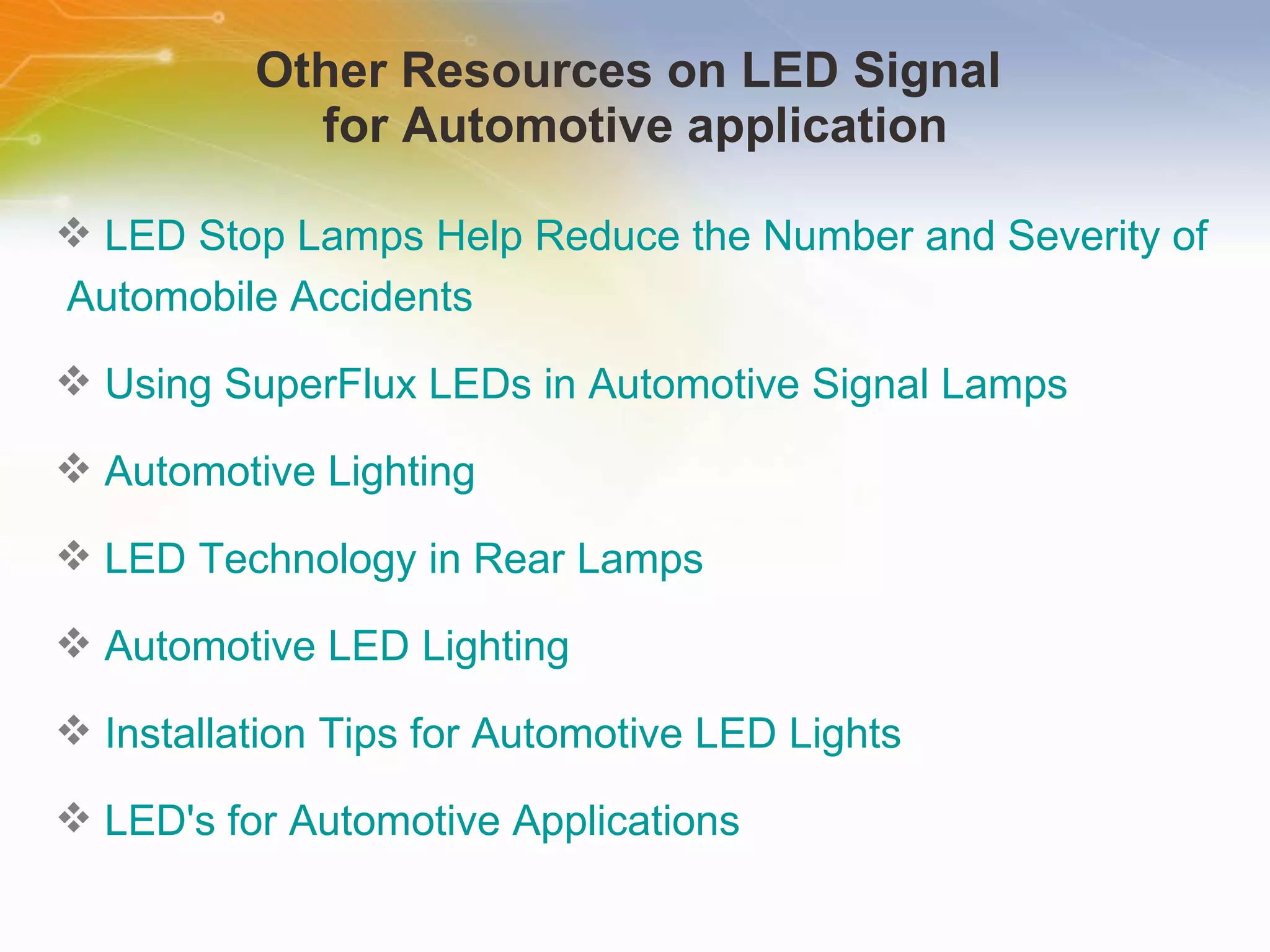
Other   Resources   on   LED   Signal   for   Automotive   application LED   Stop   Lamps   Help   Reduce   the   Number   and   Severity   of   Automobile   Accidents Using   SuperFlux   LEDs   in   Automotive   Signal   Lamps Automotive   Lighting LED   Technology   in   Rear   Lamps Automotive   LED   Lighting Installation   Tips   for   Automotive   LED   Lights LED's   for   Automotive   Applications
Additional Resource For   ordering   Solution   Related   Solution   on   Automotive   LED   Signal   Lighting ,   please   click   the   part   list   or Call   our   sales   hotline For   more   product   information   go   to http://www.element-14.com/community/docs/DOC-18240/ Visit   Element   14   to   post   your   question   www.element-14.com For   additional   inquires   contact   our   technical   service   hotline   or   even   use   our   “Live   Technical   Chat”   online   facility Newark	 Farnell

Solution on Automotive LED Signal Lighting

  • 1.
    Solution on AutomotiveLED Signal Lighting
  • 2.
    Agenda Purpose An Brief study on LED’s for Automotive Lighting from Maxim Outline Introduction to Automotive Lighting Analog and Digital LED Driver PWM dimming and simple driver circuit Design Solution for 3S3P, Buck-Boost LED Driver using MAXIM MCU, CAN Transceiver, voltage regulator, LED driver and other peripheral from Premier Farnell Content 21 pages
  • 3.
  • 4.
    LEDs for AutomotiveLighting Headlamp, high and low beam Brake Lights Rear Combination Lamps (RCL) Center High-Mount Stop Lamps (CHMSL) Daytime Running Lamps (DRL) Turn Signals Interior Reading Lights (Map Lights) Dome Lights Accent Lights Fog Lamps Position and Marker Lamps
  • 5.
  • 6.
    Analog LED DriverBlock Diagram of LED Driver: Analog AC IN Bridge Rectifier Power Factor Correction Buck / Boost Controller DC / DC Converter Dimming control Input LED String
  • 7.
    Digital LED DriverBlock Diagram of LED Driver: Digital AC IN Bridge Rectifier Voltage Regulator MCU MOSFET Gate Driver LED String MOSFET Gate Driver MOSFET Gate Driver ADC PWM LIN / CAN Transceiver and Connectivity Brake Lights Rear Lights Fog Lamps
  • 8.
    Advantages of LEDin Automotive Lighting The main advantage is that they illuminate in a matter of a few billionths rather than a few thousandths of a second . When it comes to a driver’s reaction time and a vehicle’s braking, fractions of a second count. The difference between the on-time of LEDs versus light bulbs translates to 17.6 feet of space when the car is going 60 mph. Another advantage to LEDs is that they last far longer than light bulbs — probably as long as the car itself.
  • 9.
    PWM Dimming ControlMany portable LED applications require Dimming i.e brightness control. In applications such as LCD backlighting, dimming provides brightness and contrast adjustment. Two types of dimming are available: 1) Analog 2) PWM method With analog dimming, 50% brightness is achieved by applying 50% of the maximum current to the LED PWM dimming is achieved by applying full current to the LED at a reduced duty cycle. For 50% brightness, full current is applied at a 50% duty cycle. The Frequency of the PWM signal must be above 100 Hz to ensure that the PWM pulsing is not visible to the human eye To provide the most flexibility and ease of integration, the LED driver should be able to accept PWM frequencies as high as 50 kHz. PWM Signal
  • 10.
    Buck-Boost LED DriverUsing the MAX16834 Input voltage: 7V to 18V Input voltage ripple: 100mVP-P LED current: 350mA LED current ripple: 5% (max) LED forward voltage: 3.5V at 350mA Number of LEDs: 4 (max) Output overvoltage protection: 17.2V
  • 11.
    Schematic of TheLED Driver
  • 12.
    Reference Design fora 3S3P Rear Combination Lamp (RCL) LED Driver
  • 13.
    Schematic of theLED driver MAX16823ATE LED driver
  • 14.
    LED Driver SelectionGuide Manufacturer Part Number Description Topology Linear LTC3783IFE#PBF PWM LED Driver and Boost, Flyback and SEPIC Controller Boost/ Sepic/Flyback Linear LT3474IFE#PBF Step-Down 1A LED Driver Buck Maxim MAX16806ATP+ EEPROM-Programmable, High-Voltage, 350mA LED Drivers with LED Current Foldback Linear Maxim MAX16823AUE+ High-Voltage, 3-Channel Linear High-Brightness LED Driver with Open LED Detection Linear Maxim MAX16834ATP+ High-Voltage, 3-Channel Linear High-Brightness LED Driver with Open LED Detection Buck/Boost, Buck-Boost, Inductor Based Maxim MAX16800ATE+ High-Voltage, 350mA, Adjustable Linear High-Brightness LED (HB LED) Driver Linear National Semiconductor LM3407MY 350 mA, Constant Current Output Floating Buck Switching Converter for High Power LEDs from the PowerWise® Family Buck National Semiconductor LM3402MR/NOPB 0.5A Constant Current Buck Regulator for High Power LED Drivers from the PowerWise® Family Buck National Semiconductor LM3402HVMM 0.5A Constant Current Buck Regulator for High Power LED Drivers from the PowerWise® Family Buck National Semiconductor LM3404MA 1.0A Constant Current Buck Regulator for High Power LED Drivers from the PowerWise® Family Buck National Semiconductor LM3405AXMY 1.6MHz, 1A Constant Current Buck LED Driver with Internal Compensation in Tiny SOT23 and eMSOP Package from the PowerWise® Family Buck ON Semi CAT4201TD-GT3 LED Driver, Buck, 7 LED Buck ON Semi NUD4001DR2G High Current LED Driver Linear TI TPS40200DG4 Wide Input Non-Synchronous Buck DC/DC Controller Buck TI TPS40200QDRQ1 Wide Input Non-Synchronous Buck DC/DC Controller Buck
  • 15.
    MCU Selection GuideManuf- acturer Part Number Description Speed Core Flash RAM Atmel ATmega168 Automotive, 8-bit Microcontroller with 16K Bytes Flash 16 AVR 16K 1K Atmel ATmega324P Automotive, 8-bit Microcontroller with 32K Bytes Flash 16 AVR 32K 2K Freescale MC9S12XE 16-Bit Microcontroller IC + XGATE 100Mhz S12X 1MB 64KB Freescale MC9S08LG32CLF 8-Bit Microcontroller IC 40Mhz S08 32KB 32KB Freescale MC9S08QG8CDNE 8-Bit HCS08 Central Processor Unit 20 HCS08 8K 512 Infineon SAK-XC164CM-16F40F 16-Bit Single-Chip Microcontroller with C166SV2 Core 40Mhz C166S V2 128KB 768B Infineon SAK-XC866 XC866 8-Bit Single-Chip Microcontroller   XC800 16KB 16KB Microchip PIC18F2585 Microcontrollers with ECAN Technology, 10-Bit A/D and nanoWatt Technology 40Mhz PIC 48k 3328 Microchip PIC18F2680 Microcontrollers with ECAN Technology, 10-Bit A/D and nanoWatt Technology 40Mhz PIC 64K 3328 Renesas R5F21238DFP#U0 R8C/22 Group, R8C/23 Group 20 R8C 64K 3K Renesas M30290FCHP#U3A M16C/29 Group 20 M16C /60 48K 2K ST ST10F276Z5Q3 16-bit MCU with MAC unit, 832 Kbyte Flash memory and 68 Kbyte RAM 64Mh ST10 Core 1MB 68KB ST ST7FLITE39F2M6 8-bit MCU with single voltage Flash, data EEPROM, ADC, timers, SPI, LINSCI™ 8 ST7 8K 384 ST ST72F321AR9T6 64/44-pin 8-bit MCU with 32 to 60K Flash/ROM, ADC, five timers, SPI, SCI, I2C interface 8 ST7 60K 2K
  • 16.
    CAN Transceiver SelectionGuide Manufacturer Part Number Description Supply Voltage Speed ESD Atmel ATA6660 High Speed CAN Transceiver 4.75V to 5.25V 1Mbps 8KV Freescale MC33742 System Basis Chip with Enhanced High Speed CAN (250K to 1Mbps) 4.75V to 5.25V 1Mbps NO Freescale MC33989 System Basis Chip with High- Speed CAN Transceiver 5.5V to 18V 1Mbps NO Infineon TLE 6251G High Speed CAN Transceiver 4.75V to 5.25V 1Mbps 6KV Infineon TLE 6254-3G CAN Transceiver 4.75V to 5.25V 125Kbps NO Microchip MCP2551-I/SN High Speed CAN Transceiver 4.5V to 5.5V 1Mbps NO NXP PCA82C251T/N3 High Speed CAN Transceiver 4.5V to 5.5V 1Mbps NO NXP TJA1040T/N1 High Speed CAN Transceiver 4.75V to 5.25V 1Mbps 6KV NXP TJA1041 High Speed CAN Transceiver 4.75V to 5.25V 1Mbps 6KV Onsemi AMIS-30660NGA CAN High Speed (Pure Sn) -0.3V to 7V 1Mbps NO ST L9616 High Speed CAN Transceiver -0.3V to 7V 1Mbps 4KV TI SN65HVD251D High Speed CAN Transceiver 4.5V to 5.5V 1Mbps 14KV TI SN65HVD233DG4 High Speed CAN Transceiver 3V to 3.6V 1Mbps 16KV Vishay Siliconix Si9200EY CAN Transceiver IC 4.75V to 5.25V 1Mbps NO
  • 17.
    Voltage Regulator SelectionGuide Manufac- turer Part Number Description Input Voltage Output Voltage Output Current Infineon TLE7368G Voltage Regulator 4.5V to 45V Vout1:5V /Vout2:3. 3V Iout1:800mA/ Iout2:700mA Infineon TLE 6365G Step Down Voltage Regulator with Reset up to 46V 5V 400mA ST L4941BDT-TR Very low drop 1A Voltage Regulator up to 30V 4.8V to 5.2V 1000mA ST LD1117DT50TR Low drop fixed and adjustable positive voltage regulators 6.5V to 15V 5V 800mA Toshiba TB9004FNG 5V & 3.3V/2.5V/1.5V Dual Voltage Regulator with Watchdog Timer up to 45V Vout1:5V /Vout2:3.3V Iout1:600mA/I out2:600mA Vishay Siliconix Si9181 Micropower 350-mA CMOS DO Regulator With Error Flag/Power-On-Reset 4V to 6V Fixed 1.2, 1.8,2.5, 2.6, 2.8, 3.0, 3.3, 5.0-V Output 350mA Vishay Siliconix Si91871DMP-50-T1 300-mA Ultra Low-Noise LDO Regulator With Discharge Option 4V to 6V Fixed 1.2, 1.8,2.5, 2.6, 2.8, 3.0, 3.3, 5.0-V Output 300mA Freescale MC33730 Switch Mode Power Supply with Multiple Linear Regulators 4.8V to 28V 4.9 to 5.1 V, 2.0 to 3.3 V, 1.5 to 3.3 V, 1.0 to 5.0 V, 5.0 V 2000mA
  • 18.
    Peripheral Selection GuideBlock Farnell Newark LED or LED Array click here Click Here Lead Acid Battery Click here Click Here LIN Bus Click Here Click Here
  • 19.
    Evaluation Kits DetailsTechnology Manufacturer Product Type Application Evaluation Kits Title EVKs Part Number LED lighting TI LED Driver LED Signal lamps 350mA, Constant Current Output Floating Buck Switching Regulator Evaluation Board LM3407EVAL LED lighting TI LED Driver LED Signal lamps LM3402/LM3404 Fast Dimming and True Constant LED Current Evaluation Board LM3404FSTDIMEV LED lighting TI LED Driver LED Signal lamps LM3402 and LM3404 High Power PSOP-8 Evaluation Board LM3404MREVAL LED lighting TI LED Driver LED Signal lamps LM3405A eMSOP Evaluation Board LM3405AEVAL LED lighting TI LED Driver LED Signal lamps LM3401 Hysteretic PFET Controller for High Power LED Drive LM3401EVAL LED lighting TI LED Driver LED Signal lamps LM3423 Buck-Boost Configuration Evaluation Board LM3423MHBKBSTEV LED lighting TI LED Driver LED Signal lamps LM3423 Boost Evaluation Board LM3423MHBSTEVAL LED lighting TI LED Driver LED Signal lamps LM3431 Evaluation Board LM3431EVAL LED lighting TI LED Driver LED Signal lamps Evaluation Module for a 24V Input TPS40200EVM-002 LED lighting TI LED Driver LED Signal lamps TPS40200 12V Input, 3.3V Output, 2.5A Evaluation Module TPS40200EVM-001 LED lighting TI LED Driver LED Signal lamps 1-A SWIFT Converter Evaluation Module TPS5410EVM-203 LED lighting Maxim LED Driver LED Signal lamps Evaluation Kit for the MAX16834 MAX16834EVKIT LED lighting Maxim LED Driver LED Signal lamps Evaluation System for the MAX16806 MAX16806EVCMAXQU LED lighting Maxim LED Driver LED Signal lamps Evaluation Kit for the MAX16806 MAX16806EVKIT
  • 20.
    Other Resources on LED Signal for Automotive application LED Stop Lamps Help Reduce the Number and Severity of Automobile Accidents Using SuperFlux LEDs in Automotive Signal Lamps Automotive Lighting LED Technology in Rear Lamps Automotive LED Lighting Installation Tips for Automotive LED Lights LED's for Automotive Applications
  • 21.
    Additional Resource For ordering Solution Related Solution on Automotive LED Signal Lighting , please click the part list or Call our sales hotline For more product information go to http://www.element-14.com/community/docs/DOC-18240/ Visit Element 14 to post your question www.element-14.com For additional inquires contact our technical service hotline or even use our “Live Technical Chat” online facility Newark Farnell

Editor's Notes

  • #3 Welcome to the Application solution on LED’s for Automotive Lighting , here we introduce to various types of Automotive lighting and concept of PWM dimming and also we discuss on Design Solution for 3S3P, Buck-Boost LED Driver using MAXIM.
  • #4 LED lighting is becoming increasingly prevalent in automotive applications such as rear combination lamps (RCL), headlights, daytime running lamps, turn signals and center high mounted stop lamps (CHMSL), Hazard Lamp, Rear Fog Lamp, Reverse lamp, Break Lamp, Head Lights. There are many suitable switching power supply topologies that can be utilized. Ultimately, the topology chosen will be based on LED voltage and current needs. The different topologies are Step-down (buck), Step-Up (Boost), SEPIC (Single-Ended Primary Inductor Converter).
  • #5 The entire exterior lighting solution set from headlights to signals to brake lights and daytime running lights, can now be optimized for design, efficiency and longevity with our unique automotive lighting solutions. Automotive lighting designers can utilize the small size and distinctive look of LEDs to rethink lighting applications and lighting engineers can take advantage of the efficiency, robustness and power savings that the small, light-weight emitters deliver.
  • #6 LED lighting designers are challenged with meeting their efficiency and reliability goals faster in advanced lighting designs. LEDs are current-driven devices whose brightness is proportional to their forward current. Forward current can be controlled in two ways. The first method is to use the LED V-I curve to determine what voltage needs to be applied to the LED to generate the desired forward current The second, preferred method of regulating LED current is to drive the LED with a constant-current source. The constant-current source eliminates changes in current due to variations in forward voltage, which translates into a constant LED brightness
  • #7 This page shows an general block diagram of analog based LED driver where by the control for the led is by conventional method.
  • #8 This page shows an general block diagram of a Digitally based LED driver where by the control for the led is by using an MCU. Using an MCU means more features can be implemented by utilising the in-built functions such PWMs, ADCs, Etc and also we can interface this via LIN, CAN I^2C and other types of inter communication techniques.
  • #9 LEDs, or light-emitting diodes, have been replacing light bulbs in center, eye-level brake lights for a few years, and now they’re being used in the remaining taillights as well. The use of LEDs isn’t limited to taillights anymore; some automakers are using them for daytime running lights. A few automakers like Cadillac, Audi and Lexus offer them as low-beam headlights although they’re limited to high-end cars.
  • #10 Many portable LED applications require dimming. In applications such as LCD backlighting, dimming provides brightness and contrast adjustment. Two types of dimming are available: analog and PWM. With analog dimming, 50% brightness is achieved by applying 50% of the maximum current to the LED. Drawbacks to this method include LED color shift and the need for an analog control signal, which is not usually readily available. PWM dimming is achieved by applying full current to the LED at a reduced duty cycle. A far superior method of dimming LEDs is to use Pulse Width Modulation (PWM). With PWM strings of LED bulbs can all be driven with the recommended forward current, with the dimming achieved by turning the LEDs on and off at high frequency - so fast the human eye cannot see the strobing effect. The longer the on periods are relative to the off periods, the brighter the LEDs will appear to the observer.
  • #11 This reference design is for a buck-boost LED driver. The MAX16834 current-mode high-brightness LED driver is featured, and the MAX16834 EV (evaluation) kit is used to implement the design. This buck-boost converte r (input-voltage referenced) drives 350mA through 4 white LEDs (WLEDs) from a 7V to 18V DC supply. The MAX16834 current-mode high-brightness (HB) LED driver is featured.
  • #12 In this design a buck-boost converter (input-voltage referenced) drives 350mA through 4 white LEDs from a 7V to 18V DC supply. The MAX16834 HBLED driver with integrated peak current-mode controlle r is used to design the converter, which operates in CCM (continuous conduction mode) at 495kHz switching frequency. The switching frequency is configured with the 11kΩ R15 resistor. The MAX16834 controls the peak of the inductor current to achieve 350mA LED current under different input-output voltage conditions. The voltage across the LED current-sense resistor is sensed and then amplified by a factor of 9.9 internally
  • #13 This reference design for a rear combination lamp (RCL) LED driver in a 3-series, 3-parallel (3S3P) configuration. Using the MAX16823 linear driver and external BJTs, this design provides 200mA per string as well as enhanced heat dissipation. Also included is PWM dimming circuitry for tail-light inputs and full brightness for brake-light inputs. Double-battery and load-dump conditions have been taken into consideration. This reference design uses the MAX16823 3-channel linear LED driver and external BJTs to implement a 3S3P RCL driver circuit.
  • #14 The design consists of four main blocks: the input protection and input selector, the 10% duty-cycle generator, the load-dump and double-battery detection, and the LED driver circuitry Input protection is primarily provided by metal-oxide varistors MOV1 and MOV2. The input selector is designed to pull power from the tail light when voltage is available on that node, the MAX16823 will completely turn off all the LEDs, resulting in less than 5mA of current from the brake/turn source . The lamp-outage circuitry will successfully detect this low current and will issue service-required warning flags. The 10% duty-cycle generator circuit provides a square wave with a 10% duty cycle, which can be fed to the MAX16823 LED driver to dim the LEDs. The core IC in this reference design is the MAX16823ATE LED driver, which can sustain up to 45V on its IN pins. The IC provides current from the OUTx pins to drive LEDs
  • #15 This page gives information about different Led Driver available for selection.
  • #16 This page gives information about MCU selection from Premier Farnell along with their order codes.
  • #17 This page gives information about CAN Transceivers from Premier Farnell along with their order codes.
  • #18 This page gives information about Voltage regulator selection from Premier Farnell along with their order codes.
  • #19 This page gives information about Peripheral selection guide from Premier Farnell along with their order codes.
  • #20 This page shows Evaluation kit details suitable for automotive from Premier Farnell along with their order codes.
  • #21 Here are the List of Other Resources to support on Led signal for automotive application.
  • #22 Thank you for taking the time to view this presentation on “Solution on Automotive LED Signal Lighting”. If you would like to learn more or go on to purchase some of these devices, you may either click on the part list link, or simply call our sales hotline. For more technical information you may either visit the element14 site, or if you would prefer to speak to someone live, please call our hotline number, or even use our ‘live chat’ online facility. You may visit Element 14 e-community to post your questions.