
ZXLD1350 -  High Power LED Driver Source: ZETEX Semiconductor
Introduction Purpose This   training   module   overviews   the   ZXLD1350   LED   driver,   its   basic   operation,   and   key   functions. Outline Key   Features Block   Diagram Basic   Operations PWM   Dimming Content 15   pages
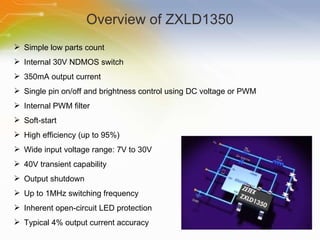
Overview of ZXLD1350 Simple low parts count Internal 30V NDMOS switch 350mA output current Single pin on/off and brightness control using DC voltage or PWM Internal PWM filter Soft-start High efficiency (up to 95%) Wide input voltage range: 7V to 30V 40V transient capability Output shutdown Up to 1MHz switching frequency Inherent open-circuit LED protection Typical 4% output current accuracy
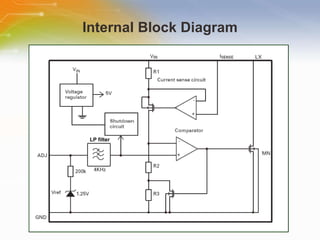
Internal Block Diagram LP filter
Applications Low voltage halogen replacement LEDs  Automotive lighting  Low voltage industrial lighting  LED back-up lighting  Illuminated signs
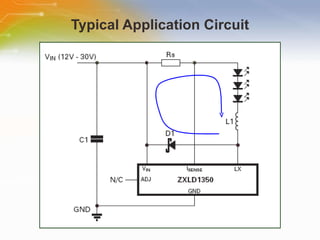
Typical Application Circuit
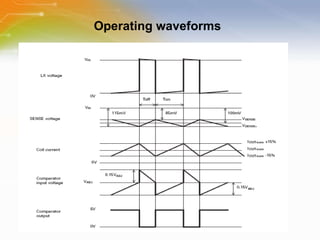
Operating waveforms
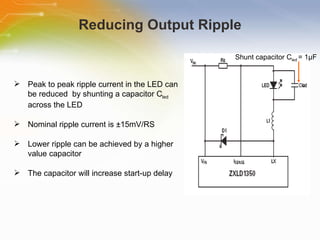
Reducing Output Ripple Peak to peak ripple current in the LED can be reduced  by shunting a capacitor C led  across the LED Nominal ripple current is ±15mV/RS Lower ripple can be achieved by a higher value capacitor The capacitor will increase start-up delay Shunt   capacitor   C led   =   1 µ F
Output current Adjustment by DC Control Voltage I OUTnom  = 0.1/R S  [for R S >0.27], where ADJ pin is floating I OUTdc  = 0.08*V ADJ /R S  [for 0.3< V ADJ  <2.5V]
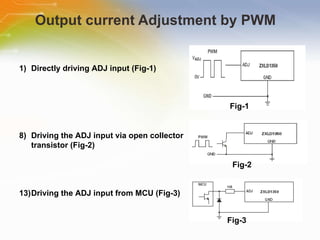
Output current Adjustment by PWM  Directly driving ADJ input (Fig-1) Driving the ADJ input via open collector transistor (Fig-2) Driving the ADJ input from MCU (Fig-3) Fig-1 Fig-2 Fig-3
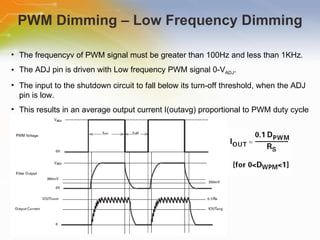
PWM Dimming – Low Frequency Dimming The   frequencyv   of   PWM   signal   must   be   greater   than   100Hz   and   less   than   1KHz. The   ADJ   pin   is   driven   with   Low   frequency   PWM   signal   0- V ADJ . The   input   to   the   shutdown   circuit   to   fall   below   its   turn-off   threshold,   when   the   ADJ   pin   is   low. This   results   in   an   average   output   current   I(outavg)   proportional   to   PWM   duty   cycle
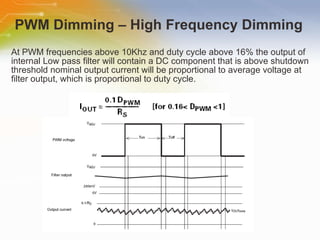
At PWM frequencies above 10Khz and duty cycle above 16% the output of internal Low pass filter will contain a DC component that is above shutdown threshold nominal output current will be proportional to average voltage at filter output, which is proportional to duty cycle. PWM Dimming – High Frequency Dimming
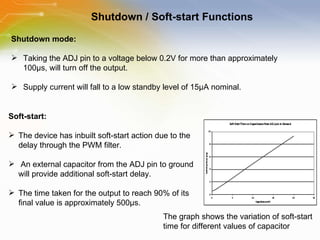
Shutdown   mode: Taking   the   ADJ   pin   to   a   voltage   below   0.2V   for   more   than   approximately   100μs,   will   turn   off   the   output.   Supply   current   will   fall   to   a   low   standby   level   of   15μA   nominal. Soft-start: The device has inbuilt soft-start action due to the delay through the PWM filter. An external capacitor from the ADJ pin to ground will provide additional soft-start delay. The time taken for the output to reach 90% of its final value is approximately 500μs.  The graph shows the variation of soft-start time for different values of capacitor Shutdown / Soft-start Functions
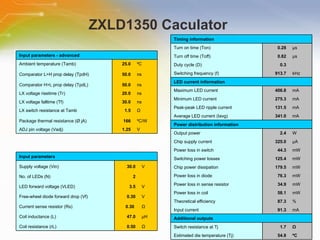
ZXLD1350 Caculator  Timing information     Turn on time (Ton) 0.28 µs Turn off time (Toff) 0.82 µs Duty cycle (D) 0.3   Switching frequency (f) 913.7 kHz LED current information     Maximum LED current 406.8 mA Minimum LED current 275.3 mA Peak-peak LED ripple current 131.5 mA Average LED current (Iavg) 341.0 mA Power distribution information   Output power 2.4 W Chip supply current 325.0 µA Power loss in switch 44.3 mW Switching power losses 125.4 mW Chip power dissipation 179.5 mW Power loss in diode 76.3 mW Power loss in sense resistor 34.9 mW Power loss in coil 58.1 mW Theoretical efficiency 87.3 % Input current 91.3 mA Additional outputs     Switch resistance at Tj 1.7 Ω Estimated die temperature (Tj) 54.8 ºC Input parameters - advanced      Ambient temperature (Tamb) 25.0 ºC Comparator L>H prop delay (TpdH) 50.0 ns Comparator H>L prop delay (TpdL) 50.0 ns LX voltage risetime (Tr) 20.0 ns LX voltage falltime (Tf) 30.0 ns LX switch resistance at Tamb 1.5 Ω Package thermal resistance (Ø jA) 166 ºC/W ADJ pin voltage (Vadj) 1.25 V Input parameters Supply voltage (Vin) 30.0 V No. of LEDs (N) 2   LED forward voltage (VLED) 3.5 V Free-wheel diode forward drop (Vf) 0.30 V Current sense resistor (Rs) 0.30  Ω Coil inductance (L) 47.0 µH Coil resistance (rL) 0.50 Ω
Additional Resource For ordering the ZXLD1350 LED driver, please click the  part list  or Call our sales hotline For additional inquires contact our technical service hotline For more product information go to http://www.zetex.com/3.0/product_portfolio.asp?pno=ZXLD1350&h

ZXLD1350 - High Power LED Driver

  • 1.
    ZXLD1350 - High Power LED Driver Source: ZETEX Semiconductor
  • 2.
    Introduction Purpose This training module overviews the ZXLD1350 LED driver, its basic operation, and key functions. Outline Key Features Block Diagram Basic Operations PWM Dimming Content 15 pages
  • 3.
    Overview of ZXLD1350Simple low parts count Internal 30V NDMOS switch 350mA output current Single pin on/off and brightness control using DC voltage or PWM Internal PWM filter Soft-start High efficiency (up to 95%) Wide input voltage range: 7V to 30V 40V transient capability Output shutdown Up to 1MHz switching frequency Inherent open-circuit LED protection Typical 4% output current accuracy
  • 4.
  • 5.
    Applications Low voltagehalogen replacement LEDs Automotive lighting Low voltage industrial lighting LED back-up lighting Illuminated signs
  • 6.
  • 7.
  • 8.
    Reducing Output RipplePeak to peak ripple current in the LED can be reduced by shunting a capacitor C led across the LED Nominal ripple current is ±15mV/RS Lower ripple can be achieved by a higher value capacitor The capacitor will increase start-up delay Shunt capacitor C led = 1 µ F
  • 9.
    Output current Adjustmentby DC Control Voltage I OUTnom = 0.1/R S [for R S >0.27], where ADJ pin is floating I OUTdc = 0.08*V ADJ /R S [for 0.3< V ADJ <2.5V]
  • 10.
    Output current Adjustmentby PWM Directly driving ADJ input (Fig-1) Driving the ADJ input via open collector transistor (Fig-2) Driving the ADJ input from MCU (Fig-3) Fig-1 Fig-2 Fig-3
  • 11.
    PWM Dimming –Low Frequency Dimming The frequencyv of PWM signal must be greater than 100Hz and less than 1KHz. The ADJ pin is driven with Low frequency PWM signal 0- V ADJ . The input to the shutdown circuit to fall below its turn-off threshold, when the ADJ pin is low. This results in an average output current I(outavg) proportional to PWM duty cycle
  • 12.
    At PWM frequenciesabove 10Khz and duty cycle above 16% the output of internal Low pass filter will contain a DC component that is above shutdown threshold nominal output current will be proportional to average voltage at filter output, which is proportional to duty cycle. PWM Dimming – High Frequency Dimming
  • 13.
    Shutdown mode: Taking the ADJ pin to a voltage below 0.2V for more than approximately 100μs, will turn off the output. Supply current will fall to a low standby level of 15μA nominal. Soft-start: The device has inbuilt soft-start action due to the delay through the PWM filter. An external capacitor from the ADJ pin to ground will provide additional soft-start delay. The time taken for the output to reach 90% of its final value is approximately 500μs. The graph shows the variation of soft-start time for different values of capacitor Shutdown / Soft-start Functions
  • 14.
    ZXLD1350 Caculator Timing information     Turn on time (Ton) 0.28 µs Turn off time (Toff) 0.82 µs Duty cycle (D) 0.3   Switching frequency (f) 913.7 kHz LED current information     Maximum LED current 406.8 mA Minimum LED current 275.3 mA Peak-peak LED ripple current 131.5 mA Average LED current (Iavg) 341.0 mA Power distribution information   Output power 2.4 W Chip supply current 325.0 µA Power loss in switch 44.3 mW Switching power losses 125.4 mW Chip power dissipation 179.5 mW Power loss in diode 76.3 mW Power loss in sense resistor 34.9 mW Power loss in coil 58.1 mW Theoretical efficiency 87.3 % Input current 91.3 mA Additional outputs     Switch resistance at Tj 1.7 Ω Estimated die temperature (Tj) 54.8 ºC Input parameters - advanced     Ambient temperature (Tamb) 25.0 ºC Comparator L>H prop delay (TpdH) 50.0 ns Comparator H>L prop delay (TpdL) 50.0 ns LX voltage risetime (Tr) 20.0 ns LX voltage falltime (Tf) 30.0 ns LX switch resistance at Tamb 1.5 Ω Package thermal resistance (Ø jA) 166 ºC/W ADJ pin voltage (Vadj) 1.25 V Input parameters Supply voltage (Vin) 30.0 V No. of LEDs (N) 2   LED forward voltage (VLED) 3.5 V Free-wheel diode forward drop (Vf) 0.30 V Current sense resistor (Rs) 0.30 Ω Coil inductance (L) 47.0 µH Coil resistance (rL) 0.50 Ω
  • 15.
    Additional Resource Forordering the ZXLD1350 LED driver, please click the part list or Call our sales hotline For additional inquires contact our technical service hotline For more product information go to http://www.zetex.com/3.0/product_portfolio.asp?pno=ZXLD1350&h

Editor's Notes

  • #3 Welcome to the training module on ZETEX’s High Power LED Driver. This training module overviews the ZXLD1350 LED driver, its basic operation, and key functions.
  • #4 Zetex Semiconductors‘ ZXLD1350 is a switching regulator. Requiring a single external resistor to accurately set its output current, the ZXLD1350 dramatically simplifies high power LED driving. Operating from an input supply of between 7V and 30V, the driver can produce an adjustable output current of up to 350mA, to support an LED chain of up to eight 1 Watt LEDs. By integrating a 30V NMOS switch, and a high-side current sensing circuit yielding a +/-4% precision current control, the ZXLD1350 needs the support of a total of just four external circuit components. Depending on the type and value of the external components used, the LED driver can achieve efficiency as high as 95%, which combined with low typical shutdown current of only 15µA, ensures the device offers good power economy and extended battery life. The PWM filter within the chip provides a soft-start feature by controlling the rise of input/output current.
  • #5 The diagram illustrates the internal functional blocks of the ZXLD1350. It has 5 pins: LX, GND, ADJ, I SENSE , and V IN . The device contains a low pass filter between the ADJ pin and the threshold comparator, and an internal 200K current limiting resistor between ADJ and the internal reference voltage. This allows the ADJ pin to adjust output current. The output of low pass filter drives the shutdown circuit. When the input voltage to this circuit falls below the threshold, the internal regulator and the output switch are turned off. The two internal comparators enable to control the two NMOS switches respectively.
  • #6 The ZXLD1350 driver is designed for driving single or multiple series connected LEDs efficiently from a voltage source higher than the LED voltage. Here lists the application areas where this driver can go into (up to 350mA current), like low voltage halogen replacement LEDs, Automotive lighting, Industrial lighting, and LED back-up.
  • #7 Here is a typical application circuit of the ZXLD1350 driver. The device, in conjunction with coil (L1) and current sense resistor (RS), forms a self-oscillating continuous-mode buck converter. When input voltage V IN is first applied, initial current in L1 and R S is zero and there is no output from the current sense circuit. Under this condition, the (-) input of the internal comparator is at ground and its output is high. This turns NMOS switch on and switches the LX pin low, causing current to flow from VIN to ground, via RS, L1 and the LEDs. When the NMOS switch is off, which switches the LX pin high, the current in L1 continues to flow via D1 and the LEDs back to V IN . The current decays at a rate determined by the LED and diode forward voltages to produce a falling voltage at the input of the comparator. When this voltage returns to V ADJ , the comparator output switches high again. This cycle of events repeats.
  • #8 This slide shows some operating waveform
  • #9 Peak to peak ripple current in the LED can be reduced by adding a shunt capacitor C led across the LED as shown. A value of 1 µ F will reduce nominal ripple current by a factor approximately three. Proportionally lower ripple can be achieved with higher capacitor values. The capacitor will not affect operating frequency or efficiency, but it will increase start-up delay, by reducing the rate of rise of LED voltage.
  • #10 The nominal average output current in the LED(s) is determined by the value of the external current sense resistor (R S ) connected between V IN and I SENSE . The ADJ pin can be driven by an external dc voltage (V ADJ ), as shown, to adjust the output current to a value above or below the nominal average value defined by R S . Note that when driving the ADJ pin above 1.25V, R S must be increased in proportion to prevent I OUTdc exceeding 370mA maximum.
  • #11 The output current can also be adjusted by PWM control. Figure 1 illustrates the PWM being applied to the ADJ input directly to control the output current to a value above or below the nominal average value set by resistor R S . The recommended method for driving the ADJ pin and controlling the amplitude of the PWM waveform is to use a small NPN switching transistor as shown Figure 2. Figure 3 shows another possibility by driving the device from an open drain output of a microcontroller.
  • #12 The ZXLD1350 has a versatile adjust pin that can be used in many ways such as to adjust the brightness of the LED by controlling LED current. Low frequency dimming is preferred since the LED instantaneous driving current is constant. The color temperature of the LED is preserved at all dimming levels. Another advantage of low frequency dimming is control down to a 1% level resulting in a dimming range of 100:1.
  • #13 High frequency dimming is preferred if the system requires low radiated emission and low in/output ripple but doing so reduces dimming range to 5:1. The ZXLD1350 has an internal low pass filter which integrates the high frequency PWM signal to produce a DC dimming control. If the PWM frequency is higher than approximately 10kHz and the duty cycle is above the specified minimum value, the device will remain active and the nominal average output current will be proportional to the average voltage at the output of the filter, which is directly proportional to the duty cycle.
  • #14 The LED driver has two additional functions, shutdown and soft-start. The output of the low pass filter drives the shutdown circuit. When the ADJ pin is set to a voltage below 0.2V for more than approximately 100μs the device will turn off and the supply current will fall to a standby level of 15μA nominal. The device has a built in soft-start circuit due to the delay through the PWM filter. An external capacitor from the ADJ pin to ground will provide additional soft-start delay in two ways: by increasing the time taken for the voltage on this pin to rise to the turn-on threshold and by slowing down the rate of rise of the control voltage at the input of the comparator.
  • #15 The ZXLD1350 calculator is a tool for estimating the performance of the ZXLD1350 in various applications. It allows the effects of different external component values to be evaluated easily, saving both time and cost compared to full circuit simulation or physical construction.
  • #16 Thank you for taking the time to view this presentation on ZXLD1350 - High Power LED Driver. If you would like to learn more or go on to purchase some of these devices, you may either click on the part list link, or simple call our sales hotline. For more technical information you may either visit the Zetex site – link shown – or if you would prefer to speak to someone live, please call our hotline number, or even use our ‘live chat’ online facility.