Constant Current LED Driver with Programmable PWM Control Source: Allegro MicroSystems
Introduction Purpose This training module introduces the three channel constant-current LED driver family, its internal function and features, and some design considerations. Outline Overview of the LED driver family Functional block diagram Various features Design considerations Content 12 pages
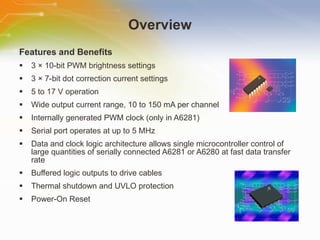
Overview Features and Benefits 3 × 10-bit PWM brightness settings 3 × 7-bit dot correction current settings 5 to 17 V operation Wide output current range, 10 to 150 mA per channel Internally generated PWM clock (only in A6281) Serial port operates at up to 5 MHz Data and clock logic architecture allows single microcontroller control of large quantities of serially connected A6281 or A6280 at fast data transfer rate Buffered logic outputs to drive cables Thermal shutdown and UVLO protection Power-On Reset
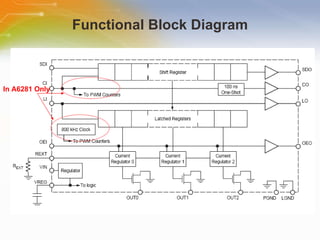
Functional Block Diagram In A6281 Only
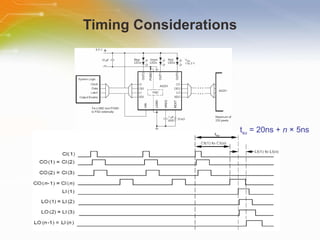
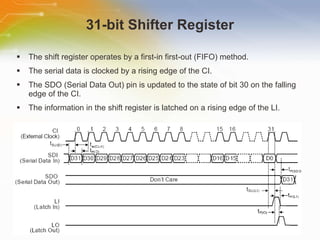
31-bit Shifter Register The shift register operates by a first-in first-out (FIFO) method. The serial data is clocked by a rising edge of the CI. The SDO (Serial Data Out) pin is updated to the state of bit 30 on the falling edge of the CI. The information in the shift register is latched on a rising edge of the LI.
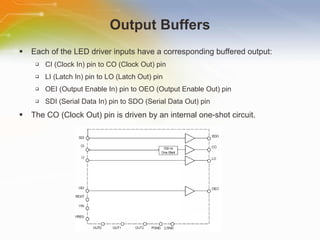
Output Buffers Each of the LED driver inputs have a corresponding buffered output: CI (Clock In) pin to CO (Clock Out) pin LI (Latch In) pin to LO (Latch Out) pin OEI (Output Enable In) pin to OEO (Output Enable Out) pin SDI (Serial Data In) pin to SDO (Serial Data Out) pin The CO (Clock Out) pin is driven by an internal one-shot circuit.
PWM Brightness Control Three 10-bit registers set the PWM count value during each PWM cycle. The duty cycle of PWM signal is determined by the equation: Duty Cycle (DC) = [(PWM n  + 1) / 1024] ×100 (%) The relationship of the PWMn value to the output duty cycle is given in the following table
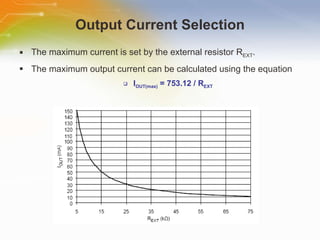
Output Current Selection The maximum current is set by the external resistor R EXT . The maximum output current can be calculated using the equation I OUT(max)  = 753.12 / R EXT
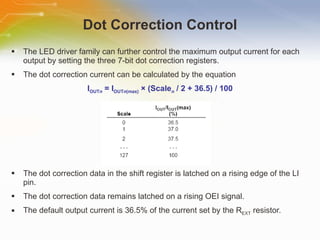
Dot Correction Control The LED driver family can further control the maximum output current for each output by setting the three 7-bit dot correction registers. The dot correction current can be calculated by the equation I OUT n   = I OUT n (max)  × (Scale n   / 2 + 36.5) / 100 The dot correction data in the shift register is latched on a rising edge of the LI pin. The dot correction data remains latched on a rising OEI signal. The default output current is 36.5% of the current set by the R EXT  resistor.
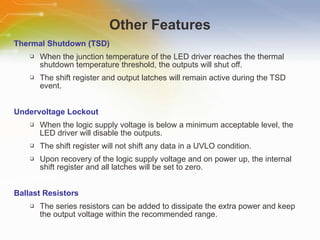
Other Features Thermal Shutdown (TSD) When the junction temperature of the LED driver reaches the thermal shutdown temperature threshold, the outputs will shut off. The shift register and output latches will remain active during the TSD event. Undervoltage Lockout When the logic supply voltage is below a minimum acceptable level, the LED driver will disable the outputs. The shift register will not shift any data in a UVLO condition. Upon recovery of the logic supply voltage and on power up, the internal shift register and all latches will be set to zero. Ballast Resistors The series resistors can be added to dissipate the extra power and keep the output voltage within the recommended range.
Timing Considerations t su  = 20ns +  n  × 5ns
Additional Resource For ordering the A6280 & A6281 LED drivers, please click the part list or Call our sales hotline For additional inquires contact our technical service hotline For more product information go to http://www.allegromicro.com/en/Products/Categories/ICs/leddriver.asp Newark Farnell

Constant Current LED Driver with Programmable PWM Control

  • 1.
    Constant Current LEDDriver with Programmable PWM Control Source: Allegro MicroSystems
  • 2.
    Introduction Purpose Thistraining module introduces the three channel constant-current LED driver family, its internal function and features, and some design considerations. Outline Overview of the LED driver family Functional block diagram Various features Design considerations Content 12 pages
  • 3.
    Overview Features andBenefits 3 × 10-bit PWM brightness settings 3 × 7-bit dot correction current settings 5 to 17 V operation Wide output current range, 10 to 150 mA per channel Internally generated PWM clock (only in A6281) Serial port operates at up to 5 MHz Data and clock logic architecture allows single microcontroller control of large quantities of serially connected A6281 or A6280 at fast data transfer rate Buffered logic outputs to drive cables Thermal shutdown and UVLO protection Power-On Reset
  • 4.
  • 5.
    31-bit Shifter RegisterThe shift register operates by a first-in first-out (FIFO) method. The serial data is clocked by a rising edge of the CI. The SDO (Serial Data Out) pin is updated to the state of bit 30 on the falling edge of the CI. The information in the shift register is latched on a rising edge of the LI.
  • 6.
    Output Buffers Eachof the LED driver inputs have a corresponding buffered output: CI (Clock In) pin to CO (Clock Out) pin LI (Latch In) pin to LO (Latch Out) pin OEI (Output Enable In) pin to OEO (Output Enable Out) pin SDI (Serial Data In) pin to SDO (Serial Data Out) pin The CO (Clock Out) pin is driven by an internal one-shot circuit.
  • 7.
    PWM Brightness ControlThree 10-bit registers set the PWM count value during each PWM cycle. The duty cycle of PWM signal is determined by the equation: Duty Cycle (DC) = [(PWM n + 1) / 1024] ×100 (%) The relationship of the PWMn value to the output duty cycle is given in the following table
  • 8.
    Output Current SelectionThe maximum current is set by the external resistor R EXT . The maximum output current can be calculated using the equation I OUT(max) = 753.12 / R EXT
  • 9.
    Dot Correction ControlThe LED driver family can further control the maximum output current for each output by setting the three 7-bit dot correction registers. The dot correction current can be calculated by the equation I OUT n = I OUT n (max) × (Scale n / 2 + 36.5) / 100 The dot correction data in the shift register is latched on a rising edge of the LI pin. The dot correction data remains latched on a rising OEI signal. The default output current is 36.5% of the current set by the R EXT resistor.
  • 10.
    Other Features ThermalShutdown (TSD) When the junction temperature of the LED driver reaches the thermal shutdown temperature threshold, the outputs will shut off. The shift register and output latches will remain active during the TSD event. Undervoltage Lockout When the logic supply voltage is below a minimum acceptable level, the LED driver will disable the outputs. The shift register will not shift any data in a UVLO condition. Upon recovery of the logic supply voltage and on power up, the internal shift register and all latches will be set to zero. Ballast Resistors The series resistors can be added to dissipate the extra power and keep the output voltage within the recommended range.
  • 11.
    Timing Considerations tsu = 20ns + n × 5ns
  • 12.
    Additional Resource Forordering the A6280 & A6281 LED drivers, please click the part list or Call our sales hotline For additional inquires contact our technical service hotline For more product information go to http://www.allegromicro.com/en/Products/Categories/ICs/leddriver.asp Newark Farnell