Solid Phase Micro Extraction
(SPME)
Out line
Introduction
Theory
Instrumentation and application
And some case studies
Section 1: Theory
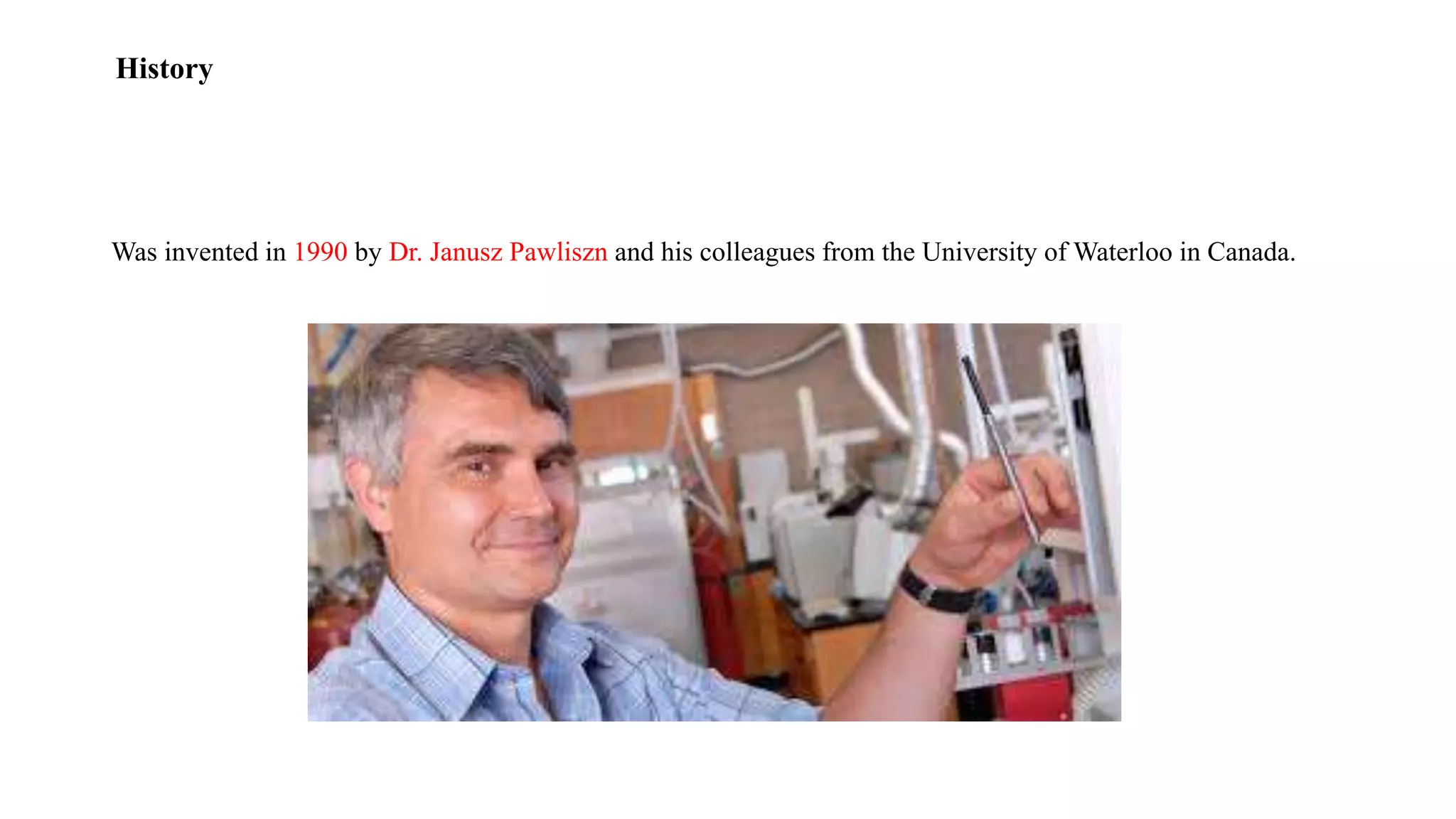
Was invented in 1990 by Dr. Janusz Pawliszn and his colleagues from the University of Waterloo in Canada.
History
Introduction
The main objective of the exhaustive techniques is to remove analytes completely from a sample matrix and
transfer them to the extraction phase. The fundamental advantage of exhaustive methods is that, in principle,
they do not require calibration because the vast majority of analytes are transferred to the extraction phase.
Alternatively, non-exhaustive approaches can be designed on the basis of the principles of equilibrium, pre-
equilibrium and permeation.
Introduction
Advantages
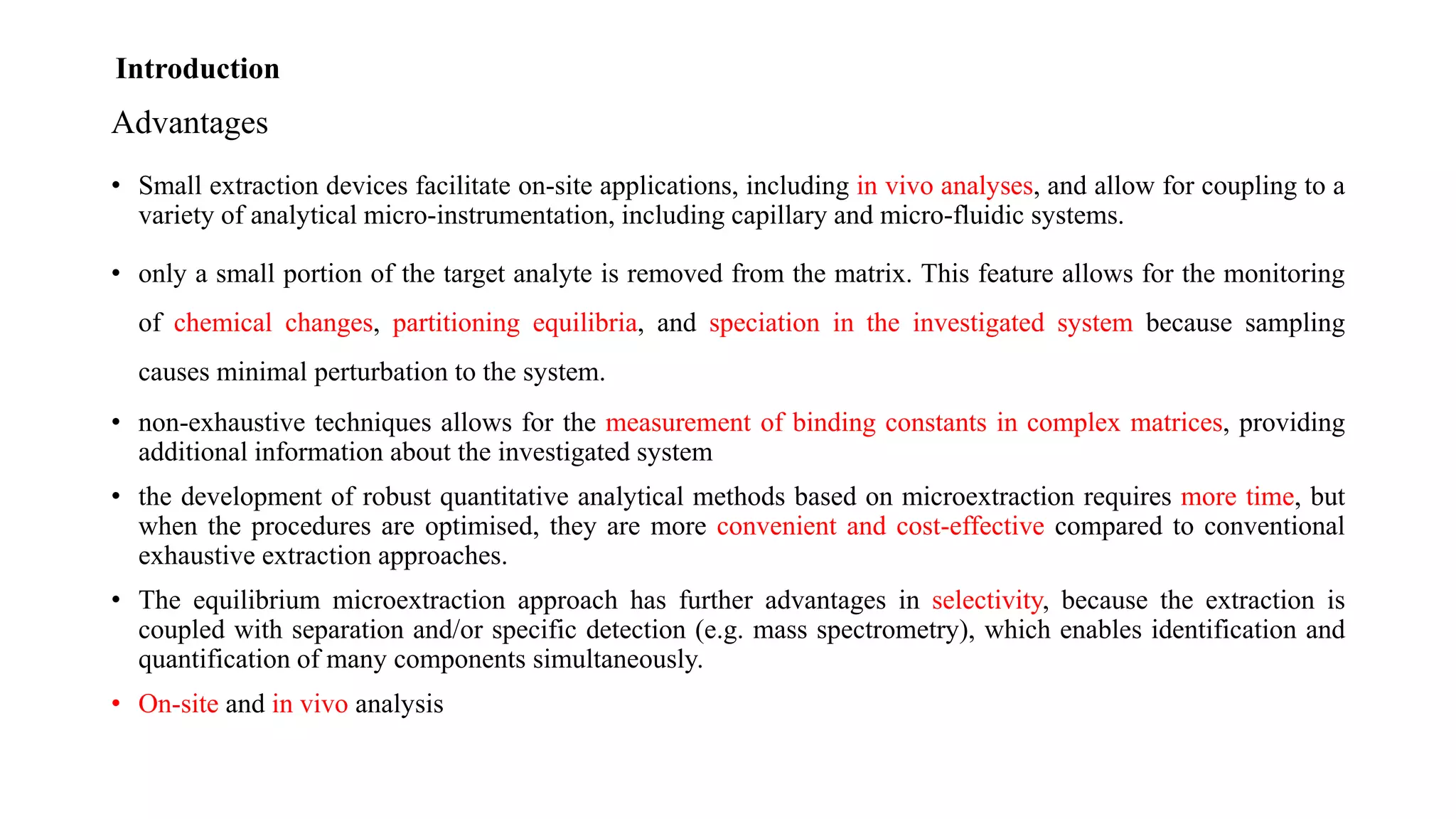
• Small extraction devices facilitate on-site applications, including in vivo analyses, and allow for coupling to a
variety of analytical micro-instrumentation, including capillary and micro-fluidic systems.
• only a small portion of the target analyte is removed from the matrix. This feature allows for the monitoring
of chemical changes, partitioning equilibria, and speciation in the investigated system because sampling
causes minimal perturbation to the system.
• non-exhaustive techniques allows for the measurement of binding constants in complex matrices, providing
additional information about the investigated system
• the development of robust quantitative analytical methods based on microextraction requires more time, but
when the procedures are optimised, they are more convenient and cost-effective compared to conventional
exhaustive extraction approaches.
• The equilibrium microextraction approach has further advantages in selectivity, because the extraction is
coupled with separation and/or specific detection (e.g. mass spectrometry), which enables identification and
quantification of many components simultaneously.
• On-site and in vivo analysis
Introduction
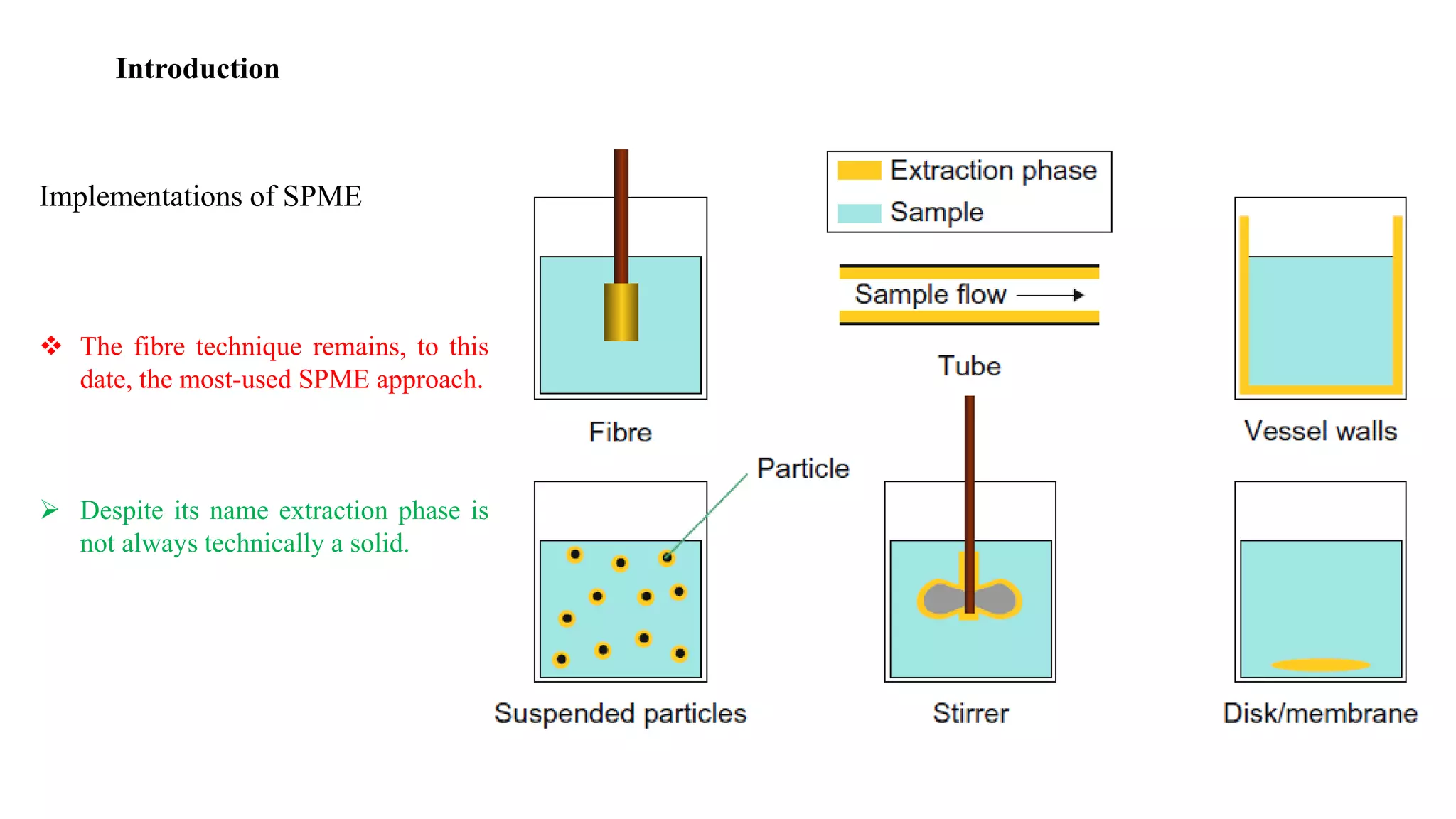
Implementations of SPME
 The fibre technique remains, to this
date, the most-used SPME approach.
 Despite its name extraction phase is
not always technically a solid.
Introduction
SPME Versus SPE
SPE : three-step process.
1. a sample is passed through the sorbent bed, and analytes present in the sample are exhaustively extracted from the
sample matrix to the solid sorbent.
2. unwanted analytes are selectively desorbed from the solid sorbent by washing with a solution capable of desorbing
unwanted analytes but leaving desired analytes retained on the sorbent.
3. the wash solution is changed for one able to desorb analytes of interest. The resulting eluent may then be
concentrated by evaporation to the desired volume.
SPME: selective sorption from the matrix onto the coating
1. the coating is exposed to the sample. Analytes with a high affinity for the sorbent are selectively extracted.
2. everything extracted by the fibre is desorbed into the analytical instrument
 Micro-SPE is more related to SPE and comparison with SPME, therefore, is inappropriate.
 with SPME, it is possible to perform convenient spectroscopic analysis of surface-adsorbed components not only
extracted chemical species but also collected aerosols or particulates.
Introduction
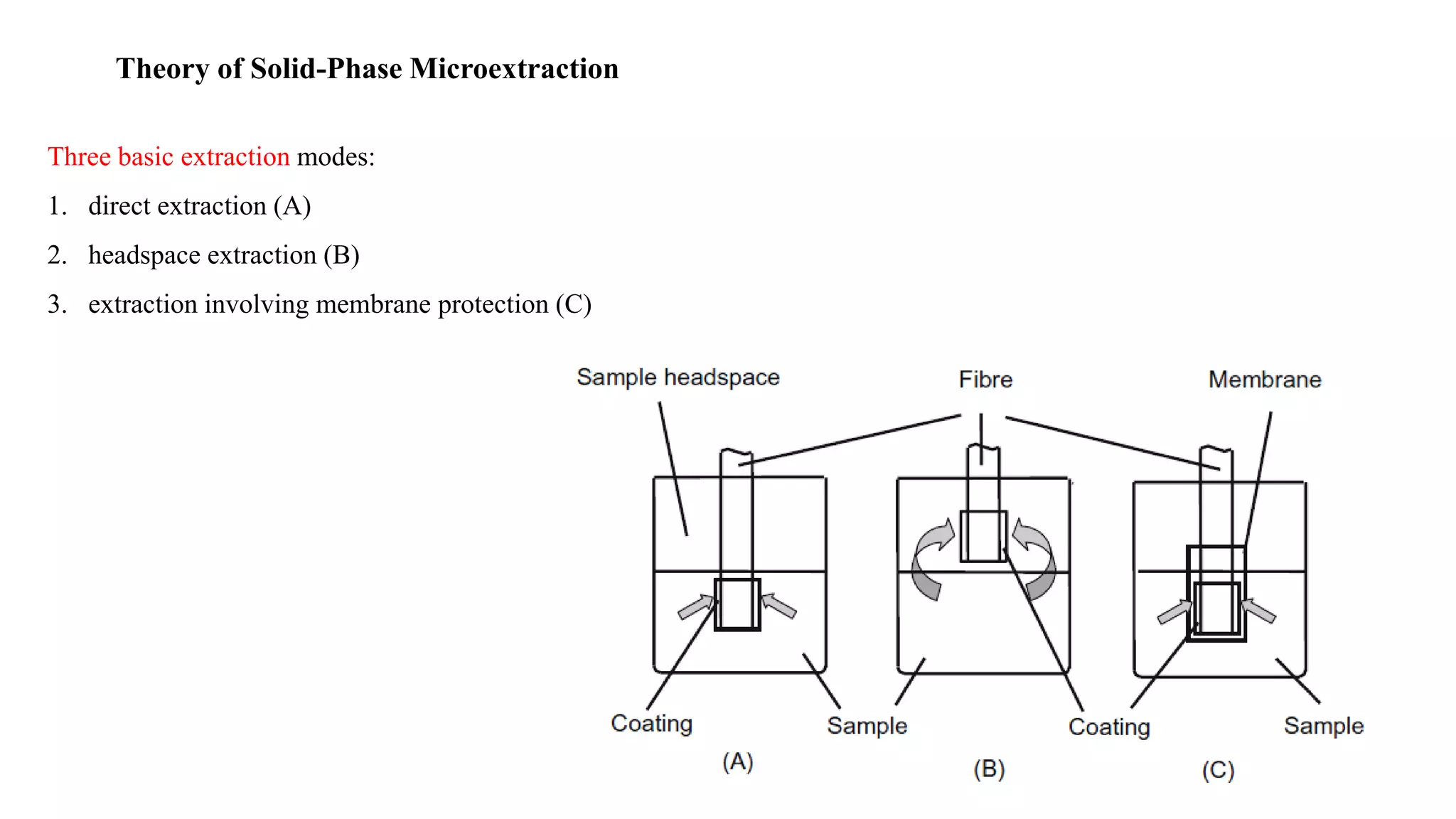
Theory of Solid-Phase Microextraction
Three basic extraction modes:
1. direct extraction (A)
2. headspace extraction (B)
3. extraction involving membrane protection (C)
Theory of Solid-Phase Microextraction
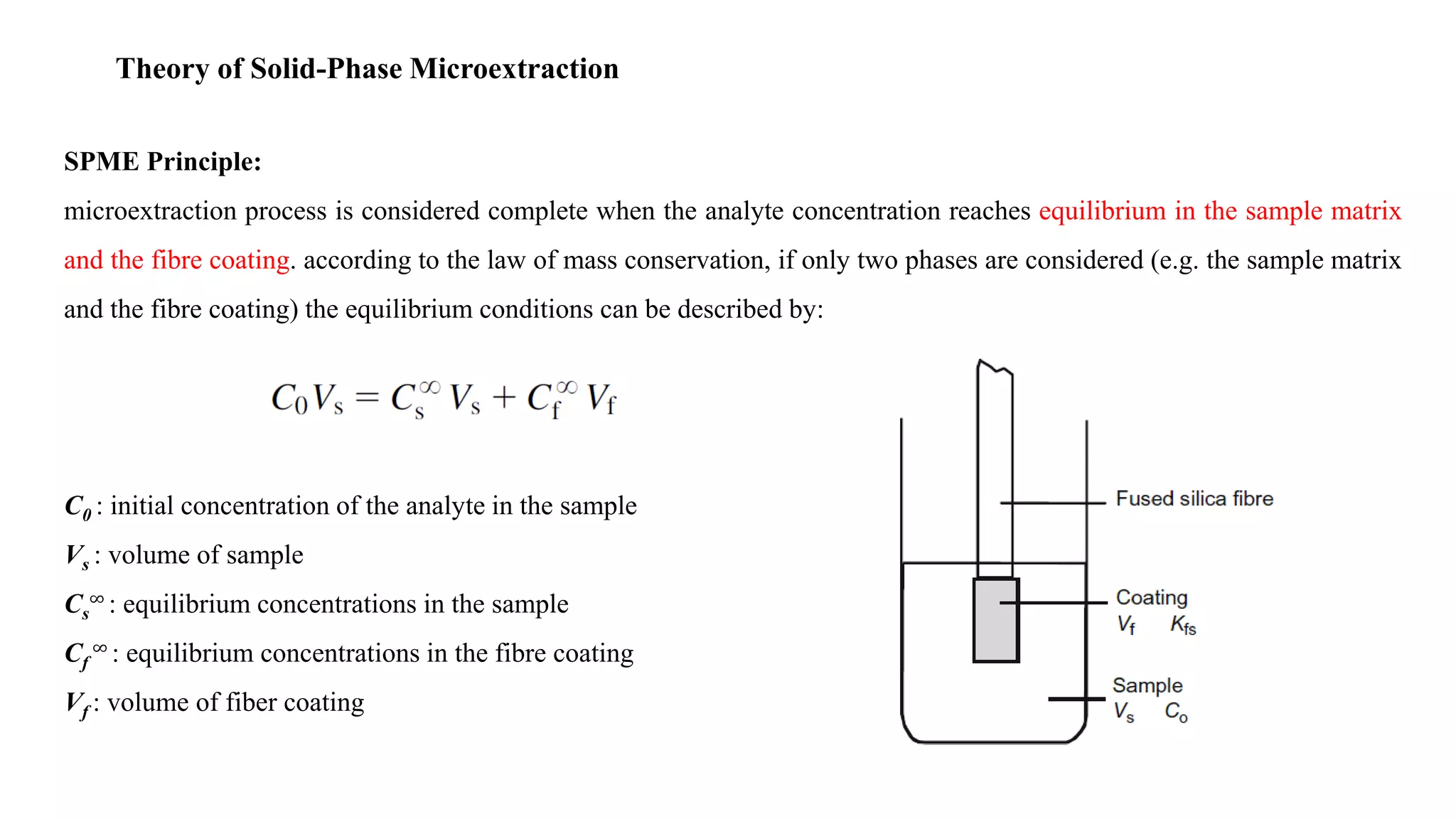
SPME Principle:
microextraction process is considered complete when the analyte concentration reaches equilibrium in the sample matrix
and the fibre coating. according to the law of mass conservation, if only two phases are considered (e.g. the sample matrix
and the fibre coating) the equilibrium conditions can be described by:
C0 : initial concentration of the analyte in the sample
Vs : volume of sample
Cs
∞ : equilibrium concentrations in the sample
Cf
∞ : equilibrium concentrations in the fibre coating
Vf : volume of fiber coating
Theory of Solid-Phase Microextraction
SPME Principle:
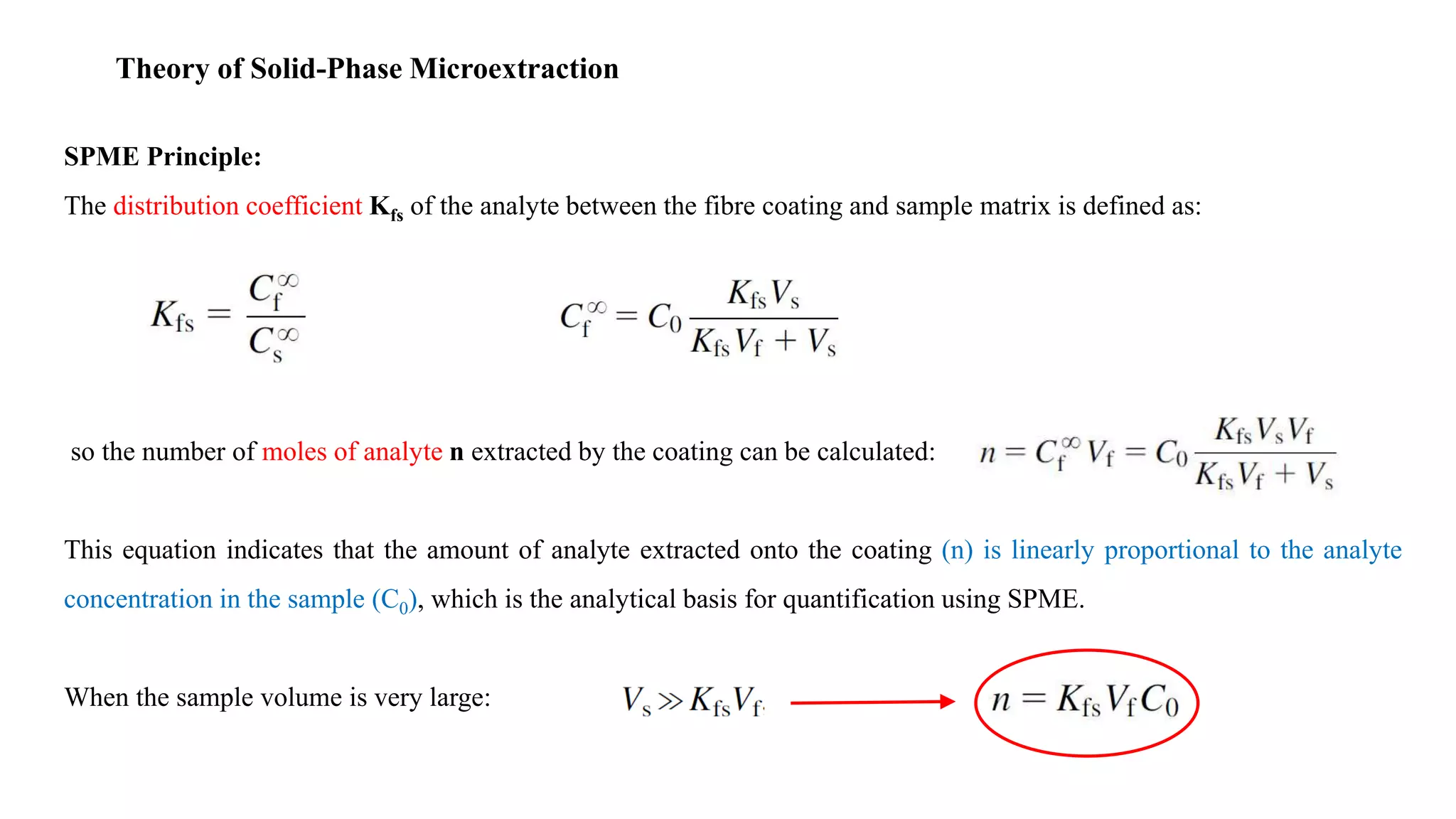
The distribution coefficient Kfs of the analyte between the fibre coating and sample matrix is defined as:
so the number of moles of analyte n extracted by the coating can be calculated:
This equation indicates that the amount of analyte extracted onto the coating (n) is linearly proportional to the analyte
concentration in the sample (C0), which is the analytical basis for quantification using SPME.
When the sample volume is very large:
Theory of Solid-Phase Microextraction
SPME Principle:
we have three phase in the system (sample matrix/headspace/coating)
If and
Also
So
 This equation states that the amount of analyte extracted is independent of the location of the fibre in the system. It
may be placed in the headspace or directly in the sample as long as the volumes of the fibre coating, headspace and
sample are kept constant.
Theory of Solid-Phase Microextraction
Estimation of Distribution Constants
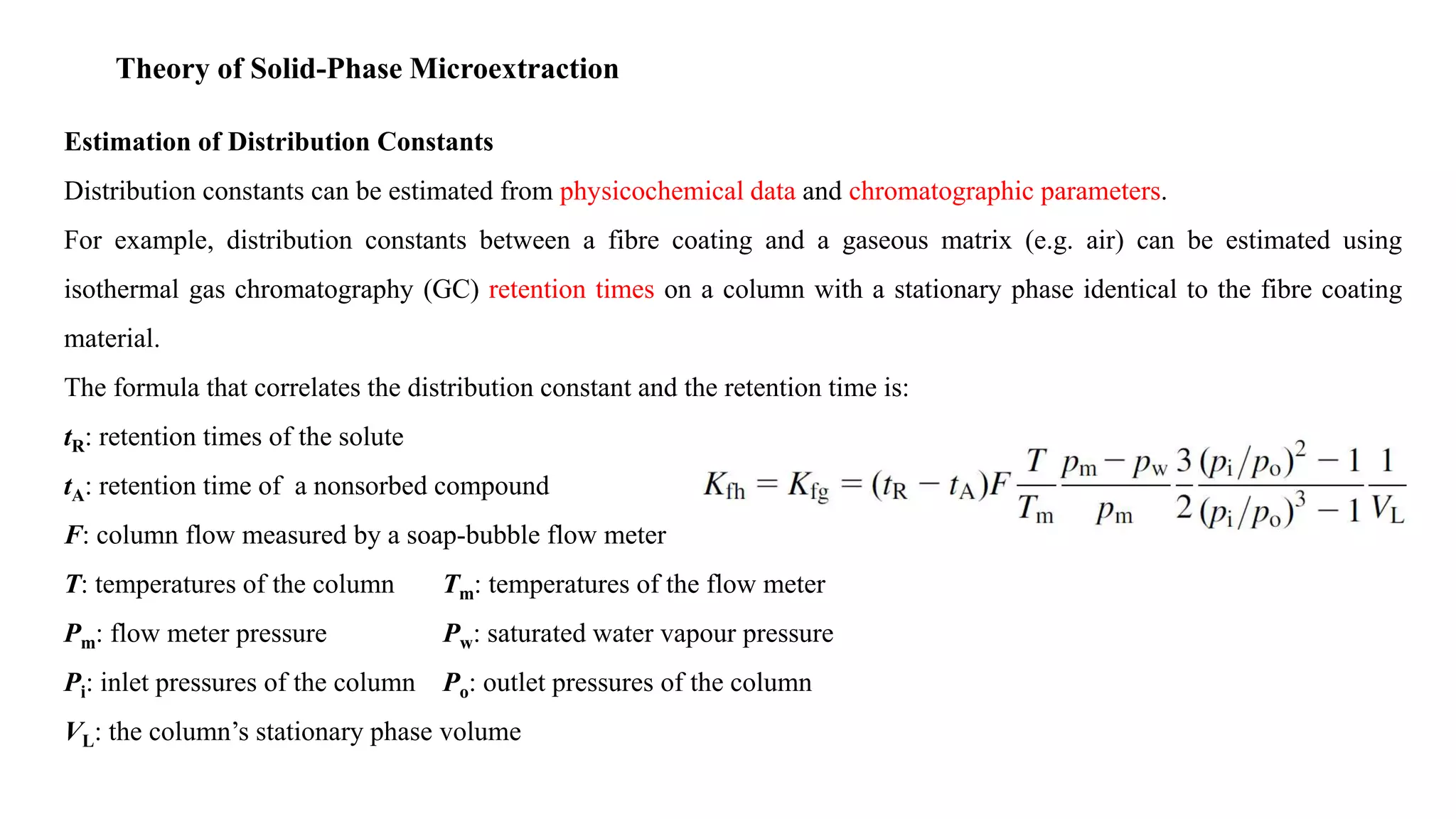
Distribution constants can be estimated from physicochemical data and chromatographic parameters.
For example, distribution constants between a fibre coating and a gaseous matrix (e.g. air) can be estimated using
isothermal gas chromatography (GC) retention times on a column with a stationary phase identical to the fibre coating
material.
The formula that correlates the distribution constant and the retention time is:
tR: retention times of the solute
tA: retention time of a nonsorbed compound
F: column flow measured by a soap-bubble flow meter
T: temperatures of the column Tm: temperatures of the flow meter
Pm: flow meter pressure Pw: saturated water vapour pressure
Pi: inlet pressures of the column Po: outlet pressures of the column
VL: the column’s stationary phase volume
Theory of Solid-Phase Microextraction
Effect of Extraction Parameters on Distribution Constants
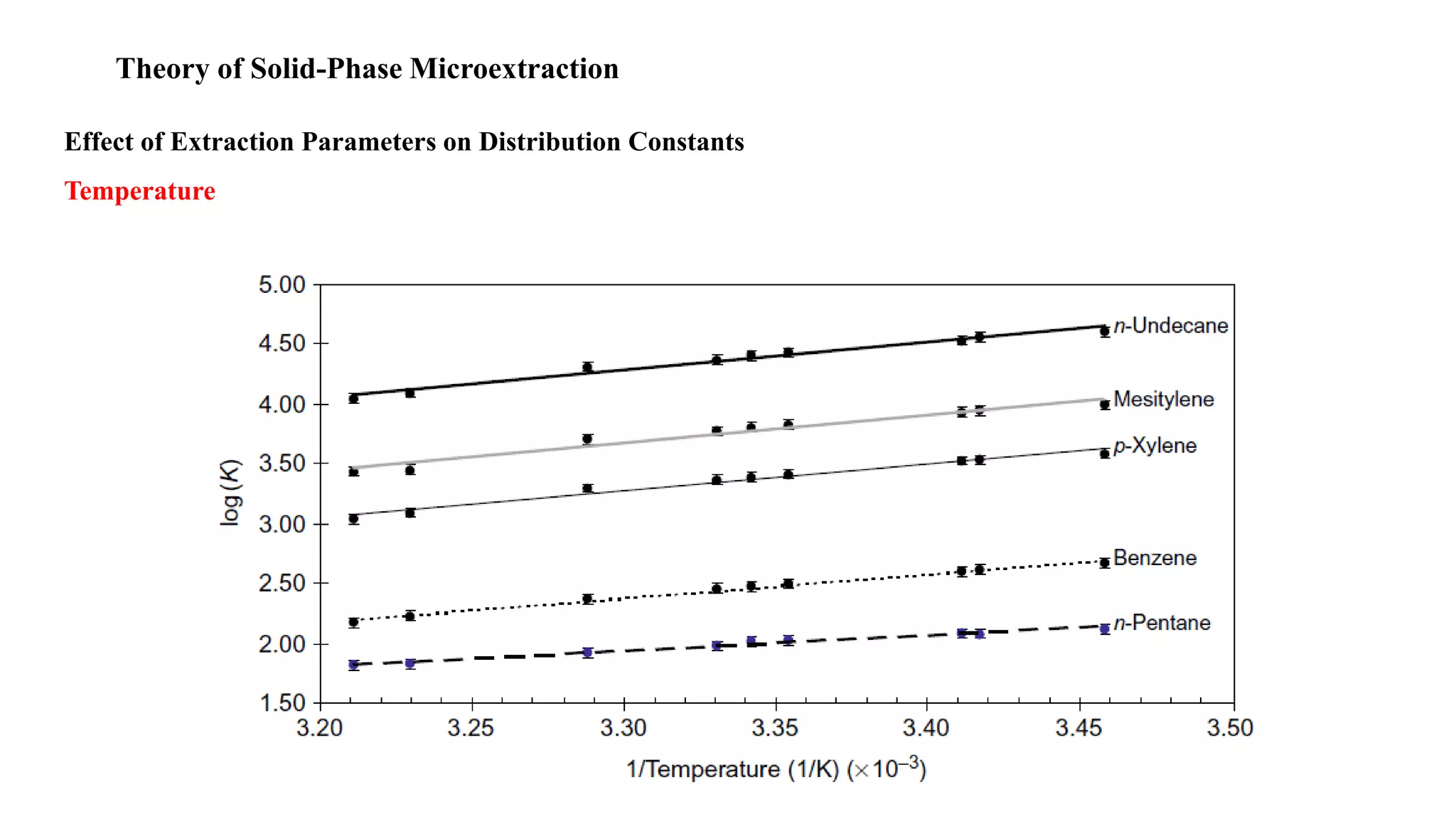
Temperature
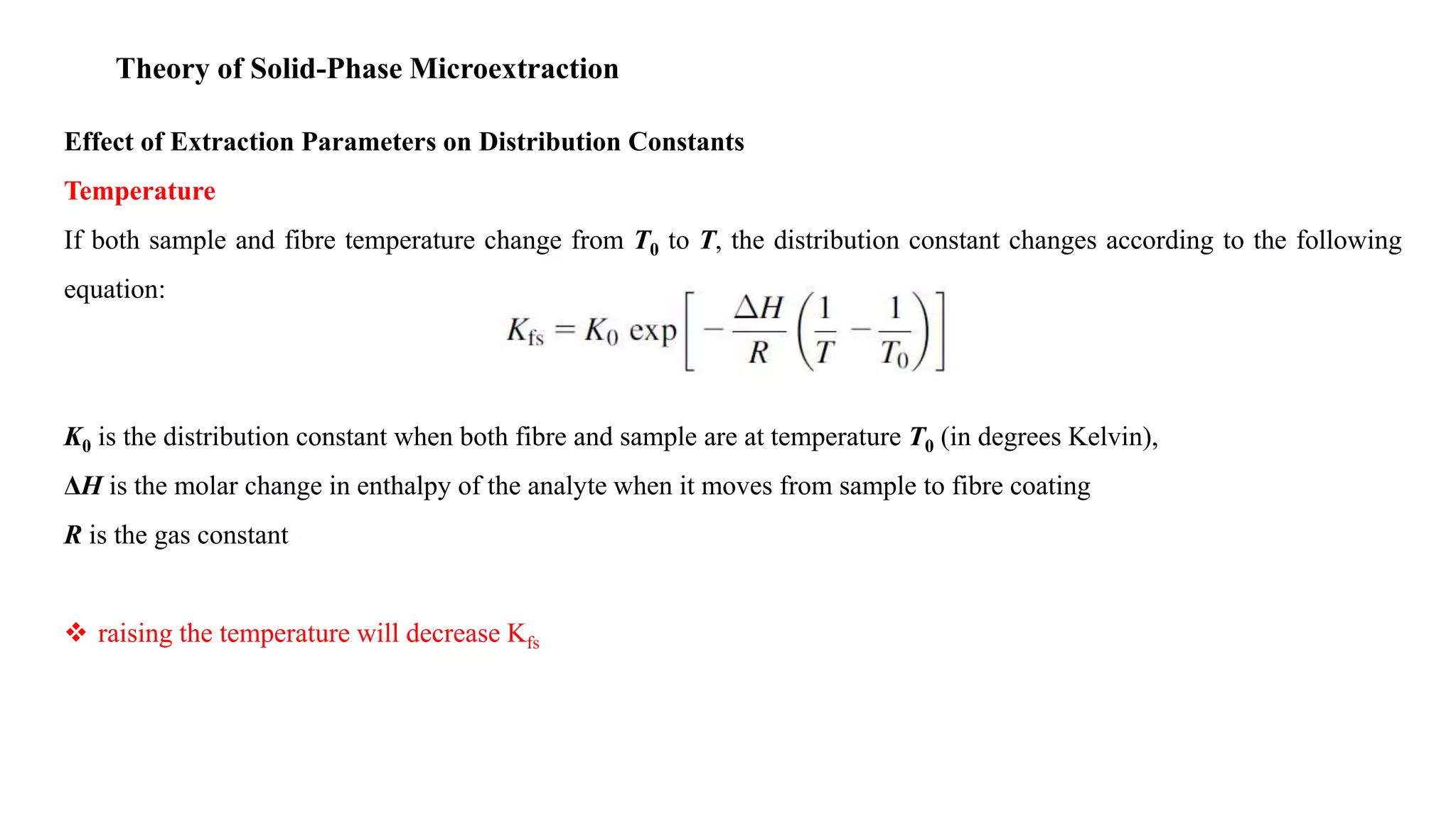
If both sample and fibre temperature change from T0 to T, the distribution constant changes according to the following
equation:
K0 is the distribution constant when both fibre and sample are at temperature T0 (in degrees Kelvin),
ΔH is the molar change in enthalpy of the analyte when it moves from sample to fibre coating
R is the gas constant
 raising the temperature will decrease Kfs
Theory of Solid-Phase Microextraction
Effect of Extraction Parameters on Distribution Constants
Temperature
Theory of Solid-Phase Microextraction
Effect of Extraction Parameters on Distribution Constants
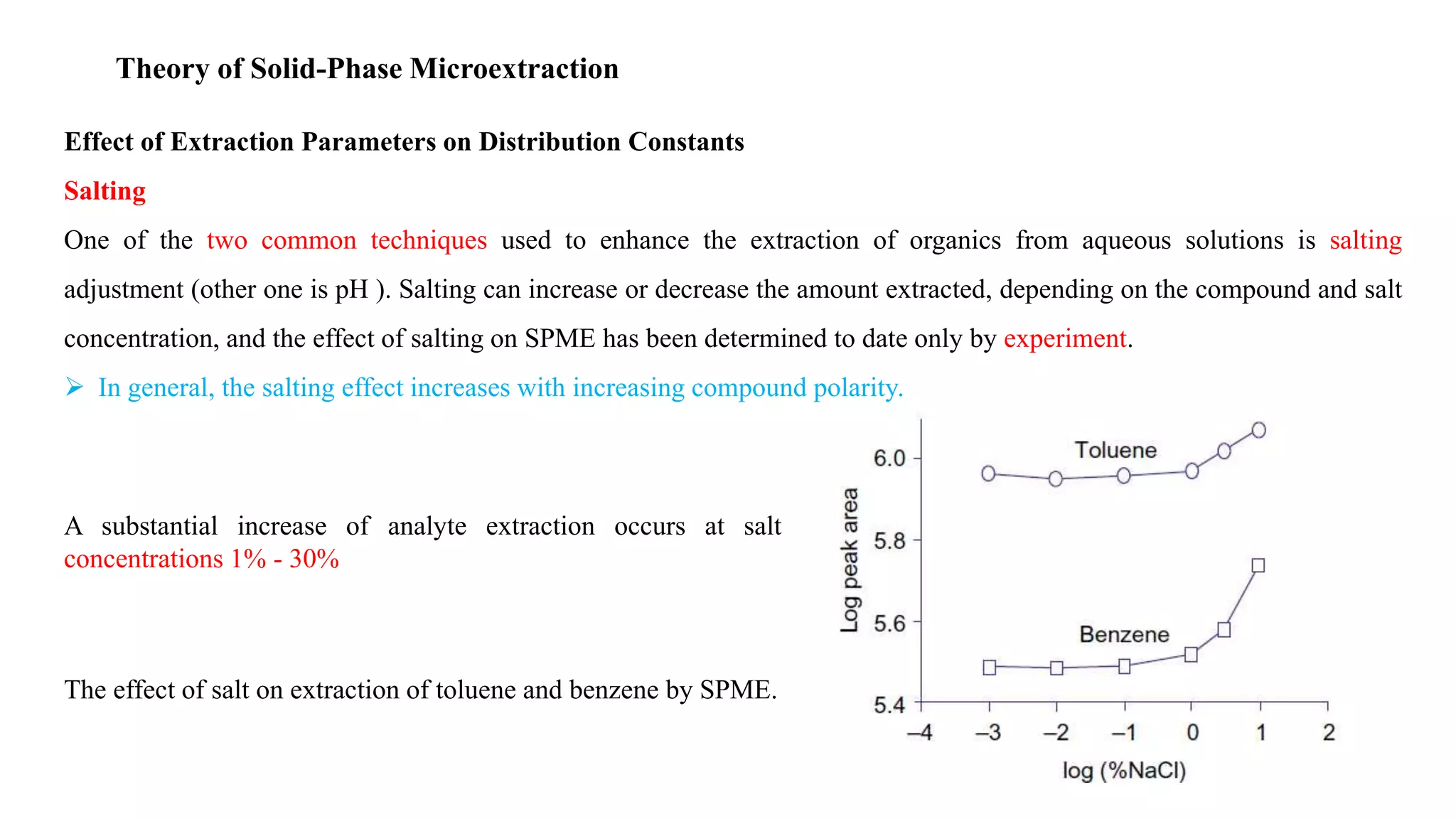
Salting
One of the two common techniques used to enhance the extraction of organics from aqueous solutions is salting
adjustment (other one is pH ). Salting can increase or decrease the amount extracted, depending on the compound and salt
concentration, and the effect of salting on SPME has been determined to date only by experiment.
 In general, the salting effect increases with increasing compound polarity.
A substantial increase of analyte extraction occurs at salt
concentrations 1% - 30%
The effect of salt on extraction of toluene and benzene by SPME.
Theory of Solid-Phase Microextraction
Effect of Extraction Parameters on Distribution Constants
pH
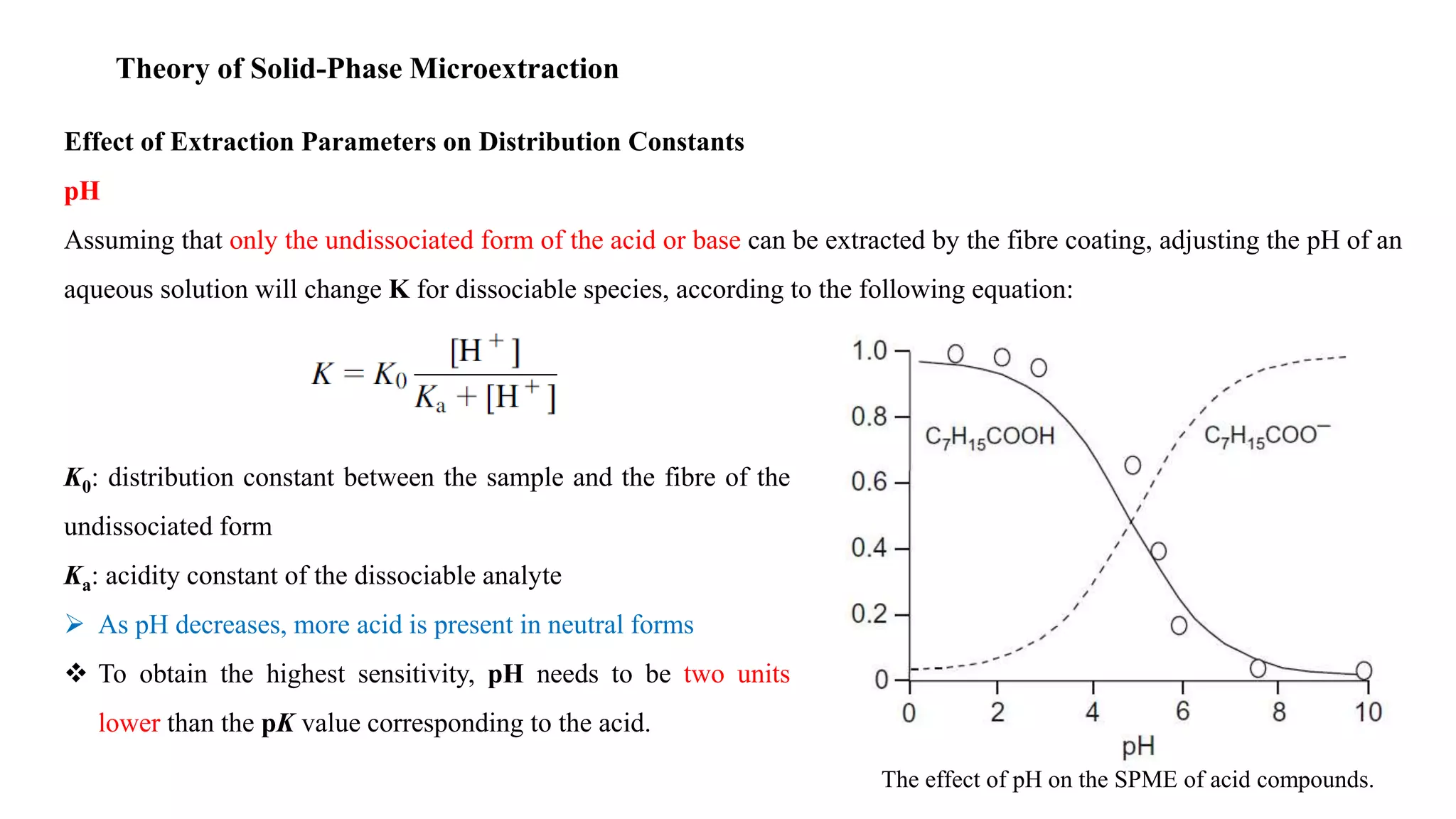
Assuming that only the undissociated form of the acid or base can be extracted by the fibre coating, adjusting the pH of an
aqueous solution will change K for dissociable species, according to the following equation:
K0: distribution constant between the sample and the fibre of the
undissociated form
Ka: acidity constant of the dissociable analyte
 As pH decreases, more acid is present in neutral forms
 To obtain the highest sensitivity, pH needs to be two units
lower than the pK value corresponding to the acid.
The effect of pH on the SPME of acid compounds.
Theory of Solid-Phase Microextraction
Effect of Extraction Parameters on Distribution Constants
Polarity of Sample Matrix and Coating Material
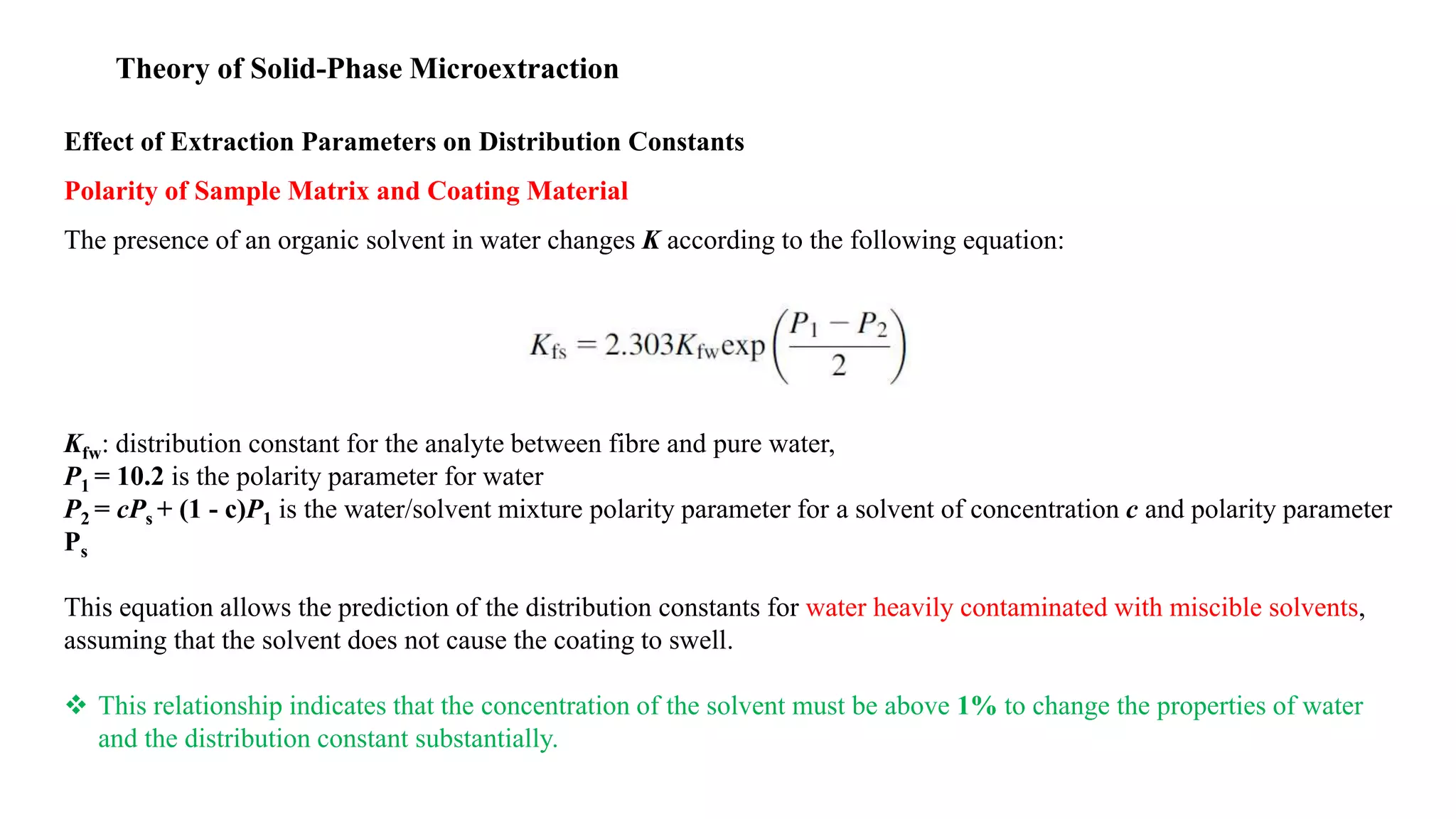
The presence of an organic solvent in water changes K according to the following equation:
Kfw: distribution constant for the analyte between fibre and pure water,
P1 = 10.2 is the polarity parameter for water
P2 = cPs + (1 - c)P1 is the water/solvent mixture polarity parameter for a solvent of concentration c and polarity parameter
Ps
This equation allows the prediction of the distribution constants for water heavily contaminated with miscible solvents,
assuming that the solvent does not cause the coating to swell.
 This relationship indicates that the concentration of the solvent must be above 1% to change the properties of water
and the distribution constant substantially.
Theory of Solid-Phase Microextraction
Effect of Extraction Parameters on Distribution Constants
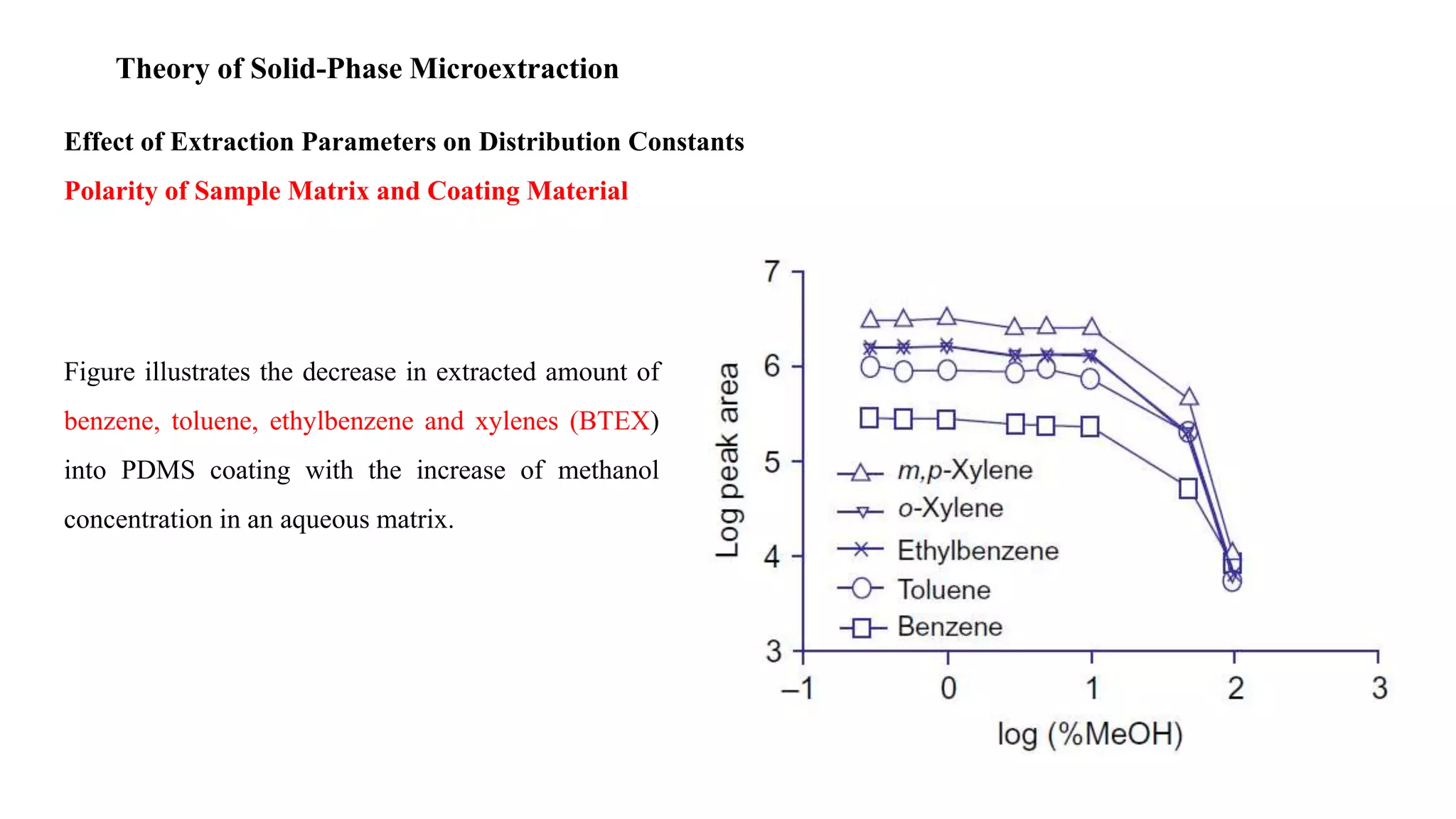
Polarity of Sample Matrix and Coating Material
Figure illustrates the decrease in extracted amount of
benzene, toluene, ethylbenzene and xylenes (BTEX)
into PDMS coating with the increase of methanol
concentration in an aqueous matrix.
Theory of Solid-Phase Microextraction
Headspace Extraction
• Addition of a gaseous headspace facilitates enhanced transport into the extraction phase because of the high diffusion
coefficients of the analytes into the gas phase.
• In order to increase transport from the sample matrix into the headspace, the system can be designed to produce a well-
agitated, large sample/headspace interface.
• For low-volatility compounds, heating of the sample is a good approach.
• analytes need to be transported through the barrier of air before they can reach the coating. This protect the fibre
coating from damage by high molecular mass and non-volatile interferences present in the sample matrix, such as
humic materials or proteins.
• The headspace mode also allows for modification of the matrix, such as a change of the pH, without damaging the
fibre.
• Amounts of analyte extracted into the coating from the same vial at equilibrium using direct and headspace sampling
are identical, as long as the volumes of the sample and gaseous headspace are the same.
Theory of Solid-Phase Microextraction
Headspace Extraction
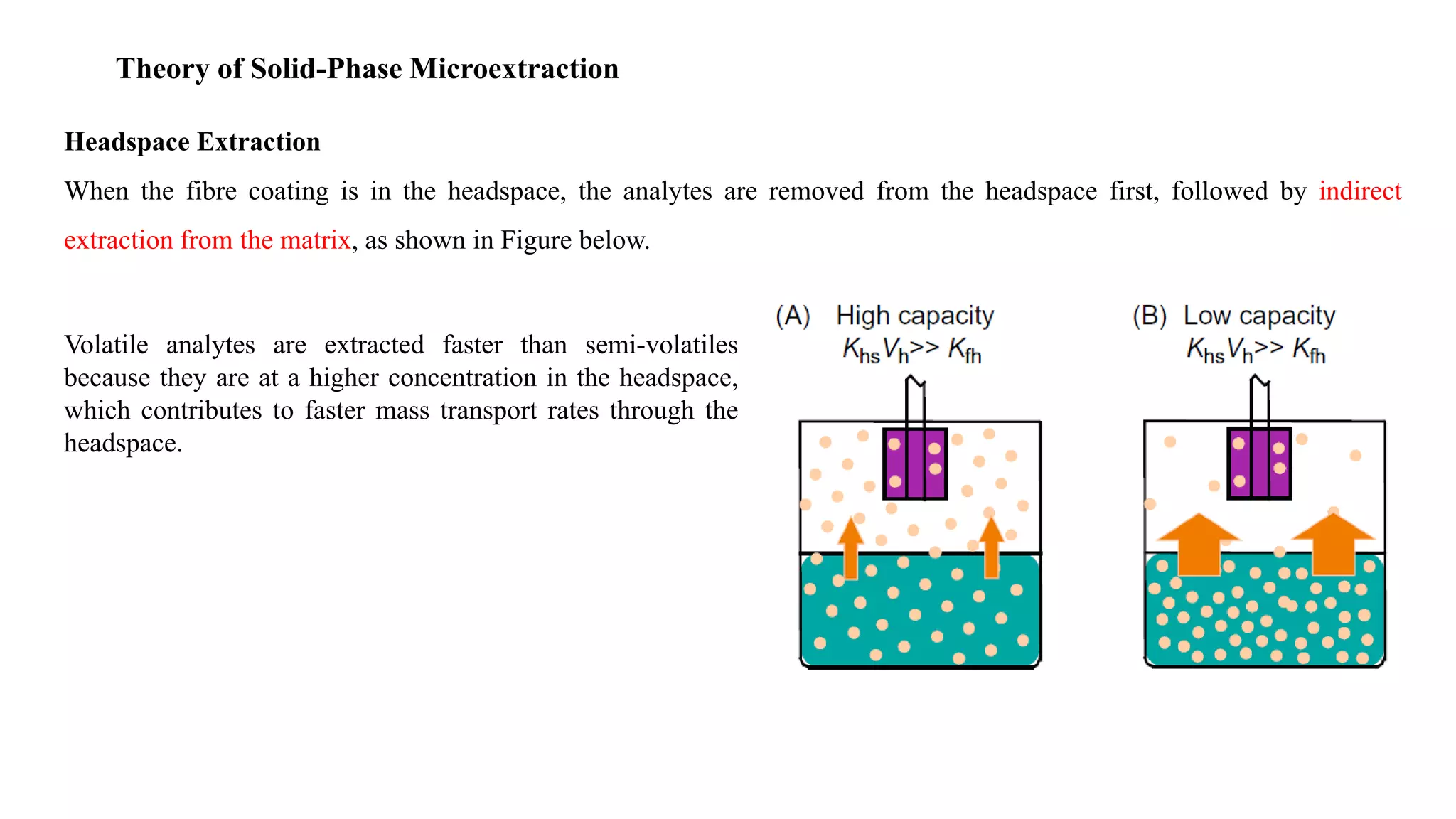
When the fibre coating is in the headspace, the analytes are removed from the headspace first, followed by indirect
extraction from the matrix, as shown in Figure below.
Volatile analytes are extracted faster than semi-volatiles
because they are at a higher concentration in the headspace,
which contributes to faster mass transport rates through the
headspace.
Theory of Solid-Phase Microextraction
Solid Versus Liquid Sorbents
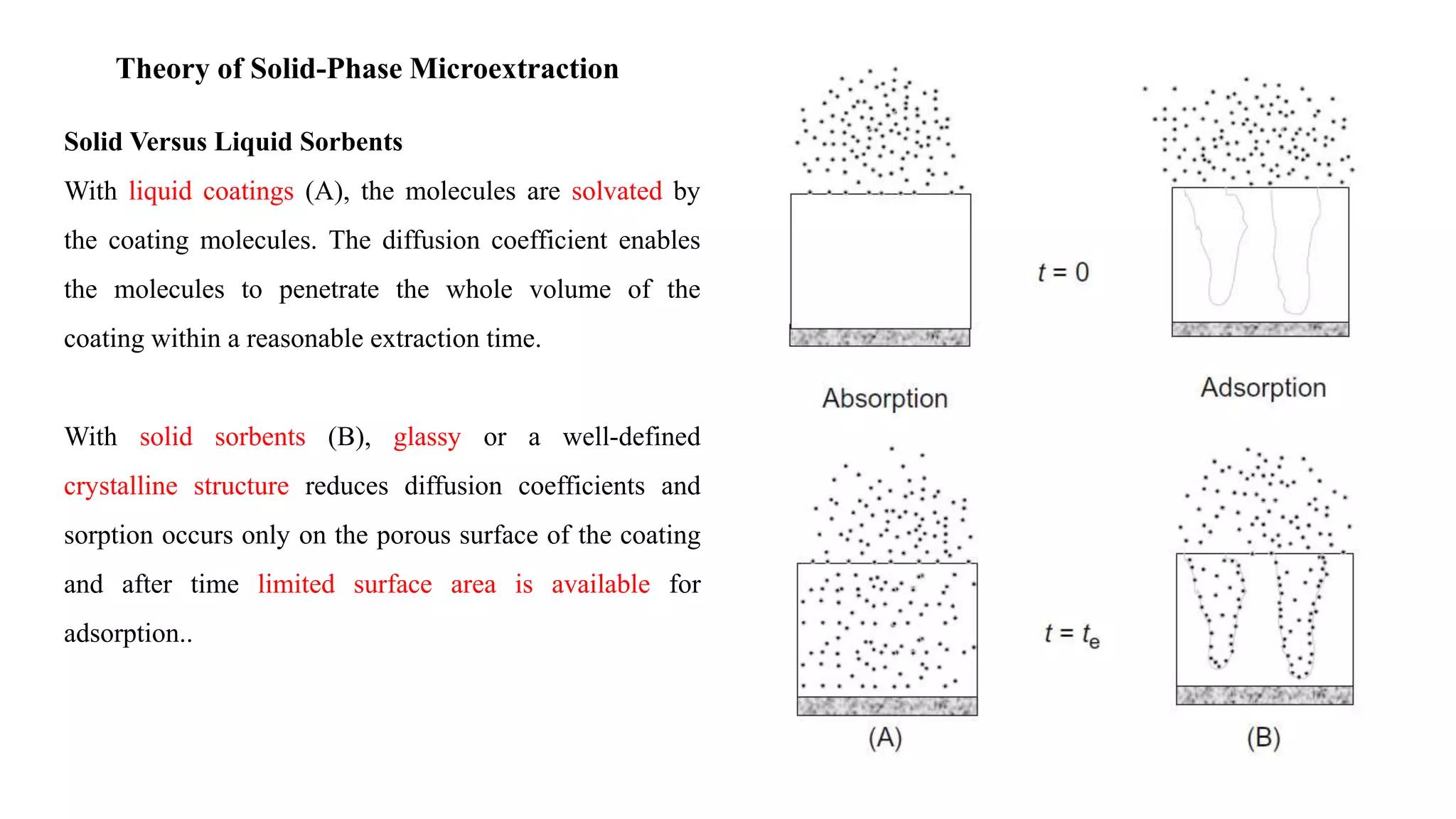
With liquid coatings (A), the molecules are solvated by
the coating molecules. The diffusion coefficient enables
the molecules to penetrate the whole volume of the
coating within a reasonable extraction time.
With solid sorbents (B), glassy or a well-defined
crystalline structure reduces diffusion coefficients and
sorption occurs only on the porous surface of the coating
and after time limited surface area is available for
adsorption..
Section 2: instrumentation and application
Development of SPME Devices and Coatings
History
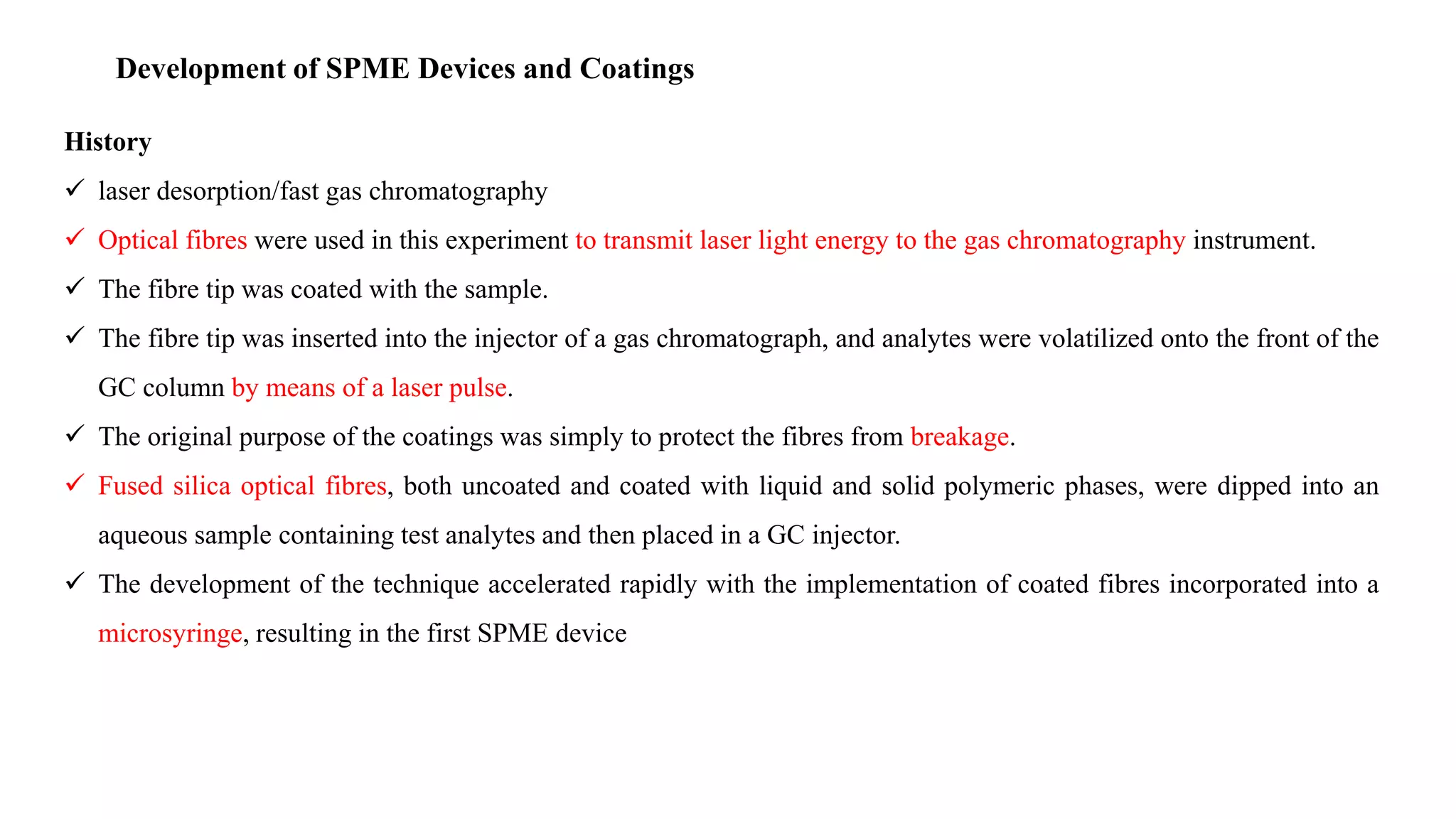
 laser desorption/fast gas chromatography
 Optical fibres were used in this experiment to transmit laser light energy to the gas chromatography instrument.
 The fibre tip was coated with the sample.
 The fibre tip was inserted into the injector of a gas chromatograph, and analytes were volatilized onto the front of the
GC column by means of a laser pulse.
 The original purpose of the coatings was simply to protect the fibres from breakage.
 Fused silica optical fibres, both uncoated and coated with liquid and solid polymeric phases, were dipped into an
aqueous sample containing test analytes and then placed in a GC injector.
 The development of the technique accelerated rapidly with the implementation of coated fibres incorporated into a
microsyringe, resulting in the first SPME device
Development of SPME Devices and Coatings
History
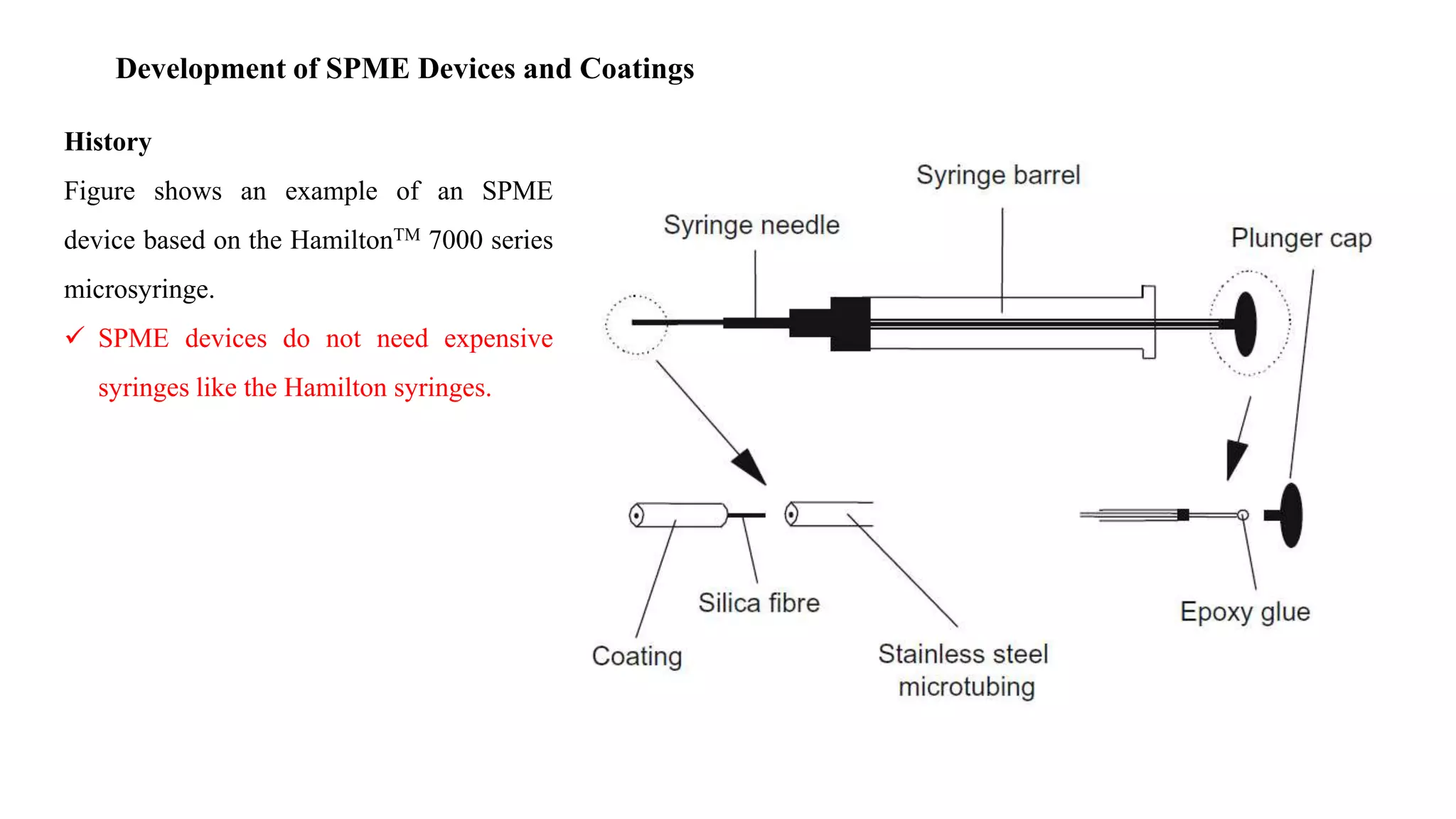
Figure shows an example of an SPME
device based on the HamiltonTM 7000 series
microsyringe.
 SPME devices do not need expensive
syringes like the Hamilton syringes.
Development of SPME Devices and Coatings
History
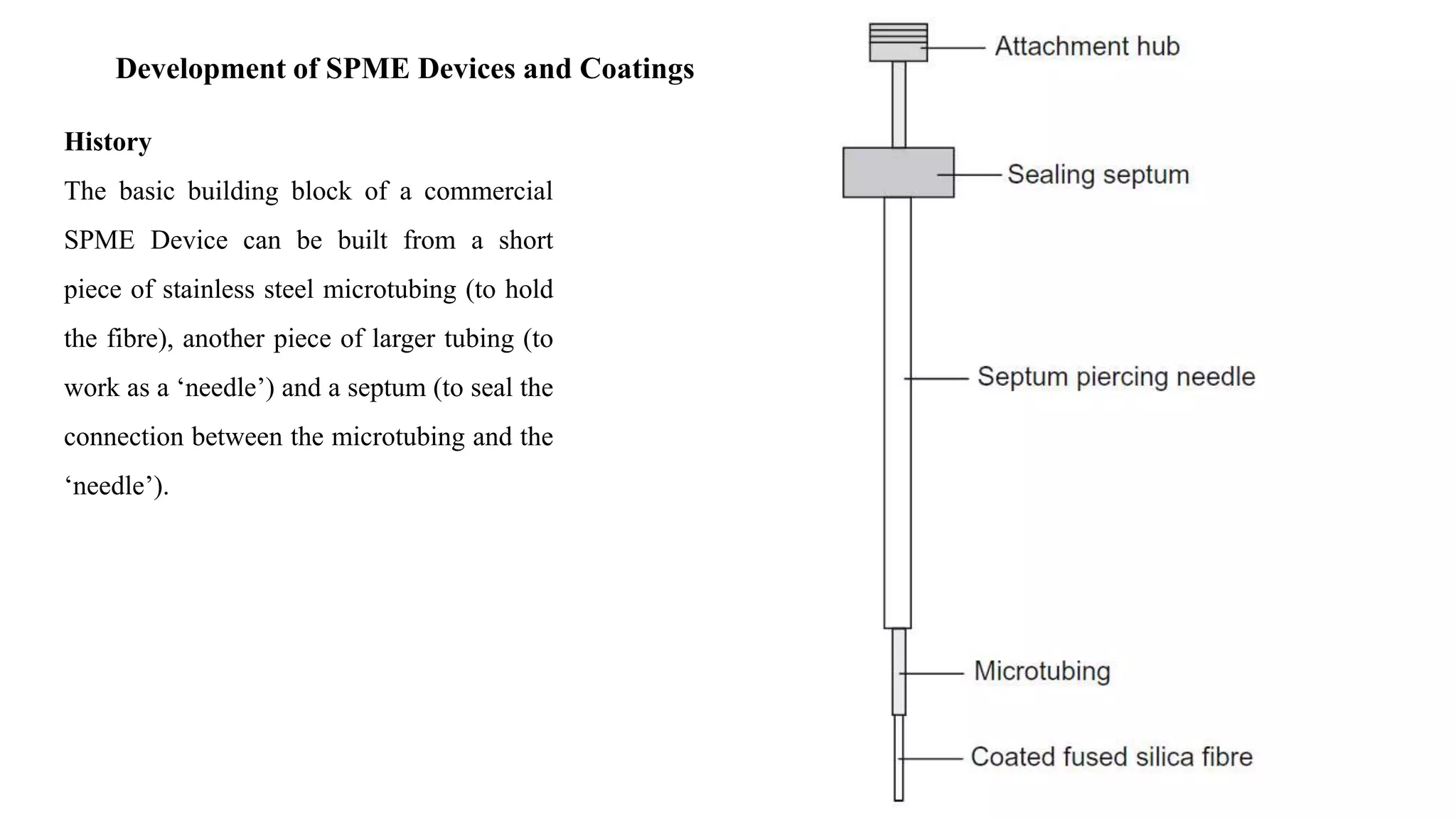
The basic building block of a commercial
SPME Device can be built from a short
piece of stainless steel microtubing (to hold
the fibre), another piece of larger tubing (to
work as a ‘needle’) and a septum (to seal the
connection between the microtubing and the
‘needle’).
Development of SPME Devices and Coatings
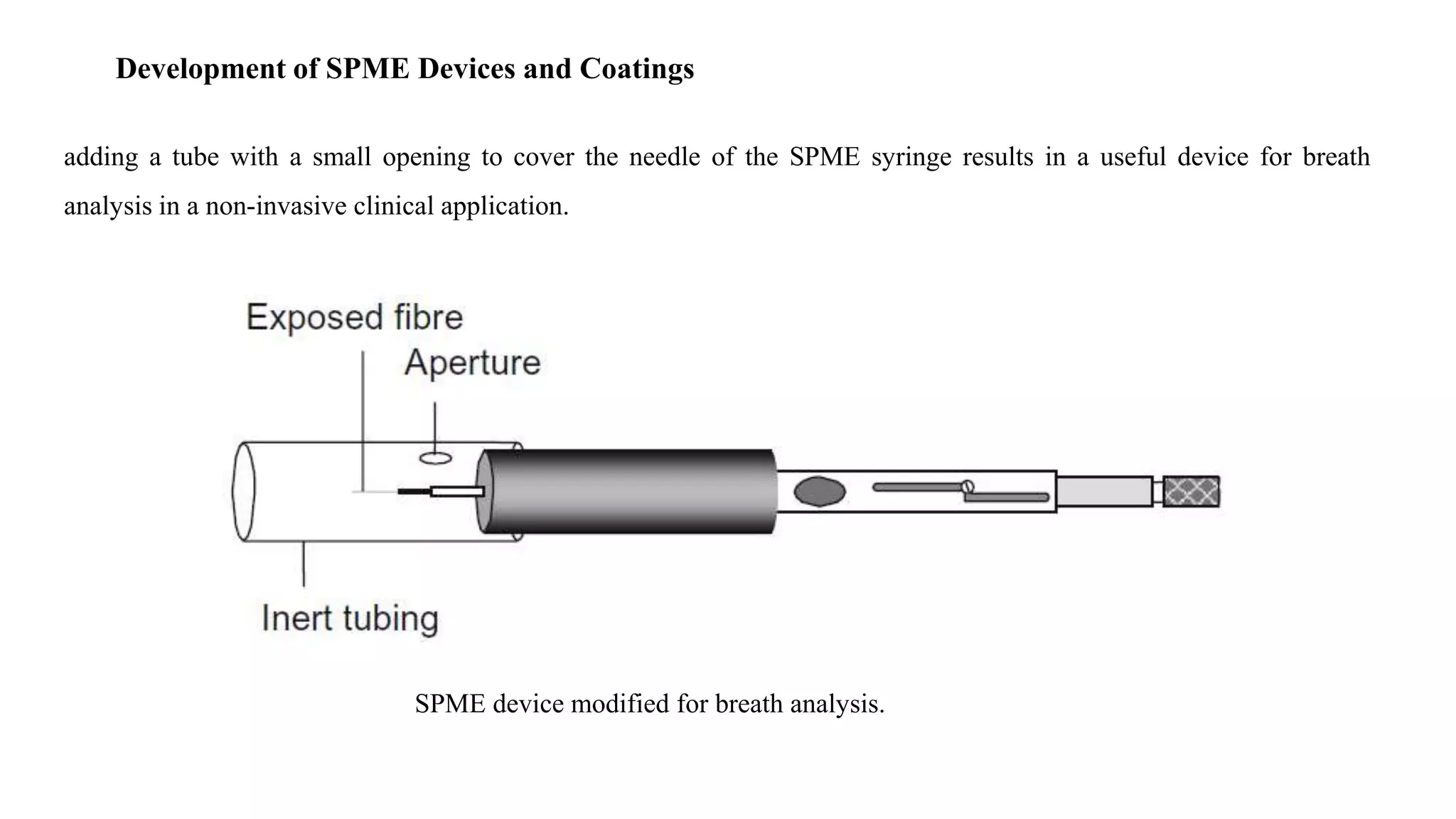
adding a tube with a small opening to cover the needle of the SPME syringe results in a useful device for breath
analysis in a non-invasive clinical application.
SPME device modified for breath analysis.
Development of SPME Devices and Coatings
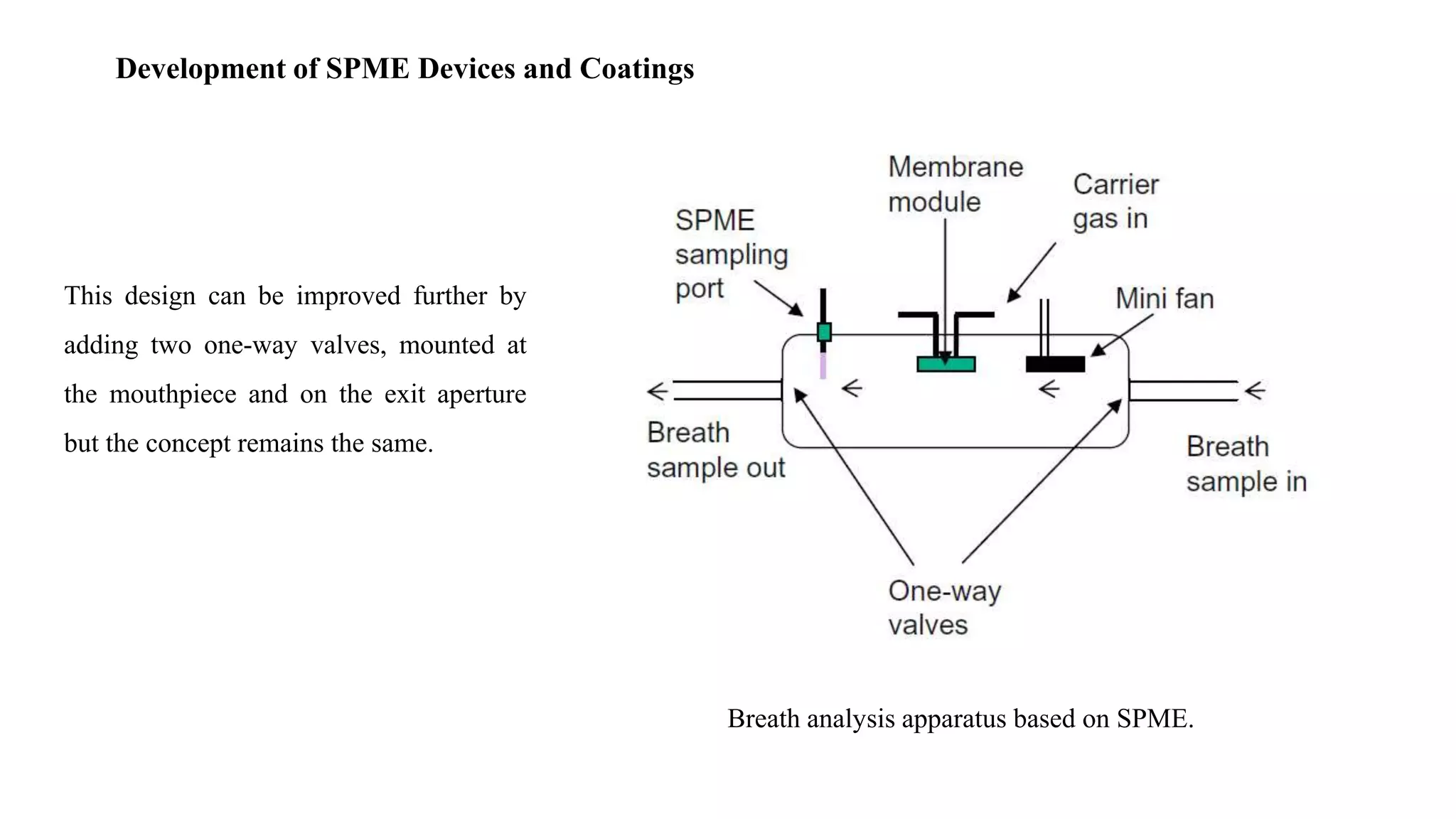
This design can be improved further by
adding two one-way valves, mounted at
the mouthpiece and on the exit aperture
but the concept remains the same.
Breath analysis apparatus based on SPME.
Development of SPME Devices and Coatings
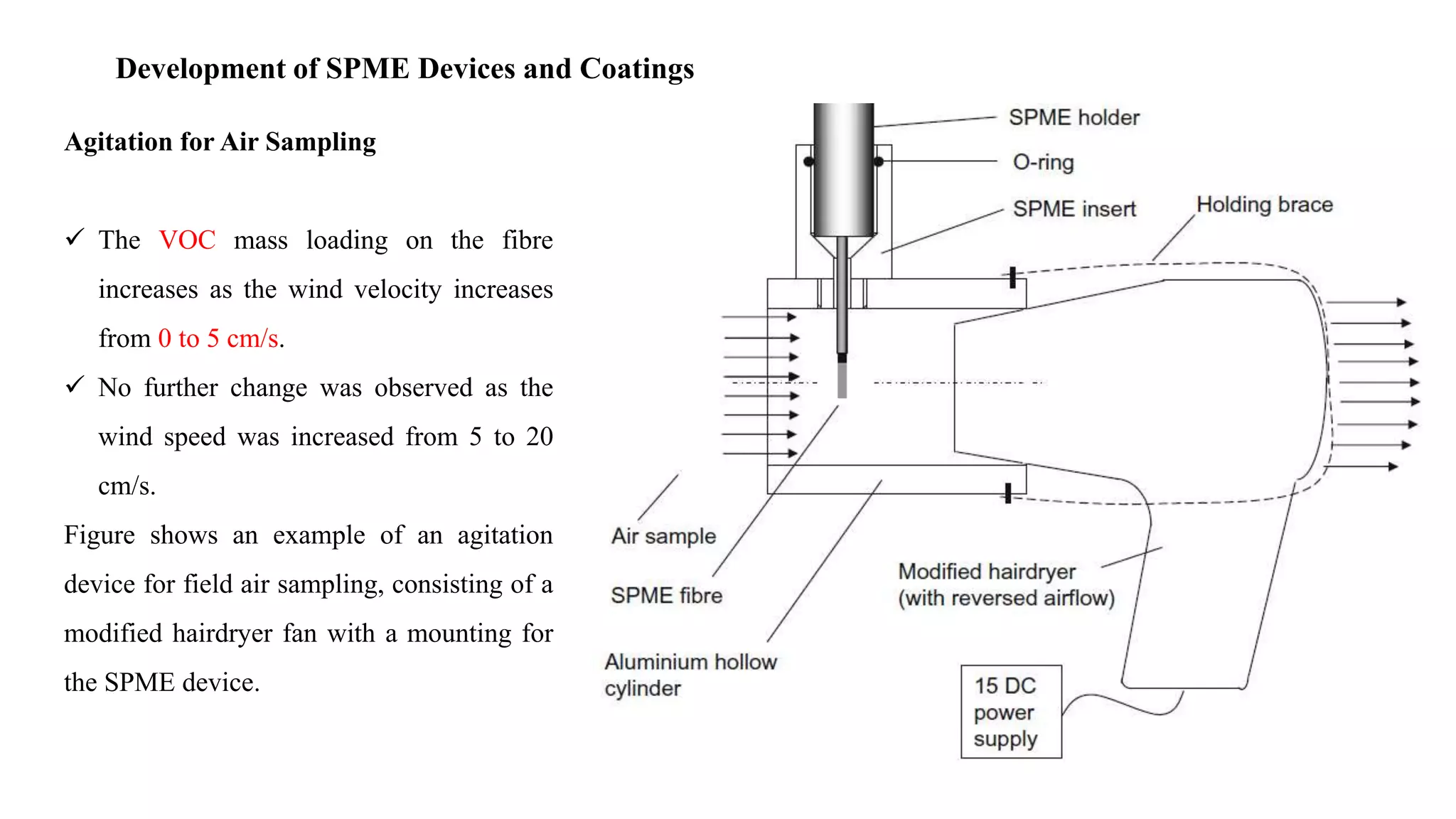
Agitation for Air Sampling
 The VOC mass loading on the fibre
increases as the wind velocity increases
from 0 to 5 cm/s.
 No further change was observed as the
wind speed was increased from 5 to 20
cm/s.
Figure shows an example of an agitation
device for field air sampling, consisting of a
modified hairdryer fan with a mounting for
the SPME device.
Development of SPME Devices and Coatings
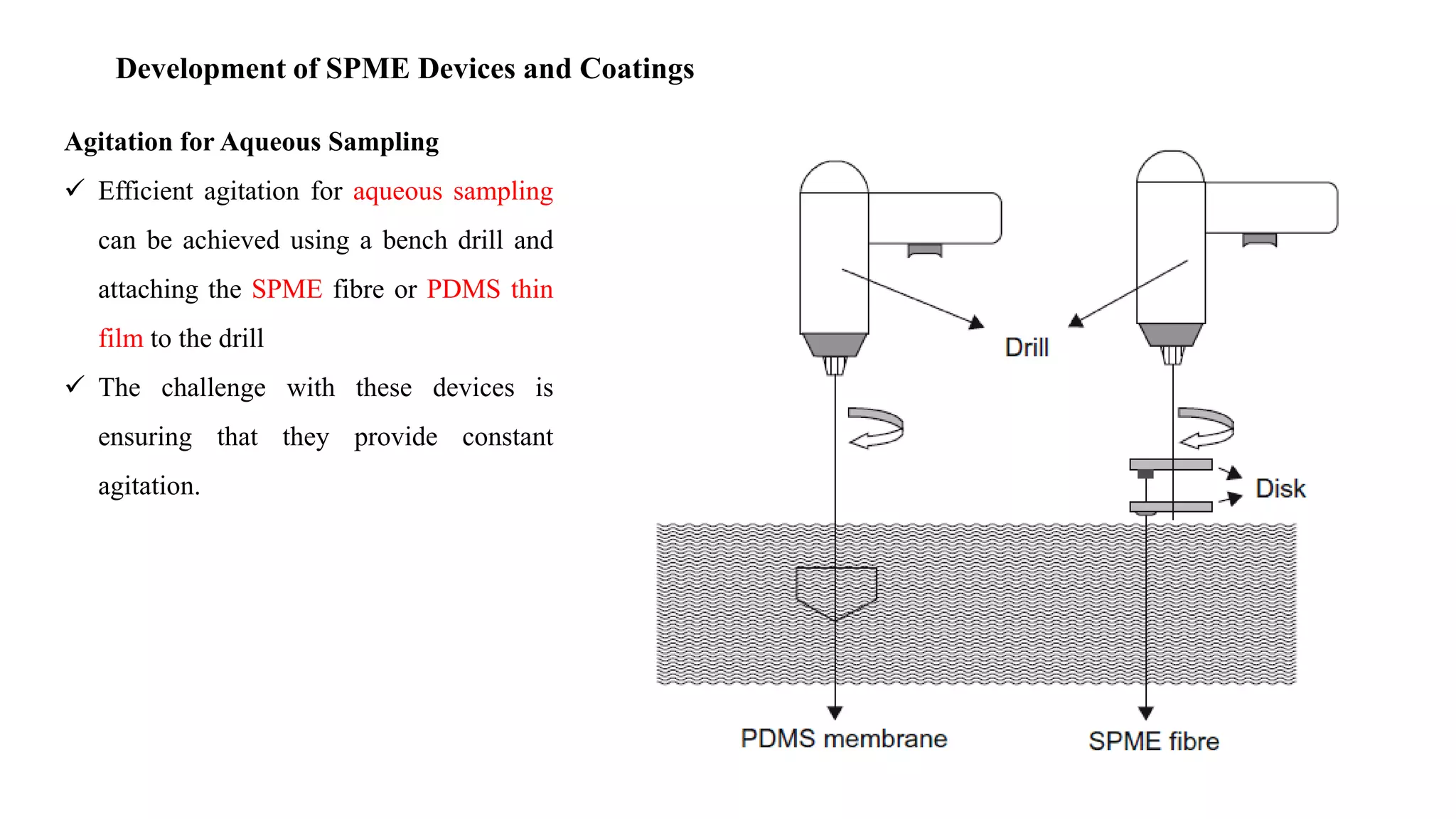
Agitation for Aqueous Sampling
 Efficient agitation for aqueous sampling
can be achieved using a bench drill and
attaching the SPME fibre or PDMS thin
film to the drill
 The challenge with these devices is
ensuring that they provide constant
agitation.
Development of SPME Devices and Coatings
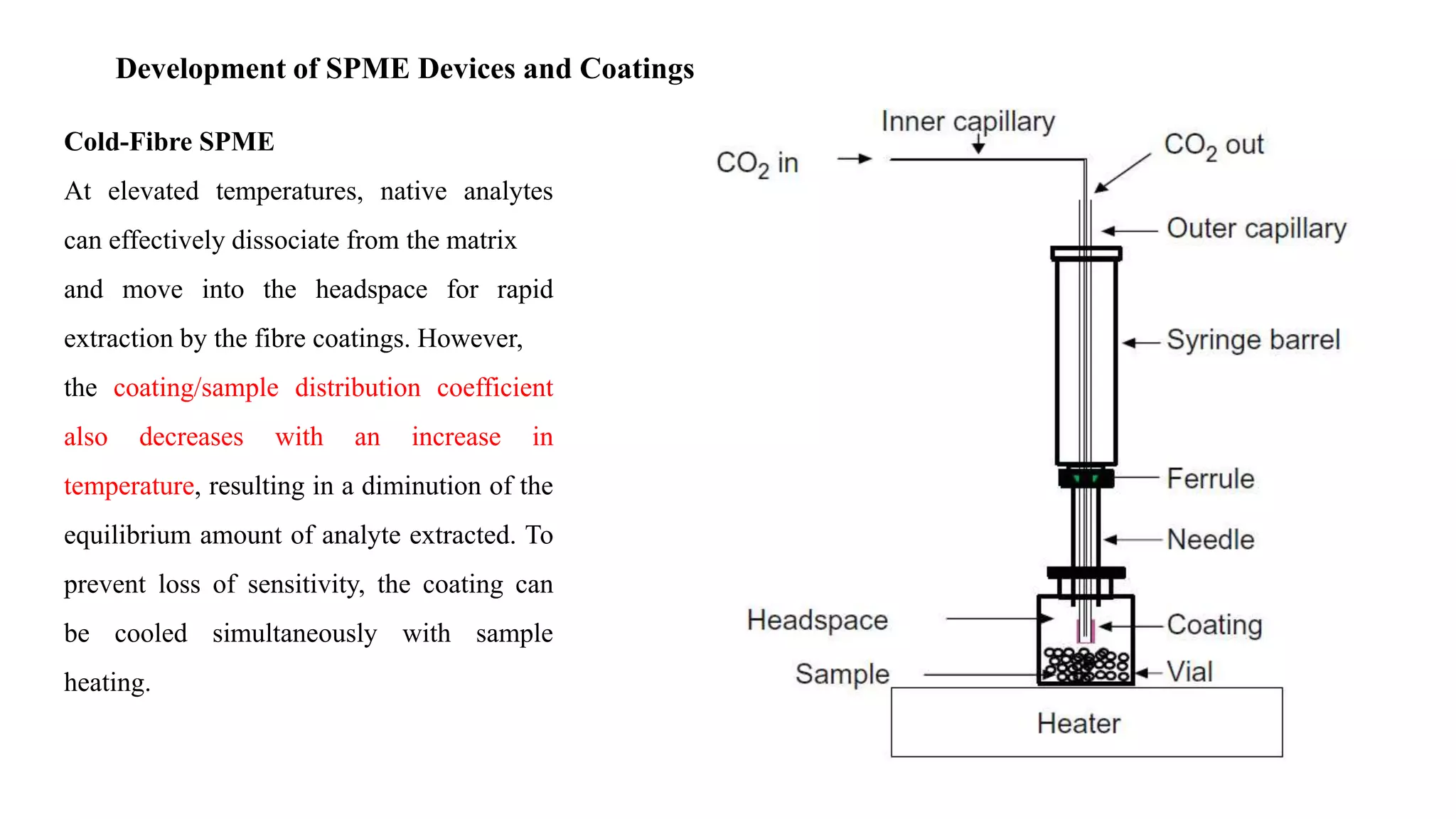
Cold-Fibre SPME
At elevated temperatures, native analytes
can effectively dissociate from the matrix
and move into the headspace for rapid
extraction by the fibre coatings. However,
the coating/sample distribution coefficient
also decreases with an increase in
temperature, resulting in a diminution of the
equilibrium amount of analyte extracted. To
prevent loss of sensitivity, the coating can
be cooled simultaneously with sample
heating.
Development of SPME Devices and Coatings
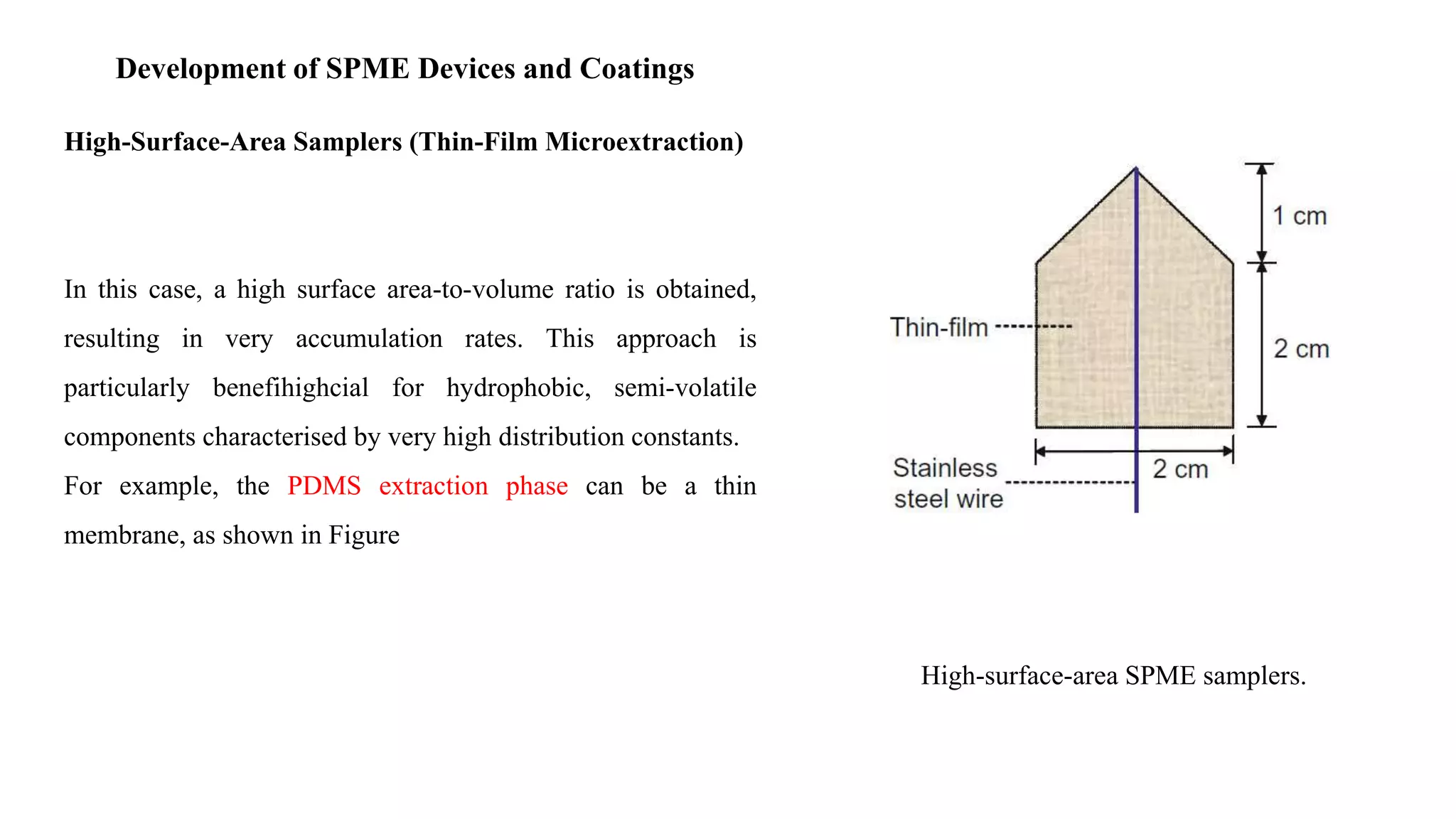
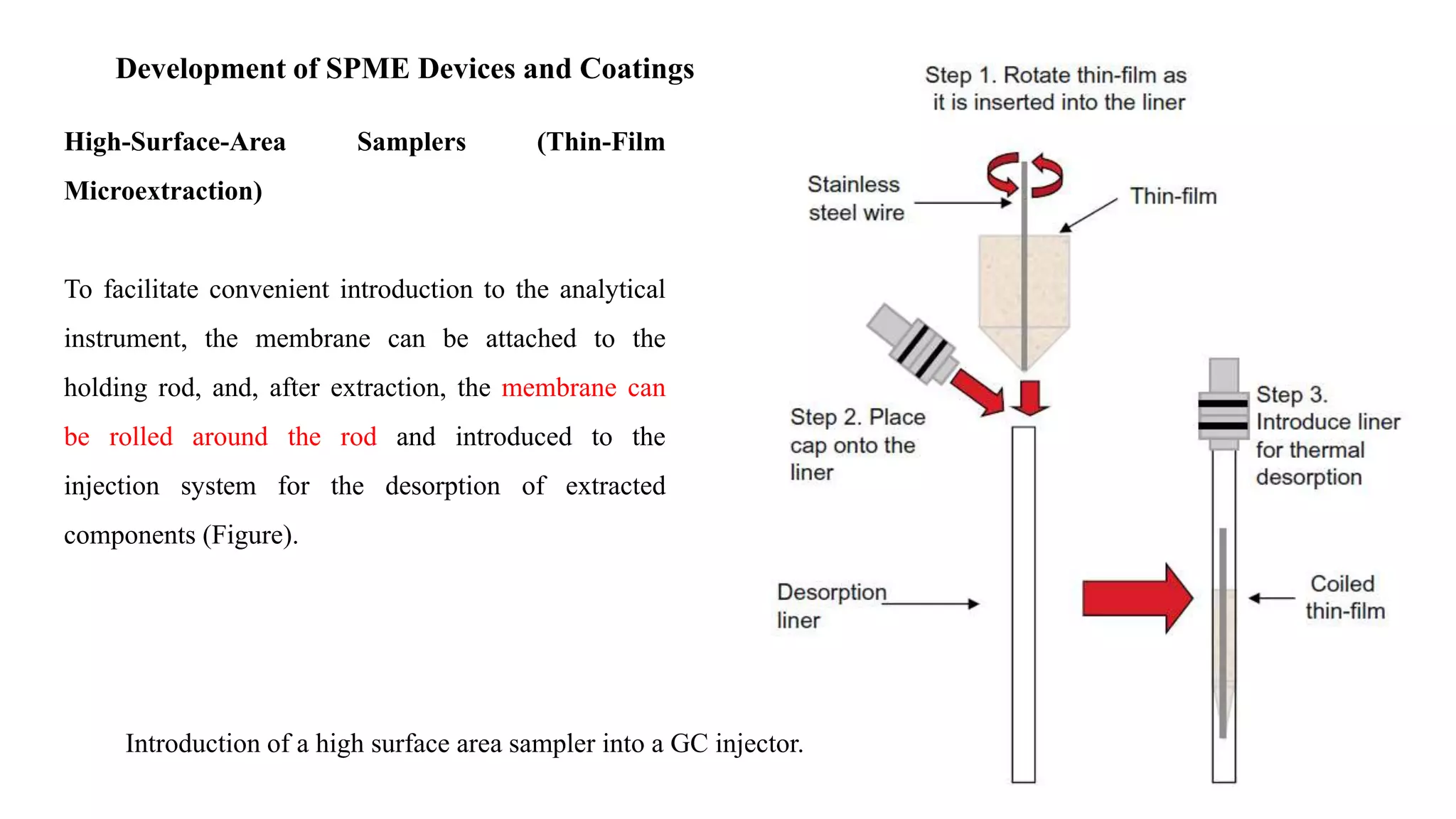
High-Surface-Area Samplers (Thin-Film Microextraction)
In this case, a high surface area-to-volume ratio is obtained,
resulting in very accumulation rates. This approach is
particularly benefihighcial for hydrophobic, semi-volatile
components characterised by very high distribution constants.
For example, the PDMS extraction phase can be a thin
membrane, as shown in Figure
High-surface-area SPME samplers.
Development of SPME Devices and Coatings
High-Surface-Area Samplers (Thin-Film
Microextraction)
To facilitate convenient introduction to the analytical
instrument, the membrane can be attached to the
holding rod, and, after extraction, the membrane can
be rolled around the rod and introduced to the
injection system for the desorption of extracted
components (Figure).
Introduction of a high surface area sampler into a GC injector.
Development of SPME Devices and Coatings
Time-weighted-average (TWA)
devices
Chen and Pawliszyn used the fibre-
retracted SPME device to determine
the TWA concentrations of VOCs in
air and demonstrated that the face
velocity of air across the needle
opening does not affect sampling,
due to the extremely small inner
diameter of the fibre needle.
Development of SPME Devices and Coatings
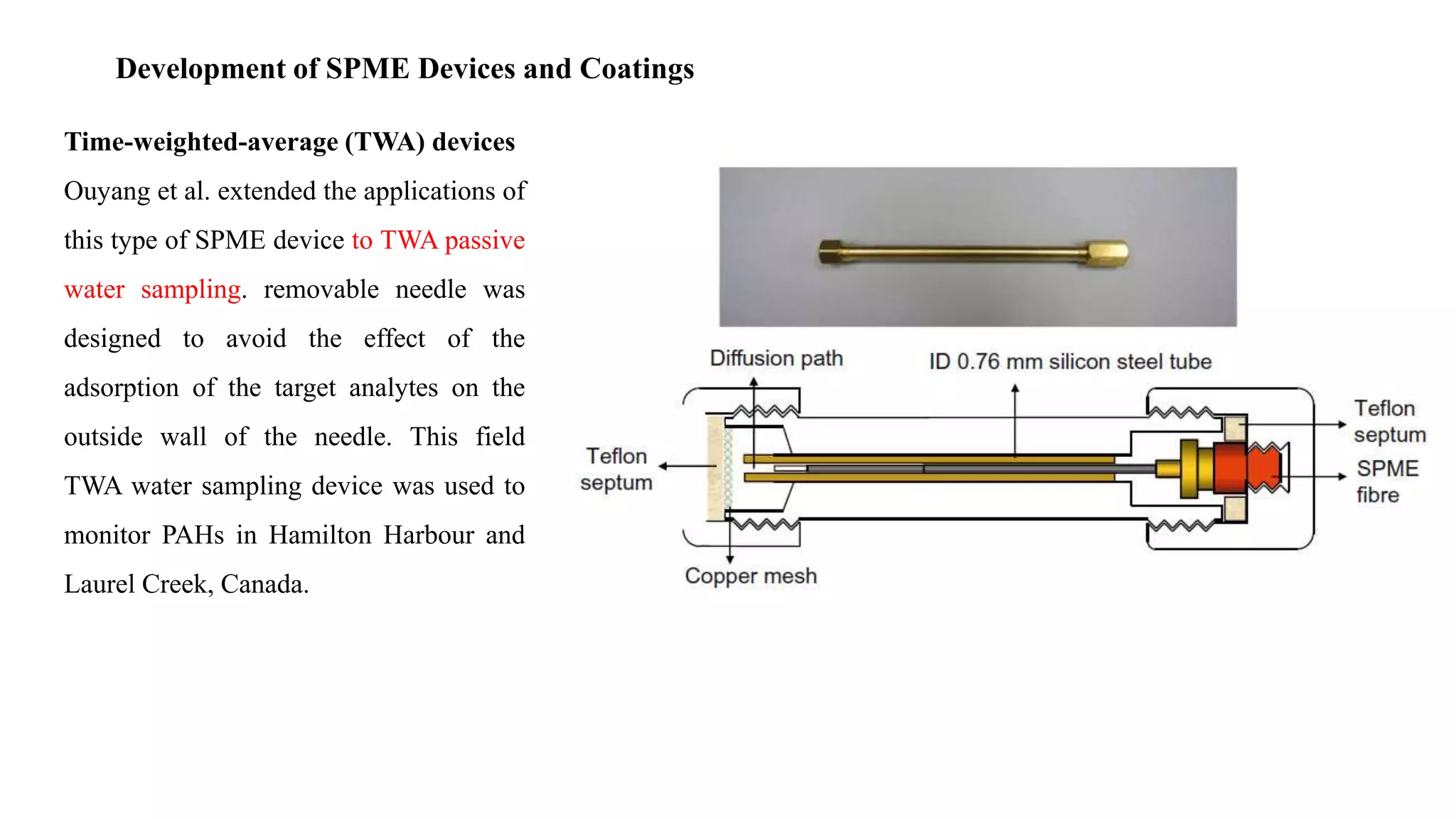
Time-weighted-average (TWA) devices
Ouyang et al. extended the applications of
this type of SPME device to TWA passive
water sampling. removable needle was
designed to avoid the effect of the
adsorption of the target analytes on the
outside wall of the needle. This field
TWA water sampling device was used to
monitor PAHs in Hamilton Harbour and
Laurel Creek, Canada.
Development of SPME Devices and Coatings
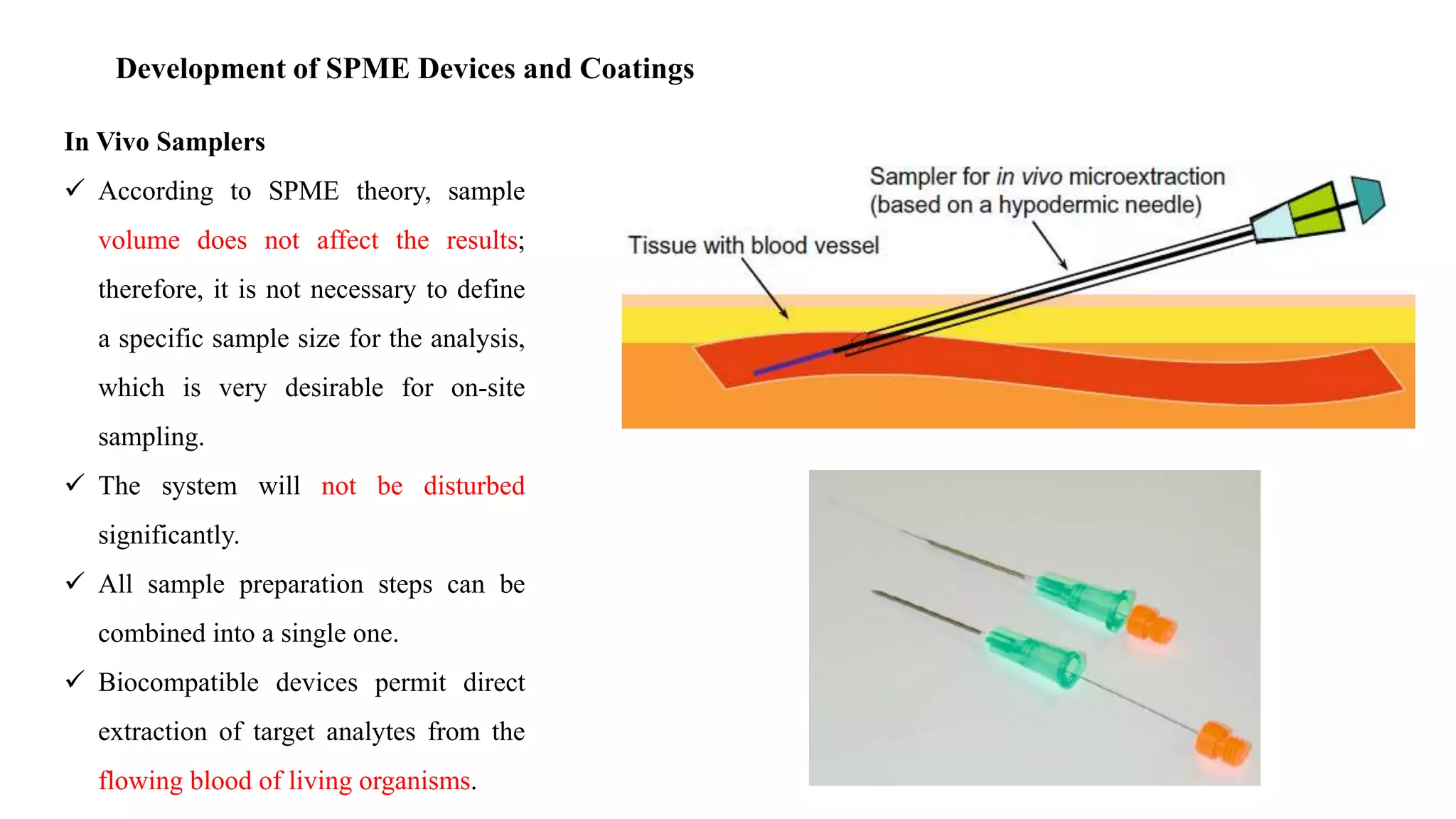
In Vivo Samplers
 According to SPME theory, sample
volume does not affect the results;
therefore, it is not necessary to define
a specific sample size for the analysis,
which is very desirable for on-site
sampling.
 The system will not be disturbed
significantly.
 All sample preparation steps can be
combined into a single one.
 Biocompatible devices permit direct
extraction of target analytes from the
flowing blood of living organisms.
Development of SPME Devices and Coatings
In Vivo Samplers
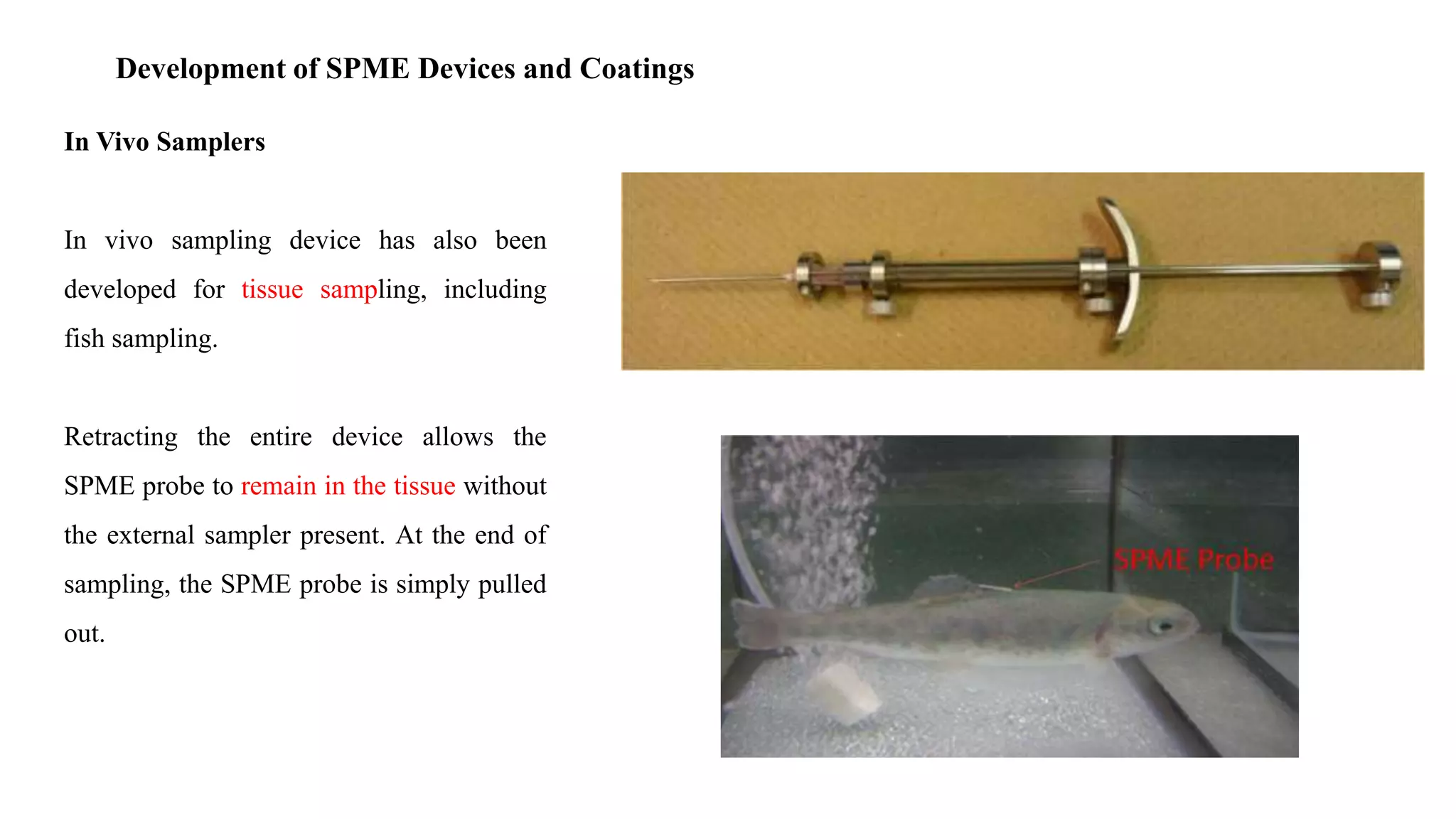
In vivo sampling device has also been
developed for tissue sampling, including
fish sampling.
Retracting the entire device allows the
SPME probe to remain in the tissue without
the external sampler present. At the end of
sampling, the SPME probe is simply pulled
out.
Development of SPME Devices and Coatings
Development of New SPME Coatings
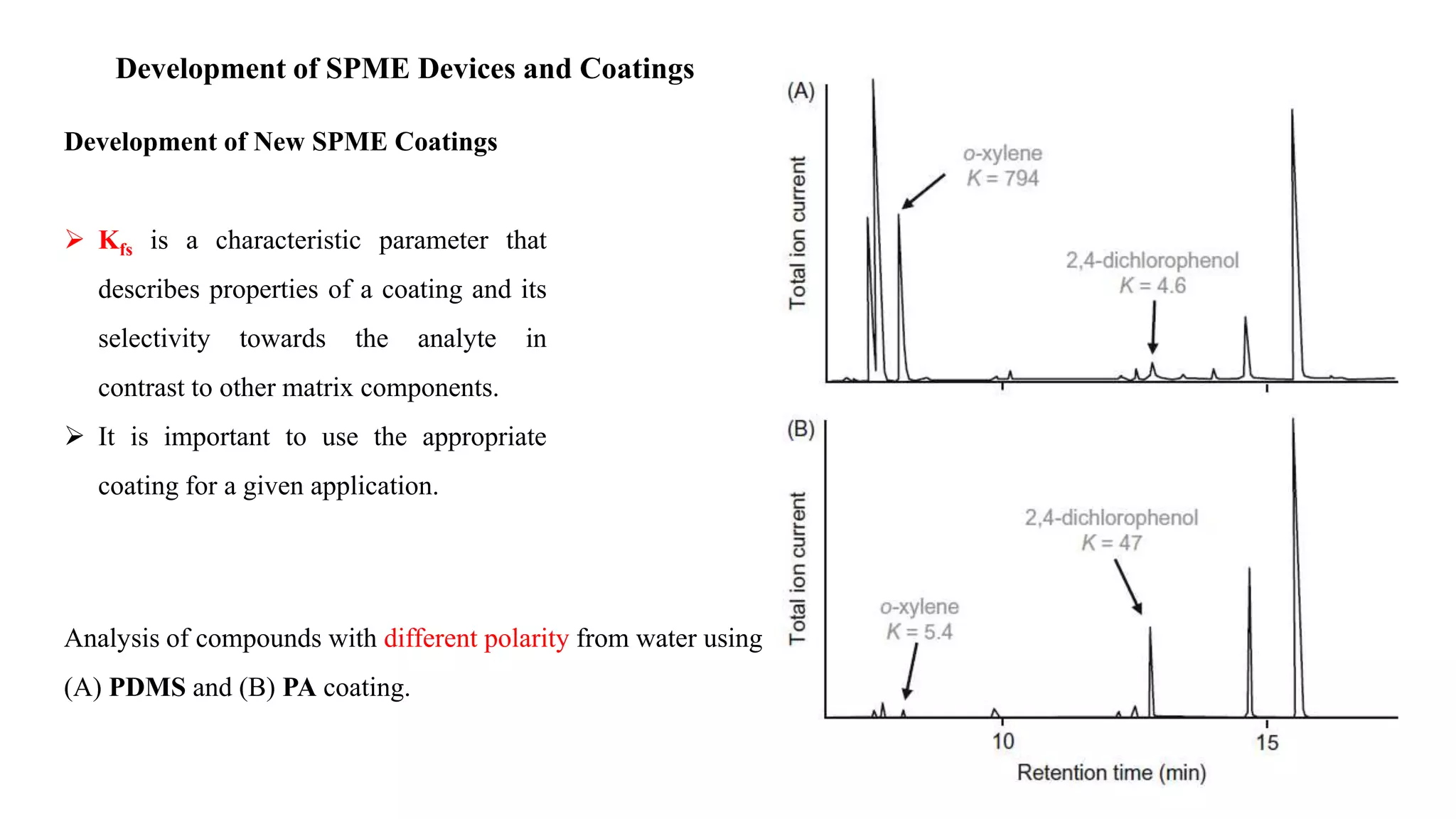
 Kfs is a characteristic parameter that
describes properties of a coating and its
selectivity towards the analyte in
contrast to other matrix components.
 It is important to use the appropriate
coating for a given application.
Analysis of compounds with different polarity from water using
(A) PDMS and (B) PA coating.
Development of SPME Devices and Coatings
Development of New SPME Coatings
Coating Preparation Methods:
• Dipping Technique
• Electrodeposition
• Hollow Fibre Membranes/Adhesive Tape
• Adhesion of Coatings
• Conducting Polymers
• Sol-Gel Coatings
Affinity-Based Coatings:
• Molecularly Imprinted Polymer Coating
• Immunoaffinity Coatings
Development of SPME Devices and Coatings
Development of New SPME Coatings
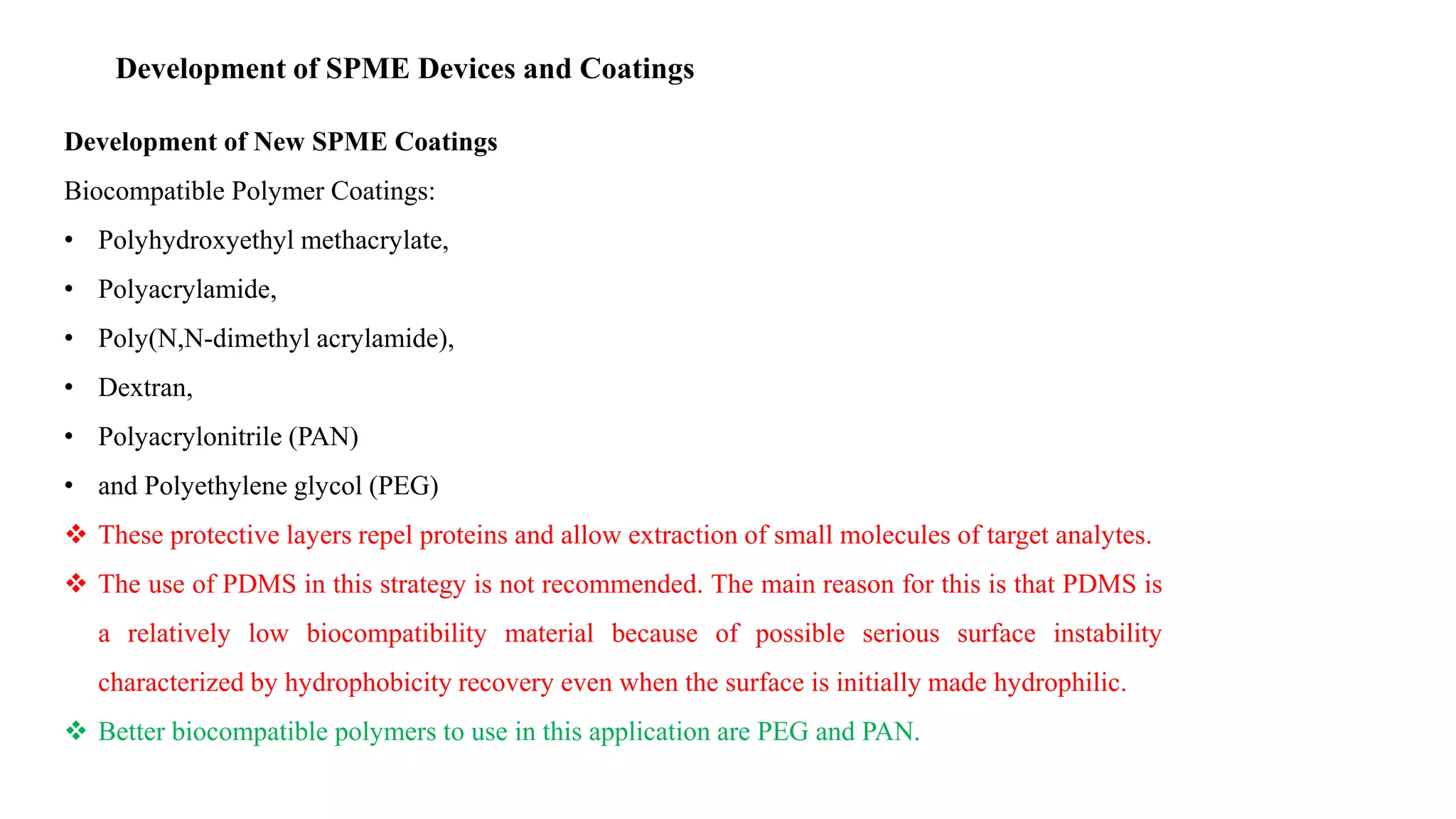
Biocompatible Polymer Coatings:
• Polyhydroxyethyl methacrylate,
• Polyacrylamide,
• Poly(N,N-dimethyl acrylamide),
• Dextran,
• Polyacrylonitrile (PAN)
• and Polyethylene glycol (PEG)
 These protective layers repel proteins and allow extraction of small molecules of target analytes.
 The use of PDMS in this strategy is not recommended. The main reason for this is that PDMS is
a relatively low biocompatibility material because of possible serious surface instability
characterized by hydrophobicity recovery even when the surface is initially made hydrophilic.
 Better biocompatible polymers to use in this application are PEG and PAN.
Interfaces to Analytical Instrumentation
SPME-GC Interface
 Standard GC injectors, such as split/splitless, can be applied to SPME as long as a narrow insert with an i.d.
close to the o.d. of the needle is used.
 The split should be turned off during SPME injection.
 One way to obtain sharper injection zones and faster separation times is to use rapid injection autosampling
devices.
Interfaces to Analytical Instrumentation
SPME-GC Interface
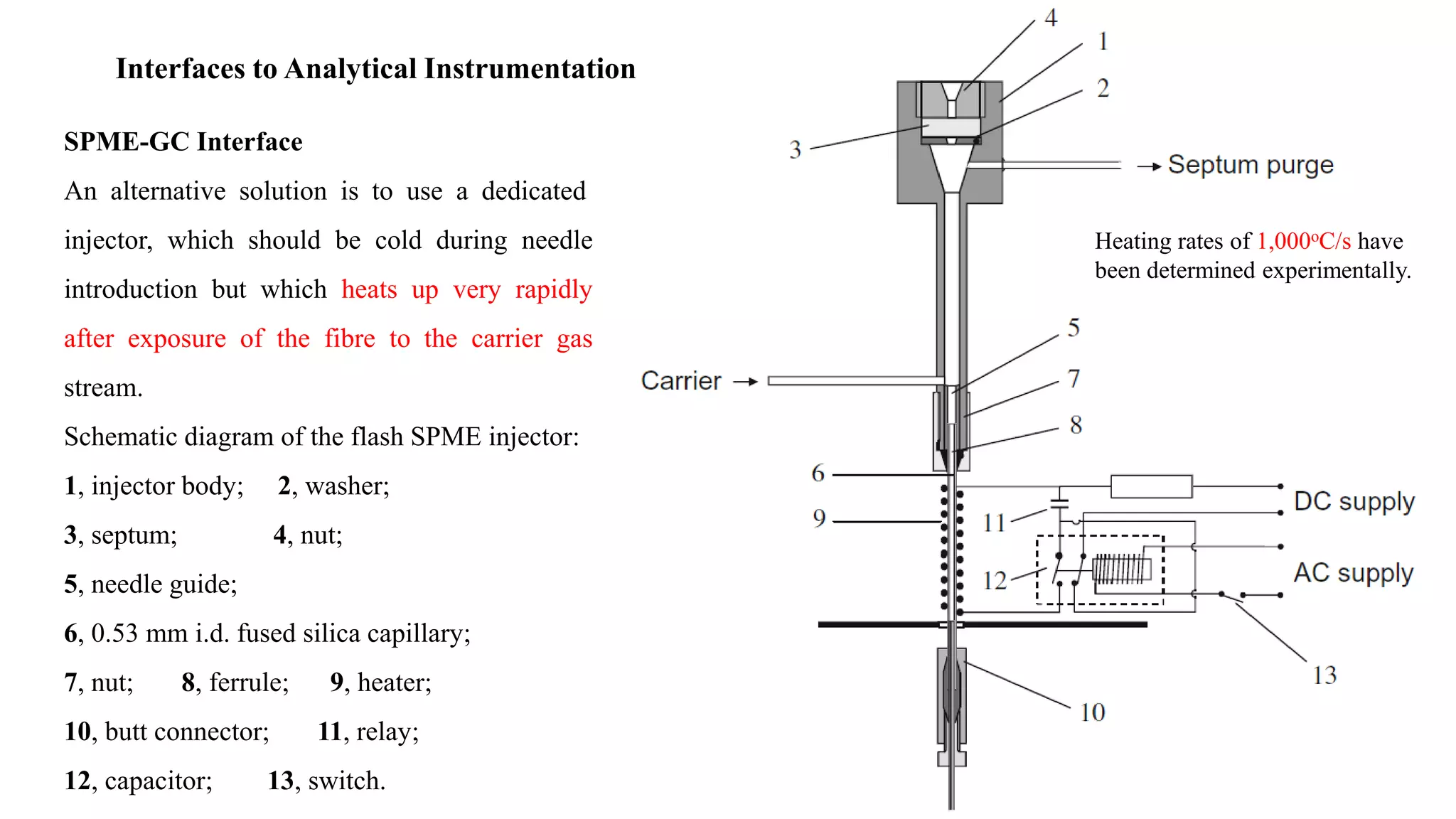
An alternative solution is to use a dedicated
injector, which should be cold during needle
introduction but which heats up very rapidly
after exposure of the fibre to the carrier gas
stream.
Schematic diagram of the flash SPME injector:
1, injector body; 2, washer;
3, septum; 4, nut;
5, needle guide;
6, 0.53 mm i.d. fused silica capillary;
7, nut; 8, ferrule; 9, heater;
10, butt connector; 11, relay;
12, capacitor; 13, switch.
Heating rates of 1,000oC/s have
been determined experimentally.
Interfaces to Analytical Instrumentation
SPME-GC Interface
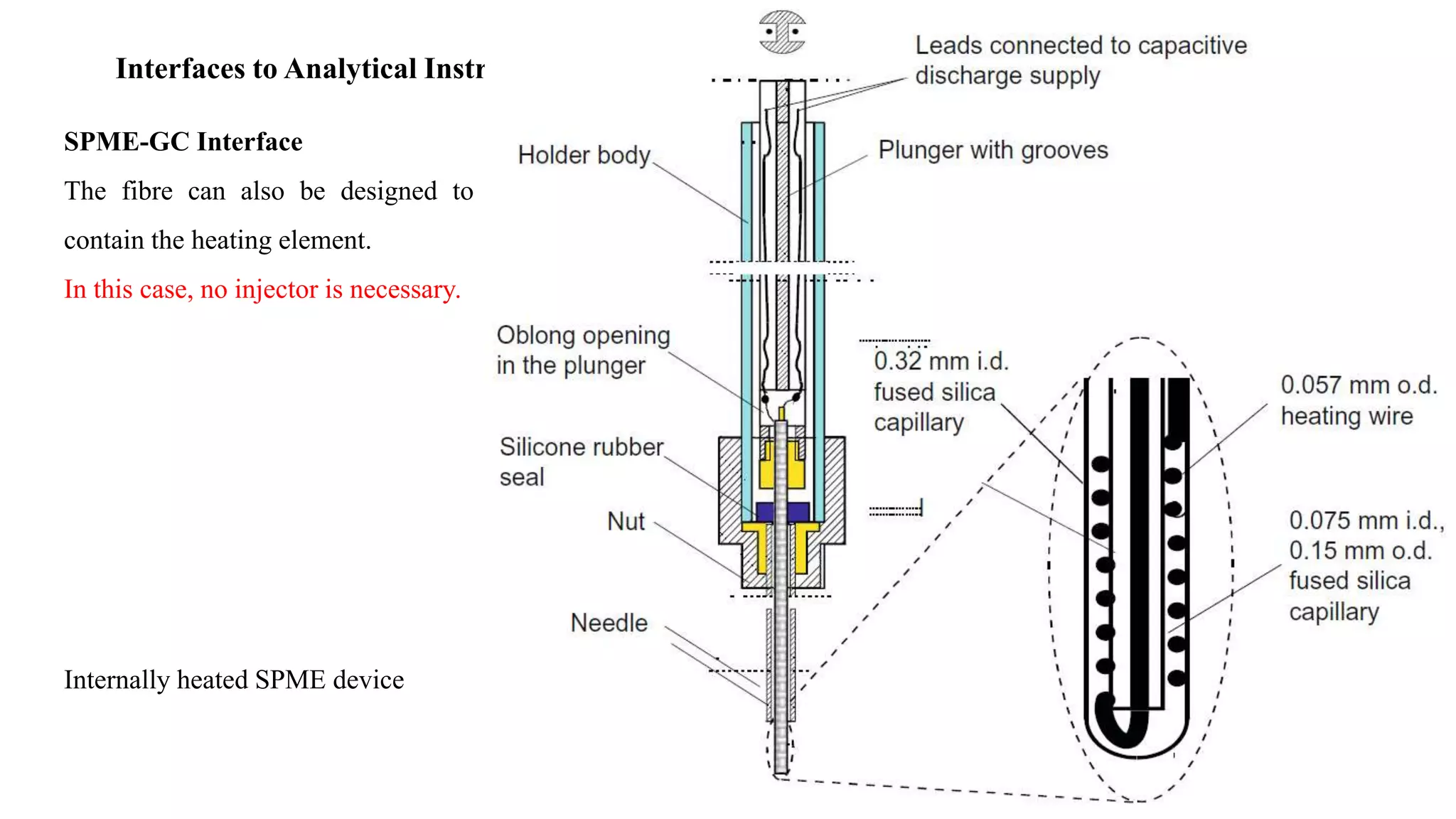
The fibre can also be designed to
contain the heating element.
In this case, no injector is necessary.
Internally heated SPME device
Interfaces to Analytical Instrumentation
SPME-GC Interface
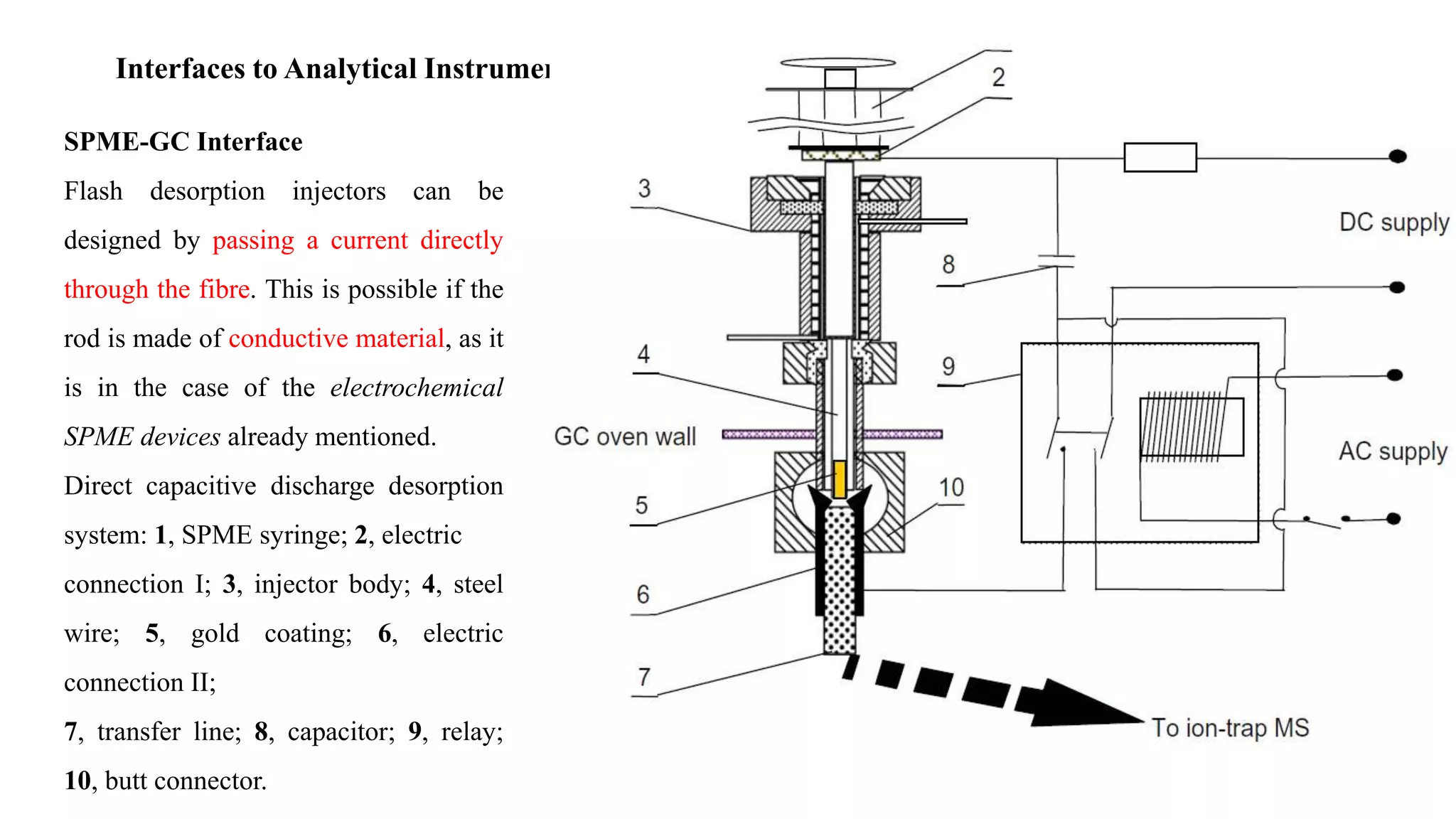
Flash desorption injectors can be
designed by passing a current directly
through the fibre. This is possible if the
rod is made of conductive material, as it
is in the case of the electrochemical
SPME devices already mentioned.
Direct capacitive discharge desorption
system: 1, SPME syringe; 2, electric
connection I; 3, injector body; 4, steel
wire; 5, gold coating; 6, electric
connection II;
7, transfer line; 8, capacitor; 9, relay;
10, butt connector.
Interfaces to Analytical Instrumentation
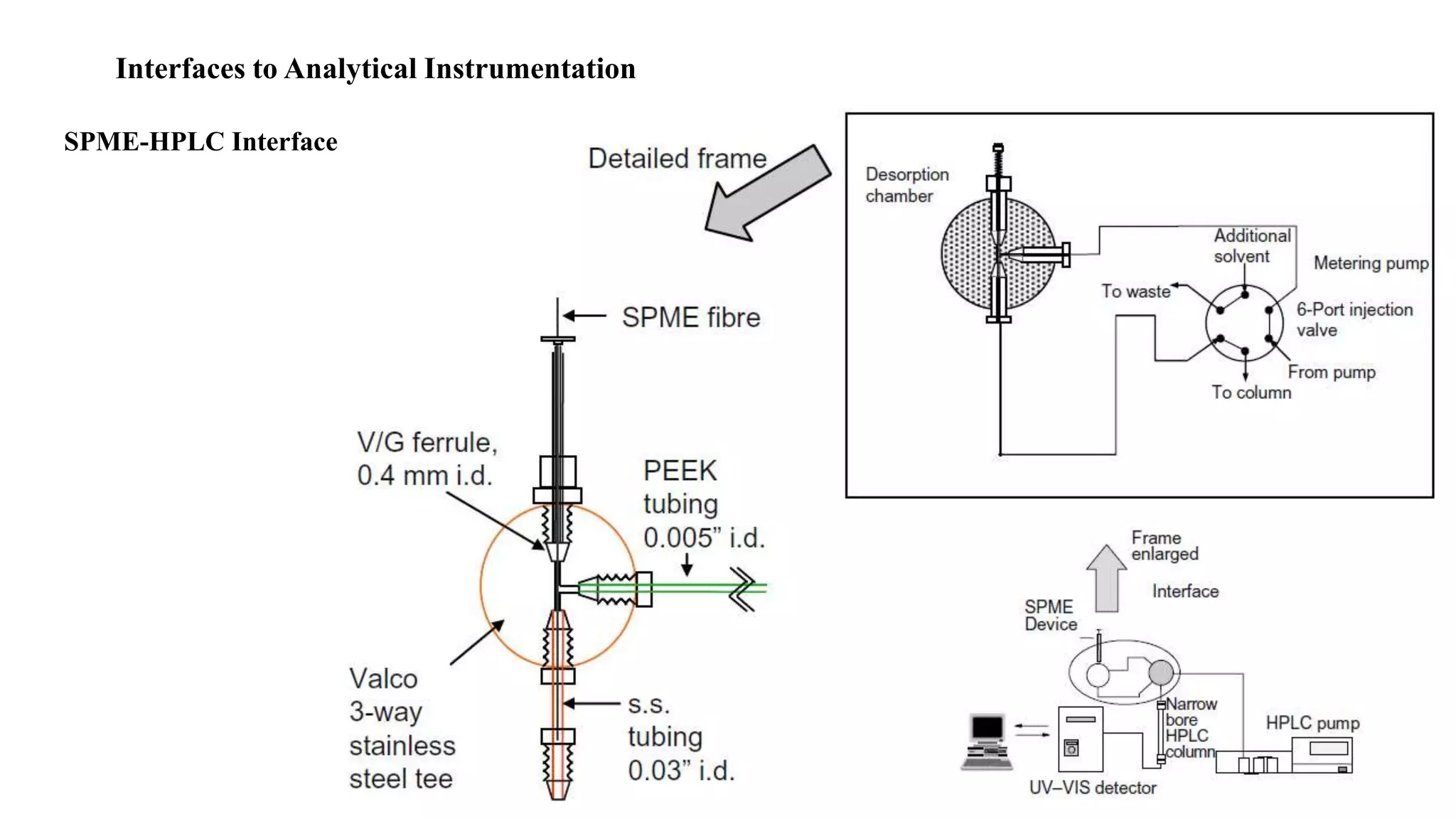
SPME-HPLC Interface
Research effort has also focused on designing interfaces for liquid-phase separation techniques to address the
need for analysis of non-volatile and thermally labile analytes.
 A typical SPME-HPLC interface consists of a custom-made desorption chamber and a six-port injection
valve.
 The internal tubing of the SPME device, which holds the fibre, can be sealed by the PEEK tubing and the
tee-union tightly enough to withstand solvent pressures as high as 4,500 psi.
 When the injection valve is in the ‘load’ position, it allows the fibre to be introduced into the desorption
chamber under ambient pressure.
 The valve is then switched to ‘inject’ to transfer the desorbed analytes to the column.
 A heater can be installed in the device to facilitate the desorption process.
Interfaces to Analytical Instrumentation
SPME-HPLC Interface
Interfaces to Analytical Instrumentation
SPME-MALDI Interface
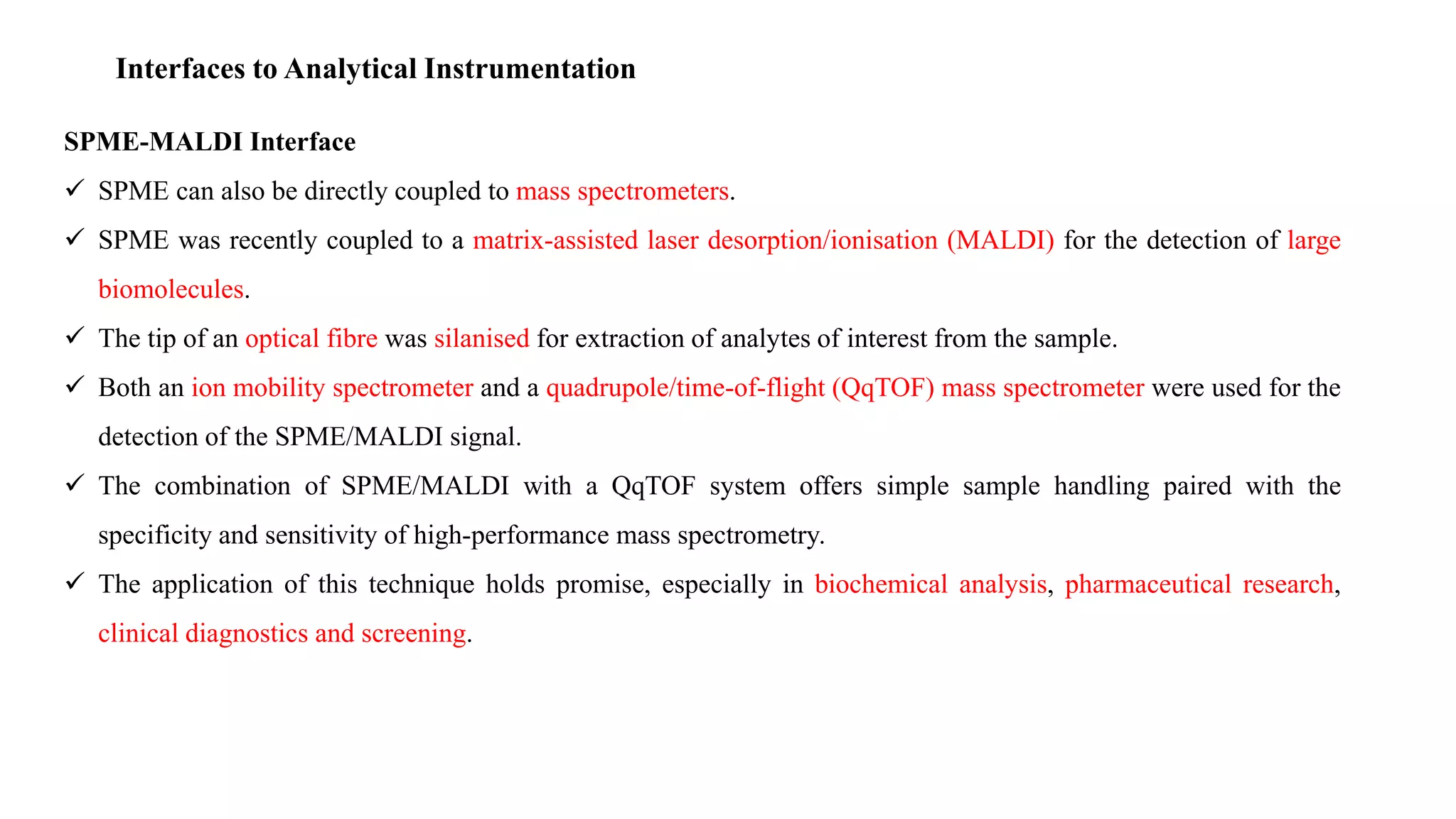
 SPME can also be directly coupled to mass spectrometers.
 SPME was recently coupled to a matrix-assisted laser desorption/ionisation (MALDI) for the detection of large
biomolecules.
 The tip of an optical fibre was silanised for extraction of analytes of interest from the sample.
 Both an ion mobility spectrometer and a quadrupole/time-of-flight (QqTOF) mass spectrometer were used for the
detection of the SPME/MALDI signal.
 The combination of SPME/MALDI with a QqTOF system offers simple sample handling paired with the
specificity and sensitivity of high-performance mass spectrometry.
 The application of this technique holds promise, especially in biochemical analysis, pharmaceutical research,
clinical diagnostics and screening.
Interfaces to Analytical Instrumentation
SPME-MALDI Interface
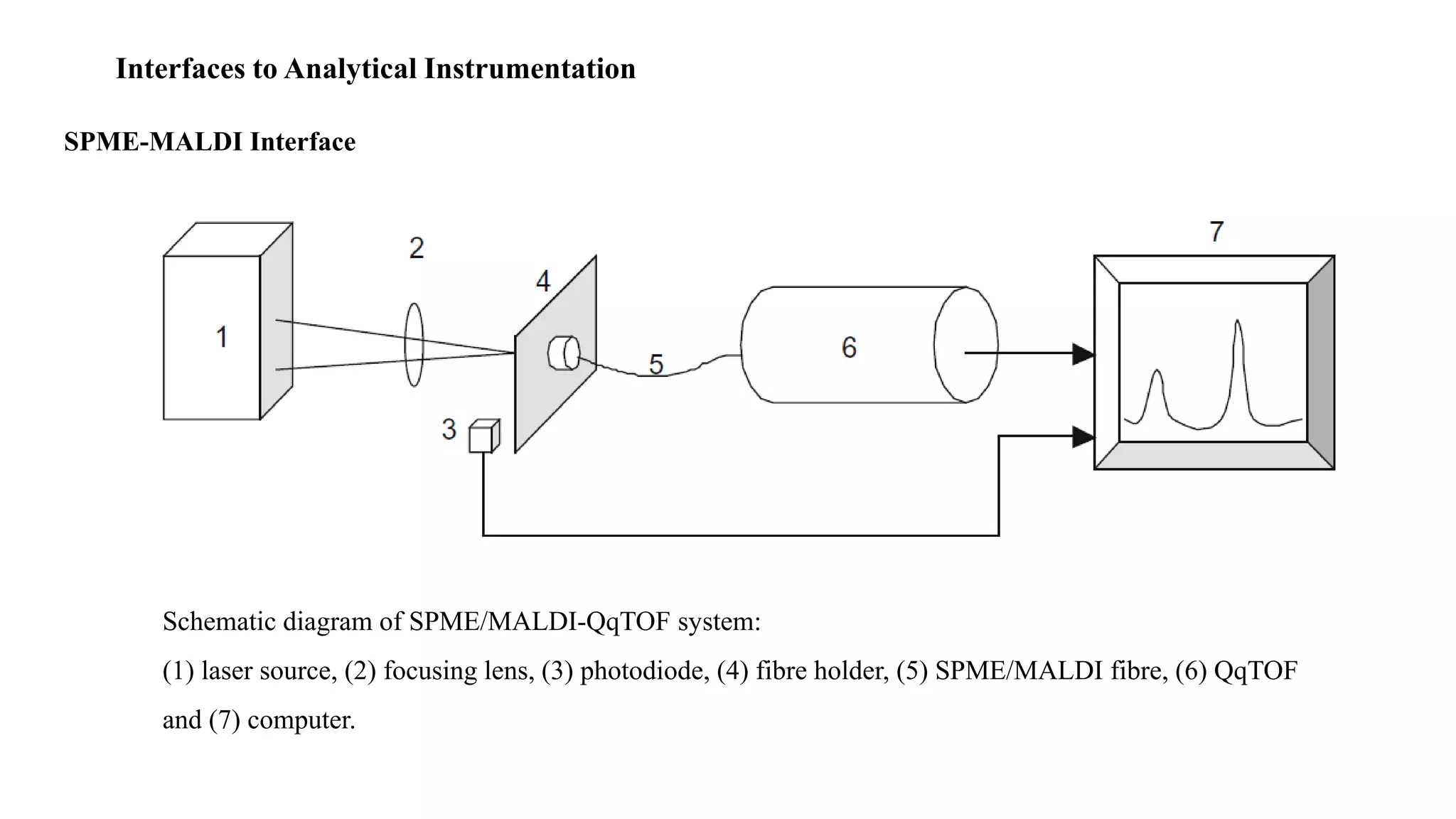
Schematic diagram of SPME/MALDI-QqTOF system:
(1) laser source, (2) focusing lens, (3) photodiode, (4) fibre holder, (5) SPME/MALDI fibre, (6) QqTOF
and (7) computer.
Interfaces to Analytical Instrumentation
SPME-CE
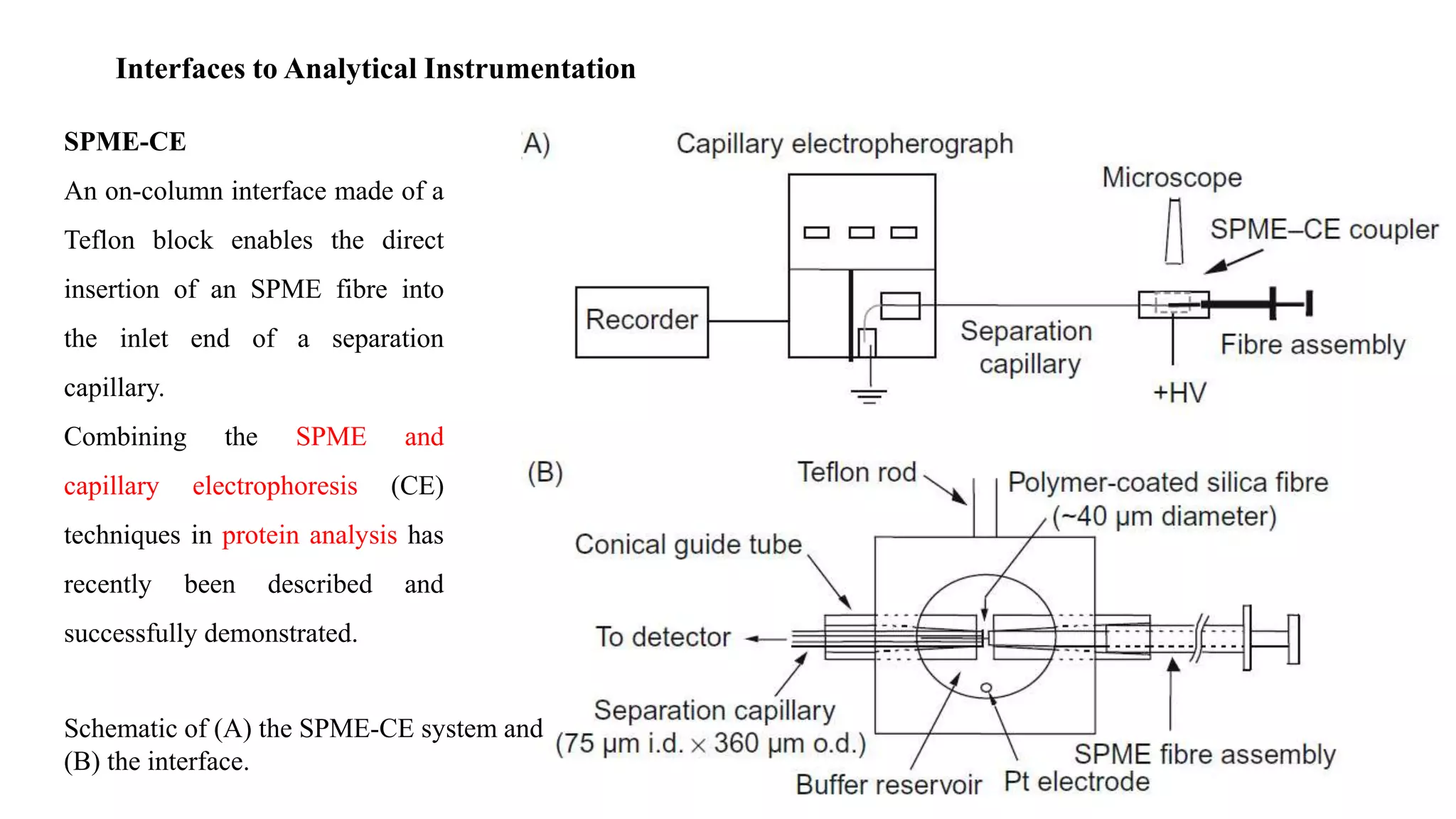
An on-column interface made of a
Teflon block enables the direct
insertion of an SPME fibre into
the inlet end of a separation
capillary.
Combining the SPME and
capillary electrophoresis (CE)
techniques in protein analysis has
recently been described and
successfully demonstrated.
Schematic of (A) the SPME-CE system and
(B) the interface.
Interfaces to Analytical Instrumentation
Other Interfaces
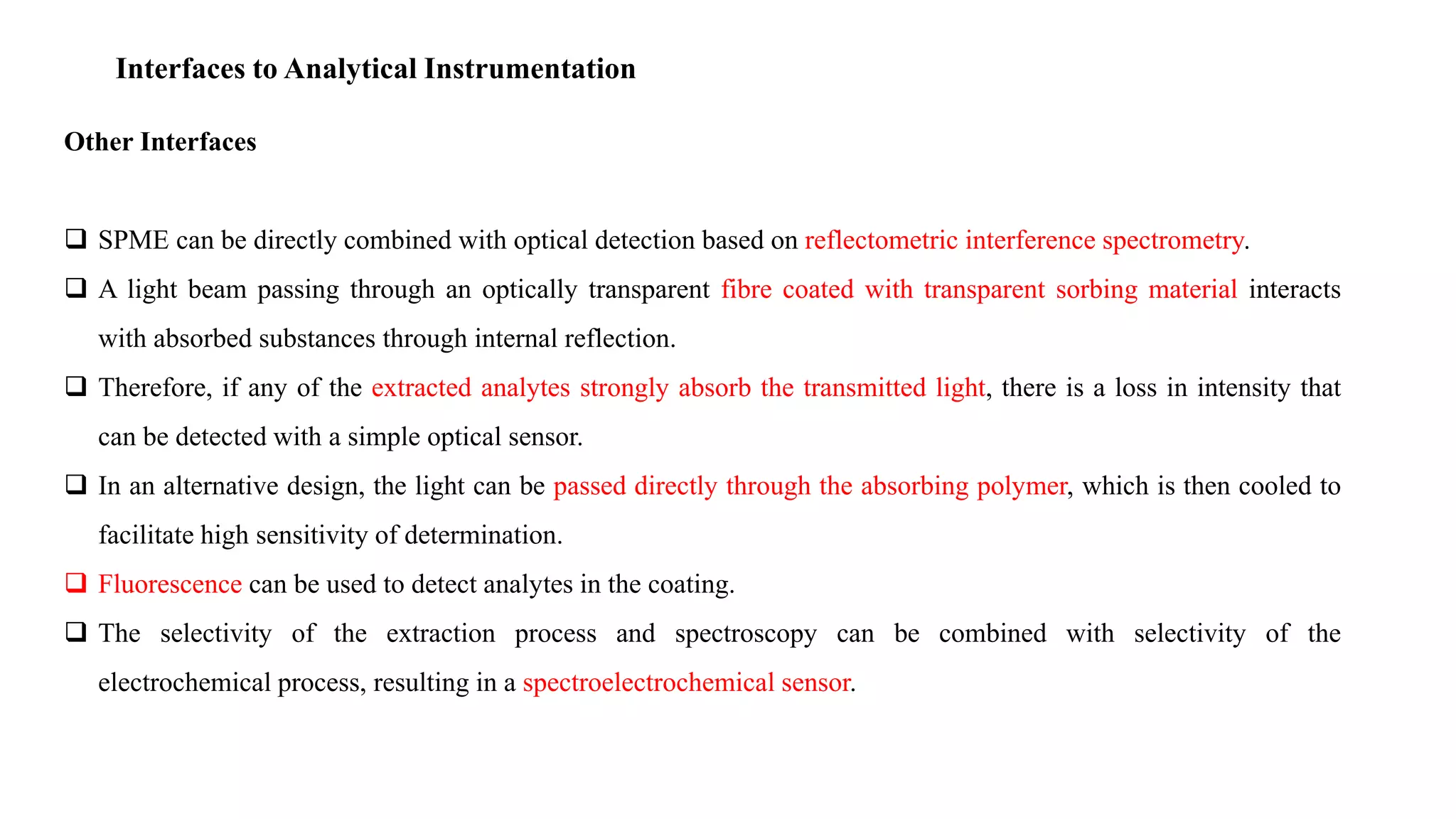
 SPME can be directly combined with optical detection based on reflectometric interference spectrometry.
 A light beam passing through an optically transparent fibre coated with transparent sorbing material interacts
with absorbed substances through internal reflection.
 Therefore, if any of the extracted analytes strongly absorb the transmitted light, there is a loss in intensity that
can be detected with a simple optical sensor.
 In an alternative design, the light can be passed directly through the absorbing polymer, which is then cooled to
facilitate high sensitivity of determination.
 Fluorescence can be used to detect analytes in the coating.
 The selectivity of the extraction process and spectroscopy can be combined with selectivity of the
electrochemical process, resulting in a spectroelectrochemical sensor.
Section 3: some case studies
Anubhav Diwan,1 Bhupinder Singh,1 Tuhin Roychowdhury,1 DanDan Yan,2 Laura Tedone,2
Pavel N. Nesterenko,2 Brett Paull,2 Eric T. Sevy,1 Robert A. Shellie,2 Massoud Kaykhaii,3, Matthew R. Linford1,*
1 Department of Chemistry and Biochemistry, Brigham Young University, Provo, Utah 84602
2 Australian Centre for Research on Separation Science (ACROSS), School of Physical Sciences, University of
Tasmania, Sandy Bay, Hobart, Tasmania, Australia
3 Department of Chemistry, University of Sistan and Baluchestan, Zahedan, Iran
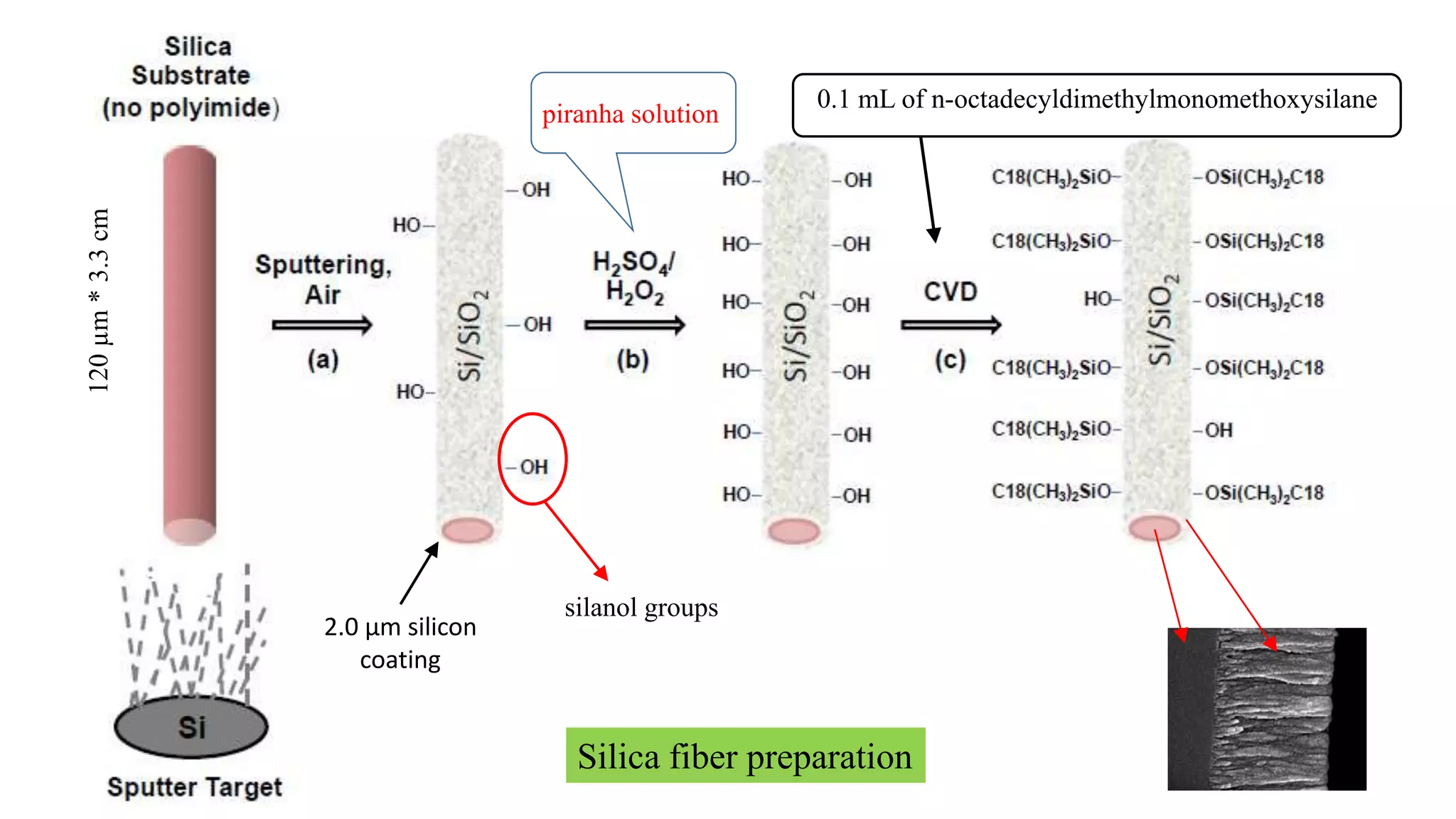
piranha solution
0.1 mL of n-octadecyldimethylmonomethoxysilane
silanol groups
120µm*3.3cm
Silica fiber preparation
2.0 μm silicon
coating
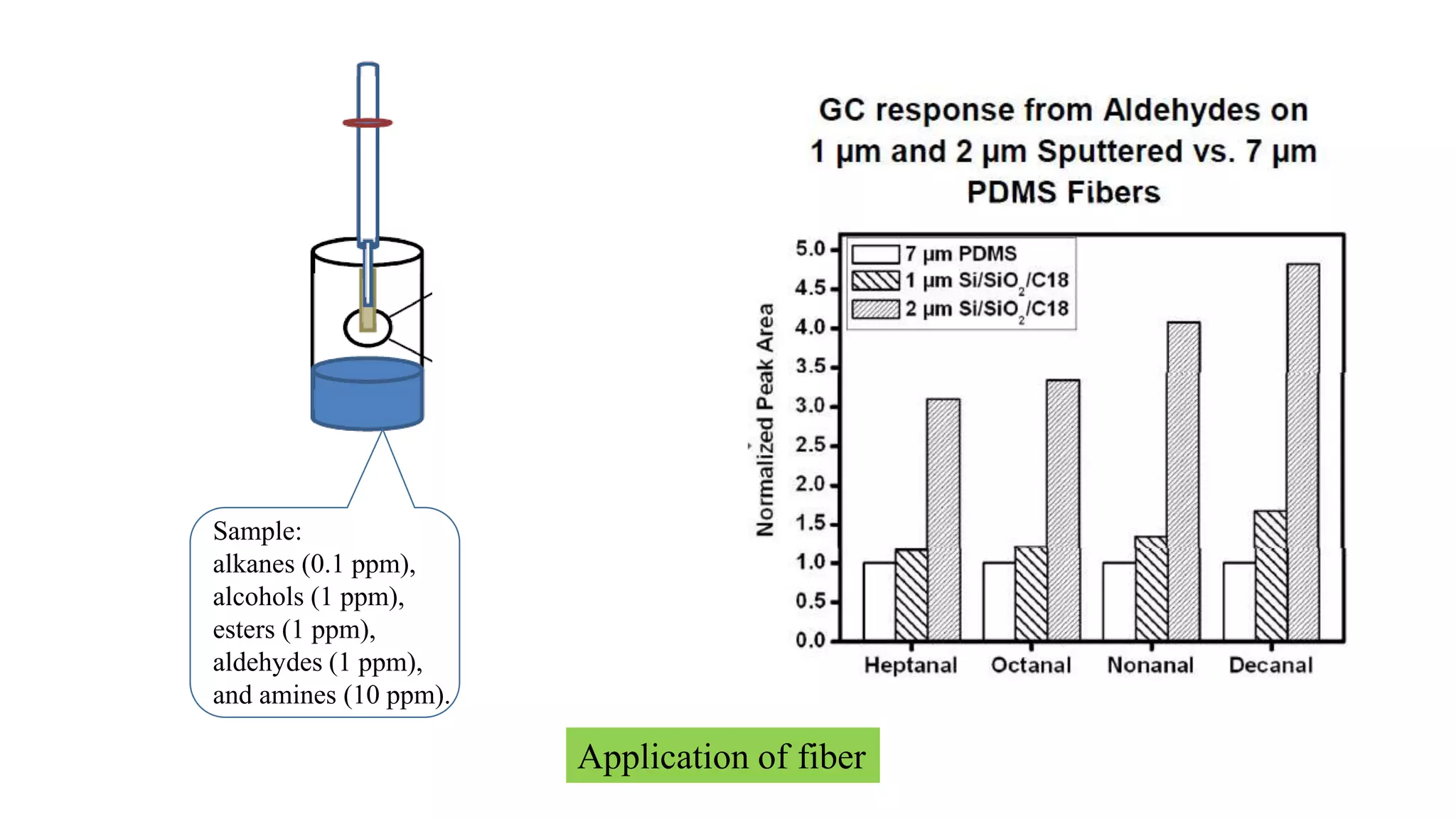
Sample:
alkanes (0.1 ppm),
alcohols (1 ppm),
esters (1 ppm),
aldehydes (1 ppm),
and amines (10 ppm).
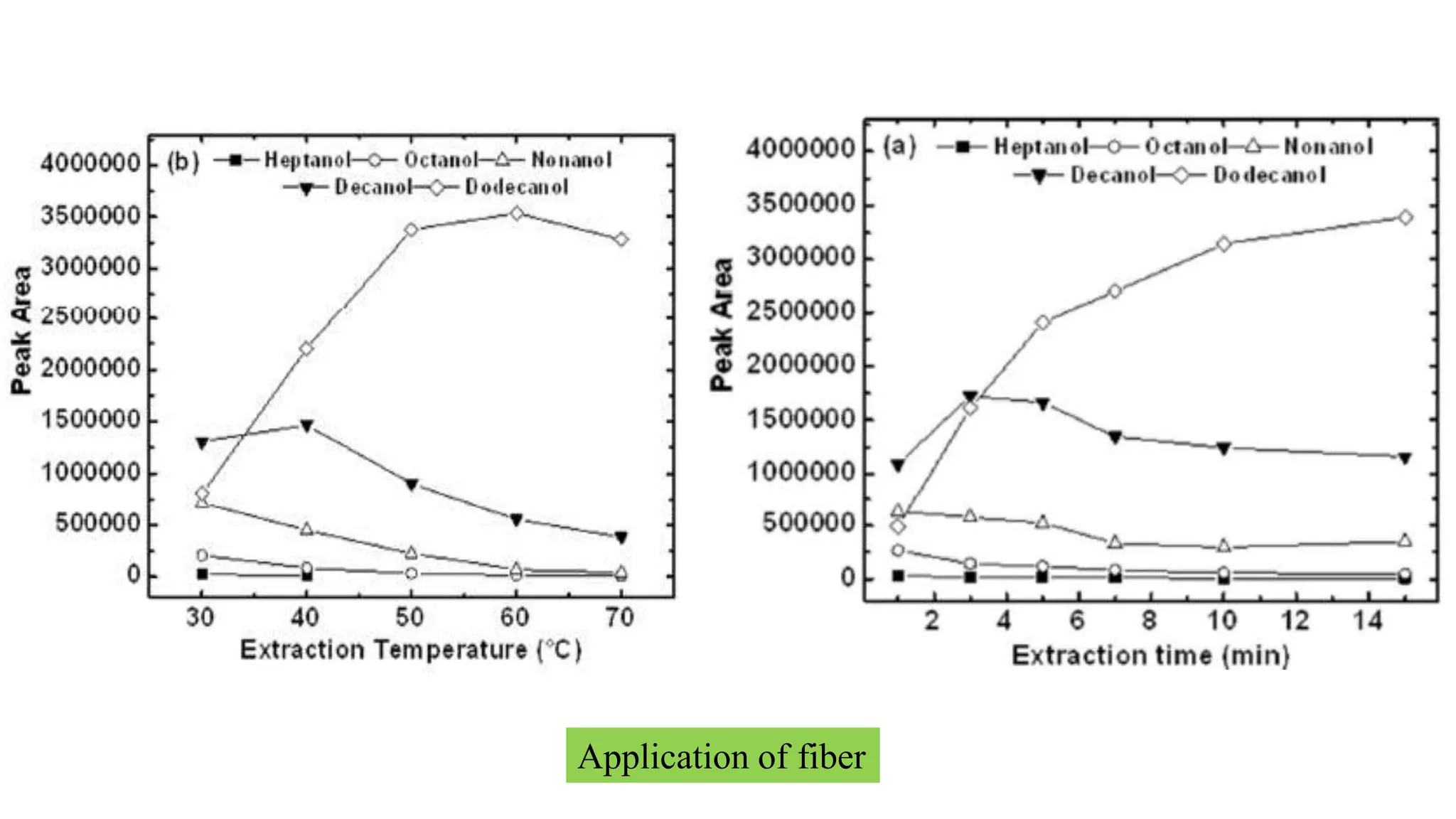
Application of fiber
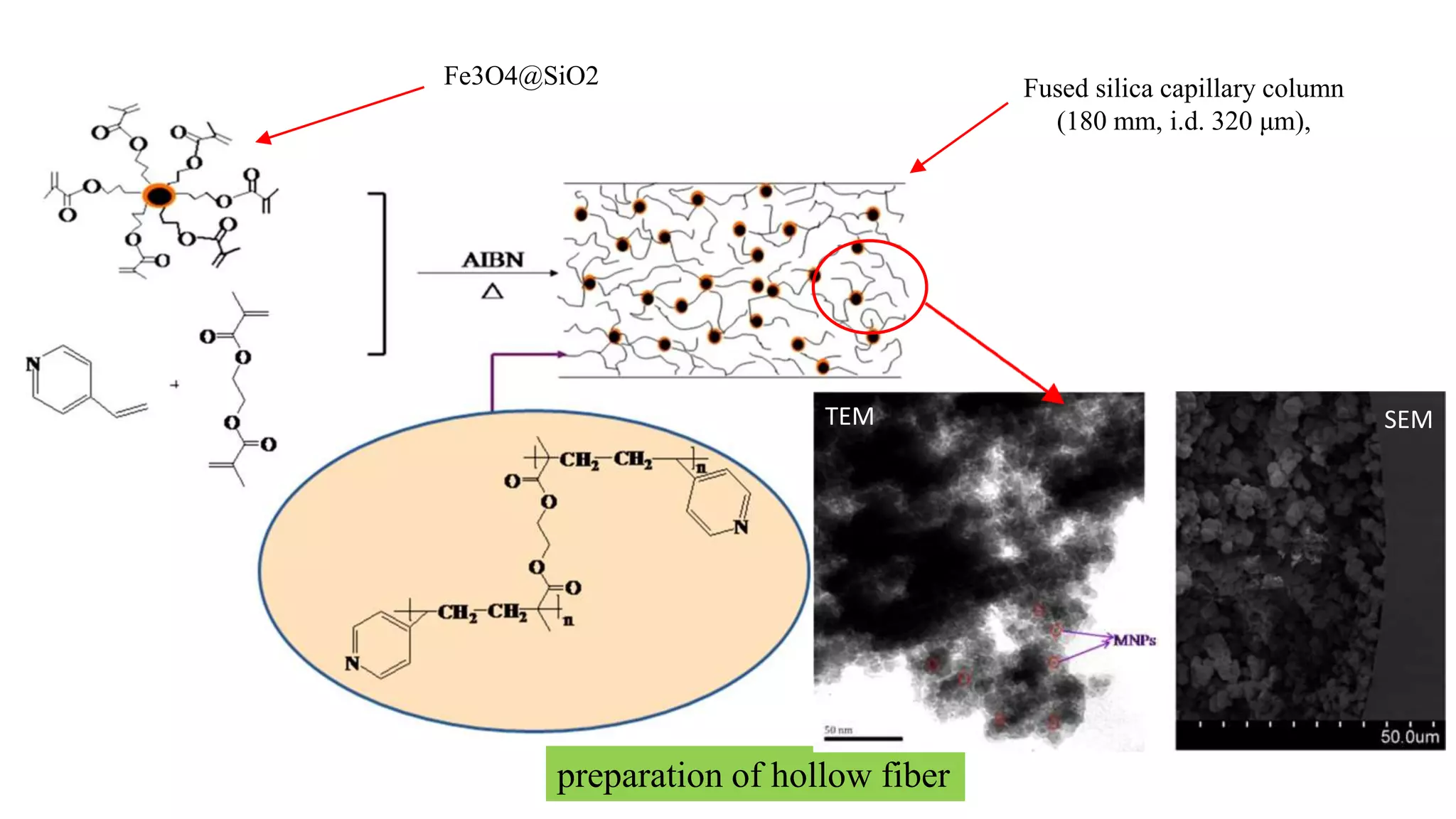
Fused silica capillary column
(180 mm, i.d. 320 μm),
Fe3O4@SiO2
preparation of hollow fiber
TEM SEM
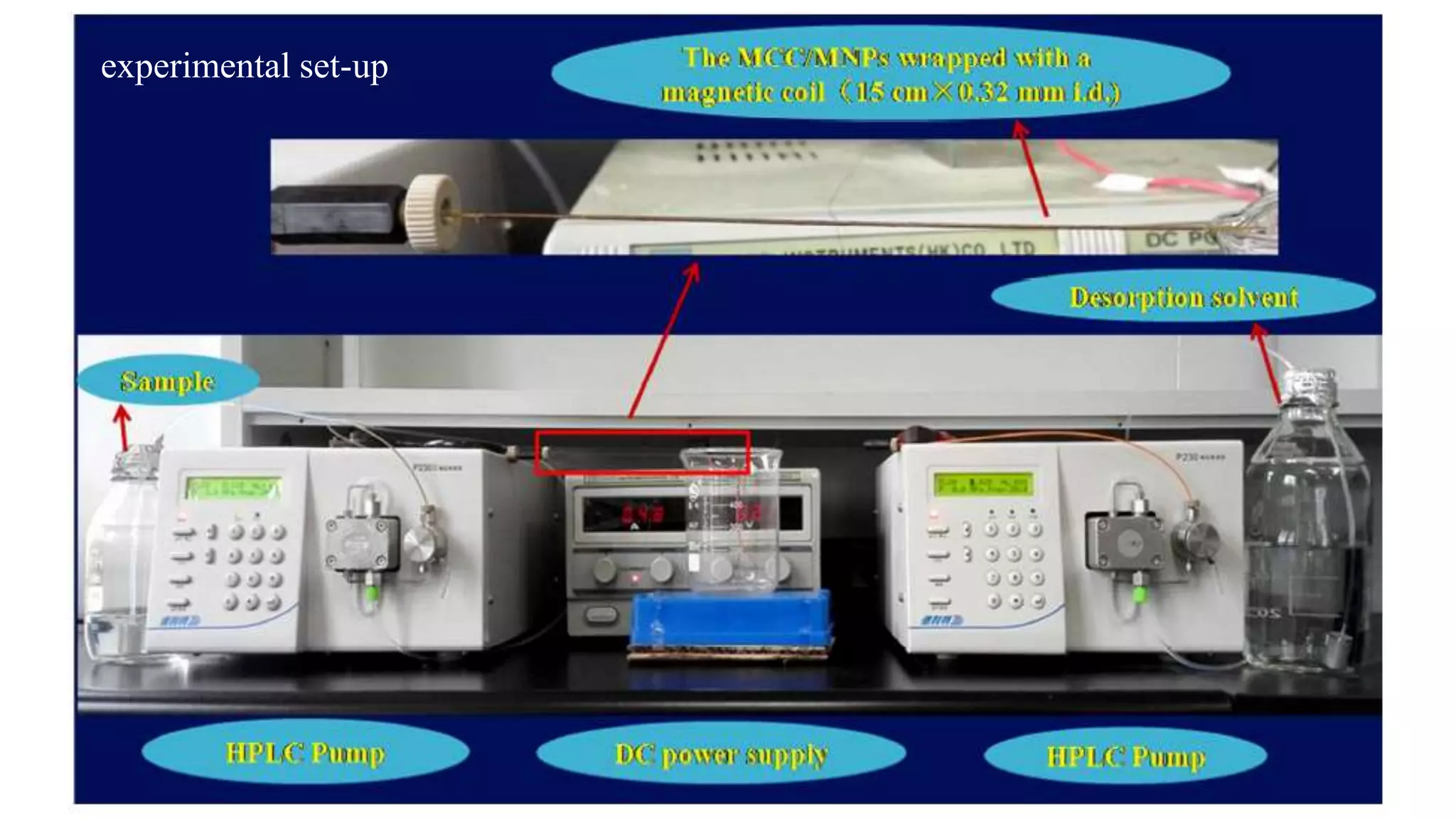
experimental set-up
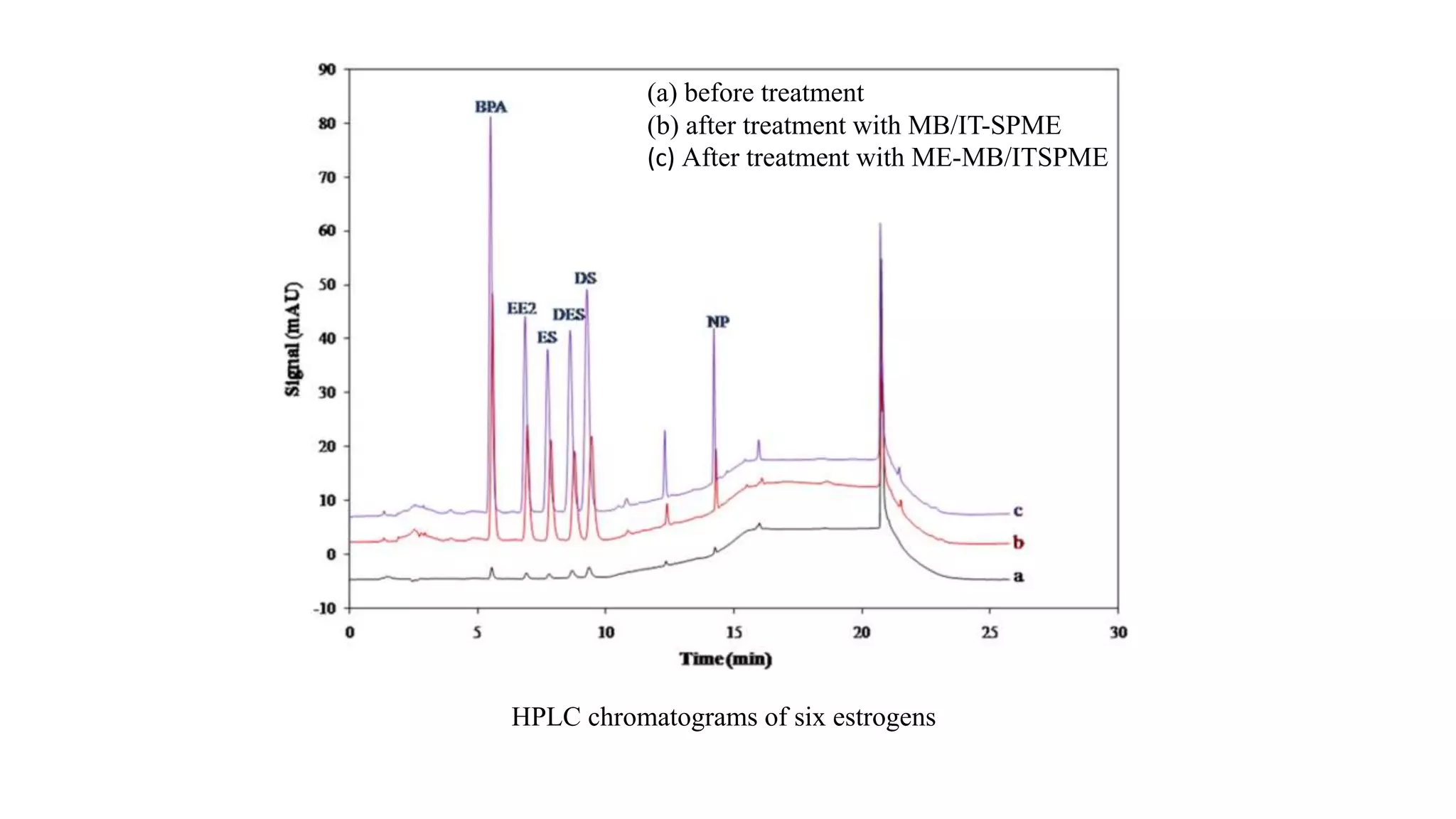
(a) before treatment
(b) after treatment with MB/IT-SPME
(c) After treatment with ME-MB/ITSPME
HPLC chromatograms of six estrogens
Abstract
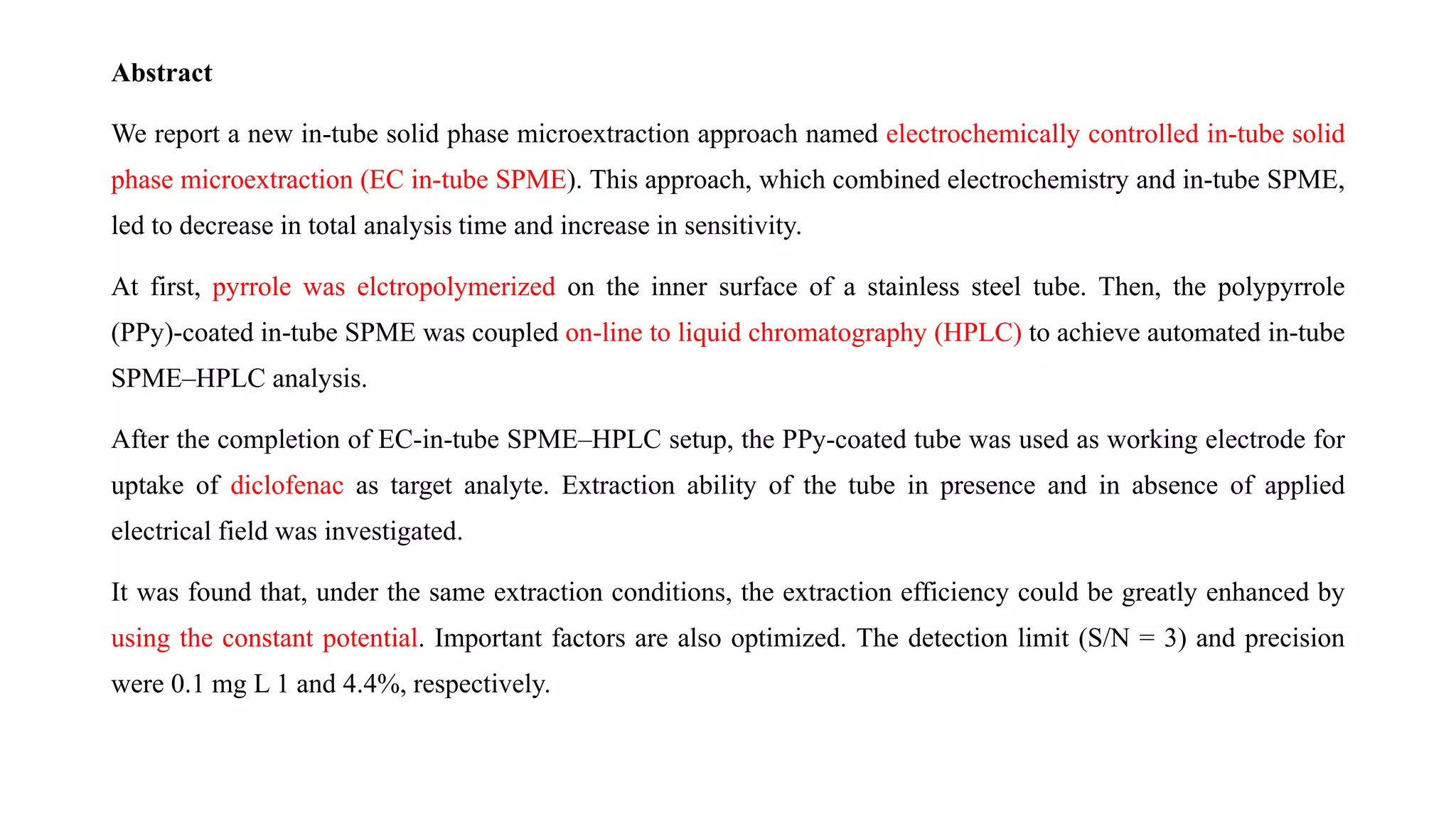
We report a new in-tube solid phase microextraction approach named electrochemically controlled in-tube solid
phase microextraction (EC in-tube SPME). This approach, which combined electrochemistry and in-tube SPME,
led to decrease in total analysis time and increase in sensitivity.
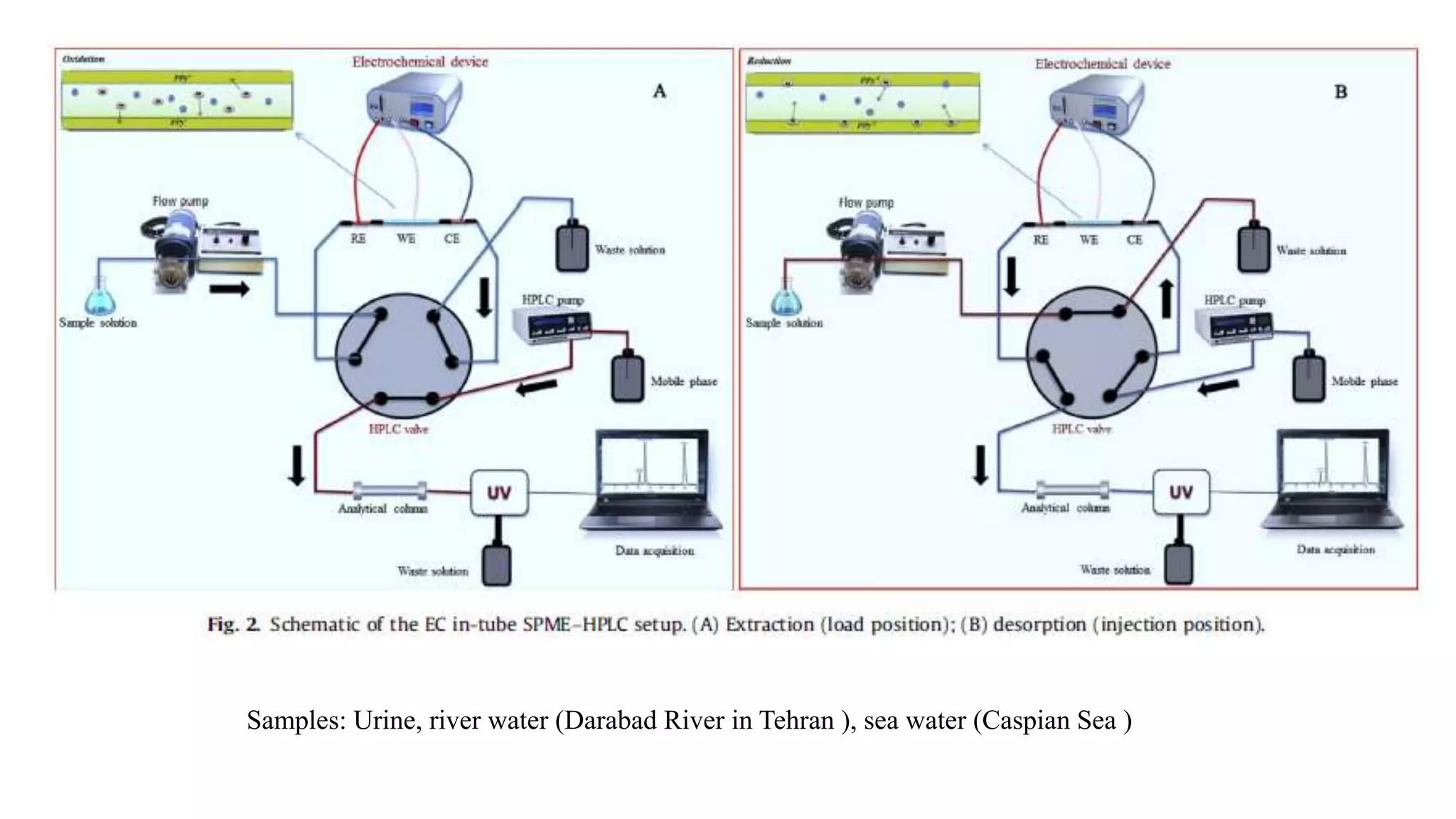
At first, pyrrole was elctropolymerized on the inner surface of a stainless steel tube. Then, the polypyrrole
(PPy)-coated in-tube SPME was coupled on-line to liquid chromatography (HPLC) to achieve automated in-tube
SPME–HPLC analysis.
After the completion of EC-in-tube SPME–HPLC setup, the PPy-coated tube was used as working electrode for
uptake of diclofenac as target analyte. Extraction ability of the tube in presence and in absence of applied
electrical field was investigated.
It was found that, under the same extraction conditions, the extraction efficiency could be greatly enhanced by
using the constant potential. Important factors are also optimized. The detection limit (S/N = 3) and precision
were 0.1 mg L 1 and 4.4%, respectively.
Samples: Urine, river water (Darabad River in Tehran ), sea water (Caspian Sea )
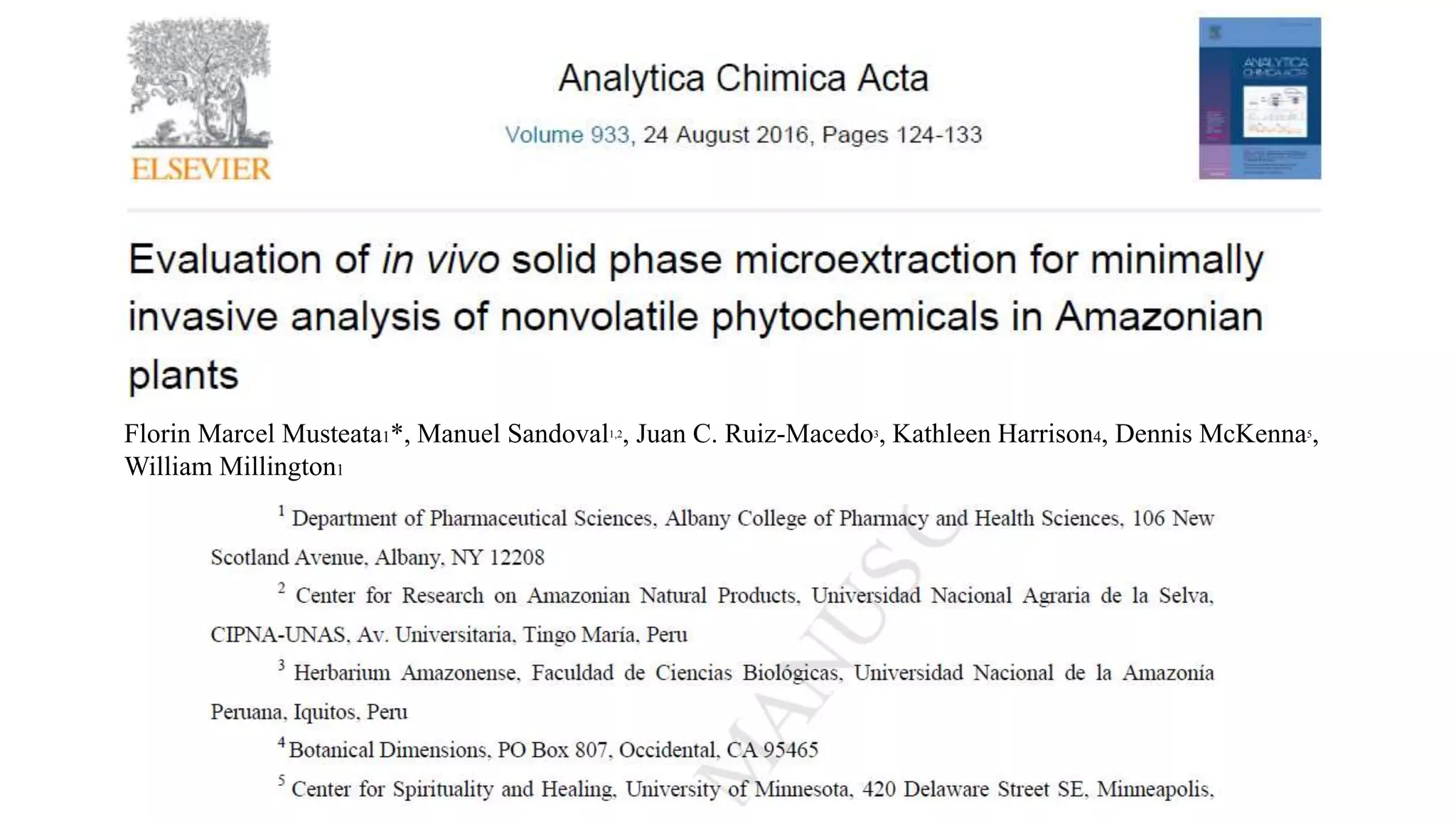
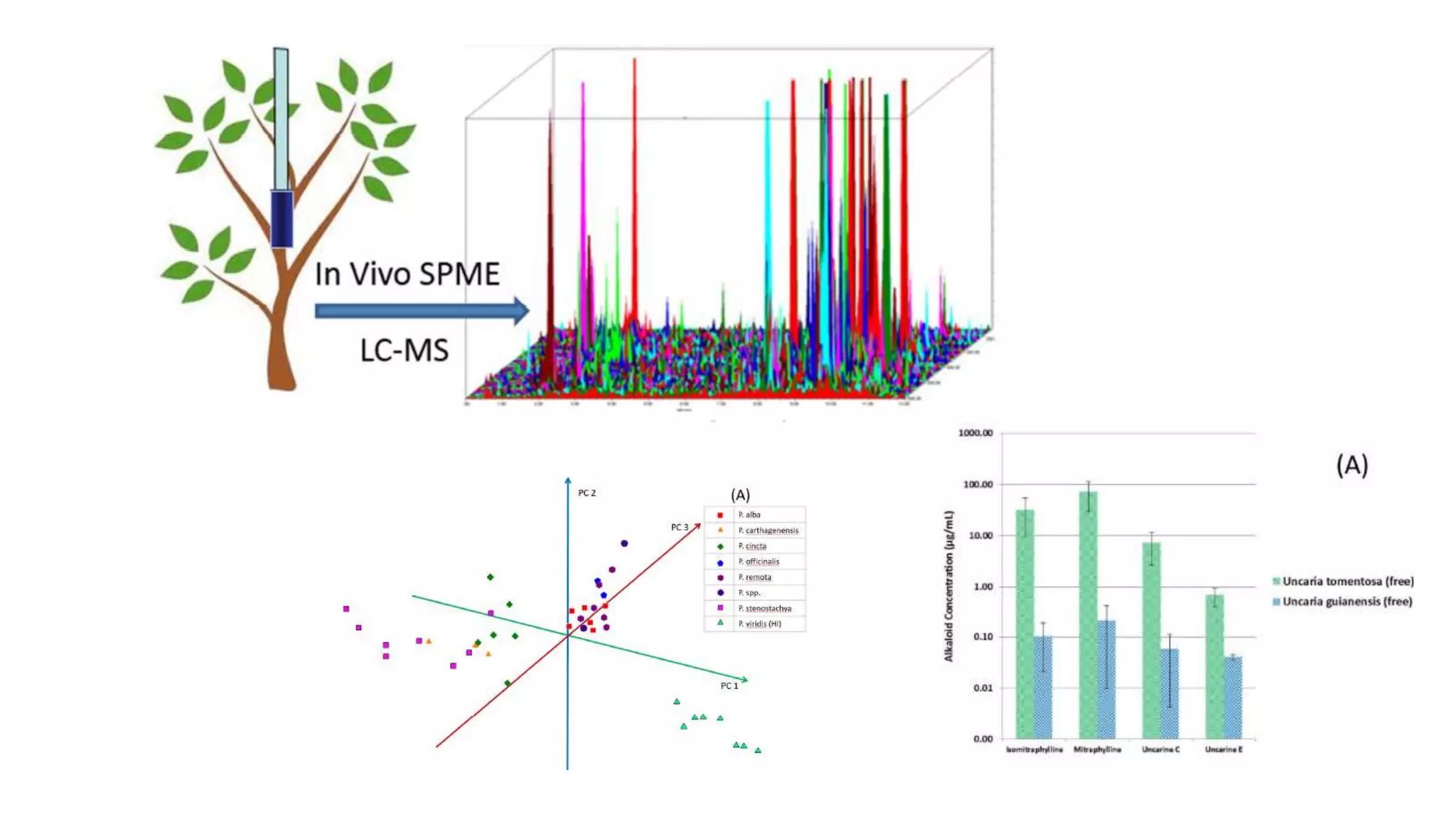
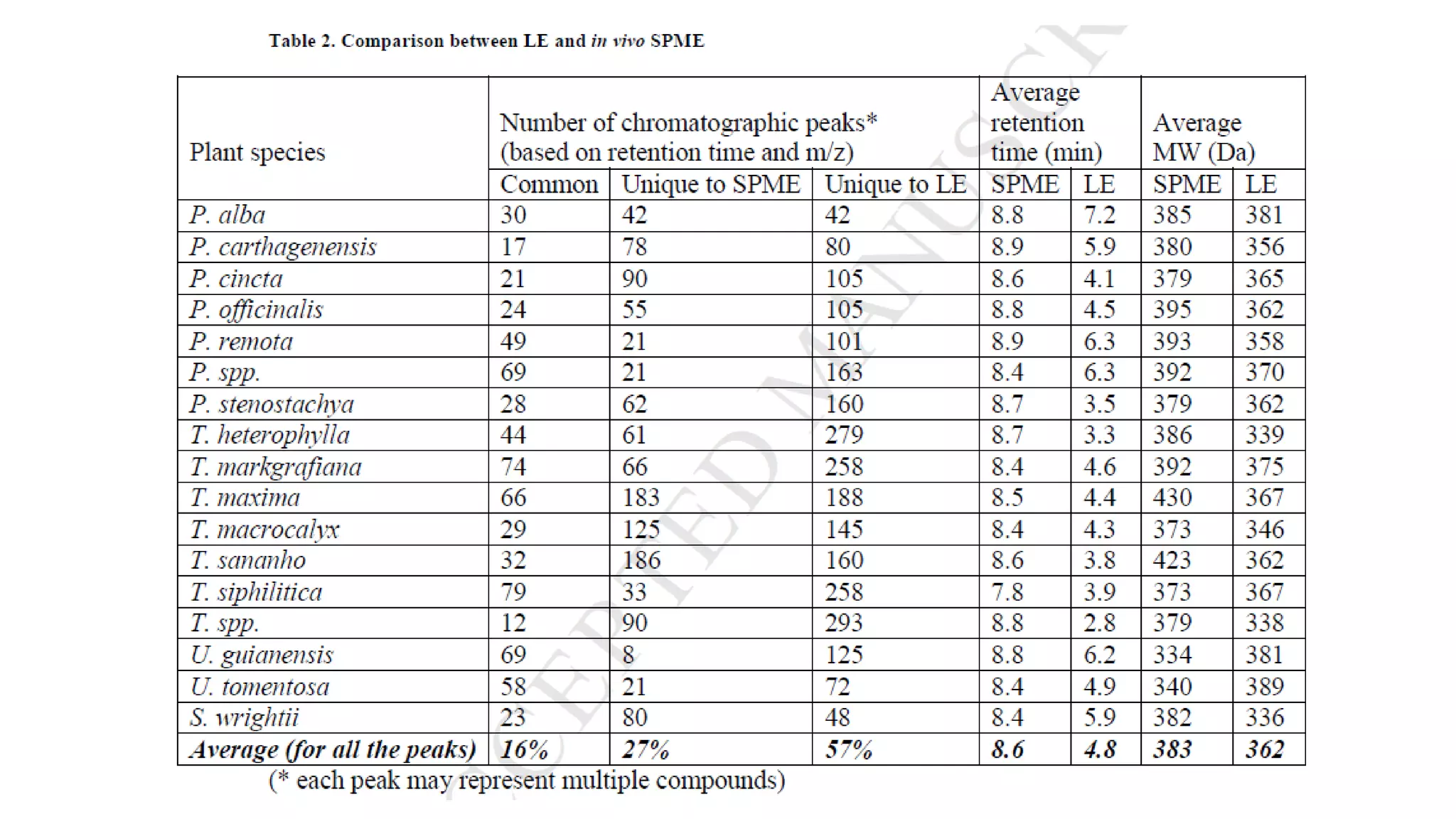
Florin Marcel Musteata1*, Manuel Sandoval1,2, Juan C. Ruiz-Macedo3, Kathleen Harrison4, Dennis McKenna5,
William Millington1
Automated SPME

Solid phase microextraction

  • 1.
    Solid Phase MicroExtraction (SPME)
  • 2.
  • 3.
  • 4.
    Was invented in1990 by Dr. Janusz Pawliszn and his colleagues from the University of Waterloo in Canada. History
  • 5.
  • 6.
    The main objectiveof the exhaustive techniques is to remove analytes completely from a sample matrix and transfer them to the extraction phase. The fundamental advantage of exhaustive methods is that, in principle, they do not require calibration because the vast majority of analytes are transferred to the extraction phase. Alternatively, non-exhaustive approaches can be designed on the basis of the principles of equilibrium, pre- equilibrium and permeation. Introduction
  • 7.
    Advantages • Small extractiondevices facilitate on-site applications, including in vivo analyses, and allow for coupling to a variety of analytical micro-instrumentation, including capillary and micro-fluidic systems. • only a small portion of the target analyte is removed from the matrix. This feature allows for the monitoring of chemical changes, partitioning equilibria, and speciation in the investigated system because sampling causes minimal perturbation to the system. • non-exhaustive techniques allows for the measurement of binding constants in complex matrices, providing additional information about the investigated system • the development of robust quantitative analytical methods based on microextraction requires more time, but when the procedures are optimised, they are more convenient and cost-effective compared to conventional exhaustive extraction approaches. • The equilibrium microextraction approach has further advantages in selectivity, because the extraction is coupled with separation and/or specific detection (e.g. mass spectrometry), which enables identification and quantification of many components simultaneously. • On-site and in vivo analysis Introduction
  • 8.
    Implementations of SPME The fibre technique remains, to this date, the most-used SPME approach.  Despite its name extraction phase is not always technically a solid. Introduction
  • 9.
    SPME Versus SPE SPE: three-step process. 1. a sample is passed through the sorbent bed, and analytes present in the sample are exhaustively extracted from the sample matrix to the solid sorbent. 2. unwanted analytes are selectively desorbed from the solid sorbent by washing with a solution capable of desorbing unwanted analytes but leaving desired analytes retained on the sorbent. 3. the wash solution is changed for one able to desorb analytes of interest. The resulting eluent may then be concentrated by evaporation to the desired volume. SPME: selective sorption from the matrix onto the coating 1. the coating is exposed to the sample. Analytes with a high affinity for the sorbent are selectively extracted. 2. everything extracted by the fibre is desorbed into the analytical instrument  Micro-SPE is more related to SPE and comparison with SPME, therefore, is inappropriate.  with SPME, it is possible to perform convenient spectroscopic analysis of surface-adsorbed components not only extracted chemical species but also collected aerosols or particulates. Introduction
  • 10.
    Theory of Solid-PhaseMicroextraction Three basic extraction modes: 1. direct extraction (A) 2. headspace extraction (B) 3. extraction involving membrane protection (C)
  • 11.
    Theory of Solid-PhaseMicroextraction SPME Principle: microextraction process is considered complete when the analyte concentration reaches equilibrium in the sample matrix and the fibre coating. according to the law of mass conservation, if only two phases are considered (e.g. the sample matrix and the fibre coating) the equilibrium conditions can be described by: C0 : initial concentration of the analyte in the sample Vs : volume of sample Cs ∞ : equilibrium concentrations in the sample Cf ∞ : equilibrium concentrations in the fibre coating Vf : volume of fiber coating
  • 12.
    Theory of Solid-PhaseMicroextraction SPME Principle: The distribution coefficient Kfs of the analyte between the fibre coating and sample matrix is defined as: so the number of moles of analyte n extracted by the coating can be calculated: This equation indicates that the amount of analyte extracted onto the coating (n) is linearly proportional to the analyte concentration in the sample (C0), which is the analytical basis for quantification using SPME. When the sample volume is very large:
  • 13.
    Theory of Solid-PhaseMicroextraction SPME Principle: we have three phase in the system (sample matrix/headspace/coating) If and Also So  This equation states that the amount of analyte extracted is independent of the location of the fibre in the system. It may be placed in the headspace or directly in the sample as long as the volumes of the fibre coating, headspace and sample are kept constant.
  • 14.
    Theory of Solid-PhaseMicroextraction Estimation of Distribution Constants Distribution constants can be estimated from physicochemical data and chromatographic parameters. For example, distribution constants between a fibre coating and a gaseous matrix (e.g. air) can be estimated using isothermal gas chromatography (GC) retention times on a column with a stationary phase identical to the fibre coating material. The formula that correlates the distribution constant and the retention time is: tR: retention times of the solute tA: retention time of a nonsorbed compound F: column flow measured by a soap-bubble flow meter T: temperatures of the column Tm: temperatures of the flow meter Pm: flow meter pressure Pw: saturated water vapour pressure Pi: inlet pressures of the column Po: outlet pressures of the column VL: the column’s stationary phase volume
  • 15.
    Theory of Solid-PhaseMicroextraction Effect of Extraction Parameters on Distribution Constants Temperature If both sample and fibre temperature change from T0 to T, the distribution constant changes according to the following equation: K0 is the distribution constant when both fibre and sample are at temperature T0 (in degrees Kelvin), ΔH is the molar change in enthalpy of the analyte when it moves from sample to fibre coating R is the gas constant  raising the temperature will decrease Kfs
  • 16.
    Theory of Solid-PhaseMicroextraction Effect of Extraction Parameters on Distribution Constants Temperature
  • 17.
    Theory of Solid-PhaseMicroextraction Effect of Extraction Parameters on Distribution Constants Salting One of the two common techniques used to enhance the extraction of organics from aqueous solutions is salting adjustment (other one is pH ). Salting can increase or decrease the amount extracted, depending on the compound and salt concentration, and the effect of salting on SPME has been determined to date only by experiment.  In general, the salting effect increases with increasing compound polarity. A substantial increase of analyte extraction occurs at salt concentrations 1% - 30% The effect of salt on extraction of toluene and benzene by SPME.
  • 18.
    Theory of Solid-PhaseMicroextraction Effect of Extraction Parameters on Distribution Constants pH Assuming that only the undissociated form of the acid or base can be extracted by the fibre coating, adjusting the pH of an aqueous solution will change K for dissociable species, according to the following equation: K0: distribution constant between the sample and the fibre of the undissociated form Ka: acidity constant of the dissociable analyte  As pH decreases, more acid is present in neutral forms  To obtain the highest sensitivity, pH needs to be two units lower than the pK value corresponding to the acid. The effect of pH on the SPME of acid compounds.
  • 19.
    Theory of Solid-PhaseMicroextraction Effect of Extraction Parameters on Distribution Constants Polarity of Sample Matrix and Coating Material The presence of an organic solvent in water changes K according to the following equation: Kfw: distribution constant for the analyte between fibre and pure water, P1 = 10.2 is the polarity parameter for water P2 = cPs + (1 - c)P1 is the water/solvent mixture polarity parameter for a solvent of concentration c and polarity parameter Ps This equation allows the prediction of the distribution constants for water heavily contaminated with miscible solvents, assuming that the solvent does not cause the coating to swell.  This relationship indicates that the concentration of the solvent must be above 1% to change the properties of water and the distribution constant substantially.
  • 20.
    Theory of Solid-PhaseMicroextraction Effect of Extraction Parameters on Distribution Constants Polarity of Sample Matrix and Coating Material Figure illustrates the decrease in extracted amount of benzene, toluene, ethylbenzene and xylenes (BTEX) into PDMS coating with the increase of methanol concentration in an aqueous matrix.
  • 21.
    Theory of Solid-PhaseMicroextraction Headspace Extraction • Addition of a gaseous headspace facilitates enhanced transport into the extraction phase because of the high diffusion coefficients of the analytes into the gas phase. • In order to increase transport from the sample matrix into the headspace, the system can be designed to produce a well- agitated, large sample/headspace interface. • For low-volatility compounds, heating of the sample is a good approach. • analytes need to be transported through the barrier of air before they can reach the coating. This protect the fibre coating from damage by high molecular mass and non-volatile interferences present in the sample matrix, such as humic materials or proteins. • The headspace mode also allows for modification of the matrix, such as a change of the pH, without damaging the fibre. • Amounts of analyte extracted into the coating from the same vial at equilibrium using direct and headspace sampling are identical, as long as the volumes of the sample and gaseous headspace are the same.
  • 22.
    Theory of Solid-PhaseMicroextraction Headspace Extraction When the fibre coating is in the headspace, the analytes are removed from the headspace first, followed by indirect extraction from the matrix, as shown in Figure below. Volatile analytes are extracted faster than semi-volatiles because they are at a higher concentration in the headspace, which contributes to faster mass transport rates through the headspace.
  • 23.
    Theory of Solid-PhaseMicroextraction Solid Versus Liquid Sorbents With liquid coatings (A), the molecules are solvated by the coating molecules. The diffusion coefficient enables the molecules to penetrate the whole volume of the coating within a reasonable extraction time. With solid sorbents (B), glassy or a well-defined crystalline structure reduces diffusion coefficients and sorption occurs only on the porous surface of the coating and after time limited surface area is available for adsorption..
  • 24.
  • 25.
    Development of SPMEDevices and Coatings History  laser desorption/fast gas chromatography  Optical fibres were used in this experiment to transmit laser light energy to the gas chromatography instrument.  The fibre tip was coated with the sample.  The fibre tip was inserted into the injector of a gas chromatograph, and analytes were volatilized onto the front of the GC column by means of a laser pulse.  The original purpose of the coatings was simply to protect the fibres from breakage.  Fused silica optical fibres, both uncoated and coated with liquid and solid polymeric phases, were dipped into an aqueous sample containing test analytes and then placed in a GC injector.  The development of the technique accelerated rapidly with the implementation of coated fibres incorporated into a microsyringe, resulting in the first SPME device
  • 26.
    Development of SPMEDevices and Coatings History Figure shows an example of an SPME device based on the HamiltonTM 7000 series microsyringe.  SPME devices do not need expensive syringes like the Hamilton syringes.
  • 27.
    Development of SPMEDevices and Coatings History The basic building block of a commercial SPME Device can be built from a short piece of stainless steel microtubing (to hold the fibre), another piece of larger tubing (to work as a ‘needle’) and a septum (to seal the connection between the microtubing and the ‘needle’).
  • 28.
    Development of SPMEDevices and Coatings adding a tube with a small opening to cover the needle of the SPME syringe results in a useful device for breath analysis in a non-invasive clinical application. SPME device modified for breath analysis.
  • 29.
    Development of SPMEDevices and Coatings This design can be improved further by adding two one-way valves, mounted at the mouthpiece and on the exit aperture but the concept remains the same. Breath analysis apparatus based on SPME.
  • 30.
    Development of SPMEDevices and Coatings Agitation for Air Sampling  The VOC mass loading on the fibre increases as the wind velocity increases from 0 to 5 cm/s.  No further change was observed as the wind speed was increased from 5 to 20 cm/s. Figure shows an example of an agitation device for field air sampling, consisting of a modified hairdryer fan with a mounting for the SPME device.
  • 31.
    Development of SPMEDevices and Coatings Agitation for Aqueous Sampling  Efficient agitation for aqueous sampling can be achieved using a bench drill and attaching the SPME fibre or PDMS thin film to the drill  The challenge with these devices is ensuring that they provide constant agitation.
  • 32.
    Development of SPMEDevices and Coatings Cold-Fibre SPME At elevated temperatures, native analytes can effectively dissociate from the matrix and move into the headspace for rapid extraction by the fibre coatings. However, the coating/sample distribution coefficient also decreases with an increase in temperature, resulting in a diminution of the equilibrium amount of analyte extracted. To prevent loss of sensitivity, the coating can be cooled simultaneously with sample heating.
  • 33.
    Development of SPMEDevices and Coatings High-Surface-Area Samplers (Thin-Film Microextraction) In this case, a high surface area-to-volume ratio is obtained, resulting in very accumulation rates. This approach is particularly benefihighcial for hydrophobic, semi-volatile components characterised by very high distribution constants. For example, the PDMS extraction phase can be a thin membrane, as shown in Figure High-surface-area SPME samplers.
  • 34.
    Development of SPMEDevices and Coatings High-Surface-Area Samplers (Thin-Film Microextraction) To facilitate convenient introduction to the analytical instrument, the membrane can be attached to the holding rod, and, after extraction, the membrane can be rolled around the rod and introduced to the injection system for the desorption of extracted components (Figure). Introduction of a high surface area sampler into a GC injector.
  • 35.
    Development of SPMEDevices and Coatings Time-weighted-average (TWA) devices Chen and Pawliszyn used the fibre- retracted SPME device to determine the TWA concentrations of VOCs in air and demonstrated that the face velocity of air across the needle opening does not affect sampling, due to the extremely small inner diameter of the fibre needle.
  • 36.
    Development of SPMEDevices and Coatings Time-weighted-average (TWA) devices Ouyang et al. extended the applications of this type of SPME device to TWA passive water sampling. removable needle was designed to avoid the effect of the adsorption of the target analytes on the outside wall of the needle. This field TWA water sampling device was used to monitor PAHs in Hamilton Harbour and Laurel Creek, Canada.
  • 37.
    Development of SPMEDevices and Coatings In Vivo Samplers  According to SPME theory, sample volume does not affect the results; therefore, it is not necessary to define a specific sample size for the analysis, which is very desirable for on-site sampling.  The system will not be disturbed significantly.  All sample preparation steps can be combined into a single one.  Biocompatible devices permit direct extraction of target analytes from the flowing blood of living organisms.
  • 38.
    Development of SPMEDevices and Coatings In Vivo Samplers In vivo sampling device has also been developed for tissue sampling, including fish sampling. Retracting the entire device allows the SPME probe to remain in the tissue without the external sampler present. At the end of sampling, the SPME probe is simply pulled out.
  • 39.
    Development of SPMEDevices and Coatings Development of New SPME Coatings  Kfs is a characteristic parameter that describes properties of a coating and its selectivity towards the analyte in contrast to other matrix components.  It is important to use the appropriate coating for a given application. Analysis of compounds with different polarity from water using (A) PDMS and (B) PA coating.
  • 40.
    Development of SPMEDevices and Coatings Development of New SPME Coatings Coating Preparation Methods: • Dipping Technique • Electrodeposition • Hollow Fibre Membranes/Adhesive Tape • Adhesion of Coatings • Conducting Polymers • Sol-Gel Coatings Affinity-Based Coatings: • Molecularly Imprinted Polymer Coating • Immunoaffinity Coatings
  • 41.
    Development of SPMEDevices and Coatings Development of New SPME Coatings Biocompatible Polymer Coatings: • Polyhydroxyethyl methacrylate, • Polyacrylamide, • Poly(N,N-dimethyl acrylamide), • Dextran, • Polyacrylonitrile (PAN) • and Polyethylene glycol (PEG)  These protective layers repel proteins and allow extraction of small molecules of target analytes.  The use of PDMS in this strategy is not recommended. The main reason for this is that PDMS is a relatively low biocompatibility material because of possible serious surface instability characterized by hydrophobicity recovery even when the surface is initially made hydrophilic.  Better biocompatible polymers to use in this application are PEG and PAN.
  • 42.
    Interfaces to AnalyticalInstrumentation SPME-GC Interface  Standard GC injectors, such as split/splitless, can be applied to SPME as long as a narrow insert with an i.d. close to the o.d. of the needle is used.  The split should be turned off during SPME injection.  One way to obtain sharper injection zones and faster separation times is to use rapid injection autosampling devices.
  • 43.
    Interfaces to AnalyticalInstrumentation SPME-GC Interface An alternative solution is to use a dedicated injector, which should be cold during needle introduction but which heats up very rapidly after exposure of the fibre to the carrier gas stream. Schematic diagram of the flash SPME injector: 1, injector body; 2, washer; 3, septum; 4, nut; 5, needle guide; 6, 0.53 mm i.d. fused silica capillary; 7, nut; 8, ferrule; 9, heater; 10, butt connector; 11, relay; 12, capacitor; 13, switch. Heating rates of 1,000oC/s have been determined experimentally.
  • 44.
    Interfaces to AnalyticalInstrumentation SPME-GC Interface The fibre can also be designed to contain the heating element. In this case, no injector is necessary. Internally heated SPME device
  • 45.
    Interfaces to AnalyticalInstrumentation SPME-GC Interface Flash desorption injectors can be designed by passing a current directly through the fibre. This is possible if the rod is made of conductive material, as it is in the case of the electrochemical SPME devices already mentioned. Direct capacitive discharge desorption system: 1, SPME syringe; 2, electric connection I; 3, injector body; 4, steel wire; 5, gold coating; 6, electric connection II; 7, transfer line; 8, capacitor; 9, relay; 10, butt connector.
  • 46.
    Interfaces to AnalyticalInstrumentation SPME-HPLC Interface Research effort has also focused on designing interfaces for liquid-phase separation techniques to address the need for analysis of non-volatile and thermally labile analytes.  A typical SPME-HPLC interface consists of a custom-made desorption chamber and a six-port injection valve.  The internal tubing of the SPME device, which holds the fibre, can be sealed by the PEEK tubing and the tee-union tightly enough to withstand solvent pressures as high as 4,500 psi.  When the injection valve is in the ‘load’ position, it allows the fibre to be introduced into the desorption chamber under ambient pressure.  The valve is then switched to ‘inject’ to transfer the desorbed analytes to the column.  A heater can be installed in the device to facilitate the desorption process.
  • 47.
    Interfaces to AnalyticalInstrumentation SPME-HPLC Interface
  • 48.
    Interfaces to AnalyticalInstrumentation SPME-MALDI Interface  SPME can also be directly coupled to mass spectrometers.  SPME was recently coupled to a matrix-assisted laser desorption/ionisation (MALDI) for the detection of large biomolecules.  The tip of an optical fibre was silanised for extraction of analytes of interest from the sample.  Both an ion mobility spectrometer and a quadrupole/time-of-flight (QqTOF) mass spectrometer were used for the detection of the SPME/MALDI signal.  The combination of SPME/MALDI with a QqTOF system offers simple sample handling paired with the specificity and sensitivity of high-performance mass spectrometry.  The application of this technique holds promise, especially in biochemical analysis, pharmaceutical research, clinical diagnostics and screening.
  • 49.
    Interfaces to AnalyticalInstrumentation SPME-MALDI Interface Schematic diagram of SPME/MALDI-QqTOF system: (1) laser source, (2) focusing lens, (3) photodiode, (4) fibre holder, (5) SPME/MALDI fibre, (6) QqTOF and (7) computer.
  • 50.
    Interfaces to AnalyticalInstrumentation SPME-CE An on-column interface made of a Teflon block enables the direct insertion of an SPME fibre into the inlet end of a separation capillary. Combining the SPME and capillary electrophoresis (CE) techniques in protein analysis has recently been described and successfully demonstrated. Schematic of (A) the SPME-CE system and (B) the interface.
  • 51.
    Interfaces to AnalyticalInstrumentation Other Interfaces  SPME can be directly combined with optical detection based on reflectometric interference spectrometry.  A light beam passing through an optically transparent fibre coated with transparent sorbing material interacts with absorbed substances through internal reflection.  Therefore, if any of the extracted analytes strongly absorb the transmitted light, there is a loss in intensity that can be detected with a simple optical sensor.  In an alternative design, the light can be passed directly through the absorbing polymer, which is then cooled to facilitate high sensitivity of determination.  Fluorescence can be used to detect analytes in the coating.  The selectivity of the extraction process and spectroscopy can be combined with selectivity of the electrochemical process, resulting in a spectroelectrochemical sensor.
  • 52.
    Section 3: somecase studies
  • 54.
    Anubhav Diwan,1 BhupinderSingh,1 Tuhin Roychowdhury,1 DanDan Yan,2 Laura Tedone,2 Pavel N. Nesterenko,2 Brett Paull,2 Eric T. Sevy,1 Robert A. Shellie,2 Massoud Kaykhaii,3, Matthew R. Linford1,* 1 Department of Chemistry and Biochemistry, Brigham Young University, Provo, Utah 84602 2 Australian Centre for Research on Separation Science (ACROSS), School of Physical Sciences, University of Tasmania, Sandy Bay, Hobart, Tasmania, Australia 3 Department of Chemistry, University of Sistan and Baluchestan, Zahedan, Iran
  • 55.
    piranha solution 0.1 mLof n-octadecyldimethylmonomethoxysilane silanol groups 120µm*3.3cm Silica fiber preparation 2.0 μm silicon coating
  • 56.
    Sample: alkanes (0.1 ppm), alcohols(1 ppm), esters (1 ppm), aldehydes (1 ppm), and amines (10 ppm). Application of fiber
  • 57.
  • 59.
    Fused silica capillarycolumn (180 mm, i.d. 320 μm), Fe3O4@SiO2 preparation of hollow fiber TEM SEM
  • 60.
  • 61.
    (a) before treatment (b)after treatment with MB/IT-SPME (c) After treatment with ME-MB/ITSPME HPLC chromatograms of six estrogens
  • 63.
    Abstract We report anew in-tube solid phase microextraction approach named electrochemically controlled in-tube solid phase microextraction (EC in-tube SPME). This approach, which combined electrochemistry and in-tube SPME, led to decrease in total analysis time and increase in sensitivity. At first, pyrrole was elctropolymerized on the inner surface of a stainless steel tube. Then, the polypyrrole (PPy)-coated in-tube SPME was coupled on-line to liquid chromatography (HPLC) to achieve automated in-tube SPME–HPLC analysis. After the completion of EC-in-tube SPME–HPLC setup, the PPy-coated tube was used as working electrode for uptake of diclofenac as target analyte. Extraction ability of the tube in presence and in absence of applied electrical field was investigated. It was found that, under the same extraction conditions, the extraction efficiency could be greatly enhanced by using the constant potential. Important factors are also optimized. The detection limit (S/N = 3) and precision were 0.1 mg L 1 and 4.4%, respectively.
  • 64.
    Samples: Urine, riverwater (Darabad River in Tehran ), sea water (Caspian Sea )
  • 65.
    Florin Marcel Musteata1*,Manuel Sandoval1,2, Juan C. Ruiz-Macedo3, Kathleen Harrison4, Dennis McKenna5, William Millington1
  • 68.