Presentation
Topic:
solid phase Microextraction
Presented to:
Doctor Zubair
Presented by:
Sania Bibi 17110807-005
MSc I chemistry
Course:
Basic Analytical chemistry I Theory
CHEM-339
solid phase micro
extraction
Introduction of SPME
 SPME is a simple and efficient technique, which
eliminates the necessity of using solvents.
 The most widely used technique of sampling
with solid phase micro extraction consists of
exposing a small amount of extracting
phase(coating) associated with a fiber to the
sample, for a predetermined amount of time.
 Essentially, SPME consists of two discrete
steps: solute absorption from the sample matrix
into a thick layer of silicone or related
adsorptive material, followed by transfer of the
absorbed analytes into a chromatography inlet
system by thermal or liquid desorption.
 Solid-phase micro extraction (SPME) is an
adaptation of SPE in which the solid-phase
column has been replaced by a microliter
syringe-like device with a hollow needle and a
plunger to which is attached a fused silica fiber
coated with a suitable stationary phase polymer.
 Various SPME fibers and coatings are
commercially available and can be used to target
different analytes.
 SPME has been applied to both GC and liquid
chromatography (LC) separations.
Discovery
 Solid Phase Micro extraction was
invented in 1990 by Dr. Janusz Pawliszyn
and his colleagues from the University of
Waterloo in Canada.
 He invented this technique to “address the
need for a fast, solvent-free, and field
compatible sample preparation method”,
which faster and more efficient is the
name of the game in industry.
What is SPME?
 A solvent less sample preparation method,
invented in 1990, that uses a fused silica fiber
which is coated with stationary phase. It is used
for sample cleaning before using other analytical
methods.
 It consists of coated fibers that are used to isolate
and concentrate analytes into a range of coating
materials.
 After extraction, the fiber is withdrawn back into
the needle and directly transferred to the GC
injector port, where the analyte is thermally
desorbed and introduced into the GC column for
separation.
 This syringe-like device also protects your fiber
Instrument of SPME
 Modified syringe-like instrument.
 A typical SPME fiber is made of fused silica coated
with a thin layer (7 μm to 100 μm thick) of
immobilized polymer or a solid adsorbent, or a
combination.
 The fused silica fiber, having a small size and
cylindrical shape, is connected to stainless-steel
tubing that is used to provide additional mechanical
strength to the fiber assembly for repeated sampling.
 This stainless-steel tubing is connected to a
specially designed syringe-like instrument.
 A small volume of extraction phase (usually less
than 1 μL) coated on fused silica support is mounted
in a modified syringe.
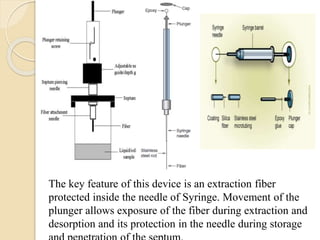
The key feature of this device is an extraction fiber
protected inside the needle of Syringe. Movement of the
plunger allows exposure of the fiber during extraction and
desorption and its protection in the needle during storage
How does SPME works?
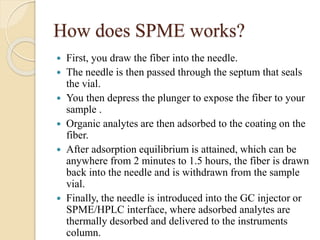
 First, you draw the fiber into the needle.
 The needle is then passed through the septum that seals
the vial.
 You then depress the plunger to expose the fiber to your
sample .
 Organic analytes are then adsorbed to the coating on the
fiber.
 After adsorption equilibrium is attained, which can be
anywhere from 2 minutes to 1.5 hours, the fiber is drawn
back into the needle and is withdrawn from the sample
vial.
 Finally, the needle is introduced into the GC injector or
SPME/HPLC interface, where adsorbed analytes are
thermally desorbed and delivered to the instruments
column.
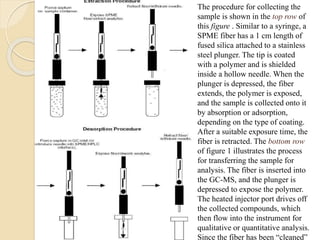
The procedure for collecting the
sample is shown in the top row of
this figure . Similar to a syringe, a
SPME fiber has a 1 cm length of
fused silica attached to a stainless
steel plunger. The tip is coated
with a polymer and is shielded
inside a hollow needle. When the
plunger is depressed, the fiber
extends, the polymer is exposed,
and the sample is collected onto it
by absorption or adsorption,
depending on the type of coating.
After a suitable exposure time, the
fiber is retracted. The bottom row
of figure 1 illustrates the process
for transferring the sample for
analysis. The fiber is inserted into
the GC-MS, and the plunger is
depressed to expose the polymer.
The heated injector port drives off
the collected compounds, which
then flow into the instrument for
qualitative or quantitative analysis.
Since the fiber has been “cleaned”
Reaching equilibrium
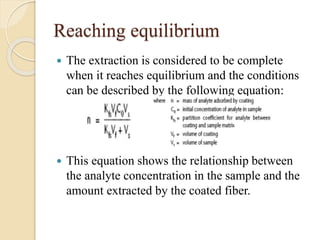
 The extraction is considered to be complete
when it reaches equilibrium and the conditions
can be described by the following equation:
 This equation shows the relationship between
the analyte concentration in the sample and the
amount extracted by the coated fiber.
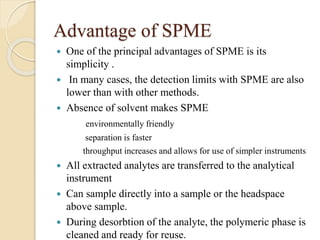
Advantage of SPME
 One of the principal advantages of SPME is its
simplicity .
 In many cases, the detection limits with SPME are also
lower than with other methods.
 Absence of solvent makes SPME
environmentally friendly
separation is faster
throughput increases and allows for use of simpler instruments
 All extracted analytes are transferred to the analytical
instrument
 Can sample directly into a sample or the headspace
above sample.
 During desorbtion of the analyte, the polymeric phase is
cleaned and ready for reuse.
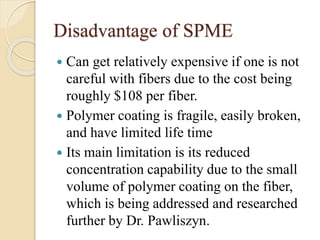
Disadvantage of SPME
 Can get relatively expensive if one is not
careful with fibers due to the cost being
roughly $108 per fiber.
 Polymer coating is fragile, easily broken,
and have limited life time
 Its main limitation is its reduced
concentration capability due to the small
volume of polymer coating on the fiber,
which is being addressed and researched
further by Dr. Pawliszyn.
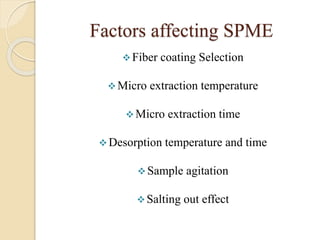
Factors affecting SPME
Fiber coating Selection
Micro extraction temperature
Micro extraction time
Desorption temperature and time
Sample agitation
Salting out effect
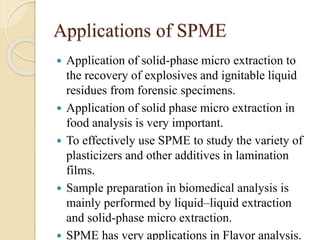
Applications of SPME
 Application of solid-phase micro extraction to
the recovery of explosives and ignitable liquid
residues from forensic specimens.
 Application of solid phase micro extraction in
food analysis is very important.
 To effectively use SPME to study the variety of
plasticizers and other additives in lamination
films.
 Sample preparation in biomedical analysis is
mainly performed by liquid–liquid extraction
and solid-phase micro extraction.
 SPME has very applications in Flavor analysis.

Solid phase micro extraction

  • 1.
    Presentation Topic: solid phase Microextraction Presentedto: Doctor Zubair Presented by: Sania Bibi 17110807-005 MSc I chemistry Course: Basic Analytical chemistry I Theory CHEM-339
  • 2.
  • 3.
    Introduction of SPME SPME is a simple and efficient technique, which eliminates the necessity of using solvents.  The most widely used technique of sampling with solid phase micro extraction consists of exposing a small amount of extracting phase(coating) associated with a fiber to the sample, for a predetermined amount of time.  Essentially, SPME consists of two discrete steps: solute absorption from the sample matrix into a thick layer of silicone or related adsorptive material, followed by transfer of the absorbed analytes into a chromatography inlet system by thermal or liquid desorption.
  • 4.
     Solid-phase microextraction (SPME) is an adaptation of SPE in which the solid-phase column has been replaced by a microliter syringe-like device with a hollow needle and a plunger to which is attached a fused silica fiber coated with a suitable stationary phase polymer.  Various SPME fibers and coatings are commercially available and can be used to target different analytes.  SPME has been applied to both GC and liquid chromatography (LC) separations.
  • 5.
    Discovery  Solid PhaseMicro extraction was invented in 1990 by Dr. Janusz Pawliszyn and his colleagues from the University of Waterloo in Canada.  He invented this technique to “address the need for a fast, solvent-free, and field compatible sample preparation method”, which faster and more efficient is the name of the game in industry.
  • 6.
    What is SPME? A solvent less sample preparation method, invented in 1990, that uses a fused silica fiber which is coated with stationary phase. It is used for sample cleaning before using other analytical methods.  It consists of coated fibers that are used to isolate and concentrate analytes into a range of coating materials.  After extraction, the fiber is withdrawn back into the needle and directly transferred to the GC injector port, where the analyte is thermally desorbed and introduced into the GC column for separation.  This syringe-like device also protects your fiber
  • 7.
    Instrument of SPME Modified syringe-like instrument.  A typical SPME fiber is made of fused silica coated with a thin layer (7 μm to 100 μm thick) of immobilized polymer or a solid adsorbent, or a combination.  The fused silica fiber, having a small size and cylindrical shape, is connected to stainless-steel tubing that is used to provide additional mechanical strength to the fiber assembly for repeated sampling.  This stainless-steel tubing is connected to a specially designed syringe-like instrument.  A small volume of extraction phase (usually less than 1 μL) coated on fused silica support is mounted in a modified syringe.
  • 8.
    The key featureof this device is an extraction fiber protected inside the needle of Syringe. Movement of the plunger allows exposure of the fiber during extraction and desorption and its protection in the needle during storage
  • 9.
    How does SPMEworks?  First, you draw the fiber into the needle.  The needle is then passed through the septum that seals the vial.  You then depress the plunger to expose the fiber to your sample .  Organic analytes are then adsorbed to the coating on the fiber.  After adsorption equilibrium is attained, which can be anywhere from 2 minutes to 1.5 hours, the fiber is drawn back into the needle and is withdrawn from the sample vial.  Finally, the needle is introduced into the GC injector or SPME/HPLC interface, where adsorbed analytes are thermally desorbed and delivered to the instruments column.
  • 10.
    The procedure forcollecting the sample is shown in the top row of this figure . Similar to a syringe, a SPME fiber has a 1 cm length of fused silica attached to a stainless steel plunger. The tip is coated with a polymer and is shielded inside a hollow needle. When the plunger is depressed, the fiber extends, the polymer is exposed, and the sample is collected onto it by absorption or adsorption, depending on the type of coating. After a suitable exposure time, the fiber is retracted. The bottom row of figure 1 illustrates the process for transferring the sample for analysis. The fiber is inserted into the GC-MS, and the plunger is depressed to expose the polymer. The heated injector port drives off the collected compounds, which then flow into the instrument for qualitative or quantitative analysis. Since the fiber has been “cleaned”
  • 11.
    Reaching equilibrium  Theextraction is considered to be complete when it reaches equilibrium and the conditions can be described by the following equation:  This equation shows the relationship between the analyte concentration in the sample and the amount extracted by the coated fiber.
  • 12.
    Advantage of SPME One of the principal advantages of SPME is its simplicity .  In many cases, the detection limits with SPME are also lower than with other methods.  Absence of solvent makes SPME environmentally friendly separation is faster throughput increases and allows for use of simpler instruments  All extracted analytes are transferred to the analytical instrument  Can sample directly into a sample or the headspace above sample.  During desorbtion of the analyte, the polymeric phase is cleaned and ready for reuse.
  • 13.
    Disadvantage of SPME Can get relatively expensive if one is not careful with fibers due to the cost being roughly $108 per fiber.  Polymer coating is fragile, easily broken, and have limited life time  Its main limitation is its reduced concentration capability due to the small volume of polymer coating on the fiber, which is being addressed and researched further by Dr. Pawliszyn.
  • 14.
    Factors affecting SPME Fibercoating Selection Micro extraction temperature Micro extraction time Desorption temperature and time Sample agitation Salting out effect
  • 15.
    Applications of SPME Application of solid-phase micro extraction to the recovery of explosives and ignitable liquid residues from forensic specimens.  Application of solid phase micro extraction in food analysis is very important.  To effectively use SPME to study the variety of plasticizers and other additives in lamination films.  Sample preparation in biomedical analysis is mainly performed by liquid–liquid extraction and solid-phase micro extraction.  SPME has very applications in Flavor analysis.