Chem. 230 – 9/16 Lecture
Announcements I
• First Homework Set (long problems) due
today (solutions will be posted soon)
• Website now has Fall 2012 quizzes (as well as
solutions) posted
• Specialized Topics sign up list available (some
blank slots if you want your own topic if
approved)
• Next Tuesday: Exam 1 for first 40 minutes
Announcements II
• Today’s Lecture:
– guest lecture (Dr. Justin Miller-Schulze on SPE)
– other advanced extraction techniques (primarily
SPME)
– comparison of extraction with chromatography (to
transition to chromatography theory)
– introduction to chromatography theory
• Last two topics (comparison of extraction with
chromatography and chromatographic
theory) not on Exam 1
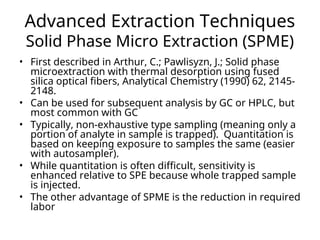
Advanced Extraction Techniques
Solid Phase Micro Extraction (SPME)
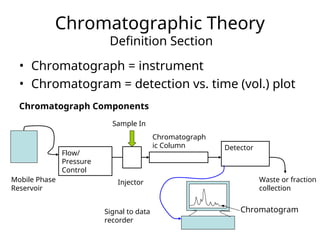
• First described in Arthur, C.; Pawlisyzn, J.; Solid phase
microextraction with thermal desorption using fused
silica optical fibers, Analytical Chemistry (1990) 62, 2145-
2148.
• Can be used for subsequent analysis by GC or HPLC, but
most common with GC
• Typically, non-exhaustive type sampling (meaning only a
portion of analyte in sample is trapped). Quantitation is
based on keeping exposure to samples the same (easier
with autosampler).
• While quantitation is often difficult, sensitivity is
enhanced relative to SPE because whole trapped sample
is injected.
• The other advantage of SPME is the reduction in required
labor
Advanced Extraction Techniques
SPME Procedure
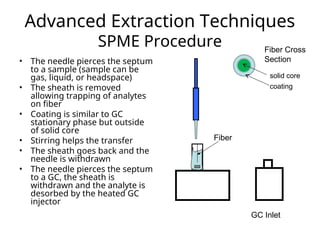
• The needle pierces the septum
to a sample (sample can be
gas, liquid, or headspace)
• The sheath is removed
allowing trapping of analytes
on fiber
• Coating is similar to GC
stationary phase but outside
of solid core
• Stirring helps the transfer
• The sheath goes back and the
needle is withdrawn
• The needle pierces the septum
to a GC, the sheath is
withdrawn and the analyte is
desorbed by the heated GC
injector
Fiber
GC Inlet
Fiber Cross
Section
solid core
coating
Advanced Extraction Techniques
SPME - Injection
• In HPLC
– Requires specialized injection valve
– Analytes desorbed from SPME fiber into solvent
flowing around fiber (should be strong solvent)
– Use in HPLC is less developed
• Transfer off of fiber
– This may take time, particularly for less volatile
compounds in GC and for compounds with polarity
more like stationary phase than solvent in HPLC
– Good peak shape usually requires “on column
trapping”
– In GC, this is done by splitless injections with the
column initially at low temperatures
Advanced Extraction Techniques
Solid Phase Micro Extraction (SPME)
• Fiber “Variables”
– One can select fibers of different polarities and
film thicknesses
– A polar fiber will selectively trap polar molecules
– Thinner films used for faster sorption/desorption
– A practical consideration is thermal stability
Advanced Extraction Techniques
Solid Phase Micro Extraction (SPME)
• Sample Types (GC analysis)
– Liquid Samples
• best for relatively clean samples at lower concentrations
• best if analyte has polarity like coating and different than
solvent (e.g. non-polar analyte and coating in water)
– Headspace Sampling
• fiber is in space above liquid sample
• good for “dirty” samples (e.g. flower components)
• preferentially absorbs moderately volatile species
– Gas Samples
– In Fiber Derivatization (typically applied to polar
organic compounds which often decompose on GC
columns)
Advanced Extraction Techniques
SPME vs. Liquid – Liquid Extraction for
Water Phase in Synthetic Diesel
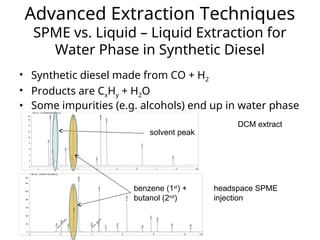
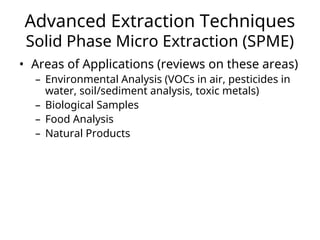
• Synthetic diesel made from CO + H2
• Products are CxHy + H2O
• Some impurities (e.g. alcohols) end up in water phase
DCM extract
headspace SPME
injection
min
0 2 4 6 8 10
pA
0
20
40
60
80
100
120
FID1 B, (TODD11041305.D)
A
rea: 13.9648
1.738
2.043
2.494
2.824
2.863
3.168
A
rea: 19.7647
4.003
4.442
4.494
4.913
5.679
6.269
7.287
7.831
8.245
9.185
10.393
min
1 2 3 4 5 6 7 8
pA
0
2
4
6
8
10
12
14
16
FID1 B, (YVONNE09181302.D)
1.523
1.612
1.729
1.810
1.925
2.390
2.713
2.768
2.948
3.974
4.162
4.465
6.271
7.843
solvent peak
benzene (1st
) +
butanol (2nd
)
Advanced Extraction Techniques
Solid Phase Micro Extraction (SPME)
• Areas of Applications (reviews on these areas)
– Environmental Analysis (VOCs in air, pesticides in
water, soil/sediment analysis, toxic metals)
– Biological Samples
– Food Analysis
– Natural Products
Advanced Extraction Techniques
SPME – Advantages/Disadvantages
• Advantages:
– Listed as “Solvent-less” technique (at least great
reduction in solvent injected into GC)
– Less interference from solvent peak
– Reduced injection of non-volatiles
– Less sample handling (+ ability to automate)
– Can chose fibers for good selectivity
• Disadvantages:
– More difficult for quantitative results
– Limited lifetime of fibers
– Memory effects (slow desorption from fibers)
Advanced Extraction Techniques
Other Methods
• Emphasis toward
microscale methods
• Liquid-Liquid
Microextraction (drop
scale liquid liquid
extraction)
• Use of semi-permeable
membranes (discussed
in text)
• Stir-Bar Sorptive
Extraction
1. Stir bar traps
analytes
2. Stir bar
transferred to
GC inlet
Advanced Extraction Techniques
Some Questions
1. A test for decomposition of a milk sample is made by measuring
small aldehydes (e.g. butyraldehyde) by SPME through direct
immersion in milk. A non-polar fiber is used and analysis is
performed by GC with a non-polar stationary phase. Which of the
following are advantages of using the SPME method:
1. removal of interferents (other parts to milk)
2. 2 dimensions of separation (on SPME fiber and on GC column)
3. increase of concentrations by trapping on fiber
4. avoiding need for more labor intensive methods (e.g. liquid – liquid
extraction)
2. If a fiber sits in a solution long enough, the peak area will reach a
constant (be independent of time). Why is this? Is this exhaustive
extraction?
3. In SPME for HPLC, analytes are desorbed from the fiber into solvent
that is injected into the HPLC column. Should the solvent be
“stronger” or “weaker” than the sample solvent?
4. In comparing direct headspace injections with SPME headspace
injections, later eluting peaks (by GC) are larger in SPME. Explain
why.
Chromatographic Theory
Simple Separations vs. Chromatography
• Simple separations generally involve one to
several process steps that lead to two to several
fractions.
• Simple separations are limited to coarse
fractionation of samples.
• Chromatographic separations are generally
capable of isolating more than 5 compounds.
• Once the number of simple separation steps
goes over a few (maybe 5 maximum), it
becomes a labor inefficient way of performing a
separation.
Chromatographic Theory
Simple Separations vs. Chromatography
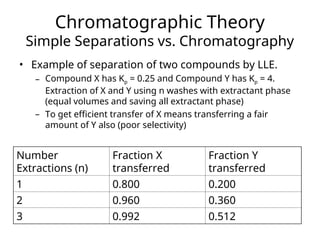
• Example of separation of two compounds by LLE.
– Compound X has Kp = 0.25 and Compound Y has Kp = 4.
Extraction of X and Y using n washes with extractant phase
(equal volumes and saving all extractant phase)
– To get efficient transfer of X means transferring a fair
amount of Y also (poor selectivity)
Number
Extractions (n)
Fraction X
transferred
Fraction Y
transferred
1 0.800 0.200
2 0.960 0.360
3 0.992 0.512
Chromatographic Theory
Simple Separations vs. Chromatography
• Continuation of example
– Better selectivity at same efficiency can be made by adjusting
extract volume and increasing number of extractions
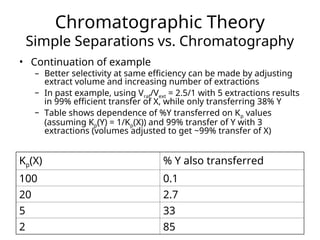
– In past example, using Vraf/Vext = 2.5/1 with 5 extractions results
in 99% efficient transfer of X, while only transferring 38% Y
– Table shows dependence of %Y transferred on Kp values
(assuming Kp(Y) = 1/Kp(X)) and 99% transfer of Y with 3
extractions (volumes adjusted to get ~99% transfer of X)
Kp(X) % Y also transferred
100 0.1
20 2.7
5 33
2 85
Chromatographic Theory
Simple Separations vs. Chromatography
• Chromatography example
– Even column of poor efficiency can handle
much more similar compounds
– Example: KY/KX = 1.25 (=  value)
– If we assume kX = 4, and resolution = 1.5
(minimum for “baseline”), a plate number
of ~1000 would be needed (not very high)
Chromatographic Theory
Simple Separations vs. Chromatography
• Conclusions to example:
– Unless order of magnitude differences in Kp
values, simple separations have limited use
(e.g. reduction of interfering substance).
– Simple separations are better for coarse
separations
– Chromatographic separations can handle
similar K values much better.
Chromatographic Theory
Chromatography vs. Other Advanced Separation Techniques
• Chromatography is based on analyte
partitioning between two phases
• Other methods use different mechanism
for separation of analytes (e.g. electrolytic
mobility in capillary zone electrophoresis)
• Some areas of overlap (e.g. Capillary
electrochromatography and size
exclusion chromatography)
Chromatographic Theory
Phase Definitions
• Mobile Phase (M subscript in later parameters)
– Fluid phase (gas, liquid or supercritical fluid) that
moves through stationary phase
– Mobile phase defines the major classes of
chromatography (GC, LC and SFC)
• Stationary Phase (S subscript)
– A non-moving phase (except in MEKC) to which
compounds partition via absorption or adsorption
– Phase can be liquid (not very stable), liquid-like
(most common), or solid (common for some
applications)
– In past was second part of class name (for example
GLC for gas-liquid chromatography)
Chromatographic Theory
More on Stationary Phases
• Stationary phases come in several arrangements: in
columns or on plates (used in thin layer
chromatography)
• In columns, open tubular (coated walls), packed
columns and monoliths are possible means of
attaching stationary phase
• Packed columns contain packing material with the
stationary phase either being the surface or being a
coating on the surface
• Porous packing material is common
• Most common stationary phase is a liquid-like
material chemically bonded to packing material or to
wall (in open tubular chromatography).
Chromatographic Theory
More on Stationary Phases
Open Tubular
(end on, cross section view)
Column Wall
Mobile phase
Stationary phase
(wall coating)
Packed column (side view) (e.g.
Silica in normal phase HPLC)
Packing Material
Stationary phase is outer
surface (although influenced by
adsorbed solvents)
Bonded phase (liquid-like)
Expanded View
Stationary Phase
Chemically bonded to
packing material
Packing Material Note: true representation should
include micropores in sphere
Chromatographic Theory
Definition Section
• Chromatograph = instrument
• Chromatogram = detection vs. time (vol.) plot
Chromatograph Components
Mobile Phase
Reservoir
Flow/
Pressure
Control
Sample In
Injector
Chromatograph
ic Column Detector
Waste or fraction
collection
Signal to data
recorder
Chromatogram

Advanced Extraction Techniques solid phase micro extraction .ppt

  • 1.
    Chem. 230 –9/16 Lecture
  • 2.
    Announcements I • FirstHomework Set (long problems) due today (solutions will be posted soon) • Website now has Fall 2012 quizzes (as well as solutions) posted • Specialized Topics sign up list available (some blank slots if you want your own topic if approved) • Next Tuesday: Exam 1 for first 40 minutes
  • 3.
    Announcements II • Today’sLecture: – guest lecture (Dr. Justin Miller-Schulze on SPE) – other advanced extraction techniques (primarily SPME) – comparison of extraction with chromatography (to transition to chromatography theory) – introduction to chromatography theory • Last two topics (comparison of extraction with chromatography and chromatographic theory) not on Exam 1
  • 4.
    Advanced Extraction Techniques SolidPhase Micro Extraction (SPME) • First described in Arthur, C.; Pawlisyzn, J.; Solid phase microextraction with thermal desorption using fused silica optical fibers, Analytical Chemistry (1990) 62, 2145- 2148. • Can be used for subsequent analysis by GC or HPLC, but most common with GC • Typically, non-exhaustive type sampling (meaning only a portion of analyte in sample is trapped). Quantitation is based on keeping exposure to samples the same (easier with autosampler). • While quantitation is often difficult, sensitivity is enhanced relative to SPE because whole trapped sample is injected. • The other advantage of SPME is the reduction in required labor
  • 5.
    Advanced Extraction Techniques SPMEProcedure • The needle pierces the septum to a sample (sample can be gas, liquid, or headspace) • The sheath is removed allowing trapping of analytes on fiber • Coating is similar to GC stationary phase but outside of solid core • Stirring helps the transfer • The sheath goes back and the needle is withdrawn • The needle pierces the septum to a GC, the sheath is withdrawn and the analyte is desorbed by the heated GC injector Fiber GC Inlet Fiber Cross Section solid core coating
  • 6.
    Advanced Extraction Techniques SPME- Injection • In HPLC – Requires specialized injection valve – Analytes desorbed from SPME fiber into solvent flowing around fiber (should be strong solvent) – Use in HPLC is less developed • Transfer off of fiber – This may take time, particularly for less volatile compounds in GC and for compounds with polarity more like stationary phase than solvent in HPLC – Good peak shape usually requires “on column trapping” – In GC, this is done by splitless injections with the column initially at low temperatures
  • 7.
    Advanced Extraction Techniques SolidPhase Micro Extraction (SPME) • Fiber “Variables” – One can select fibers of different polarities and film thicknesses – A polar fiber will selectively trap polar molecules – Thinner films used for faster sorption/desorption – A practical consideration is thermal stability
  • 8.
    Advanced Extraction Techniques SolidPhase Micro Extraction (SPME) • Sample Types (GC analysis) – Liquid Samples • best for relatively clean samples at lower concentrations • best if analyte has polarity like coating and different than solvent (e.g. non-polar analyte and coating in water) – Headspace Sampling • fiber is in space above liquid sample • good for “dirty” samples (e.g. flower components) • preferentially absorbs moderately volatile species – Gas Samples – In Fiber Derivatization (typically applied to polar organic compounds which often decompose on GC columns)
  • 9.
    Advanced Extraction Techniques SPMEvs. Liquid – Liquid Extraction for Water Phase in Synthetic Diesel • Synthetic diesel made from CO + H2 • Products are CxHy + H2O • Some impurities (e.g. alcohols) end up in water phase DCM extract headspace SPME injection min 0 2 4 6 8 10 pA 0 20 40 60 80 100 120 FID1 B, (TODD11041305.D) A rea: 13.9648 1.738 2.043 2.494 2.824 2.863 3.168 A rea: 19.7647 4.003 4.442 4.494 4.913 5.679 6.269 7.287 7.831 8.245 9.185 10.393 min 1 2 3 4 5 6 7 8 pA 0 2 4 6 8 10 12 14 16 FID1 B, (YVONNE09181302.D) 1.523 1.612 1.729 1.810 1.925 2.390 2.713 2.768 2.948 3.974 4.162 4.465 6.271 7.843 solvent peak benzene (1st ) + butanol (2nd )
  • 10.
    Advanced Extraction Techniques SolidPhase Micro Extraction (SPME) • Areas of Applications (reviews on these areas) – Environmental Analysis (VOCs in air, pesticides in water, soil/sediment analysis, toxic metals) – Biological Samples – Food Analysis – Natural Products
  • 11.
    Advanced Extraction Techniques SPME– Advantages/Disadvantages • Advantages: – Listed as “Solvent-less” technique (at least great reduction in solvent injected into GC) – Less interference from solvent peak – Reduced injection of non-volatiles – Less sample handling (+ ability to automate) – Can chose fibers for good selectivity • Disadvantages: – More difficult for quantitative results – Limited lifetime of fibers – Memory effects (slow desorption from fibers)
  • 12.
    Advanced Extraction Techniques OtherMethods • Emphasis toward microscale methods • Liquid-Liquid Microextraction (drop scale liquid liquid extraction) • Use of semi-permeable membranes (discussed in text) • Stir-Bar Sorptive Extraction 1. Stir bar traps analytes 2. Stir bar transferred to GC inlet
  • 13.
    Advanced Extraction Techniques SomeQuestions 1. A test for decomposition of a milk sample is made by measuring small aldehydes (e.g. butyraldehyde) by SPME through direct immersion in milk. A non-polar fiber is used and analysis is performed by GC with a non-polar stationary phase. Which of the following are advantages of using the SPME method: 1. removal of interferents (other parts to milk) 2. 2 dimensions of separation (on SPME fiber and on GC column) 3. increase of concentrations by trapping on fiber 4. avoiding need for more labor intensive methods (e.g. liquid – liquid extraction) 2. If a fiber sits in a solution long enough, the peak area will reach a constant (be independent of time). Why is this? Is this exhaustive extraction? 3. In SPME for HPLC, analytes are desorbed from the fiber into solvent that is injected into the HPLC column. Should the solvent be “stronger” or “weaker” than the sample solvent? 4. In comparing direct headspace injections with SPME headspace injections, later eluting peaks (by GC) are larger in SPME. Explain why.
  • 14.
    Chromatographic Theory Simple Separationsvs. Chromatography • Simple separations generally involve one to several process steps that lead to two to several fractions. • Simple separations are limited to coarse fractionation of samples. • Chromatographic separations are generally capable of isolating more than 5 compounds. • Once the number of simple separation steps goes over a few (maybe 5 maximum), it becomes a labor inefficient way of performing a separation.
  • 15.
    Chromatographic Theory Simple Separationsvs. Chromatography • Example of separation of two compounds by LLE. – Compound X has Kp = 0.25 and Compound Y has Kp = 4. Extraction of X and Y using n washes with extractant phase (equal volumes and saving all extractant phase) – To get efficient transfer of X means transferring a fair amount of Y also (poor selectivity) Number Extractions (n) Fraction X transferred Fraction Y transferred 1 0.800 0.200 2 0.960 0.360 3 0.992 0.512
  • 16.
    Chromatographic Theory Simple Separationsvs. Chromatography • Continuation of example – Better selectivity at same efficiency can be made by adjusting extract volume and increasing number of extractions – In past example, using Vraf/Vext = 2.5/1 with 5 extractions results in 99% efficient transfer of X, while only transferring 38% Y – Table shows dependence of %Y transferred on Kp values (assuming Kp(Y) = 1/Kp(X)) and 99% transfer of Y with 3 extractions (volumes adjusted to get ~99% transfer of X) Kp(X) % Y also transferred 100 0.1 20 2.7 5 33 2 85
  • 17.
    Chromatographic Theory Simple Separationsvs. Chromatography • Chromatography example – Even column of poor efficiency can handle much more similar compounds – Example: KY/KX = 1.25 (=  value) – If we assume kX = 4, and resolution = 1.5 (minimum for “baseline”), a plate number of ~1000 would be needed (not very high)
  • 18.
    Chromatographic Theory Simple Separationsvs. Chromatography • Conclusions to example: – Unless order of magnitude differences in Kp values, simple separations have limited use (e.g. reduction of interfering substance). – Simple separations are better for coarse separations – Chromatographic separations can handle similar K values much better.
  • 19.
    Chromatographic Theory Chromatography vs.Other Advanced Separation Techniques • Chromatography is based on analyte partitioning between two phases • Other methods use different mechanism for separation of analytes (e.g. electrolytic mobility in capillary zone electrophoresis) • Some areas of overlap (e.g. Capillary electrochromatography and size exclusion chromatography)
  • 20.
    Chromatographic Theory Phase Definitions •Mobile Phase (M subscript in later parameters) – Fluid phase (gas, liquid or supercritical fluid) that moves through stationary phase – Mobile phase defines the major classes of chromatography (GC, LC and SFC) • Stationary Phase (S subscript) – A non-moving phase (except in MEKC) to which compounds partition via absorption or adsorption – Phase can be liquid (not very stable), liquid-like (most common), or solid (common for some applications) – In past was second part of class name (for example GLC for gas-liquid chromatography)
  • 21.
    Chromatographic Theory More onStationary Phases • Stationary phases come in several arrangements: in columns or on plates (used in thin layer chromatography) • In columns, open tubular (coated walls), packed columns and monoliths are possible means of attaching stationary phase • Packed columns contain packing material with the stationary phase either being the surface or being a coating on the surface • Porous packing material is common • Most common stationary phase is a liquid-like material chemically bonded to packing material or to wall (in open tubular chromatography).
  • 22.
    Chromatographic Theory More onStationary Phases Open Tubular (end on, cross section view) Column Wall Mobile phase Stationary phase (wall coating) Packed column (side view) (e.g. Silica in normal phase HPLC) Packing Material Stationary phase is outer surface (although influenced by adsorbed solvents) Bonded phase (liquid-like) Expanded View Stationary Phase Chemically bonded to packing material Packing Material Note: true representation should include micropores in sphere
  • 23.
    Chromatographic Theory Definition Section •Chromatograph = instrument • Chromatogram = detection vs. time (vol.) plot Chromatograph Components Mobile Phase Reservoir Flow/ Pressure Control Sample In Injector Chromatograph ic Column Detector Waste or fraction collection Signal to data recorder Chromatogram