GERSTEL Advanced AnalyticalGERSTEL Advanced Analytical
WebinarWebinar
Use of Automation to Achieve High
Performance Solid Phase ExtractionPerformance Solid Phase Extraction
Mark Hayward PhD., Chief Scientific Officer at ITSP Solutions
Use of Automation to Achieve
High Performance SPEHigh Performance SPE
Mark Hayward,1 Jonathan Ho,2 Matthew T. Hardison,3
Martin Johnson,3 Tom Moran,2 and Kim Gamble1
1ITSP Solutions Inc., 10 South Carolina St., Hartwell GA 30643
2Shimadzu Scientific Instruments, 19 Schoolhouse Rd, Suite 107, Somerset NJ 088732Shimadzu Scientific Instruments, 19 Schoolhouse Rd, Suite 107, Somerset NJ 08873
3Assurance Scientific Laboratories, 2868 Acton Rd, Suite 207, Vestavia, AL 35243
Key take away:
Solid phase extraction is liquid chromatography!
Operate it as such and get better results!Operate it as such and get better results!
All content intended for Laboratory Developed Tests (LDTs) only
Chromatography: started with Tswett
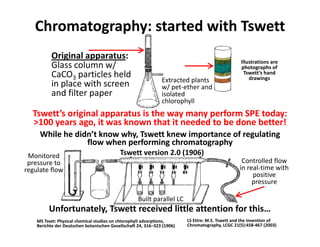
Original apparatus:
Glass column w/
CaCO3 particles held
Extracted plants
Illustrations are
photographs of
Tswett’s hand
drawingsCaCO3 particles held
in place with screen
and filter paper
Extracted plants
w/ pet-ether and
isolated
chlorophyll
Tswett’s original apparatus is the way many perform SPE today:
drawings
Tswett’s original apparatus is the way many perform SPE today:
>100 years ago, it was known that it needed to be done better!
While he didn’t know why, Tswett knew importance of regulating
flow when performing chromatography
Controlled flow
in real-time with
positive
Monitored
pressure to
regulate flow
flow when performing chromatography
Tswett version 2.0 (1906)
Built parallel LC
in real-time with
positive
pressure
regulate flow
Built parallel LC
Unfortunately, Tswett received little attention for this…
MS Tsvet: Physical chemical studies on chlorophyll adsorptions,
Berichte der Deutschen botanischen Gesellschaft 24, 316–323 (1906)
LS Ettre: M.S. Tswett and the Invention of
Chromatography, LCGC 21(5):458-467 (2003)
Chromatography
received little attention untilreceived little attention until
• 1941: partitioning model explains chromatographic
process (mechanistic understanding chromatography - Nobel)*process (mechanistic understanding chromatography - Nobel)*
• 1945: Erika Cremer and Fritz Prior built first GC**
• 1950: Metal tubes filled with activated carbon used in• 1950: Metal tubes filled with activated carbon used in
large volume water sampling (emergence of SPE)***
• 1956: Quantitative understanding of chromatographic
flow****flow****
Then, the basic knowledge was in place for the
use of chromatography to grow exponentially
Then, the basic knowledge was in place for the
use of chromatography to grow exponentially
*AJP Martin, RLM Synge. Biochem. J. 1941, 35, 1358–1368. ***“50 years of SPE”, I. Liška, J. Chromatogr., A,*AJP Martin, RLM Synge. Biochem. J. 1941, 35, 1358–1368.
*LS Ettre , “The birth of partition chromatograph” LCGC,
2001, 19, 506–512.
**F Prior, PhD Thesis, Univ Innsbruck, 1947.
***“50 years of SPE”, I. Liška, J. Chromatogr., A,
2000, 885, 3–16.
****J.J. van Deemter , F.J. Zuiderweg, A.
Klinkenberg, Chem. Eng. Sc., 1956, 5, 271–289 .
Evolution of Practical LC and SPE
• Commercialization of LC efforts by J. Waters in the 1960s
• Led to pumps, injection systems, & silica sorbent particles in the 1970s
• Silica sorbent development led to SPE (syringe tube) in 1970s
• Development of HPLC closely followed teachings of van
Deemter* & Giddings** (1970s – 2000s)
• Development of HPLC closely followed teachings of van
Deemter* & Giddings** (1970s – 2000s) [accurate flow & small particles]
• SPE development did not follow these teachings since it is not
isocratic (Required assumption to derive chromatography equations)isocratic (Required assumption to derive chromatography equations)
• Later, van Deemter & Giddings teachings were applied to
gradient LC separations and shown to apply***gradient LC separations and shown to apply***
• Until now, single use SPE devices haven’t followed these
teachings, particularly importance of carefully controlled flow
*JJ van Deemter , FJ Zuiderweg, A Klinkenberg, Chem. Eng. Sc., 1956, 5, 271–289
**JC Giddings, Dynamics of Chromatography: Principles and Theory, CRC Press, 1965
*** UD Neue, HPLC Columns: Theory, Technology, and Practice, Wiley, 1997, p77
Issues with common single use SPE devices
• Lack of flow control• Lack of flow control
– With vacuum, gravity, or pneumatic pressure, changing
weight of liquid above sorbent changes flow
– Changing solvent viscosity changes flow
– In parallel, effect is exacerbated since each device has
different flow resistance & variable flow ratedifferent flow resistance & variable flow rate
• Result of flow variability is variability in absolute
recovery (50-85% common) & results
– ISs used to achieve meaningful results– ISs used to achieve meaningful results
– Overall data evaluated based on worst case scenario (flow far
from optimal, low absolute recovery)from optimal, low absolute recovery)
• High absolute recovery against external standards in
solvent, the gold standard in demonstrating absence
of matrix effects, isn’t used with SPEof matrix effects, isn’t used with SPE
– 3 injection experiment leaves no doubts about matrix effects
Assertion: SPE is LC!
• Fundamentals of high performance operation in LC:• Fundamentals of high performance operation in LC:
– well packed sorbents to control variance in diffusion distance
– precise flow control to match diffusion velocity/distance–
– minimizing dispersion (dilution)
• History improving LC performance well documented &
gains truly significantgains truly significant
• Until now, these principles have not been applied to SPE
• Commonly heard rationalization:• Commonly heard rationalization:
– “SPE is digital chromatography.” Thus, we cannot expect LC like
performance despite the fact that we are using LC sorbents.
• This presentation challenges that claim using packed• This presentation challenges that claim using packed
sorbent & automation to achieve flow control
• Reality: all known principles that apply to gradient• Reality: all known principles that apply to gradient
HPLC, apply to SPE equally
Typical single use SPE device performance
*Jordan L, LCGC 1993, 11, 634-8
DecreasingRecovery
Flow
Optimum Flow
Expected chromatographic behavior
• Flow: slower is
better but counter
productive
• Lack of clearly
defined optimum
flow demonstrates
lack of flow control
or packed
chromatographic
sorbent, or both
σσσσ2 = A + B + C
Known SPE
behavior*
Why do we use SPE?
• SPE is a preferred tool for isolating target analytes
from complex matrices due to:
– Availability of diverse range of chromatographic sorbents
– Enables targeted approaches based on specific chemistry
of analytes & matrices (important)of analytes & matrices (important)
• SPE offers the ability to enrich or pre-concentrate
analytes (particularly when drying & re-dissolving)
– Enrichment is valuable allowing one to match analyte– Enrichment is valuable allowing one to match analyte
concentrations to approach used to measure them
• Single use devices help prevent carryover• Single use devices help prevent carryover
• Given these unique capabilities, SPE often first
choice in analytical sample preparationchoice in analytical sample preparation
Compelling reasons for interest in SmartSPE
– Automation using GERSTEL MPS autosampler
– SPE performed on-line in parallel workflow with– SPE performed on-line in parallel workflow with
LC/MS/MS (or GC/MS/MS)
– JIT sample prep delivers “freshest” possible sample– JIT sample prep delivers “freshest” possible sample
with no time cost for sample prep*
– No need for drying eluant due to small elution– No need for drying eluant due to small elution
volumes (up to 200x enrichment)*
• Testing also showed interesting chromatographic• Testing also showed interesting chromatographic
performance not previously seen in other single
use SPE devices*
*Hayward M, et. al. Am. Lab., 2016, 48(7): 14-17
use SPE devices*
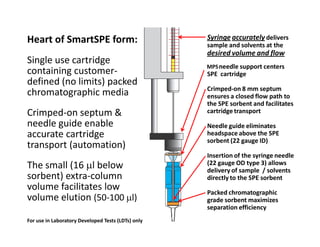
Syringe accurately delivers
sample and solvents at the
Heart of SmartSPE form: sample and solvents at the
desired volume and flow
PAL needle support centers
SPE cartridge
Single use cartridge
containing customer-
defined (no limits) packed
MPS
SPE cartridge
Crimped-on 8 mm septum
ensures a closed flow path to
the SPE sorbent and facilitates
cartridge transport
defined (no limits) packed
chromatographic media
Crimped-on septum & cartridge transport
Needle guide eliminates
headspace above the SPE
sorbent (22 gauge ID)
Crimped-on septum &
needle guide enable
accurate cartridge
transport (automation) sorbent (22 gauge ID)
Insertion of the syringe needle
(22 gauge OD type 3) allows
delivery of sample / solvents
accurate cartridge
transport (automation)
The small (16 µl below
sorbent) extra-column
delivery of sample / solvents
directly to the SPE sorbent
Packed chromatographic
grade sorbent maximizes
The small (16 µl below
sorbent) extra-column
volume facilitates low
volume elution (50-100 µl) grade sorbent maximizes
separation efficiency
volume elution (50-100 µl)
For use in Laboratory Developed Tests (LDTs) only
Automated SmartSPE Using an
Autosampler: How it worksAutosampler: How it works
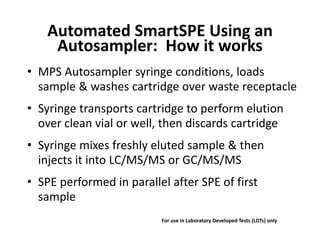
• MPS Autosampler syringe conditions, loads• MPS Autosampler syringe conditions, loads
sample & washes cartridge over waste receptacle
• Syringe transports cartridge to perform elution• Syringe transports cartridge to perform elution
over clean vial or well, then discards cartridge
• Syringe mixes freshly eluted sample & then• Syringe mixes freshly eluted sample & then
injects it into LC/MS/MS or GC/MS/MS
• SPE performed in parallel after SPE of first
samplesample
For use in Laboratory Developed Tests (LDTs) only
Workflow: minimizing cycle time
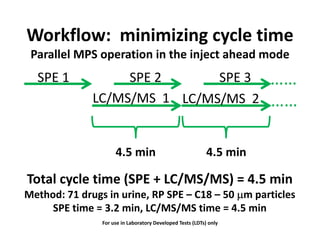
Parallel MPS operation in the inject ahead mode
SPE 1 SPE 2 SPE 3 ……SPE 1 SPE 2 SPE 3
LC/MS/MS 1 LC/MS/MS 2 ……
……
……
4.5 min 4.5 min
Total cycle time (SPE + LC/MS/MS) = 4.5 minTotal cycle time (SPE + LC/MS/MS) = 4.5 min
Method: 71 drugs in urine, RP SPE – C18 – 50 µµµµm particles
SPE time = 3.2 min, LC/MS/MS time = 4.5 minSPE time = 3.2 min, LC/MS/MS time = 4.5 min
For use in Laboratory Developed Tests (LDTs) only
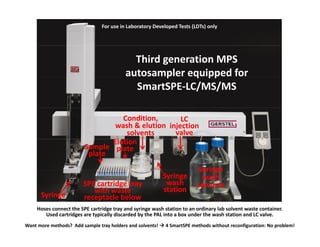
Third generation MPS
autosampler equipped forautosampler equipped for
SmartSPE-LC/MS/MS
Condition,
wash & elution
solvents
ElutionElution
LC
injection
valve
SampleSample
plateplate
ElutionElution
plateplate
SyringeSyringe
SPE cartridge tray
with waste
receptacle belowSyringeSyringe
SyringeSyringe
washwash
stationstation
SyringeSyringe
washwash
solventssolvents
Hoses connect the SPE cartridge tray and syringe wash station to an ordinary lab solvent waste container.
Used cartridges are typically discarded by the PAL into a box under the wash station and LC valve.
Want more methods? Add sample tray holders and solvents! 4 SmartSPE methods without reconfiguration: No problem!
Development of Automated SmartSPE Methods
Resulted in Detailed SPE Flow StudiesResulted in Detailed SPE Flow Studies
• UCT 50 µm C18 end capped silica sorbent
• Included in method development was thorough flow• Included in method development was thorough flow
optimization study intended to measure cost/benefit in
time/recovery
Confirmed results not previously expected:
– The result was a 20 data point U-shaped curve showing– The result was a 20 data point U-shaped curve showing
that flow of 5 µl/s resulted in 100% absolute recovery
– Skeptical, the flow study was repeated, then again
measuring 94 data points, then again measuring load andmeasuring 94 data points, then again measuring load and
elute steps separately while holding the other at 5 µl/s
– All of these produced the same U-shaped curve and they– All of these produced the same U-shaped curve and they
all looked similar to a van Deemter curve
For use in Laboratory Developed Tests (LDTs) only
How to plot a van Deemter curve for SPE
• Conventional measures of SPE (recovery) differ from conventional
measures of GC and LC (retention time & peak width [2σ])
• Yet the processes are same* & van Deemter equation is a• Yet the processes are same* & van Deemter equation is a
variance (σ2) equation
• Use of computerized chromatography data to evaluate separation
performance offers simple view of relative nature of σ & how toperformance offers simple view of relative nature of σ & how to
address SPE data**
• %Recovery measures deviation (σ) like LC peak width & thus,
(100% - measured %Recovery)2 is a measure of variance (σ2)(100% - measured %Recovery)2 is a measure of variance (σ2)
Hence, plotting (100% - measured %Recovery)2 vs. flow should
yield typical van Deemter curve shape if chromatographicyield typical van Deemter curve shape if chromatographic
processes govern dispersion of molecules in SPE
*Giddings, JC, Unified Separation Science, Wiley 1991, p 92-101 (diffusion, adsorption [or not], & desorption [or delayed]), the
random walk model applies)random walk model applies)
**Neue, UD, HPLC Columns: Theory, Technology, and Practice, Wiley, 1997, p12-13 (%RSD method for plate height calculation)
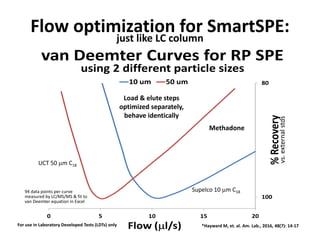
Flow optimization for SmartSPE:just like LC column
van Deemter Curves for RP SPE
using 2 different particle sizes
8010 um 50 um
Load & elute steps
optimized separately,
%Recovery
Methadone
optimized separately,
behave identically
vs.externalstds
%Recovery
vs.external
UCT 50 µm C18
100
94 data points per curve
measured by LC/MS/MS & fit to
van Deemter equation in Excel
Supelco 10 µm C18
Flow (µµµµl/s)
0 5 10 15 20
van Deemter equation in Excel
*Hayward M, et. al. Am. Lab., 2016, 48(7): 14-17For use in Laboratory Developed Tests (LDTs) only
Flow Optimization: Outcome and Impact
• SmartSPE cartridges behave like LC columns due to:
– Accurate flow control from PAL autosampler (syringe pump)
– Sorbent is packed
– Low extra-column volume
• Benefits:• Benefits:
– >99% absolute recovery systematically achieved (LC/MS/MS
±3%)±3%)
– Smaller particles can be used to increase speed for SPE (just
like LC)
– Thus far, we haven’t found an application that can’t be done– Thus far, we haven’t found an application that can’t be done
with 10 mg sorbent
– High sorbent mass SPE cartridges appear to be band-aid for
overcoming low recoveries caused by insufficient flow control…overcoming low recoveries caused by insufficient flow control…
For use in Laboratory Developed Tests (LDTs) only
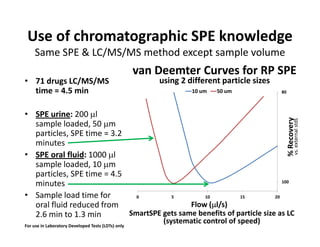
Use of chromatographic SPE knowledge
Same SPE & LC/MS/MS method except sample volumeSame SPE & LC/MS/MS method except sample volume
• 71 drugs LC/MS/MS
van Deemter Curves for RP SPE
using 2 different particle sizes• 71 drugs LC/MS/MS
time = 4.5 min
using 2 different particle sizes
8010 um 50 um
• SPE urine: 200 µl
sample loaded, 50 µm
particles, SPE time = 3.2
minutes
%Recovery
vs.externalstds
minutes
• SPE oral fluid: 1000 µl
sample loaded, 10 µm
particles, SPE time = 4.5
%Recovery
vs.external
particles, SPE time = 4.5
minutes
• Sample load time for
oral fluid reduced from Flow (µµµµl/s)
100
0 5 10 15 20
oral fluid reduced from
2.6 min to 1.3 min
Flow (µµµµl/s)
SmartSPE gets same benefits of particle size as LC
(systematic control of speed)For use in Laboratory Developed Tests (LDTs) only
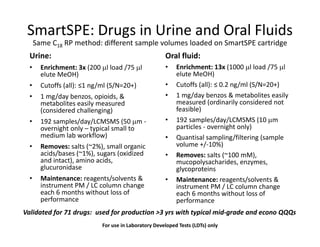
SmartSPE: Drugs in Urine and Oral Fluids
Same C18 RP method: different sample volumes loaded on SmartSPE cartridgeSame C18 RP method: different sample volumes loaded on SmartSPE cartridge
Urine:
• Enrichment: 3x (200 µl load /75 µl
elute MeOH)
Oral fluid:
• Enrichment: 13x (1000 µl load /75 µl
elute MeOH)elute MeOH)
• Cutoffs (all): ≤1 ng/ml (S/N=20+)
• 1 mg/day benzos, opioids, &
metabolites easily measured
(considered challenging)
elute MeOH)
• Cutoffs (all): ≤ 0.2 ng/ml (S/N=20+)
• 1 mg/day benzos & metabolites easily
measured (ordinarily considered not
feasible)(considered challenging)
• 192 samples/day/LCMSMS (50 µm -
overnight only – typical small to
medium lab workflow)
feasible)
• 192 samples/day/LCMSMS (10 µm
particles - overnight only)
• Quantisal sampling/filtering (samplemedium lab workflow)
• Removes: salts (~2%), small organic
acids/bases (~1%), sugars (oxidized
and intact), amino acids,
glucuronidase
• Quantisal sampling/filtering (sample
volume +/-10%)
• Removes: salts (~100 mM),
mucopolysacharides, enzymes,
glycoproteinsglucuronidase
• Maintenance: reagents/solvents &
instrument PM / LC column change
each 6 months without loss of
performance
glycoproteins
• Maintenance: reagents/solvents &
instrument PM / LC column change
each 6 months without loss of
performanceperformance performance
Validated for 71 drugs: used for production >3 yrs with typical mid-grade and econo QQQs
For use in Laboratory Developed Tests (LDTs) only
SmartSPE: Drugs in Urine and Oral Fluids
Impact on clinical production work
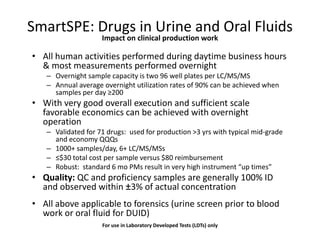
• All human activities performed during daytime business hours
& most measurements performed overnight
– Overnight sample capacity is two 96 well plates per LC/MS/MS– Overnight sample capacity is two 96 well plates per LC/MS/MS
– Annual average overnight utilization rates of 90% can be achieved when
samples per day ≥200
• With very good overall execution and sufficient scale
favorable economics can be achieved with overnight
•
favorable economics can be achieved with overnight
operation
– Validated for 71 drugs: used for production >3 yrs with typical mid-grade
and economy QQQsand economy QQQs
– 1000+ samples/day, 6+ LC/MS/MSs
– ≤$30 total cost per sample versus $80 reimbursement
– Robust: standard 6 mo PMs result in very high instrument “up times”– Robust: standard 6 mo PMs result in very high instrument “up times”
• Quality: QC and proficiency samples are generally 100% ID
and observed within ±3% of actual concentration
• All above applicable to forensics (urine screen prior to blood• All above applicable to forensics (urine screen prior to blood
work or oral fluid for DUID)
For use in Laboratory Developed Tests (LDTs) only
Further Study
• Rapid progress developing urine & oral fluid
methods led to variety of method development
efforts expanding the range analytes in more
complex matrices (blood/tissues/food)
• To address the more complex matrices this led to use• To address the more complex matrices this led to use
of more selective sorbents:
– Cation exchange for drugs (mixed mode RP due to alkyl– Cation exchange for drugs (mixed mode RP due to alkyl
linker)
– Anion exchange for lipids (mixed mode RP due to alkyl– Anion exchange for lipids (mixed mode RP due to alkyl
linker)
– Chelation for phospholipids and phosphopeptides
• As might expected, this led to more SPE flow studies
For use in Laboratory Developed Tests (LDTs) only
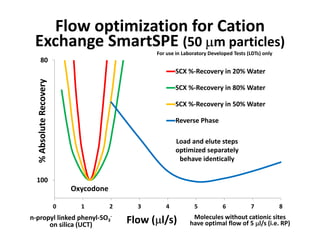
Flow optimization for Cation
Exchange SmartSPE (50 µµµµm particles)Exchange SmartSPE (50 µµµµm particles)
80
SCX %-Recovery in 20% Water
For use in Laboratory Developed Tests (LDTs) only
SCX %-Recovery in 80% Water
SCX %-Recovery in 50% Water
%AbsoluteRecovery
Reverse Phase
%AbsoluteRecovery
Load and elute steps
%AbsoluteRecovery
Load and elute steps
optimized separately
behave identically
100
Oxycodone
0 1 2 3 4 5 6 7 8
Flow (µµµµl/s)n-propyl linked phenyl-SO3
-
on silica (UCT)
Molecules without cationic sites
have optimal flow of 5 µµµµl/s (i.e. RP)
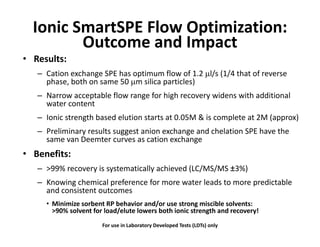
Ionic SmartSPE Flow Optimization:
Outcome and ImpactOutcome and Impact
• Results:
– Cation exchange SPE has optimum flow of 1.2 µl/s (1/4 that of reverse
phase, both on same 50 µm silica particles)
– Cation exchange SPE has optimum flow of 1.2 µl/s (1/4 that of reverse
phase, both on same 50 µm silica particles)
– Narrow acceptable flow range for high recovery widens with additional
water content
– Ionic strength based elution starts at 0.05M & is complete at 2M (approx)
– Preliminary results suggest anion exchange and chelation SPE have the
same van Deemter curves as cation exchangesame van Deemter curves as cation exchange
• Benefits:
– >99% recovery is systematically achieved (LC/MS/MS ±3%)– >99% recovery is systematically achieved (LC/MS/MS ±3%)
– Knowing chemical preference for more water leads to more predictable
and consistent outcomes
• Minimize sorbent RP behavior and/or use strong miscible solvents:• Minimize sorbent RP behavior and/or use strong miscible solvents:
>90% solvent for load/elute lowers both ionic strength and recovery!
For use in Laboratory Developed Tests (LDTs) only
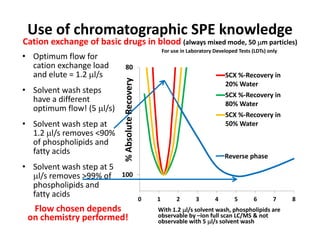
Use of chromatographic SPE knowledge
Cation exchange of basic drugs in blood (always mixed mode, 50 µµµµm particles)Cation exchange of basic drugs in blood (always mixed mode, 50 µµµµm particles)
• Optimum flow for
cation exchange load
and elute = 1.2 µl/s
80
SCX %-Recovery in
For use in Laboratory Developed Tests (LDTs) only
and elute = 1.2 µl/s
• Solvent wash steps
have a different
optimum flow! (5 µl/s)
SCX %-Recovery in
20% Water
SCX %-Recovery in
80% Water
%AbsoluteRecovery
optimum flow! (5 µl/s)
• Solvent wash step at
1.2 µl/s removes <90%
of phospholipids and
SCX %-Recovery in
50% Water
%AbsoluteRecovery
of phospholipids and
fatty acids
• Solvent wash step at 5
µl/s removes >99% of 100
Reverse phase
%AbsoluteRecovery
• Solvent wash step at 5
µl/s removes >99% of
phospholipids and
fatty acids
100
0 1 2 3 4 5 6 7 80 1 2 3 4 5 6 7 8
With 1.2 µµµµl/s solvent wash, phospholipids are
observable by –ion full scan LC/MS & not
observable with 5 µµµµl/s solvent wash
Flow chosen depends
on chemistry performed!
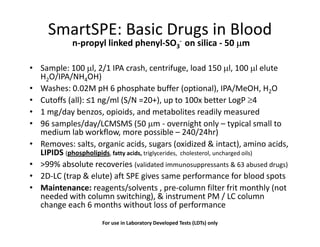
SmartSPE: Basic Drugs in Blood
n-propyl linked phenyl-SO3
- on silica - 50 µµµµm
• Sample: 100 µl, 2/1 IPA crash, centrifuge, load 150 µl, 100 µl elute
H2O/IPA/NH4OH)
n-propyl linked phenyl-SO3 on silica - 50 µµµµm
H2O/IPA/NH4OH)
• Washes: 0.02M pH 6 phosphate buffer (optional), IPA/MeOH, H2O
• Cutoffs (all): ≤1 ng/ml (S/N =20+), up to 100x better LogP ≥4
• 1 mg/day benzos, opioids, and metabolites readily measured• 1 mg/day benzos, opioids, and metabolites readily measured
• 96 samples/day/LCMSMS (50 µm - overnight only – typical small to
medium lab workflow, more possible – 240/24hr)
• Removes: salts, organic acids, sugars (oxidized & intact), amino acids,• Removes: salts, organic acids, sugars (oxidized & intact), amino acids,
LIPIDS (phospholipids, fatty acids, triglycerides, cholesterol, uncharged oils)
• >99% absolute recoveries (validated immunosuppressants & 63 abused drugs)
• 2D-LC (trap & elute) aft SPE gives same performance for blood spots
• Maintenance: reagents/solvents , pre-column filter frit monthly (not
needed with column switching), & instrument PM / LC column
change each 6 months without loss of performancechange each 6 months without loss of performance
For use in Laboratory Developed Tests (LDTs) only
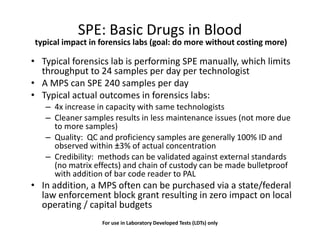
SPE: Basic Drugs in Blood
typical impact in forensics labs (goal: do more without costing more)
• Typical forensics lab is performing SPE manually, which limits
throughput to 24 samples per day per technologist
A MPS can SPE 240 samples per day
typical impact in forensics labs (goal: do more without costing more)
• A MPS can SPE 240 samples per day
• Typical actual outcomes in forensics labs:
– 4x increase in capacity with same technologists– 4x increase in capacity with same technologists
– Cleaner samples results in less maintenance issues (not more due
to more samples)
– Quality: QC and proficiency samples are generally 100% ID and– Quality: QC and proficiency samples are generally 100% ID and
observed within ±3% of actual concentration
– Credibility: methods can be validated against external standards
(no matrix effects) and chain of custody can be made bulletproof
with addition of bar code reader to PALwith addition of bar code reader to PAL
• In addition, a MPS often can be purchased via a state/federal
law enforcement block grant resulting in zero impact on local
operating / capital budgetsoperating / capital budgets
For use in Laboratory Developed Tests (LDTs) only
Summary and Conclusions
• With flow control and packed sorbent, SPE is gradient LC• With flow control and packed sorbent, SPE is gradient LC
– Knowledge about gradient LC can be applied to SPE
– Applying this knowledge produces significantly better results
than alternatives (
– Applying this knowledge produces significantly better results
than alternatives (systematic 99+% recovery / matrix removal)
• Adsorption and desorption is a reversible equilibrium
– Separate measurement of load and elute flow behavior– Separate measurement of load and elute flow behavior
produces the same van Deemter curves
– Key chromatography assumption (velocity on = velocity off)
empirically shown to be true under gradient conditionsempirically shown to be true under gradient conditions
• SPE with single use devices & accurate flow achieves high
quality in high throughput applications & provides high
productivity impact for clinical & forensics applicationsproductivity impact for clinical & forensics applications
Given the same price point, it’s hard to see rationale for
continued use of single use SPE devices that utilize loose
sorbent and/or vacuum / pneumatic driven flow
continued use of single use SPE devices that utilize loose
sorbent and/or vacuum / pneumatic driven flow
For use in Laboratory Developed Tests (LDTs) only
Acknowledgements
Experimental support & advice:Experimental support & advice:
Assurance Scientific LaboratoriesAssurance Scientific Laboratories
(clinical LDT validation & use)
Shimadzu Scientific InstrumentsShimadzu Scientific Instruments
(analytical research)
South Carolina Law Enforcement
(Robert Sears - forensics validation & use)
South Carolina Law Enforcement
(Robert Sears - forensics validation & use)
OpAns
(Ken Lewis - clinical & forensics validation & use)(Ken Lewis - clinical & forensics validation & use)
ITSP SolutionsITSP Solutions
SmartSPE
10 South Carolina St
Hartwell GA 30643
www.ITSPSolutions.com
(855) 395-8300
Next StepsNext Steps
Lunch Seminar
• Schedule a personalized Lunch Seminar with your local
GERSTEL automation specialist
Follow Up Email (receiving today)Follow Up Email (receiving today)
Webinar RecordingWebinar Recording
• Access to the webinar recording and slides will be sent to
all registrants tomorrow via email.
Questions?Questions?

Use of automation to achieve high performance solid phase extraction

  • 1.
    GERSTEL Advanced AnalyticalGERSTELAdvanced Analytical WebinarWebinar Use of Automation to Achieve High Performance Solid Phase ExtractionPerformance Solid Phase Extraction Mark Hayward PhD., Chief Scientific Officer at ITSP Solutions
  • 2.
    Use of Automationto Achieve High Performance SPEHigh Performance SPE Mark Hayward,1 Jonathan Ho,2 Matthew T. Hardison,3 Martin Johnson,3 Tom Moran,2 and Kim Gamble1 1ITSP Solutions Inc., 10 South Carolina St., Hartwell GA 30643 2Shimadzu Scientific Instruments, 19 Schoolhouse Rd, Suite 107, Somerset NJ 088732Shimadzu Scientific Instruments, 19 Schoolhouse Rd, Suite 107, Somerset NJ 08873 3Assurance Scientific Laboratories, 2868 Acton Rd, Suite 207, Vestavia, AL 35243 Key take away: Solid phase extraction is liquid chromatography! Operate it as such and get better results!Operate it as such and get better results! All content intended for Laboratory Developed Tests (LDTs) only
  • 3.
    Chromatography: started withTswett Original apparatus: Glass column w/ CaCO3 particles held Extracted plants Illustrations are photographs of Tswett’s hand drawingsCaCO3 particles held in place with screen and filter paper Extracted plants w/ pet-ether and isolated chlorophyll Tswett’s original apparatus is the way many perform SPE today: drawings Tswett’s original apparatus is the way many perform SPE today: >100 years ago, it was known that it needed to be done better! While he didn’t know why, Tswett knew importance of regulating flow when performing chromatography Controlled flow in real-time with positive Monitored pressure to regulate flow flow when performing chromatography Tswett version 2.0 (1906) Built parallel LC in real-time with positive pressure regulate flow Built parallel LC Unfortunately, Tswett received little attention for this… MS Tsvet: Physical chemical studies on chlorophyll adsorptions, Berichte der Deutschen botanischen Gesellschaft 24, 316–323 (1906) LS Ettre: M.S. Tswett and the Invention of Chromatography, LCGC 21(5):458-467 (2003)
  • 4.
    Chromatography received little attentionuntilreceived little attention until • 1941: partitioning model explains chromatographic process (mechanistic understanding chromatography - Nobel)*process (mechanistic understanding chromatography - Nobel)* • 1945: Erika Cremer and Fritz Prior built first GC** • 1950: Metal tubes filled with activated carbon used in• 1950: Metal tubes filled with activated carbon used in large volume water sampling (emergence of SPE)*** • 1956: Quantitative understanding of chromatographic flow****flow**** Then, the basic knowledge was in place for the use of chromatography to grow exponentially Then, the basic knowledge was in place for the use of chromatography to grow exponentially *AJP Martin, RLM Synge. Biochem. J. 1941, 35, 1358–1368. ***“50 years of SPE”, I. Liška, J. Chromatogr., A,*AJP Martin, RLM Synge. Biochem. J. 1941, 35, 1358–1368. *LS Ettre , “The birth of partition chromatograph” LCGC, 2001, 19, 506–512. **F Prior, PhD Thesis, Univ Innsbruck, 1947. ***“50 years of SPE”, I. Liška, J. Chromatogr., A, 2000, 885, 3–16. ****J.J. van Deemter , F.J. Zuiderweg, A. Klinkenberg, Chem. Eng. Sc., 1956, 5, 271–289 .
  • 5.
    Evolution of PracticalLC and SPE • Commercialization of LC efforts by J. Waters in the 1960s • Led to pumps, injection systems, & silica sorbent particles in the 1970s • Silica sorbent development led to SPE (syringe tube) in 1970s • Development of HPLC closely followed teachings of van Deemter* & Giddings** (1970s – 2000s) • Development of HPLC closely followed teachings of van Deemter* & Giddings** (1970s – 2000s) [accurate flow & small particles] • SPE development did not follow these teachings since it is not isocratic (Required assumption to derive chromatography equations)isocratic (Required assumption to derive chromatography equations) • Later, van Deemter & Giddings teachings were applied to gradient LC separations and shown to apply***gradient LC separations and shown to apply*** • Until now, single use SPE devices haven’t followed these teachings, particularly importance of carefully controlled flow *JJ van Deemter , FJ Zuiderweg, A Klinkenberg, Chem. Eng. Sc., 1956, 5, 271–289 **JC Giddings, Dynamics of Chromatography: Principles and Theory, CRC Press, 1965 *** UD Neue, HPLC Columns: Theory, Technology, and Practice, Wiley, 1997, p77
  • 6.
    Issues with commonsingle use SPE devices • Lack of flow control• Lack of flow control – With vacuum, gravity, or pneumatic pressure, changing weight of liquid above sorbent changes flow – Changing solvent viscosity changes flow – In parallel, effect is exacerbated since each device has different flow resistance & variable flow ratedifferent flow resistance & variable flow rate • Result of flow variability is variability in absolute recovery (50-85% common) & results – ISs used to achieve meaningful results– ISs used to achieve meaningful results – Overall data evaluated based on worst case scenario (flow far from optimal, low absolute recovery)from optimal, low absolute recovery) • High absolute recovery against external standards in solvent, the gold standard in demonstrating absence of matrix effects, isn’t used with SPEof matrix effects, isn’t used with SPE – 3 injection experiment leaves no doubts about matrix effects
  • 7.
    Assertion: SPE isLC! • Fundamentals of high performance operation in LC:• Fundamentals of high performance operation in LC: – well packed sorbents to control variance in diffusion distance – precise flow control to match diffusion velocity/distance– – minimizing dispersion (dilution) • History improving LC performance well documented & gains truly significantgains truly significant • Until now, these principles have not been applied to SPE • Commonly heard rationalization:• Commonly heard rationalization: – “SPE is digital chromatography.” Thus, we cannot expect LC like performance despite the fact that we are using LC sorbents. • This presentation challenges that claim using packed• This presentation challenges that claim using packed sorbent & automation to achieve flow control • Reality: all known principles that apply to gradient• Reality: all known principles that apply to gradient HPLC, apply to SPE equally
  • 8.
    Typical single useSPE device performance *Jordan L, LCGC 1993, 11, 634-8 DecreasingRecovery Flow Optimum Flow Expected chromatographic behavior • Flow: slower is better but counter productive • Lack of clearly defined optimum flow demonstrates lack of flow control or packed chromatographic sorbent, or both σσσσ2 = A + B + C Known SPE behavior*
  • 9.
    Why do weuse SPE? • SPE is a preferred tool for isolating target analytes from complex matrices due to: – Availability of diverse range of chromatographic sorbents – Enables targeted approaches based on specific chemistry of analytes & matrices (important)of analytes & matrices (important) • SPE offers the ability to enrich or pre-concentrate analytes (particularly when drying & re-dissolving) – Enrichment is valuable allowing one to match analyte– Enrichment is valuable allowing one to match analyte concentrations to approach used to measure them • Single use devices help prevent carryover• Single use devices help prevent carryover • Given these unique capabilities, SPE often first choice in analytical sample preparationchoice in analytical sample preparation
  • 10.
    Compelling reasons forinterest in SmartSPE – Automation using GERSTEL MPS autosampler – SPE performed on-line in parallel workflow with– SPE performed on-line in parallel workflow with LC/MS/MS (or GC/MS/MS) – JIT sample prep delivers “freshest” possible sample– JIT sample prep delivers “freshest” possible sample with no time cost for sample prep* – No need for drying eluant due to small elution– No need for drying eluant due to small elution volumes (up to 200x enrichment)* • Testing also showed interesting chromatographic• Testing also showed interesting chromatographic performance not previously seen in other single use SPE devices* *Hayward M, et. al. Am. Lab., 2016, 48(7): 14-17 use SPE devices*
  • 11.
    Syringe accurately delivers sampleand solvents at the Heart of SmartSPE form: sample and solvents at the desired volume and flow PAL needle support centers SPE cartridge Single use cartridge containing customer- defined (no limits) packed MPS SPE cartridge Crimped-on 8 mm septum ensures a closed flow path to the SPE sorbent and facilitates cartridge transport defined (no limits) packed chromatographic media Crimped-on septum & cartridge transport Needle guide eliminates headspace above the SPE sorbent (22 gauge ID) Crimped-on septum & needle guide enable accurate cartridge transport (automation) sorbent (22 gauge ID) Insertion of the syringe needle (22 gauge OD type 3) allows delivery of sample / solvents accurate cartridge transport (automation) The small (16 µl below sorbent) extra-column delivery of sample / solvents directly to the SPE sorbent Packed chromatographic grade sorbent maximizes The small (16 µl below sorbent) extra-column volume facilitates low volume elution (50-100 µl) grade sorbent maximizes separation efficiency volume elution (50-100 µl) For use in Laboratory Developed Tests (LDTs) only
  • 12.
    Automated SmartSPE Usingan Autosampler: How it worksAutosampler: How it works • MPS Autosampler syringe conditions, loads• MPS Autosampler syringe conditions, loads sample & washes cartridge over waste receptacle • Syringe transports cartridge to perform elution• Syringe transports cartridge to perform elution over clean vial or well, then discards cartridge • Syringe mixes freshly eluted sample & then• Syringe mixes freshly eluted sample & then injects it into LC/MS/MS or GC/MS/MS • SPE performed in parallel after SPE of first samplesample For use in Laboratory Developed Tests (LDTs) only
  • 13.
    Workflow: minimizing cycletime Parallel MPS operation in the inject ahead mode SPE 1 SPE 2 SPE 3 ……SPE 1 SPE 2 SPE 3 LC/MS/MS 1 LC/MS/MS 2 …… …… …… 4.5 min 4.5 min Total cycle time (SPE + LC/MS/MS) = 4.5 minTotal cycle time (SPE + LC/MS/MS) = 4.5 min Method: 71 drugs in urine, RP SPE – C18 – 50 µµµµm particles SPE time = 3.2 min, LC/MS/MS time = 4.5 minSPE time = 3.2 min, LC/MS/MS time = 4.5 min For use in Laboratory Developed Tests (LDTs) only
  • 14.
    For use inLaboratory Developed Tests (LDTs) only Third generation MPS autosampler equipped forautosampler equipped for SmartSPE-LC/MS/MS Condition, wash & elution solvents ElutionElution LC injection valve SampleSample plateplate ElutionElution plateplate SyringeSyringe SPE cartridge tray with waste receptacle belowSyringeSyringe SyringeSyringe washwash stationstation SyringeSyringe washwash solventssolvents Hoses connect the SPE cartridge tray and syringe wash station to an ordinary lab solvent waste container. Used cartridges are typically discarded by the PAL into a box under the wash station and LC valve. Want more methods? Add sample tray holders and solvents! 4 SmartSPE methods without reconfiguration: No problem!
  • 15.
    Development of AutomatedSmartSPE Methods Resulted in Detailed SPE Flow StudiesResulted in Detailed SPE Flow Studies • UCT 50 µm C18 end capped silica sorbent • Included in method development was thorough flow• Included in method development was thorough flow optimization study intended to measure cost/benefit in time/recovery Confirmed results not previously expected: – The result was a 20 data point U-shaped curve showing– The result was a 20 data point U-shaped curve showing that flow of 5 µl/s resulted in 100% absolute recovery – Skeptical, the flow study was repeated, then again measuring 94 data points, then again measuring load andmeasuring 94 data points, then again measuring load and elute steps separately while holding the other at 5 µl/s – All of these produced the same U-shaped curve and they– All of these produced the same U-shaped curve and they all looked similar to a van Deemter curve For use in Laboratory Developed Tests (LDTs) only
  • 16.
    How to plota van Deemter curve for SPE • Conventional measures of SPE (recovery) differ from conventional measures of GC and LC (retention time & peak width [2σ]) • Yet the processes are same* & van Deemter equation is a• Yet the processes are same* & van Deemter equation is a variance (σ2) equation • Use of computerized chromatography data to evaluate separation performance offers simple view of relative nature of σ & how toperformance offers simple view of relative nature of σ & how to address SPE data** • %Recovery measures deviation (σ) like LC peak width & thus, (100% - measured %Recovery)2 is a measure of variance (σ2)(100% - measured %Recovery)2 is a measure of variance (σ2) Hence, plotting (100% - measured %Recovery)2 vs. flow should yield typical van Deemter curve shape if chromatographicyield typical van Deemter curve shape if chromatographic processes govern dispersion of molecules in SPE *Giddings, JC, Unified Separation Science, Wiley 1991, p 92-101 (diffusion, adsorption [or not], & desorption [or delayed]), the random walk model applies)random walk model applies) **Neue, UD, HPLC Columns: Theory, Technology, and Practice, Wiley, 1997, p12-13 (%RSD method for plate height calculation)
  • 17.
    Flow optimization forSmartSPE:just like LC column van Deemter Curves for RP SPE using 2 different particle sizes 8010 um 50 um Load & elute steps optimized separately, %Recovery Methadone optimized separately, behave identically vs.externalstds %Recovery vs.external UCT 50 µm C18 100 94 data points per curve measured by LC/MS/MS & fit to van Deemter equation in Excel Supelco 10 µm C18 Flow (µµµµl/s) 0 5 10 15 20 van Deemter equation in Excel *Hayward M, et. al. Am. Lab., 2016, 48(7): 14-17For use in Laboratory Developed Tests (LDTs) only
  • 18.
    Flow Optimization: Outcomeand Impact • SmartSPE cartridges behave like LC columns due to: – Accurate flow control from PAL autosampler (syringe pump) – Sorbent is packed – Low extra-column volume • Benefits:• Benefits: – >99% absolute recovery systematically achieved (LC/MS/MS ±3%)±3%) – Smaller particles can be used to increase speed for SPE (just like LC) – Thus far, we haven’t found an application that can’t be done– Thus far, we haven’t found an application that can’t be done with 10 mg sorbent – High sorbent mass SPE cartridges appear to be band-aid for overcoming low recoveries caused by insufficient flow control…overcoming low recoveries caused by insufficient flow control… For use in Laboratory Developed Tests (LDTs) only
  • 19.
    Use of chromatographicSPE knowledge Same SPE & LC/MS/MS method except sample volumeSame SPE & LC/MS/MS method except sample volume • 71 drugs LC/MS/MS van Deemter Curves for RP SPE using 2 different particle sizes• 71 drugs LC/MS/MS time = 4.5 min using 2 different particle sizes 8010 um 50 um • SPE urine: 200 µl sample loaded, 50 µm particles, SPE time = 3.2 minutes %Recovery vs.externalstds minutes • SPE oral fluid: 1000 µl sample loaded, 10 µm particles, SPE time = 4.5 %Recovery vs.external particles, SPE time = 4.5 minutes • Sample load time for oral fluid reduced from Flow (µµµµl/s) 100 0 5 10 15 20 oral fluid reduced from 2.6 min to 1.3 min Flow (µµµµl/s) SmartSPE gets same benefits of particle size as LC (systematic control of speed)For use in Laboratory Developed Tests (LDTs) only
  • 20.
    SmartSPE: Drugs inUrine and Oral Fluids Same C18 RP method: different sample volumes loaded on SmartSPE cartridgeSame C18 RP method: different sample volumes loaded on SmartSPE cartridge Urine: • Enrichment: 3x (200 µl load /75 µl elute MeOH) Oral fluid: • Enrichment: 13x (1000 µl load /75 µl elute MeOH)elute MeOH) • Cutoffs (all): ≤1 ng/ml (S/N=20+) • 1 mg/day benzos, opioids, & metabolites easily measured (considered challenging) elute MeOH) • Cutoffs (all): ≤ 0.2 ng/ml (S/N=20+) • 1 mg/day benzos & metabolites easily measured (ordinarily considered not feasible)(considered challenging) • 192 samples/day/LCMSMS (50 µm - overnight only – typical small to medium lab workflow) feasible) • 192 samples/day/LCMSMS (10 µm particles - overnight only) • Quantisal sampling/filtering (samplemedium lab workflow) • Removes: salts (~2%), small organic acids/bases (~1%), sugars (oxidized and intact), amino acids, glucuronidase • Quantisal sampling/filtering (sample volume +/-10%) • Removes: salts (~100 mM), mucopolysacharides, enzymes, glycoproteinsglucuronidase • Maintenance: reagents/solvents & instrument PM / LC column change each 6 months without loss of performance glycoproteins • Maintenance: reagents/solvents & instrument PM / LC column change each 6 months without loss of performanceperformance performance Validated for 71 drugs: used for production >3 yrs with typical mid-grade and econo QQQs For use in Laboratory Developed Tests (LDTs) only
  • 21.
    SmartSPE: Drugs inUrine and Oral Fluids Impact on clinical production work • All human activities performed during daytime business hours & most measurements performed overnight – Overnight sample capacity is two 96 well plates per LC/MS/MS– Overnight sample capacity is two 96 well plates per LC/MS/MS – Annual average overnight utilization rates of 90% can be achieved when samples per day ≥200 • With very good overall execution and sufficient scale favorable economics can be achieved with overnight • favorable economics can be achieved with overnight operation – Validated for 71 drugs: used for production >3 yrs with typical mid-grade and economy QQQsand economy QQQs – 1000+ samples/day, 6+ LC/MS/MSs – ≤$30 total cost per sample versus $80 reimbursement – Robust: standard 6 mo PMs result in very high instrument “up times”– Robust: standard 6 mo PMs result in very high instrument “up times” • Quality: QC and proficiency samples are generally 100% ID and observed within ±3% of actual concentration • All above applicable to forensics (urine screen prior to blood• All above applicable to forensics (urine screen prior to blood work or oral fluid for DUID) For use in Laboratory Developed Tests (LDTs) only
  • 22.
    Further Study • Rapidprogress developing urine & oral fluid methods led to variety of method development efforts expanding the range analytes in more complex matrices (blood/tissues/food) • To address the more complex matrices this led to use• To address the more complex matrices this led to use of more selective sorbents: – Cation exchange for drugs (mixed mode RP due to alkyl– Cation exchange for drugs (mixed mode RP due to alkyl linker) – Anion exchange for lipids (mixed mode RP due to alkyl– Anion exchange for lipids (mixed mode RP due to alkyl linker) – Chelation for phospholipids and phosphopeptides • As might expected, this led to more SPE flow studies For use in Laboratory Developed Tests (LDTs) only
  • 23.
    Flow optimization forCation Exchange SmartSPE (50 µµµµm particles)Exchange SmartSPE (50 µµµµm particles) 80 SCX %-Recovery in 20% Water For use in Laboratory Developed Tests (LDTs) only SCX %-Recovery in 80% Water SCX %-Recovery in 50% Water %AbsoluteRecovery Reverse Phase %AbsoluteRecovery Load and elute steps %AbsoluteRecovery Load and elute steps optimized separately behave identically 100 Oxycodone 0 1 2 3 4 5 6 7 8 Flow (µµµµl/s)n-propyl linked phenyl-SO3 - on silica (UCT) Molecules without cationic sites have optimal flow of 5 µµµµl/s (i.e. RP)
  • 24.
    Ionic SmartSPE FlowOptimization: Outcome and ImpactOutcome and Impact • Results: – Cation exchange SPE has optimum flow of 1.2 µl/s (1/4 that of reverse phase, both on same 50 µm silica particles) – Cation exchange SPE has optimum flow of 1.2 µl/s (1/4 that of reverse phase, both on same 50 µm silica particles) – Narrow acceptable flow range for high recovery widens with additional water content – Ionic strength based elution starts at 0.05M & is complete at 2M (approx) – Preliminary results suggest anion exchange and chelation SPE have the same van Deemter curves as cation exchangesame van Deemter curves as cation exchange • Benefits: – >99% recovery is systematically achieved (LC/MS/MS ±3%)– >99% recovery is systematically achieved (LC/MS/MS ±3%) – Knowing chemical preference for more water leads to more predictable and consistent outcomes • Minimize sorbent RP behavior and/or use strong miscible solvents:• Minimize sorbent RP behavior and/or use strong miscible solvents: >90% solvent for load/elute lowers both ionic strength and recovery! For use in Laboratory Developed Tests (LDTs) only
  • 25.
    Use of chromatographicSPE knowledge Cation exchange of basic drugs in blood (always mixed mode, 50 µµµµm particles)Cation exchange of basic drugs in blood (always mixed mode, 50 µµµµm particles) • Optimum flow for cation exchange load and elute = 1.2 µl/s 80 SCX %-Recovery in For use in Laboratory Developed Tests (LDTs) only and elute = 1.2 µl/s • Solvent wash steps have a different optimum flow! (5 µl/s) SCX %-Recovery in 20% Water SCX %-Recovery in 80% Water %AbsoluteRecovery optimum flow! (5 µl/s) • Solvent wash step at 1.2 µl/s removes <90% of phospholipids and SCX %-Recovery in 50% Water %AbsoluteRecovery of phospholipids and fatty acids • Solvent wash step at 5 µl/s removes >99% of 100 Reverse phase %AbsoluteRecovery • Solvent wash step at 5 µl/s removes >99% of phospholipids and fatty acids 100 0 1 2 3 4 5 6 7 80 1 2 3 4 5 6 7 8 With 1.2 µµµµl/s solvent wash, phospholipids are observable by –ion full scan LC/MS & not observable with 5 µµµµl/s solvent wash Flow chosen depends on chemistry performed!
  • 26.
    SmartSPE: Basic Drugsin Blood n-propyl linked phenyl-SO3 - on silica - 50 µµµµm • Sample: 100 µl, 2/1 IPA crash, centrifuge, load 150 µl, 100 µl elute H2O/IPA/NH4OH) n-propyl linked phenyl-SO3 on silica - 50 µµµµm H2O/IPA/NH4OH) • Washes: 0.02M pH 6 phosphate buffer (optional), IPA/MeOH, H2O • Cutoffs (all): ≤1 ng/ml (S/N =20+), up to 100x better LogP ≥4 • 1 mg/day benzos, opioids, and metabolites readily measured• 1 mg/day benzos, opioids, and metabolites readily measured • 96 samples/day/LCMSMS (50 µm - overnight only – typical small to medium lab workflow, more possible – 240/24hr) • Removes: salts, organic acids, sugars (oxidized & intact), amino acids,• Removes: salts, organic acids, sugars (oxidized & intact), amino acids, LIPIDS (phospholipids, fatty acids, triglycerides, cholesterol, uncharged oils) • >99% absolute recoveries (validated immunosuppressants & 63 abused drugs) • 2D-LC (trap & elute) aft SPE gives same performance for blood spots • Maintenance: reagents/solvents , pre-column filter frit monthly (not needed with column switching), & instrument PM / LC column change each 6 months without loss of performancechange each 6 months without loss of performance For use in Laboratory Developed Tests (LDTs) only
  • 27.
    SPE: Basic Drugsin Blood typical impact in forensics labs (goal: do more without costing more) • Typical forensics lab is performing SPE manually, which limits throughput to 24 samples per day per technologist A MPS can SPE 240 samples per day typical impact in forensics labs (goal: do more without costing more) • A MPS can SPE 240 samples per day • Typical actual outcomes in forensics labs: – 4x increase in capacity with same technologists– 4x increase in capacity with same technologists – Cleaner samples results in less maintenance issues (not more due to more samples) – Quality: QC and proficiency samples are generally 100% ID and– Quality: QC and proficiency samples are generally 100% ID and observed within ±3% of actual concentration – Credibility: methods can be validated against external standards (no matrix effects) and chain of custody can be made bulletproof with addition of bar code reader to PALwith addition of bar code reader to PAL • In addition, a MPS often can be purchased via a state/federal law enforcement block grant resulting in zero impact on local operating / capital budgetsoperating / capital budgets For use in Laboratory Developed Tests (LDTs) only
  • 28.
    Summary and Conclusions •With flow control and packed sorbent, SPE is gradient LC• With flow control and packed sorbent, SPE is gradient LC – Knowledge about gradient LC can be applied to SPE – Applying this knowledge produces significantly better results than alternatives ( – Applying this knowledge produces significantly better results than alternatives (systematic 99+% recovery / matrix removal) • Adsorption and desorption is a reversible equilibrium – Separate measurement of load and elute flow behavior– Separate measurement of load and elute flow behavior produces the same van Deemter curves – Key chromatography assumption (velocity on = velocity off) empirically shown to be true under gradient conditionsempirically shown to be true under gradient conditions • SPE with single use devices & accurate flow achieves high quality in high throughput applications & provides high productivity impact for clinical & forensics applicationsproductivity impact for clinical & forensics applications Given the same price point, it’s hard to see rationale for continued use of single use SPE devices that utilize loose sorbent and/or vacuum / pneumatic driven flow continued use of single use SPE devices that utilize loose sorbent and/or vacuum / pneumatic driven flow For use in Laboratory Developed Tests (LDTs) only
  • 29.
    Acknowledgements Experimental support &advice:Experimental support & advice: Assurance Scientific LaboratoriesAssurance Scientific Laboratories (clinical LDT validation & use) Shimadzu Scientific InstrumentsShimadzu Scientific Instruments (analytical research) South Carolina Law Enforcement (Robert Sears - forensics validation & use) South Carolina Law Enforcement (Robert Sears - forensics validation & use) OpAns (Ken Lewis - clinical & forensics validation & use)(Ken Lewis - clinical & forensics validation & use) ITSP SolutionsITSP Solutions SmartSPE 10 South Carolina St Hartwell GA 30643 www.ITSPSolutions.com (855) 395-8300
  • 30.
    Next StepsNext Steps LunchSeminar • Schedule a personalized Lunch Seminar with your local GERSTEL automation specialist Follow Up Email (receiving today)Follow Up Email (receiving today) Webinar RecordingWebinar Recording • Access to the webinar recording and slides will be sent to all registrants tomorrow via email.
  • 31.