Solar Panels and How They
          Work
First… A Brief Introduction

                               About The Sun

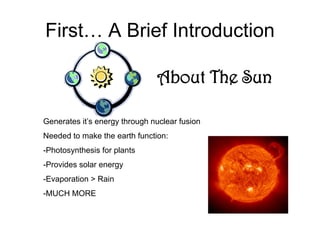
Generates it’s energy through nuclear fusion
Needed to make the earth function:
-Photosynthesis for plants
-Provides solar energy
-Evaporation > Rain
-MUCH MORE
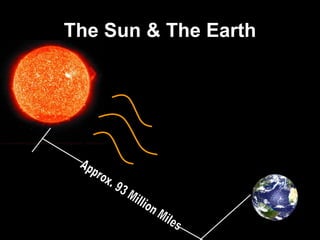
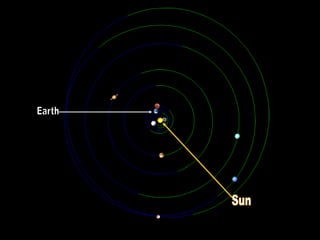
The Sun & The Earth
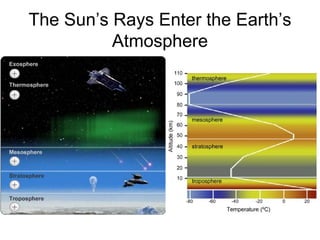
The Sun’s Rays Enter the Earth’s
          Atmosphere
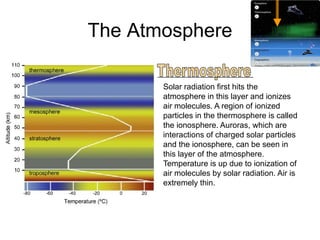
The Atmosphere

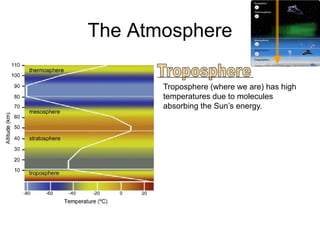
       Solar radiation first hits the
       atmosphere in this layer and ionizes
       air molecules. A region of ionized
       particles in the thermosphere is called
       the ionosphere. Auroras, which are
       interactions of charged solar particles
       and the ionosphere, can be seen in
       this layer of the atmosphere.
       Temperature is up due to ionization of
       air molecules by solar radiation. Air is
       extremely thin.
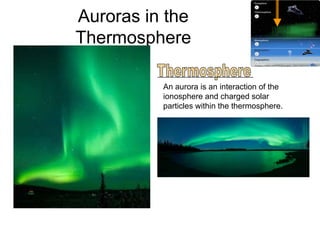
Auroras in the
Thermosphere

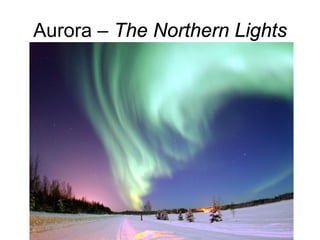
          An aurora is an interaction of the
          ionosphere and charged solar
          particles within the thermosphere.
Aurora – The Northern Lights
The Atmosphere

       Troposphere (where we are) has high
       temperatures due to molecules
       absorbing the Sun’s energy.
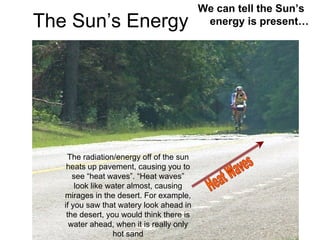
We can tell the Sun’s
The Sun’s Energy                            energy is present…


    The radiation/energy off of the sun
    heats up pavement, causing you to
      see “heat waves”. “Heat waves”
       look like water almost, causing
   mirages in the desert. For example,
   if you saw that watery look ahead in
    the desert, you would think there is
     water ahead, when it is really only
                  hot sand
The Sun’s Energy
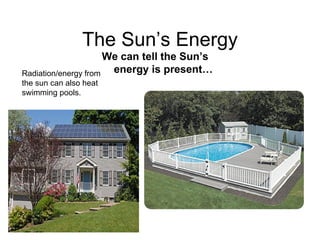
                      We can tell the Sun’s
Radiation/energy from  energy is present…
the sun can also heat
swimming pools.
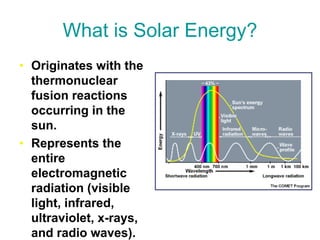
What is Solar Energy?
• Originates with the
  thermonuclear
  fusion reactions
  occurring in the
  sun.
• Represents the
  entire
  electromagnetic
  radiation (visible
  light, infrared,
  ultraviolet, x-rays,
  and radio waves).
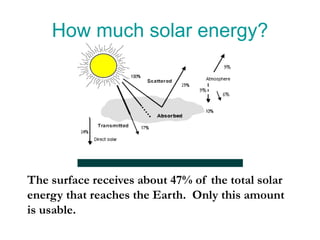
How much solar energy?


The surface receives about 47% of the total solar
energy that reaches the Earth. Only this amount
is usable.
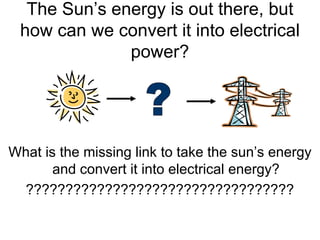
The Sun’s energy is out there, but
 how can we convert it into electrical
              power?


What is the missing link to take the sun’s energy
       and convert it into electrical energy?
  ??????????????????????????????????
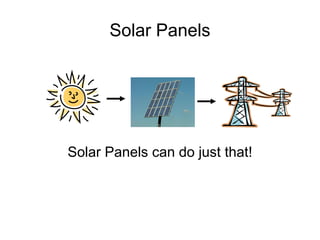
Solar Panels


Solar Panels can do just that!
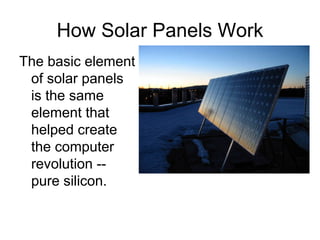
How Solar Panels Work
The basic element
 of solar panels
 is the same
 element that
 helped create
 the computer
 revolution --
 pure silicon.
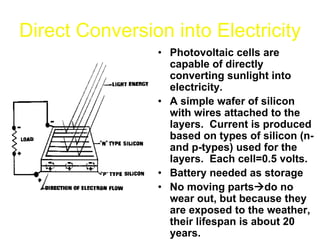
Direct Conversion into Electricity
                • Photovoltaic cells are
                  capable of directly
                  converting sunlight into
                  electricity.
                • A simple wafer of silicon
                  with wires attached to the
                  layers. Current is produced
                  based on types of silicon (n-
                  and p-types) used for the
                  layers. Each cell=0.5 volts.
                • Battery needed as storage
                • No moving partsdo no
                  wear out, but because they
                  are exposed to the weather,
                  their lifespan is about 20
                  years.
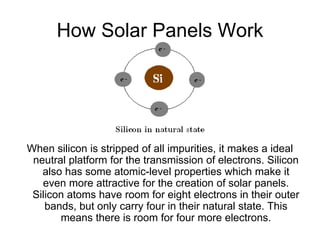
How Solar Panels Work


When silicon is stripped of all impurities, it makes a ideal
 neutral platform for the transmission of electrons. Silicon
   also has some atomic-level properties which make it
   even more attractive for the creation of solar panels.
 Silicon atoms have room for eight electrons in their outer
    bands, but only carry four in their natural state. This
       means there is room for four more electrons.
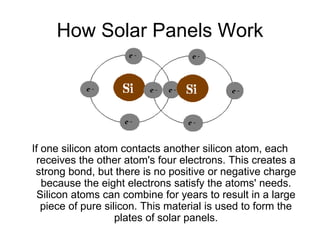
How Solar Panels Work


If one silicon atom contacts another silicon atom, each
 receives the other atom's four electrons. This creates a
 strong bond, but there is no positive or negative charge
   because the eight electrons satisfy the atoms' needs.
  Silicon atoms can combine for years to result in a large
   piece of pure silicon. This material is used to form the
                    plates of solar panels.
How Solar Panels Work


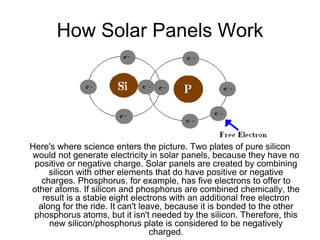
Here's where science enters the picture. Two plates of pure silicon
would not generate electricity in solar panels, because they have no
 positive or negative charge. Solar panels are created by combining
     silicon with other elements that do have positive or negative
   charges. Phosphorus, for example, has five electrons to offer to
other atoms. If silicon and phosphorus are combined chemically, the
   result is a stable eight electrons with an additional free electron
  along for the ride. It can't leave, because it is bonded to the other
 phosphorus atoms, but it isn't needed by the silicon. Therefore, this
     new silicon/phosphorus plate is considered to be negatively
                                  charged.
How Solar Panels Work


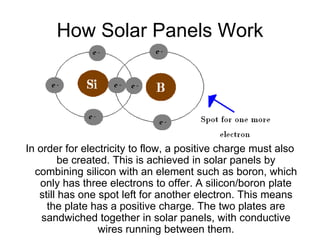
In order for electricity to flow, a positive charge must also
         be created. This is achieved in solar panels by
  combining silicon with an element such as boron, which
   only has three electrons to offer. A silicon/boron plate
   still has one spot left for another electron. This means
     the plate has a positive charge. The two plates are
    sandwiched together in solar panels, with conductive
                 wires running between them.
How Solar Panels Work


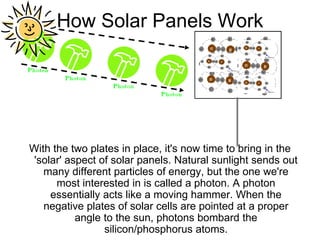
With the two plates in place, it's now time to bring in the
 'solar' aspect of solar panels. Natural sunlight sends out
   many different particles of energy, but the one we're
      most interested in is called a photon. A photon
     essentially acts like a moving hammer. When the
   negative plates of solar cells are pointed at a proper
           angle to the sun, photons bombard the
                 silicon/phosphorus atoms.
How Solar Panels Work


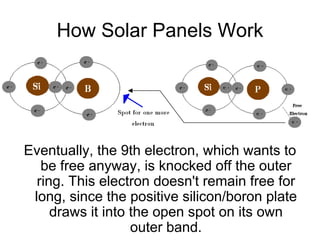
Eventually, the 9th electron, which wants to
   be free anyway, is knocked off the outer
  ring. This electron doesn't remain free for
 long, since the positive silicon/boron plate
     draws it into the open spot on its own
                   outer band.
How Solar Panels Work


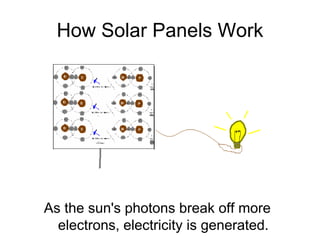
As the sun's photons break off more
  electrons, electricity is generated.
Solar Power Plants
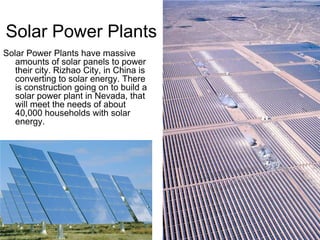
Solar Power Plants have massive
   amounts of solar panels to power
   their city. Rizhao City, in China is
   converting to solar energy. There
   is construction going on to build a
   solar power plant in Nevada, that
   will meet the needs of about
   40,000 households with solar
   energy.
Sun goes down, Lights go out???
Many people think that when the sun goes down,
 or we have a cloudy day, no energy would be
 produced, leaving us in the dark. That theory is
 not true. In fact, even with clouds, some rays
 from the sun still get through, just not as many
 on a clear day. Also, when the solar panels
 collect energy during the day, not all of it is used.
 What isn’t used is stored in giant batteries at the
 plant so there is always a reserve. However, it
 would be quite a test in Alaska, because the
 reserve may not hold out for three months!
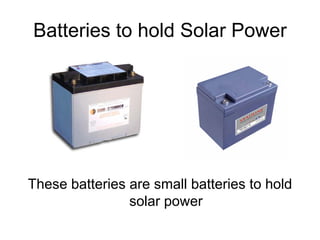
Batteries to hold Solar Power


These batteries are small batteries to hold
                solar power
Batteries to hold Solar Power


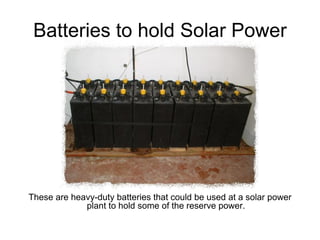
These are heavy-duty batteries that could be used at a solar power
             plant to hold some of the reserve power.
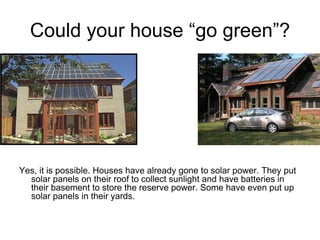
Could your house “go green”?


Yes, it is possible. Houses have already gone to solar power. They put
  solar panels on their roof to collect sunlight and have batteries in
  their basement to store the reserve power. Some have even put up
  solar panels in their yards.
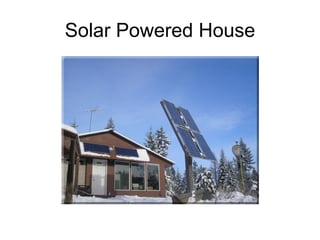
Solar Powered House
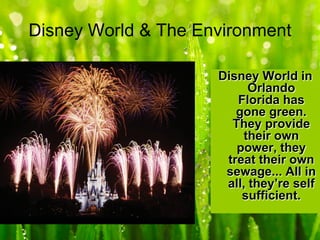
Disney World & The Environment

                     Disney World in
                           Orlando
                        Florida has
                        gone green.
                       They provide
                          their own
                        power, they
                      treat their own
                      sewage... All in
                      all, they’re self
                         sufficient.
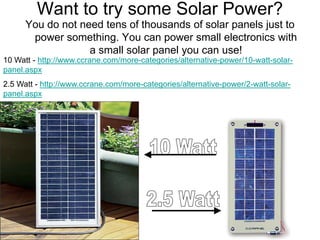
Want to try some Solar Power?
      You do not need tens of thousands of solar panels just to
       power something. You can power small electronics with
                   a small solar panel you can use!
10 Watt - http://www.ccrane.com/more-categories/alternative-power/10-watt-solar-
panel.aspx
2.5 Watt - http://www.ccrane.com/more-categories/alternative-power/2-watt-solar-
panel.aspx
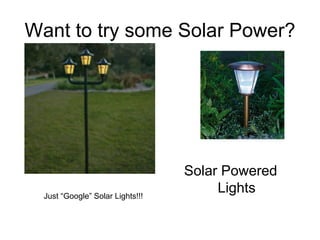
Want to try some Solar Power?


                                  Solar Powered
  Just “Google” Solar Lights!!!
                                       Lights
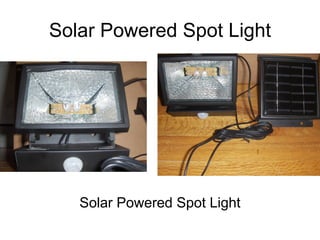
Solar Powered Spot Light


   Solar Powered Spot Light
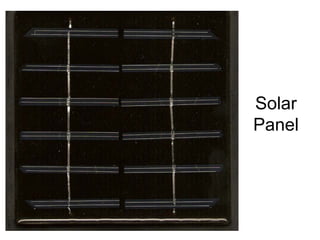
Solar
Panel

Solar panels

  • 1.
    Solar Panels andHow They Work
  • 2.
    First… A BriefIntroduction About The Sun Generates it’s energy through nuclear fusion Needed to make the earth function: -Photosynthesis for plants -Provides solar energy -Evaporation > Rain -MUCH MORE
  • 3.
    The Sun &The Earth
  • 5.
    The Sun’s RaysEnter the Earth’s Atmosphere
  • 6.
    The Atmosphere Solar radiation first hits the atmosphere in this layer and ionizes air molecules. A region of ionized particles in the thermosphere is called the ionosphere. Auroras, which are interactions of charged solar particles and the ionosphere, can be seen in this layer of the atmosphere. Temperature is up due to ionization of air molecules by solar radiation. Air is extremely thin.
  • 7.
    Auroras in the Thermosphere An aurora is an interaction of the ionosphere and charged solar particles within the thermosphere.
  • 8.
    Aurora – TheNorthern Lights
  • 9.
    The Atmosphere Troposphere (where we are) has high temperatures due to molecules absorbing the Sun’s energy.
  • 10.
    We can tellthe Sun’s The Sun’s Energy energy is present… The radiation/energy off of the sun heats up pavement, causing you to see “heat waves”. “Heat waves” look like water almost, causing mirages in the desert. For example, if you saw that watery look ahead in the desert, you would think there is water ahead, when it is really only hot sand
  • 11.
    The Sun’s Energy We can tell the Sun’s Radiation/energy from energy is present… the sun can also heat swimming pools.
  • 12.
    What is SolarEnergy? • Originates with the thermonuclear fusion reactions occurring in the sun. • Represents the entire electromagnetic radiation (visible light, infrared, ultraviolet, x-rays, and radio waves).
  • 13.
    How much solarenergy? The surface receives about 47% of the total solar energy that reaches the Earth. Only this amount is usable.
  • 14.
    The Sun’s energyis out there, but how can we convert it into electrical power? What is the missing link to take the sun’s energy and convert it into electrical energy? ??????????????????????????????????
  • 15.
    Solar Panels Solar Panelscan do just that!
  • 16.
    How Solar PanelsWork The basic element of solar panels is the same element that helped create the computer revolution -- pure silicon.
  • 17.
    Direct Conversion intoElectricity • Photovoltaic cells are capable of directly converting sunlight into electricity. • A simple wafer of silicon with wires attached to the layers. Current is produced based on types of silicon (n- and p-types) used for the layers. Each cell=0.5 volts. • Battery needed as storage • No moving partsdo no wear out, but because they are exposed to the weather, their lifespan is about 20 years.
  • 18.
    How Solar PanelsWork When silicon is stripped of all impurities, it makes a ideal neutral platform for the transmission of electrons. Silicon also has some atomic-level properties which make it even more attractive for the creation of solar panels. Silicon atoms have room for eight electrons in their outer bands, but only carry four in their natural state. This means there is room for four more electrons.
  • 19.
    How Solar PanelsWork If one silicon atom contacts another silicon atom, each receives the other atom's four electrons. This creates a strong bond, but there is no positive or negative charge because the eight electrons satisfy the atoms' needs. Silicon atoms can combine for years to result in a large piece of pure silicon. This material is used to form the plates of solar panels.
  • 20.
    How Solar PanelsWork Here's where science enters the picture. Two plates of pure silicon would not generate electricity in solar panels, because they have no positive or negative charge. Solar panels are created by combining silicon with other elements that do have positive or negative charges. Phosphorus, for example, has five electrons to offer to other atoms. If silicon and phosphorus are combined chemically, the result is a stable eight electrons with an additional free electron along for the ride. It can't leave, because it is bonded to the other phosphorus atoms, but it isn't needed by the silicon. Therefore, this new silicon/phosphorus plate is considered to be negatively charged.
  • 21.
    How Solar PanelsWork In order for electricity to flow, a positive charge must also be created. This is achieved in solar panels by combining silicon with an element such as boron, which only has three electrons to offer. A silicon/boron plate still has one spot left for another electron. This means the plate has a positive charge. The two plates are sandwiched together in solar panels, with conductive wires running between them.
  • 22.
    How Solar PanelsWork With the two plates in place, it's now time to bring in the 'solar' aspect of solar panels. Natural sunlight sends out many different particles of energy, but the one we're most interested in is called a photon. A photon essentially acts like a moving hammer. When the negative plates of solar cells are pointed at a proper angle to the sun, photons bombard the silicon/phosphorus atoms.
  • 23.
    How Solar PanelsWork Eventually, the 9th electron, which wants to be free anyway, is knocked off the outer ring. This electron doesn't remain free for long, since the positive silicon/boron plate draws it into the open spot on its own outer band.
  • 24.
    How Solar PanelsWork As the sun's photons break off more electrons, electricity is generated.
  • 25.
    Solar Power Plants SolarPower Plants have massive amounts of solar panels to power their city. Rizhao City, in China is converting to solar energy. There is construction going on to build a solar power plant in Nevada, that will meet the needs of about 40,000 households with solar energy.
  • 26.
    Sun goes down,Lights go out??? Many people think that when the sun goes down, or we have a cloudy day, no energy would be produced, leaving us in the dark. That theory is not true. In fact, even with clouds, some rays from the sun still get through, just not as many on a clear day. Also, when the solar panels collect energy during the day, not all of it is used. What isn’t used is stored in giant batteries at the plant so there is always a reserve. However, it would be quite a test in Alaska, because the reserve may not hold out for three months!
  • 27.
    Batteries to holdSolar Power These batteries are small batteries to hold solar power
  • 28.
    Batteries to holdSolar Power These are heavy-duty batteries that could be used at a solar power plant to hold some of the reserve power.
  • 29.
    Could your house“go green”? Yes, it is possible. Houses have already gone to solar power. They put solar panels on their roof to collect sunlight and have batteries in their basement to store the reserve power. Some have even put up solar panels in their yards.
  • 30.
  • 31.
    Disney World &The Environment Disney World in Orlando Florida has gone green. They provide their own power, they treat their own sewage... All in all, they’re self sufficient.
  • 32.
    Want to trysome Solar Power? You do not need tens of thousands of solar panels just to power something. You can power small electronics with a small solar panel you can use! 10 Watt - http://www.ccrane.com/more-categories/alternative-power/10-watt-solar- panel.aspx 2.5 Watt - http://www.ccrane.com/more-categories/alternative-power/2-watt-solar- panel.aspx
  • 33.
    Want to trysome Solar Power? Solar Powered Just “Google” Solar Lights!!! Lights
  • 34.
    Solar Powered SpotLight Solar Powered Spot Light
  • 35.