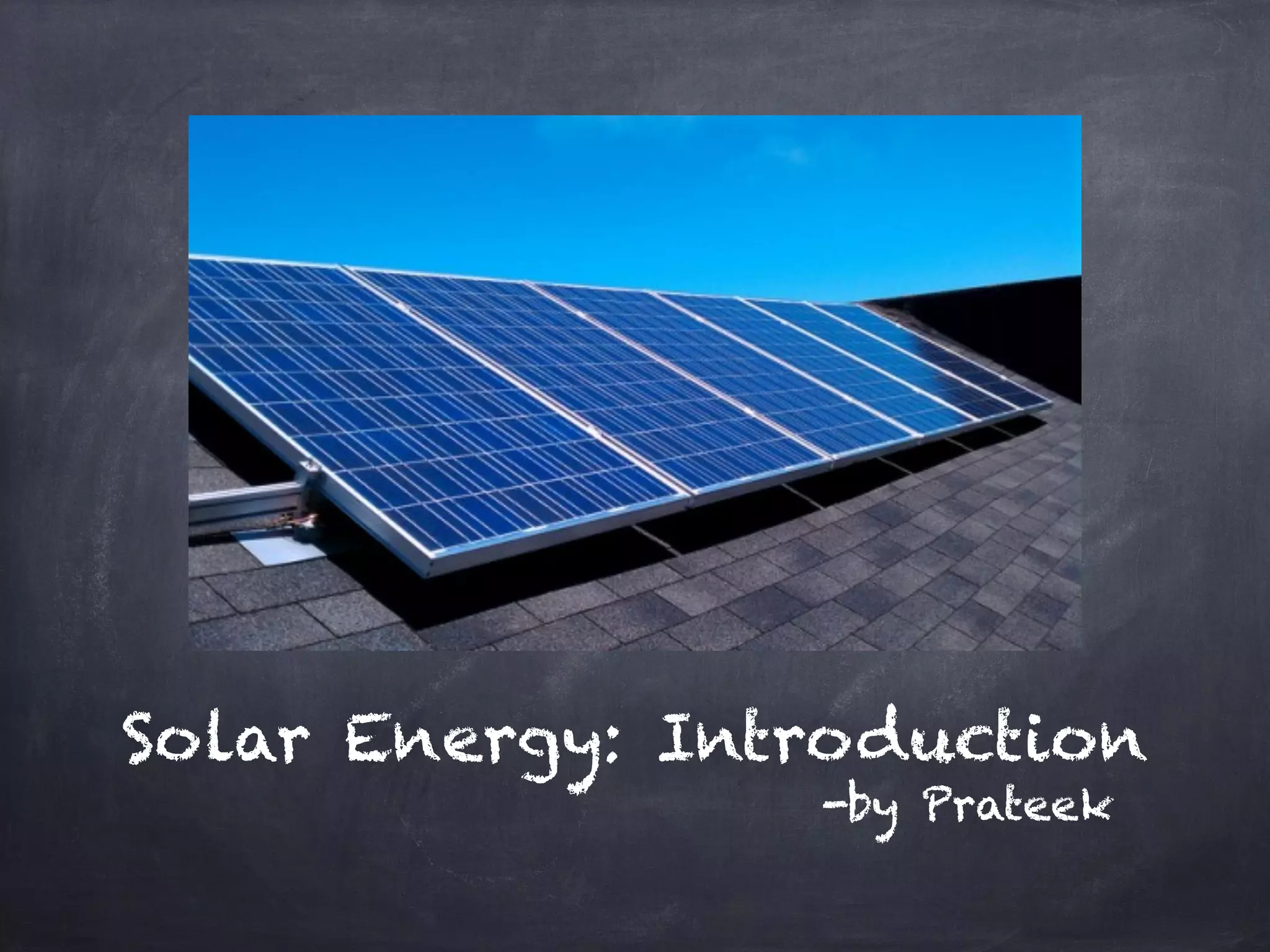
Solar Energy: Introduction
-by Prateek
Contents
Lesson 01: Introduction
Lesson 02: Technology
Lesson 03: India’s Perspective
Energy from
the Sun
The Sun is a huge ball of nuclear
power
On average, every square meter of
Earth's surface receives 164 watts of
solar energy
In other words, you could stand a
really powerful (150 watt) table
lamp on every square meter of
Earth's surface and light up the
whole planet with the Sun's energy!
Solar panels can convert this power
into a convenient supply of
electricity
Solar Energy
Solar Energy refers to the energy from the sun
The sun has produced energy for billions of years.
and it is the most important source of energy for
all life-forms
It is a renewable source of energy unlike non-
renewable sources such as fossil fuels.
The main benefit of solar energy is that it does
not produce any pollutants and is one of the
cleanest source of energy
Solar Cell
An electronic device that
converts sunlight directly into
electricity
It's about the size of an adult's
palm, octagonal in shape, and
coloured bluish black
Solar cells -> Solar modules ->
Solar panels
Also called as photovoltaic
(PV) cells
Solar energy technologies use
the sun’s energy to light homes,
produce hot water, heat homes
and electricity.
Types of Solar
Cells
First Generation
Second
Generation
Third
Generation
Efficiency of Solar
Cells
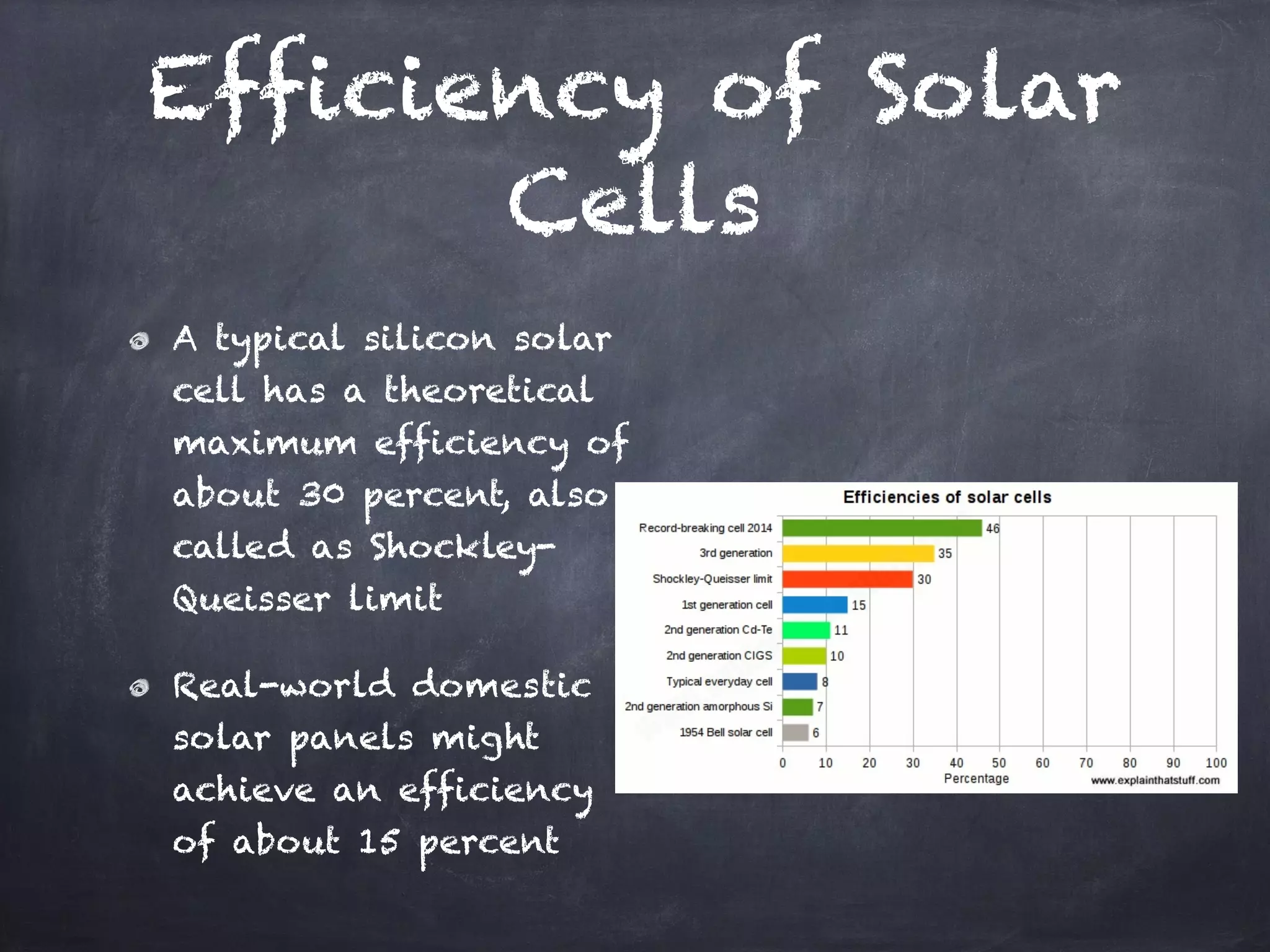
A typical silicon solar
cell has a theoretical
maximum efficiency of
about 30 percent, also
called as Shockley-
Queisser limit
Real-world domestic
solar panels might
achieve an efficiency
of about 15 percent
Why hasn't solar
power caught on yet?
A mixture of economic, political, and technological factors.
From the economic viewpoint, in most countries, electricity
generated by solar panels is still more expensive than
electricity made by burning dirty, polluting fossil fuels.
Politically, oil, gas, and coal companies are enormously
powerful and influential and resist the kind of
environmental regulations that favour renewable
technologies like solar and wind power.
Technologically, as we've already seen, solar cells are a
permanent "work in progress" and much of the world's solar
investment is still based on first-generation technology.
–European Photovoltaic Industry Association/Greenpeace,
2011.
“The total solar energy that reaches
the Earth's surface could meet
existing global energy needs 10,000
times over.”
Thank You

1.introduction to Solar Energy

  • 1.
  • 2.
    Contents Lesson 01: Introduction Lesson02: Technology Lesson 03: India’s Perspective
  • 3.
    Energy from the Sun TheSun is a huge ball of nuclear power On average, every square meter of Earth's surface receives 164 watts of solar energy In other words, you could stand a really powerful (150 watt) table lamp on every square meter of Earth's surface and light up the whole planet with the Sun's energy! Solar panels can convert this power into a convenient supply of electricity
  • 4.
    Solar Energy Solar Energyrefers to the energy from the sun The sun has produced energy for billions of years. and it is the most important source of energy for all life-forms It is a renewable source of energy unlike non- renewable sources such as fossil fuels. The main benefit of solar energy is that it does not produce any pollutants and is one of the cleanest source of energy
  • 5.
    Solar Cell An electronicdevice that converts sunlight directly into electricity It's about the size of an adult's palm, octagonal in shape, and coloured bluish black Solar cells -> Solar modules -> Solar panels Also called as photovoltaic (PV) cells Solar energy technologies use the sun’s energy to light homes, produce hot water, heat homes and electricity.
  • 6.
    Types of Solar Cells FirstGeneration Second Generation Third Generation
  • 7.
    Efficiency of Solar Cells Atypical silicon solar cell has a theoretical maximum efficiency of about 30 percent, also called as Shockley- Queisser limit Real-world domestic solar panels might achieve an efficiency of about 15 percent
  • 8.
    Why hasn't solar powercaught on yet? A mixture of economic, political, and technological factors. From the economic viewpoint, in most countries, electricity generated by solar panels is still more expensive than electricity made by burning dirty, polluting fossil fuels. Politically, oil, gas, and coal companies are enormously powerful and influential and resist the kind of environmental regulations that favour renewable technologies like solar and wind power. Technologically, as we've already seen, solar cells are a permanent "work in progress" and much of the world's solar investment is still based on first-generation technology.
  • 9.
    –European Photovoltaic IndustryAssociation/Greenpeace, 2011. “The total solar energy that reaches the Earth's surface could meet existing global energy needs 10,000 times over.”
  • 10.