SOLAR POWER PLANT
INDUSTRIAL TRAINING
SUBMITTED TO :
Mr. GOPAL TIWARI
SUBMITTED BY :
DEVESH SHARMA
EE-19
21EJCEE019
INTRODUCTION
• Solar panels are those devices which are used to absorb the sun's rays and
convert them into electricity or heat.
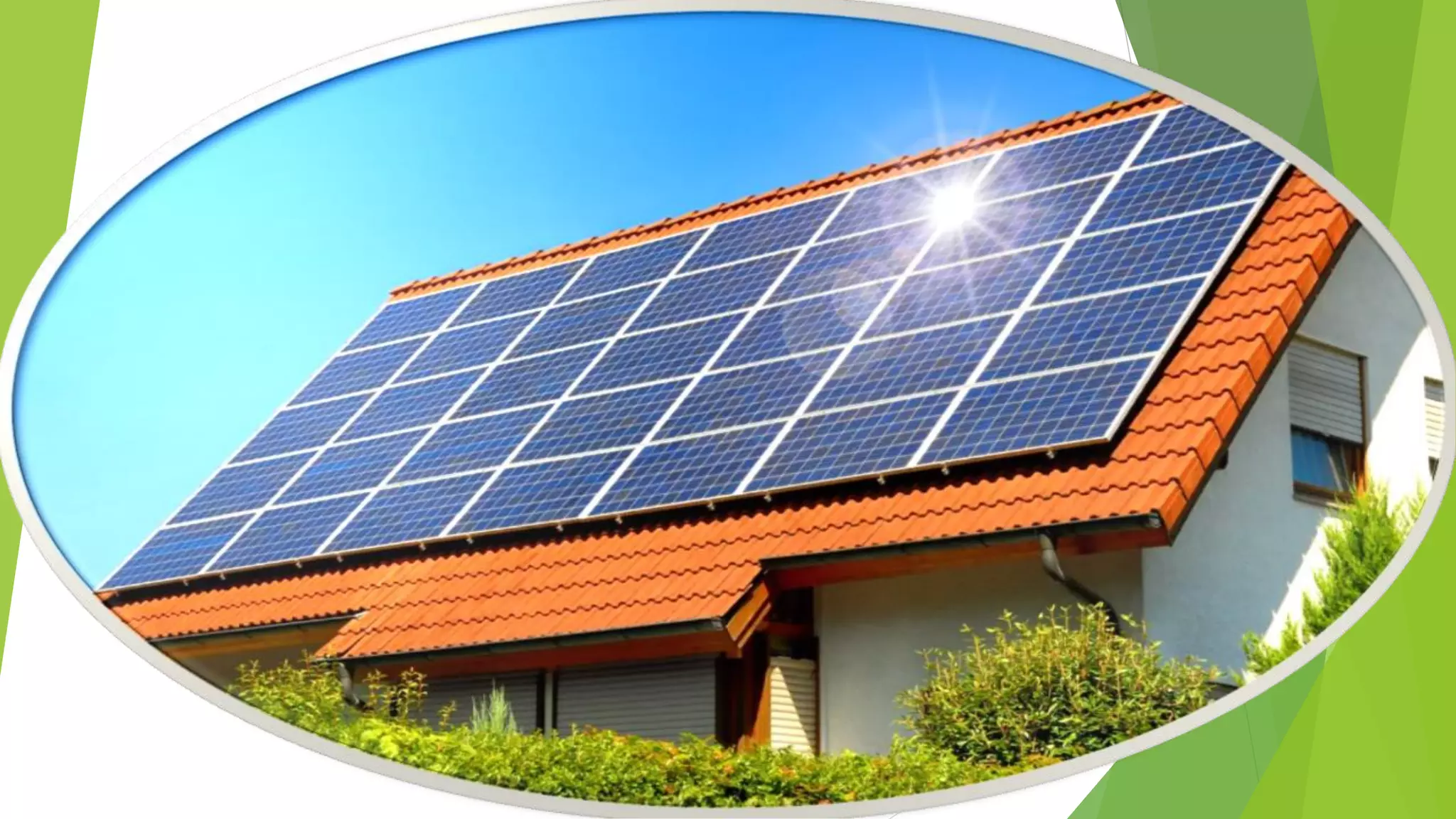
• A solar panel is actually a collection of solar (or photovoltaic) cells, which
can be used to generate electricity through photovoltaic effect. These cells
are arranged in a grid-like pattern on the surface of solar panels.
Thus, it may also be described as a set of photovoltaic modules, mounted on
a structure supporting it. A photovoltaic (PV) module is a packaged and
connected assembly of 6×10 solar cells.
When it comes to wear-and-tear, these panels are very hardy. Solar panels
wear out extremely slow. In a year, their effectiveness decreases only about
one to two per cent (at times, even lesser).
Most solar panels are made up using crystalline silicon solar cells
WHY SOLAR ENERGY
 It’s a Free Source of Energy
 It Can Make Use of the Underutilized Land
 It’s Good for the Environment
 Renewable Energy Source
 Reduces Electricity Bills
 Low Maintenance Costs
SOLAR CELL
 A solar cell (also known as a photovoltaic
cell or PV cell) is defined as an electrical
device that converts light energy into
electrical energry through the
photovoltaic effect. A solar cell is basically
a p-n junction diode. Solar cells are a
form of photoelectric cell, defined as a
device whose electrical characteristics –
such as current, voltage, or resistance –
vary when exposed to light.
 Individual solar cells can be combined to
form modules commonly known as solar
panels. The common single junction silicon
solar cell can produce a maximum open-
circuit voltage of approximately 0.5 to
0.6 volts. By itself this isn’t much – but
remember these solar cells are tiny. When
combined into a large solar panel,
considerable amounts of renewable energy
can be generated
 A solar cell is basically a junction diode,
although its construction it is little bit
different from conventional p-n junction
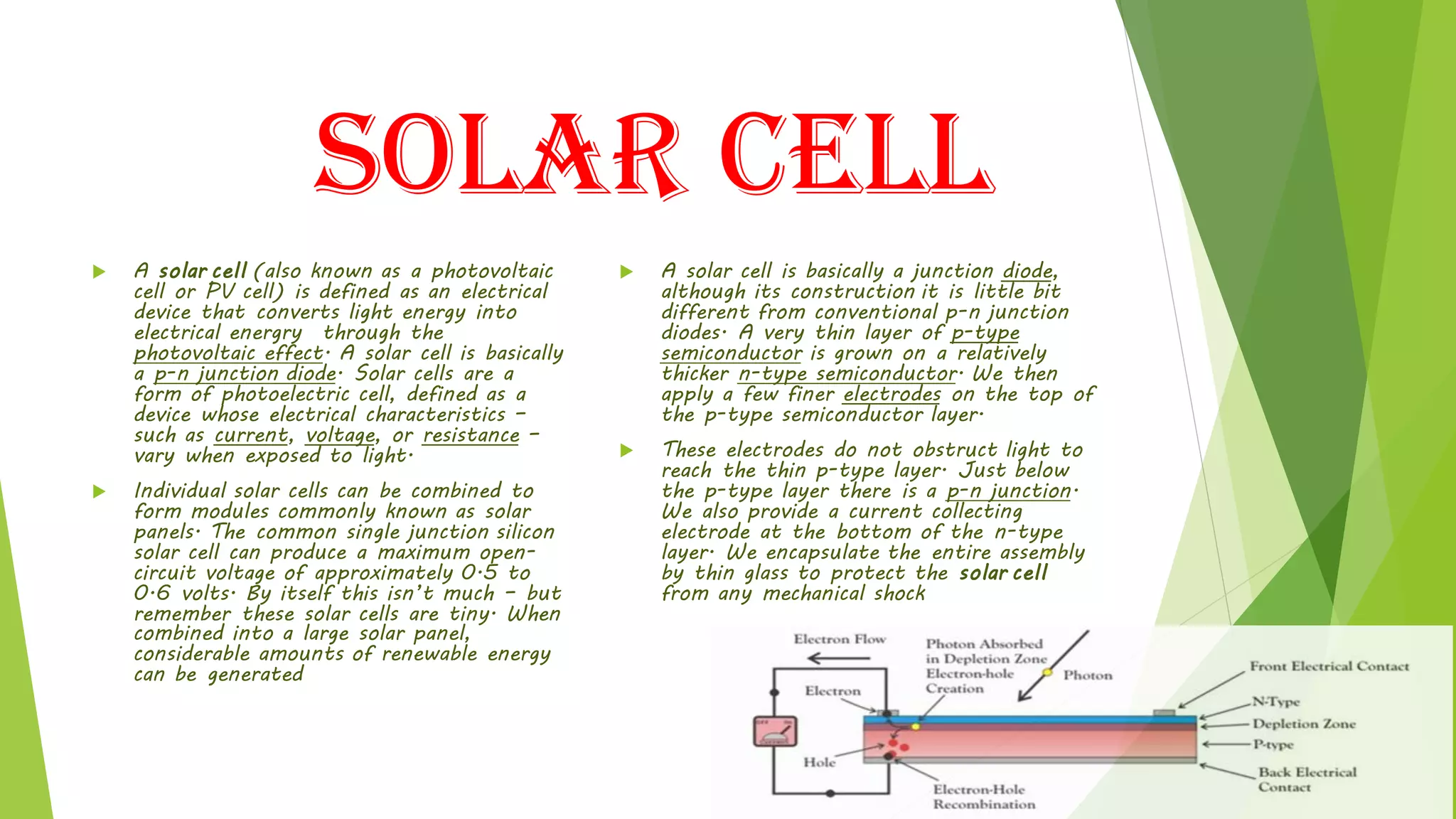
diodes. A very thin layer of p-type
semiconductor is grown on a relatively
thicker n-type semiconductor. We then
apply a few finer electrodes on the top of
the p-type semiconductor layer.
 These electrodes do not obstruct light to
reach the thin p-type layer. Just below
the p-type layer there is a p-n junction.
We also provide a current collecting
electrode at the bottom of the n-type
layer. We encapsulate the entire assembly
by thin glass to protect the solar cell
from any mechanical shock
WORKING PRINCIPLE
 When light reaches the p-n junction, the light photons can easily enter in the
junction, through very thin p-type layer. The light energy, in the form of photons,
supplies sufficient energy to the junction to create a number of electron-hole pairs.
The incident light breaks the thermal equilibrium condition of the junction. The free
electrons in the depletion region can quickly come to the n-type side of the junction.
 Similarly, the holes in the depletion can quickly come to the p-type side of the
junction. Once, the newly created free electrons come to the n-type side, cannot
further cross the junction because of barrier potential of the junction.
 Similarly, the newly created holes once come to the p-type side cannot further cross
the junction became of same barrier potential of the junction. As the concentration
of electrons becomes higher in one side, i.e. n-type side of the junction and
concentration of holes becomes more in another side, i.e. the p-type side of the
junction, the p-n junction will behave like a small battery cell. A voltage is set up
which is known as photo voltage. If we connect a small load across the junction, there
will be a tiny current flowing through it
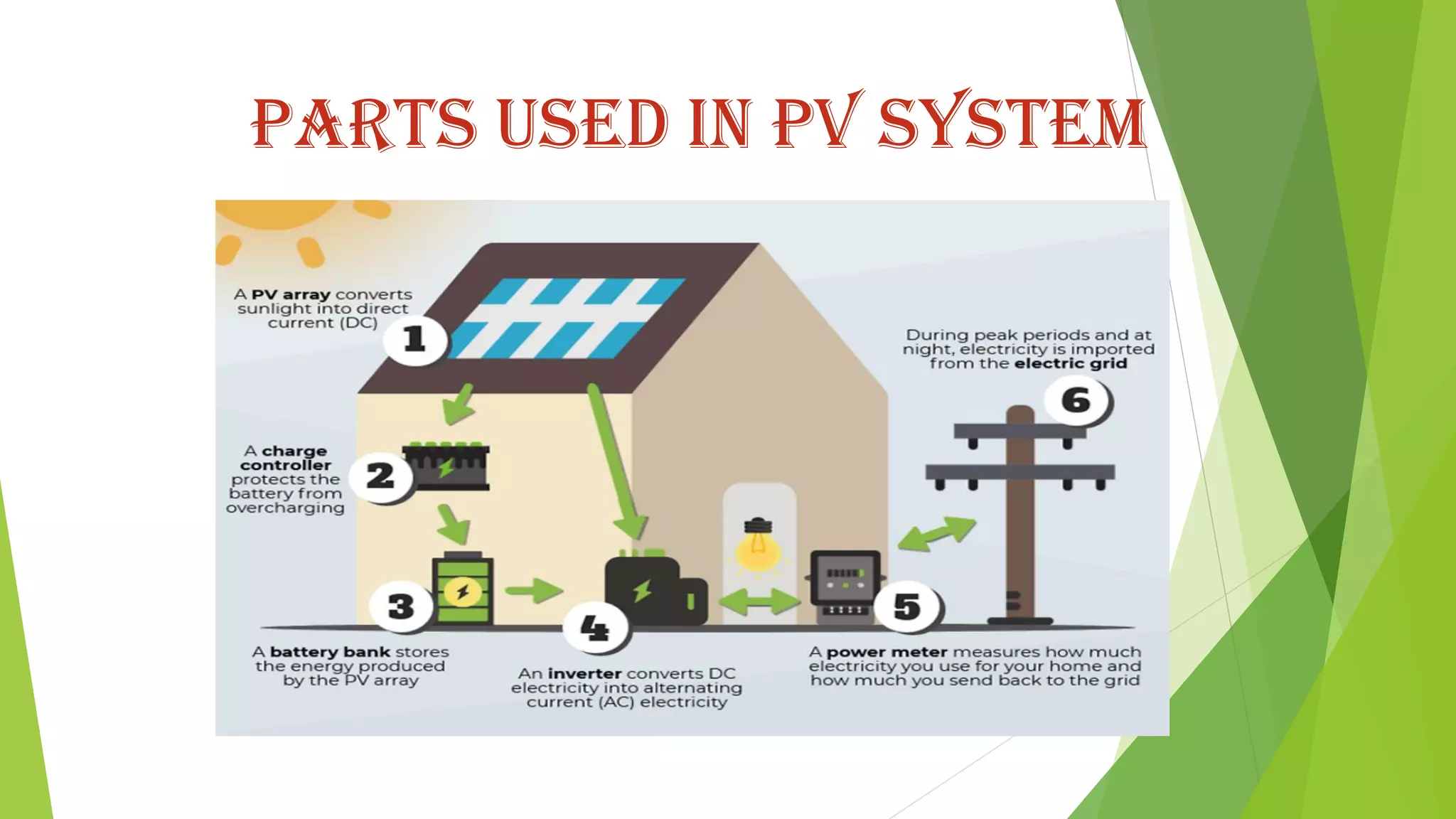
PARTS USED IN PV SYSTEM
APPLICATION OF SOLAR ENERGY
SITE SELECTION
CONS OF SOLAR ENERGY
 Cost
 Weather-Dependent
 Solar Energy Storage Is Expensive
 Uses a Lot of Space
 Associated with Pollution
Solar power plant presentation.pdf

Solar power plant presentation.pdf

  • 1.
    SOLAR POWER PLANT INDUSTRIALTRAINING SUBMITTED TO : Mr. GOPAL TIWARI SUBMITTED BY : DEVESH SHARMA EE-19 21EJCEE019
  • 3.
    INTRODUCTION • Solar panelsare those devices which are used to absorb the sun's rays and convert them into electricity or heat. • A solar panel is actually a collection of solar (or photovoltaic) cells, which can be used to generate electricity through photovoltaic effect. These cells are arranged in a grid-like pattern on the surface of solar panels. Thus, it may also be described as a set of photovoltaic modules, mounted on a structure supporting it. A photovoltaic (PV) module is a packaged and connected assembly of 6×10 solar cells. When it comes to wear-and-tear, these panels are very hardy. Solar panels wear out extremely slow. In a year, their effectiveness decreases only about one to two per cent (at times, even lesser). Most solar panels are made up using crystalline silicon solar cells
  • 4.
    WHY SOLAR ENERGY It’s a Free Source of Energy  It Can Make Use of the Underutilized Land  It’s Good for the Environment  Renewable Energy Source  Reduces Electricity Bills  Low Maintenance Costs
  • 5.
    SOLAR CELL  Asolar cell (also known as a photovoltaic cell or PV cell) is defined as an electrical device that converts light energy into electrical energry through the photovoltaic effect. A solar cell is basically a p-n junction diode. Solar cells are a form of photoelectric cell, defined as a device whose electrical characteristics – such as current, voltage, or resistance – vary when exposed to light.  Individual solar cells can be combined to form modules commonly known as solar panels. The common single junction silicon solar cell can produce a maximum open- circuit voltage of approximately 0.5 to 0.6 volts. By itself this isn’t much – but remember these solar cells are tiny. When combined into a large solar panel, considerable amounts of renewable energy can be generated  A solar cell is basically a junction diode, although its construction it is little bit different from conventional p-n junction diodes. A very thin layer of p-type semiconductor is grown on a relatively thicker n-type semiconductor. We then apply a few finer electrodes on the top of the p-type semiconductor layer.  These electrodes do not obstruct light to reach the thin p-type layer. Just below the p-type layer there is a p-n junction. We also provide a current collecting electrode at the bottom of the n-type layer. We encapsulate the entire assembly by thin glass to protect the solar cell from any mechanical shock
  • 6.
    WORKING PRINCIPLE  Whenlight reaches the p-n junction, the light photons can easily enter in the junction, through very thin p-type layer. The light energy, in the form of photons, supplies sufficient energy to the junction to create a number of electron-hole pairs. The incident light breaks the thermal equilibrium condition of the junction. The free electrons in the depletion region can quickly come to the n-type side of the junction.  Similarly, the holes in the depletion can quickly come to the p-type side of the junction. Once, the newly created free electrons come to the n-type side, cannot further cross the junction because of barrier potential of the junction.  Similarly, the newly created holes once come to the p-type side cannot further cross the junction became of same barrier potential of the junction. As the concentration of electrons becomes higher in one side, i.e. n-type side of the junction and concentration of holes becomes more in another side, i.e. the p-type side of the junction, the p-n junction will behave like a small battery cell. A voltage is set up which is known as photo voltage. If we connect a small load across the junction, there will be a tiny current flowing through it
  • 8.
    PARTS USED INPV SYSTEM
  • 9.
  • 10.
  • 11.
    CONS OF SOLARENERGY  Cost  Weather-Dependent  Solar Energy Storage Is Expensive  Uses a Lot of Space  Associated with Pollution