Transportation Engineering – II (Town Planning)
1/7/2018
Prof. S.K. Patil, www.skpatil.com 1
.
Course Learning Outcomes:
• At the end of this session, the student will be able to explain
various rules setup to control development of city
Development Control Rules
Prof. (Dr.) Sachin Kishor Patil
B.E. Civil, M.E. Civil Environmental Engineering, Ph.D. (IIT, Bombay)
❑ Professor & Head of Department
❑ Department of Civil Engineering
❑ AMGOI, Vathar, Kolhapur, MH, India.
1/7/2018
Prof. S.K. Patil, www.skpatil.com 2
Disclaimer and acknowledgment
The study material presented by Prof. S K Patil is licensed under
The study material presented herewith is web sourced made
available for community use under Creative Commons Attribution-
NonCommercial-ShareAlike 3.0 unported License.
If you feel the ownership of some of the content, I can acknowledge
or remove as the case may be. Permissions beyond the scope of this
license can be requested at www.skpatil.com
Development control rules
1/15/2018Prof.S.K.Patil,www.skpatil.com
3
 Regulation is necessary to ensure planned development
 Motive of development control is that any approved plan is
implemented by individual and by corporate or by public
sector developer and thus all new developments should
confirm to the provision of the plan.
 Necessity: DCR is must for every growing city because the
area immediately beyond the city limits is often a source of
health hazard to the city and generally under no strict
control of an efficient local authority.
Objectives of development control
1/15/2018Prof.S.K.Patil,www.skpatil.com
4
 1) To control the private development as per the required
standards in relation to public health, safety and convenience.
 2) To encourage private interest along with public interest in all
aspects of development.
 3) To prevent the conflicting demand and misuse of land.
 4) To control and prevent overcrowding on land.
 Development control is statutory in nature and the planning
authority has the power to punish the defaulters.
DCR
1/15/2018Prof.S.K.Patil,www.skpatil.com
5
Types of Development Controls
 1) Town and Country Planning Act
2) Zoning Regulations
3) SLUM Clearance Act
4) Building Bye-laws
5) Periphery Control Act
6) Land Acquisition Act
DCR
1/15/2018Prof.S.K.Patil,www.skpatil.com
6
 Zoning Regulations deal with
 1) Allocation of land for specific purposes
2) Control of the use, height and construction of the building
 Objective of zoning:-
1) The Town planner gets ample opportunity for designing the future
growth and development of the town.
2) Re-zoning if required for better uses of land by revising their zoning
ordinances can be possible.
3) The zoning affords proper co-ordination of various public amenities
such as transport facilities, drainage, electric power, etc.
4) The zoning proves to be an effective instrument for making any
town planning scheme effective and successful
1/15/2018Prof.S.K.Patil,www.skpatil.com
7
 Bye Laws
 Freedom to builder or landlord
 Rights of occupants
 Rights of neighbor
Applicability of Bye-Laws:-
1) Additions and alteration to a buildings.
2) New construction.
3) Requirement of open space
DCR
1/15/2018Prof.S.K.Patil,www.skpatil.com
8
Building Bye-laws- Objectives
 1) It becomes easier to pre-plan the building activities and
provision of bye-laws, give guidelines to the designing
architect or engineer.
 2) The building bye-laws prevent haphazard development
without any resemblance to the development of the area
as a whole.
 3) To provide open spaces, air breeze and afford safety
against fire, noise, smoke etc.
 4) To control land development
 5)Material types control
1/15/2018Prof.S.K.Patil,www.skpatil.com
9
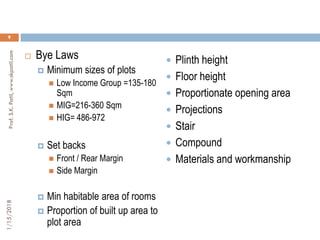
 Bye Laws
 Minimum sizes of plots
 Low Income Group =135-180
Sqm
 MIG=216-360 Sqm
 HIG= 486-972
 Set backs
 Front / Rear Margin
 Side Margin
 Min habitable area of rooms
 Proportion of built up area to
plot area
 Plinth height
 Floor height
 Proportionate opening area
 Projections
 Stair
 Compound
 Materials and workmanship

3.1 development control rules

  • 1.
    Transportation Engineering –II (Town Planning) 1/7/2018 Prof. S.K. Patil, www.skpatil.com 1 . Course Learning Outcomes: • At the end of this session, the student will be able to explain various rules setup to control development of city Development Control Rules
  • 2.
    Prof. (Dr.) SachinKishor Patil B.E. Civil, M.E. Civil Environmental Engineering, Ph.D. (IIT, Bombay) ❑ Professor & Head of Department ❑ Department of Civil Engineering ❑ AMGOI, Vathar, Kolhapur, MH, India. 1/7/2018 Prof. S.K. Patil, www.skpatil.com 2 Disclaimer and acknowledgment The study material presented by Prof. S K Patil is licensed under The study material presented herewith is web sourced made available for community use under Creative Commons Attribution- NonCommercial-ShareAlike 3.0 unported License. If you feel the ownership of some of the content, I can acknowledge or remove as the case may be. Permissions beyond the scope of this license can be requested at www.skpatil.com
  • 3.
    Development control rules 1/15/2018Prof.S.K.Patil,www.skpatil.com 3 Regulation is necessary to ensure planned development  Motive of development control is that any approved plan is implemented by individual and by corporate or by public sector developer and thus all new developments should confirm to the provision of the plan.  Necessity: DCR is must for every growing city because the area immediately beyond the city limits is often a source of health hazard to the city and generally under no strict control of an efficient local authority.
  • 4.
    Objectives of developmentcontrol 1/15/2018Prof.S.K.Patil,www.skpatil.com 4  1) To control the private development as per the required standards in relation to public health, safety and convenience.  2) To encourage private interest along with public interest in all aspects of development.  3) To prevent the conflicting demand and misuse of land.  4) To control and prevent overcrowding on land.  Development control is statutory in nature and the planning authority has the power to punish the defaulters.
  • 5.
    DCR 1/15/2018Prof.S.K.Patil,www.skpatil.com 5 Types of DevelopmentControls  1) Town and Country Planning Act 2) Zoning Regulations 3) SLUM Clearance Act 4) Building Bye-laws 5) Periphery Control Act 6) Land Acquisition Act
  • 6.
    DCR 1/15/2018Prof.S.K.Patil,www.skpatil.com 6  Zoning Regulationsdeal with  1) Allocation of land for specific purposes 2) Control of the use, height and construction of the building  Objective of zoning:- 1) The Town planner gets ample opportunity for designing the future growth and development of the town. 2) Re-zoning if required for better uses of land by revising their zoning ordinances can be possible. 3) The zoning affords proper co-ordination of various public amenities such as transport facilities, drainage, electric power, etc. 4) The zoning proves to be an effective instrument for making any town planning scheme effective and successful
  • 7.
    1/15/2018Prof.S.K.Patil,www.skpatil.com 7  Bye Laws Freedom to builder or landlord  Rights of occupants  Rights of neighbor Applicability of Bye-Laws:- 1) Additions and alteration to a buildings. 2) New construction. 3) Requirement of open space
  • 8.
    DCR 1/15/2018Prof.S.K.Patil,www.skpatil.com 8 Building Bye-laws- Objectives 1) It becomes easier to pre-plan the building activities and provision of bye-laws, give guidelines to the designing architect or engineer.  2) The building bye-laws prevent haphazard development without any resemblance to the development of the area as a whole.  3) To provide open spaces, air breeze and afford safety against fire, noise, smoke etc.  4) To control land development  5)Material types control
  • 9.
    1/15/2018Prof.S.K.Patil,www.skpatil.com 9  Bye Laws Minimum sizes of plots  Low Income Group =135-180 Sqm  MIG=216-360 Sqm  HIG= 486-972  Set backs  Front / Rear Margin  Side Margin  Min habitable area of rooms  Proportion of built up area to plot area  Plinth height  Floor height  Proportionate opening area  Projections  Stair  Compound  Materials and workmanship