1
Unit – 1. Water Treatment
Unit -1 Water Treatment
1. Introduction- Importance of water and its source.
2. Hard water and soft water- Definition.
3. Boiler Feed water- requirements, scale and sludge
formation, priming and foaming, Caustic
embrittlement and boiler corrosion.
4. Softening/ Conditioning methods-Internal &
External methods.
5. External methods- Lime-soda method, zeolite
method and ion exchange method.
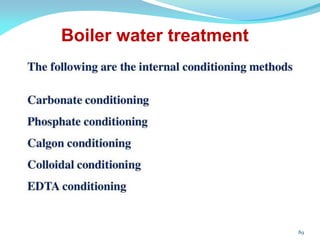
6. Internal conditioning methods- carbonate,
phosphate and calgon conditioning.
7. Domestic treatment of water.
2
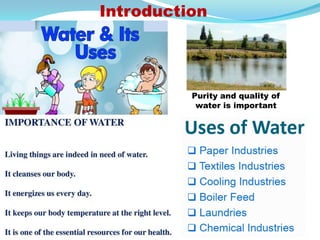
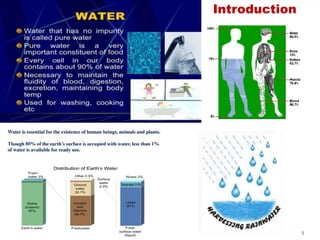
Introduction
Purity and quality of
water is important
3
4
5
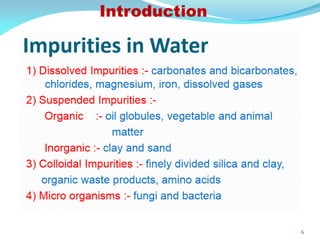
Introduction
6
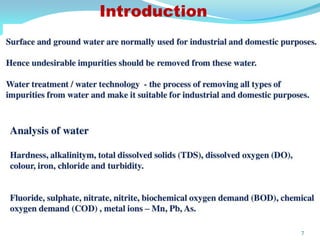
Introduction
7
Introduction
8
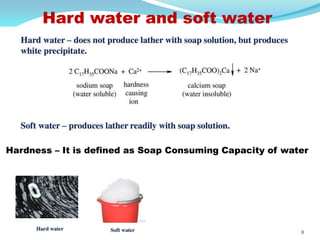
Hard water and soft water
Hardness – It is defined as Soap Consuming Capacity of water
9
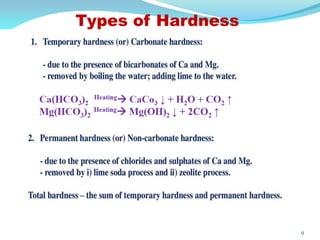
Types of Hardness
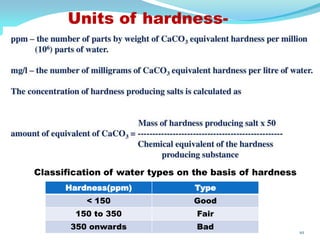
Units of hardness-
10
Hardness(ppm) Type
< 150 Good
150 to 350 Fair
350 onwards Bad
Classification of water types on the basis of hardness
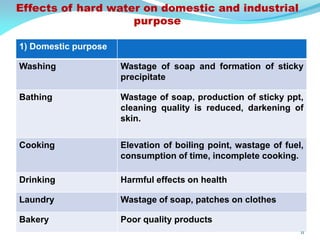
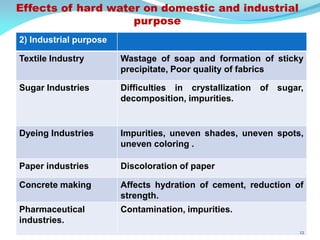
Effects of hard water on domestic and industrial
purpose
1) Domestic purpose
Washing Wastage of soap and formation of sticky
precipitate
Bathing Wastage of soap, production of sticky ppt,
cleaning quality is reduced, darkening of
skin.
Cooking Elevation of boiling point, wastage of fuel,
consumption of time, incomplete cooking.
Drinking Harmful effects on health
Laundry Wastage of soap, patches on clothes
Bakery Poor quality products
11
2) Industrial purpose
Textile Industry Wastage of soap and formation of sticky
precipitate, Poor quality of fabrics
Sugar Industries Difficulties in crystallization of sugar,
decomposition, impurities.
Dyeing Industries Impurities, uneven shades, uneven spots,
uneven coloring .
Paper industries Discoloration of paper
Concrete making Affects hydration of cement, reduction of
strength.
Pharmaceutical
industries.
Contamination, impurities.
Effects of hard water on domestic and industrial
purpose
12
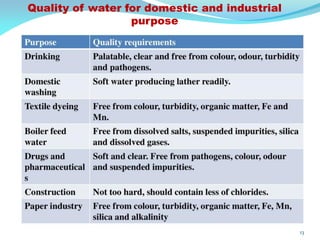
13
Quality of water for domestic and industrial
purpose
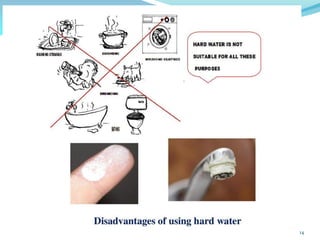
14
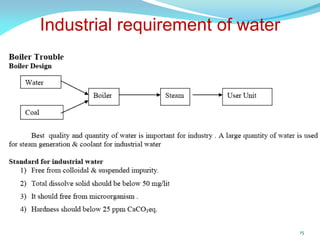
Industrial requirement of water
15
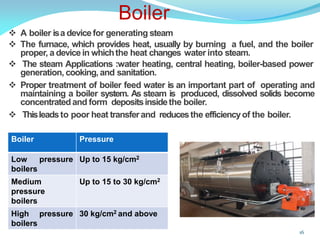
 A boiler isa devicefor generating steam
 The furnace, which provides heat, usually by burning a fuel, and the boiler
proper, a devicein whichthe heat changes water into steam.
 The steam Applications :water heating, central heating, boiler-based power
generation, cooking,and sanitation.
 Proper treatment of boiler feed water is an important part of operating and
maintaining a boiler system. As steam is produced, dissolved solids become
concentratedand form depositsinsidethe boiler.
 Thisleadsto poor heat transferand reducesthe efficiencyof the boiler.
Boiler
16
Boiler Pressure
Low pressure
boilers
Up to 15 kg/cm2
Medium
pressure
boilers
Up to 15 to 30 kg/cm2
High pressure
boilers
30 kg/cm2 and above
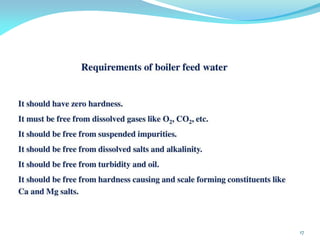
17
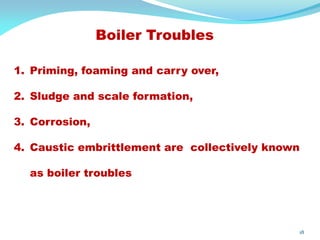
Boiler Troubles
18
1. Priming, foaming and carry over,
2. Sludge and scale formation,
3. Corrosion,
4. Caustic embrittlement are collectively known
as boiler troubles
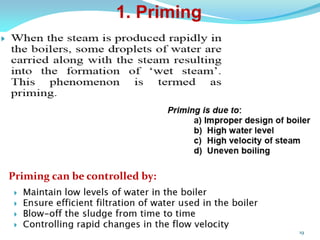
1. Priming
Priming can be controlled by:
19
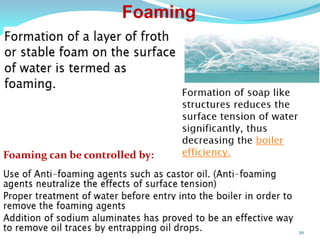
Foaming
Foaming can be controlled by:
20
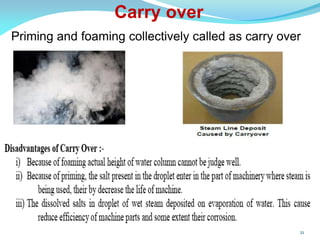
Priming and foaming collectively called as carry over
Carry over
21
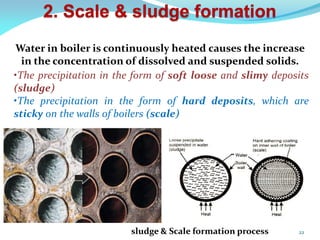
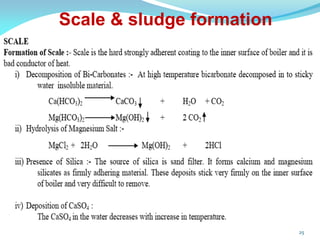
Water in boiler is continuously heated causes the increase
in the concentration of dissolved and suspended solids.
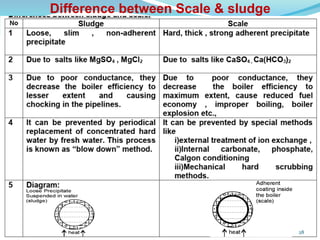
•The precipitation in the form of soft loose and slimy deposits
(sludge)
•The precipitation in the form of hard deposits, which are
sticky on the walls of boilers (scale)
sludge & Scale formation process 22
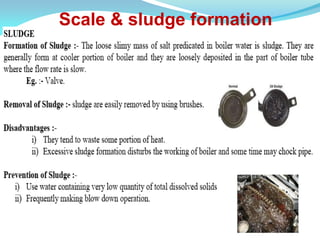
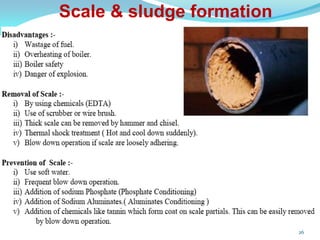
Scale & sludge formation
23
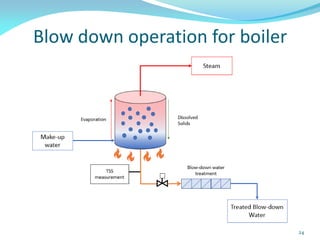
Blow down operation for boiler
24
25
Scale & sludge formation
26
Scale & sludge formation
27
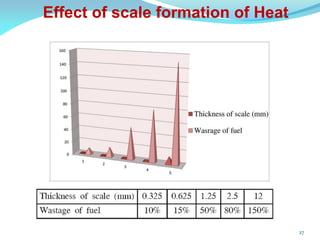
Effect of scale formation of Heat
28
Difference between Scale & sludge
29
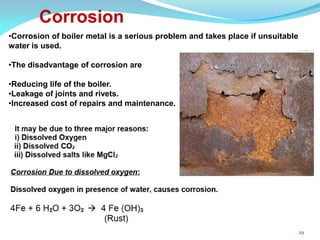
Corrosion
•Corrosion of boiler metal is a serious problem and takes place if unsuitable
water is used.
•The disadvantage of corrosion are
•Reducing life of the boiler.
•Leakage of joints and rivets.
•Increased cost of repairs and maintenance.
30
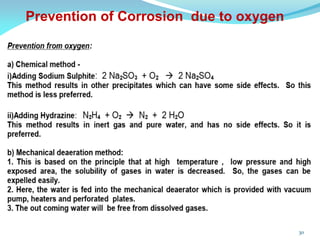
Prevention of Corrosion due to oxygen
31
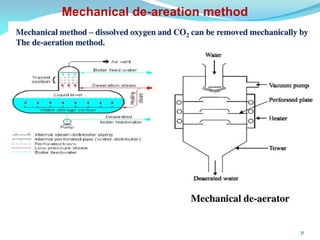
Mechanical de-areation method
32
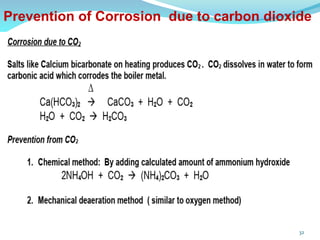
Prevention of Corrosion due to carbon dioxide
33
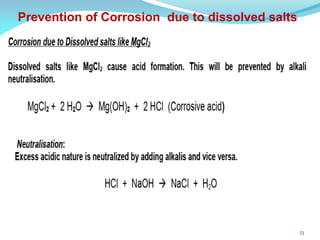
Prevention of Corrosion due to dissolved salts
34
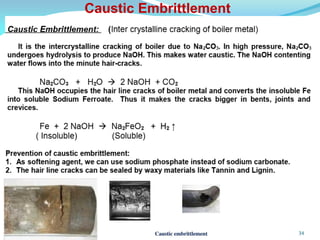
Caustic Embrittlement
35
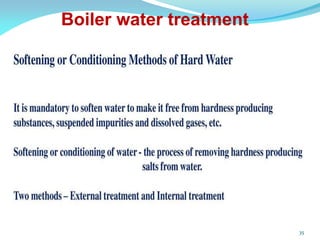
Boiler water treatment
36
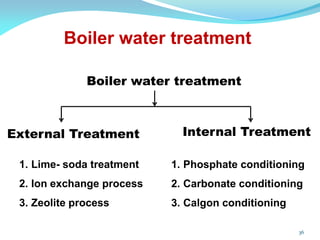
Boiler water treatment
External Treatment Internal Treatment
1. Lime- soda treatment
2. Ion exchange process
3. Zeolite process
1. Phosphate conditioning
2. Carbonate conditioning
3. Calgon conditioning
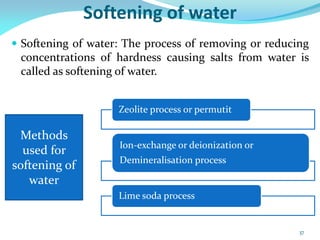
Softening of water
 Softening of water: The process of removing or reducing
concentrations of hardness causing salts from water is
called as softening of water.
Zeolite process or permutit
Ion-exchange or deionization or
Demineralisation process
Lime soda process
Methods
used for
softening of
water
37
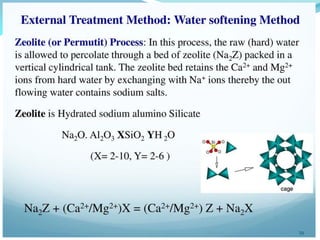
(a). Zeolite process of water
treatment
38
39
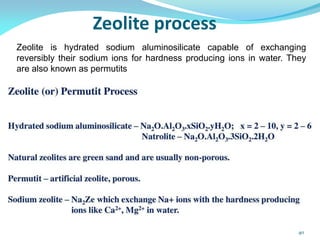
Zeolite process
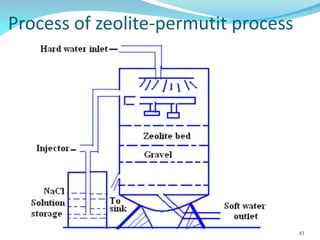
Zeolite is hydrated sodium aluminosilicate capable of exchanging
reversibly their sodium ions for hardness producing ions in water. They
are also known as permutits
40
41
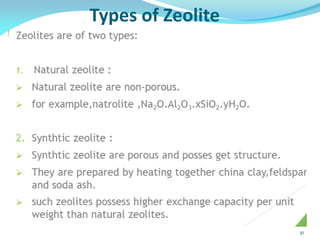
Types of Zeolite
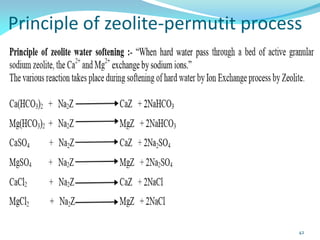
Principle of zeolite-permutit process
42
Process of zeolite-permutit process
43
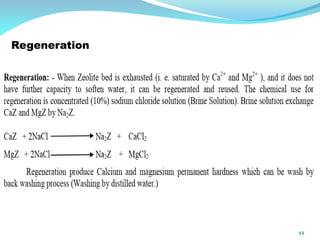
Regeneration
44
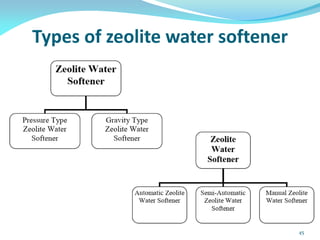
Types of zeolite water softener
45
46
47
Applications
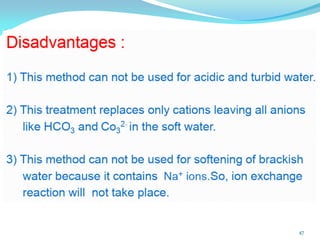
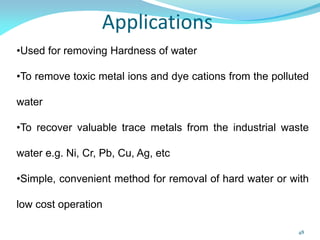
•Used for removing Hardness of water
•To remove toxic metal ions and dye cations from the polluted
water
•To recover valuable trace metals from the industrial waste
water e.g. Ni, Cr, Pb, Cu, Ag, etc
•Simple, convenient method for removal of hard water or with
low cost operation
48
(b)Ion exchange process of
water softening
49
50
51
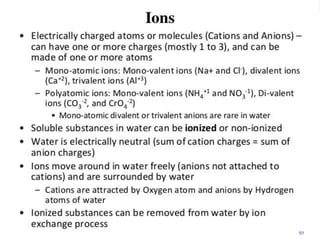
Ion- exchange process
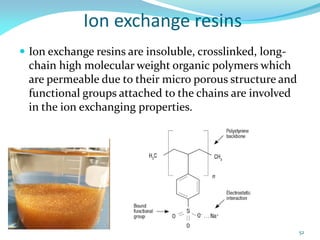
Ion exchange resins
 Ion exchange resins are insoluble, crosslinked, long-
chain high molecular weight organic polymers which
are permeable due to their micro porous structure and
functional groups attached to the chains are involved
in the ion exchanging properties.
52
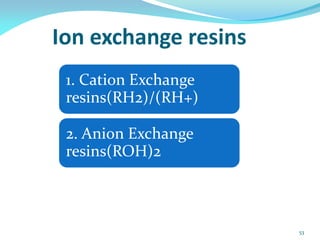
Ion exchange resins
1. Cation Exchange
resins(RH2)/(RH+)
2. Anion Exchange
resins(ROH)2
53
54
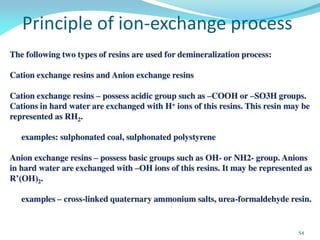
Principle of ion-exchange process
55
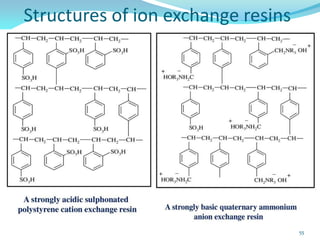
Structures of ion exchange resins
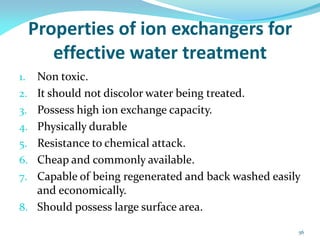
Properties of ion exchangers for
effective water treatment
1. Non toxic.
2. It should not discolor water being treated.
3. Possess high ion exchange capacity.
4. Physically durable
5. Resistance to chemical attack.
6. Cheap and commonly available.
7. Capable of being regenerated and back washed easily
and economically.
8. Should possess large surface area.
56
Ion exchange resins
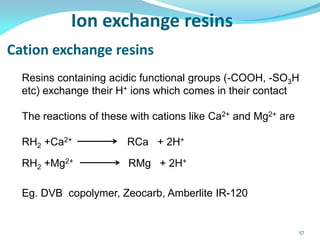
Cation exchange resins
Resins containing acidic functional groups (-COOH, -SO3H
etc) exchange their H+ ions which comes in their contact
The reactions of these with cations like Ca2+ and Mg2+ are
RH2 +Ca2+ RCa + 2H+
RH2 +Mg2+ RMg + 2H+
Eg. DVB copolymer, Zeocarb, Amberlite IR-120
57
Ion exchange resins
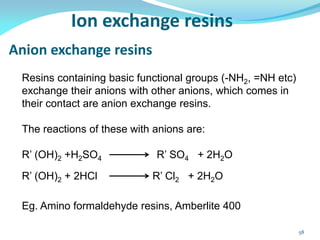
Anion exchange resins
Resins containing basic functional groups (-NH2, =NH etc)
exchange their anions with other anions, which comes in
their contact are anion exchange resins.
The reactions of these with anions are:
R’ (OH)2 +H2SO4 R’ SO4 + 2H2O
R’ (OH)2 + 2HCl R’ Cl2 + 2H2O
Eg. Amino formaldehyde resins, Amberlite 400
58
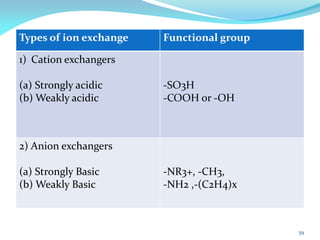
Types of ion exchange Functional group
1) Cation exchangers
(a) Strongly acidic
(b) Weakly acidic
-SO3H
-COOH or -OH
2) Anion exchangers
(a) Strongly Basic
(b) Weakly Basic
-NR3+, -CH3,
-NH2 ,-(C2H4)x
59
60
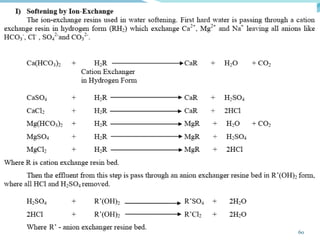
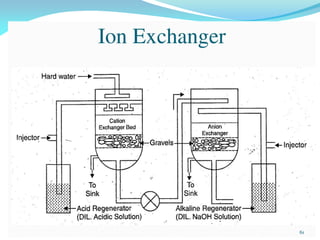
Water softening by ion exchange method
61
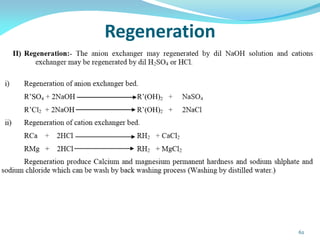
Regeneration
62
63
64
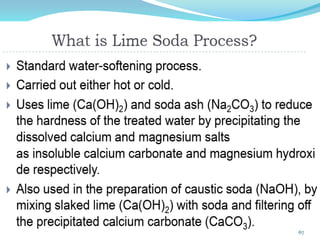
(c)Lime soda process of
water softening
65
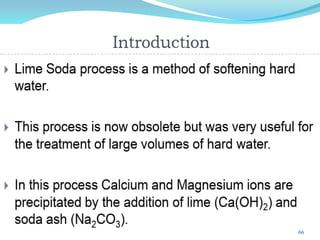
66
67
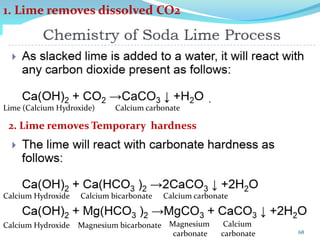
1. Lime removes dissolved CO2
Lime (Calcium Hydroxide) Calcium carbonate
2. Lime removes Temporary hardness
Calcium Hydroxide Calcium bicarbonate Calcium carbonate
Calcium Hydroxide Magnesium bicarbonate Calcium
carbonate
Magnesium
carbonate 68
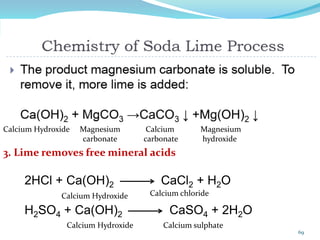
3. Lime removes free mineral acids
2HCl + Ca(OH)2 CaCl2 + H2O
H2SO4 + Ca(OH)2 CaSO4 + 2H2O
Calcium Hydroxide Magnesium
carbonate
Calcium
carbonate
Magnesium
hydroxide
Calcium Hydroxide
Calcium Hydroxide
Calcium chloride
Calcium sulphate
69
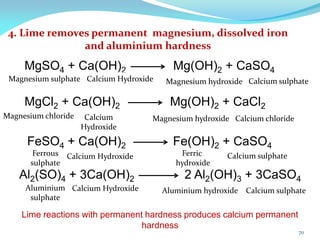
4. Lime removes permanent magnesium, dissolved iron
and aluminium hardness
MgCl2 + Ca(OH)2 Mg(OH)2 + CaCl2
FeSO4 + Ca(OH)2 Fe(OH)2 + CaSO4
Al2(SO)4 + 3Ca(OH)2 2 Al2(OH)3 + 3CaSO4
Lime reactions with permanent hardness produces calcium permanent
hardness
Magnesium chloride Magnesium hydroxide
Calcium Hydroxide
Calcium Hydroxide
Calcium
Hydroxide
MgSO4 + Ca(OH)2 Mg(OH)2 + CaSO4
Magnesium sulphate Magnesium hydroxide
Calcium Hydroxide
Ferrous
sulphate
Aluminium
sulphate
Calcium sulphate
Calcium sulphate
Calcium chloride
Ferric
hydroxide
Calcium sulphate
Aluminium hydroxide
70
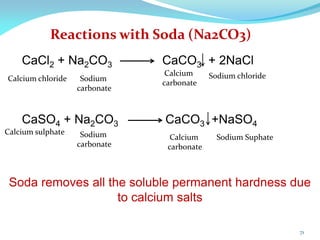
Reactions with Soda (Na2CO3)
CaSO4 + Na2CO3 CaCO3 +NaSO4
CaCl2 + Na2CO3 CaCO3 + 2NaCl
Soda removes all the soluble permanent hardness due
to calcium salts
Calcium chloride
Calcium sulphate
Calcium
carbonate
Calcium
carbonate
Sodium chloride
Sodium Suphate
Sodium
carbonate
Sodium
carbonate
71
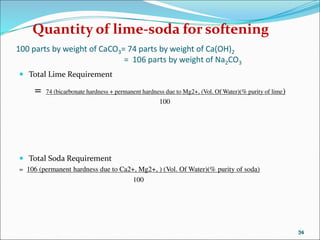
Quantity of lime-soda for softening
72
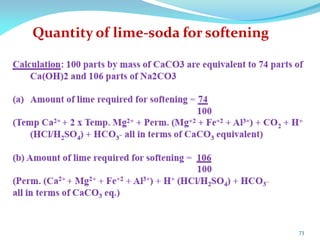
Quantity of lime-soda for softening
73
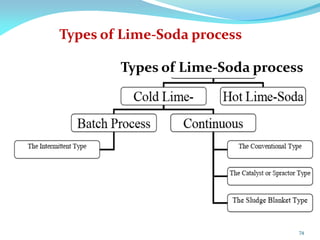
Types of Lime-Soda process
74
Cold Lime-Soda process
(Precipitation Technique)
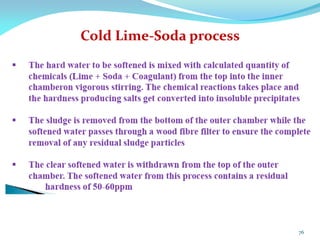
•When the lime and soda are added to hard water at
room temperature, the process is known as cold lime
soda process.
•At room temperature, the precipitates does not settle
down easily, and can not be easily filtered.
•Thus it is necessary to add coagulants like alum,
sodium sulphate and sodium aluminate.
75
Cold Lime-Soda process
76
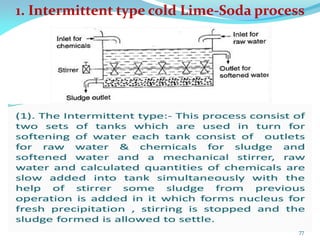
1. Intermittent type cold Lime-Soda process
77
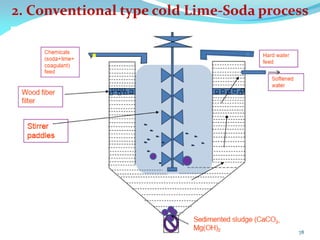
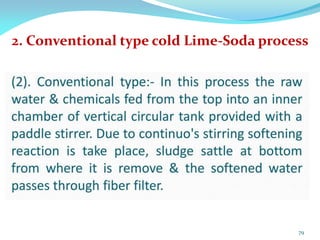
2. Conventional type cold Lime-Soda process
78
2. Conventional type cold Lime-Soda process
79
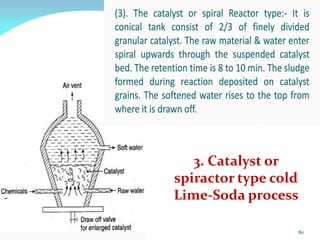
3. Catalyst or
spiractor type cold
Lime-Soda process
80
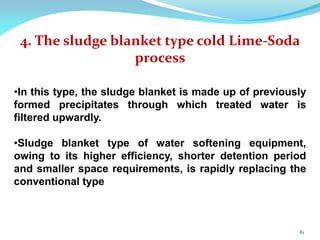
4. The sludge blanket type cold Lime-Soda
process
•In this type, the sludge blanket is made up of previously
formed precipitates through which treated water is
filtered upwardly.
•Sludge blanket type of water softening equipment,
owing to its higher efficiency, shorter detention period
and smaller space requirements, is rapidly replacing the
conventional type
81
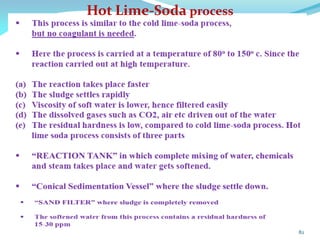
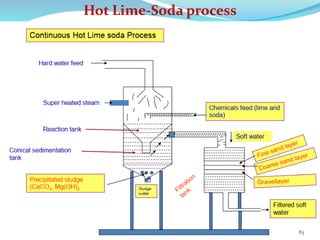
Hot Lime-Soda process
82
Hot Lime-Soda process
83
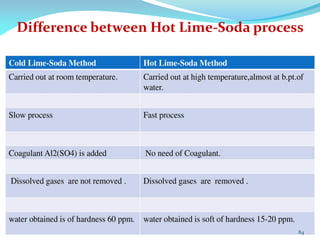
Difference between Hot Lime-Soda process
84
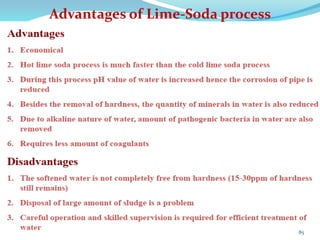
Advantages of Lime-Soda process
85
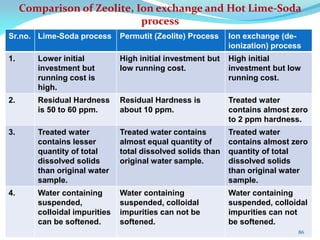
Comparison of Zeolite, Ion exchange and Hot Lime-Soda
process
Sr.no. Lime-Soda process Permutit (Zeolite) Process Ion exchange (de-
ionization) process
1. Lower initial
investment but
running cost is
high.
High initial investment but
low running cost.
High initial
investment but low
running cost.
2. Residual Hardness
is 50 to 60 ppm.
Residual Hardness is
about 10 ppm.
Treated water
contains almost zero
to 2 ppm hardness.
3. Treated water
contains lesser
quantity of total
dissolved solids
than original water
sample.
Treated water contains
almost equal quantity of
total dissolved solids than
original water sample.
Treated water
contains almost zero
quantity of total
dissolved solids
than original water
sample.
4. Water containing
suspended,
colloidal impurities
can be softened.
Water containing
suspended, colloidal
impurities can not be
softened.
Water containing
suspended, colloidal
impurities can not
be softened.
86
Comparison of Zeolite, Ion exchange and Hot Lime-Soda
process
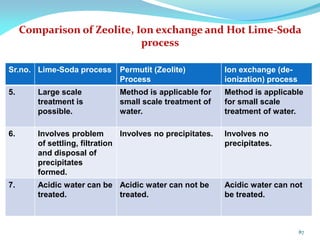
Sr.no. Lime-Soda process Permutit (Zeolite)
Process
Ion exchange (de-
ionization) process
5. Large scale
treatment is
possible.
Method is applicable for
small scale treatment of
water.
Method is applicable
for small scale
treatment of water.
6. Involves problem
of settling, filtration
and disposal of
precipitates
formed.
Involves no precipitates. Involves no
precipitates.
7. Acidic water can be
treated.
Acidic water can not be
treated.
Acidic water can not
be treated.
87
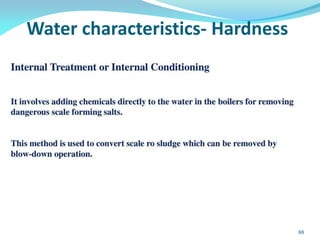
Water characteristics- Hardness
88
89
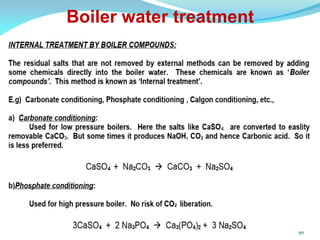
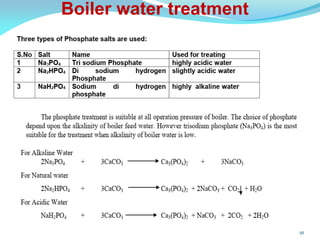
Boiler water treatment
90
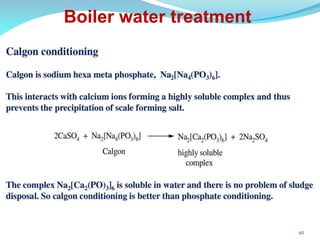
Boiler water treatment
91
Boiler water treatment
92
Boiler water treatment
93
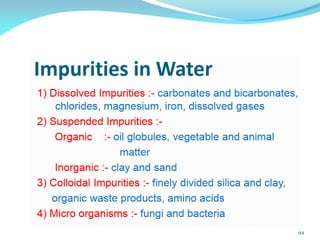
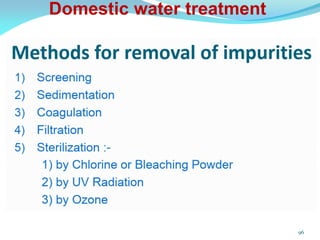
Domestic water treatment
94
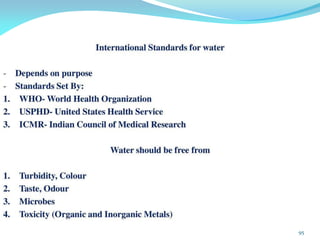
95
96
Domestic water treatment
97
98
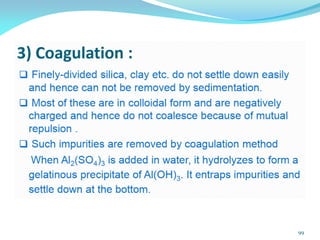
99
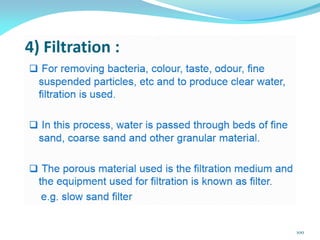
100
101
102
Thank You
Dr. Sushma Pardeshi Singh,
Assistant Professor,
Department of Basic Science&
Humanities,
J.D. College of Engineering &
Management, Nagpur
Email- pardeshisushma@gmail.com

Water treatment

  • 1.
    1 Unit – 1.Water Treatment
  • 2.
    Unit -1 WaterTreatment 1. Introduction- Importance of water and its source. 2. Hard water and soft water- Definition. 3. Boiler Feed water- requirements, scale and sludge formation, priming and foaming, Caustic embrittlement and boiler corrosion. 4. Softening/ Conditioning methods-Internal & External methods. 5. External methods- Lime-soda method, zeolite method and ion exchange method. 6. Internal conditioning methods- carbonate, phosphate and calgon conditioning. 7. Domestic treatment of water. 2
  • 3.
    Introduction Purity and qualityof water is important 3
  • 4.
  • 5.
  • 6.
  • 7.
  • 8.
    8 Hard water andsoft water Hardness – It is defined as Soap Consuming Capacity of water
  • 9.
  • 10.
    Units of hardness- 10 Hardness(ppm)Type < 150 Good 150 to 350 Fair 350 onwards Bad Classification of water types on the basis of hardness
  • 11.
    Effects of hardwater on domestic and industrial purpose 1) Domestic purpose Washing Wastage of soap and formation of sticky precipitate Bathing Wastage of soap, production of sticky ppt, cleaning quality is reduced, darkening of skin. Cooking Elevation of boiling point, wastage of fuel, consumption of time, incomplete cooking. Drinking Harmful effects on health Laundry Wastage of soap, patches on clothes Bakery Poor quality products 11
  • 12.
    2) Industrial purpose TextileIndustry Wastage of soap and formation of sticky precipitate, Poor quality of fabrics Sugar Industries Difficulties in crystallization of sugar, decomposition, impurities. Dyeing Industries Impurities, uneven shades, uneven spots, uneven coloring . Paper industries Discoloration of paper Concrete making Affects hydration of cement, reduction of strength. Pharmaceutical industries. Contamination, impurities. Effects of hard water on domestic and industrial purpose 12
  • 13.
    13 Quality of waterfor domestic and industrial purpose
  • 14.
  • 15.
  • 16.
     A boilerisa devicefor generating steam  The furnace, which provides heat, usually by burning a fuel, and the boiler proper, a devicein whichthe heat changes water into steam.  The steam Applications :water heating, central heating, boiler-based power generation, cooking,and sanitation.  Proper treatment of boiler feed water is an important part of operating and maintaining a boiler system. As steam is produced, dissolved solids become concentratedand form depositsinsidethe boiler.  Thisleadsto poor heat transferand reducesthe efficiencyof the boiler. Boiler 16 Boiler Pressure Low pressure boilers Up to 15 kg/cm2 Medium pressure boilers Up to 15 to 30 kg/cm2 High pressure boilers 30 kg/cm2 and above
  • 17.
  • 18.
    Boiler Troubles 18 1. Priming,foaming and carry over, 2. Sludge and scale formation, 3. Corrosion, 4. Caustic embrittlement are collectively known as boiler troubles
  • 19.
    1. Priming Priming canbe controlled by: 19
  • 20.
    Foaming Foaming can becontrolled by: 20
  • 21.
    Priming and foamingcollectively called as carry over Carry over 21
  • 22.
    Water in boileris continuously heated causes the increase in the concentration of dissolved and suspended solids. •The precipitation in the form of soft loose and slimy deposits (sludge) •The precipitation in the form of hard deposits, which are sticky on the walls of boilers (scale) sludge & Scale formation process 22
  • 23.
    Scale & sludgeformation 23
  • 24.
    Blow down operationfor boiler 24
  • 25.
  • 26.
  • 27.
    27 Effect of scaleformation of Heat
  • 28.
  • 29.
    29 Corrosion •Corrosion of boilermetal is a serious problem and takes place if unsuitable water is used. •The disadvantage of corrosion are •Reducing life of the boiler. •Leakage of joints and rivets. •Increased cost of repairs and maintenance.
  • 30.
  • 31.
  • 32.
    32 Prevention of Corrosiondue to carbon dioxide
  • 33.
    33 Prevention of Corrosiondue to dissolved salts
  • 34.
  • 35.
  • 36.
    36 Boiler water treatment Boilerwater treatment External Treatment Internal Treatment 1. Lime- soda treatment 2. Ion exchange process 3. Zeolite process 1. Phosphate conditioning 2. Carbonate conditioning 3. Calgon conditioning
  • 37.
    Softening of water Softening of water: The process of removing or reducing concentrations of hardness causing salts from water is called as softening of water. Zeolite process or permutit Ion-exchange or deionization or Demineralisation process Lime soda process Methods used for softening of water 37
  • 38.
    (a). Zeolite processof water treatment 38
  • 39.
  • 40.
    Zeolite process Zeolite ishydrated sodium aluminosilicate capable of exchanging reversibly their sodium ions for hardness producing ions in water. They are also known as permutits 40
  • 41.
  • 42.
  • 43.
  • 44.
  • 45.
    Types of zeolitewater softener 45
  • 46.
  • 47.
  • 48.
    Applications •Used for removingHardness of water •To remove toxic metal ions and dye cations from the polluted water •To recover valuable trace metals from the industrial waste water e.g. Ni, Cr, Pb, Cu, Ag, etc •Simple, convenient method for removal of hard water or with low cost operation 48
  • 49.
    (b)Ion exchange processof water softening 49
  • 50.
  • 51.
  • 52.
    Ion exchange resins Ion exchange resins are insoluble, crosslinked, long- chain high molecular weight organic polymers which are permeable due to their micro porous structure and functional groups attached to the chains are involved in the ion exchanging properties. 52
  • 53.
    Ion exchange resins 1.Cation Exchange resins(RH2)/(RH+) 2. Anion Exchange resins(ROH)2 53
  • 54.
  • 55.
    55 Structures of ionexchange resins
  • 56.
    Properties of ionexchangers for effective water treatment 1. Non toxic. 2. It should not discolor water being treated. 3. Possess high ion exchange capacity. 4. Physically durable 5. Resistance to chemical attack. 6. Cheap and commonly available. 7. Capable of being regenerated and back washed easily and economically. 8. Should possess large surface area. 56
  • 57.
    Ion exchange resins Cationexchange resins Resins containing acidic functional groups (-COOH, -SO3H etc) exchange their H+ ions which comes in their contact The reactions of these with cations like Ca2+ and Mg2+ are RH2 +Ca2+ RCa + 2H+ RH2 +Mg2+ RMg + 2H+ Eg. DVB copolymer, Zeocarb, Amberlite IR-120 57
  • 58.
    Ion exchange resins Anionexchange resins Resins containing basic functional groups (-NH2, =NH etc) exchange their anions with other anions, which comes in their contact are anion exchange resins. The reactions of these with anions are: R’ (OH)2 +H2SO4 R’ SO4 + 2H2O R’ (OH)2 + 2HCl R’ Cl2 + 2H2O Eg. Amino formaldehyde resins, Amberlite 400 58
  • 59.
    Types of ionexchange Functional group 1) Cation exchangers (a) Strongly acidic (b) Weakly acidic -SO3H -COOH or -OH 2) Anion exchangers (a) Strongly Basic (b) Weakly Basic -NR3+, -CH3, -NH2 ,-(C2H4)x 59
  • 60.
  • 61.
    Water softening byion exchange method 61
  • 62.
  • 63.
  • 64.
  • 65.
    (c)Lime soda processof water softening 65
  • 66.
  • 67.
  • 68.
    1. Lime removesdissolved CO2 Lime (Calcium Hydroxide) Calcium carbonate 2. Lime removes Temporary hardness Calcium Hydroxide Calcium bicarbonate Calcium carbonate Calcium Hydroxide Magnesium bicarbonate Calcium carbonate Magnesium carbonate 68
  • 69.
    3. Lime removesfree mineral acids 2HCl + Ca(OH)2 CaCl2 + H2O H2SO4 + Ca(OH)2 CaSO4 + 2H2O Calcium Hydroxide Magnesium carbonate Calcium carbonate Magnesium hydroxide Calcium Hydroxide Calcium Hydroxide Calcium chloride Calcium sulphate 69
  • 70.
    4. Lime removespermanent magnesium, dissolved iron and aluminium hardness MgCl2 + Ca(OH)2 Mg(OH)2 + CaCl2 FeSO4 + Ca(OH)2 Fe(OH)2 + CaSO4 Al2(SO)4 + 3Ca(OH)2 2 Al2(OH)3 + 3CaSO4 Lime reactions with permanent hardness produces calcium permanent hardness Magnesium chloride Magnesium hydroxide Calcium Hydroxide Calcium Hydroxide Calcium Hydroxide MgSO4 + Ca(OH)2 Mg(OH)2 + CaSO4 Magnesium sulphate Magnesium hydroxide Calcium Hydroxide Ferrous sulphate Aluminium sulphate Calcium sulphate Calcium sulphate Calcium chloride Ferric hydroxide Calcium sulphate Aluminium hydroxide 70
  • 71.
    Reactions with Soda(Na2CO3) CaSO4 + Na2CO3 CaCO3 +NaSO4 CaCl2 + Na2CO3 CaCO3 + 2NaCl Soda removes all the soluble permanent hardness due to calcium salts Calcium chloride Calcium sulphate Calcium carbonate Calcium carbonate Sodium chloride Sodium Suphate Sodium carbonate Sodium carbonate 71
  • 72.
    Quantity of lime-sodafor softening 72
  • 73.
    Quantity of lime-sodafor softening 73
  • 74.
    Types of Lime-Sodaprocess Types of Lime-Soda process 74
  • 75.
    Cold Lime-Soda process (PrecipitationTechnique) •When the lime and soda are added to hard water at room temperature, the process is known as cold lime soda process. •At room temperature, the precipitates does not settle down easily, and can not be easily filtered. •Thus it is necessary to add coagulants like alum, sodium sulphate and sodium aluminate. 75
  • 76.
  • 77.
    1. Intermittent typecold Lime-Soda process 77
  • 78.
    2. Conventional typecold Lime-Soda process 78
  • 79.
    2. Conventional typecold Lime-Soda process 79
  • 80.
    3. Catalyst or spiractortype cold Lime-Soda process 80
  • 81.
    4. The sludgeblanket type cold Lime-Soda process •In this type, the sludge blanket is made up of previously formed precipitates through which treated water is filtered upwardly. •Sludge blanket type of water softening equipment, owing to its higher efficiency, shorter detention period and smaller space requirements, is rapidly replacing the conventional type 81
  • 82.
  • 83.
  • 84.
    Difference between HotLime-Soda process 84
  • 85.
  • 86.
    Comparison of Zeolite,Ion exchange and Hot Lime-Soda process Sr.no. Lime-Soda process Permutit (Zeolite) Process Ion exchange (de- ionization) process 1. Lower initial investment but running cost is high. High initial investment but low running cost. High initial investment but low running cost. 2. Residual Hardness is 50 to 60 ppm. Residual Hardness is about 10 ppm. Treated water contains almost zero to 2 ppm hardness. 3. Treated water contains lesser quantity of total dissolved solids than original water sample. Treated water contains almost equal quantity of total dissolved solids than original water sample. Treated water contains almost zero quantity of total dissolved solids than original water sample. 4. Water containing suspended, colloidal impurities can be softened. Water containing suspended, colloidal impurities can not be softened. Water containing suspended, colloidal impurities can not be softened. 86
  • 87.
    Comparison of Zeolite,Ion exchange and Hot Lime-Soda process Sr.no. Lime-Soda process Permutit (Zeolite) Process Ion exchange (de- ionization) process 5. Large scale treatment is possible. Method is applicable for small scale treatment of water. Method is applicable for small scale treatment of water. 6. Involves problem of settling, filtration and disposal of precipitates formed. Involves no precipitates. Involves no precipitates. 7. Acidic water can be treated. Acidic water can not be treated. Acidic water can not be treated. 87
  • 88.
  • 89.
  • 90.
  • 91.
  • 92.
  • 93.
  • 94.
  • 95.
  • 96.
  • 97.
  • 98.
  • 99.
  • 100.
  • 101.
  • 102.
    102 Thank You Dr. SushmaPardeshi Singh, Assistant Professor, Department of Basic Science& Humanities, J.D. College of Engineering & Management, Nagpur Email- pardeshisushma@gmail.com