‘social media’, learning &
teaching
some questions & issues
Graham Jeffery
Porous institutions
• Increasingly we are teaching and learning ‘in public’
• Consideration of learning environments – physical, social, digital
• Awareness of networked/hybrid identities – professional, personal, social -
for students and academics
• What about time for disconnection, repair, quiet and reflection?
• Traditionally, universities might have been regarded as ‘places of retreat’ -
now – ‘places of engagement’
• Equally, overbearing demands of marketised/vocational ideologies that
need critical interrogation – we are still the public university, not (yet?)
the privatized/corporate/marketised university
• Connecting communities of learning/building engagement beyond the
campus
Environments for learning
1. Different types of physical learning spaces -
2. Ambulatory/peripatetic pedagogies – or
walking/place-based…
3. Wider networked informational environments
…all now technologically mediated – we capture
experience using portable media tools
Environments for learning
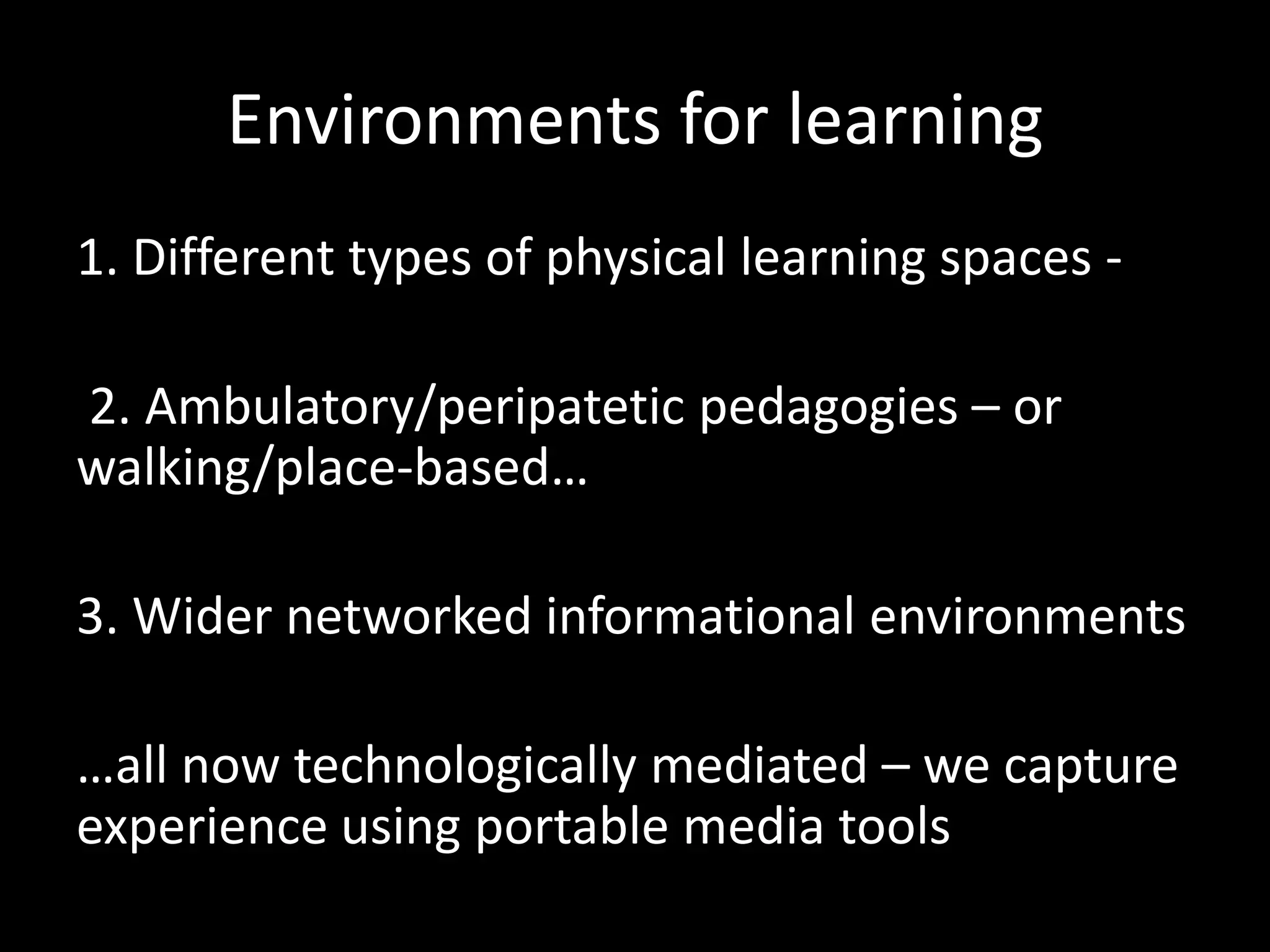
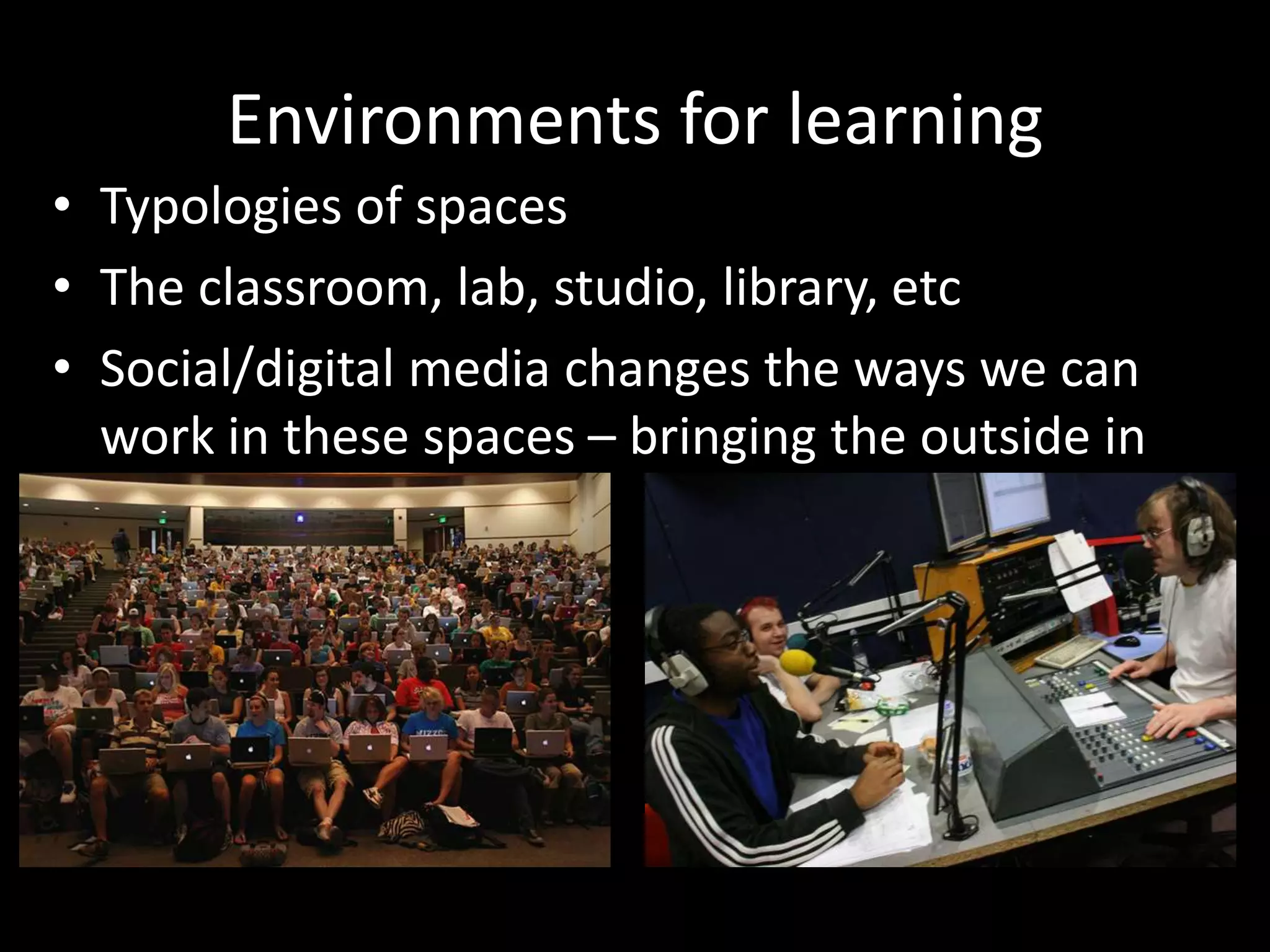
• Typologies of spaces
• The classroom, lab, studio, library, etc
• Social/digital media changes the ways we can
work in these spaces – bringing the outside in
etc
Environments for learning
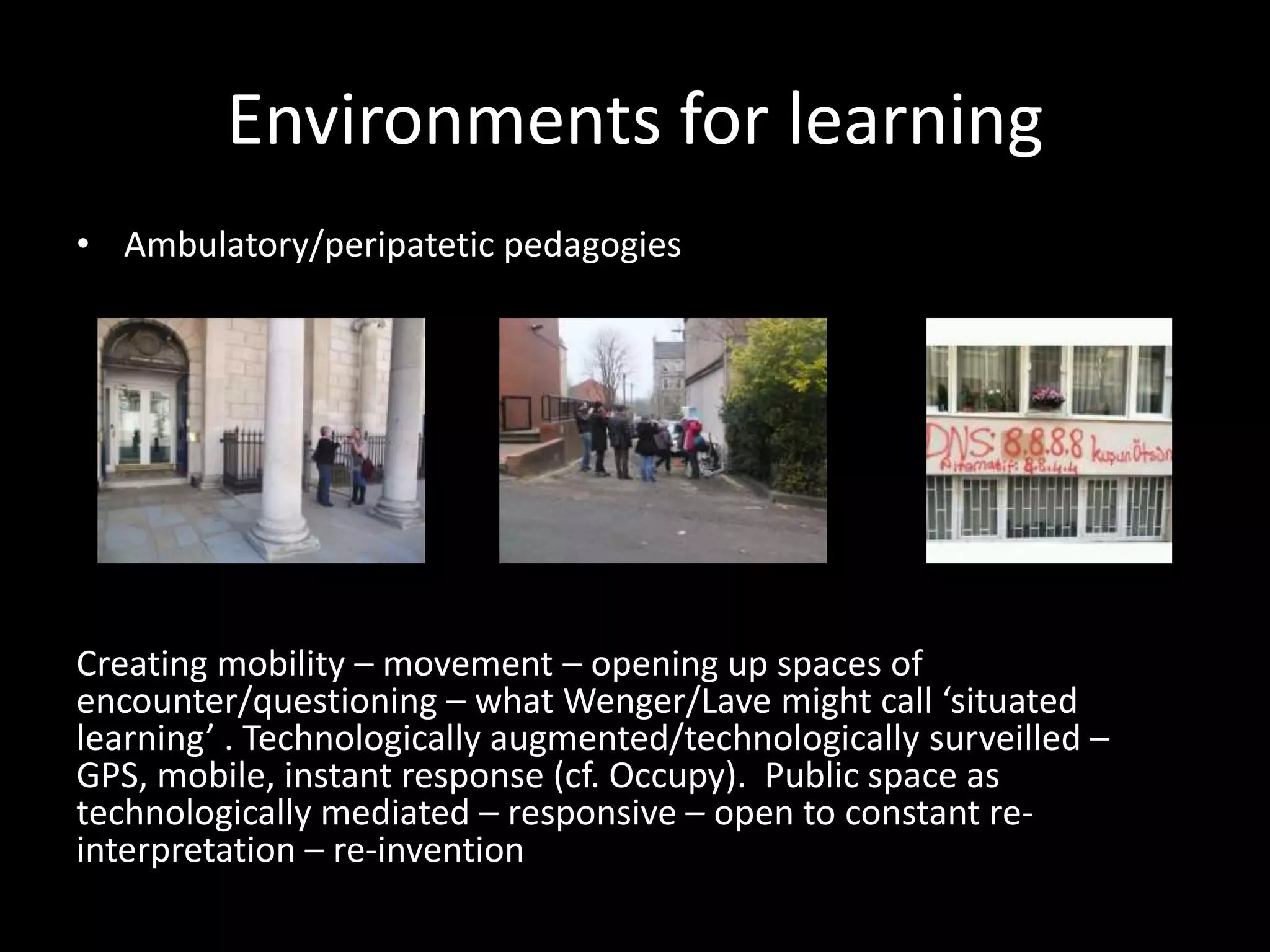
• Ambulatory/peripatetic pedagogies
Creating mobility – movement – opening up spaces of
encounter/questioning – what Wenger/Lave might call ‘situated
learning’ . Technologically augmented/technologically surveilled –
GPS, mobile, instant response (cf. Occupy). Public space as
technologically mediated – responsive – open to constant re-
interpretation – re-invention
Environments for learning
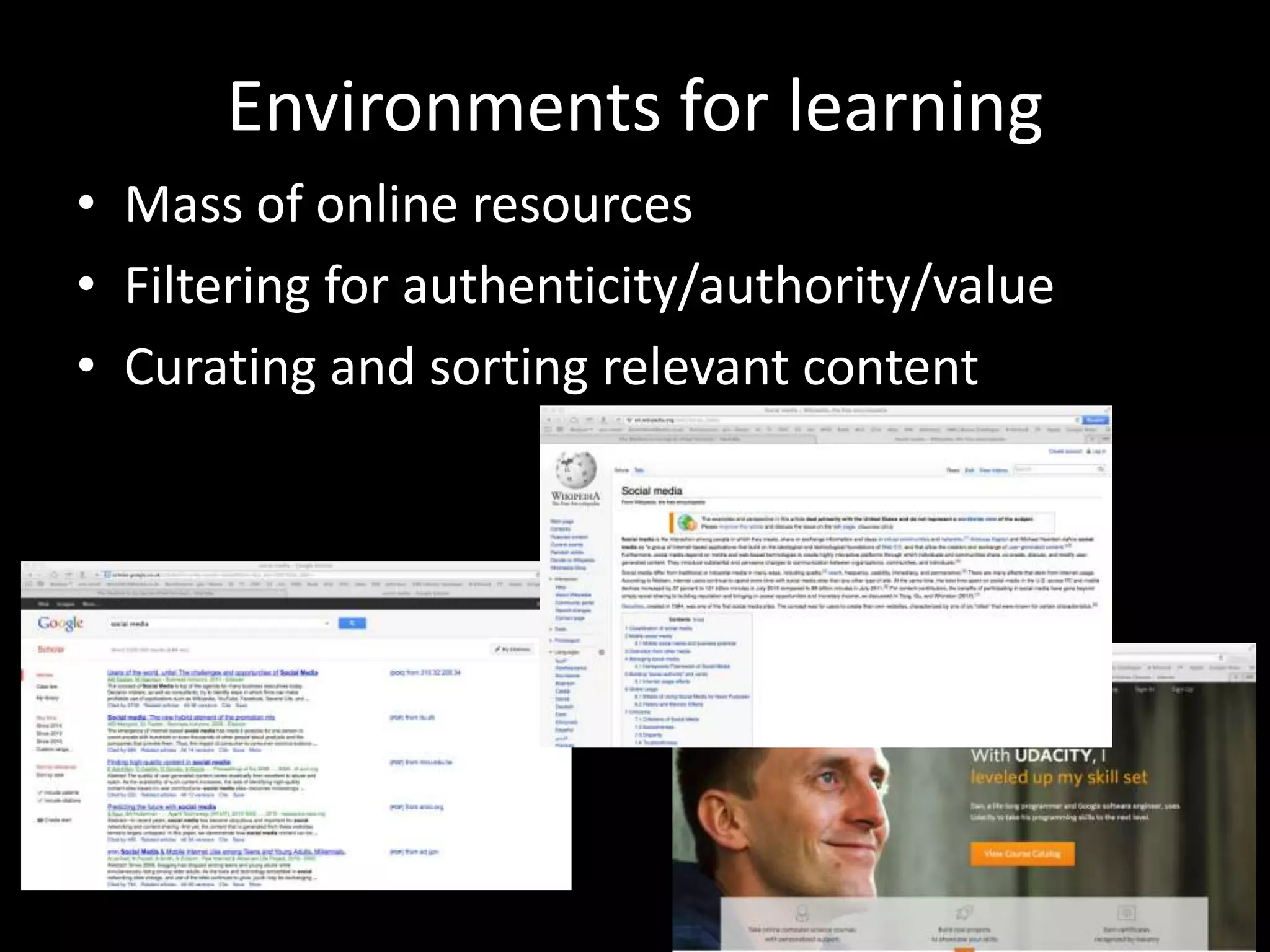
• Mass of online resources
• Filtering for authenticity/authority/value
• Curating and sorting relevant content
New kinds of public academic
practice?
• http://www.youtube.com/watch?v=NLlGopyX
T_g&list=PL8305209F433E1CAB
(Michael Wesch’s Digital Ethnographies at Kansas State University)
• Generating public engagement
• Generating conversation
• Generating reputation? And shared enquiry?
Environments for learning
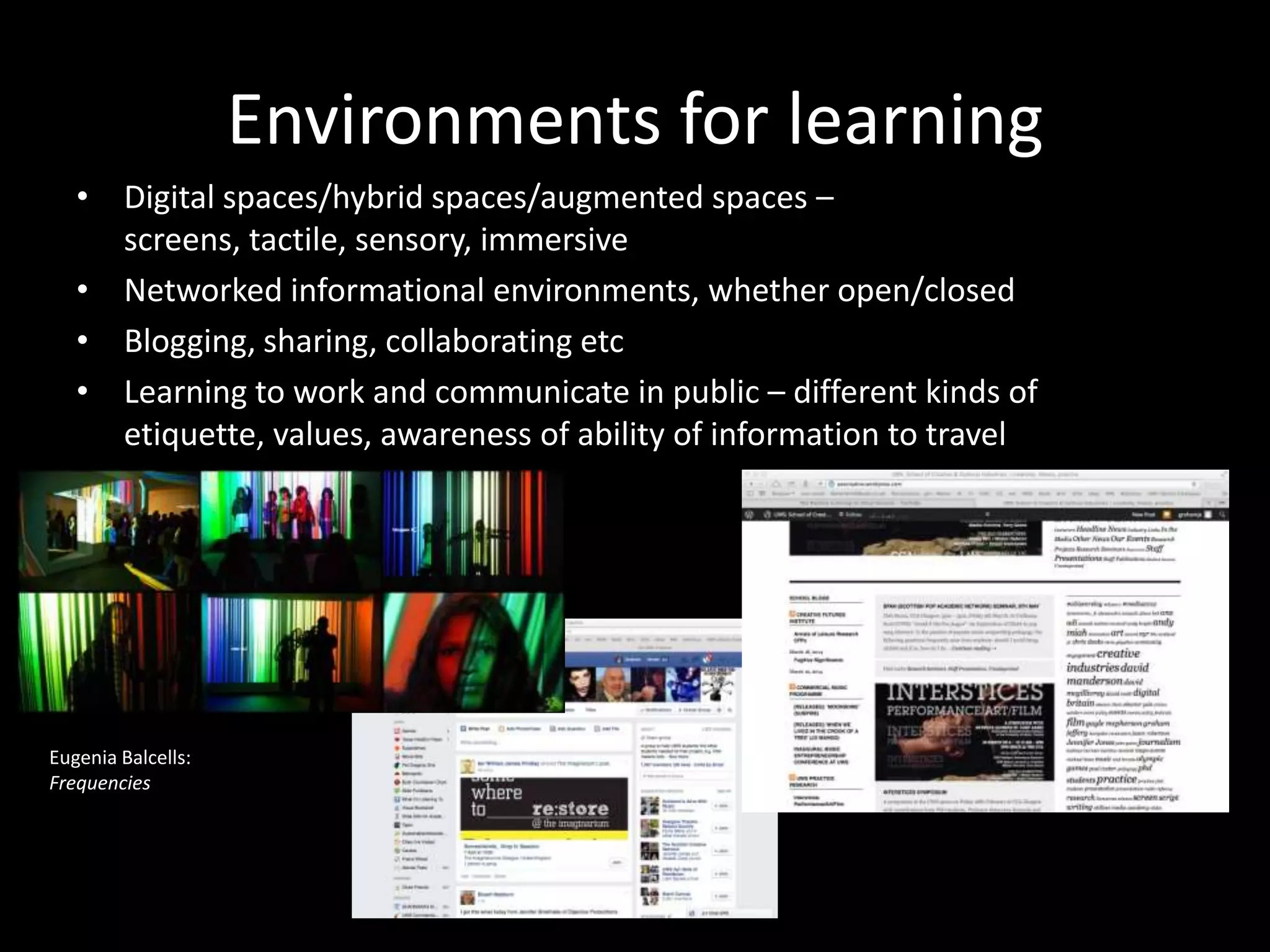
• Digital spaces/hybrid spaces/augmented spaces –
screens, tactile, sensory, immersive
• Networked informational environments, whether open/closed
• Blogging, sharing, collaborating etc
• Learning to work and communicate in public – different kinds of
etiquette, values, awareness of ability of information to travel
Eugenia Balcells:
Frequencies
A challenge
Consider typologies of learning spaces and how
your programmes of study mobilize different
modes of learning
This is what learning design is about
e.g. Social learning, spatial learning, not just logical-
mathematical-verbal (back to Gardner’s Multiple
Intelligences) – and whether we
recognise/reward/allow for variations in ways of
knowing… (systems of assessment come into play
here…)
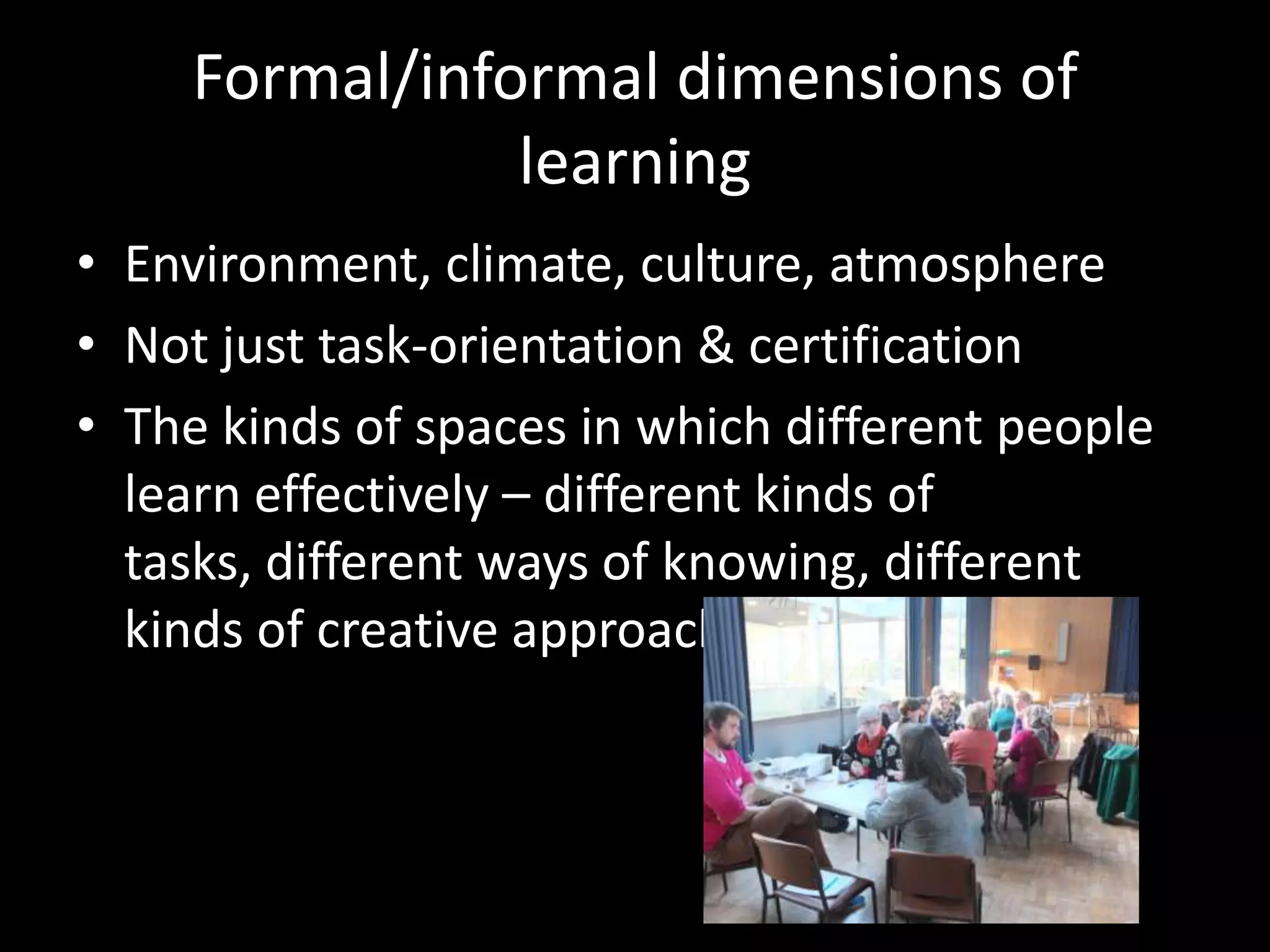
Formal/informal dimensions of
learning
• Environment, climate, culture, atmosphere
• Not just task-orientation & certification
• The kinds of spaces in which different people
learn effectively – different kinds of
tasks, different ways of knowing, different
kinds of creative approaches
Hyperconnectivity
• Makes possible all sorts of new project-based
pedagogies
• Collaboration and shared planning between
individuals and organisations can be very fast
• Organizational systems and processes
(particularly around resources and decision
making) however have failed to keep pace
• Navigating dissonance, risk and uncertainty
Disembodied learning?
• What about information overload?
• Being discriminating and critical – mobilising
theory takes time
• Hyper-individualised society? Or new forms of
collectivity? Or both?
• Marketisation, branding, stratification and
fakery
• Ethics, values, authenticity remain important
New platforms/new frontiers
• Plethora of ‘challenger’ platforms – universities
have ‘authority’ to certify – but for how long?
• E-learning suits some kinds of knowledge
ecologies but not others. Changing roles of the
educator - curator, designer, collaborator, not
just ‘instructor’? New kinds of pedagogic
authority - beyond ‘the face at the front’
• wider communities, online sharing, wider
dissemination, potential for misrepresentation…
Futures?
• ‘Technologies of the self’
• Tools for future occupations/inventing the
future – becoming media literate
• Strategies that enable collaboration and
shared enquiry
• Maintaining offline space for
quiet, privacy, reflection,
• Not everything needs to be done in public
…my public selves
www.twitter.com/grahamjeffery
generalpraxis.blogspot.com
graham.jeffery@uws.ac.uk

"Social Media" and teaching and learning: some issues

  • 1.
    ‘social media’, learning& teaching some questions & issues Graham Jeffery
  • 2.
    Porous institutions • Increasinglywe are teaching and learning ‘in public’ • Consideration of learning environments – physical, social, digital • Awareness of networked/hybrid identities – professional, personal, social - for students and academics • What about time for disconnection, repair, quiet and reflection? • Traditionally, universities might have been regarded as ‘places of retreat’ - now – ‘places of engagement’ • Equally, overbearing demands of marketised/vocational ideologies that need critical interrogation – we are still the public university, not (yet?) the privatized/corporate/marketised university • Connecting communities of learning/building engagement beyond the campus
  • 3.
    Environments for learning 1.Different types of physical learning spaces - 2. Ambulatory/peripatetic pedagogies – or walking/place-based… 3. Wider networked informational environments …all now technologically mediated – we capture experience using portable media tools
  • 4.
    Environments for learning •Typologies of spaces • The classroom, lab, studio, library, etc • Social/digital media changes the ways we can work in these spaces – bringing the outside in etc
  • 5.
    Environments for learning •Ambulatory/peripatetic pedagogies Creating mobility – movement – opening up spaces of encounter/questioning – what Wenger/Lave might call ‘situated learning’ . Technologically augmented/technologically surveilled – GPS, mobile, instant response (cf. Occupy). Public space as technologically mediated – responsive – open to constant re- interpretation – re-invention
  • 6.
    Environments for learning •Mass of online resources • Filtering for authenticity/authority/value • Curating and sorting relevant content
  • 7.
    New kinds ofpublic academic practice? • http://www.youtube.com/watch?v=NLlGopyX T_g&list=PL8305209F433E1CAB (Michael Wesch’s Digital Ethnographies at Kansas State University) • Generating public engagement • Generating conversation • Generating reputation? And shared enquiry?
  • 8.
    Environments for learning •Digital spaces/hybrid spaces/augmented spaces – screens, tactile, sensory, immersive • Networked informational environments, whether open/closed • Blogging, sharing, collaborating etc • Learning to work and communicate in public – different kinds of etiquette, values, awareness of ability of information to travel Eugenia Balcells: Frequencies
  • 9.
    A challenge Consider typologiesof learning spaces and how your programmes of study mobilize different modes of learning This is what learning design is about e.g. Social learning, spatial learning, not just logical- mathematical-verbal (back to Gardner’s Multiple Intelligences) – and whether we recognise/reward/allow for variations in ways of knowing… (systems of assessment come into play here…)
  • 10.
    Formal/informal dimensions of learning •Environment, climate, culture, atmosphere • Not just task-orientation & certification • The kinds of spaces in which different people learn effectively – different kinds of tasks, different ways of knowing, different kinds of creative approaches
  • 11.
    Hyperconnectivity • Makes possibleall sorts of new project-based pedagogies • Collaboration and shared planning between individuals and organisations can be very fast • Organizational systems and processes (particularly around resources and decision making) however have failed to keep pace • Navigating dissonance, risk and uncertainty
  • 12.
    Disembodied learning? • Whatabout information overload? • Being discriminating and critical – mobilising theory takes time • Hyper-individualised society? Or new forms of collectivity? Or both? • Marketisation, branding, stratification and fakery • Ethics, values, authenticity remain important
  • 13.
    New platforms/new frontiers •Plethora of ‘challenger’ platforms – universities have ‘authority’ to certify – but for how long? • E-learning suits some kinds of knowledge ecologies but not others. Changing roles of the educator - curator, designer, collaborator, not just ‘instructor’? New kinds of pedagogic authority - beyond ‘the face at the front’ • wider communities, online sharing, wider dissemination, potential for misrepresentation…
  • 14.
    Futures? • ‘Technologies ofthe self’ • Tools for future occupations/inventing the future – becoming media literate • Strategies that enable collaboration and shared enquiry • Maintaining offline space for quiet, privacy, reflection, • Not everything needs to be done in public
  • 15.