Principles, Practices and the Current
Context of Adult Higher Education:
Underlying Ideas in a Changing Field

Katherine Jelly
Betty Hurley-Dasgupta
Adult Higher Education Alliance Conference
November 6, 2013
• Principles informing adult education, including:
• Progressive education
• Adult development and learning
• Various lenses:
• philosophical
• pedagogical
• psychological
• political

2
Principles/tenets of progressive education

• Student-centered:
Drawing on students‟ purposes, interests, goals
(J. Dewey)
Listening, not talking; asking, not telling (C. Rogers)
• Holistic:
Focusing on students‟ personal and professional as well
as academic life (Dewey)
• Experiential:
Drawing on student‟s experiences,
Engaging in active learning in “real” world (Dewey)

3
Principles/tenets of progressive education, cont’d.

• Constant interaction of action and reflection:
Conceptualization of praxis (P. Freire)
• Integration of theory and practice:
Each needed to examine and inform the other
• Reconstruction of society:
Renaming the world (Freire)
Social reconstruction,
Focused on societal as well as individual development
(Dewey)

4
Principles/tenets of progressive education, cont’d.

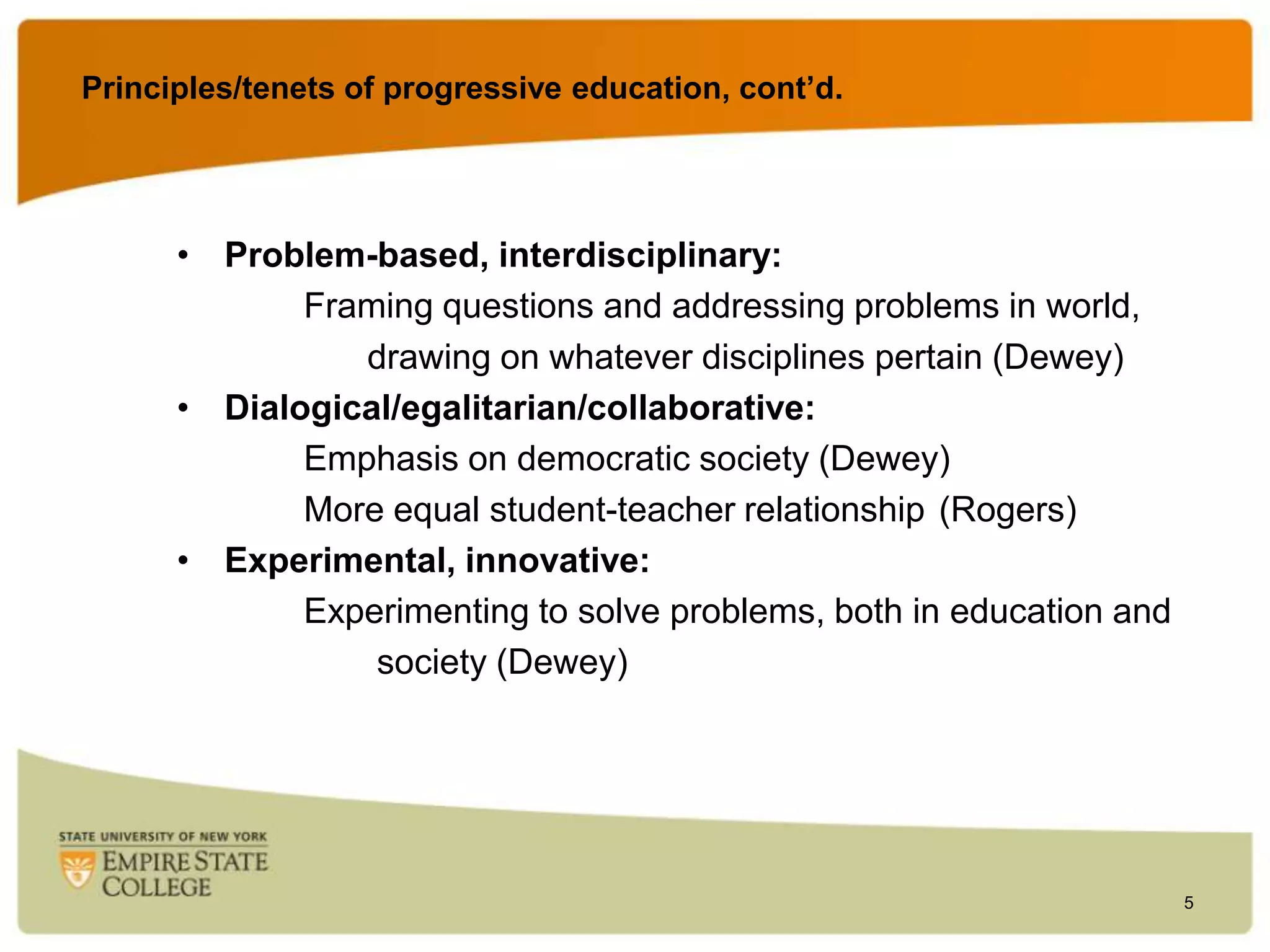
• Problem-based, interdisciplinary:
Framing questions and addressing problems in world,
drawing on whatever disciplines pertain (Dewey)
• Dialogical/egalitarian/collaborative:
Emphasis on democratic society (Dewey)
More equal student-teacher relationship (Rogers)
• Experimental, innovative:
Experimenting to solve problems, both in education and
society (Dewey)

5
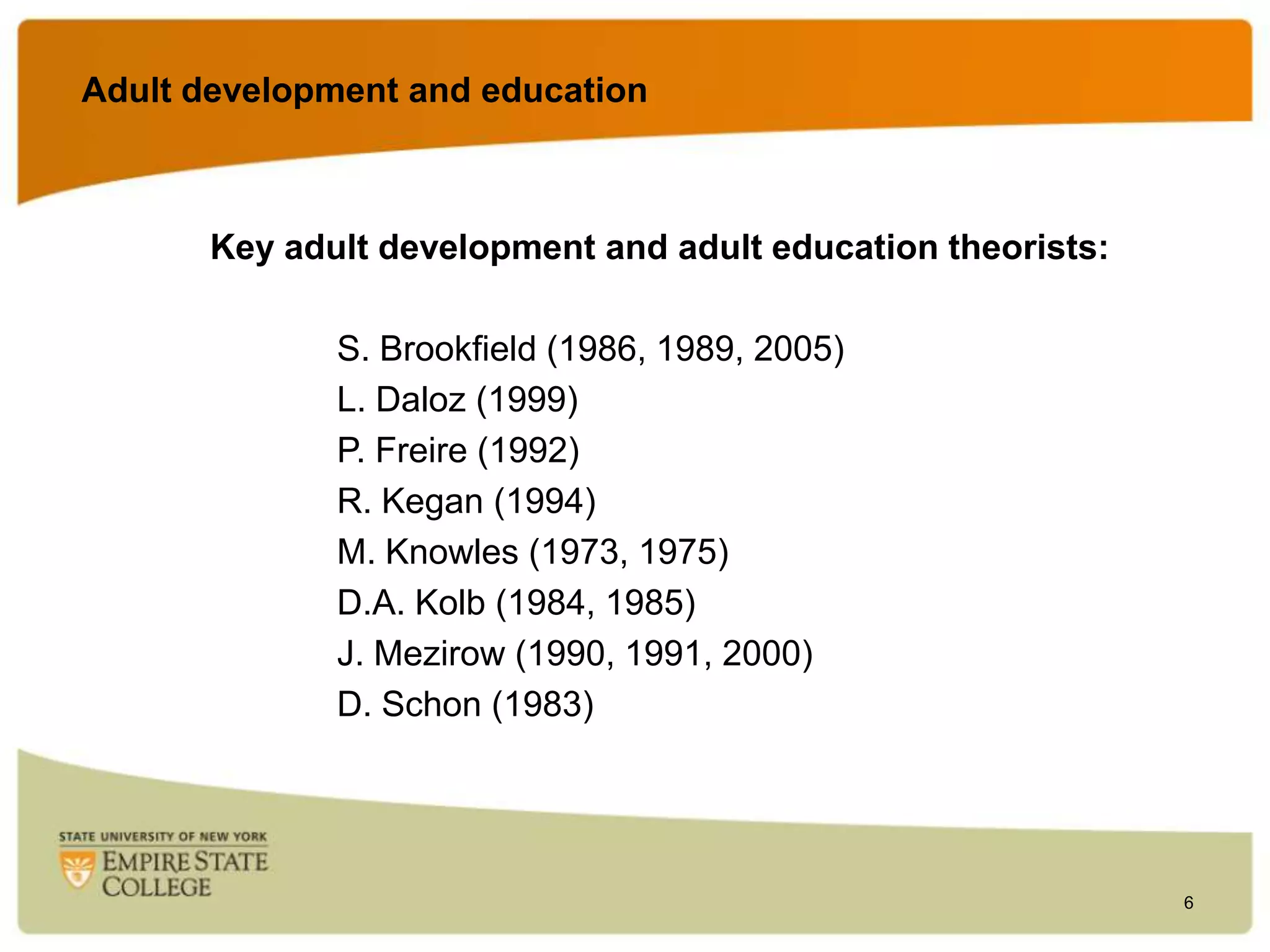
Adult development and education

Key adult development and adult education theorists:
S. Brookfield (1986, 1989, 2005)
L. Daloz (1999)
P. Freire (1992)
R. Kegan (1994)
M. Knowles (1973, 1975)
D.A. Kolb (1984, 1985)
J. Mezirow (1990, 1991, 2000)
D. Schon (1983)

6
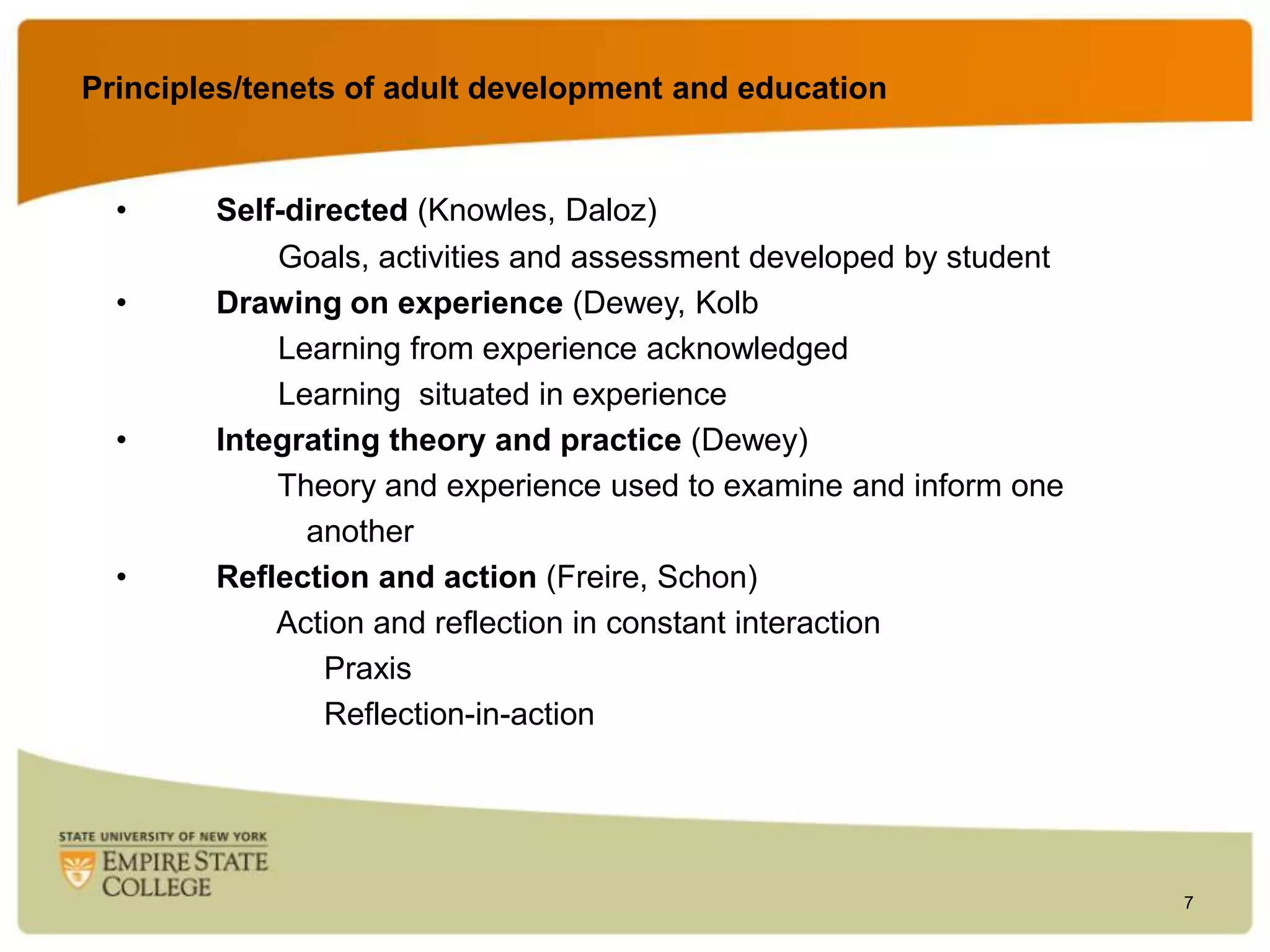
Principles/tenets of adult development and education

•
•

•

•

Self-directed (Knowles, Daloz)
Goals, activities and assessment developed by student
Drawing on experience (Dewey, Kolb
Learning from experience acknowledged
Learning situated in experience
Integrating theory and practice (Dewey)
Theory and experience used to examine and inform one
another
Reflection and action (Freire, Schon)
Action and reflection in constant interaction
Praxis
Reflection-in-action

7
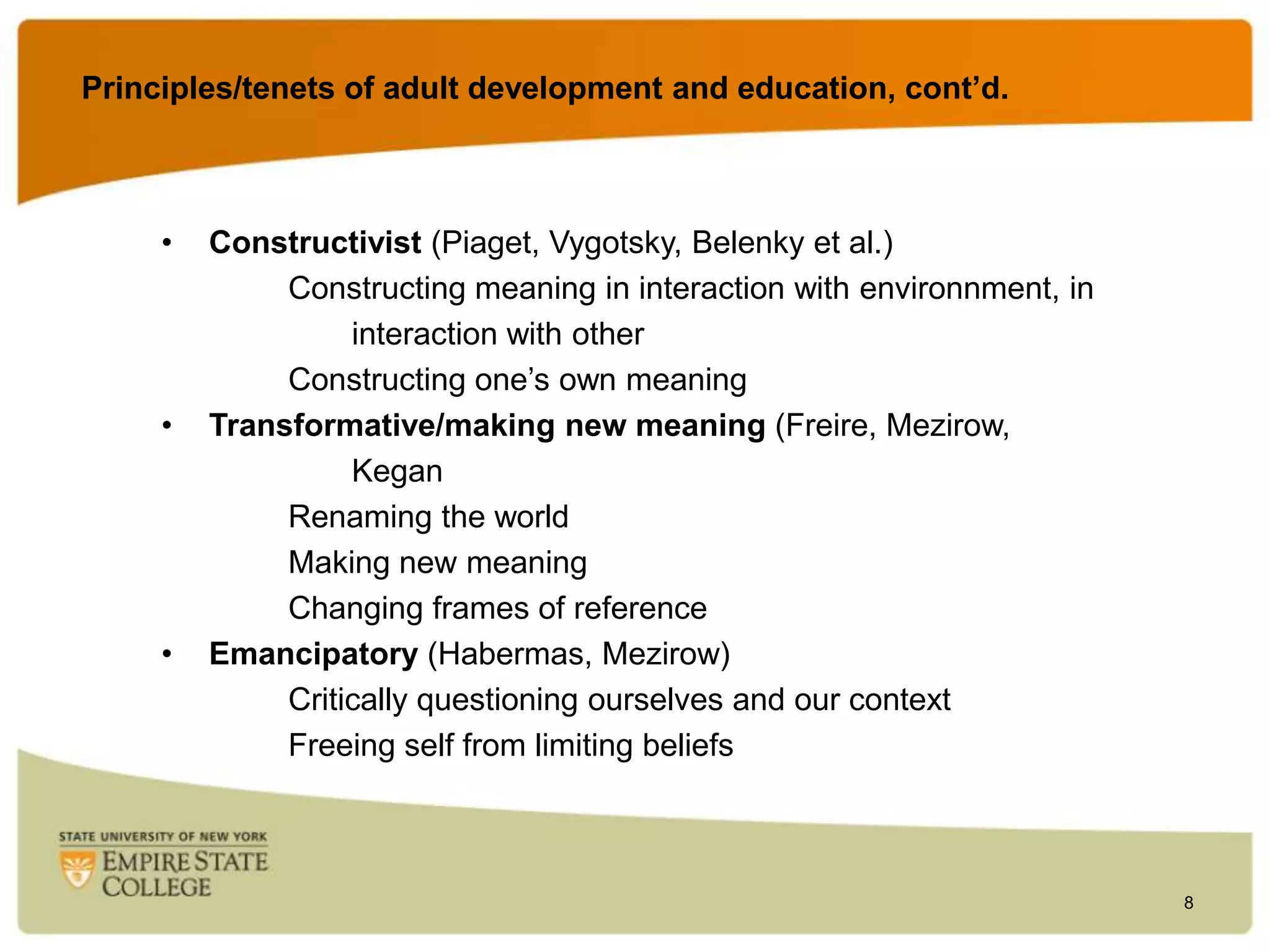
Principles/tenets of adult development and education, cont’d.
education

•

•

•

Constructivist (Piaget, Vygotsky, Belenky et al.)
Constructing meaning in interaction with environnment, in
interaction with other
Constructing one‟s own meaning
Transformative/making new meaning (Freire, Mezirow,
Kegan
Renaming the world
Making new meaning
Changing frames of reference
Emancipatory (Habermas, Mezirow)
Critically questioning ourselves and our context
Freeing self from limiting beliefs

8
Principles/tenets of adult development and education, cont’d.

•

Reconstructing society (Dewey, Freire)
Social reconstruction through:
experimentation
experiential learning
Renaming and transforming the world

• Dialogical/collaborative (Habermas, Mezirow, Brookfield)
Examining perspectives with others
Questioning assumptions together
Encountering others‟ varying orientations
What is an OER?
Open Learning- UNESCO Definition
OPEN LEARNING - instructional systems in
which many facets of the learning process
are under the control of the learner. It
attempts to deliver learning opportunities
where, when, and how the learner needs
them.
http://www.unesco.org/education/lwf/doc/portfolio/definitions.htm

11
“Open” Defined by David Wiley

“By „open‟ it is generally meant that the
resource is available at no cost to others for
adaptation and reuse in different contexts.”
http://scholar.google.com/citations?view_op=view_citation&hl=en&user=M47HR7IAAAAJ&
citation_for_view=M47HR7IAAAAJ:mVmsd5A6BfQC

12
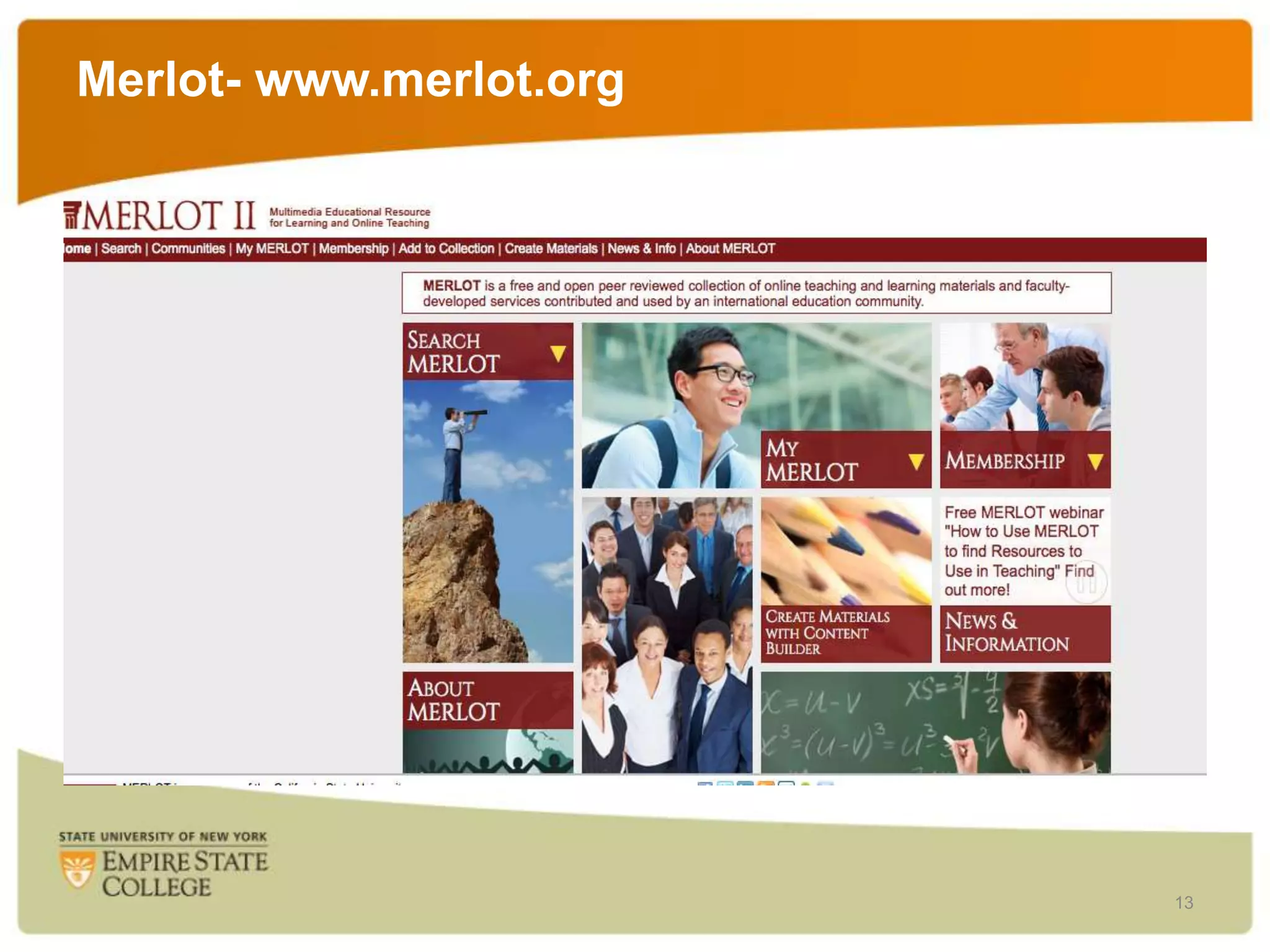
Merlot- www.merlot.org

13
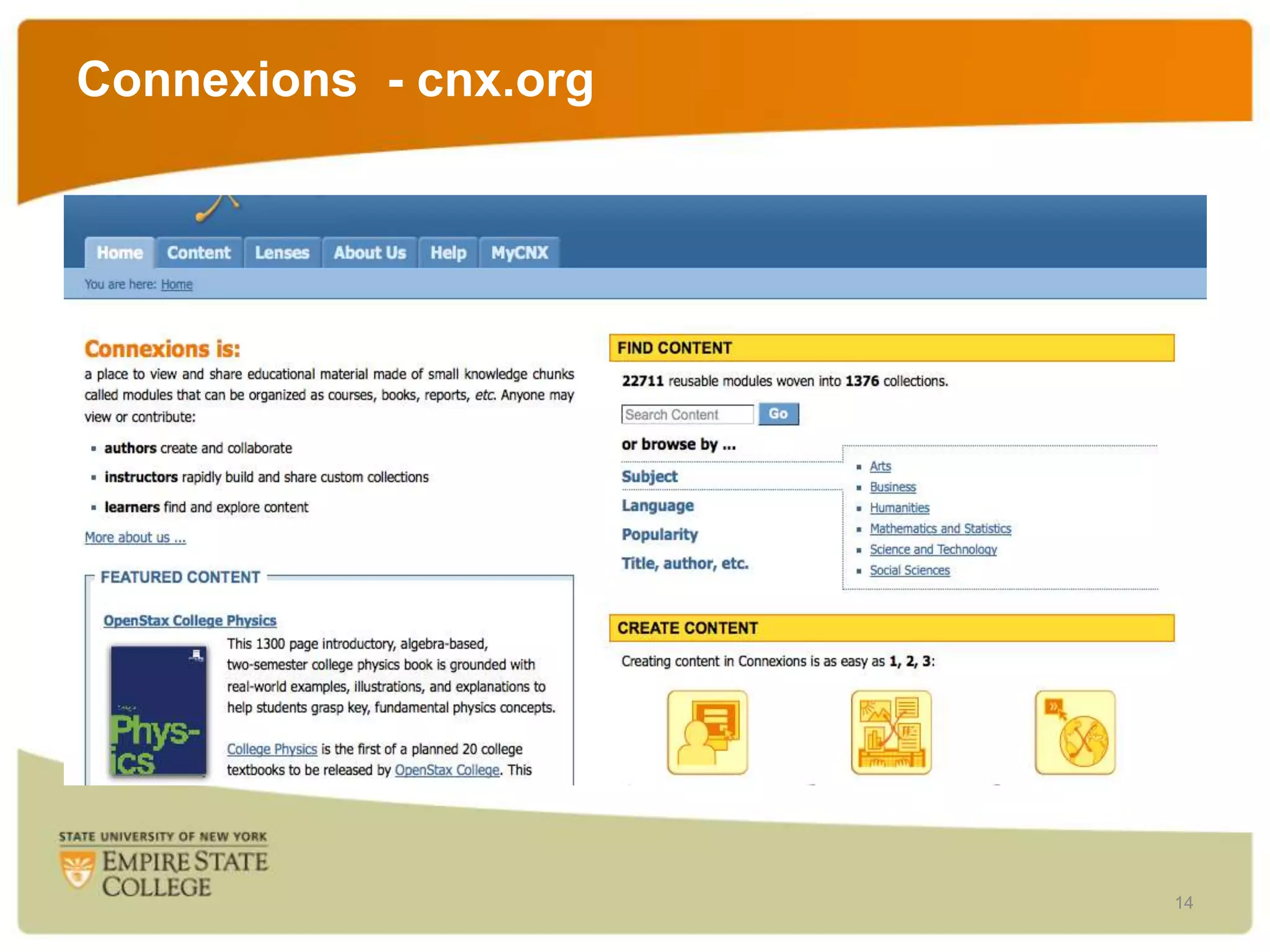
Connexions - cnx.org

14
Saylor - www.saylor.org

15
Group Exercise
Choose one of the sites given (cnx.com, merlot.org or www.saylor.org
or another of your choice and explore. Be prepared to share your
answers to these questions:
1
2

Would you find some of these resources useful?
How would you use these resources?
What is a MOOC?
MOOC Variations
• Massive: Vary in size
• Open: range (from free to meeting UNESCO and
Wiley definitions)
• Online
• Course: again, variations; schedule? Assessment?
Assignments?
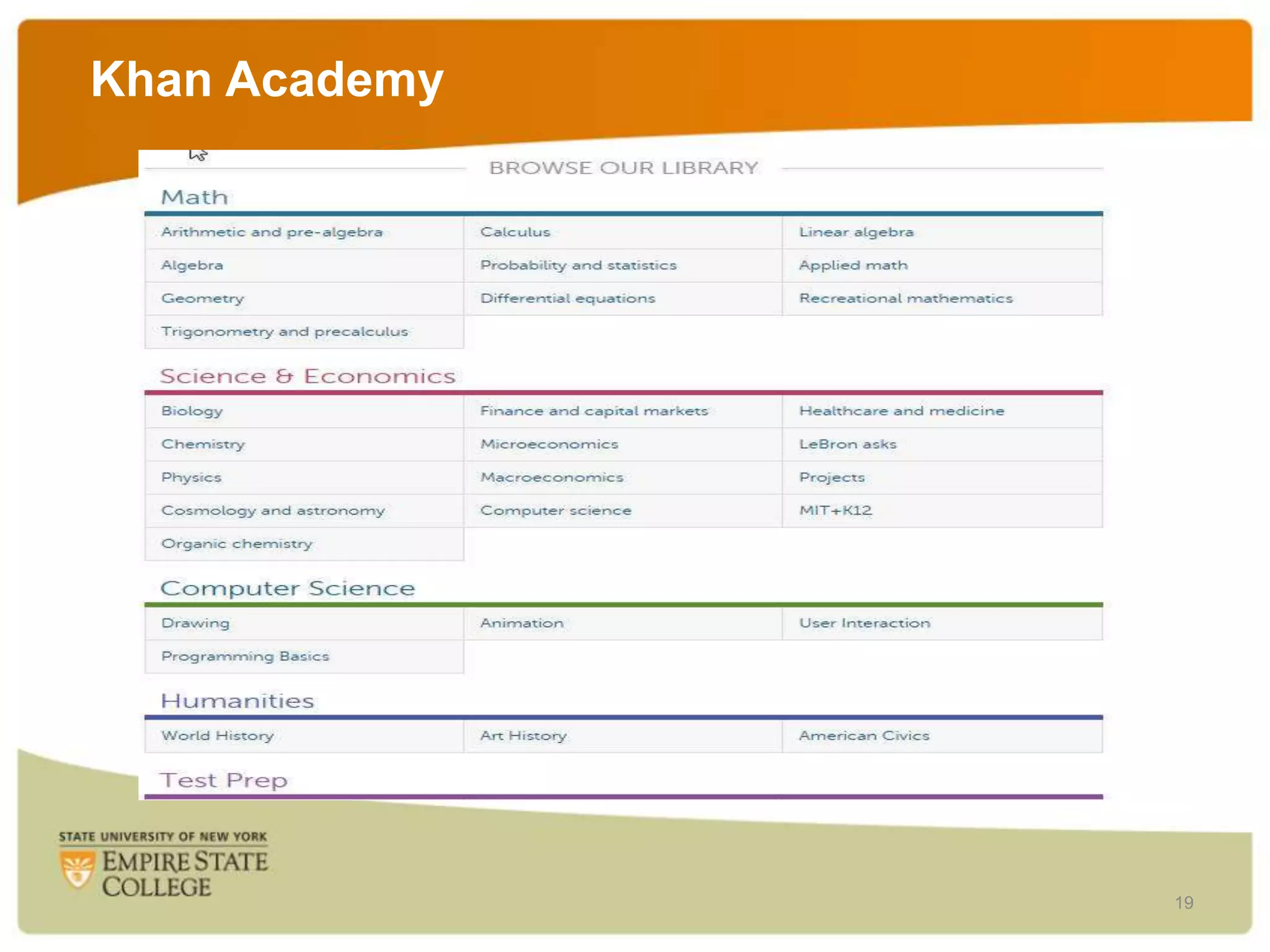
Khan Academy

19
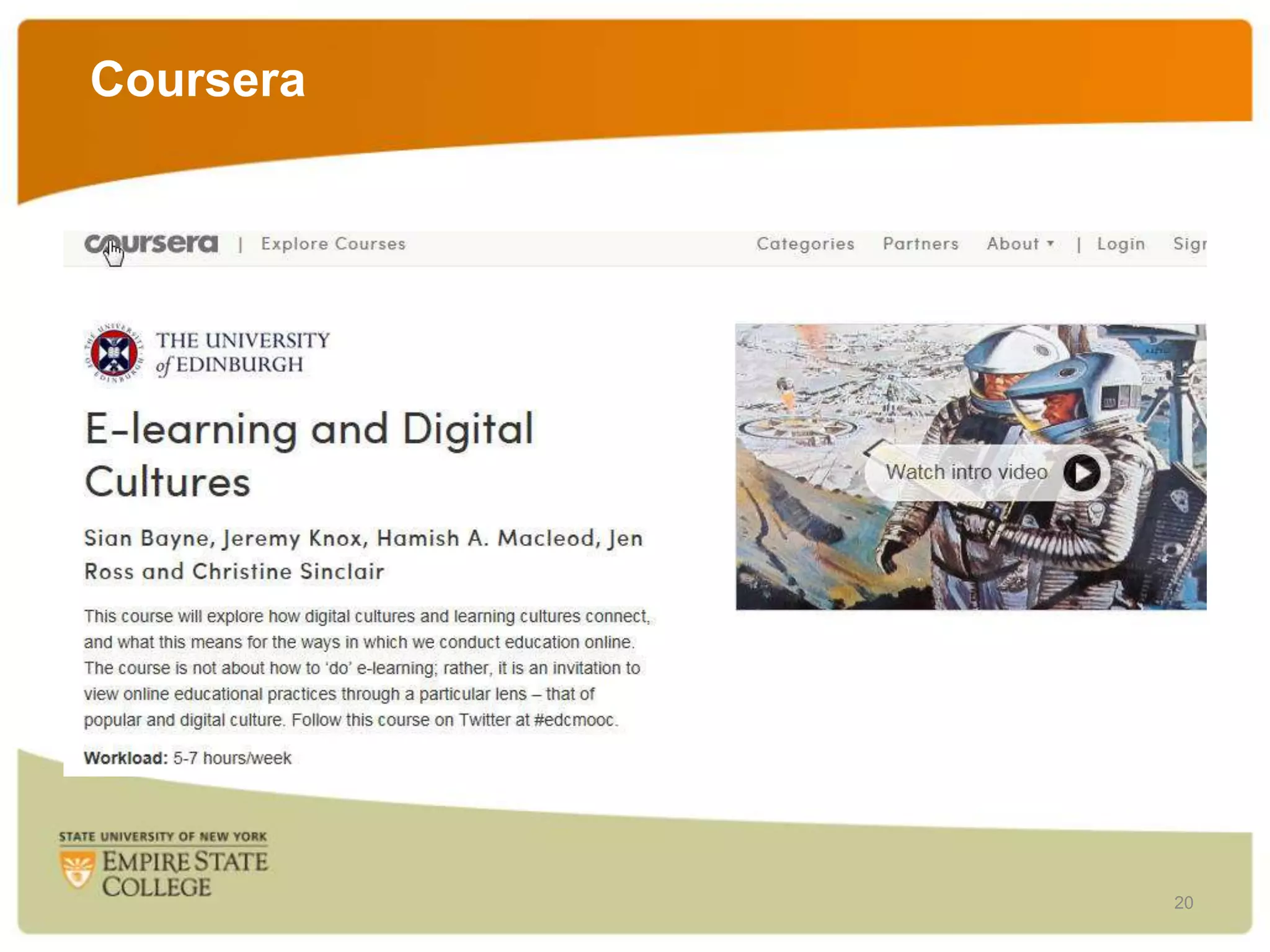
Coursera

20
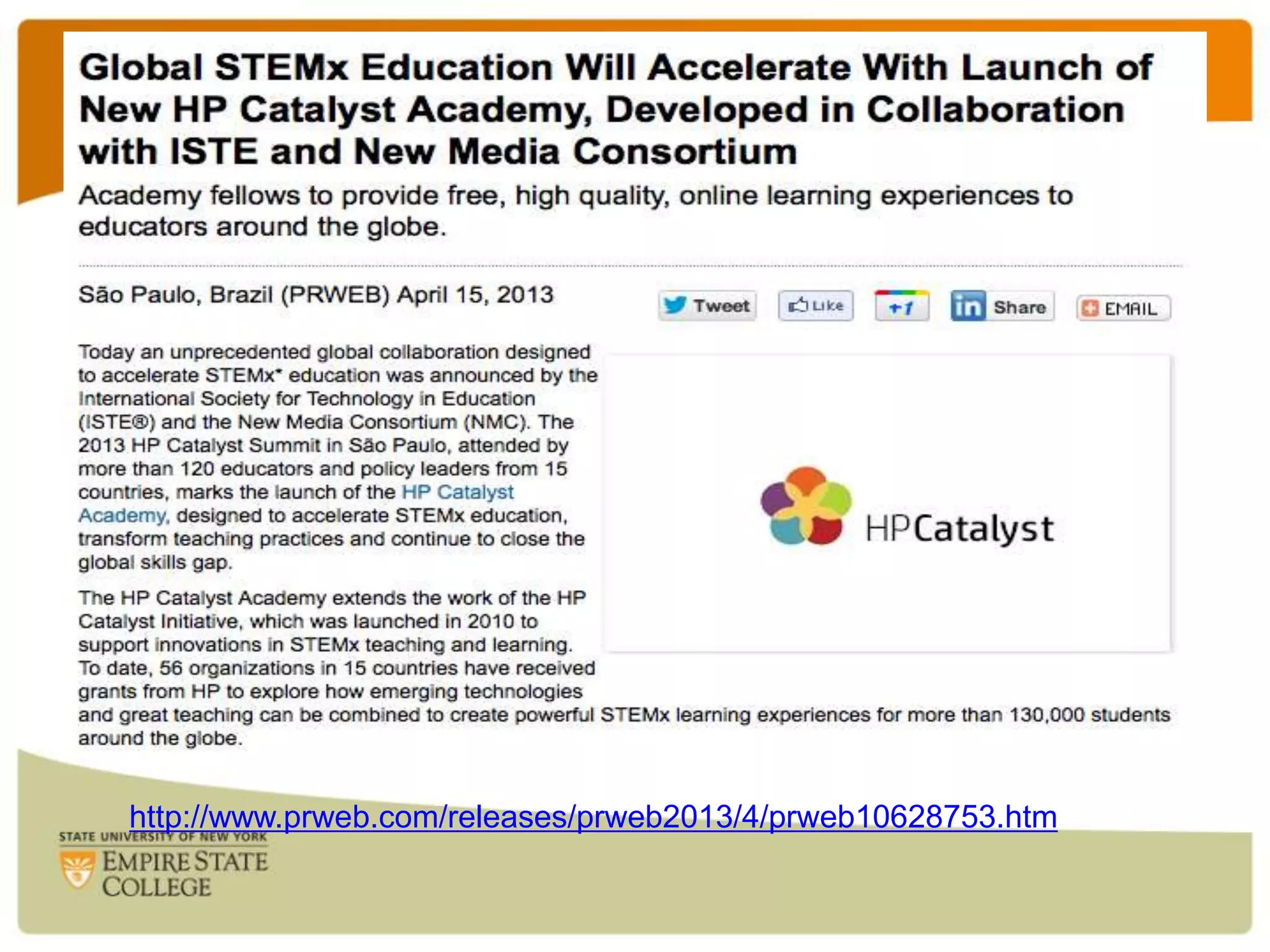
http://www.prweb.com/releases/prweb2013/4/prweb10628753.htm
Group Exercise
Choose one of the sites given (www.khanacademy.org,
www.coursera.org, catalyst-academy.org )
or another of your choice and explore. Be prepared to share your
answers to these questions:
1
2

Would you find some of these resources useful?
How would you use these resources?
My Own Experiences
What is Connectivism?
• Principles of connectivism:
• Learning and knowledge rests in diversity of opinions.
• Learning is a process of connecting specialized nodes or
information sources.
• Learning may reside in non-human appliances.
• Capacity to know more is more critical than what is currently known
• Nurturing and maintaining connections is needed to facilitate
continual learning.
What is Connectivism? (con’d)
• Ability to see connections between fields, ideas, and concepts is a
core skill.
• Currency (accurate, up-to-date knowledge) is the intent of all
connectivist learning activities.
• Decision-making is itself a learning process. Choosing what to learn
and the meaning of incoming information is seen through the lens of
a shifting reality. While there is a right answer now, it may be wrong
tomorrow due to alterations in the information climate affecting the
decision.
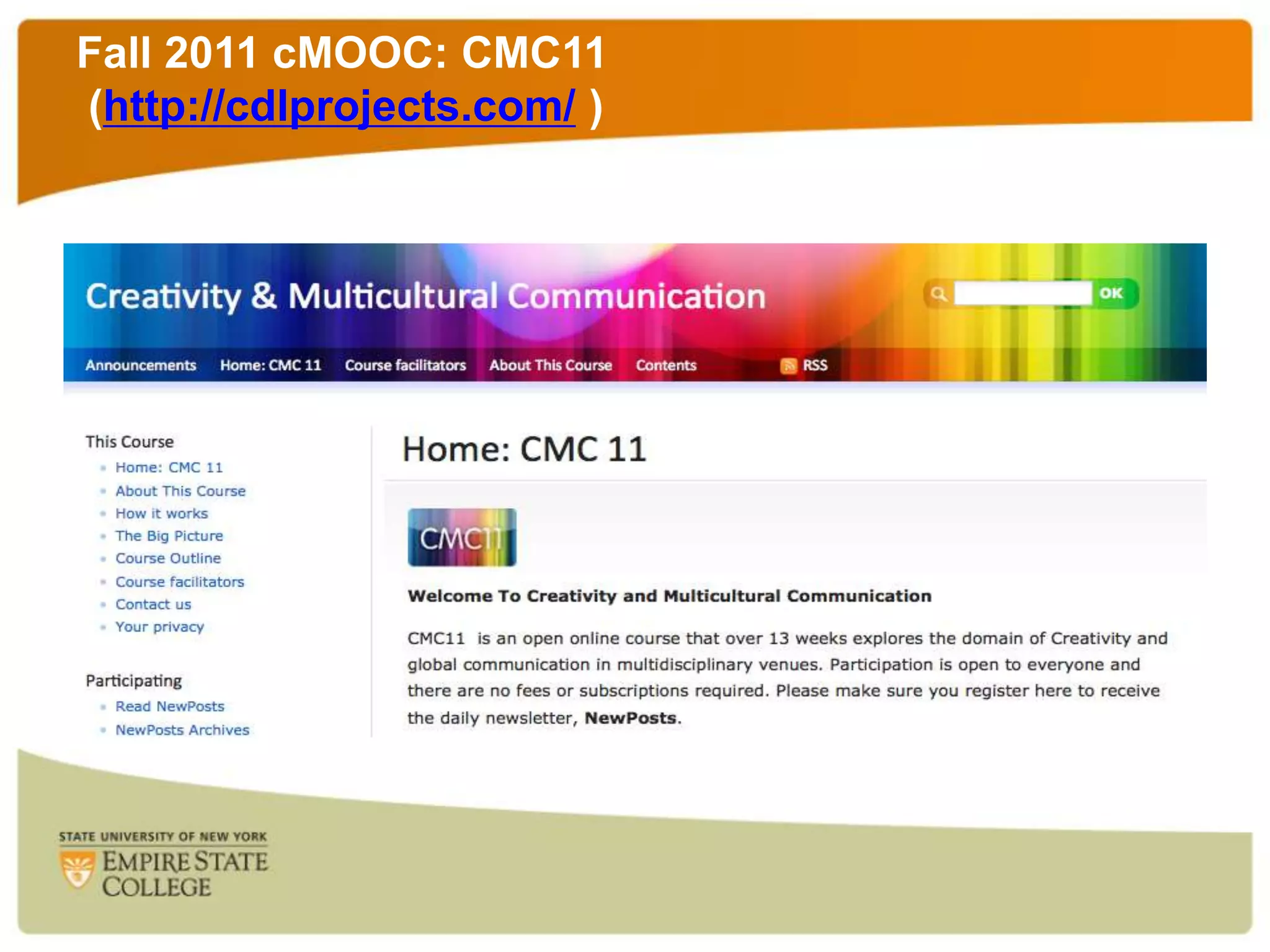
Fall 2011 cMOOC: CMC11
(http://cdlprojects.com/ )
(http://math.cdlprojects.com/ )
cMOOC Fall 2012- VizMath
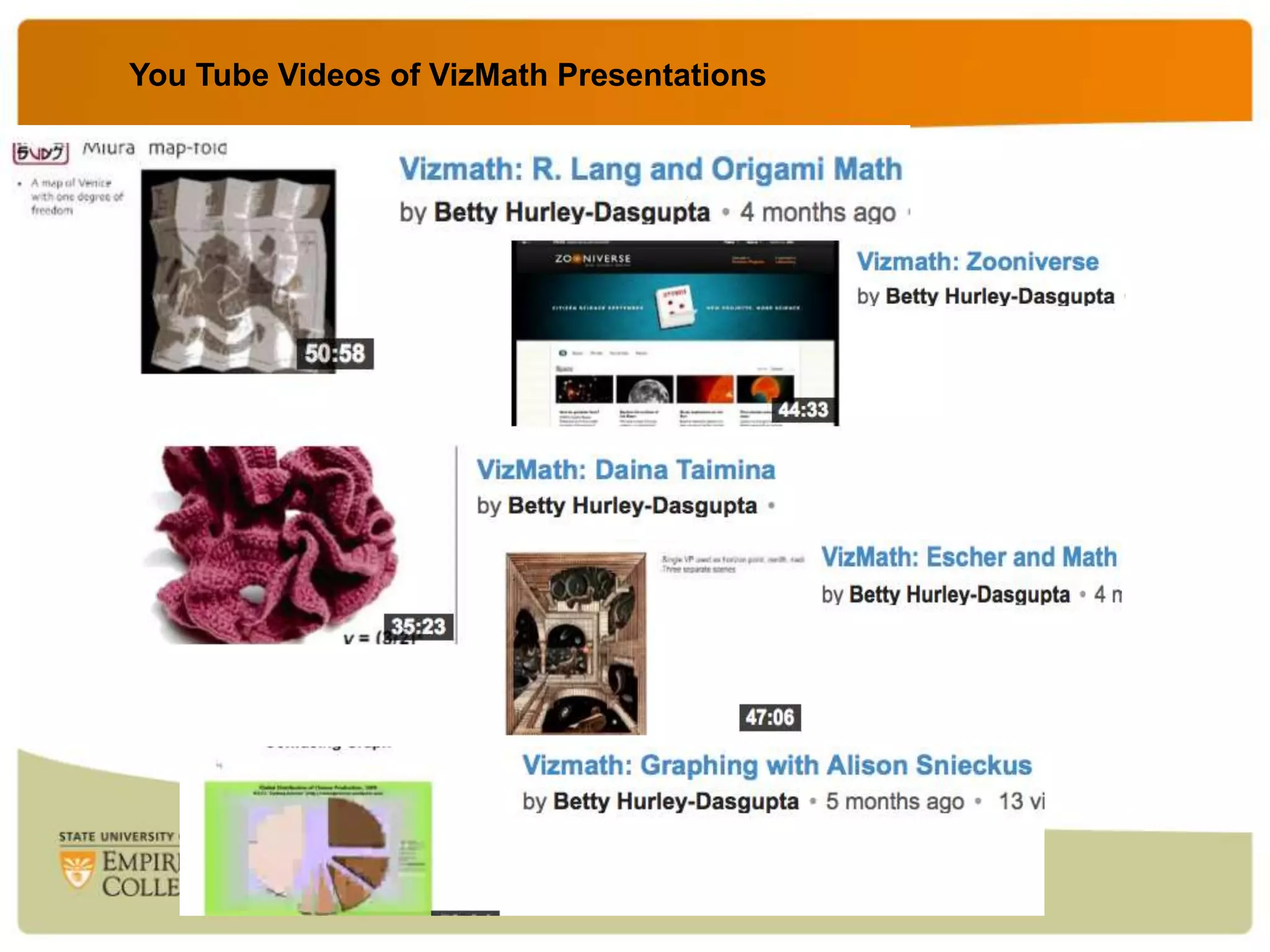
You Tube Videos of VizMath Presentations
Assessment
ACE-evaluated Coursera courses
MOOCs and use of ePortfolios

29
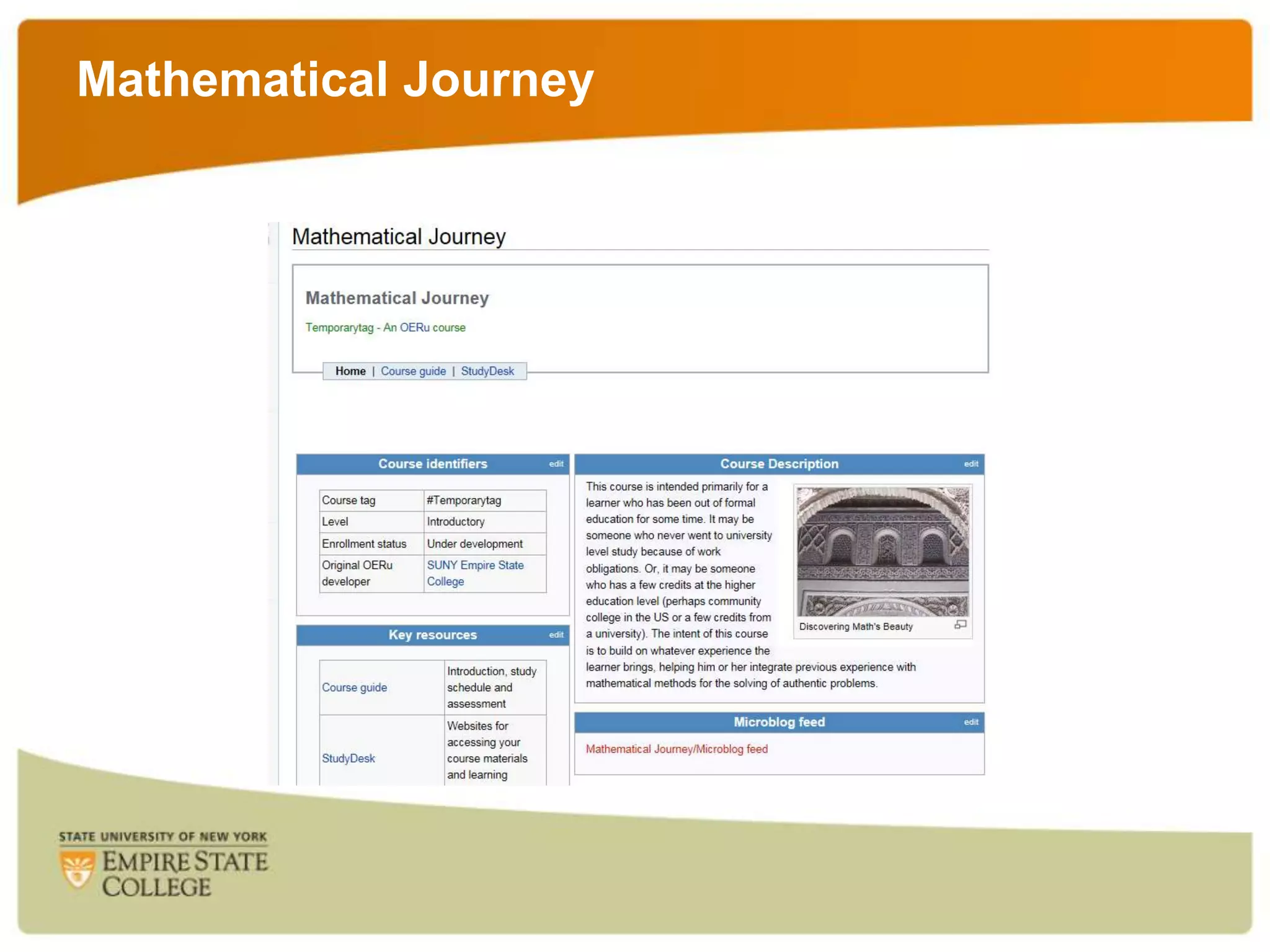
Mathematical Journey
References
https://mahara.esc.edu/view/view.ph
p?id=9338
https://groups.diigo.com/group/citand-open-learning

AHEA Presentation November 2013

  • 1.
    Principles, Practices andthe Current Context of Adult Higher Education: Underlying Ideas in a Changing Field Katherine Jelly Betty Hurley-Dasgupta Adult Higher Education Alliance Conference November 6, 2013
  • 2.
    • Principles informingadult education, including: • Progressive education • Adult development and learning • Various lenses: • philosophical • pedagogical • psychological • political 2
  • 3.
    Principles/tenets of progressiveeducation • Student-centered: Drawing on students‟ purposes, interests, goals (J. Dewey) Listening, not talking; asking, not telling (C. Rogers) • Holistic: Focusing on students‟ personal and professional as well as academic life (Dewey) • Experiential: Drawing on student‟s experiences, Engaging in active learning in “real” world (Dewey) 3
  • 4.
    Principles/tenets of progressiveeducation, cont’d. • Constant interaction of action and reflection: Conceptualization of praxis (P. Freire) • Integration of theory and practice: Each needed to examine and inform the other • Reconstruction of society: Renaming the world (Freire) Social reconstruction, Focused on societal as well as individual development (Dewey) 4
  • 5.
    Principles/tenets of progressiveeducation, cont’d. • Problem-based, interdisciplinary: Framing questions and addressing problems in world, drawing on whatever disciplines pertain (Dewey) • Dialogical/egalitarian/collaborative: Emphasis on democratic society (Dewey) More equal student-teacher relationship (Rogers) • Experimental, innovative: Experimenting to solve problems, both in education and society (Dewey) 5
  • 6.
    Adult development andeducation Key adult development and adult education theorists: S. Brookfield (1986, 1989, 2005) L. Daloz (1999) P. Freire (1992) R. Kegan (1994) M. Knowles (1973, 1975) D.A. Kolb (1984, 1985) J. Mezirow (1990, 1991, 2000) D. Schon (1983) 6
  • 7.
    Principles/tenets of adultdevelopment and education • • • • Self-directed (Knowles, Daloz) Goals, activities and assessment developed by student Drawing on experience (Dewey, Kolb Learning from experience acknowledged Learning situated in experience Integrating theory and practice (Dewey) Theory and experience used to examine and inform one another Reflection and action (Freire, Schon) Action and reflection in constant interaction Praxis Reflection-in-action 7
  • 8.
    Principles/tenets of adultdevelopment and education, cont’d. education • • • Constructivist (Piaget, Vygotsky, Belenky et al.) Constructing meaning in interaction with environnment, in interaction with other Constructing one‟s own meaning Transformative/making new meaning (Freire, Mezirow, Kegan Renaming the world Making new meaning Changing frames of reference Emancipatory (Habermas, Mezirow) Critically questioning ourselves and our context Freeing self from limiting beliefs 8
  • 9.
    Principles/tenets of adultdevelopment and education, cont’d. • Reconstructing society (Dewey, Freire) Social reconstruction through: experimentation experiential learning Renaming and transforming the world • Dialogical/collaborative (Habermas, Mezirow, Brookfield) Examining perspectives with others Questioning assumptions together Encountering others‟ varying orientations
  • 10.
  • 11.
    Open Learning- UNESCODefinition OPEN LEARNING - instructional systems in which many facets of the learning process are under the control of the learner. It attempts to deliver learning opportunities where, when, and how the learner needs them. http://www.unesco.org/education/lwf/doc/portfolio/definitions.htm 11
  • 12.
    “Open” Defined byDavid Wiley “By „open‟ it is generally meant that the resource is available at no cost to others for adaptation and reuse in different contexts.” http://scholar.google.com/citations?view_op=view_citation&hl=en&user=M47HR7IAAAAJ& citation_for_view=M47HR7IAAAAJ:mVmsd5A6BfQC 12
  • 13.
  • 14.
  • 15.
  • 16.
    Group Exercise Choose oneof the sites given (cnx.com, merlot.org or www.saylor.org or another of your choice and explore. Be prepared to share your answers to these questions: 1 2 Would you find some of these resources useful? How would you use these resources?
  • 17.
    What is aMOOC?
  • 18.
    MOOC Variations • Massive:Vary in size • Open: range (from free to meeting UNESCO and Wiley definitions) • Online • Course: again, variations; schedule? Assessment? Assignments?
  • 19.
  • 20.
  • 21.
  • 22.
    Group Exercise Choose oneof the sites given (www.khanacademy.org, www.coursera.org, catalyst-academy.org ) or another of your choice and explore. Be prepared to share your answers to these questions: 1 2 Would you find some of these resources useful? How would you use these resources?
  • 23.
  • 24.
    What is Connectivism? •Principles of connectivism: • Learning and knowledge rests in diversity of opinions. • Learning is a process of connecting specialized nodes or information sources. • Learning may reside in non-human appliances. • Capacity to know more is more critical than what is currently known • Nurturing and maintaining connections is needed to facilitate continual learning.
  • 25.
    What is Connectivism?(con’d) • Ability to see connections between fields, ideas, and concepts is a core skill. • Currency (accurate, up-to-date knowledge) is the intent of all connectivist learning activities. • Decision-making is itself a learning process. Choosing what to learn and the meaning of incoming information is seen through the lens of a shifting reality. While there is a right answer now, it may be wrong tomorrow due to alterations in the information climate affecting the decision.
  • 26.
    Fall 2011 cMOOC:CMC11 (http://cdlprojects.com/ )
  • 27.
  • 28.
    You Tube Videosof VizMath Presentations
  • 29.
  • 30.
  • 31.

Editor's Notes

  • #17 Thirteen credit seeking participants, one of whom was a grad student; 350+ total registrations in first offering Fall 2011. Approx 15% active, all registered participants completed; a number of not for credit completed and some are still active today.Learning contract of expectations for credit seekers; constantly updating, adding new presentations .. One 3 weeks from Mexico also using cMOOC theory in her teaching … all sessions are recorded and available now in the “course”
  • #22 HP catalyst Academy- it's teachers (K-12) around the world who need easily accessible resources for their professional learning (in small chunks- each chunk should take about 12 hours to complete.)  They will get badges and will become part of the Academy community, including a profile page.
  • #23 Thirteen credit seeking participants, one of whom was a grad student; 350+ total registrations in first offering Fall 2011. Approx 15% active, all registered participants completed; a number of not for credit completed and some are still active today.Learning contract of expectations for credit seekers; constantly updating, adding new presentations .. One 3 weeks from Mexico also using cMOOC theory in her teaching … all sessions are recorded and available now in the “course”
  • #25 Thirteen credit seeking participants, one of whom was a grad student; 350+ total registrations in first offering Fall 2011. Approx 15% active, all registered participants completed; a number of not for credit completed and some are still active today.Learning contract of expectations for credit seekers; constantly updating, adding new presentations .. One 3 weeks from Mexico also using cMOOC theory in her teaching … all sessions are recorded and available now in the “course”
  • #26 Thirteen credit seeking participants, one of whom was a grad student; 350+ total registrations in first offering Fall 2011. Approx 15% active, all registered participants completed; a number of not for credit completed and some are still active today.Learning contract of expectations for credit seekers; constantly updating, adding new presentations .. One 3 weeks from Mexico also using cMOOC theory in her teaching … all sessions are recorded and available now in the “course”
  • #27 Thirteen credit seeking participants, one of whom was a grad student; 350+ total registrations in first offering Fall 2011. Approx 15% active, all registered participants completed; a number of not for credit completed and some are still active today.Learning contract of expectations for credit seekers; constantly updating, adding new presentations .. One 3 weeks from Mexico also using cMOOC theory in her teaching … all sessions are recorded and available now in the “course”
  • #28 Spring of 2012 started work on second MOOC … not for credit and as an adjunct to another open resource course, A Mathemtical Journey that also uses Khan Academy videos. Wanted to attract non math lovers as well as math afficionados