Beyond Current Horizons:
              Educational Futures,
          Challenges and Opportunities


Jen Groff
jen.groff@futurelab.org.uk
@jsgroff
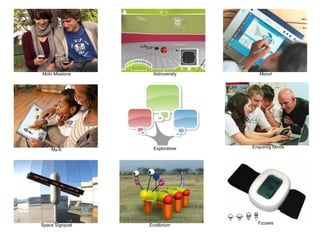
Mobi Missions     Astroversity      Moovl


                  Exploratree    Enquiring Minds
    My-E


Space Signpost   Ecolibrium        Fizzees
SCHOOLS,
KNOWLEDGE&&
EDUCATIONAL
    CHANGE


  John Morgan and Ben Williamson
www.futurelab.org.uk


Gaming in families
A literature review


Mary Ulicsak, Martha Wright, Sue Cranmer, Futurelab
August 2009
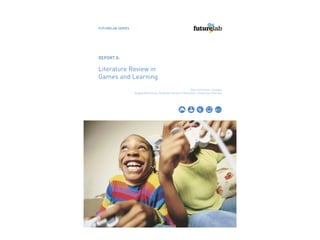
FUTURELAB SERIES


REPORT 8:

Literature Review in
Games and Learning
                                                            John Kirriemuir, Ceangal
                   Angela McFarlane, Graduate School of Education, University of Bristol
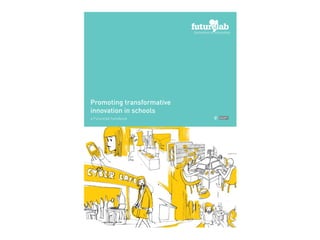
games and learning


a handbook from Futurelab 2005
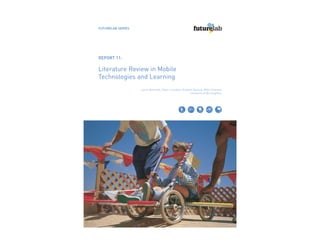
FUTURELAB SERIES


REPORT 11:

Literature Review in Mobile
Technologies and Learning
                   Laura Naismith, Peter Lonsdale, Giasemi Vavoula, Mike Sharples
                                                        University of Birmingham
www.beyondcurrenthorizons.org.uk
AIMS:
build a challenging and long term VISION for education in
the context of socio-technological change 2025 and beyond


Long term futures programme intended to:
•Enhance the ‘futures thinking’ capacity of the education policy makers
•Inform current strategy, decision making and planning
Section title goes here

Socio-technological Trends
what are the sorts of trends we need to be aware of?


              5 review areas


                            Keri Facer, 2009, BCH Final Report
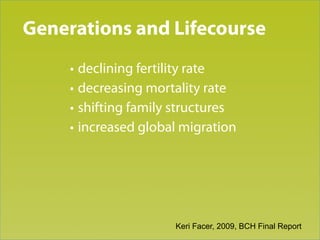
Generations and Lifecourse
Trend 1

     • declining fertility rate
     • decreasing mortality rate
     • shifting family structures
     • increased global migration


                      Keri Facer, 2009, BCH Final Report
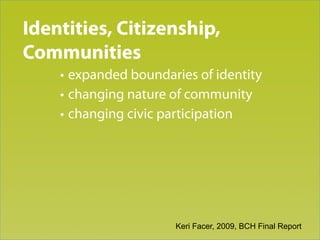
Identities, Citizenship,
Trend 2
Communities
    • expanded boundaries of identity
    • changing nature of community
    • changing civic participation


                      Keri Facer, 2009, BCH Final Report
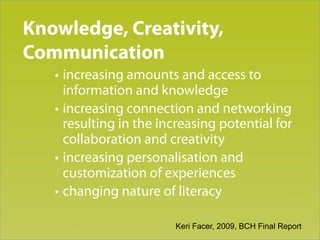
Knowledge, Creativity,
Trend 3
Communication
   • increasing amounts and access to
     information and knowledge
   • increasing connection and networking
     resulting in the increasing potential for
     collaboration and creativity
   • increasing personalisation and
     customization of experiences
   • changing nature of literacy

                        Keri Facer, 2009, BCH Final Report
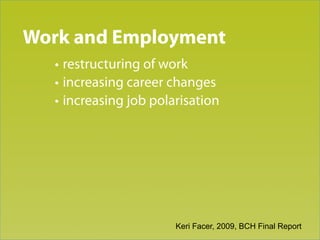
Trend 3
Work and Employment
   • restructuring of work
   • increasing career changes
   • increasing job polarisation


                        Keri Facer, 2009, BCH Final Report
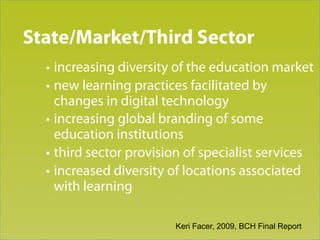
Trend 3
State/Market/Third Sector
  • increasing diversity of the education market
  • new learning practices facilitated by
    changes in digital technology
  • increasing global branding of some
    education institutions
  • third sector provision of specialist services
  • increased diversity of locations associated
    with learning

                        Keri Facer, 2009, BCH Final Report
Trend 3
Other Trends...

  • advancement in learning sciences


                       Keri Facer, 2009, BCH Final Report
Creating the personal ‘cloud’
The capacity to connect to a network and be constantly
connected to knowledge, resources, people and tools
The ability to be ‘wrapped’ in an information landscape
rather than managing it through institutions
• Recognising the rise of the ‘mobile learner’
• ‘Pulsating networks of learning’
• New ways of connecting and accessing ‘educational offerings’


 What does this mean for how we access formal and non-formal learning offerings?
Information landscape
Denser, deeper, more diverse – “know more stuff about
more stuff”
Gather, store, use, share more data about more of our
world than at present
 • Social movements towards accountability & transparency
 • Increased availability of data storage
 • Digitally tag entities in extended world
 • New forms of bio/genetic information


                   What does this mean for what we teach and when we teach it?
Institutional boundaries
•Weakened & porous
• Information not tied to institution
• Greater number of ‘suppliers’ of education
•Blurring ‘work’ & ‘leisure’
• Personal networks/expertise/brand
•Education/work/retirement no longer differentiated
• Working life longer/education as leisure, lifelong etc
•Public/private roles merging
• Disaggregation of learning/resources from the institution


What does this mean for where learning takes place – and when people access it?
‘Silver bullets’ not expected for
 complex educational problems
•Quick-fixes won’t emerge
• Neuroscience, computing and biosciences are not expected to
  produce ‘easy solutions’ over coming two decades
• Targeted progress made in relation to specific disabilities, including
  ‘smart’ prosthetics, new learning methods or targeted
  pharmacological enhancements


  What does this mean for how we develop the education systems that we need?
Scientific-technological trends
Profs Dave Cliff, Josie Fraser, Claire O’Malley

•Moore’s law continues
• Gordon Moore’s observation that the number of transistors on a
  chip doubles approximately every two years
• £1000 today = £31.50 in 2020 and £1 by 2030
• Device today = 32 times more powerful in 2020 and x1000 in 2030
•Once per decade disruptions
• Joel Birnbaum’s observation (1982) expected to hold true:
  mainframe – minicomputers – PC – internet – (cloud computing) - ?
• Cloud computing; ubiquitous computing; digital display
  technologies; tangible and haptic technologies


                 What does this mean for how we remake our vision for education?
Questions to consider?
•What does a curriculum for a networked learner look like?
•What does it mean to digitally participate?
•What does it mean for teachers and teaching?


What does this mean for our vision of education
development:
            ....how do we achieve our potential?
Section title goes here


Responding to the challenges
– ways of achieving learning potential
Exciting things (1)
•Personal Learning Networks (PLNs)
 • Finding access to the people, resources, ideas
   appropriate to you
 • Inherently personal (and therefore different to other
   people’s)
 • Developing our individual expertise whilst developing the
   workforce as a whole

                              Asset Mapping
                              Where do you get your information from?
                              What sources do you use regularly/rarely?
                              Who do you share ideas with?
                              Who do you trust?
                              How do you access this and how often?
                              www.exploratree.org.uk www.bubbl.us
End-user innovation
      … a source of innovation, only now becoming widely
recognized, is end-user innovation. This is where an agent
(person or company) develops an innovation for their own
(personal or in-house) use because existing products do
not meet their needs

      “end-user innovation [is], by far, the most important and critical”
                               Eric Von Hippell Sources of Innovation
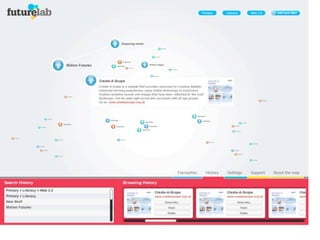
Exciting things (2)
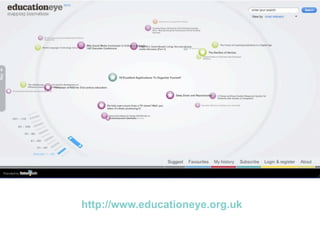
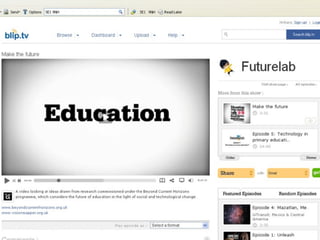
•New resources in learning
• http://www.educationeye.org.uk
Exciting things (3)
•Teachers’ and Learners’ voice
 • Development (and recognition) of PLNs
 • Range of tools to support Learner Voice, policy
   imperatives to increase teacher freedom
 • Rise of Teachmeets, unconferences etc
 • Introduction of ‘Conflab’
www.futurelab.org.uk
dan.sutch@futurelab.org.uk
         @Dannno

Beyond Current Horizons - Futurelab

  • 1.
    Beyond Current Horizons: Educational Futures, Challenges and Opportunities Jen Groff jen.groff@futurelab.org.uk @jsgroff
  • 2.
    Mobi Missions Astroversity Moovl Exploratree Enquiring Minds My-E Space Signpost Ecolibrium Fizzees
  • 3.
    SCHOOLS, KNOWLEDGE&& EDUCATIONAL CHANGE John Morgan and Ben Williamson
  • 4.
    www.futurelab.org.uk Gaming in families Aliterature review Mary Ulicsak, Martha Wright, Sue Cranmer, Futurelab August 2009
  • 5.
    FUTURELAB SERIES REPORT 8: LiteratureReview in Games and Learning John Kirriemuir, Ceangal Angela McFarlane, Graduate School of Education, University of Bristol
  • 7.
    games and learning ahandbook from Futurelab 2005
  • 8.
    FUTURELAB SERIES REPORT 11: LiteratureReview in Mobile Technologies and Learning Laura Naismith, Peter Lonsdale, Giasemi Vavoula, Mike Sharples University of Birmingham
  • 9.
  • 10.
    AIMS: build a challengingand long term VISION for education in the context of socio-technological change 2025 and beyond Long term futures programme intended to: •Enhance the ‘futures thinking’ capacity of the education policy makers •Inform current strategy, decision making and planning
  • 11.
    Section title goeshere Socio-technological Trends what are the sorts of trends we need to be aware of? 5 review areas Keri Facer, 2009, BCH Final Report
  • 12.
    Generations and Lifecourse Trend1 • declining fertility rate • decreasing mortality rate • shifting family structures • increased global migration Keri Facer, 2009, BCH Final Report
  • 13.
    Identities, Citizenship, Trend 2 Communities • expanded boundaries of identity • changing nature of community • changing civic participation Keri Facer, 2009, BCH Final Report
  • 14.
    Knowledge, Creativity, Trend 3 Communication • increasing amounts and access to information and knowledge • increasing connection and networking resulting in the increasing potential for collaboration and creativity • increasing personalisation and customization of experiences • changing nature of literacy Keri Facer, 2009, BCH Final Report
  • 15.
    Trend 3 Work andEmployment • restructuring of work • increasing career changes • increasing job polarisation Keri Facer, 2009, BCH Final Report
  • 16.
    Trend 3 State/Market/Third Sector • increasing diversity of the education market • new learning practices facilitated by changes in digital technology • increasing global branding of some education institutions • third sector provision of specialist services • increased diversity of locations associated with learning Keri Facer, 2009, BCH Final Report
  • 17.
    Trend 3 Other Trends... • advancement in learning sciences Keri Facer, 2009, BCH Final Report
  • 18.
    Creating the personal‘cloud’ The capacity to connect to a network and be constantly connected to knowledge, resources, people and tools The ability to be ‘wrapped’ in an information landscape rather than managing it through institutions • Recognising the rise of the ‘mobile learner’ • ‘Pulsating networks of learning’ • New ways of connecting and accessing ‘educational offerings’ What does this mean for how we access formal and non-formal learning offerings?
  • 19.
    Information landscape Denser, deeper,more diverse – “know more stuff about more stuff” Gather, store, use, share more data about more of our world than at present • Social movements towards accountability & transparency • Increased availability of data storage • Digitally tag entities in extended world • New forms of bio/genetic information What does this mean for what we teach and when we teach it?
  • 20.
    Institutional boundaries •Weakened &porous • Information not tied to institution • Greater number of ‘suppliers’ of education •Blurring ‘work’ & ‘leisure’ • Personal networks/expertise/brand •Education/work/retirement no longer differentiated • Working life longer/education as leisure, lifelong etc •Public/private roles merging • Disaggregation of learning/resources from the institution What does this mean for where learning takes place – and when people access it?
  • 21.
    ‘Silver bullets’ notexpected for complex educational problems •Quick-fixes won’t emerge • Neuroscience, computing and biosciences are not expected to produce ‘easy solutions’ over coming two decades • Targeted progress made in relation to specific disabilities, including ‘smart’ prosthetics, new learning methods or targeted pharmacological enhancements What does this mean for how we develop the education systems that we need?
  • 22.
    Scientific-technological trends Profs DaveCliff, Josie Fraser, Claire O’Malley •Moore’s law continues • Gordon Moore’s observation that the number of transistors on a chip doubles approximately every two years • £1000 today = £31.50 in 2020 and £1 by 2030 • Device today = 32 times more powerful in 2020 and x1000 in 2030 •Once per decade disruptions • Joel Birnbaum’s observation (1982) expected to hold true: mainframe – minicomputers – PC – internet – (cloud computing) - ? • Cloud computing; ubiquitous computing; digital display technologies; tangible and haptic technologies What does this mean for how we remake our vision for education?
  • 23.
    Questions to consider? •Whatdoes a curriculum for a networked learner look like? •What does it mean to digitally participate? •What does it mean for teachers and teaching? What does this mean for our vision of education development: ....how do we achieve our potential?
  • 24.
    Section title goeshere Responding to the challenges – ways of achieving learning potential
  • 25.
    Exciting things (1) •PersonalLearning Networks (PLNs) • Finding access to the people, resources, ideas appropriate to you • Inherently personal (and therefore different to other people’s) • Developing our individual expertise whilst developing the workforce as a whole Asset Mapping Where do you get your information from? What sources do you use regularly/rarely? Who do you share ideas with? Who do you trust? How do you access this and how often? www.exploratree.org.uk www.bubbl.us
  • 26.
    End-user innovation … a source of innovation, only now becoming widely recognized, is end-user innovation. This is where an agent (person or company) develops an innovation for their own (personal or in-house) use because existing products do not meet their needs “end-user innovation [is], by far, the most important and critical” Eric Von Hippell Sources of Innovation
  • 27.
    Exciting things (2) •Newresources in learning
  • 30.
  • 31.
    Exciting things (3) •Teachers’and Learners’ voice • Development (and recognition) of PLNs • Range of tools to support Learner Voice, policy imperatives to increase teacher freedom • Rise of Teachmeets, unconferences etc • Introduction of ‘Conflab’
  • 33.